Uncommon Descent Serving The Intelligent Design Community

ID Breakthrough — Syn61 marks a live case of intelligent design of a life form

Categories
Cell biology
Design inference
General interest
Genomics
ID Foundations
Intelligent Design
Origin Of Life
speciation
specified complexity
The Design of Life
Share
Facebook
Twitter/X
LinkedIn
Flipboard
Print
Email

Let’s read the Nature abstract:


Nature (2019) Article | Published: 15 May 2019

Total synthesis of Escherichia coli with a recoded genome
Julius Fredens, Kaihang Wang, Daniel de la Torre, Louise F. H. Funke, Wesley E. Robertson, Yonka Christova, Tiongsun Chia, Wolfgang H. Schmied, Daniel L. Dunkelmann, Václav Beránek, Chayasith Uttamapinant, Andres Gonzalez Llamazares, Thomas S. Elliott & Jason W. Chin
Abstract
Nature uses 64 codons to encode the synthesis of proteins from the genome, and chooses 1 sense codon—out of up to 6 synonyms—to encode each amino acid. Synonymous codon choice has diverse and important roles, and many synonymous substitutions are detrimental. Here we demonstrate that the number of codons used to encode the canonical amino acids can be reduced, through the genome-wide substitution of target codons by defined synonyms. We create a variant of Escherichia coli with a four-megabase synthetic genome through a high-fidelity convergent total synthesis. Our synthetic genome implements a defined recoding and refactoring scheme—with simple corrections at just seven positions—to replace every known occurrence of two sense codons and a stop codon in the genome. Thus, we recode 18,214 codons to create an organism with a 61-codon genome; this organism uses 59 codons to encode the 20 amino acids, and enables the deletion of a previously essential transfer RNA. [Cited, per fair use doctrine for academic, non commercial purposes.]

Let us refresh memory on the genetic code:
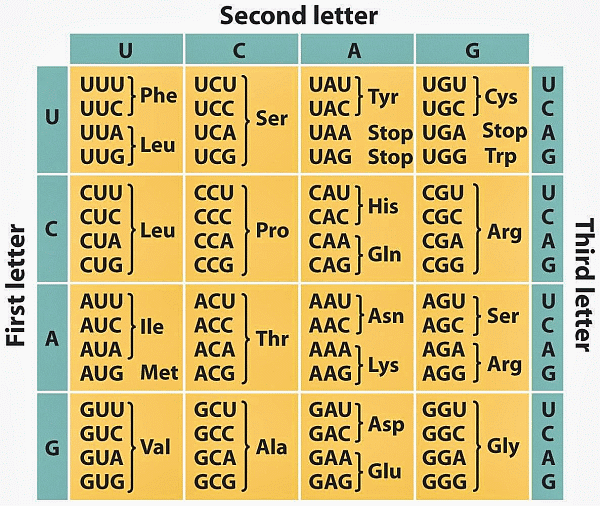
The Genetic code uses three-letter codons to specify the sequence of AA’s in proteins and specifying start/stop, and using six bits per AA

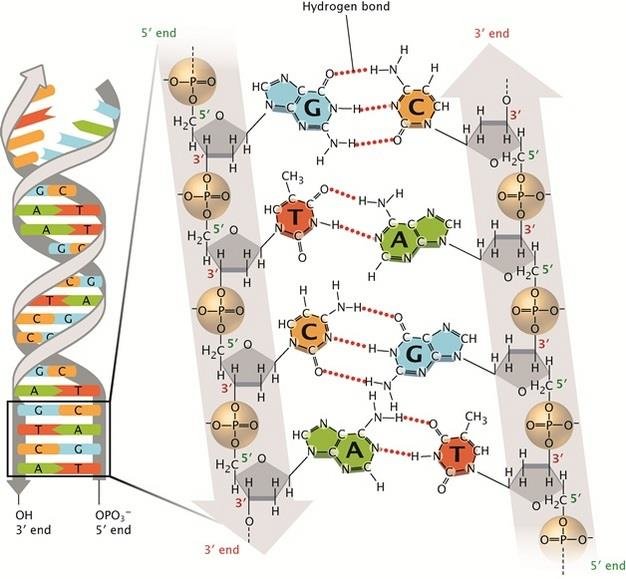
And on the DNA:

The DNA Helix with GCAT (HT: Research Gate, fair use)

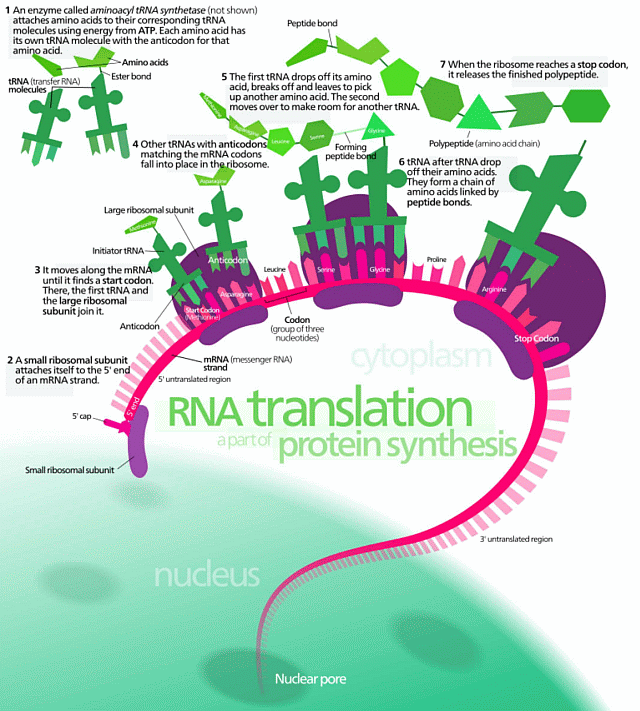
Then also, protein synthesis:

Protein Synthesis (HT: Wiki Media)

Phys dot org gives some context:

A team of researchers at Cambridge University has replaced the genes of E. coli bacteria with genomes they synthesized in the lab. In their paper published in the journal Nature, the group describes replacing the genome and removing redundant genetic codes [–> three letter 4-state elements have 64 possibilities but only 20 are needed for typical protein AA’s, AUG codes for an AA and serves as START, there are three STOP codons] . . . . In this new effort, the researchers had two goals: The first was to synthesize the genome of an E. coli bacterium in their lab—all four million letters of it. The second was to find out what would happen to such a specimen if some of its DNA redundancies were removed . . . .

The researchers report that it took longer for the special bacterial specimen to grow, but other than that, it behaved just like unedited specimens. They suggest that in future efforts, it might be possible to replace the redundancies they removed with other sequences to create bacteria with special abilities, such as making new types of biopolymers not found in nature.

In short, they confirmed that the choice of “synonym” has a regulatory effect.

Where are we today, then?

First, we have definitive demonstration of the intelligent design of a genome. Yes, they obviously have not created a de novo cell body (a much more difficult task), but we see that intelligent design of life here definitively passes the Newton test of observed actual cause. Further, we see that DNA functions as an information system in the cell, supporting the significance of this conceptual representation, based on Yockey’s work:
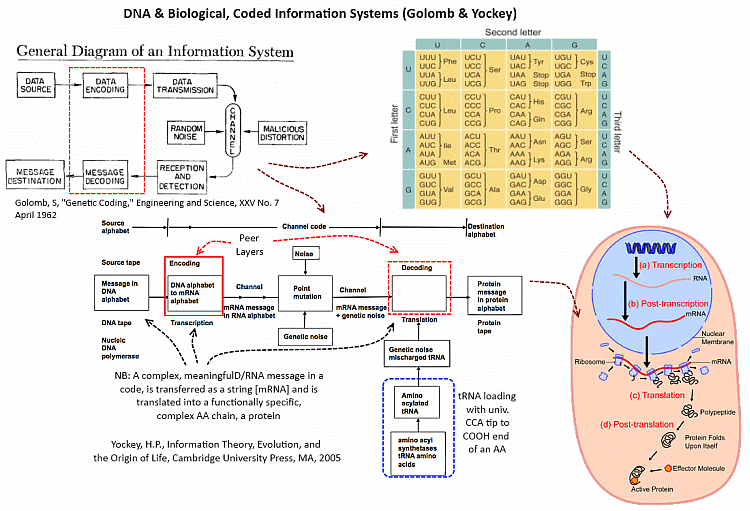
I add: Let’s zoom in on Yockey’s contribution, on the code-communication system as applied to protein synthesis, which underscores the linguistic nature of what is involved:
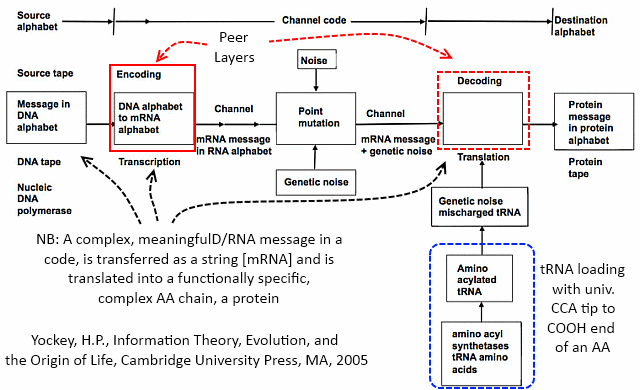
Yockey’s analysis of protein synthesis as a code-based communication process

Where, Crick understood this from the beginning in 1953, witness p. 5 of his letter to his son Michael, March 19, 1953:
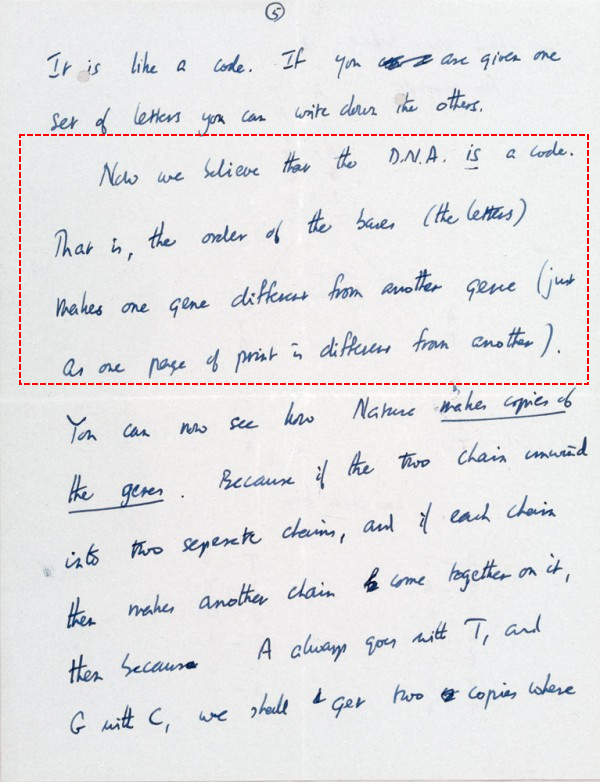
Crick’s letter

At this stage, we definitively know that using nanotech molecular biology and linked computational techniques it is feasible to construct a genome based on intelligently directed configuration. AKA, design.

Therefore, intelligent design, as of right not sufferance, sits at the table for study on origin of life and of body plans.

Where, we separately know on configuration space search challenge, that it is maximally implausible to construct in excess of 500 – 1,000 bits of functionally specific complex organisation and/or associated information. As a reminder:
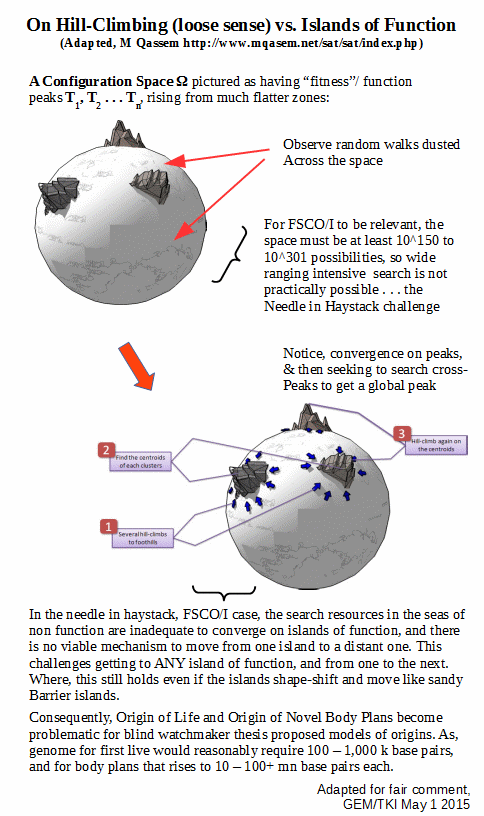
We are now in a different ball game completely: Intelligent Design of life is demonstrated to be feasible and actual in the here and now, as of this investigation. Therefore, as of right, it is a serious candidate to explain what we see in the world of life; especially as regards origin of cell based life and origin of main body plans.

Going forward, we are now a full-fledged independent school of thought. END

PS: James Tour on the Mystery of Life’s Origin, challenging the usual OoL claims, focus from c. 8:30 on:

PPS: It seems we need to understand that there are such things as DNA Synthesisers. Here, is a sample, the “Dr Oligo”:

Biocyclopedia lays out the architecture:
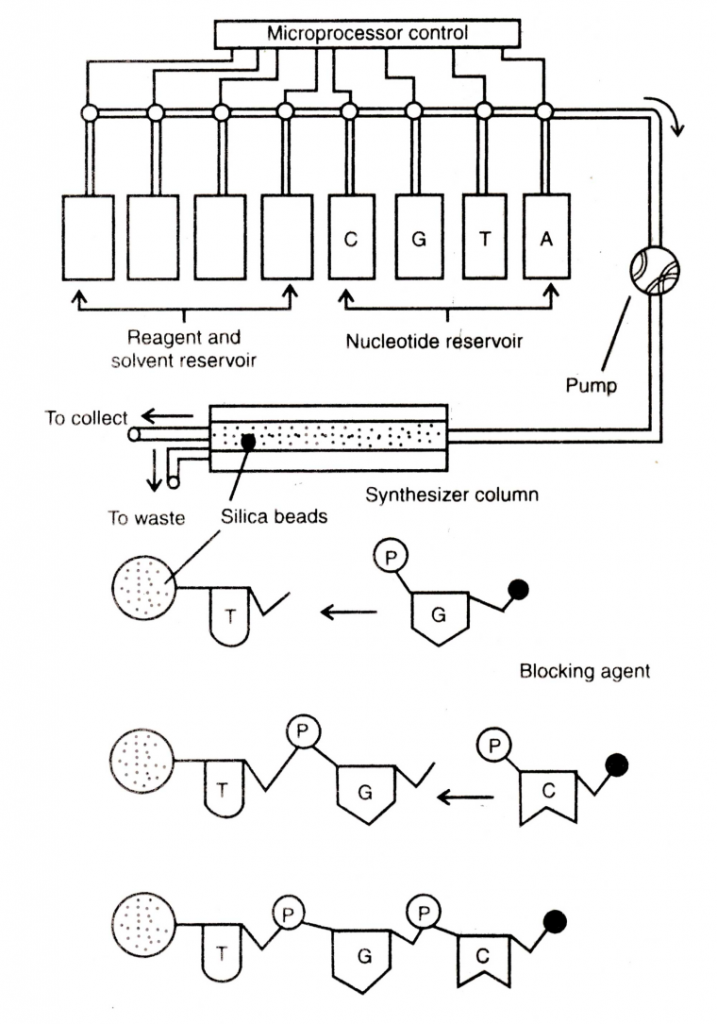
Clipping the explanation:

Recently, fully automated commercial instrument called automated polynucleotide synthesizer or gene machine is available in market which synthesizes predetermined polynucleotide sequence. Therefore, the genes can be synthesized rapidly and in high amount. For example, a gene for tRNA can be synthesized within a few days through gene machine. It automatically synthesizes the short segments of single stranded DNA under the control of microprocessor. The working principle of a gene machine includes (i) development of insoluble silica based support in the form of beads which provides support for solid phase synthesis of DNA chain, and (ii) development of stable deoxyribonucleoside phosphoramidites as synthons which are stable to oxidation and hydrolysis, and ideal for DNA synthesis.

The mechanism of a gene machine is shown in Fig. 2.14 [–> above]. Four separate reservoirs containing nucleotides (A,T,C and G) are connected with a tube to a cylinder (synthesizer column) packed with small silica beads. These beads provide support for assembly of DNA molecules. Reservoirs for reagent and solvent are also attached. The whole procedure of adding or removing the chemicals from the reagent reservoir in time is controlled by microcomputer control system i.e. microprocessor . . . .

The desired sequence is entered on a key board and the microprocessor automatically opens the valve of nucleotide reservoir, and chemical and solvent reservoir. In the gene machine the nucleotides are added into a polynucleotide chain at the rate of two nucleotides per hour. By feeding the instructions of human insulin gene in gene machine, human insulin has been synthesized.

As in, molecular nanotech lab in action.

PPPS: As objectors have raised the claimed logical, inductive inference that designing intelligences are embodied (which we can safely hold, implicitly “lives” in the context of the presumed, evolutionary materialistic account of origins — of cosmos, matter, life, body plans, man, brains and minds), I first link a discussion of how this undermines rationality, by Craig:

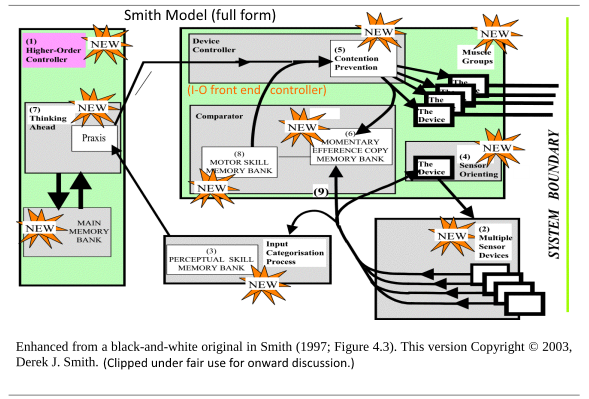
I also put on the table the Smith, two-tier supervisory controller bio-cybernetic model, as a context to discuss embodiment, intelligence and computational substrates, first in simplified form:
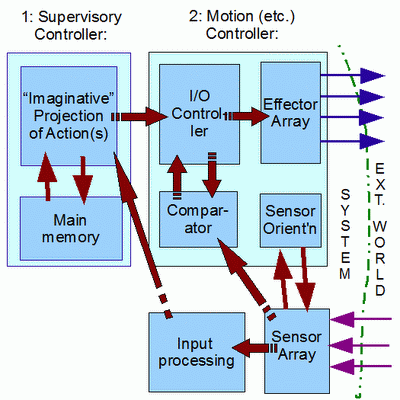
The Derek Smith two-tier controller cybernetic model

Then, in more full detail:

This then leads to the gap between computation on a substrate and rational contemplation. That is, Reppert’s point holds:

. . . let us suppose that brain state A [–> notice, state of a wetware, electrochemically operated computational substrate], which is token identical to the thought that all men are mortal, and brain state B, which is token identical to the thought that Socrates is a man, together cause the belief [–> concious, perceptual state or disposition] that Socrates is mortal. It isn’t enough for rational inference that these events be those beliefs, it is also necessary that the causal transaction be in virtue of the content of those thoughts . . . [But] if naturalism is true, then the propositional content is irrelevant to the causal transaction that produces the conclusion, and [so] we do not have a case of rational inference. In rational inference, as Lewis puts it, one thought causes another thought not by being, but by being seen to be, the ground for it. But causal transactions in the brain occur in virtue of the brain’s being in a particular type of state that is relevant to physical causal transactions.

Comments
This is a new one: if person A makes an argument against person B, and person C agrees with A, person C is engaging in "piling-on". We'll have to add the "pile-on tactic" to our list of nefarious rhetorical and agit-prop behaviors, along with "red herrings –> strawmen –> ad homs –> clouding, confusing, poisoning and polarising the atmosphere, frustrating serious discussion but reinforcing polarisation and unjustified ideological imposition of a priori evolutionary materialistic scientism, closing and clouding minds."hazel
May 27, 2019
May
05
May
27
27
2019
06:02 AM
6
06
02
AM
PDT
BB, you question-beggingly lock out a world of observations again, and compound by highly loaded suggestions. It is simply not the case that there is a global consensus -- never mind the radical secularists and their hall of mirrors -- that all actually observed designers are embodied entities. Billions would and do beg to differ, and they cannot all be written off as delusional without self-referentially, radically undermining the credibility of human rationality. I think you do not realise that you crossed the border and are making a worldview level, philosophical claim with significant metaphysical import. That has to be handled on a very different base than projection from we observe embodied genetic engineers, a few thousands, so we infer that intelligently directed configuration of genes etc will be by similarly embodied creatures. The problem here is immediately the post hoc fallacy, leading to binding designing intelligence to embodiment (and to possessing a wetware computational substrate). I have pointed this out several times, going so far as to highlight the statistical blunder. Where, surely, you recognise that statistics is in material part mathematically structured inductive inference. I also addressed the ontological error, as, demonstrably, computation on a substrate is categorically distinct from free, rational, morally [not mechanically and/or stochastically] governed reasoning. That cuts across a lot of fashionable thinking today on AI etc. but is quite clear. Yet again -- notice, how you have never answered this -- Reppert:
. . . let us suppose that brain state A [--> notice, state of a wetware, electrochemically operated computational substrate], which is token identical to the thought that all men are mortal, and brain state B, which is token identical to the thought that Socrates is a man, together cause the belief [--> concious, perceptual state or disposition] that Socrates is mortal. It isn’t enough for rational inference that these events be those beliefs, it is also necessary that the causal transaction be in virtue of the content of those thoughts . . . [But] if naturalism is true, then the propositional content is irrelevant to the causal transaction that produces the conclusion, and [so] we do not have a case of rational inference. In rational inference, as Lewis puts it, one thought causes another thought not by being, but by being seen to be, the ground for it. But causal transactions in the brain occur in virtue of the brain’s being in a particular type of state that is relevant to physical causal transactions.
The obvious conclusion is, you don't have a cogent reply. Let me address your latest claim in steps of thought: >>If I make an inference that all known designers are embodied beings>> a: Begs the question, billions for cause beg to differ. b: One cannot simply imply delusion on that scale, as it would undermine (self-referentially) the credibility of human rationality. c: In short, your first premise locks out any conclusion other than the one you wish and is dubious, highly debatable. d: Further to this, you have consistently failed to address the other design inference, fine tuning. This points to extra-cosmic designer. e: Yet further, the logic of being requires a finitely remote necessary being world root capable of causing a fine tuned C-Chem aqueous medium cell based life facilitating cosmos. Necessary beings cannot be composed of arranged, independently existing proper parts. That may be unfamiliar to you but is readily established as composite entities are inherently contingent. f: There is good reason to set aside your first premise and recognise instead that we observe designing intelligences so designing intelligence is possible. Without question-begging ontological commitments. >> therefore all designers are most likely embodied individuals,>> g: Reasoning on a begged question goes in pointless circles. h: Further, this side-steps the point I have elaborated above, on the known ideology at work across our civilisation, evolutionary materialistic scientism, i.e. you are setting up a strawman to knock over. i: On this ideology, intelligence is founded on sufficiently sophisticated computational substrates, but it is readily seen that these are blind, mechanically and/or stochastically governed glorified calculating engines, not responsibly and rationally free reasoning entities. Never mind pretentions of AI, they are inherently not freely thinking intelligences. j: Thus, it is an error to seek to bind intelligence to embodiment. Intelligences may indeed be embodied, but this points to an "amphibian" ontological character: mind over matter. k: I clip from above -- which you ducked in order to revert to a compound fallacy now being answered point by point:
What we actually observe is: A: [material computational substrates] –X –> [rational inference] B: [material computational substrates] —-> [mechanically and/or stochastically governed computation] C: [intelligent agents] —-> [rational, freely chosen, morally governed inference] D: [embodied intelligent agents] —-> [rational, freely chosen, morally governed inference] The set of observations A through D imply that intelligent agency transcends computation, as their characteristics and capabilities are not reducible to: – components and their device physics, – organisation as circuits and networks [e.g. gates, flip-flops, registers, operational amplifiers (especially integrators), ball-disk integrators, neuron-gates and networks, etc], – organisation/ architecture forming computational circuits, systems and cybernetic entities, – input signals, – stored information, – processing/algorithm execution, – outputs
>> it is not valid because I haven’t taken God into account.>> l: Motive mongering, given widespread polarisation once "God" is mentioned. m: Above and previously, I have pointed out that billions will disagree, for cause, with the claim that ALL intelligences we have observed are embodied, i.e. I pointed to question-begging and further to the implications of implying such widespread delusion. Including, self-referential implications for you. n: Further, I have already taken much time and effort to mark the ontological differences between computational substrates and freely acting, insightful, morally governed intelligence. That counts and we scan above, in vain, for a cogent answer on your part. >> But ID can make a very similar inference>> o: You really need to read the UD weak argument correctives and take their points seriously, even if you disagree with our conclusions. p: The design inference is an inference on reliable signs, from observed functionally specific, sufficiently complex, configuration based organisation and associated information to a causal process . . . not agency . . . of intelligently directed configuration. It lets associated ontological and identity of design suspect chips lie where they fly. q: They are not material to the logic, apart from, we know designers are possible and that intelligence is a manifestation of rationality. r: Exploration of same, on other arguments and even disciplines, showing -- whether or no you may like it -- that we cannot bind intelligence to embodiment on computational substrates. s: In the case of the world of life, we see in the OP a demonstrated case of known intelligent design at genome scope, which is a breakthrough as -- published in Nature -- we have actual demonstration of intelligent design of a life form, so by Newton's rules we have no good warrant to ideologically lock out the possibility of intelligently directed configuration of cell based life at origin or at origin of body plans. t: Where, repeat, there is no good reason to bind designing intelligence to embodiment on computational substrates, starting with sharply different characteristics, u: especially, that such substrates are inherently non-rational but rather are blindly mechanical and/or stochastic. >>and claim that it is independent of God.>> v: Yes, because it is an inductive inference on tested, reliable sign to credible causal PROCESS, not a speculative inference as to ontological character or identity of possible causal agents. w: That distinction must be preserved if there is to be a genuine understanding and responsible discussion. That too often, insistently (and in the face of cogent correction) such is not done, speaks volumes about the motivations of too many objectors to design. >> Do you have your cake and eat it much?>> x: This, instead only shows biased projections and a cluster of mutually reinforcing fallacies in action, as outlined. It is time for objectors to leave behind long since corrected fallacies amounting to a characteristic pattern of misleading argument: red herrings --> strawmen --> ad homs --> clouding, confusing, poisoning and polarising the atmosphere, frustrating serious discussion but reinforcing polarisation and unjustified ideological imposition of a priori evolutionary materialistic scientism, closing and clouding minds. KFkairosfocus
May 27, 2019
May
05
May
27
27
2019
05:38 AM
5
05
38
AM
PDT
KF,
Rationality required to be a designer is not bound to embodiment and associated computational substrates
Has anyone one claimed otherwise? I don't believe so. This appears to be a strawman you are arguing against.daveS
May 27, 2019
May
05
May
27
27
2019
05:11 AM
5
05
11
AM
PDT
EG: >>Although I generally side with KF over BB,>> -- Manifestly false on long track record; stable-mate may be more like it. -- Classic concern troll start-point. >> I’m afraid that BB is correct here.>> -- Pile-on tactic -- The substantial point remains clear: the case in the OP demonstrates that intelligent design at genome level is feasible (so also, that such intelligently directed configuration cannot be ideologically locked out in considering OoL or Oo body plans. -- Said lockout is of course a notorious problem and you will scan above in vain to see acknowledgement of an outrageous pattern of academic, media, administrative and legal bias. Telling. -- The operative factor being intelligence, and there being a notorious observation that there's more than one way to skin a cat[fish], we are not bound to lock such intelligently directed configuration down to use of the sort of technologies used in this case. -- There also being an attempt to bind the inference to the claim that designing intelligence in this case must be embodied, it is in order to observe why such is a case of post hoc reasoning, an error of observational bias or happenstance. -- Notoriously, this pivots on brains as wetware, a neural network based form of computational substrate. -- Accordingly, it is entirely in order to point out the nature of such a substrate, which is inherently non-rational, a mechanically and/or stochastically governed blind entity. Such is not intelligent and rational, regardless of what those wedded to strong AI may hope for. -- By contrast, rationality is inherently free, insight-driven and morally governed through duties to truth, right reason, prudence (thus, warrant and caution etc), fairness and justice etc. -- This, on pain of nihilistic collapse and absurdity . . . and even the manipulative nihilist parasites off our adherence to these duties. -- There is therefore a sufficient difference of characteristics to properly infer a categorical distinction of nature and identity: mind over matter (which is widely understood save where evolutionary materialistic ideology warps thinking, this ideology being self-refuting on grounds tied to our present considerations) -- Moral government also implies that mind inherently, inescapably acts on both sides of the IS-OUGHT gap, underscoring the need to bridge it. -- This can only be done at world-root level, requiring that the necessary being world root [required on logic of being grounds] is adequate to ground moral government. Only an inherently good entity at world root can fill this bill. -- And yes, this is a worldview level issue; that is inherent to what was asked. Worldview level question begging by ideological imposition of evolutionary materialistic scientism (which is self-refuting but institutionally dominant) undermines freedom to seek well warranted truth. -- Unfortunately, just such imposition, is notoriously present and is one of the means by which the soundness of the mind of Western man has been radically undermined. >> KF just appears to be clutching at straws>> -- More of the same piling on pattern. -- If my argument is so utterly fallacious then kindly engage it on comparative difficulties and overturn it, rather than piling on on talk points. KFkairosfocus
May 27, 2019
May
05
May
27
27
2019
04:20 AM
4
04
20
AM
PDT
Although I generally side with KF over BB, I’m afraid that BB is correct here. KF just appears to be clutching at straws.Ed George
May 27, 2019
May
05
May
27
27
2019
03:39 AM
3
03
39
AM
PDT
KF
BB, first, you confuse examples you accept as known and those known to others. Millions of people personally know God in positively life-transforming ways, for example.
Well, this discussion has certainly taken a turn to the surreal. If I make an inference that all known designers are embodied beings therefore all designers are most likely embodied individuals, it is not valid because I haven’t taken God into account. But ID can make a very similar inference and claim that it is independent of God. Do you have your cake and eat it much?Brother Brian
May 27, 2019
May
05
May
27
27
2019
03:33 AM
3
03
33
AM
PDT
BB, first, you confuse examples you accept as known and those known to others. Millions of people personally know God in positively life-transforming ways, for example. Or, are you willing to assign us to the category, deluded? If so, that comes with a stiff price, undermining credibility of mind -- as the alleged delusion would be so widespread, so persistent, so pervasive, so indelible that it would rise to the level of grand delusion. We rely on the credibility of mind just to have an exchange. Absent utter demonstration otherwise, we take that credibility as a given. And indeed, a claimed demonstration otherwise would imply that demonstration itself is impossible. We deal here with inescapable truth. Next, let me point out that there is an issue of the principle of identity at work. Yes, that A is itself, A i/l/o its core, defining characteristics. Thus, when we see embodiment or composition as material, with computational substrates, we find certain properties and resulting capabilities/ performance. In particular, we see why computation is inherently a non rational, blind, mechanically and/or stochastically governed process. That is by contrast with intelligent action, which turns on understanding, insight, inference, freedom and duties to truth, right reason, prudence, fairness/justice etc. That is, it is morally governed. What we actually observe is: A: [material computational substrates] --X --> [rational inference] B: [material computational substrates] ----> [mechanically and/or stochastically governed computation] C: [intelligent agents] ----> [rational, freely chosen, morally governed inference] D: [embodied intelligent agents] ----> [rational, freely chosen, morally governed inference] The set of observations A through D imply that intelligent agency transcends computation, as their characteristics and capabilities are not reducible to:
- components and their device physics, - organisation as circuits and networks [e.g. gates, flip-flops, registers, operational amplifiers (especially integrators), ball-disk integrators, neuron-gates and networks, etc], - organisation/ architecture forming computational circuits, systems and cybernetic entities, - input signals, - stored information, - processing/algorithm execution, - outputs
This is what Reppert was getting at:
. . . let us suppose that brain state A [--> notice, state of a wetware, electrochemically operated computational substrate], which is token identical to the thought that all men are mortal, and brain state B, which is token identical to the thought that Socrates is a man, together cause the belief [--> concious, perceptual state or disposition] that Socrates is mortal. It isn’t enough for rational inference that these events be those beliefs, it is also necessary that the causal transaction be in virtue of the content of those thoughts . . . [But] if naturalism is true, then the propositional content is irrelevant to the causal transaction that produces the conclusion, and [so] we do not have a case of rational inference. In rational inference, as Lewis puts it, one thought causes another thought not by being, but by being seen to be, the ground for it. But causal transactions in the brain occur in virtue of the brain’s being in a particular type of state that is relevant to physical causal transactions.
It seems further, that you are unwilling to acknowledge that we all undeniably know that our rational life is governed through duties to truth, right reason, prudence, fairness/justice etc. And yet, the whole point of your attempts to argue is to persuade through your knowledge that we have these duties. The rejection of these duties transforms rationality into self-manipulation and manipulation of others through in the end cynical will to power. That is, we see reduction to the absurdity of nihilistic chaos and collapse of communicative rationality. An individual may indeed flout these principles through amoral, nihilistic will to power and manipulation. But in so doing, that agent is forced to rely on our adherence to these duties. That is, amorality and nihilism parasite off the general acknowledgement of these duties of rational freedom. Were that condition to become dominant, community rational life would collapse into chaos, both revealing it as an evil and underscoring the vital importance of such moral government. That Cretans are liars [when they think they can get away with it] cannot extend to Cretans are universally deceitful, or else Cretan community would collapse. Such moral government and underlying responsible freedom are essential components of rationality. We are undeniably morally governed (as an aspect of our freedom) and such would extend to any other intelligent agent. Where, further, the capabilities of rational, responsible freedom do not bind to embodiment or to material composition. They are a strong indicator of our "amphibian" character, manifest in the famous phrase: mind over matter. As such, we have no proper epistemic right to rule out that intelligent agency may operate independent of a material, computational or cybernetic substrate. As was already pointed out, the Smith model allows us to consider a cybernetic loop with a controller that is two-tiered. One is an in the loop computational substrate, the other a supervisor with purpose, freedom of action etc. The two have been envisioned as interacting through quantum inferences. We obviously do not understand how interactions happen, but we can and do recognise the necessity of responsible freedom for rationality and why computational substrates by themselves do not have that freedom. Just last night, driving home for a meeting in prep for onward budget debate, in the dark, I came to a strange-seeming fork in the road. It seemed the left was the better option, but then as I got closer I perceived that the right fork was the correct one to attain my purposes. I turned right, despite the lingering appeal of the left. Similarly, passing a nearby point earlier, I again saw what looked like a grazing animal (which I had seen many months before) but I recognised what I learned earlier, that this is an illusion created by a peculiar line of bushes. So, I superposed on my lingering perception, that this is an optical illusion and even briefly pondered some of why it works. Of course, routinely, similar illusions are artistically used in paintings and in videos. We willingly suspend our knowledge of an illusion, to perceive a message of verisimilitude. Though, with AI, the emergence of deep fakery can paint a desired face over a convincing but false image. Likewise, as I type, I make choices of composition, computers offering flexibility to readily edit on the fly. In all of these, the supervisory and computational come together but are perceptibly distinct. They have distinct identity and nature. Therefore, there is a general recognition of the distinction; save, among those committed to the self-referentially incoherent ideology of evolutionary materialism and their fellow travellers. The ideology fails, we freely follow the evidence of distinct identity and nature. KFkairosfocus
May 27, 2019
May
05
May
27
27
2019
12:22 AM
12
12
22
AM
PDT
KF
Rationality required to be a designer is not bound to embodiment...
And yet all known examples are embodied. Don’t blame me because the same type of inference that you use for ID rules out God as the designer.
... and associated computational substrates, as such substrates are non-rational and are mechanically and/or stochastically rather than morally governed.
Good example of goalpost shifting. The fact remains, all known examples of designers are embodied individuals. And what does moral governance have to do with being a designer? That doesn’t make any sense. Why can’t a completely amoral individual be a designer?Brother Brian
May 26, 2019
May
05
May
26
26
2019
08:48 PM
8
08
48
PM
PDT
BB, no. Your argument fails, as was shown. Rationality required to be a designer is not bound to embodiment and associated computational substrates, as such substrates are non-rational and are mechanically and/or stochastically rather than morally governed. A key clue. Designers may be embodied but that does not rule out the possibility of those that are not. On the wider range of evidence, embodied designers are "amphibians." KFkairosfocus
May 26, 2019
May
05
May
26
26
2019
05:26 PM
5
05
26
PM
PDT
KF@244, you are still dodging the logical conclusion. If you are going to infer that life is designed because all known designs have an intelligent designer (a ludicrous inference to start with), then you also have to acknowledge the validity of the inference that all designers are embodied because all known examples of designers are embodied. If you dismiss one you have to dismiss the other.Brother Brian
May 26, 2019
May
05
May
26
26
2019
03:10 PM
3
03
10
PM
PDT
DS, the matter is clear on substance: there is no good reason to infer that designers must be or inevitably are embodied, on the nature of rationality as requiring freedom which is morally not mechanically governed. Inference to design, is not inference to embodied designers, and even if the designers are embodied, computational substrates do not -- cannot -- account for rational freedom to infer and warrant. Mind, to be credible, must be free and morally governed, it cannot be mechanically and/or stochastically governed as computational substrates are . . . as we both know in intimate detail down to device physics, up through circuits and networks to systems and architecture, taken not only on digital machines but analogue ones and neural networks. Good day. KFkairosfocus
May 26, 2019
May
05
May
26
26
2019
10:16 AM
10
10
16
AM
PDT
Sorry, kf, bb, and ds: please ignore my comment.hazel
May 26, 2019
May
05
May
26
26
2019
07:29 AM
7
07
29
AM
PDT
As they say in some commonwealth countries, "bollocks". You're putting words in Brother Brian's mouth.daveS
May 26, 2019
May
05
May
26
26
2019
06:59 AM
6
06
59
AM
PDT
DS, no. The question exists in the context where embodiment and computational substrates are held to account for rationality. This fails, as shown. KFkairosfocus
May 26, 2019
May
05
May
26
26
2019
06:54 AM
6
06
54
AM
PDT
H, you are opening up a huge domain, logic of being, philosophical theology and the idea of God, systematic theology, how such matters correlate with traditions. My comment is, above -- as world root issues came up -- I have spoken to such, including to what some call the God of the philosophers, here, God as conceived through the lens of root of being and through roots of morally governed being. Necessary beings are not made up from arrangements of proper parts, and God is understood to be such. As such God as to core nature is immaterial, spiritual and mental. In the Christian tradition he is also incarnate, which becomes a very powerful concept. But before that in him we live, move and have our being, he upholds all things by his word of power, without him was not anything made that was made. There is much more, thousands of closely reasoned pages worth. Too much for a blog comment. But if we are going to address rational, responsible, morally governed minded creatures, these subjects will open up. KFkairosfocus
May 26, 2019
May
05
May
26
26
2019
06:52 AM
6
06
52
AM
PDT
KF,
I did so by showing that the question pivots on a fundamental,. worldview level fallacy of self referential incoherence, which falsifies its implicit premises and leads to a very different association, that design pivots on morally governed rationality and thus points onward to a different sort of world than is envisioned by evolutionary materialists — whose view is self defeating.
Nonsense. No one is invoking the premises of "evolutionary materialism" here. It's a straightforward inductive argument.daveS
May 26, 2019
May
05
May
26
26
2019
06:48 AM
6
06
48
AM
PDT
BB, you are doubling down on adequately corrected errors at this point. As to the design inference and design theory, have you as yet [again?] worked through the UD Weak argument correctives? If you had done so, you should not be arguing like that. KFkairosfocus
May 26, 2019
May
05
May
26
26
2019
06:44 AM
6
06
44
AM
PDT
KF
BB, kindly see the just above i/l/o the further above. None of that addresses the validity of the inference I presented. ID keeps saying that a supernatural being isn’t required for ID.
Brother Brian
May 26, 2019
May
05
May
26
26
2019
06:37 AM
6
06
37
AM
PDT
Perhaps "God" is a combination of material and immaterial properties. Given that "material", according to our current ideas, ultimately is quantum in nature, the source of our universe, "God", might be a quantum being who is as much material as we are. but exists as a quantum whole in a level of reality beyond the world we live in. If we use both body and mind to design and create, the inference that similar beings exist which are also designers and creators is worth considering. BB's question: why is this an invalid inference?hazel
May 26, 2019
May
05
May
26
26
2019
06:34 AM
6
06
34
AM
PDT
BB, kindly see the just above i/l/o the further above. Motive mongering on your part does not answer to the underlying ontological issue. KFkairosfocus
May 26, 2019
May
05
May
26
26
2019
06:22 AM
6
06
22
AM
PDT
F/N: It seems, given the above, I need to also point out the correlation vs causation problem. Here, Wikipedia is a helpful short summary:
In statistics, the phrase "correlation does not imply causation" refers to the inability to legitimately deduce a cause-and-effect relationship between two variables solely on the basis of an observed association or correlation between them.[1][2] The complementary idea that "correlation implies causation" is an example of a questionable-cause logical fallacy, in which two events occurring together are taken to have established a cause-and-effect relationship. This fallacy is also known by the Latin phrase cum hoc ergo propter hoc ("with this, therefore because of this"). This differs from the fallacy known as post hoc ergo propter hoc ("after this, therefore because of this"), in which an event following another is seen as a necessary consequence of the former event.
That on some presumably finite and limited sample we find an association between A and B may indeed suggest a possibility of causal relationship. But that is not enough, we need to find a plausible dynamical connexion also. Smoking correlates with cancer, but that by itself is not enough, and chemical harm was established. Wiki gives a counter example where hormone replacement therapy at first seemed to reduce heart attack risk but then further findings showed the opposite. In this context, the question is whether design is causally driven by or inseparable from embodiment. As there is a rational element, the role of computational substrates is implicit as this is viewed as the locus of rationality, whether brains or hoped for strong AI. So, there is an implicit proposed dynamical connexion. However, it fails, as computational substrates are inherently non-rational. As Reppert discusses and as can be further drawn out at length. Instead, a far more fruitful connexion is that design is rational, and rationality requires freedom, which is morally governed. This was drawn out above, but seems to be repeatedly brushed aside on the perception that it is evasive and/or irrelevant. Above there was even a loaded suggestion that I am speaking with disregard to truth. In fact, the matter posed is a worldview level question, on ontology of mind. Which was addressed. Computational substrates do not account for rationality, period. Rationality does not find its roots in embodiment and associated computational substrates. Instead, pursuit of rational freedom points to a need for an ontology that transcends the material and bridges the IS-OUGHT gap, given the moral government involved. That has world-root level import as was drawn out above; import that is distasteful to those committed to naturalistic ideologies and is apt to be dismissed by them. But the social psychology of their cognitive dissonance is irrelevant to the grounding of rational, responsible, significantly free, thus morally [rather than mechanically and/or stochastically] governed mind. Consequently, observing that certain designers are embodied does not entail that design and associated rationality are causally rooted in embodiment. KFkairosfocus
May 26, 2019
May
05
May
26
26
2019
06:19 AM
6
06
19
AM
PDT
DaveS
Indeed. We’re witnessing a veritable clinic on strawmen and red herrings here
Being a leftist a/mat, I prefer the terms “strawpersons of indeterminabt gender” and “colorblind piscine like organisms”. :)Brother Brian
May 26, 2019
May
05
May
26
26
2019
06:01 AM
6
06
01
AM
PDT
KF
DS (attn BB): I have long since answered the question, in detail and then in correction to onward doubling down.
I honestly believe that you think you did. But I assure you, your responses have been nothing but evasion so as to not open the door on the possibility that your God is not the designer. It is very quite simple. 1) The ID inference is based on comparison to incidences of known design (human). It extrapolates this to life, where design has not been confirmed. Hence, inference. 2) Using the same example (human design) we can also say that all confirmed designs were caused by embodied beings. 3) The most logical inference for this is that all designs are caused by embodied beings. I could have narrowed the inference to say that all designs are caused by humans, but I wanted to give you a little wiggle room.Brother Brian
May 26, 2019
May
05
May
26
26
2019
05:57 AM
5
05
57
AM
PDT
DS (attn BB): I have long since answered the question, in detail and then in correction to onward doubling down. 1: I did so by showing that the question pivots on a fundamental,. worldview level fallacy of self referential incoherence, which falsifies its implicit premises and leads to a very different association, that design pivots on morally governed rationality and thus points onward to a different sort of world than is envisioned by evolutionary materialists -- whose view is self defeating. Namely, 2: the fact of embodiment is not what drives design but the fact of responsible rational freedom, which latter is beyond what any computational substrate can do of its own inherently non-rational dynamical GIGo-limited functionality. For reference, I again point to Reppert -- at this stage, simply for record:
. . . let us suppose that brain state A [--> notice, state of a wetware, electrochemically operated computational substrate], which is token identical to the thought that all men are mortal, and brain state B, which is token identical to the thought that Socrates is a man, together cause the belief [--> concious, perceptual state or disposition] that Socrates is mortal. It isn’t enough for rational inference that these events be those beliefs, it is also necessary that the causal transaction be in virtue of the content of those thoughts . . . [But] if naturalism is true, then the propositional content is irrelevant to the causal transaction that produces the conclusion, and [so] we do not have a case of rational inference. In rational inference, as Lewis puts it, one thought causes another thought not by being, but by being seen to be, the ground for it. But causal transactions in the brain occur in virtue of the brain’s being in a particular type of state that is relevant to physical causal transactions.
Thus, 3: there is an ontological error at stake: the presumption that embodiment explains or could ever explain mind. We see designers who are embodied, but the embodiment does not account for their ability to design, so trying to infer to embodiment as a characteristic of designing intelligence is ill-founded. Where, 4: as such rationality is morally governed, it points to a necessary being world-root capable of sustaining that order of being, morally governed rationality and linked reasoning. Which, 5: is itself rational and designing (consider here the fine tuned cosmos) and by being a necessary being, is not an embodied being made up from atoms or other independently existing components. The argument that designers are embodied as a suggested induction, fails, fails in multiple ways. KFkairosfocus
May 26, 2019
May
05
May
26
26
2019
05:43 AM
5
05
43
AM
PDT
Brother Brian,
I have never seen anyone expend so much energy to avoid answering a question.
Indeed. We're witnessing a veritable clinic on strawmen and red herrings here.daveS
May 26, 2019
May
05
May
26
26
2019
05:10 AM
5
05
10
AM
PDT
KF
BB, you are playing rhetorical games of evasion and polarisation.
Have you read your responses at 223, 225 and 226? Those are the biggest examples of evasion that I have seen in a long time.
The fact is, you have tried to pin mindedness and conscious, responsible, significantly free mind to embodied computational substrates.
No. I have provided an inference, based on billions of observations (ie, all examples of confirmed designers are embodied individuals), that you refuse to accept as a valid inference because it is more logically sound than the ID inference.
The key factual and logical blunders in that exercise are that computational substrates are inherently non-rational, and that your argument is necessarily self-referential. </blockquote/ If this is true of my inference then this means that humans (embodied beings) are inherently non-rational. Which means that the ID inference, which is based on comparisons to humans, is necessarily self-referential.
Brother Brian
May 26, 2019
May
05
May
26
26
2019
05:02 AM
5
05
02
AM
PDT
BB, you are playing rhetorical games of evasion and polarisation. The fact is, you have tried to pin mindedness and conscious, responsible, significantly free mind to embodied computational substrates. The key factual and logical blunders in that exercise are that computational substrates are inherently non-rational, and that your argument is necessarily self-referential. So, if it is true we have no credible means of warranting it, because reduction of mind to computational substrates blows up rationality itself. On the contrary to your fallacious reasoning, we freely start from there being embodied, rational, responsibly free designers and ask, what kind of world has such; has room for credible rationality? The answer is, a world that is not what self-refuting evolutionary materialistic scientism envisions. So, the material fact is not, that we observe certain embodied designers, but that we observe conscious, conscience-guided, credibly responsibly and rationally free designers. This means that designers operate on both sides of the IS-OUGHT gap, and we live in a world where it is properly bridged, on pain of reducing rationality to grand delusion. Such a world will have in it an inherently good, necessary being world root. But of course, those locked into evolutionary materialistic scientism are strongly disinclined to follow much less take seriously such reasoning. Your reactions above are unfortunately diagnostic and telling about how the evolutionary materialistic crooked yardstick warps ability to reason. KFkairosfocus
May 26, 2019
May
05
May
26
26
2019
02:16 AM
2
02
16
AM
PDT
KF@223, 225 and 226, I have never seen anyone expend so much energy to avoid answering a question. From this I can only assume that you realize that my inference is stronger than the design inference, and you don’t like it.Brother Brian
May 26, 2019
May
05
May
26
26
2019
01:58 AM
1
01
58
AM
PDT
F/N: As it has obviously not been adequately attended to, Reppert again:
. . . let us suppose that brain state A [--> notice, state of a wetware, electrochemically operated computational substrate], which is token identical to the thought that all men are mortal, and brain state B, which is token identical to the thought that Socrates is a man, together cause the belief [--> concious, perceptual state or disposition] that Socrates is mortal. It isn’t enough for rational inference that these events be those beliefs, it is also necessary that the causal transaction be in virtue of the content of those thoughts . . . [But] if naturalism is true, then the propositional content is irrelevant to the causal transaction that produces the conclusion, and [so] we do not have a case of rational inference. In rational inference, as Lewis puts it, one thought causes another thought not by being, but by being seen to be, the ground for it. But causal transactions in the brain occur in virtue of the brain’s being in a particular type of state that is relevant to physical causal transactions.
That inference on rational insight is morally governed as already described: duties to truth, right reason, sound conscience and prudence, fairness and justice etc. What kind of world must this be, to bridge the requisite IS and OUGHT? ANS: A world with a necessary being world root of inherently good character. As was already explained (but which was brushed aside rhetorically). KFkairosfocus
May 26, 2019
May
05
May
26
26
2019
01:52 AM
1
01
52
AM
PDT
BB. your dismissive attempt fails. The fact of rational, responsible, significantly free-- those factors are critical -- embodied designers points to reality going beyond a world in which mind is reduced to GIGO-bound computational substrates. The latter reduces to absurdity -- including wrecking inductive reasoning, which you tried to use to bind mindedness to GIGO-bound, inherently non-rational computational substrates -- and starting over from the facts of rational consciousness (the basis for us to be designers) runs into the implications of such mindedness being inescapably under moral government through duties to truth, right reason, sound conscience and prudence, fairness and justice etc. Namely, that mind IS and is necessarily governed by OUGHT. So, for a credible mind to be, the IS-OUGHT gap must be bridged; which is only possible with an inherently good, necessary being world root. You can have a credible mind or you can try to reduce mind to epiphenomena of a GIGO-bound, blind and inherently non rational, mechanical force and/or chance driven computational substrate, but not both. The latter rapidly reduces to absurdity. So, you got the argument precisely backward: the reality of embodied designers points to the field of reality not being reduced to what evolutionary materialistic scientism envisions. Worse, such reduces to self-falsifying absurdity. A world with credible, designing, morally governed minds is not merely physicalist. Your attempt to bind mind to GIGO-limited, inherently non-rational computational substrates fails. KFkairosfocus
May 26, 2019
May
05
May
26
26
2019
01:46 AM
1
01
46
AM
PDT
1 2 3 4 5 6 12

Leave a Reply