Uncommon Descent Serving The Intelligent Design Community

Stirring the Pot, 3: What about the so-called Laws of Thought/First Principles of Right Reason?

Categories
ID Foundations
Logic and Reason
worldview
Share
Facebook
Twitter/X
LinkedIn
Flipboard
Print
Email

Cf follow up on laws of thought including cause, here

In our day, it is common to see the so-called Laws of Thought or First Principles of Right Reason challenged or dismissed. As a rule, design thinkers strongly tend to reject this common trend, including when it is claimed to be anchored in quantum theory.

Going beyond, here at UD it is common to see design thinkers saying that rejection of the laws of thought is tantamount to rejection of rationality, and is a key source of endless going in evasive rhetorical circles and refusal to come to grips with the most patent facts; often bogging down attempted discussions of ID issues.

The debate has hotted up over the past several days, and so it is back on the front burner.

But, why are design thinkers today inclined to swim so strongly against a cultural tide that may often seem to be overwhelming?

Perhaps, Wikipedia, speaking against known ideological inclination on the Law of Thought, may help us begin to see why:

That everything be ‘the same with itself and different from another’ (law of identity) is the self-evident first principle upon which all symbolic communication systems (languages) are founded, for it governs the use of those symbols (names, words, pictograms, etc.) which denote the various individual concepts within a language, so as to eliminate ambiguity in the conveyance of those concepts between the users of the language. Such a principle (law) is necessary because symbolic designators have no inherent meaning of their own, but derive their meaning from the language users themselves, who associate each symbol with an individual concept in a manner that has been conventionally prescribed within their linguistic group . . . .

we cannot think without making use of some form of language (symbolic communication), for thinking entails the manipulation and amalgamation of simpler concepts in order to form more complex ones, and therefore, we must have a means of distinguishing these different concepts. It follows then that the first principle of language (law of identity) is also rightfully called the first principle of thought, and by extension, the first principle reason (rational thought).

In short, to think reasonably about the world, we must mentally dichotomise, and once that is done, the first principles of right reason apply.

For instance (to connect to reality not just words), consider say a bright red ball on a table:

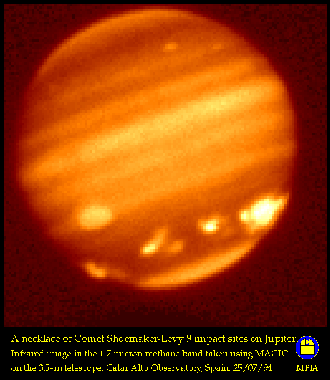
Where Jupiter (seen here in IR some days after the Shoemaker-Levy 9 multiple comet impact) is the ultimate “red ball” — but one — in our solar system:
 

Or, analysing in terms of an abstraction of this observational/experiential situation that brings out the laws of thought and the issue of warrant against accuracy to experiential reality:
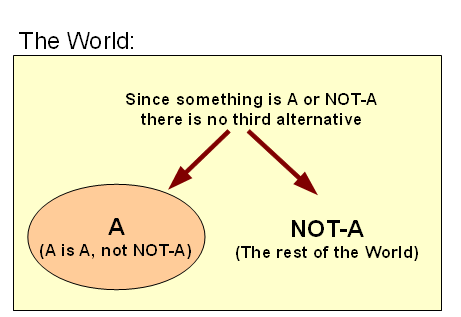
Okay, you may say:  that addresses the world of thinking. In cases where we mark distinctions, then the distinction obtains, but that does not bridge to reality.

Or, does it?

So long as there is a distinction between the red ball on the table and the rest of the world, and so long as it is inevitable that we do know something about the world, on pain of absurdity, these will also apply to external reality. The laws are objective not just subjective.

Take, one who suggests there is an ugly gulch between our inner world of appearances and thoughts, and the outer one of things in themselves, so that we can never bridge the gap.

But, to make such a claim is to make a claim to know something about  external reality, its alleged un-knowable nature.

Self-referential incoherence leading to confusion, in short.

(That will not faze some, but that only tells the rest of us, that such are beyond the reach of reason. Pray for them, that is their only hope.)

So, we are back at the objectivity of these first principles of right reason.

Let me now clip a comment just made in the KN thread:

This, from Wiki speaking against known ideological inclination, on the Laws of Thought c. Feb 2012 [cf Rationale], may help in understanding how the three key first principles of right reason are inextricably linked:

The law of non-contradiction and the law of excluded middle are not separate laws per se, but correlates of the law of identity. That is to say, they are two interdependent and complementary principles that inhere naturally (implicitly) within the law of identity, as its essential nature . . . whenever we ‘identify’ a thing as belonging to a certain class or instance of a class, we intellectually set that thing apart from all the other things in existence which are ‘not’ of that same class or instance of a class. In other words, the proposition, “A is A and A is not ~A” (law of identity) intellectually partitions a universe of discourse (the domain of all things) into exactly two subsets, A and ~A, and thus gives rise to a dichotomy. As with all dichotomies, A and ~A must then be ‘mutually exclusive’ and ‘jointly exhaustive’ with respect to that universe of discourse. In other words, ‘no one thing can simultaneously be a member of both A and ~A’ (law of non-contradiction), whilst ‘every single thing must be a member of either A or ~A’ (law of excluded middle).

See what happens so soon as we make a clear and crisp distinction?

Therefore, why I highlight how we are using glyphs, characters, words, sentences, symbols, relations, expressions etc in trying to make all of these novel “logics” or Quantum speculations, etc?

That is, we inescapably are marking distinctions and are dichotomising reality, into (T|NOT-T) . . . (H|NOT_H) . . . (A|NOT_A) . . . (T|NOT_T) etc. just to type out a sentence. The stability of identity of T, H, A, T then leads straight to the correlates, that we have marked a distinction that is “‘mutually exclusive’ and ‘jointly exhaustive’ with respect to that universe of discourse.”

The implication is, that so soon as we make sharp distinctions and identify things on the one side thereof, we are facing the underlying significance of such distinctions: A is A, A is not NOT_A, and there is not a fuzzy thing out there other than A and NOT_A. of course, there are spectra or trends or timelines that credibly have a smooth gradation along a continuum, there are superpositions and there are trichotomies etc [which can be reduced to structured sets of dichotomies). But so soon as we are even just talking of this, we are inescapably back to the business of making (A|NOT_A) distinctions.

That is where I find myself standing this morning.

What about you? END

Comments
Box, re. 85:
Why you believe that we live in the same world is beyond my comprehension. If there is no real Jupiter out there it is all in your mind right? Why would I be living in the world of your imagination? Please elaborate.
All my experience is in my mind. All yours is in yours. If you cannot see the truth of this, there is no point in continuing the discussion. Yet our experience is coordinated. You read the words I write on my computer, and the image you perceive on your computer corresponds to that which I see on mine. Obviously, then, some entity is coordinating our experience. This is what I mean by the statement we live in the same world. You believe that the coordinating entity is the physical universe. I, on the other hand, don't accept that the physical world has an independent existence. I see it as a kind of virtual reality. So obviously, something or someone must be coordinating the experience of all of us inhabiting this place, which is to say performing the role like that of the computer that controls an on-line role playing game or the supercomputer that created the virtual reality that the humans experienced in the film The Matrix. If I am right, then who or what would be the obvious candidate for the entity which coordinates our experience? The answer should be obvious.Bruce David
March 23, 2013
March
03
Mar
23
23
2013
12:15 PM
12
12
15
PM
PDT
KF, re. #84: I'm using the term "rules" in a more general sense. If, as I propose, this physical world we inhabit is a kind of virtual reality, then the laws of physics would be examples of the "rules" by which it operates. But even then, those rules are not ironclad. Many people throughout history have performed miracles, not just Jesus. My spiritual teacher, Reshad Feild, even performed a couple that I know of in his life. There have been many others.Bruce David
March 23, 2013
March
03
Mar
23
23
2013
11:54 AM
11
11
54
AM
PDT
BD: Realities are not rules. Rules are set up by convention. Realities neither care nor yield to what we may wish were so. on the contrary, we had better conform our beliefs and behaviour to realities, or we suffer consequences. Indeed, realities correct our rules. KFkairosfocus
March 23, 2013
March
03
Mar
23
23
2013
10:35 AM
10
10
35
AM
PDT
Bruce David (80): We live in the same world, Box. The difference is that you regard it as reality and I regard it as merely appearance.
Why you believe that we live in the same world is beyond my comprehension. If there is no real Jupiter out there it is all in your mind right? Why would I be living in the world of your imagination? Please elaborate.Box
March 23, 2013
March
03
Mar
23
23
2013
09:42 AM
9
09
42
AM
PDT
KF, re. #81:
BD: Is or is not the out of control vehicle, careering down the road you are trying to cross there AND not there in the same sense, at the same time? Why do you instinctively try to jump out of the way? What does that say about what even your programmed instincts are trying to tell you? KF
The world of appearances or virtual reality in which we live while we are incarnate on earth has its rules, rather like the rules that govern the operation of the flight simulators that airline pilots use to hone their skills at handling emergency situations. If you don't pay close enough attention to what you are doing, like the airline pilot who handles the simulated emergency poorly, you are likely to be ejected from the virtual reality into a more real environment. Our instincts along with the concepts we create with which to organize our sensory experience enable us to operate successfully in this world. The fact that a given "reality" has rules which govern its operation tells us nothing one way or the other regarding its ontological status. By the way, I have never argued with the statement that the laws of reason apply to the concepts we create to handle our experience here (like the vehicle careening towards us in your question). I'll leave that to people who are interested in that subject, like Kantian Naturalist. My contention in this thread has been that asking whether they apply to the Reality into which the mystic sees is a misapplication of categories, since the rules of reason are embedded in language, and language is impotent to describe that Reality. I'm just offereing another possibility here. You of course are free to take it or leave it. It's clear to me, however, from reading the writings of the mystics through the ages, that they have seen something very powerful and real, at least to them. To cavalierly dismiss their experience as nonsense, as tgpeeler does for instance, is in my view a mistake bordering on foolishness.Bruce David
March 23, 2013
March
03
Mar
23
23
2013
09:39 AM
9
09
39
AM
PDT
BD: Is or is not the out of control vehicle, careering down the road you are trying to cross there AND not there in the same sense, at the same time? Why do you instinctively try to jump out of the way? What does that say about what even your programmed instincts are trying to tell you? KFkairosfocus
March 23, 2013
March
03
Mar
23
23
2013
02:40 AM
2
02
40
AM
PDT
Box:
It must be an intellectual nightmare for sure to be surrounded by non-existent things, produced by your own uncontrollable mind.
No more of a nightmare than it is for you to be surrounded by existent, material things over which you have no control. And where do you get the idea that my mind is uncontrollable? We live in the same world, Box. The difference is that you regard it as reality and I regard it as merely appearance. The practical difference is that I have more possibilities open to me than you do, as I believe in the power of mind to directly influence the physical.Bruce David
March 22, 2013
March
03
Mar
22
22
2013
08:40 PM
8
08
40
PM
PDT
Bruce David:
What if my former teacher, Reshad Feild, was right when he delcared,”Reason is powerless in the expression of Love.”?
What if your former teacher was a quack? What if your former teacher never asked whether he himself was ignorant, stupid, insane or wicked? What if what your former teacher really meant in saying that "Reason is powerless in the expression of Love" is that truly, "Reason is NOT powerless in the expression of Love"? What if REASON and LOVE have their origin in the same being?Mung
March 22, 2013
March
03
Mar
22
22
2013
06:41 PM
6
06
41
PM
PDT
timothya:
How are we to tell if you are ignorant, stupid, insane or wicked?
Should you not first settle the question of whether or not you yourself are ignorant, stupid, insane or wicked?Mung
March 22, 2013
March
03
Mar
22
22
2013
06:31 PM
6
06
31
PM
PDT
Bruce David(75): What reason do you have to trust your own mind? Have you never been mistaken about anything?
You entertain the possibility that you have a mind which is constantly feeding you false information about a non-existent world. That is of an entirely different magnitude than sometimes being mistaken about something.
Bruce David(75): And believe me when I tell you that for me it is no nightmare. The experience is full of love and joy.
It must be an intellectual nightmare for sure to be surrounded by non-existent things, produced by your own uncontrollable mind. Tell me what are the foundations of your epistemology?Box
March 22, 2013
March
03
Mar
22
22
2013
06:29 PM
6
06
29
PM
PDT
tgpeeler (71): To say that one is more real than the other doesn’t make any sense. Existence is existence. One either is, or one is not, whether one is God or not-God makes no difference.
Begging the question (Petito Principii). When the fallacy of begging the question is committed in a single step, it is sometimes called a hysteron proteron.Box
March 22, 2013
March
03
Mar
22
22
2013
06:06 PM
6
06
06
PM
PDT
Box, re #67:
If I understand you correctly you entertain the possibility that there is no real Jupiter out there. If there is no Jupiter out there what reason do you have to trust your mind? Are not you in a constant state of disharmony with your own mind which is trying to trick you? Your mind is constantly creating concepts of things that are not there. It’s like a nightmare in which you constantly have to tell yourself that it is just a dream. Is there a part of your mind in which you can trust and if so for what reason?
What reason do you have to trust your own mind? Have you never been mistaken about anything? I regard the "world of appearances" which I currently inhabit as a kind of virtual reality. I live, play, work, and love here as if it were real because that is how its purpose is realized. When I stop to think about it, I understand that it is not Reality, but, you know, so what? This is what to me is meant by being in the world but not of it. And believe me when I tell you that for me it is no nightmare. The experience is full of love and joy.Bruce David
March 22, 2013
March
03
Mar
22
22
2013
02:12 PM
2
02
12
PM
PDT
tgpeeeler, re #70:
heh heh. I guess you can safely be ignored, then. How can you not see the inanity of what you say???? On the one hand you can know about reality and on the other hand language cannot describe it. But ALL of your thoughts are in a language. So… I think you may be the most extreme case of irrationality I have seen out here and I’ve seen a few. Kudos to KF, SB, and others for having the patience to keep engaging. You are better men than I.
So ignore me already. For someone who can safely ignore me, you certainly do prattle on. And by the way, you are dead wrong when you say, "But ALL of your thoughts are in a language." None of our thoughts are in language. We have thoughts, which we then transfer into language in order to communicate them. Have you never had trouble putting an idea into words? I have, many times.Bruce David
March 22, 2013
March
03
Mar
22
22
2013
02:01 PM
2
02
01
PM
PDT
WJM, re #58:
The LNC doesn’t claim to know what Jupiter “actually” is. All we know of “reality” is via experience; one cannot experience Jupiter – whatever it is – as both existing and not existing in the same sense at the same time.
All I can say at this point is that in talking about Jupiter as you do, you still regard is as some kind of "thing", even if you don't know what it is. You are framing it within the categories of language. The view that I am trying to convey is that the mystics throughout the ages have seen directly into the true nature of Reality, and that language is wholly inadequate to describe what they have seen. Since---StephenB to the contrary notwithstanding---the LNC and other laws of reason are imbedded in and at the service of the concepts that underlie our use of language, they have no applicability to Reality as so perceived. It's not that they are false or wrong in that context, it is that they simply don't apply. This Reality cannot be described, but words can be used to point to it, or to open a person up to that mystical vision. If you (or anyone reading this thread) is really interested in what I am talking about, I recommend reading the works of any of the great mystics, for example Rumi, Lao Tzu, Hafiz, the Zen masters, Yogananda, or Ibn al 'Arabi, to name a few. If so, good luck. I wish you every success in your spiritual journey.Bruce David
March 22, 2013
March
03
Mar
22
22
2013
01:48 PM
1
01
48
PM
PDT
Stephen, re 54:
Excuse me, but you are not free to misrepresent the facts–or to invent your own definition of the Law of Identity– or to reduce it to a function of language–try though you might. Whether you like it or not, that principle is tied to ontological reality. As Aristotle puts it, “It is impossible that the same thing belong and not belong to the same thing at the same time and in the same respect.” You will notice that he is writing about the things we talk about, not what we say about the things we talk about. In other words, he is not referring to language; he is referring to things in themselves. You may not like to face the truth, but that is your problem, not mine.
Freedom is the essence of Who We Are, made in the image and likeness of God. Your complaints notwithstanding, I most certainly am free to do whatever I like. And by the way, Aristotle saw the objects in the world as real, as do you. In that he was wrong, in my view. An appeal to the authority of Aristotle simply doesn't cut it with me. You're certainly entitled to your opinion. Forgive me, however, if I don't regard it as absolute truth.Bruce David
March 22, 2013
March
03
Mar
22
22
2013
01:23 PM
1
01
23
PM
PDT
Box @ 42 I think there are two kinds of existence, infinite and finite. Some of the words that describe infinite are necessary, uncaused, and abstract or immaterial. Some of the words that describe finite are contingent, caused, and physical (and there is an immaterial component to us that is also finite, since it changes). To say that one is more real than the other doesn't make any sense. Existence is existence. One either is, or one is not, whether one is God or not-God makes no difference. I think that the "spiritual" world is just an aspect of the universe we inhabit. It's not a different reality it's a different aspect of reality.tgpeeler
March 22, 2013
March
03
Mar
22
22
2013
12:26 PM
12
12
26
PM
PDT
BD @ 53 "What I assert is that Reality cannot be described by the use of language. I never said it could not be known." heh heh. I guess you can safely be ignored, then. How can you not see the inanity of what you say???? On the one hand you can know about reality and on the other hand language cannot describe it. But ALL of your thoughts are in a language. So... I think you may be the most extreme case of irrationality I have seen out here and I've seen a few. Kudos to KF, SB, and others for having the patience to keep engaging. You are better men than I.tgpeeler
March 22, 2013
March
03
Mar
22
22
2013
12:19 PM
12
12
19
PM
PDT
BD @ 51 I guess the irony of you arguing (reasoning) with us about mysticism is lost on you. The irony of me arguing with you, an advocate of mysticism, about the effectiveness of reason is not, however, lost on me. Best of luck.tgpeeler
March 22, 2013
March
03
Mar
22
22
2013
12:11 PM
12
12
11
PM
PDT
So what happens when Bruce David flies into the planet Jupiter and his body dies a horrible death? Can you decide to "conceive" that your version of Jupiter won't do that to you? Also, how is it that we all have the same construct of Jupiter? I've tried really hard to figure out something physical isn't really there. That it's just a construct of my mind. I don't think it lines up.ellijacket
March 22, 2013
March
03
Mar
22
22
2013
12:10 PM
12
12
10
PM
PDT
Bruce David (48) If I understand you correctly you entertain the possibility that there is no real Jupiter out there. If there is no Jupiter out there what reason do you have to trust your mind? Are not you in a constant state of disharmony with your own mind which is trying to trick you? Your mind is constantly creating concepts of things that are not there. It's like a nightmare in which you constantly have to tell yourself that it is just a dream. Is there a part of your mind in which you can trust and if so for what reason?Box
March 22, 2013
March
03
Mar
22
22
2013
08:47 AM
8
08
47
AM
PDT
Folks, I think Isaiah nailed it, over 2,700 years ago:
Isa 5:18 Woe to those who draw iniquity with cords of falsehood, who draw sin as with cart ropes, 19 who say: “Let him be quick, let him speed his work that we may see it; let the counsel of the Holy One of Israel draw near, and let it come, that we may know it!” 20 Woe to those who call evil good and good evil, who put darkness for light and light for darkness, who put bitter for sweet and sweet for bitter! 21 Woe to those who are wise in their own eyes, and shrewd in their own sight! 22 Woe to those who are heroes at drinking wine, and valiant men in mixing strong drink, 23 who acquit the guilty for a bribe, and deprive the innocent of his right! 24 Therefore, as the tongue of fire devours the stubble, and as dry grass sinks down in the flame, so their root will be as rottenness, and their blossom go up like dust; for they have rejected the law of the Lord of hosts, and have despised the word of the Holy One of Israel.
And yes, this is theological at this point. Prophetic, to be exact. Here is where that sort of behaviour ends up, in utter defeat and destruction, because there is nothing worth fighting for anymore and because there isn't any cohesion and trust to be strong in the fight:
Isa 5:26 He will raise a signal for nations far away, and whistle for them from the ends of the earth; and behold, quickly, speedily they come! 27 None is weary, none stumbles, none slumbers or sleeps, not a waistband is loose, not a sandal strap broken; 28 their arrows are sharp, all their bows bent, their horses' hoofs seem like flint, and their wheels like the whirlwind. 29 Their roaring is like a lion, like young lions they roar; they growl and seize their prey; they carry it off, and none can rescue. 30 They will growl over it on that day, like the growling of the sea. And if one looks to the land, behold, darkness and distress; and the light is darkened by its clouds.
Enough said by way of warning? Or, do we even care; anymore? KFkairosfocus
March 22, 2013
March
03
Mar
22
22
2013
08:16 AM
8
08
16
AM
PDT
WJM: You rightly stressed: "debate fairly . . . " And, if one disregards truth as distinct from error, then why bother about seeking the truth, what is persuasive is "good enough for government work." As in, doesn't this problem of disregard for truth,and for fairness, sound all too familiar? Where is our civilisation headed? KFkairosfocus
March 22, 2013
March
03
Mar
22
22
2013
08:09 AM
8
08
09
AM
PDT
Hmmm ... with no LNC, then "pulverized" = "brilliant"!!!William J Murray
March 22, 2013
March
03
Mar
22
22
2013
08:07 AM
8
08
07
AM
PDT
Great points, KF and Box. Can X be what it is, and also what it is not? Can one debate fairly if the argument cannot be parsed in terms of what it is about, if it is what it is about, and also what it is not about? The LNC is about as absolute as it gets when talking about reality.William J Murray
March 22, 2013
March
03
Mar
22
22
2013
08:05 AM
8
08
05
AM
PDT
You guys are all pulverized so stop it already! ;)Joe
March 22, 2013
March
03
Mar
22
22
2013
07:06 AM
7
07
06
AM
PDT
I agree fully with WJM's profound statements in post 58. I would like to add to WJM's definition of LNC that LNC is also a statement about being. LNC states that being is something that cannot be and not be at the same time. Aristotle put it this way:
"First then this at least is obviously true, that the word 'be' or 'not be' has a definite meaning, so that not everything will be 'so and not so'."
Box
March 22, 2013
March
03
Mar
22
22
2013
06:08 AM
6
06
08
AM
PDT
F/N: Another pot-stirrer: I suggest that one of the reasons the first principles of right reason are vital, is that they are a bulwark against willful, deceitful misrepresentation and also against refusing to do due duties of care to the truth and to fairness. That is because A is not to be conflated or confused with or substituted by NOT_A. So, we need to be careful to be accurate and clear, as clear as is reasonably possible; bearing in mind that many crucial concepts -- e.g. so "simple" a concept as biological life -- resist precising definition and are best communicated in practice by key cases and relevantly close family resemblance. Where also, such deliberate or willfully negligent misrepresentations by objectors to design theory have long been major problems in debates concerning design issues. So much so, that I have often had to wonder if they think the truth is an option and it is all a game FIGHT, with one goal, winning at any cost. KFkairosfocus
March 22, 2013
March
03
Mar
22
22
2013
05:57 AM
5
05
57
AM
PDT
This goes back to Plato's cave - we believe our experience is not the actual reality. Of course, the only thing we can expect the LNC and other necessary principles to refer to is our experience of reality, or our experience of whatever is generating experience. However, "our experience" is the only thing we can call "reality" in any direct sense, because whatever is outside the cave casting shadows (if anything) into our experience cannot be known by us as itself from our perspective as an individual, experiencing entity. Just as one cannot experience a 4-sided triangle, and cannot experience putting 2 apples with 2 apples and then having 10, one cannot experience any X as both existent and non-existent at the same time and in the same sense. There are laws that govern experience, whether or not they govern reality. In trying to imagine what good might come from holding that, outside of experience, Jupiter might (in reality) both exist and not exist at the same time and in the same way; but IMO it's a nonsensical notion. Whatever Jupiter is "in reality", regardless of how we experience it, it is what it is, and isn't not what it is. If it is in reality a superposition of all possible states of that location, then that is the "in the same sense" we are talking about. It either is a "superposition of all possible states of that location" (including what we would experience as jupiter or as not-jupiter) or it is not - in reality. So I don't see how any real thing can violate the LNC, whether one is applying the LNC to actual experience, or imagining how it might apply to a reality that is not the same as our experience indicates. Even if the "reality" is "all possible states", including Jupiter and not-Jupiter, that is what reality is, and it is not "not all possible states". The key is the term "in the same sense". It makes the LNC as impossible to violate as it is impossible to construct a 4-sided triangle.William J Murray
March 22, 2013
March
03
Mar
22
22
2013
05:35 AM
5
05
35
AM
PDT
Bruce David, If you are saying that the "ultimate" reality - God as One, and not God as a dichotomy of experiencer and experienced - is the unknowable "ultimate" state of what reality is, I agree. If you are saying that there is much, much more to reality than what we currently know, and probably more than what we will ever know, and that our senses are how we organize that experience is a faulty reflection of "what is actually going on", I agree, especially in terms of intention affecting physical experience. However, if you are saying that the law of contradiction is negotiable, I disagree, because IMO it relates to the primary aspect of conscious experience as an individual - an entity below the "god as one" level of reality. IOW, in order for what we understand "conscious experience" to occur, the LNC is necessarily in operation. There must be X, the experiencer, and not-X, what is being experienced, even if ultimately they are aspects of the same thing. As an example, when one dreams, the sleeping dreamer is both the subject in the dream, and the context. However, from the dreamer's position as the character focus in the dream, there "appears to be" an experiencer and the experienced two different things, even if the focus of the sleeper's point of view in the dream moves around to different characters or even a 3rd person perspective. The LNC makes the point of saying that jupiter cannot exist and not exist in the same sense at the same time. To frame it another way, in your experience Jupiter cannot both exist and not exist at the same time and in the same way, regardless of what Jupiter "actually" is, because the LNC is not just a law of language; it is a law of experience. The LNC doesn't claim to know what Jupiter "actually" is. All we know of "reality" is via experience; one cannot experience Jupiter - whatever it is - as both existing and not existing in the same sense at the same time.William J Murray
March 22, 2013
March
03
Mar
22
22
2013
03:55 AM
3
03
55
AM
PDT
SB: Is the Law of Identity a distinct, recognisable thing? If so, is it not then a case where recognising and respecting that identity is a pivot to reasonable discourse? [And does this not sound ever so familiar on the subject of materialist objectors -- noting that BD is evidently a Sufi Muslim -- so often refusing to recognise key things as just that, distinct things? Yet another sign of what is going on . . . ] KFkairosfocus
March 22, 2013
March
03
Mar
22
22
2013
02:42 AM
2
02
42
AM
PDT
1 2 3 4 5 6