Uncommon Descent Serving The Intelligent Design Community

L&FP, 55: Defining/Clarifying Intelligent Design as Inference, as Theory, as a Movement

Categories
Design inference
Epistemology
Food for thought
ID Foundations
Intelligent Design
Logic and Reason
Science
science education
specified complexity
Share
Facebook
Twitter/X
LinkedIn
Flipboard
Print
Email

It seems, despite UD’s resources tab, some still struggle to understand ID in the three distinct senses: inference, theory/research programme, movement. Accordingly, let us headline a clarifying note from the current thread on people who doubt, for the record:

[KF, 269:] >>. . . first we must mark out a matter of inductive reasoning and epistemology. Observed tested, reliable signs such as FSCO/I [= functionally specific, complex organisation and/or associated information, “fun-skee”] beyond 500 – 1,000 bits point to design as cause for cases we have not observed. This is the design INFERENCE.
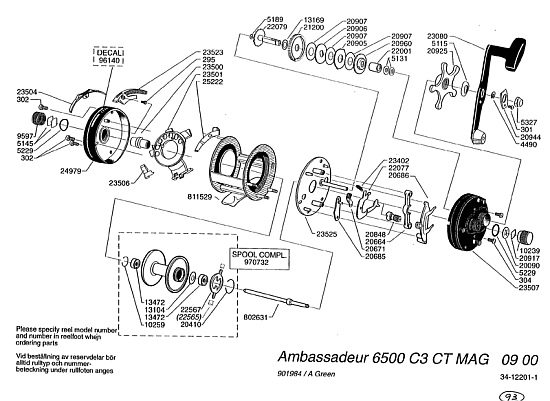
A classic example of FSCO/I, the organisation of a fishing reel
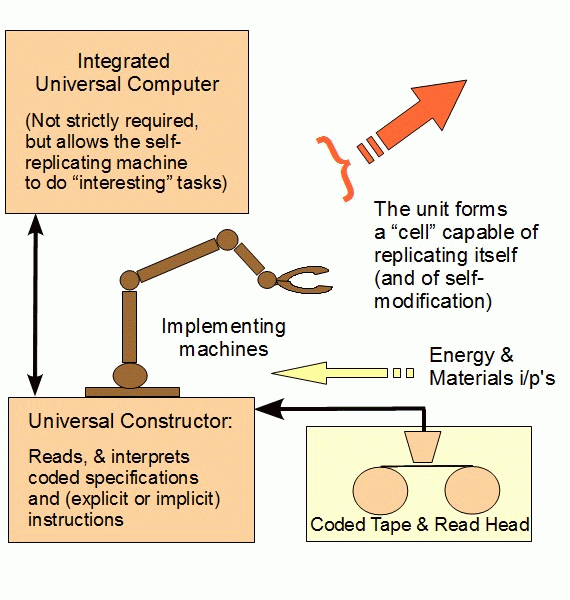
A von Neumann, kinematic Self Replicator, illustrating how an entity with
self-replication reflects considerable additional FSCO/I, where
the living cell embeds such a vNSR
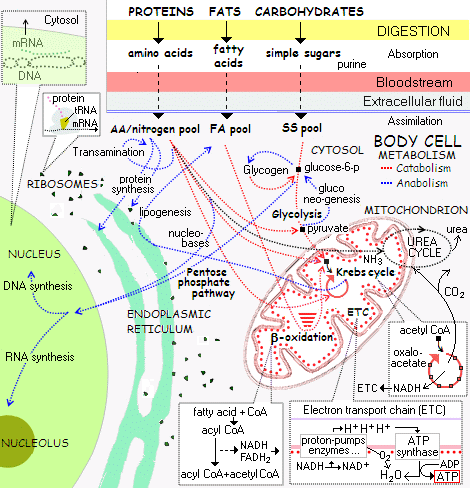
The metabolic network of a cell exhibits FSCO/I in a process-flow, molecular nanotech self replicating system
Petroleum refinery block diagram illustrating FSCO/I in a process-flow system
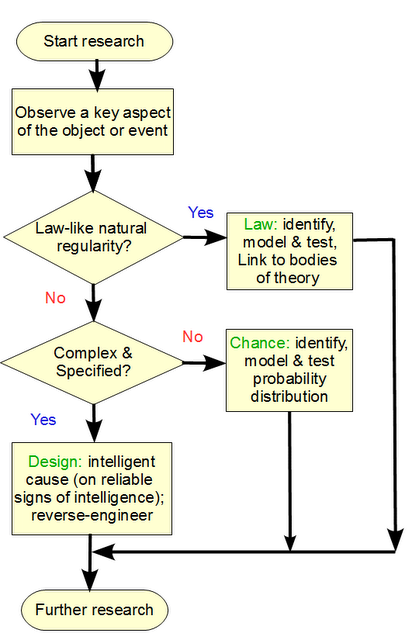
The design inference reduced to a flowchart, the per aspect explanatory filter

Note, inference, not movement, not theory.

Following the UD Weak Argument Correctives under the Resources tab, we can identify ID Theory as a [small] research programme that explores whether there are such observable, testable, reliable signs, whether they appear in the world of life and in the cosmos, whether we may responsibly — notice, how duties of reason pop up naturally — use them to infer that cell based life, body plans, the cosmos etc are credibly the result of intelligently directed configuration . . . and that’s a definition of design. This, in a context where the proposed “scientific” alternative, blind chance and/or mechanical necessity has not been observed to actually produce things exhibiting FSCO/I etc.

Logically, this is an application of inductive reasoning, modern sense, abduction.

Which is common in science and is commonly held to ground scientific, weak philosophical sense, knowledge. Weak, it is open ended and can be defeated by further analysis and evidence, warranted, credibly true [and so reliable] belief.

Going beyond, where we have further information, evidence and argument we may explore whodunit, howtweredun, etc.

Such is after all commonplace in technical forensics, medical research, archaeology, engineering [esp. reverse engineering], code cracking etc. I guess, these can be taken as design-oriented sciences. Going back to 4th form I remember doing natural science explorations of springs. Manufactured entities. So are lenses, mirrors, glass blocks, radio systems, lasers etc.

Beyond the theory, there is a movement, comprising supporters and friendly critics as well as practitioners consciously researching design theory or extending thinking on it and applying same to society or civilisation, including history of ideas.

The first major design inference on record in our civilisation is by Plato, in The Laws, Bk X:

Ath [in The Laws, Bk X 2,360 ya]. . . .[The avant garde philosophers and poets, c. 360 BC] say that fire and water, and earth and air [i.e the classical “material” elements of the cosmos — the natural order], all exist by nature and chance, and none of them by art . . . [such that] all that is in the heaven, as well as animals and all plants, and all the seasons come from these elements, not by the action of mind, as they say, or of any God, or from art, but as I was saying, by nature and chance only [ –> that is, evolutionary materialism is ancient and would trace all things to blind chance and mechanical necessity, contrasted to “the action of mind” i.e. intelligently directed configuration] . . . .

[[T]hese people would say that the Gods exist not by nature, but by art, and by the laws of states, which are different in different places, according to the agreement of those who make them . . . .

Then, by Heaven, we have discovered the source of this vain opinion of all those physical investigators . . . . they affirm that which is the first cause of the generation and destruction of all things, to be not first, but last, and that which is last to be first, and hence they have fallen into error about the true nature of the Gods.

Cle. Still I do not understand you.

Ath. Nearly all of them, my friends, seem to be ignorant of the nature and power of the soul [[ = psuche], especially in what relates to her origin: they do not know that she is among the first of things, and before all bodies, and is the chief author of their changes and transpositions. And if this is true, and if the soul is older than the body, must not the things which are of the soul’s kindred be of necessity prior to those which appertain to the body?

Cle. Certainly.

Ath. Then thought and attention and mind and art and law will be prior to that which is hard and soft and heavy and light; and the great and primitive works and actions will be works of art; they will be the first, and after them will come nature and works of nature, which however is a wrong term for men to apply to them; these will follow, and will be under the government of art and mind.

Cle. But why is the word “nature” wrong?

Ath. Because those who use the term mean to say that nature is the first creative power; but if the soul turn out to be the primeval element, and not fire or air, then in the truest sense and beyond other things the soul may be said to exist by nature; and this would be true if you proved that the soul is older than the body, but not otherwise.

[[ . . . .]

Ath. . . . when one thing changes another, and that another, of such will there be any primary changing element? How can a thing which is moved by another ever be the beginning of change? Impossible. But when the self-moved changes other, and that again other, and thus thousands upon tens of thousands of bodies are set in motion, must not the beginning of all this motion be the change of the self-moving principle? . . . . self-motion being the origin of all motions, and the first which arises among things at rest as well as among things in motion, is the eldest and mightiest principle of change, and that which is changed by another and yet moves other is second. [–> notice, the self-moved, initiating, reflexively acting causal agent, which defines freedom as essential to our nature, and this is root of discussion on agents as first causes.]

[[ . . . .]

Ath. If we were to see this power existing in any earthy, watery, or fiery substance, simple or compound-how should we describe it?

Cle. You mean to ask whether we should call such a self-moving power life?

Ath. I do.

Cle. Certainly we should.

Ath. And when we see soul in anything, must we not do the same-must we not admit that this is life?

[[ . . . . ]

Cle. You mean to say that the essence which is defined as the self-moved is the same with that which has the name soul?

Ath. Yes; and if this is true, do we still maintain that there is anything wanting in the proof that the soul is the first origin and moving power of all that is, or has become, or will be, and their contraries, when she has been clearly shown to be the source of change and motion in all things?

Cle. Certainly not; the soul as being the source of motion, has been most satisfactorily shown to be the oldest of all things.

Ath. And is not that motion which is produced in another, by reason of another, but never has any self-moving power at all, being in truth the change of an inanimate body, to be reckoned second, or by any lower number which you may prefer?

Cle. Exactly.

Ath. Then we are right, and speak the most perfect and absolute truth, when we say that the soul is prior to the body, and that the body is second and comes afterwards, and is born to obey the soul, which is the ruler?

[[ . . . . ]

Ath. If, my friend, we say that the whole path and movement of heaven, and of all that is therein, is by nature akin to the movement and revolution and calculation of mind, and proceeds by kindred laws, then, as is plain, we must say that the best soul takes care of the world and guides it along the good path. [[Plato here explicitly sets up an inference to design (by a good soul) from the intelligible order of the cosmos.

Earlier in the same Bk X, he had noted just how old and how philosophically loaded evolutionary materialism and its appeal to chance and/or necessity are, drawing out consequences for law, government and community:

Ath[enian Stranger, in The Laws, Bk X 2,360 ya]. . . .[The avant garde philosophers and poets, c. 360 BC] say that fire and water, and earth and air [i.e the classical “material” elements of the cosmos — the natural order], all exist by nature and chance, and none of them by art . . . [such that] all that is in the heaven, as well as animals and all plants, and all the seasons come from these elements, not by the action of mind, as they say, or of any God, or from art, but as I was saying, by nature and chance only [ –> that is, evolutionary materialism is ancient and would trace all things to blind chance and mechanical necessity; observe, too, the trichotomy: “nature” (here, mechanical, blind necessity), “chance” (similar to a tossed fair die), ART (the action of a mind, i.e. intelligently directed configuration)] . . . .

[Thus, they hold] that the principles of justice have no existence at all in nature, but that mankind are always disputing about them and altering them; and that the alterations which are made by art and by law have no basis in nature, but are of authority for the moment and at the time at which they are made . . .

We see the wider setting and the more specific themes.>>

U/D May 14, to promote from 470 below and onward, a summary of kernel ID theory as a cluster of postulates — based on clips from the UD Resources tab:

ID as a Postulates based Scientific Framework

The theory of intelligent design (ID) holds

[–> key, evidence backed postulate, cf those of Newtonian dynamics and special then general relativity, thermodynamics and statistical thermodynamics, postulational cores can be brief but sweeping in impact]

that

[First, Evidence-backed Programmatic Postulate:] certain features of the universe and of living things are best explained [–> explicit reference to logic of abductive reasoning] by an intelligent cause rather than an undirected process such as natural selection.

ID is thus a scientific disagreement with the core claim of evolutionary theory that the apparent design of living systems is an illusion.

In a broader sense,

[2nd, Operational Postulate:] Intelligent Design is simply the science of design detection — how to recognize patterns arranged by an intelligent cause for a purpose.

Design detection is used in a number of scientific fields, including anthropology, forensic sciences that seek to explain the cause of events such as a death or fire, cryptanalysis and the search for extraterrestrial intelligence (SETI). [–> design oriented sciences. Signal to noise ratio in telecommunications is based on a design inference.]

[3rd, Empirical Warrant/Point of test or potential falsification postulate:] An inference that certain biological information may be the product of an intelligent cause can be tested or evaluated in the same manner as scientists daily test for design in other sciences.

ID is controversial because of the implications of its evidence, rather than the significant weight of its evidence. ID proponents believe science should be conducted objectively, without regard to the implications of its findings. This is particularly necessary in origins science because of its historical (and thus very subjective) nature, and because it is a science that unavoidably impacts religion.

[Evidence Corollary:] Positive evidence of design in living systems consists of the semantic, meaningful or functional nature of biological information, the lack of any known law that can explain the sequence of symbols that carry the “messages,” and statistical and experimental evidence that tends to rule out chance as a plausible explanation. Other evidence challenges the adequacy of natural or material causes to explain both the origin and diversity of life . . . .

Intelligent design [ID] – Dr William A Dembski, a leading design theorist, has defined ID as “the science that studies signs of intelligence.” That is,

[4th, Designs and Signs Postulate:] as we ourselves instantiate [thus exemplify as opposed to “exhaust”], intelligent designers act into the world, and create artifacts. When such agents act, there are certain characteristics that commonly appear, and that – per massive experience — reliably mark such artifacts. It it therefore a reasonable and useful scientific project to study such signs and identify how we may credibly reliably infer from empirical sign to the signified causal factor: purposefully directed contingency or intelligent design. [–> definition of design, note, abductive inference from observed sign to signified cause.]

Among the signs of intelligence of current interest for research are:

[Supplement, on evidence:] [a] FSCI — function-specifying complex information [e.g. blog posts in English text that take in more than 143 ASCII characters, and/or — as was highlighted by Yockey and Wickens by the mid-1980s — as a distinguishing marker of the macromolecules in the heart of cell-based life forms], or more broadly

[b] CSI — complex, independently specified information [e.g. Mt Rushmore vs New Hampshire’s former Old Man of the mountain, or — as was highlighted by Orgel in 1973 — a distinguishing feature of the cell’s information-rich organized aperiodic macromolecules that are neither simply orderly like crystals nor random like chance-polymerized peptide chains], or

[c] IC — multi-part functionality that relies on an irreducible core of mutually co-adapted, interacting components. [e.g. the hardware parts of a PC or more simply of a mousetrap; or – as was highlighted by Behe in the mid 1990’s — the bacterial flagellum and many other cell-based bodily features and functions.], or

[d] “Oracular” active information – in some cases, e.g. many Genetic Algorithms, successful performance of a system traces to built-in information or organisation that guides algorithmicsearch processes and/or performance so that the system significantly outperforms random search. Such guidance may include oracles that, step by step, inform a search process that the iterations are “warmer/ colder” relative to a performance target zone. (A classic example is the Weasel phrase search program.) Also,

[e] Complex, algorithmically active, coded information – the complex information used in systems and processes is symbolically coded in ways that are not preset by underlying physical or chemical forces, but by encoding and decoding dynamically inert but algorithmically active information that guides step by step execution sequences, i.e. algorithms. (For instance, in hard disk drives, the stored information in bits is coded based a conventional, symbolic assignment of the N/S poles, forces and fields involved, and is impressed and used algorithmically. The physics of forces and fields does not determine or control the bit-pattern of the information – or, the drive would be useless. Similarly, in DNA, the polymer chaining chemistry is effectively unrelated to the information stored in the sequence and reading frames of the A/ G/ C/ T side-groups. It is the coded genetic information in the successive three-letter D/RNA codons that is used by the cell’s molecular nano- machines in the step by step creation of proteins. Such DNA sets from observed living organisms starts at 100,000 – 500,000 four-state elements [200 k – 1 M bits], abundantly meriting the description: function- specifying, complex information, or FSCI.)

[(f) evidence of the fine tuned cosmos.] . . . .

Thus, ID can be framed on postulates, and we may draw forth from such that cells using memory structures storing coded algorithms and associated execution machinery are strong evidence of the design of cell based life. With Drexler, we are looking a bit at nanotech issues.>>

Food for thought and for clarification. END

U/D May 8th, to allow another thread to return to its focus:

>>THE FOLLOWING COME FROM THE LEAK CASE THREAD:

F/N May 7: As tangential objections to the design inference have been taken up (in obvious subject switching) I pose p. 5 from Sir Francis Crick’s March 19, 1953 letter to his son:
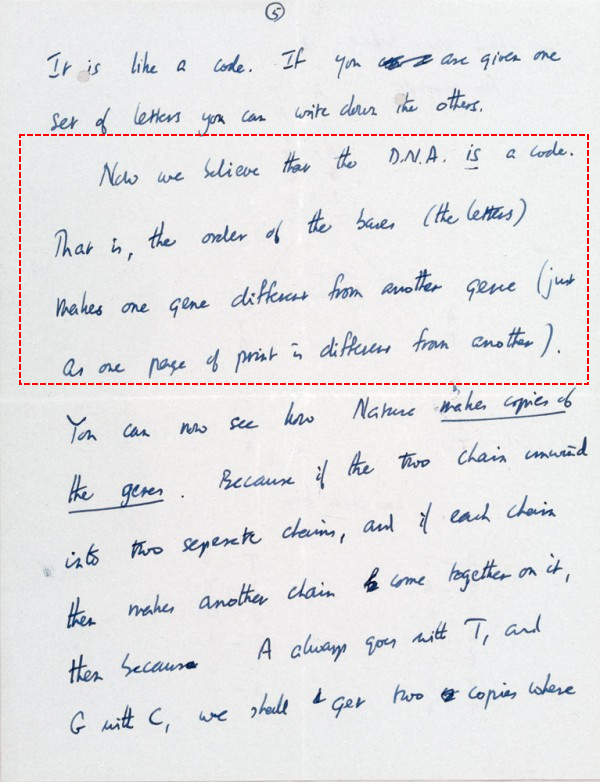
Crick’s letter

And, here is the protein synthesis process in outline:
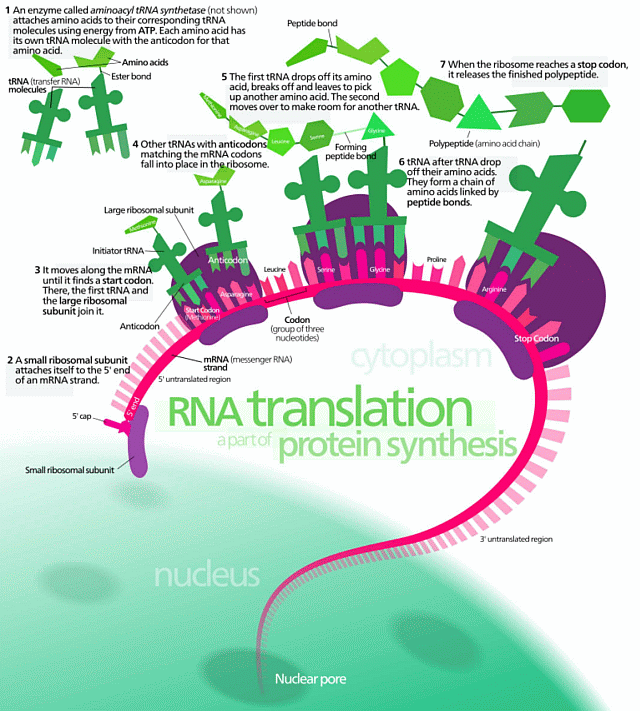
Protein Synthesis (HT: Wiki Media)

Together with a summary of the information communication system involved, as outlined by Yockey:
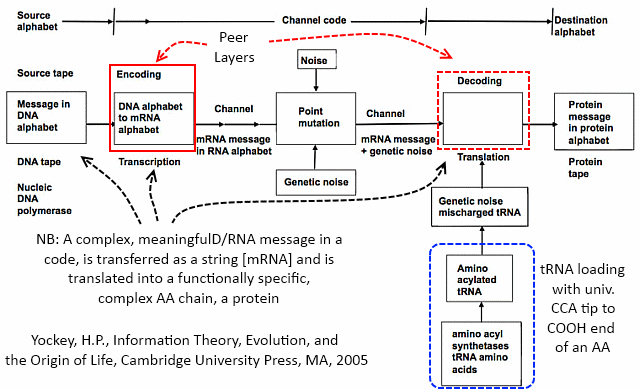
Yockey’s analysis of protein synthesis as a code-based communication process

F/N, May 8: As the tangent continues, it seems a further illustration is advisable:
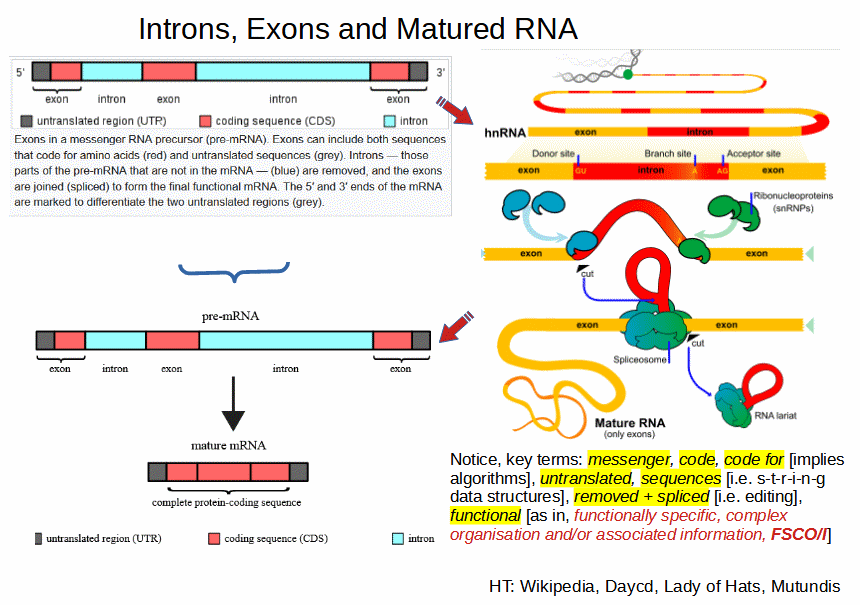
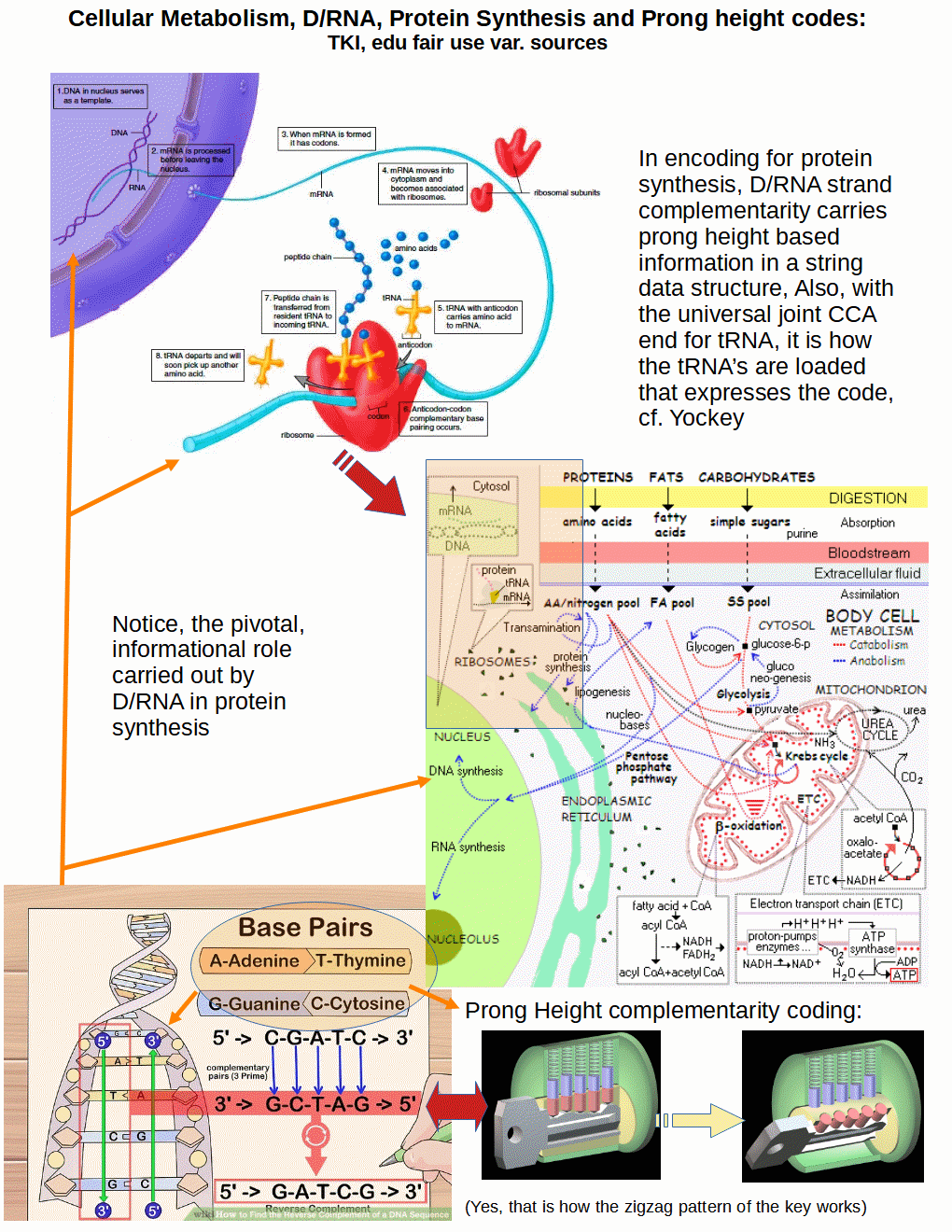
It seems more is needed, so here is how this fits into protein synthesis and the metabolic network and how we see prong height coding:
In for a penny, in for a pound, here is a video:

Notice, we are actually dealing with a storage register. Say, each shaft with pins is set for five positions, four elevated, one on the ledge. This is directly comparable to GCAT, and as the video shows there are five digits:

| X1 | X2 | X3 | X4 | X5 |

The key is encoded to the correct string of digits that in combination will open the lock, say 13213. The resting fully locked position is of course 00000.>>

U/D May 14: As a side chain appeared in another thread that is more appropriate here, I cross post a footnote added there:

It being now an obvious tactic to sidetrack non technical UD threads into ID debates (even where there is a thread that is live on the topic with relevant information, graphics and video) I will augment basic correction below by adding here a chart showing tRNA as a Drexler style molecular nanotech position-arm device:
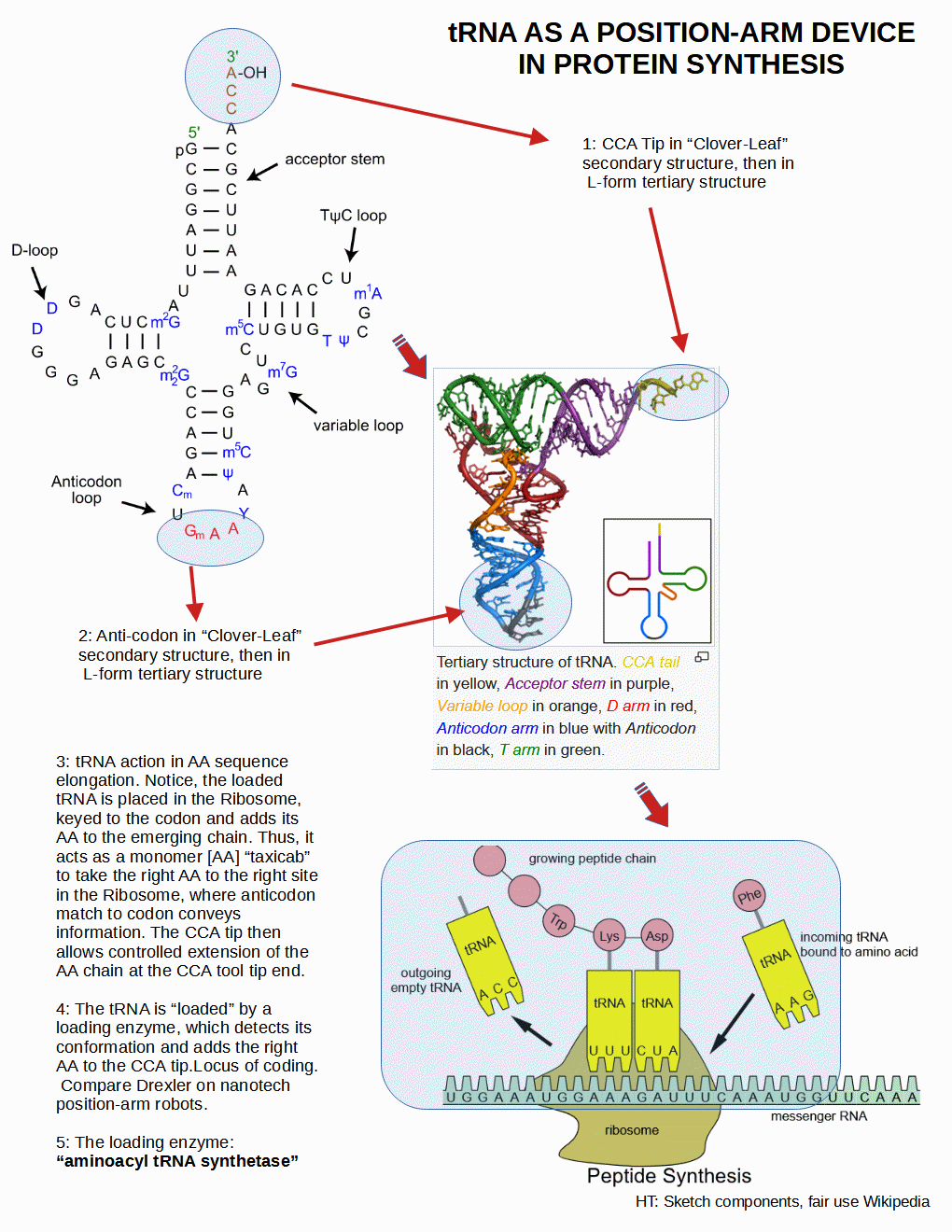
We may expand our view of the Ribosome’s action:
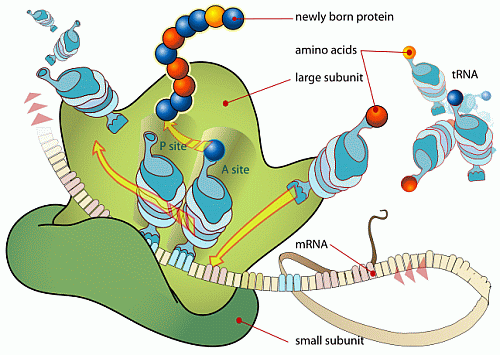
The Ribosome, assembling a protein step by step based on the instructions in the mRNA “control tape”

As a comparison, here is punched paper tape used formerly to store digital information:

Punch Tape

We should tabulate”

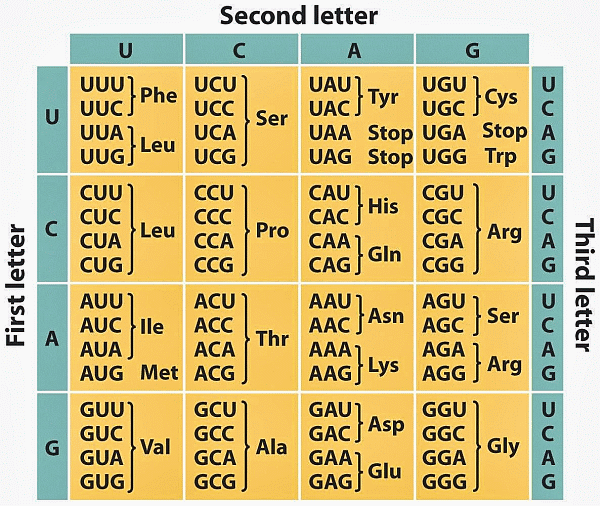
The Genetic code uses three-letter codons to specify the sequence of AA’s in proteins and specifying start/stop, and using six bits per AA

In Yockey’s communication system framework, we now can see the loading [blue dotted box] and how tRNA is involved in translation, as the AA chain towards protein formation is created, step by step — algorithm — under control of the mRNA chain of three base codons that match successive tRNA anticodons, the matching, of course is by key-lock fitting of G-C or C-G and A-T or T-A, a 4-state, prong height digital code:

Yockey’s analysis of protein synthesis as a code-based communication process

Further to this, DNA has been extended with other similar monomers, and DNA has been used as a general purpose information storage medium for digital codes, apparently even including for movie files.

The point of this is, for record, to expose and correct how hyperskeptical objectors have inappropriately tried to deny that D/RNA acts as a string based digital information storage unit, that it holds algorithmic code used in protein synthesis, and latterly that tRNA acts in this process in the role of a position-arm nanotech robot device with a CCA tool tip, CCA being a universal joint that attaches to the COOH end of an AA.

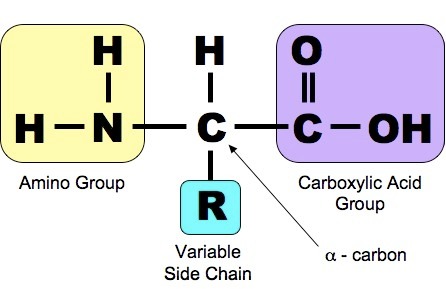
Speaking of which, AA structure, with side branches [R] and chaining links, i.e. NH2-alpha Carbon + R – COOH:
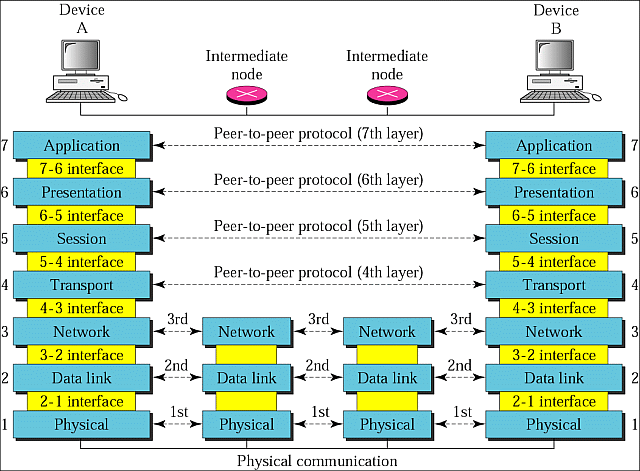
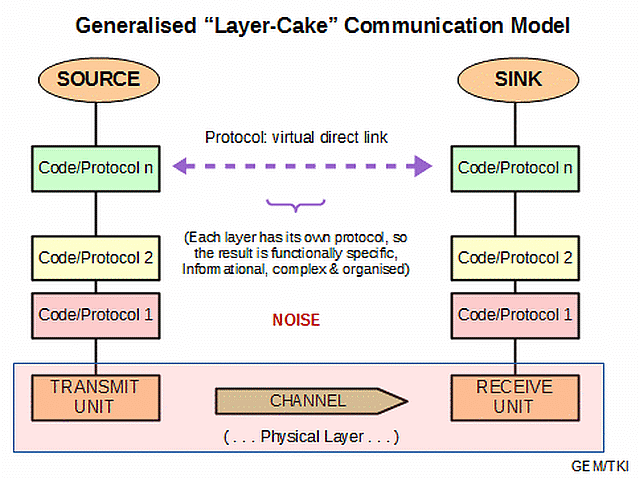
F/N, May 14, it is worth the while to add, regarding layer cake communication architectures and protocols:
Where, underlying this is the Shannon model, here bent into a U to show how layers fit in, this also ties to Yockey:
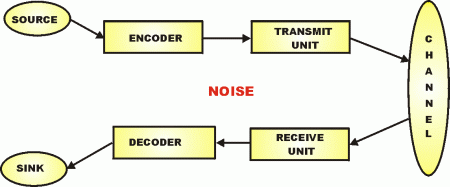
A communication system

We may then extend to Gitt’s broader framework:
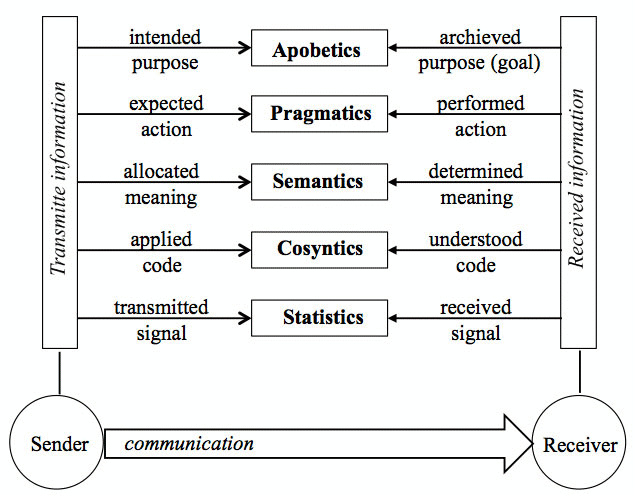
Gitt’s Layer-cake communications model

As an illustration, the ISO model:

OSI Network “layer-cake” model

Similarly, here is a layer cake view of a computer (network ports can be added):
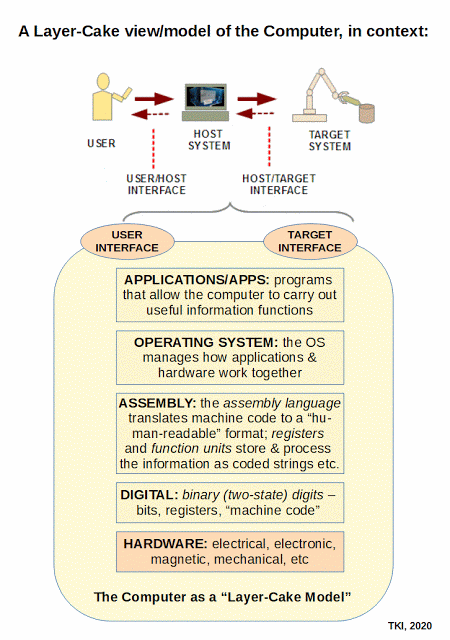
These layers, of course, are abstract, only the physical layer is hardware we can see directly. Even for that, we cannot easily see all the design details for compatibility and function.

These may be compared to Yockey, to draw out the framework of codes, protocols and communication requisites.

U/D May 21, on illustrating one aspect of cosmological fine tuning:
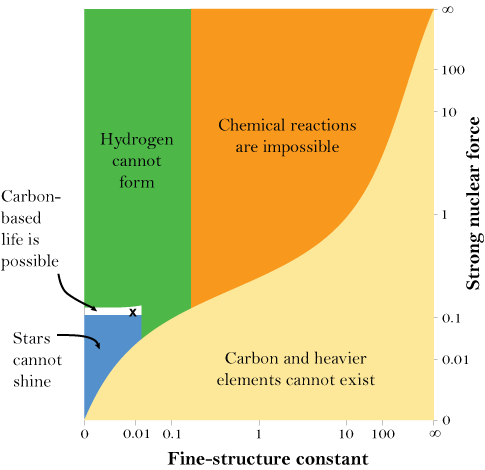
Barnes: “What if we tweaked just two of the fundamental constants? This figure shows what the universe would look like if the strength of the strong nuclear force (which holds atoms together) and the value of the fine-structure constant (which represents the strength of the electromagnetic force between elementary particles) were higher or lower than they are in this universe. The small, white sliver represents where life can use all the complexity of chemistry and the energy of stars. Within that region, the small “x” marks the spot where those constants are set in our own universe.” (HT: New Atlantis)
Comments
So it's not infinity as a mathematical concept (in our imaginations) that has absurdities, but rather the possible instantiation of infinity in reality that is absurd. Is that an accurate summary of your position?Viola Lee
April 22, 2022
April
04
Apr
22
22
2022
07:51 AM
7
07
51
AM
PDT
What examples do you have?
The real world not imaginary ones. No one can point to anything infinite except in their imagination.
That’s why physical entities that exist in a sequence of days from past to present are not infinite in eternity.
That's saying it isn't because it isn't. Duh! jerry
April 22, 2022
April
04
Apr
22
22
2022
07:46 AM
7
07
46
AM
PDT
Jerry, as a mathematical concept, what "absurdities" does infinity present. Does the fact that there are just as many even numbers as prime numbers count as an absurdity? What examples do you have?Viola Lee
April 22, 2022
April
04
Apr
22
22
2022
07:35 AM
7
07
35
AM
PDT
If there is no beginning, then you couldn't have a sequence of events over time. That's why physical entities that exist in a sequence of days from past to present are not infinite in eternity.Silver Asiatic
April 22, 2022
April
04
Apr
22
22
2022
07:21 AM
7
07
21
AM
PDT
The belief that the physical universe is infinite is refuted because that kind of infinite entity cannot be traversed in time from eternity to the present day.
I don't think that would convince anyone. All this is saying is there isn't anything infinite because there isn't a beginning. The response would be "Duh." There is a much much better way to refute infinity. Assuming it, leads to absurdities.jerry
April 22, 2022
April
04
Apr
22
22
2022
07:13 AM
7
07
13
AM
PDT
The belief that the physical universe is infinite is refuted because that kind of infinite entity cannot be traversed in time from eternity to the present day.Silver Asiatic
April 22, 2022
April
04
Apr
22
22
2022
07:03 AM
7
07
03
AM
PDT
WJM Regarding the time/space problem we exists as human beings through a linear process of time within finite space. If you disagree with that, I'm open to your explanation and evidence. In order to speak about anything - to communicate from one person to another - we are required to do that within linear time and finite space. If you have some other way to speak to me in a non-linear, timeless, spaceless manner, then I'm open to that experience also. Failing that, however, we use a communication method that exists in time to explain that which is not bound by a linear process (timelessness). Our rational process itself is that of "apprehending" concepts or aspects of reality. That also requires a finite, time-bound reality. To "grasp something" even a concept indicates that there are boundaries and limits and those cannot exist in a spaceless reality. We cannot have a rational process that does not move from one thing to the next. In fact, we cannot have any "process" at all in a timeless existence. So, what is it that you can explain about the condition of timelessness, that you can communicate to me without using a rational, time-bound, sequential thought process? So far, all of your writing uses that which is inherent in my ontology. But if you can communicate to me something about your idea of timelessness that does not use a linear (and therefore inappropriate) process that would be interesting. But I predict you cannot do it. So, your critique would not hold up. In ontological realism, we use terms like designed and created because those are analogous and we have no other or better terms for what happens outside of time and space.Silver Asiatic
April 22, 2022
April
04
Apr
22
22
2022
06:59 AM
6
06
59
AM
PDT
no one ever said that you could “traverse the transfinite in finite steps.”
Since there is no such thing as transfinite, traversing it is a meaningless concept.jerry
April 22, 2022
April
04
Apr
22
22
2022
06:56 AM
6
06
56
AM
PDT
KF writes, "Traversal of the transfinite in finite steps is an infeasible supertask a matter we hammered out here over three years" KF, no one ever said that you could "traverse the transfinite in finite steps." That didn't need to "get hammered out." That's obvious. It's amazing how much you don't understand and/or misremember about the situation about what was actually being discussed.Viola Lee
April 22, 2022
April
04
Apr
22
22
2022
06:00 AM
6
06
00
AM
PDT
SA said:
I’m not going to go any farther with this, WJM. If you can find someone else who is interested in your ideas, that’s great and I may join in. But until then, I wish you the best.
It's okay, there are other forums I'm currently in where people do understand and discuss MRTs. However, you and KF still haven't answered the time problem with your ontologies that I outlined earlier. Should I assume this is something else you don't wish to discuss further?William J Murray
April 22, 2022
April
04
Apr
22
22
2022
02:57 AM
2
02
57
AM
PDT
Q, many of the relevant parameters seem largely independent, and forcing super laws would themselves be fine tuned. Of course one can go to the Agrippa trilemma and point to infinite regress of cause vs circular retro causation vs root world. Traversal of the transfinite in finite steps is an infeasible supertask, a matter we hammered out here over three years. Circular retrocausation is a form of appeal to a world from utter non being, and direct appeal to such is manifestly absurd. We are left with finitely remote, necessary being worlds root. We do not understand or have ability to articulate everything about that, but we must never make the fatal error of making what we don't know lead us to sideline what we do know. That sort of spreading hyperskepticism is self defeating. KFkairosfocus
April 22, 2022
April
04
Apr
22
22
2022
12:34 AM
12
12
34
AM
PDT
Kairosfocus @105,
Q, assume, for argument, that there are as yet undiscovered super laws of the underlying quasi physical world
I'd suggest that this is indeed highly probable. But let me use an analogy to make my point clear. Consider the "fine tuning" of a ball of diameter 1.0000... Notice that the radius also is finely tuned to 0.5000... and the circumference is finely tuned to 3.1415926... Should the fine tuning of these three parameters be considered amazing? But, the diameter of the ball still has a highly improbable value of 1.0000... Of course, one could counter-argue that the shape of the ball is oscillating in shape such that the additional parameters, while related, are changing over time and are therefore significant because only one set of such parameters is precisely a sphere rather than, for example, an ellipsoid. Again, probabilistic quantum foam cannot exist without the prior existence of space-time in some form (not to mention mass-energy). Suggesting a probabilistic space-time would similarly need a hyper space-time within which to appear and it's turtles all the way up or elephants all the way down. Gravity is also requires deformable space-time and mass-energy for it to be identifiable. Some humor: In today's Wall Street Journal, there's a cartoon with a theoretical physicist telling a dog and a cat, "Okay, String Theory has stalled, I think we're finally ready to look into Chew-Toy Theory." -QQuerius
April 21, 2022
April
04
Apr
21
21
2022
08:13 AM
8
08
13
AM
PDT
Sandy Agreed - because in that view there is no reason to care for anyone else, and not even for oneself.Silver Asiatic
April 21, 2022
April
04
Apr
21
21
2022
07:37 AM
7
07
37
AM
PDT
WJM
The inability of some, many or most people to understand a worldview does not make that worldview less likely to be valid.
It makes it less likely to be comprehensible. Yes, it does not matter if anyone at all except yourself understand what you're saying. But if you use your own particular worldview, which is not shared or understood by anyone else, to critique everyone else, then that makes for an unsuccessful and worthless conversation. It's like someone saying they've invented their own system of logic, known only to themselves (as some physicists attempted in response to quantum theory). But the challenge is to communicate with other people.
That’s not where the evidence exists in my paradigm; that evidence exists the same place that logic and mathematics exists: in mind, internal of us.
If it is internal to you, then I cannot access your means of validation. As I pointed out twice already, a worldview that says that the only thing that exists is the individual's mind cannot be refuted by logic or evidence. It's an entirely self-centered view, and eventually nobody wants to listen to it because - so what and who cares? You have your own mind, things happen in your mind, everything you see in your mind is an illusion projected by yourself for yourself ... again, there's no reason to talk about that. The fact that someone would be interested in communicating that worldview to anyone else is an argument against it. I think yours is similar to that - not as extreme, but it faces the same problem.
Now, is it my fault that you and KF and others keep making this same fundamental error of reasoning over and over, taking what I say and then telling me what it means under your ontological paradigm?
Perhaps we are not able to view the world through your paradigm, so that would not be your fault. At the same time, I think the idea that you're referring to me, KF and others would normally mean that we exist external to you. However, you deny that. But to prove that we really do not have an external existence to whatever is in your own mind - you have to go through (what I see as) a convoluted and unclear explanation that still ends up in the end with you referring to people as if we are external to your mind. That is illogical. It would be better, I think, to use terminology that does not indicate an external reality. You may have to create your own terms or your own mental structure for that, but as it stands you're using our realist-ontology in all of your conversation, and then just backing out of it with complex explanations about why what you said is not really true about reality.
Understanding some things is just hard; it’s impossible if one is not willing to make the effort, and it’s not the fault of the person presenting the evidence and the argument if the person receiving it is fundamentally unwilling to make that effort.
The problem is that there has to be some good reason to make the effort. A lot of people believe things that are hard to understand. They probably think they have the truth about reality or whatever it may be. But there's no reason to make a grand effort to understand the person if there are no consequences to what they believe. It's easy enough to ignore the person. However, if a person's view represents a widespread idea that has big consequences, or is supported by an academic consensus somehow, or has political or social implications in a significant way, or like religion is a matter of salvation - heaven or hell, then it's more worth the effort. Your view, as an IDist, has some value. I'd like to understand it if it didn't require a lot of reading and analysis and discussion. But it's like my interest in Hinduism - a 5000 year old religion affecting hundreds of millions of people. I'm interested in Hinduism but not enough to spend years studying it. I think my own religious views are better and I haven't seen anything to make me question that. If I could sense that you had a better view of reality than mine, then I'd take more interest.
Says the guy who admits he doesn’t understand what he’s talking about.
I'm not going to go any farther with this, WJM. If you can find someone else who is interested in your ideas, that's great and I may join in. But until then, I wish you the best.Silver Asiatic
April 21, 2022
April
04
Apr
21
21
2022
07:18 AM
7
07
18
AM
PDT
Kairosfocus SA, anything that asserts or invites inference of grand delusion can safely be set aside as absurd and self defeating. KF
...and evil.Sandy
April 21, 2022
April
04
Apr
21
21
2022
06:08 AM
6
06
08
AM
PDT
So, your worldview cannot be demonstrated logically. You’re proposing entities that cannot be accessed empirically, and which are speculative philosophically.
I want to explore this a bit.
So, your worldview cannot be demonstrated logically.
The essential qualities and commodities of my worldview are necessary for any worldview to get off the ground. In fact, it's logically inescapable that all we know or can access of "reality" is what occurs in some form of experience, that has some kind of informational content, in some state of consciousness (which includes unconscious, subconscious, aware conscience, and altered states of consciousness.) Every other worldview proposes something additional to that, but must begin with at least that. "Demonstrating" my worldview logically takes no more than stating what is self-evidently true and necessary before any other worldview can even get off the ground.
You’re proposing entities that cannot be accessed empirically, ...
The entities I'm referring to are the only entities that can possibly be accessed empirically; they are the inescapable root of empiricism itself. Without some form of conscious, informational experience, there is no such thing as "empiricism." There is no logic. There is no science. There are no theories. There is no self. There is no concept of anything. There are no sensations of anything. There is no information.
..and which are speculative philosophically.
No. They are inescapably necessary for any and all philosophy. Is consciousness speculative? Is experience speculative? Is information speculative? What is inescapably a matter of "speculation" is that something exists independently external of those necessary commodities.William J Murray
April 21, 2022
April
04
Apr
21
21
2022
04:21 AM
4
04
21
AM
PDT
SA said:
If your worldview is couched in language that makes “any meaningful communication” impossible with 99% of humanity, then I’m suggesting that there’s a problem with the worldview, not with everyone else. You need to be able to communicate what you mean, in the language that aligns with your view – that’s the challenge.
The inability of some, many or most people to understand a worldview does not make that worldview less likely to be valid.
If I don’t understand it because it is illogical then there’s a problem. A worldview that references external reality to validate itself and then denies that external reality exists is illogical.
I don't reference external reality for validation. I reference evidence that, under your paradigm, is part of an external world that exists independently of mind/consciousness/experience. That's not where the evidence exists in my paradigm; that evidence exists the same place that logic and mathematics exists: in mind, internal of us. In your paradigm, you, me and the scientists/evidence I'm referencing all exist in external independence. In my paradigm, all of "those things" exist internally of each other in an information entangled state, much like the "the whole hologram" exists within each "part" of the hologram, or much like the internal entanglement of photons defies being described as the two being external of each other, meaning independent qualities, that "are what they are" regardless of the state of the other. It only appears that they are two independent commodities; but they are not. The main point being: you're interpreting what I say through your worldview and saying that I'm implying your worldview by what I'm saying. This is the same thing that is happening in #122 where KF interprets what I'm saying through his worldview; under his ontology, what I say means "grand delusion." Now, is it my fault that you and KF and others keep making this same fundamental error of reasoning over and over, taking what I say and then telling me what it means under your ontological paradigm? This is exactly like militant anti-Christians taking what the Bible says, or anything that you and KF and others here say, and regurgitating what those things mean under their own materialist/physicalist or anti-ID or anti-Christian perspective. This us why I spent so much effort trying to understand KF's "duties' argument; understanding what something means under someone else's paradigm can be very hard. I had to work to understand the argument someone here (I can't remember his name right now) made about the instantiation of semiotic processes in living cells. It was hard. Once you understand it, it's clear and irrefutable; but it was something you had to be willing to make the effort to understand. No anti-IDist made that effort. Also, understanding the argument and evidence someone presented here for actual geocentrism was difficult, but I made the effort and agreed with him that he made his case. Understanding some things is just hard; it's impossible if one is not willing to make the effort, and it's not the fault of the person presenting the evidence and the argument if the person receiving it is fundamentally unwilling to make that effort.
I’m explaining why it is incomprehensible. Instead of attacking my lack of understanding, maybe you could try to explain it in some other manner?
I can't make this easy for you or anyone because it's hard. I spent the better part of a year trying to understand what KF could be talking about by the term "duty." I posed hundreds of questions and countless times I rephrased my understanding to ask him if I was on the right track. I came at the problem from several different conceptual angles. Eventually, I concluded that I just had to tackle the problem on my own because KF's explanations were just not something I could understand. That's not saying he wasn't explaining it well; that's just saying that I had to find a different way to understand it. Perhaps I had a cognitive/psychological barrier. I wanted to see if I could overcome it. It took a while, but I think I've come up with a way to understand "first duty" conceptually. I think KF is right that we have a general, inescapable "first duty," but it is not "to truth." I think finding true statements via logical principles is inescapably, whether we do that badly or well, how we go about carrying out our duty; it's not what our duty is about. "True statements" are always about something. Anyway, here's the thing: I don't actually expect anyone here to be interested or motivated enough to pursue trying to understand MRT on it's own ontological/conceptual terms. Non-Mental Reality Theories work well enough for most people. What difference does any evidence or argument to the contrary matter, then? If it ain't broke, why try to fix it? I'm motivated to "fix it," because a lifetime of experiences eventually broke "reality" for me, or at least every concept of reality I had any familiarity with, at around the age of 30. That's when I first started trying to find some model of reality that could explain my experiences. So, I'm highly motivated, and I understand why most people aren't. Reality didn't break for them, or if it did, they found some other model that satisfied them.
So, your worldview cannot be demonstrated logically. You’re proposing entities that cannot be accessed empirically, and which are speculative philosophically.
Says the guy who admits he doesn't understand what he's talking about.William J Murray
April 21, 2022
April
04
Apr
21
21
2022
02:33 AM
2
02
33
AM
PDT
SA, anything that asserts or invites inference of grand delusion can safely be set aside as absurd and self defeating. KFkairosfocus
April 20, 2022
April
04
Apr
20
20
2022
03:05 PM
3
03
05
PM
PDT
WJM
I think it’s more the case that idealists are largely talking with realists, and in order for any meaningful communication to occur, the idealist attempts to use the language and conceptual model of those they are talking to in order to help them understand the idealist model.
If your worldview is couched in language that makes "any meaningful communication" impossible with 99% of humanity, then I'm suggesting that there's a problem with the worldview, not with everyone else. You need to be able to communicate what you mean, in the language that aligns with your view - that's the challenge.
Just because you don’t understand a thing doesn’t mean it is illogical or impossible to understand for everyone.
If I don't understand it because it is illogical then there's a problem. A worldview that references external reality to validate itself and then denies that external reality exists is illogical.
Why then are you attempting to characterize it as if you understand it?
I'm explaining why it is incomprehensible. Instead of attacking my lack of understanding, maybe you could try to explain it in some other manner?
If you have no interest in making an attempt to understand it, surely you realize you are not equipped to criticize it?
When I say "everything that begins to exist has a cause" that connects with people, not because it is a logical deduction but because it is intuitive. A person could say "nothing exists except my mind and everything I see in my mind is an illusion - so things can happen without a cause'. There's no way to refute that. Most people who would say such a thing would not get much of an audience, but they're free to proclaim that all they want. Eventually, almost nobody will care because it's entirely self-centered and if true, then so what? If not true, as you say, it's difficult to talk with that person. So, your worldview cannot be demonstrated logically. You're proposing entities that cannot be accessed empirically, and which are speculative philosophically.Silver Asiatic
April 20, 2022
April
04
Apr
20
20
2022
07:27 AM
7
07
27
AM
PDT
SA said:
You’re assuming that logical consistency is necessary to support your ontology. But as I pointed out, the fact that all humans understand an external reality, and it is the most basic intuition,
You say that as if it is some kind of meaningful argument. You keep making arguments with other people that logic is the means by which we discern true statements. It now appears, however, that when logic and evidence fail to support your views, you abandon them for ... intuition?
...and even idealists must couch their ideas in external-world-reality concepts —
I don't know that this is true. I think it's more the case that idealists are largely talking with realists, and in order for any meaningful communication to occur, the idealist attempts to use the language and conceptual model of those they are talking to in order to help them understand the idealist model.
...and in spite of one’s best efforts, idealism is convoluted and impossible to explain (and therefore understand) – then it’s a clear indication that the entire framework of idealism is illogical.
One might level the same claim against various religious ontologies. Just because you don't understand a thing doesn't mean it is illogical or impossible to understand for everyone.
One has to propose some kind of illusory world existing for some unknown reason – an illusory “real world” which is not external but is projected by a mind somehow.
Just prior to this, you have admitted you do not understand idealism. Why then are you attempting to characterize it as if you understand it? If you have no interest in making an attempt to understand it, surely you realize you are not equipped to criticize it?
If it’s built on the findings of quantum mechanics then the idea that it is based on logic is going to be a major challenge to prove.
How would you know if you admit you don't understand it?
But aside from that, why should all of reality be entirely conformable to human logic?
You realize you've just undermined every objection you just made? Are you going to only accept logic where it doesn't interfere with your preferred ontology? Are you only going to follow the evidence and the logic when it suits what you want to believe?William J Murray
April 20, 2022
April
04
Apr
20
20
2022
02:00 AM
2
02
00
AM
PDT
KF said:
WJM, reality is, whatever it is. It seems you wish to deny the reality of the physical world, especially macro phenomena. That becomes self referentially self defeating. KF
Well, what it seems to you I wish to do isn't really much in the way of an argument or rebuttal; but, even so, what I am arguing against is your ontological characterization of what "reality" is and what the nature of the "physical world" is. You can't use your ontology to judge whether or not my ontology results in "self-referential" absurdity; that can only be assessed from within the framework of my ontology, at least accepted arguendo for the purpose of evaluating that logic. You've never shown any interest in actually understanding MRT; you just keep condemning with the same rote evaluation from your own ontological perspective. This is why your criticisms of MRT have never held any weight: because you don't understand it well enough to substantively criticize it.William J Murray
April 20, 2022
April
04
Apr
20
20
2022
01:08 AM
1
01
08
AM
PDT
SA said:
The act of disproving something is an expression of realism.
No, it isn't. This just means you don't understand idealism.William J Murray
April 19, 2022
April
04
Apr
19
19
2022
11:58 PM
11
11
58
PM
PDT
WJM, reality is, whatever it is. It seems you wish to deny the reality of the physical world, especially macro phenomena. That becomes self referentially self defeating. KFkairosfocus
April 19, 2022
April
04
Apr
19
19
2022
08:55 AM
8
08
55
AM
PDT
CD, we need formalisation of detection by inference on reliable sign, specifically for those who will insist on a formal method. KFkairosfocus
April 19, 2022
April
04
Apr
19
19
2022
08:47 AM
8
08
47
AM
PDT
WJM
Unfortunately for you, realism has been disproved.
The act of disproving something is an expression of realism.Silver Asiatic
April 19, 2022
April
04
Apr
19
19
2022
08:34 AM
8
08
34
AM
PDT
SA said:
My views align with realist ontology.
Unfortunately for you, realism has been disproved.William J Murray
April 19, 2022
April
04
Apr
19
19
2022
07:59 AM
7
07
59
AM
PDT
KF said:
That the physical cosmos we inhabit had a beginning is a logical necessity given its CTTHD nature and the infeasible supertask of traversing the transfinite in finite stage steps
No, it's not a logical necessity because CTTHD is a theoretical model rooted in a disproved ontological assumption - IOW, realism. I see you still have no answer for the time dilemma.William J Murray
April 19, 2022
April
04
Apr
19
19
2022
07:58 AM
7
07
58
AM
PDT
CD
I didn’t say anything about “scientific evidence of intelligent design in nature.” That is your spin.
When you said: "That’s the problem with ID–99% of the time ID merely states the obvious, that something was designed." - I didn't have to spin it to point out that it refers to scientific evidence of intelligent design. That's what ID states. But ok, you have a different explanation for that statement.
I simply said that ID states the obvious, that we see design in the world around us.
But we don't say that the arrangement of grains of sand on a deserted beach are an example of "design". That's just the random collection of sand that occurs on the shore and ocean bottom. When we study the bacterial flagellum, however, or the human eye, or the activity of bees in a hive - ID proposes those as evidence of design and not comparable with with an array of sand.
What I am saying is that we don’t need ID to “detect” design–it is an immediate perception. ID is the proverbial “solution” looking for a problem.
We don't need forensics to observe design either. But forensics is a means of organizing thought around what is designed and what is accidental. We can call that "detecting" (detective work) design from what we observe. The clues are analyzed and determined to indicate purpose or accident. It's the same with ID. We can look at what is there and propose a blind, material cause. That's what Michael Behe has done with lab data. Can random mutations account for the thing being observed (which appears in observation to be designed)? If so, then we don't consider it to be evidence of design in that context.
This leads to your question “what do you propose as the cause of that intelligent design?” I would re-frame the question–what is the cause of our existence in the broadest sense?
I think you're re-framing of the question takes it far beyond what ID would propose. All ID is saying is that the best inference is an intelligent cause.
My response is that I don’t know, nor does anyone else.
Well, you have the inference to work with. "This is evidence of an intelligent (not material) cause." You can respond with "I don't know" but that's not addressing the inference given.
Thus, my “deism” is simply a matter of convenience, an imperfect (and likely, wrong, who knows) explanation, not a theological belief.
Deism would be more specific and more comprehensive an explanation than what ID proposes. You're choosing deism because you correctly see that some explanation is needed and that one works. ID is saying the same thing. Some explanation is needed and the best explanation is that the thing in question was designed by intelligence. Whether its deism or something else is not for ID to sort out, but rather for philosophy or theology.Silver Asiatic
April 19, 2022
April
04
Apr
19
19
2022
07:44 AM
7
07
44
AM
PDT
WJM
Part of the problem here is that these arguments about “first” or “ultimate” cause are made from ontological premises that may or may not be true
Yes, I understand that people may adopt different ontological premises, as yours differs from mine. A person may believe that one's own personal mind is all that exists - there is no external reality, there are no other minds. Everything is just thought generated within one's own mind. Some Hindu beliefs follow this concept. My views align with realist ontology.
Part of the problem here is that these arguments about “first” or “ultimate” cause are made from ontological premises that may or may not be true; and the logic, as I’ve outlined in this thread, demonstrates that such ontological premises cannot be true or else they logically end in one of two absurdities.
You're assuming that logical consistency is necessary to support your ontology. But as I pointed out, the fact that all humans understand an external reality, and it is the most basic intuition, and even idealists must couch their ideas in external-world-reality concepts -- and in spite of one's best efforts, idealism is convoluted and impossible to explain (and therefore understand) - then it's a clear indication that the entire framework of idealism is illogical. One has to propose some kind of illusory world existing for some unknown reason - an illusory "real world" which is not external but is projected by a mind somehow. If it's built on the findings of quantum mechanics then the idea that it is based on logic is going to be a major challenge to prove. But aside from that, why should all of reality be entirely conformable to human logic?Silver Asiatic
April 19, 2022
April
04
Apr
19
19
2022
07:28 AM
7
07
28
AM
PDT
SA @ 95
This is a good comment. You’re accepting ID’s proposals that there is, indeed, scientific evidence of intelligent design in nature. You’re saying it is obvious. So, what do you propose as the cause of that intelligent design? We know it is not a material cause – ID has eliminated that.
I didn't say anything about "scientific evidence of intelligent design in nature." That is your spin. I simply said that ID states the obvious, that we see design in the world around us. What I am saying is that we don't need ID to "detect" design--it is an immediate perception. ID is the proverbial "solution" looking for a problem. This leads to your question "what do you propose as the cause of that intelligent design?" I would re-frame the question--what is the cause of our existence in the broadest sense? My response is that I don't know, nor does anyone else. People claim to know, but that is simply self-delusion. Thus, my "deism" is simply a matter of convenience, an imperfect (and likely, wrong, who knows) explanation, not a theological belief.chuckdarwin
April 19, 2022
April
04
Apr
19
19
2022
06:55 AM
6
06
55
AM
PDT
1 12 13 14 15 16 18

Leave a Reply