It seems, despite UD’s resources tab, some still struggle to understand ID in the three distinct senses: inference, theory/research programme, movement. Accordingly, let us headline a clarifying note from the current thread on people who doubt, for the record:
[KF, 269:] >>. . . first we must mark out a matter of inductive reasoning and epistemology. Observed tested, reliable signs such as FSCO/I [= functionally specific, complex organisation and/or associated information, “fun-skee”] beyond 500 – 1,000 bits point to design as cause for cases we have not observed. This is the design INFERENCE.
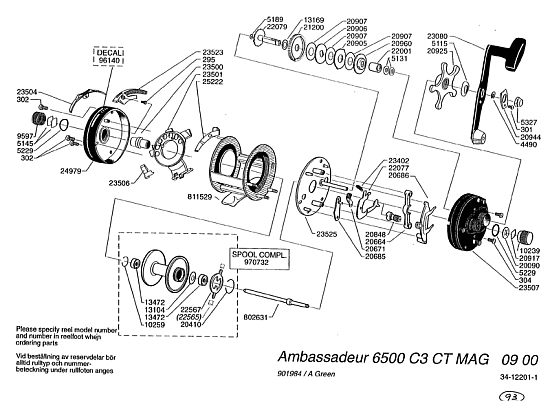
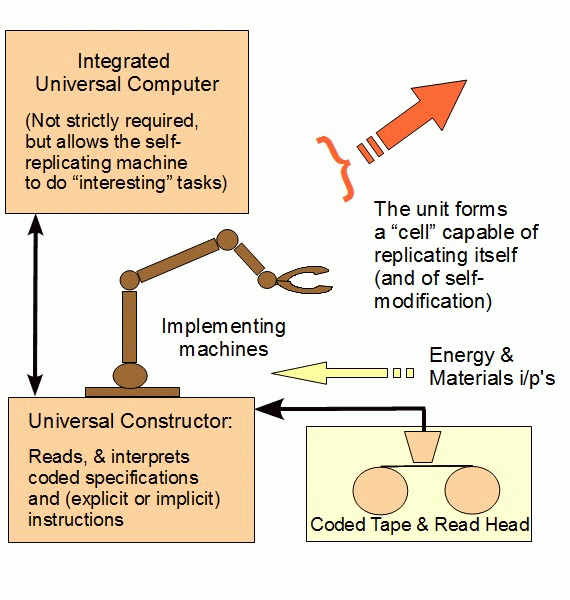
self-replication reflects considerable additional FSCO/I, where
the living cell embeds such a vNSR

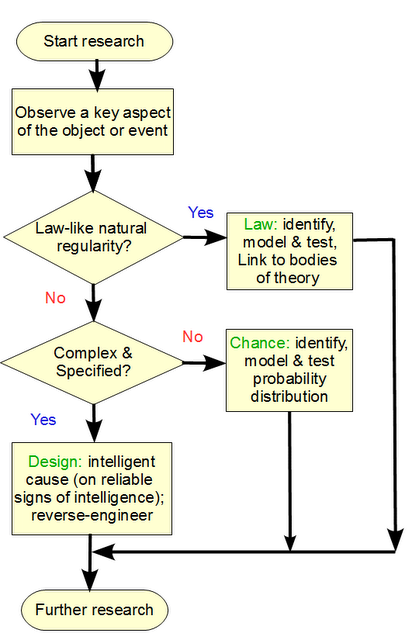
Note, inference, not movement, not theory.
Following the UD Weak Argument Correctives under the Resources tab, we can identify ID Theory as a [small] research programme that explores whether there are such observable, testable, reliable signs, whether they appear in the world of life and in the cosmos, whether we may responsibly — notice, how duties of reason pop up naturally — use them to infer that cell based life, body plans, the cosmos etc are credibly the result of intelligently directed configuration . . . and that’s a definition of design. This, in a context where the proposed “scientific” alternative, blind chance and/or mechanical necessity has not been observed to actually produce things exhibiting FSCO/I etc.
Logically, this is an application of inductive reasoning, modern sense, abduction.
Which is common in science and is commonly held to ground scientific, weak philosophical sense, knowledge. Weak, it is open ended and can be defeated by further analysis and evidence, warranted, credibly true [and so reliable] belief.
Going beyond, where we have further information, evidence and argument we may explore whodunit, howtweredun, etc.
Such is after all commonplace in technical forensics, medical research, archaeology, engineering [esp. reverse engineering], code cracking etc. I guess, these can be taken as design-oriented sciences. Going back to 4th form I remember doing natural science explorations of springs. Manufactured entities. So are lenses, mirrors, glass blocks, radio systems, lasers etc.
Beyond the theory, there is a movement, comprising supporters and friendly critics as well as practitioners consciously researching design theory or extending thinking on it and applying same to society or civilisation, including history of ideas.
The first major design inference on record in our civilisation is by Plato, in The Laws, Bk X:
Ath [in The Laws, Bk X 2,360 ya]. . . .[The avant garde philosophers and poets, c. 360 BC] say that fire and water, and earth and air [i.e the classical “material” elements of the cosmos — the natural order], all exist by nature and chance, and none of them by art . . . [such that] all that is in the heaven, as well as animals and all plants, and all the seasons come from these elements, not by the action of mind, as they say, or of any God, or from art, but as I was saying, by nature and chance only [ –> that is, evolutionary materialism is ancient and would trace all things to blind chance and mechanical necessity, contrasted to “the action of mind” i.e. intelligently directed configuration] . . . .
[[T]hese people would say that the Gods exist not by nature, but by art, and by the laws of states, which are different in different places, according to the agreement of those who make them . . . .
Then, by Heaven, we have discovered the source of this vain opinion of all those physical investigators . . . . they affirm that which is the first cause of the generation and destruction of all things, to be not first, but last, and that which is last to be first, and hence they have fallen into error about the true nature of the Gods.
Cle. Still I do not understand you.
Ath. Nearly all of them, my friends, seem to be ignorant of the nature and power of the soul [[ = psuche], especially in what relates to her origin: they do not know that she is among the first of things, and before all bodies, and is the chief author of their changes and transpositions. And if this is true, and if the soul is older than the body, must not the things which are of the soul’s kindred be of necessity prior to those which appertain to the body?
Cle. Certainly.
Ath. Then thought and attention and mind and art and law will be prior to that which is hard and soft and heavy and light; and the great and primitive works and actions will be works of art; they will be the first, and after them will come nature and works of nature, which however is a wrong term for men to apply to them; these will follow, and will be under the government of art and mind.
Cle. But why is the word “nature” wrong?
Ath. Because those who use the term mean to say that nature is the first creative power; but if the soul turn out to be the primeval element, and not fire or air, then in the truest sense and beyond other things the soul may be said to exist by nature; and this would be true if you proved that the soul is older than the body, but not otherwise.
[[ . . . .]
Ath. . . . when one thing changes another, and that another, of such will there be any primary changing element? How can a thing which is moved by another ever be the beginning of change? Impossible. But when the self-moved changes other, and that again other, and thus thousands upon tens of thousands of bodies are set in motion, must not the beginning of all this motion be the change of the self-moving principle? . . . . self-motion being the origin of all motions, and the first which arises among things at rest as well as among things in motion, is the eldest and mightiest principle of change, and that which is changed by another and yet moves other is second. [–> notice, the self-moved, initiating, reflexively acting causal agent, which defines freedom as essential to our nature, and this is root of discussion on agents as first causes.]
[[ . . . .]
Ath. If we were to see this power existing in any earthy, watery, or fiery substance, simple or compound-how should we describe it?
Cle. You mean to ask whether we should call such a self-moving power life?
Ath. I do.
Cle. Certainly we should.
Ath. And when we see soul in anything, must we not do the same-must we not admit that this is life?
[[ . . . . ]
Cle. You mean to say that the essence which is defined as the self-moved is the same with that which has the name soul?
Ath. Yes; and if this is true, do we still maintain that there is anything wanting in the proof that the soul is the first origin and moving power of all that is, or has become, or will be, and their contraries, when she has been clearly shown to be the source of change and motion in all things?
Cle. Certainly not; the soul as being the source of motion, has been most satisfactorily shown to be the oldest of all things.
Ath. And is not that motion which is produced in another, by reason of another, but never has any self-moving power at all, being in truth the change of an inanimate body, to be reckoned second, or by any lower number which you may prefer?
Cle. Exactly.
Ath. Then we are right, and speak the most perfect and absolute truth, when we say that the soul is prior to the body, and that the body is second and comes afterwards, and is born to obey the soul, which is the ruler?
[[ . . . . ]
Ath. If, my friend, we say that the whole path and movement of heaven, and of all that is therein, is by nature akin to the movement and revolution and calculation of mind, and proceeds by kindred laws, then, as is plain, we must say that the best soul takes care of the world and guides it along the good path. [[Plato here explicitly sets up an inference to design (by a good soul) from the intelligible order of the cosmos.
Earlier in the same Bk X, he had noted just how old and how philosophically loaded evolutionary materialism and its appeal to chance and/or necessity are, drawing out consequences for law, government and community:
Ath[enian Stranger, in The Laws, Bk X 2,360 ya]. . . .[The avant garde philosophers and poets, c. 360 BC] say that fire and water, and earth and air [i.e the classical “material” elements of the cosmos — the natural order], all exist by nature and chance, and none of them by art . . . [such that] all that is in the heaven, as well as animals and all plants, and all the seasons come from these elements, not by the action of mind, as they say, or of any God, or from art, but as I was saying, by nature and chance only [ –> that is, evolutionary materialism is ancient and would trace all things to blind chance and mechanical necessity; observe, too, the trichotomy: “nature” (here, mechanical, blind necessity), “chance” (similar to a tossed fair die), ART (the action of a mind, i.e. intelligently directed configuration)] . . . .
[Thus, they hold] that the principles of justice have no existence at all in nature, but that mankind are always disputing about them and altering them; and that the alterations which are made by art and by law have no basis in nature, but are of authority for the moment and at the time at which they are made . . .
We see the wider setting and the more specific themes.>>
U/D May 14, to promote from 470 below and onward, a summary of kernel ID theory as a cluster of postulates — based on clips from the UD Resources tab:
ID as a Postulates based Scientific Framework
The theory of intelligent design (ID) holds
[–> key, evidence backed postulate, cf those of Newtonian dynamics and special then general relativity, thermodynamics and statistical thermodynamics, postulational cores can be brief but sweeping in impact]
that
[First, Evidence-backed Programmatic Postulate:] certain features of the universe and of living things are best explained [–> explicit reference to logic of abductive reasoning] by an intelligent cause rather than an undirected process such as natural selection.
ID is thus a scientific disagreement with the core claim of evolutionary theory that the apparent design of living systems is an illusion.
In a broader sense,
[2nd, Operational Postulate:] Intelligent Design is simply the science of design detection — how to recognize patterns arranged by an intelligent cause for a purpose.
Design detection is used in a number of scientific fields, including anthropology, forensic sciences that seek to explain the cause of events such as a death or fire, cryptanalysis and the search for extraterrestrial intelligence (SETI). [–> design oriented sciences. Signal to noise ratio in telecommunications is based on a design inference.]
[3rd, Empirical Warrant/Point of test or potential falsification postulate:] An inference that certain biological information may be the product of an intelligent cause can be tested or evaluated in the same manner as scientists daily test for design in other sciences.
ID is controversial because of the implications of its evidence, rather than the significant weight of its evidence. ID proponents believe science should be conducted objectively, without regard to the implications of its findings. This is particularly necessary in origins science because of its historical (and thus very subjective) nature, and because it is a science that unavoidably impacts religion.
[Evidence Corollary:] Positive evidence of design in living systems consists of the semantic, meaningful or functional nature of biological information, the lack of any known law that can explain the sequence of symbols that carry the “messages,” and statistical and experimental evidence that tends to rule out chance as a plausible explanation. Other evidence challenges the adequacy of natural or material causes to explain both the origin and diversity of life . . . .
Intelligent design [ID] – Dr William A Dembski, a leading design theorist, has defined ID as “the science that studies signs of intelligence.” That is,
[4th, Designs and Signs Postulate:] as we ourselves instantiate [thus exemplify as opposed to “exhaust”], intelligent designers act into the world, and create artifacts. When such agents act, there are certain characteristics that commonly appear, and that – per massive experience — reliably mark such artifacts. It it therefore a reasonable and useful scientific project to study such signs and identify how we may credibly reliably infer from empirical sign to the signified causal factor: purposefully directed contingency or intelligent design. [–> definition of design, note, abductive inference from observed sign to signified cause.]
Among the signs of intelligence of current interest for research are:
[Supplement, on evidence:] [a] FSCI — function-specifying complex information [e.g. blog posts in English text that take in more than 143 ASCII characters, and/or — as was highlighted by Yockey and Wickens by the mid-1980s — as a distinguishing marker of the macromolecules in the heart of cell-based life forms], or more broadly
[b] CSI — complex, independently specified information [e.g. Mt Rushmore vs New Hampshire’s former Old Man of the mountain, or — as was highlighted by Orgel in 1973 — a distinguishing feature of the cell’s information-rich organized aperiodic macromolecules that are neither simply orderly like crystals nor random like chance-polymerized peptide chains], or
[c] IC — multi-part functionality that relies on an irreducible core of mutually co-adapted, interacting components. [e.g. the hardware parts of a PC or more simply of a mousetrap; or – as was highlighted by Behe in the mid 1990’s — the bacterial flagellum and many other cell-based bodily features and functions.], or
[d] “Oracular” active information – in some cases, e.g. many Genetic Algorithms, successful performance of a system traces to built-in information or organisation that guides algorithmicsearch processes and/or performance so that the system significantly outperforms random search. Such guidance may include oracles that, step by step, inform a search process that the iterations are “warmer/ colder” relative to a performance target zone. (A classic example is the Weasel phrase search program.) Also,
[e] Complex, algorithmically active, coded information – the complex information used in systems and processes is symbolically coded in ways that are not preset by underlying physical or chemical forces, but by encoding and decoding dynamically inert but algorithmically active information that guides step by step execution sequences, i.e. algorithms. (For instance, in hard disk drives, the stored information in bits is coded based a conventional, symbolic assignment of the N/S poles, forces and fields involved, and is impressed and used algorithmically. The physics of forces and fields does not determine or control the bit-pattern of the information – or, the drive would be useless. Similarly, in DNA, the polymer chaining chemistry is effectively unrelated to the information stored in the sequence and reading frames of the A/ G/ C/ T side-groups. It is the coded genetic information in the successive three-letter D/RNA codons that is used by the cell’s molecular nano- machines in the step by step creation of proteins. Such DNA sets from observed living organisms starts at 100,000 – 500,000 four-state elements [200 k – 1 M bits], abundantly meriting the description: function- specifying, complex information, or FSCI.)
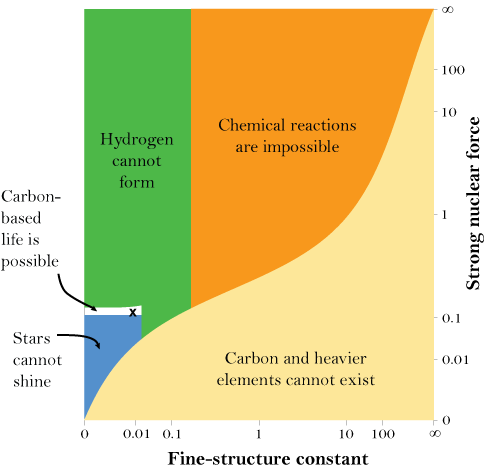
[(f) evidence of the fine tuned cosmos.] . . . .
Thus, ID can be framed on postulates, and we may draw forth from such that cells using memory structures storing coded algorithms and associated execution machinery are strong evidence of the design of cell based life. With Drexler, we are looking a bit at nanotech issues.>>
Food for thought and for clarification. END
U/D May 8th, to allow another thread to return to its focus:
>>THE FOLLOWING COME FROM THE LEAK CASE THREAD:
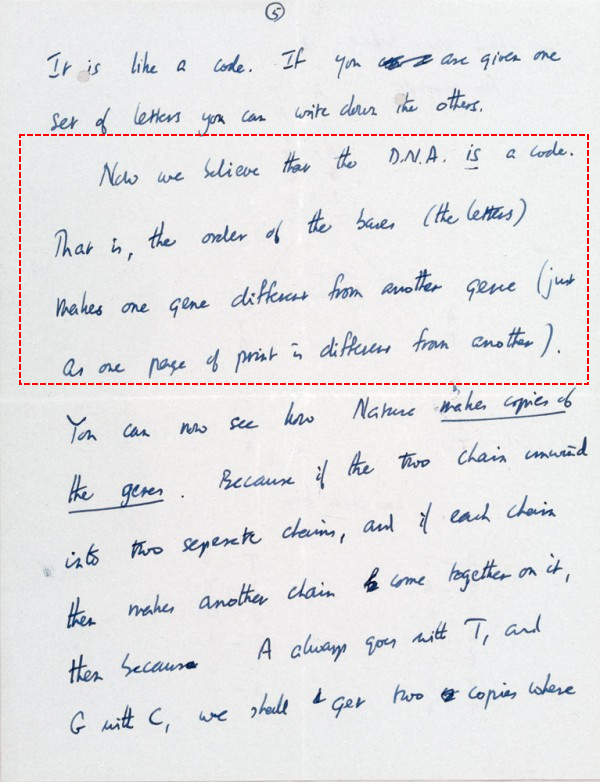
F/N May 7: As tangential objections to the design inference have been taken up (in obvious subject switching) I pose p. 5 from Sir Francis Crick’s March 19, 1953 letter to his son:
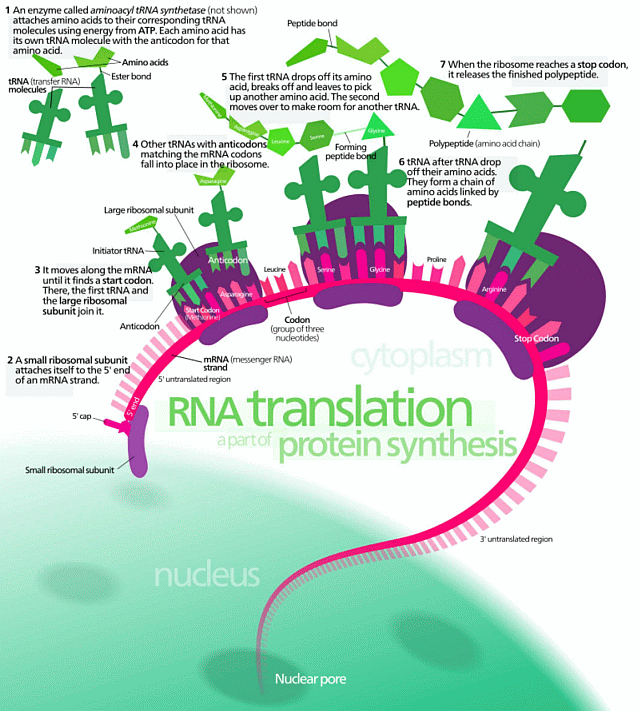
And, here is the protein synthesis process in outline:
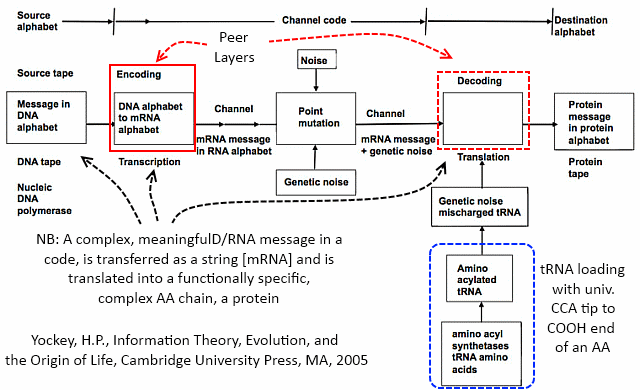
Together with a summary of the information communication system involved, as outlined by Yockey:
F/N, May 8: As the tangent continues, it seems a further illustration is advisable:
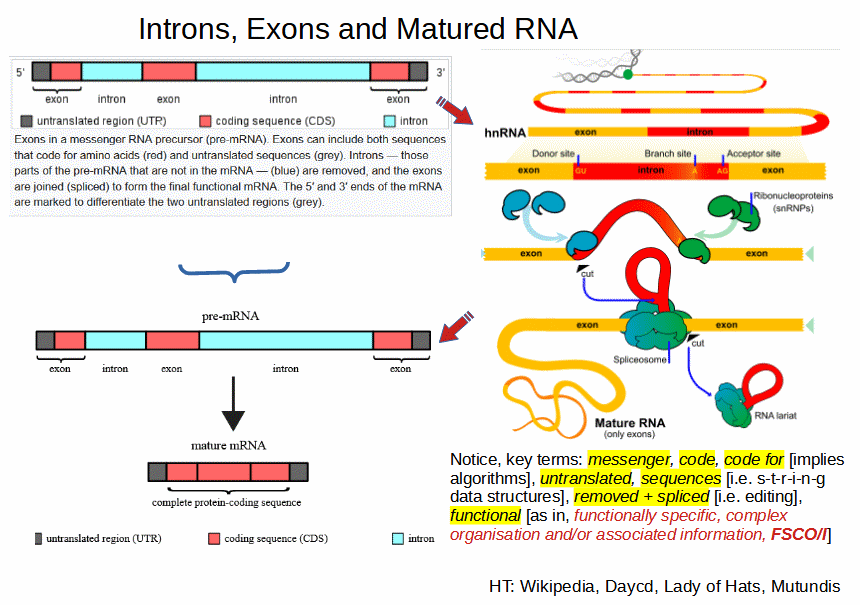
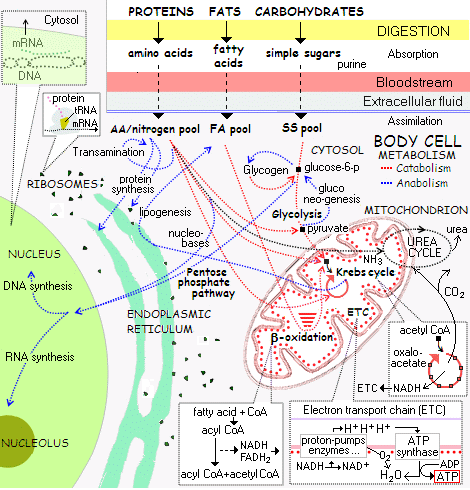
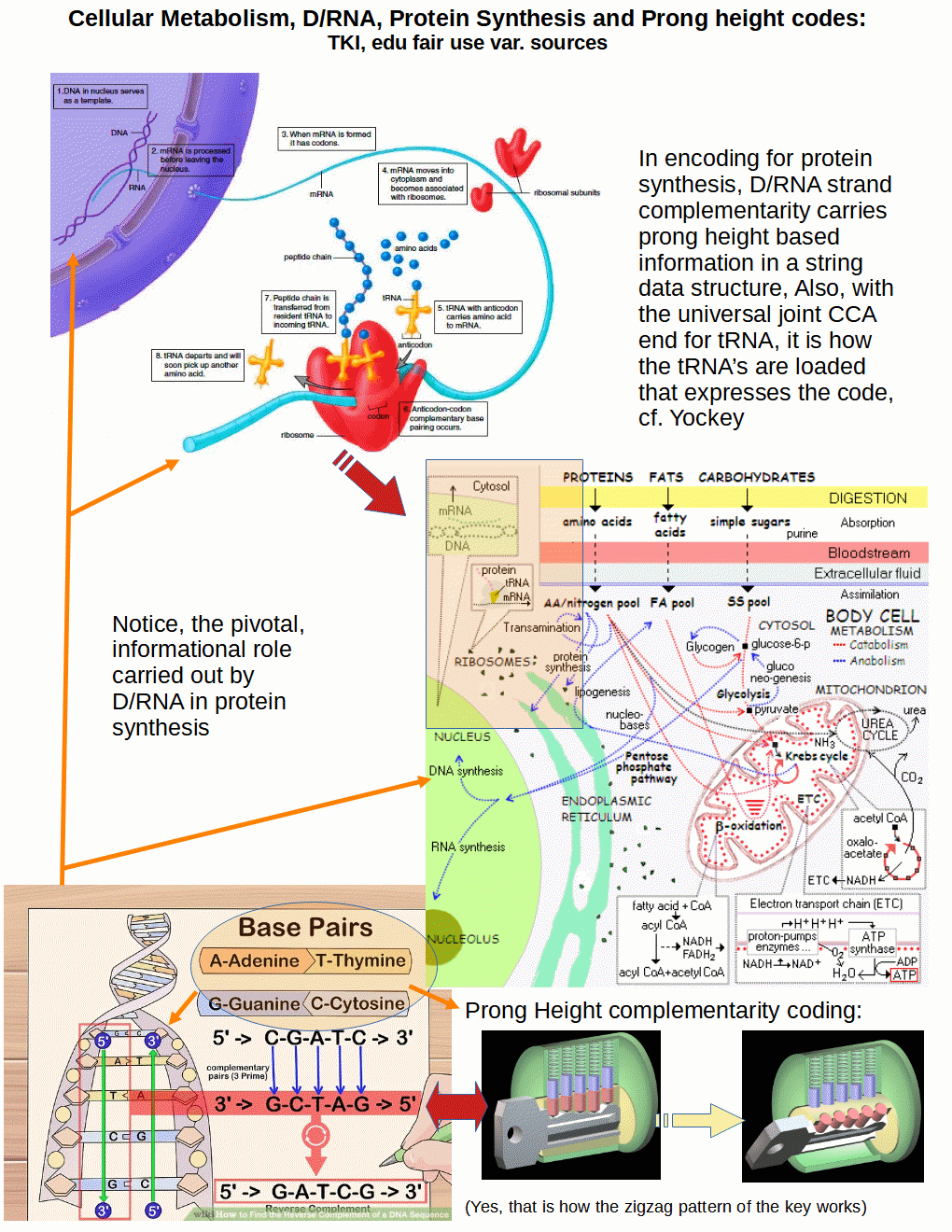
It seems more is needed, so here is how this fits into protein synthesis and the metabolic network and how we see prong height coding:
In for a penny, in for a pound, here is a video:
Notice, we are actually dealing with a storage register. Say, each shaft with pins is set for five positions, four elevated, one on the ledge. This is directly comparable to GCAT, and as the video shows there are five digits:
| X1 | X2 | X3 | X4 | X5 |
The key is encoded to the correct string of digits that in combination will open the lock, say 13213. The resting fully locked position is of course 00000.>>
U/D May 14: As a side chain appeared in another thread that is more appropriate here, I cross post a footnote added there:
It being now an obvious tactic to sidetrack non technical UD threads into ID debates (even where there is a thread that is live on the topic with relevant information, graphics and video) I will augment basic correction below by adding here a chart showing tRNA as a Drexler style molecular nanotech position-arm device:
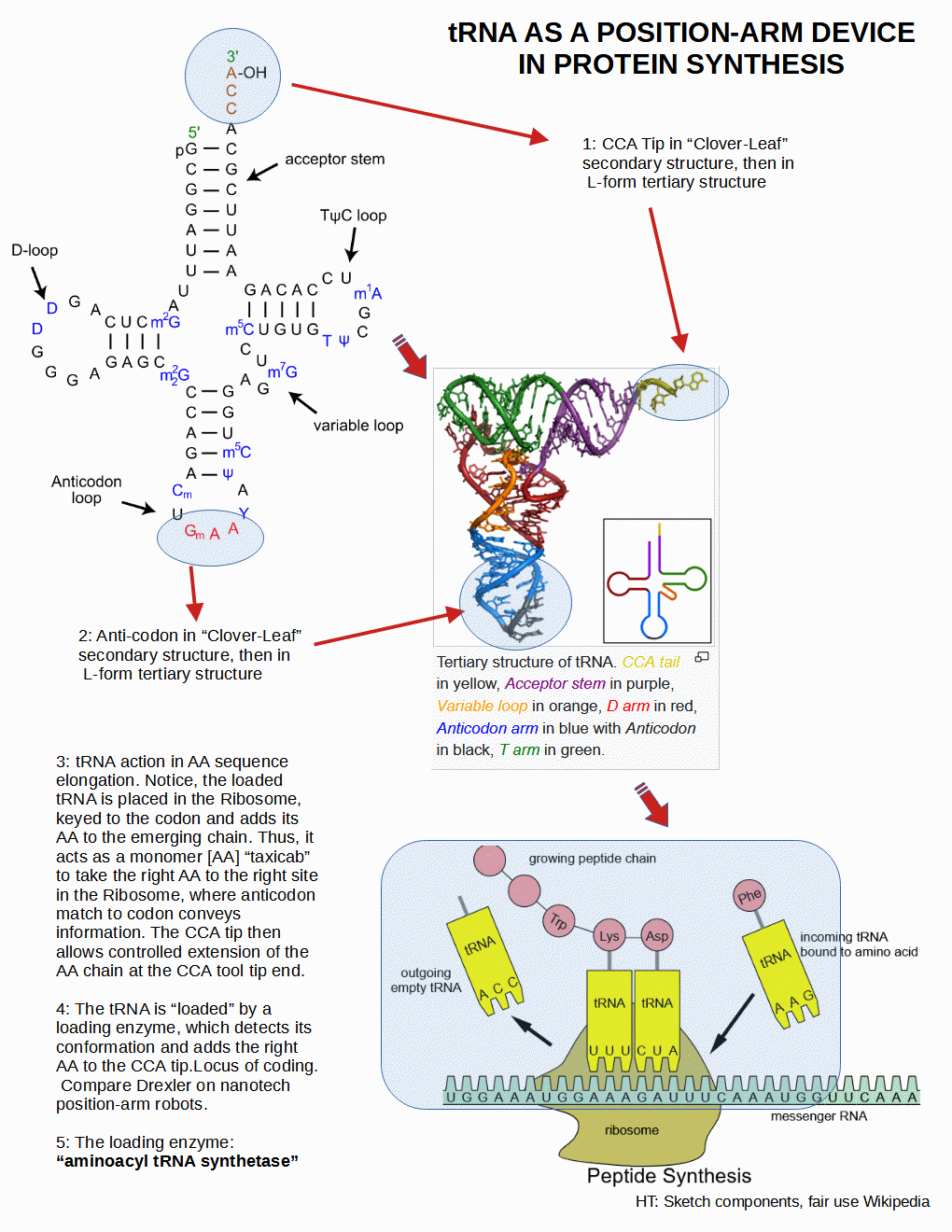
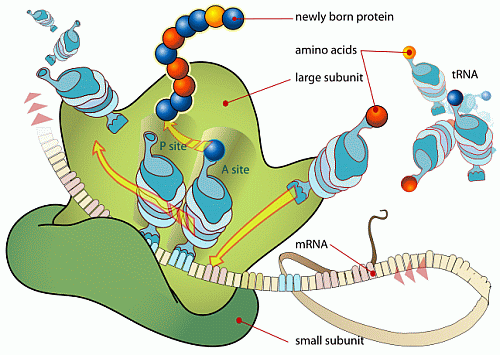
We may expand our view of the Ribosome’s action:
As a comparison, here is punched paper tape used formerly to store digital information:

We should tabulate”
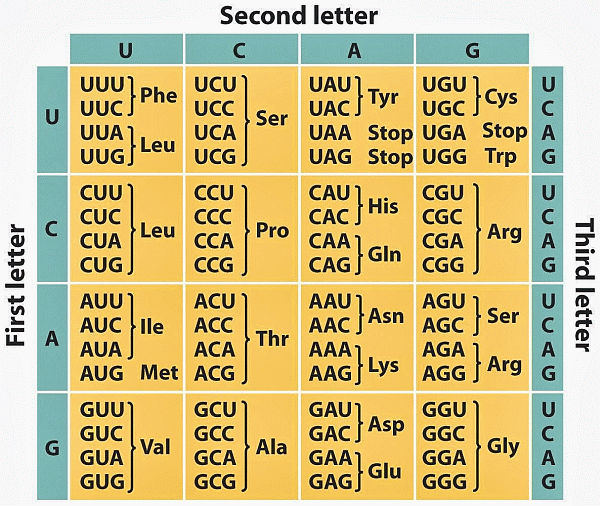
In Yockey’s communication system framework, we now can see the loading [blue dotted box] and how tRNA is involved in translation, as the AA chain towards protein formation is created, step by step — algorithm — under control of the mRNA chain of three base codons that match successive tRNA anticodons, the matching, of course is by key-lock fitting of G-C or C-G and A-T or T-A, a 4-state, prong height digital code:
Further to this, DNA has been extended with other similar monomers, and DNA has been used as a general purpose information storage medium for digital codes, apparently even including for movie files.
The point of this is, for record, to expose and correct how hyperskeptical objectors have inappropriately tried to deny that D/RNA acts as a string based digital information storage unit, that it holds algorithmic code used in protein synthesis, and latterly that tRNA acts in this process in the role of a position-arm nanotech robot device with a CCA tool tip, CCA being a universal joint that attaches to the COOH end of an AA.
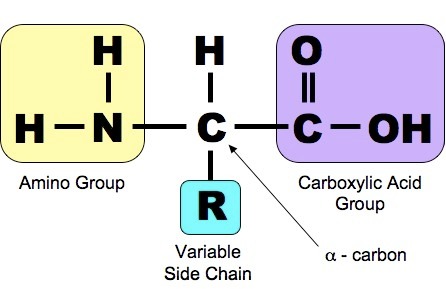
Speaking of which, AA structure, with side branches [R] and chaining links, i.e. NH2-alpha Carbon + R – COOH:
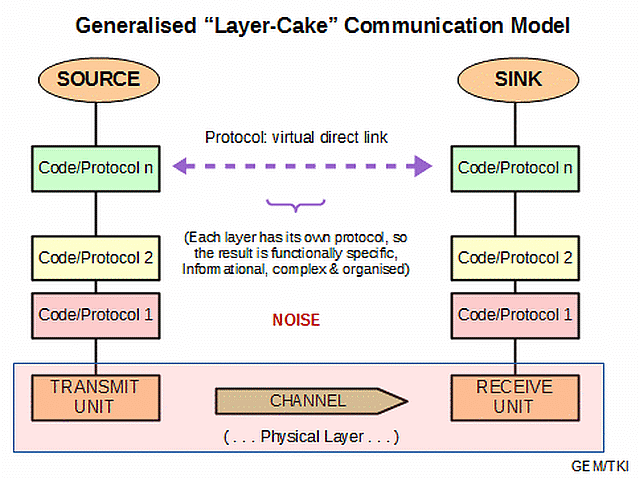
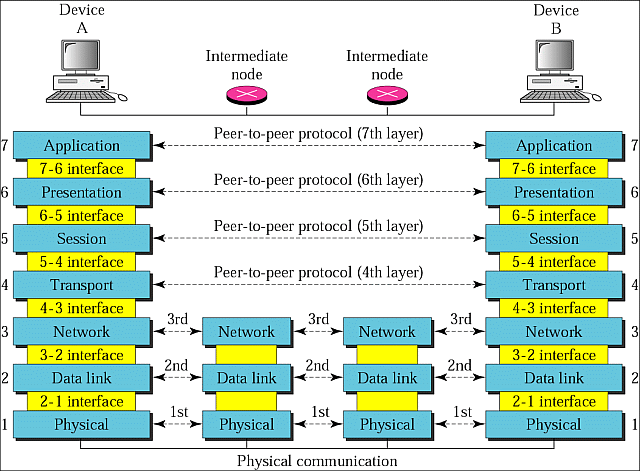
F/N, May 14, it is worth the while to add, regarding layer cake communication architectures and protocols:
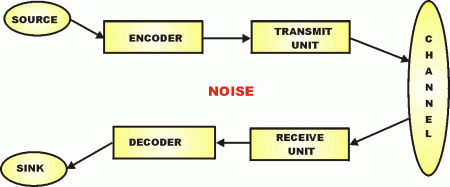
Where, underlying this is the Shannon model, here bent into a U to show how layers fit in, this also ties to Yockey:
We may then extend to Gitt’s broader framework:
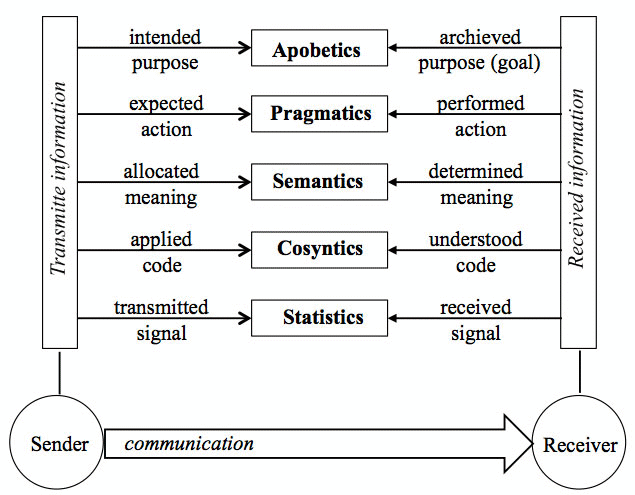
As an illustration, the ISO model:
Similarly, here is a layer cake view of a computer (network ports can be added):
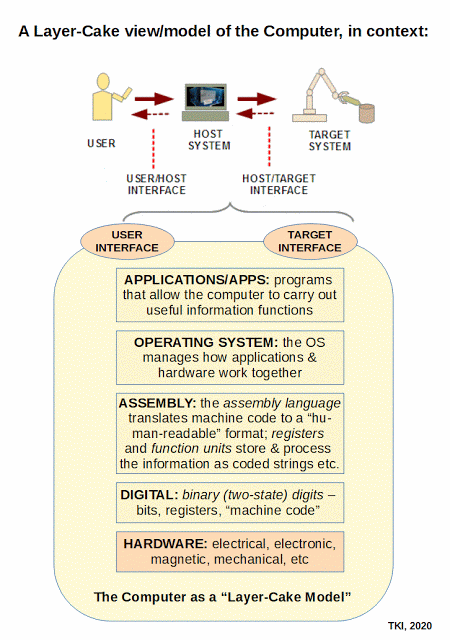
These layers, of course, are abstract, only the physical layer is hardware we can see directly. Even for that, we cannot easily see all the design details for compatibility and function.
These may be compared to Yockey, to draw out the framework of codes, protocols and communication requisites.
U/D May 21, on illustrating one aspect of cosmological fine tuning: