Uncommon Descent Serving The Intelligent Design Community

The spliceosome: a molecular machine that defies any non-design explanation.

Categories
Intelligent Design
Share
Facebook
Twitter/X
LinkedIn
Flipboard
Print
Email

OK, let’s start with a very simple fact: eukaryotic genes have introns.

IOWs, they are not continuous. They are made of exons and introns: exon – intron – exon – intron – exon and so on. Exons code for the protein. Introns don’t.

So, when the content of the gene is copied to the mRNA, introns must be cut away, and only exons are retained, in order to be translated, so that the mature mRNA can be transferred to the cytoplasm and translated by the ribosome.

This process of removing introns is called splicing.

Now, a few clarifications:

a) Introns exist in prokaryotes too, but they are rather rare. For our purposes, we will only discuss introns in eukaryotes.

b) Introns exist in many different types of genes. For our purposes, we will discuss only those in protein coding genes.

c) The origin and possible function of introns is, still, a mystery.

d) Introns are usually longer than exons. In humans, for example, they amount to approximately 35% of the whole geneome, vs about 1.5% of coding exons.

e) However, the amount and length of introns can vary a lot in different organims. An extreme example is yeast (s. cerevisiae), whose genome contains a very small amount of introns (about 250 out of about 6250 genes).

When the gene if transcribed, both exons and introns are transcribed. A 5′ UTR (Untranslated region) and 3′ UTR, is also part of the pre-mRNA.


Fig. 1
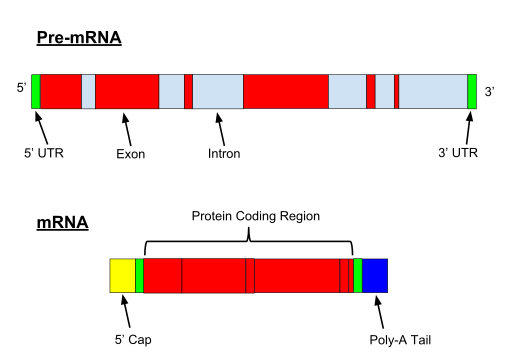
Pre-mRNA is the first form of RNA created through transcription in protein synthesis. The pre-mRNA lacks structures that the messenger RNA (mRNA) requires. First all introns have to be removed from the transcribed RNA through a process known as splicing. Before the RNA is ready for export, a Poly(A)tail is added to the 3’ end of the RNA and a 5’ cap is added to the 5’ end. – By Nastypatty (Own work) [CC BY-SA 4.0 (https://creativecommons.org/licenses/by-sa/4.0)], via Wikimedia Commons

So the question is: how are introns removed from pre-mRNA? IOWs, how is splicing achieved?

And there is more. As everybody probably knows, splicing is not always done in the same way. Different isoforms of the same protein can be obtained by alternative splicing, and they can have functional differences. I will not go into details about that, but here is the Wikipedia page about alternative splicing:

https://en.wikipedia.org/wiki/Alternative_splicing

So, how is splicing done, and how is alternative splicing regulated?

We know much about the first question, very little about the second.

There are three ways to perform splicing:

  1. Spliceosomal splicing
  2. Self-splicing
  3. tRNA splicing

The last two modalities are rare, and can be found both in prokaryotes and eukaryotes. I will not discuss them here.

So, the subject of this OP is spliceosomal splicing, which is restricted to eukaryotes.

Moreover, I will discuss only the major spliceosome, which is responsible for the vast majority of splicing in eukaryotes. It must be said, however, that also a minor spliceosome exists, and that it acts in a minority of cases.

So, the spliceosome.

The first important point is:

It is an amazing molecular machine. Even more, it is an amazing molecular cycle, involving many different stages each of which is an amazing molecular machine.

Let’s see. Here is a figure which summarizes the main stages of the spliceosome cycle:


Fig. 2
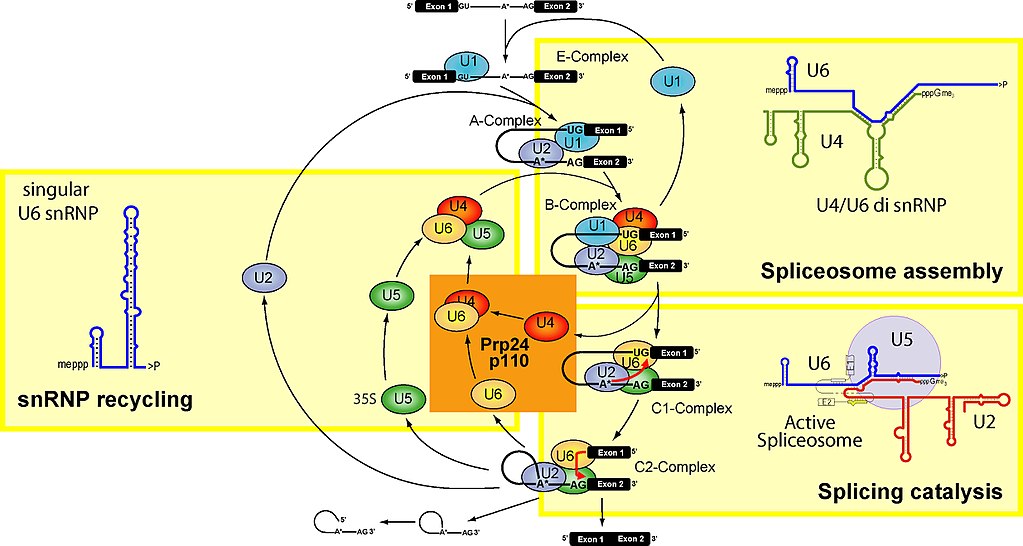
 

Spliceosomal splicing cycle – By JBrain [CC BY-SA 2.0 de (https://creativecommons.org/licenses/by-sa/2.0/de/deed.en)], via Wikimedia Commons

To make it simple, the spliceosome units are built upon 5 specific RNAs, called small nuclear RNAs (snRNA). These are, in humans:

U1 (164 bases), U2 (187 bases), U4 (145 bases), U5 (116 bases), U6 (107 bases)

They are transcribed from multiple gene copies. While their sequences are not particularly conserved (U6 being the most conserved of all), their secondary structure seems to be very conserved.

snRNAs are very important in the spliceosome, because they seem to be responsible for the catalytic activities.

Each of the 5 snRNAs forms a complex with proteins, and the complex takes the name of snRNP. The whole spliceosome includes at least 145 different proteins, maybe more, some of which are still not well known.

I will mention here some of the most important:


U1 snRNP:

U1 snRNP 70 kDa  (P08621, 437 AAs)

U1 snRNP A (P09012, 282 AAs)

U1 snRNP C  (P09234, 159 AAs)

Sm proteins: 7 small proteins (76 – 240 AAs) which form the “Sm core” ring in spliceosome subunits U1, U2, U4, U5, a ring which hosts the specific snRNA molecule.


U2 snRNP:

U2 snRNP A’ (P09661, 255 AAs)

U2 snRNP  B” (P08579, 225 AAs)

SF3a120 (Q15459, 793 AAs)

SF3a66 (Q15428, 464 AAs)

SF3a60 (Q12874, 501 AAs)

SF3b155 (O75533, 1304 AAs)

SF3b145 (Q13435,  895 AAs)

SF3b130 (Q15393, 1217 AAs)

SF3b49 (Q15427, 424 AAs)

SF3b14a/p14 (Q9Y3B4, 125 AAs)

SF3b10 (Q9BWJ5, 86 AAs)

Sm proteins


U4/U6 snRNP:

Prp3 (O43395, 683 AAs)

Prp31 (Q8WWY3, 499 AAs)

Prp4 (O43172, 522 AAs)

Cyph ( O43447, 177 AAs)

15.5 K (P55769, 128 AAs)

Sm proteins (for the U4 snRNA)

Lsm proteins: a number of proteins similar to Sm proteins (usually Lsm 2-8), which form a specific ring for the U6 snRNA.


U5 snRNP:

Prp8 (Q6P2Q9, 2335 AAs)

BRR2 (O75643, 2136 AAs)

Snu114 (Q15029, 972 AAs)

Prp6 (O94906, 941 AAs)

Prp28 (Q9BUQ8, 820 AAs)

52 K (O95400, 341 AAs)

40 K (Q96DI7, 357 AAs)

Sm proteins


Additional proteins in the U4/U6/U5 complex:

hSnu66 (O43290, 800 AAs)

hSad1 (Q53GS9, 565 AAs)

27 K (Q8WVK2, 155 AAs)


OK, these are only the main components, and the best understood. We are still far from the sum total of 145/150 proteins which are involved in the spliceosome cycle.

But how does it work?

Always in brief. Here is a typical exon-intron structure:

Fig. 3

 

Parts of an intron – By miguelferig (Own work) [Public domain], via Wikimedia Commons


GU, A and AG are nucleotides almost universally conserved in all introns, approximately at the positions shown in the figure, and which have a fundamental role in splicing. However, the real stuff is much more complex than this (see the splicing code section). GU (n. 4 in the figure) is near to the 5′ end of the intron, AG (n. 1) near to the 3′ end. The A (n. 3 in the figure) is called “the branch point”. The py-py-py (n. 2 in the figure) is the “polypyrimidine tract”.

a) The U1 subunit binds to the GU sequence at the 5′ splice site in the intron

b) The U2 subunit binds to the “branch point”.

c) The U4/U6/U5 binds to the complex.

d) Numeorus further modifications take place, causing the formation of a “lariat” (including the intron), which is then cleaved, while the two exons are ligated.

I will spare you the many complexities in all the various steps, which are well summarized (in a very simplified way) in this Wikipedia page:

RNA splicing

See in particular the “Formation and activity” section.

Or, if you like more detail, here:

Spliceosome Structure and Function

And here is a very good video on the whole splicing process in yeast:


Now, if somebody still has doubts about the complexity of this molecular machine/process, let’s consider some important aspects.

  • 1. The spliceosome is a molecular machine which appears in eukaryotes.

I quote from this paper (in the abstract):

Origin and evolution of spliceosomal introns

There is no indication that any prokaryote has ever possessed a spliceosome or introns in protein-coding genes, other than relatively rare mobile self-splicing introns.

The following Table shows how some of the main proteins involved in the spliceosome activity show practically no trace of homology in prokaryotes. I have included also included in the table two examples  which show low homologies due to some domain which is already expressed in prokaryotes: Prp4, whose 209 bits of homology are due to a specific domain, WD40, and Prp28, which exhibits 313 bits linked to the DEXDc domain. The point is: many of the spliceosome proteins are complete novelties in eukaryotes, but not all of them.


 Protein Bacteria Archea
U1 snRNP 70 kDa  (P08621, 437 AAs) 67
U2 SF3b130 (Q15393, 1217 AAs) 43.5
U4/U6 hPrp3 (O43395, 683 AAs)
U4/U6/U5 hSnu66 (O43290, 800 AAs)
U5 Prp8 (Q6P2Q9, 2335 AAs)
U5 Prp6 (O94906, 941 AAs) 100
U4/U6 hPrp4 (O43172, 522 AAs) 209 150
U/5 Prp28 (Q9BUQ8, 820 AAs) 313 286


I will analyze in more detail one of the most important proteins in the spliceosome, Prp8, in the last part of this OP

(Just a technical note: if you blast Prp8, you will find 3 hits which are obviously  an error due to unverified sequences, probably cases of contamination).

  • 2. The spliceosome is a molecular machine which is universally present in eukaryotes.

All eukaryotes have introns, even if in very different degrees, and the spliceosome, even if in some organisms parts of the spliceosome complex can be lost. For a more detailed discussion, look at the Rogozin paper quoted above (Origin and evolution of spliceosomal introns), in particular the section:

Intron density, size and distribution in protein coding genes across the eukaryote domain

I quote this important conclusion:

As pointed out above, despite the existence of numerous, diverse intron-poor genomes, eukaryotes do not lose the “last” intron or the spliceosome although degradation of the spliceosome including loss of many components does occur, e.g. in yeast. The only firmly established exception is the tiny genome of a nucleomorph (an extremely degraded intracellular symbiont of algae) that has lost both all the introns and the spliceosome [7]; preliminary genomic data indicate that all introns might have been lost also in a microsporidium, a highly degraded intracellular parasite distantly related to Fungi [54].

So, whe can conclude that both introns and the spliceosome are a universal feature of eukaryotes, the few exceptions being simply cases of loss of information.

  • 3. The spliceosome is a molecular machine whose information is extremely conserved throughout eukaryotes, up to humans.

I have already mentioned that the 5 RNAs which form the core of the spliceosome are not extremely conserved at sequence level, even if they are extremely conserved at structure level.

However, many of the proteins that compose the spliceosome show an amazing sequence conservation throughout eukaryotes. Now, even if we cannot be certain of when eukaryoyes really emerged, and of their early evolutionary history (both issues being at present highly controversial), we can reasonably assume that protein sequences which are highly conserved in all eukaryotes have been conserved for something like 2 billion years (more or less). As anybody who has followed my previous OPs about information conservation in vertebrates certainly knows, that is an evolutionary time frame which certainly allows us to equal conservation to extremely high functional constraint.

But how conserved are spliceosome proteins? We can analyze a few of them with my usual methodology: looking at human conserved information. The results shows that many proteins involved in the spliceosome are amazingly conserved in all eukaryotes. While there are a few cases which have a rather different evolutionary history, this is by far the most common behaviour for spliceosomal proteins.

Here is a sample of some important sequences that show high homology with the human form in all major groups of single celled eukaryotes. The 5 groups of single celled organisms chosen here, indeed, cover rather well the whole range of single celled eukaryotes.


Fig. 4
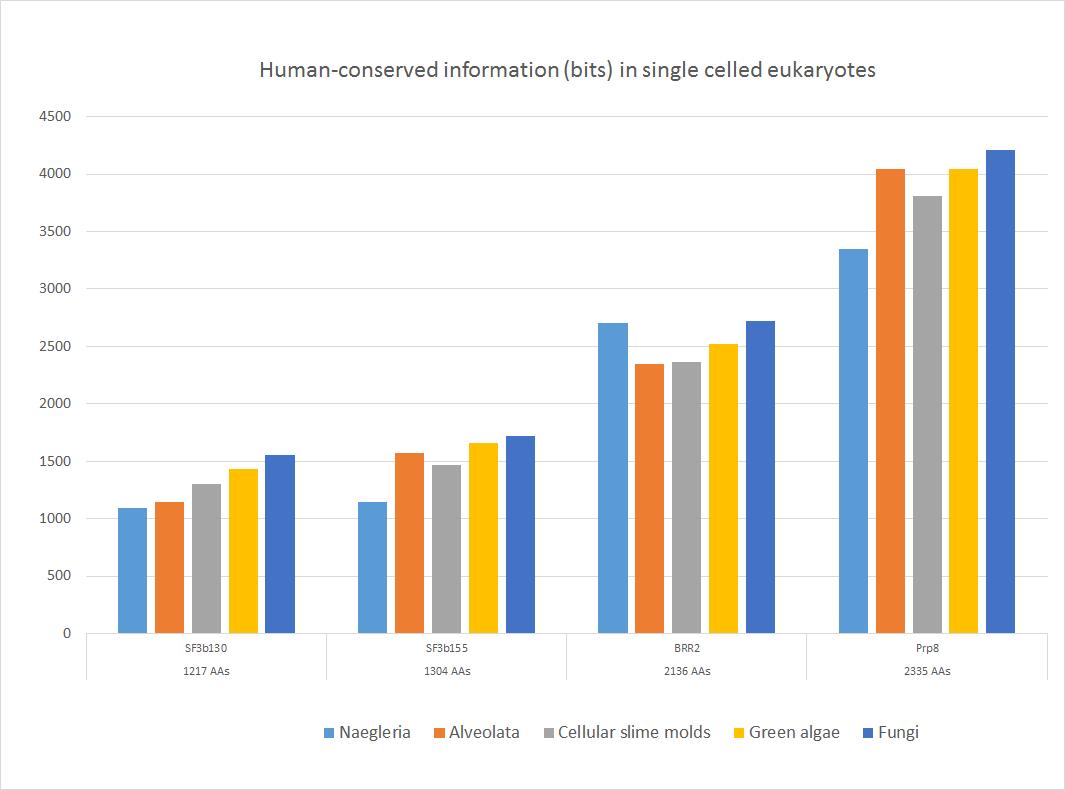
 

These four important proteins, as shown, have an amazing amount of information shared with the human form, ranging from more than 1000 to more than 4000 bits. In bits per AA, the range goes from 0.88 to 1.80 bits per aminoacid (baa).  As can be seen, the highest homology is found in fungi, as expected, because fungi are the most likely ancestors of metazoa. The lowest homologies are observed in Naegleria (Excavata) or in Alveolata.

Of course, these proteins remain highly similar to the human form in the following evolutionary history in Metazoa.

So, we can safely state that most spliceosomal proteins, while emerging almost entirely in eukaryotes and showing only trivial homologies with prokaryotes, were probably already universally present in the Last Universal Eukaryotic Ancestor (LECA), and in a form already very similar at sequence level to what we observe in metazoa and in humans.

  • 4. The spliceosome is a wonderful example of irreducibly complexity.

OK, we have already said that splicing can be achieved in at least three different ways. For example, bacterial introns, although rare, are of the self-splicing type. So, we know that the generic function of splicing introns can be implemented in different ways.

But eukaryotic introns are of the spliceosomal type, and they are spliced only by the spliceosome.

We have also said that a minor spliceosome also exists. It shares some featues with the major spliceosome, but it is a different structure and acts on different, and much rarer, introns.

So, for the vast majority of eukaryotic introns, the major spliceosome, and only the major spliceosome, can effectively accomplish the splicing.

Now, I don’t mean here that the major spliceosome must always be absolutely complete, with all its 150 proteins, to be able to work. That’s not what I mean when I say that it is irreducibly complex.

Maybe in some organisms the spliceosome can be partially defective, and still work. It is difficult to say, because we still don’t understand the role of all the components of the spliceosome.

But however, as far as we can understand, most of the principal features must be present, because, as we have seen, the splicing is the result of a complex cycle, involving the RNAs and the subunits, and all stages are essential to the final result.

So, the spliceosome is certainly highly irreducibly complex, even if we may not be able to clearly identify the essential nucleus of molecules which is absolutely necessary to the minimal function.

Moreover, the spliceosome would be useless if spliceosomal introns did not exist, with their properties and code (see later), and spliceosomal introns could not exist if the spliceosome were not there to splice them, because otherwise transcription would be completely ineffective. So, in that sense, spliceosomal introns and the spliceosome are a good example of chicken egg paradox, or we could also say that they form an irreducibly complex system at a higher level. And remember, the whole system seems to have been already present, very much similar to its current form in humans, in LECA, as we have seen.

But, of course, our darwinist friends will simply say that they have co-evolved!  🙂

Moreover, we can and should ask ourselves: why is the spliceosome so complex? The answer is not easy, because we still understand very little, but it is certainly related to the complexity of the splicing code, and to the fundamental issue of alternative splicing.

The Splicing code.

To splice introns by localizing 5 (or a few more) conserved nucleotides and then cutting at the ends of a lariat and rejoining the two exons is certainly a complex task, but apparently not so complex  that one of the biggest and most impressing known molecular machines is needed for that. But the simple truth is that recognizing and appropriately splicing all introns is a much more complex task than that.

That is due to the simple fact that conserved nucleotides at the ends are not a sufficient signal to identify the segment that has to be spliced, and that a lot of other components (not always well understood) are necessary to that, and that the splicing is not made always in the same way, and that alternative splicing is a very powerful tool for transcription regulation.

The subject is very complex, and I will not deal with it in depth. However, Those interested could look at this recent review:

The splicing code.

Unfortunately, the paper is paywalled, but the abstract is very informative.

The complexity of the splicing code can give us some insight about the true reasons for the complexity of the spliceosome, and definitely supposrts the idea that the whole system, introns, splicing code and spliceosome, is irreducibly complex.

The Prp8 protein.

I will add a few words about this proteins, which is probably the most amazing component of the spliceosome, and well represents its essential features.

This protein has many amazing charactertistics:

a) It is, as far as I can say, the longest protein in the whole spliceosomal system, and a very long protein indeed: 2335 AAs.

b) It is completely absent in prokaryotes.

c) It is extremely conserved in eukaryotes, probably the most conserved protein in the whole spliceosomal complex (see Fig. 4). In Naegleria, we have 3345 bits of homology with the human protein, corresponding to 1.4 baa, while in fungi we have the amazing result of 4211 bits of human-conserved information, corresponding to 1.8 baa. IOWs, in fungi we already find almost 90% of the functional information present in human Prp8 (remember, the highest possible bitscore is about 1.2 baas), corresponding to 1995 identities (86%) and 2155 positives (92%): a result which is incredibly rare, considering that such information has been conserved for about 2 billion years.

Just to emphasize the importance of this fact, here is the blast between the human protein and the best hit in fungi (Basidiobolus meristosporus):


d) It is a protein which is extremely important for the function of the spliceosome. Here is a very good paper about this protein and its functional relevance:

Prp8 protein: At the heart of the spliceosome

I quote from the conclusions:

Prp8p is central to the expression of all nuclear intron-containing mRNAs. In higher eukaryotes, it is responsible for processing thousands of transcripts in alternative splicing pathways, and in both U2 and U12 spliceosomes. It is important for the pathology of human disease, as all eukaryotic pathogens and parasites require Prp8p to functionally express their genes, in some cases via the trans-spliceosome. Retinitis Pigmentosa, a human genetic disorder that causes progressive blindness, positions Prp8p as a target for therapeutic medicine.

Moreover, another way to assess the functional constraints of a protein is to check its tolerance to polymorphisms in humans. That can be done consulting a very recent and useful database, the ExAC browser, which reports data from about 60000 human genomes.

ExAC gives two important metrics to assess how much a protein is tolerant to polymorphisms and variants. I quote here from the site FAQ:

What are the constraint metrics?

For synonymous and missense, we created a signed Z score for the deviation of observed counts from the expected number. Positive Z scores indicate increased constraint (intolerance to variation) and therefore that the gene had fewer variants than expected. Negative Z scores are given to genes that had a more variants than expected.

For LoF, we assume that there are three classes of genes with respect to tolerance to LoF variation: null (where LoF variation is completely tolerated), recessive (where heterozygous LoFs are tolerated), and haploinsufficient (where heterozygous LoFs are not tolerated). We used the observed and expected variants counts to determine the probability that a given gene is extremely intolerant of loss-of-function variation (falls into the third category). The closer pLI is to one, the more LoF intolerant the gene appears to be. We consider pLI >= 0.9 as an extremely LoF intolerant set of genes.

Now, for Prp8 we get the following results:

Constraint
from ExAC
Expected
no. variants
Observed
no. variants
Constraint
Metric
Synonymous 366.6 460 z = -3.02
Missense 920.2 266 z = 10.55
LoF 92.6 8 pLI = 1.00

That means the following:

a) The number of observed missense variants is so low vs expected (266 vs 920.2) that the z value is 10.55 (IOWs, 10.55 standard deviations, more than 10 sigma). Believe me, this is a really exceptional result, most proteins are much more tolerant to missense variants.

b) The probability of loss of function is 1. That means that even heterozygous LoF is absolutely not tolerated.

This is an extremely functional molecule, if ever there was one!

A brief conclusion.

To sum up the meaning of this rather long discussion, I would simply say:

  1. The introns – spliceosome system is a molecular machine of amazing complexity. I have touched only its main aspects in this OP, but believe me, there are layers of complexity there that would require a whole treatise and that I have not even started to mention here.
  2. Whoever can really believe that all this can be explained by some RV + NS model is, IMO, really admirable for his faith in a wrong paradigm.
Comments
hnorman5: I absolutely agree. Thank you for pointing to that. :)gpuccio
December 24, 2017
December
12
Dec
24
24
2017
09:46 AM
9
09
46
AM
PDT
nkendall: Thank you for your very interesting intervention: I love the analogies between biologic information and human language! :) You could perhaps be interested in this older OP of mine: An attempt at computing dFSCI for English language https://uncommondescent.com/intelligent-design/an-attempt-at-computing-dfsci-for-english-language/ Have a great holiday! :)gpuccio
December 24, 2017
December
12
Dec
24
24
2017
09:45 AM
9
09
45
AM
PDT
Arthur Hunt (and all interested): Now, another important point I would like to discuss. Group II introns are supposed to be at the origin of spliceosomal introns. But also of the retrotransposon component of metazoa genome. IOWs, of most of our genome: introns and a great part of intergenic non coding DNA. That's an important theory, and I want to discuss it in some detail. Moreover, group II introns have been in some way involved in a theory about the evolution of spliceosomal proteins. I will discuss that point later, when I come to point 2 (the proteins). Let's refer again to the Lambowitz and Belfort paper, the first I quoted. In brief, group II introns are obviously similar to other retrotransposons, in particular non-LTR retrotransposons (SINEs and LINEs). You can find some details in the paper section: "Mobile group II intron-eukaryotic retrotransposon relationships" However, the possible derivations of SINEs and LINEs (important intergenic forms of non coding DNA) from bacterial group II introns, while fascinating, are not really relevant for our discussion here, so I will not go into further detail about this aspect. Much more interesting, for us, is the idea that eukaryotic spliceosomal introns, those which are spliced by our friend the spliceosome, may derive from group II self-splicing introns. The theory goes more or less this way: group II introns were carried on from prokaryotes in the endosymbiont events, and then "invaded" the eukaryotic genome, becoming the spliceosomal introns. That is possible, but there is one major problem: group II introns cannot be found in the eukaryotic nuclear genome (only in the organelles), and spliceosomal introns are rather different. For example, the conserved splicing signals in 5' and 3' are similar, but not the same: GUGYC and AY in group II introns GU and AG in spliceosomal introns and, of course, spliceosomal introns, as far as I know, lack any ribozyme activity and do not encode IEPs. The two references given by the paper for this theory are indeed very old (1991, Cavalier-Smith and Palmer), and I could not find more recent support to the theory. I am not really convinced, I must say. However, even if spliceosomal introns "evolved" from group II introns, here again some major process of reorganization obviously took place: the fact remains that group II introns are absent from eukaryotic nuclear DNA, that spliceosomal introns cannot self-splice and require the spliceosome, and that obviously genes cannot be successfully transcribed and translated unless introns are spliced from mRNA. OK, more in next post, when possible! With the discussion about proteins, at last! :) In the meantime, my best wishes for Christmas time to all! :)gpuccio
December 24, 2017
December
12
Dec
24
24
2017
09:41 AM
9
09
41
AM
PDT
@98:
Although the structural working of the catalytic site is highly comparable, it is however realized in very different ways in the two contexts. In group II intron RNA, indeed, almost everything depends on the six domains in the one molecule, which fold into a very complex 3D structure. For example, the main role of scaffold here is implemented by DI, the biggest domain. Moreover, the only protein contribution is provided by the IEP, with its maturase activity. On the contrary, in the spliceosome we have five different RNA molecules, only one of which really corresponds to one domain in the group II intron RNA, and each of these five snRNAs is part of a complex with its specific proteins, a lot of them. The global interaction of all these ribonucleoproteins in some way reconstructs the structure of the catalytic site. Even if we consider only the final shared catalytic activity, I would definitely say that the two contexts are very different, and that going from the first to the second is no simple matter, and requires a lot of engineering.
This is very important to consider seriously. What's the official explanation for transitioning from one context to another?Dionisio
December 24, 2017
December
12
Dec
24
24
2017
09:25 AM
9
09
25
AM
PDT
gpuccio @98: "Although the structural working of the catalytic site is highly comparable, it is however realized in very different ways in the two contexts." This seems like a very important point. Isn't it?Dionisio
December 24, 2017
December
12
Dec
24
24
2017
09:00 AM
9
09
00
AM
PDT
Perhaps a bit OT for this thread, but interesting nonetheless? Looking for any coverage of the origin and evolution of the spliceosomes in The Evolution of the Genome Edited by T. Ryan Gregory. I didn't find any. Amazing. But I did find a pie chart on p. 553 that showed the "distribution of the homologs of the predicted human proteins." [ETA: This has nothing to do with spliceosomes. Different topic.] 1% had no animal homology. Vertebrate only 22% Vertebrates and other animals 24% Animals and other eukaryotes 32% Eukaryote and prokaryote 21% Prokaryotes only < 1% Is this really the pattern we would expect to see given common ancestry?Mung
December 24, 2017
December
12
Dec
24
24
2017
08:29 AM
8
08
29
AM
PDT
gpucci: "... they could make a very good argument for ID, in their own right." Probably correct. I can't judge the IC in complex molecular machines but I think there's two logical points that are relevant here. The contention that a structure is IC is not a concession that a smaller structure within it is not IC. And -- even if the smaller structure is not IC, it doesn't affect the IC of the larger structure.hnorman5
December 24, 2017
December
12
Dec
24
24
2017
08:26 AM
8
08
26
AM
PDT
Great article. Thanks for taking the time to put this together. As a broad-brush analysis that is intuitive for most let me offer the following. Suppose we put together an analogy between the complexity of the spliceosome and the English text necessary to describe it in detail. In this back of the envelope exercise I have made every effort to be charitable to Neo Darwinism--extraordinarily charitable. In Stephen Meyer's book, "Darwin's Doubt" he quotes Michael Denton as saying that the ratio of meaningful English sentences or phrases of 100 characters to character phrases that are unintelligible is 1 / 10^100. The article here references the paper: "Spliceosome Structure and Function", stripped of the TOC and Bibliography, this paper is about 65,000 characters. There are many pictures. It has been said that a picture is worth a thousand words. I think that is an understatement in this case. But let us say there are 10 pictures and assign 1000 words to each; each word has 4-5 letters. So roughly, let's say there are 100,000 English letters needed to describe the spliceosome based on this one article. A very low estimate for the adequacy of human informational conveyance especially considering we don't know everything there is to know about how the spliceosome works. But let's go with that anyway. Let's further assume that 100 characters is about the minimum distinct informational quantity that can be meaningful. Let's say that we have as many monkeys typing new English text phrases as we have grains of sand on earth (10^19) and that each monkey was turning out a new 100 character string each second. There have been about 10^18 seconds since our planet was born. So there could be only about 10^37 total 100-character English sentences/phrases generated since the birth of our planet using these assumptions. And let's further assume that every valid (meaningful) 100 character English phrase generated by our monkeys just happened to be suitable as a new (i.e. non-redundant) useful explanation for a spliceosome--in other words, let's factor out natural selection completely. These are all preposterous assumptions of course and all wildly favorable to Neo-Darwinism. Even with these assumptions the probability of obtaining a text to describe the splicesome would fall short by about 66 orders of magnitude. 10^103 - 10^37 Conclusion: Neo-Darwinism is a canard. But it is only the second greatest intellectual canard in human history. The greatest intellectual canard in human history is the metaphysical doctrine of materialism. It is the assumption of the truth of materialism that necessitates Neo-Darwinism and it is the believed truth of Neo-Darwinism that forms the necessary condition to support materialism. Together they form a grand intellectual tandem canard--a magnificent intellectual catch-22 and a supreme example of human gullibility. Be well all. Have a great holiday.nkendall
December 24, 2017
December
12
Dec
24
24
2017
08:00 AM
8
08
00
AM
PDT
Mung: Yes, of course!gpuccio
December 24, 2017
December
12
Dec
24
24
2017
07:15 AM
7
07
15
AM
PDT
And of course, given an hypothesis of intelligent design, one might expect to find such re-use.Mung
December 24, 2017
December
12
Dec
24
24
2017
06:59 AM
6
06
59
AM
PDT
Arthur Hunt (and all interested): So, let's take again the discussion. I think we have enough data now to answer point 1. Your point was: "There is indeed an abundance of evidence for the proposition that the structural and catalytic components of the spliceosome and group 2 introns are basically the same." and, (which is more or less the same): "At the heart of the splicesosome sits what is essentially a self-splicing intron." Is that true? In the light of what we know, I would definitely say: yes!. With some reservations that I will clarify. In my comment #54 I had already stated that I had nothing against this concept, I just needed more information. After some research, I can say that the concept is correct. Let's see some details: a) We have seen that the ribozyme catalytic activity in the group II intron RNA is mainly localized in one domain, DV. Well DV is also the only domain whcih is highly conserved, and at the same time the only domain which has high homology with one of the spliceosomal RNAs U6. On the other hand, U6 is also the most sequence conserved spliceosomal RNA, and directly involved in the catalysis. So, we can certainly say that this important piece of the complex is shared between the group II ribozyme and the spliceosomal catalytic site, both at sequence and at structure level. b) The rest of the RNA component is rather different in the two context, at sequence level. But we can accept that there is a very strong structure similarity, and that essentially the catalysis works in a very similar way in group II introns and in the spliceosome. I must say that the more i read about group II self-splicing introns, the more I become convinced that they are a fascinating structure, and that they could make a very good argument for ID, in their own right. :) However, let's not digress! For those who are interested in the basic structural features of the catalytic site, I would recommend this very good, although very technical, video: https://www.youtube.com/watch?v=ESXo3fTThBI Now, a few more points: c) Although the structural working of the catalytic site is highly comparable, it is however realized in very different ways in the two contexts. In group II intron RNA, indeed, almost everything depends on the six domains in the one molecule, which fold into a very complex 3D structure. For example, the main role of scaffold here is implemented by DI, the biggest domain. Moreover, the only protein contribution is provided by the IEP, with its maturase activity. On the contrary, in the spliceosome we have five different RNA molecules, only one of which really corresponds to one domain in the group II intron RNA, and each of these five snRNAs is part of a complex with its specific proteins, a lot of them. The global interaction of all these ribonucleoproteins in some way reconstructs the structure of the catalytic site. Even if we consider only the final shared catalytic activity, I would definitely say that the two contexts are very different, and that going from the first to the second is no simple matter, and requires a lot of engineering. More in next post.gpuccio
December 24, 2017
December
12
Dec
24
24
2017
04:52 AM
4
04
52
AM
PDT
#95 Mung, yes, it's my expectation as well.DATCG
December 23, 2017
December
12
Dec
23
23
2017
06:45 PM
6
06
45
PM
PDT
Found link, is this the correct Arthur Hunt? Arthur Hunt - UKY Research Gate ProfileDATCG
December 23, 2017
December
12
Dec
23
23
2017
06:44 PM
6
06
44
PM
PDT
DATCG:
Will we get detailed step by step evolutionary progress of interdependent systems coordination and organization?
My experience is that you'll find far more discussion of how the different sorts of introns evolved with far less devoted to to the origin and evolution of the spliceosomes. They will cover one and pretend to have thus addressed the other.Mung
December 23, 2017
December
12
Dec
23
23
2017
06:44 PM
6
06
44
PM
PDT
#44 PAV, thanks for book link.DATCG
December 23, 2017
December
12
Dec
23
23
2017
06:41 PM
6
06
41
PM
PDT
It is now clear that introns are not all alike, even in the most general terms. - Intervening Sequences in Evolution and Development. p. 112 gpuccio, If you let me know which kind of introns and/or which aspects of the spliceosomes you are studying deeper I'll see what I can contribute. So far you appear to be spot on. Good work. CheersMung
December 23, 2017
December
12
Dec
23
23
2017
06:41 PM
6
06
41
PM
PDT
Thanks Gpuccio on another engaging post. I look forward to Arthur Hunt's input regarding #50 #51 #56 assertions as well. As we track through this discussion, I wonder how many assumptions come from the heart of the matter, that are made for blind, unguided evolution to progress to the Spliceosome? Will we get detailed step by step evolutionary progress of interdependent systems coordination and organization? Driven by unguided, gradual step by step "process" or the usual narrative that "could have" or "may have likely" happened? I'm intrigued that this may offer up something unique in both sides of the discussion.DATCG
December 23, 2017
December
12
Dec
23
23
2017
06:34 PM
6
06
34
PM
PDT
Whoever can really believe that all this can be explained by some RV + NS model is, IMO, really admirable for his faith in a wrong paradigm. You are very kind. Personally, I call such a person a jackass. But that's just me.FourFaces
December 23, 2017
December
12
Dec
23
23
2017
06:26 PM
6
06
26
PM
PDT
gpuccio:
Just have a little patience! As you can see, the subject is rather complex.
ok. Guess I'll have to break out my copy of Intervening Sequences in Evolution and Development. Chapter 6 is "Different Types of Introns and Splicing Mechanisms." :)Mung
December 23, 2017
December
12
Dec
23
23
2017
06:08 PM
6
06
08
PM
PDT
gpuccio:
3) They [group II self-splicing introns] are not found in the nuclear genome of eukaryotes.
Lynch agrees: No group II intron has been found in a eukaryotic nuclear gene. (p. 244) Ir's amazing, all those mitochondrial genes that moved into the nuclear DNA, but none with a group II intron. What are the odds.Mung
December 23, 2017
December
12
Dec
23
23
2017
05:00 PM
5
05
00
PM
PDT
Mung, ET, Eric Anderson, Dionisio and others: I am postponing all discussion about the "origin of the spliceosome" and its relations with group II introns, because I believe that we have to have clear and detailed ideas on a number of important things before. Just have a little patience! As you can see, the subject is rather complex. :)gpuccio
December 23, 2017
December
12
Dec
23
23
2017
03:49 PM
3
03
49
PM
PDT
ET: Yes, of course, but let's just say that it is about 1% of protein coding genes! :)gpuccio
December 23, 2017
December
12
Dec
23
23
2017
03:45 PM
3
03
45
PM
PDT
Arthur Hunt (and all interested): Now, let's try to summarize the main points about group II self-splicing introns: 1) They are essentially retrotransposons, mobile elements 2) They can be found in bacteria, rarely in archaea, and in the organelles of eukaryotes (mitochondria and chloroplasts), where they are often degenerate. 3) They are not found in the nuclear genome of eukaryotes. Now, what is the structure of these special introns? Look at Fig 1 in the first paper I quoted. You will see the secondary structure of the RNA derived from a group II intron, organized into six domains (DI - DVI). Now, here it gets complicated. The intron-transcribed RNA is indeed a ribozyme, and has a catalytic activity which can self-splice it from the transcribed mRNA. The catalytic activity is especially implemented by the DV domain, but also other domains contribute. But the DIV domain is also special, because it includes an ORF, which encodes for a protein, called IEP (intron-encoded protein). This protein does three different things, by three different domains: a) A reverse transcriptase domain (RT), which can copy the RNA to DNA for retrotransposition b) A maturase domain which helps the ribozyme catalytic site to effecting the self-splicing c) A DNA binding domain and an endonuclease domain which intervene in the final phase of retrotransposition, when the new DNA is inserted in the genome (retro-homing). Not so simple, is it? :) OK, so to sum up: - the ribozyme activity in the transcribed intron itself effects the splicing (self-splicing). This process is rather complex, and is mediated by a complex tertiary structure, where the active site is mainly represented by DV. - however, the splicing probably need, in vivo, the intervention of the IEC, the protein encoded by DIV of the same intron, with its maturase acticity which helps stabilize the splicing by the ribozyme. In that sense, the ribozyme and its encoded protein act as a ribonucleoprotein complex. - moreover, the IEC, with other domains, can also intervene as a reverse transcriptase and endonuclease to allow retrotransposition and retro-homing of the intron code. Well, to onlookers: I told you it was not simple. I apologize again to Arthur Hunt for having to explain these basic points before going on with my reasonings. Any correction or integration will be welcome. I would leave it at that for today. I will go on tomorrow. As a final thought, I give you the Uniprot description of the function of a typical IEC, a protein encoded by the DIV of a group II intron. It is one of the best known, LtrA. In particular, the following relates to the LtrA in Lactococcus lactis, P0A3U0, a 599 AAs long protein. Here is the function section from Uniprot, which illustrates well many of the concepts I have described before:
Multifunctional protein that promotes group II intron splicing and mobility by acting both on RNA and DNA. It has three activities: reverse transcriptase (RT) for intron duplication, maturase to promote splicing, and DNA endonuclease for site-specific cleavage of recipient alleles. The intron-encoded protein promotes splicing by facilitating the formation of the catalytically active structure of the intron RNA. After splicing, the protein remains bound to the excised intron lariat RNA, forming ribonucleoprotein particles, and cleaving the antisense strand of the recipient DNA in the 3' exon. After DNA cleavage, retrohoming occurs by a target DNA-primed reverse transcription of the intron RNA that had reverse spliced into the sense strand of the recipient DNA. It also contributes to the recognition of the DNA target site and acts as a repressor of its own translation.
Moreover, just to have some idea of how conserved is this Ltra protein in bacteria, I have blasted the protein from Lactococcus lactis against a different group of bacteria, Proteobacteria. I got a best hit of 419 bits, and a range of 372 - 419 bits in the first 100 hits. That means that the intron-encoded protein shows a good, but not really impressive, conservation in bacteria, at a level of about 0.6 - 0.7 bits per aminoacid (baa), at least in the limited comparison I have done. I would like all to remember this, because I think it will have some importance in the future discussion about spliceosomal proteins. OK, that's all for the moment.gpuccio
December 23, 2017
December
12
Dec
23
23
2017
03:42 PM
3
03
42
PM
PDT
Mung @74: It is interesting how preconceptions can cause people to be a sloppy with their language. Quoting:
An unexpected layer of complexity in the evolution of the spliceosome was introduced with the discovery that many eukaryotes harbor not just one, but two, such molecular machines (Hall and Padgett 1994; Burge et al. 1998; Patel and Steitz 2003).
No change in the "evolution" was introduced. However the spliceosome came about, it came about. Nothing about its history changed with our discovery of additional complexity in the system. :) Furthermore, contrary to what evolutionists typically believe from the assumptions they bring to the table, the discovery of additional challenges to the evolutionary story doesn't mean the new discovery helps us better understand the evolutionary story. What an objective observer might very well conclude is that the evolutionary story is headed down the wrong path altogether. What they should have said is: "The discovery that many eukaryotes harbor not just one, but two, spliceosomes means our made up story about the evolution of the spliceosome isn't correct. So we'll have to come up with another made up story." There. Fixed it for them.Eric Anderson
December 23, 2017
December
12
Dec
23
23
2017
03:30 PM
3
03
30
PM
PDT
gpuccio:
Yes, 150-200 proteins involved in the spliceosome, out of about 20000 genes, is about 1%.
Thanks to the spliceosome we know the 20,000 is a base number as there are more than 20,000 proteins. In other words it isn't "one gene = one protein" scheme, as was once thought. And that scheme was presented because, given blind watchmaker evolution, no one could have ever predicted that cells contained spliceosomes and alternative splicing was the norm. But now that we know all of that of course blind and mindless processes didit.ET
December 23, 2017
December
12
Dec
23
23
2017
03:15 PM
3
03
15
PM
PDT
gpuccio @75: As usual, very pedagogical approach to present complex biological information. Thanks. This thread is very informative. One thing I did not like about this comment @75 is that it finishes suddenly with this announcement: "More in next post." Now we have to wait for the next episode. :)Dionisio
December 23, 2017
December
12
Dec
23
23
2017
02:30 PM
2
02
30
PM
PDT
gpuccio @75: However, not it’s time to deepen the discussion. However, now it’s time to deepen the discussion.Dionisio
December 23, 2017
December
12
Dec
23
23
2017
02:19 PM
2
02
19
PM
PDT
As Eric Anderson wrote @71, I look forward to reading what gpuccio will explain on this fascinating subject. Thanks.Dionisio
December 23, 2017
December
12
Dec
23
23
2017
02:08 PM
2
02
08
PM
PDT
How might the major and minor spliceosomes have arisen?The Origins of Genome Architecture. p. 240 Oh goody! Yes, how? Will Christmas come early this year? :DMung
December 23, 2017
December
12
Dec
23
23
2017
02:03 PM
2
02
03
PM
PDT
gpuccio:
Again, for the sake of brevity, I will not discuss here group I, because group II is the category which is more directly implied in the possible origin of spliceosomal introns and of the spliceosome, as we will see.
I, otoh, don't see the relevance of Type II self-splicing introns to the origin of the spliceosome. I cannot seem to find any connection between the two. :)Mung
December 23, 2017
December
12
Dec
23
23
2017
02:01 PM
2
02
01
PM
PDT
1 9 10 11 12 13 14

Leave a Reply