Uncommon Descent Serving The Intelligent Design Community

ID Foundations, 14: “Islands” vs “Continents” of complex, specific function — a pivotal issue and debate

Categories
Design inference
ID Foundations
Irreducible Complexity
specified complexity
Share
Facebook
Twitter/X
LinkedIn
Flipboard
Print
Email

In the current discussion on [Mis-]Representing Natural Selection, UD commenter Bruce David has posed a significant challenge:
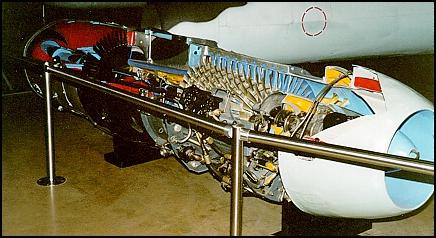
A junkers Jumo 004 early Turbojet Engine (Courtesy, Wiki)

. . . it is not obvious that even with intelligence in the picture a major modification of a complex system is possible one small step at a time if there is a requirement that the system continue to function after each such step.

For example, consider a WWII fighter, say the P51 Mustang. Can you imagine any series of incremental changes that would transform it into a jet fighter, say the F80 and have the plane continue to function after each change? To transform a piston engine fighter in to a jet fighter requires multiple simultaneous changes for it to work–an entirely new type of engine, different engine placement, different location of the wings, different cockpit controls and dials, changes to the electrical system, different placement of the fuel tanks, new air intake systems, different materials to withstand the intense heat of the jet exhaust, etc., etc., etc. You can’t make these changes in a series of small steps and have a plane that works after each step, no matter how much intelligence is input into the process.

He then concludes:

Now both a P51 and an F80 are complex devices, but any living organism, from the simplest cell on up to a large multicellular plant or animal, is many orders of magnitude more complex than a fighter plane. If you believe that it is possible to transform a reptile with a bellows lung, solid bones and scales, say, into a bird with a circular flow lung, hollow bones, and feathers by a series of small incremental changes each of which not only results in a functioning organism, but a more “fit” one, then the burden of proof is squarely on your shoulders, because the idea is absurd on the face of it.

In responding, UD Contributor gpuccio clarifies:

consider that engineered modifications can be implemented in a complex organism while retaining the old functionality, and then the new plan can be activated when everything is ready. I am not saying that’s the way it was done, but that it is possible.

For instance, and just to stay simple, one or more new proteins could be implemented using duplicated, non translated genes as origin. Or segments of non coding DNA. That’s, indeed, very much part of some darwinian scenarios.

The difference with an ID scenario is that, once a gene is duplicated and inactivated, it becomes non visible to NS. So, intelligent causes can very well act on it without any problem, while pure randomness, mutations and drift, will be free to operate in neutral form, but will still have the whole wall of probabilistic barriers against them.

[U/d, Dec 30] He goes on to later add:

NS acts as negative selection to keep the already existing information. We see the results of that everywhere in the proteome: the same function is maintained in time and in different species, even if the primary sequence can vary in time because of neutral variation. So, negative NS conserves the existing function, and allow only neutral or quasi neutral variation. In that sense it works againstany emergence of completely new information from the existing one, even if it can tolerate some limites “tweaking” of what already exists (microevolution).

I suppose that darwinists, or at least some of them, are aware of that difficulty as soon as one tries to explain completely new information, such as a new basic protein domain. Not only the darwinian theory cannot explain it, it really works against it.

So, the duplicated gene mechanism is invoked.

The problem is that the duplicated gene, to be free to vary and to leave the original functional island, must be no more translated and no more functional. Indeed, that happens very early in the history of a duplicated gene, because many forma of variation will completely inactivate it as a functional ORF, as we can see all the time with pseudogenes.

So, one of the two:

a) either the duplicated gene remains functional and contributes to the reproduction, so that negative NS can preserve it. In that case, it cannot “move” to new unrelated forms of function.

b) or the duplicated gene immediately becomes non functional, and is free to vary.

The important point is that case a) is completely useless to the darwinian explanation.

Case b) allows free transitions, but they are no more visible to NS, at least not until a new functional ORF (with the necessary regulatory sites) is generated. IOWs, all variation from that point on becomes neutral by definition.

But neutral variation, while free of going anywhere, is indeed free of going anywhere. That means: feedom is accompanied by the huge rising of the probability barriers. As we know, finding a new protein domain by chance alone is exactly what ID has shown to be empirically impossible.

In her attempted rebuttal, contributor Dr Elizabeth Liddle remarks:

I don’t find Behe’s argument that each phylum has a radically different “kernel” very convincing. Sure, prokaryotic cells and eukaryotic cells are different, but, as I said, we have at least one theory (symbiosis) that might explain that. And in any case for non-sexually reproducing organisms, “speciation” is a poor term – what we must postulate is cloning populations that clone along with their symbiotic inclusions. Which is perfectly possible (indeed even we “inherit” parental gut flora).

I think you are making the mistake of assuming that because “phyla” is a term that refers not only to the earliest exemplars of each phylum but also to the entire lineage from each, that those earliest exemplars were as different from each other as we, for example, are from trees, or bacteria. It’s really important to be clear when we are talking longitudinally (adaptation over time) and when laterally (subdivisions of populations into separate lineages).

This was largely in response to Dr V J Torley’s listing of evidence:

What evidence [for the distinctness of main body plans and for abrupt origin of same in the fossil record], Elizabeth? Please have a look here:

http://www.darwinsdilemma.org/pdf/faq.pdf
http://www.darwinsdilemma.org/
http://www.nature.com/news/eni…..ria-1.9714
http://www.arn.org/blogs/index.php/literature

In “The Edge of Evolution”, Dr. Michael Behe argues that phyla were probably separately designed because each phylum has it own kernel that requires design. He also suggests that new orders (or families, or genera – he’s not yet sure which) are characterized by unique cell types, which he thinks must have been intelligently designed, because the number of protein factors in their gene regulatory network (about ten) well exceeds the number that might fall into place naturally (three).

This exchange pivots on the central issue: does complex, multi-part functionality come in easily accessible continents that can be spanned by an incrementally growing and branching tree, or does it normally come in isolated islands in beyond astronomical spaces dominated by seas of non-function, that the atomic level resources of our solar system (our effective universe) or of the observed cosmos as a whole cannot take more than a tiny sample of?

Let’s take the matter in steps of thought:

1 –> Complex, multi-part function depends on having several well-matched, correctly aligned and “wired together” parts that work together to carry out an overall task, i.e. we see apparently purposeful matching and organisation of multiple parts into a whole that carries out what seems to be a goal. The Junkers Jumo 004 Jet engine in the above image is a relevant case in point.

2 –> Ever since Wicken posed the following clip in 1979, this issue of wiring-diagram based complex functional organisation has been on the table as a characteristic feature of life forms that must be properly explained by any successful theory of the causal roots of life. Clip:

‘Organized’ systems are to be carefully distinguished from ‘ordered’ systems.  Neither kind of system is ‘random,’ but whereas ordered systems are generated according to simple algorithms [[i.e. “simple” force laws acting on objects starting from arbitrary and common- place initial conditions] and therefore lack complexity, organized systems must be assembled element by element according to an [[originally . . . ] external ‘wiring diagram’ with a high information content . . . Organization, then, is functional complexity and carries information. It is non-random by design or by selection, rather than by the a priori necessity of crystallographic ‘order.’ [[“The Generation of Complexity in Evolution: A Thermodynamic and Information-Theoretical Discussion,” Journal of Theoretical Biology, 77 (April 1979): p. 353, of pp. 349-65. (Emphases and notes added. Nb: “originally” is added to highlight that for self-replicating systems, the blue print can be built-in.)]

3 –> The question at stake in the thread excerpted from above, is whether there can be an effective, incremental culling-out based on competition for niches and thence reproductive success of sub-populations that will create ever more complex systems that will then appear to have been designed.

4 –> Of course, we must notice that the implication of this claim is that we are dealing with in effect a vast continent of possible functional forms that can be spanned by a gradually branching tree. That’s a big claim, and it needs to be warranted on observational evidence, or it becomes little more than wishful thinking and grand extrapolation in service to an a priori evolutionary materialistic scheme of thought.

5 –> I cases where the function in question has an irreducible core of necessary parts, it is often suggested that something that may have had another purpose may simply find itself duplicated or fall out of use, then fit in with a new use. “Simple.”

6 –> NOT. For, such a proposal faces a cluster of challenges highlighted earlier in this UD series as posed by Angus Menuge [oops!] for the case of the flagellum:

For a working [bacterial] flagellum to be built by exaptation, the five following conditions would all have to be met:

C1: Availability. Among the parts available for recruitment to form the flagellum, there would need to be ones capable of performing the highly specialized tasks of paddle, rotor, and motor, even though all of these items serve some other function or no function.

C2: Synchronization. The availability of these parts would have to be synchronized so that at some point, either individually or in combination, they are all available at the same time.

C3: Localization. The selected parts must all be made available at the same ‘construction site,’ perhaps not simultaneously but certainly at the time they are needed.

C4: Coordination. The parts must be coordinated in just the right way: even if all of the parts of a flagellum are available at the right time, it is clear that the majority of ways of assembling them will be non-functional or irrelevant.

C5: Interface compatibility. The parts must be mutually compatible, that is, ‘well-matched’ and capable of properly ‘interacting’: even if a paddle, rotor, and motor are put together in the right order, they also need to interface correctly.

( Agents Under Fire: Materialism and the Rationality of Science, pgs. 104-105 (Rowman & Littlefield, 2004). HT: ENV.)

8 –> The number of biologically relevant cases where C1 – 5 has been observed: ZERO.

9 –> What is coming out ever more clearly is this:

when a set of matching components must be arranged so they can work together to carry out a task or function, this strongly constrains both the choice of individual parts and how they must be arranged to fit together

A jigsaw puzzle is a good case in point.

So is a car engine — as anyone who has had to hunt down a specific, hard to find part will know.

So are the statements in a computer program — there was once a NASA rocket that veered off course on launch and had to be destroyed by triggering the self-destruct because of — I think it was — a misplaced comma.

The letters and words in this paragraph are like that too.

That’s why (at first, simple level) we can usually quite easily tell the difference between:

A: An orderly, periodic, meaninglessly repetitive sequence: FFFFFFFFFF . . .

B: Aperiodic, evidently random, equally meaningless text: y8ivgdfdihgdftrs . . .

C: Aperiodic, but recognisably meaningfully organised sequences of characters: such as this sequence of letters . . .

In short, to be meaningful or functional, a correct set of core components have to match and must be properly arranged, and while there may be some room to vary, it is not true that just any part popped in in any number of ways can fit in.

As a direct result, in our general experience, and observation, if the functional result is complex enough, the most likely cause is intelligent choice, or design.  

This has a consequence. For, this need for choosing and correctly arranging then hooking up correct, matching parts in a specific pattern implicitly rules out the vast majority of possibilities and leads to the concept of islands of function in a vast sea of possible but meaningless and/or non-functional configurations.

10 –> Consequently, the normal expectation is that complex, multi-part functionality will come in isolated islands. So also, those who wish to assert an “exception” for biological functions like the avian flow-through lung, will need to  empirically warrant their claims. Show us, in short.

11 –> And, to do so will require addressing the difficulty posed by Gould in his last book, in 2002:

. . . long term stasis following geologically abrupt origin of most fossil morphospecies, has always been recognized by professional paleontologists. [The Structure of Evolutionary Theory (2002), p. 752.]

. . . .  The great majority of species do not show any appreciable evolutionary change at all. These species appear in the section [[first occurrence] without obvious ancestors in the underlying beds, are stable once established and disappear higher up without leaving any descendants.” [p. 753.]

. . . . proclamations for the supposed ‘truth’ of gradualism – asserted against every working paleontologist’s knowledge of its rarity – emerged largely from such a restriction of attention to exceedingly rare cases under the false belief that they alone provided a record of evolution at all! The falsification of most ‘textbook classics’ upon restudy only accentuates the fallacy of the ‘case study’ method and its root in prior expectation rather than objective reading of the fossil record. [[p. 773.]

12 –> In that context, the point raised by GP above, that

. . .  once a gene is duplicated and inactivated, it becomes non visible to NS. So, intelligent causes can very well act on it without any problem, while pure randomness, mutations and drift, will be free to operate in neutral form, but will still have the whole wall of probabilistic barriers against them.

. . . takes on multiplied force.

___________

In short, the islands of function issue — rhetorical brush-asides notwithstanding — is real, and it counts.  Let us see how the evolutionary materialism advocates will answer to it. END

PS: I am facing a security headache, so this post was completed on a Linux partition. Linux is looking better than ever, just now. as a main OS . . .

Comments
And if it were linked in such a way that it led to the creatures demise, then it wouldn't leave offspring. Only those creatures in which the link led to safety would leave offspring. Hence the evolution of a beneficial link. But recall, that visual systems would have evolved much later than other sensory systems. As far as we know,the earliest sensory system was smell, i.e. chemical. And no need to apologize :) Cheers LizzieElizabeth Liddle
January 2, 2012
January
01
Jan
2
02
2012
06:55 AM
6
06
55
AM
PDT
Dr. Liddle, Clearly, we meant different things by “half an eye” which may further evidence of my having only half a brain. I apologize for the misunderstanding. I wonder, though, if you see the difficulty some have in making the leaps made by those on your side of this discussion? For example, the rudimentary light sensitive system you described still sounds extremely complex so that the problem seems to not have been resolved at all. It only leads to more questions and what appear to be further leaping for answers. A light sensitive spot that reacts in a way that triggers muscular movement? From my experience light sensitive spots tend to result in itchy rashes and visits to the pharmacy not muscular movements. How do we know that such a spot, in its initial formation before it could signal anything, wasn’t detrimental to the creature it resided on? Such a spot on our little friend’s skin could just have easily allowed for infections that would lead to its demise. And a prey creature who reflexively moves when a shadow passes is likely to live in the kind of environment where sitting still may be be the best thing to do when a predator nears. Movement may be the very thing that alerts a predator to prey since no one, as yet, has a functional vision system. If so, our spotted friend is doomed. And how is any of this demonstrable?lpadron
January 2, 2012
January
01
Jan
2
02
2012
06:46 AM
6
06
46
AM
PDT
Elizabeth, I’m afraid you’ve misunderstood the question. You’ve attempted to explain the origin of species in general.
I think the problem lies in the question, then, Scott :) I think you think that evoltution claims to answer a question that it does not attempt to answer - that the theory, in fact, says is not the right question. The theory of evolution is the theory that all modern variety came about by two means: adaptation down lineages, and speciation across lineages. It disputes the notion that there are large longitudinal leaps between the characteristics of populations and claims instead that all change is incremental. And not only is it incremental, that each bifurcation (speciation point), at the time it happens, results in species that are, as you say, as similar as two non-interbreeding populations of herring gull at the extreme ends of a range, or two species of finch. However, and this is important, once interbreeding between those two populations has ceased, adaptation within each of the two lineages will proceed independently, resulting not only in descendents that may differ profoundly from their ancestors, but also in descendents, down different lineages, that differ profoundly from each other. So when what we now call phyla first diverged, they were a similar as closely related species are today; ditto with what we now call kingdoms, classes, genuses, etc. The reason we have different words for them is that since kingdoms etc speciated, there have been large numbers of subsequent subdivisions. But at the time it happens, all subdivisions are simply speciation events, resulting, at first, in two extremely similar populations. I'm not trying to persuade you what did happen; I'm trying to explain what evolutionist claim happened, because it seems to me that you are challenging evolutions to explain something that the actually claim did not happen - which obviously we can't do! I'll respond in more detail below:
If you can explain the origin of species, why not demonstrate it by explaining the origin of a species using genetic variation and natural selection (and whatever else you wish to throw in?)
Sure. How about the apple maggot fly? Obviously within living observation, there will be few unambiguous speciation events outside the lab (i.e. naturally occurring - there are plenty with lab fruitflies). Here is Talk Origins:
5.5.1 Apple Maggot Fly (Rhagoletis pomonella) Rhagoletis pomonella is a fly that is native to North America. Its normal host is the hawthorn tree. Sometime during the nineteenth century it began to infest apple trees. Since then it has begun to infest cherries, roses, pears and possibly other members of the rosaceae. Quite a bit of work has been done on the differences between flies infesting hawthorn and flies infesting apple. There appear to be differences in host preferences among populations. Offspring of females collected from on of these two hosts are more likely to select that host for oviposition (Prokopy et al. 1988). Genetic differences between flies on these two hosts have been found at 6 out of 13 allozyme loci (Feder et al. 1988, see also McPheron et al. 1988). Laboratory studies have shown an asynchrony in emergence time of adults between these two host races (Smith 1988). Flies from apple trees take about 40 days to mature, whereas flies from hawthorn trees take 54-60 days to mature. This makes sense when we consider that hawthorn fruit tends to mature later in the season that apples. Hybridization studies show that host preferences are inherited, but give no evidence of barriers to mating. This is a very exciting case. It may represent the early stages of a sympatric speciation event (considering the dispersal of R. pomonella to other plants it may even represent the beginning of an adaptive radiation). It is important to note that some of the leading researchers on this question are urging caution in interpreting it. Feder and Bush (1989) stated: "Hawthorn and apple "host races" of R. pomonella may therefore represent incipient species. However, it remains to be seen whether host-associated traits can evolve into effective enough barriers to gene flow to result eventually in the complete reproductive isolation of R. pomonella populations."
Naming a species is not an explanation. I can open a book and read the names of many species.
No indeed, but it's important not to be mislead by nomenclature. Complaining that finches that speciate "are still finches" is merely arguing from nomenclature. Moreover, from nomenclature designed to deal with categories rather than continua, and the whole thesis of evolutionary theory is that populations are continually evolving, and periodically speciating. We will probably always call the descendents of dogs "dogs" even if they turn out to look more like marine mammals, just as we still call snakes "tetrapods" even though they have no legs.
I looked up the northern herring gull. Frankly I’m disappointed that you would retreat to an example of simple variation that starts with a gull and ends with a gull that only a birdwatcher could distinguish from the first. Is this what Darwin had in mind when he used the term “origin of species?” Did he revolutionize biology by proposing how gulls come from gulls?
Yes, actually :) See above. Living things come from living things. Mammals always have mammalian descendents. Synapsids always have synapsid descendents. Tetrapods always have tetrapod descendents. Vertebrates always have vertebrate descendents. Chordata always have chordata descendents. Bilateria always have bilaterian descendents. We don't yet have separate names for the layers below species (well, subspecies) and will always be somewhat defeated because nature isn't that orderly. There is no absolute difference between a twig and a branch, a branch and a bough, a bough and a limb. And you can trace all twigs back to the trunk, incrementally, even though you pass bifurcations on the way.
I feel trifled with. If I tell you specifically what to explain, even I see why that might be unreasonable. But if I don’t, you and others retreat to these meaningless examples that tell us nothing about the origin of anything at all.
No, you aren't being trifled with, but the fact that you think so is a clue to what is going wrong here I think. As I tried to explain above
Anyway, I looked it up. As is typical, the research focused on taking samples from various birds and comparing their DNA, and then looking for identifiers that would separate them in a manner corresponding to their taxonomy. The specific variations are uncertain. Natural selection is not even mentioned in the paper. Now you’ll mention that not all speciation is caused by natural selection. Some is caused because a population spreads out and is geographically prevented from interbreeding.
Yes, and speciation isn't caused by natural selection. It's caused by two populations spreading out and evolving independently. Some of that evolution will involve natural selection and some will simply be drift. If you separated one populations into two and placed each in identical, but separate, environments, you'd end up with two species, i.e. species that would or could no longer interbreed, even if no adaptation at all had occurred in either population (i.e. no natural selection). However, adaptation pretty well always does occur, so that would probably happen to. But the point is that speciation is a horizontal event, natural selection is a longitudinal event.
That’s very interesting. But it tells us nothing of the evolution of anything about a herring gull, only the way that separated populations have different colors. (Wow, cichlid fish again!)
Exactly. It tells you about speciation. It does not tell you about adaptation (which is where natural selection comes in).
And it tells us nothing of the mechanics of natural selection.
No, because you asked about speciation. Both happen together of course, but they are different processes. Speciation can happen in the absence of natural selection. But adaptation results from natural selection.
If these are your examples of what evolution explains, and they don’t even mention natural selection, what am I to understand? That you had a better example but preferred to make your point with northern herring gulls?
That you are a little confused about the difference between speciation and adaptation :)
You’re making my point for me. My point is that you cannot explain anything in biology beyond trivial variations within species using the mechanics of evolutionary theory, namely genetic variation and natural selection.
But "trivial variations" are exactly the "incremental variations" that evolutionary theory posits are responsible for adaptation. Every single adaption is trivial. Just as every millimetre on a journey is trivial. Stack them up, though, and you'll get from New York to Los Angeles. Travel in convey, then one car takes a different turning at Denver and they end up in Portland. The adding up is adaptation (natural selection) + drift. The different turning is speciation. For a while after Denver, the convoys will be a trivial difference apart. But the time you both reach the Pacific, you won't need a birdwatcher to tell you that you are in very different locations!Elizabeth Liddle
January 2, 2012
January
01
Jan
2
02
2012
06:35 AM
6
06
35
AM
PDT
Hi goodusername, Tell me what part of genetics forbids a feathered monkey. Tell me what part of genetics forbids any of the alleged hybrids that would allegedly foil the theory of evolution. Geez Louise if we saw a bunch of jumbled-up organisms we would think that is the normJoe
January 2, 2012
January
01
Jan
2
02
2012
06:12 AM
6
06
12
AM
PDT
GUN: How many times did vision and flight allegedly evolve convergently again? The echolocation systems of bats and cetaceans? Marsupial and placental analogues? What about mosaic organisms like the platypus? [Cf discussions here on in context.] KFkairosfocus
January 2, 2012
January
01
Jan
2
02
2012
05:27 AM
5
05
27
AM
PDT
Cabal: I suggest you take some time out to read say the NWE survey on ID, the FAQ's at UD at top under the resources tab and perhaps the summary article here. [Take time to view the two introductory videos.] Then, kindly be specific rather than blanket dismissive. I particularly note that many objections to the design inference on empirical signs, and the warrant for that, pivot on talking point distortions such as are addressed in the FAQ above. In the meanwhile, this thread is about something specific, which should not be distracted from. I note to you -- IIRC, yet again -- that the inference that design is the best explanation for an object, on well tested signs, is prior to evaluating who or what may be a good candidate. And, the answer that design is on evidence the best explanation of a given object is of the order of the conclusion that arson is the best explanation for a given fire. It is specific in itself and foundational to further investigations. GEM of TKIkairosfocus
January 2, 2012
January
01
Jan
2
02
2012
05:19 AM
5
05
19
AM
PDT
Elizabeth, I'm afraid you've misunderstood the question. You've attempted to explain the origin of species in general. If you can explain the origin of species, why not demonstrate it by explaining the origin of a species using genetic variation and natural selection (and whatever else you wish to throw in?) Naming a species is not an explanation. I can open a book and read the names of many species. I looked up the northern herring gull. Frankly I'm disappointed that you would retreat to an example of simple variation that starts with a gull and ends with a gull that only a birdwatcher could distinguish from the first. Is this what Darwin had in mind when he used the term "origin of species?" Did he revolutionize biology by proposing how gulls come from gulls? I feel trifled with. If I tell you specifically what to explain, even I see why that might be unreasonable. But if I don't, you and others retreat to these meaningless examples that tell us nothing about the origin of anything at all. Anyway, I looked it up. As is typical, the research focused on taking samples from various birds and comparing their DNA, and then looking for identifiers that would separate them in a manner corresponding to their taxonomy. The specific variations are uncertain. Natural selection is not even mentioned in the paper. Now you'll mention that not all speciation is caused by natural selection. Some is caused because a population spreads out and is geographically prevented from interbreeding. That's very interesting. But it tells us nothing of the evolution of anything about a herring gull, only the way that separated populations have different colors. (Wow, cichlid fish again!) And it tells us nothing of the mechanics of natural selection. If these are your examples of what evolution explains, and they don't even mention natural selection, what am I to understand? That you had a better example but preferred to make your point with northern herring gulls? You're making my point for me. My point is that you cannot explain anything in biology beyond trivial variations within species using the mechanics of evolutionary theory, namely genetic variation and natural selection.ScottAndrews2
January 2, 2012
January
01
Jan
2
02
2012
05:05 AM
5
05
05
AM
PDT
Dr Liddle: The problem is not generic origin of a "species" -- a particularly vague target -- but the origin of functionally specific body plans or significant organ systems or structures that exhibit FSCO/I and perhaps IC. That is what needs to be documented on empirical observation, not something like how populations of gulls in the North grade from one species to another by the time we get back around the circle. That sort of variation is within islands of function and is not even a serious issue. GEM of TKIkairosfocus
January 2, 2012
January
01
Jan
2
02
2012
05:04 AM
5
05
04
AM
PDT
OK,you ask me to explain the origin of a species by means of evolutionary theory. Sure. Here goes: Evolutionary theory explains the origin of species as follows: A single interbreeding population subdivides into two sub-populations which decreasingly interbreed. This may be because they become geographically separated, by a mountain range, or by a stretch of water, or it may that the population simply spreads over a wide area, even though each member's territorial range remains small, resulting in clustering. Thereupon each interbreeding group starts to adapt to its own local conditions, independently of the rest of the population. For example, finches on a particular island might evolve larger beaks because of some locally available large seed, while finches on a neighbouring island evolve smaller beaks because of a locally available small seed. Over time, because the species rarely hybridise, the populations grow increasingly dissimilar, both because of genetic drift (which doesn't travel beyond each population) and because of adaptation to local conditions. Eventually, they become so dissimilar that interbreeding cannot occur successfully, even if the species come to inhabit the same territory. At that point we say we have two species of finch instead of the original one. One of those species may closely resemble the ancestral population, and may be given the same name, while the other is given a new name. But that's just a question of nomenclature. Sometimes two new names are given. Either way, there are two species where before there was only one. This has been observed in real time, and is also indicated by ring species, in which populations at the extreme ends of a territorial range do not interbreed (even if they have the opportunity to do so) but each population hybridises with the neighbouring population along the range. Northern herring gulls are such an example. But clearly it is a slow process, and we do not see dramatic divergence on the timescale of human eyewitnesses. We do, however, see those divergences in the fossil record, and also in the genetic record, which is why we can construct branching phylogenies aka nested hierarchies. The more remote from present day the bifurcation point, or node, the more dissimilar the descendents of the common ancestral population will be. And are.Elizabeth Liddle
January 2, 2012
January
01
Jan
2
02
2012
04:11 AM
4
04
11
AM
PDT
C: Pardon, but you are changing the subject again. The issue is not about nested hierarchies or the causes of diabetes, but about the empirically warranted source of functionally specific, complex organisation and associated information, and the linked point that such FSCO/I strongly points to isolated islands of function in configuration spaces. In short, there is a pivotal phenomenon on the table, and a reasonable, empirically warranted account of it needs to be had. Assertions as to how much darwinian evolution "explains" are useless if it cannot account for how we get to islands of function. Or, failing that, if it cannot show that on observed cases in point, body plan origin is explicable on incremental changes to a few initial single celled forms. Or, even, that we have good observations that show how by such mechanisms, we have specifically got to significant organ systems. Just so stories with a few highlights with some hand waving driven by a priori evolutionary materialism will not do. As a case in point, how -- on actual observed evidence, step by step -- did birds get their specialised lungs and wings? Or, the like. Perhaps, the definition of ID at NWE in its ID article will help clarify the proper focus:
Intelligent design (ID) is the view that it is possible to infer from empirical evidence that "certain features of the universe and of living things are best explained by an intelligent cause, not an undirected process such as natural selection" [1] Intelligent design cannot be inferred from complexity alone, since complex patterns often happen by chance. ID focuses on just those sorts of complex patterns [ --> specific, info rich ones, especially functionally specific ones, or irreducibly complex ones, with fine tuning of the cosmos we observe being also on the table] that in human experience are produced by a mind that conceives and executes a plan. According to adherents, intelligent design can be detected in the natural laws and structure of the cosmos; it also can be detected in at least some features of living things. Greater clarity on the topic may be gained from a discussion of what ID is not considered to be by its leading theorists. Intelligent design generally is not defined the same as creationism, with proponents maintaining that ID relies on scientific evidence rather than on Scripture or religious doctrines. ID makes no claims about biblical chronology, and technically a person does not have to believe in God to infer intelligent design in nature. As a theory, ID also does not specify the identity or nature of the designer, so it is not the same as natural theology, which reasons from nature to the existence and attributes of God. ID does not claim that all species of living things were created in their present forms, and it does not claim to provide a complete account of the history of the universe or of living things.
If indeed the inference is cogent, theories that purport to explain say life forms on blind chance and/or mechanical processes will run short of specific, step by step observational evidence. Which seems to be the precise problem behind how much of this discussion has been so repeatedly on side tracks. So, let us refocus. The expression, below -- and as discussed here -- may help us: Chi_500 = I*P - 500, functionally specific bits beyond the solar system threshold. GEM of TKI PS: Marxists were fond, too, of how much their theory seemed to explain. But in fact, that was symptomatic of its flaws. It was so broad that it could explain just about anything and its opposite.kairosfocus
January 2, 2012
January
01
Jan
2
02
2012
04:05 AM
4
04
05
AM
PDT
Scott, I've answered your questions. Now it's your turn to answer mine. I've reproduced them here for your convenience, so that you don't have to page back to find them. If you're unable to answer them, that's understandable. After all, it's the predictive and explanatory power of the theory of evolution vis-a-vis its rivals that makes it such a successful theory, accepted by more than 99% of biologists. ID simply can't compete. The questions: 1. How does ID “theory” explain the fact that there is a single nested hierarchy, to a precision of 38 decimal places? 2. How does ID explain the 1:1 sex ratios of so many sexual species? 3. How does ID explain gestational diabetes, which pits mother against fetus in a hormonal battle? 4. Which is scientifically preferable: a theory that makes predictions that are confirmed to an amazing degree of precision, or one that does not? 5. Which is preferable: a theory that provides explanations for otherwise mysterious phenomena, or one that does not?champignon
January 1, 2012
January
01
Jan
1
01
2012
09:05 PM
9
09
05
PM
PDT
I am saying that there isn’t anything in either the theory of evolution nor genetics that prevents the mixture of characteristics that would alledgedly refute the theory.
If we discovered a species of monkey with feathers, I would believe that it originated via intelligent design. To say that the odds of two independent lineages coming up with such a specific trait is astronomical, would be an understatement. I would say, given our current knowledge of genetics, that such a thing is statistically impossible. And so I would believe that someone (God, aliens, a human super-genius) fiddled with the genetics to create such a creature.goodusername
January 1, 2012
January
01
Jan
1
01
2012
08:58 PM
8
08
58
PM
PDT
Champignon, Neither of you provided either. Elizabeth mentioned the finches, although she declined to explain them using evolutionary theory. That's fine. If you wish to scale back the grandiose claims of TOE and call it an explanation of how finch beaks and lizard heads vary slightly and fish change color, I will find less to object to. You also provided your checklist of items that contain no specific content regarding the operation of darwinian mechanisms. There's no points for that. I'm not speaking as an ID advocate right now. I'm just having fun repeatedly pointing out that no one is able to use this awesome explanatory power to explain anything. I don't split hairs over the little stuff like the finches or the lizard heads. Living things change. They get smaller, bigger, smaller again, the beaks get longer, shorter, and longer again. If you want to amass evidence that evolution produces such minor variations, go for it. I've been quite reasonable with regard to the scope of change I've asked you to explain. Rather than picking really tough cases, I've asked you to chuck a few stones off the ol' mountain of evidence my way. I'm not asking you to explain the giraffe's neck. I'm asking you for any example you can provide as a basis for thinking that TOE can explain the giraffe's neck. (You're still saying that evolved, right?) Please don't pretend that you've answered. An explanation using genetic variation and selection must involve genetic variations and selections. It's almost surreal that I must even point this out more than once. I know you're in a big hurry to change subjects and talk about ID. But TOE is taught in public schools, and its proponents are fond of pointing out that it's been explaining biology for 150 years. Please either back it up or concede before moving on. Or don't. Failure to explain any evolutionary transitions in terms of genetic variation and selection is concession. The request is far too reasonable to be objectionable. If you can explain A-Z, demonstrate it by picking one and explaining it. If you don't have a response that involves genetic variations and selections, my advice is pretending to be too busy to answer. That's always fair. We all have other things to do. But every non-answering post reinforces your implicit concession that you cannot reply.ScottAndrews2
January 1, 2012
January
01
Jan
1
01
2012
08:14 PM
8
08
14
PM
PDT
champignon, I am saying that there isn't anything in either the theory of evolution nor genetics that prevents the mixture of characteristics that would alledgedly refute the theory.Joe
January 1, 2012
January
01
Jan
1
01
2012
07:37 PM
7
07
37
PM
PDT
Joe, Are you arguing against goodusername or for him? Think about what you just wrote.champignon
January 1, 2012
January
01
Jan
1
01
2012
06:44 PM
6
06
44
PM
PDT
Scott, Even the saintly Elizabeth Liddle must be getting exasperated with you. You asked us to explain "something, anything, using evolutionary theory." We did. You asked us to use "the cornerstone of biology to explain something biological." We did, as anyone reading the thread can see. Yet you pretend we didn't. You're not fooling anyone, except perhaps for yourself. Here are some questions for you: 1. How does ID "theory" explain the fact that there is a single nested hierarchy, to a precision of 38 decimal places? 2. How does ID explain the 1:1 sex ratios of so many sexual species? 3. How does ID explain gestational diabetes, which pits mother against fetus in a hormonal battle? 4. Which is scientifically preferable: a theory that makes predictions that are confirmed to an amazing degree of precision, or one that does not? 5. Which is preferable: a theory that provides explanations for otherwise mysterious phenomena, or one that does not?champignon
January 1, 2012
January
01
Jan
1
01
2012
06:32 PM
6
06
32
PM
PDT
Tell me what part of genetics forbids a feathered monkey. Tell me what part of genetics forbids any of the alleged hybrids that would allegedly foil the theory of evolution. Geez Louise if we saw a bunch of jumbled-up organisms we would think that is the normJoe
January 1, 2012
January
01
Jan
1
01
2012
05:57 PM
5
05
57
PM
PDT
Champignon, You've recited the same tired list. As much as it annoys me, I'll point out again that the hierarchies and fossils provide not a single instance of a genetic variation or the selection of a genetic variation. Have I been saying this to myself? These are what evolution is made of! And they are entirely missing from your evidence of evolution. They are not sparse. They are missing! How can evidence of change through genetic variation and selection specify no, none, zero genetic variations or selections of them? I sure hope whoever taught you that fossils and hierarchies constitute evidence of the mechanisms of evolution at work didn't get any of your money. And if they did, I hope you kept your receipt. You've been boondoggled. There's nothing under any of the shells.ScottAndrews2
January 1, 2012
January
01
Jan
1
01
2012
05:44 PM
5
05
44
PM
PDT
But I’m still not at all sure why you are rejecting the Galapagos finch beaks, which were actually observed evolving.
Now you see why even mainstream biologists use terms such as micro and macro-evolution. Because we're using the same word to describe the origin of finches and the variations of their beaks. Even the most casual reader can tell that we're talking about - what did Darwin call it - the origin of species. You've made it quite clear that you think the two are the same. Your opinion is noted. Now will you attempt to make a case for it or not so that those of us who value empirical evidence can have a reason to share your opinion? If so, please do. Or don't. But that's where the eyes are.
And then there is then there is the broader level at which evolutionary theory explains adaptation. I’m not sure why you think it doesn’t.
Why don't you explain why it does? As you're fond of pointing out, that's how science works. Use the 'broader level of evolutionary theory' to 'explain an adaptation (Now you're making me double up on tags.) If I have pennies, I have a penny. If I do not have a penny, it follows that I do not have pennies. Am I inaccurate? I think it's beyond question. Therefore, explain an adaptation. If it can explain adaptations then it follows that it must explain an adaptation, and the converse is true. And if the answer is finch beaks or colored cichlid fishes, then congratulations, you get the ribbon for explaining variation within species, and will have conceded that evolution does not explain the origin of species. How many times can I repeat such a simple question and receive so many non-answers? I've conceded that even if its explanatory power is what you think, the origin of a species is too much to ask. But if you can't explain the origin of something, only its variations, then it's dead in the water. Game over. Give the cornerstone a headstone. I've asked enough times, and what should be off-the-shelf information either does not exist or is a well-guarded secret. Whether or not the discussion continues, it is conceded, past tense, pending new input, that evolutionary theory does not explain the origin of species. We have the evidence we have, not what we hope for or are confident we will have.ScottAndrews2
January 1, 2012
January
01
Jan
1
01
2012
05:25 PM
5
05
25
PM
PDT
What do we make of stuff like this? It’s clearly a combination of highly derived traits from one part of the hierarchy or tree (bicycles) with highly derived traits from a completely different part of the tree (motorized vehicles). Such a thing would be the equivalent of finding feathered monkeys in the animal kingdom. Or better yet, someone who takes a car, puts floatation devices on the sides, and paddles their way up and down a river on it (something I’ve seen people do). Let’s say someone does this with a Nissan Sentra SE-R. You have then what is clearly a barely modified Nissan Sentra SE-R that is not only not classified with other Nissan Sentra SE-Rs, but not even with other Nissan Sentras, nor even with other compact cars, nor even with other cars, nor even as a motorized vehicle. This “Nissan Sentra SE-R” would be classified with vehicles that are about as far as possible from Nissan Sentra SE-Rs on the tree (as a row boat or something I guess). Of course, that we’d encounter such problems is easily anticipated – after, all, we’re clearly dealing with “intelligent design” here, and so there’s no reason that a piece of technology in one area wouldn’t be borrowed in very different areas, and breakthroughs in one area are going to be quickly applied to other unrelated areas. And this is why no one (or hardly anyone) would bother trying to put vehicles into a nested hierarchy or taxonomic tree; it’s going to be completely arbitrary and useless.goodusername
January 1, 2012
January
01
Jan
1
01
2012
05:19 PM
5
05
19
PM
PDT
Elizabeth, to Scott:
But I’m still not at all sure why you are rejecting the Galapagos finch beaks, which were actually observed evolving.
Or the 1:1 sex ratios I mentioned in comment 25. Or the congruence of the nested hierarchy to 1 part in 100 trillion trillion trillion trillion. Or the gradual transformation of reptilian jaw bones into mammalian inner ear bones through a series of functional intermediates, as mentioned by Petrushka. Or the bizarre hormonal warfare between mother and fetus in gestational diabetes. Scott, you asked for examples of "how the cornerstone of biology explains something in biology”. Evolutionary theory explains all of these. Intelligent design explains none of them.champignon
January 1, 2012
January
01
Jan
1
01
2012
04:22 PM
4
04
22
PM
PDT
No, I don't think any one of those things has been fully researched. But I'm still not at all sure why you are rejecting the Galapagos finch beaks, which were actually observed evolving. And then there is then there is the broader level at which evolutionary theory explains adaptation. I'm not sure why you think it doesn't.Elizabeth Liddle
January 1, 2012
January
01
Jan
1
01
2012
02:36 PM
2
02
36
PM
PDT
Actually, let me clarify even further. I'm trying to set a ballpark, but I would really rather not have you respond to one of my examples. Again, because I'm so reasonable. Even if it could eventually explain everything, it's not reasonable to expect that all or even any of the examples I had provided had been fully researched. I don't want an ad-hoc explanation. I want whatever it is that has been carefully researched and documented, providing basis for using evolution as an explanation for biological phenomena in general. As far as I can tell it's kept in an underground vault guarded by a secret society and a two-headed devil dog. But maybe you know somebody.ScottAndrews2
January 1, 2012
January
01
Jan
1
01
2012
02:13 PM
2
02
13
PM
PDT
You have been given many examples of evolutionary theory explaining something. ... You have been given many examples of evolutionary theory explaining something.
Explain gecko feet. Why does my cat have retractable claws? Why do I have toenails? (Odd - I did't mean to focus on feet.) Why do I have earlobes? Why do clovers usually have three leaves? Why do trees have bark? Why do dogs have tails? Am I being unreasonable? I'm not asking anything hard, like orbital spiderwebs or what have you. I'm setting the bar as low as I can. That's a good ballpark. What, at this level, can you explain using evolutionary theory? Don't use one of my examples if it's going to make you guess.ScottAndrews2
January 1, 2012
January
01
Jan
1
01
2012
02:04 PM
2
02
04
PM
PDT
You have been given many examples of evolutionary theory explaining something. But you reject them. I can only conclude that you do not understand what evolutionary theory claims to explain. Could you perhaps give an example of a phenomenon that you think should be able to be explained by evolutionary theory but hasn't been?Elizabeth Liddle
January 1, 2012
January
01
Jan
1
01
2012
10:53 AM
10
10
53
AM
PDT
I’m simply saying that simple systems work (as we can see) and can therefore be the precursors to complex systems
Of course they can. As I said, I've designed both. But if you're using that to support an explanation of the origin of those systems then it is circular. If you're just pointing out the consistency between evolutionary theory and the existence of simple and complex systems in that chronological order, so be it. It's a weak correlation, and as I've said no fewer than a dozen times, there is no application of evolutionary theory to account for it. I could respond that a designer might start simple and build complex, or that it makes more sense to build an ecology from the ground up. You wouldn't start with elephants and then add grass a million years later, followed a million years later by bacteria to consume the remains of the elephants that starved and the grass they weren't around to eat. There could be half eyes or no half eyes, monkeys or no monkeys. There is absolutely no evolutionary explanation for any of it, no exceptions, period. For the theory to allow them is meaningless. The flying spaghetti monster permits half eyes and monkeys. Despite the majority opinion, evolutionary theory is playing defense. I've asked repeatedly for the simplest, most reasonable substantiation. Use evolutionary theory to explain something. Every single reply that does not do so is tap dancing. If no one has a direct answer then the best move would be pretending to be too busy to reply.ScottAndrews2
January 1, 2012
January
01
Jan
1
01
2012
10:49 AM
10
10
49
AM
PDT
Recall that there is no lineage that connects lizards with finches. Scott, I've tried honestly to explain. I don't think there is any evidence or example you would accept because your thinking is so far from the way evolutionists think. This you may regard as a virtue, of course! But from where I'm standing, you have a monumental straw man, based, I think, on a lack of understanding of how evolutionary investigations are conducted and why. It seems back to front to me. Darwin knew nothing about genetics; genetics gives us the mechanism for heritability. So now we can infer that inherited change is transferred genetically, even though we can't, obviously, trace the exact genetic change for every morphological change - though we can date the evolution of relevant genes, and map those on to morphological changes in the fossil record. So we are gradually building up a good picture of just how those adapted changes happened, and what genes were involved. But you seem to think that until we know everything we can draw no conclusions. I'm not sure why. There is far more that we don't know than we know, and the fossil record can only be a smattering of the total number of populations that have ever lived, and we don't have tissues from fossils. We do, however, have genetics from extant organisms, and increasingly, especially with evo-devo, we start to undertand the role that genes (especially regulatory genes) play in the evolution of morphological features that we see in the fossil record. Sure, we don't know, and never will know, for sure, just what genetic changes resulted in what selected features, so if that's what you are waiting for, you will wait a long time! But in the mean time, science will go on, and we will keep uncovering this wonderful picture of how life came to be.Elizabeth Liddle
January 1, 2012
January
01
Jan
1
01
2012
10:27 AM
10
10
27
AM
PDT
What "reason is circular"? I'm simply saying that simple systems work (as we can see) and can therefore be the precursors to complex systems, thus disposing of the "what use is half an eye?" canard. We see creatures with half eyes and they find them useful. Job done. Or is your question now: if simple eyes are the precursors to complex eyes, why are there still simple eyes? That's awfully like the proverbial "why are there still monkeys?" :) Simple answer: because not all lineages undergo the same adaptations, but some still thrive. Remember: it is not evolutionists who proposed the "ladder of being". We do not see evolution as progress towards complexity, but as increase in diversity.Elizabeth Liddle
January 1, 2012
January
01
Jan
1
01
2012
09:54 AM
9
09
54
AM
PDT
I'm not sure whether you are begging the question or conceding that this is evidence of nothing. You seem to be straddling the fence.
What we do know now is a fair bit about which genes, and alleles of which genes, are implicated in the development of phenotypic features – it’s what evo-devo is all about, but it’s still very much in its infancy. Phenotypic features are the result of highly complex interactions between many genes and the expressed products of many others.
Of course genetic differences correspond to phenotypic features. That's common knowledge. The genes and alleles and their phenotypic expressions are exactly what require explanation. It's the question, not the answer. It's a no-brainer that two fossils with different forms came from two organisms with varying genes. But you have absolutely know way of knowing, given any two or two thousand fossils which genes or how many vary between them, which ones vary, which genetic variations form the pathway between two variations, and how, why, or whether they were selected. That's what evolution is supposedly made of. And that is why the 'mountains' of fossil evidence and phylogenetic trees contain no evidence of evolution. That leaves you with finch beaks and the fantastic, wishful notion that the variations between them can be extrapolated to the explain the differences between lizards and finches. I think the point has been made repeatedly that this assertion requires some sort of confirming evidence. That evidence would consist of explaining something, anything, using evolutionary theory. Frankly I don't expect anyone to produce anything. No one has yet. All the talk of fitting models to data is irrelevant, abstract fluff without it. I can respect even abstract fluff, but not when it's called the 'cornerstone of biology,' taught as fact, and supported by evidence that obviously isn't evidence.ScottAndrews2
January 1, 2012
January
01
Jan
1
01
2012
09:51 AM
9
09
51
AM
PDT
But that doesn’t mean that simple systems can’t be precursors to complex systems, or that coevolution can’t happen. The palaeontological record suggests exactly that.
Of course simple systems can be precursors to complex systems. I've designed a number of each. What does that have to do with what we're discussing, the origin of simple and complex systems? Your reason is circular, as the existence of both simple and complex systems is explained by evolution, and then you use them as evidence confirming that explanation. Let no one be mistaken that the existence of simple and complex systems are evidence confirming any theory of their origins. They are what must be explained. They are not the evidence. Further, the palaeontological record is not evidence of evolution as evolution consists of variations and selections which cannot be inferred or otherwise determined from it. That point can't be made enough, and certainly not while anyone presents fossils as evidence of darwinian evolution. People have heard that so many times that it starts to sound like it makes sense. It doesn't.ScottAndrews2
January 1, 2012
January
01
Jan
1
01
2012
09:33 AM
9
09
33
AM
PDT
1 7 8 9 10 11 14

Leave a Reply