ID Foundations, 21: MF — “as a materialist I believe intelligence to be a blend of the determined and random so for me that is not a third type of explanation” . . . a root worldview assumption based cause for rejecting the design inference emerges into plain view
In the OK thread, in comment 50, ID objector Mark Frank has finally laid out the root of ever so many of the objections to the design inference filter. Unsurprisingly, it is a worldview based controlling a priori of materialism:
[re EA] #38
[MF, in 50:] I see “chance” as usually meaning to “unpredictable” or “no known explanation”. The unknown explanations may be deterministic elements or genuinely random uncaused events which we just don’t know about.
It can also includes things that happen as the result of intelligence – but as a materialist I believe intelligence to be a blend of the determined and random so for me that is not a third type of explanation.
But, just what what is the explanatory filter that is being objected to so strenuously?
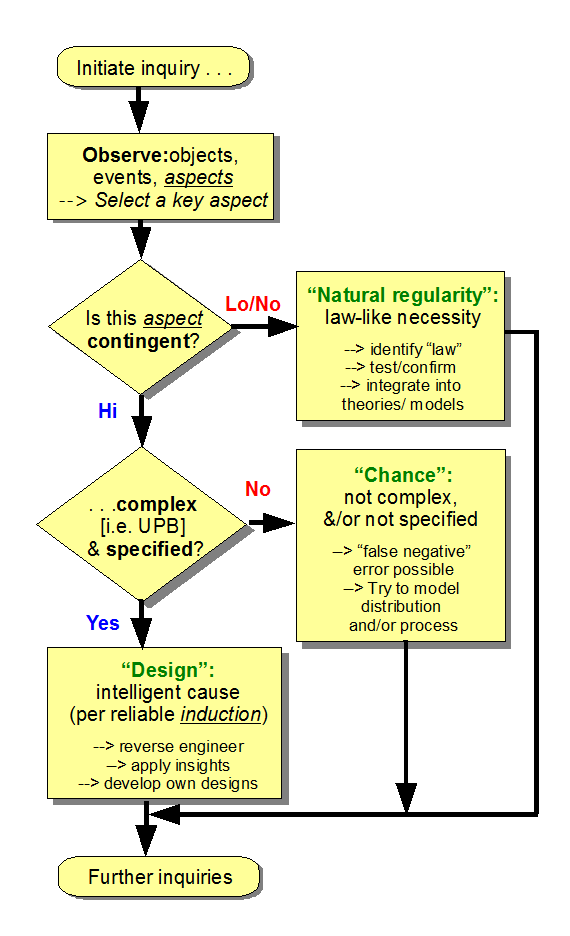
Let me present it first, in the per aspect flowchart form that I have often used here at UD, that shows it to be a more specific and detailed understanding of a lot of empirically grounded scientific methods of investigation.
Galileo’s leaning tower exercise, showing mechanical necessity: F = m*g, of course less air resistance. NB: He did a thought expt of imagining the light and heavy ball tied together, so on the “heavier must fall faster” concept, the objects now should fall even faster. But, shouldn’t the lighter one instead have retarded the heavier? As in, oopsie. The expt may have been done and the heavier may have hit just ahead, as air resistance is as cross section but weight is as volume. (HT: Lannyland & Wiki.)
One that explicitly invokes mechanical necessity as first default, then on high contingency rejects it — if a lawlike necessity is at work, it will produce reliably similar outcomes on similar initial circumstances, just as a dropped heavy object near earth’s surface has initial acceleration 9.8 N/kg due to the gravity field of the earth.
However, this does not cover all phenomena, e.g. if the dropped object is a fair common die that then falls to a table, it will tumble and settle to read a value from the set {1, 2, . . . 6} in a way that is close to the mathematical behaviour of an ideal flat random variable.
But also, chance and necessity cannot cover all outcomes. Not only do we routinely experience being intelligent designers — e.g. by my composing this post — but we often see a class of phenomena which is highly contingent but not plausibly accounted for on chance. For, if we see 500 – 1,000 bits or more of functionally specific complex organisation and/or information [FSCO/I], the needle in haystack challenge faced by the atomic resources of our solar system or cosmos will be overwhelmed by the space of possible configurations and the challenge of finding cases E from narrow and isolated target or hot zones T in such spaces, W.
Citing Dembski’s definition of CSI in No Free Lunch:
p. 148: “The great myth of contemporary evolutionary biology is that the information needed to explain complex biological structures can be purchased without intelligence. My aim throughout this book is to dispel that myth . . . . Eigen and his colleagues must have something else in mind besides information simpliciter when they describe the origin of information as the central problem of biology.
I submit that what they have in mind is specified complexity [[cf. here below], or what equivalently we have been calling in this Chapter Complex Specified information or CSI . . . .
Biological specification always refers to function . . . In virtue of their function [[a living organism’s subsystems] embody patterns that are objectively given and can be identified independently of the systems that embody them. Hence these systems are specified in the sense required by the complexity-specificity criterion . . . the specification can be cashed out in any number of ways [[through observing the requisites of functional organisation within the cell, or in organs and tissues or at the level of the organism as a whole] . . .”
p. 144: [[Specified complexity can be defined:] “. . . since a universal probability bound of 1 [[chance] in 10^150 corresponds to a universal complexity bound of 500 bits of information, [[the cluster] (T, E) constitutes CSI because T [[ effectively the target hot zone in the field of possibilities] subsumes E [[ effectively the observed event from that field], T is detachable from E, and and T measures at least 500 bits of information . . . ”
So, design thinkers reject the default explanation for high contingency– chance — if we see FSCO/I or the like. That is, we infer on FSCO/I and related patterns best explained on (and as known reliable signs of) design, to just that, intelligent design:
Accordingly, I replied to MF at 59 in the OK thread, as follows:
____________
>>> the pivot of the issue is now plain from MF at 50 above:
[re EA] #38
[MF:] I see “chance” as usually meaning to “unpredictable” or “no known explanation”. The unknown explanations may be deterministic elements or genuinely random uncaused events which we just don’t know about.
It can also includes things that happen as the result of intelligence – but as a materialist I believe intelligence to be a blend of the determined and random so for me that is not a third type of explanation.
Here we have the root problem, that for MF, design reduces to chance and necessity.
Also, I would not go along fully with MF’s definition of chance {“uncaused events” is a very troublesome concept for instance but my focus here is,} having identified that chance processes come about by two major known physical processes:
Chance:
Tumbling dice — a chaotic phenomenon thanks to eight corners and twelve edges interacting with uncontrollable surface roughness etc. (HT:Rosendahl, Flicker)
TYPE I:the clash of uncorrelated trains of events such as is seen when a dropped fair die hits a table etc and tumbles, settling to readings in the set {1, 2, . . . 6} in a pattern that is effectively flat random. In this sort of event, we often see manifestations of sensitive dependence on initial conditions, aka chaos, intersecting with uncontrolled or uncontrollable small variations yielding a result predictable in most cases only up to a statistical distribution which needs not be flat random.
TYPE II:processes — especially quantum ones — that are evidently random, such as quantum tunnelling as is the explanation for phenomena of alpha decay. This is used in for instance zener noise sources that drive special counter circuits to give a random number source. Such are sometimes used in lotteries or the like, or presumably in making one time message pads used in decoding.
In reply to MF’s attempt to reduce design by intelligence to the other two sources of cause, I suggest that this approach radically undermines the credibility of mind as a thinking and knowing function of being intelligent humans, in a reductio ad absurdum. (Cf my remarks here yesterday in reply to Dan Barker’s FFRF and my longstanding observations — in the end they go back to the mid 1980′s in answer to Marxist materialism as well as evolutionary materialism — here on.)
Haldane sums up one of the major problems aptly, in a turn of the 1930′s remark that has often been cited here at UD:
“It seems to me immensely unlikely that mind is a mere by-product of matter. For if my mental processes are determined wholly by the motions of atoms in my brain I have no reason to suppose that my beliefs are true. They may be sound chemically, but that does not make them sound logically. And hence I have no reason for supposing my brain to be composed of atoms. In order to escape from this necessity of sawing away the branch on which I am sitting, so to speak, I am compelled to believe that mind is not wholly conditioned by matter.” [[“When I am dead,” in Possible Worlds: And Other Essays [1927], Chatto and Windus: London, 1932, reprint, p.209.]
Let me clip my more extended discussion:
___________
>> 15 –> In short, it is at least arguable that self-referential absurdity is the dagger pointing to the heart of evolutionary materialistic models of mind and its origin . . . . [It can be presented at a much more sophisticated way, cf. Hasker p. 64 on here as an example, also Reppert, Plantinga and others] but without losing its general force, it can also be drawn out a bit in a fairly simple way:
a: Evolutionary materialism argues that the cosmos is the product of chance interactions of matter and energy, within the constraint of the laws of nature; from hydrogen to humans by undirected chance and necessity.
b: Therefore, all phenomena in the universe, without residue, are determined by the working of purposeless laws of chance and/or mechanical necessity acting on material objects, under the direct or indirect control of happenstance initial circumstances.
(This is physicalism. This view covers both the forms where (a) the mind and the brain are seen as one and the same thing, and those where (b) somehow mind emerges from and/or “supervenes” on brain, perhaps as a result of sophisticated and complex software looping. The key point, though is as already noted: physical causal closure — the phenomena that play out across time, without residue, are in principle deducible or at least explainable up to various random statistical distributions and/or mechanical laws, from prior physical states. Such physical causal closure, clearly, implicitly discounts or even dismisses the causal effect of concept formation and reasoning then responsibly deciding, in favour of specifically physical interactions in the brain-body control loop; indeed, some mock the idea of — in their view — an “obviously” imaginary “ghost” in the meat-machine. [[There is also some evidence from simulation exercises, that accuracy of even sensory perceptions may lose out to utilitarian but inaccurate ones in an evolutionary competition. “It works” does not warrant the inference to “it is true.”] )
c: But human thought, clearly a phenomenon in the universe, must now fit into this meat-machine picture. So, we rapidly arrive at Crick’s claim in his The Astonishing Hypothesis (1994): what we subjectively experience as “thoughts,” “reasoning” and “conclusions” can only be understood materialistically as the unintended by-products of the blind natural forces which cause and control the electro-chemical events going on in neural networks in our brains that (as the Smith Model illustrates) serve as cybernetic controllers for our bodies.
d: These underlying driving forces are viewed as being ultimately physical, but are taken to be partly mediated through a complex pattern of genetic inheritance shaped by forces of selection [[“nature”] and psycho-social conditioning [[“nurture”], within the framework of human culture [[i.e. socio-cultural conditioning and resulting/associated relativism]. And, remember, the focal issue to such minds — notice, this is a conceptual analysis made and believed by the materialists! — is the physical causal chains in a control loop, not the internalised “mouth-noises” that may somehow sit on them and come along for the ride.
(Save, insofar as such “mouth noises” somehow associate with or become embedded as physically instantiated signals or maybe codes in such a loop. [[How signals, languages and codes originate and function in systems in our observation of such origin — i.e by design — tends to be pushed to the back-burner and conveniently forgotten. So does the point that a signal or code takes its significance precisely from being an intelligently focused on, observed or chosen and significant alternative from a range of possibilities that then can guide decisive action.])
e: For instance, Marxists commonly derided opponents for their “bourgeois class conditioning” — but what of the effect of their own class origins? Freudians frequently dismissed qualms about their loosening of moral restraints by alluding to the impact of strict potty training on their “up-tight” critics — but doesn’t this cut both ways? Should we not ask a Behaviourist whether s/he is little more than yet another operantly conditioned rat trapped in the cosmic maze? And — as we saw above — would the writings of a Crick be any more than the firing of neurons in networks in his own brain?
f: For further instance, we may take the favourite whipping-boy of materialists: religion. Notoriously, they often hold that belief in God is not merely cognitive, conceptual error, but delusion. Borderline lunacy, in short. But, if such a patent “delusion” is so utterly widespread, even among the highly educated, then it “must” — by the principles of evolution — somehow be adaptive to survival, whether in nature or in society. And so, this would be a major illustration of the unreliability of our conceptual reasoning ability, on the assumption of evolutionary materialism.
g: Turning the materialist dismissal of theism around, evolutionary materialism itself would be in the same leaky boat. For, the sauce for the goose is notoriously just as good a sauce for the gander, too.
h: That is, on its own premises [[and following Dawkins in A Devil’s Chaplain, 2004, p. 46], the cause of the belief system of evolutionary materialism, “must” also be reducible to forces of blind chance and mechanical necessity that are sufficiently adaptive to spread this “meme” in populations of jumped- up apes from the savannahs of East Africa scrambling for survival in a Malthusian world of struggle for existence. Reppert brings the underlying point sharply home, in commenting on the “internalised mouth-noise signals riding on the physical cause-effect chain in a cybernetic loop” view:
. . . let us suppose that brain state A, which is token identical to the thought that all men are mortal, and brain state B, which is token identical to the thought that Socrates is a man, together cause the belief that Socrates is mortal. It isn’t enough for rational inference that these events be those beliefs, it is also necessary that the causal transaction be in virtue of the content of those thoughts . . . [[But] if naturalism is true, then the propositional content is irrelevant to the causal transaction that produces the conclusion, and [[so] we do not have a case of rational inference. In rational inference, as Lewis puts it, one thought causes another thought not by being, but by being seen to be, the ground for it. But causal transactions in the brain occur in virtue of the brain’s being in a particular type of state that is relevant to physical causal transactions. [[Emphases added . . . ]
i: The famous geneticist and evolutionary biologist (as well as Socialist) J. B. S. Haldane made much the same point in a famous 1932 remark:
“It seems to me immensely unlikely that mind is a mere by-product of matter. For if my mental processes are determined wholly by the motions of atoms in my brain I have no reason to suppose that my beliefs are true. They may be sound chemically, but that does not make them sound logically. And hence I have no reason for supposing my brain to be composed of atoms. In order to escape from this necessity of sawing away the branch on which I am sitting, so to speak, I am compelled to believe that mind is not wholly conditioned by matter.” [[“When I am dead,” in Possible Worlds: And Other Essays [1927], Chatto and Windus: London, 1932, reprint, p.209.]
j: Therefore, though materialists will often try to pointedly ignore or angrily brush aside the issue, we may freely argue: if such evolutionary materialism is true, then (i) our consciousness, (ii) the “thoughts” we have, (iii) the conceptualised beliefs we hold, (iv) the reasonings we attempt based on such and (v) the “conclusions” and “choices” (a.k.a. “decisions”) we reach — without residue — must be produced and controlled by blind forces of chance happenstance and mechanical necessity that are irrelevant to “mere” ill-defined abstractions such as: purpose or truth, or even logical validity.
(NB: The conclusions of such “arguments” may still happen to be true, by astonishingly lucky coincidence — but we have no rational grounds for relying on the “reasoning” that has led us to feel that we have “proved” or “warranted” them. It seems that rationality itself has thus been undermined fatally on evolutionary materialistic premises. Including that of Crick et al. Through, self-reference leading to incoherence and utter inability to provide a cogent explanation of our commonplace, first-person experience of reasoning and rational warrant for beliefs, conclusions and chosen paths of action. Reduction to absurdity and explanatory failure in short.)
k: And, if materialists then object: “But, we can always apply scientific tests, through observation, experiment and measurement,” then we must immediately note that — as the fate of Newtonian Dynamics between 1880 and 1930 shows — empirical support is not equivalent to establishing the truth of a scientific theory. For, at any time, one newly discovered countering fact can in principle overturn the hitherto most reliable of theories. (And as well, we must not lose sight of this: in science, one is relying on the legitimacy of the reasoning process to make the case that scientific evidence provides reasonable albeit provisional warrant for one’s beliefs etc. Scientific reasoning is not independent of reasoning.) >>
___________
In short, there is a major issue that materialism is inherently and inescapably self referentially incoherent, undermining its whole scheme of reasoning.
That is a big topic itself.
But, when it comes to the issue of debates over the meaning of chance and inferences to design which implicate intelligence, it is an underlying assumption that plainly leads to endless debates.
In this context, however, the case of 500 coins in a row on a table reading all H or alternating H and T or the first 72 characters of this post in ASCII code, strongly shows the difference in capacity of chance and design as sources of configurations that come from independently and simply describable clusters that are deeply isolated in a space of configs that are such that the atomic resources of our solar system cannot credibly search a big enough fraction to make it reasonable to believe one will stumble upon such configs blindly.
In short, there is a major and directly experienced phenomenon to be accounted for, self aware conscious intellect and related capacities we subsume under the term mind. And this phenomenon is manifest in capacity to design, which is as familiar as composing posts in this thread.
Such designs are well beyond the capacity of blind chance and mechanical necessity, so we have good reason to see that intelligence capable of design is as fundamental in understanding our empirical world as chance and as necessity.
Whatever the worldview consequences — and I think they are huge.>>>
____________
In short, it seems that one key root of objections to the design inference is the notion that intelligence needed for design in the end reduces to cumulative effects of blind chance and mechanical necessity.
Only, that runs into significant self referential incoherence challenges.
A safer approach would be to recognise that intelligence indisputably exists and indisputably exerts capacities not credibly observed to emerge from blind chance and mechanical necessity. Indeed, on inductive and analytic — needle in haystack — grounds, it is arguable and compelling that certain phenomena such as FSCO/I are reliable signs of design as cause.
Then, we run into the challenge that from its very roots, cell based life is chock full of such signs of design, starting with the genetic code and the size of genomes, from 100 – 1,000 kbits on up.
Then, the observed cosmos itself shows strong and multiple signs of being fine tuned in ways that enable the existence of cell based life on terrestrial planets such as our own — where fine tuning is another empirically grounded sign of being designed.
So, there are good reasons to extend the force of the design inference to the origin of cell based life and of major body plans for such life, and to the origins of the observed cosmos that hosts such life. END
__________
F/N: I must update by posting this all too aptly accurate debate summary by no less than UD’s inimitable WJM, done here on Christmas day as a gift to the blog and world. WJM, I CANNOT let this one just wash away in the stream of comments! (You ought to separately headline it under your monicker.) Here goes:
Typical debate with an anti-ID advocate:
ID advocate: There are certain things that exist that are best explained by intelligent designed.
Anti-ID advocate: Whoa! Hold up there, fella. “Explained”, in science, means “caused by”. Intelligent design doesn’t by itself “cause” anything.
ID advocate: What I meant is that teleology is required to generate certain things, like a functioning battleship. It can’t come about by chance.
Anti-ID advocate: What do you mean “by chance”? “By” means to cause. Are you claiming that chance causes things to happen?
ID advocate: Of course not. Chance, design and necessity are the three fundamental categories of causation used to characterize the outcomes of various processes and mechanisms. You’re taking objection with colloquialisms that are commonly used in mainstream science and debate. Here are some examples of peer-reviewed, published papers that use these same colloquialisms.
Anti-ID advocate: Those aren’t real scientists!
ID advocate: Those are scientists you yourself have quoted in the past – they are mainstream Darwinists.
ID advocate: I’m using the quotes the same way the authors used them.
Anti-ID advocate: Can you prove it?
ID Advocate: It’s not my job to prove my own innocence, but whatever. Look, it has been accepted for thousands of years that there are only three categories of causation – necessity, or law, chance and artifice, or design. Each category is distinct.
Anti ID advocate: I have no reason to accept that design is a distinct category.
ID advocate: So, you’re saying that battleship or a computer can be generated by a combination of necessity (physical laws) and chance?
Anti-ID advocate: Can you prove otherwise? Are you saying it’s impossible?
ID advocate: No, I’m saying that chance and necessity are not plausible explanations.
Anti-ID advocate: “Explanation” means to “cause” a thing. Chance and necessity don’t “cause” anything.
ID advocate: We’ve already been over this. Those are shorthand ways of talking about processes and mechanisms that produce effects categorized as lawful or chance.
Anti-ID advocate: Shorthand isn’t good enough – we must have specific uses of terms using explicitly laid-out definitions or else debate cannot go forward.
ID advocate: (insert several pages lay out specifics and definitions with citations and historical references).
ID advocate: In summary, this demonstrates that mainstream scientists have long accepted that there are qualitative difference between CSI, or organized, complimentary complexity/functionality, and what can in principle be generated via the causal categories of chance and necessity. Only intelligent or intentional agency is known to be in principle capable of generating such phenomena.
Anti-ID advocate: OMG, you can’t really expect me to read and understand all of that! I don’t understand the way you word things. Is English your first language? It makes my head hurt.
Comments
RDFish is confused:
First, I have been arguing on this and other boards for many years that ID – the claim (as Stephen Meyer describes it) that certain features of biology and the universe are best explained by the actions of a conscious, rational, deliberative agent – is merely a philosophical argument rather than a scientific result. The quote happily provided today from none other than Bill Dembski completely supports my position:
Wrong again, as usual. Dembski's quote in no way supports you. Meyer does NOT posit a personal designer. YOU are confused, as usual.Joe
January 15, 2014
January
01
Jan
15
15
2014
04:36 AM
4
04
36
AM
PDT
RDFish in 259:
As I’ve said many times, ID is such a big tent full of contradicting viewpoints it is difficult to address them all. Dembski here denies that ID posits that the cause of life was a conscious personal intelligent agent.
Right, the designer didn't have each of us in mind. THat is what is meant by a personal designer.
Oh it would help RDFish if he listed these alleged contradictions made by IDists wrt ID...Joe
January 15, 2014
January
01
Jan
15
15
2014
04:32 AM
4
04
32
AM
PDT
PPS: So for instance a cometary impact near Mexico 65 MYA triggering a 1,500 ft wall of water inter alia [that's how high it is said it was when it swept over Jamaica and left scars on the land], and so forth is a valid scientific explanation. Not only on the principle that meteorites can hit us and do so why not comets too, but that we saw the comet hit Jupiter a few years ago.kairosfocus
January 15, 2014
January
01
Jan
15
15
2014
04:26 AM
4
04
26
AM
PDT
PS: That is why the vera causa principle is so important, we must only allow as scientific (or more broadly, inductive, empirical) causal explanations things that have been observed [of course, whether they are commonly known or freshly observed and reliably reported . . . ], and so demonstrated to be adequate to cause the class of effects to be explained, whether in the here and now or as traces from the remote past. So, we may infer to a great flood or volcanic outburst or cometary impact as reasonable causes, and by extension, collisions of planets etc. Likewise, we may not infer to blind chance and mechanical necessity as explanations for complex code systems, algorithms and execution machinery for same unless we can SHOW them adequate instead of locking them in by ideologically censoring out causes such as design that are manifestly adequate.kairosfocus
January 15, 2014
January
01
Jan
15
15
2014
04:17 AM
4
04
17
AM
PDT
Onlookers, we are plainly seeing the effect of a mind closing materialist a priori, which MUST imply or assert that design reduces to chance and necessity, multiplied by rhetorical squid ink clouds. This leads tot he fallacy of the ideologised, closed mind that until it yields that lockoff, will never acknowledge the most cogent arguments but will try to evade or somehow deflect them. KFkairosfocus
January 15, 2014
January
01
Jan
15
15
2014
04:03 AM
4
04
03
AM
PDT
SB:
It is patent that designers exist and designed objects such as posts in this thread also. Further, it can be seen by those willing to look honestly, that the explanatory filter works in light of known causal forces, chance necessity and design. Design being OBSERVED and producing things that per needle in haystack analysis are not reasonable on the other two individually or in concert.
It is obvious that we have no good reason to infer that we exhaust the list of possible or actual designers, or intelligences. Where, intelligence and consciousness and self awareness are also obvious from our own experience, whether or not we wish to acknowledge it. Save that refusal to acknowledge the undeniable underscores irrationality.
So, identifying signs that are characteristic of mechanical necessity and that which is not easily explained thereby -- the highly contingent, is reasonable. Similarly, to identify FSCO/I and the 500 - 1,000 bit threshold is a reasonable and empirically warranted basis for marking the difference between design and chance as best explanation. If one wishes to overturn such an empirical basis on vera causa s/he must show an empirical counterexample that is replicable. Of which nowhere we find the faintest serious trace.
So, the exercise of spewing squid ink rhetorical clouds to obscure the fact, is plainly a matter of evasion.
Game over.
KFkairosfocus
January 15, 2014
January
01
Jan
15
15
2014
03:55 AM
3
03
55
AM
PDT
UB:
The pivotal inductive point is that origins science is about an unobserved, remote past.
So, we are trying to scientifically reconstruct on traces of that past -- which obviously includes systems and structures in the living cell expressing codes, symbols, algorithms and organised algorithm storing, transcribing and execution machinery.
FSCO/I is abundant everywhere.
So the key step is to insist on the vera causa principle that unless we see efficacious cause capable and demonstrated empirically to cause the phenomena in question, speculative assertions can be discarded as not being empirically grounded. FSCO/I is easily seen on billions of cases to result reliably from design, design being as familiar as composing posts in this thread.
So on inductive inference to best explanation -- backed up by needle in haystack challenges that allow us to see why the observation makes sense -- we have a perfect right to infer that the best explanation for FSCO/I in the cell, including codes and symbols [thus LANGUAGE for crying out loud!!!] and algorithms [thus things only seen to result from purpose and creative skilled intelligence!!!], as well as organised implementing machinery is design. If some want to object, we hold them to the vera causa principle, no alternative claimed scientific explanation will be entertained until it has been OBSERVED in the present repeatedly causing such FSCO/I and associated code symbolic and algorithmic phenomena beyond 500 - 1,000 bits as the needle in haystack analysis tells us is a reasonable threshold.
On imposing this, all the rhetorical huffing, puffing and spewing of squid ink clouds will be seen as part of an escape tactic to avoid addressing requisites of a genuinely scientific alternative.
Game over.
KFkairosfocus
January 15, 2014
January
01
Jan
15
15
2014
03:40 AM
3
03
40
AM
PDT
Folks:
The onward playout of the thread is as I predicted last evening at 266.
Let's roll the tape:
___________
KF, 266: >> It is pretty clear by now that the root problem is the one headlined at top of this thread.
So we need to reckon with the evidence of a controlling materialist a priori that leads straight to self referential incoherence.
The easiest way to duck that is to play at confusing and distractive turnabout accusations that it is design theory that is begging metaphysics questions. Then just find rhetorical hooks, twists and turns to make talking points to squirt a rhetorical ink cloud to evade the pivotal issue behind.
In fact, it is obvious that designers exist and often leave characteristic traces.
So, when we can easily show on atomic needle in haystack calcs that the gamut of the solar system or the observed cosmos cannot credibly account for FSCO/I beyond 500 – 1,000 bits and we see no examples of FSCO/I produced in our observation by such means but billions of OBSERVED cases by design, we have an empirically reliable sign of design.
Where we see the sign, we have a perfect right to infer to design as best warranted causal explanation, and then let the metaphysical issues sort themselves out.
But, for a priori materialists, that is just what they cannot allow to happen, it seems.
Thus, the rhetorical ink clouds.
And, the above simply underscores that.
KF
PS: Prediction, RDF et al will studiously ignore and try to proceed with squid ink rhetorical clouds as usual. Ironically, they are in so producing comments, adding to the billions of cases of seeing FSCO/I come about by design. >>
_____________
Until the root problem is squarely faces, all that we are going to see is more rhetorical squid-ink clouds, the better to escape facing the irretrievable self-referential incoherence, self-refutation and utter irrationality of evolutionary materialism.
Never mind, how many lab coats it puts on as it solemnly propounds self-refuting irrationality in the name of science.
KF
PS: Further prediction, RDF will continue to try to ignore this issue until it blows up in his face. (I suspect he will only pay it any attention if several commenters line up and demand that he address it. And even then, he will try to distract from it, tame it down into a strawman, bluff in the name of Science etc, and dismiss. Why? Because there really is no serious answer to the problem of the utter incoherence of lab coat clad, "scientific" -- used to be philosopher's cloak clad "philosophical" -- evolutionary materialism.)kairosfocus
January 15, 2014
January
01
Jan
15
15
2014
03:19 AM
3
03
19
AM
PDT
RDF
The quote happily provided today from none other than Bill Dembski completely supports my position
Nonsense. You are just doing damage control at this point. What the quote proved is that your claims to the effect that the EF presupposes dualism is as false as it can be. There simply is no doubt left on that matter. So much so, that you don't even try to peddle that nonsense any more.
There is no scientific evidence that a conscious entity was involved in the creation of life. Period.
You really do make a lot of claims that you cannot support. ID is not the only program to investigate the design phenomenon. I know of at least two scientific programs who argue for supernatural design and do so quite persuasively.StephenB
January 15, 2014
January
01
Jan
15
15
2014
01:00 AM
1
01
00
AM
PDT
RDF at 272,
All you do, over and over, is to keep describing things in nature for which we have no explanation.
What we have is an untold number of examples of a singular physical system. It’s singular in the sense that specific material conditions prevail in each and every instance of the system, but are not seen anywhere else in the physical world. The system is describable and the description is coherent. We also know that in every instance of these unique conditions, we find other commonalities as well. And in all of these untold billions of examples, we know the provenance of every single one of them, but one. If the observations are valid, then it is not invalid to draw an inference to the one instance where we do not know the system’s origin. The principle of uniformity virtually demands it. Anyone who wishes to object to that inference will have to make their case against the evidence.
What you fail to describe is why you think these observations constitute evidence that a conscious being was involved in their creation
I’ve already answered this question in #173. Every instance of this singular phenomenon is found only within the living kingdom (i.e. a universal inference to pre-existing organization). Moreover, the much narrower set of observations found within the specific system in question, are only found elsewhere in the translation of language and mathematics (i.e. a universal inference to higher intelligence).
As for your remaining stream of objections … if dualism is true, or if “intelligence” is better described in a certain way, the system itself still operates the exact way we find it. The same unique material conditions prevail. And if dualism is not true, or if there is no complete agreement about some concept, or if we cannot answer even another question, the system still operates the exact same way. Such objections are a non-starter.
Once again, for the Nth time, what you have described is a set of observations – they are in fact the observations that we all seek to explain. You fail, however, to explain why these observations are evidence of the involvement of a conscious being.
I’ve already described the material basis of the inference. Asking for it again will not make it go away. Frankly, it is you who has not described why the inference is invalid. Pondering the best definition of “intelligence” is no objection.
After all, even Bill Dembski doesn’t believe there is scientific evidence of a conscious personal intelligent agent that involved in the creation of biological systems!
This is irrelevant. There is substantial material evidence that the origin of biology on earth required massive pre-existing organization, as well as the capacity to establish a semiotic translation system using dimensional iterative code. In this particular instance, the word “substantial” indicates universal observation, without contradictory evidence.Upright BiPed
January 15, 2014
January
01
Jan
15
15
2014
12:10 AM
12
12
10
AM
PDT
RDF:
But Dem[b]ski does not [define intelligence as the activity of a conscious and rational deliberate agent.
There is no conflict between Dembski's definition of intelligence and Meyer's definition. If you disagree, provide evidence to the contrary. Don't keep making silly claims without support.
Will the real ID theory please stand up?
There is only one theory of Intelligent Design.
“The theory of intelligent design (ID) holds that certain features of the universe and of living things are best explained by an intelligent cause rather than an undirected process such as natural selection. ID is thus a scientific disagreement with the core claim of evolutionary theory that the apparent design of living systems is an illusion.”
Now that your false claims about the so-called metaphysical assumptions inherent in the EF have been refuted, you are off chasing the wind in another direction.StephenB
January 15, 2014
January
01
Jan
15
15
2014
12:05 AM
12
12
05
AM
PDT
Hi Box,
RDFish: Stephen Meyer defines “design” as “the activity of a conscious and rational deliberative agent”
StephenB gives a very elucidating answer. Notice the important distinction he makes between philosophy and ID as science:
SB: So he does, and so would I. Philosophically, that would, indeed, indicate dualism. Scientifically, it does not. ID cannot make the claim that consciousness requires a second realm of existence. From a philosophical perspective, I insist that it does. ID science is not committed to my philosophical perspective-or yours. ID is science, not philosophy.
One would expect that this is a conclusive answer to RDFish’s objection.
Oh my goodness, Box, you seem to have missed the point entirely - actually all of the points.
First, I have been arguing on this and other boards for many years that ID - the claim (as Stephen Meyer describes it) that certain features of biology and the universe are best explained by the actions of a conscious, rational, deliberative agent - is merely a philosophical argument rather than a scientific result. The quote happily provided today from none other than Bill Dembski completely supports my position: There is no scientific evidence that a conscious entity was involved in the creation of life. Period.
First RDFish strips the italic explanation from StephenB’s answer.
What a joke. I wasn't quote mining or removing any context for my response. The fact of the matter is that two prominent ID luminaries, Meyer and Dembski, disagree on this point.
Next, note we're not even talking about dualism or free will here! We are talking about the property of being conscious. Dembski's position is that ID cannot scientifically support the claim that the origin of biological complexity involved a conscious being. Case closed.
BTW Dembski surely believes in conscious and rational deliberative agent – as Evangelical Christian – but of course that is not how Demski defines ID as science. Precisely what StephenB pointed out.
Read it again, this time more slowly. StephenB argued that Meyer was right to say that a conscious agency was scientifically supported; what StephenB denied was that the science was intended to support the supposition of dualism. StephenB and Meyer disagree with Dembski on the matter, which is pretty funny in itself.
Everybody is of course entitled to think anything they'd like to about these things, and can (and will) make theological and philosophical arguments endlessly, just as they have for millenia. But people need to understand that ID does not scientifically support the idea that a human-like mind - a conscious mind - was involved. As far as Dembski is concerned, as far as the science can show, the "teleology" that accounts for CSI in biological systems has nothing we'd recognize as a conscious mind at all.
Cheers,
RDFish/AIGuyRDFish
January 14, 2014
January
01
Jan
14
14
2014
10:16 PM
10
10
16
PM
PDT
RDFish: Stephen Meyer defines “design” as “the activity of a conscious and rational deliberative agent”
StephenB gives a very elucidating answer. Notice the important distinction he makes between philosophy and ID as science:
SB: So he does, and so would I. Philosophically, that would, indeed, indicate dualism. Scientifically, it does not. ID cannot make the claim that consciousness requires a second realm of existence. From a philosophical perspective, I insist that it does. ID science is not committed to my philosophical perspective-or yours. ID is science, not philosophy.
One would expect that this is a conclusive answer to RDFish’s objection. Not at all. First RDFish strips the italic explanation from StephenB’s answer. Simply like this:
RDFish: Stephen Meyer defines “design” as “the activity of a conscious and rational deliberative agent”
SB: So he does, and so would I.
And then follows up with a smart ass remark:
RDFish: But Demski does not. Will the real ID theory please stand up? :)
How low is that?
BTW Dembski surely believes in conscious and rational deliberative agent – as Evangelical Christian – but of course that is not how Demski defines ID as science. Precisely what StephenB pointed out.Box
January 14, 2014
January
01
Jan
14
14
2014
07:06 PM
7
07
06
PM
PDT
Hi UprightBiped,
You're really confused about this. Read this slowly.
RDF #184: Your “universal inference” is to human beings, which obviously cannot be responsible for designing human beings. So you throw your universal inference out the window, and in its place you make up a hypothesis for some sort of entity of which we have no experience, for which we have no evidence at all
UB #192: There is one (and only one) place in the cosmos where we find iterative arrangments of matter producing unambiguous function, where the arrangements of matter are physico-chemically arbitrary to the effects they produce.
All you do, over and over, is to keep describing things in nature for which we have no explanation. What you fail to describe is why you think these observations constitute evidence that a conscious being was involved in their creation.
Ignore it.
You wish :-)
And *why* exactly should we ignore this physical evidence?
Nobody is ignoring this. Once again, for the Nth time, what you have described is a set of observations - they are in fact the observations that we all seek to explain. You fail, however, to explain why these observations are evidence of the involvement of a conscious being.
After all, even Bill Dembski doesn't believe there is scientific evidence of a conscious personal intelligent agent that involved in the creation of biological systems!
Cheers,
RDFish/AIGuyRDFish
January 14, 2014
January
01
Jan
14
14
2014
06:40 PM
6
06
40
PM
PDT
"RDF at 267"Upright BiPed
January 14, 2014
January
01
Jan
14
14
2014
06:21 PM
6
06
21
PM
PDT
RDF at 257,
UB: The inference to design neither requires nor defends a commitment to dualism. You only pack that on as a rhetorical strategy. In truth, you know very well that the design inference is based on our uniform experience.
RDF: You’ve made accusations, but no argument.
You do not engage arguments in earnest. Here is an example:
RDF #167: simply provide examples (or even one single example) of something we might find in the fossil record, or in living biological systems, or anywhere else, that would 1) indicate that some conscious being existed before life on Earth
UB #173:1) A translation apparatus producing unambiguous function, with the following physical system:
• A set of arrangements of matter to evoke specific physical effects within a system, where the arrangements of the matter are physicochemically arbitrary to the effects they evoke
• A preserved discontinuity between the arrangements of the information-bearing medium and the effects they evoke within the system
• A second set of arrangements of matter to establish the otherwise non-existent (i.e. local) relationships between the arrangements of the information-bearing medium and their effects.
2) A translation apparatus that also includes:
• An information-bearing medium using a finite set of objects as an iterative dimensional representation, requiring systematic constraints in addition to the mapping of effects (i.e. establishment of the object set, symbol syntax, a start function, a stop function, etc).
• An information-bearing medium whose individuating characteristics are thermodynamically inert.
- – - – - – - – - – -
Set #1 is only found within the living kingdom (i.e. a universal inference to pre-existing organization), and set #2 is only found in the translation of language and mathematics (i.e. a universal inference to higher intelligence).
There you have an inference to design based purely on empirical observation. It is made complete without commitments to dualism, free will, supernaturalism, or consciousness. Each of those topics is surely important in their own right, but the inference is rendered valid and complete without them.
Your response?
RDF #175 you talk about complex stuff we find in biological systems and simply declare that only intelligent agents could build such things, which is obviously nothing but assuming the very conclusion we are debating.
UB #181: If I go outside and toss a rock into the air, I do not merely assume it will come back down and hit the ground, nor do I “declare” it. Coming back down and hitting the ground is the only thing that anyone has ever seen such rocks do. It’s called a universal observation, and its valid for every single person who has ever lived, even if we have no theory of gravity, and do not know its source.
RDF #184: Your “universal inference” is to human beings, which obviously cannot be responsible for designing human beings. So you throw your universal inference out the window, and in its place you make up a hypothesis for some sort of entity of which we have no experience, for which we have no evidence at all
UB #192: There is one (and only one) place in the cosmos where we find iterative arrangments of matter producing unambiguous function, where the arrangements of matter are physico-chemically arbitrary to the effects they produce.
Ignore it.
There is one (and only one) place in the cosmos where we find local relationships instantiated and preserved within such systems.
Ignore that too.
There is one (and only one) place in the cosmos where we find these arrangements of matter, where they are not derived from their minimum potential energy state, so the systems they operate within require additional dimensional constraints in order to function.
Ignore it all.
- – - – - – - – - – - –
And *why* exactly should we ignore this physical evidence?
Because it points to something for which we have no evidence.
...and the pièce de résistance (punt)
RDF#195: If ID simply presented itself as a philosophical or religious treatise, I’d have no problem with it at all. It’s the specious claim to scientific status that is the problem.
You see; there's no point in arguing over evidence with you. You are immune to it.
:|Upright BiPed
January 14, 2014
January
01
Jan
14
14
2014
06:20 PM
6
06
20
PM
PDT
Hi StephenB,
DEMBSKI: In this definition, real 37 teleology is not reducible to purely material processes. At the same time, in this definition, real teleology is not simply presupposed as a consequence of prior metaphysical commitments. Intelligent design asks teleology to prove itself scientifically. In the context of biology, intelligent design looks for patterns in biological systems that confirm real teleology. The definition of intelligent design given here is in fact how its proponents understand the term. This definition avoids two common linguistic pitfalls associated with it: intelligent design’s critics tend to assume that the reference to “design” in “intelligent design” commits it to an external-design view of teleology; moreover, they tend to assume that the reference to “intelligent” in “intelligent design” makes any such external design the product of a conscious personal intelligent agent. Both assumptions are false.
As I've said many times, ID is such a big tent full of contradicting viewpoints it is difficult to address them all. Dembski here denies that ID posits that the cause of life was a conscious personal intelligent agent. Very well! This stands in contradiction to Stephen Meyer, who refers to ID's explanation as a "conscious, rational, deliberative agent". And it very obviously stands in contradiction to what most people here (including you) mean by "intelligent designer".
So if you'd like to change your mind and give up the claim that ID empirically supports the notion that a conscious personal intelligent agent was responsible for life, that would be a giant leap forward. There still, however, would be two other fatal problems with ID:
1) Once Dembski removes the notion of "consciousness" from "teleology", the latter term becomes scientifically vacuous (unless ID proponents adopt another inter-subjectively verifiable definition of this term, such as "a system employing negative feedback to orient toward a goal" or something).
2) This is the problem that I've been explaining to you over and over again, only to be ignored. Dembski falls into the trap of thinking there is some comprehensive catalogue of "material processes" and that we understand all of them. There isn't, and we clearly don't. What we do know of quantum physics is sufficiently bizarre to let us know that the old view of "materialism" (matter in motion) isn't even close to what actually exists. It is a mistake to imagine we can rule out any possibility that some unknown aspect of physics (there are certainly many) play a role in extradordinary events (such as the beginning of the universe, or of life).
Yes, mindlessly. You know nothing of the evidence, and care less. I knew that you would shrug if off without even a modicum of research. Also, your comment that “millions” dismiss the evidence is equally thoughtless since you have no way of knowing. You just made that up to create a rhetorical effect. I won’t even bother to ask you for the evidence because I know that you don’t have any.
You're the one making assumptions about my interest and familiarity with paranormal phenomena, including cures that defy scientific understanding. So no, it's your assumptions about me that are mindless and without evidence. And you're wrong, of course.
As for Lourdes, my opinion is that they fail to sufficiently investigate and control for cures that meet the same criteria as Lourdes "miracles", except they occur without a vist to Lourdes. If that control was performed, the Church would see that just because medical doctors can't always explain remissions doesn't mean that God is picking people here and there who happen to make the trip to Lourdes and then getting rid of their disease (whilst ignoring all those poor sick people who don't go there!)
The correct answer, and the one that applies to everyone, including you, is that the design patterns in the painting provide a compelling clue that some transcendent cause was responsible for the portrait. This is not ID science. This is a correct informal inference made by everyone. No knowledge of the history of human painters is necessary. Indeed, If it was the first painting in history, you would recognize the design pattern.
Your answer is wrong in two ways. First, nothing about a painting indicates anything "transcendent". And second, it is not the history of human painters that allow us to recognize the work of a human painter - it is what we know of human beings in general. (Including, but not limited to, the fact that we have eyes and can see, and that we have hands and can hold tools, and that we are on the same order-of-magnitude in size to produce a painting like that, and that we produce all sorts of tools and other artifacts, and so on).
Stephen Meyer defines “design” as “the activity of a conscious and rational deliberative agent”
So he does, and so would I.
But Demski does not. Will the real ID theory please stand up? :-)
Since you don’t know the EF definition, I will provide it for you: “The Explanatory Filter is a criterion for deciding when something is intelligently caused and when it isn’t.” There is nothing in that definition about a conscious agent.
Oh good grief, SB - you are so desperate to make a point against me that you decide this summary definition of the EF's function is the canonical definition, while I was obviously referring to the definition of the EF's structure. Do you think these games make you look less wrong? They don't - they just waste time.
As I pointed out, not all your premises are correct. Also, and this is no small thing, the author of the EF has said that you are wrong. He would be in a position to know.
Sorry, but according even to Dembski, the third stage in fact transcends physical cause, which is an unsupported philosophical conjecture, and Dembski's only justification for this is to say that his work has somehow eliminated all possible "material processes". I've explained why that strategy fails - because we evidently do not understand all possible "material processes".
Moreover, since you appear to be invoking Dembski as a true authority regarding ID, will you agree with him that ID cannot scientifically demonstrate the likelihood that a conscious personal intelligent agent was responsible? I truly hope you do, for this is the very essence of what I have been arguing all along!
Cheers,
RDFish/AIGuyRDFish
January 14, 2014
January
01
Jan
14
14
2014
05:26 PM
5
05
26
PM
PDT
Hi CentralScrutinizer,
RDFish: SETI is not a theory. It is a search for evidence of extra-terrestrial life forms.
CS: With certain presumptions.
Yes. As SETI researchers frequently explain, their presumptions are that they are looking for life as we know it (i.e. organisms that require liquid water, organic compounds, a source of energy, and a highly developed brain that would enable these life forms to devise ways to communicate).
Here is a very good introduction to the way SETI defines and uses the concept of "intelligence":
http://intelligence.seti.org/pages/intelligence
(emphasis added)
Intelligence is a term that we use to describe a range of abilities that have to do with how an individual processes information. This includes learning, memory, problem solving, abstract thinking, creativity, behavioral flexibility, and rate of information processing. There is no consensus on a strict definition of intelligence, and there likely never will be because intelligence is what is known as a fuzzy concept; it lacks well-defined boundaries and contains multiple components. However, the study of intelligence lies firmly in the domain of empirical science because its features can be operationally defined and its correlates can be quantified and measured.In the domain of SETI, intelligence has been operationalized as the presence of a technology detectable from Earth. In the framework of astrobiology, however, there is no need to limit the study of intelligence to these criteria. Just as astrobiology is concerned with the study of the origin and evolution of life in the broader sense, it is critical to understand the origin and evolution of intelligence in order to create a scientific basis for guiding hypothesis-formation and searching strategies.
Give this page a read - I hope you'll find it informative. Pay particular attention to the focus on the neural correlates of intelligence that SETI studies in order to guide its search on a scientific basis.
“Coded information” is one of the things they are looking for.
Yes, SETI looks for things that are not found in nature in order to demonstrate the existence of extra-terrestrial life. ID is the diametric opposite of that: ID looks at things are are found in nature and attempts to demonstrate the existence of extra-terrestrial non-living things.
As many SETI researchers have pointed out, SETI methods are utterly antithetical to ID.
Well, look no further than your own back yard: the speculator super-collosal DNA replicator based on coded information that is the basis of all earth life.
I agree that biological systems are incredibly mysterious, and we haven't any idea how they came to exist. None of the theories currently proposed have any evidence, unfortunately. Probably the least terrible theory would be that life on Earth came from life elsewhere - our genetic information pre-existed in other living species on another planet.
Let those who have ears, hear.
Hear, hear!
Cheers,
RDFish/AIGuyRDFish
January 14, 2014
January
01
Jan
14
14
2014
05:20 PM
5
05
20
PM
PDT
Hi UprightBiped,
The inference to design neither requires nor defends a commitment to dualism. You only pack that on as a rhetorical strategy. In truth, you know very well that the design inference is based on our uniform experience. Obviously, there are no illusions that this fact (that you already know where the design inference comes from) will alter your arguement in any way whatsoever. You argue what suits you at the time.
You've made accusations, but no argument. If you're interested in the discussion, just read the arguments I've made that demonstrate ID does in fact rely on a commitment to libertarianism (which is typically, but not necessarily, associated with some sort of dualism, so I'd like to stick to discussing ID's commitment to libertarianism in this discussion).
RDF: “Our uniform and repeated experience confirms that CSI never occurs absent intelligence” – (Oct 2013)
I don't understand the significance of this quote. It is as true today as when I said it, of course, but it isn't relevant to the present discussion in any way I can see.
When I say "intelligence" there, I do not mean, as ID does, that it (necessarily) transcends chance+necessity. In fact, although I do not believe that currently understood evolutionary mechanisms are capable of producing the complex form and function we observe in biology, I think that since evolutionary mechanisms learn, adapt, and solve problems, they themselves are reasonably called "intelligent".
Cheers,
RDFish/AIGuyRDFish
January 14, 2014
January
01
Jan
14
14
2014
05:16 PM
5
05
16
PM
PDT
F/N: It is pretty clear by now that the root problem is the one headlined at top of this thread.
So we need to reckon with the evidence of a controlling materialist a priori that leads straight to self referential incoherence.
The easiest way to duck that is to play at confusing and distractive turnabout accusations that it is design theory that is begging metaphysics questions. Then just find rhetorical hooks, twists and turns to make talking points to squirt a rhetorical ink cloud to evade the pivotal issue behind.
In fact, it is obvious that designers exist and often leave characteristic traces.
So, when we can easily show on atomic needle in haystack calcs that the gamut of the solar system or the observed cosmos cannot credibly account for FSCO/I beyond 500 - 1,000 bits and we see no examples of FSCO/I produced in our observation by such means but billions of OBSERVED cases by design, we have an empirically reliable sign of design.
Where we see the sign, we have a perfect right to infer to design as best warranted causal explanation, and then let the metaphysical issues sort themselves out.
But, for a priori materialists, that is just what they cannot allow to happen, it seems.
Thus, the rhetorical ink clouds.
And, the above simply underscores that.
KF
PS: Prediction, RDF et al will studiously ignore and try to proceed with squid ink rhetorical clouds as usual. Ironically, they are in so producing comments, adding to the billions of cases of seeing FSCO/I come about by design.kairosfocus
January 14, 2014
January
01
Jan
14
14
2014
03:09 PM
3
03
09
PM
PDT
RDF:
Like millions of other people, I do dismiss the evidence of Lourdes, but certainly not mindlessly.
Yes, mindlessly. You know nothing of the evidence, and care less. I knew that you would shrug if off without even a modicum of research. Also, your comment that "millions" dismiss the evidence is equally thoughtless since you have no way of knowing. You just made that up to create a rhetorical effect. I won't even bother to ask you for the evidence because I know that you don't have any.
Instead of insulting me, why not simply explain why my answer was wrong (or irrelevant or incoherent or whatever your particular complaint is)? I stand by my answer completely!
The correct answer, and the one that applies to everyone, including you, is that the design patterns in the painting provide a compelling clue that some transcendent cause was responsible for the portrait. This is not ID science. This is a correct informal inference made by everyone. No knowledge of the history of human painters is necessary. Indeed, If it was the first painting in history, you would recognize the design pattern.
The EF calls the third category of causation “design”
Is that your "definition?" On that basis, you say that the EF assumes metaphysical dualism? (I will provide the real definition for the EF later since you obviously do not know what it is).
Stephen Meyer defines “design” as “the activity of a conscious and rational deliberative agent”
So he does, and so would I. Philosophically, that would, indeed, indicate dualism. Scientifically, it does not. ID cannot make the claim that consciousness requires a second realm of existence. From a philosophical perspective, I insist that it does. ID science is not committed to my philosophical perspective-or yours. ID is science, not philosophy.
Thus, according to ID, the third category of the EF is the activity of a conscious being
Since you don't know the EF definition, I will provide it for you: "The Explanatory Filter is a criterion for deciding when something is intelligently caused and when it isn't." There is nothing in that definition about a conscious agent.
The EF presents “design” as a category of causation that transcends physical law
No, it doesn't. It simply presents design as a different kind of cause:
From Dembski:
..
intelligent design’s critics tend to assume that the reference to “design” in “intelligent design” commits it to an external-design view of teleology; moreover, they tend to assume that the reference to “intelligent” in “intelligent design” makes any such external design the product of a conscious personal intelligent agent. Both assumptions are false.
This is coming from the author of the Explanatory Filter.
This is the definition of libertarian free will
Irrelevant as indicated.
Therefore, the EF’s third category of causation, called “design”, is in fact conscious free will.
As I pointed out, not all your premises are correct. Also, and this is no small thing, the author of the EF has said that you are wrong. He would be in a position to know.StephenB
January 14, 2014
January
01
Jan
14
14
2014
01:44 PM
1
01
44
PM
PDT
Well, there is nothing like hearing it straight from the horses mouth: William Dembski
Intelligent design is the study of patterns (hence “design”) in nature that give empirical evidence of resulting from real teleology (hence “intelligent”). In this definition, real 37 teleology is not reducible to purely material processes. At the same time, in this definition, real teleology is not simply presupposed as a consequence of prior metaphysical commitments. Intelligent design asks teleology to prove itself scientifically. In the context of biology, intelligent design looks for patterns in biological systems that confirm real teleology. The definition of intelligent design given here is in fact how its proponents understand the term. This definition avoids two common linguistic pitfalls associated with it: intelligent design’s critics tend to assume that the reference to “design” in “intelligent design” commits it to an external-design view of teleology; moreover, they tend to assume that the reference to “intelligent” in “intelligent design” makes any such external design the product of a conscious personal intelligent agent. Both assumptions are false.
Granted, intelligent design is compatible with external design imposed by a conscious personal intelligent agent. But it is not limited to this understanding of teleology in nature. In fact, it is open to whatever form teleology in nature may take provided that the teleology is real. The principle of charity in interpretation demands that, so long as speakers are not simply making up meanings as they go along, terms are to be interpreted in line with speakers’ intent and recognized linguistic usage. The definition of intelligent design just given, which explicitly cites real teleology and does not restrict itself to external design, is consistent with recognized meanings of both words that make up the term intelligent design. Design includes among its recognized meanings pattern, arrangement, or form, and thus can be a synonym for information. Moreover, intelligence can be a general term for denoting causes that have teleological effects. Intelligence therefore need not merely refer to conscious personal intelligent agents like us, but can also refer to teleology quite generally.
It's time for RDF to do his dance.StephenB
January 14, 2014
January
01
Jan
14
14
2014
12:02 PM
12
12
02
PM
PDT
RDFish: SETI is not a theory. It is a search for evidence of extra-terrestrial life forms.
With certain presumptions. "Coded information" is one of the things they are looking for.
Well, look no further than your own back yard: the speculator super-collosal DNA replicator based on coded information that is the basis of all earth life.
Let those who have ears, hear.
CentralScrutinizer
January 14, 2014
January
01
Jan
14
14
2014
11:50 AM
11
11
50
AM
PDT
RDF,
The inference to design neither requires nor defends a commitment to dualism. You only pack that on as a rhetorical strategy. In truth, you know very well that the design inference is based on our uniform experience. Obviously, there are no illusions that this fact (that you already know where the design inference comes from) will alter your arguement in any way whatsoever. You argue what suits you at the time.
RDF: "Our uniform and repeated experience confirms that CSI never occurs absent intelligence" - (Oct 2013)
Upright BiPed
January 14, 2014
January
01
Jan
14
14
2014
10:52 AM
10
10
52
AM
PDT
Hi StephenB,
I was simply referring to a gross misrepresentation for which you did not apologize. I never said that a dog is a cat or that an avalanche is a log cabin. You just made that up. It isn’t a personal attack to point that out.
It is a personal attack to claim that misunderstanding between us arise from my intentional gross mispresentations, obviously. When a misunderstandin arises, mature debaters redouble their efforts to be clear and precise, using different terms, explanations, or analogies to make their point understood. You just pretend that anyone who misunderstands your (very poorly explicated) arguments must be intentionally mispresenting you.
RDF: The very definition of the EF – the fact that it treats “intelligent cause” as something that cannot, in principle, be reduced to any combination of chance+necessity – is where ID makes the assumption of libertarianism.
SB: That is your characterization of the EF definition. I know how you like to put words in people’s mouths, but that is a bit harder to do with an official definition.
And there you go again :-)
Instead of crying about mispresentations, a good debater would at this point explain why the EF does not actually equate the third category of causation, which it calls "design", with libertarian free will. It certainly appears to be exactly that, since libertarian free will is indeed the position that the actions of humans are not determined by any combination of fixed law and chance (in other words, agency transcends physical cause).
Go ahead and provide the definition. Don’t you really mean that dualism is built into your definition of the EF? Of course you do. LOL
I have been using the term dualism/libertarianism to describe the metaphysical assumptions of ID (e.g. those built into the defintion of the EF). The connection between dualism and libertarianism is fairly complex; in order to simplify our discussion, let's stick with libertarianism - the view that agency transcends physical cause.
It could not be more obvious that the EF is based upon exactly this libertarian view: The EF sets out three mutually exclusive categories of causation, the last one being "design", that which is not due to chance and/or necessity.
(Apparently the reason ID doesn't use the more specific terms like "libertarian free will" is because that would make ID's reliance on metaphysics more obvious. Dembski has actually admitted this in the past, agreeing that ID requires an "expanded ontology". This coyness of ID is one of the reasons people get so irritated at ID proponents - if you believe the arguments are on your side, come out and say what you mean!)
No assumption of free will is necessary to test for law-like regularity.
Again, the introduction of libertarianism occurs in the very definition of the EF, as the third type of causation presented. The EF presents "design" as a third category of causation that is exclusive of chance + necessity, which means that "design" is assumed to be libertarian free choice.
The EF says nothing about conscious free will. If you think it does, provide the evidence. Give us the “definition.”
1) The EF calls the third category of causation "design"
2) Stephen Meyer defines "design" as "the activity of a conscious and rational deliberative agent"
3) Thus, according to ID, the third category of the EF is the activity of a conscious being
4) The EF presents "design" as a category of causation that transcends physical law
5) This is the definition of libertarian free will
6) Therefore, the EF's third category of causation, called "design", is in fact conscious free will.
Don't play word games here - just admit that is what you mean and let's debate it!
Even if the EF did assume free will agency,...
Even if? I believe you are fully aware that is exactly what is being claimed. Why be coy?
...that component would not come into play until stage 3. Your argument is that it precedes stage 1. It doesn’t.
Again, the introduction of libertarianism occurs in the very definition of the EF, as the third type of causation presented. Once you simply look at the EF you realize that it is based upon the idea that "design" is a type of cause that somehow transcends physical cause.
Again, no assumption of free will is necessary to test for law-like regularity.
Again, the assumption of libertarianism is built into the definition of the EF - it is the third category of causation that is assumed to be responsible for the observation in question, once "law-like" and "chance" causes have been "eliminated".
And again, you ignore the problem I've pointed repeatedly with the first stage of the EF, which is that the EF assumes we can rule out any possible law-like explanation, but we can't. We can only rule out explanations that we've already understood and though of. We clearly do not understand everything there is to understand about physics, and so if we haven't explained something yes is no reason to assume it will never be explained according to lawlike causes we haven't yet discovered.
RDF: You are wrong to say that archeology and forensics posit unknown hypothetical causes
SB: No, you are wrong. When forensic scientists use a design inference to detect murder and rule out accidental death, they do not know the identity of the murderer. When archeologists detect the effects of intelligence in an ancient hunter’s spear, they do not know the identity of the hunter.
When you say "identity" here, what you mean is that the researchers don't know which human being was responsible - they don't have their name, or address, or social security number, or a link to their facebook page. I would have hoped it was clear to you that this is not what we're talking about, of course. What we are talking about is that these disciplines (archeology and forensics) are explicitly studying the action of human being, and not some other hypothetical sort of being that is not a human being. Again, we know a tremendous amount about human beings in general, and the fact that an archeologist can't say which particular human produced some artifact obviously doesn't matter in this regard.
So the fact remains that if an archeologist or forensic scientist came across something that is known to be outside of human abilities (such as setting the values of the physical constants), because of our knowledge of the limits of human abilities, they would falsify their hypothesis of human activity. In contrast, there can be no testing of the hypothesis of ID against the evidence, because according to ID, there is nothing that is considered to be outside of the ability of some "conscious agent". That is one reason why ID is not a scientific theory, along with all of the other reasons I've presented.
RDF: You are wrong to say that SETI represents a form of ID theory – it isn’t a theory
SB: That’s your story, but it doesn’t matter.
That's funny! Do you know what "SETI" stands for? :-)
SETI uses ID methodology. We are discussing an empirical process that begins with observation.
SETI is not a theory. It is a search for evidence of extra-terrestrial life forms. It hasn’t found anything of interest yet, but if it ever does, we will need a theory at that time to determine if we are seeing evidence of an extra-terrestrial life form or not.
ID uses the methodology of historical science. It would help if you would learn something about it so that you don’t keep making the same errors.
As I've already explained to you, unless you point out the particular error I'm making with regard to your view of "historical science", this is just a meaningless ad hominem. I could just as well counter all of your arguments with "You should learn something about artificial intelligence, and then you'd understand why you're wrong". These sorts of blanket statements are simply evasions: Either tell me what particular aspect of historical science I am neglecting to respect, or quit alluding to your vast knowledge of "historical science" as some sort of argument.
There is plenty of evidence for miracles. So far, 67 have been verified through a rigorous scientific process. Consult the The Lourdes Medical Bureau and the International Medical Committee of Lourdes. (I realize that you will mindlessly dismiss the evidence, but you did ask).
Like millions of other people, I do dismiss the evidence of Lourdes, but certainly not mindlessly. I actually think it would be an instructive excercise for you to see why such cases do not constitute scientific evidence for miracles, but let's save that discussion for another day and focus on the issues we've already engaged.
You have found a portrait of the last supper...
You did not even approach the question about the painting in question.
Instead of insulting me, why not simply explain why my answer was wrong (or irrelevant or incoherent or whatever your particular complaint is)? I stand by my answer completely! Look:
1) If I come across a termite mound in the jungle, I identify it as the result of termite activity, because of what I know about termites.
2) If I come across a beehive, I attribute it to a colony of bees, because of what I know of bees
3) If I come across a painting, I attribute it to a human being, because of what I know of humans
4) If I come across a termite mound, I would never attribute it to rain or wind, because of what I know of rain and wind
5) If I come across a painting, I would never attribute it to an explosion, because of what I know of explosions.
Cheers,
RDFish/AIGuyRDFish
January 14, 2014
January
01
Jan
14
14
2014
08:47 AM
8
08
47
AM
PDT
RDF
I can always tell when you find yourself without any counter-arguments, StephenB. You stop responding to my points and you start attacking me personally.
I was simply referring to a gross misrepresentation for which you did not apologize. I never said that a dog is a cat or that an avalanche is a log cabin. You just made that up. It isn’t a personal attack to point that out.
The very definition of the EF – the fact that it treats “intelligent cause” as something that cannot, in principle, be reduced to any combination of chance+necessity – is where ID makes the assumption of libertarianism.
That is your characterization of the EF definition. I know how you like to put words in people’s mouths, but that is a bit harder to do with an official definition.
Again, dualism is built into the definition of the EF.
Go ahead and provide the definition. Don’t you really mean that dualism is built into your definition of the EF? Of course you do. LOL
Then, the EF tests for law-like regularity, and then chance, and then if we have no good explanation, the EF declares that a third type of cause is the best explanation, something called conscious free will (libertarian free will). This is how the EF is a fundamentally dualistic construct – it makes no sense at all unless you already believe in libertarian free will.
No assumption of free will is necessary to test for law-like regularity. The EF says nothing about conscious free will. If you think it does, provide the evidence. Give us the “definition.”
Even if the EF did assume free will agency, that component would not come into play until stage 3. Your argument is that it precedes stage 1. It doesn’t. Again, no assumption of free will is necessary to test for law-like regularity.
You are wrong to say that archeology and forensics posit unknown hypothetical causes
No, you are wrong. When forensic scientists use a design inference to detect murder and rule out accidental death, they do not know the identity of the murderer. When archeologists detect the effects of intelligence in an ancient hunter’s spear, they do not know the identity of the hunter.
You are wrong to say that SETI represents a form of ID theory – it isn’t a theory
That’s your story, but it doesn’t matter. SETI uses ID methodology. We are discussing an empirical process that begins with observation.
You never responded to the problem of ID being an explanation that unlike every single scientific theory fails to characterize its hypothetical cause in a way that allows researchers to test ID against observations
I have answered your objection numerous times. You just slept through the answer each time. ID uses the methodology of historical science. It would help if you would learn something about it so that you don’t keep making the same errors.
You admitted that the concepts you’ve used to explain ID (and that ID is predicated upon) are in fact philosophical arguments rather than empirically tested facts, but you haven’t conceded that ID itself is nothing but a philosophical argument.
No, I have answered your philosophical objections with philosophical corrections.
You claimed a substantial amount of scientific evidence for miracles, but failed to answer when I asked you for any citations.
There is plenty of evidence for miracles. So far, 67 have been verified through a rigorous scientific process. Consult the The Lourdes Medical Bureau and the International Medical Committee of Lourdes. (I realize that you will mindlessly dismiss the evidence, but you did ask).
You suggested that a belief in dualism was connected to lower rates of indulgence in vice and “the passions”, but failed to provide any evidence that your view about that was anything but unsubstantiated prejudice.
As usual, you misrepresented what I said, but what else is new. I said that immoral people typically embrace a philosophy of life that allows them to rationalize their behavior and that they often try to remake the world in their own image and likeness. Read Degenerate Moderns by E. Michael Jones.
Oh well, at least you didn’t accuse me of saying that dogs are cats, so you are making modest improvements on the intensity of your misrepresentations if not on the frequency of their occurrences. LOL
StephenB: You have found a portrait of the last supper in an empty field. You know nothing about its history. How do you know that it was not simply the result of an explosion in a paint factory?
RDFish: Because I know about human beings and explosions of course.
BOX: This speedy reply by RDFish – devoid of any thoughtfulness – is, after so many exchanges, truly nauseating.
This response is not only thoughtful, but obviously correct.
It is complete nonsense and a total evasion.
How else would I know that a human being is what produces paintings, and that explosions do not? If you are nauseated, perhaps you need to see a doctor (and perhaps your problem is not entirely physical).
Box is right. You did not even approach the question about the painting in question. Your gratuitous insult makes you appear very defensive. Perhaps it is because you know that an honest answer would refute your entire philosophy.StephenB
January 13, 2014
January
01
Jan
13
13
2014
11:17 PM
11
11
17
PM
PDT
Hi Box,
StephenB: You have found a portrait of the last supper in an empty field. You know nothing about its history. How do you know that it was not simply the result of an explosion in a paint factory?
RDFish: Because I know about human beings and explosions of course.
BOX: This speedy reply by RDFish – devoid of any thoughtfulness – is, after so many exchanges, truly nauseating.
This response is not only thoughtful, but obviously correct. How else would I know that a human being is what produces paintings, and that explosions do not? If you are nauseated, perhaps you need to see a doctor (and perhaps your problem is not entirely physical).
Cheers,
RDFish/AIGuyRDFish
January 13, 2014
January
01
Jan
13
13
2014
04:54 PM
4
04
54
PM
PDT
Hi StephenB,
If there is no ontological distinction between the avalanche and the log cabin, then the avalanche is the log cabin.
I'm not sure why you are bringing this up again - I thought we had moved past this. We were talking past each other by using the term "ontological distinction" in different ways. Still, lest you accuse me of dodging your points, I will respond once again.
An avalanche is an event; a log cabin is a thing. They cannot be compared and contrasted in a rational way.
An avalanche is a matter (mainly snow) in motion. If dualism is true, then a human being has some other component besides matter (viz an immaterial mind or soul). If dualism is false, however, then a human, no less than an avalanche, is matter (flesh, blood, neural tissue, and so on) in motion. Thus, your statement is only meaningful if you already assume dualism is true. Otherwise, while humans and avalanches are quite obviously different in inummerable ways, there is no reason to treat one as an "event" and the other is a "thing". They are both "things".
This is the third time that I have explained to you that there is a prepositional phrase (in bold type) that begins my sentence.
This is the third time I have had to point out that this prepositional phrase is a qualifying phrase.
This is the third time that you have stripped the first clause from the sentence and reproduced the second clause in isolation, putting the silliest possible words in my mouth.
Actually, I don't see in my last post where I said anything about that statement at all! Are you sure you are responding to my last post (#254)?
In the past, you have committed serial misrepresentations of others’ arguments to the point of absurdity. Still, I had hoped that a little patience on my part would prompt you to overcome that irritating habit. This was an error in judgment on my part. I no longer believe that you can rise above it. I feel very sorry for you.
I never intend to misrepresent anyone's arguments; we all talk past each other and misunderstand each other for various reasons.
I can always tell when you find yourself without any counter-arguments, StephenB. You stop responding to my points and you start attacking me personally. You were doing pretty well for a while, but I guess you feel too threatened now.
RDF: “Free will agency” is not known to exist; rather, it is a metaphysical speculation that may or may not be true. If it gets to stage 3, the correct answer is “we do not know how this feature came about”.
SB: Your charge is that the assumption of free will precedes the first stage of the EF process. It doesn’t.
The very definition of the EF - the fact that it treats "intelligent cause" as something that cannot, in principle, be reduced to any combination of chance+necessity - is where ID makes the assumption of libertarianism.
The EF tests for law-like regularity in the total absence of any apriori assumption about dualism or free will.
Again, dualism is built into the definition of the EF. Then, the EF tests for law-like regularity, and then chance, and then if we have no good explanation, the EF declares that a third type of cause is the best explanation, something called conscious free will (libertarian free will). This is how the EF is a fundamentally dualistic construct - it makes no sense at all unless you already believe in libertarian free will.
RDF: And one more thing about the EF: Nothing should ever get beyond stage 1, because we clearly do not understand all of physical law.
SB: Irrelevant to your charge that the assumption of free will precedes the fist stage of the process.
Once again:
1) The assumption of free will is built into the very definition of the EF, so in that sense it precedes any application of the EF.
2) It is quite important to see the mistake of believing that we can judge anything to be inexplicable in princple by necessity, because it is very clear that we do not understand everything there is to understand about natural laws. Many fundamental mysteries remain, especially in quantum physics and where it may converge with relativity.
Now that I have, as always, responded to each of your points, here are all the ones you dodged just in my last post:
1) You are wrong to say that archeology and forensics posit unknown hypothetical causes
2) You are wrong to say that SETI represents a form of ID theory - it isn't a theory
3) You never responded to the problem of ID being an explanation that unlike every single scientific theory fails to characterize its hypothetical cause in a way that allows researchers to test ID against observations
4) You admitted that the concepts you've used to explain ID (and that ID is predicated upon) are in fact philosophical arguments rather than empirically tested facts, but you haven't conceded that ID itself is nothing but a philosophical argument.
5) You claimed a substantial amount of scientific evidence for miracles, but failed to answer when I asked you for any citations.
6) You suggested that a belief in dualism was connected to lower rates of indulgence in vice and "the passions", but failed to provide any evidence that your view about that was anything but unsubstantiated prejudice.
There were other points to which you failed to respond, but I'll leave it there - I think we get the point.
:-)
Cheers,
RDFish/AIGuyRDFish
January 13, 2014
January
01
Jan
13
13
2014
04:54 PM
4
04
54
PM
PDT
StephenB #: You have found a portrait of the last supper in an empty field. You know nothing about its history. How do you know that it was not simply the result of an explosion in a paint factory?
RDFish #: Because I know about human beings and explosions of course.
This speedy reply by RDFish - devoid of any thoughtfulness - is, after so many exchanges, truly nauseating.Box
January 13, 2014
January
01
Jan
13
13
2014
12:56 PM
12
12
56
PM
PDT
“Free will agency” is not known to exist; rather, it is a metaphysical speculation that may or may not be true. If it gets to stage 3, the correct answer is “we do not know how this feature came about”.
Your charge is that the assumption of free will precedes the first stage of the EF process. It doesn't. The EF tests for law-like regularity in the total absence of any apriori assumption about dualism or free will..
And one more thing about the EF: Nothing should ever get beyond stage 1, because we clearly do not understand all of physical law.
Irrelevant to your charge that the assumption of free will precedes the fist stage of the process.StephenB