In a recent UD thread on evidence vs selectively hyperskeptical dismissal, AS has been challenging that “religious” belief [= theism as worldview, worked into way of life] is ill founded, lacks evidence beyond testimonials, and the like. (Such is not new, already at UD I have had occasion to rebut his blanket dismissals of religious “dogma.”)
At 64, he sums up his perspective particularly succinctly:
AS, 64: I think religions have an emotional appeal that some people are more susceptible to than others. For those that succumb to that emotional need, evidence is superfluous. Those that lack that need aren’t swayed by testimony. Whether they might be impressed by evidence other than testimony is yet to be tested.
This is the old religion as a crutch fallacy.
(BTW, when I all but broke my ankle one Christmas morning as a student and had a doctor tell me I was very lucky once the X-Rays came out, I learned a lesson about crutches: when you need one, you need one real bad. Just ask the lovely and ever-cheerful Sis N, a lifelong Polio victim who walks with the aid of a pair of crutches and the most impressively muscled arms I have ever seen on a woman.)
Now, while debating theism is not the main purpose of UD, there is a matter of intellectual justice vs secularist prejudice — and even in some cases bigotry — here; the tendency to scorn theists as intellectually inferior emotional wrecks depending on unwarranted blind “faith” must be set straight.
Nor should the parting words of testimony as an eyewitness and chief spokesman of the 500+ witnesses at the core of the Christian contention, the Apostle Peter, about to be judicially murdered by Nero on a false charge of arson at Rome in AD 64, be ignored:
2 Peter 1:13 I think it right, as long as I am in this body, to stir you up by way of reminder, 14 since I know that the putting off of my body will be soon, as our Lord Jesus Christ made clear to me. 15 And I will make every effort so that after my departure you may be able at any time to recall these things.
16 For we did not follow cleverly devised myths when we made known to you the power and coming of our Lord Jesus Christ, but we were eyewitnesses of his majesty . . . .
19 And we have the prophetic word [E.g. Isa 53, c 700 BC] more fully confirmed, to which you will do well to pay attention as to a lamp shining in a dark place, until the day dawns and the morning star rises in your hearts, 20 knowing this first of all, that no prophecy of Scripture comes from someone’s own interpretation. 21 For no prophecy was ever produced by the will of man, but men spoke from God as they were carried along by the Holy Spirit. [ESV]
Where (given the Christian Faith is a primary target) I note, this is what Peter was talking about, vid:
[vimeo 17960119]
Or, as Barrister Frank Morison so aptly put the matter eighty plus years past now:
[N]ow the peculiar thing . . . is that not only did [belief in Jesus’ resurrection as in part testified to by the empty tomb] spread to every member of the Party of Jesus of whom we have any trace, but they brought it to Jerusalem and carried it with inconceivable audacity into the most keenly intellectual centre of Judaea . . . and in the face of every impediment which a brilliant and highly organised camarilla could devise. And they won. Within twenty years the claim of these Galilean peasants had disrupted the Jewish Church and impressed itself upon every town on the Eastern littoral of the Mediterranean from Caesarea to Troas. In less than fifty years it had began to threaten the peace of the Roman Empire . . . .
Why did it win? . . . .
We have to account not only for the enthusiasm of its friends, but for the paralysis of its enemies and for the ever growing stream of new converts . . . When we remember what certain highly placed personages would almost certainly have given to have strangled this movement at its birth but could not – how one desperate expedient after another was adopted to silence the apostles, until that veritable bow of Ulysses, the Great Persecution, was tried and broke in pieces in their hands [the chief persecutor became the leading C1 Missionary/Apostle!] – we begin to realise that behind all these subterfuges and makeshifts there must have been a silent, unanswerable fact. [Who Moved the Stone, (Faber, 1971; nb. orig. pub. 1930), pp. 114 – 115.]
Where also, we would do well to bear in mind the remarks of famed jurist (and former skeptic) Simon Greenleaf, in the opening chapter of his treatise on evidence (where, such of course includes eyewitness testimony and record of same):
Evidence, in legal acceptation, includes all the means by which any alleged matter of fact, the truth of which is submitted to investigation, is established or disproved . . . None but mathematical truth is susceptible of that high degree of evidence, called demonstration, which excludes all possibility of error [–> Greenleaf wrote almost 100 years before Godel], and which, therefore, may reasonably be required in support of every mathematical deduction.
Matters of fact are proved by moral evidence alone; by which is meant, not only that kind of evidence which is employed on subjects connected with moral conduct, but all the evidence which is not obtained either from intuition, or from demonstration. In the ordinary affairs of life, we do not require demonstrative evidence, because it is not consistent with the nature of the subject, and to insist upon it would be unreasonable and absurd.
The most that can be affirmed of such things, is, that there is no reasonable doubt concerning them.
The true question, therefore, in trials of fact, is not whether it is possible that the testimony may be false, but, whether there is sufficient probability of its truth; that is, whether the facts are shown by competent and satisfactory evidence. Things established by competent and satisfactory evidence are said to be proved.
By competent evidence, is meant that which the very-nature of the thing to be proved requires, as the fit and appropriate proof in the particular case, such as the production of a writing, where its contents are the subject of inquiry. By satisfactory evidence, which is sometimes called sufficient evidence, is intended that amount of proof, which ordinarily satisfies an unprejudiced mind, beyond reasonable doubt.
The circumstances which will amount to this degree of proof can never be previously defined; the only legal test of which they are susceptible, is their sufficiency to satisfy the mind and conscience of a common man; and so to convince him, that he would venture to act upon that conviction, in matters of the highest concern and importance to his own interest. [A Treatise on Evidence, Vol I, 11th edn. (Boston: Little, Brown, 1888) ch 1., sections 1 and 2. Shorter paragraphs added. (NB: Greenleaf was a founder of the modern Harvard Law School and is regarded as a founding father of the modern Anglophone school of thought on evidence, in large part on the strength of this classic work.)]
So, trying to sweep the report of millions of people whose lives have been transformed by meeting God off the table is patently ill-advised.
Now, too, I replied to AS initially at 165, pointing to the significance of worldview foundations:
A summary of why we end up with foundations for our worldviews, whether or not we would phrase the matter that way}
In that context, to blanket-dismiss the experience of millions across the world and across the ages of life-transforming encounter with the living God, is tantamount to implying general delusion of the human mind. This leads straight to self-referential incoherence. I suggest, you may find it relevant to contrast the chain and the rope. KF
Of chains, ropes and cumulative cases
PS: I point out that evolutionary materialism credibly does entail general delusion by way of self-referential incoherence, e.g. as the well known evolutionary theorist Haldane noted:
“It seems to me immensely unlikely that mind is a mere by-product of matter. For if my mental processes are determined wholly by the motions of atoms in my brain I have no reason to suppose that my beliefs are true. They may be sound chemically, but that does not make them sound logically. And hence I have no reason for supposing my brain to be composed of atoms. In order to escape from this necessity of sawing away the branch on which I am sitting, so to speak, I am compelled to believe that mind is not wholly conditioned by matter.” [“When I am dead,” in Possible Worlds: And Other Essays [1927], Chatto and Windus: London, 1932, reprint, p.209. [–> and in response to a silly distractor, what Haldane says here is pivotal and needs to be seriously attended to and addressed on its merits.]]
In reply to this, AS went off on a tangent as to why denominations and variants of theism exist and why their adherents quarrel or even fight. To which the basic answer is obvious, we humans are factious. Then, at 176, AS repeated his challenge and dismissal of testimony, in reply to a question on what research he has recently done on religious evidence:
AS: None, recently. Where do you suggest I start, bearing in mind that testimony isn’t going to cut it for me?
c: But human thought, clearly a phenomenon in the universe, must now fit into this [a priori evolutionary materialistic] meat-machine picture. So, we rapidly arrive at Crick’s claim in his The Astonishing Hypothesis (1994): what we subjectively experience as “thoughts,” “reasoning” and “conclusions” can only be understood materialistically as the unintended by-products of the blind natural forces which cause and control the electro-chemical events going on in neural networks in our brains that (asthe Smith Modelillustrates) serve as cybernetic controllers for our bodies.
The Derek Smith two-tier controller cybernetic model
d: These underlying driving forces are viewed as being ultimately physical, but are taken to be partly mediated through a complex pattern of genetic inheritance shaped by forces of selection [[“nature”] and psycho-social conditioning [[“nurture”], within the framework of human culture [[i.e. socio-cultural conditioning and resulting/associated relativism]. And, remember, the focal issue to such minds — notice, this is a conceptual analysis made and believed by the materialists! — is the physical causal chains in a control loop, not the internalised “mouth-noises” that may somehow sit on them and come along for the ride.
A neural network is essentially a weighted sum interconnected gate array, it is not an exception to the GIGO principle
(Save, insofar as such “mouth noises” somehow associate with or become embedded as physically instantiated signals or maybe codes in such a loop. [[How signals, languages and codes originate and function in systems in our observation of such origin — i.e by design — tends to be pushed to the back-burner and conveniently forgotten. So does the point that a signal or code takes its significance precisely from being an intelligently focused on, observed or chosen and significant alternative from a range of possibilities that then can guide decisive action.])
e: For instance, Marxists commonly derided opponents for their “bourgeois class conditioning” — but what of the effect of their own class origins? Freudians frequently dismissed qualms about their loosening of moral restraints by alluding to the impact of strict potty training on their “up-tight” critics — but doesn’t this cut both ways? Should we not ask a Behaviourist whether s/he is little more than yet another operantly conditioned rat trapped in the cosmic maze? And — as we saw above — would the writings of a Crick be any more than the firing of neurons in networks in his own brain?
f: For further instance, we may take the favourite whipping-boy of materialists: religion. Notoriously, they often hold that belief in God is not merely cognitive, conceptual error, but delusion. Borderline lunacy, in short. But, if such a patent “delusion” is so utterly widespread, even among the highly educated, then it “must” — by the principles of evolution — somehow be adaptive to survival, whether in nature or in society. And so, this would be a major illustration of the unreliability of our conceptual reasoning ability, on the assumption of evolutionary materialism.
g: Turning the materialist dismissal of theism around, evolutionary materialism itself would be in the same leaky boat. For, the sauce for the goose is notoriously just as good a sauce for the gander, too.
h: That is, on its own premises [and following Dawkins in A Devil’s Chaplain, 2004, p. 46], the cause of the belief system of evolutionary materialism, “must” also be reducible to forces of blind chance and mechanical necessity that are sufficiently adaptive to spread this “meme” in populations of jumped- up apes from the savannahs of East Africa scrambling for survival in a Malthusian world of struggle for existence. Reppert brings the underlying point sharply home, in commenting on the “internalised mouth-noise signalsriding on the physical cause-effect chain in a cybernetic loop” view:
. . . let us suppose that brain state A, which is token identical to the thought that all men are mortal, and brain state B, which is token identical to the thought that Socrates is a man, together cause the belief that Socrates is mortal. It isn’t enough for rational inference that these events be those beliefs, it is also necessary that the causal transaction be in virtue of the content of those thoughts . . . [[But] if naturalism is true, then the propositional content is irrelevant to the causal transaction that produces the conclusion, and [[so] we do not have a case of rational inference. In rational inference, as Lewis puts it, one thought causes another thought not by being, but by being seen to be, the ground for it. But causal transactions in the brain occur in virtue of the brain’s being in a particular type of state that is relevant to physical causal transactions. [[Emphases added. Also cf. Reppert’s summary of Barefoot’s argument here.]
AS comments:
AS, 189: KF writes:
…to blanket-dismiss the experience of millions across the world and across the ages of life-transforming encounter with the living God, is tantamount to implying general delusion of the human mind.
Well, “delusion” is a bit strong, but, yes, I do think people who believe that the various gods exist are mistaken. But I don’t think belief in something that is not true is per se a terrible thing. It is only when religion is used as an excuse to attack the out-group, be they infidels, women, gays and so on, that it becomes something that must be opposed.
Of course, we have just come off a century where ideologies of irreligion, atheism, materialism, scientific racism or class-ism, amorality disguising itself under the label of advancing novel rights and rescue for favoured groups [= the essence of fascism] and the like, secularism and evolutionism were used as a key part of agendas that murdered well over 100 millions, just inside states. Names such as Stalin, Pol Pot, Mao, or even Hitler (who definitively was NOT a Christian, pace too many atheistical online rants), are not to be found in the generally acknowledged lists of religious leaders. Nor is such exactly news, Plato long since warned 2350 years ago, speaking in the voice of the Athenian Stranger in The Laws bk X:
Ath. . . .[The avant garde philosophers and poets, c. 360 BC] say that fire and water, and earth and air [i.e the classical “material” elements of the cosmos], all exist by nature and chance, and none of them by art . . . [such that] all that is in the heaven, as well as animals and all plants, and all the seasons come from these elements, not by the action of mind, as they say, or of any God, or from art, but as I was saying, by nature and chance only [ –> that is, evolutionary materialism is ancient and would trace all things to blind chance and mechanical necessity] . . . . [Thus, they hold] that the principles of justice have no existence at all in nature, but that mankind are always disputing about them and altering them; and that the alterations which are made by art and by law have no basis in nature, but are of authority for the moment and at the time at which they are made.- [ –> Relativism, too, is not new; complete with its radical amorality rooted in a worldview that has no foundational IS that can ground OUGHT.] These, my friends, are the sayings of wise men, poets and prose writers, which find a way into the minds of youth. They are told by them that the highest right is might [ –> Evolutionary materialism — having no IS that can properly ground OUGHT — leads to the promotion of amorality on which the only basis for “OUGHT” is seen to be might (and manipulation: might in “spin”)], and in this way the young fall into impieties, under the idea that the Gods are not such as the law bids them imagine; and hence arise factions [ –> Evolutionary materialism-motivated amorality “naturally” leads to continual contentions and power struggles influenced by that amorality], these philosophers inviting them to lead a true life according to nature, that is, to live in real dominion over others [ –> such amoral factions, if they gain power, “naturally” tend towards ruthless abuse], and not in legal subjection to them.
But, the core issue needed some elaboration. So, at 207, I pointed to ontological and linked issues. This, I believe, should be headlined for record:
I have long since suggested that we start with the foundations of worldviews and then overnight, that we focus on a pivotal issue, root of being in a necessary being and of what character. Cf here for an outline i/l/o modes of being and ontology:
https://uncommondescent.com…..eat-being
I must assume that you have not simply ignored a linked discussion, in haste to drum out talking points in disregard of there being another side to the story.
If you all are unable to recognise this as addressing a body of evidence on the general approaches of inference to best explanation, comparative difficulties and particularly grand sense-making, in light of evidence accessible to all who would inquire, then it shows logical, epistemological and broader philosophical impoverishment.
Which, is unsurprising.
Let me do a basic outline of key points:
1: A world, patently exists.
2: Nothing, denotes just that, non-being.
3: A genuine nothing, can have no causal capacity.
4: If ever there were an utter nothing, that is exactly what would forever obtain.
5: But, per 1, we and a world exist, so there was always something.
6: This raises the issue of modes of being, first possible vs impossible.
7: A possible being would exist if a relevant state of affairs were realised, e.g. heat + fuel + oxidiser + chain rxn –> fire (a causal process, showing fire to depend on external enabling factors)
8: An impossible being such as a square circle has contradictory core characteristics and cannot be in any possible world. (Worlds being patently possible as one is actual.)
9: Of possible beings, we see contingent ones, e.g. fires. This also highlights that if something begins, there are circumstances under which it may not be, and so, it is contingent and is caused as the fire illustrates.
10: Our observed cosmos had a beginning and is caused. This implies a deeper root of being, as necessarily, something always was.
11: Another possible mode of being is a necessary being. To see such, consider a candidate being that has no dependence on external, on/off enabling factors.
12: Such (if actual) has no beginning and cannot end, it is either impossible or actual and would exist in any possible world. For instance, a square circle is impossible,
One and the same object cannot be circular and square in the same sense and place at the same time
. . . but there is no possible world in which twoness does not exist.
13: To see such, begin with the set that collects nothing and proceed:
{ } –> 0
{0} –> 1
{0, 1} –> 2
Etc.
14: We thus see on analysis of being, that we have possible vs impossible and of possible beings, contingent vs necessary.
15: Also, that of serious candidate necessary beings, they will either be impossible or actual in any possible world. That’s the only way they can be, they have to be in the [world-]substructure in some way so that once a world can exist they are there necessarily.
16: Something like a flying spaghetti monster or the like, is contingent [here, not least as composed of parts and materials], and is not a serious candidate. (Cf also the discussions in the linked thread for other parodies and why they fail.)
Public domainFlying Spaghetti Monster Creation of Adam
17: By contrast, God is a serious candidate necessary being, The Eternal Root of being. Where, a necessary being root of reality is the best class of candidates to always have been.
18: The choice, as discussed in the already linked, is between God as impossible or as actual. Where, there is no good reason to see God as impossible, or not a serious candidate to be a necessary being, or to be contingent, etc.
19: So, to deny God is to imply and to need to shoulder the burden of showing God impossible. [U/D April 4, 2015: We can for illustrative instance cf. a form of Godel’s argument, demonstrated to be valid:]
20: Moreover, we find ourselves under moral government, to be under OUGHT.
21: This, post the valid part of Hume’s guillotine argument (on pain of the absurdity of ultimate amorality and might/manipulation makes ‘right’) implies that there is a world foundational IS that properly bears the weight of OUGHT.
22: Across many centuries of debates, there is only one serious candidate: the inherently good, eternal creator God, a necessary and maximally great being worthy of loyalty, respect, service through doing the good and even worship.
23: Where in this course of argument, no recourse has been had to specifically religious experiences or testimony of same, or to religious traditions; we here have what has been called the God of the philosophers, with more than adequate reason to accept his reality such that it is not delusional or immature to be a theist or to adhere to ethical theism.
24: Where, ironically, we here see exposed, precisely the emotional appeal and hostility of too many who reject and dismiss the reality of God (and of our being under moral government) without adequate reason.
So, it would seem the shoe is rather on the other foot.
In the day since, there has been a tip-toe around. But, given that there has been a global challenge to the basic rationality of theists, rooted in a priori evolutionary materialist scientism, it is appropriate to headline this matter as a question on science, scientism, worldviews, cultural agendas and society. END
PS: Trollish conduct will not be tolerated. Comment at UD is a privilege on good behaviour — basic civility and what in my neck of the woods is termed broughtupcy; especially in a world where there are any number of soap boxes out there and a blog can be set up in fifteen minutes at no cost. Abuse of privilege will lead to forfeit.
PPS: It seems some notes on first rules of right reason are required:
Here we see a bright red ball on a table, marking a world partition {A | NOT_A }.
From this we can generalise to see the force of first principles of right reason:
That is, the world partition pivoting on our ball or any entity having a distinct identity immediately imposes that A is A, A is not also at the same time and in the same sense NOT_A, and that anything will either be A or not A but not both or neither. This directly applies to for instance what happens when we try to communicate. As noted in comment 98 below to P:
. . . you object using a definite, structured language based on distinct sounds and using text that is based on distinct symbols. That is already pregnant with implications that decisively undermine your argument (i.e. WJM is right). Let me go to an often neglected classical source, Paul of Tarsus, speaking to requisites of articulate, intelligible language and implications thereof:
1 Cor 14:7 If even inanimate musical instruments, such as the flute or the harp, do not give distinct notes, how will anyone [listening] know or understand what is played? 8 And if the war bugle gives an uncertain (indistinct) call, who will prepare for battle?
9 Just so it is with you; if you in the [unknown] tongue speak words that are not intelligible, how will anyone understand what you are saying? For you will be talking into empty space!
10 There are, I suppose, all these many [to us unknown] tongues in the world [somewhere], and none is destitute of [its own power of] expression and meaning. 11 But if I do not know the force and significance of the speech (language), I shall seem to be a foreigner to the one who speaks [to me], and the speaker who addresses [me] will seem a foreigner to me. [AMP]
In short, the very project of communication in symbolic language or music depends on and manifests the self evident nature of distinct identity, linked contrast and associated dichotomy. A is A (let’s use the bright red ball sitting on a table case in point I have used here at UD for years . . . I will append to OP for reference) directly distinguishes itself via a dichotomising world partition:
{ A | ~ A }
As immediately present corollaries of distinct identity (LOI), we have LNC, that A AND ~A cannot hold of the same thing and sense, and also excluded middle (LEM) by virtue of partition: A X-OR ~ A.
These are first, self evident truths that we must imply or acknowledge just in order to communicate.
So, my first, foremost point, is that it is thereafter useless to seek to dismiss the reality and presence of foundational, self evident truths.
To try to protest such is to hopelessly depend on them, it is absurd. Manifestly absurd.
The case you attempt to make collapses with literally the first word of your own, in comment no 83:
{Y | ~Y} + {o | ~o} + {u | ~u}
Comments
I'm always surprised how the philosophical position expressed under 165 is presented as evidence, when there are several good criticisms of Foundationalism and alternatives which are simply ignored. It's as if KF thinks the entire field of Epistemology simply doesn't even exist.
From This article
Infinite Regress versus Dogmatism
The true belief framework is fundamentally flawed due to the perennial problem of validation and the dilemma of the infinite regress versus dogmatism. Sextus Empiricus was one of the first people to draw attention to this (circa 200 AD) and more recently David Hume made it topical with his devastating critique of induction. The dilemma arises as follows: If a belief claims validation by a supporting argument, what justifies the support? Where and how does the chain of justifications stop? If one attempts to provide reasons for the supporting argument then an infinite regress can be forced by anyone who presses for more supporting statements which in turn demand justification. It appears that this can only be avoided by a dogmatic or arbitrary decision to stop the regress at some stage and settle on a belief at that point.
This dilemma creates 'conscientious objections' to open-mindedness because a logical chain of argument apparently justifies resistance to counter arguments by suggesting that the only way out of the infinite regress is to place an arbitrary limit on criticism at some point: 'Here I stand'. To the despair of people who believe in reason, their opponents can defeat the principle of open-ended criticism and debate on impeccably logical grounds, simply by pointing to the problem of the infinite regress.
Critical Preference
The solution is to abandon the quest for positive justification and instead to settle for a critical preference for one option rather than others, in the light of critical arguments and evidence offered to that point. A preference may (or may not) be revised in the light of new evidence and arguments. This appears to be a simple, commonsense position but it defies the dominant traditions of Western thought which have almost all taught that some authority provides (or ought to provide) grounds for positively justified beliefs.
Relativism, Dogmatism and Critical Preference
In the light of Bartley's ideas we can discern a number of possible attitudes towards positions, notably those of relativism, dogmatism (called “fideism” in the scholarly literature) and critical preference (or in Bartley's unfortunately clumsy language, “pancritical rationalism”.) Relativists tend to be disappointed dogmatists who realise that positive confirmation cannot be achieved. From this correct premise they proceed to the false conclusion that all positions are pretty much the same and none can really claim to be better than any other. There is no such thing as the truth, no way to get nearer to the truth and there is no such thing as a rational position.
Fideists are people who believe that knowledge is based on an act of faith. Consequently they embrace whatever they want to regard as the truth. If they stop to think about it they may accept that there is no logical way to establish a positive justification for their beliefs or any others, so they insist that we make our choice regardless of reason: ”Here I stand!”. Most forms of rationalism up to date have, at rock bottom, shared this attitude with the irrationalists and other fundamentalists because they share the same 'true belief' structure of thought.
According to the stance of critical preference no position can be positively justified but it is quite likely that one, (or some) will turn out to be better than others are in the light of critical discussion and tests. This type of rationality holds all its positions and propositions open to criticism and a standard objection to this stance is that it is empty; just holding our positions open to criticism provides no guidance as to what position we should adopt in any particular situation. This criticism misses its mark for two reasons. First, the stance of critical preference is not a position, it is a metacontext and as such it is not directed at solving the kind of problems that are solved by adopting a position on some issue or other. It is concerned with the way that such positions are adopted, criticised, defended and relinquished. Second, Bartley does provide guidance on adopting positions; we may adopt the position that to this moment has stood up to criticism most effectively. Of course this is no help for dogmatists who seek stronger reasons for belief, but that is a problem for them, not for exponents of critical preference."
How does this not represent an example of ignoring criticism?Popperian
March 28, 2015
March
03
Mar
28
28
2015
08:34 PM
8
08
34
PM
PDT
velikovskys said:
The vast number of philosophers are atheists, perhaps the moral argument is not persuasive.
That it may not be persuasive is irrelevant to the point; it is evidence that was presented in this thread, and it is not testimonial in nature.
Because not pretending you know something that you don’t know is self deception?
Nobody said anything about knowing or not knowing, but rather reasonable belief based on weight of evidence. The weight of evidence is clearly in favor of, at minimum, a classical theistic god. One doesn't have to know something to have a justifiable, provisional belief.
I thought it was just the opposite. Perhaps agnostics believe if a God exists he would prefer honesty over belief based on selfish motivations
I hardly call holding a provisional belief based on weight of the evidence a "selfish" motivation.William J Murray
March 28, 2015
March
03
Mar
28
28
2015
07:14 PM
7
07
14
PM
PDT
Wjm:
Are you unaware of scientific research that shows the medical and psychological benefits of religion/belief in god?
Some research shows higher level of depression among the religious , also a higher level of obesity.
The moral argument for god is not “testimonial” in nature.
The vast number of philosophers are atheists, perhaps the moral argument is not persuasive.
For an intelligent, honest, informed person, agnosticism can only be a form of self-deception.
Because not pretending you know something that you don't know is self deception? I thought it was just the opposite. Perhaps agnostics believe if a God exists he would prefer honesty over belief based on selfish motivationsvelikovskys
March 28, 2015
March
03
Mar
28
28
2015
02:00 PM
2
02
00
PM
PDT
I’ve judged no-one in any of my comments here.
Who then is guilty of exhibiting "childish hubris"?
Another example in this very thread:
Fourthly, I still suggest that religion’s appeal is basically emotional and there is varying susceptibility to that appeal in humans.
Are you not judging large segments of humanity as holding religious beliefs due to their susceptibility to the emotional appeal of those beliefs?
What is the harm in not believing it, BTW?
Are you unaware of scientific research that shows the medical and psychological benefits of religion/belief in god?
I’m only demanding a similar consideration for others that don’t share your very particular beliefs.
You are of course free to believe as you wish and I think this is a basic human right. That's not the issue being debated; the issue being debated is the reasonableness/rationality of some positions, such as atheism, agnosticism, and the insistence that nobody has presented any non-testimonial evidence for god.
The logical arguments (such as KF has presented) for god are not "testimonial" in nature, AS. The fine-tuning evidence is not "testimonial" in nature. The moral argument for god is not "testimonial" in nature. Yet you keep insisting that the only thing that has been presented is "testimonial" in nature, and that's simply not true.William J Murray
March 28, 2015
March
03
Mar
28
28
2015
12:17 PM
12
12
17
PM
PDT
AS, there you go again with strawman caricatures and hyperskeptical dismissals. You have had a whole universe of evidence pointed out to you and it makes no difference. KF
PS: Personal testimony is almost the last thing I would characterise Lennox's video lecture as. Sounds like you watched only as far as he talked about himself and an atheist interlocutor, and jumped to a conclusion.kairosfocus
March 28, 2015
March
03
Mar
28
28
2015
11:30 AM
11
11
30
AM
PDT
AS said:
Why do you feel yourself capable of judging others?
People who don’t think like you are insane, willfully ignorant, in denial? This is childish hubris.
Why do you feel yourself capable of judging others?
Judging others based upon their words and actions is what we all do, AS. Uninformed people can be ignorant of the evidence and argument, and so could be rational agnostics; those who are informed and have the intelligence capable of discerning it can easily see the logical bankruptcy of the atheist and even agnostic positions.
There are reasons to avoid theism even in the face of such evidence, but they are not sane (i.e., rational) reasons. They are usually based on either habit (upbringing) or emotion.
Let's look at it this way; if we accept the proposition arguendo that the classical theistic god (as grounding of being, morality, cause and effect, logic, creator/sustainer of the universe) cannot be proven, what is the harm in believing that? If there is no intrinsic harm, then what is the point, given the argument and evidence for at least that kind of god, in insisting on remaining atheist or agnostic?William J Murray
March 28, 2015
March
03
Mar
28
28
2015
10:06 AM
10
10
06
AM
PDT
Seversky said:
I agree with Bertrand Russell’s argument that, strictly speaking, agnosticism is the only proper philosophical posture while still acting for all practical purposes as if there is no god:
Whether or not people have disagreed about how to interpret their experience of god over the duration of history is a hyperskeptical argument - people have disagreed over the course of history about everything they experience. It's certainly not proper to accept such historical variations and conflicting descriptions of phenomena on the one hand as local and cultural variances when perceiving all sorts of actual commodities, while on the other using it to shore up an agnostic position about the very existence of a "god" commodity.
Also, no sane person can act as if there is no god. We all must act as if morality is an objective commodity, as if mind is primary and as if we have free will. Those things cannot be supported without reference to god. We all must act as if there is sufficient and necessary cause, which requires an uncaused cause or unmoved mover.
For an intelligent, honest, informed person, agnosticism can only be a form of self-deception. There is no place to hide from the evidence in favor of god except behind one's own willful ignorance and denialism.
When one is reduced to fronting up the fact that the billions and billions of people throughout history (that have at least agreed that a god of some sort exists) have disagreed about how they describe that god as a sound reason to dismiss the idea altogether, then one is obviously being selectively hyperskeptical.
If, in a debate about god, one takes the position of agnosticism, when challenged should they not have reasons and reasoning to support their agnosticism? Is "people have historically disagreed in their descriptions of god" really the best you have to offer in terms of supporting a position of agnosticism? In light of all the argument, logic and evidence supporting at least a classical theism god, that is the case you're making for maintaining a position of agnosticism?William J Murray
March 28, 2015
March
03
Mar
28
28
2015
08:59 AM
8
08
59
AM
PDT
Sev: The history is there, starting with the 500, and millions since. But that is not the main point. There is on the table a discussion of roots of being and serious candidate necessary being at that root. For this, there is literally a universe full of evidence, and the degree to which objectors etc have done everything other than address such -- along with other linked contexts, speaks volumes -- shows that it is patent that theists do have a reasonable base but one that people are unwilling to face. And, strictly, every worldview faces comparative difficulties analysis, including evolutionary materialism -- which is clearly self referentially incoherent. KF
PS: Wedding in three languages . . . the bride's response in English (having been addressed in English and French), I will, spoke volumes. The Creole appeared in the music. It seems, this is now a land of at least four or five languages (depending on how you count the Creoles).kairosfocus
March 28, 2015
March
03
Mar
28
28
2015
07:15 AM
7
07
15
AM
PDT
In the face of such overwhelming amounts of evidence — thousands of years of testimony and anecdotal stories; many serious arguments based on credible empirical evidence and apparently necessary logical premises and inferences; and, the complete lack of any generally successful attempt to make a sound argument that god in fact does not exist — one must ask: how can any intellectually honest person come to any conclusion other than that on the balance of the evidence, god probably exists, even if god is poorly and diversely defined, and even if the experience of god is open to various interpretations and even to misunderstanding?
Millions, probably billions, of people over the millenia have believed, yes. In something. Did they all believe in the same god, follow the same faith? No. Over that period, they have belonged to thousands of different faiths and believed in thousands of different gods. They can't all be the true faith or true god - unless you believe in some vast pantheon - perhaps none of them. So that vast body of anecdotal evidence only testifies to the fact that people have a strong tendency to believe in something. It's hardly evidence that any one of them in true.
It gets worse. Even if one of those faiths is the true faith, the fact that so many people believed in the wrong ones is evidence of how bad they are at picking the right one. In other words, because so much of that vast body of anecdotal evidence testifies to the existence of false gods and faiths, it's credibility as evidence of anything, other than the apparent need for people to believe in something, is fatally undermined.
I agree with Bertrand Russell's argument that, strictly speaking, agnosticism is the only proper philosophical posture while still acting for all practical purposes as if there is no god:
Here there comes a practical question which has often troubled me. Whenever I go into a foreign country or a prison or any similar place they always ask me what is my religion.
I never know whether I should say "Agnostic" or whether I should say "Atheist". It is a very difficult question and I daresay that some of you have been troubled by it. As a philosopher, if I were speaking to a purely philosophic audience I should say that I ought to describe myself as an Agnostic, because I do not think that there is a conclusive argument by which one prove that there is not a God.
On the other hand, if I am to convey the right impression to the ordinary man in the street I think I ought to say that I am an Atheist, because when I say that I cannot prove that there is not a God, I ought to add equally that I cannot prove that there are not the Homeric gods.
None of us would seriously consider the possibility that all the gods of homer really exist, and yet if you were to set to work to give a logical demonstration that Zeus, Hera, Poseidon, and the rest of them did not exist you would find it an awful job. You could not get such proof.
Therefore, in regard to the Olympic gods, speaking to a purely philosophical audience, I would say that I am an Agnostic. But speaking popularly, I think that all of us would say in regard to those gods that we were Atheists. In regard to the Christian God, I should, I think, take exactly the same line.
The burden of proof in these matters, as always, rest with the claimant. If an atheist asserts that there is definitely no god then, if he wants to persuade his audience that his case has merit then he or she must provide the evidence and arguments to support it. The same goes for the Christian or any other believer.Seversky
March 28, 2015
March
03
Mar
28
28
2015
07:02 AM
7
07
02
AM
PDT
F/N: In 2 above, WJM pointed to a post of his that will well repay a timeout to read it; especially given some objections above:
https://uncommondescent.com/philosophy/is-atheism-rationally-justifiable/
Before I head off to my first Haitian wedding (and after some budgie cheeping exercises on lax monetary policies and whatnot), let me clip a key part of WJM's article -- though there is much more there:
If a “weak atheist” claims to “lack belief” because there is “no evidence for god,” he or she is necessarily being intellectually dishonest, because we certainly aren’t privy to all potential or available evidence. Are such atheists claiming to be omniscient? If not, then, a more modest and reasonable point would be that they are not aware of evidence for god. However, given what we have already seen, such “weak atheists” cannot genuinely claim to not know of “any” evidence for god after having perused any of the above evidence. That is to say, there is evidence for god, just, they don’t accept it. But incredulity or hyper-skepticism on your part does not equate to “no evidence” on my part. Testimony from otherwise credible sources is not made “less credible” simply because the testimony is about something the listener personally finds to be in-credible; it is not intellectually honest to discredit the credibility of testimony only on the basis of the subject matter being debated.
Also, strong atheists often only refer to themselves as weak atheists because they have realized that the strong atheist position is an assertion they cannot support in informed company. They do this to provide cover for their real view, which is an obvious form of intellectual dishonesty. One can often discern when this is going on when the person ridicules belief in god or makes categorical dismissals about evidence they have never even seen; they believe there is no god, and so assume there can be no valid evidence for god, and advocate for that position rhetorically via ridicule.
Even if the “weak atheist” is not aware of any compelling evidence for god, he or she must know that we humans are quite limited in what we know, and may often be unaware of mistakes in what we think we know. That means that any categorical claim a “weak” atheist makes about the available evidence he or she is not privy to — that it is not credible or convincing — is again intellectually dishonest because you cannot justifiably make a categorical claim about something you have no knowledge of.
So, if we have a weak atheist who is aware of the existence of the above evidence and agrees that there might be more evidence they are not privy to; and who does not categorically assert problems with the evidence they have not yet seen; and who does not categorically dismiss the available evidence as “non-evidence” due to hyper-skeptical bias but rather states that the available evidence they have seen is not compelling towards a conclusion that god exists; then one must ask the following:
In the face of such overwhelming amounts of evidence — thousands of years of testimony and anecdotal stories; many serious arguments based on credible empirical evidence and apparently necessary logical premises and inferences; and, the complete lack of any generally successful attempt to make a sound argument that god in fact does not exist — one must ask: how can any intellectually honest person come to any conclusion other than that on the balance of the evidence, god probably exists, even if god is poorly and diversely defined, and even if the experience of god is open to various interpretations and even to misunderstanding?
KFkairosfocus
March 28, 2015
March
03
Mar
28
28
2015
02:53 AM
2
02
53
AM
PDT
Aurelio S.
As I’ve remarked before, if you are inclined to religious ideas, you don’t need evidence. I’m happy to leave it there.
Of course, such declarations require no evidence. There's a simple beauty in being a hypocrite. Or ugliness. I’m happy to leave it there.
TrollMung
March 27, 2015
March
03
Mar
27
27
2015
09:48 PM
9
09
48
PM
PDT
StephenB:
Kairosfocus, your post is a thing of beauty. You have made the point clear: When atheism confronts reason, atheism will lose.
No doubt that explains why atheists hate and avoid reason at all costs.Mung
March 27, 2015
March
03
Mar
27
27
2015
09:39 PM
9
09
39
PM
PDT
AS:
There is absolutely nothing in your OP that mentions what evidence there is, other than reported testimony for the existence of God, a god or gods.
The brazen evasion game continues, in the teeth of literally a universe full of evidence.
Let's start there, just for a reminder:
1: A world, patently exists.
2: Nothing, denotes just that, non-being.
3: A genuine nothing, can have no causal capacity.
4: If ever there were an utter nothing, that is exactly what would forever obtain.
5: But, per 1, we and a world exist, so there was always something . . .
Let's see if AS will now read on and address the implications of there being a root of being; with God as a serious candidate to be such, being necessary and maximally great.
Where, impossible beings are like square circles, infeasible of instantiation. (And this case is a further case of evidence, of the reality of impossible beings as a class with "examples" that can be described in words though not instantiated in actuality; and why such "examples" are like that, mutual contradiction of proposed core characteristics. This evidence yields a crucial point: if God were impossible, core characteristics of God would stand in mutual contradiction.)
Thus, we see possible beings up to and including a world.
Of which, one type is the contingent being, such as a flame, which is again evidential, illustrative of a key characteristic: existing under certain possible circumstances, not existing under others, AKA possible worlds. Where also, the flame is dependent on external, enabling factors (heat, fuel, oxidiser, chain rxn) thus showing enabling, on/off causal factors. Flames evidencing the observed nature of contingent being. Not to mention, causal factors, enabling on/off [conventionally: "necessary" causal factors"] and a sufficient cluster of factors. Also, beginning, sustaining in existence and ending i/l/o action of such factors and clusters.
Evidence, evidence, evidence, refused attention or admission lest they testify to what ever so many do not wish to consider.
By contrast:
9: Of possible beings, we see contingent ones, e.g. fires. This also highlights that if something begins, there are circumstances under which it may not be, and so, it is contingent and is caused as the fire illustrates.
10: Our observed cosmos had a beginning and is caused. This implies a deeper root of being, as necessarily, something always was.
11: Another possible mode of being is a necessary being. To see such, consider a candidate being that has no dependence on external, on/off enabling factors.
12: Such (if actual) has no beginning and cannot end, it is either impossible or actual and would exist in any possible world . . . but [as just one case --> evidence, again] there is no possible world in which twoness does not exist.
13: To see such, begin with the set that collects nothing and proceed:
{ } –> 0
{0} –> 1
{0, 1} –> 2
Etc.
14: We thus see on analysis of being, that we have possible vs impossible and of possible beings, contingent vs necessary.
15: Also, that of serious candidate necessary beings, they will either be impossible or actual in any possible world. That’s the only way they can be, they have to be in the [world-]substructure in some way so that once a world can exist they are there necessarily. [--> again, cumulative force of a body of evidence, that allows us to consider modes of being; which we may then draw out as to significance]
16: Something like a flying spaghetti monster or the like, is contingent [here, not least as composed of parts and materials], and is not a serious candidate. . . . .
17: By contrast, God is a serious candidate necessary being, The Eternal Root of being. Where, a necessary being root of reality is the best class of candidates to always have been.
18: The choice, as discussed in the already linked, is between God as impossible or as actual. Where, there is no good reason to see God as impossible, or not a serious candidate to be a necessary being, or to be contingent, etc.
19: So, to deny God is to imply and to need to shoulder the burden of showing God impossible.
As in, at bottom we ponder, why is there something instead of nothing, given types of possible or impossible being, and where does that point in light of serious alternatives?
Where, the underlying modal ontological frame of thought (which you have studiously avoided for days now) draws out these considerations further, pondering the facet of God that he would be maximally great and so also necessary as just outlined:
P1: It is possible that a Maximally Great Being (MGB) exists [--> where such a being has greatmaking properties and no lesser making ones, to the maximal degree; and will be a successful serious candidate necessary being, NB]
P2: If it is possible that a MGB [--> inter alia a serious candidate NB] exists, then a MGB exists in some possible world
P3: If a MGB exists in some possible world, then a MGB exists in all possible worlds
[--> As,
(P3.1) a serious NB candidate will be impossible or else will exist in any possible world [--> cf. OP above on that], and
(P3.2) existence in one possible world directly indicates that the candidate being is possible, and where
(P3.3) something like a flying spaghetti monster will be material, composed of arranged parts etc, and will thus not be necessary . . . this also tells us something about constraints on what a NB can be like -- a mind or abstract entities are serious candidates (and, immediately, we see that materialists or those deeply influenced by evolutionary materialism dressed up in a lab coat, will have endless conceptual difficulties with necessary beings; I suggest a glance here on in context [ --> cf. OP above, also dodged] to begin to see the inescapable incoherence and self-refutation of such evolutionary materialism. Never mind the lab coat and the boasts of being rational, evo mat for short is inescapably self refuting and irrational. This is already an important side benefit of reflecting on this topic.)]
P4: If a MGB exists in all possible worlds, then a MGB exists in the actual world [--> the one that we know to be instantiated, all around us]
P5: If a MGB exists in the actual world, then a MGB exists
________________________________________
C6: A MGB. . . which is in effect, God . . . exists.
The above, duly symbolised, is valid [as can be shown technically using propositional calculus . . . but is also intuitively plain on careful examination], and in fact given the logic of being, possibility and contingency vs necessity, premises 2 – 5 are not generally controversial.
The key issue, then, is the truth or otherwise of P1: it is possible (not IMPOSSIBLE) that a MGB exists.
You can of course reject P1, but at a price: showing (not merely asserting or skeptically implying or playing at knocking over strawmanised parodies, etc. . . . ) the impossibility of a MGB.
Tough row to hoe (especially after the same Plantinga who has put this argument forward sank the deductive problem of evil several decades ago . . . which used to be a favourite atheistical argument to claim that God as conceived by theists was impossible).
So, it seems the modal form ontological argument forces us to face serious issues and implications on what may be reasonably understood on the nature of God and also, how that works to ground morality.
Which, is also discussed in the OP, in light of the general observation that we find ourselves morally obligated.
Those who wish to deny such need to ask themselves about whether it is self-evidently true that it is wrong to kidnap, bind, torture, rape and murder a young child for one's pleasure.
The repeated evasiveness in the teeth of this unfortunately real world case, has repeatedly spoken volumes.
But, in context, the further stage of argument pivots on that experience of moral obligation . . . again, widely accessible evidence, just look at how we quarrel -- or, how many atheistical advocates point to cases where abusive religious leaders indulged in evils as though that OUGHT not to be, as though there are genuine rights, binding morally freighted obligations owed to a human being due to his or her inherent dignity. (Or is this just a piece of cynically amoral manipulation, driven by the cynical sense that feelings can be exploited so why not . . . with all the horrors of C20 down that road at the hands of certain amoral atheistical dictators.)
We can safely take the general sense of obligation under OUGHT as reasonable evidence that we really are under government of OUGHT:
20: . . . we find ourselves under moral government, to be under OUGHT.
21: This, post the valid part of Hume’s guillotine argument (on pain of the absurdity of ultimate amorality and might/manipulation makes ‘right’) implies that there is a world foundational IS that properly bears the weight of OUGHT.
22: Across many centuries of debates, there is only one serious candidate: the inherently good, eternal creator God, a necessary and maximally great being worthy of loyalty, respect, service through doing the good and even worship.
23: Where in this course of argument, no recourse has been had to specifically religious experiences or testimony of same, or to religious traditions; we here have what has been called the God of the philosophers, with more than adequate reason to accept his reality such that it is not delusional or immature to be a theist or to adhere to ethical theism.
24: Where, ironically, we here see exposed, precisely the emotional appeal and hostility of too many who reject and dismiss the reality of God (and of our being under moral government) without adequate reason.
Now, is this expected to actually persuade atheistical activists and/or fellow travellers, such as we commonly see at or around UD?
Nope.
Such have proved perfectly willing to burn down logic, morality, truth, duties of care to same and more. They adhere to systems of thought that as the OP shows, are irretrievably self-referentially incoherent. Until/unless such become willing to reconsider what they are doing, we can take their pose of being oh so intellectually superior while indulging in selective hyperskepticism as signs of something deeply wrong.
No, we have no need to try to persuade such.
Nor, do we need to try to prove to such that evidence is evidence, their refusal to acknowledge patent evidence is proof enough that something is deeply wrong with such thinking.
We only pause to note how they have refused to address historical evidence and record at the root of the Christian faith, or how they wish to sneeringly dismiss the life experience of millions who have met and been transformed by God.
Just deny, sneer and dismiss, see how easy selective hyperskepticism is?
Only too easy.
But, no, we had a very modest aim: to show that -- never mind such all too telling sneering as even this thread shows -- it is a reasonable worldview to hold that God as necessary and maximally great being is a serious possible explanation for the world with ourselves in it. With, the further understanding that once a candidate necessary being is serious -- flying spaghetti monsters etc need not apply -- then it will either be impossible or actual.
Something inherent in the substructure of any possible world, and especially one in which there are creatures under moral government.
So, if objectors wish to show us to be irrational, immature, credulous and clinging to needless emotional crutches and fairy tales etc, they need to stop sneering and start showing that an inherently good, maximally great, necessary being is inherently incoherent and comparable to a square circle. Or else, that God by nature is inherently contingent as a flame is, or is simply not a serious candidate to be a necessary being.
Where, the very fact that there is a world -- something, not nothing -- cries out for solid explanation.
That, the atheists etc simply have not done, and I daresay, cannot do.
KFkairosfocus
March 27, 2015
March
03
Mar
27
27
2015
07:03 PM
7
07
03
PM
PDT
F/N: Just a reminder from the OP, Simon Greenleaf on evidence:
Evidence, in legal acceptation, includes all the means by which any alleged matter of fact, the truth of which is submitted to investigation, is established or disproved . . . None but mathematical truth is susceptible of that high degree of evidence, called demonstration, which excludes all possibility of error [--> Greenleaf wrote almost 100 years before Godel], and which, therefore, may reasonably be required in support of every mathematical deduction.
Matters of fact are proved by moral evidence alone; by which is meant, not only that kind of evidence which is employed on subjects connected with moral conduct, but all the evidence which is not obtained either from intuition, or from demonstration. In the ordinary affairs of life, we do not require demonstrative evidence, because it is not consistent with the nature of the subject, and to insist upon it would be unreasonable and absurd.
The most that can be affirmed of such things, is, that there is no reasonable doubt concerning them.
The true question, therefore, in trials of fact, is not whether it is possible that the testimony may be false, but, whether there is sufficient probability of its truth; that is, whether the facts are shown by competent and satisfactory evidence. Things established by competent and satisfactory evidence are said to be proved.
By competent evidence, is meant that which the very-nature of the thing to be proved requires, as the fit and appropriate proof in the particular case, such as the production of a writing, where its contents are the subject of inquiry. By satisfactory evidence, which is sometimes called sufficient evidence, is intended that amount of proof, which ordinarily satisfies an unprejudiced mind, beyond reasonable doubt.
The circumstances which will amount to this degree of proof can never be previously defined; the only legal test of which they are susceptible, is their sufficiency to satisfy the mind and conscience of a common man; and so to convince him, that he would venture to act upon that conviction, in matters of the highest concern and importance to his own interest. [A Treatise on Evidence, Vol I, 11th edn. (Boston: Little, Brown, 1888) ch 1., sections 1 and 2. Shorter paragraphs added. (NB: Greenleaf was a founder of the modern Harvard Law School and is regarded as a founding father of the modern Anglophone school of thought on evidence, in large part on the strength of this classic work.)]
KFkairosfocus
March 27, 2015
March
03
Mar
27
27
2015
04:37 PM
4
04
37
PM
PDT
Aurelio Smith, you have arrived at a point in your mental "development" where logic and reason - provided in abundance in the OP - no longer carry any meaning. Therefore you think that it makes perfect sense to state ...
AS: I don’t yet see any suggestion from anyone what this evidence might be and where it can be found.
... but for those who haven't lost their minds it absolutely makes NO sense.Box
March 27, 2015
March
03
Mar
27
27
2015
04:37 PM
4
04
37
PM
PDT
AS, you full well know you should read the OP; where there is quite literally a world of evidence in view, not to mention a fire as a case in point, and more. That you are doing everything but straightforwardly do that says all we need to know. You have taken refuge in some selective hyperskepticism and now in evading addressing the issue on the merits, while sneering at the man. Speaks volumes, KFkairosfocus
March 27, 2015
March
03
Mar
27
27
2015
04:17 PM
4
04
17
PM
PDT
LarTanner: (...) God, Brand X 2.0. Plain old God, Brand X wasn’t right.
Is the fact that there are distinct concepts of God supposed to be a counter-argument against e.g. the First Cause argument? If ppl differ in opinion about anyone does that make the existence of that person somehow unlikely? Do we not know for sure if Obama exist, because there are different opinions about him?
I have heard this argument before, but never quite understood it. Please do enlighten me.
LarTanner:
And since you can’t fully dismiss them, then theism generally and god-worshipping specifically is not to be considered as ridiculous or irrational as it probably is.
No, you got it all backwards: the alternative - materialism - is utterly ridiculous and irrational, as has been pointed out in the OP - DO READ Reppert. Sticking your fingers in your ears and chant “la la la la la la” doesn’t make it go away.Box
March 27, 2015
March
03
Mar
27
27
2015
02:39 PM
2
02
39
PM
PDT
LT, pardon but the primary matter on the table is not who met God. Though, it is quite true that people have met God and been transformed by such. There is a main argument on the table that has nothing to do with religious experiences; which you too have managed to duck, dodge and caricature. That evasiveness, again points inadvertently to its strength. The fact that you try to project unto me unquestioning and by suggestion irrational belief instead of actually addressing that main argument on the merits speaks further volumes. KFkairosfocus
March 27, 2015
March
03
Mar
27
27
2015
02:27 PM
2
02
27
PM
PDT
Aurelio Smith,
You see the game being played here, I'm sure.
Millions of people, they say, have 'met' God, Brand X. Their lives were transformed. Millions of other people 'met' God, Brand Y. Their lives were also transformed. Milions of yet other people had their lives transformed by God, Brand X 2.0. Plain old God, Brand X wasn't right. Millions, too, abandoned God, Brand X and found bliss with God, Brand Z.
The game here at UD is to argue that you cannot fully dismiss the possibility that one of these brands or versions of God is real. And since you can't fully dismiss them, then theism generally and god-worshipping specifically is not to be considered as ridiculous or irrational as it probably is.
What's more, if theism and god-worshipping were to be considered ridiculous or irrational, then not only would many of the UD-ists feel pretty foolish but also their relatives and friends would be implicated. After all, maybe some of their ancestors were martyred; or, maybe some of their ancestors lit the fire at the pyre that martyred someone else.
Many of the UD-ists have way too much at stake, psychically, to examine their theism/god-worshipping critically. But I assume they do sometimes have doubts and do sometimes even explore them.
Indeed, I wonder if the UD-ists would care to discuss how they have sought to challenge their own beliefs and confirm to themselves that they do hold the right (or, mostly right) beliefs. How about it, KF, since you wrote the OP? When was the last time you sought to challenge and question your own beliefs?LarTanner
March 27, 2015
March
03
Mar
27
27
2015
02:14 PM
2
02
14
PM
PDT
AS, 26:
Nonetheless, there has been no laying out of evidence other than the repetition of testimony.
False.
You refuse to examine what has been presented for several days and drawn to your attention repeatedly.
That speaks volumes, and not to your advantage. Nor, does your name-calling in lieu of actually addressing the matter on the table.
As for:
Arguments aren’t evidence. Reports of testimony are not evidence.
That too is false. Arguments present evidence and reports once admissible are evidence. Facts testified to by witnesses and reported are evidence.
KF
PS: There is literally a universe worth of evidence in the argument you refuse to engage.kairosfocus
March 27, 2015
March
03
Mar
27
27
2015
12:19 PM
12
12
19
PM
PDT
Seversky:
No one has an adequate explanation of consciousness, not materialists not immaterialists.
What a pathetic attempt .... Is it really necessary to point out that being able to base one's explanation of consciousness on an intelligent conscious Creator is an incomparably better starting point than being forced to rustle things up with blind unmotivated unreasonable particles?
Seversky: In other areas, materialism works.
No it sure does not, as pointed out in the OP. Sticking your fingers in your ears and chant “la la la la la la” doesn't make them go away.Box
March 27, 2015
March
03
Mar
27
27
2015
08:56 AM
8
08
56
AM
PDT
Sev, kindly cf the Smith Model. Ponder the impact of glitches in the I/O front end controller and/or memory store.But that tends to be tangential, there is a focal and critically important issue on the table to be addressed. KFkairosfocus
March 27, 2015
March
03
Mar
27
27
2015
06:23 AM
6
06
23
AM
PDT
AS:
Right now, I am dealing with an islandwide internet brownout/out that at best gives intermittent, slow service (as in Lime, Digicel here we come!) so responses will be slow and intermittent.
I observe your:
Secondly, if someone wants to claim that there is evidence that some particular god exists other than testimony then I’d be fascinated to hear it.
I would think this reflects unresponsiveness on your part to first a link several days back, then a point by point expansion and then yesterday, a full headlined post.
The God of interest is the eternal, inherently good creator-God, a necessary and maximally great being, the root of reality and the IS who grounds OUGHT.
This is quite precise enough to be identifiable.
The ontological reasoning on possible/impossible and contingent/necessary being and implication of consequences of an utter nothing are sufficient to show the reasonableness and linked evidence of holding that the root of reality is necessary being.
This carries the direct import that a serious candidate to be a necessary being will be either impossible or else actual as directly connected to the substructure of reality.
Thereafter, that we are under government of OUGHT is manifest and undeniable on pain of absurd amorality.
This, points to a world foundational IS that grounds OUGHT.
The two together lead directly to the only serious candidate on the table after many centuries of debates and back-forth. God, the eternal inherently good supreme being, as characterised already.
As, God, the eternal one [recognisable in the Judaeo-Christian tradition per I AM THAT I AM, YHWH, The Eternal], we are speaking of unconditioned existence, i.e. necessary being.
Such, will either be impossible as a square circle is impossible, or else necessary and actual even as at least one cosmos is actual.
So, your choice is to acknowledge that reality, or else show that God as so understood is an impossibility.
None of the above depends on testimonials (though witness is a valid and foundational means to credible knowledge) and it uses evidence accessible to all, ranging from the world, to studying the being of a flame contrasted with a square circle and twoness, together with general reasoning on such.
No, there is no empirical design inference on signs in it - but then, I long since pointed out that my intellectual, worldview level grounds for holding my belief in and experience with God across a lifetime has little or nothing to do with why I hold that FSCO/I etc point credibly to design of life and of observed cosmos. I believe those things on empirical warrant and inductive logic. Such is consilient with belief in God but does not in itself ground such.
My grounds here for a rich idea of God and for holding such rational and credibly true as worldview foundation are outright modal ontological and moral.
As, long since stated.
I find in your remark cited above, however, a serious want of appropriate responsiveness to that.
This, is beginning to tell inadvertent volumes.
KF
PS: On historical and reasonable documentation, authenticated scripture, lifelong theological reflection and experience etc grounds, I am also a full, Nicene-Creed adherent of the triune orthodox, Christian view. As a first step to why, cf as linked, which begins with a survey of evidence relating to Jesus of Nazareth and the 500 witnesses at the core of the Christian tradition:
http://nicenesystheol.blogspot.com/2010/11/unit-1-biblical-foundations-of-and-core.html#u1_grnds
PPS: TA, I mean just what I already stated quite plainly. The issue is not the actuality and adequacy of observation and record but the errors of selective hyperskepticism that could not be consistently applied in serious affairs of men. You are cautioned not to divert this thread of discussion. And BTW, Babbage busted Hume over 150 years ago on the utter implausibility of sufficiently multiple convergent eyewitness testimony and by extension credible record of same being coherent but wrong. "in the mouth of two or three [independent] witnesses shall a word be established" has a profound wisdom and force. Quoting Hume in the teeth of that is not good enough . . . and in fact the mass of evidence regarding Cupertino and several others of the same general time suffices to bring Hume's reasonableness in his writings on this subject under serious question. Much less, onwards, the impact of the 500+ core witnesses behind the Christian tradition and the issues Morison highlighted. Not to mention the millions since who have been positively transformed by living encounter with God in the face of Christ.kairosfocus
March 27, 2015
March
03
Mar
27
27
2015
06:11 AM
6
06
11
AM
PDT
No one has an adequate explanation of consciousness, not materialists not immaterialists.
In other areas, materialism works. Epileptic fits are better explained by the misfiring of material neurons than demonic possession, thunder by shockwaves propagated through the atmosphere by lightning bolts rather than some god having a temper tantrum.
Quantum mechanics is not about the supernatural but about the structure of the material world at the sub-atomic level.Seversky
March 27, 2015
March
03
Mar
27
27
2015
05:34 AM
5
05
34
AM
PDT
'A universe from nothing', 'matter that self-organizes into highly organized systems', 'brain chemicals that trick "us" into believing that "we" exist', just a few of the many miracles that materialists unflinchingly accept on a daily bases. How utterly bizarre it is to witness their incredulity - their "skepticism" - regarding events that don't support their outrageously ridiculous worldview.Box
March 27, 2015
March
03
Mar
27
27
2015
05:26 AM
5
05
26
AM
PDT
Box, Materialism doesn't need miracles, just a lot of sheer dumb luck! :)Joe
March 27, 2015
March
03
Mar
27
27
2015
04:40 AM
4
04
40
AM
PDT
Timothya,
If you, like Hume, indeed "always reject the greater miracle", then you should start off by rejecting materialism. Read the Reppert quote provided by KF and understand that the 'miracle of thinking matter' stands out as a class by itself; unequaled by any other miracle.
On a more general note, the materialist worldview is so outrageously incoherent that its conception of what is miraculous and what's not cannot be taken seriously.Box
March 27, 2015
March
03
Mar
27
27
2015
04:15 AM
4
04
15
AM
PDT
Kairosfocus said this:
(I will, however, note that as one who has seen non prestidigitation levitation happen in the presence of multiple witnesses (and BTW, as I learned the other day in a conversation, the victim was unaware, being unconscious at the time), I have no reason to doubt the credibility of the cumulative record in that case and many others. What is significant to me as one with direct knowledge of the reality, is to see how selective skepticism leads to ill-considered denial of credibly reported but politically incorrect actuality. Extraordinary events need only ADEQUATE evidence. And, in the case of ontological-moral issues . . . the matter actually on the table . . . the pivotal facts are manifest, it is to truly understand them that is where philosophy enters. With serious impact. KF)
You have witnessed what you regard as a genuine case of miraculous levitation? I am sure you have encountered this rebuttal of the "adequacy" argument:
The plain consequence is (and it is a general maxim worthy of our attention), 'That no testimony is sufficient to establish a miracle, unless the testimony be of such a kind, that its falsehood would be more miraculous, than the fact, which it endeavours to establish....' When anyone tells me, that he saw a dead man restored to life, I immediately consider with myself, whether it be more probable, that this person should either deceive or be deceived, or that the fact, which he relates, should really have happened. I weigh the one miracle against the other; and according to the superiority, which I discover, I pronounce my decision, and always reject the greater miracle. If the falsehood of his testimony would be more miraculous, than the event which he relates; then, and not till then, can he pretend to command my belief or opinion.
timothya
March 27, 2015
March
03
Mar
27
27
2015
03:14 AM
3
03
14
AM
PDT
AS is a a classic example, as has already been pointed out, of the village atheist who goes around shouting there is no evidence for God and then when the evidence is laid out for him simply ignores it as if it were not there.
Irony: Like most atheists he almost certainly thinks of himself as unflinching in the face of facts and logic; yet the fact of the matter is that every time someone puts facts and logic in front of him he wets his pants and runs away.
I think that if I subscribed to a position that required me to stick my fingers in my ears and chant "la la la la la la" every time I was presented with an argument, I might reevaluate. That's just me. Barry Arrington
March 26, 2015
March
03
Mar
26
26
2015
04:35 PM
4
04
35
PM
PDT
Aurelio Smith,
Aurelio Smith: As I’ve remarked before, if you are inclined to religious ideas, you don’t need evidence.
It sure is very honest of you to give this candid explanation for your continuous dodging of the arguments provided in the OP. Due to your inclination to atheism, evidence and arguments don't mean anything to you and obviously you are not conscience-stricken about it. For me things don't work that way at all, but again, I sure appreciate your honesty.
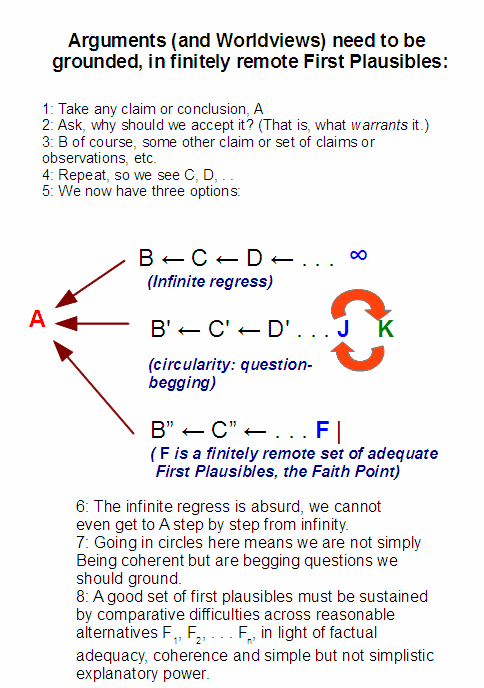
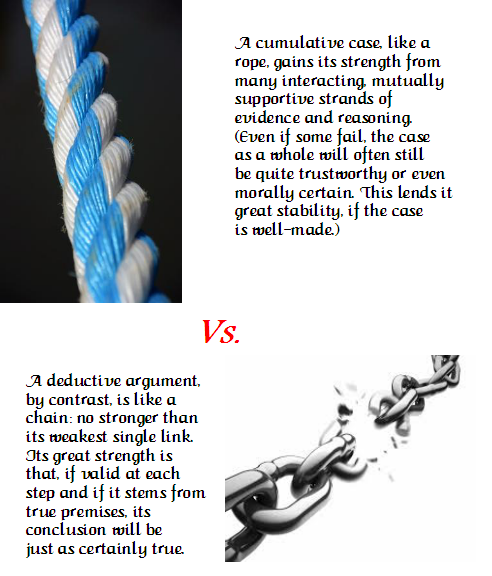
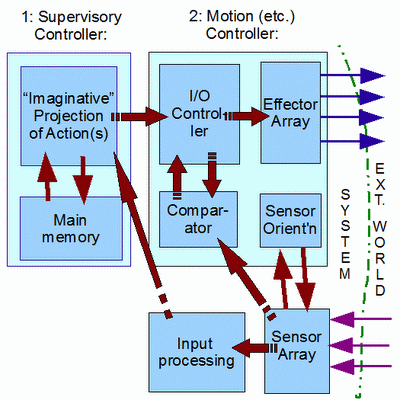
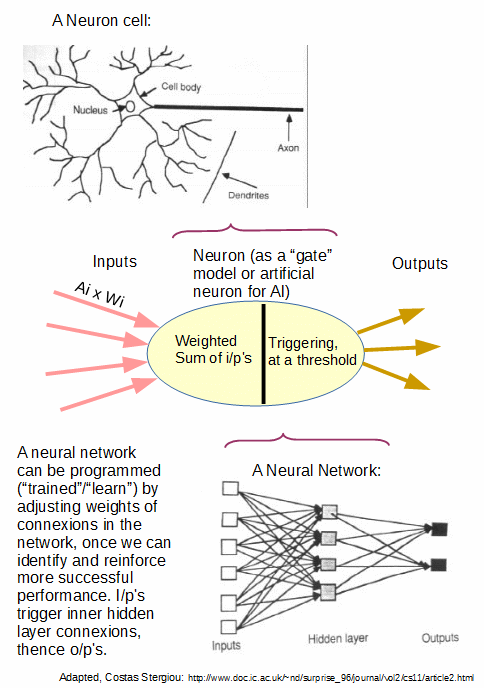
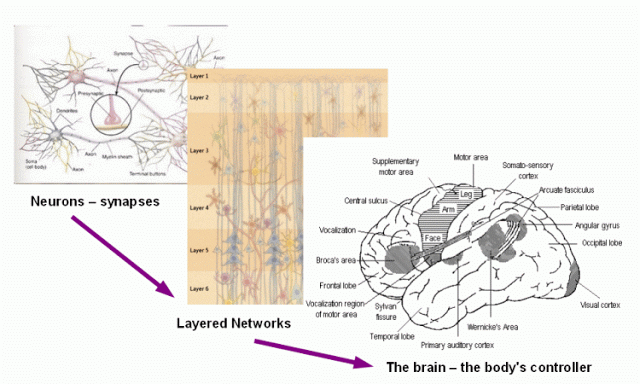
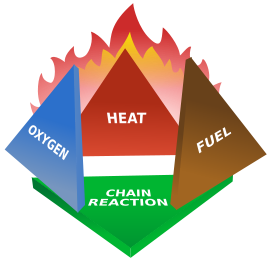

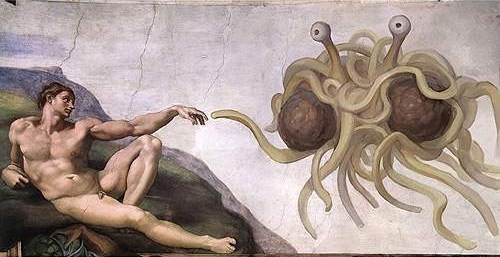 Public domain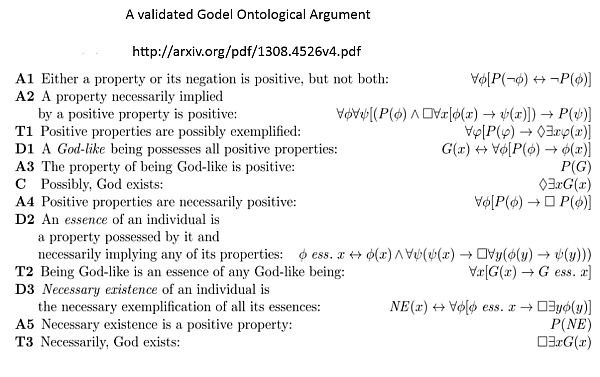

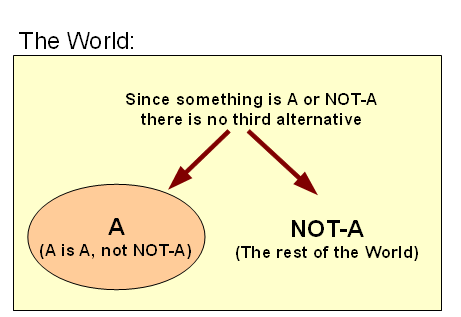
AS, 189: KF writes:
Well, “delusion” is a bit strong, but, yes, I do think people who believe that the various gods exist are mistaken. But I don’t think belief in something that is not true is per se a terrible thing. It is only when religion is used as an excuse to attack the out-group, be they infidels, women, gays and so on, that it becomes something that must be opposed.