Uncommon Descent Serving The Intelligent Design Community

US AG Barr on the importance of religious liberty

Categories
Academic Freedom
Atheism
Defending our Civilization
News Highlights
Religion
Share
Facebook
Twitter/X
LinkedIn
Flipboard
Print
Email

Here (as updated):

Money clip:

The imperative of protecting religious freedom was not just a nod in the direction of piety. It reflects the framers’ belief that religion was indispensable to sustaining our free system of government . . . ”

Food for thought. END

F/N, U/D: Prepared text, found. I think he mostly read the speech, let us clip and discuss below.

PS: First, a different view on political spectra (than where one sat in the French legislature 200 years ago or thereabouts):

U/d b for clarity, nb Nil

Next, Aquinas on law, as summarised:

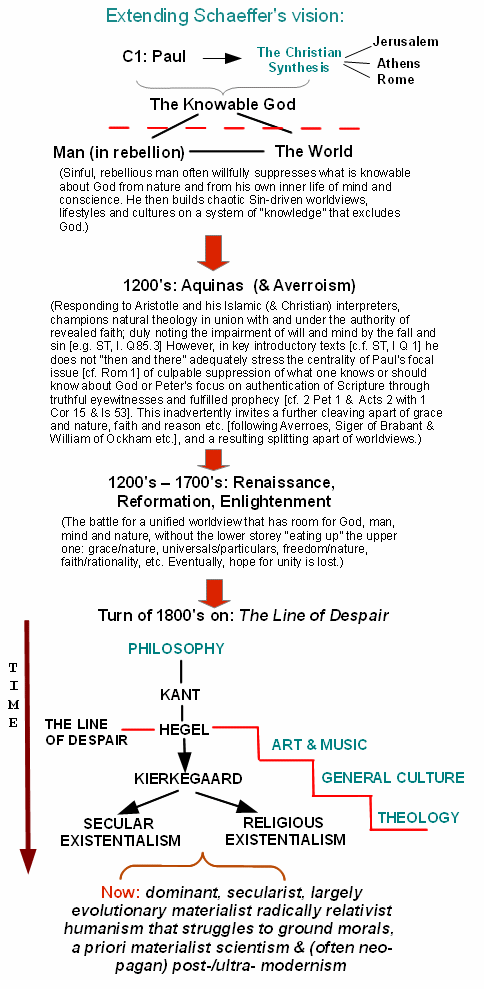
Third, Schaeffer’s line of despair analysis, as adjusted and extended:
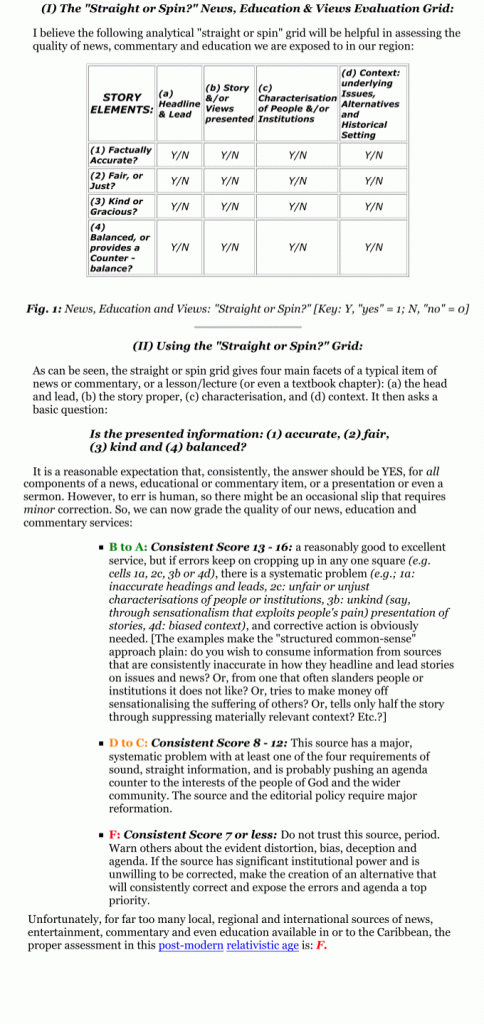
Let’s add on straight vs spin
Comments
Hazel, I notice you are off on a tangential issue that has been adequately answered. I simply challenge you to read the Greyland book. On the main subject, it is clear that the objections you endorsed have failed. KFkairosfocus
October 22, 2019
October
10
Oct
22
22
2019
05:24 PM
5
05
24
PM
PDT
EG, maybe you did not notice the exploration of objective principles/canons of beauty here at UD some time back? Subjectivity in this context as opposed to objectivity would entail delusion as we perceive duties to truth, right, right reason etc -- as you full well know. If such duties are purely subjective, they are delusional. KFkairosfocus
October 22, 2019
October
10
Oct
22
22
2019
05:22 PM
5
05
22
PM
PDT
KF
The issue is whether that perception is merely subjective and delusional or objective, having warrant to make it credible that it is reflective of reality.
I like how you conflate subjective and delusion. Is your wife’s beauty a delusion? Are you sure you want to go that route?Ed George
October 22, 2019
October
10
Oct
22
22
2019
04:12 PM
4
04
12
PM
PDT
I wonder how much weight kf would place on my experiences knowing many happy, successful homosexual people, many now married, I'm happy to say, and some with successful, well-adjusted children. As I read someplace recently, the plural of anecdote is not data.hazel
October 22, 2019
October
10
Oct
22
22
2019
04:00 PM
4
04
00
PM
PDT
F/N: Video Link updated: https://www.youtube.com/watch?v=IM87WMsrCWM . KFkairosfocus
October 22, 2019
October
10
Oct
22
22
2019
01:49 PM
1
01
49
PM
PDT
PPS: His other warning, in the parable of the ship of state:
It is not too hard to figure out that our civilisation is in deep trouble and is most likely headed for shipwreck. (And of course, that sort of concern is dismissed as “apocalyptic,” or neurotic pessimism that refuses to pause and smell the roses.) Plato’s Socrates spoke to this sort of situation, long since, in the ship of state parable in The Republic, Bk VI:
>>[Soc.] I perceive, I said, that you are vastly amused at having plunged me into such a hopeless discussion; but now hear the parable, and then you will be still more amused at the meagreness of my imagination: for the manner in which the best men are treated in their own States is so grievous that no single thing on earth is comparable to it; and therefore, if I am to plead their cause, I must have recourse to fiction, and put together a figure made up of many things, like the fabulous unions of goats and stags which are found in pictures. Imagine then a fleet or a ship in which there is a captain [–> often interpreted, ship’s owner] who is taller and stronger than any of the crew, but he is a little deaf and has a similar infirmity in sight, and his knowledge of navigation is not much better. [= The people own the community and in the mass are overwhelmingly strong, but are ill equipped on the whole to guide, guard and lead it] The sailors are quarrelling with one another about the steering – every one is of opinion that he has a right to steer [= selfish ambition to rule and dominate], though he has never learned the art of navigation and cannot tell who taught him or when he learned, and will further assert that it cannot be taught, and they are ready to cut in pieces any one who says the contrary. They throng about the captain, begging and praying him to commit the helm to them [–> kubernetes, steersman, from which both cybernetics and government come in English]; and if at any time they do not prevail, but others are preferred to them, they kill the others or throw them overboard [ = ruthless contest for domination of the community], and having first chained up the noble captain’s senses with drink or some narcotic drug [ = manipulation and befuddlement, cf. the parable of the cave], they mutiny and take possession of the ship and make free with the stores; thus, eating and drinking, they proceed on their voyage in such a manner as might be expected of them [–> Cf here Luke’s subtle case study in Ac 27]. Him who is their partisan and cleverly aids them in their plot for getting the ship out of the captain’s hands into their own whether by force or persuasion [–> Nihilistic will to power on the premise of might and manipulation making ‘right’ ‘truth’ ‘justice’ ‘rights’ etc], they compliment with the name of sailor, pilot, able seaman, and abuse the other sort of man, whom they call a good-for-nothing; but that the true pilot must pay attention to the year and seasons and sky and stars and winds, and whatever else belongs to his art, if he intends to be really qualified for the command of a ship, and that he must and will be the steerer, whether other people like or not-the possibility of this union of authority with the steerer’s art has never seriously entered into their thoughts or been made part of their calling. Now in vessels which are in a state of mutiny and by sailors who are mutineers, how will the true pilot be regarded? Will he not be called by them a prater, a star-gazer, a good-for-nothing? [Ad.] Of course, said Adeimantus. [Soc.] Then you will hardly need, I said, to hear the interpretation of the figure, which describes the true philosopher in his relation to the State[ --> here we see Plato's philosoppher-king emerging]; for you understand already. [Ad.] Certainly. [Soc.] Then suppose you now take this parable to the gentleman who is surprised at finding that philosophers have no honour in their cities; explain it to him and try to convince him that their having honour would be far more extraordinary. [Ad.] I will. [Soc.] Say to him, that, in deeming the best votaries of philosophy to be useless to the rest of the world, he is right; but also tell him to attribute their uselessness to the fault of those who will not use them, and not to themselves. The pilot should not humbly beg the sailors to be commanded by him –that is not the order of nature; neither are ‘the wise to go to the doors of the rich’ –the ingenious author of this saying told a lie –but the truth is, that, when a man is ill, whether he be rich or poor, to the physician he must go, and he who wants to be governed, to him who is able to govern. The ruler who is good for anything ought not to beg his subjects to be ruled by him [ --> down this road lies the modern solution: a sound, well informed people will seek sound leaders, who will not need to manipulate or bribe or worse, and such a ruler will in turn be checked by the soundness of the people, cf. US DoI, 1776]; although the present governors of mankind are of a different stamp; they may be justly compared to the mutinous sailors, and the true helmsmen to those who are called by them good-for-nothings and star-gazers. [Ad.] Precisely so, he said. [Soc] For these reasons, and among men like these, philosophy, the noblest pursuit of all, is not likely to be much esteemed by those of the opposite faction; not that the greatest and most lasting injury is done to her by her opponents, but by her own professing followers, the same of whom you suppose the accuser to say, that the greater number of them are arrant rogues, and the best are useless; in which opinion I agreed [--> even among the students of the sound state (here, political philosophy and likely history etc.), many are of unsound motivation and intent, so mere education is not enough, character transformation is critical]. [Ad.] Yes. [Soc.] And the reason why the good are useless has now been explained? [Ad.] True. [Soc.] Then shall we proceed to show that the corruption of the majority is also unavoidable, and that this is not to be laid to the charge of philosophy any more than the other? [Ad.] By all means. [Soc.] And let us ask and answer in turn, first going back to the description of the gentle and noble nature.[ -- > note the character issue] Truth, as you will remember, was his leader, whom he followed always and in all things [ --> The spirit of truth as a marker]; failing in this, he was an impostor, and had no part or lot in true philosophy [--> the spirit of truth is a marker, for good or ill] . . . >>
(There is more than an echo of this in Acts 27, a real world case study. [Luke, a physician, was an educated Greek with a taste for subtle references.] This blog post, on soundness in policy, will also help)
kairosfocus
October 22, 2019
October
10
Oct
22
22
2019
01:43 PM
1
01
43
PM
PDT
Hazel, recall that the above includes grooming of children under false colours of library reading times. To see the force of my point I challenge you to read Moira Greyland's The Last Closet -- warning, tough read. Understand, that that is an IDEOLOGY that was at work. And already in my region, I am seeing judges presuming to amend Constitutions from the bench. When something as manifest as sex and its roots in XX vs XY chromosomes can be manipulated as we see, wrenching law and all sorts of other things, that is a warning that the nihilists are trying to seize power. I will append Plato's warning on the consequences. KF PS: That Bible-thumping fundy redneck yahoo -- NOT -- Plato warned our civilisation, 2350+ years ago:
Ath [in The Laws, Bk X 2,350+ ya]. . . .[The avant garde philosophers and poets, c. 360 BC] say that fire and water, and earth and air [i.e the classical "material" elements of the cosmos], all exist by nature and chance, and none of them by art . . . [such that] all that is in the heaven, as well as animals and all plants, and all the seasons come from these elements, not by the action of mind, as they say, or of any God, or from art, but as I was saying, by nature and chance only [ --> that is, evolutionary materialism is ancient and would trace all things to blind chance and mechanical necessity] . . . . [Thus, they hold] that the principles of justice have no existence at all in nature, but that mankind are always disputing about them and altering them; and that the alterations which are made by art and by law have no basis in nature, but are of authority for the moment and at the time at which they are made.-
[ --> Relativism, too, is not new; complete with its radical amorality rooted in a worldview that has no foundational IS that can ground OUGHT, leading to an effectively arbitrary foundation only for morality, ethics and law: accident of personal preference, the ebbs and flows of power politics, accidents of history and and the shifting sands of manipulated community opinion driven by "winds and waves of doctrine and the cunning craftiness of men in their deceitful scheming . . . " cf a video on Plato's parable of the cave; from the perspective of pondering who set up the manipulative shadow-shows, why.]
These, my friends, are the sayings of wise men, poets and prose writers, which find a way into the minds of youth. They are told by them that the highest right is might,
[ --> Evolutionary materialism -- having no IS that can properly ground OUGHT -- leads to the promotion of amorality on which the only basis for "OUGHT" is seen to be might (and manipulation: might in "spin") . . . ]
and in this way the young fall into impieties, under the idea that the Gods are not such as the law bids them imagine; and hence arise factions [ --> Evolutionary materialism-motivated amorality "naturally" leads to continual contentions and power struggles influenced by that amorality at the hands of ruthless power hungry nihilistic agendas], these philosophers inviting them to lead a true life according to nature, that is,to live in real dominion over others [ --> such amoral and/or nihilistic factions, if they gain power, "naturally" tend towards ruthless abuse and arbitrariness . . . they have not learned the habits nor accepted the principles of mutual respect, justice, fairness and keeping the civil peace of justice, so they will want to deceive, manipulate and crush -- as the consistent history of radical revolutions over the past 250 years so plainly shows again and again], and not in legal subjection to them [--> nihilistic will to power not the spirit of justice and lawfulness].
kairosfocus
October 22, 2019
October
10
Oct
22
22
2019
01:41 PM
1
01
41
PM
PDT
kf writes, "those who will increasingly face the consequences will one day for cause curse our generation and its follies." Well, we won't be around to see if that is true or not, but I am much more concerned about many other things they may curse about: same-sex marriage is not one of them.hazel
October 22, 2019
October
10
Oct
22
22
2019
01:13 PM
1
01
13
PM
PDT
Hazel, your own arguments reflect part of the ruin. In this case, of the understanding of sex, sexual identity, linked morality and protective institutions such as marriage and family, thence law, Constitutions, institutions of justice and law enforcement, then rights and justice; also the education and moral formation of the young. Those ill advised changes lead to progressively warped behaviours and policy then to unintended but in part long since warned against consequences. Whether or not you happen to agree or disagree is immaterial, those who will increasingly face the consequences will one day for cause curse our generation and its follies. But also, underneath all your arguments we see the same prime duties of right reason being appealed to and showing themselves as inescapable. What you refuse to acknowledge is in fact everywhere present. KF.kairosfocus
October 22, 2019
October
10
Oct
22
22
2019
11:38 AM
11
11
38
AM
PDT
hazel:
You can disapprove or refuse to enable homosexual behaviors, including getting married, if you wish, but I choose to support them because I value those people as complete human beings, deserving of, dare I say it, the pursuit of happiness that is appropriate to their natures.
And yet their actions are purely unnatural, deviant and perverse. Perhaps hazel would have us free all of the criminals that are currently in prison so they too can pursue their happiness that is appropriate to their natures.ET
October 22, 2019
October
10
Oct
22
22
2019
09:05 AM
9
09
05
AM
PDT
We disagree about what constitutes "ruinous behavior". You can disapprove or refuse to enable homosexual behaviors, including getting married, if you wish, but I choose to support them because I value those people as complete human beings, deserving of, dare I say it, the pursuit of happiness that is appropriate to their natures.hazel
October 22, 2019
October
10
Oct
22
22
2019
09:01 AM
9
09
01
AM
PDT
EG, with homosexualisation of our civilisation -- an evident obsession on your part -- it is obvious that if you cannot address self evident duties of reason, much less implications of unselfish neighbour love in the decalogue, you will not understand the natural law written into our chromosomes and manifest in our bodies and biological development, which ground what marriage is as in-built law that we do not invent nor can we change as we wish. We can pretend, but only to the severe damage of societies that go down such roads. As is already massively evident but is of course denied by those who hope to gain from the chaos. KF PS: It also seems that you confuse value of person with blind enabling of ruinous behaviour. Precisely because I value persons, there are ruinous behaviours, habits and the like which I cannot approve or enable.kairosfocus
October 22, 2019
October
10
Oct
22
22
2019
08:43 AM
8
08
43
AM
PDT
EG, you simply cling to errors at this point and have begun to suggest vulgarities etc. Basic English:
perceive (p??si?v) vb 1. to become aware of (something) through the senses, esp the sight; recognize or observe 2. (tr; may take a clause as object) to come to comprehend; grasp [C13: from Old French perçoivre, from Latin percipere seize entirely, from per- (thoroughly) + capere to grasp] per?ceivable adj per?ceiva?bility n per?ceivably adv per?ceiver n Collins English Dictionary – Complete and Unabridged, 12th Edition 2014 © HarperCollins Publishers 1991, 1994, 1998, 2000, 2003, 2006, 2007, 2009, 2011, 2014
The issue is whether that perception is merely subjective and delusional or objective, having warrant to make it credible that it is reflective of reality. If the former, grand delusion enters and the whole of rational life is corrupted and discredited including your own. Instantly. This is the absurdity issue in action. The usual tactic of course is to use the suggestion of delusion to attack but not to recognise that one has grabbed a double edge sword without a handle and has fatally wounded one's own credibility. Often, it is done by dressing up in a lab coat or the like. In response, I yet again point out first duties of reason and how they are so self referential that either we accept them or rationality is at an end:
1] The first self evident moral truth is that we are inescapably under the government of ought.
(This is manifest in even an objector's implication in the questions, challenges and arguments that s/he would advance, that we are in the wrong and there is something to be avoided about that. That is, even the objector inadvertently implies that we OUGHT to do, think, aim for and say the right. Not even the hyperskeptical objector can escape this truth. Patent absurdity on attempted denial. Expanding slightly: our rational, responsible intelligent behaviour is inescapably under the moral government of known duties to truth, to right reason, to prudence [so to warrant], to sound conscience, to neighbourliness [thus, the Golden Rule], to fairness and justice, etc. Thus, we find morally rooted law built into our morally governed nature, even for our intellectual life. Thus, too, the civil law extends what is already built in, to our social circumstances, turning on issues of prudence, justice and mutual duties; if it is to be legitimate. Notice, this is itself a theory on what law is or at least should be. And yes, all of this is fraught with implications for the roots of reality.)
Inescapably true, so true. Antecedent to demonstrations, but requiring a base of experience and insight to understand and acknowledge. KFkairosfocus
October 22, 2019
October
10
Oct
22
22
2019
08:30 AM
8
08
30
AM
PDT
Ed George:
Please don’t tell me what I mean. That is very annoying.
Then stop doing it.
I assert that we all have something that we call a “sense of morality”.
And that is only because there is an objective morality.
And, like other senses, our perception of them is subjective.
That is only because of who we are
I think that homosexuals deserve our acceptance, you don’t.
Stop telling KF what he thinks, Ed. Accepting homosexuality and redefining marriage to allow SSM are two different things. Only a desperate loser would conflate the two.
Unless you can provide proof that humans are not, inherently, selfish.
Bovine excrement.
Young children are a perfect display of our inherent nature.
My kids were never selfish. Perhaps your parenting is the problem, Ed.ET
October 22, 2019
October
10
Oct
22
22
2019
08:12 AM
8
08
12
AM
PDT
KF
2: In short, you accept that we perceive moral government...
No. Please don’t tell me what I mean. That is very annoying. I assert that we all have something that we call a “sense of morality”. And, like other senses, our perception of them is subjective. I like the taste of brussel sprouts, my wife hates them.
3: That is, you recognise that oughtness reflects moral government under principles.
Subjective principles. I think that homosexuals deserve our acceptance, you don’t.
4: Error of attribution on improper motives.
Bovine excrement. Unless you can provide proof that humans are not, inherently, selfish. Young children are a perfect display of our inherent nature. The fact that we can rise above this is testament to our reasoning abilities.
5: Disagreement in a context where error exists and where people may cling to absurdities for various reasons, does not show that moral or other SET’s do not exist,
I agree. One disagreement is an anomaly, two is coincidence, but hundreds of thousands is compelling evidence. I would respond to the rest of your numbered points (as if numbering them gives them more credence) but they are just rehashing the same tired theme.Ed George
October 22, 2019
October
10
Oct
22
22
2019
07:40 AM
7
07
40
AM
PDT
EG, Back to you in 351: >>Not accepting your self-evident truths as being self-evident is not struggling.>> 1: Of course, people, being free are free to reject what is indeed self evident, though they are then not free to avert the direct consequence of manifest absurdity. 2: In this case, your own argument pivots on our known, inescapable duties of right reason, i.e., again you implicitly appeal to what you wish to persuade us to reject:
1] The first self evident moral truth is that we are inescapably under the government of ought.
(This is manifest in even an objector's implication in the questions, challenges and arguments that s/he would advance, that we are in the wrong and there is something to be avoided about that. That is, even the objector inadvertently implies that we OUGHT to do, think, aim for and say the right. Not even the hyperskeptical objector can escape this truth. Patent absurdity on attempted denial. Expanding slightly: our rational, responsible intelligent behaviour is inescapably under the moral government of known duties to truth, to right reason, to prudence [so to warrant], to sound conscience, to neighbourliness [thus, the Golden Rule], to fairness and justice, etc. Thus, we find morally rooted law built into our morally governed nature, even for our intellectual life. Thus, too, the civil law extends what is already built in, to our social circumstances, turning on issues of prudence, justice and mutual duties; if it is to be legitimate. Notice, this is itself a theory on what law is or at least should be. And yes, all of this is fraught with implications for the roots of reality.)
3: This pattern only reinforces the point that these principles are inescapable. >>If something is self-evident, it does not need to be demonstrated or explained. >> 4: Simply false. As ET pointed out, 2 + 2 = 4 does have to be explained, taught, shown, demonstrated, corrected etc till we get it and the like reliably correct. Self evidence has to be understood and we have to have a level of experience and background knowledge to understand it. >>The fact that you have to explain why your claimed SETs are self-evident is proof that they are not self-evident. >> 5: Error carried forward, and indeed it echoes Seversky's similar errors. >>They are things that you have concluded to be true based on your examination.>> 6: To understand, one needs to at minimum inspect or experience, nuh? You here try to turn a condition of knowledge into an objection to being knowledge. This will not end well. >>The problem is, these conclusions are dependent on assumptions>> 7: You here try a turnabout, setting up a strawman to then attack suggested assumptions. Meanwhile the very process of your objection pivots on the implicit knowledge that we are governed by said duties. >> that have not been proven beyond any reasonable doubt.>> 8: Proofs of course, depend on a network of SET's of various kinds, including of course the triple first principles of reason which cannot be proved as they are implicit in any attempt to prove. 9: Just so, the first duties of right reason are implicit in any argument, discussion, thinking exercise etc and so are unprovable. The attempted proof implicitly uses what it would demonstrate -- these are warranted as true by virtue of that inescapability on pain of absurdities such as we are seeing in these objections. Thus, we see their self-evidence. 10: That is what you do not wish to acknowledge, likely because that then opens up an onward set of issues, such as:
4] Fourth, we are objectively under obligation of OUGHT. That is, despite any particular person’s (or group’s or august council’s or majority’s) wishes or claims to the contrary [--> yes many will disagree, but cannot escape the absurdities of such disagreement], such obligation credibly holds to moral certainty. That is, it would be irresponsible, foolish and unwise for us to act and try to live otherwise. 5] Fifth, this cumulative framework of moral government under OUGHT is the basis for the manifest core principles of the natural moral law under which we find ourselves obligated to the right the good, the true etc. [--> this is where it is going, moral government is objective and frames built in law] Where also, patently, we struggle to live up to what we acknowledge or imply we ought to do. [--> yes this was there all along, but was of course conveniently ignored, and when I focussed on a narrower set it was smuggled back in as though it were part of an overturning objection] 6] Sixth, this means we live in a world in which being under core, generally understood principles of natural moral law is coherent and factually adequate, thus calling for a world-understanding in which OUGHT is properly grounded at root level. (Thus worldviews that can soundly meet this test are the only truly viable ones. if a worldview does not have in it a world-root level IS that can simultaneously ground OUGHT, it fails decisively.* [--> Suspicion, this is the ideological problem, moral government points to a root of such that is part of the source of reality]) 7] Seventh, in light of the above, even the weakest and most voiceless of us thus has a natural right to life, liberty, the pursuit of fulfillment of one’s sense of what s/he ought to be (“happiness”). This includes the young child, the unborn and more. (We see here the concept that rights are binding moral expectations of others to provide respect in regards to us because of our inherent status as human beings, members of the community of valuable neighbours. Where also who is my neighbour was forever answered by the parable of the Good Samaritan. Likewise, there can be no right to demand of or compel my neighbour that s/he upholds me and enables me in the wrong — including under false colour of law through lawfare. To justly claim a right, one must first be in the right.) 8] Eighth, like unto the seventh, such may only be circumscribed or limited for good cause. Such as, reciprocal obligation to cherish and not harm neighbour of equal, equally valuable nature in community and in the wider world of the common brotherhood of humanity. 9] Ninth, this is the context in which it becomes self evidently wrong, wicked and evil to kidnap, sexually torture and murder a young child or the like as concrete cases in point that show that might and/or manipulation do not make ‘right,’ ‘truth,’ ‘worth,’ ‘justice,’ ‘fairness,’ ‘law’ etc. That is, anything that expresses or implies the nihilist’s credo is morally absurd.
KFkairosfocus
October 22, 2019
October
10
Oct
22
22
2019
07:33 AM
7
07
33
AM
PDT
Ed George:
Well, that’s convenient if you want to take all the evidence demonstrating that moral values are subjective and declaring that they are objective.
Well, that's convenient if you want to ignore what people do. Even subjective morals had to come from something, Ed.ET
October 22, 2019
October
10
Oct
22
22
2019
07:13 AM
7
07
13
AM
PDT
Hazel, 309: >>Good work, Sev and Ed. I especially like Ed’s remark about where kf goes too far.>> Endorsement, again, so I was right to focus on first Seversky then EG. Both, manifestly, fail. KFkairosfocus
October 22, 2019
October
10
Oct
22
22
2019
07:05 AM
7
07
05
AM
PDT
EG, Re, 305: >>What was stopping them from freeing the slaves that they owned? If they truly believed that these principles applied to all humans, surely they would have set the example.>> I already pointed out hopeless indebtedness. You will also find that there were in fact manumissions. KFkairosfocus
October 22, 2019
October
10
Oct
22
22
2019
07:03 AM
7
07
03
AM
PDT
EG, Your turn now, from 304 above: >>Seversky @ 299 and 300, thank you. You presented this better than I could have.>> 1: Endorsement so it was proper to first show the errors in Seversky. >>I would tend to concede to KF that we all have, for lack of better words, a sense of morality.>> 2: In short, you accept that we perceive moral government but embark on some species or another of relativism, subjectivism and emotivism, leading to the delusion problem. >> But when we unpack this “sense” it comes down to a set of rules that we each have that we feel we should follow>> 3: That is, you recognise that oughtness reflects moral government under principles. Let me therefore remind you of SET 1:
1] The first self evident moral truth is that we are inescapably under the government of ought.
(This is manifest in even an objector's implication in the questions, challenges and arguments that s/he would advance, that we are in the wrong and there is something to be avoided about that. That is, even the objector inadvertently implies that we OUGHT to do, think, aim for and say the right. Not even the hyperskeptical objector can escape this truth. Patent absurdity on attempted denial. Expanding slightly: our rational, responsible intelligent behaviour is inescapably under the moral government of known duties to truth, to right reason, to prudence [so to warrant], to sound conscience, to neighbourliness [thus, the Golden Rule], to fairness and justice, etc. Thus, we find morally rooted law built into our morally governed nature, even for our intellectual life. Thus, too, the civil law extends what is already built in, to our social circumstances, turning on issues of prudence, justice and mutual duties; if it is to be legitimate. Notice, this is itself a theory on what law is or at least should be. And yes, all of this is fraught with implications for the roots of reality.)
>>. And, due to the inherently selfish nature of humans, we feel others should (OUGHT) follow as well.>> 4: Error of attribution on improper motives. But ironically, you acknowledge that we are morally governed and struggle to do the right we know we should. But ought is always not the same as is, that is the very point. >> But you don’t have to look any further than this thread to discover that we done all have the same moral values.>> 5: Disagreement in a context where error exists and where people may cling to absurdities for various reasons, does not show that moral or other SET's do not exist, just that some will cling to crooked yardsticks in the face of the testimony of the plumb line right in front of them. 6: At this point, you have actually implicitly acknowledged the material points, and your case is built on appeal to the said duties of responsible reason. We see this right away as we notice: >>Where I believe KF goes off the rails>> 7: Precisely the point noted above under SET 1: "even the objector inadvertently implies that we OUGHT to do, think, aim for and say the right." >> is to make the leap from the apparently universal existence of a moral sense, in spite of its complete lack of consistency over space and time,>> 8: Error of appealing to mere disagreement as if that were disproof. Never mind that it is actually notorious that there is far more consensus than those who promote relat5ivism and subjectivism wish to suggest. >> to conclude that the moral values that he has are objectively derived.>> 9: This is a projection, that I am trying to impose my own personal values, in context of such being attributed to selfishness. that is itself ill advised and can easily become uncivil. 10: The "derived" is a further turnabout attempt. Nope, known duties to truth, right reason, prudence, sound conscience, justice etc are ANTECEDENT to any stated argument and govern how it works. try to make an argument that does not expect such commitments and you will see the inescapability. >>We don’t have to go any further than the Ten Commandments to know this is not the case. Thou shall not steal and thou shall not lie (bare false witness), for example. Anyone who has had kids knows that these values must be taught and repeatedly reinforced.>> 11: And kids do not have to be taught that II + III --> IIIII? 12: Notice, one needs to have a basis of adequate experience and understanding to address a SET. that may be acquired informally or through formal education but must be present in adequate degree. >>I guess it could be argued that not lying or stealing are objectively necessary for a society to thrive, and I would probably agree with this. But KF is not arguing for it as objective societal values, he is arguing for it as objective human value.>> 13: Notice, the shifting of subjects that now has set up and proceeds to knock over a strawman. The duties on the table are not the decalogue, but instead duties of responsible reason, specifically, how such is governed by known duty to truth, right reason, prudence, sound conscience, justice, etc. 14: All the while, EG, you are implying that I am in error and I ought to correct such, i.e. these duties are again inescapable. >>you only have to take a brief look at history to find plenty of examples of societies of people lying to and stealing from other societies of people, and thriving.>> 15: That oppression and injustice work for a time is notorious, if they didn't such would not be a problem. 16: And again, the appeal to said duties is the pivot of your argument. Fail, not just because I say so -- as you have tried to project -- but on clear evidence once examined. KFkairosfocus
October 22, 2019
October
10
Oct
22
22
2019
05:53 AM
5
05
53
AM
PDT
Seversky, Though fairly brief, this one is perhaps the most telling on what is wrong: >>As we have all seen, the debate over the nature of free will is ongoing and vigorous and that debate, of itself, is evidence against any one position being self-evidently true.>> 1: We by your own admission, have a debate, not merely a meaningless, random and/or mechanically determined spewing of noises imagined to be freely responsible, meaningful communications, or actual symbolic representation as actual text. 2: See the self-referentiality, already? Yes, you are sawing off the branch on which we all must sit including yourself. Already, reduced to absurdity, fail. 3: More interestingly, you imagine that disagreement disproves self-evidence. Nope, not in a world where people may misunderstand or for emotional, psychological, social or ideological or even prudential reasons, might cling to the manifestly absurd. 4: Notice, the first thing is that one must have adequate experience and general understanding to understand what is being asserted in a SET. It is those who are so equipped (generally, the practical criterion for ordinary things like 2 + 3 = 5 or error exists would be the intelligent 12 year old or for more technical matters, having enough of a 101 to understand the matters at stake) who can respond to what may be objectively self-evident but then subjectivity of the individual affects ability to access it. 5: In the case of moral government of our rational life, I think the 12 year old is more relevant. Surely, someone able to read a typical newspaper will appreciate enough of:
1] The first self evident moral truth is that we are inescapably under the government of ought.
(This is manifest in even an objector's implication in the questions, challenges and arguments that s/he would advance, that we are in the wrong and there is something to be avoided about that. That is, even the objector inadvertently implies that we OUGHT to do, think, aim for and say the right. Not even the hyperskeptical objector can escape this truth. Patent absurdity on attempted denial. Expanding slightly: our rational, responsible intelligent behaviour is inescapably under the moral government of known duties to truth, to right reason, to prudence [so to warrant], to sound conscience, to neighbourliness [thus, the Golden Rule], to fairness and justice, etc. Thus, we find morally rooted law built into our morally governed nature, even for our intellectual life. Thus, too, the civil law extends what is already built in, to our social circumstances, turning on issues of prudence, justice and mutual duties; if it is to be legitimate. Notice, this is itself a theory on what law is or at least should be. And yes, all of this is fraught with implications for the roots of reality.)
6: In that context, we cannot but notice that you=r own dismissal rests on said knowledge of those duties. Thus, to moral government of rationality. 7: Extending, the fact of disagreement and debate pivots on a tacit understanding that these duties obtain. You are in the position of Epictetus' interlocutor. 8: Turning to the absurdity problem, the rejection of a SET is immediately, manifestly absurd in one way or another. Obvious for basic Arithmetic facts. 9: For moral issues, it is often harder to admit the absurdity, such as that it is self evidently wrong to torture and kill innocent babies for pleasure. But a moment's reflection shows what is now exposed in those who evade or even dare to deny the point, their nihilism is exposed, some would think in terms of criminal insanity. Which is automatically absurd to the point of being a red warning flag. 10: Now, let us look again at SET 3 in the list:
3] Third, were this sense of conscience and linked sense that we can make responsibly free, rational decisions to be a delusion, we would at once descend into a status of grand delusion in which there is no good ground for confidence in our self-understanding. That is, we look at an infinite regress of Plato’s cave worlds: once such a principle of grand global delusion is injected, there is no firewall so the perception of level one delusion is subject to the same issue, and this level two perception too, ad infinitum; landing in patent absurdity.
11: Here, we see the effect of pervasiveness of moral government, i.e. there are no firewalls in the mind, so if something this ubiquitous is delusional, we indict the mind, which is self referential and destroys credibility to make a case. 12: And once grand delusion is injected as a principle, even the level one perception is then subject to the same question, due to the self-reference. So, off we go in an infinite regress of delusions, blatant absurdity. This is enough to show how the objections collapse, actually inadvertently illustrating the force of the point. KFkairosfocus
October 22, 2019
October
10
Oct
22
22
2019
05:03 AM
5
05
03
AM
PDT
ET
Humans can take something that is objective and make it subjective
Well, that’s convenient if you want to take all the evidence demonstrating that moral values are subjective and declaring that they are objective.Ed George
October 22, 2019
October
10
Oct
22
22
2019
04:37 AM
4
04
37
AM
PDT
Ed George:
You still have not addressed the FACT that all of human history fits a subjective nature of moral values rather than an objective one.
It has been addressed. Your willful ignorance is neither an argument nor a refutation. Humans can take something that is objective and make it subjectiveET
October 22, 2019
October
10
Oct
22
22
2019
03:50 AM
3
03
50
AM
PDT
EG, more turnabout projection on your part. In showing stubborn refusal to acknowledge self evident truth and demonstration of absurdity resulting from that refusal, you are manifestly clinging to crooked yardsticks as standards of straight, accurate, upright. Meanwhile the plumb line has spoken. KF PS: just as a reminder, on the utter failure of subjectivism and relativism:
Excerpted chapter summary, on Subjectivism, Relativism, and Emotivism, in Doing Ethics 3rd Edn, by Lewis Vaughn, W W Norton, 2012. [Also see here and here.] Clipping: . . . Subjective relativism is the view that an action is morally right if one approves of it. A person’s approval makes the action right. This doctrine (as well as cultural relativism) is in stark contrast to moral objectivism, the view that some moral principles are valid for everyone.. Subjective relativism, though, has some troubling implications. It implies that each person is morally infallible and that individuals can never have a genuine moral disagreement Cultural relativism is the view that an action is morally right if one’s culture approves of it. The argument for this doctrine is based on the diversity of moral judgments among cultures: because people’s judgments about right and wrong differ from culture to culture, right and wrong must be relative to culture, and there are no objective moral principles. This argument is defective, however, because the diversity of moral views does not imply that morality is relative to cultures. In addition, the alleged diversity of basic moral standards among cultures may be only apparent, not real. Societies whose moral judgments conflict may be differing not over moral principles but over nonmoral facts. Some think that tolerance is entailed by cultural relativism. But there is no necessary connection between tolerance and the doctrine. Indeed, the cultural relativist cannot consistently advocate tolerance while maintaining his relativist standpoint. To advocate tolerance is to advocate an objective moral value. But if tolerance is an objective moral value, then cultural relativism must be false, because it says that there are no objective moral values. Like subjective relativism, cultural relativism has some disturbing consequences. It implies that cultures are morally infallible, that social reformers can never be morally right, that moral disagreements between individuals in the same culture amount to arguments over whether they disagree with their culture, that other cultures cannot be legitimately criticized, and that moral progress is impossible. Emotivism is the view that moral utterances are neither true nor false but are expressions of emotions or attitudes. It leads to the conclusion that people can disagree only in attitude, not in beliefs. People cannot disagree over the moral facts, because there are no moral facts. Emotivism also implies that presenting reasons in support of a moral utterance is a matter of offering nonmoral facts that can influence someone’s attitude. It seems that any nonmoral facts will do, as long as they affect attitudes. Perhaps the most far-reaching implication of emotivism is that nothing is actually good or bad. There simply are no properties of goodness and badness. There is only the expression of favorable or unfavorable emotions or attitudes toward something.
PPS: We also notice, yet again, how you are using what you try to deny, in order to try to persuade -- demonstrating yet again just how inescapably self-evident these principles are:
1] The first self evident moral truth is that we are inescapably under the government of ought.
(This is manifest in even an objector's implication in the questions, challenges and arguments that s/he would advance, that we are in the wrong and there is something to be avoided about that. That is, even the objector inadvertently implies that we OUGHT to do, think, aim for and say the right. Not even the hyperskeptical objector can escape this truth. Patent absurdity on attempted denial. Expanding slightly: our rational, responsible intelligent behaviour is inescapably under the moral government of known duties to truth, to right reason, to prudence [so to warrant], to sound conscience, to neighbourliness [thus, the Golden Rule], to fairness and justice, etc. Thus, we find morally rooted law built into our morally governed nature, even for our intellectual life. Thus, too, the civil law extends what is already built in, to our social circumstances, turning on issues of prudence, justice and mutual duties; if it is to be legitimate. Notice, this is itself a theory on what law is or at least should be. And yes, all of this is fraught with implications for the roots of reality.)
2] Second self evident truth, we discern that some things are right and others are wrong by a compass-sense we term conscience which guides our thought. (Again, objectors depend on a sense of guilt/ urgency to be right not wrong on our part to give their points persuasive force. See what would be undermined should conscience be deadened or dismissed universally? Sawing off the branch on which we all must sit.) 3] Third, were this sense of conscience and linked sense that we can make responsibly free, rational decisions to be a delusion, we would at once descend into a status of grand delusion in which there is no good ground for confidence in our self-understanding. That is, we look at an infinite regress of Plato’s cave worlds: once such a principle of grand global delusion is injected, there is no firewall so the perception of level one delusion is subject to the same issue, and this level two perception too, ad infinitum; landing in patent absurdity.
In short, once we have genuine power of responsible, reasonable choice -- prerequisites of credibility of mind -- then immediately we face the government of ought. And if one denies that freedom, s/he undermines his or her own rationality. But of course, some will always try to have their cake and eat it. PPPS: Kurt Schlichter, excerpted: >>“gaslighting,” the straight-faced denial of what’s happening right in front of you that tries to leverage your politeness and deference to convince you . . . You’re . . . crazy for noticing.>> One of the uglier agit prop and trollish stunts. if he were a modern agit prop or trollish operator, Epictetus' interlocutor would say, but you are using logic to try to prove it. That's just what YOU say, so there. Nyah nyah nyah na na!kairosfocus
October 22, 2019
October
10
Oct
22
22
2019
03:17 AM
3
03
17
AM
PDT
KF
EG, turnabout projection.
If it was turnabout projection you are admitting that your comments are projection. :)
Note, Hazel and you seem to have endorsed his attempted point by point dismissal, which has already been shown a failure.
I hope you realize that you declaring failure does not mean it was a failure. That is simply your opinion, as are most of your claims, including many of the things you claim to be SETs. You still have not addressed the FACT that all of human history fits a subjective nature of moral values rather than an objective one. To make history fit an objective regime you have to do some pretty fancy dancing.Ed George
October 22, 2019
October
10
Oct
22
22
2019
02:53 AM
2
02
53
AM
PDT
Vivid writes to JAD,
I don’t engage people on this site with any illusions that I am going to change anyone’s mind rather only to expose to any onlookers their total lack of intellectual honesty and truthfulness.
Well, I’m glad he’s stated his preconceptions and goals clearly, although I think I had already reached that conclusion. If our paths cross again, I’ll remember this and avoid him.hazel
October 21, 2019
October
10
Oct
21
21
2019
06:38 PM
6
06
38
PM
PDT
EG, turnabout projection. And, yet again, you imply directly what you try to dismiss, it is that inescapable:
1] The first self evident moral truth is that we are inescapably under the government of ought.
(This is manifest in even an objector's implication in the questions, challenges and arguments that s/he would advance, that we are in the wrong and there is something to be avoided about that. That is, even the objector inadvertently implies that we OUGHT to do, think, aim for and say the right. Not even the hyperskeptical objector can escape this truth. Patent absurdity on attempted denial. Expanding slightly: our rational, responsible intelligent behaviour is inescapably under the moral government of known duties to truth, to right reason, to prudence [so to warrant], to sound conscience, to neighbourliness [thus, the Golden Rule], to fairness and justice, etc. Thus, we find morally rooted law built into our morally governed nature, even for our intellectual life. Thus, too, the civil law extends what is already built in, to our social circumstances, turning on issues of prudence, justice and mutual duties; if it is to be legitimate. Notice, this is itself a theory on what law is or at least should be. And yes, all of this is fraught with implications for the roots of reality.)
2] Second self evident truth, we discern that some things are right and others are wrong by a compass-sense we term conscience which guides our thought. (Again, objectors depend on a sense of guilt/ urgency to be right not wrong on our part to give their points persuasive force. See what would be undermined should conscience be deadened or dismissed universally? Sawing off the branch on which we all must sit.) 3] Third, were this sense of conscience and linked sense that we can make responsibly free, rational decisions to be a delusion, we would at once descend into a status of grand delusion in which there is no good ground for confidence in our self-understanding. That is, we look at an infinite regress of Plato’s cave worlds: once such a principle of grand global delusion is injected, there is no firewall so the perception of level one delusion is subject to the same issue, and this level two perception too, ad infinitum; landing in patent absurdity.
KF PS: On some key matters, you are in the queue for after I finish the point by point on Seversky. Note, Hazel and you seem to have endorsed his attempted point by point dismissal, which has already been shown a failure. But at least he tried to make a case on some research. Notice, his pivotal worldviews loaded error in addressing truth, evidence, moral truth.kairosfocus
October 21, 2019
October
10
Oct
21
21
2019
06:35 PM
6
06
35
PM
PDT
She starts out with a claim at 12 Actually 14 not 12 Vividvividbleau
October 21, 2019
October
10
Oct
21
21
2019
02:33 PM
2
02
33
PM
PDT
Hazel
Ed, do you sometimes get the sense that kf doesn’t even read what you write, much less think about it?
Only on days that end in a “y”. :) But seriously, I get the feeling that we are not speaking the same language. His responses do nothing to address my points (as you have seen) and I assume that he doesn’t think that mine address his. I have performed operational audits of foreign companies using translators and have never had as much difficulty having a meaningful discussion as I do with KF.Ed George
October 21, 2019
October
10
Oct
21
21
2019
01:32 PM
1
01
32
PM
PDT
Ed George:
If it were subjectively derived we would expect moral values to vary within a society, between societies, and over time.
Just because some morals may be subjectively derived does not mean there aren't objective morals. After all those subjective derivations had to come from something. That there are some laws that are universal says that there are objective morals.ET
October 21, 2019
October
10
Oct
21
21
2019
12:05 PM
12
12
05
PM
PDT
1 10 11 12 13 14 25

Leave a Reply