Uncommon Descent Serving The Intelligent Design Community
Year

2011

Is Darwinism the enemy of liberalism?

The Origins of Political Order: From Prehuman Times to the French Revolution

In City Journal, (Spring 2011), New Republic editor Adam Kirsch offers an interesting reflection on Darwinism and liberalism, in his review of political thinker Francis Fukuyama’s latest, The Origins of Political Order :

Yet since ideas have consequences, the ideological victory of liberalism would be nothing to scorn—if it were really assured. Ironically, however, The Origins of Political Order itself gives reason for doubting this.

[ … ]

In The Origins of Political Order, Fukuyama makes a considerably weaker claim for liberalism:

[ … ]

The explanation for Fukuyama’s evolution must be sought, rather, in the realm of ideas—in particular, in the idea of evolution itself. Briefly put, Darwin has replaced Hegel as Fukuyama’s guide to politics. Read More ›

Church of Flying Spaghetti Monster stages social protest?

http://www.cafepress.ca/venganza/3682856

An Austrian atheist has won the right to be shown on his driving-licence photo wearing a pasta strainer as “religious headgear”.

In “Austrian driver’s religious headgear strains credulity” (July 14, 2011), BBC News tells us so

Readers may recall that pastafarianism first surfaced as the Church of the Flying Spaghetti Monster, a sort of street drama against the idea of design in nature, at Kansas school board hearings. It blossomed into a Web site. Austrian Niko Alm, learning that religious headgear is allowed in official photos claimed that “the sieve was a requirement of his religion, pastafarianism.”

Given that “the only dogma allowed in the Church of the Flying Spaghetti Monster is the rejection of dogma,” some think his three-year crusade a protest against the permissible religious headgear policy. Read More ›

Are exosomes the new “junk DNA”?

In “Exosome Explosion” (The Scientist , July 1, 2011), Clotilde Théry tells us “These small membrane vesicles do much more than clean up a cell’s trash—they also carry signals to distant parts of the body, where they can impact multiple dimensions of cellular life”:

Secreted vesicles known as exosomes were first discovered nearly 30 years ago. But, considered little more than garbage cans whose job was to discard unwanted cellular components, these small vesicles remained little studied for the next decade. Read More ›

Popcorn: How much of the genome is transcribed?

All? Some? None?

Clark et al., The Reality of Pervasive Transcription:

Current estimates indicate that only about 1.2% of the mammalian genome codes for amino acids in proteins. However, mounting evidence over the past decade has suggested that the vast majority of the genome is transcribed, well beyond the boundaries of known genes, a phenomenon known as pervasive transcription [1]. Challenging this view, an article published in PLoS Biology by van Bakel et al. concluded that “the genome is not as pervasively transcribed as previously reported” [2] and that the majority of the detected low-level transcription is due to technical artefacts and/or background biological noise. These conclusions attracted considerable publicity [3]–[6]. Here, we present an evaluation of the analysis and conclusions of van Bakel et al. compared to those of others and show that (1) the existence of pervasive transcription is supported by multiple independent techniques; (2) re-analysis of the van Bakel et al. tiling arrays shows that their results are atypical compared to those of ENCODE and lack independent validation; and (3) the RNA sequencing dataset used by van Bakel et al. suffered from insufficient sequencing depth and poor transcript assembly, compromising their ability to detect the less abundant transcripts outside of protein-coding genes. We conclude that the totality of the evidence strongly supports pervasive transcription of mammalian genomes, although the biological significance of many novel coding and noncoding transcripts remains to be explored.

However, van Bakel et al. respond: Read More ›

Last eukaryotic common ancestor had many “modern-like features”

The Design Matrix: A Consilience of Clues

At Design Matrix, blog for the book of the name, Mike Gene introduces us to the Last Eukaryotic Common Ancestor:

Earlier I showed you that the last eukaryotic common ancestor (LECA) was quite modern-like in terms of its nuclear pore complex, mechanisms of transport through this complex, and the entire endomembranous system. Yet the modern-like features do not stop there.

Introns and Spliceosome Read More ›

Why I think the interaction problem is real

Regular readers of my posts will be aware that I reject materialism. One of the strongest arguments for materialism, however, is that its alternative, dualism, is untenable. The main problem confronting dualism is the “interaction problem”: how can an immaterial mind, which is completely lacking in physical properties, exert any causal influence on the material world? The idea seems to make no sense at all.

In today’s post, I’m going to examine one argument which attempts to dissolve the interaction problem, and explain why I think the argument does not succeed. (I’ll propose a tentative solution in my next post.) According to the solution put forward by Professor Edward Feser, a well-known philosopher of mind, the interaction problem only arises if you think (as Descartes is supposed to have done) that mind and body are two things, and that the former interacts with the latter in a purely mechanical fashion – as if the mind were like a “spiritual billiard ball” that could somehow set “physical billiard balls” (i.e. neurons in the brain) in motion. (Descartes’ actual views are the subject of some debate, but the picture I’ve outlined here is commonly referred to as Cartesian dualism.) Professor Feser objects strongly to the mechanical conception of causality that has dominated philosophy for the last 300 years, because it completely ignores the directedness (or finality) of causal processes, as well as the forms of causal agents, which make them the kinds of entities they are.

While I share Feser’s view that Cartesian dualism is flawed, I disagree with his claim that Aristotle’s hylemorphic dualism (which views the soul as the form of the body and not as a separate entity) automatically dissolves the interaction problem. I shall argue that while minds do not interact with brains, people can and do interact with their brains in a non-physical manner. (Just to be clear, I’m talking about efficient-causal interaction here: I’m claiming that I can cause the neurons in my brain to move, simply by deciding to raise my arm.) Read More ›

Fundamental physics increasingly dominated by “unsuccessful highly speculative research programs”?

Not Even Wrong: The Failure of String Theory and the Search for Unity in Physical Law

At Not Even Wrong, (July 8, 2011), the blog for his book of the name, Columbia computer scientist Peter Woit goes after the defects of cosmic string theory and other bizarre cosmologies Here he notes a new book by Helge Kragh, Higher Speculations: Grand Theories and Failed Revolutions in Physics and Cosmology :

I’ve always wondered what historians of science would make of the increasing dominance of research in fundamental physics by unsuccessful highly speculative research programs, and have also often wondered if there are any relevant historical parallels to this situation. This book does a great job of addressing those questions, and it’s pretty much unique in doing so. Read More ›

Animal minds: A really smart lizard would conceal the extent of its knowledge ;)

In “Smart lizard solves a problem it’s never seen before” (New Scientist July 2011), Michael Marshall reports,

Clever lizards have worked out how to unplug holes to reach food, suggesting that problem-solving is not the sole preserve of warm-blooded birds and mammals.

Read More ›

Anyone else for the myth of junk DNA? Richard Dawkins, for one

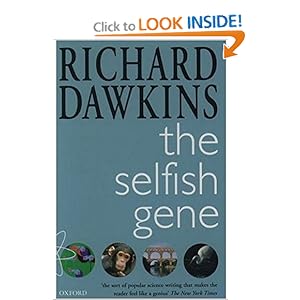
The Selfish Gene

He certainly drew the desired Darwinian conclusion:

“The amount of DNA in organisms,” Dawkins wrote in 1976, “is more than is strictly necessary for building them: A large fraction of the DNA is never translated into protein. From the point of view of the individual organism this seems paradoxical. If the ‘purpose’ of DNA is to supervise the building of bodies, it is surprising to find a large quantity of DNA which does no such thing. Biologists are racking their brains trying to think what useful task this apparently surplus DNA is doing. But from the point of view of the selfish genes themselves, there is no paradox. Read More ›

Overwhelming Evidence that Software Evolves

By comparing successive versions of Granville Sewell’s finite element program PDE2D (video here ), NCSE scientists have uncovered overwhelming evidence (from homology, etc.) that current versions evolved from a common ancester. The evidence is so overwhelming, in fact, that the competing theory of intelligent design has been abandoned by all serious scientists. “That Sewell’s software is the product of 35 years of evolution is now beyond debate,” said an NCSE spokesperson. “Only minor issues such as the mechanism of evolution are still being debated.” (For a modest proposal on how the two competing theories might be reconciled, see this or this, or the video here.)

Biophysics: Long DNA terminal repeats have wrapping function, researcher finds

In “Kinky genes: Biophysics of DNA affects how it works” (New Scientist, 08 July 2011), MacGregor Campbell reports DNA is typically a long double-helical strand that can expose its sequences of base pairs. These are translated by RNA and particles called ribosomes into proteins, which do the cell’s work. When not in use, DNA wraps around structural proteins called histones to form compact chromosomes. This wrapping is poorly understood, but one thing we do know is that it plays a key role in gene expression. Histones have up to 1000 times greater attraction for some DNA subsequences than others, but why this should be was a mystery.

Mind: Put “neuro” in front of an abstract discipline and poof! – it becomes nonsense

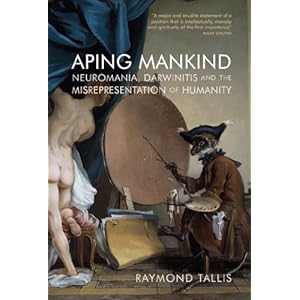
Aping Mankind: Neuromania, Darwinitis and the Misrepresentation of Humanity

In a recent review of Aping Mankind: Neuromania, Darwinitis and the Misrepresentation of Humanity, by MD neuroscientist Raymond Tallis, British journalist Robert McLuhan quotes Tallis on the current fad for identifying changes in brain function that are associated with thoughts and feelings as the explanation for those feelings.

There are repeated references to new disciplines with the prefix ‘neuro-‘ or ‘evolutionary’: neuro-jurisprudence, evolutionary economics, evolutionary aesthetics, neuro-theology, neuro-architecture, neuro-archeology and so on. Even philsophers – who should know better, being trained, one hopes, in scepticism – have entered the field with the discipline of ‘X-phi’, or experimental philosophy. Starry-eyed sages, for example, have invented ‘neuro-ethics’, in which ethical principles are examined by using brain scans to determine people’s intuitions when they are asked to deliberate on the classical dilemmas.

It is somewhat as if blushing was thought to be the cause of embarrassment. Yet … that is exactly what many such researchers believe: Read More ›

Darwinism: An Embarrassment for Legitimate Science

I write this post from a hotel room in Livermore, California, home of Lawrence Livermore National Laboratory, where my company has sent me for advanced training in computational fluid dynamics using LS-DYNA, arguably the most advanced finite element analysis program ever devised, originally at LLNL in the 1970s for the development and analysis of variable-yield nuclear weapons. I have a particular interest in LLNL because my father worked on the Manhattan A-bomb Project during WWII, and was the founder and director of an experimental nuclear reactor at Washington State University, which has been named in his honor. Here is some info from the LLNL website: For more than half a century, Lawrence Livermore National Laboratory has applied cutting-edge science and Read More ›

Proteins Did Not Evolve Even According to the Evolutionist’s Own Calculations but so What, Evolution is a Fact

Evolutionists say they just don’t know how to discern miracles. They might begin by looking at a protein. Proteins, according to science, are not likely to have evolved. And when I say “not likely,” I mean the chances are astronomically against such evolution. I may as well simply say: Proteins, according to science, did not evolve. To review, very briefly, here are some of the reasons:  Read more