Sometimes, one of UD’s frequent objectors makes an inadvertently telling objection that deserves highlighting in order to publicly document what we are up against. In this case, AK has provided us with TWO, as headlined. Accordingly, over the past several days, I responded in the Skeptical Review thread. This morning, on seeing doubling down, I have further responded and I now highlight for all to see:
KF, 125: >> . . . let us go back to your context from 64 above: “the ID technique [–> that’s already a Big Lie agit prop tactic and slander] that you excel at called the Gish Gallop [–> diagnostic, terrible sign], made famous by Duane Gish and others [–> root-slander]” and again at 100 above: “evil is a concept fabricated by religion.”
Before anything else, I note this is an attempt to relativise and dismiss the reality of evil and to side-step two significant developments. First, that while up to the 50’s – 70’s the appeal to the problem of evils was a favourite tactic of atheists to try to dismiss the reality of God. But after Plantinga’s highly successful free will defense [–> cf. PS below] was put on the table the deductive form collapsed and the inductive one was broken in its impact. But of course, some of us are old enough to remember and to bear witness.
The second matter turns on recognising what evil is, as a secondary phenomenon:
EVIL: the frustration, twisting, perversion or privation of what is good in itself that prevents or hampers it from attaining its proper end. A proper end that is often naturally evident. Such as, that our minds are properly aimed at and governed by truth and linked correct, cogent reasoning and duties to the just, the good, the prudent, the wise, etc.
As WmAD famously highlighted from Boethius’ Consolation of Philosophy, that issue is the problem of good:
In his Consolation of Philosophy, Boethius states the following paradox: “If God exists, whence evil? But whence good, if God does not exist?” . . .
I doubt that you would as cavalierly assert through the confident manner fallacy: evil [–> GOOD] is a concept fabricated by religion . . .
But the two are inextricably intertwined, indeed evil parasites off the good and much of its repugnance when its destructive effects are manifest for all to see comes from its patent violation and frustration of what is a manifest proper end.
And so, we can hardly but observe that you are forced to appeal to our sense of duty to truth, justice and more, even as you work as a saw-tooth cutting away at our connexion to the root of such things.
Now, Rational Wiki (and no I will not link the source, do your own search):
The Gish Gallop, named after creationist Duane Gish, is the debating technique of drowning the opponent in such a torrent of half-truths, lies, and straw-man arguments that the opponent cannot possibly answer every falsehood in real time. The term was coined by Eugenie Scott of the National Center for Science Education. Sam Harris describes the technique as “starting 10 fires in 10 minutes.” [U/D May 16: Subsequently RW updated their definition to speak of “weak arguments.” This is itself problematic (as, in inductive contexts arguments may mutually reinforce as a cumulative case and “weakness” is often a matter of opinion, especially when tendentious charges of “half truth” and out of context or distorted quotes or the notion that you cannot use an expert’s admission against interest are in play) and it turns out that Ms Scott suggested misleading citation and used “half truth” — a half truth being a whole lie — right from the beginning. As at May 15, 2018, Wikipedia used: “During a Gish gallop, a debater confronts an opponent with a rapid series of many specious arguments, half-truths, and misrepresentations in a short space of time, which makes it impossible for the opponent to refute all of them within the format of a formal debate.” The term is clearly tainted with invidious insinuations and attacks to the man. It should not be used, especially as it is already a case of attacking a man, by its very name.]
Each tooth of a saw cuts a tiny curlicue of sawdust, but with many teeth going zip-zip-zip, soon a pile of sawdust tells how much of a cut has been given. (That is how mass-mobilisation agit prop activism cumulatively wreaks havoc.)
Now, too, before I speak more specifically, remember my metaphor just above on the cumulative impact of corrosive polarising slander and cutting off the roots of our civilisation — noting, the dismissive genetic fallacy on evil also made by you, AK: one tooth of a zipping saw does not do much, it seems, from how tiny a sawdust shaving is. But once we see many teeth in action, the cumulative effect is huge as the sawdust pile grows and grows and grows zip-zip-zip, especially if the branch we are sitting on is under strain and has to bear all of us.
Then, beyond a certain unpredictable point, a critical threshold is hit and CRAACK, SNAP, COLLAPSE.
Too late, bitterly too late.
Where, we are dealing with a civilisation that — having nukes — is far too dangerous to fail safely.
In that light, AK’s strawman tactic of twisting my words into:
Civilization is going to come crashing down because I used the term “Gish gallop” . . .
. . . only manages to show the sort of destructive blindness caused by evil and in accumulation, the zipping saw at suicidal work in our civilisation may well precipitate the unthinkable.
FYI, AK, you sheared off one little curlicue of sawdust from the branch on which we are all sitting. You did this by a doubly slanderous reference. Which, I called you on, and which you show no signs of due responsiveness and responsibility over. And indeed, making that particular reference is a serious sign of how far the rot has progressed in a particular case.
I don’t know if we can wake up from the stupor of a Plato’s Cave suicidal horror show already in progress, but that will take a miracle of mass repentance.
This I do know, our civilisation is in self-induced mortal peril, and the saws are busily zipping away with destructive agit prop cutting us off from the root and support that are vital for our civilisation to thrive.
Not that the blinded, benumbed and polarised will be particularly inclined to wake up to, face and do something about our common peril.
Now, here is my longstanding response to the Gish-smear slander, here at UD (and no it is not a threat to ban, in answer to yet another twister of facts and issues out there):
In short, this term [= Gish gallop] is an accusation of lying, distorting and the like on a wholesale basis, further allegedly in order to overwhelm an opponent and thus prevent answering the flood of falsehoods.
Something is very wrong here, however, even after taking the questionable list of sources cited at face value for the moment, for the sake of discussion.
For, it is well known that to select several examples of actual falsehood or gross error and to expose them normally suffices to ground the conclusion that the party who has actually indulged such a flood of false assertions, is not responsible or credible and should be dismissed.
One slice of such a spoiled cake has in it all the ingredients, and all that.
In short, if the accusation were TRUE, it would be quite easy to overturn such an argument.
It would fail so spectacularly, that it would be rhetorically suicidal.
Provided, the other side of the debate or discussion were in command of the actual facts, not mere ideological talking points and disputable opinions.
So, it is quite plain that there is no real need for such a named fallacy.
And, in the case of Mr Gish, it is well known that he consistently won debates on origins science by focussing on the problem that the fossil record is full of gaps that lead to a want of on-the-ground evidence for body-plan level macroevolution. [Kindly, see the linked discussion of the real facts, — let me now use the unlimited number of links capacity of an OP: “here is Ken Ham’s summary of the relevant history, and here and here we may see John Morris of ICR on debates. It is to be noted that Creationist spokesmen, for forty years, have actively sought debates, and have had such a long-running pattern of success, that it is the advocates of body-plan level Macro-Evolution by blind chance and necessity who have counselled their colleagues not to participate in debates. As a result, while Gish seems to have taken part in some 300 – 400 debates and Henry Morris some 100, such are reportedly rare today.”]
Nobody wins 300+:0 public debates, inducing opponents to find excuses to dodge further debates and to smear the debater unless he stands on solid facts and cogent reasoning. In this case, were [neo-] darwinist evolutionary theory even roughly true, 250+k fossil species in museums and the billions of further readily seen fossils in the field [e.g. Barbados, where I have lived, is literally built out of layers of fossil limestone, often in the form of corals] would overwhelm us with gradualism of body form transformation as a dominant, obvious pattern. Instead, as Gould et al inadvertently highlighted by championing Punctuated Equilibria, the actual pattern is one of systematic gaps and persistent absence of the roots of the tree of life icon — OoL by blind watchmaker mechanisms. That’s why we see so many evolutionary just so stories in the textbooks, the museums, the documentaries and the literature.
By utter contrast, we may answer the slanders against ID simply and directly.
On a trillion directly observed cases [including your objecting comments above, which are meaningful text strings], functionally specific, complex organisation and associated information — FSCO/I for handy short — is a highly reliable sign of intelligently directed configuration [= design] as relevant cause. This is backed up by the search challenge posed by blind chance and mechanical necessity driven needle in haystack search for configuration spaces that start at the 500 to 1,000 bit threshold of complexity. That is, such a search challenge overwhelms sol system or observed cosmos scale resources, given 3.27*10-150 to 1.07*10^301 and sharply up possibilities, overwhemingly non-functional gibberish.
The only empirically warranted, analytically plausible cause of FSCO/I is design.
PS: Let me excerpt here a short summary [scroll down here] of Plantinga’s reply to the problem of evil:
>>Leading design theorist and philosopher-theologian William Dembski helps us put the intellectual forms of the problem of evil in context, by citing the sixth century Christian philosopher, Boethius:
In his Consolation of Philosophy, Boethius states the following paradox: “If God exists, whence evil? But whence good, if God does not exist?” Boethius contrasts the problem that evil poses for theism with the problem that good poses for atheism. The problem of good does not receive nearly as much attention as the problem evil, but it is the more basic problem. That’s because evil always presupposes a good that has been subverted. All our words for evil make this plain: the New Testament word for sin (Greek hamartia) presupposes a target that’s been missed; deviation presupposes a way (Latin via) from which we’ve departed; injustice presupposes justice; etc. So let’s ask, who’s got the worse problem, the theist or the atheist? Start with the theist. God is the source of all being and purpose. Given God’s existence, what sense does it make to deny God’s goodness? None . . . . The problem of evil still confronts theists, though not as a logical or philosophical problem, but instead as a psychological and existential one [as was addressed above] . . . .
The problem of good as it faces the atheist is this: nature, which is nuts-and-bolts reality for the atheist, has no values and thus can offer no grounding for good and evil. As nineteenth century freethinker Robert Green Ingersoll used to say, “In nature there are neither rewards nor punishments. There are consequences.” More recently, Richard Dawkins made the same point: “The universe we observe has precisely the properties we should expect if there is, at bottom, no design, no purpose, no evil and no good, nothing but blind pitiless indifference.” [“Prepared Remarks for the Dembski-Hitchens Debate,” Uncommon Descent Blog, Nov 22, 2010]
In short, when we come to core worldview problems, we should address the comparative difficulties of the main alternatives, and make our choice on which difficulties it is better to live with.
Plantinga’s free-will defense, in a skeletal form, allows us to effectively address the problem. For, it is claimed that the following set of theistic beliefs embed an unresolvable contradiction:
1. God exists
2. God is omnipotent – all powerful
3. God is omniscient – all-knowing
4. God is omni-benevolent – all-good
5. God created the world
6. The world contains evil
To do so, there is an implicit claim that, (2a) if he exists, God is omnipotent and so capable of — but obviously does not eliminate — evil. So, at least one of 2 – 5 should be surrendered. But all of these claims are central to the notion of God, so it is held that the problem is actually 1.
Therefore, NOT-1: God does not exist.
However, it has been pointed out by Plantinga and others that:
2a is not consistent with what theists actually believe: if the elimination of some evil would lead to a worse evil, or prevent the emergence of a greater good, then God might have a good reason to permit some evil in the cosmos.
Specifically, what if “many evils result from human free will or from the fact that our universe operates under natural laws or from the fact that humans exist in a setting that fosters soul-making . . . [and that such a world] contains more good than a world that does not” ?
In this case, Theists propose that 2a should be revised: 2b: “A good, omnipotent God will eliminate evil as far as he can without either losing a greater good or bringing about a greater evil.” But, once this is done, the alleged contradiction collapses.
Further, Alvin Plantinga – through his free will defense — was able to show that the theistic set is actually consistent. He did this by augmenting the set with a further proposition that is logically possible (as opposed to seeming plausible to one who may be committed to another worldview) and which makes the consistency clear. That proposition, skeletally, is 5a: “God created a world (potentially) containing evil; and has a good reason for doing so.” Propositions 1, 2b, 3, 4, and 5a are plainly consistent, and entail 6.
The essence of that defense is:
“A world containing creatures who are significantly free (and freely perform more good than evil actions) is more valuable, all else being equal, than a world containing no free creatures . . . God can create free creatures, but he can’t cause or determine them to do only what is right. For . . . then they aren’t significantly free after all . . . He could only have forestalled the occurrence of moral evil only by removing the possibility of moral good.” [NB: This assumes that moral good reflects the power of choice: if we are merely robots carrying out programs, then we cannot actually love, be truthful, etc.] [From: Clark, Kelley James. Return to Reason. (Grand Rapids, MI: Eerdmans, 1994), pp. 69 – 70, citing Plantinga, God, Freedom and Evil, (Eerdmans, 1974), p. 30.]
Nor is the possible world known as heaven a good counter-example. For, heaven would exist as a world in which the results of choices made to live by the truth in love across a lifetime have culminated in their eternal reward. This we may see from an argument made by the apostle Paul:
Rom 2:6 God “will repay each person according to what they have done.” 78 But for those who are self-seeking and who reject the truth and follow evil, there will be wrath and anger. To those who by persistence in doing good seek glory, honor and immortality, he will give eternal life. [NIV]
Anticipating the onward response that in at least some possible worlds, there are free creatures, all of whom freely do what is right, Plantinga asserts a further possibility: trans-world depravity. That is, in all worlds God could create in which a certain person, say Gordon, exists; then that person would have freely gone wrong at least once. And, what if it is further possible that this holds for every class of created, morally capable being? (Then, there would be no possible worlds in which moral good is possible but in which moral evil would not in fact occur. So the benefit of moral good would entail that the world would contain transworld depraved creatures.)
Moreover, Plantinga proposes that there is a possible state of affairs in which God and natural evil can exist. For instance, if all natural evils are the result of the actions of significantly free creatures such as Satan and his minions, then since it is logically possible that God could not have created a world with a greater balance of good over evil if it did not contain such creatures, God and natural evil are compatible.
At this point, albeit grudgingly, leading atheologians (Such as Mackie and Williams) concede that the deductive form of the problem of evil stands overturned. Thus, a new question is put on the table.
It is: But what if the world seems to contain too much evil, and evil that is apparently pointless, i.e. gratuitous? First, the greater good “absorbs” at least some of the evils. To this, the Christian Theist further responds that there are goods in the world that are left out of the account so far; especially, that the fall of mankind led to the greatest good of all: that God loved the world and gave his Son, setting in motion the programme of redemption as a supreme good that absorbs all evils. That is, it is rational for a Christian to believe there are no un-absorbed evils, even though the a-theologian may beg to differ with the Christian’s beliefs.
However, it should be noted that there is an existential or pastoral form of the problem of evil (as we saw above): where the overwhelming force of evil and pain brings us to doubt God. To that, no mere rational argument will suffice; for it is a life-challenge we face, as did Job. And, as a perusal of Job 23:1 – 7, 38:1 – 7, 40:1 – 8, 42:1 – 6, God may be more interested in exposing our underlying motives and calling for willingness to trust him even where we cannot trace him, than in satisfying our queries and rebutting our pained accusations. That is, it is at least possible that God is primarily in the business of soul-making.
Where then does the problem of evil stand today?
On balance, it is rational to believe that God exists, but obviously there are many deep, even painful questions to which we have no answers. And, those who choose to believe in God will have a radically different evaluation of evil than those who reject him. >>
PPS: For reference, the seven mountains model:
. . . also, the window of change/change challenge model:
. . . and the Overton Window, double-BATNA model:
H’mm, I feel prompted to add this, on the SWOT-BAU vs. ALT solution strategy (which ideally works by bringing a cross-section of stakeholders . . . including hitherto marginalised ones . . . to the table to ponder together a wall-sized version of the chart and use ZOPP-style contributions to collaboratively synthesise a solution-strategy):
PPPS: I tracked down the source and confirm the slander. I clip for record from another thread (on somebody’s review of Darwin’s Doubt):
KF, 151:>>I took time out to track down the essay where the ideas are introduced by Ms Scott. The taint [of slander] I pointed out is there from the outset. Ms Scott complains on citing Gould on the trade secret of paleontology, then says:
Creationist debaters (at least the nationally-prominent ones) are masters at presenting these half-truth non-sequiturs that the audience misunderstands as relevant points. These can be very difficult to counter in a debate situation, unless you have a lot of time.
[–> she later contradicts herself on this point, arguing for a tight time debate format that locks out substantiating the big picture problem that is at stake; surely, 45 minutes and what a 20 – 30 minute rebuttal is a lot of time, especially after hundreds of debates have been done and books have been published so the substance is no surprise. BTW, Creation Scientists Answer their critics is a key part of that literature, as well as Gish’s Fossils say no series]
And you never have enough time to deal with even a fraction of the half-truths or plain erroneous statements that creationists can come out with. Even if you deal with a handful of the unscientific nonsense spewed out by your opponent, your audience is left with the , “Yeah, but…” syndrome: well, maybe there are intermediate forms and the creationist was wrong about radiometric dating, YEAH, BUT why didn’t that evolutionist answer the question about polonium halos?” (or some other argument.)
[–> Thin gruel. If one has solidly broken several key cases AND has laid out the positive evidence that actually shows by clear observed case the pattern of body-plan level macroevo that surely is there all across the fossil record, the other side should be shattered. Oh, maybe, the point is, that from molecular machines in the cell to major body plans, there is a systematic pattern of gaps and islands of function isolated by gaps without functional forms . . . in which case Gish and co clearly have a point, one the public has a RIGHT to hear.]
The evolutionist debater is never going to be able to counter all of the misinformation that a creationist can put out in a lengthy debate format. And the way these things work is that suspicion is sowed in the minds of the audience no matter what . . . .
[–> suspicion that a case has not been made on the empirical merits, substantiating the arguments by icon?]
Now, there are ways to have a formal debate that actually teaches the audience something about science, or evolution, and that has the potential to expose creation science for the junk it is. This is to have a narrowly-focused exchange in which the debaters deal with a limited number of topics. Instead of the “Gish Gallop” format of most debates where the creationist is allowed to run on for 45 minutes or an hour, spewing forth torrents of error
[–> see the contradiction? What about the cross-complaint that YEARS of schooling, hundreds of hours of TV time, acres of museum space and more are used to indoctrinate and it is complained that there should never be a forum where both sides can make the case they have in summary at feature article length or book chapter length?]
that the evolutionist hasn’t a prayer of refuting in the format of a debate, the debaters have limited topics and limited time.
There is much that is utterly wrong with this essay, for reasons already highlighted and in part noted in-quote.
In particular, a torrent of half-truths is a thinly veiled way of saying reams of lies. For, a half-truth is a whole lie.Including twisted quotation — as I was accused of above. I here substantiate that my concern was there from the beginning, though Ms Scott is a bit more genteel than the raw statement in Rational Wiki which I found years ago on first encountering this pseudo-fallacy.
Where spewing reams of half-truths, lies, distorted dishonest quotes etc is an actual problem, any half-decent lawyer knows that if you pick out several points of error, and properly expose falsity and deceit or even just incompetence, the credibility of the other side is shattered.
So, the rhetorical premise Scott offers is fundamentally false.
Her claims about Creationists dodging narrow formats is also misleading, as in fact the claimed gradualism is a matter of a wide array of evidence relative to 150 years of fossils, with a broad pattern that should be there but is not. That’s Gould’s famous trade secret. And no it’s not just rates, the rates issue [as is suggested in Punctuated Equilibria] was put up to explain the gaps. The systematic gaps.
So, the core point is there, right from the beginning. The term is tainted, it insinuates deceitful insincerity and manipulation of the public. Even, going so far as to suggest that a format that gives time to make the case is calculated to get away with in effect public education fraud.
I am reminded of the what, six year old offer here at UD that we would publish an up to 6,000 word or so (the limit is generous and flexible, where at 120 WPM that is 50 minutes of speech, about the times in question) essay that would outline and substantiate the core blind watchmaker thesis case for ooL and tree of life. Links can go elsewhere but the case as a summary must be made in the essay. After a year of pursuing it, no satisfactory submission was received from the penumbra of objector sites.
That is relevant to the credibility of the argument Ms Scott made. No, I do not buy the claim, for cause.
Coming back to the core point, it is clear that “Gish gallop” is loaded to the point of slander and should not be used. it boils down to saying that if one puts up a sustained, lecture length or magazine feature article length argument with many sources, using expert testimony against interest one is a liar and misquoter, pretty automatically.
That is patently false and unjustifiably accusatory.
It is time this was set aside.
And, web searches show the term is now being migrated into making even more loaded political points in what is in effect a policy opinion verbal war that is deeply poisoning the atmosphere for discussion.
Something is wrong here, seriously wrong.
Something connected to the obvious ongoing suicide of our civilisation.
It is time to turn back before the crumbling cliff’s edge collapses underfoot.>>
Comments
Allan Keith:
Maybe you could enlighten us on how plate tectonics causing mountain formation was tested.
Maybe you can enlighten me and show me where I made that claim. Or perhaps you should stop being such a cowardly jerk.
What I do know is evolutionism is totally BS because no one can test its claims. And I understand why that bothers you.ET
May 16, 2018
May
05
May
16
16
2018
07:44 AM
7
07
44
AM
PST
If Newton were here, he would slap you in the face for comparing his theory to the pseudoscience that is Darwinian evolution.
A short Schem of the true Religion - Isaac Newton
Of Atheism
Opposite to the first is Atheism in profession & Idolatry in practise. Atheism is so senseless & odious to mankind that it never had many professors. Can it be by accident that all birds beasts & men have their right side & left side alike shaped (except in their bowells) & just two eyes & no more on either side the face & just two ears on either side the head & a nose with two holes & no more between the eyes & one mouth under the nose & either two fore leggs or two wings or two arms on the sholders & two leggs on the hipps one on either side & no more? Whence arises this uniformity in all their outward shapes but from the counsel & contrivance of an Author? Whence is it that the eyes of all sorts of living creatures are transparent to the very bottom & the only transparent members in the body, having on the outside an hard transparent skin, & within transparent juyces with a crystalline Lens in the middle & a pupil before the Lens all of them so truly shaped & fitted for vision, that no Artist can mend them? Did blind chance know that there was light & what was its refraction & fit the eys of all creatures after the most curious manner to make use of it? These & such like considerations always have & ever will prevail with man kind to beleive that there is a being who made all things & has all things in his power & who is therfore to be feared.
http://www.newtonproject.ox.ac.uk/view/texts/normalized/THEM00007
Moreover, at least we know, experimentally, precisely where Newton's theory breaks down, and that experimental 'anomaly' is a major reason that led to the formulation of Einstein's theory. Moreover, Newton's theory, although not exact, was good enough to at least land men on the moon, whereas Darwinian evolution, besides being completely fruitlesss for the progress of man, has actually hindered science by postulating junk DNA, vestigial organs, etc...
i.e. Darwinian evolution is a useless, even harmful, pseudoscience!bornagain77
May 16, 2018
May
05
May
16
16
2018
07:38 AM
7
07
38
AM
PST
Of related note to the Atheist's war on science and his war of falsification in particular:
Scientific method: Defend the integrity of physics - George Ellis & Joe Silk - 16 December 2014
Excerpt: This year, debates in physics circles took a worrying turn. Faced with difficulties in applying fundamental theories to the observed Universe, some researchers called for a change in how theoretical physics is done. They began to argue — explicitly — that if a theory is sufficiently elegant and explanatory, it need not be tested experimentally, breaking with centuries of philosophical tradition of defining scientific knowledge as empirical. We disagree. As the philosopher of science Karl Popper argued: a theory must be falsifiable to be scientific.,,,
Pass the test
We agree with theoretical physicist Sabine Hossenfelder: post-empirical science is an oxymoron (see go.nature.com/p3upwp and go.nature.com/68rijj). Theories such as quantum mechanics and relativity turned out well because they made predictions that survived testing. Yet numerous historical examples point to how, in the absence of adequate data, elegant and compelling ideas led researchers in the wrong direction, from Ptolemy's geocentric theories of the cosmos to Lord Kelvin's 'vortex theory' of the atom and Fred Hoyle's perpetual steady-state Universe.
The consequences of overclaiming the significance of certain theories are profound — the scientific method is at stake (see go.nature.com/hh7mm6). To state that a theory is so good that its existence supplants the need for data and testing in our opinion risks misleading students and the public as to how science should be done and could open the door for pseudoscientists to claim that their ideas meet similar requirements.
What to do about it? Physicists, philosophers and other scientists should hammer out a new narrative for the scientific method that can deal with the scope of modern physics. In our view, the issue boils down to clarifying one question: what potential observational or experimental evidence is there that would persuade you that the theory is wrong and lead you to abandoning it? If there is none, it is not a scientific theory.
https://www.nature.com/news/scientific-method-defend-the-integrity-of-physics-1.16535
bornagain77
May 16, 2018
May
05
May
16
16
2018
07:29 AM
7
07
29
AM
PST
BA77,
Actually, only fringe and pseudo-theories, such as Darwinian evolution, appeal to “secondary assumptions, i.e. punk eek, convergent evolution, etc.., and/or try to “adapt” their theory to avoid falsifying evidence.
This is the first I have heard that people consider Newtonian physics to be a fringe pseudo-theory.Allan Keith
May 16, 2018
May
05
May
16
16
2018
07:25 AM
7
07
25
AM
PST
Mung,
I ask again. What known law of physics states that an object in an orbit cannot have it’s orbit changed?
I didn't say change, I said reversed. If id did this slowly, laws of physics dictate that it would fall into the earth. If it did it quickly, laws of physics dictate that the moon would fall apart.Allan Keith
May 16, 2018
May
05
May
16
16
2018
07:14 AM
7
07
14
AM
PST
Kairosfocus,
In short, you posed a complete misunderstanding of the nature of prayer.
I didn't pose any understanding of prayer.Allan Keith
May 16, 2018
May
05
May
16
16
2018
07:05 AM
7
07
05
AM
PST
Bob (and weave) O'Hara, in typical fashion, claims as such
"In theory it (falsification/testability) doesn’t work because falsification can be swept onto secondary assumptions, or theories can be adapted."
Actually, only fringe and pseudo-theories, such as Darwinian evolution, appeal to "secondary assumptions, i.e. punk eek, convergent evolution, etc.., and/or try to "adapt" their theory to avoid falsifying evidence.
As to:
"It (falsification) doesn’t work in practice because almost every major theory has been falsified,"
Perhaps you would be so kind as to provide the actual experimental tests that have falsified General Relativity, Quantum Mechanics and Intelligent Design?
Seeing as you fancy yourself so knowledgeable in these matters, you should be able to recite the exact experimental falsifications of each of those theories specific predictions right off the top of your head. :)
Whereas, on the other hand, just the other day News cited this article noting the stubborn robustness of General Relativity in the face of extreme testing of its specific claims in particular:
Troubled Times for Alternatives to Einstein’s Theory of Gravity - April 30, 2018
New observations of extreme astrophysical systems have “brutally and pitilessly murdered” attempts to replace Einstein’s general theory of relativity.
Excerpt: The neutron-star collision was just the beginning. New data in the months since that discovery have made life increasingly difficult for the proponents of many of the modified-gravity theories that remain. Astronomers have analyzed extreme astronomical systems that contain spinning neutron stars, or pulsars, to look for discrepancies between their motion and the predictions of general relativity — discrepancies that some theories of alternative gravity anticipate. These pulsar systems let astronomers probe gravity on a new scale and with new precision. And with each new observation, these alternative theories of gravity are having an increasingly hard time solving the problems they were invented for. Researchers “have to sweat some more trying to get new physics,” said Anne Archibald, an astrophysicist at the University of Amsterdam.
https://www.quantamagazine.org/troubled-times-for-alternatives-to-einsteins-theory-of-gravity-20180430/
Bob (and weave) I seriously don't see why Mr. Arrington tolerates your, and a few other nameless atheists, shameless dishonesty on his site.
IMHO, you add nothing to this site.bornagain77
May 16, 2018
May
05
May
16
16
2018
06:55 AM
6
06
55
AM
PST
Allan Keith:
That is why I said that it would have to be something that violated our known laws of physics.
I ask again. What known law of physics states that an object in an orbit cannot have it's orbit changed?
For example, the moon reversing the direction of its orbit.
There is no law of physics that states that the orbit of the moon cannot be reversed. It's a fake example. Do you have another example, one that is actually relevant?Mung
May 16, 2018
May
05
May
16
16
2018
06:53 AM
6
06
53
AM
PST
ET,
Testability, Bob. If the claims of an alleged theory cannot be tested then it isn’t scientific. And neither Darwin’s claims nor those of the modern synthesis can be tested.
Maybe you could enlighten us on how plate tectonics causing mountain formation was tested.Allan Keith
May 16, 2018
May
05
May
16
16
2018
06:36 AM
6
06
36
AM
PST
ba77 @ 89 - Ah, I wondered about that. I'm afraid your knowledge of the philosophy of science is about half a century out of date. Falsification doesn't work as a demarcation criterion in either theory or practice. In theory it doesn't work because falsification can be swept onto secondary assumptions, or theories can be adapted. It doesn't work in practice because almost every major theory has been falsified, and yet many are still used. Quite simply,science has never worked that way.Bob O'H
May 16, 2018
May
05
May
16
16
2018
06:33 AM
6
06
33
AM
PST
Testability, Bob. If the claims of an alleged theory cannot be tested then it isn't scientific. And neither Darwin's claims nor those of the modern synthesis can be tested.ET
May 16, 2018
May
05
May
16
16
2018
05:01 AM
5
05
01
AM
PST
Moreover, completely contrary to what Hoffman found for Darwinian theory, it turns out that accurate perception, i.e. conscious observation, far from being unreliable and illusory, is experimentally found to be far more integral to reality, i.e. far more reliable of reality, than the mathematics of population genetics predicted. In the following experiment, it was found that reality doesn’t exist without an observer.
New Mind-blowing Experiment Confirms That Reality Doesn’t Exist If You Are Not Looking at It – June 3, 2015
Excerpt: The results of the Australian scientists’ experiment, which were published in the journal Nature Physics, show that this choice is determined by the way the object is measured, which is in accordance with what quantum theory predicts.
“It proves that measurement is everything. At the quantum level, reality does not exist if you are not looking at it,” said lead researcher Dr. Andrew Truscott in a press release.,,,
“The atoms did not travel from A to B. It was only when they were measured at the end of the journey that their wave-like or particle-like behavior was brought into existence,” he said.
Thus, this experiment adds to the validity of the quantum theory and provides new evidence to the idea that reality doesn’t exist without an observer.
http://themindunleashed.org/2015/06/new-mind-blowing-experiment-confirms-that-reality-doesnt-exist-if-you-are-not-looking-at-it.html
Apparently science itself could care less if atheists are forced to believe, because of the mathematics of population genetics, that their observations of reality are illusory!
As Richard Feynman stated: “If it disagrees with experiment, it’s wrong. In that simple statement is the key to science. It doesn’t make any difference how beautiful your guess is, it doesn’t matter how smart you are who made the guess, or what his name is… If it disagrees with experiment, it’s wrong. That’s all there is to it.”
The Scientific Method - Richard Feynman - video
Quote: “If it disagrees with experiment, it’s wrong. In that simple statement is the key to science. It doesn’t make any difference how beautiful your guess is, it doesn’t matter how smart you are who made the guess, or what his name is… If it disagrees with experiment, it’s wrong. That’s all there is to it.”
https://www.youtube.com/watch?v=OL6-x0modwY
Thus in conclusion, although Darwinism lacks a rigid falsification/demarcation criteria based on some universal law/constant, that characterizes other hard sciences, Darwinism is still, regardless of whether Darwinists ever accept it or not, thoroughly falsified.
Apparently, Modern Science has a way of weeding out even pseudosciences even though those pseudosciences are not set in a precise way, on a universal law, so as to make them testable/falsifiable like proper and normal sciences.bornagain77
May 16, 2018
May
05
May
16
16
2018
03:57 AM
3
03
57
AM
PST
The following further highlights the fact that Evolution simply fails to qualify as a science by any reasonable measure of science one might wish to invoke and thus, once again. Darwinian evolution is more properly classified as a pseudoscience than a real science.
“There are five standard tests for a scientific hypothesis. Has anyone observed the phenomenon — in this case, Evolution — as it occurred and recorded it? Could other scientists replicate it? Could any of them come up with a set of facts that, if true, would contradict the theory (Karl Popper’s “falsifiability” tests)? Could scientists make predictions based on it? Did it illuminate hitherto unknown or baffling areas of science? In the case of Evolution… well… no… no… no… no… and no.”
– Tom Wolfe – The Kingdom of Speech – page 17
Darwinian Evolution Fails the Five Standard Tests of a Scientific Hypothesis – video
https://www.youtube.com/watch?v=L7f_fyoPybw
But in regards to falsification in particular, even though Darwinian evolution is not mathematically structured in such a way as to make it easily susceptible to empirical falsification, Darwinian evolution can, nevertheless, be rigorously falsified. It just takes a bit more effort to do so than usual.
Charles Darwin himself set out some falsification criteria for his theory. One example he set out is that Darwin stated that “If it could be demonstrated that any complex organ existed which could not possibly have been formed by numerous, successive, slight modifications, my theory would absolutely break down.”
“If it could be demonstrated that any complex organ existed which could not possibly have been formed by numerous, successive, slight modifications, my theory would absolutely break down.”
–Charles Darwin, Origin of Species
And that criteria for falsification, that Darwin himself set out, has now been meet.
In regards to how his work, and the work of others. falsify Charles Darwin's claim, in the following video Dr. Axe states:
"Charles Darwin said (paraphrase) "If anyone could find anything that could not be had through a number of slight, successive, modifications my theory would absolutely breakdown." Well, that condition has been met time and time again now. Basically every gene and every new protein fold, there is nothing of significance that we can show that can be had in that gradualistic way. It's all a mirage. None of it happens that way."
- Douglas Axe - 200 Years After Darwin - What Didn't Darwin Know? - (5:30 minute mark) video - Part 2 of 2
https://youtu.be/VKIgNroTj54?t=329
Darwin offered other suggestions as to how his theory could be falsified, one of which was as follows: “If it could be proved that any part of the structure of any one species had been formed for the exclusive good of another species, it would annihilate my theory, for such could not have been produced through natural selection.”
Natural selection cannot possibly produce any modification in any one species exclusively for the good of another species; though throughout nature one species incessantly takes advantage of, and profits by, the structure of another. But natural selection can and does often produce structures for the direct injury of other species, as we see in the fang of the adder, and in the ovipositor of the ichneumon, by which its eggs are deposited in the living bodies of other insects. If it could be proved that any part of the structure of any one species had been formed for the exclusive good of another species, it would annihilate my theory, for such could not have been produced through natural selection.
- Charles Darwin - Origin of Species
Wolf-Ekkehard Lönnig has recently written an article which falsifies Darwinism on this criterion also,
Plant Galls and Evolution How More than Twelve Thousand Ugly Facts are Slaying a Beautiful Hypothesis: Darwinism - Wolf-Ekkehard Lönnig - 7 September 2017
Excerpt: If it could be proved that any part of the structure of any one species had been formed for the exclusive good of another species, it would annihilate my theory, for such could not have been produced through natural selection
- Charles Darwin,,,
,,, in thousands of plant species often entirely new organs have been formed for the exclusive good of more than 132,930 other species, these ‘ugly facts’ have annihilated Darwin’s theory as well as the
modern versions of it. The galls are not ‘useful to the possessor’, the plants. There is no space
for these phenomena in the world of “the selfish gene” (Dawkins). Moreover, the same conclusion appears to be true for thousands of angiosperm species producing deceptive flowers (in contrast to gall formations, now for the exclusive good of the plant species) – a topic which should be carefully treated in another paper.
http://www.weloennig.de/PlantGalls.pdf
In regards to the falsification criteria of “any one species had been formed for the exclusive good of another species”, instead of eating us, time after time we find micro-organisms helping each other, and us, in ways that have nothing to with their own ‘survival of the fittest'’ concerns.
“Microbial life can easily live without us; we, however, cannot survive without the global catalysis and environmental transformations it provides.”
- Paul G. Falkowski – Professor Geological Sciences – Rutgers
NIH Human Microbiome Project defines normal bacterial makeup of the body – June 13, 2012
Excerpt: Microbes inhabit just about every part of the human body, living on the skin, in the gut, and up the nose. Sometimes they cause sickness, but most of the time, microorganisms live in harmony with their human hosts, providing vital functions essential for human survival.
http://www.nih.gov/news/health/jun2012/nhgri-13.htm
The following researchers said they were ‘banging our heads against the wall' by the contradictory findings to Darwinian 'survival of the fittest' thinking that they had found:
Doubting Darwin: Algae Findings Surprise Scientists - April 28, 2014
Excerpt: One of Charles Darwin's hypotheses posits that closely related species will compete for food and other resources more strongly with one another than with distant relatives, because they occupy similar ecological niches. Most biologists long have accepted this to be true.
Thus, three researchers were more than a little shaken to find that their experiments on fresh water green algae failed to support Darwin's theory — at least in one case.
"It was completely unexpected," says Bradley Cardinale, associate professor in the University of Michigan's school of natural resources & environment. "When we saw the results, we said 'this can't be."' We sat there banging our heads against the wall. Darwin's hypothesis has been with us for so long, how can it not be right?"
The researchers ,,,— were so uncomfortable with their results that they spent the next several months trying to disprove their own work. But the research held up.,,,
The scientists did not set out to disprove Darwin, but, in fact, to learn more about the genetic and ecological uniqueness of fresh water green algae so they could provide conservationists with useful data for decision-making. "We went into it assuming Darwin to be right, and expecting to come up with some real numbers for conservationists," Cardinale says. "When we started coming up with numbers that showed he wasn't right, we were completely baffled.",,,
Darwin "was obsessed with competition," Cardinale says. "He assumed the whole world was composed of species competing with each other, but we found that one-third of the species of algae we studied actually like each other. They don't grow as well unless you put them with another species. It may be that nature has a heck of a lot more mutualisms than we ever expected.
",,, Maybe Darwin's presumption that the world may be dominated by competition is wrong."
http://www.livescience.com/45205-data-dont-back-up-darwin-in-algae-study-nsf-bts.html
Moreover, Natural Selection itself, Charles Darwin's main claim to scientific fame, has now been shown to be grossly inadequate as the supposed “Designer substitute' that Darwin had falsely imagined it to be.
The waiting time problem in a model hominin population – 2015 Sep 17
John Sanford, Wesley Brewer, Franzine Smith, and John Baumgardner
Excerpt: The program Mendel’s Accountant realistically simulates the mutation/selection process,,,
Given optimal settings, what is the longest nucleotide string that can arise within a reasonable waiting time within a hominin population of 10,000? Arguably, the waiting time for the fixation of a “string-of-one” is by itself problematic (Table 2). Waiting a minimum of 1.5 million years (realistically, much longer), for a single point mutation is not timely adaptation in the face of any type of pressing evolutionary challenge. This is especially problematic when we consider that it is estimated that it only took six million years for the chimp and human genomes to diverge by over 5 % [1]. This represents at least 75 million nucleotide changes in the human lineage, many of which must encode new information.
While fixing one point mutation is problematic, our simulations show that the fixation of two co-dependent mutations is extremely problematic – requiring at least 84 million years (Table 2). This is ten-fold longer than the estimated time required for ape-to-man evolution. In this light, we suggest that a string of two specific mutations is a reasonable upper limit, in terms of the longest string length that is likely to evolve within a hominin population (at least in a way that is either timely or meaningful). Certainly the creation and fixation of a string of three (requiring at least 380 million years) would be extremely untimely (and trivial in effect), in terms of the evolution of modern man.
It is widely thought that a larger population size can eliminate the waiting time problem. If that were true, then the waiting time problem would only be meaningful within small populations. While our simulations show that larger populations do help reduce waiting time, we see that the benefit of larger population size produces rapidly diminishing returns (Table 4 and Fig. 4). When we increase the hominin population from 10,000 to 1 million (our current upper limit for these types of experiments), the waiting time for creating a string of five is only reduced from two billion to 482 million years.
http://www.ncbi.nlm.nih.gov/pmc/articles/PMC4573302/
As Dr. Richard Sternberg states in the following video,
“Darwinism provided an explanation for the appearance of design, and argued that there is no Designer — or, if you will, the designer is natural selection. If that’s out of the way — if that (natural selection) just does not explain the evidence — then the flip side of that is, well, things appear designed because they are designed.”
Richard Sternberg – Living Waters documentary
Whale Evolution vs. Population Genetics – Richard Sternberg and Paul Nelson – (excerpt from Living Waters video)
https://www.youtube.com/watch?v=0csd3M4bc0Q
Here is another falsification that comes from population genetics. Donald Hoffman has shown, through numerous computer simulations of Darwinian evolution, that if Darwinian evolution were true then ALL of our observations of reality would be illusory.
The Evolutionary Argument Against Reality - April 2016
The cognitive scientist Donald Hoffman uses evolutionary game theory to show that our perceptions of an independent reality must be illusions.
Excerpt: “The classic argument is that those of our ancestors who saw more accurately had a competitive advantage over those who saw less accurately and thus were more likely to pass on their genes that coded for those more accurate perceptions, so after thousands of generations we can be quite confident that we’re the offspring of those who saw accurately, and so we see accurately. That sounds very plausible. But I think it is utterly false. It misunderstands the fundamental fact about evolution, which is that it’s about fitness functions — mathematical functions that describe how well a given strategy achieves the goals of survival and reproduction. The mathematical physicist Chetan Prakash proved a theorem that I devised that says: According to evolution by natural selection, an organism that sees reality as it is will never be more fit than an organism of equal complexity that sees none of reality but is just tuned to fitness. Never.”
https://www.quantamagazine.org/20160421-the-evolutionary-argument-against-reality/
Yet, reliable observation is a necessary cornerstone of the scientific method.
Steps of the Scientific Method
Observation/Research
Hypothesis
Prediction
Experimentation
Conclusion
http://www.sciencemadesimple.com/scientific_method.html
Thus, since Darwinian evolution denies 'reliable observation', which is a necessary cornerstone of the scientific method itself, then Darwinian evolution can never be based upon the scientific method and is therefore falsified once again in its claim to be a scientific theory.bornagain77
May 16, 2018
May
05
May
16
16
2018
03:56 AM
3
03
56
AM
PST
In fact, not only is there no ‘law of evolution’ within the known physical universe for Darwinists to build a realistic mathematical model upon, as the following video shows,,,
Evolution vs Entropy - video
https://www.youtube.com/watch?v=SGaSE-Q8nDU
The Austrian physicist Ludwig Boltzmann first linked entropy and probability in 1877. However, the equation as shown, involving a specific constant, was first written down by Max Planck, the father of quantum mechanics in 1900. In his 1918 Nobel Prize lecture, Planck said: This constant is often referred to as Boltzmann’s constant, although, to my knowledge, Boltzmann himself never introduced it – a peculiar state of affairs, which can be explained by the fact that Boltzmann, as appears from his occasional utterances, never gave thought to the possibility of carrying out an exact measurement of the constant. Nothing can better illustrate the positive and hectic pace of progress which the art of experimenters has made over the past twenty years, than the fact that since that time, not only one, but a great number of methods have been discovered for measuring the mass of a molecule with practically the same accuracy as that attained for a planet.
http://www.daviddarling.info/encyclopedia/B/Boltzmann_equation.html
,,,the second law of thermodynamics, entropy, a law with great mathematical explanatory power in science, almost directly contradicts the primary Darwinian claim that greater and greater levels of functional complexity can easily be had and/or ‘naturally selected’ for over long periods of time. Indeed, entropy’s main claim is that, over long periods of time, everything in the universe will decay into simpler and simpler states until what is termed thermodynamic equilibrium is finally reached.
Imre Lakatos, who was a student of Karl Popper, and who is also regarded as another prominent philosopher of science in the 20th century, as the following article points out, basically tried to tiptoe around the failure of Darwinism to have a rigid demarcation criteria in science,,,
A Philosophical Question… Does Evolution have a Hard Core?
Some Concluding Food for Thought
In my research on the demarcation problem, I have noticed philosophers of science attempting to balance (usually unconsciously) a consistent demarcation criteria against the disruptive effects that its application might have with regard to the academic status quo (and evolution in particular)… Few philosophers of science will even touch such matters, but (perhaps unintentionally) Imre Lakatos does offer us a peek at how one might go about balancing these schizophrenic demands (in Motterlini1999: 24)
“Let us call the first school militant positivism; you will understand why later on. The problem of this school was to find certain demarcation criteria similar to those I have outlined, but these also had to satisfy certain boundary conditions, as a mathematician would say. I am referring to a definite set of people to which most scientists as well as Popper and Carnap would belong. These people think that there are goodies and baddies among scientific theories, and once you have defined a demarcation criterion. you should divide all your theories between the two groups. You would end up. for example, with a goodies list including Copernicus’s (Theory1), Galileo’s (T2), Kepler’s (T3), Newton’s (T4) … and Einstein’s (T5), along with (but this is just my supposition) Darwin’s (T6). Let me just anticipate that nobody to date has yet found a demarcation criterion according to which Darwin can be described as scientific, but this is exactly what we are looking for.”
So basically, the demarcation problem is a fun game philosophers enjoy playing, but when they realize the implications regarding the theory of evolution, they quickly back off…
http://www.samizdat.qc.ca/cosmos/philo/hardcore_pg.htm
,,,although Lakatos tried to tiptoe around the failure of Darwinism to have a rigid demarcation criteria in science, Lakatos was at least brave enough to state that a theory is pseudoscientific if it fails to make any novel predictions of previously unknown phenomena. And Lakatos was also brave enough to state that "nobody to date has yet found a demarcation criterion according to which Darwin can be described as scientific".
Imre Lakatos - Pseudoscience - Darwin's Theory
According to the demarcation criterion of pseudoscience originally proposed by Lakatos, a theory is pseudoscientific if it fails to make any novel predictions of previously unknown phenomena, in contrast with scientific theories, which predict novel fact(s).[21] Progressive scientific theories are those which have their novel facts confirmed and degenerate scientific theories are those whose predictions of novel facts are refuted. As he put it:
"A given fact is explained scientifically only if a new fact is predicted with it....The idea of growth and the concept of empirical character are soldered into one."
See pages 34–5 of The Methodology of Scientific Research Programmes, 1978.
Lakatos's own key examples of pseudoscience were Ptolemaic astronomy, Immanuel Velikovsky's planetary cosmogony, Freudian psychoanalysis, 20th century Soviet Marxism,[22] Lysenko's biology, Niels Bohr's Quantum Mechanics post-1924, astrology, psychiatry, sociology, neoclassical economics, and Darwin's theory.
Darwin's theory
In his 1973 LSE Scientific Method Lecture 1[23] he also claimed that "nobody to date has yet found a demarcation criterion according to which Darwin can be described as scientific".
Almost 20 years after Lakatos's 1973 challenge to the scientificity of Darwin, in her 1991 The Ant and the Peacock, LSE lecturer and ex-colleague of Lakatos, Helena Cronin, attempted to establish that Darwinian theory was empirically scientific in respect of at least being supported by evidence of likeness in the diversity of life forms in the world, explained by descent with modification. She wrote that
"our usual idea of corroboration as requiring the successful prediction of novel facts...Darwinian theory was not strong on temporally novel predictions.."
https://en.wikipedia.org/wiki/Imre_Lakatos#Pseudoscience
Lakatos also went on to state that “In degenerating programmes, however, theories are fabricated only in order to accommodate known facts”
Science and Pseudoscience (transcript) –
“In degenerating programmes, however, theories are fabricated only in order to accommodate known facts”
– Imre Lakatos (November 9, 1922 – February 2, 1974) a philosopher of mathematics and science, , quote as stated in 1973 LSE Scientific Method Lecture
http://www2.lse.ac.uk/philosophy/about/lakatos/scienceandpseudosciencetranscript.aspx
And another prominent philosopher of science of the 20th century, Thomas Kuhn, who introduced the term 'paradigm shift, also noted that when faced with an anomaly, a theory's defenders "will devise numerous articulations and ad hoc modifications of their theory in order to eliminate any apparent conflict."
Inquiry-Based Science Education -- on Everything but Evolution - Sarah Chaffee - January 22, 2016
Excerpt: As Thomas Kuhn wrote in The Structure of Scientific Revolutions, when faced with an anomaly, a theory's defenders "will devise numerous articulations and ad hoc modifications of their theory in order to eliminate any apparent conflict."
http://www.evolutionnews.org/2016/01/inquiry-based_s102534.html
And in regards to a theory making predictions that are shown to be false and then making up ad hoc theories to try to cover up those falsified predictions, then by that demarcation criteria of Lakatos and Kuhn, Darwinian evolution more than qualifies as a pseudoscience. Here is a site, that was put together by Dr. Cornelius Hunter, that goes over many of the failed predictions of Darwinian evolution.
Darwin’s (Failed) Predictions – Cornelius Hunter
https://sites.google.com/site/darwinspredictions/
As Dr. Hunter states in the following article,,, “With each new absurdity another new complicated just-so story is woven into evolutionary theory. As Lakatos explained, some theories simply are not falsifiable. But as a result they sacrifice realism and parsimony.”
Here’s That Algae Study That Decouples Phylogeny and Competition – June 17, 2014
Excerpt: “With each new absurdity another new complicated just-so story is woven into evolutionary theory. As Lakatos explained, some theories simply are not falsifiable. But as a result they sacrifice realism and parsimony.”
– Cornelius Hunter
http://darwins-god.blogspot.com/2014/06/heres-that-algae-study-that-decouples.html
Of humorous note, in regards to a theory adding ad hoc theories to cover up embarrassing findings, the only thing that anyone can ever seem to catch ‘evolving’ in the real world is the theory of Darwinian evolution itself. As Dr. Hunter notes in the following article, Darwin’s pseudo-theory is forever plastic and is able to explain completely contradictory results with equal ease.
“Being an evolutionist means there is no bad news. If new species appear abruptly in the fossil record, that just means evolution operates in spurts. If species then persist for eons with little modification, that just means evolution takes long breaks. If clever mechanisms are discovered in biology, that just means evolution is smarter than we imagined. If strikingly similar designs are found in distant species, that just means evolution repeats itself. If significant differences are found in allied species, that just means evolution sometimes introduces new designs rapidly. If no likely mechanism can be found for the large-scale change evolution requires, that just means evolution is mysterious. If adaptation responds to environmental signals, that just means evolution has more foresight than was thought. If major predictions of evolution are found to be false, that just means evolution is more complex than we thought.”
~ Cornelius Hunter - Arsenic-Based Biochemistry: Turning Poison Into Wine - December 2, 2010
bornagain77
May 16, 2018
May
05
May
16
16
2018
03:54 AM
3
03
54
AM
PST
Bob (and weave) O' Hara asks
"Can you tell us all what this criterion is? As far as I’m aware, philosophers of science had given up on this decades ago."
I consider the falsification/testability criteria of Popper to be the gold standard of science.
Karl Popper stated,,,
"In so far as a scientific statement speaks about reality, it must be falsifiable; and in so far as it is not falsifiable, it does not speak about reality."
Karl Popper - The Two Fundamental Problems of the Theory of Knowledge (2014 edition), Routledge
Early in his career, Popper also noted that Darwinian evolution itself is set up in a way that makes it impervious to empirical falsification. Specifically, Popper called evolution via natural selection “almost a tautology” and “not a testable scientific theory but a metaphysical research program.”
Popper was attacked by Darwinists for these criticisms. So Popper, in approx 1978, for the most part, took his criticisms of Darwinism back. But when John Horgan interviewed Popper in 1992, Horgan noted that Popper “blurted out that he still found Darwin’s theory dissatisfying. “One ought to look for alternatives!” Popper exclaimed, banging his kitchen table.”
Dubitable Darwin? Why Some Smart, Nonreligious People Doubt the Theory of Evolution - John Horgan - July 6, 2010
Excerpt: Early in his career, the philosopher Karl Popper ,, called evolution via natural selection “almost a tautology” and “not a testable scientific theory but a metaphysical research program.” Attacked for these criticisms, Popper took them back (in approx 1978). But when I interviewed him in 1992, he blurted out that he still found Darwin’s theory dissatisfying. “One ought to look for alternatives!” Popper exclaimed, banging his kitchen table.
http://blogs.scientificamerican.com/cross-check/dubitable-darwin-why-some-smart-nonreligious-people-doubt-the-theory-of-evolution/
Tom Bethell also interviewed Karl Popper after the Darwinian backlash and Popper again reiterated his claim that Darwinism was not a testable scientific theory.
Tom Bethell on Karl Popper's rejection of Darwinian Evolution as a testable scientific theory - 5:54 minute mark
https://youtu.be/MLdZzf8HoUU?t=352
Darwinian Evolution simply lacks any of the rigor that one usually encounters with a scientific theory. As David Berlinski notes: “On the other hand, I disagree that Darwin’s theory is as `solid as any explanation in science.; Disagree? I regard the claim as preposterous. Quantum electrodynamics is accurate to thirteen or so decimal places; so, too, general relativity. A leaf trembling in the wrong way would suffice to shatter either theory. What can Darwinian theory offer in comparison?”
“On the other hand, I disagree that Darwin’s theory is as `solid as any explanation in science.; Disagree? I regard the claim as preposterous. Quantum electrodynamics is accurate to thirteen or so decimal places; so, too, general relativity. A leaf trembling in the wrong way would suffice to shatter either theory. What can Darwinian theory offer in comparison?”
- David Berlinski, “A Scientific Scandal?: David Berlinski & Critics,” Commentary, July 8, 2003
The primary reason why Darwinian evolution lacks any of the rigor that is usually associated with the hard sciences is because Darwinian evolution has no mathematical model to test against. As Dr. Robert Marks states “Hard sciences are built on foundations of mathematics or definitive simulations. ,,, there exists no model successfully describing undirected Darwinian evolution. According to our current understanding, there never will be.,,,”
“There exists no model successfully describing undirected Darwinian evolution. Hard sciences are built on foundations of mathematics or definitive simulations. Examples include electromagnetics, Newtonian mechanics, geophysics, relativity, thermodynamics, quantum mechanics, optics, and many areas in biology. Those hoping to establish Darwinian evolution as a hard science with a model have either failed or inadvertently cheated. These models contain guidance mechanisms to land the airplane squarely on the target runway despite stochastic wind gusts. Not only can the guiding assistance be specifically identified in each proposed evolution model, its contribution to the success can be measured, in bits, as active information.,,,”,,, “there exists no model successfully describing undirected Darwinian evolution. According to our current understanding, there never will be.,,,”
– Robert J. Marks II – Top Ten Questions and Objections to ‘Introduction to Evolutionary Informatics’ – June 12, 2017
And the primary reason why nobody has ever been able to build a realistic mathematical model for Darwinian evolution to test against is simply because there is no ‘law of evolution’ within the known physical universe for mathematicians and physicists to ever build a realistic mathematical model upon:
Laws of science
1 Conservation laws
1.1 Conservation and symmetry
1.2 Continuity and transfer
2 Laws of classical mechanics
2.1 Principle of least action
3 Laws of gravitation and relativity
3.1 Modern laws
3.2 Classical laws
4 Thermodynamics
5 Electromagnetism
6 Photonics
7 Laws of quantum mechanics
8 Radiation laws
9 Laws of chemistry
10 Geophysical laws
https://en.wikipedia.org/wiki/Laws_of_science
As Ernst Mayr himself conceded, “In biology, as several other people have shown, and I totally agree with them, there are no natural laws in biology corresponding to the natural laws of the physical sciences.”
The Evolution of Ernst: Interview with Ernst Mayr – 2004 (page 2 of 14)
Excerpt: biology (Darwinian Evolution) differs from the physical sciences in that in the physical sciences, all theories, I don’t know exceptions so I think it’s probably a safe statement, all theories are based somehow or other on natural laws. In biology, as several other people have shown, and I totally agree with them, there are no natural laws in biology corresponding to the natural laws of the physical sciences.
,,, And so that’s what I do in this book. I show that the theoretical basis, you might call it, or I prefer to call it the philosophy of biology, has a totally different basis than the theories of physics.
https://www.scientificamerican.com/media/pdf/0004D8E1-178C-10EB-978C83414B7F012C.pdf
In the following article, Roger Highfield makes much the same observation as Ernst Mayr and states, ,,, Whatever the case, those universal truths—’laws’—that physicists and chemists all rely upon appear relatively absent from biology.
WHAT SCIENTIFIC IDEA IS READY FOR RETIREMENT? Evolution is True – Roger Highfield – January 2014
Excerpt: If evolutionary biologists are really Seekers of the Truth, they need to focus more on finding the mathematical regularities of biology, following in the giant footsteps of Sewall Wright, JBS Haldane, Ronald Fisher and so on.
,,, Whatever the case, those universal truths—’laws’—that physicists and chemists all rely upon appear relatively absent from biology.
Little seems to have changed from a decade ago when the late and great John Maynard Smith wrote a chapter on evolutionary game theory for a book on the most powerful equations of science: his contribution did not include a single equation.
http://www.edge.org/response-detail/25468
It should also be noted that modern science was born out of the Christian presupposition of universal laws/constants. (i.e. Newton's first great unification)
Newton's Law of Universal Gravitation
Excerpt: The first major unification in physics was Sir Isaac Newton's realization that the same force that caused an apple to fall at the Earth's surface—gravity—was also responsible for holding the Moon in orbit about the Earth. This universal force would also act between the planets and the Sun, providing a common explanation for both terrestrial and astronomical phenomena.
https://www.learner.org/courses/physics/unit/text.html?unit=3&secNum=3
“Men became scientific because they expected Law in Nature, and they expected Law in Nature because they believed in a Legislator. In most modern scientists this belief has died: it will be interesting to see how long their confidence in uniformity survives it.”
Lewis, C.S., Miracles: a preliminary study, Collins, London, p. 110, 1947.
Moreover, if variance were to be found in the universal laws/constants, it would destroy our ability to do science.
Scientists Question Nature’s Fundamental Laws – Michael Schirber – 2006
Excerpt: “There is absolutely no reason these constants should be constant,” says astronomer Michael Murphy of the University of Cambridge. “These are famous numbers in physics, but we have no real reason for why they are what they are.”,,,
The observed differences are small-roughly a few parts in a million-but the implications are huge (if they hold up): The laws of physics would have to be rewritten, not to mention we might need to make room for six more spatial dimensions than the three that we are used to.”,,,
The speed of light, for instance, might be measured one day with a ruler and a clock. If the next day the same measurement gave a different answer, no one could tell if the speed of light changed, the ruler length changed, or the clock ticking changed.
http://www.space.com/2613-scientists-question-nature-fundamental-laws.html
And yet, even though science itself is dependent on the invariance of universal laws/constants, Darwinian evolution, besides having no universal law/constant to appeal to as all other hard sciences have, is found to based on randomness instead of a unchanging universal law/constant, and that is the primary reason Darwinism is, as Murray Eden points out, ‘inadequate’ as a scientific theory:
Professor Murray Eden of MIT, in a paper entitled “Inadequacies of Neo-Darwinian Evolution as a Scientific Theory” stated that “the randomness postulate is highly implausible and that an adequate scientific theory of evolution must await the discovery and elucidation of new natural laws—physical, physico-chemical, and biological.”
“It is our contention that if ‘random’ is given a serious and crucial interpretation from a probabilistic point of view, the randomness postulate is highly implausible and that an adequate scientific theory of evolution must await the discovery and elucidation of new natural laws—physical, physico-chemical, and biological.”
Murray Eden, “Inadequacies of Neo-Darwinian Evolution as a Scientific Theory,” Mathematical Challenges to the Neo-Darwinian Interpretation of Evolution, editors Paul S. Moorhead and Martin M. Kaplan, June 1967, p. 109.
https://people.eecs.berkeley.edu/~christos/evol/compevol_files/Wistar-Eden-1.pdf
bornagain77
May 16, 2018
May
05
May
16
16
2018
03:52 AM
3
03
52
AM
PST
BO'H: You are correct that philosophers of science have long since despaired of any hard and fast delineation of sciencs vs non science and also of any definitive, specific, technical methodological summary. That said, and leaving room for a rhetorical flourish, BA77 is right that by far and away most sciences are far more accountable before empirical observations and do not have the sort of a prioris I just commented on. That there is no hard line of demarcation has a further impact you should have mentioned: it means that the tendency to dismiss what one does not like as pseudo-science is not well founded, and particularly that naive falsificationism (post Kuhn's work on paradigms, puzzles and anomalies as well as Lakatos on armour belts of auxiliary hypotheses protecting the core) is dead. Instead, we are forced to look at the cumulative weight and cogency of evidence, inferences and explanatory constructs to identify which case is best so far on the merits. It is fair comment to note that there are major challenges to the blind watchmaker narrative on origin of life and of body plans and there are exceptionally powerful armour belts that guard the evolutionary materialistic account of the world of life, and that these unduly shield it from empirical testing. It is also fair for me to say that the only actually observed adequate cause of FSCO/I is intelligently directed configuration; with a trillion member observation base. This is backed up by search challenge for blind needle in haystack search in relevantly large config spaces on the gamut of the sol sys or the observed cosmos. To infer that on evidence from the living cell up across the tree of life to ourselves, there are good reasons to infer design as cause on reliable tested sign is not mere ignorant or foolish "god of the gaps" reasoning. Instead, we have a grounded inference to the best current explanation, where blind chance and necessity AND the ART-ifical, working by design are all valid causal factors to be considered. The blind watchmaker scheme of thought does have a serious empirical testing challenge. KFkairosfocus
May 16, 2018
May
05
May
16
16
2018
02:51 AM
2
02
51
AM
PST
F/N: I have just updated the OP to reckon with RW's subtler update to its definition of the so-called Gish gallop. I note, for reference that as at yesterday evening Wikipedia speaks of: "During a Gish gallop, a debater confronts an opponent with a rapid series of many specious arguments, half-truths, and misrepresentations in a short space of time, which makes it impossible for the opponent to refute all of them within the format of a formal debate."
This is patently self-refuting, for the suggested tactic would be suicidal as noted in the OP above; no-one who spewed forth reams of out of context twisted citations, misrepresentations and half-of-the-truth deceptions would rack up a long-format [lecture length presentations] debate score of 300+:0. Where, of course, a half-truth is a whole lie. Moreover, the basic fact is that an expert's telling admission against interest is by the criterion of embarrassment MORE likely to be truthful than other things said, and that empirically observed facts offered as science are public domain things.
Ever since Darwin's day, there have been systematic body plan origin level gaps in the fossils and today we cannot justly claim want of adequate sample. That's why -- pace Scott on oh it's just rate differences in her 1996 essay -- Gould spoke of such systematic gaps as the trade secret of paleontology and with others set out to found a new school, Punctuated Equilibria, to account for those systematic gaps. This school has failed, too. In short, the dominant pattern of the fossil record is of systematic body plan level gaps, showing as sudden emergence and continuation of a plan until it vanishes or is present today. Sometimes, a body plan disappears for a considerable part of the record but is seen living today.
It is also a matter of fact that on a trillion observed cases, the only actually demonstrated cause of functionally specific, complex organisation and associated information (FSCO/I) is intelligently directed configuration. Blind watchmaker, chance and necessity accounts of OoL and of origin of body plans gain force from an ideological imposition that only naturalistic/ evolutionary materialistic accounts of origin are permitted to be deemed scientific.
Such so-called methodological naturalism has long since been aptly critiqued by Philip Johnson:
For scientific materialists the materialism comes first; the science comes thereafter. [Emphasis original] We might more accurately term them "materialists employing science." And if materialism is true, then some materialistic theory of evolution has to be true simply as a matter of logical deduction, regardless of the evidence.
[--> notice, the power of an undisclosed, question-begging, controlling assumption . . . often put up as if it were a mere reasonable methodological constraint; emphasis added. Let us note how Rational Wiki, so-called, presents it:
"Methodological naturalism is the label for the required assumption of philosophical naturalism when working with the scientific method. Methodological naturalists limit their scientific research to the study of natural causes, because any attempts to define causal relationships with the supernatural are never fruitful, and result in the creation of scientific "dead ends" and God of the gaps-type hypotheses."
Of course, this ideological imposition on science that subverts it from freely seeking the empirically, observationally anchored truth about our world pivots on the deception of side-stepping the obvious fact since Plato in The Laws Bk X, that there is a second, readily empirically testable and observable alternative to "natural vs [the suspect] supernatural." Namely, blind chance and/or mechanical necessity [= the natural] vs the ART-ificial, the latter acting by evident intelligently directed configuration. [Cf Plantinga's reply here and here.]
And as for the god of the gaps canard, the issue is, inference to best explanation across competing live option candidates. If chance and necessity is a candidate, so is intelligence acting by art through design. And it is not an appeal to ever- diminishing- ignorance to point out that design, rooted in intelligent action, routinely configures systems exhibiting functionally specific, often fine tuned complex organisation and associated information. Nor, that it is the only observed cause of such, nor that the search challenge of our observed cosmos makes it maximally implausible that blind chance and/or mechanical necessity can account for such.]
That theory will necessarily be at least roughly like neo-Darwinism, in that it will have to involve some combination of random changes and law-like processes capable of producing complicated organisms that (in Dawkins’ words) "give the appearance of having been designed for a purpose."
. . . . The debate about creation and evolution is not deadlocked . . . Biblical literalism is not the issue. The issue is whether materialism and rationality are the same thing. Darwinism is based on an a priori commitment to materialism, not on a philosophically neutral assessment of the evidence. Separate the philosophy from the science, and the proud tower collapses. [Emphasis added.] [The Unraveling of Scientific Materialism, First Things, 77 (Nov. 1997), pp. 22 – 25.]
KFkairosfocus
May 16, 2018
May
05
May
16
16
2018
02:31 AM
2
02
31
AM
PST
ba77 @ 75 -
In fact, every other theory of science, besides Darwin’s theory, has a rigid demarcation criteria, based on some law of nature, that allows one to easily delineate that theory as scientific since that theory can then be tested against and potentially falsified.
Can you tell us all what this criterion is? As far as I'm aware, philosophers of science had given up on this decades ago.Bob O'H
May 16, 2018
May
05
May
16
16
2018
12:40 AM
12
12
40
AM
PST
Barry,
“Is it pink?”
Certainly.
Then an intervention might be warranted.Allan Keith
May 15, 2018
May
05
May
15
15
2018
07:35 PM
7
07
35
PM
PST
"Is it pink?"
Certainly.Barry Arrington
May 15, 2018
May
05
May
15
15
2018
07:24 PM
7
07
24
PM
PST
AK, consider:
B: Lord, could you kindly heal X and Z from their diseases which were just diagnosed?
L: Why are you not praying for Y also?
B: This is a randomised statistical test.
L: That's asking amiss.
B: oops, please, Lord forgive me and touch Y also.
L: I will heal all three, you have now prayed.
S: See, prayer does not work, everybody got well whether or not they were prayed for.
In short, you posed a complete misunderstanding of the nature of prayer.
KFkairosfocus
May 15, 2018
May
05
May
15
15
2018
03:56 PM
3
03
56
PM
PST
Barry,
Think of an elephant. Where in the physical world is the elephant you just pictured in your mind instantiated?
Is it pink?Allan Keith
May 15, 2018
May
05
May
15
15
2018
02:32 PM
2
02
32
PM
PST
AK
Surely the aliens would still be obeying the laws of physics.
Why do you say that? Humans, when they create, are not bound by the laws of physics. Why should aliens be? Do you doubt that humans are not bound by the laws of physics? Think of an elephant. Where in the physical world is the elephant you just pictured in your mind instantiated?Barry Arrington
May 15, 2018
May
05
May
15
15
2018
02:14 PM
2
02
14
PM
PST
Hi Alan,
Thanks for the response. That seems an eminently sensible position.
CharlesCharles Birch
May 15, 2018
May
05
May
15
15
2018
01:25 PM
1
01
25
PM
PST
Charles,
Those are good examples but are still explainable without reference to God.
Aliens could have reversed the moon’s orbit.
That is why I said that it would have to be something that violated our known laws of physics. Surely the aliens would still be obeying the laws of physics.
If the moon reversed its orbit tomorrow (and if we weren’t all wiped out by the ensuing earthquakes, volcanic eruptions and tidal waves), would you plump for God or aliens, if the aliens chose to remain hidden?
If aliens did it, they would have had to expect an enormous amount of energy. Energy is measurable. If the moon's orbit reversed and there were no such indication, I would certainly consider some higher being as the best explanation. Of course, I may end up being wrong, but I think it would be fair to say that this would be the best explanation given the evidence available.Allan Keith
May 15, 2018
May
05
May
15
15
2018
12:33 PM
12
12
33
PM
PST
Hi Alan,
Those are good examples but are still explainable without reference to God.
Aliens could have reversed the moon's orbit.
Some form of telekinesis, or distant healing (involving currently unknown but materialistic processes) could account for the positive effects of prayer.
I have thought about this for a long time and have concluded that there is absolutely nothing imaginable - up to and including the galaxies rearranging themselves to form the words 'Hi guys, it's God' - that is immune from a 100% materialist explanation involving any of the following:
- highly advanced aliens
- hallucination
- misperception
- coincidence
- luck
- currently unknown but material processes
If the moon reversed its orbit tomorrow (and if we weren't all wiped out by the ensuing earthquakes, volcanic eruptions and tidal waves), would you plump for God or aliens, if the aliens chose to remain hidden?
Perhaps - and this to me seems like the sensible option - you could conclude that either God or aliens are reasonable explanations.
But if push came to shove, do you think you could entertain that possibility, or do you think you'd still go with the aliens?
CharlesCharles Birch
May 15, 2018
May
05
May
15
15
2018
12:14 PM
12
12
14
PM
PST
Allan Keith:
For example, the moon reversing the direction of its orbit.
What physical law states that objects cannot have the direction of their orbit changed?
ETA: Besides, the moon is an alien spaceship.Mung
May 15, 2018
May
05
May
15
15
2018
10:44 AM
10
10
44
AM
PST
Charles,
Can you suggest ONE piece of evidence that would (a) convince you of God’s existence, and (b) couldn’t be explained away by anything other than God (benevolent, highly advanced aliens, for example)?
The obvious would be observing something that completely defies all physical laws that we know of. For example, the moon reversing the direction of its orbit. But less absurd would be randomized controlled studies that show conclusively the efficacy of prayer. If those studies were conclusive, that would go a long way to convincing me that there is some higher power.Allan Keith
May 15, 2018
May
05
May
15
15
2018
10:10 AM
10
10
10
AM
PST
as to:
"A/Mats are skeptical of extraordinary claims. And I don’t apologize for that."
What a{SNIP! -- language, BA77, thread owner] joke. The one thing that is completely missing from Darwin's theory, that typifies other sciences, is a healthy skepticism.
"Much of the vast neo-Darwinian literature is distressingly uncritical. The possibility that anything is seriously amiss with Darwin's account of evolution is hardly considered. ... The methodological skepticism that characterizes most areas of scientific discourse seems strikingly absent when Darwinism is the topic."
Jerry Fodor and Massimo Piattelli-Palmarini
http://www.evolutionnews.org/2015/07/second_thoughts098141.html
In fact, every other theory of science, besides Darwin's theory, has a rigid demarcation criteria, based on some law of nature, that allows one to easily delineate that theory as scientific since that theory can then be tested against and potentially falsified. i.e. Each theory, besides Darwin's, has 'self-skepticism' built into it.
Again, Darwin's theory, since there is no 'law of evolution' in the physical universe, has no such 'self-skepticism' built into it.
Moreover, the falsification criteria set by Charles Darwin himself for his own theory are ad hoc and are not 'naturally' derived from physical law.
Moreover, even when Charles Darwin's own ad hoc falsification criteria were met, Darwinists still refused to accept falsification of their theory.
As such, the one thing Darwinists cannot ever claim in science is healthy skepticism. In fact, a term that would be much more appropriate to describe Darwinists is not healthy skepticism but 'extreme gullibility'!
A few notes:
Darwin’s Theory vs Falsification – video
https://www.youtube.com/watch?v=8rzw0JkuKuQ
“If it could be demonstrated that any complex organ existed which could not possibly have been formed by numerous, successive, slight modifications, my theory would absolutely break down.”
–Charles Darwin, Origin of Species
"Charles Darwin said (paraphrase) "If anyone could find anything that could not be had through a number of slight, successive, modifications my theory would absolutely breakdown." Well, that condition has been met time and time again now. Basically every gene and every new protein fold, there is nothing of significance that we can show that can be had in that gradualistic way. It's all a mirage. None of it happens that way."
- Douglas Axe - 200 Years After Darwin - What Didn't Darwin Know? - (5:30 minute mark) video - Part 2 of 2
https://youtu.be/VKIgNroTj54?t=329
Charles Darwin famously offered the following suggestion as to how his theory could be falsified:
“If it could be demonstrated that any complex organ existed which could not possibly have been formed by numerous, successive, slight modifications, my theory would absolutely break down.” Dr. Loennig has repeatedly offered examples which defy a gradualist explanation, for example, listen to this
interview where he discusses carnivorous plants, whose complicated traps were clearly useless until almost perfect. (I have written on this topic myself, here. )
But Darwin offered other suggestions as to how his theory could be falsified, one of which was as follows: “If it could be proved that any part of the structure of any one species had been formed for the exclusive good of another species, it would annihilate my theory, for such could not have been produced through natural selection.” Loennig has recently written an article which falsifies Darwinism on this criterion also,
‘Plants Galls and Evolution’ by Wolf-Ekkehard Loennig ,,,
“The biological facts have proved that complex parts of the structure of thousands of plant species have been formed for the exclusive good of galling insects (i. e. other species), and this phenomenon has – in his own words – annihilated Darwin’s theory, as well as that of his modern followers, for “natural selection cannot possibly produce any modification in a species exclusively for the good of another species”
https://uncommondescent.com/intelligent-design/wolf-ekkehard-loennig-falsifies-darwinism/
bornagain77
May 15, 2018
May
05
May
15
15
2018
09:30 AM
9
09
30
AM
PST
Allan @ 72
Allan, apologies for asking you this 'evidence' question again - I put it to you in another thread and you did respond, but I'd like to get more specific here.
I'm not trying to catch you out; it's just that this question is central to my understanding. of why atheists remain atheists, despite the existence of several strands of evidence that suggest theism is, at least, an equally reasonable interpretation of existence (and in my own view, is a somewhat more plausible interpretation than is atheism).
The question is, 'what evidence would persuade you of the existence of God?' And I'm not necessarily talking about the Abrahamic God; a vast all-encompassing self-aware Mind that is the ultimate Source of everything, would qualify.
I'd like you to get very specific here:
Can you suggest ONE piece of evidence that would (a) convince you of God's existence, and (b) couldn't be explained away by anything other than God (benevolent, highly advanced aliens, for example)?
I have noted that most atheists claim 'lack of evidence' as a major basis for their atheism, yet they never clearly state what evidence they are looking for, nor how they would differentiate this 'irrefutable evidence for God' from non-theistic explanations.
IOW no matter how strong the evidence, the committed atheist would always have an 'out' such as an intervention by benevolent aliens.
Unless......well, what WOULD convince you?
CharlesCharles Birch

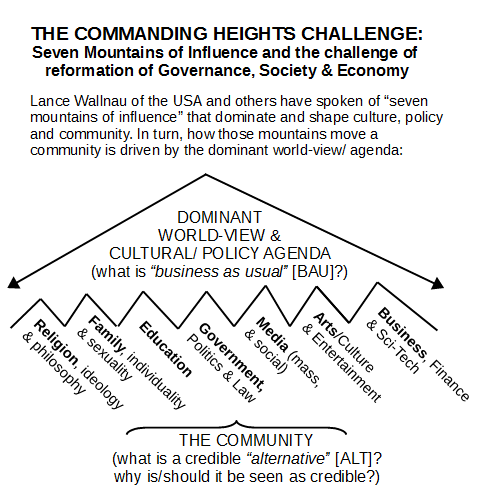
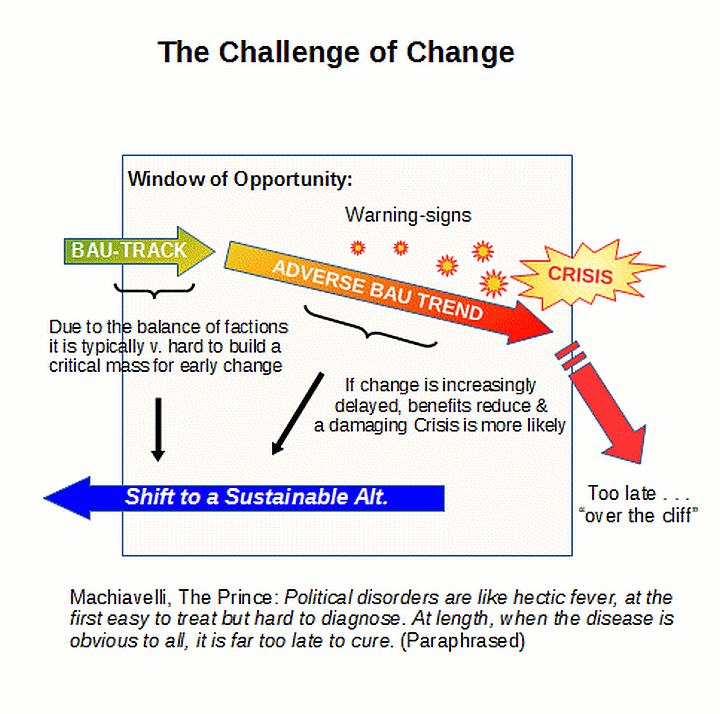 . . . and the Overton Window, double-BATNA model: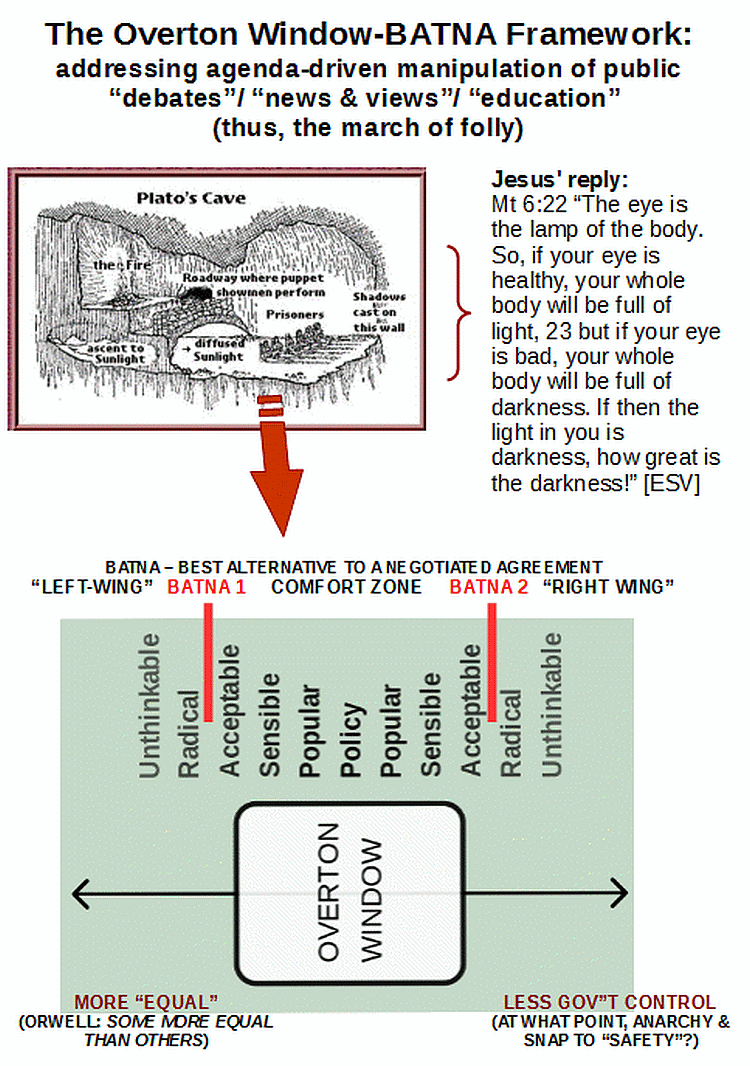
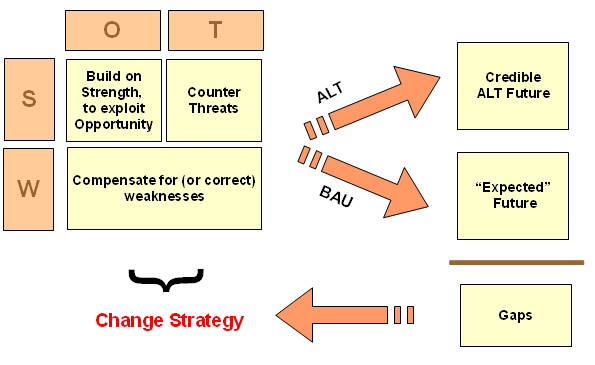 PPPS: I tracked down the source and confirm the slander. I clip for record from another thread (on somebody’s review of Darwin’s Doubt):