Uncommon Descent Serving The Intelligent Design Community

Does ID ASSUME “contra-causal free will” and “intelligence” (and so injects questionable “assumptions”)?

Categories
Atheism
ID Foundations
mind and brain
specified complexity
Share
Facebook
Twitter/X
LinkedIn
Flipboard
Print
Email

Those who have been following recent exchanges at UD will recognise that the headlined summarises the current objection highlighted by objector RDFish, an AI advocate and researcher.

A bit of backdrop will be useful; a clip from Luke Muehlhauser in the blog/site “Common Sense Atheism” will aid us in understanding claim and context:

Contra-causal free will is the power to do something without yourself being fully caused to do it. This is what most people mean by “free will.” Contra-causal free will is distinct from what you might call caused free will, which is the type of free will compatibilists like Frankfurt and Dennett accept. Those with caused free will are able to do what they want. But this doesn’t mean that their actions are somehow free from causal determination. What you want, and therefore how you act, are totally determined by the causal chain of past events (neurons firing, atoms moving, etc.) Basically, if humans have only caused free will, then we are yet another species of animal. If humans have contra-causal free will, then we have a very special ability to transcend the causal chain to which the rest of nature is subject.

This obviously reflects the underlying view expressed by William Provine in his well known 1998 U Tenn Darwin Day keynote address:

Naturalistic evolution has clear consequences that Charles Darwin understood perfectly. 1) No gods worth having exist; 2) no life after death exists; 3) no ultimate foundation for ethics exists; 4) no ultimate meaning in life exists; and 5) human free will is nonexistent . . . .  The first 4 implications are so obvious to modern naturalistic evolutionists that I will spend little time defending them. Human free will, however, is another matter. Even evolutionists have trouble swallowing that implication. I will argue that humans are locally determined systems that make choices. They have, however, no free will . . .

However, it is hard to see how such views — while seemingly plausible in a day dominated by a priori evolutionary Materialism  and Scientism — can escape the stricture made by J B S Haldane at the turn of the 1930s:

“It seems to me immensely unlikely that mind is a mere by-product of matter. For if my mental processes are determined wholly by the motions of atoms in my brain I have no reason to suppose that my beliefs are true. They may be sound chemically, but that does not make them sound logically. And hence I have no reason for supposing my brain to be composed of atoms. In order to escape from this necessity of sawing away the branch on which I am sitting, so to speak, I am compelled to believe that mind is not wholly conditioned by matter.” [“When I am dead,” in Possible Worlds: And Other Essays [1927], Chatto and Windus: London, 1932, reprint, p.209.]

It is not helpful to saw off the branch on which we all must sit: in order to do science, as well as to think, reason and know we must be sufficiently free and responsible to be self-moved by insight into meanings and associated ground-consequent relationships not blindly programmed and controlled by mechanical necessity and/or chance, directly or indirectly. (It does not help, too, that the only empirically known, adequate cause of functionally specific, complex organisation and associated information — FSCO/I — is design.)

That is, we must never forget the GIGO-driven limitations of blindly mechanical cause-effect chains in computers:
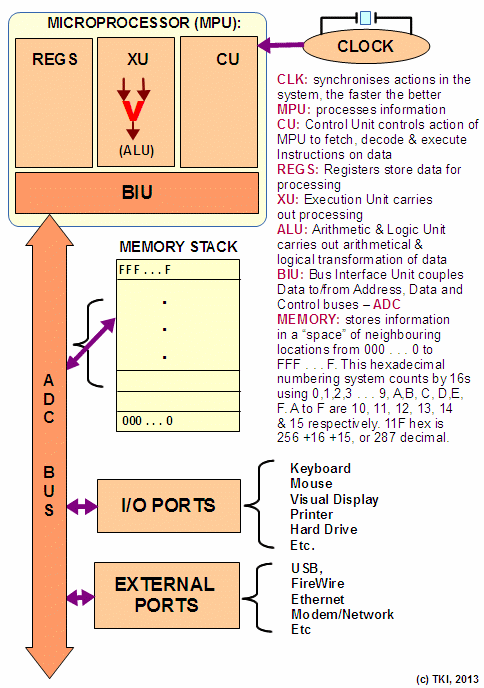
mpu_model

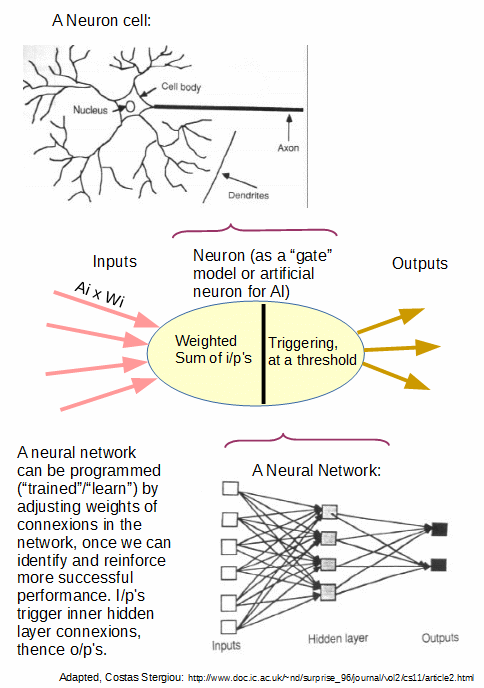
. . . and in neural networks alike:

A neural network is essentially a weighted sum interconnected gate array, it is not an exception to the GIGO principle


That is, it is quite evident that for cause, we can reasonably conclude that mechanical cause-effect chain based computation is categorically distinct from self-aware, self-moved responsible, rational contemplation.

[U/D Aug. 21:] Where, it will help to note on the classic structured programming structures, which — even if they incorporate a stochastic, chance based process — are not examples of freely made insight based decisions (save those of the programmer) but instead are cases of blind GIGO-limited computation based on programmed cause-effect sequences:
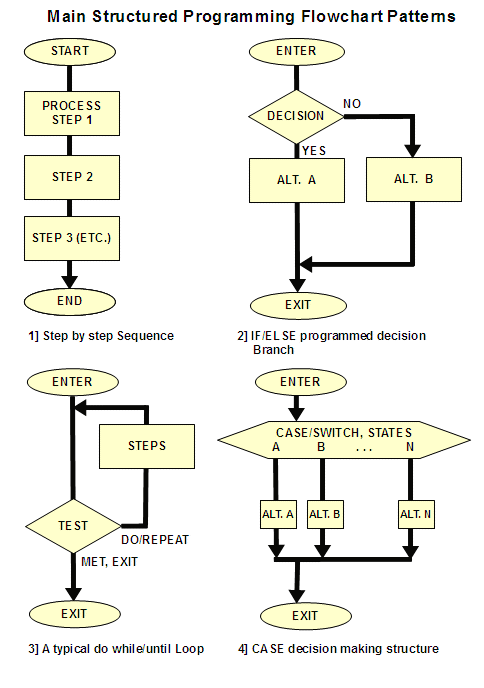
The classic programming structures, which are able to carry out any algorithmic procedure

In turn, that points to intelligence, an observed and measurable phenomenon.

This, too, is being stridently dismissed as a dubious metaphysically driven assumption; so let us note from an Educational Psychology 101 site:

E. G. Boring, a well-known Harvard psychologist in the 1920′s defined intelligence as whatever intelligence tests measure. Wechsler, one of the most influential researchers in the area of intelligence defined it as the global capacity of a person to act purposefully, to think rationally, and to deal effectively with his/her environment. Notice that there is a conative aspect to this definition. [–> AmHD: co·na·tion (k-nshn) n. Psychology The aspect of mental processes or behavior directed toward action or change and including impulse, desire, volition, and striving.] Many modern psychology textbooks would accept a working definition of intelligence as the general ability to perform cognitive tasks. Others might favor a more behaviorally-oriented definition such as the capacity to learn from experience or the capacity to adapt to one’s environment. Sternberg has combined these two viewpoints into the following: Intelligence is the cognitive ability of an individual to learn from experience, to reason well, to remember important information, and to cope with the demands of daily living.

That is, we have an empirically founded, measurable concept. One that sees major application in science and daily life.

Where, further, design can then be understood as intelligently, purposefully directed contingency — that is, design (and its characteristic outputs such as FSCO/I) will be manifestations of intelligent action. So, it is unsurprising to see leading ID researcher William Dembski remarking:

We know from experience that intelligent agents build intricate machines that need all their parts to function [–> i.e. he is specifically discussing “irreducibly complex” objects, structures or processes for which there is a core group of parts all of which must be present and properly arranged for the entity to function (cf. here, here and here)], things like mousetraps and motors. And we know how they do it — by looking to a future goal and then purposefully assembling a set of parts until they’re a working whole. Intelligent agents, in fact, are the one and only type of thing we have ever seen doing this sort of thing from scratch. In other words, our common experience provides positive evidence of only one kind of cause able to assemble such machines. It’s not electricity. It’s not magnetism. It’s not natural selection working on random variation. It’s not any purely mindless process. It’s intelligence  . . . . 

When we attribute intelligent design to complex biological machines that need all of their parts to work, we’re doing what historical scientists do generally. Think of it as a three-step process: (1) locate a type of cause active in the present that routinely produces the thing in question; (2) make a thorough search to determine if it is the only known cause of this type of thing; and (3) if it is, offer it as the best explanation for the thing in question. 

[William Dembski and Jonathan Witt, Intelligent Design Uncensored: An Easy-to-Understand Guide to the Controversy, pp. 20-21, 53 (InterVarsity Press, 2010). HT, CL of ENV & DI.]

But, one may ask, why is it that FSCO/I and the like are observed as characteristic products of intelligence? Is that a mere matter of coincidence?

No.

Because of the blind, needle- in- haystack challenge (similar to that which grounds the second law of thermodynamics in its statistical form) faced by a solar system of 10^57 atoms or an observed cosmos of some 10^80 atoms, a 10^17 s blind chance and mechanical necessity driven search process faces empirically insuperable odds:
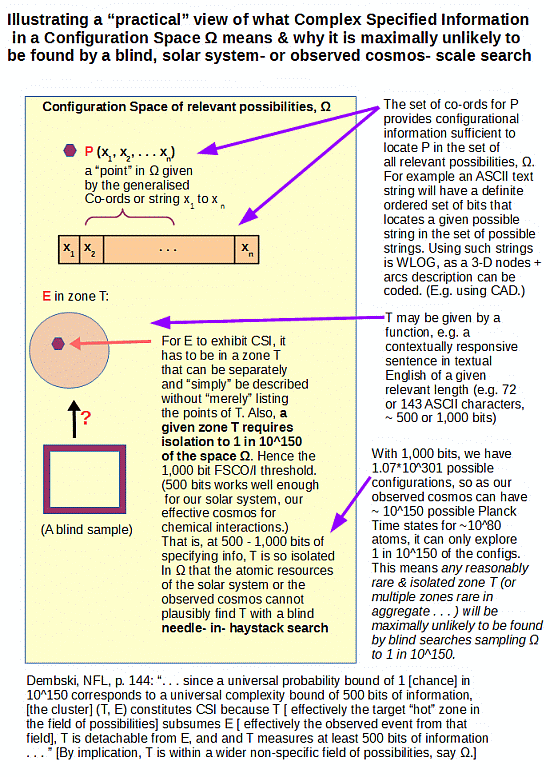
csi_defnSo, even the notion that our brains have been composed and programmed by a blind chance and necessity search process over 4 bn years of life on earth is dubious, once we see that FSCO/I beyond 500 – 1,000 bits faces a super-search challenge.

As for the notion that blind chance and mechanical necessity adequately account for the origin and diversification across major body plans, of cell based life, let the advocates of such adequately account — on observed evidence not a priori materialist impositions dressed up in lab coats — for something like protein synthesis (HT, VJT, onward thanks Wiki Media):
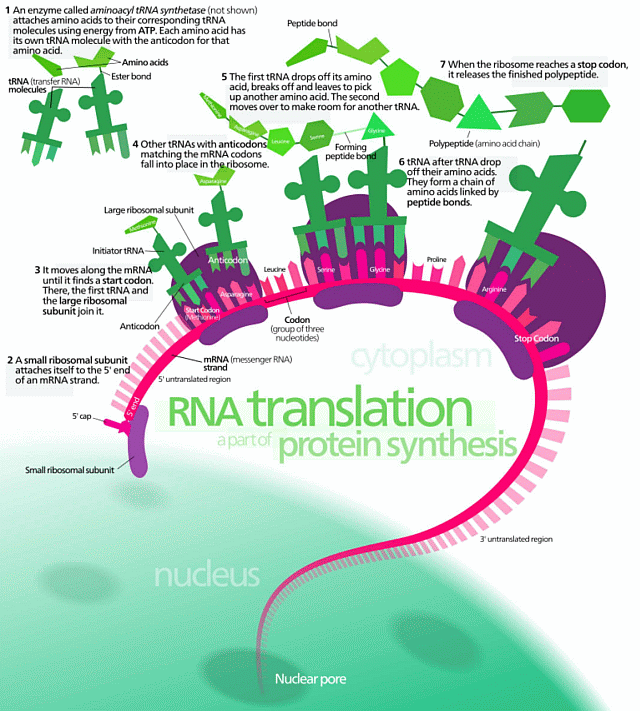
Protein Synthesis (HT: Wiki Media)


That is the context in which, on Sunday, I responded to RDF at 235 in the Do We Need a Context thread, as follows — only to be studiously ignored (as is his common tactic):

______________

>>I find it important to speak for record:

[RDF to SB:] . . . ID rests on the assumption of libertarianism, an unprovable metaphysical assumption

This characterisation of SB’s reasoning is false to the full set of options he puts on the table, but I leave answering that to SB.

What is more interesting is how you[–> RDF]  switch from an empirical inference to projection of a phil assumption you reject while ignoring something that is easily empirically and analytically verifiable. Which, strongly implicates that the root problem we face is ideological, driven and/or influenced by a priori evolutionary materialism [perhaps by the back door of methodological impositions] and/or its fellow travellers.

First, intelligence is a summary term for the underlying capacity of certain observed beings to emit characteristic behaviours, most notably to generate FSCO/I in its various forms.

For example as your posts in this thread demonstrate, you understand and express yourself in textual language in accord with well known specifications of written English. It can be shown that it is extremely implausible for blind chance and/or mechanical necessity to stumble upon zones of FSCO/I in the sea of possible configurations, once we pass 500 – 1,000 bits of complexity. Where as 3-d descriptions of complex functional objects can easily be reduced to strings [cf. AutoCAD etc], discussion on strings is WLOG.

At no point in years of discussion have you ever satisfactorily addressed this easily shown point. (Cf. here.)

Despite your skepticism, the above is sufficient to responsibly accept the significance of intelligence per a basic description and/or examples such as humans and dam-building beavers or even flint-knapping fire-using omelette-cooking chimps — there is reportedly at least one such. Then there was a certain bear who was a private in the Polish Army during WW II. Etc.

Being human is obviously neither necessary to nor sufficient for being intelligent.

Nor for that matter — given the significance of fine tuning of our observed cosmos from its origin, would it be wise to demand embodiment in a material form. Where also, it has been sufficiently pointed out — whether or no you are inclined to accept such — that a computational material substrate is not enough to account for insightful, self-aware rational contemplation.

We should not ideologically lock out possibilities.

Where also, the notion of “proof” — as opposed to warrant per inference to best explanation — is also material. In both science and serious worldviews discussion, IBE is more reasonable as a criterion of reasonableness than demonstrative proof on premises acceptable to all rational individuals etc. The projection of such a demand while one implicitly clings to a set of a prioris that are at least as subject to comparative difficulties challenge is selective hyperskepticism.

So, already we see a functional framework for identifying the attribute intelligence and using it as an empirically founded concept. One that is in fact a generally acknowledged commonplace. Let me again cite Wiki, via the UD WACs and Glossary as at 206 above . . . which of course you ignored:

Intelligence – Wikipedia aptly and succinctly defines: “capacities to reason, to plan, to solve problems, to think abstractly, to comprehend ideas, to use language, and to learn.” . . . .

Chance – undirected contingency. That is, events that come from a cluster of possible outcomes, but for which there is no decisive evidence that they are directed; especially where sampled or observed outcomes follow mathematical distributions tied to statistical models of randomness. (E.g. which side of a fair die is uppermost on tossing and tumbling then settling.)

Contingency – here, possible outcomes that (by contrast with those of necessity) may vary significantly from case to case under reasonably similar initial conditions. (E.g. which side of a die is uppermost, whether it has been loaded or not, upon tossing, tumbling and settling.). Contingent [as opposed to necessary] beings begin to exist (and so are caused), need not exist in all possible worlds, and may/do go out of existence.

Necessity — here, events that are triggered and controlled by mechanical forces that (together with initial conditions) reliably lead to given – sometimes simple (an unsupported heavy object falls) but also perhaps complicated — outcomes. (Newtonian dynamics is the classical model of such necessity.) In some cases, sensitive dependence on [or, “to”] initial conditions may leads to unpredictability of outcomes, due to cumulative amplification of the effects of noise or small, random/ accidental differences between initial and intervening conditions, or simply inevitable rounding errors in calculation. This is called “chaos.”

Design — purposefully directed contingency. That is, the intelligent, creative manipulation of possible outcomes (and usually of objects, forces, materials, processes and trends) towards goals. (E.g. 1: writing a meaningful sentence or a functional computer program. E.g. 2: loading of a die to produce biased, often advantageous, outcomes. E.g. 3: the creation of a complex object such as a statue, or a stone arrow-head, or a computer, or a pocket knife.) . . . .

Intelligent design [ID] – Dr William A Dembski, a leading design theorist, has defined ID as “the science that studies signs of intelligence.” That is, as we ourselves instantiate [thus exemplify as opposed to “exhaust”], intelligent designers act into the world, and create artifacts. When such agents act, there are certain characteristics that commonly appear, and that – per massive experience — reliably mark such artifacts. It it therefore a reasonable and useful scientific project to study such signs and identify how we may credibly reliably infer from empirical sign to the signified causal factor: purposefully directed contingency or intelligent design . . .

Indeed, on just this it is you who have a burden of warranting dismissal of the concept.

Where also, design can be summed up as intelligently directed contingency that evidently targets a goal, which may be functional, communicative etc. We easily see this from text strings in this thread and the PCs etc we are using to interact.

Again, empirically well founded.

So, the concept of intelligent design is a reasonable one, and FSCO/I as reliable sign thereof is also reasonable.

In that context the sort of rhetorical resorts now being championed by objectors actually indicate the strength of the design inference argument. Had it been empirically poorly founded, it would long since have been decisively undermined on those grounds. The resort instead to debating meanings of widely understood terms and the like is inadvertently revealing.

But also, this is clearly also a worldviews level issue.

So, I again highlight from Reppert (cf. here on) on why it is highly reasonable to point to a sharp distinction between ground-consequent rational inference and blindly mechanical cause effect chains involved in the operation of a computational substrate such as a brain and CNS are:

. . . let us suppose that brain state A, which is token identical to the thought that all men are mortal, and brain state B, which is token identical to the thought that Socrates is a man, together cause the belief that Socrates is mortal. It isn’t enough for rational inference that these events be those beliefs, it is also necessary that the causal transaction be in virtue of the content of those thoughts . . . [[But] if naturalism is true, then the propositional content is irrelevant to the causal transaction that produces the conclusion, and [[so] we do not have a case of rational inference. In rational inference, as Lewis puts it, one thought causes another thought not by being, but by being seen to be, the ground for it. But causal transactions in the brain occur in virtue of the brain’s being in a particular type of state that is relevant to physical causal transactions.

Unless we are sufficiently intelligent to understand and infer based on meanings, and unless we are also free enough to follow rational implications or inferences rather than simply carry out GIGO-limited computational cause-effect chains, rationality itself collapses. So, any system of thought that undermines rationality through computational reductionism, or through dismissing responsible rational freedom is delusional and self referentially incoherent.

You may wish to dismissively label responsible freedom as “contra-causal free will,” or the like and dismiss such as “unprovable.” That is of no effective consequence to the fact of responsible rational freedom that is not plausibly explained on blindly mechanical and/or stochastic computation. Which last is a condition of even participating in a real discussion — I dare to say, a meeting of minds.

That is, we again see the fallacy of trying to get North by heading due West.

It is time to reform and renew our thinking again in our civilisation, given the patent self-refutation of the ever so dominant evolutionary materialism. As Haldane pointed out so long ago now:

“It seems to me immensely unlikely that mind is a mere by-product of matter. For if my mental processes are determined wholly by the motions of atoms in my brain I have no reason to suppose that my beliefs are true. They may be sound chemically, but that does not make them sound logically. And hence I have no reason for supposing my brain to be composed of atoms. In order to escape from this necessity of sawing away the branch on which I am sitting, so to speak, I am compelled to believe that mind is not wholly conditioned by matter.” [[“When I am dead,” in Possible Worlds: And Other Essays [1927], Chatto and Windus: London, 1932, reprint, p.209.]

It is time for fresh, sound thinking.  >>

______________

I actually think this is a good sign. In the 1980’s and 90’s as Marxism gradually crumbled, many Marxists redoubled their efforts, until the ship went down under them. So, the trend that objections to the design inference are now being commonly rooted in hyperskeptically challenging common sense, empirically warranted concepts such as design, intelligence and functionally specific quantifiably complex organisation and associated information all point to the gradual crumbling of the objector case on the actual empirical and analytical merits. END

Comments
Gpuccio Do you think we could take a bit of the emotion out of this. It is not helpful. You use phrases like:   true free will   real choice   true sense of free choice Can we avoid that kind of rhetoric? You and I have different accounts of what it is to make a choice. To say that yours is the real or true account is effectively just to say “I am right and you wrong” which takes the debate no further and raises the emotional temperature unnecessarily.
My simple point is that a true free will scenario, IOWs one in which the word “free” has meaning, is not compatible with determinism.
  Let us avoid arguing about the different meanings of the word free – clearly there are lots of them. I think I know what your point is. What I am missing is the argument to support it
So, the name itself of compatibilism is misleading. So, what is “compatible” in compatibilism? A determinisitc definition of choices is compatible with determinism. OK, I can accept that. But do you accept that compatibilism is only a way of defining “choices” deterministically?
  Compatibilism is the proposition that choice is deterministic/random and this is compatible with several statements including the 5 I made above.  I am surprised you find  Compatibilism to be a misleading name for a thesis that some things are compatible!  But I am willing to adopt a different name if you have a suggestion.
1) Point one is true, but it just means that those who passively experience deterministic choices can experience dterministic choices which have deterministic representations of what you call “alternatives”. In no way those representations are “alternatives” of what could happen. What will happen is alredy detrmined, or anyway not controllable, so the representation of “alternatives” is just a mental play, which has no real consequences on what will happen. It is only a phenomenological process of manifestation of what will necessarily (or randomly) happen. IOWs, what you call “weighing the alternatives” is just a film that the subject can only experience, and with which it cannot really interact.
  Now you are the one playing tricks with language.  Alternatives are just different ways things might turn out.  In a world with a random element or even in a world with incomplete knowledge there are alternatives even if there are no minds at all.  When I (or a machine) tosses a coin the alternatives are heads or tails. This is what the word normally means in English and I know your English is extremely good. If you want to give it a special meaning so something is only an alternative if it conforms to your account of what a choice is then fine but recognise that you are the one supplying the non-standard meaning.   You slip in some language which really belongs with point 4 about power e.g. “passively” and “not controllable” and “just mental play”. So I will cover it there. Anyhow I am glad you accept that point 1 is true.
So, using words, like “weighing up alternatives before choosing” is misleading, and it is an incorrect use of language and reasoning.
  I believe I have used every word in that phrase in a completely standard way. (I also went to some effort in the previous comment to emphasise that I was using an ostensive definition of “choice”). You slipped in a non-standard use of the word “alternative”. You also accept that the sentence in which the phrase is used is true. Given this, if the phrase is misleading then this cannot be because of an incorrect use of language and reasoning.  
2) Point 2 is true, but it just means: “Experiencers often have great emotional concern that a sequence of events has happened which will manifest as a “choice” that they like and that will have pleasurable consequences on the future series of events”. IOWs, if I am just watching a film, I can have great emotional concern about the choices of one of the characters and about their consequences, but in no way I can change them.   But, again “that they have made the right choice” is misleading: it just means “that they haveexperienced the right choice. To “make a choice” in the common language implies the ability to choose effectively between different real alternatives, an ability which is denied bt the premise of compatibilism. Again, this is an incorrect use of language and reasoning.
  Oh dear. The premise of compatabilism is that determinism/random is compatible with choosing between alternatives in the common or garden ordinary English sense of the words choosing and alternatives. If you disagree then prove why they are incompatible. Just to reiterate that this ability is denied by the premise of compatibilism (by which I take it you mean determinism/random) is not an argument – it is just reiterating your belief. Throwing in words like “effectively” and “real” does not help either.    
3) “Choosers can reasonably be praised or blamed for their choices”. Why? Well, we can do anything we like, but is it reasonable? …… Going to animals, go we praise a bird for singing well, or blame a crocodile for killing its prey? Again, saying that it is reasonable to praise or blame anyone for choices that are not free choices is an incorrect use of language and reasoning.
  The fact remains that many people do praise and blame dogs for their behaviour and this is generally accepted as reasonable.  Among other things it is a way of getting the dogs to behave in the way we want (and may sometimes express a moral revulsion or attraction to what the dogs are doing). It is true that we do excuse people for bad behaviour if they are externally constrained from doing anything else, but we do not excuse them just because they really, really wanted to do it - even though this may just as inevitably to lead to their action. The debate about what conditions exonerate you from praise and blame is thousands of years old and still has no commonly accepted answer –  to dismiss one view as “incorrect use of language and reasoning” seems an inadequate response.  But it is a long and complicated issue so I suggest we leave the moral compatibility element
4) “The ability to choose gives choosers power over what happens next”. This is simply false. Of what “power” are you talking? Who has “power” on anything here? I cannot see what you mean. This is simply nonsense. In your premises, there is no “ability to choose” in the sense of a free choice. Only a free choice scenario, which you deny in your premises, gives “power”. In your scenario, “what happens next” is determined or random. So, of what “power” are you talking?
  Well I guess this is the crux.  And this is where it is important to be very precise in logic and language. I said power over what happens next. Clearly this is true.  A dog has power over the rabbit in its jaws. To deny that is to redefine the word “power” and I need to understand what you mean. I suspect what concerns you is whether we have power over what we choose.  But to have such a power would be to choose what we choose which as I argued before an infinite regress. In the end we make a choice and currently we do not know the whole story about what causes us to make one choice as opposed to another – but you cannot solve it by saying that what causes us to choose X is that we choose to choose X! 
5) Point 5 is obviously true, but irrelevant. Random systems are unpredictable (in detail, they are predictable in their general form). But that has nothing to do with free choice. The unpredictability of free choice is all another concept.
Glad you accept it is true. We will see about its relevance later.   At this point I have already written too much,  am exhausted and out of time. I will return to the rest of your response later if/when I can.   MarkMark Frank
August 21, 2014
August
08
Aug
21
21
2014
04:39 AM
4
04
39
AM
PDT
F/N: I have updated the original post to incorporate a figure showing classic structured programming patterns, to illustrate the point that the machines executing programs with conditional branching and loops or case structures etc do not exhibit actual responsible decisions that they make -- much less, a river forking as it comes to its delta. Not even if a stochastic component is involved. The real decisions involved are those of the programmer, in a classic case of intelligent design. KFkairosfocus
August 21, 2014
August
08
Aug
21
21
2014
04:10 AM
4
04
10
AM
PDT
MF: Sometimes we need to be brave and accept the implications of our world views. It can be hard for obvious reasons but embrace them we must. That is why I have an odd form of respect for someone like Richard Dawkins. I may disagree with just about everything he stands for, but at least he is embracing the logical consequences of his world views. If I were a compatibilist I would have to accept the following: - 1) Our criminal justice system should be based on a consequentiality model where the primary objective is to modify behaviour as opposed to punish. It would be irrational to look back in time to see what a defendant might have done or not done. 2) We should have sympathy with those in our society that commit the most heinous of crimes as opposed to having feelings of moral outrage and condemnation. The sympathy is of course rooted in the notion that those individuals who are committing such acts are "poor" decision making agents that could not have done differently. Would you agree with the above two statements, and if not why not?aqeels
August 21, 2014
August
08
Aug
21
21
2014
03:53 AM
3
03
53
AM
PDT
PS: SB, also very well said, at 47:
the human faculty of will, by consenting to immoral desires over a long period of time, can come to desire them with progressively greater intensity. Immorality is, by its very nature, inflationary, that is, it requires more and more feeding to satisfy the want. Bad habits finally breed character defects. Thus, the greedy investor wants more money more than he ought to; the lusty lecher wants sex more than he ought to; the lazy student wants leisure more than he ought to; the prideful leader wants power more than he ought to. By contrast, the intellect can present the to the will moral truths concerning what the person “ought” to want (or love) as opposed to what he does want (or love). At that point, the individual is free to accept those truths and can begin to train the will to love the kinds of behavior that it ought to love–and, in the meantime–refuse to indulge in behaviors it ought not to love for the sake of principle, even it it costs some discomfort for a while. That is what self-control is all about. Without it, there can be no moral life.
kairosfocus
August 21, 2014
August
08
Aug
21
21
2014
03:40 AM
3
03
40
AM
PDT
GP, 45:
The important point about which we probably disagree a little is after all the most important one: can we change our destiny with our choices? I absolutely believe we can. About wanting, the simple fact is that we often want very different and incompatible things. The problem is: will the final victory be of the thing which just has more power on us? Or can we choose, freely choose, what we will try to pursue, according to our intuition of its true value in reality? Is there merit in trying to side with what is better, and not only with what has more power on us? In doing that because it is better, and not because doing it has more attraction for us? I certainly believe that there is merit in that, and that only that kind of merit can change ourselves and our destiny for the best. IOWs, I fully believe, with all my heart, in libertarian free will (ehm, free choice).
Very well said. I suggest that both yourself and Vivid, may find this passage in Romans 2 suggestive in light of the principle that it is God who by his Spirit enlightens every man who comes into the world, and that that Spirit will not always strive with a man so that it is not wise to quench or grieve the Spirit who pulls us upwards:
Rom 2:6 He [God] will render to each one according to his works: 7 to those who by patience in well-doing seek for glory and honor and immortality, he will give eternal life; 8 but for those who are self-seeking[a] and do not obey the truth, but obey unrighteousness, there will be wrath and fury. 9 There will be tribulation and distress for every human being who does evil . . . 10 but glory and honor and peace for everyone who does good . . .
That is, there is a struggle to the right, in which we all stumble and need to get up and persist patiently in the path of the truth and the right we know or should know. Where, the truth we SHOULD or DO know, calls for obedience. Living by the light we can, do or should have. (Which, IMHO, at this stage of civilisation and history includes this [note video] and this.) In short, I think there is excellent reason to hold that we have responsible freedom of thought, volition and conscience; also, a plain duty to obey the truth provided by the light we do or should have. KFkairosfocus
August 21, 2014
August
08
Aug
21
21
2014
03:37 AM
3
03
37
AM
PDT
GP, 44:
All forms of full determinism, in the end, exclude any reasonable model for personal responsibility. Indeed, they exclude any reasonable model for many other things: motivation, hope, ideals, and so on. And compatibilism is a form of full determinism. Just think: if determinism is true, in all its forms, the conscious “I” cannot in any way change its own destiny. There can be no difference in the experiences that the “I” will have according to free choices: what will happen will happen. Maybe the conscious “I” can believe differently, deluding itself, but the simple truth, if determinism is true, is that there is no room to change what will happen by an intentional choice. Even our apparently intentional choices are determined. So are our convictions, our understanding (or not understanding), everything in our life. Determinism is a consistent theory: you cannot prove it false, for the simple fact that if it is true, you cannot prove false or true anything, except for what you are determined to prove false or true, and you cannot ever know if your convictions about that are correct or not. Determinism is, among other things, the death of cognition. I wonder how many sincere determinists may have the courage to really embrace the consequences of what they believe.
In short, such determinism is an appeal to grand delusion, and drastically undermines the life of the mind, leading to the enthronement of irrationality and utter irresponsibility. In whatever form it comes in. So, we have a choice -- and I am deliberately using this word:
A: Determinism, with its consequences for mind and responsibility -- utterly undermined B: Responsible freedom and the life of the mind under moral government (however we must struggle to consistently grow towards reason, truth, fairness and goodness)
The choice is obvious: A is utterly self-refuting. So, the reasonable man will choose B. But as we are in fact free to choose even to be irrational many find reasons that lead them to lean to A instead. And, in so doing, they may in fact make up clever reasons for why they accept A. Including this, from a Nobel Prize winning scientist, Sir Francis Crick -- in his The Astonishing Hypothesis, 1994:
. . . that "You", your joys and your sorrows, your memories and your ambitions, your sense of personal identity and free will, are in fact no more than the behaviour of a vast assembly of nerve cells and their associated molecules. As Lewis Carroll's Alice might have phrased: "You're nothing but a pack of neurons." This hypothesis is so alien to the ideas of most people today that it can truly be called astonishing.
To say the least, this fits in with the point that blind, GIGO limited mechanically necessary computational causal chains (or even those that fit in some randomness through some stochastic process or other) are simply not equal to self-aware, insightful, meaning based rational contemplation. So, seminal ID thinker Phillip Johnson rightly responded that Dr Crick should therefore be willing to preface his books: “I, Francis Crick, my opinions and my science, and even the thoughts expressed in this book, consist of nothing more than the behavior of a vast assembly of nerve cells and their associated molecules.” (In short, as Prof Johnson then went on to say: “[t]he plausibility of materialistic determinism requires that an implicit exception be made for the theorist.” [In, Reason in the Balance, 1995.]) And, I have not even touched on the challenge of accounting for the FSCO/I found in the CNS as a computational device. As the infographic in the OP shows, such is not credibly the product of blind chance and mechanical necessity on the gamut of the observed cosmos. (Of course, objectors have studiously avoided that argument.) I suggest, that we should consider instead the possibilities in Eng Derek Smith of Wales' two tier controller cybernetic loop model. Namely, that an in- the- loop i/o controller may be influenced by and also interacts with a higher order controller that provides a higher tier of function [notice the reflexivity, inviting a spiral interaction understanding of self-moved agency], constituting what we may follow Jonathan Bartlett and term an oracular machine. Such would transcend the limitations of algorithmic, Turing computation. And, it also points to the role of FSCO/I . . . something beyond the capacity of our observed cosmos on blind chance and mechanical necessity . . . as an index of something more than that at work, namely, intelligence joined to agency. KFkairosfocus
August 21, 2014
August
08
Aug
21
21
2014
03:23 AM
3
03
23
AM
PDT
GP and Aqeels: I agree that there is something deeply wrong, and that those who should know better are culpable, those who have taken leadership roles being much more so. "Those who SHOULD know . . . " bespeaks the issue that we have duties of care to truth, straight thinking and the right. I remain convinced that absent responsible freedom, we are unable to choose based on reason as opposed to impulses deriving force from things unconnected to ground and consequent, leading straight to the undermining of the life of the mind. That is in my mind sufficient to see the utter bankruptcy of evolutionary materialism. For, we cannot but live as those who can, do and ought to think reasonably based on understanding, where we have a further duty to ensure that our understanding is as accurate to reality as we can get. Which last is a definition of truth. KFkairosfocus
August 21, 2014
August
08
Aug
21
21
2014
03:00 AM
3
03
00
AM
PDT
Mung: You see, RDF has a policy of studiously ignoring what I have said on some rhetorical excuse that it is incomprehensible or or the like. I still await the taking of a serious step of responding to the cluster of issues in the OP by RDF or other defender of the Darwinist or fellow traveller views. KFkairosfocus
August 21, 2014
August
08
Aug
21
21
2014
02:52 AM
2
02
52
AM
PDT
Mark: Neither am I trying to convert you to a beliefe in free will. My simple point is that a true free will scenario, IOWs one in which the word "free" has meaning, is not compatible with determinism. So, the name itself of compatibilism is misleading. So, what is "compatible" in compatibilism? A determinisitc definition of choices is compatible with determinism. OK, I can accept that. But do you accept that compatibilism is only a way of defining "choices" deterministically? Let's go to your points about compatibilism. You make five points which would be true given the deterministic/random definition of choices. 1) Point one is true, but it just means that those who passively experience deterministic choices can experience dterministic choices which have deterministic representations of what you call "alternatives". In no way those representations are "alternatives" of what could happen. What will happen is alredy detrmined, or anyway not controllable, so the representation of "alternatives" is just a mental play, which has no real consequences on what will happen. It is only a phenomenological process of manifestation of what will necessarily (or randomly) happen. IOWs, what you call "weighing the alternatives" is just a film that the subject can only experience, and with which it cannot really interact. So, using words, like "weighing up alternatives before choosing" is misleading, and it is an incorrect use of language and reasoning. 2) Point 2 is true, but it just means: "Experiencers often have great emotional concern that a sequence of events has happened which will manifest as a "choice" that they like and that will have pleasurable consequences on the future series of events". IOWs, if I am just watching a film, I can have great emotional concern about the choices of one of the characters and about their consequences, but in no way I can change them. But, again "that they have made the right choice" is misleading: it just means "that they have experienced the right choice. To "make a choice" in the common language implies the ability to choose effectively between different real alternatives, an ability which is denied bt the premise of compatibilism. Again, this is an incorrect use of language and reasoning. 3) "Choosers can reasonably be praised or blamed for their choices". Why? Well, we can do anything we like, but is it reasonable? I can look at a beautiful sunset and praise it. I can looka at ugly weather and blame it. But does that make sense? So, I can see a beautiful woman, and praise her. Or blame one that is not beautiful. But does that make sense? A beautiful woman has no merit for being beautiful, just as a beautiful sunset has no merit for being what it is. So, if compatibilism/determinism is true, no one has any merit for being what he is. Or demerit. So, why should we "reasonably" praise or blame anyone? Going to animals, go we praise a bird for singing well, or blame a crocodile for killing its prey? Again, saying that it is reasonable to praise or blame anyone for choices that are not free choices is an incorrect use of language and reasoning. 4) "The ability to choose gives choosers power over what happens next". This is simply false. Of what "power" are you talking? Who has "power" on anything here? I cannot see what you mean. This is simply nonsense. In your premises, there is no "ability to choose" in the sense of a free choice. Only a free choice scenario, which you deny in your premises, gives "power". In your scenario, "what happens next" is determined or random. So, of what "power" are you talking? 5) Point 5 is obviously true, but irrelevant. Random systems are unpredictable (in detail, they are predictable in their general form). But that has nothing to do with free choice. The unpredictability of free choice is all another concept. Now, let's go to the second list of five arguments. a) As shown, there is great incompatibility between your statements and your premise, if your statements are understood in a true sense of free choice, Otherwise, those statements are simply meaningless. b) I have shown that it is not true that all those statements are true for animals'choices. For example, we usually don't praise or blame animals in a moral sense, although we can certainly do that as a relational modality. Animals have a behaviour that, while variable, is much more constrained than human behaviour. They don't change their way of being in time, like humans do. They build no system of thought and of values. Most of their behaviour is mainly instinctive, and repetitive. This is one of the main differences between animals and humans. That's why I think that it is very incorrect to debate animals in a discussion about free will. It cannot really help. c) I wholly disagree about your criticism of the fundamental inference by analogy that humans share fundamental subjective experiences. Are you serious about that? All our model of reality is based on accepting that inference. The logical concepts themselves, that you seem to love so much, are shared by accepting that inference. Again, are you really serious about that point? d) There are intuitions and intuitions. The intuition that I exist and am conscious cannot be "wrong". The intuition of free choice is "almost" as strong as the intuition that I exist and am conscious. If my intuition of my free choices were wrong, I would simply have no sense of meaning. Nothing would be the same. No worldview would be consistent with my inner experiences. As I have said, I don't believe that any human being can really accept in his deep consciousness all the necessary consequences of true determinism. e) I obviously disagree with your last statement. There are a lot of inner experiences of events about which we clearly feel that we have no free choice. And there are a lot of inner experiences about which we do feel that we have choices. Again, it's our inner intuition that informs us. This intuition can certainly be wrong about specific instances: we can believe that we have no choices when we probably have them, and the reverse. I agree with that. But still, we have a clear inner distinction between having no choice and having free choices. We can err in the specific evaluation, but we have a clear intuition of the concept.gpuccio
August 21, 2014
August
08
Aug
21
21
2014
02:22 AM
2
02
22
AM
PDT
GP – I strongly disagree that you what you describe is “the only one which corresponds to what free will has always meant in the course of human thought”. I pointed to Hobbes and Hume as examples of people who thought otherwise. But in any case let us not get tied up in the definition of free will or the history of the term.  I am not going to try to convert you to compatibilism. I just want you to understand it and be a bit less contemptuous of it.   I will try to explain compatibilism without using the term free will. Compatibilism is a form of determinism but it challenges some of the conclusions that you think follow. If we consider the activity we call choosing (and this is an ostensive definition  - it just points to examples all around us – it does not try to characterise what is going on internally when this activity takes place) then even though determinism (including a random element) is true:   * Choosers can spend considerable time weighing up alternatives before choosing   * Choosers often have great emotional concern that they have made the right choice   * Choosers can reasonably be praised or blamed for their choices   * The ability to choose gives choosers power over what happens next   And if we accept a random element in determinism   * Chooser’s choices are to some degree fundamentally unpredictable   Arguments:   1) There is no logical incompatibility between these statements and the proposition that choice is determined/random.   2) All of these things are true of some animal’s choices and yet you yourself say you do  not know if their choices are determined/random or not – so you accept their choices  may be determined/random and yet all of these apply.   3) You don’t even know for certain that my choices are not determined/random (certainly they seem like that to me and your only argument is by analogy with your own situation which is a sample of one) and yet I bet you ascribe all these statements to me with absolute certainty.   4) Your only evidence that your choices are not determined/random is an intuition that they are something else (what I guess you would call real choices) – but of course intuitions can be wrong and if yours was wrong I am sure you would still accept that these statements were true of your choices.   5) No one has ever to my mind described how a choice that is neither determined nor random differs from one that is just random in practice. Choices happen.  They may be predictable or not. If they are not we call it random. That seems to exhaust the options!   As I say – I am not trying to convert you but simply to ask you to accept that such a line of reasoning is not a very incorrect use of language and reasoning procedures.Mark Frank
August 21, 2014
August
08
Aug
21
21
2014
01:31 AM
1
01
31
AM
PDT
Mark: I will try to explain more in detail what I believe. You are right that we must specify well what we mean with our words. Let's say that the statement is: "I can change my destiny by my free choices". What does it mean? I will begin by defining the subject and the object in the statement. "I" is, as I have always stated, the subject in our conscious experiences, which is what we really are, the only principle which gives unity and continuity to our subjective reality. "my destiny" is the sequence of events that the I experiences in time. It includes both outer and inner events, and those events certainly abey specific laws, deterministic laws. IOWs, "my destiny" is the deterministic flux of bodily and mental events, with its deterministic laws, that the I experiences, and to which the I reacts. IOWs, "my destiny" is the game, the I is the gamer. So, the definition of free will (the libertarian free will, the only one which corresponds to what free will has always meant in the course of human thought) is that while the flux of events that the "I" experiences is deterministic (and that includes also what the "I" likes and dislikes, wants or fears, considers right or wrong in its mental representations), the "I" is not only a witness, but also an actor: it can and does intervene to modify the flux at each moment that it happens and is represented in the I's consciousness. And the "I" is a free actor, because its interventions are not determined by the flux itself, and cannot be predicted by the flux itself. Is the "I" a deterministic structure? No. It is not a structure, and it is not deterministic in any sense. So, why should it choose to intervene in different ways? Let's say, to simplify, that all free choices can be classified as "good" and "bad". At each moment, the "I" can intervene on the deterministic flux in at least two different ways, one good and one bad. Of course, the different responses cannot be random, otherwise there would be no free choice. At the same time, they cannot be determined by the flux itself, otherwise there would be no free choice. Moreover, they must have some meaning, some "orientation" in some field, otherwise they could not be considered as good or bad. The traditional way of answering that, a way that I wholly accept, is that the "I" has a constant intuitive awareness of a field of meanings and values, let's call it a "moral" field. That awareness is what is called, even in popular language, "conscience". And, while the "I" has a conscience, it is free, at each moment, to use it or not. That is the supreme free choice, at each moment: shall we choose to be in tune with our intuitive conscience, or shall we choose to ignore it, and to be completely determined by the flux of our representations? Why should we get in tune with our inner conscience? Because the cumulative result of using our conscience, and not ignoring it, is a change of our "destiny", and a change for the best: the flux of our representations gradually changes, and we become better persons, stronger, happier, more peaceful. Above all, we acquire greater inner freedom. What does it mean? It means that the results of our free choices on our flux of representations become greater. IOWs, we have more control on ourselves, on our body and mind and on the deterministic events that happen there. As you can see, in this scenario (which is nothing else than what a fee will scenario has always been in the history of human thought) your statement: "we can change our destiny if we want to" is misleading. Indeed, what we "want" is usually part of the deterministic flux. So, you are right in saying, in that sense, that what we "want" is determined. The point is, if we "choose" to follow our intuitive consciousness, our actions will be more in tune with what we deeply want: IOWs, a true improvement of our destiny. But in our present flux, what we "want" can be very different from what will bring us to that improvement of our destiny. However, our inner conscience, our intuitive awareness of that inner field of meanings and values, can constantly guide us in our free choices, according to the options that we have at the moment. Those options are, moment by moment, fully determined by our deterministic flux. Our choice between those options is always free.gpuccio
August 21, 2014
August
08
Aug
21
21
2014
12:32 AM
12
12
32
AM
PDT
GP. The rest did the trick so I will rejoin the debate.  
The important point about which we probably disagree a little is after all the most important one: can we change our destiny with our choices?
  Sometimes it is the small words that cause the most confusion.  They slip by without us realising they need attention. In this case it is the word “can”. “Can” is a modal word. It means “is possible” and whenever we have a modal word we need to be clear about what kind of possibility we are discussing – possibility always entails a condition  - something is possible if X – sometimes X is implied – sometimes it is just brushed over which is what is happening here.   In the clause “We can change our destiny with our choices”  what is X? Of course I don’t know for certain what you had in mind for X but I would guess that you meant  we can change our destiny if we want to. Well that is perfectly compatible with determinism. Because determinism would determine what we want. Mark Frank
August 20, 2014
August
08
Aug
20
20
2014
10:55 PM
10
10
55
PM
PDT
kairosfocus:
I see your taste for irony is still going strong.
Always my friend! And RDFish is always a steady source of supply whenever he posts here. There is nothing non-deterministic to be found in any natural or robotic system, RDFish assures us, and this is scientific fact, else why would he argue it to be the case? Yet RDFish also assures us he is not a determinist. Why not? Modern physics. He also tells us that there is no scientific support for either determinism or non-determinism. Go figure.Mung
August 20, 2014
August
08
Aug
20
20
2014
05:15 PM
5
05
15
PM
PDT
Mark Frank:
I wish I could respond to this as I agree with a lot of it but I must rest my right hand (not your fault GP).
You must learn to drink with your left. Or use speech recognition software. :)Mung
August 20, 2014
August
08
Aug
20
20
2014
05:04 PM
5
05
04
PM
PDT
Joe, you need to give the folks over at TSZ a break. They are skeptics, after all. How they know that skepticism is true, well, that's a different problem.Mung
August 20, 2014
August
08
Aug
20
20
2014
05:00 PM
5
05
00
PM
PDT
SB:
Here is the other: Que Sera Sera, Whatever will be will be.
Actually, wouldn't Sartre offer the other philosophy? A man has no potential, nothing to become. A man just is what what he does.Mung
August 20, 2014
August
08
Aug
20
20
2014
04:57 PM
4
04
57
PM
PDT
An entire thread devoted to RDFish and his nonsense and he doesn't even have the courtesy to make an appearance. It's not like juggling self-contradictions is all that arduous a task. Perhaps he's too busy working on his non-deterministic flying robot-bird fence-post-lander.Mung
August 20, 2014
August
08
Aug
20
20
2014
04:51 PM
4
04
51
PM
PDT
SB RE 46 Very insightful !! Vividvividbleau
August 20, 2014
August
08
Aug
20
20
2014
02:58 PM
2
02
58
PM
PDT
Gp
The important point about which we probably disagree a little is after all the most important one: can we change our destiny with our choices?
Yes we can if we most want to. Vividvividbleau
August 20, 2014
August
08
Aug
20
20
2014
02:57 PM
2
02
57
PM
PDT
Stephen: Thank you for your contributions. :) The gradual accumulation of the results of a good or a bad use of free will is particularly evident in scenarios like the fight against an addiction (whatever kind of addiction), the building of a relationship of love in spite of trials and difficulties, all paths of constructive self-transformation and, above all, the spiritual life. Nothing is more beautiful and rewarding than choosing to adhere, although with difficulties and imperfectly, to what we recognize as true with our deepest intuitive cognition, and love with our deepest intuitive love.gpuccio
August 20, 2014
August
08
Aug
20
20
2014
02:49 PM
2
02
49
PM
PDT
Vivid
I am not saying that there is in many cases a struggle as to which to choose especially in moral choices. There are many times when I really want to choose one thing and I really want to choose another thing, in the end whatever I most want will be the deciding factor.
Vivid, the human faculty of will, by consenting to immoral desires over a long period of time, can come to desire them with progressively greater intensity. Immorality is, by its very nature, inflationary, that is, it requires more and more feeding to satisfy the want. Bad habits finally breed character defects. Thus, the greedy investor wants more money more than he ought to; the lusty lecher wants sex more than he ought to; the lazy student wants leisure more than he ought to; the prideful leader wants power more than he ought to. By contrast, the intellect can present the to the will moral truths concerning what the person "ought" to want (or love) as opposed to what he does want (or love). At that point, the individual is free to accept those truths and can begin to train the will to love the kinds of behavior that it ought to love--and, in the meantime--refuse to indulge in behaviors it ought not to love for the sake of principle, even it it costs some discomfort for a while. That is what self-control is all about. Without it, there can be no moral life.StephenB
August 20, 2014
August
08
Aug
20
20
2014
02:23 PM
2
02
23
PM
PDT
GPuccio
The important point about which we probably disagree a little is after all the most important one: can we change our destiny with our choices?
GP, Excellent! Yes, indeed. The question is whether or not our life would have been (or will be) different if we choose one course of action over another. The key words here are "course of action," meaning that one choice naturally leads to another, all of which create direction and momentum, reverberating finally into eternity. We may choose to ignore someone's cry for help, in which case he may commit suicide, or we may choose to console him, in which case he may not. We may choose to accept our addictions and bad habits, in which case we become slaves, or we may choose to conquer them, in which case we become masters of ourselves. “Sow a thought, reap an action; sow an action, reap a habit; sow a habit, reap a character; sow a character, reap a destiny That's one philosophy of life (the correct one). ------------------------------------------------------------- Here is the other: Que Sera Sera, Whatever will be will be.StephenB
August 20, 2014
August
08
Aug
20
20
2014
11:26 AM
11
11
26
AM
PDT
Vivid: Thank you for the reply. I agree, there are many things we agree on. I would be all too happy to use the term "free choice" instead of "free will". I am convinced that "free will/choice" and "will" are two completely different concepts. I respect your theological position, but don't agree with it. The important point about which we probably disagree a little is after all the most important one: can we change our destiny with our choices? I absolutely believe we can. About wanting, the simple fact is that we often want very different and incompatible things. The problem is: will the final victory be of the thing which just has more power on us? Or can we choose, freely choose, what we will try to pursue, according to our intuition of its true value in reality? Is there merit in trying to side with what is better, and not only with what has more power on us? In doing that because it is better, and not because doing it has more attraction for us? I certainly believe that there is merit in that, and that only that kind of merit can change ourselves and our destiny for the best. IOWs, I fully believe, with all my heart, in libertarian free will (ehm, free choice). :)gpuccio
August 20, 2014
August
08
Aug
20
20
2014
10:00 AM
10
10
00
AM
PDT
aqeels: Happy to know that I am not the only frustrated guy! :) All forms of full determinism, in the end, exclude any reasonable model for personal responsibility. Indeed, they exclude any reasonable model for many other things: motivation, hope, ideals, and so on. And compatibilism is a form of full determinism. Just think: if determinism is true, in all its forms, the conscious "I" cannot in any way change its own destiny. There can be no difference in the experiences that the "I" will have according to free choices: what will happen will happen. Maybe the conscious "I" can believe differently, deluding itself, but the simple truth, if determinism is true, is that there is no room to change what will happen by an intentional choice. Even our apparently intentional choices are determined. So are our convictions, our understanding (or not understanding), everything in our life. Determinism is a consistent theory: you cannot prove it false, for the simple fact that if it is true, you cannot prove false or true anything, except for what you are determined to prove false or true, and you cannot ever know if your convictions about that are correct or not. Determinism is, among other things, the death of cognition. I wonder how many sincere determinists may have the courage to really embrace the consequences of what they believe. For their own sake, I hope they have it not. So, maybe I am too hard on compatibilism: given the horrible consequences of determinism, and given the strange fact that many apparently feel the need to believe in it, maybe compatibilism is their last hope to remain in peace with themselves.gpuccio
August 20, 2014
August
08
Aug
20
20
2014
09:47 AM
9
09
47
AM
PDT
aqeels@ 39- Yes that is a never-ending cycle they love to play. And as soon as they have evidence to support their claims I will willingly re-join their ranks.Joe
August 20, 2014
August
08
Aug
20
20
2014
09:42 AM
9
09
42
AM
PDT
Free will seems so subjective as to make it irrelevant. To me it is very similar to the way some people want to define science as excluding ID and Creation, ie very selectively and very subjectively. Over on Skeptic Ink they like to denounce free will from one side of their mouths and call themselves free thinkers from the other. It's all philosophical gibberish.Joe
August 20, 2014
August
08
Aug
20
20
2014
09:40 AM
9
09
40
AM
PDT
gp RE 28 Thanks for your thoughtful reply there is much that we agree on.
Obviously our choices are determined by our Self. That’s why they are free.
Yes.
But our Self is not a series of events. It is a transcendental subject.
Yes philosophicaly speaking.
It is absolutely obvious that free will always acts under restraints
You know how you despise compatabilism? Well I despise the term free will. The will is not free from many things most importantly it is not free from us. This is why I prefer the terms free choice or free agency.
Moreover, as you yourself define it as an “ability” to “choose”, not as a “necessity” to choose,
I dunno. I do think we are not able not to sin by neccessity but this is a theological position.
it implies that I can very well not choose that which I most want (in the sense defined above).
I disagree although I suspect we are not that far apart. If I choose that which I dont most want at the time the choice is made givin the options available to me at the time the choice is made then my choice is not self determined rather determined by something else. I am not saying that there is in many cases a struggle as to which to choose especially in moral choices. There are many times when I really want to choose one thing and I really want to choose another thing, in the end whatever I most want will be the deciding factor. Vividvividbleau
August 20, 2014
August
08
Aug
20
20
2014
09:35 AM
9
09
35
AM
PDT
Joe: I am convinced that the ability to generate new original dFSCI is the result of the joint operation of three different aspects of consciousness: cognition (meaning), feeling (purpose) and free will (the ability of outputting creatively our meaningful, purposeful representations). However, it is true that it is difficult to prove that: we can only assume it as a reasonable model to explain how dFSCI is generated. However, it is extremely easy to prove empirically the simple observation that only conscious intelligent purposeful agents can generate dFSCI.gpuccio
August 20, 2014
August
08
Aug
20
20
2014
09:33 AM
9
09
33
AM
PDT
kairosfocus: And we know how they do it — by looking to a future goal and then purposefully assembling a set of parts until they’re a working whole. Intelligent agents, in fact, are the one and only type of thing we have ever seen doing this sort of thing from scratch. First, one could just as well argue that every intelligent designer we've experienced designing things had complex material brains. Therefore, we supposedly "know from experience" that all intelligence requires complex material brains. Yet, I'm guessing you would not agree with this conclusion. Note, i'm *not* making that argument, I'm pointing out that we do not actually use induction. Rather, observations are themselves theory laden. This is may be what RDFish means when he refers to a "context". Second, I'd suggest that while ID's designer is a logical possibility, it's not a good explanation as presented because it's abstract and has no defined limitations. It's been stripped of everything but having the property of "design", as if it's an immutable primitive that cannot or need no be explained. So, I'd suggest you're correct in that, we know how they do it. You've just chosen to ignore what we know about how knowledge is created, the role that plays in designing things, etc. You've stopped prematurely.Popperian
August 20, 2014
August
08
Aug
20
20
2014
08:57 AM
8
08
57
AM
PDT
The criticism leveled is that ID doesn't explain "intelligence" or contra-causual free will. Both are treated as an inexplicable, immutable primitive that doesn't need to be explained or cannot be explained. For example, I'm a computer scientist, not a cancer researcher. Despite this fact, let's hypothetically assume I freely choose to create a drug for the purpose of curing cancer. I then obtain laboratory mice that have cancer and administer my drug. Given that I'm starting from nothing, it would come as no surprise if any first pass at a drug doesn't actually serve the purpose of curing cancer, despite the fact that I developed it for that specific purpose. IOW, any treatment that was actually successful would be successful because it embodied the "knowledge" of how cancerous cells multiply, how they can be identified and how cell death can be induced in just those cells, while excluding healthy cells. So, curing cancer occurs when the right transformations of matter occurs, which is independent of anyone's purpose. Ideas are jugged by their contents, not the source. IOW, ID ignores or denies progress in the field of how human designers, well make progress, which is a subset of our best explanation for the universal growth of knowledge, etc. Human designer are good explanation for human designed things because of our human limitations. It's unclear how an inability for "materialism", which is quite outdated characterization, to explain our common-sense experience of having free will or our ability to create knowledge actually addresses this criticism. Explanations can be fundamental, in the sense that they play an important role in many other explanations, yet exist at multiple levels, such as emergence. So, not all explanations are reductionist in nature. IOW, if "materialism" is just another word for reductionism, then I'm not a materialist. We are surrounded by emergent universality - much of which we stumbled upon accidentally. Number systems became universal without the specific goal of creating a system that could universality represent any number. In fact, it appears that universality in some cultures was thought to be taboo, and was avoided. The universality of computation emerges from a specific set of operations that can performed using cogs, transistors or even optics. It was only until Alan Turing formalized what Babbage had stumbled upon that we understood the importance of the ability of any universal computer to emulate any other universal computer. So, I'd suggest that we can understand the world not merely because we're made of atoms, but because we share an important relationship with the laws of physics.Popperian
August 20, 2014
August
08
Aug
20
20
2014
08:24 AM
8
08
24
AM
PDT
1 6 7 8 9 10

Leave a Reply