Uncommon Descent Serving The Intelligent Design Community
Author

Denyse O'Leary

Darwinism best career choice for aspiring influential atheists?

Of the 25 most influential atheists featured at a student homework help site, it’s curious how many are best known or widely known for pushing Darwinism.

(I’m sure Larry Krauss, at #11, is as solid a brass-footed fish as you could hope for. But he is best known for preaching the end of all things, including science, so he’s not in tonight’s lineup.)

How about, instead:

#1 Richard Dawkins (“Darwin’s Rottweiler”, ‘nuff said)

#4 Daniel Dennett (winner of Darwin look-alike contest) and the Darwinist education award: “If you insist on teaching your children falsehoods- that the earth is flat, that “Man” is not a product of evolution by natural selection-then you must expect, at the very least, that those of us who have freedom of speech will feel free to describe your teachings as the spreading of falsehoods, and will attempt to demonstrate this to your children at our earliest opportunity.”)*

#7 Michael Shermer (skeptical of everything except Darwinism, I gather, but as Dennett would assure him, Darwin answers all needs)

#12 Edwin O. Wilson, prophet of Social Darwinism, oops, make that sociobiology, no wait, “evolutionary psychology”is the new brand name. To see the reason for continual rebranding, see #4 above.

Note: Wilson apparently describes himself as a provisional deist. I’d call it “true agnostic”, but see the combox below for a discussion of terms.

Read More ›

More from the “They Thought the Earth Was Flat” file …

antikythera, main hub (Wiki Commons) Here we learn, A mechanical instrument made from bronze and wood in ancient Greece was a calendar for predicting solar eclipses and the dates of the Olympic Games, scientists have discovered. X-ray analysis of the device, known as the Antikythera Mechanism, has revealed that it marked the timing of sporting events around Greece – including at Olympia. It was made in the 2nd century BC. The device was found by sponge divers in 1900 off the island of Antikythera. [ … ] The mechanism ran on a complicated set of dials and bronze gears and was decorated with elaborate but indiscernible inscriptions. – Steve Connor, “Ancient device was used to predict solar eclipses and Olympic Read More ›

To be fine tuned for life, the universe should have been tuned differently?

At Slashdot “News for Nerds.Stuff that Matters” we learn:

eldavojohn writes
“A common argument one might encounter in intelligent design or the arduous process of resolving science with religion is that the physical constants of our world are fine tuned for life by some creator or designer. A University of Alberta theoretical physicist claims quite the opposite when it comes to the cosmological constant. His paper says that our ever expanding universe has a positive cosmological constant and he explains that the optimum cosmological constant for maximizing the chances of life in the universe would be slightly negative: ‘any positive value of the constant would tend to decrease the fraction of matter that forms into galaxies, reducing the amount available for life. Therefore the measured value of the cosmological constant, which is positive, is evidence against the idea that the constants have been fine-tuned for life.'” (Links at site.)

Well, when we find a good many of Stephen Hawking’s other universes, we can see whether any are negatively constanted, and if so, whether they have more life.

Thoughts?

More from Colliding Universes, my blog on competing theories of our universe:

Read More ›

“Moral Minds” author Marc Hauser makes Science’s Top Ten retractions list

The Scientist recently published “Top Ten Retractions of 2010″ (16th December 2010), among which is

3. Cognition expert takes hard look at his data

Basically, it isn’t true that monkeys mimic human capacities. Hauser had apparently come to believe this, with bad results for himself and his lab:

Well-known psychologist and author of the book “Moral Minds” Marc Hauser is taking a year of leave from his position at Harvard University after an internal investigation found evidence of scientific misconduct. The questionable data also led to the retraction of a 2002 Cognition paper, cited 38 times, which demonstrated that, like human infants, cotton-top tamarins have the capacity to generalize patterns.

For more retractions, go here.

I suspect that contentious areas like Apes ‘R Us – where one side is lavishly supported – breed overconfidence, hence more aggressive claims, hence more frequent retraction.

More on Marc Hauser: Read More ›

Different species show identical patterns?

At honest broker of media releases ScienceDaily (Jan. 11, 2011), we learn that “Catfish Study Reveals Multiplicity of Species” — Peer into any stream in a South American rainforest and you may well see a small shoal of similar-looking miniature catfish. But don’t be fooled into thinking that they are all the same species. Promise, I won’t be fooled. An extensive investigation of South American Corydoras catfish, reveals that catfish communities- although containing almost identically coloured and patterned fish, could actually contain three or more different species. Establishing for the first time that many species are mimetic; that is, they evolve to share the same colour patterns for mutual benefit- the research also established that each individual community of similar Read More ›

Thought for the week: Imagine no re-smidgeon …

No more smidgeons of evidence puffed up and blazoned everywhere, then retakes and this-time-it’s-trues, all in the gloriouscause of lighting a shining path to the future – endless worship at Darwin’s shrine! This Tiktaalik story, for example, mainly shows how much hasty-wrong-conclusion evolutionary science is simply a Darwin cult (too bad the cult practises human sacrifice too). Skinny: “Missing link “Tiktaalik wass actually Johnny come lately, the new kid in town. So where are the fish that turned into tetrapods? According to Nature, they must exist in the “‘ghost range’ — that is, a period of time during which members of the groups should have been present but for which no body fossils have yet been found.” Shubin’s arguments that Read More ›

At this time of night? You really want another cup of coffee?

It’s so hard to keep up with the way ID concepts zip around popular culture now. Doesn’t matter what people think of them, it seems they do. So load up on something a friend noticed: There was a TV programme in the UK over Christmas called ‘Unintelligent Design’. It was nothing to do with ID – in fact, it was a documentary about a situation comedy! – but it’s encouraging that the makers clearly assumed that most viewers would be familiar with the term. As I said, logging another find, I can remember googling “intelligent design” a decade ago and coming up with the Web sites of firms selling non-walloping window blinds. Now I am practically drowning in relevant info. Read More ›

Jathink? Guy says materialism “not the most viable philosophy” and keeps job …

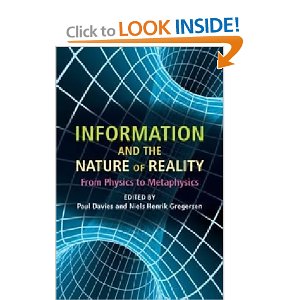
Computational physicist Vlatko Vedral reviews Paul Davies and Niels Henrik Gregersen’s new collection of essays at physicsworld.com in “An inordinate fondness for bits” (Jan 11, 2011). In Information and the Nature of Reality: From Physics to Metaphysics (Cambridge University Press 2010), he says,

Each article explores the hypothesis that information is at the root of everything. And I mean everything – from atoms to, perhaps, a deity.

Well, that last’ll get attention.

Hmmm. Are the contributors trying to mock the intelligent design guys, but they lost the plot somewhere? Well,

The collection starts with historical essays by philosopher of science Ernan McMullin and philosopher-theologian Philip Clayton, who write about materialism (the worldview that states that the only thing that really exists is matter and that all other phenomena are just interactions between different pieces of matter) and its receding hold on philosophy. The stage being set, Davies and fellow physicist Seth Lloyd then present a physics perspective on information. Davies is without a doubt one of the best popular-science writers in the world, and his article demonstrates why. In it, he explains why, in light of modern physics discoveries, materialism is not the most viable philosophy. Lloyd then expands on this idea by introducing the notion that the universe is a giant information-processing device. This is a view that has emerged from my own field of research – quantum computation – and Lloyd is one of its most prominent advocates.

Hold that thought. Materialism is “not the most viable philosophy”?

Well, why did Baptist U Baylor shut down Dembski and Gordon’s Polanyi Center in 2002 for sponsoring a conference where lots of learned folk said substantially the same thing? Why was it big time heresy among … the Baptists when atheist Vedral is okay with it?

Alas, theo-weirdness soon kicks in:
Read More ›

Exoplanets: Aren’t we at risk of running out of gee whiz adjectives?

From “Rocky exoplanet milestone in hunt for Earth-like worlds” (Jason Palmer, BBC News, 10 January 11), we learn, Astronomers have discovered the smallest planet outside our Solar System, and the first that is undoubtedly rocky like Earth. Measurements of unprecedented precision have shown that the planet, Kepler 10b, has a diameter 1.4 times that of Earth, and a mass 4.6 times higher. However, because it orbits its host star so closely, the planet could not harbour life. The discovery has been hailed as “among the most profound in human history”. One can’t help wondering why, actually. Well, because “We want to know if we’re alone in the galaxy, simply put – and this is one link in the chain toward Read More ›

Coffee!! Pop science flexes its flab: “Christians” vs “science” on … spanking

What happens when pop science usurps reason in the public sphere? Not always what you would expect. Here’s a great example, courtesy Jewish Canadian civil rights lawyer and publisher Ezra Levant: “Liberal Senator thinks spanking is the cause of all violence” (January 4, 2011)

“I’m not even kidding,” he begins.

Ez, no fear you’d be kidding. A fellow Norther, I accept that any lunacy may phosphoresce suddenly from our unelected Senate (a gravy heaven for past-their-sell-date partisans).

And, like, what hoo-hoo this time?

So she wants to make it a crime to spank your kids. That’s right: get a criminal record for it. And mandatory, government parenting classes.

Read her nutty speech here. My favourite part is when she cites an animal biologist to say no animals are naturally violent – it’s taught.

As if carnivores in nature would naturally negotiate with their dinner-to-be, as opposed to hunting them.

Wowza, Ez. Wonder what other animal biologists will say – never mind fans of Taylor Mitchell (folk singer killed by coyote attack). What restrains a wild animal from gratuitous violence is the need to fill the belly quickly and move on.

Now, what about Christians, Ez? Where we come in?

He goes on:
Read More ›

Influential atheist cosmologists, and why they might not matter

On a recent list of the 25 most influential atheists, three key cosmologists come up.

# 5 Stephen Hawking

Stephen Hawking is one of the world’s great theoretical physicists. His trade-press book A Brief History of Time took the world by storm in the late 1980s. In it he raised the prospect of a self-creating universe, which he has since developed at length. The theme he keeps pounding is the extraneousness of the God hypothesis.

Wrote a bit about him. With his new take on a God-free M-theory, he is now mainly famous for staying famous. But that’s still pretty famous. Read More ›

Sugars: About face! Left turn!

A friend observes this item from Science News Daily,

ScienceDaily (Jan. 7, 2011) — Certain molecules do exist in two forms which are symmetrical mirror images of each other: they are known as chiral molecules. On Earth, the chiral molecules of life, especially amino acids and sugars, exist in only one form, either left-handed or right-handed. Why is it that life has initially chosen one form over the other? [ … ]

…has for the first time obtained an excess of left-handed molecules (and then an excess of right-handedones) under conditions that reproduce those found in interstellar space. This result therefore supports the hypothesis that the asymmetry of biological molecules on Earth has a cosmic origin.

[ … ]

The excess, which was over 1.3%, is comparable to that measured in primitive meteorites. The researchers thus succeeded in producing, under interstellar conditions, asymmetrical molecules of life from a mixture that did not contain chiral substances. This is the first time that a scenario that explains the origin of this asymmetry has been demonstrated using an experiment that reproduces an entirely natural synthesis.

My friend sniffs, “the production of a small (1.3%) excess of one over the other ( and then the opposite result) is a crowning achievement in a field where any success of any kind is a towering feat.”

Caution is needed. One can get 1.3% in almost any direction, at least once, before the wheels fall off. Thoughts?

Other recent stories at Colliding Universes, my blog on competing theories of our universe: Read More ›

Winds of change? Humanist deflates popcorn neuroscience

In “Mind in the Mirror,” Raymond Tallis reflects on V.S. Ramachandran’s The Tell-Tale Brain: A Neuroscientist’s Quest for What Makes Us Human, “Neuroscience can explain many brain functions, but not the mystery of consciousness”:

The subtitle of V.S. Ramachandran’s latest book prompts a question: Why should “A Neuroscientist’s Quest for What Makes Us Human” be of particular interest? The answer is obvious if you believe, as so many do, that humans are essentially their brains. When a brain scientist speaks, we should pay attention, for “What makes us human” then boils down to what makes our brains special, compared with those of other highly evolved creatures.

RaymondTallis

Dr. Ramachandran and many others, including prominent philosophers like Daniel Dennett and Patricia and Paul Churchland, promise that neuroscience will help us understand not only the mechanism of brain functions (such as those that coordinate movement or underpin speech) but also key features of human consciousness. As of yet, though, we have no neural explanation of even the most basic properties of consciousness, such as the unity of self, how it is rooted in an explicit past and explicit future, how experience is owned and referred to a self, and how we are, or feel that we are, voluntary agents. Neuroscience, in short, has no way of accommodating everyday first-person being.

No, and neuroscience is often invoked to explain things it doesn’t:

Here, as elsewhere, the intellectual audit trail connecting the neuroscience to the things he claims to explain is fragile. For a start, mirror neurons have been observed not just in monkeys and humans but also in swamp sparrows, enabling them to learn to sing the songs they hear. They are admirable birds, but their cultural achievements are modest. Moreover, the existence in humans of a distinct mirror neuron system with properties such as “mind-reading” is still contested. At any rate, the claim that mirror neurons are a “specialized circuitry for social cognition” in humans is a death-defying leap beyond the humble “Monkey see, Monkey do” function they were first observed to have.

Tallis describes himself, at his own site, as a humanist. Read More ›

Coffee!! Is peer review the wheel of life or the Wheel of Fortune?

Bit of both. Neuroskeptic offers:

In the spirit of the 9 Circles of Scientific Hell, and inspired by the evidence showing that scientific peer reviewers agree only slightly more often than they would by chance, here’s a handy tool for randomly generating your review.

How’s this one:

4. Cite Me, Me, Me!: The problem with this paper is that it doesn’t reference the right previous work… yours. Unless the authors change it to cite everything you’ve written in the past 10 years, they can get lost. If they do, the paper will be immediately accepted – to reject it would harm your citation count.

Some readers may wish to try it on their work in progress or on this week’s grocery flyer.

Hat tip: Stephanie West Allen at Brains on Purpose

More peer review stories: Read More ›

Coffee!! Typical Christian Darwinist evolves into 2011

And perhaps deserves, like his patron, to be called a theist. This series of 2011 Christian Darwinist events, hosted by Rev. Michael Dowd, landed in my mailbox. The press release for the 2011 events informs, The six-part series on EvolutionaryChristianity.com will explore what it means to be Christian in a myth-busting age of scientific discovery. Guests will include prominent, and often controversial, Christians, such as: Professor Ken Miller, co-author of the most widely-used biology textbook in America, and lead witness in the Dover ‘intelligent design’ trial. Karl Giberson, vice president of the BioLogos Foundation, an organization that helps conservative Christians integrate their faith with contemporary science. Brian McLaren, a pastor named by Time magazine as one of America’s 25 most Read More ›