Uncommon Descent Serving The Intelligent Design Community
Category

Science

“Blown Away” Dan Peterson reviews Dr. Stephen Meyer’s book The Signature in the Cell at The American Spectator

Dr. Stephen C. Meyer’s book The Signature in the Cell is reviewed by Dan Peterson in The American Spectator (September 1st, 2009). Here is an excerpt: “Of the approaches taken by ID theorists, Signature in the Cell is most closely aligned with the pioneering work on design detection published over the last decade by mathematician William Dembski, one of Meyer’s colleagues at the Discovery Institute.  Dembski and Meyer both rely, at least in part, on information theory and probabilistic analysis to determine whether a phenomenon is best explained as the  product of unguided “chance and necessity,” or of design by an intelligence… Signature in the Cell is a defining work in the discussion of life’s origins and the question of Read More ›

D Rad – Painting in the infrared colors

I learned about this bug back in 2001 and fell in love with it.  Here is partly why: Painting in the infrared colors Olga Glazunov – Chaskor, August 27, 2009  The bacterial protein has the capacity for absorption and emission in the infrared spectral region, was successful (put into action) in mammalian cells.  This protein can be used as a nontoxic dye, which will improve the image of the human body, obtained on CT scanners, and thushelp in the diagnosis and treatment of many diseases. Of the spectrum, which emits a glow derived protein—infrared region, i.e., with a wavelength longer 700nm, It is located outside the visible spectrum, and therefore not perceived by the eye, but can be recorded by special devices, Read More ›

Wired

Wired.com has a new article about why ID isn’t science because it’s been falsified. Usually the tactic against ID is that it isn’t a science because it isn’t falsifiable. I reckon use whatever club is closest at hand when you’re interested only in beating ID instead of being consistent. The article states: “You look at cellular machines and say, why on earth would biology do anything like this? It’s too bizarre,” he said. “But when you think about it in a neutral evolutionary fashion, in which these machineries emerge before there’s a need for them, then it makes sense.” “In which these machineries emerge before there’s a need” for the machineries. I don’t see how that makes any sense. Evolution Read More ›

Hunter Baker’s THE END OF SECULARISM

Hunter Baker, formerly a colleague of mine at Baylor and now associate provost at Houston Baptist University, has just published a book with Crossway titled THE END OF SECULARISM (go here for the Amazon.com listing). It provides a far-sweeping historical analysis of secularism within western culture. His critique of secularism is solid: Secularism is not neutral, nor is it something that simply happened thanks to the growing maturity and rationality of human beings. It is an understandable reaction to the various tragedies of church-state alliances in Western history. It is not, however, necessarily more rational nor more harmonious than any number of alternatives. It cannot claim the authority of science. It cannot escape the need to look beyond materialism in Read More ›

And there you have it!

Janna Levin, Columbia astrophysicist, gives us the cutting-edge science on the origin of the universe: there was nothing, really nothing, nothing at all … but the potential to exist. Was it Aristotle who said that nothing admits no predicates? So where did nothing get the potential to exist and then bring the universe into existence? Not to worry. Janna does give us this assurance: “We know that something happened.” Yes, this is science at its best. Let’s not bring God or design into this discussion — we wouldn’t want to be accused of “acting stupidly.” Oh, one more thing, she’s an assistant professor (go here). Want to bet that she doesn’t have problems getting tenure? Compare this to Guillermo Gonzalez Read More ›

Evidence for an early prokaryotic endosymbiosis

Hypothesis Nature 460, 967-971 (20 August 2009) | doi:10.1038/nature08183 James A. Lake Endosymbioses have dramatically altered eukaryotic life, but are thought to have negligibly affected prokaryotic evolution. Here, by analysing the flows of protein families, I present evidence that the double-membrane, Gram-negative prokaryotes were formed as the result of a symbiosis between an ancient actinobacterium and an ancient clostridium. The resulting taxon has been extraordinarily successful, and has profoundly altered the evolution of life by providing endosymbionts necessary for the emergence of eukaryotes and by generating Earth’s oxygen atmosphere. Their double-membrane architecture and the observed genome flows into them suggest a common evolutionary mechanism for their origin: an endosymbiosis between a clostridium and actinobacterium. You’ll have to pay for this Read More ›

PZ Myers Does It Again

PZ Myers has, once again, railed against something that he doesn’t understand at his blog Pharyngula. Hi PZ! Notice that he doesn’t actually address the content of Dr. Dembski and Dr. Marks’ paper, which you can read here: Conservation of Information in Search: Measuring the Cost of Success, published at the IEEE. Given his argument, he doesn’t know how to measure the cost of success, yet claims that Dr. Dembski doesn’t understand selection. A bit of advice PZ, the argument presented by Dr. Dembski and Dr. Marks is very sophisticated PZ, your mud slinging isn’t PZ, you need to step it up PZ. I know this new stuff isn’t ez, but you may want to consider a response that has Read More ›

Uncommon Descent Contest Question 8: Do the “new atheists” help or hurt the cause of Darwinism?

The prize?:  A free copy of Stephen Meyer’s Signature in the Cell (Harper One, 2009).

Judged: Go here for winner.

You may wish to note this discussion on the new atheists and the problem of evil.

Admin Note: Re contest 7: Endoplasmic Messenger needs to send me a real world address at oleary@sympatico.ca, in order to collect his prize. It will NOT be added to a database for any further purpose.

My own view – and not meant to prejudice yours: Read More ›

Not Very NICE

Investor’s Business Daily posted an article relating Obama’s Healthcare Bill to the National Institute for Health and Clinical Excellence (NICE), the technocrats responsible for the U.K.’s health care.  The article states:

This administration, pledging to cut medical costs and for which “cost-effectiveness” is a new mantra, knows that a quarter of Medicare spending is made in a patient’s final year of life. Certainly the British were aware when they nationalized their medical system.

The controlling of medical costs in countries such as Britain through rationing, and the health consequences thereof are legendary. The stories of people dying on a waiting list or being denied altogether read like a horror movie script.

The U.K.’s National Institute for Health and Clinical Excellence (NICE) basically figures out who deserves treatment by using a cost-utility analysis based on the “quality adjusted life year.”

One year in perfect health gets you one point. Deductions are taken for blindness, for being in a wheelchair and so on.

The more points you have, the more your life is considered worth saving, and the likelier you are to get care.

The British are praised for spending half as much per capita on medical care. How they do it is another matter. The NICE people say that Britain cannot afford to spend $20,000 to extend a life by six months. So if care will cost $1 more, you get to curl up in a corner and die.

These NICE people bring to mind another technocratic group I’ve read about called the “National Institute of Coordinated Experiments (NICE)” in C. S. Lewis’s 1945 novel That Hideous Strength: a Modern Fairy-Tale for Grown-Ups.  Those NICE folks in Lewis’s novel were an institution which would decide who lived and who died in accordance to their agenda of control and advancement of the remaining people into a Utopian, omni-competent and global scientific technocracy. That Hideous Strength was the fictional representation of the governmental materialism and scientism philosophy of social control Lewis described in The Abolition of Man, in which Lewis explains:

It is the magician’s bargain: give up our soul, get power in return. But once our souls, that is, ourselves, have been given up, the power thus conferred will not belong to us. We shall in fact be the slaves and puppets of that to which we have given our souls. It is in Man’s power to treat himself as a mere `natural object’ and his own judgements of value as raw material for scientific manipulation to alter at will. The objection to his doing so does not lie in the fact that this point of view (like one’s first day in a dissecting room) is painful and shocking till we grow used to it. The pain and the shock are at most a warning and a symptom. The real objection is that if man chooses to treat himself as raw material, raw material he will be: not raw material to be manipulated, as he fondly imagined, by himself, but by mere appetite, that is, mere Nature, in the person of his de-humanized Conditioners.

The Investor’s Business Daily article continues: Read More ›
John Mark Reynolds debates Robert Wright with Hugh Hewitt

……..… For the podcast, go to: FIRST HOUR: http://salem/townhall/audio/hour_1…mp3 SECOND HOUR: http://salem/townhall/audio/hour_2…mp3 THIRD HOUR: http://salem/townhall/audio/hour_3…mp3 John Mark Reynolds is a long-time supporter of ID. He invented the title of a Biola conference that I helped organize (and for which I edited the proceedings): MERE CREATION.

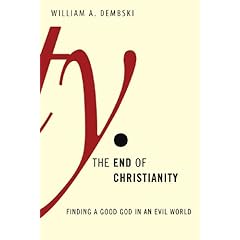
UPDATE: The End of Christianity

THE END OF CHRISTIANITYYesterday I met with the literary publicist hired by Broadman & Holman to promote The End of Christianity when it is released November 1st (for the Amazon.com listing, go here). This book will do much to create further conceptual room for ID. It is also being positioned to go face-to-face with the neo-atheist literature.

The initial print-run and expectations for The End of Christianity far exceed anything for my previous books (even for my best-selling book to date, Intelligent Design: The Bridge Between Science and Theology, which has sold about 80,000 copies). I learned yesterday that Costco and Wal-Mart have placed orders for over 10,000 copies. An immediate Spanish translation will have an initial print-run of 15,000. Paternoster will be handling printing and distribution in the UK. Preorders at Amazon.com have been doing great.

The official launch begins soon and the literary publicist has some exciting ideas for promoting the book online (stay tuned!). For an overview of the book, along with the introductory material and first chapter, go to www.designinference.com. Below are the endorsements:

Read More ›

Design of functional metalloproteins

NATURE|Vol 460|13 August 2009|doi:10.1038/nature08304 REVIEW Yi Lu1, Natasha Yeung1, Nathan Sieracki1 & Nicholas M. Marshall1 Metalloproteins account for nearly half of all proteins in nature. Protein metal-binding sites are responsible for catalysing important biological processes, such as photosynthesis, respiration, water oxidation, molecular oxygen reduction and nitrogen fixation. Much effort has been devoted to understanding the structure and function of metalloproteins, as summarized by other reviews in this Insight. The ultimate test is to use this knowledge to design new metalloproteins that reproduce the structures and functions of native metalloproteins1–3. Metalloprotein design is not just an intellectual exercise that duplicates biochemical and biophysical studies of native metalloproteins. This ‘bottom-up’ approach can also elucidate structural features that may remain hidden in those Read More ›

“The intellectual equivalent of spray painting graffiti”

The folks at RichardDawkins.net have their panties in a bunch over some of my class assignments (go here): Thanks to Baron Scarpia for alerting us to this website, which outlines the rigorous academic standards [Quote-miners, please note: this is sarcasm] which William Dembski’s students have to achieve in his courses on Intelligent Design and Christian Apologetics at Southwestern Baptist Theological Seminary: http://www.designinference.com/teaching/teaching.htm If you follow the links, you will see that it is full of gems: we won’t spoil them for you by flagging them all up, but – just to whet your appetite – you will notice that, at both undergrad and masters level, there are courses for which 20% of the final marks come from having made 10 Read More ›

H. L. Mencken on the “urge to save humanity”

H. L. Mencken once remarked that “the urge to save humanity is always a false front for the urge to rule it.” I made much the same point in a recent op-ed about our new science czar John Holdren (go here). I first became aware of the quote from a July 24th article in INVESTOR’S BUSINESS DAILY on climate change. Here are some highlights:

Ignoring Science
By INVESTOR’S BUSINESS DAILY | Posted Friday, July 24, 2009 4:20 PM PT

Climate Change: A new scientific paper says that man has had little or nothing to do with global temperature variations. Maybe the only place it’s really getting hotter is in Al Gore’s head.

Because he must be getting flustered now, what with his efforts to save the benighted world from global warming continually being exposed as a fraud.

The true believers will not be moved by the peer-reviewed findings of Chris de Freitas, John McLean and Bob Carter, scientists at universities in Australia and New Zealand.

Warming advocates have too much invested in perpetuating the myth. (And are probably having too much fun calling those who don’t agree with them “deniers” and likening skeptics to fascists.)

But these scientists have made an important contribution to the debate that Gore says doesn’t exist.

Their research, published in the Journal of Geophysical Research, indicates that nature, not man, has been the dominant force in climate change in the late 20th century. Read More ›