Uncommon Descent Serving The Intelligent Design Community

Logic & First Principles, 14: Are beauty, truth, knowledge, goodness and justice merely matters of subjective opinions? (Preliminary thoughts.)

Categories
Culture
Logic and Reason
Share
Facebook
Twitter/X
LinkedIn
Flipboard
Print
Email

We live in a Kant-haunted age, where the “ugly gulch” between our inner world of appearances and judgements and the world of things in themselves is often seen as unbridgeable. Of course, there are many other streams of thought that lead to widespread relativism and subjectivism, but the ugly gulch concept is in some ways emblematic. Such trends influence many commonly encountered views, most notably our tendency to hold that being a matter of taste, beauty lies solely in the eye of the beholder.

And yet, we find the world-famous bust of Nefertiti:

The famous bust of Nefertiti, found in Thutmose’s workshop (notice, how subtle smiles will play a role in portraits of beautiful women)

Compare, 3400 years later; notice the symmetry and focal power of key features for Guinean model, Sira Kante :


Sira Kante

And then, ponder the highly formal architecture of the Taj Mahal:

The Taj Mahal

ADDED: To help drive home the point, here is a collage of current architectural eyesores:
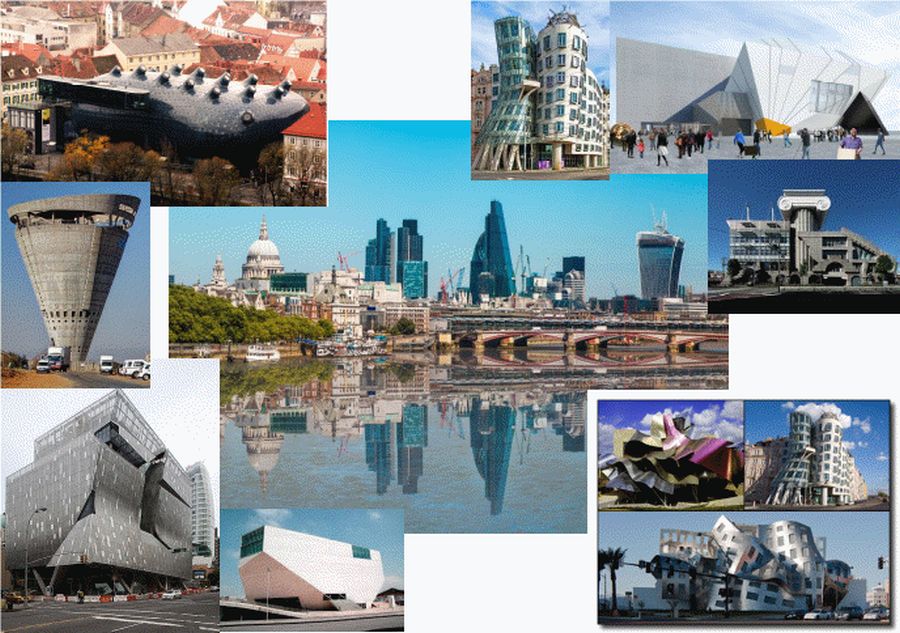
Current Eyesores

Added, Mar 23 — Vernal Equinox: The oddly shaped building on London’s skyline is called “Walkie-Talkie” and due to its curved surface creates a heating hazard at the height of summer on a nearby street — yet another aspect of sound design that was overlooked (this one, ethical):


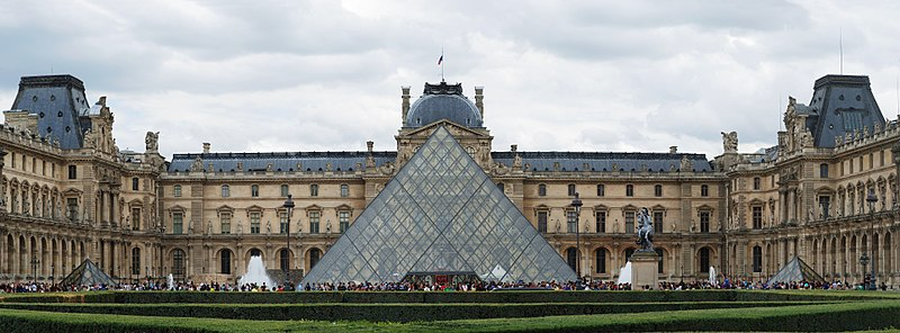
Louvre as seen from inside the Pei pyramid

Since it has come up I add the Louvre’s recent addition of a Pyramid (which apparently echoes a similar temporary monument placed there c. 1839 to honour the dead in an 1830 uprising). Notice, below, how symmetric it is in the context of the museum; where triangular elements are a longstanding part of the design as may be seen from the structure below the central dome and above many windows. Observe the balance between overall framework and detailed elements that relieve the boredom of large, flat blank walls. Historically, also, as Notre Dame’s South Rose Window so aptly illustrates, windows and light have been part of the design and function of French architecture. Notice, how it fits the symmetry and is not overwhelmingly large, though of course those who objected that it is not simply aligned with the classical design of the building have a point:
Yet again, the similarly strongly patterned South Rose Window at Notre Dame (with its obvious focal point, as well as how the many portraits give delightful detail and variety amidst the symmetry) :
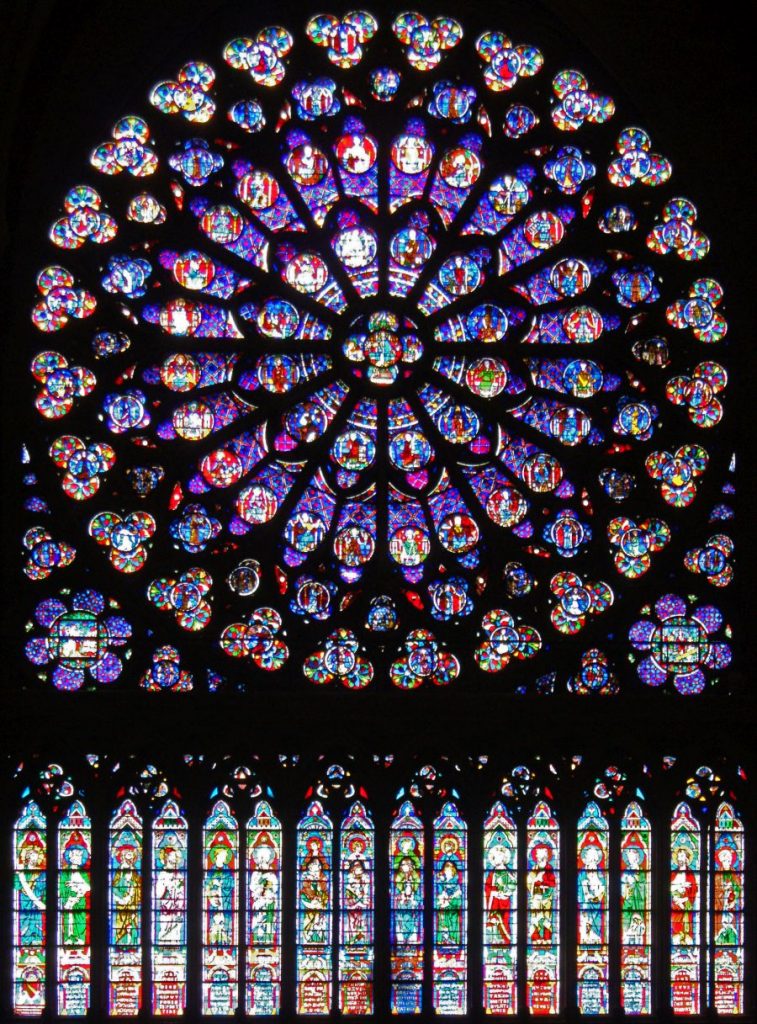
Notre Dame, South Rose Window

Compare, patterning, variety and focus with subtle asymmetry in part of “Seahorse Valley” for the Mandelbrot set:
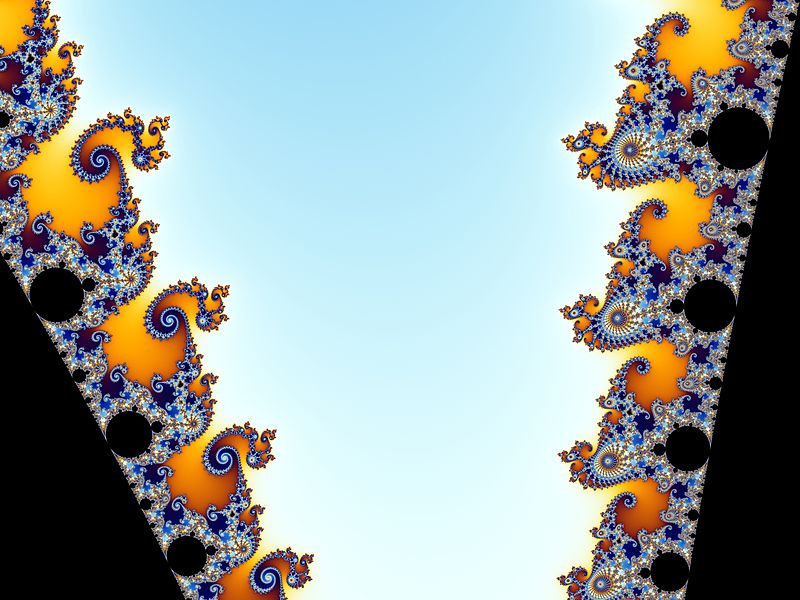
Seahorse Valley zoom, Mandelbrot set

I add, let us pause to see the power of spirals as a pattern, tying in the Fibonacci sequence and thus also the Golden Ratio, Phi, 1.618 . . . (where concentric circles as in the Rose Window, have much of the same almost hypnotic effect and where we see spirals in the seahorse valley also):
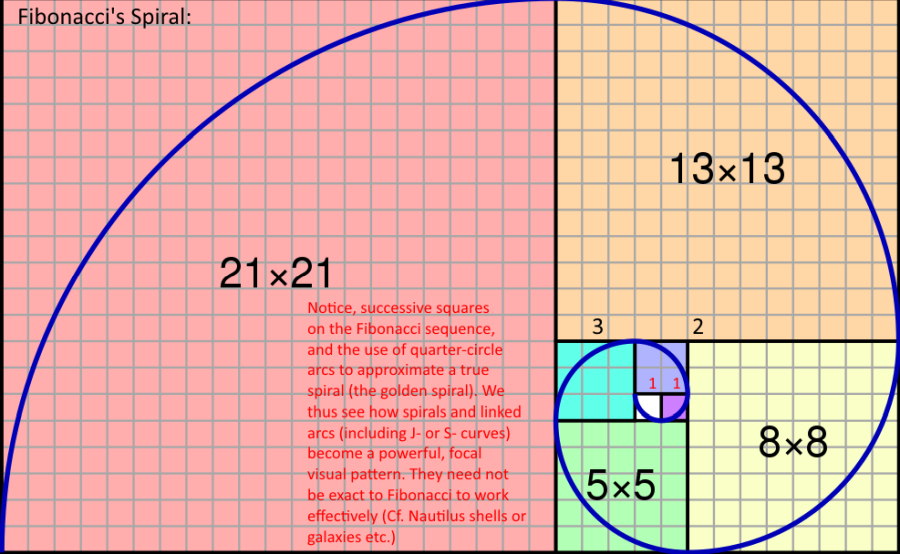
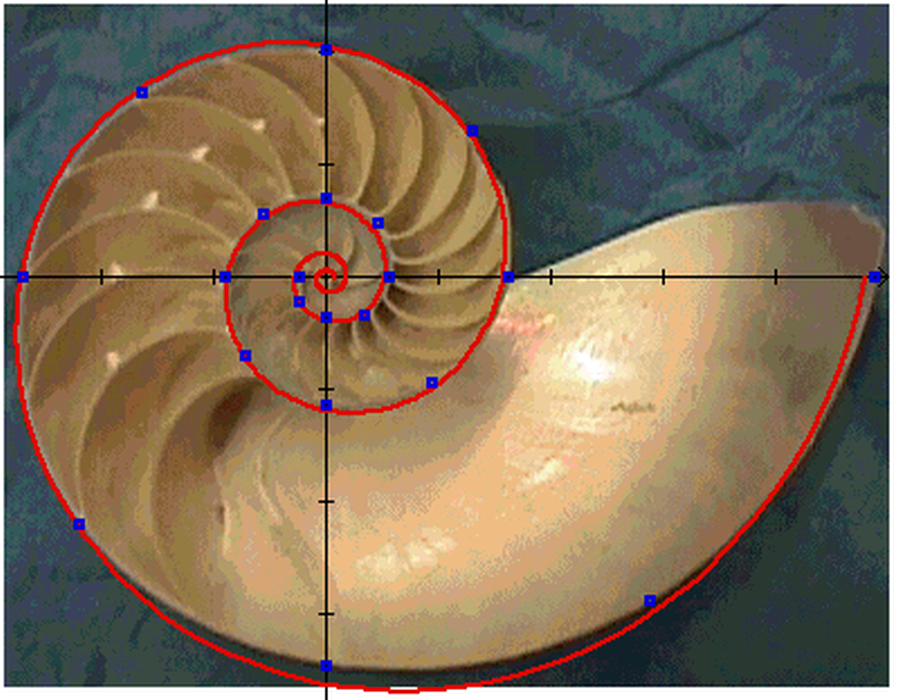
Here, let us observe a least squares fit logarithmic spiral superposed on a cut Nautilus shell:
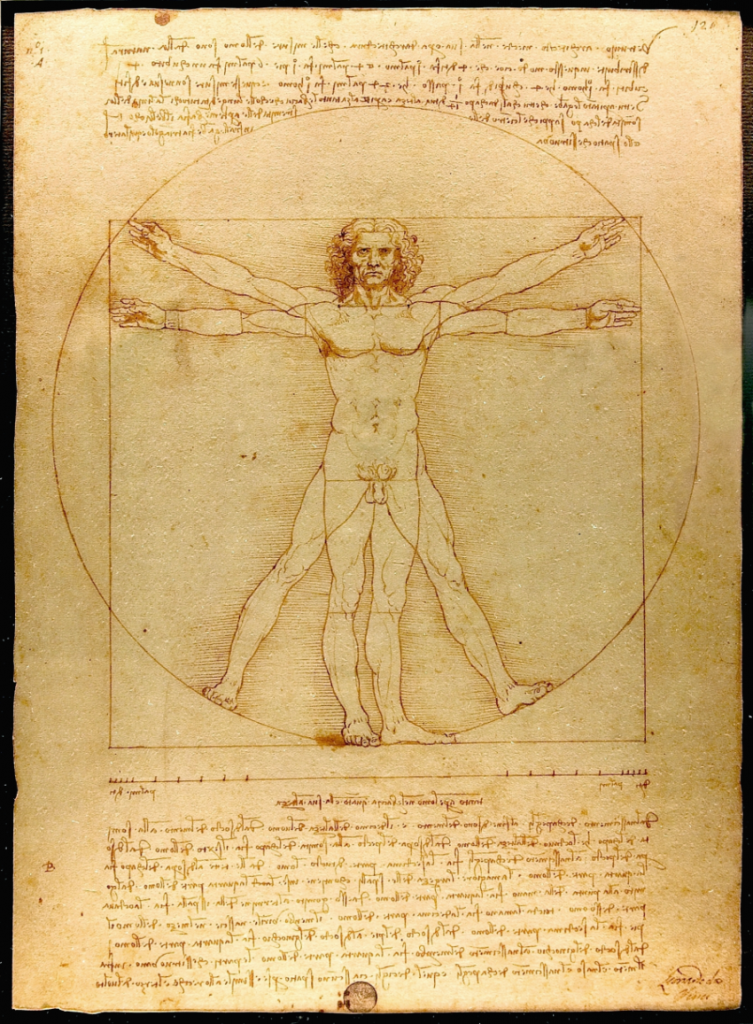
Let us also note, Da Vinci’s Vitruvian Man, as an illustration of patterns and proportions, noting the impact of the dynamic effect of the many S- and J-curve sculptural forms of the curved shapes in the human figure:
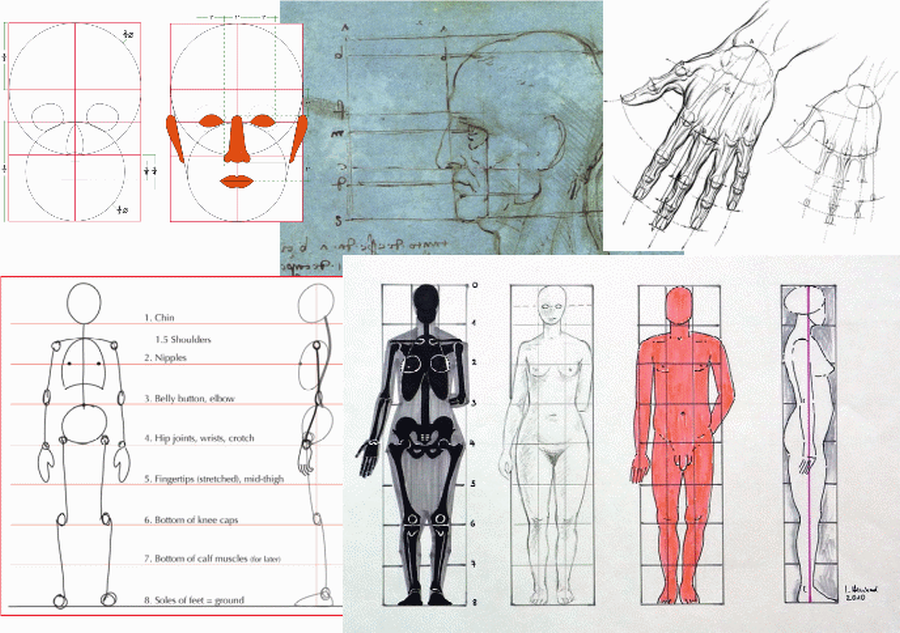
Note, a collage of “typical” human figure proportions:
Contrast the striking abstract forms (echoing and evoking human or animal figures), asymmetric patterning, colour balances, contrasts and fractal-rich cloudy details in the Eagle Nebula:

The Eagle Nebula

Also, the fractal patterning and highlighted focus shown by a partially sunlit Grand Canyon:

Grand Canyon

And then, with refreshed eyes, ponder Mona Lisa, noticing how da Vinci’s composition draws together all the above elements:
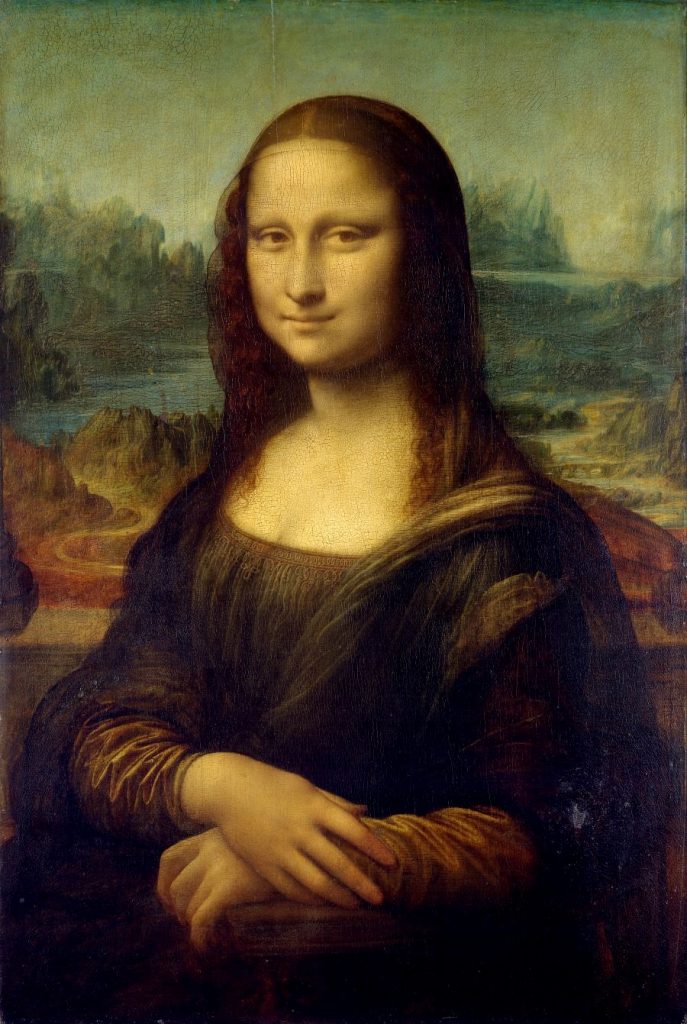
Mona Lisa — the most famous portrait
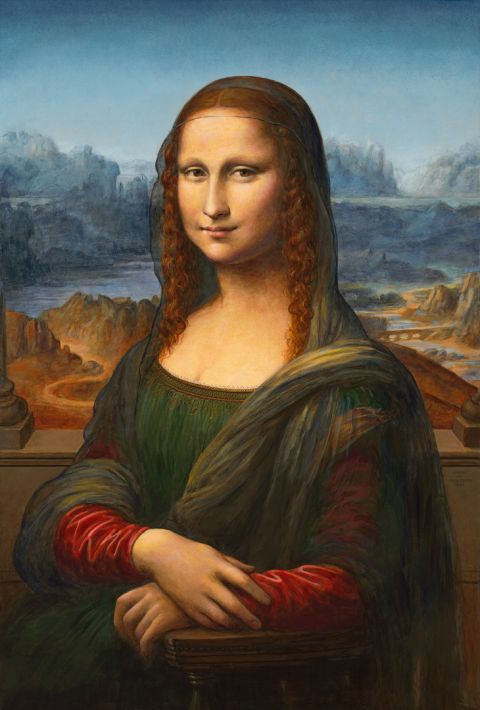
A modern reconstruction of what Mona Lisa may have looked like on completion

Let me also add, in a deliberately reduced scale, a reconstruction of what the portrait may have originally looked like. Over 400 years have passed, varnish has aged and yellowed, poplar wood has responded to its environment, some pigments have lost their colour, there have apparently been over-zealous reconstructions. Of course, the modern painter is not in Da Vinci’s class.

However, such a reconstruction helps us see the story the painting subtly weaves.

A wealthy young lady sits in a three-quarters pose . . . already a subtle asymmetry, in an ornate armchair, on an elevated balcony overlooking a civilisation-tamed landscape; she represents the upper class of the community that has tamed the land. Notice, how a serpentine, S-curved road just below her right shoulder ties her to the landscape and how a ridge line at the base of her neck acts as a secondary horizon and lead in. Also, the main horizon line (at viewer’s eye-level) is a little below her eyes; it is relieved by more ridges. She wears bright red, softened with dark green and translucent layers. Her reddish brown hair is similarly veiled. As a slight double-chin and well-fed hands show, she is not an exemplar of the extreme thinness equals beauty school of thought. The right hand is brought over to the left and superposed, covering her midriff — one almost suspects, she may be an expectant mother. Her eyes (note the restored highlights) look to her left . . . a subtle asymmetry that communicates lifelike movement so verisimilitude, as if she is smiling subtly with the painter or the viewer — this is not a smirk or sneer. And of course the presence of an invited narrative adds to the aesthetic power of the composition.

These classics (old and new alike) serve to show how stable a settled judgement of beauty can be. Which raises a question: what is beauty? Like unto that: are there principles of aesthetic judgement that give a rational framework, setting up objective knowledge of beauty? And, how do beauty, goodness, justice and truth align?

These are notoriously hard questions, probing aesthetics and ethics, the two main branches of axiology, the philosophical study of the valuable.

Where, yes, beauty is recognised to be valuable, even as ethics is clearly tied to moral value and goodness and truth are also valuable, worthy to be prized. It is unsurprising that the Taj Mahal was built as a mausoleum by a King to honour his beautiful, deeply loved wife (who had died in childbirth).

AmHD is a good place to start: beauty is “[a] quality or combination of qualities that gives pleasure to the mind or senses and is often associated with properties such as harmony of form or color, proportion, authenticity, and originality. “

Wikipedia first suggests that beauty is:

a property or characteristic of an animal, idea, object, person or place that provides a perceptual experience of pleasure or satisfaction. Beauty is studied as part of aesthetics, culture, social psychology, philosophy and sociology. An “ideal beauty” is an entity which is admired, or possesses features widely attributed to beauty in a particular culture, for perfection. Ugliness is the opposite of beauty.

The experience of “beauty” often involves an interpretation of some entity as being in balance and harmony with nature, which may lead to feelings of attraction and emotional well-being. Because this can be a subjective experience, it is often said that “beauty is in the eye of the beholder.” However, given the empirical observations of things that are considered beautiful often aligning with the aforementioned nature and health thereof, beauty has been stated to have levels of objectivity as well

It then continues (unsurprisingly) that ” [t]here is also evidence that perceptions of beauty are determined by natural selection; that things, aspects of people and landscapes considered beautiful are typically found in situations likely to give enhanced survival of the perceiving human’s genes.” Thus we find the concepts of unconscious programming and perception driven by blind evolutionary forces. The shadow of the ugly gulch lurks just beneath the surface.

Can these differences be resolved?

At one level, at least since Plato’s dialogue Hippias Major, it has been well known that beauty is notoriously hard to define or specify in terms of readily agreed principles. There definitely is subjectivity, but is there also objectivity? If one says no, why then are there classics?

Further, if no, then why could we lay out a cumulative pattern across time, art-form, nature and theme above that then appears exquisitely fused together in a portrait that just happens to be the most famous, classic portrait in the world?

If so, what are such and can they constitute a coherent framework that could justify the claim to objective knowledge of aesthetic value?

Hard questions, hard as there are no easy, simple readily agreed answers. And yet, the process of addressing a hard puzzle where our intuitions tell us something but it seems to be forever just beyond our grasp, is itself highly instructive. For, we know in part.

Dewitt H. Parker, in opening his 1920 textbook, Principles of Aesthetics, aptly captures the paradox:

Although some feeling for beauty is perhaps universal among men, the
same cannot be said of the understanding of beauty. The average man,
who may exercise considerable taste in personal adornment, in the
decoration of the home, or in the choice of poetry and painting, is
at a loss when called upon to tell what art is or to explain why he
calls one thing “beautiful” and another “ugly.” Even the artist and
the connoisseur, skilled to produce or accurate in judgment, are often
wanting in clear and consistent ideas about their own works or
appreciations. Here, as elsewhere, we meet the contrast between feeling
and doing, on the one hand, and knowing, on the other.

Of course, as we saw above, reflective (and perhaps, aided) observation of case studies can support an inductive process that tries to identify principles and design patterns of effective artistic or natural composition that reliably excite the beauty response. That can be quite suggestive, as we already saw:

  • symmetry,
  • balance,
  • pattern (including rhythms in space and/or time [e.g. percussion, dance]),
  • proportion (including the golden ratio phi, 1.618 etc)
  • unity or harmony (with tension and resolution), highlighting contrast,
    variety and detail,
  • subtle asymmetry,
  • focus or vision or theme,
  • verisimilitude (insight that shows/focusses a credible truth/reality)
  • echoing of familiar forms (including scaled, fractal self-symmetry),
  • skilled combination or composition
  • and more.

We may see this with greater richness by taking a side-light from literature, drama and cinema, by using the premise that art tells a story, drawing us into a fresh vision of the world, ourselves, possibilities:
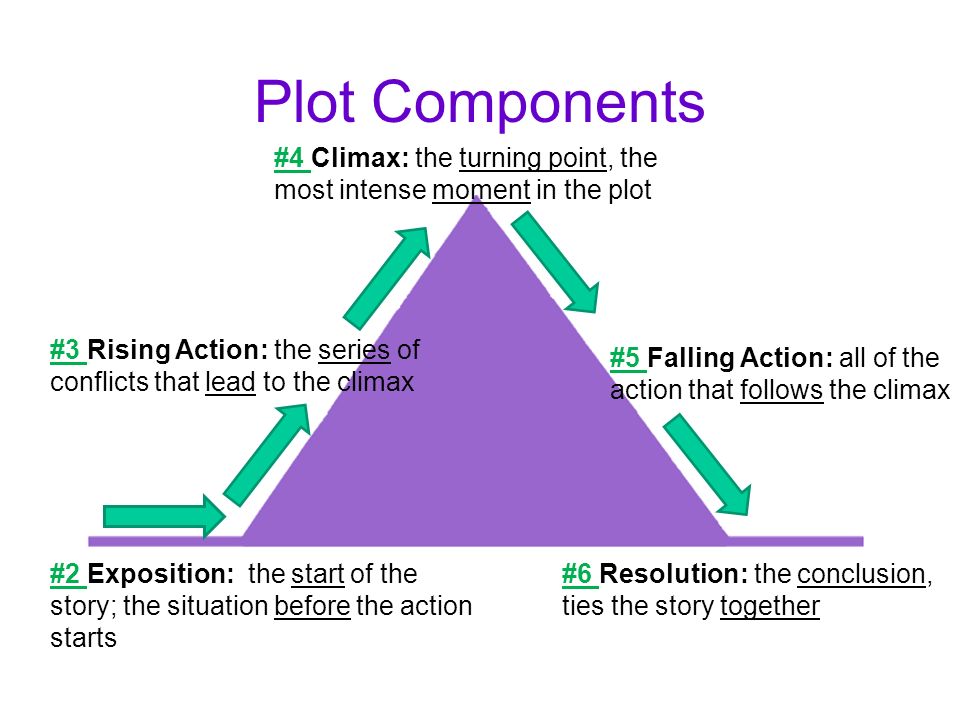
Already, it is clear that beauty has in it organising principles and that coherence with variety in composition indicates that there is indeed organisation, which brings to bear purpose and thus a way in for reflective, critical discussion. From this, we reach to development of higher quality of works and growing knowledge that guides skill and intuition without stifling creativity or originality. So, credibly, there is artistic — or even, aesthetic — knowledge that turns on rational principles, which may rightly be deemed truths.

Where, as we are rational, responsible, significantly free , morally governed creatures, the ethical must also intersect.

Where also, art has a visionary, instructive function that can strongly shape a culture. So, nobility, purity and virtue are inextricably entangled with the artistic: the perverse, ill-advised, unjust or corrupting (consider here, pornography or the like, or literature, drama and cinema that teach propaganda or the techniques of vice) are issues to be faced.

And, after our initial journey, we are back home, but in a different way. We may — if we choose — begin to see how beauty, truth, knowledge, goodness and justice may all come together, and how beauty in particular is more than merely subjective taste or culturally induced preference or disguised population survival. Where also, art reflecting rational principles, purposes and value points to artist. END

PS: To document the impact of the beauty of ordinary things (we have got de-sensitised) here are people who thanks to filtering glasses are seeing (enough of) colour for the first time:

Similarly, here are people hearing for the first time:

This will be a bit more controversial, but observe these Korean plastic surgery outcomes:

Comments
I don’t doubt that there is a mathematical underpinning to music, but to suggest that this mathematical underpinning is responsible for the beauty of the music does not follow.
Why not?
If this were the case, we should be able to program a computer to create beautiful music.
That doesn't follow, unless you are using FORTRANET
March 13, 2019
March
03
Mar
13
13
2019
06:54 AM
6
06
54
AM
PDT
I don't doubt that there is a mathematical underpinning to music, but to suggest that this mathematical underpinning is responsible for the beauty of the music does not follow. If this were the case, we should be able to program a computer to create beautiful music.Brother Brian
March 13, 2019
March
03
Mar
13
13
2019
06:28 AM
6
06
28
AM
PDT
Mathematics is beautifulET
March 13, 2019
March
03
Mar
13
13
2019
06:27 AM
6
06
27
AM
PDT
KF, Does this mathematical analysis provide evidence that certain pieces of music are objectively beautiful? It seems to me that you have explained that many humans (those of us in the west, esp.) find music with certain mathematical properties to be beautiful. But not that the beauty we experience in, for example, a Bach cello suite exists independently of our minds. You have also explained that humans find architecture, paintings, and even geographical formations with certain mathematical properties to be beautiful. So we can conclude that humans, across cultures and time (to some extent), share similar tastes in art, and these tastes are connected to "mathematics" (using the term in a very broad sense). I still don't see how you can know, based on your arguments, that there actually is such a thing as objective beauty.daveS
March 13, 2019
March
03
Mar
13
13
2019
06:04 AM
6
06
04
AM
PDT
F/N: Notice, on the logic of octaves in music thence the challenge of harmony and creation of scales -- further drawing out the principle of coherence or harmony and the role of subtle asymmetry -- here due to a problem of reconciling ratios -- and the place of a focal point:
https://en.wikipedia.org/wiki/Octave Explanation and definition For example, if one note has a frequency of 440 Hz, the note one octave above is at 880 Hz, and the note one octave below is at 220 Hz. The ratio of frequencies of two notes an octave apart is therefore 2:1. Further octaves of a note occur at 2 n {displaystyle 2^{n}} 2^{n} times the frequency of that note (where n is an integer), such as 2, 4, 8, 16, etc. and the reciprocal of that series. For example, 55 Hz and 440 Hz are one and two octaves away from 110 Hz because they are ? 1?2 (or 2 ? 1 {displaystyle 2^{-1}} 2^{{-1}}) and 4 (or 2 2 {displaystyle 2^{2}} {displaystyle 2^{2}}) times the frequency, respectively. The number of octaves between two frequencies is given by the formula: Number of octaves = log_2 ? ( f 2 /f 1 ) The octave is defined by ANSI[4] as the unit of frequency level when the base of the logarithm is two. Octave equivalency After the unison, the octave is the simplest interval in music. The human ear tends to hear both notes as being essentially "the same", due to closely related harmonics. Notes separated by an octave "ring" together, adding a pleasing sound to music. The interval is so natural to humans that when men and women are asked to sing in unison, they typically sing in octave.[5] For this reason, notes an octave apart are given the same note name in the Western system of music notation—the name of a note an octave above A is also A. This is called octave equivalency, the assumption that pitches one or more octaves apart are musically equivalent in many ways, leading to the convention "that scales are uniquely defined by specifying the intervals within an octave".[6] The conceptualization of pitch as having two dimensions, pitch height (absolute frequency) and pitch class (relative position within the octave), inherently include octave circularity.[6] Thus all C?s, or all 1s (if C = 0), in any octave are part of the same pitch class. Octave equivalency is a part of most "advanced musical cultures", but is far from universal in "primitive" and early music.[7][8] The languages in which the oldest extant written documents on tuning are written, Sumerian and Akkadian, have no known word for "octave". However, it is believed that a set of cuneiform tablets that collectively describe the tuning of a nine-stringed instrument, believed to be a Babylonian lyre, describe tunings for seven of the strings, with indications to tune the remaining two strings an octave from two of the seven tuned strings.[9] Leon Crickmore recently proposed that "The octave may not have been thought of as a unit in its own right, but rather by analogy like the first day of a new seven-day week".[10] Monkeys experience octave equivalency, and its biological basis apparently is an octave mapping of neurons in the auditory thalamus of the mammalian brain.[11] Studies have also shown the perception of octave equivalence in rats (Blackwell & Schlosberg 1943), human infants (Demany & Armand 1984),[12] and musicians (Allen 1967) but not starlings (Cynx 1993), 4–9 year old children (Sergeant 1983), or nonmusicians (Allen 1967).[6]
A good referent, here, is to recognise that the human vocal tract is effectively a wind instrument with transients and node-antinode patterns. Like other instruments, it responds to acoustical vibrations by forming standing waves which have over a given length L, a pattern of peak and minimal vibrations termed nodes and antinodes (best seen with strings). These create a pattern of whole number numerical ratios between a fundamental vibration mode and harmonics that have more nodes and antinodes. In a typical instrument, there will be a particular pattern of such harmonics, giving rise to its timbre or quality of sound . . . essentially, wave-shape (and yes, this points to Fourier analysis). In basic quantum theory, say the particle in a box, similar standing wave patterns naturally give rise to quantum numbers. Let me add, 3/2 * 2 = 6/2, a third harmonic to the fundamental. Likewise, 3/2 * 3 = 9/2, 4.5:1 and 3/2 * 4 = 12/2, etc. Of course, in the physical acoustic system, higher order harmonics will normally have lower and lower amplitudes. Clipping distortion [due to hard saturation] tends to have odd number harmonics and crossover distortions, even number harmonics, which are relevant especially to electronic instruments. Note, too, conical and exponential horns are dispersive media with wavelength-dependent velocity leading to phase-shifts. Such horns serve as acoustic impedance match devices, reducing standing waves and enhancing transfer to the general atmosphere. The chromatic scale of notes is a cycle of twelve notes spanning an octave at an interval of the twelfth root of two. However, it is more instructive to understand the creation of a scale of notes from the attempt to fuse octaves (2:1 frequency ratios) and fifths (3:2 ratios):
http://www.sound-physics.com/Music-Physics/Pythagorean-Comma/ Pythagorean Comma Although musical notes can be calculated mathematically, doing that creates notes which are slightly off pitch. The Perfect Fifth is the lowest ratio harmonic you hear and is mathematically calculated by multiplying a frequency the ratio by 3/2 or 1.5. For example, in the note of C, the perfect fifth would be a G. In harmonic terms, the perfect fifth is one octave below the third harmonic [--> i.e. triple the fundamental frequency, f_0, yielding 3 * f_0, then halve that to get 1.5 * f_0]. Pythagorous of Samos (c.582 - c.507 B.C.) discovered that you could make a musical scale by continuing through the Circle of Fifths, and dividing down harmonically with The Law of Octaves to determine the pitch for each note. There is a distinct problem in this procedure, however. It does not add up correctly but leaves a small residual error that has been the frustration and bane of musicians ever since. It works out like this. Say we start at C at 256 Hz. G would be 1.5 x C or 384. D would be 1.5 x 384 or 576. This continues as follows: C > G > D > A > E > B > F# > C# > G# > D# > A# > F > C. C 256 > G 384 > D 576 > A 864 > E 1,296 > B 1,944 > F# 2,916 > C# 4,374 > G# 6,561 > D# 9,841 > A# 14,762 > F 22,143 > C 33215 Then utilize the Law of Octaves to divide down C at 33,215 Hz by 2 until you obtain 259.5 Hz. The difference between C at 256 Hz, and C at 259.5 Hz is known as the Pythagorean Comma. It works out to the ratio of about 74/73 or 743/733. There is another comma defined in music, the comma diesis which is equal to about 81/80 or 5.4 savarts. This small excess ratio means that a music scale cannot be completely harmonic with regard to octaves and with regard to the interval of a fifth since this musical error must reside somewhere in the scale. The question is- where? Thousands of musical scales have been invented to reduce the effects of this error . . .
So, the physics of voicing, sounding and of hearing through in effect a mechanical fourier transform naturally emphasises whole number ratio harmonics. However, the two key harmonic ratios 2:1 (leading to octave equivalence) and 3:2 (lowest heard aesthetically pleasing blend) cannot be exactly reconciled, leading to slight asymmetries that have to be distributed across the scale somehow. And of course, the fundamental is a hidden focus in the patterns. We here see an example of how the aesthetic principles naturally emerge and of how say a hypothetical hearing-less alien race (say, they communicate by radio) could come to understand the aesthetic principles of our music without being able to directly appreciate it. However, if the aliens have vocalisation and auditory systems, it is likely that they will have the same frequency responsiveness with the same octave and fifth responses as these are closely tied to the physics of harmonics and reinforcing rather than clashingly an-harmonic overtones. Similar aesthetics extend to the visual and plastic arts. (Notice, our visual arrays will recognise the evenly spaced and what is significantly out of a pattern as a change. The Weber-Fechner law highlights that we respond to delta-x/x, to change. A natural pattern will not tend to have co-ordinated regularities, e.g. dappled colours and shadows in a forest, so a regularity or shape-pattern will highlight itself for good or ill.) In literature and drama, other morally governed races would readily appreciate the pattern of plotline in context with challenge and conflict interacting with motive and character towards climax and outcome. This further underscores the significance of the principles as were noted above. KF PS: consider, similarly, a race that say sees mostly in our IR zone. Note, visual range is connected to energy gaps between orbitals in atoms and molecules, thus chemical interactions and onward to blackbody radiation peak bands, our visual range is roughly an octave in electromagnetic vibrations. Yes, finetuning again. Such IR-sensing creatures likely would not see our paintings as we do but could use false colours to detect what we see, and again the logic of patterns, regularities and sensitivity to fractional change would bring out ability to recognise and respond. The mathematical patterns of symmetry, reflection, rotation, translation, asymmetry etc would be relevant. (Recall, the earlier discussion on how core structure and quantity are necessarily embedded in any possible world. Dismissiveness at that point will predictably lead to needless difficulties at this point. I again recommend the mobius strip cutting exercises as a way to break through controlling presuppositions that are serving as crooked yardsticks.)kairosfocus
March 13, 2019
March
03
Mar
13
13
2019
02:45 AM
2
02
45
AM
PDT
F/N: Note on the physics of music: http://kellerphysics.com/acoustics/Lapp.pdf KFkairosfocus
March 12, 2019
March
03
Mar
12
12
2019
08:49 PM
8
08
49
PM
PDT
H, do you notice, that I have separated the aesthetic impact we feel from the intelligible, rational principles and connected metrics and functions on structure and quantity? This is why I have pointed out that even an alien species that has no reaction of that sort, on encountering creatures such as we are, could form the concept. Precisely because it is intelligible. Which is specifically broader than having any particular taste or preference. And that has nothing to do with anything as particular as views on attractiveness vs functionality of noses etc. Recall, the OP is looking at a wide array of cases. KFkairosfocus
March 12, 2019
March
03
Mar
12
12
2019
08:35 PM
8
08
35
PM
PDT
Thankfully clever, humorous conversation, broad shoulders and a chest that fills out the shirt, still work. :cool: :razz:ET
March 12, 2019
March
03
Mar
12
12
2019
04:23 PM
4
04
23
PM
PDT
Hazel
And Brian, my remark about “parochial” was addressed to kf:
I knew that. I was just being a [SNIP -- Ed]. I apologize. But i agree that there are some broad stroke ideas of beauty that most of us would agree on. But the bigger question is if our anscestors would agree with us. In previous ages pasty white skin was the ideal. And women who were more “pudgy”? And this is just European norms. I’m sure that African ideals of beauty, and Indian, East Indian, Australian aborigiginal, etc were completely different than our modern ideal. I am hoping that late middle age, beer bellied men become the epitome of male beauty. I won’t hold my breath. (ET, feel free to hold your breath).Brother Brian
March 12, 2019
March
03
Mar
12
12
2019
04:06 PM
4
04
06
PM
PDT
Perhaps aliens do have as well-developed an aesthetic sense of beauty as we have, but think our noses are incredibly ugly! I can't believe you think this is comparable to math. And Brian, my remark about "parochial" was addressed to kf: it means having a narrow viewpoint that just expresses the ideas of one's own group. Thinking that having tea at 4:00 pm is the only civilized way to live is parochial.hazel
March 12, 2019
March
03
Mar
12
12
2019
03:46 PM
3
03
46
PM
PDT
H, we are speaking of hypothetical aliens. You are using them as a foil for differing views on beauty. I pointed out that we have no warrant for thinking that an alien race would have the sort of aesthetic response we have to beauty at all, BUT that they will be able to conceptualise i/l/o the clearly mathematical import of concepts such as symmetry, harmony, simple ratio overtones, formants in voice boxes and windpipes (the human vocal tract is a wind instrument working off harmonic excitations and transients with nodes and antinodes), subtle asymmetries, diversity and detail in the midst of patterns etc. In short, because there is an objective side, even aliens who have no response as we do, would be able to form the concept. Such is patently the utter opposite of provincialism or the like. KFkairosfocus
March 12, 2019
March
03
Mar
12
12
2019
03:30 PM
3
03
30
PM
PDT
BB, aesthetical relativism has no better warrant than ethical relativism or Mathematical nominalism. If you look at the OP you can see in the counter-instances a billion dollar exercise in deliberately violating the sort of principles that the OP lists. Billions worth of eyesores that mar our cityscapes is the direct and blatant result. Never mind the sort of institutional, ideological and political dominance it took to push through such monstrosities and eyesores. And yes, I look towards the controlled demolitions to come. KFkairosfocus
March 12, 2019
March
03
Mar
12
12
2019
03:22 PM
3
03
22
PM
PDT
Brother Brian:
Beauty and moral values vary within a culture, vary even more between cultures, and change throughout time.
And from the Old Testament the consequences of the Tower of Babel explains that. Again, just because we find ourselves in a chaotic time doesn't mean there isn't or never was an objective morality or that beauty isn't objective.ET
March 12, 2019
March
03
Mar
12
12
2019
03:14 PM
3
03
14
PM
PDT
Hazel
Incredibly parochial viewpoint, I think.
Perhaps. What does parochial mean? :)Brother Brian
March 12, 2019
March
03
Mar
12
12
2019
02:49 PM
2
02
49
PM
PDT
re 83: Incredibly parochial viewpoint, I think.hazel
March 12, 2019
March
03
Mar
12
12
2019
02:42 PM
2
02
42
PM
PDT
Hazel@81, I don’t think you even have to invoke a hypothetical alien. Different cultures have different ideas of what is beautiful. And even within a single culture, the variation is huge. I see a parallel in this with moral values. Beauty and moral values vary within a culture, vary even more between cultures, and change throughout time. Subjectivity informed by nurture seems to explain this much better than some I’ll-defined, unidentifiable objective nature.Brother Brian
March 12, 2019
March
03
Mar
12
12
2019
02:42 PM
2
02
42
PM
PDT
H, hypothetical, but we have no reason to assume such would have the concept, beauty, much less the similar aesthetic response. However, on contact with us, they could form the concept due to the objective properties, even were they unresponsive in the way we are. KFkairosfocus
March 12, 2019
March
03
Mar
12
12
2019
02:23 PM
2
02
23
PM
PDT
PK, similar pose, not the same woman. It seems Da Vinci worked on this theme for years producing two paintings. That he might have done such a nude study (likely NOT with the paying client) is not unlikely. The article suggests a nude painting was done. Remember, the figure sets the foundation for the clothed figure -- hence anatomical dissection studies done by the artists of that time. KFkairosfocus
March 12, 2019
March
03
Mar
12
12
2019
02:17 PM
2
02
17
PM
PDT
All kidding aside, the substantial point is that we would expect aliens to have the same math, but not the same sense of what is beautiful.hazel
March 12, 2019
March
03
Mar
12
12
2019
01:57 PM
1
01
57
PM
PDT
What it says about Brian is that he has a fetish for actresses in green body paint. :razz:ET
March 12, 2019
March
03
Mar
12
12
2019
01:29 PM
1
01
29
PM
PDT
@KF #75 But what do you think of Da Vinci's nude Mona Lisa ? https://www.smithsonianmag.com/smart-news/experts-think-nude-mona-lisa-could-have-been-drawn-leonardo-da-vinci-180971644/Pater Kimbridge
March 12, 2019
March
03
Mar
12
12
2019
01:09 PM
1
01
09
PM
PDT
Hazel
But what does that say about you, Brian? What star system are you from?
I guess we would just be star-crossed lovers. :)Brother Brian
March 12, 2019
March
03
Mar
12
12
2019
01:02 PM
1
01
02
PM
PDT
But what does that say about you, Brian? What star system are you from? :-)hazel
March 12, 2019
March
03
Mar
12
12
2019
12:53 PM
12
12
53
PM
PDT
Hazel
Good point about alien math vs alien beauty.
I'm not sure about this. I find the green skinned Orion women on Star Trek very beautiful. :)Brother Brian
March 12, 2019
March
03
Mar
12
12
2019
12:51 PM
12
12
51
PM
PDT
GUN (attn H and PK), there is no conflation of intersubjective agreement (limited or universal) with objectivity. There is a set of cases (now with an architectural counter example) which shows the intelligibility of rational principles of aesthetics. Notice, above I spoke of two cases where [1] reparative surgery in accordance with said principles led to much enhanced facial beauty (cleft palate surgery, FYI), and [2] where an otherwise highly beautiful face is marred by a distorted, misaligned feature. The architectural eyesores clearly demonstrate what happened when the known principles were willfully mocked and defied -- to the tune of billions that simply proved the original point. Though, the willful imposition of the ugly may very well be sending a message. I add, the cases and counters point to actual causal factors being at work, the aesthetic sense is responding to something real, measurable, effective. The hypothetical aliens may or may not natively have the concept of beauty, or may not have the aesthetic sensibilities to feel much as we do when confronted by great beauty, but surely, they will grasp the mathematical relationships that are demonstrably involved in exciting our response. BTW, I was just looking at the comparison of Da Vinci's two -- yes, credibly TWO -- Mona Lisa paintings (one seems younger and has the same balcony but different landscape features . . . yes that is suggestive of artistic rather than literal purpose), and they remarked on his geometrical focus at the time, showing some convincing parallels of proportion and compositional patterns. See here for starts. KF PS: Video: https://www.youtube.com/watch?list=PLUv9oht3hC6Q8RDzfG8H0tUHqcy_a7Zav&time_continue=45&v=IUr-5Rwy8VYkairosfocus
March 12, 2019
March
03
Mar
12
12
2019
12:22 PM
12
12
22
PM
PDT
Yes, that is a good point. It reminds me of how some people point out similarities in near-death experiences, and use that to infer that there must be an afterlife, when in reality it just points to common culture and common brain chemistry.Pater Kimbridge
March 12, 2019
March
03
Mar
12
12
2019
12:00 PM
12
12
00
PM
PDT
Good point about alien math vs alien beauty.hazel
March 12, 2019
March
03
Mar
12
12
2019
11:47 AM
11
11
47
AM
PDT
Good point about alien math vs alien beauty.hazel
March 12, 2019
March
03
Mar
12
12
2019
11:47 AM
11
11
47
AM
PDT
I’m a little surprised at how many people here seem to be equating inter-subjectivity with objectivity. I’m inclined to believe that there are certain patterns and features that are universal (or nearly so) among humans in regards to what we find “beautiful”. There’s certainly a lot of disagreement (as seen above) as to what degree “nature” plays a role versus “nurture” in regards to what we find beautiful, but I think most people would agree that “nature” is a factor. I believe that the reason for this inter-subjectivity is that we, as fellow humans, share certain features, and thus it’s to be expected that there would be certain similarities to what we find pleasant or unpleasant. I have no doubt that if we encounter space-faring intelligent aliens, that they will agree that 2 + 2 equals 4, but it wouldn’t be the least bit surprising if they had very different ideas of what is beautiful - that’s even assuming that they have a concept of “beauty”. If the only requirement here for saying that something is objective is to show inter-subjectivity, does that also apply to other areas (e.g. morality)?goodusername
March 12, 2019
March
03
Mar
12
12
2019
11:45 AM
11
11
45
AM
PDT
M@67, thanks for the explanation. I just couldn't figure out the logic for your claim that subjectivity is an inherently creationist concept. I'm not sure that I agree but it has given me food for thought.Ed George
March 12, 2019
March
03
Mar
12
12
2019
08:17 AM
8
08
17
AM
PDT
1 … 9 10 11 12 13 14