Uncommon Descent Serving The Intelligent Design Community

UD PRO-DARWINISM ESSAY CHALLENGE

Categories
Darwinism
Design inference
Education
Evolution
ID Foundations
Intelligent Design
Origin Of Life
Science
science education
specified complexity
worldview
Share
Facebook
Twitter/X
LinkedIn
Flipboard
Print
Email

On Sept 23rd, I put up an essay challenge as captioned, primarily to objecting commenter Jerad.

As at October 2nd, he has definitively said: no.

Joe informs us that Zachriel has tried to brush it aside:

Try Darwin’s Origin of Species (1859). It’s a bit dated and longer than 6,000 words, (the 6th edition is 190,000 words), but Darwin considered it just a long abstract, and it still makes for a powerful argument.

This is, frankly, a “don’t bother me” brush-off; telling in itself, as a definitive, successful answer would have momentous impact on this blog.

Zachriel’s response reminds me, all too strikingly, of the cogency of  what Philip Johnson had to say in reply to Lewontin’s claims in his NYRB article in January 1997:

For scientific materialists the materialism comes first; the science comes thereafter. [[Emphasis original]We might more accurately term them “materialists employing science.” And if materialism is true, then some materialistic theory of evolution has to be true simply as a matter of logical deduction, regardless of the evidence. That theory will necessarily be at least roughly like neo-Darwinism, in that it will have to involve some combination of random changes and law-like processes capable of producing complicated organisms that (in Dawkins’ words) “give the appearance of having been designed for a purpose.”
 
. . . .   The debate about creation and evolution is not deadlocked . . . Biblical literalism is not the issue. The issue is whether materialism and rationality are the same thing. Darwinism is based on an a priori commitment to materialism, not on a philosophically neutral assessment of the evidence. Separate the philosophy from the science, and the proud tower collapses. [[Emphasis added.] [[The Unraveling of Scientific Materialism, First Things, 77 (Nov. 1997), pp. 22 – 25.]

There is a serious matter on the table, to be addressed in the context that there is now a significant empirically grounded challenge to the claim that blind chance forces and mechanical necessity can account for the world of life. And, that reminds us to mention that the co-founder of the theory of evolution from 1869 on argued for intelligent evolution, specifically publishing his views at length in The World of Life. Which, is still a powerful argument that that world is “a manifestation of Creative Power, Directive Mind and Ultimate Purpose.”

Hey, let’s add a vid:

For instance, here — with simplified paragraphing — is a comment in Wallace’s preface:

. . . the most prominent feature of my book is that I enter into a popular yet critical examination of those underlying fundamental problems which Darwin purposely excluded from his works as being beyond the scope of his enquiry.

Such are, the nature and causes of Life itself ; and more especially of its most fundamental and mysterious powers growth and reproduction. I first endeavour to show (in Chapter XIV.) by a care-ful consideration of the structure of the bird’s feather; of the marvellous transformations of the higher insects ; and, more especially of the highly elaborated wing-scales of the Lepidoptera (as easily accessible examples of what is going on in every part of the structure of every living thing), the absolute necessity for an organising and directive Life-Principle in order to account for the very possibility of these complex outgrowths.

I argue, that they necessarily imply first, a Creative Power, which so constituted matter as to render these marvels possible ; next, a directive Mind which is demanded at every step of what we term growth, and often look upon as so simple and natural a process as to require no explanation ; and, lastly, an ultimate Purpose, in the very existence of the whole vast life-world in all its long course of evolution throughout the eons of geological time.

This Purpose, which alone throws light on many of the mysteries of its mode of evolution, I hold to be the development of Man, the one crowning product of the whole cosmic process of  life-development ; the only being which can to some extent comprehend nature; which can perceive and trace out her modes of action ; which can appreciate the hidden forces and motions everywhere at work, and can deduce from them a supreme and over-ruling Mind as their necessary cause.

For those who accept some such view as I have indicated, I show (in Chapters XV. and XVI.) how strongly it is sup-ported and enforced by a long series of facts and co-relations which we can hardly look upon as all purely accidental coincidences. Such are the infinitely varied products of living things which serve man’s purposes and man’s alone not only by supplying his material wants, and by gratifying his higher tastes and emotions, but as rendering possible many of those advances in the arts and in science which we claim to be the highest proofs of his superiority to the brutes, as well as of his advancing civilisation.

From a consideration of these better-known facts I proceed (in Chapter XVII.) to an exposition of the mystery of cell-growth ; to a consideration of the elements in their special relation to the earth itself and to the life-world ; while in the last chapter I endeavour to show the purpose of that law of diversity which seems to pervade the whole material Universe.

In short, Darwin’s co-founder — and a man who was at least as learned on the substantial evidence as Darwin was — plainly argued at book length with copious evidence, that the evidence on the ground strongly points to design and purpose even within an evolutionary frame. Brushing the challenge off off by pointing to Darwin’s book, fails the giggle test.

So, here is the challenge, placed before the Darwinist (and similar), Blind Watchmaker Thesis objectors to design theory; especially those at TSZ:
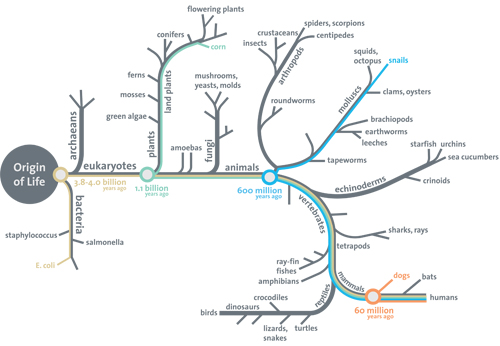
The Smithsonian’s tree of life model, note the root in OOL

UD PRO-DARWINISM ESSAY CHALLENGE: Compose your summary case for darwinism (or any preferred variant that has at least some significant support in the professional literature, such as punctuated equlibria etc) in a fashion that is accessible to the non-technical reader — based on empirical evidence that warrants the inference to body plan level macroevolution — in up to say 6,000 words [a chapter in a serious paper is often about that long]. Outgoing links are welcome so long as they do not become the main point. That is, there must be a coherent essay, with

(i)an intro,
(ii) a thesis,
(iii) a structure of exposition,
(iv) presentation of empirical warrant that meets the inference to best current empirically grounded explanation [–> IBCE] test for scientific reconstructions of the remote past,
(v) a discussion and from that
(vi) a warranted conclusion.

Your primary objective should be to show in this way, per IBCE, why there is no need to infer to design from the root of the Darwinian tree of life — cf. Smithsonian discussion here —  on up (BTW, it will help to find a way to resolve the various divergent trees), on grounds that the Darwinist explanation, as extended to include OOL, is adequate to explain origin and diversification of the tree of life. A second objective of like level is to show how your thesis is further supported by such evidence as suffices to warrant the onward claim that is is credibly the true or approximately true explanation of origin and body-plan level diversification of life; on blind watchmaker style chance variation plus differential reproductive success, starting with some plausible pre-life circumstance.

It would be helpful if in that essay you would outline why alternatives such as design, are inferior on the evidence we face. [As an initial spark for thinking, contrast my own survey of origins science here on (note the onward resources page), the definition of design theory in the UD resources tab top of this and every UD page, the Weak Argument Correctives in the same tab, the general resources that pop up on clicking the tab itself, and the discussion of design theory in the NWE article here. You may also want to refer to the site of the IDEA Center, and the Discovery Institute CSC site as well as Mike Gene’s Telic Thoughts. Notice IDEA’s essay on the case for design here.] . . . .

I would put this up as an original post, with preliminary contextual remarks and an invitation to respond in the comments section.

I will not submit the post with a rebutting markup or make an immediate rebuttal. In fact, let me make the offer to hold off my own comments for at least five initial comments. I will give you two full days of comments before I post any full post level response; though others at UD will be free to respond in their own right.

And BTW, I am making this offer without consulting with the blog owner or others, I am sure they would welcome a serious response . . .  [NB: I have given how to contact me in the original Sept 23 post, I will not repeat that in a headlined original post.]

That challenge is on the table. In truth, it has always been implicitly on the table. For, as I went on to note on Sept 23:

Now, at any time, in essentially any thread at UD any serious and civil design theory objector could have submitted such an essay, breaking it up into a multi part comment if desired . . .

And, it is quite clear that if there were a cogent, empirically well-grounded blind watchmaker thesis account of the origins of the world of life, there would be no design theory movement in biology.

(There would still be a serious design argument in cosmology, but that is a different matter. That does, however, show that strictly speaking design theory has no need to make its case in the world of life; it is because of the blatant weight of the evidence that there is a design movement on phenomena in the world of life.)

So, there you have it, there is a challenge officially on the table.

Let us see if any of the many objectors to design theory at TSZ or elsewhere — I would even accept a parallel post and discussion here and at TSZ (though, no, I will not be commenting there if that is done) — will be willing to step up to the plate. END

Comments
Joe: I don’t see a nested hierarchy in what you provided. Zachriel:
Try looking for shared traits. You should be able to find natural sets. Start there.
No thanks. If you cannot do as requested it proves that you are a waste of time. So here it is AGAIN: Again, what citeria, ie what traits? What is the nested hierarchy? Define the levels and sets, please.Joe
October 13, 2012
October
10
Oct
13
13
2012
06:58 AM
6
06
58
AM
PDT
KF (329):
Observe what Dr Sternberg (double biology PhD, one in evolutionary Biology) notes on the pop plus mut plus time to fix issues to form the whale body plan. Berlinski (a mathematician) also has some similar remarks to make.
I know of Dr Sternberg but have not read much of his work or followed him very closely. If you have a link I'll take a look. Dr Berlinski I do not find credible. He does no research of his own, mathematical or otherwise, and his main approach seems to be casting doubt and aspersion without having any kind of alternative. I think he enjoys the notoriety he has amongst the ID community (and has stated he's happy cashing the Discovery Institute's checks) but he contributes nothing to the science on either side. He talks a lot but he never sticks his neck out, he never takes a stand. He will also be able to say: I never said I endorsed ID!! I also have to say I tried reading his book on Calculus and I found it pretty bad. Hard to read and meandering with no real point. I question his motives, his insights and his abilities to do scientific work.Jerad
October 13, 2012
October
10
Oct
13
13
2012
06:51 AM
6
06
51
AM
PDT
Oh, yes: Day nineteen and no offers of a 6,000 word, empirically well grounded blind watchmaker, molecules to man evo essay. KFkairosfocus
October 13, 2012
October
10
Oct
13
13
2012
04:20 AM
4
04
20
AM
PDT
Jerad: Observe what Dr Sternberg (double biology PhD, one in evolutionary Biology) notes on the pop plus mut plus time to fix issues to form the whale body plan. Berlinski (a mathematician) also has some similar remarks to make. KFkairosfocus
October 13, 2012
October
10
Oct
13
13
2012
04:03 AM
4
04
03
AM
PDT
Mung (320):
How does one examine the claim that natural selection was the cause of the extinction of the dinosaurs? Seriously.
The environmental changes which meant small furry mammals were 'more fit' than the dinosaurs were brought about (perhaps) by an meteorite impact. But the impact was not directly the cause of most of the die off except for the dinosaurs it actually landed on. The climate changed. The environmental pressures changed. Again: have you got an alternative which corresponds to the available data, is in agreement with other sciences, has great explanatory power (as in answering the how and when questions) and makes few causational assumptions?Jerad
October 12, 2012
October
10
Oct
12
12
2012
10:32 PM
10
10
32
PM
PDT
KF (312):
Take time to look carefully at the whale examples to see what is not so often brought up when body plan origin is asserted to be simple extrapolation of pop variations.
Is there something specific you'd like me to address?Jerad
October 12, 2012
October
10
Oct
12
12
2012
10:25 PM
10
10
25
PM
PDT
Joe (311):
Also catastrophes are a random effect, not part of natural selection.
KF (312):
Neat slip-slide by the key point, the presence of random processes in the dynamics. And there is the onward implication, potential for gamblers ruin, lack of pop scale and time to effect changes.
Me (308):
The natural events are random but the effects on the flora and fauna are not since they depend on the environment.
Me (309):
The natural event is not natural selection. The effect it has on the breeding population is natural selection.
I agree there are random events that then change the dynamics, the environmental pressures, which affects survival chances.Jerad
October 12, 2012
October
10
Oct
12
12
2012
10:24 PM
10
10
24
PM
PDT
Continued... Source string bits = 501, Total compressed bits = 162 Approximately 3:1 compressionCentralScrutinizer
October 12, 2012
October
10
Oct
12
12
2012
08:58 PM
8
08
58
PM
PDT
Continued... Any ANSI C++ compiler should compile it.CentralScrutinizer
October 12, 2012
October
10
Oct
12
12
2012
08:52 PM
8
08
52
PM
PDT
Mung @332, I threw together a simple Huffman codec: http://net46038.wordpress.com/ It turns substrings into shorter bit sequences. The dictionary is optimized in the order of likelihood of a given substring. http://en.wikipedia.org/wiki/Huffman_codingCentralScrutinizer
October 12, 2012
October
10
Oct
12
12
2012
08:51 PM
8
08
51
PM
PDT
Finally, an actual string to analyze. So, can someone please post a program to algorithmically compress and decompress this string? And can some give me a description of it that doesn't just consist of the string itself? H H H T H H H T H H H H T H H H H T H H H H T H H H H T H H H H T H H H H T H H H H T H H H H T H H H H T H H H H T H H H H T H H H H T H H H H T H H H H T H H H H T H H H H T H H H H T H H H H T H H H H T H H H H T H H H H T H H H H T H H H H T H H H H T H H H H T H H H H T H H H H T H H H H T H H H H T H H H H T H H H H T H H H H T H H H H T H H H H T H H H H T H H H H T H H H H T H H H H T H H H H T H H H H T H H H T H H H T H H H T H H H T H H H H T H H H H T H H H H T H H H H T H H H H T H H H H T H H H H T H H H H T H H H H T H H H H T H H H H T H H H H T H H H H T H H H H T H H H H T H H H H T H H H H T H H H H T H H H H T H H H H T H H H T H H H H T H H H H T H H H T H H H H T H H H H T H H H H T H H H H T H H H H T H H H H T H H H H T H H H H T H H H H T H H H H T H H H H T H H H H T H H H H T H H H H T H H H H T H H H H T H H H H T H H H H T H H H H T H H H H T H H H H T H H H H T H H H H T H H H H T H H H H T H H H H T H H H H T H H H H T H H H T H H H H T H H H T H H H H TMung
October 12, 2012
October
10
Oct
12
12
2012
06:22 PM
6
06
22
PM
PDT
For posterity: keiths on October 12, 2012 at 5:20 pm said:
Contrast that with the hypothesis of unguided evolution. We observe unguided evolution operating in the present. We predict what the data should look like if it were also operating in the past. The prediction is confirmed, to an astonishing degree. We have a good theory, and no unjustified assumptions were required.
Mung
October 12, 2012
October
10
Oct
12
12
2012
06:14 PM
6
06
14
PM
PDT
I’m happy to have an intelligent conversation about these issue but I expect to be treated with some respect and dignity. We can all benefit from a serious examination of the issues.
How does one examine the claim that natural selection was the cause of the extinction of the dinosaurs? Seriously.Mung
October 12, 2012
October
10
Oct
12
12
2012
06:10 PM
6
06
10
PM
PDT
keiths:
I’m reposting the following comment because I’m very interested in hearing how ID supporters will answer the questions I ask. Kairosfocus? PaV? Gpuccio? Eric Anderson? Upright Biped? StephenB? Jon Garvey? Timaeus? VJ Torley?
I'm hurt. But here's my answer. Your comments have nothing to do with your thesis: Intelligent Design is not compatible with the evidence for common descent As such, they can safely be ignored as irrelevant. A red herring. You can't make your case, so you try to change the subject. You still haven't told us how to test your claim that evolution is unguided. So how can "unguided evolution" be a better explanation than, say, magical pixies? Will Part II be any better than Part I? Please spend less time posting and more time working on Part II.Mung
October 12, 2012
October
10
Oct
12
12
2012
06:08 PM
6
06
08
PM
PDT
keiths:
I’m reposting the following comment because I’m very interested in hearing how ID supporters will answer the questions I ask. Joe has responded, but his answers were predictably unenlightening.
Earth to keiths- no one cares because your scenarios and questions are unenlightening. And pretty pathetic even for you. Ya see keiths in scenario 1 Bob and friends did design that streambed and fooled the geologist. And we have video to prove it. Scenrio 2 was another set-up, Hollywood-style. It's easy to get spray stuff that will set off an explosives detector- but anyway it's all on film too. So by the time we get to scenrio 3 we already know how stupid your whole clap-trap is. You think that your absurd extremes really mean something? Really?Joe
October 12, 2012
October
10
Oct
12
12
2012
05:04 PM
5
05
04
PM
PDT
keiths:
To reconstruct an objective nested hierarchy, you need both traits that are stable and traits that are changing.
Hey, that is what I said- the traits have to be immutable (stable) and additive (changing). I guess I know more about these things than what has been said about me. Strange how it always goes that way.
Without selection, you don’t get the necessary stability.
Yes, a wobbling stability- Chapter IV of prominent geneticist Giuseppe Sermonti's book Why is a Fly Not a Horse? is titled "Wobbling Stability". In that chapter he discusses what I have been talking about in other threads- that populations oscillate. The following is what he has to say which is based on thorough scientific investigation:
Sexuality has brought joy to the world, to the world of the wild beasts, and to the world of flowers, but it has brought an end to evolution. In the lineages of living beings, whenever absent-minded Venus has taken the upper hand, forms have forgotten to make progress. It is only the husbandman that has improved strains, and he has done so by bullying, enslaving, and segregating. All these methods, of course, have made for sad, alienated animals, but they have not resulted in new species. Left to themselves, domesticated breeds would either die out or revert to the wild state—scarcely a commendable model for nature’s progress.
(snip a few paragraphs on peppered moths)
Natural Selection, which indeed occurs in nature (as Bishop Wilberforce, too, was perfectly aware), mainly has the effect of maintaining equilibrium and stability. It eliminates all those that dare depart from the type—the eccentrics and the adventurers and the marginal sort. It is ever adjusting populations, but it does so in each case by bringing them back to the norm. We read in the textbooks that, when environmental conditions change, the selection process may produce a shift in a population’s mean values, by a process known as adaptation. If the climate turns very cold, the cold-adapted beings are favored relative to others.; if it becomes windy, the wind blows away those that are most exposed; if an illness breaks out, those in questionable health will be lost. But all these artful guiles serve their purpose only until the clouds blow away. The species, in fact, is an organic entity, a typical form, which may deviate only to return to the furrow of its destiny; it may wander from the band only to find its proper place by returning to the gang.
Everything that disassembles, upsets proportions or becomes distorted in any way is sooner or later brought back to the type. There has been a tendency to confuse fleeting adjustments with grand destinies, minor shrewdness with signs of the times.
It is true that species may lose something on the way—the mole its eyes, say, and the succulent plant its leaves, never to recover them again. But here we are dealing with unhappy, mutilated species, at the margins of their area of distribution—the extreme and the specialized. These are species with no future; they are not pioneers, but prisoners in nature’s penitentiary.
You don't get a nested hierarchy from that.Joe
October 12, 2012
October
10
Oct
12
12
2012
04:45 PM
4
04
45
PM
PDT
No you did not provide any criteria.
We provided you several sequences and asked how you would group them into a nested hierarchy based on their characteristics.
Well we told YOU to do it: Again, what citeria, ie what traits? What is the nested hierarchy? Define the levels and sets, please. I don't see a nested hierarchy in what you provided. But then again I am not as demented as you are.Joe
October 12, 2012
October
10
Oct
12
12
2012
03:29 PM
3
03
29
PM
PDT
Eric, Heck with tautology issue. Natural selection doesn't do anything, let alone mimic a designer. And taht means they have bigger issues than being a tautology.Joe
October 12, 2012
October
10
Oct
12
12
2012
03:24 PM
3
03
24
PM
PDT
Hmmm . . . looks like this thread is heading toward the good old 'natural selection is a tautology' discussion. And, yes, if anyone is wondering, that is a real issue for natural selection as it is so often presented (despite the fact that most everyone is too polite to bring it up in mixed company) . . .Eric Anderson
October 12, 2012
October
10
Oct
12
12
2012
02:55 PM
2
02
55
PM
PDT
gpuccio, Unfortunately nothing you say, no matter how you say it, will ever make any sense to them. But we appreciate the effort. Thank youJoe
October 12, 2012
October
10
Oct
12
12
2012
02:20 PM
2
02
20
PM
PDT
Jerad: Neat slip-slide by the key point, the presence of random processes in the dynamics. And there is the onward implication, potential for gamblers ruin, lack of pop scale and time to effect changes. Take time to look carefully at the whale examples to see what is not so often brought up when body plan origin is asserted to be simple extrapolation of pop variations. KFkairosfocus
October 12, 2012
October
10
Oct
12
12
2012
02:19 PM
2
02
19
PM
PDT
Jerad, Lions set up and execute ambushes. That is by design. Also catastrophes are a random effect, not part of natural selection.Joe
October 12, 2012
October
10
Oct
12
12
2012
02:17 PM
2
02
17
PM
PDT
To Keiths (at TSZ): I will not spend another word to show that dFSCI is not circular. I have said enough. Please, refer to my answers to Zachriel. If you are not convinved, good luck.gpuccio
October 12, 2012
October
10
Oct
12
12
2012
02:16 PM
2
02
16
PM
PDT
Joe (307);
Do you have any evidence it was natural selection, or not? Or perhaps it was just [snip] ill- luck. When a flood wipes out a population, that isn’t natural selection, that is just the luck of the draw.
The natural event is not natural selection. The effect it has on the breeding population is natural selection. Proof/evidence? Well, without evidence that there was some kind of intervention, some extra influence, then it comes down to natural forces. Why would you ASSUME otherwise?
How about when a lion makes a kill? Natural or artificial selection, and why?
Traditionally natural selection since lions are not assumed to have high enough reasoning skills to formulate design.
BTW when humans kill a deer we usually go for the big buck or big doe- we take from the top. And that isn’t selective breeding- well because we aren’t selectively breeding anything.
You are affecting the next generation by limiting the breeding time of some deer. If bigger individuals are more likely to be killed then they might leave fewer offspring. It depends on if you shoot them after their breeding years are over or not. You might not think you're selective breeding but just because you don't have a goal in mind doesn't mean you aren't affecting the herd.Jerad
October 12, 2012
October
10
Oct
12
12
2012
02:09 PM
2
02
09
PM
PDT
KF (303):
This is an illustration of the reason why Wiki is so reliably unreliable and ideologically driven on this general subject. The role of random processes and variables in the selection process should be highly evident, and in fact that such would be so is common sense.
Really? I thought the extended quote was a fairly good statement of the general idea. I think the role of random processes is highly evident. Otherwise I would have expected more advanced life forms to have arisen much earlier. I know you look at existent life forms from a very mechanistic point of view, with islands of function, etc. But that's not the general view of biologists. And science is not subject to common sense.
Now for the real challenge: natural selection or more properly differential reproductive success of populations, is quite literally a subtract-er of information, an eliminator of variations. THE NATURALISTIC SOURCE OF NOVEL BIOINFO IS CHANCE VARIATION. Which, is severely challenged to bridge the sort of gaps that are required to innovate new body plans, starting esp4ecially from that hypothesised last universal common ancestral unicellular organism. Which is highly relevant to the challenge posed by the Cambrian fossils ever since Darwin.
You can make that assertion but that's all it is. I agree that most mutations are deleterious. But that doesn't mean that all are. You focus on the majority and give short shrift to the unusual. You insist there is a body plan gap but you cannot prove it. It's just an assertion. And there's evidence to suggest that it wasn't a gap at all.
Going further, in the case of the dinosaurs and the usual story of a meteorite impact, this would clearly be a case of two uncorrelated deterministc chains, leading to intersection of trajectories, i.e. it would be a chance event, and a catastrophic one. There is no incremental variation and selection there.
Variation comes from mutations. It was a chance event. It shifted the goal posts. There was new criteria for 'the fittest'. The natural event was random but it determined the effect and influence on the life forms. And, therefore, 'natural selection' was not random and was determined by the environmental conditions.
In short random variables and circumstances show up all over the process as imagined, which should be acknowledged.
The natural events are random but the effects on the flora and fauna are not since they depend on the environment.
For, if a given selection advantage is small and the absolute numbers of the sub-population with the innovation are also relatively low, most of the time, such an innovation will simply be lost due to the overwhelming effects of mere chance on odds of survival and reproduction. In other words, one has to have enough population resources to “spend” for long enough to get to the long-run point where modest differential effects will pay off to one’s advantage.
Obviously. This is a big question: what does it take for a new trait to get 'fixed' in a population. But it is an issue that has been acknowledged and researched. Even books like The Greatest Show on Earth address such issues.
There are more than enough challenges there to debate all day long.
Seriously and honestly, I think you should spend more time reading evolutionary research. Many of your points are examined and discussed.Jerad
October 12, 2012
October
10
Oct
12
12
2012
01:57 PM
1
01
57
PM
PDT
Jerad:
Well, have you got an alternative explanation which is in agreement with the available data, is coherent with the other sciences, which has great explanatory power (i.e. addresses some how and when questions) AND makes few causal assumptions?
Do you have any evidence it was natural selection, or not? Or perhaps it was just [snip] ill + luck. When a flood wipes out a population, that isn't natural selection, that is just the luck of the draw. How about when a lion makes a kill? Natural or artificial selection, and why? BTW when humans kill a deer we usually go for the big buck or big doe- we take from the top. And that isn't selective breeding- well because we aren't selectively breeding anything.Joe
October 12, 2012
October
10
Oct
12
12
2012
01:40 PM
1
01
40
PM
PDT
Joe (302):
There isn’t any “now I’m getting it” as I have understood that for decades. And what is your evidence that natural selection got rid of the dinosaurs? I have heard different stories but never one that included natural selection.
Well, have you got an alternative explanation which is in agreement with the available data, is coherent with the other sciences, which has great explanatory power (i.e. addresses some how and when questions) AND makes few causal assumptions? You like dancing around the definitions and issues. And I've agreed that 'natural selection' is a somewhat problematical expression, especially when scrutinised with the goal of disproving it. But you have yet to present me with a cogent, concise and coherent alternative which matches the criteria I've elucidated above.Jerad
October 12, 2012
October
10
Oct
12
12
2012
01:28 PM
1
01
28
PM
PDT
Mung (301),
really. and you know that it was natural selection that done it?
Well, if you've got an alternative which corresponds to the available data, is in agreement with other sciences, has great explanatory power (as in answering the how and when questions) and makes few causational assumptions then I'm happy to consider it.
So if I go out and kill a deer, that is natural selection, because the dear didn’t survive?
If I suggested the same scenario to you I would guess you'd say that was an example of intelligent intervention. I'm happy to have an intelligent conversation about these issue but I expect to be treated with some respect and dignity. We can all benefit from a serious examination of the issues. But, just to avoid accusations of not answering the question: you killing a deer is not an example of natural selection. That's artificial selection. As in selective breeding. Clearly.Jerad
October 12, 2012
October
10
Oct
12
12
2012
01:20 PM
1
01
20
PM
PDT
PS: Cf here and here on the case of the whale as it links to the above. (Do watch the vids.)kairosfocus
October 12, 2012
October
10
Oct
12
12
2012
12:57 PM
12
12
57
PM
PDT
Jerad: I see your Wiki clip. Now, nothing has changed on the basic understanding of natural selection in the past few years, so let me clip the same article from a couple of years back, as I use in my always linked online note:
Natural selection is the process by which favorable heritable traits become more common in successive generations of a population of reproducing organisms, and unfavorable heritable traits become less common. Natural selection acts on the phenotype, or the observable characteristics of an organism, such that individuals with favorable phenotypes are more likely to survive and reproduce than those with less favorable phenotypes. The phenotype's genetic basis . . . will increase in frequency over the following generations. Over time, this process can result in adaptations that specialize organisms for particular ecological niches and may eventually result in the emergence of new species. In other words, natural selection is the mechanism by which evolution may take place in a population of a specific organism.
This is an illustration of the reason why Wiki is so reliably unreliable and ideologically driven on this general subject. The role of random processes and variables in the selection process should be highly evident, and in fact that such would be so is common sense. Now for the real challenge: natural selection or more properly differential reproductive success of populations, is quite literally a subtract-er of information, an eliminator of variations. THE NATURALISTIC SOURCE OF NOVEL BIOINFO IS CHANCE VARIATION. Which, is severely challenged to bridge the sort of gaps that are required to innovate new body plans, starting esp4ecially from that hypothesised last universal common ancestral unicellular organism. Which is highly relevant to the challenge posed by the Cambrian fossils ever since Darwin. Going further, in the case of the dinosaurs and the usual story of a meteorite impact, this would clearly be a case of two uncorrelated deterministc chains, leading to intersection of trajectories, i.e. it would be a chance event, and a catastrophic one. There is no incremental variation and selection there. In short random variables and circumstances show up all over the process as imagined, which should be acknowledged. Next, we have the fitness problem. Tautology lurks. There are formulations that do avoid tautology, but consistently there is a falling back into circles as to the fittest and the survivors who dominate following populations. Or, whatever terminology is favoured nowadays. Not to mention the issue of genetic drift, entropic decay of genomic info, and the gamblers ruin challenge. For, if a given selection advantage is small and the absolute numbers of the sub-population with the innovation are also relatively low, most of the time, such an innovation will simply be lost due to the overwhelming effects of mere chance on odds of survival and reproduction. In other words, one has to have enough population resources to "spend" for long enough to get to the long-run point where modest differential effects will pay off to one's advantage. And, if we take isolation to a niche without competition as a typical example by which such innovations will have a good chance to grow into a viable sub-population that can then migrate back and compete with then dominate over the original population, we still have not accounted for the rise of information-rich organically coherent innovations, especially at that core body-plan level which expresses itself in the vulnerable early phases of the embryological development process. There are more than enough challenges there to debate all day long. KFkairosfocus
October 12, 2012
October
10
Oct
12
12
2012
12:31 PM
12
12
31
PM
PDT
1 7 8 9 10 11 20

Leave a Reply