Uncommon Descent Serving The Intelligent Design Community

BTB, Q: Where does the FSCO/I concept come from? (Is it reasonable/ credible?)

Categories
ID Foundations
Intelligent Design
rhetoric
specified complexity
Share
Facebook
Twitter/X
LinkedIn
Flipboard
Print
Email

A: One of the old sayings of WW II era bomber pilots was that flak gets heaviest over a sensitive target. So, when something as intuitively obvious and easily demonstrated as configuration-based, functionally specific complex organisation and/or associated (explicit or implicit) information — FSCO/I — becomes a focus for objections, that is an implicit sign of its central importance and potential impact on the prevailing a priori materialism school of thought. So, it is appropriate to pause, headline and note for record its source in the works of Orgel, Wicken and Thaxton et al (where Dembski’s link to CSI is also important, cf here from a few days ago; as is the metric approach by Trevors, Abel, Durston Chiu et al, cf. this 2007 paper).

So, let’s start with noted OoL researcher, J. S. Wicken, in 1979, who brought the ingredients together in an article in the peer reviewed literature — and yes, this is before there was an ID movement (indeed this helped spark its emergence):

>>‘Organized’ systems are to be carefully distinguished from ‘ordered’ systems.  Neither kind of system is ‘random,’ but whereas ordered systems are generated according to simple algorithms [i.e. “simple” force laws acting on objects starting from arbitrary and common- place initial conditions] and therefore lack complexity, organized systems must be assembled element by element according to an [originally . . . ] external ‘wiring diagram’ [–> specification] with a high information content [–> chain of y/n q’s in some structured description language to specify nodes- and- arcs mesh towards function based on the configured elements interacting to give a systems level synergistic effect] . . . Organization, then, is functional complexity and carries information. It is non-random by design or by selection, rather than by the a priori necessity of crystallographic ‘order.’ [“The Generation of Complexity in Evolution: A Thermodynamic and Information-Theoretical Discussion,” Journal of Theoretical Biology, 77 (April 1979): p. 353, of pp. 349-65. (Emphases and notes added. Nb: “originally” is added to highlight that for self-replicating systems, the blue print can be built-in.)]>>

This is already enough to be decisive.

We have here all the elements of FSCO/I, only requiring setting up an acronym. And, in the peer-reviewed literature. With the wiring diagram reference already pointing to the world of technology to indicate just how pervasive and familiar this phenomenon is. Further to this, obviously, a

s-t-r-i-n-g-_-o-f-_-g-l-y-p-h-s-_-e-x-p-r-e-s-s-i-n-g-_-a-_-c-o-d-e-d-_-m-e-s-s-a-g-e

. . . is an instantiation of the wiring diagram based, element by element assembled nodes-arcs mesh.

This instantly means texts of original posts, comments (including those composed to object to the FSCO/I concept) and D/RNA alike, are manifestations of the same phenomenon, FSCO/I. Here, let us behold the ribosome in action as compared to FSCO/I in a PC-based punched tape reader:
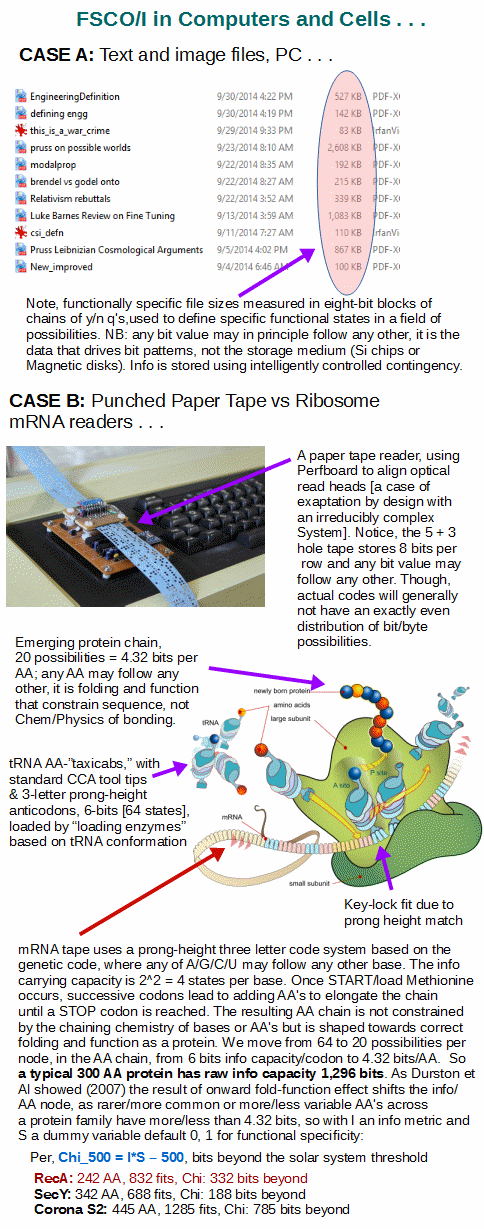
fscoi_factsAnd again:

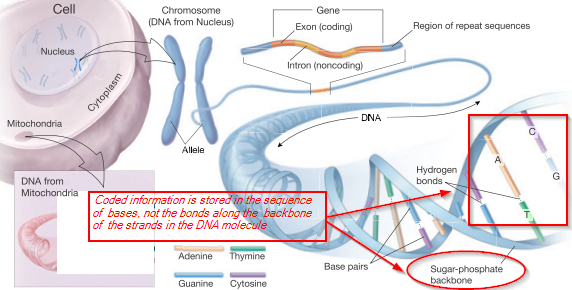
Fig I.0: DNA as a stored code exhibiting functionally specific complex digital information (HT: NIH)

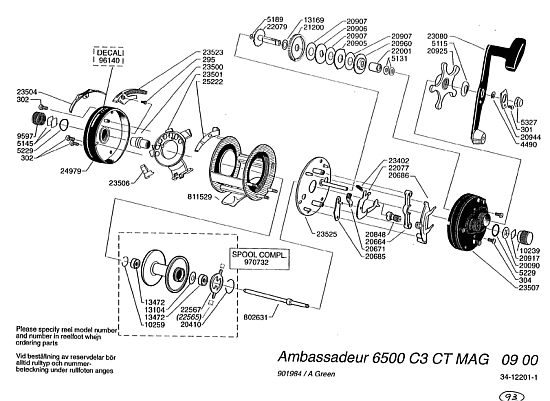
Where also, just for fun, let’s look yet again at the good old 6500 C3 CT Mag fishing reel, showing the wiring diagram, nodes-arcs pattern that is patently informational:
abu_6500c3mag

Back in 1973, Orgel went on record, too:

>>. . . In brief, living organisms are distinguished by their specified complexity. Crystals are usually taken as the prototypes of simple well-specified structures, because they consist of a very large number of identical molecules packed together in a uniform way. Lumps of granite or random mixtures of polymers are examples of structures that are complex but not specified. The crystals fail to qualify as living because they lack complexity; the mixtures of polymers fail to qualify because they lack specificity . . . .

[HT, Mung, fr. p. 190 & 196:] These vague idea can be made more precise by introducing the idea of information. Roughly speaking, the information content of a structure is the minimum number of instructions needed to specify the structure. [–> this is of course equivalent to the string of yes/no questions required to specify the relevant “wiring diagram” for the set of functional states, T, in the much larger space of possible clumped or scattered configurations, W, as Dembski would go on to define in NFL in 2002, also cf here, here and here (with here on self-moved agents as designing causes).]  One can see intuitively that many instructions are needed to specify a complex structure. [–> so if the q’s to be answered are Y/N, the chain length is an information measure that indicates complexity in bits . . . ] On the other hand a simple repeating structure can be specified in rather few instructions.  [–> do once and repeat over and over in a loop . . . ] Complex but random structures, by definition, need hardly be specified at all . . . . Paley was right to emphasize the need for special explanations of the existence of objects with high information content, for they cannot be formed in nonevolutionary, inorganic processes [–> of course, that novel FSCO/I beyond 500 – 1,000 bits can be formed by even evolutionary processes is the precise issue at stake . . . the search space based and empirical observation answer is, no, incremental evolutionary change is within an island of function, not something that is observed to give rise to a novel body plan. And this holds with redoubled force for the OoL; hence the design theory movement].

[The Origins of Life (John Wiley, 1973), p. 189, p. 190, p. 196. Of course, that immediately highlights OOL, where the required self-replicating entity is part of what has to be explained (cf. Paley here), a notorious conundrum for advocates of evolutionary materialism; one, that has led to mutual ruin documented by Shapiro and Orgel between metabolism first and genes first schools of thought, cf here. Behe would go on to point out that irreducibly complex structures are not credibly formed by incremental evolutionary processes and Menuge et al would bring up serious issues for the suggested exaptation alternative, cf. his challenges C1 – 5 in the just linked. Finally, Dembski highlights that CSI comes in deeply isolated islands T in much larger configuration spaces W, for biological systems functional islands. That puts up serious questions for origin of dozens of body plans reasonably requiring some 10 – 100+ mn bases of fresh genetic information to account for cell types, tissues, organs and multiple coherently integrated systems. Wicken’s remarks a few years later as already were cited now take on fuller force in light of the further points from Orgel at pp. 190 and 196 . . . ]>>

No surprise then, that Thaxton, Bradley and Olsen, in the first technical ID book, The Mystery of Life’s Origin [TMLO], would summarise the state of play c. 1981 – 84:

>>Yockey7 and Wickens5 [sic] develop the same distinction, that “order” is a statistical concept referring to regularity such as might characterize a series of digits in a number, or the ions of an inorganic crystal. On the other hand, “organization” refers to physical systems and the specific set of spatio-temporal and functional relationships among their parts. Yockey and Wickens note that informational macromolecules have a low degree of order but a high degree of specified complexity. In short, the redundant order of crystals cannot give rise to specified complexity of the kind or magnitude found in biological organization; attempts to relate the two have little future. [–> save as dismissive rhetoric, of course] [TMLO, Thaxton et al [TBO], (Dallas, TX: Lewis & Stanley, 1984), p.130. ]>>

(This passage is in fact the specific source of my abbreviation- for- convenience; in response to Patrick May et al, Dr Torley, a medical doctor active at Loma Linda whose name escapes me at the moment [U/D, 111:12 loc: Paul Giem] and I constructed a simplified metric approach that in the end is linked to the Dembski metric via a log reduction that converts to the information form, as appears in an infographic above. The Durston et al approach can be fed into that simple metric, as is shown.)

So, we can see for the record just where the abbreviation FSCO/I comes from, and that as such it does not need any grand elaboration in the literature, as the relevant underlying analysis is there in increasing abundance.

Instead of a secondary and in the end distractive debate over credibility or otherwise of terminology . . . here, an acrostic summary of a descriptive phrase, let us re-focus on the substantial issues. END

Comments
DK, the nature of search challenge of the order implied by FSCO/I is such that it does not depend on any sophisticated analysis of probabilities. The sheer scope of config space and the utter want of resources on a solar system or cosmological scale locks out ANY blind chance and/or mechanical necessity solution as credibly feasible. Moreover, the fundamental point raised by Newton still stands, vera causa: until and unless a claimed causal means has been empirically demonstrated to be capable of producing an effect it should not be considered as a credible scientific explanation for said effect. This starts with the chemistry and physics of Darwin's warm pond or the like OoL environment, and it goes on to the necessity of originating major body plans for multi-cellular organisms through increments of 10 - 100+ mn bases just for genomes. Neither OoL nor body plan origin level macro evolution by mechanisms rooted in blind chance and/or mechanical necessity has been able to pass the vera causa test. As Lewontin inadvertently showed, they are ideologically, not scientifically sustained. KFkairosfocus
November 7, 2016
November
11
Nov
7
07
2016
05:55 PM
5
05
55
PM
PST
Marfin, My friend is visiting CA from Ireland and will return to Waterford December 2.bb
November 7, 2016
November
11
Nov
7
07
2016
05:04 PM
5
05
04
PM
PST
Murray:
There are all sorts of possible explanations, but until someone demonstrates an explanation’s probability by describing the principles and math that makes such a route a good, probabilistic explanation, you’ve done nothing more than make a case that such a sequence is not impossible.
Have you read, as an example, Evidence and Evolution by Elliott Sober for the statistical evaluation of evidence for evolution? (Statistics has empirically based principles and requires mathematics, as you may be aware.) Looking forward to your critique when you've read it.Daniel King
November 7, 2016
November
11
Nov
7
07
2016
04:49 PM
4
04
49
PM
PST
I'm going to be celebrating a win tomorrow night.AhmedKiaan
November 7, 2016
November
11
Nov
7
07
2016
12:42 PM
12
12
42
PM
PST
Marfin, a lot of people here in NZ celebrated that win with you. Congratulations!Pindi
November 7, 2016
November
11
Nov
7
07
2016
11:57 AM
11
11
57
AM
PST
REW: "It seems to me that the main thinkers in the ID movement (Behe, Dembski etc) have moved away from this argument at least a decade ago." That raises an interesting point - since Dembski has officially "retired" from ID, who is carrying the mantle for continuing research in CSI and related matters? Is it Stephen Meyer or somebody else in the DI? Seems like an important area of research so just curious as what is happening here in the space, or what might be planned to promote CSI going forward.Fordgreen
November 7, 2016
November
11
Nov
7
07
2016
10:33 AM
10
10
33
AM
PST
Marfin, thank you for the accurate weather report. :) Have a good week.Dionisio
November 7, 2016
November
11
Nov
7
07
2016
08:31 AM
8
08
31
AM
PST
Dionisio-Weather in Ireland is as per usual cold, sunny,rainy, calm , windy,take you pick.Marfin
November 7, 2016
November
11
Nov
7
07
2016
08:22 AM
8
08
22
AM
PST
Silver Asiatic @24: Definitely you're a thinking person. Sadly, that's quite rare these days. We're commanded to test everything and hold onto what's good. That requires thinking seriously, open-minded, outside of any kind of preconceived boxes. Sometimes we encounter in the biology research papers expressions like 'surprisingly' or 'unexpectedly' which give the impression that the authors expected something else or nothing at all. Is that a serious approach to biology research?Dionisio
November 7, 2016
November
11
Nov
7
07
2016
08:19 AM
8
08
19
AM
PST
rvb8
What I do know is that all of these systems are keenly researched. The scientists who do this universally disagree with your attempted road blocking. Ask the scientists (a few religious) their opinion on the matter and the answer would dissapoint you. Just ask the ones from ‘Project Steve’. Pointing to a system (immune system for example) and saying it points to a designer is not helpful. When Behe denied major work on the immune system at Dover he was surrounded by a mountain of published work, and texts, all explaining possible evolutionary pathways.
I will suggest that Dionisio has already reviewed a mountain of published work where no such pathways are even hypothesized. Check out his threads.Silver Asiatic
November 7, 2016
November
11
Nov
7
07
2016
07:37 AM
7
07
37
AM
PST
Seversky
… it was obvious that these were not simple, agreed, unitary concepts. Unless the definitions of these terms are clearly defined and agreed in advance any discussions are bound to be prone to ambiguity and equivocation.
There are several approaches to the definition of complexity and information. When ID opponents argue this way, it concedes the study of information science to ID, since this is where there efforts to refine and improve definitions are taken seriously. The addition of “functional” to complex specified information is simply one more advance in understanding of information (Trevors, Durston, Abel). In other words, as rbv8 seems to say “CSI doesn’t exist because there are conflicting definitions of it”. This is one tactic used to simply avoid the discussion. “Come up with a universally agreed-upon exact definition of complex specificity and then we will get interested in the topic.” That’s really an anti-science view. There is some difficulty in nailing down the exact definition so you’re not interested in learning about it? This is a case where ID is pushing science forward – building expertise in what functional information actually is. It’s a fight against the obfuscation and outright denial that complex functional specificity even exists – a denial built on the threat that exists to evolutionary theory (let’s mention the double-standard regarding definitions of what “evolution” really is).
There is also the common assumption here – and elsewhere – that information, whatever that might be, is a property of the physical universe rather than – as I believe – being a property of the mental model or simulation of that external reality in which we live our daily lives.
That may be fine but the challenge extends beyond a definition. You’d need to define clearly what you mean by functional complex information, in contrast to Shannon or Kolmogorov complexity. Then it needs to be demonstrated how unintelligent natural processes can create FCSI.
As an example, consider the red car I can see in the parking-lot. The color of that car is information I have about it. Yet physics tells us that what we see as red is just one wavelength or narrow band of wavelengths from the visible spectrum, no different, apart from the wavelength, from any other wavelength in the EM spectrum. In other words, the “redness” I experience is the way that wavelength of reflected EM energy is represented in my mental model. That information is a property of the model not the car itself.
There are problems here, of course. The red carries information because it exists through intent. It’s a signal that was created by design. In the same way, letters on the screen, reduced to physics, are pixels of light and darkness. “Information does not exist” in the English language letters I am producing. But we, the observers, recognize a design, intentionality in my writing. These letters are specified, not random or determined by natural laws. They are the product of intelligent choice. That’s how we differentiate between design and non-design. To claim that “design is all in the mind” is Kantian and a form of Solipsism. The paper you cited circles around that very point and is ultimately destructive of reason itself – but that’s the problem with anti-realist philosophy.
If you are interested, there is a paper called “A deflationary account of information in biology.” by philosopher of science John S Wilkins which discusses the problems with the concept of information as a property of living things. It can be downloaded as a .pdf file here.
Thanks for this reference. For one thing, people like rvb need to read it to observe that CSI is not “nowhere admitted” but is in fact a concept that has taken on a lot of study and analysis from academics who are “no friends of ID” (and that’s a problem?). So, in that regard I found it to be quite good in giving a clear summary of kinds of information and the issues at stake. I disagree with Wilkins, however, and I don’t think his arguments are consistent. For example:
a bird seeking prey but avoiding certain markings because they signal toxicity. Under a Dretskean account, there is a strong causal component to this kind of information. Clearly the signal causally correlates with the toxicity (due to natural selection), and so Dretskean information relies upon that for the account that he offers of the “knowledge” (scare quoted to prevent begging the question) the bird has of the toxicity.
This is circular since he needs to show that this kind of information is the product of selection and not merely assume that it is. In this case, the bird picks up and retains the signal from the toxic prey. How is this information communicated to future generations? How is it retained? How was it originally learned? There’s no evidence that selection created this information network (signal, translation, retention, application to future events, transmission to offspring) was created by natural selection. Or, more simply, we need to see how it could happen. Dawkins’ Weasel was an attempt to do this. But nobody can take that seriously.
Millikan is concerned with functions, and argues that the proper function of any thing, including organic components, is effectively what it was selected for in a chain of reproduction
This is the classic tautology. The proper function is what was selected for to make the organism fit for the environment. Fitness is whatever features the organism possesses since that is what was selected for. But again, this defines away the challenge in the origin of information and how function supposedly can evolve from non-function.
So we will continue to say only learning systems can instantiate Dretskean semantic causal information.
This was a bold statement, and admirable for that fact. He’s putting it out there for us … only learning systems can instantiate. So, he needs to show that biological information is not a learning system – and he fails there, as I see it.
We know there are objects that do have information; we are such objects. The question is whether, as the informationalists claim, information arises in biology, and we have one instance of this in our heads, or whether it arises in our heads and heads very like them, and we apply it retrograde to things that we interpret in intentional ways.
Here he bumps into a major problem. It’s a lot easier just to say, “information does not exist”, “there is no CSI”, or “FCSI cannot be found anywhere since nobody can define it”. Wilkins again takes a risk: “there are objects that do have information”. Ok! We know something for certain at least. What objects? “we are such objects”. Ahh- we are biological objects that contain information. Plus! “heads very like” ours also have it! It’s a big problem now. We have an analogy of “heads like ours”. But in the evolutionary continuum, all heads emerged from non-living matter. So, it doesn’t matter where biological information exists, even if only “in our heads”, these biological objects that contain information had to arise through physics. Wilkins struggles with that.
Of course, any token of an abstraction exists somewhere – in a head or group of heads – but the abstract entity “information” exists nowhere in time and space.
It’s a very good argument against atheistic materialism and scientism. Information exists in objects, as Wilkins admits. But, it exists only as immaterial abstractions – it has causal power (Wilkins admits) but is not reducible to materialism. It’s exactly the same with Design itself.
But I want to propose that we can eliminate information talk except when we are talking about representations, that is, when we are analyzing data or models of the biological systems
Well, it’s a good try! If we can eliminate talk about information, then we won’t have a problem in dealing with it’s supposed origin from unintelligent, deterministic forces. But that’s just the same as the information denialism that we see when people object to FCSI, claiming “it doesn’t exist”, or “nobody can define it”. The task of science is to explain what is observed. We observe information, as Wilkins’ paper does make very clear. To then conclude that we should just ignore it at the same time is certainly a philosophical position that one can take, but it leaves the question wide open for those who would not ignore it but rather attempt to provide clear answers. That’s what ID is, and has been doing.Silver Asiatic
November 7, 2016
November
11
Nov
7
07
2016
07:10 AM
7
07
10
AM
PST
Marfin @16: Go Ireland! How's the weather there now?Dionisio
November 7, 2016
November
11
Nov
7
07
2016
06:41 AM
6
06
41
AM
PST
REW, I think I see your point: first things first. However, what I meant was that if someone would like to say "hey, let's assume just for a moment that we borrow the 'ready-to-use' MT-CO1 from somewhere" then the biology conundrum enchilada isn't resolved anyway. It's a long and winding road of research and discoveries that seems unending. Could it be that the current bottom-up reverse engineering of a complex system that seems designed top-down may take forever?Dionisio
November 7, 2016
November
11
Nov
7
07
2016
06:33 AM
6
06
33
AM
PST
Dionisio@ #13
However, isn’t that just the tip of the iceberg?
Yes but that's irrelevant. If cytochrome c couldnt have evolved then ID has been irrefutably proven. Theres no need to bring up any other topic, its just fluff. If on the other hand natural processes can produce complex integrated systems then IDers can bring up as many examples as they like and nothing has been proven. IF gene A could have evolved then whats the point of bringing up gene B? It seems to me that the main thinkers in the ID movement (Behe, Dembski etc) have moved away from this argument at least a decade ago. Both would agree that complex integrated systems can evolve in principle. They argue against the probability of the evolution of particular systems.REW
November 7, 2016
November
11
Nov
7
07
2016
06:18 AM
6
06
18
AM
PST
rvb8 said:
Pointing to a system (immune system for example) and saying it points to a designer is not helpful. When Behe denied major work on the immune system at Dover he was surrounded by a mountain of published work, and texts, all explaining possible evolutionary pathways.
rvb8, like so many of his ilk, cling to ignorance about what the "designer" perspective brings to the table, and then clings to ignorance about the difference between a "probability" and a bare "possibility". No ID advocate claims that evolution without design is not possible, rvb8. In fact, every argument presented about such a system includes a discussion about the improbability of the possibility that undirected natural forces generated the phenomena in question. Yes, it's possible, but stating that it is possible gains no traction towards a conclusion that it is the best explanation. There are all sorts of possible explanations, but until someone demonstrates an explanation's probability by describing the principles and math that makes such a route a good, probabilistic explanation, you've done nothing more than make a case that such a sequence is not impossible. Nobody was claiming it was a literal impossibility. Until a possibility is shown to be more than merely "not impossible", Behe (and everyone else) should ignore such assertions of bare possibility. As for the design inference "not being helpful", all of modern science is predicated upon principles extracted from the design inference. More pointedly, there is a world of difference in biological research and standard medical practice when based on designed vs non-designed expectations. For example, both tonsils and the appendix were quick to be labeled "vestigial organs" that were detrimental or neutral to human health and an enormous amount of genetic material was classified as "junk" based upon non-design expectations and research parameters. Money is funded into research in certain ways based upon expectations. When your paradigm holds that certain organs are useless and large amounts of DNA is junk, you make both operational and research decisions based upon that view. Who knows what lives were lost or what discoveries were delayed because of the general assumption of the non-design perspective?William J Murray
November 7, 2016
November
11
Nov
7
07
2016
04:49 AM
4
04
49
AM
PST
Sev, cf ES's guest post, here: https://uncommondescent.com/intelligent-design/ud-guest-post-dr-eugen-s-on-biological-memory-vs-memory-of-materials/ KFkairosfocus
November 7, 2016
November
11
Nov
7
07
2016
03:54 AM
3
03
54
AM
PST
RVB8, you have put cart before donkey. Remember, cell based life, involving things like
--> ribosomes as molecular nanotech protein assemblers --> the DNA-mRNA NC controlled code based production of proteins in same --> ATP synthase and the pervasive ATP/ADP energy battery system (integrated with the above) --> all wrapped up in a vNSR facility-using automaton --> In a cosmos at a fine tuned, deeply isolated operating point that enables C-chemistry, aqueous medium cell based life --> and much more
. . . is the architecture of life we have to address. This involves FSCO/I in huge quantity. So, particular examples must be understood as illustrative cases against a wider context. One, where just the genome scope for first cell based life is of order 100 - 1,000 k bases, two to three orders of magnitude beyond the 500 - 1,000 bit threshold that points reliably to design (on a trillion-member observation base backed up by search challenge analysis). In short, you have to start from the root of the tree of life model, in a Darwin's warm little pond, or a hydrothermal vent or a gas giant moon or a comet core or some other such pre-biotic, OOL scenario. That is, the first pivotal matter to be explained is not (a) oh, we can extrapolate micro-adaptations within a body-plan level island of function and fudge OoL issues (Darwin's rhetorical strategy). But instead, (b) we have to credibly get to the cellular architecture of life with its FSCO/I rich context, thus to body plans starting with the very first, the living cell. The only responsible solution -- one, not blinkered by a priori imposition of Lewontin's a priori ideological evolutionary materialism and institutionalised censorship of scientific, empirically based inference -- is, the cell, the root of the tree of life, is a convincing case for intelligently directed configuration as causal source. That is, the design inference on FSCO/I sits at the table as of right from the root of the tree of life on up. In that context, major body plan changes such as multi-cellular life, kingdoms, phyla, sub phyla and equivalent, down to families or equivalent, clearly fit best into a design framework of explanation. So do integrative concepts such as ecosystems and linked energy and materials flow mesh networks of organisms. Not to mention life forms showing metamorphosis, where a first . . . or even more than just one . . . body plan is reproductively ineffective and in effect dies to give rise to a reproductive form. And more. A point strongly backed up by the pervasive pattern of fossil record gaps [with 150 years worth of investigations leading to near unmanageable richness], sudden top-down emergence of life forms then general stasis of form and disappearance rather than smooth incremental transformations into other major plans showing how features arise. The Cambrian revolution being perhaps the most familiar case in point. Not that ever so many talking points cannot be brought out to blunt the impact of the pattern. Of course they can (the Marxists were busy spinning out explanations right up to the point where their system collapsed), but that is the point, being forced to explain away evidence. One is led in the end to a conclusion, much as Philip Johnson put it in his reply to Lewontin in November 1997 in First Things:
For scientific materialists the materialism comes first; the science comes thereafter. [Emphasis original] We might more accurately term them "materialists employing science." And if materialism is true, then some materialistic theory of evolution has to be true simply as a matter of logical deduction, regardless of the evidence.
[--> notice, the power of an undisclosed, question-begging, controlling assumption . . . often put up as if it were a mere reasonable methodological constraint; emphasis added. Let us note how Rational Wiki, so-called, presents it:
"Methodological naturalism is the label for the required assumption of philosophical naturalism when working with the scientific method. Methodological naturalists limit their scientific research to the study of natural causes, because any attempts to define causal relationships with the supernatural are never fruitful, and result in the creation of scientific "dead ends" and God of the gaps-type hypotheses."
Of course, this ideological imposition on science that subverts it from freely seeking the empirically, observationally anchored truth about our world pivots on the deception of side-stepping the obvious fact since Plato in The Laws Bk X, that there is a second, readily empirically testable and observable alternative to "natural vs [the suspect] supernatural." Namely, blind chance and/or mechanical necessity [= the natural] vs the ART-ificial, the latter acting by evident intelligently directed configuration. [Cf Plantinga's reply here and here.] And as for the god of the gaps canard, the issue is, inference to best explanation across competing live option candidates. If chance and necessity is a candidate, so is intelligence acting by art through design. And it is not an appeal to ever- diminishing- ignorance to point out that design, rooted in intelligent action, routinely configures systems exhibiting functionally specific, often fine tuned complex organisation and associated information. Nor, that it is the only observed cause of such, nor that the search challenge of our observed cosmos makes it maximally implausible that blind chance and/or mechanical necessity can account for such.]
That theory will necessarily be at least roughly like neo-Darwinism, in that it will have to involve some combination of random changes and law-like processes capable of producing complicated organisms that (in Dawkins’ words) "give the appearance of having been designed for a purpose." . . . . The debate about creation and evolution is not deadlocked . . . Biblical literalism is not the issue. The issue is whether materialism and rationality are the same thing. Darwinism is based on an a priori commitment to materialism, not on a philosophically neutral assessment of the evidence. Separate the philosophy from the science, and the proud tower collapses. [Emphasis added.] [The Unraveling of Scientific Materialism, First Things, 77 (Nov. 1997), pp. 22 – 25.]
Evolutionary materialism is intellectually bankrupt and its intellectual promissory notes are now -- for cause -- discounted to zero. KFkairosfocus
November 7, 2016
November
11
Nov
7
07
2016
02:40 AM
2
02
40
AM
PST
rvb8- And another thing Ireland 40 New Zealand 29 And everyone said the all Blacks would winMarfin
November 7, 2016
November
11
Nov
7
07
2016
02:19 AM
2
02
19
AM
PST
rvb8- You are saying that if the majority of scientist say something then that must be right , and how dare anyone disagree with them , that is the most unscientific thing I have ever heard. Please check out Ignaz Semmelweis and get back to me just to see if he or the majority of scientists who opposed his ideas were right .Marfin
November 6, 2016
November
11
Nov
6
06
2016
11:31 PM
11
11
31
PM
PST
Dionisio, "That's an interesting question." Agreed! And after REW explains the improbabilit of evolution to create such complex pathways you volunteer other (irreducible?) systems I suppose you believe knock Evolution on its arse. What I do know is that all of these systems are keenly researched. The scientists who do this universally disagree with your attempted road blocking. Ask the scientists (a few religious) their opinion on the matter and the answer would dissapoint you. Just ask the ones from 'Project Steve'. Pointing to a system (immune system for example) and saying it points to a designer is not helpful. When Behe denied major work on the immune system at Dover he was surrounded by a mountain of published work, and texts, all explaining possible evolutionary pathways.rvb8
November 6, 2016
November
11
Nov
6
06
2016
08:57 PM
8
08
57
PM
PST
REW @12: That's an interesting question. Is the complexity of that protein which has such an important function in the biological systems associated with the current topic? Most probable it is. However, isn't that just the tip of the iceberg? What about the signaling pathways and regulatory networks associated with the production of such a protein in the right location at the right time and in the required amount? Is that part of the 'big picture' functional specified complexity too? What about the mechanisms underlying the actual use of the given protein in combination with other proteins within the appropriate context? Should these things be considered in the whole informational enchilada too?Dionisio
November 6, 2016
November
11
Nov
6
06
2016
04:12 PM
4
04
12
PM
PST
The cytochrome c oxidase subunit 1 protein is vitally important for producing energy in all living things. Its a chain of 513 amino acids. The odds of getting this sequence by luck from randomly hooking together amino acids is about 1 in 10^667 - therefore it couldn't have evolved. Isn't the argument for FSCO/I just an elaboration of this same argument.REW
November 6, 2016
November
11
Nov
6
06
2016
03:10 PM
3
03
10
PM
PST
Sev, You have posted a comment comprising a few thousand bits worth of ASCII characters. Is this informational, and is that metric in bits a mere figment of imagination? What then does the bitwise capacity of a file mean, and what does the bit rate for transfer of information mean? Yes, there are all sorts of views on information, complexity, function dependent on specific arrangement and interaction of parts, and more. That diversity does not change the reality that these things are observable and subject to reasonable metrics. Where, even length and volume are subject to different metrics. Nor does this change the force of the point GP just underscored: once we go past 500 - 1,000 bits of info, FSCO/I is -- with trillions of cases observed -- reliably produced by intelligently directed configuration. Nor, that search challenge is a highly relevant explanation for that. As for trying to dismiss information in biology, including coded information, I simply draw your attention to DNA, RNA, the ribosome and protein synthesis. Including, the genetic code. While you are at it, cf. a punched paper tape reader and the reading of mRNA in a Ribosome. KFkairosfocus
November 6, 2016
November
11
Nov
6
06
2016
06:06 AM
6
06
06
AM
PST
rvb8 @ 5
Sorry Mung, but after these posts on CSI (no where recognized) and FSCO/I (no where recognized) I do get confused.
You are not alone. On October 6, 2009 UD published an OP by William Dembski entitled "Jeff Shallit — leveling the charge of incompetence incompetently". You can Google it. In that article, Dembski mentions that Seth Lloyd, professor of mechanical engineering and physics at MIT, had compiled a list of upwards of forty definitions if complexity and information at that time. He admitted that there was probably some duplication but it was obvious that these were not simple, agreed, unitary concepts. Unless the definitions of these terms are clearly defined and agreed in advance any discussions are bound to be prone to ambiguity and equivocation. There is also the common assumption here - and elsewhere - that information, whatever that might be, is a property of the physical universe rather than - as I believe - being a property of the mental model or simulation of that external reality in which we live our daily lives. As an example, consider the red car I can see in the parking-lot. The color of that car is information I have about it. Yet physics tells us that what we see as red is just one wavelength or narrow band of wavelengths from the visible spectrum, no different, apart from the wavelength, from any other wavelength in the EM spectrum. In other words, the "redness" I experience is the way that wavelength of reflected EM energy is represented in my mental model. That information is a property of the model not the car itself. If you are interested, there is a paper called "A deflationary account of information in biology." by philosopher of science John S Wilkins which discusses the problems with the concept of information as a property of living things. It can be downloaded as a .pdf file here. Seversky
November 6, 2016
November
11
Nov
6
06
2016
05:23 AM
5
05
23
AM
PST
gpuccio, Your clear explanation of functional specified complex information is understandable to anyone who desires to understand it, but it's difficult to understand for anybody who is not interested in the subject. I have relatives and friends who wouldn't even try to understand such a relatively simple concept, because they just don't care about it. Hence to them it doesn't make sense.Dionisio
November 6, 2016
November
11
Nov
6
06
2016
05:06 AM
5
05
06
AM
PST
GP, I would add, that the function emerges from being in one of a cluster of related configurations of interacting parts; which is where the info comes in. KFkairosfocus
November 6, 2016
November
11
Nov
6
06
2016
04:32 AM
4
04
32
AM
PST
rvb8: It's really very simple, but you will never admit it. The concept is simply: complexity tied to the implementation of a function So, let's say that we use as specification a well defined function F. And let's say that we verify that, in order to implement that function, we need at least 2000 bits of specific information. Then the function is complex, because it requires at least 2000 bits of specific information (which is well beyond any proposed threshold of complexity to detect design). Therefore, if we find an object which can implement the function, because its configuration includes those 2000 bits, we infer design for that object. This kind of inference is supported by all that we can observe, and has never been falsified, in any case. It's as simple as that.gpuccio
November 6, 2016
November
11
Nov
6
06
2016
03:56 AM
3
03
56
AM
PST
RVB8, Please, first note carefully just who is speaking, why. It is the late Leslie Orgel, noted OoL researcher, pioneering discussion of what marks out life and its chemistry etc from the sort of phenomena that would go on in a Darwin warm pond or comet core or hydrothermal vent or whatever prebiotic zone, c 1973. (And yes, the book is literally next to me as I type.) Orgel is trying to clarify the ways in which the organisation of life differs from randomness and order. Along the way he contrasts the complexity of randomness [resistance to compressed description], the simplicity of repetitive, periodic order [easily compressed: set out unit cell, repeat n times], and what six years later Wicken would describe as the wiring diagram, step by step, functionally constrained, information-rich organisation that marks out living cells and the like. In more recent years, Abel, Trevors, Durston et al have spoken in terms of orderly, random and functional sequence complexity and have developed metrics in terms of functional bits. Where, it is fairly easy to show that discussion on string sequences is WLOG. So, if anything, your quarrel is with leading OoL researchers with world class reputations writing literally over a decade before there was any significant ID movement, not with some random easily dismissed ID-iot off in cyberspace. In short, CSI and FSCO/I etc -- these are abbreviations for descriptive phrases, and I showed what you refuse to acknowledge, the concepts being described were present in 1973 to 1979 in Orgel and Wicken -- come out of the first task of science: to accurately and substantially describe key features of the empirical world. Orgel and others were doing that on the cusp of the molecular biology revolution 40 years ago, and they had in the back of their mind statistical thermodynamics and information considerations. (Indeed, I can see echoes of where Orgel is fighting hard to simplify without becoming simplistic, to understand, communicate and discuss. For instance, the entropy of a system can be seen in terms of the amount of info about its typical microstates uncommunicated by a description in terms of macro-state variables. Where, with living systems that pivot on molecular nanotech, we are probing ever deeper into the micro scale and are finding advanced info tech talking back to us. Which then reflects back as macro-observable, state confining behaviour. So it becomes necessary to understand the difference between randomness [complex but not specific]. order [algorithmically highly compressible so short description length and low info], and organised [wiring diagram guided step by step assembly, highly informational and complex, but not effectively incompressible algorithmically].) That is where we need to go back to, if we are going to soundly describe, explain, understand so we can predict and influence. And, as I have pointed out, down this road lies an industrial civilisation reboot based on the von Neumann kinematic self replicator and universal constructor. Development transformation and beyond solar system colonisation beckon to us. That is the magnitude of what is lurking behind these debates and rhetorical confusion is no aid to clarity. Nonsense about science stopping becomes particularly fallacious given that a part of the discussion across these threads has been precisely that reverse engineering life (and perhaps the cosmos' design!) is a vast and ongoing challenge. As Sheldon put it -- but was obviously not taken seriously -- detecting design is just the easy step, understanding the role of info in the architecture of life (and the cosmos by extension to ID's other domain), is where the major task begins, once blinding materialism has been removed. And I have been pointing to the issue of industrial transformation long since. As for the probative value of a telling admission against interest, it seems this is discarded at convenience. Yet another barbed fallacious dismissive talking point agenda is exposed for what it is. Time for rethinking. KFkairosfocus
November 6, 2016
November
11
Nov
6
06
2016
12:41 AM
12
12
41
AM
PST
Sorry Mung, but after these posts on CSI (no where recognized) and FSCO/I (no where recognized) I do get confused. A snow flake has 'complexity' but not 'specificity', right? But Orgel said, 'The crystal fails as living because they lack complexity; the lines of polymers fail because they lack specificity.' Now I don't want to get in a definition war here but some clarity would be nice. If, as Orgel (Is this the Orgel who said; 'Evolution is cleverer than you are'?)says the crystal is not complex, what is? I thought Dembski said the crystal and snowflakes are both complex but lack specificity. If there is no agreement in ID as to what is 'complex', and what is 'specified' what chance a rank pleb, like myself? P.S. This is Leslie Orgel, right? The English chemist who coined, 'specified complexity'? He's no friend of ID you know?rvb8
November 5, 2016
November
11
Nov
5
05
2016
11:52 PM
11
11
52
PM
PST
rvb8:
So chrystals and snowflakes have ‘complexity’ but no ‘specificity’? And if crystals lack ‘complexity’ because they are repeated molecules, can they gain, develop, evolve, complexity?
Make up your mind. Please.Mung
November 5, 2016
November
11
Nov
5
05
2016
10:54 PM
10
10
54
PM
PST
1 2 3

Leave a Reply