Uncommon Descent Serving The Intelligent Design Community

Homologies, differences and information jumps

Categories
Intelligent Design
Share
Facebook
Twitter/X
LinkedIn
Flipboard
Print
Email

In recent posts, I have been discussing some important points about the reasonable meaning of homologies and differences in the proteome in the course of natural history. For the following discussion, just to be clear, I will accept a scenario of Common Descent (as explained in many recent posts) in the context of an ID approach. I will also accept the very reasonable concept that neutral or quasi-neutral random variation happens in time, and that negative (purifying) selection is the main principle which limits random variation in functional sequences.

My main points are the following:

  1. Given those premises, homologies through natural history are certainly an indicator of functional constraints, because they mean that some sequence cannot be significantly transformed by random variation. Another way to express this concept is that variation in a functional sequence with strong functional constraints is not neutral, but negative, and therefore negative selection will in mot cases suppress variation and conserve the functional sequence through time. This is a very important point, because it means that strong homologies through time point to high functional complexity, and therefore to design. I have used this kind of argument, for example, for proteins like the beta chain of ATP synthase (highly conserved from LUCA to humans) and Histone H3 (highly conserved in all eukaryotes).
  2. Differences between homologues, instead, can have two completely different meanings:
  •  2a) They can be the result of accumulating neutral variation in parts of the molecule which are not functionally constrained
  • 2b) They can be the expression of differences in function in different species and contexts

I do believe that both 2a and 2b happen and have an important role in shaping the proteome. 2b, in particular, is often underestimated. It is also, in many cases, a very good argument for ID.

Now, I will try to apply this reasoning to one example. I have chosen a regulatory protein, one which is not really well understood, but which has certainly an important role in epigenetic regulation. The protein is called “Prickle”, and we will consider in particular the one known as “Prickle 1”. It has come to my attention trough an interesting paper linked by Dionisio (to whom go my sincere thanks and appreciation):

Planar polarization of Vangl2 in the vertebrate neural plate is controlled by Wnt and Myosin II signaling

In brief, Prickle is a molecule implied, among other things, in planar polarization events and in the regulation of neural system in vertebrates.

Let’s have a look at the protein. From Wikipedia:

Prickle is part of the non-canonical Wnt signaling pathway that establishes planar cell polarity.[2] A gain or loss of function of Prickle1 causes defects in the convergent extension movements of gastrulation.[3] In epithelial cells, Prickle2 establishes and maintains cell apical/basal polarity.[4] Prickle1 plays an important role in the development of the nervous system by regulating the movement of nerve cells.[5

And:

Mutations in Prickle genes can cause epilepsy in humans by perturbing Prickle function.[12] One mutation in Prickle1 gene can result in Prickle1-Related Progressive Myoclonus Epilepsy-Ataxia Syndrome.[2] This mutation disrupts the interaction between prickle-like 1 and REST, which results in the inability to suppress REST.[2] Gene knockdown of Prickle1 by shRNA or dominant-negative constructs results in decreased axonal and dendritic extension in neurons in the hippocampus.[5] Prickle1 gene knockdown in neonatal retina causes defects in axon terminals of photoreceptors and in inner and outer segments.[5]

The human protein is 831 AAs long.

Its structure is interesting: according to Uniprot, in the first part of the molecule we can recognize 4 domains:

1 PET domain:  AAs 14 – 122

3 LIM zinc-binding doamins:  AAs 124 – 313

In the rest of the sequence (AAs 314 – 831) no known domain is recognized.

Here is the FASTA sequence of the human protein, divided in the two parts (red: 4 domain part; blue: no domain part):

>sp|Q96MT3|PRIC1_HUMAN Prickle-like protein 1 OS=Homo sapiens GN=PRICKLE1 PE=1 SV=2
MPLEMEPKMSKLAFGCQRSSTSDDDSGCALEEYAWVPPGLRPEQIQLYFACLPEEKVPYV
NSPGEKHRIKQLLYQLPPHDNEVRYCQSLSEEEKKELQVFSAQRKKEALGRGTIKLLSRA
VMHAVCEQCGLKINGGEVAVFASRAGPGVCWHPSCFVCFTCNELLVDLIYFYQDGKIHCG
RHHAELLKPRCSACDEIIFADECTEAEGRHWHMKHFCCLECETVLGGQRYIMKDGRPFCC
GCFESLYAEYCETCGEHIGVDHAQMTYDGQHWHATEACFSCAQCKASLLGCPFLPKQGQI
YCSKTCSLGEDVHASDSSDSAFQSARSRDSRRSVRMGKSSRSADQCRQSLLLSPALNYKF
PGLSGNADDTLSRKLDDLSLSRQGTSFASEEFWKGRVEQETPEDPEEWADHEDYMTQLLL
KFGDKSLFQPQPNEMDIRASEHWISDNMVKSKTELKQNNQSLASKKYQSDMYWAQSQDGL
GDSAYGSHPGPASSRRLQELELDHGASGYNHDETQWYEDSLECLSDLKPEQSVRDSMDSL
ALSNITGASVDGENKPRPSLYSLQNFEEMETEDCEKMSNMGTLNSSMLHRSAESLKSLSS
ELCPEKILPEEKPVHLPVLRRSKSQSRPQQVKFSDDVIDNGNYDIEIRQPPMSERTRRRV
YNFEERGSRSHHHRRRRSRKSRSDNALNLVTERKYSPKDRLRLYTPDNYEKFIQNKSARE
IQAYIQNADLYGQYAHATSDYGLQNPGMNRFLGLYGEDDDSWCSSSSSSSDSEEEGYFLG
QPIPQPRPQRFAYYTDDLSSPPSALPTPQFGQRTTKSKKKKGHKGKNCIIS

So, this is a very interesting situation, which is not so rare. We have the first part of the sequence (313 AAs) which configures well known and conserved domains, while “the rest”(517 AAs)  is apparently not understood in terms of structure and function.

So, to better understand what all this could mean, I have blasted those two parts of the human molecule separately.

(Those who are not interested in the technical details, can choose here to go on to the conclusions  🙂 )

The first part of the sequence (AAs 1 – 313) shows no homologies in prokaryotes. So, we are apparently in the presence of domains which appear in eukaryotes.

In fungi, we find some significant, but weak, homologues. The best hit is an expect of 2e-21, with 56 identities and 93 positives (99.4 bits).

Multicellular organisms have definitely stronger homologies:

C. elegans:  144 identities, 186 positives, expect 2e-90 (282 bits)

Drosophila melanogaster:  202 identities, 244 positives, expect 5e-152 (447 bits)

Let’s go to non vertebrate chordates:

Cephalochordata (Branchiostoma floridae):  222 identities, 256 positives, expect 6e-165 (484 bits)

Tunicata (Ciona intestinalis): 196 identities, 241 positives, expect 2e-149 (442 bits)

Now, vertebrates:

Cartilaginous fishes (Callorhincus milii): 266 identities, 290 positives, expect 0.0 (588 bits)

Bony fishes (Lepisosteus oculatus): 274 identities, 292 positives, expect 0.0 (598 bits)

Mammals (Mouse): 309 identities, 312 positives, expect 0.0 (664 bits)

IOWs, what we see here is that the 4 domain part of the molecule, absent in prokaryotes, is already partially observable in single celled eukaryotes, and is strongly recognizable in all multicellular beings. It is interesting that homology with the human form is not very different between drosophila and non vertebrate chordates, while there is a significant increase in vertebrates, and practical identity already in mouse. That is a very common pattern, and IMO it can be explained as a mixed result of different functional constraints and neutral evolution in different time splits.

Now, let’s go to “the rest” of the molecule: AAs 314 – 831 (518 AAs). No recognizable domains here.

What is the behaviour of this sequence in natural history?

Again, let’s start again from the human sequence and blast it.

With Prokaryotes: no homologies

With Fungi: no homologies

C. elegans: no homologies

Drosophila melanogaster: no homologies

Let’s go to non vertebrate chordates:

Cephalochordata (Branchiostoma floridae):  no significant homologies

Tunicata (Ciona intestinalis): no significant homologies

So, there is no significant homology in the whole range of eukaryotes, excluding vertebrates and including chordates which are not vertebrates.

Now, what happens with vertebrates?

Here are the numbers:

Cartilaginous fishes (Callorhincus milii): 350 identities, 429 positives, expect 0.0 (597 bits)

Bony fishes (Lepisosteus oculatus): 396 identities, 446 positives, expect 0.0 (662 bits)

Mammals (Mouse): 466 identities, 491 positives, expect 0.0 (832 bits)

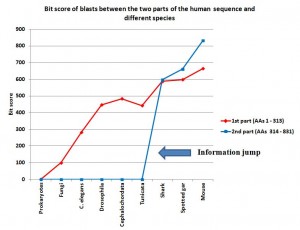
IOWs, what we see here is that the no domain part of the molecule is practically non existent in prokaryotes, in single celled eukaryotes and in all multicellular beings which are not vertebrates. In vertebrates, the sequence is not only present in practically all vertebrates, but it is also extremely conserved, from sharks to humans. So, we have a steep informational jump from non chordates and non vertebrate chordates, where the sequence is practically absent, to the very first vertebrates, where the sequence is already highly specific.

What does that mean from an ID point of view? It’s simple:

a) The sequence of 517 AAs which represents the major part of the human protein must be reasonably considered highly functional, because it is strongly conserved throughout vertebrate evolution. As we have said in the beginning, the only reasonable explanation for high conservation throughout a span of time which must be more than 400 million years long is the presence of strong functional constraints in the sequence.

b) The sequence and its function, whatever it may be (but it is probably an important regulatory function) is highly specific of vertebrates.

We have here a very good example of a part of a protein which practically appears in vertebrates while it is absent before, and which is reasonably highly functional in vertebrates.

So, to sum up:

  1. Prickle 1 is a functional protein which is found in all eukaryotes.
  2. The human sequence can be divided in two parts, with different properties.
  3. The first part, while undergoing evolutionary changes, is rather well conserved in all eukaryotes. Its function can be better understood, because it is made of known domains with known structure.
  4. The second part does not include any known domain or structure, and is practically absent in all eukaryotes except vertebrates.
  5. In vertebrates, it is highly conserved and almost certainly highly functional. Probably as a regulatory epigenetic sequence.
  6. For its properties, this second part, and its functional sequence, are a very reasonable object for a strong design inference.

I have added a graph to show better what is described in the conclusions, in particular the information jump in vertebrates for the second part of the sequence:
Graph3

Note: Thanks to the careful checking of Alicia Cartelli, I have corrected a couple of minor imprecisions in the data and the graph (see posts #83 and #136). Thank you, Alicia, for your commitment. The sense of the post, however, does not change.

Those who are interested in the evolutionary behaviour of protein Prickle 2 could give a look at my posts #127 and #137.

Comments
Zachriel #766, In post #726 Gpuccio's has asked you some excellent questions, which you refuse to answer. The following question deals with your terribly incoherent extinction scenario.
Gpuccio: And all those lancelets precursors, which have been expanded to the whole planet for hundreds of time, have all gone extinct? 10^12 fish for each of the 350 fixations? While we still have, only, lancelets and sharks? Is that, more or less, your idea?
Well? Is that your idea?Origenes
March 10, 2016
March
03
Mar
10
10
2016
06:13 PM
6
06
13
PM
PDT
Origenes: Well, do tell where evolutionary theory predicts that there will be a gap for the blue sequence between vertebrates and pre-vertebrates and no gap for the red sequence. The question concerned whether so-called gaps were consistent with evolution theory. Here's the basic pattern posited by evolutionary theory: http://darwin-online.org.uk/converted/published/1872_Origin_F391/1872_Origin_F391_figdiagram.jpg Are you saying you don't think organisms go extinct? Or given common descent, do you understand that gaps are a natural consequence of divergence and extinction?Zachriel
March 10, 2016
March
03
Mar
10
10
2016
03:32 PM
3
03
32
PM
PDT
Zachriel: Good thing evolutionary theory doesn’t do that then.
Excellent news! Well, do tell where evolutionary theory predicts that there will be a gap for the blue sequence between vertebrates and pre-vertebrates and no gap for the red sequence.Origenes
March 10, 2016
March
03
Mar
10
10
2016
02:56 PM
2
02
56
PM
PDT
Origenes: Meteorology which predicts that there will be “hot and cold, wet and dry” without any attempt to specify where and when would be just as useless as the “predictions” of evolutionary theory. Good thing evolutionary theory doesn't do that then. Extinction is a well-researched topic. Take a look again at the basic pattern. http://darwin-online.org.uk/converted/published/1872_Origin_F391/1872_Origin_F391_figdiagram.jpgZachriel
March 10, 2016
March
03
Mar
10
10
2016
02:28 PM
2
02
28
PM
PDT
Zachriel,
Origenes: And if the theory predicts gaps and no-gaps, then the theory predicts nothing at all.
Zachriel: Sort of like meteorology. It predicts both hot and cold, wet and dry.
Meteorology which predicts that there will be "hot and cold, wet and dry" without any attempt to specify where and when would be just as useless as the "predictions" of evolutionary theory.Origenes
March 10, 2016
March
03
Mar
10
10
2016
02:21 PM
2
02
21
PM
PDT
Dionisio: You may enjoy reading this: Rapid evolution of citrate utilization by Escherichia coli by direct selection requires citT and dctA Seems to be interesting research, but a poorly reasoned paper. Dionisio: The replaced text is irrelevant in the given context. The phrase "have evolved to" is obviously relevant in context. Let's take a guess. You used a secondary source and the ellipses came along for the ride.Zachriel
March 10, 2016
March
03
Mar
10
10
2016
01:26 PM
1
01
26
PM
PDT
Zachriel @756
Why did you use ellipses at that point?
That's a valid question. The replaced text is irrelevant in the given context. BTW, did you answer the questions @750 & @751? Thank you.Dionisio
March 10, 2016
March
03
Mar
10
10
2016
12:34 PM
12
12
34
PM
PDT
Zachriel You may enjoy reading this: :)
[...] because this adaptation did not generate any new genetic information and only required expanded expressions of two existing transporters (citT and dctA), generation of E. coli Cit+ phenotypes in our estimation do not warrant consideration as a speciation event. In fact, mutations in these two loci are sufficient for the LTEE Cit+ phenotype (10).
Rapid evolution of citrate utilization by Escherichia coli by direct selection requires citT and dctA Dustin J. Van Hofwegen, Carolyn J. Hovde and Scott A. Minnich doi: 10.1128/JB.00831-15 http://jb.asm.org/content/early/2016/01/28/JB.00831-15.abstract
Dionisio
March 10, 2016
March
03
Mar
10
10
2016
10:06 AM
10
10
06
AM
PDT
Me Thinks
Andreas Wagner in ‘Arrival of the Fittest’ shows how Hyperdimensions can reduce the search space drastically. IIRC, there were a whole bunch of posts about it here. So, no, there is no ‘probabilistic problem’ in search space.
I have recently read his book and don't agree that he has solved the search space problem. He has interesting ideas and I do agree that he described the search space problem very well.bill cole
March 10, 2016
March
03
Mar
10
10
2016
09:27 AM
9
09
27
AM
PDT
bill cole @ 575
So your idea is the environment is explorable by evolutionary search but you are not describing a mechanism at this point. It appears you understand the probabilistic problems with the genome as a sequence...
Andreas Wagner in 'Arrival of the Fittest' shows how Hyperdimensions can reduce the search space drastically. IIRC, there were a whole bunch of posts about it here. So, no, there is no 'probabilistic problem' in search space.Me_Think
March 10, 2016
March
03
Mar
10
10
2016
09:00 AM
9
09
00
AM
PDT
Zachriel
Not sure we would call the environment a mechanism, but it is certainly an important component of the process. Turns out the physical landscape, both on the molecular and morphological level, are explorable by evolutionary search. Otherwise, the random mutation in Lenski’s bacteria would have been very unlikely to increase fitness, or in the case of Cit+, to have made multiple sequential steps in fitness.
So your idea is the environment is explorable by evolutionary search but you are not describing a mechanism at this point. It appears you understand the probabilistic problems with the genome as a sequence. In the Lenski experiment the enzyme to process citrate was already in the bacteria. It is not surprising to me that after 60000 generations that this enzyme was transcribed in an aerobic environment but I have not recently looked at all the mutations required to do this. Do you think it was random mutations or as you say the environment was enabling the evolutionary process by some mechanism we don't yet understand?bill cole
March 10, 2016
March
03
Mar
10
10
2016
08:17 AM
8
08
17
AM
PDT
bill cole: So how do you explain 10^12 population and 60000 generations fixing only 100 mutations and chimp man split with 44million with 10^10 population and 300000 generations? The rate of fixation of neutral mutations is generally the same as the mutation rate — regardless of population size. The neutral mutation rate is about 10^-10. The genome of E. coli is about 10^7 bases, so we expect a new mutation with every thousand replications or so. After 60000 that's about 60 mutations, which is in the ballpark. Mutations in humans works a bit differently. The human gamete is the result of many replications. The human genome is about 3*10^9 base-pairs, so there are about 0.3 mutations per replication of the gamete. It takes about 30 replications to make an egg, which introduces 10 mutations average. The number of replications to make a male gamete varies with age, but about 400 replications is typical. That introduces about 120 mutations. So we have about 1.3*10^2 mutations per generation times 3*10^5 generations which equals about 4*10^7 mutations, which is in the ballpark of 44 million. The rate of fixation of selectable mutations depends on the fitness landscape. bill cole: You are describing a mechanism other then random mutation or the phone example should translate directly. Not sure we would call the environment a mechanism, but it is certainly an important component of the process. Turns out the physical landscape, both on the molecular and morphological level, are explorable by evolutionary search. Otherwise, the random mutation in Lenski's bacteria would have been very unlikely to increase fitness, or in the case of Cit+, to have made multiple sequential steps in fitness. Origenes: that if evolution predicts gaps this wide, then why is there no such gap wrt to the red sequence? The gaps are formed by extinction, which are contingent. Compare a10 to f10 to m10: http://darwin-online.org.uk/converted/published/1872_Origin_F391/1872_Origin_F391_figdiagram.jpg Origenes: And if the theory predicts gaps and no-gaps, then the theory predicts nothing at all. Sort of like meteorology. It predicts both hot and cold, wet and dry. Dionisio: Can you point to what seems wrong or inaccurate in the above quoted comments? It oversimplifies what happened. There were potentiating mutations, a tandem copy, then amplification and optimizing mutations. They ask "Does any of this resemble natural, undirected Darwinian evolution?" The answer is yes. The mutations were consistent with random distributions, and the selection was consistent with population genetics. Dionisio (quoting): "The components of an organism’s metabolic, regulatory, and developmental networks […] interact in complex ways that are attuned to its current niche." Why did you use ellipses at that point? Let's read the entire quote:
The components of an organism's metabolic, regulatory, and developmental networks have evolved to interact in complex ways that are attuned to its current niche. Yet, these networks are also poised such that they can be dynamically reorganized toward new purposes by only a few mutations in key enzymes and regulatory proteins.
Now, you should be able to make sense of the researchers comments. Dionisio (quoting): "No new genetic information (novel gene function) evolved." Again, the mangling of language. New genetic information certainly did evolve. It should simply read "No novel gene evolved."Zachriel
March 10, 2016
March
03
Mar
10
10
2016
07:27 AM
7
07
27
AM
PDT
Zachriel:
That’s was the argument presented, but evolutionary divergence predicts “gaps” in extant organisms,
Reference please. Your say-so is neither an argument nor validVirgil Cain
March 10, 2016
March
03
Mar
10
10
2016
05:10 AM
5
05
10
AM
PDT
Origenes @784
If evolutionary theory predicts gaps, then it cannot explain the red sequence. If the theory predicts no-gaps, then it cannot explain the blue sequence. And if the theory predicts gaps and no-gaps, then the theory predicts nothing at all.
Quite on the contrary, that theory does predict anything and everything. Head? They win. Tail? We lose. The problem is that we just don't understand it. We should start from learning biology 101. There are free courses online. Then -and only then- maybe we should understand how it all works. :)Dionisio
March 9, 2016
March
03
Mar
9
09
2016
11:33 PM
11
11
33
PM
PDT
Zachriel @734
Is that “Cit+. E. coli” also a bacteria? Of course. Are humans also mammals? By the way, the inability of E. coli to metabolize citrate in aerobic conditions is generally considered a distinguishing characteristic of the species. How many generations of RM+NS+HGT+… did it take to get that Cit+. E. coli? There’s no horizontal gene transfer in this strain of bacteria. It took about 31000 generations for Cit+ to be discovered, but potentiating mutations occurred much earlier. Have those results provided any hint pointing to the possibility of getting a higher complexity system above the bacteria in the tree of life? Why would they? Bacteria have evolved to be fast reproducers, so they have highly optimized genomes. Evolution doesn’t have a tendency towards complexity. Rather, it’s opportunistic and fills available niches. IOW, have bacteria remained bacteria so far in that famous experiment? Yes, just like humans are still mammals. How can we at least theoretically propose a step-by-step process to move from bacteria up to the next level, let’s say multicellular? Bacteria can exhibit primitive colonial behavior.
Ok. Thank you. Can you comment on the below quoted text?
Van Hofwegen et al. demonstrate that E. coli rapidly evolves ability to use citrate when long selective periods are provided. This contrasts with the extreme delay (15 years of daily transfers) seen in the long-term evolution experiments of Lenski and coworkers. Their idea of “historical contingency” may require reinterpretation. Rapid evolution seems to involve selection for duplications of whole cit locus that are too unstable to contribute when selection is provided in short pulses.
Re-interpreting long-term evolution experiments — Is delayed adaptation an example of historical contingency or a consequence of intermittent selection? John Roth* and Sophie Maisnier-Patin doi: 10.1128/JB.00110-16 http://jb.asm.org/content/early/2016/02/10/JB.00110-16.abstract
Reinterpretation of Lenski's LTEE? :) [emphasis mine]Dionisio
March 9, 2016
March
03
Mar
9
09
2016
10:33 PM
10
10
33
PM
PDT
Zachriel @734
Is that “Cit+. E. coli” also a bacteria? Of course. Are humans also mammals? By the way, the inability of E. coli to metabolize citrate in aerobic conditions is generally considered a distinguishing characteristic of the species. How many generations of RM+NS+HGT+… did it take to get that Cit+. E. coli? There’s no horizontal gene transfer in this strain of bacteria. It took about 31000 generations for Cit+ to be discovered, but potentiating mutations occurred much earlier. Have those results provided any hint pointing to the possibility of getting a higher complexity system above the bacteria in the tree of life? Why would they? Bacteria have evolved to be fast reproducers, so they have highly optimized genomes. Evolution doesn’t have a tendency towards complexity. Rather, it’s opportunistic and fills available niches. IOW, have bacteria remained bacteria so far in that famous experiment? Yes, just like humans are still mammals. How can we at least theoretically propose a step-by-step process to move from bacteria up to the next level, let’s say multicellular? Bacteria can exhibit primitive colonial behavior.
Ok. Thank you. Can you comment on the below quoted text?
The isolation of aerobic citrate-utilizing Escherichia coli (Cit+) in long term evolution experiments (LTEE) has been termed a rare, innovative, presumptive speciation event. [...] direct selection would rapidly yield the same class of E. coli Cit+ mutants and follow the same genetic trajectory: potentiation, actualization, and refinement. [...] the rarity of the LTEE mutant was an artifact of the experimental conditions, not a unique evolutionary event. No new genetic information (novel gene function) evolved.
Rapid evolution of citrate utilization by Escherichia coli by direct selection requires citT and dctA Dustin J. Van Hofwegen, Carolyn J. Hovde and Scott A. Minnich doi: 10.1128/JB.00831-15 http://jb.asm.org/content/early/2016/01/28/JB.00831-15.short?rss=1&ssource=mfr
No new genetic information (novel gene function) evolved. ? :) [emphasis mine]Dionisio
March 9, 2016
March
03
Mar
9
09
2016
10:18 PM
10
10
18
PM
PDT
Zachriel @734
Is that “Cit+. E. coli” also a bacteria? Of course. Are humans also mammals? By the way, the inability of E. coli to metabolize citrate in aerobic conditions is generally considered a distinguishing characteristic of the species. How many generations of RM+NS+HGT+… did it take to get that Cit+. E. coli? There’s no horizontal gene transfer in this strain of bacteria. It took about 31000 generations for Cit+ to be discovered, but potentiating mutations occurred much earlier. Have those results provided any hint pointing to the possibility of getting a higher complexity system above the bacteria in the tree of life? Why would they? Bacteria have evolved to be fast reproducers, so they have highly optimized genomes. Evolution doesn’t have a tendency towards complexity. Rather, it’s opportunistic and fills available niches. IOW, have bacteria remained bacteria so far in that famous experiment? Yes, just like humans are still mammals. How can we at least theoretically propose a step-by-step process to move from bacteria up to the next level, let’s say multicellular? Bacteria can exhibit primitive colonial behavior.
Ok. Thank you. Can you comment on the below quoted text?
[...] mutations in the gltA gene encoding citrate synthase (CS) were critical for both potentiating the evolution of aerobic citrate utilization in the Lenski LTEE and for the subsequent refinement of this new metabolic capability. [...] complexity in both the resource environment and in the genetic architecture of the cell conspired to make this metabolic innovation possible. [...] innovations may rely [...] on the inherent malleability of core cellular processes. The components of an organism's metabolic, regulatory, and developmental networks [...] interact in complex ways that are attuned to its current niche. Yet, these networks are also poised such that they can be dynamically reorganized toward new purposes by only a few mutations in key enzymes and regulatory proteins.
Fine-tuning citrate synthase flux potentiates and refines metabolic innovation in the Lenski evolution experiment Erik M Quandt, Jimmy Gollihar, Zachary D Blount, Andrew D Ellington, George Georgiou, Jeffrey E Barrick DOI: http://dx.doi.org/10.7554/eLife.09696 eLife 2015;4:e09696 http://elifesciences.org/content/4/e09696v2
Are they referring to biological systems with built-in adaptation mechanisms? :) [emphasis mine]Dionisio
March 9, 2016
March
03
Mar
9
09
2016
09:39 PM
9
09
39
PM
PDT
Zachriel @734
Is that “Cit+. E. coli” also a bacteria? Of course. Are humans also mammals? By the way, the inability of E. coli to metabolize citrate in aerobic conditions is generally considered a distinguishing characteristic of the species. How many generations of RM+NS+HGT+… did it take to get that Cit+. E. coli? There’s no horizontal gene transfer in this strain of bacteria. It took about 31000 generations for Cit+ to be discovered, but potentiating mutations occurred much earlier. Have those results provided any hint pointing to the possibility of getting a higher complexity system above the bacteria in the tree of life? Why would they? Bacteria have evolved to be fast reproducers, so they have highly optimized genomes. Evolution doesn’t have a tendency towards complexity. Rather, it’s opportunistic and fills available niches. IOW, have bacteria remained bacteria so far in that famous experiment? Yes, just like humans are still mammals. How can we at least theoretically propose a step-by-step process to move from bacteria up to the next level, let’s say multicellular? Bacteria can exhibit primitive colonial behavior.
Ok. Thank you. Are Cit+. E. coli as different from other bacteria as a whale is from a cow (both mammals)? Or is it more comparable to the difference between a cat and a dog? My children have a cat and a dog that coexist in full harmony. :)Dionisio
March 9, 2016
March
03
Mar
9
09
2016
08:50 PM
8
08
50
PM
PDT
Zachriel @734
Is that “Cit+. E. coli” also a bacteria? Of course. Are humans also mammals? By the way, the inability of E. coli to metabolize citrate in aerobic conditions is generally considered a distinguishing characteristic of the species. How many generations of RM+NS+HGT+… did it take to get that Cit+. E. coli? There’s no horizontal gene transfer in this strain of bacteria. It took about 31000 generations for Cit+ to be discovered, but potentiating mutations occurred much earlier. Have those results provided any hint pointing to the possibility of getting a higher complexity system above the bacteria in the tree of life? Why would they? Bacteria have evolved to be fast reproducers, so they have highly optimized genomes. Evolution doesn’t have a tendency towards complexity. Rather, it’s opportunistic and fills available niches. IOW, have bacteria remained bacteria so far in that famous experiment? Yes, just like humans are still mammals. How can we at least theoretically propose a step-by-step process to move from bacteria up to the next level, let’s say multicellular? Bacteria can exhibit primitive colonial behavior.
Ok. Thank you. In a (3+ years old) non-academic article* they wrote the below comments on this "Cit+. E. Coli" topic:
In Lenski's experiment, the bacteria (both Cit+ and wild-type) already possessed a gene named citT. It encodes a protein that transports a range of citrate-like chemicals. The recent results showed that the bacteria made extra copies of citT and a neighboring sequence—a process called gene amplification. More copies of the gene should translate to higher amounts of the transporter protein that it encodes. With enough transporters, the bacteria could access enough citrate. But oxygen deactivates citT, and having many copies of a gene that is turned off is not very useful! But the bacteria solved this problem when the amplification event also moved the gene sequence to a different place in the bacterial chromosome, where a different but pre-existing promoter could regulate it. Unlike the original one, it appears that the new promoter does not have an "oxygen off" switching mode. Instead, it allowed expression of citT in the presence of oxygen so that the bacteria successfully imported enough citrate to grow. The study authors wrote, "The structure of the cit amplification led us to propose that the Cit+ trait arose from an amplification-mediated promoter capture."1 Further investigation confirmed the proposal. References 1. Blount, Z. D. et al. 2012. Genomic analysis of a key innovation in an experimental Escherichia coli population. Nature. 489 (7417): 513-518.
Can you point to what seems wrong or inaccurate in the above quoted comments? Thank you. (*) http://www.icr.org/article/7083/Dionisio
March 9, 2016
March
03
Mar
9
09
2016
08:30 PM
8
08
30
PM
PDT
Zachriel,
Origenes: One reason is, that if evolutionary processes were responsible, then we would have found homologies in pre-vertebrates — similar to homologies found wrt the red sequence.
Zachriel: That’s was the argument presented, but evolutionary divergence predicts “gaps” in extant organisms, so such gaps are consistent with evolution.
The problem for your position is, that if evolution predicts gaps this wide, then why is there no such gap wrt to the red sequence? If evolutionary theory predicts gaps, then it cannot explain the red sequence. If the theory predicts no-gaps, then it cannot explain the blue sequence. And if the theory predicts gaps and no-gaps, then the theory predicts nothing at all.Origenes
March 9, 2016
March
03
Mar
9
09
2016
05:10 PM
5
05
10
PM
PDT
A special thank you to Zachriel, who has with patience and intellectual honesty defended his views. Even if I don’t agree with him, I certainly appreciate his effort. I believe that we have touched some very interesting aspects of the debate here.
I agree with this. I am interested in the science returning to a discipline of testing. Zachriel discusses the issues with integrity.bill cole
March 9, 2016
March
03
Mar
9
09
2016
01:34 PM
1
01
34
PM
PDT
Zachriel
We observe mutations, and can determine their rate. We can calculate the rate of accumulation of neutral mutations. We can then compare this to the differences between species for confirmation. That’s not circular, but independent lines of evidence supporting the same conclusion.
So how do you explain 10^12 population and 60000 generations fixing only 100 mutations and chimp man split with 44million with 10^10 population and 300000 generations? How do you explain the difference without a circular argument? In the lab large populations and 20% of human generations are producing .0004% fixed mutations. The math does not work.
You just said to duplicate the number, so the original number is still there, as well as many other discovered numbers that may be of interest. In any case, phone numbers don’t generally form a landscape suitable for evolutionary search. Compare this to Lenski’s experiment, where the bacteria evolved to their laboratory environment through mutations.
You are describing a mechanism other then random mutation or the phone example should translate directly. What is the mechanism you are describing that caused genome change in the Lenski experiment? You may say there is more proteins that can fold but this is small compared to the amount of added sequences in proteins compared to phone numbers. The protein problem is orders of magnitude larger then the phone problem with 10^500 sequential space units. I think this issues kills the current theory(random change plus selection and drift) and we should search immediately for and alternative mechanism. I hope you have ideas. Have you thought about alternative splicing as a mechanism?bill cole
March 9, 2016
March
03
Mar
9
09
2016
01:30 PM
1
01
30
PM
PDT
Origenes: Thank you for admitting that you have no idea how the blue sequence of the Prickle 1 protein came about from an evolutionary standpoint. Well, everything else is evolution, so we can reasonably suppose evolution in this case also, but we are not knowledgeable as to the specific pathways. Origenes: One reason is, that if evolutionary processes were responsible, then we would have found homologies in pre-vertebrates That's was the argument presented, but evolutionary divergence predicts "gaps" in extant organisms, so such gaps are consistent with evolution.Zachriel
March 9, 2016
March
03
Mar
9
09
2016
12:48 PM
12
12
48
PM
PDT
@743 +1mike1962
March 9, 2016
March
03
Mar
9
09
2016
12:43 PM
12
12
43
PM
PDT
To all: I will be away for a few days, so I will not be able to go on with this very good discussion for some time. I want to really thank all those who have contributed. It has been great fun! A special thank you to Zachriel, who has with patience and intellectual honesty defended his views. Even if I don't agree with him, I certainly appreciate his effort. I believe that we have touched some very interesting aspects of the debate here. So, for the moment, many greetings to all! :)gpuccio
March 9, 2016
March
03
Mar
9
09
2016
12:37 PM
12
12
37
PM
PDT
Zachriel:
We expect millions of neutral mutations to fix (the rate of fixation of neutral mutations is generally equal to the rate of mutation)...
Unfortunately no one has ever validated the math of neutral evolution. That means Zachriel is spewing pure propaganda and trying to pass it off as a fact.Virgil Cain
March 9, 2016
March
03
Mar
9
09
2016
10:55 AM
10
10
55
AM
PDT
Zachriel,
Origenes: There is simply no coherent evolutionary explanation for the sudden appearance of 600 bits of specific functional information in the “blue sequence” of Prickle 1
Zachriel: Have no idea about Prickle 1,
Thank you for admitting that you have no idea how the blue sequence of the Prickle 1 protein came about from an evolutionary standpoint.
Zachriel: (...) nor has any IDer provided any evidence of the manufacturing process.
Incorrect. Thanks to Gpuccio's argument we know that intelligent design must be involved.
However, evolution is capable of building up complex structures incrementally, such as when there is a selectable pathway.
That is the Darwinian hypothesis. However, as you have admitted, this doesn't explain the blue sequence of the Prickle 1 protein. One reason is, that if evolutionary processes were responsible, then we would have found homologies in pre-vertebrates — similar to homologies found wrt the red sequence.Origenes
March 9, 2016
March
03
Mar
9
09
2016
09:54 AM
9
09
54
AM
PDT
bill cole: So evolution is a circular argument. We look at history and assume random mutations created what we see and then determine mutation rate. We observe mutations, and can determine their rate. We can calculate the rate of accumulation of neutral mutations. We can then compare this to the differences between species for confirmation. That's not circular, but independent lines of evidence supporting the same conclusion. bill cole: If we had 1000000 people do this for a year. Would anyone have added a new number without destroying the rest of their numbers? You just said to duplicate the number, so the original number is still there, as well as many other discovered numbers that may be of interest. In any case, phone numbers don't generally form a landscape suitable for evolutionary search. Compare this to Lenski's experiment, where the bacteria evolved to their laboratory environment through mutations.Zachriel
March 9, 2016
March
03
Mar
9
09
2016
09:41 AM
9
09
41
AM
PDT
Zachriel So evolution is a circular argument. We look at history and assume random mutations created what we see and then determine mutation rate. Don't you think 100 fixed mutations over 30 years and populations 0f 10^12 we would need to see more than 100 fixed mutations or does this rule out random mutation and selection as the driver of lifes diversity? Again the sequential space of the genome is 4^3.2 billion. Imagine taking your cell phone and copying one of the numbers you have on direct dial(simulate gene duplication). Now change a number randomly from one of your direct dial numbers every hour. Do you ever expect your direct dial numbers to improve? If we had 1000000 people do this for a year. Would anyone have added a new number without destroying the rest of their numbers? Sequences and random mutation are like oil and water. Your computer password in an example how we use sequences to block random search.bill cole
March 9, 2016
March
03
Mar
9
09
2016
09:14 AM
9
09
14
AM
PDT
"None of this tells us whether we should see a new protein in Lenski’s experiment." Pathetic.EugeneS
March 9, 2016
March
03
Mar
9
09
2016
08:42 AM
8
08
42
AM
PDT
1 6 7 8 9 10 33

Leave a Reply