Uncommon Descent Serving The Intelligent Design Community

Homologies, differences and information jumps

Categories
Intelligent Design
Share
Facebook
Twitter/X
LinkedIn
Flipboard
Print
Email

In recent posts, I have been discussing some important points about the reasonable meaning of homologies and differences in the proteome in the course of natural history. For the following discussion, just to be clear, I will accept a scenario of Common Descent (as explained in many recent posts) in the context of an ID approach. I will also accept the very reasonable concept that neutral or quasi-neutral random variation happens in time, and that negative (purifying) selection is the main principle which limits random variation in functional sequences.

My main points are the following:

  1. Given those premises, homologies through natural history are certainly an indicator of functional constraints, because they mean that some sequence cannot be significantly transformed by random variation. Another way to express this concept is that variation in a functional sequence with strong functional constraints is not neutral, but negative, and therefore negative selection will in mot cases suppress variation and conserve the functional sequence through time. This is a very important point, because it means that strong homologies through time point to high functional complexity, and therefore to design. I have used this kind of argument, for example, for proteins like the beta chain of ATP synthase (highly conserved from LUCA to humans) and Histone H3 (highly conserved in all eukaryotes).
  2. Differences between homologues, instead, can have two completely different meanings:
  •  2a) They can be the result of accumulating neutral variation in parts of the molecule which are not functionally constrained
  • 2b) They can be the expression of differences in function in different species and contexts

I do believe that both 2a and 2b happen and have an important role in shaping the proteome. 2b, in particular, is often underestimated. It is also, in many cases, a very good argument for ID.

Now, I will try to apply this reasoning to one example. I have chosen a regulatory protein, one which is not really well understood, but which has certainly an important role in epigenetic regulation. The protein is called “Prickle”, and we will consider in particular the one known as “Prickle 1”. It has come to my attention trough an interesting paper linked by Dionisio (to whom go my sincere thanks and appreciation):

Planar polarization of Vangl2 in the vertebrate neural plate is controlled by Wnt and Myosin II signaling

In brief, Prickle is a molecule implied, among other things, in planar polarization events and in the regulation of neural system in vertebrates.

Let’s have a look at the protein. From Wikipedia:

Prickle is part of the non-canonical Wnt signaling pathway that establishes planar cell polarity.[2] A gain or loss of function of Prickle1 causes defects in the convergent extension movements of gastrulation.[3] In epithelial cells, Prickle2 establishes and maintains cell apical/basal polarity.[4] Prickle1 plays an important role in the development of the nervous system by regulating the movement of nerve cells.[5

And:

Mutations in Prickle genes can cause epilepsy in humans by perturbing Prickle function.[12] One mutation in Prickle1 gene can result in Prickle1-Related Progressive Myoclonus Epilepsy-Ataxia Syndrome.[2] This mutation disrupts the interaction between prickle-like 1 and REST, which results in the inability to suppress REST.[2] Gene knockdown of Prickle1 by shRNA or dominant-negative constructs results in decreased axonal and dendritic extension in neurons in the hippocampus.[5] Prickle1 gene knockdown in neonatal retina causes defects in axon terminals of photoreceptors and in inner and outer segments.[5]

The human protein is 831 AAs long.

Its structure is interesting: according to Uniprot, in the first part of the molecule we can recognize 4 domains:

1 PET domain:  AAs 14 – 122

3 LIM zinc-binding doamins:  AAs 124 – 313

In the rest of the sequence (AAs 314 – 831) no known domain is recognized.

Here is the FASTA sequence of the human protein, divided in the two parts (red: 4 domain part; blue: no domain part):

>sp|Q96MT3|PRIC1_HUMAN Prickle-like protein 1 OS=Homo sapiens GN=PRICKLE1 PE=1 SV=2
MPLEMEPKMSKLAFGCQRSSTSDDDSGCALEEYAWVPPGLRPEQIQLYFACLPEEKVPYV
NSPGEKHRIKQLLYQLPPHDNEVRYCQSLSEEEKKELQVFSAQRKKEALGRGTIKLLSRA
VMHAVCEQCGLKINGGEVAVFASRAGPGVCWHPSCFVCFTCNELLVDLIYFYQDGKIHCG
RHHAELLKPRCSACDEIIFADECTEAEGRHWHMKHFCCLECETVLGGQRYIMKDGRPFCC
GCFESLYAEYCETCGEHIGVDHAQMTYDGQHWHATEACFSCAQCKASLLGCPFLPKQGQI
YCSKTCSLGEDVHASDSSDSAFQSARSRDSRRSVRMGKSSRSADQCRQSLLLSPALNYKF
PGLSGNADDTLSRKLDDLSLSRQGTSFASEEFWKGRVEQETPEDPEEWADHEDYMTQLLL
KFGDKSLFQPQPNEMDIRASEHWISDNMVKSKTELKQNNQSLASKKYQSDMYWAQSQDGL
GDSAYGSHPGPASSRRLQELELDHGASGYNHDETQWYEDSLECLSDLKPEQSVRDSMDSL
ALSNITGASVDGENKPRPSLYSLQNFEEMETEDCEKMSNMGTLNSSMLHRSAESLKSLSS
ELCPEKILPEEKPVHLPVLRRSKSQSRPQQVKFSDDVIDNGNYDIEIRQPPMSERTRRRV
YNFEERGSRSHHHRRRRSRKSRSDNALNLVTERKYSPKDRLRLYTPDNYEKFIQNKSARE
IQAYIQNADLYGQYAHATSDYGLQNPGMNRFLGLYGEDDDSWCSSSSSSSDSEEEGYFLG
QPIPQPRPQRFAYYTDDLSSPPSALPTPQFGQRTTKSKKKKGHKGKNCIIS

So, this is a very interesting situation, which is not so rare. We have the first part of the sequence (313 AAs) which configures well known and conserved domains, while “the rest”(517 AAs)  is apparently not understood in terms of structure and function.

So, to better understand what all this could mean, I have blasted those two parts of the human molecule separately.

(Those who are not interested in the technical details, can choose here to go on to the conclusions  🙂 )

The first part of the sequence (AAs 1 – 313) shows no homologies in prokaryotes. So, we are apparently in the presence of domains which appear in eukaryotes.

In fungi, we find some significant, but weak, homologues. The best hit is an expect of 2e-21, with 56 identities and 93 positives (99.4 bits).

Multicellular organisms have definitely stronger homologies:

C. elegans:  144 identities, 186 positives, expect 2e-90 (282 bits)

Drosophila melanogaster:  202 identities, 244 positives, expect 5e-152 (447 bits)

Let’s go to non vertebrate chordates:

Cephalochordata (Branchiostoma floridae):  222 identities, 256 positives, expect 6e-165 (484 bits)

Tunicata (Ciona intestinalis): 196 identities, 241 positives, expect 2e-149 (442 bits)

Now, vertebrates:

Cartilaginous fishes (Callorhincus milii): 266 identities, 290 positives, expect 0.0 (588 bits)

Bony fishes (Lepisosteus oculatus): 274 identities, 292 positives, expect 0.0 (598 bits)

Mammals (Mouse): 309 identities, 312 positives, expect 0.0 (664 bits)

IOWs, what we see here is that the 4 domain part of the molecule, absent in prokaryotes, is already partially observable in single celled eukaryotes, and is strongly recognizable in all multicellular beings. It is interesting that homology with the human form is not very different between drosophila and non vertebrate chordates, while there is a significant increase in vertebrates, and practical identity already in mouse. That is a very common pattern, and IMO it can be explained as a mixed result of different functional constraints and neutral evolution in different time splits.

Now, let’s go to “the rest” of the molecule: AAs 314 – 831 (518 AAs). No recognizable domains here.

What is the behaviour of this sequence in natural history?

Again, let’s start again from the human sequence and blast it.

With Prokaryotes: no homologies

With Fungi: no homologies

C. elegans: no homologies

Drosophila melanogaster: no homologies

Let’s go to non vertebrate chordates:

Cephalochordata (Branchiostoma floridae):  no significant homologies

Tunicata (Ciona intestinalis): no significant homologies

So, there is no significant homology in the whole range of eukaryotes, excluding vertebrates and including chordates which are not vertebrates.

Now, what happens with vertebrates?

Here are the numbers:

Cartilaginous fishes (Callorhincus milii): 350 identities, 429 positives, expect 0.0 (597 bits)

Bony fishes (Lepisosteus oculatus): 396 identities, 446 positives, expect 0.0 (662 bits)

Mammals (Mouse): 466 identities, 491 positives, expect 0.0 (832 bits)

IOWs, what we see here is that the no domain part of the molecule is practically non existent in prokaryotes, in single celled eukaryotes and in all multicellular beings which are not vertebrates. In vertebrates, the sequence is not only present in practically all vertebrates, but it is also extremely conserved, from sharks to humans. So, we have a steep informational jump from non chordates and non vertebrate chordates, where the sequence is practically absent, to the very first vertebrates, where the sequence is already highly specific.

What does that mean from an ID point of view? It’s simple:

a) The sequence of 517 AAs which represents the major part of the human protein must be reasonably considered highly functional, because it is strongly conserved throughout vertebrate evolution. As we have said in the beginning, the only reasonable explanation for high conservation throughout a span of time which must be more than 400 million years long is the presence of strong functional constraints in the sequence.

b) The sequence and its function, whatever it may be (but it is probably an important regulatory function) is highly specific of vertebrates.

We have here a very good example of a part of a protein which practically appears in vertebrates while it is absent before, and which is reasonably highly functional in vertebrates.

So, to sum up:

  1. Prickle 1 is a functional protein which is found in all eukaryotes.
  2. The human sequence can be divided in two parts, with different properties.
  3. The first part, while undergoing evolutionary changes, is rather well conserved in all eukaryotes. Its function can be better understood, because it is made of known domains with known structure.
  4. The second part does not include any known domain or structure, and is practically absent in all eukaryotes except vertebrates.
  5. In vertebrates, it is highly conserved and almost certainly highly functional. Probably as a regulatory epigenetic sequence.
  6. For its properties, this second part, and its functional sequence, are a very reasonable object for a strong design inference.

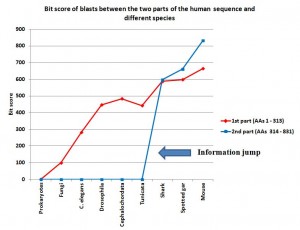
I have added a graph to show better what is described in the conclusions, in particular the information jump in vertebrates for the second part of the sequence:
Graph3

Note: Thanks to the careful checking of Alicia Cartelli, I have corrected a couple of minor imprecisions in the data and the graph (see posts #83 and #136). Thank you, Alicia, for your commitment. The sense of the post, however, does not change.

Those who are interested in the evolutionary behaviour of protein Prickle 2 could give a look at my posts #127 and #137.

Comments
gpuccio: The important point is that each selectable step must expand to the whole population, or almost, if it must be a reasonable place where the successive step can take place. The chance of fixation is 2s, where s is the selection coefficient. So if a particular trait provides a 10% advantage, there is a 20% chance of fixation.Zachriel
March 7, 2016
March
03
Mar
7
07
2016
05:25 AM
5
05
25
AM
PDT
Zachriel: Your last post is senseless. The important point is that each selectable step must expand to the whole population, or almost, if it must be a reasonable place where the successive step can take place. That is true for any possible path to complex functional information, even those which don't exist (practically all). Now, it is irrelevant if the step is fixed in a small population, if after it has to expand to the whole population. It is still one step. One intermediate. And it must expand to the whole population. And that is true of each step, of each intermediate. Therefore, local fixation in a small population does not help. If fixation there must be, it must be in the big population. Therefore, each intermediate must expand, and those many expanded intermediate must be erased, for your dream to come true.gpuccio
March 6, 2016
March
03
Mar
6
06
2016
01:29 PM
1
01
29
PM
PDT
gpuccio: A small expansion is irrelevant. Consider a large population with significant genetic diversity. Edges of the population adapt to local conditions through natural selection, often becoming reproductively isolated. This child population then overtakes the parent population. gpuccio: If you have 10^12 fish, and one gets a useful mutation, the probability of a second useful mutation which contributes to the final result (if ever there is such a path!) are completely negligible, if the first mutation remains confined to that fish and to its descendants. That doesn't add up. Let's say there are 10^8 fish of a given species, and a genome of 10^8. That means every mutation is being tried in every generation on average. Such a population is going to have a wide number of types, with distinct geographical variations. gpuccio: But if the mutation expands to a limited population, for some reason reproductively isolated, say of 10^4 fish, then the second mutation will have to occur in that limited population. No, because the child population with the beneficial mutation will tend to overtake the niche of the parent population. This will frequently be accompanied by reproductive isolation.Zachriel
March 6, 2016
March
03
Mar
6
06
2016
07:51 AM
7
07
51
AM
PDT
Mung the Internet Prig and Stalker @680
Hi Troll!
A poster responds to another post and is called a "troll." I don't think the word means what Internet epithet hurler Mung thinks it means. Has it ever thought of getting a life? Or saying something intelligent?Daniel King
March 5, 2016
March
03
Mar
5
05
2016
05:20 PM
5
05
20
PM
PDT
Zachriel: "It expands in a smaller population" But that's exactly the point! A small expansion is irrelevant. The probabilistic resources of a small population are small. If you have 10^12 fish, and one gets a useful mutation, the probability of a second useful mutation which contributes to the final result (if ever there is such a path!) are completely negligible, if the first mutation remains confined to that fish and to its descendants. Now, if after time t the mutation has become expanded to 10^12 fish again (or even almost to that), then the probabilities of the second mutation will be comparable to those of the first mutation. And that is certainly some help, not negligible. But if the mutation expands to a limited population, for some reason reproductively isolated, say of 10^4 fish, then the second mutation will have to occur in that limited population. OK, 10^4 is better than 1, but only slightly better, for the informational complexity levels we are discussing. Certainly, it is very different from 10^12 organisms. IOWs, the size of the population is the most relevant component of the probabilistic resources of the system, if populations are big enough. And if populations are not big enopugh, there is absolutely no game.gpuccio
March 5, 2016
March
03
Mar
5
05
2016
11:07 AM
11
11
07
AM
PDT
Zachriel seems to think there is only ever one population of a given species.Mung
March 5, 2016
March
03
Mar
5
05
2016
10:54 AM
10
10
54
AM
PDT
gpuccio: So, one thing is if some beneficial mutation step is expanded to a population of 2^30, all another thing if it is expanded only to a population of 2^10. It expands in a smaller population, which then crowds out sister species. Rinse and repeat.Zachriel
March 5, 2016
March
03
Mar
5
05
2016
10:43 AM
10
10
43
AM
PDT
Zachriel: "It means that the history of transitions are lost." That does not seem at all an answer to my quoted comment: "Yes, but fixation in a small population means low probabilistic gain." You realize, I suppose, that the only way positive NS really helps in probabilistic problems is by the quantitative expansion of some trait, don't you? So, one thing is if some beneficial mutation step is expanded to a population of 2^30, all another thing if it is expanded only to a population of 2^10. That was my comment. Which was in answer to your comment that: "Reproductive isolation allows for rapid fixation, especially when the pace of evolution is increased, such as during adaptive radiation." Usually, I try to offer pertinent comments. :)gpuccio
March 5, 2016
March
03
Mar
5
05
2016
09:56 AM
9
09
56
AM
PDT
gpuccio: Yes, but fixation in a small population means low probabilistic gain. It means that the history of transitions are lost. Again, this is easy to simulate. If you have divergence, then the leaves will appear to have gaps between them, even if extinction if random.Zachriel
March 5, 2016
March
03
Mar
5
05
2016
09:11 AM
9
09
11
AM
PDT
gpuccio: Isn’t that amazing? Well, it's interesting, but not sure why you think it is inconsistent with evolution. Insects diverged from other arthropods and the intermediates are extinct.Zachriel
March 5, 2016
March
03
Mar
5
05
2016
09:10 AM
9
09
10
AM
PDT
Zachriel: "Reproductive isolation allows for rapid fixation, especially when the pace of evolution is increased, such as during adaptive radiation." Yes, but fixation in a small population means low probabilistic gain.gpuccio
March 5, 2016
March
03
Mar
5
05
2016
09:04 AM
9
09
04
AM
PDT
Zachriel: OK, I suppose we are at a standstill again. Old arguments come back. However, I appreciate the original aspects in the discussion here. I suppose that: "No, that is not correct. If the components were random, then that would be true, but the components aren’t random, but usually the parts of other components, or the detritus of obsolete components." is an appeal to recombination again. But you see, recombination is detected by sequence blasting. Take the case of the 26 AAs segment (post #590 here, and #13 in the other thread). I quote myself: "A 26 AAs sequence is already so specific in the search space of proteins (after all, it corresponds to a search space of 20^26, which is about 112 bits of information) that it is a signature, a fingerprint. Just blast the above sequence and you will get only Prickle proteins in insects. Isn’t that amazing?" So, modules are recognizable. Recombination is detectable. What a pity, when all you need is undetectables, which can remain in the kingdom of fancy!gpuccio
March 5, 2016
March
03
Mar
5
05
2016
09:03 AM
9
09
03
AM
PDT
gpuccio: OK, let’s say 10^20 fish-replications. In the whole planet, with all the objections about fixations in a widespread population. Reproductive isolation allows for rapid fixation, especially when the pace of evolution is increased, such as during adaptive radiation.Zachriel
March 5, 2016
March
03
Mar
5
05
2016
08:57 AM
8
08
57
AM
PDT
gpuccio: You brought Lenski’s experiment as an example (the only one) of fixation in a biological context, so I commented on it. It shows fixation, and how evolution causes jumps in extant genomes occur. gpuccio: Now, take into account all the other objections which I have made, especially those about combinatorial complexity in a single sequence. As long as there a selectable pathways, then any manner of complex structure can evolve. That's a question of the landscape, however, there are vast numbers of dimensions, and small changes in sequence can often result in small changes in structure, meaning there are selectable pathways, such as with optimizing selection. gpuccio: 1) That observed gaps are too large for evolution to cross. That is the argument from complex functional information, you know. When only looking at the leaves, the gaps will appear larger than they do from a historical perspective. gpuccio: 2) That if the neo darwinian explanation were true, you would have hundreds or thousands of molecular intermediates which were fixed and then disappeared. This is the argument of the missing intermediates. Yes, and it turns out that extinction is rampant in the history of life. We end up with something like this (compare a10 to f10 to m10): http://darwin-online.org.uk/converted/published/1872_Origin_F391/1872_Origin_F391_figdiagram.jpg gpuccio: But remember, the longer the sequence which builds a single step which will go to fixation, the higher the improbability of having that specific variation. Combinatorial principles always apply. No, that is not correct. If the components were random, then that would be true, but the components aren't random, but usually the parts of other components, or the detritus of obsolete components. Mung: You are aware of the existence of protein superfamilies within the human species, aren’t you? Yes. And?Zachriel
March 5, 2016
March
03
Mar
5
05
2016
08:43 AM
8
08
43
AM
PDT
Zachriel:
In any case, now your argument has drifted. It was that historical vestiges would have to be extant in the very same strain. Now, it’s that the gap it too large for evolution to cross.
You are aware of the existence of protein superfamilies within the human species, aren't you?Mung
March 5, 2016
March
03
Mar
5
05
2016
08:18 AM
8
08
18
AM
PDT
Zachriel: My argument has not drifted at all. I am just answering your comments. You brought Lenski's experiment as an example (the only one) of fixation in a biological context, so I commented on it. It's the discussion which drifts, not my arguments. OK, let's say 10^20 fish-replications. In the whole planet, with all the objections about fixations in a widespread population. And so? Now, take into account all the other objections which I have made, especially those about combinatorial complexity in a single sequence. You say: "if there is a selectable pathway, then it is well-within the resources described." A very big if, indeed. And are you aware of how many different functional sequences arise in vertebrates from pre-vertebrates? Remember, I have only given a few examples. My argument has always been: 1) That observed gaps are too large for evolution to cross. That is the argument from complex functional information, you know. 2) That if the neo darwinian explanation were true, you would have hundreds or thousands of molecular intermediates which were fixed and then disappeared. This is the argument of the missing intermediates. Both arguments are strong and valid, ad they are complementary. Regarding the possibility that the path is not made of simple mutations, it is obviously a possibility. But remember, the longer the sequence which builds a single step which will go to fixation, the higher the improbability of having that specific variation. Combinatorial principles always apply.gpuccio
March 5, 2016
March
03
Mar
5
05
2016
08:17 AM
8
08
17
AM
PDT
gpuccio: That’s 1500 billion divisions {10^12}. Are you sure that we are so distant from the number of replications in a pre-vertebrate population? There are, say, about a trillion fish in the ocean, and say they replicate only once each year. That's 10^12 fish-replications per year * 10^8 years = 10^20 fish-replications. gpuccio: And however, we have 10 – 20 fixations in the whole genome, that is 5×10^6 bp. There were about 100 fixed mutations, though only 10-20 provided a known benefit. gpuccio: In my example, what you need is a sequence of at least 906 coordinated mutations which build a specific sequence in one single protein! That's assuming it was built one point-mutation at a time, which is unlikely. However, even then, if there is a selectable pathway, then it is well-within the resources described. gpuccio: The case of the protein could be treated like the case of Lenski’s fixations only if each single aminoacid of the sequence were capable of giving a strong reproductive advantage to the organism. What Lenski's experiment showed was that functional structures can be contingent on potentiating mutations. In any case, now your argument has drifted. It was that historical vestiges would have to be extant in the very same strain. Now, it's that the gap it too large for evolution to cross.Zachriel
March 5, 2016
March
03
Mar
5
05
2016
07:57 AM
7
07
57
AM
PDT
Origenes: The point is: Lenski's events are one more example of what we can call "molecular microevolution". IOWs, very simple mutations which, in a context of extremely strong selection, confer some advantage. Essentially, like simple cases of antibiotic resistance. In no way they are examples of generation of complex functional information. If a new protein which could metabolize citrate had been generated, with an original long and complex sequence which generated a new structure and biochemical activity, then it would be all another thing. But that is not what happened. The sequences which I have brought as examples in this discussion, instead, are true example of complex functional information. In each case, there is an informational gain of many hundreds of bits at stake. There is one reason why neo darwinists always try to use molecular microevolution as though it were complex functional information: it's because it's all that they have. You just spend what you have. Zachriel, with all his ability, cannot do anything different.gpuccio
March 5, 2016
March
03
Mar
5
05
2016
07:53 AM
7
07
53
AM
PDT
Zachriel: About Cit+. From Wikipedia:
In 2012, Lenski and his team reported the results of a genomic analysis of the Cit+ trait that shed light on the genetic basis and evolutionary history of the trait. The researchers had sequenced the entire genomes of twenty-nine clones isolated from various time points in the Ara-3 population's history. They used these sequences to reconstruct the phylogenetic history of the population, which showed that the population had diversified into three clades by 20,000 generations. The Cit+ variants had evolved in one of these, which they called Clade 3. Clones that had been found to be potentiated in earlier research were distributed among all three clades, but were over-represented in Clade 3. This led the researchers to conclude that there had been at least two potentiating mutations involved in Cit+ evolution.[5] The researchers also found that all Cit+ clones had duplication mutations of a 2933 base pair segment that were involved in the gene for the citrate transporter protein used in anaerobic growth on citrate, citT. The duplication is tandem and resulted in two copies that were head-to-tail with respect to each other. This duplication immediately conferred the Cit+ trait by altering the regulation in which the normally silent citT gene is placed under the control of a promoter for an adjacent gene called rnk. The new promoter activated the expression of the citrate transporter when oxygen was present, and thereby enabled aerobic growth on citrate.[5]
So, "two potentiating mutations" (in the first 20000 generations, therefore, I suppose, to be counted among the 10 -20 already discussed), plus a single duplication event. It really does not seem that the Cit+ mutation is in any way different from what we have already discussed.gpuccio
March 5, 2016
March
03
Mar
5
05
2016
07:44 AM
7
07
44
AM
PDT
Zachriel: The fact remains that only 10 - 20 positive mutations achieved fixation in 20000 generations, according to Lenski. "Twenty thousand generations vs. hundreds of million of generations." 20000 generations in an expanding population of bacteria, according to the described methodology, corresponds to about 1,49E+12 divisions. That's 1500 billion divisions. Are you sure that we are so distant from the number of replications in a pre-vertebrate population? And however, we have 10 - 20 fixations in the whole genome, that is 5x10^6 bp. In my last example, we need at least 906 fixations in a genetic sequence corresponding to 1589 AAs, therefore in 4767 bp! Moreover, the most important point: the mutations which are fixed in Lenski's experiment are, as far as we know, point mutations, and are unrelated to each other. IOWs, those 10 - 20 mutations are fixed because each of them gives some reproductive advantage in the conditions of the experiment, but in no way they build a sequence of 10 - 20 AAs in a protein! In my example, what you need is a sequence of at least 906 coordinated mutations which build a specific sequence in one single protein! As you certainly understand, the combinatorial analysis of the two cases is completely different. The case of the protein could be treated like the case of Lenski's fixations only if each single aminoacid of the sequence were capable of giving a strong reproductive advantage to the organism. IOWs, the functional sequence should be deconstructable into at least 906 intermediates, each of them capable of complete positive expansion and therefore fixation. We are no more in the boundaries of myth. This is complete folly.gpuccio
March 5, 2016
March
03
Mar
5
05
2016
07:35 AM
7
07
35
AM
PDT
There are two possibilities. Either Zachriel doesn't grasp the problem at hand or he is playing dumb as a debating tactic. Whatever the case may be, he is becoming more and more unresponsive.Origenes
March 5, 2016
March
03
Mar
5
05
2016
07:20 AM
7
07
20
AM
PDT
Me_Think: "Shouldn’t that convince you that protein sequence has nothing to do with conservation? I also notice that both in red and blue sequence, we have essential amino acids. ‘essential’ means the body cannot synthesize it and thus it must be obtained from the diet. Eg W- Tryptophan, M-Methionine,T-Threonine, I-Isoleucine,D- aspartate etc. How can something which can’t be produced by body be conserved in a sequence?" I really don't understand if it's just that you really do not understand the basics of biology. You say things which are beyond any reasonable understanding. Even Zachriel pointed to your error. What is conserved, obviously, is the information in the protein coding gene. And all organisms use the 20 AAs for their proteins, essential or not. How can you say that "protein sequence has nothing to do with conservation"? We have been discussing conservation of sequences here. Your statement is senseless! Of course, we can have conservation of structure with low conservation of sequence, but conservation of sequence can only be explained by functional constraints, as any book of biology will tell you.gpuccio
March 5, 2016
March
03
Mar
5
05
2016
07:08 AM
7
07
08
AM
PDT
gpuccio: So, only 10 – 20 mutations achieve fixation by positive selection in 20000 generations in the whole bacterial genome! By the way, that was before the evolution of Cit+. The organisms were still evolving! For Cit+, there was at least one potentiating mutation (probably more), a tandem copy, then a series of incremental optimizations which became dominant in the population, leaving gaps or jumps in the extant population. If they hadn't kept clones of previous generations, then they would not have been able to determine the sequence of events just from the extant population. While Cit- persisted in the population, much of the history between Cit- and Cit+ had been lost to extinction.Zachriel
March 5, 2016
March
03
Mar
5
05
2016
06:57 AM
6
06
57
AM
PDT
Me_Think: How can something which can’t be produced by body be conserved in a sequence? All animals consume other organisms for nourishment. Also, many animals can synthesize those amino acids which humans must consume.Zachriel
March 5, 2016
March
03
Mar
5
05
2016
06:19 AM
6
06
19
AM
PDT
gpuccio: Lenski’s experiment is certainly very artificial: a constantly expanding bacterial population subject to strong and constant environmental pressure, in a homogeneous and connected space. That's right. So is dropping stones from the Tower of Pisa. It simplifies some parameters in order to study others. gpuccio: So, only 10 – 20 mutations achieve fixation by positive selection in 20000 generations in the whole bacterial genome! That's right. The intermediates were lost from the extant population. Fortunately, they did keep samples (fossils) of earlier generations so they could unravel the lines of descent. gpuccio: I have mentioned, and in all those which I could still mention, and all of this happened in the population of the common precursors of cephalochordata, tunicata and cartilaginous fishes, in a population of quasi-fishes or quasi-cionas or what else, spread in the oceans of the whole planet, in a 100 million years time (more or less)? Twenty thousand generations vs. hundreds of million of generations. Origenes: Zachriel is arguing that evolutionary theory somehow explains that no detectable precursors of the blue sequence are to be found. Don't know about the "blue sequence", but gaps between extant forms are the expected pattern from evolutionary divergence and extinction (Darwin 1859). Consequently, pointing to such gaps doesn't constitute an argument against evolution.Zachriel
March 5, 2016
March
03
Mar
5
05
2016
06:15 AM
6
06
15
AM
PDT
gpuccio @ 677
So, how can Zachriel explain the different behavior? Why do those selective extinctions, and exceptional fixations/expansions, erase the imagined evolutionary history of the blue sequence, while they apparently have no effect on the red sequence? After all, we are talking the same protein here!
Shouldn't that convince you that protein sequence has nothing to do with conservation? I also notice that both in red and blue sequence, we have essential amino acids. 'essential' means the body cannot synthesize it and thus it must be obtained from the diet. Eg W- Tryptophan, M-Methionine,T-Threonine, I-Isoleucine,D- aspartate etc. How can something which can't be produced by body be conserved in a sequence?Me_Think
March 5, 2016
March
03
Mar
5
05
2016
05:54 AM
5
05
54
AM
PDT
Mung: Indeed, Daniel King is shameless. I often wonder what motivates people like him to waste their time (and dignity) here. Are they feeling as participating to some crusade? Is it simply goliardic arrogance? Just a way of killing time, for lack of better chores to be done?gpuccio
March 5, 2016
March
03
Mar
5
05
2016
04:13 AM
4
04
13
AM
PDT
Hi Troll!Mung
March 4, 2016
March
03
Mar
4
04
2016
06:34 PM
6
06
34
PM
PDT
Dionisio:
Sorry to see someone giving up on trying to understand something as simple as this. Did you have problems opening the provided links? Did you try and read the referenced papers, at least the text where the word ‘design’ (or a variation of it) is used within serious scientific research reports? Did you encounter difficulties trying to locate where in the referenced papers that keyword was written in? If that was the case, just let me know, and I gladly could try to quote the specific text explicitly here for you. Perhaps the indicated links take too long to open on certain mobile devices? I’ve noticed very different speed between my laptop and my Surface tablet, though both run on W8.1. I haven’t tested this on my wife’s iPad or iPhone. If that’s what kept you from looking into those papers from the beginning of our mini-discussion, please let me know and I will certainly try my best to make the referenced text visible to you here. Your obvious mistake has been clearly identified and described here, but still you have not been able (or maybe willing?) to see it? The anonymous visitors in this discussion can read this and draw their own conclusions. Could it be that your apparent unwillingness to accept your error is revealing the real motives behind some of your comments in this discussion thread and perhaps even in the whole site? You still may come back later and admit your mistake. I’m sure many folks here will welcome you gladly. Please, think about it. Don’t quit so easily. I encourage you to reconsider this once more. Thank you. I look forward to reading more positive comments from you in the days ahead. Be more open-minded, think out of the box. And read carefully any text that you read. You’ll see the difference that makes. Have a good weekend.
So Dionisio can't (or won't) tell me what my error is, but he's happy to condescend at great length. It's like trying to nail Jello to a wall. That's ID in a nutshell.Daniel King
March 4, 2016
March
03
Mar
4
04
2016
05:17 PM
5
05
17
PM
PDT
Gpuccio @677, Zachriel is arguing that evolutionary theory somehow explains that no detectable precursors of the blue sequence are to be found. The problem for Zachriel is that the stronger his case wrt the blue sequence, the greater a conundrum the red sequence becomes — and vice versa. The red sequence behaves in perfect accord with evolution — from fungi to mammals. And guess what? Evolutionary theory treats it like a persona non grata and claims that it cannot explain it. One cannot help but feeling sorry for the red sequence :)Origenes
March 4, 2016
March
03
Mar
4
04
2016
03:07 PM
3
03
07
PM
PDT
1 8 9 10 11 12 33

Leave a Reply