Uncommon Descent Serving The Intelligent Design Community

The highly engineered transition to vertebrates: an example of functional information analysis

Categories
Information
Intelligent Design
Share
Facebook
Twitter/X
LinkedIn
Flipboard
Print
Email

In the recent thread “That’s gotta hurt” Bill Cole states:

I think over the next few years 3 other origins (my note: together with OOL), will start to be recognized as equally hard to explain:

  • The origin of eukaryotic cell: difficult to explain the origin of the spliceosome, the nuclear pore complex and chromosome structure.
  • The origin of multicellular life: difficult to explain the origin of the ability to build complex body plans.
  • The origin of man: difficult to explain the origin of language and complex thought.

That thought is perfectly correct. There are, in natural history, a few fundamental transitions which scream design more that anything else. I want to be clear: I stick to my often expressed opinion that each single new complex protein is enough to infer design. But it is equally true that some crucial points in the devlopment of life on earth certainly stand out as major engineering events. So, let’s sum up a few of them:

  1. OOL
  2. The prokaryote – eukaryote transition (IOWs, eukaryogenesis)
  3. The origin of metazoa (multicellular life)
  4. The diversification of the basic phyla and body planes (IOWs, the Cambrian explosion)

Well, to those 4 examples, I would like to add the diversification of all major clades and subphyla.

Of course, another fundamental transition is the one to homo sapiens, but I will not deal with it here: I fully agree with Bill Cole that it is an amazing event under all points of view, but it is also true that it presents some very specific problems, which make it a little bit different from all the other transitions we have considered above.

I will state now in advance the point that I am trying to make here: each of the transitions described requires tons and tons of new, original, highly specific functional information. Therefore, each of those transitions commands an extremely strong inference to design. I will deal in particular with the transition to the subphylum of vertebrates, for a series of reasons: being vertebrates, we are naturally specially interested in that transition; there are a lot of fully sequenced genomes and proteomes of vertebrate species ;  and a lot is known about vertebrate biology. IOWs, we have a lot of data that can help us in our reasoning. So, I will  try to fix a few basic points which will be the foundation of our analysis:

  • a) The basic phylum is Chordates, which are characterized by the presence of a notochord. Chordates include three different clades: Craniata, Tunicata, Cephalochordata.
  • b) Vertebrates are a subphylum of the phylum Chordates, and in particular of the clade Craniata. They represent the vast majority of Chordates, with  about 64,000 species described. As the name suggests, they are characterized by the presence of a vertebral column, either cartilaginous or bony, which replaces the notochord.
  • c) The phylum Chordate, like other phyla, can be traced at least to the Cambrian explosion (540 million years ago).
  • d) Chordates which are not vertebrates are quite rare today. They include:
    • 1) Craniata: the only craniates which are not vertebrates are in the class Myxini (hagfish), whose classification however remains somewhat controversial. All other craniates are vertebrates.
    • 2) Tunicata (or urochordata): about 3000 species, the best known and studied is Ciona intestinalis.
    • 3) Cephalochordata: about 30 species of Lancelets.
  • e) The phyla most closely related to Chordates are Hemichordates (like the Acorn worm) and Echinoderms (Starfish, Sea urchins, Sea cucumbers).
  • f) Vertebrates can be divided into the following two groups:
    • 1) Fishes: 3 Classes:
      • 1a) Jawless  (lampreys)
      • 1b)  Cartilaginous (sharks, rays, chimaeras)
      • 1c) Bony fish
    • 2) Tetrapods: all the rest (frogs, snakes, birds, mammals)

For the following analysis, I will consider vertebrates versus everything which preceded them (all metazoa, including “pre-chordates” (Hemichordates and Echinoderms) and “early chordates”  (Tunicata and Cephalochordata). So, everything which is new in vertebrates had to appear in the window between early chordates and the first vertebrates: cartilaginous fish and bony fish (I will not refer to lampreys, because the data are rather scarce). So, let’s try to define the temporal window, for what it is possible:

  • Chordates are already present at the Cambrian explosion, 540 my ago.
  • Jawless fish appeared slightly later (about 530 my ago), but they are mostly extinct.
  • The split of jawless fish into cartilaginous fish and bony fish can be traced about at 450 my ago

Therefore, with all the caution that is required, we can say that the information which can be found in both cartilaginous fish and bony fish, but not in non vertebrates (including early chordates), must have been generated in a window of less that 100 my, say between 540 my ago and 450 my ago. Now, my point is very simple: we can safely state that in that window of less than 100 million years a lot of new complex functional information was generated. Really a lot. To begin our reasoning, we can say that vertebrates are characterized by the remarkable development of two major relational systems:

  1. The adaptive immune system, which appears for the first time exactly in vertebrates.
  2. The nervous system, which is obviously well represented in all metazoa, but certainly reaches new important adaptations in vertebrates.

Much can be said about the adaptive immune system, and that will probably be the object of a future OP. For the moment, however, I will discuss some aspects linked to the development of the nervous system. The only point that is important here is that the nervous system of vertebrates undergoes many important modifications, especially a process of encephalization.  My interest is mainly in the developmental controls that are involved in the realization of the new body plans and structures linked to those processes. Of course, we don’t understand how those regulations are achieved. But today we know much about some molecules, especially regulatory proteins, which have an important role in the embryonal development of the vertebrate nervous system, and in particular in the development and migration of neurons, which is obviously the foundation for the achievement of the final structure and function of the nervous system. So, I will link here a recent paper which deals with some important knowledge about the process of neuron migration. I invite all those interested to read it carefully: Sticky situations: recent advances in control of cell adhesion during neuronal migration by David J. Solecki Here is the abstract:

The migration of neurons along glial fibers from a germinal zone (GZ) to their final laminar positions is essential for morphogenesis of the developing brain, aberrations in this process are linked to profound neurodevelopmental and cognitive disorders. During this critical morphogenic movement, neurons must navigate complex migration paths, propelling their cell bodies through the dense cellular environment of the developing nervous system to their final destinations. It is not understood how neurons can successfully migrate along their glial guides through the myriad processes and cell bodies of neighboring neurons. Although much progress has been made in understanding the substrates (14), guidance mechanisms (57), cytoskeletal elements (810), and post-translational modifications (1113) required for neuronal migration, we have yet to elucidate how neurons regulate their cellular interactions and adhesive specificity to follow the appropriate migratory pathways. Here I will examine recent developments in our understanding of the mechanisms controlling neuronal cell adhesion and how these mechanisms interact with crucial neurodevelopmental events, such as GZ exit, migration pathway selection, multipolar-to-radial transition, and final lamination.

In brief, the author reviews what is known about the process of neuronal cell adhesion and migration. Starting from that paper and some other material, I have chosen a group of six regulatory proteins which seem to have an important role in the above process. They are rather long and complex proteins, particularly good for an information analysis. Here is the list. I give first the name of the protein, and then the length and accession number in Uniprot for the human protein:

  • Astrotactin 1,     1302 AAs,     O14525
  • Astrotactin 2,    1339 AAs,     O75129
  • BRNP1 (BMP/retinoic acid-inducible neural-specific protein 1),     761 AAs,     O60477
  • Cadherin 2 (CADH2),      906 AAs,    P19022
  • Integrin alpha-V,    1048 AAs,      P06756
  • Neural cell adhesion molecule 1 (NCAM1),   858 AAs,  P13591

This is a  very interesting bunch of molecules:

  • Astrotactin 1 and 2 are two partially related perforin-like proteins. ASTN-1 is a membrane protein which is directly responsible for the formation of neuron–glial fibre contacts. ASTN2 is not a neuron-glial adhesion molecule, but it functions in cerebellar granule neuron (CGN)-glial junction formation by forming a complex with ASTN1 to regulate ASTN1 cell surface recruitment. More about these very interesting proteins can be found in the following paper:

Structure of astrotactin-2: a conserved vertebrate-specific and perforin-like membrane protein involved in neuronal development by Tao Ni, Karl Harlos, and Robert Gilbert

  • BRNP1 is another  protein which functions in neural cell migration and guidance
  • Cadherin 2, or N-cadherin, is active in many neuronal funtions and in other tissues, and seems to have a crucial role in glial-guided migration of neurons
  • Integrin alpha-V, or Vitronectin receptor, is one of the 18 alpha subunits of integrins in mammals. Integrins are transmembrane receptors that are the bridges for cell-cell and cell-extracellular matrix (ECM) interactions.
  • NCAM1 is a cell adhesion molecule involved in neuron-neuron adhesion, neurite fasciculation, outgrowth of neurites

Now, why have I chosen these six proteins, and what do they have in common? They have two important things in common:

  • They are all big regulatory proteins, and they are all involved in a similar regulatory network which controls endocytosis, cell adhesion and cell migration in neurons, and therefore is in part responsible for the correct development of the vertebrate nervous system
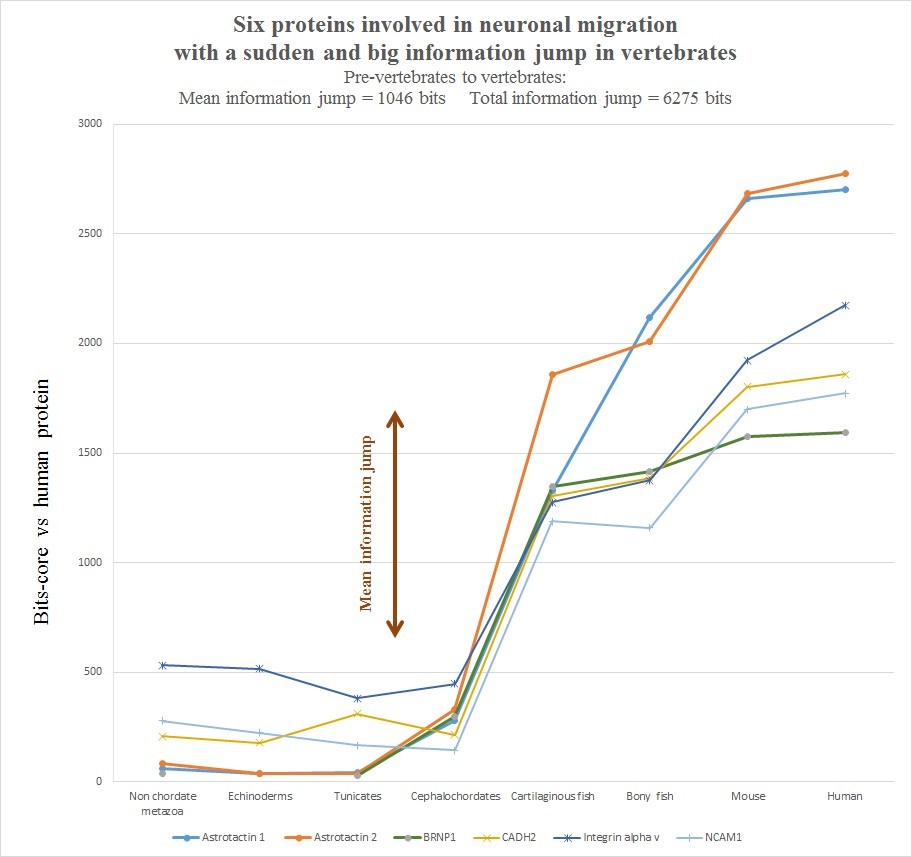
  • All those six proteins present a very big informarion jump between pre-vertebrate organisms and the first vertebrates

The evolutionary history of those six protein is summarized in the following graph, realized as usual by computing the best homology bit score with the human protein in different groups of organisms.
Neuron_migration

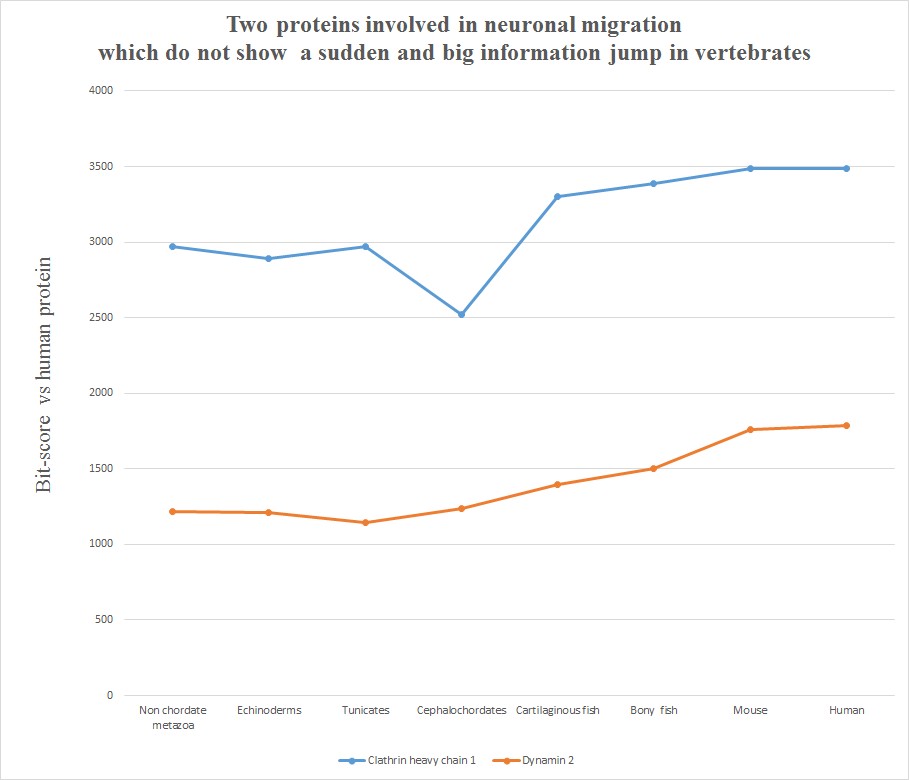
Very briefly, all the six human molecules have low homology with pre-vertebrates, while they already show a very high homology  in cartilaginous fishes. The most striking example is probably Astrotactin 2, which presents the biggest jump from cephalochordata (329 bits) to cartilaginous fishes (1860 bits), for a great total of 1531 bits of jump! The range of individual jumps in the group is 745 – 1531 bits, with a mean jump of 1046 bits per molecule and a total jump of 6275 bits for all six molecules. The jump has always been computed as the difference between the best bit score in cartilaginous fishes and the best bitscore in all pre-vertebrate metazoa. We can also observe that the first three proteins have really low homology with everything up to tunicates, but show a definite increase in Cephalochordata, which precedes the big jump in cartilaginous fishes, while the other three molecules have a rather constant behaviour in all pre-vertebrate metazoa, with a few hundred bits of homology, before “jumping” up in sharks. One could ask: is that a common behaviour of all proteins? The answer is no. Look at the following graph, which shows the same evolutionary history for two other proteins, both of them very big regulatory proteins, both of them implied in the same processes as the previous six.
Neuron_migration2

Here, the behaviour is completely different. While there is a slight increase of homology in time, with a few smaller “jumps”, there is nothing comparable to the thousand bit jumps in the first six molecules. IOWs, these two molecules already show a very high level of homology to the human form in pre-vertebrates, and change only relatively little in vertebrates. We can say, therefore, that most of the functional information in these two proteins was already present before the transition to vertebrates.

So, to sum up:

  • a) The six proteins analyzed here all exhibit a huge informational jump between pre-vertebrates and vertebrates. The total functional informational novelty for just this small group of proteins is more than 6000 bits, with a mean of more than 1000 bits per protein.
  • b) These proteins are probably crucial agents in a much more complex regulation network implied in neuron adhesion, endocytosis, migration, and in the end in the vast developmental process which makes individual neurons migrate to their specific individual locations in the vertebrate body plan.
  • c) The above process is certainly much more complex than the six proteins we have considered, and implies other proteins and obviously many non coding elements. Our six proteins, therefore, can be considered as a tiny sample of the general complexity of the process, and of the informational novelty implied in the process itself.
  • d) Moreover, the process regulating neuron migration is certainly strictly integrated, with so many agents working in a coordinated way. Therefore, there is obviously a strong element of irreducible complexity implied in the whole informational novelty of the vertebrate process, an element that we can only barely envisage, because we still understand too little.
  • e) The neuron regulation process, of course, is only a part of the informational novelty implied in vertebrates, a small sample of a much more complex reality. For example, there is a lot of similar novelty implied in the workings of the immune system, of the cytokine signaling system, and so on.
  • f) The jump described here is really a jump: there is no trace of intermediate forms which can explain that jump in all existing pre-vertebrates. Of course, neo darwinists can always dream of lost intermediates in extinct species. This is a free world.
  • g) Are these 6000+ bits of functional information really functional? Yes, they are. Why? because they have been conserved for more than 400 million years. Remember, the transition we have considered happens between the first chordates and cartilaginous fish, and it can be traced to that range of time. And those 6000+ bits are bits of homology between cartilaginous fish and humans.
  • h) How much is 6000 bits of functional information? It is really a lot! Remember, Dembski’s Universal Probability Bound, taking in consideration the whole reasonable probabilistic resource of our whole universe from the Big Bang to now, is just 500 bits. 6000 bits correspond to a search space of 2^6000, IOWs about 10^2000, a number so big that we cannot even begin to visualize it. It’s good to remind ourselves, from time to time, that we are dealing with exponential values.
  • i) How great is the probability that 6000 bits of functional information can be generated in a window time of less than 100 million years, by some unguided process of RV + NS in six objects connected in an irreducibly complex system, even if RV were really helped by some NS in intermediates of which there is no trace? The answer is simple: practically non existent.
  • j) Therefore, the tiny sample of six proteins that we have considered here, which is only a small part of a much bigger scenario, points with extreme strength to a definite design inference:

The transition to vertebrates was a highly engineered process. The necessary functional information was added by design.

Comments
here is Behe's response. https://youtu.be/vEGjMgPOGeMbill cole
July 23, 2016
July
07
Jul
23
23
2016
10:25 AM
10
10
25
AM
PDT
bill: Pitiful!gpuccio
July 23, 2016
July
07
Jul
23
23
2016
10:03 AM
10
10
03
AM
PDT
gpuccio Dionisio Remember Ken Millers attempt to show a Darwinian account of the bacterial flagellum.:-) https://youtu.be/K_HVrjKcvrUbill cole
July 23, 2016
July
07
Jul
23
23
2016
09:52 AM
9
09
52
AM
PDT
bill: IMO, co-option is a very lame concept used by neo darwinists as an extreme weapon of defense. In particular, it had its moment of pseudo-glory when neo darwinists had to desperately find some counter-argument to Behe's brilliant introduction of the idea of irreducible complexity, which has since been a real pillar of ID theory. Co-option, like convergent evolution, is just a poor tool of bad magics, to convince your audience that you can explain what cannot be explained.gpuccio
July 23, 2016
July
07
Jul
23
23
2016
08:58 AM
8
08
58
AM
PDT
Dionisio: Yes, these small protein objects made of even smaller aminoacids are really fascinating! Hypnotic, I would say. So, let's enjoy our common passion in this quiet solitude... :)gpuccio
July 23, 2016
July
07
Jul
23
23
2016
08:51 AM
8
08
51
AM
PDT
Dionisio
But that does not mean that those domains are the same thing in different proteins. They can be very different, and have very different functions. IOWs, what usually is labeled as co-option, or simply as re-use of the same domain, is really a process characterized in many cases by a whole re-formulation of the information in that sequence and structure. A design process, under all points of view.
I completely agree with Gpuccio here. If you see a claim of co option there is never a detailed discussion of how the reorganization of the genome could have facilitated that co option. The claim that co option is the answer to evolution forming the bacterial flagellium has never been validated in any detail of how the genome reorganized.bill cole
July 23, 2016
July
07
Jul
23
23
2016
08:49 AM
8
08
49
AM
PDT
gpuccio: Perhaps I've said this funny anecdote here before, but I'll say it again: A few years ago, when I was exploring the idea to switch career, I met a couple of biology professors at a university in Poland. While we were at lunch in a local restaurant, one of the scientists briefly told me about his research on protein folding. That was the first time I had heard about such a thing. At some point he suddenly stopped his talk and asked me if I didn't like the food, because he noticed I wasn't eating more. That unexpected question kind of woke me up from a strange hypnotism. Then I told him that I was so fascinated by what he was saying about protein folding issues that I literally had forgotten I was in a restaurant. My mind had been just blown away by his overwhelmingly fantastic description of that stuff I had never heard about until then. He just laughed out loud. Well, I think that conversation was one of the tipping points in my decision to change career. Since then the fascination has only increased and eventually became an irresistible obsession. Here we are now. Life goes on... :)Dionisio
July 23, 2016
July
07
Jul
23
23
2016
08:40 AM
8
08
40
AM
PDT
Mung @101
gpuccio: …but if I must be sincere I miss the confrontation. gpuccio is a nutjob and anyone who believes that anything he writes is true needs to have their head examined. Is that better?
Not bad. Really. That was a very creative idea to please gpuccio by 'faking' a confrontational comment. Definitely the comment was funny, it made me laugh, but perhaps it would be better to have a real serious discussion, not pretended confrontational 'acting'? :) Since this discussion has turned so technical (above the pay grade of low-IQ biology-illiterate folks like me), maybe we all could learn more by inviting to this 'arena' real accredited biology scientists like Professor Larry Moran and/or Professor S. Joshua Swamidass. Regarding the latter, perhaps Dr. V J Torley can give a hand with this using his connection? :) As all can see, gpuccio has raised very interesting questions about profound issues in biology. Where are those professors when we need them more? :) We have seen them actively involved in previous occasions in this site. Their involvement should be highly appreciated again.Dionisio
July 23, 2016
July
07
Jul
23
23
2016
08:06 AM
8
08
06
AM
PDT
Dionisio: Yes, it's amazing, isn't it? 2020 groups of basic protein information which are, admittedly, beyond the "current limits of our ability to identify common ancestry". IOWs, they are completely separated islands of function. And the example of the MACPF domain in astrotactin 2, that we discussed above, shows clearly that there may be huge differences in sequence and function even between domains classified in the same family (not even superfamily), in different proteins! Consider this: blasting the sequence of the MACPF domain in human astrotactin 2 versus the whole human proteome, we get only 43 hits. About half of them, ranging from 186 to 374 bits, are with various isoforms of astrotactin 2. The rest, ranging from 139 to 141 bits, are with various isoforms of astrotactin 1. So, this particular implementation of the MACPF domain seems really quite specific to astrotactins, and nothing else. So, it is in itself an isolated island of function! :)gpuccio
July 23, 2016
July
07
Jul
23
23
2016
07:49 AM
7
07
49
AM
PDT
gpuccio @107 Interesting points. Thank you. BTW,
SCOP 1.75 lists 2020 individual superfamilies
I kind of like that number 2020! :) Isn't it also used for referring to good vision? [Emphasis mine]Dionisio
July 23, 2016
July
07
Jul
23
23
2016
07:18 AM
7
07
18
AM
PDT
Dionisio: Well, there is no doubt that all the factors that you mention can contribute to the final form and function of a protein. However, the basic discussions about protein domains and their functions, and their classification into superfamilies, families, and so on, derive essentially from a limited source of knowledge: a) The sequence: domains are usually recognized by sequence homology. For example, when we blast a protein at the NCBI site, the software recognizes the presence of possible domains in the sequence we are blasting because of its homology with the reference sequence for that domain. However, even low homologies are enough to identify a domain. That's why the software states, in its output: "Putative conserved domains have been detected". b) The structure: this is the main level at which a domain is defined. Domains have some known folding and tertiary structure. Here, again, the structure can be more or less similar. c) The function: in general, some similarity of function is expected from domains in a same family. However, as we have seen, it is perfectly possible for domains with similar structure to have different functions, and it is perfectly possible that similar functions are implemented by different domains. The classification of protein domains in superfamilies, like for example in the SCOP database, is largely based on the concept of finding groups of protein domains which share no similarity, either in sequence or in structure or in function, and for which, therefore, no derivation can be objectively hypothesized from one to any other. As Wikipedia puts it:
Protein superfamilies represent the current limits of our ability to identify common ancestry. They are the largest evolutionary grouping based on direct evidence that is currently possible.
SCOP 1.75 lists 2020 individual superfamilies.gpuccio
July 23, 2016
July
07
Jul
23
23
2016
07:02 AM
7
07
02
AM
PDT
gpuccio @99
[...] in this particular case, they mean “co-option” in the sense of joining many different domains with different functions to get a new original result.
This concise statement should help to understand some important concepts you have referred to in this discussion thread. However, since this OP and your follow-up comments tend to be very technical --as it's the case of your very insightful explanation @105, which I'm in the process of chewing and digesting before commenting on it later-- understanding some basic concepts like "protein domains" is required. For example, are these good basic references? http://www.ebi.ac.uk/training/online/course/introduction-protein-classification-ebi/protein-classification/what-are-protein-domains https://en.wikipedia.org/wiki/Protein_domain Here's an interesting paper on the subject of protein domains:
[...] the way domains are defined needs to shift, if the concept of the domain is to maintain coherence when applied to conditionally disordered proteins. [...] For a long time domain definition has ignored the linkage between structure and the physiochemical environment, because many proteins fold into a singular and structurally specific state at regular temperature and pressure, and in the absence of other molecules. The discovery of increasing numbers of proteins that do not behave in this fashion requires a changed emphasis in heuristic definitions of the protein domain.
Protein domain definition should allow for conditional disorder Kavestri Yegambaram, Esther MM Bulloch, and Richard L Kingston Protein Sci. 22(11): 1502–1518. doi: 10.1002/pro.2336
BTW, perhaps the technical level of your explanations is one of the reasons the "polite dissenters" from the opposite side of the debate seem mostly absent from this highly interesting discussion. However, the topic of the OP is technical, hence there's no way around. Now, isn't ironic that some of your opponents complain quite often that your 'intelligent design' proposition is not scientific? Can a discussion get more scientific than this? I'm processing the rest of your explanations @99 & @105 which provide much foods for thoughts. :) One issue I'm trying to understand has to do with the relation between the central dogma of biology (or its updated versions) and the co-option. IOW, the whole enchilada: DNA protein-coding exon sequences, transcription, promoters, operons, transduction signaling pathways, TFs, splicing, translation, PTMs, etc. Are the domain reshaping, their swapping, their co-options or multi-domain fusions, etc. sometimes associated with DNA changes, other times with epigenetic mechanisms, other with other post-transcriptional and/or post-translational events, others with combinations of the above? Disclaimer: as usual, my biology-illiterate condition may explain the noticeable dumbness of some of my questions. One of the advantages of this discussion is the forgiving attitude of the moderator. :)Dionisio
July 23, 2016
July
07
Jul
23
23
2016
06:32 AM
6
06
32
AM
PDT
Dionisio: A few more thoughts about the idea of co-option in astroctin, and in general of re-use of existing domains. The main recognizable domain in astrotactins is the MACPF domain (membrane attack complex-perforin) which in astrotactin 2, for example, is located at the 852-1035 interval, and which strongly characterizes astrotactins as perforin related proteins. So, form the quoted paper about astrotactins:
The N-terminus of the endodomain structure is formed by the canonical MACPF domain consisting of a central, broken, antiparallel four-stranded ?-sheet that possesses a distinctive central approximately 90° bend. Figure 2 shows a structure-based phylogenetic comparison of the ASTN-2 MACPF domain and other known equivalent structures from the MACPF/CDC superfamily.
Now, a first important point is that the similarity of the MACPF domain in astrotactins with the same domain in other perforin related proteins, although undeniable, is more a general structure similarity than a sequence similarity, more than enough to classify those domains in the same protein family, but certainly not to believe that they are really the same thing. For example, is we blast human astrotactin 2 (the MACPF domain part only) against human perforin 1, the sequence similarity is really low: 8 identities 16 positives just 21.9 bits of homology an expect of 0.015, barely statistically significant. Consider, for comparison, that blasting the same domain sequence of human astrotactin 2 with lepisosteus oculatus, a bony fish, we get: 158 identities (86%) 171 positives (92%) 333 bits of homology expect 2e-106 A remarkable difference indeed! What does that mean? It means that the MACPF sequence that we find in astrotactin 2, both in humans and in fish and in all vertebrates, is certainly a sequence which can be traced to the MACPF protein family, but it is extremely different in sequence from the other MACPF domains found in other perforin like proteins, even in humans, while it is extremely similar in sequence to all astrotactin 2 proteins, even between distant species like human and fish. IOWs, the MACPF domain that we observe in astrotactins is highly specific for astrotactins, and highly conserved at sequence level in astrotactins, and in astrotactins only. The paper about astrotactins confirms this conclusion. Please, read carefully the part: 2.2. MACPF and EGF-like domain structures I quote a relevant paragraph:
All MACPF/CDC proteins that form pores have to date been shown to do so using a ?-stranded barrel in which each subunit contributes two ?-strand hairpins to generate a structure similar to a bacterial outer membrane porin, but formed by multiple subunits rather than a single polypeptide chain [3,61]. This requires the two ?-hairpins to be not significantly different in length to each other and that they are long enough to span a bilayer membrane. Two factors suggest that ASTN-2 loops 1 and 2 may not function in pore formation or that, if they do, the mechanism of pore formation by ASTN-2 differs significantly from that of the pore-forming members of the MACPF/CDC superfamily
Emphasis mine. The same paper suggest a similar conclusion for the annexin like domain in astrotactin 2, as you can read in the part: 2.6. The annexin-like domain The relevant passage:
Thus, despite no sequence homology ASTN-2 and human annexin have very similar structures; their charge distributions, however, are very different (electronic supplementary material, figure S9b). For example, with the annexin V domains and the ASTN-2 annexin-like domain all oriented equivalently, the most-similar annexin V domain 3 presents a highly positively charged face whereas ASTN-2 presents a mixed face with regions of positive and negative charge.
Again, emphasis mine. Co-option? In my world, this is heavy and brilliant engineering! So, we must be very careful. The biological literature correctly recognizes domains using both structural similarities and even weak sequence similarities. That's perfectly fine. But that does not mean that those domains are the same thing in different proteins. They can be very different, and have very different functions. IOWs, what usually is labeled as co-option, or simply as re-use of the same domain, is really a process characterized in many cases by a whole re-formulation of the information in that sequence and structure. A design process, under all points of view.gpuccio
July 23, 2016
July
07
Jul
23
23
2016
01:06 AM
1
01
06
AM
PDT
gpuccio: Just a simple ackowledgement. After a couple of days, there is still no pertinent comment from the other side about the content of the OP.
A similar complaint has been expressed by Douglas Axe:
… we’ve nailed this thing, there is nothing more that we need to do. We’ve made these arguments and nobody has responded to these arguments, at least not in the technical literature as a lot of people do. I mean, on their blogs, they say that we are full of … whatever. No one has done the kind of work that we’ve done, with the care that we’ve done it, to show that our results are wrong. …. On the other hand it is not by any means acknowledged by the academic scientists, not by any means acknowledged in the universities and the textbooks that our point is correct. So, we are largely ignored by the academic establishment. And, as I was scratching my head with the opportunity to write a book, I was wondering: what do you do in a situation when you have done all the work and it turned out beautifully clear — in my mind it shows very clearly that design is the correct way to explain life; not the Darwinian explanations — but it is not changing anything. [Douglas Axe, youtube 14 min 20 sec]
Origenes
July 22, 2016
July
07
Jul
22
22
2016
04:06 PM
4
04
06
PM
PDT
gpuccio @99 Thank you for the clear explanation.Dionisio
July 22, 2016
July
07
Jul
22
22
2016
04:03 PM
4
04
03
PM
PDT
Mung: Ah, Mung! What could I do without you? :)gpuccio
July 22, 2016
July
07
Jul
22
22
2016
03:48 PM
3
03
48
PM
PDT
gpuccio: ...but if I must be sincere I miss the confrontation. gpuccio is a nutjob and anyone who believes that anything he writes is true needs to have their head examined. Is that better? :DMung
July 22, 2016
July
07
Jul
22
22
2016
03:41 PM
3
03
41
PM
PDT
gpuccio @98
[...] the identification of specific and highly conserved sequences in such a group of related proteins should help to ask new questions.
Excellent point!
If those sequences arise in vertebrates, they must be related to specific properties of the vertebrate body plan and functions, like neuron organization and so on.
Excellent point!
One of the most intriguing possibilities is to try to match the information about sequence conservation (functional information) and biochemical structure and activity.
Excellent point!
Starting from conservation, correctly interpreted as functional information, to get to the regulatory functions would be a fascinating way to understand new levels of organization.
Excellent point!
Another stimulating topic could be to enquire about the coordinated engineering and function of those proteins, IOWs the irreducible complexity aspect: how much are these sequences which arise in the same time window and subphylum related one to the other? How do they contribute to body plan, development and organization?
Excellent point!
[...] reasoning in terms of design, intention and plans is a true science promoter which can help give new perspective to our approach to biology. why was this functional information introduced at this stage? what is the plan? what functions (even completely unrelated to sheer survival and reproduction) are being engineered here?
Excellent point!Dionisio
July 22, 2016
July
07
Jul
22
22
2016
03:38 PM
3
03
38
PM
PDT
Dionisio: I suppose that, in this particular case, they mean "co-option" in the sense of joining many different domains with different functions to get a new original result. However, we must consider that the domains are redefined, acquire new sequence features, and that the general result is much more than the original functions of the individual domains. These are very complex proteins, and only part of their structure-function relationship is understood. Here, individual bits of information can make a real difference, and there are a lot of them to be considered. Even the known domains are identified by some definite homology, but are very different from one protein to another one. The truth is: these are very complex realities, and we cannot simplify them, we have to understand them for what they are.gpuccio
July 22, 2016
July
07
Jul
22
22
2016
03:37 PM
3
03
37
PM
PDT
Dionisio: No, all that you say makes sense, and of course it deverves attention. I will try to deepen some of these topics. As I have said many times, I am not sure that our understanding of the regulatory networks is enough to clarify many of the aspects you point to. I believe that the identification of specific and highly conserved sequences in such a group of related proteins should help to ask new questions. If those sequences arise in vertebrates, they must be related to specific properties of the vertebrate body plan and functions, like neuron organization and so on. One of the most intriguing possibilities is to try to match the information about sequence conservation (functional information) and biochemical structure and activity. The problem is that we understand enough about specific domains and structures with known biochemical functions (for example, DNA binding domains in transcription factors), but much less is understood about sequences which are conserved but have no obvious domain structure and probably regulatory functions. Starting from conservation, correctly interpreted as functional information, to get to the regulatory functions would be a fascinating way to understand new levels of organization. Another stimulating topic could be to enquire about the coordinated engineering and function of those proteins, IOWs the irreducible complexity aspect: how much are these sequences which arise in the same time window and subphylum related one to the other? How do they contribute to body plan, development and organization? My simple point is: reasoning in terms of design, intention and plans is a true science promoter which can help give new perspective to our approach to biology. Questions simply change. The question is no more: how did this sequence evolve by some non existent neo darwinian mechanism giving reproductive advantage? but rather: why was this functional information introduced at this stage? what is the plan? what functions (even completely unrelated to sheer survival and reproduction) are being engineered here? By the way, I am going to correct the mispelled word. :)gpuccio
July 22, 2016
July
07
Jul
22
22
2016
03:05 PM
3
03
05
PM
PDT
gpuccio In this paper you referenced in your OP:
Structure of astrotactin-2: a conserved vertebrate-specific and perforin-like membrane protein involved in neuronal development Tao Ni, Karl Harlos, Robert Gilbert DOI: 10.1098/rsob.160053 Open Biology The Royal Society Publishing
I read this:
Our structure reveals how different functions, such as membrane binding via an annexin-like domain, have been co-opted to enable the functioning of a modified MACPF/CDC domain in a novel context [...]
What does "have been co-opted" mean in the given context? How does that work in this case?Dionisio
July 22, 2016
July
07
Jul
22
22
2016
02:53 PM
2
02
53
PM
PDT
gpuccio RE: @95 Am I barking up the wrong tree? :)Dionisio
July 22, 2016
July
07
Jul
22
22
2016
01:48 PM
1
01
48
PM
PDT
They all seem to be produced from straightforward gene expression, no pleiotropic cases, no splicing, PTM, etc. Did I get this right? If that's the case, then the expressed genes in the ancestor and descendant should display differences that correspond to the differences observed in the actual proteins. Is this correct? ?Astrotactin 1, http://www.ncbi.nlm.nih.gov/gtr/genes/460/ http://www.ncbi.nlm.nih.gov/gene/460 http://www.uniprot.org/uniprot/Q61137 ?Astrotactin 2, http://www.uniprot.org/uniprot/O75129 ?BRNP1 http://www.uniprot.org/uniprot/O60477 ?Cadherin 2 http://www.uniprot.org/uniprot/P15116 ?Integrin alpha-V, http://www.uniprot.org/uniprot/P06756 ?NCAM1 http://www.ncbi.nlm.nih.gov/gene/4684 Basically, in addition to comparing the actual proteins, also compare the processes to make them. Is this the correct path to get the information I'm looking for?Dionisio
July 22, 2016
July
07
Jul
22
22
2016
01:22 PM
1
01
22
PM
PDT
Since this OP might become part of a permanent reference publication, it's worth correcting "fat finger" errors:
In brief, the author reviews what is known about the process of neuronal cell adhesion and migration. Starting from that paper and some other material, I have chosen a group of six regulatory proteins which seem to have an inportant role in the above process. They are rather long and complex proteins, particularly good for an information analysis. Here is the list.
Didn't notice the misspelled word the first time I read this. The mind makes the correction automatically. Now I'm trying to answer these questions: How are these proteins produced? i.e. what genes get expressed and how? what GRN get activated? What signaling pathways? Then we could try to see what genetic/epigenetic changes needed to occur in order to get the enhanced version of the proteins. Does this make sense?Dionisio
July 22, 2016
July
07
Jul
22
22
2016
12:47 PM
12
12
47
PM
PDT
gpuccio @92
In a sense, I could easily interpret their silence as a confirmation that what we write and say is not easily denied,...
Your interpretation seems very logically accurate. Keep posting your OPs. Many of us here like to read them. And perhaps many onlookers/lurkers/anonymous visitors enjoy reading your explanations too.Dionisio
July 22, 2016
July
07
Jul
22
22
2016
12:30 PM
12
12
30
PM
PDT
UB: I have really appreciated your comments on those points. I think we are in such harmony of thoughts that what you write could well have been written by me! :) If my interlocutors find reasons not to return, the reason should probably be searched in the substance of the debate. In a sense, I could easily interpret their silence as a confirmation that what we write and say is not easily denied, but if I must be sincere I miss the confrontation. :)gpuccio
July 22, 2016
July
07
Jul
22
22
2016
08:17 AM
8
08
17
AM
PDT
After a couple of days, there is still no pertinent comment from the other side about the content of the OP. I am obviously grateful to CLAUDIUS and ellazimm for constructively joining the discussion…
GP, I applaud your attempts to keep the conversation on course, and I apologize if my response to the ”God of Gaps, irreducible complexity, and dFSCI” comments did not help your cause, or gave your interlocutors a reason to not return.Upright BiPed
July 22, 2016
July
07
Jul
22
22
2016
07:41 AM
7
07
41
AM
PDT
gpuccio @86
A gap of knowledge is always the origin of scientific understanding. Science arises because our consciousness is intuitively motivated to understand the things that it does not understand. Hence science, and indeed all cognition, arise. So, there is nothing wrong in gaps of knowledge. Any argument against gaps is indeed an argument against science itself.
Exactly. I believe Kopernik did not get inspired to write his breakthrough astronomic conclusions while looking at the birds during a pleasant walk in Frombork. He was motivated by difficult unanswered questions. His thorough research led him to discoveries that helped him to answer the outstanding questions, but raised new ones. We see the same in biology all the time. For example, here you posted this excellent OP pointing to the fact that 6 proteins show a relatively huge jump in functional complex information within a relatively short biological time interval. That intriguing observation raises interesting questions, which motivate you to search for logically coherent answers. How could we get that information added to the given proteins? One way could be to make it happen through a guided process under laboratory conditions. How would you do it? Is there another way? On the other hand, could it be that some questions raised by the published research papers are related to the established approach of doing bottom-up research of top-down design?Dionisio
July 22, 2016
July
07
Jul
22
22
2016
07:12 AM
7
07
12
AM
PDT
gpuccio @86
why can’t we call ID the inference to a “Conscious dark energy designer of biological information”?
Well, I guess that the 'itchy' terms 'conscious' and 'designer' are unacceptable in the given biological context. Perhaps if you call ID the inference to the “natural dark energy design of biological information” it would be more acceptable? You may keep trying to accommodate your OPs to the 'taste' of your interlocutors or just ignore all the whining and complaining coming from your 'polite dissenters' and call things by their names. In Spanish we say 'al pan pan y al vino vino'. There's a phrase -perhaps incorrectly associated with Cervantes' Don Quixote- that says that when you advance some dogs bark. :) Ignore the barking and keep writing your insightful OPs and posting your follow-up comments. Many folks will appreciate it.Dionisio
July 22, 2016
July
07
Jul
22
22
2016
04:25 AM
4
04
25
AM
PDT
Origenes: I agree with you that life is more than blind matter. I also believe that life is more than just information in matter. In that sense, the concept of life is elusive even to ID, because ID deals only with the informational aspect. I would say that the nature of life is still elusive.gpuccio
July 22, 2016
July
07
Jul
22
22
2016
03:31 AM
3
03
31
AM
PDT
1 5 6 7 8 9 10

Leave a Reply