Uncommon Descent Serving The Intelligent Design Community

The highly engineered transition to vertebrates: an example of functional information analysis

Categories
Information
Intelligent Design
Share
Facebook
Twitter/X
LinkedIn
Flipboard
Print
Email

In the recent thread “That’s gotta hurt” Bill Cole states:

I think over the next few years 3 other origins (my note: together with OOL), will start to be recognized as equally hard to explain:

  • The origin of eukaryotic cell: difficult to explain the origin of the spliceosome, the nuclear pore complex and chromosome structure.
  • The origin of multicellular life: difficult to explain the origin of the ability to build complex body plans.
  • The origin of man: difficult to explain the origin of language and complex thought.

That thought is perfectly correct. There are, in natural history, a few fundamental transitions which scream design more that anything else. I want to be clear: I stick to my often expressed opinion that each single new complex protein is enough to infer design. But it is equally true that some crucial points in the devlopment of life on earth certainly stand out as major engineering events. So, let’s sum up a few of them:

  1. OOL
  2. The prokaryote – eukaryote transition (IOWs, eukaryogenesis)
  3. The origin of metazoa (multicellular life)
  4. The diversification of the basic phyla and body planes (IOWs, the Cambrian explosion)

Well, to those 4 examples, I would like to add the diversification of all major clades and subphyla.

Of course, another fundamental transition is the one to homo sapiens, but I will not deal with it here: I fully agree with Bill Cole that it is an amazing event under all points of view, but it is also true that it presents some very specific problems, which make it a little bit different from all the other transitions we have considered above.

I will state now in advance the point that I am trying to make here: each of the transitions described requires tons and tons of new, original, highly specific functional information. Therefore, each of those transitions commands an extremely strong inference to design. I will deal in particular with the transition to the subphylum of vertebrates, for a series of reasons: being vertebrates, we are naturally specially interested in that transition; there are a lot of fully sequenced genomes and proteomes of vertebrate species ;  and a lot is known about vertebrate biology. IOWs, we have a lot of data that can help us in our reasoning. So, I will  try to fix a few basic points which will be the foundation of our analysis:

  • a) The basic phylum is Chordates, which are characterized by the presence of a notochord. Chordates include three different clades: Craniata, Tunicata, Cephalochordata.
  • b) Vertebrates are a subphylum of the phylum Chordates, and in particular of the clade Craniata. They represent the vast majority of Chordates, with  about 64,000 species described. As the name suggests, they are characterized by the presence of a vertebral column, either cartilaginous or bony, which replaces the notochord.
  • c) The phylum Chordate, like other phyla, can be traced at least to the Cambrian explosion (540 million years ago).
  • d) Chordates which are not vertebrates are quite rare today. They include:
    • 1) Craniata: the only craniates which are not vertebrates are in the class Myxini (hagfish), whose classification however remains somewhat controversial. All other craniates are vertebrates.
    • 2) Tunicata (or urochordata): about 3000 species, the best known and studied is Ciona intestinalis.
    • 3) Cephalochordata: about 30 species of Lancelets.
  • e) The phyla most closely related to Chordates are Hemichordates (like the Acorn worm) and Echinoderms (Starfish, Sea urchins, Sea cucumbers).
  • f) Vertebrates can be divided into the following two groups:
    • 1) Fishes: 3 Classes:
      • 1a) Jawless  (lampreys)
      • 1b)  Cartilaginous (sharks, rays, chimaeras)
      • 1c) Bony fish
    • 2) Tetrapods: all the rest (frogs, snakes, birds, mammals)

For the following analysis, I will consider vertebrates versus everything which preceded them (all metazoa, including “pre-chordates” (Hemichordates and Echinoderms) and “early chordates”  (Tunicata and Cephalochordata). So, everything which is new in vertebrates had to appear in the window between early chordates and the first vertebrates: cartilaginous fish and bony fish (I will not refer to lampreys, because the data are rather scarce). So, let’s try to define the temporal window, for what it is possible:

  • Chordates are already present at the Cambrian explosion, 540 my ago.
  • Jawless fish appeared slightly later (about 530 my ago), but they are mostly extinct.
  • The split of jawless fish into cartilaginous fish and bony fish can be traced about at 450 my ago

Therefore, with all the caution that is required, we can say that the information which can be found in both cartilaginous fish and bony fish, but not in non vertebrates (including early chordates), must have been generated in a window of less that 100 my, say between 540 my ago and 450 my ago. Now, my point is very simple: we can safely state that in that window of less than 100 million years a lot of new complex functional information was generated. Really a lot. To begin our reasoning, we can say that vertebrates are characterized by the remarkable development of two major relational systems:

  1. The adaptive immune system, which appears for the first time exactly in vertebrates.
  2. The nervous system, which is obviously well represented in all metazoa, but certainly reaches new important adaptations in vertebrates.

Much can be said about the adaptive immune system, and that will probably be the object of a future OP. For the moment, however, I will discuss some aspects linked to the development of the nervous system. The only point that is important here is that the nervous system of vertebrates undergoes many important modifications, especially a process of encephalization.  My interest is mainly in the developmental controls that are involved in the realization of the new body plans and structures linked to those processes. Of course, we don’t understand how those regulations are achieved. But today we know much about some molecules, especially regulatory proteins, which have an important role in the embryonal development of the vertebrate nervous system, and in particular in the development and migration of neurons, which is obviously the foundation for the achievement of the final structure and function of the nervous system. So, I will link here a recent paper which deals with some important knowledge about the process of neuron migration. I invite all those interested to read it carefully: Sticky situations: recent advances in control of cell adhesion during neuronal migration by David J. Solecki Here is the abstract:

The migration of neurons along glial fibers from a germinal zone (GZ) to their final laminar positions is essential for morphogenesis of the developing brain, aberrations in this process are linked to profound neurodevelopmental and cognitive disorders. During this critical morphogenic movement, neurons must navigate complex migration paths, propelling their cell bodies through the dense cellular environment of the developing nervous system to their final destinations. It is not understood how neurons can successfully migrate along their glial guides through the myriad processes and cell bodies of neighboring neurons. Although much progress has been made in understanding the substrates (14), guidance mechanisms (57), cytoskeletal elements (810), and post-translational modifications (1113) required for neuronal migration, we have yet to elucidate how neurons regulate their cellular interactions and adhesive specificity to follow the appropriate migratory pathways. Here I will examine recent developments in our understanding of the mechanisms controlling neuronal cell adhesion and how these mechanisms interact with crucial neurodevelopmental events, such as GZ exit, migration pathway selection, multipolar-to-radial transition, and final lamination.

In brief, the author reviews what is known about the process of neuronal cell adhesion and migration. Starting from that paper and some other material, I have chosen a group of six regulatory proteins which seem to have an important role in the above process. They are rather long and complex proteins, particularly good for an information analysis. Here is the list. I give first the name of the protein, and then the length and accession number in Uniprot for the human protein:

  • Astrotactin 1,     1302 AAs,     O14525
  • Astrotactin 2,    1339 AAs,     O75129
  • BRNP1 (BMP/retinoic acid-inducible neural-specific protein 1),     761 AAs,     O60477
  • Cadherin 2 (CADH2),      906 AAs,    P19022
  • Integrin alpha-V,    1048 AAs,      P06756
  • Neural cell adhesion molecule 1 (NCAM1),   858 AAs,  P13591

This is a  very interesting bunch of molecules:

  • Astrotactin 1 and 2 are two partially related perforin-like proteins. ASTN-1 is a membrane protein which is directly responsible for the formation of neuron–glial fibre contacts. ASTN2 is not a neuron-glial adhesion molecule, but it functions in cerebellar granule neuron (CGN)-glial junction formation by forming a complex with ASTN1 to regulate ASTN1 cell surface recruitment. More about these very interesting proteins can be found in the following paper:

Structure of astrotactin-2: a conserved vertebrate-specific and perforin-like membrane protein involved in neuronal development by Tao Ni, Karl Harlos, and Robert Gilbert

  • BRNP1 is another  protein which functions in neural cell migration and guidance
  • Cadherin 2, or N-cadherin, is active in many neuronal funtions and in other tissues, and seems to have a crucial role in glial-guided migration of neurons
  • Integrin alpha-V, or Vitronectin receptor, is one of the 18 alpha subunits of integrins in mammals. Integrins are transmembrane receptors that are the bridges for cell-cell and cell-extracellular matrix (ECM) interactions.
  • NCAM1 is a cell adhesion molecule involved in neuron-neuron adhesion, neurite fasciculation, outgrowth of neurites

Now, why have I chosen these six proteins, and what do they have in common? They have two important things in common:

  • They are all big regulatory proteins, and they are all involved in a similar regulatory network which controls endocytosis, cell adhesion and cell migration in neurons, and therefore is in part responsible for the correct development of the vertebrate nervous system
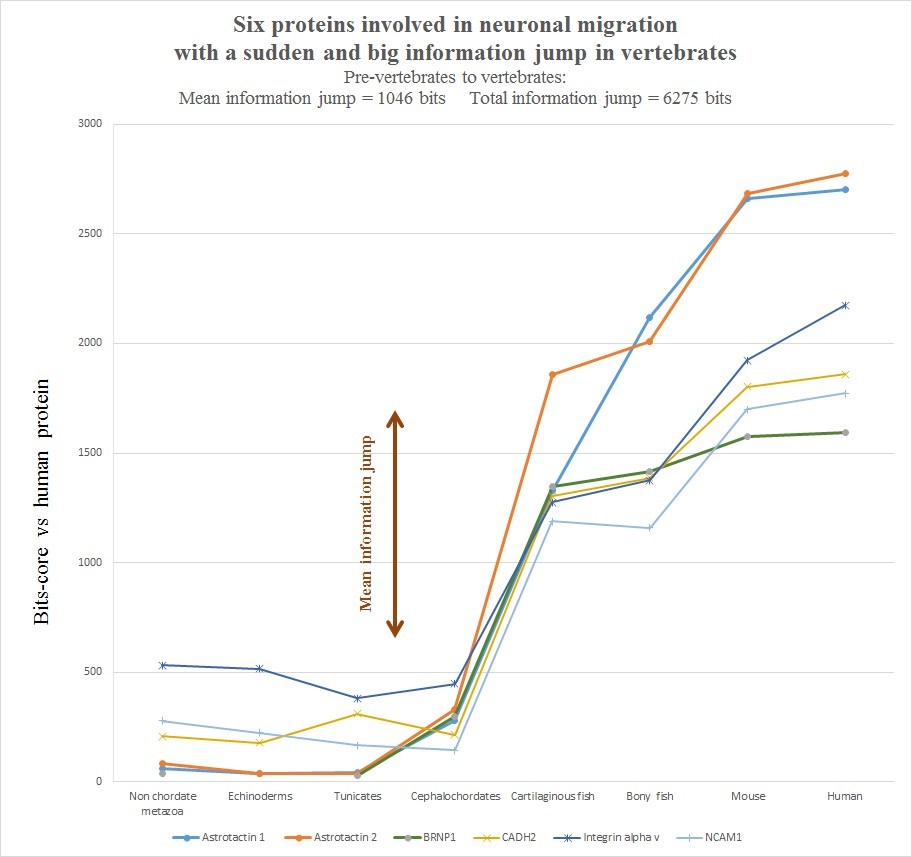
  • All those six proteins present a very big informarion jump between pre-vertebrate organisms and the first vertebrates

The evolutionary history of those six protein is summarized in the following graph, realized as usual by computing the best homology bit score with the human protein in different groups of organisms.
Neuron_migration

Very briefly, all the six human molecules have low homology with pre-vertebrates, while they already show a very high homology  in cartilaginous fishes. The most striking example is probably Astrotactin 2, which presents the biggest jump from cephalochordata (329 bits) to cartilaginous fishes (1860 bits), for a great total of 1531 bits of jump! The range of individual jumps in the group is 745 – 1531 bits, with a mean jump of 1046 bits per molecule and a total jump of 6275 bits for all six molecules. The jump has always been computed as the difference between the best bit score in cartilaginous fishes and the best bitscore in all pre-vertebrate metazoa. We can also observe that the first three proteins have really low homology with everything up to tunicates, but show a definite increase in Cephalochordata, which precedes the big jump in cartilaginous fishes, while the other three molecules have a rather constant behaviour in all pre-vertebrate metazoa, with a few hundred bits of homology, before “jumping” up in sharks. One could ask: is that a common behaviour of all proteins? The answer is no. Look at the following graph, which shows the same evolutionary history for two other proteins, both of them very big regulatory proteins, both of them implied in the same processes as the previous six.
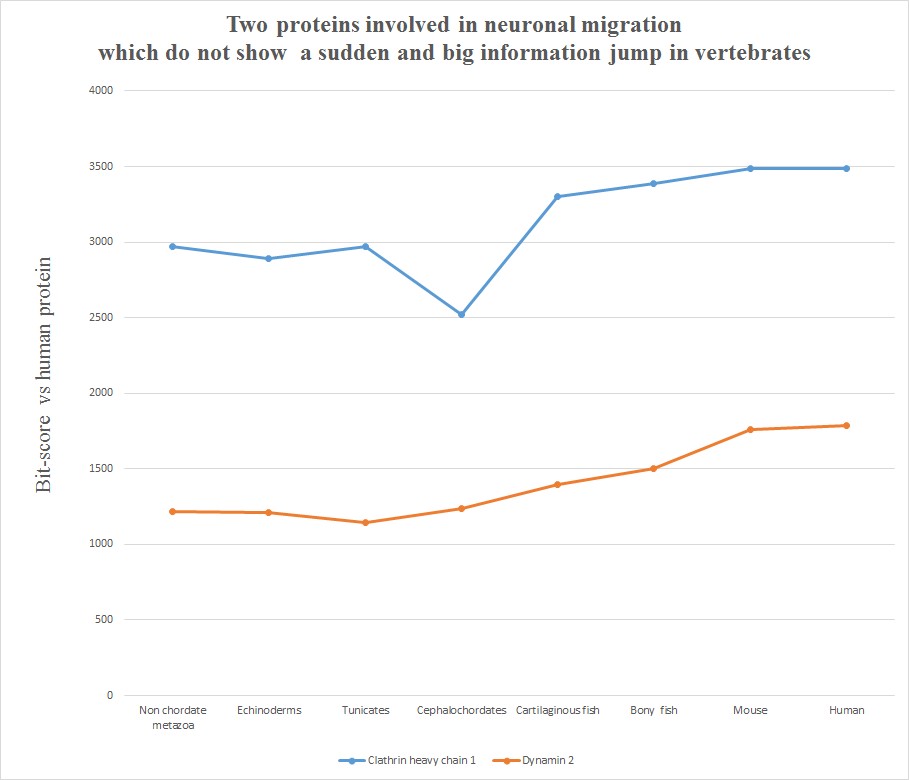
Neuron_migration2

Here, the behaviour is completely different. While there is a slight increase of homology in time, with a few smaller “jumps”, there is nothing comparable to the thousand bit jumps in the first six molecules. IOWs, these two molecules already show a very high level of homology to the human form in pre-vertebrates, and change only relatively little in vertebrates. We can say, therefore, that most of the functional information in these two proteins was already present before the transition to vertebrates.

So, to sum up:

  • a) The six proteins analyzed here all exhibit a huge informational jump between pre-vertebrates and vertebrates. The total functional informational novelty for just this small group of proteins is more than 6000 bits, with a mean of more than 1000 bits per protein.
  • b) These proteins are probably crucial agents in a much more complex regulation network implied in neuron adhesion, endocytosis, migration, and in the end in the vast developmental process which makes individual neurons migrate to their specific individual locations in the vertebrate body plan.
  • c) The above process is certainly much more complex than the six proteins we have considered, and implies other proteins and obviously many non coding elements. Our six proteins, therefore, can be considered as a tiny sample of the general complexity of the process, and of the informational novelty implied in the process itself.
  • d) Moreover, the process regulating neuron migration is certainly strictly integrated, with so many agents working in a coordinated way. Therefore, there is obviously a strong element of irreducible complexity implied in the whole informational novelty of the vertebrate process, an element that we can only barely envisage, because we still understand too little.
  • e) The neuron regulation process, of course, is only a part of the informational novelty implied in vertebrates, a small sample of a much more complex reality. For example, there is a lot of similar novelty implied in the workings of the immune system, of the cytokine signaling system, and so on.
  • f) The jump described here is really a jump: there is no trace of intermediate forms which can explain that jump in all existing pre-vertebrates. Of course, neo darwinists can always dream of lost intermediates in extinct species. This is a free world.
  • g) Are these 6000+ bits of functional information really functional? Yes, they are. Why? because they have been conserved for more than 400 million years. Remember, the transition we have considered happens between the first chordates and cartilaginous fish, and it can be traced to that range of time. And those 6000+ bits are bits of homology between cartilaginous fish and humans.
  • h) How much is 6000 bits of functional information? It is really a lot! Remember, Dembski’s Universal Probability Bound, taking in consideration the whole reasonable probabilistic resource of our whole universe from the Big Bang to now, is just 500 bits. 6000 bits correspond to a search space of 2^6000, IOWs about 10^2000, a number so big that we cannot even begin to visualize it. It’s good to remind ourselves, from time to time, that we are dealing with exponential values.
  • i) How great is the probability that 6000 bits of functional information can be generated in a window time of less than 100 million years, by some unguided process of RV + NS in six objects connected in an irreducibly complex system, even if RV were really helped by some NS in intermediates of which there is no trace? The answer is simple: practically non existent.
  • j) Therefore, the tiny sample of six proteins that we have considered here, which is only a small part of a much bigger scenario, points with extreme strength to a definite design inference:

The transition to vertebrates was a highly engineered process. The necessary functional information was added by design.

Comments
To all: Just a simple ackowledgement. After a couple of days, there is still no pertinent comment from the other side about the content of the OP. I am obviously grateful to CLAUDIUS and ellazimm for constructively joining the discussion, but I think that they would be the first to admit that their arguments, valid or not that they are, have nothing to do with the specifics of the OP. We could well say that they are not even "peripherally pertinent", in that regard. So, I will try again to emphasize what, in my OP, could perhaps deserve some discussion, kindly or not, aggressive or not, constructive or not. My title is: "The highly engineered transition to vertebrates: an example of functional information analysis". OK, I think there are two different things at issue here. "The highly engineered transition to vertebrates" refers to a specific design inference, based on the data proposed in the OP. Here, the arguments presented by CLAUDIUS and ellazimm are maybe pertinent, but really peripherally. Indeed, they have kindly offered basic objections to any design inference for biology, and not to my specific inference. The arguments they used (God of the gaps, and similar) would refute any such inference, whatever the motivations of the inference itself. OK, let's go to the second part of the title, which IMO is probably the most relevant: "an example of functional information analysis" Now, this is potentially more interesting. Functional information analysis? An example? Am I kidding? Have I succeeded, or am I completely out of my mind? In either case, some discussion could help. After all, we have been hearing for years, from the other side, that CSI and dFSCI are frauds, false concepts, logical fallacies, circular reasonings, you say it. Now, this foolish IDist (or IDiot, as you prefer) posts an "example" of "functional information" analysis!!! And nobody says a word (from the other side, I mean). And I think: how many times have we been requested to show how the concept of CSI, or dFSCI, could be applied to a real context? Well, right or wrong, this is a real context. Is it wrong? OK, I am here to listen: this is wrong because... I apologize for these (maybe too personal) considerations, but I thought that some of these things had to be said.gpuccio
July 22, 2016
July
07
Jul
22
22
2016
03:00 AM
3
03
00
AM
PDT
J-Mac, Dionisio: Thank you for contributing to criticism of the "God of the gaps" argument. A few more thoughts on the issue. A gap of knowledge is always the origin of scientific understanding. Science arises because our consciousness is intuitively motivated to understand the things that it does not understand. Hence science, and indeed all cognition, arise. So, there is nothing wrong in gaps of knowledge. Any argument against gaps is indeed an argument against science itself. So, I suppose that, as we could expect, the problem lies in the "God" part. We can have gaps, we can have theories to try to explain them. The important thing is to keep "God" out of that, because then it's no more science. OK, I am fine with that. But I would call that "methodological avoidance of the concept of God", rather than "methodological naturalism". At least, that would be a more meaningful name. But my problem is: when have I used the name, or concept, of God in mt reasoning? Maybe it's my old age, but I don't remember doing that! I have inferred the existence of a designer of biological information, not a transcendent creator of everything. So, we have a "designer of the gaps" argument. Well, is that a problem? Let's see. We already agree that there is no problem in using a gap of knowledge to build an explanatory theory. All science does exactly that. Is the problem in the concept of a conscious designer? I can't see why. Conscious designers exists, ans we know that conscious designers design objects which exhibit great quantities of dFSCI. Great quantities of dFSCI are exactly what is observed in my OP. So, it seems rather "natural" to use the concept of a conscious designer to explain what is observed. So, where is the problem? It's simple. Our friends cannot accept the hypothesis that in reality there may be conscious agents who could design biological objects. OK, but why? They say: we have never observed that kind of conscious agents. Let's concede that (I am not sure it is exactly true, but that's another story). But I ask: are you really sure that we have observed all that exists in reality? Few people would really answer yes to that question even among the most convinced devotees of scientism. But we can observe the results which point to a conscious designer: dFSCI in biological objects. That's what the OP is about. So, if we can reasonably infer the existence of dark energy from its effects, even if we have no idea of what it is, why can't we reasonably infer the existence of a biological designer, even if we don't know who he is (or they are)? The answer is simple, and disappointing: because the idea of a biological designer is too similar to the idea of a God. With dark energy, we are still more safe (at least for the moment). After all, there is energy in the name, and energy is somewhat reassuring. Even the "dark" is not bad: it sounds more like Star Wars than religion. So, I have a proposal: why can't we call ID the inference to a "Conscious dark energy designer of biological information"? Maybe we could find a way to a truce with our interlocutors, after all! :)gpuccio
July 22, 2016
July
07
Jul
22
22
2016
02:39 AM
2
02
39
AM
PDT
J-Mac: What gaps are you talking about here when referring to the “God of the gaps”? Are you talking about minuscule, insignificant gaps of knowledge that Darwinians that are about to be resolved? No way. You are talking about a chasm (s) of plausibility that Darwinists have not been able to bridge.
Indeed. And it is not the case that theses gaps are embedded in coherent materialistic explanations for other aspects of the organism. The “gaps” which are pointed out here are the ones that can be backed up by calculations. It is, in fact, the case that materialism cannot accommodate life at all. We are not talking about gaps in understanding; we are talking about a theory that is utterly incompatible with life. According to any materialistic explanation of life, there are only particles which create the illusion of one thing — the organism. However, in reality, instead of an organism, there is nothing over and beyond blind particles bumping into each other. IOWs there is, in fact, not one thing. Given materialism, there is nothing that wants to live, struggles to survive and/or organizes its parts. Yet the unfounded, incompatible idea that organisms want to live — struggle to survive — has great force in the materialistic Darwinian narrative. Darwinism assumes, without any basis, that an organism is compatible with materialism and uses it at a starting point of a "materialistic" explanation. Materialism holds that only fermions and bosons exist, organisms are and do things that don’t fit that picture. Given fermions and bosons why would there be organisms? Essentially, materialism needs to explain how intricate flexible coherence — the viability of an organism — can exist at levels above and beyond fermions and bosons. Producing such a materialistic explanation, bottom-up from the level of fermions and bosons, is a daunting task indeed. But, to be clear, organisms can never be a starting point of any materialistic explanation. One cannot assume what needs to be explained.
How can living systems be so robust (dynamically stable), when they consist of thousands of chemical interactions that must all be coordinated precisely in time and space? From the point of view of physics, cells (not to speak of more complex organisms) should not exist, and yet they do. How is that possible? http://jamesabarham.com/my-blog/33-seeing-past-darwin-i
Origenes
July 22, 2016
July
07
Jul
22
22
2016
12:42 AM
12
12
42
AM
PDT
J-Mac @82-83 You've asked a valid question. gpuccio, UB, and other nice folks here evidently dislike any knowledge gaps. One can tell by their interest in learning and sharing what they've learned. The 'gods of the gaps' is a figment in some people's minds. The real God is the God of he entire show, as professor John Lennox have said.Dionisio
July 21, 2016
July
07
Jul
21
21
2016
09:24 PM
9
09
24
PM
PDT
I remember one very, very wise man once told me: "If you were the designer of a masterpiece and someone else was taking credit for it, how long would you wait to expose it if you had the power to do it even though you had an eternity to wait?" 150 years might seem like a long time from human prospective that is limited by time. Is it a lot for Someone who is not restricted by time?J-Mac
July 21, 2016
July
07
Jul
21
21
2016
04:14 PM
4
04
14
PM
PDT
What gaps are you talking about here when referring to the "God of the gaps"? Are you talking about minuscule, insignificant gaps of knowledge that Darwinians that are about to be resolved? No way. You are talking about a chasm (s) of plausibility that Darwinists have not been able to bridge. Being positive about it or critical of those who point them out doesn't change a thing. The good thing is that ordinary public is well informed and pretty educated now and they are not going to be bullied into believing that if something is "called science" it is actually science.J-Mac
July 21, 2016
July
07
Jul
21
21
2016
04:07 PM
4
04
07
PM
PDT
EugeneS: Well said! :)gpuccio
July 21, 2016
July
07
Jul
21
21
2016
07:12 AM
7
07
12
AM
PDT
Actually, dismissing intelligence from science as genuine causation is absurd because science itself is an intelligent enterprise. Intelligence is written all over it. This is why we see drastic departure from reason in the recent attempts to reconcile materialism with contemporary science. This departure comes in different forms: the multiverse, denial of fine tuning and of the objectivity of design detection.EugeneS
July 21, 2016
July
07
Jul
21
21
2016
06:39 AM
6
06
39
AM
PDT
Origenes: OK, I perfectly agree. Thank you again. :)gpuccio
July 21, 2016
July
07
Jul
21
21
2016
01:46 AM
1
01
46
AM
PDT
GPuccio @75, I'm no fan of the the alien hypothesis either. However, post #74 is about protecting the design inference from the tiresome objection that intelligence can only be human. We've been told again and again by atheists how irrational it is to hold that we are alone in the universe. They conveniently forget about that when they argue against ID.
Neil deGrasse Tyson: Ordinarily, there is no riskier step that a scientist (or anyone) can take than to make sweeping generalizations from just one example. At the moment, life on Earth is the only known life in the universe, but there are compelling arguments to suggest we are not alone. Indeed, most astrophysicists accept a high probability of there being life elsewhere in the universe, if not on other planets or on moons within our own solar system. The numbers are, well, astronomical: If the count of planets in our solar system is not unusual, then there are more planets in the universe than the sum of all sounds and words ever uttered by every human who has ever lived. To declare that Earth must be the only planet in the cosmos with life would be inexcusably egocentric of us.
Origenes
July 21, 2016
July
07
Jul
21
21
2016
01:30 AM
1
01
30
AM
PDT
ellazimm at #72: "It has already happened that a signal has been received that, at first, was considered to come from an intelligent source. And it was examined and scrutinised and analysed. And a non-intelligent source was discovered. Something as important as non-terrestial intelligence will be heavily examined before acceptance. When science examines the claims of ID proponents that a non-human intelligence has been ‘detected’ then those claims are not upheld. Your case has not yet been proven. You need to do more work." I really think that you should make up your mind! :) It's one of the two. Either: 1) Your argument is that no amount of evidence for design in biological beings will ever do, because we know of no possible designers who are not physical beings on our planet. Or: 2) Your argument is that we have not presented enough evidence that "non-human intelligence has been ‘detected’", and we need to do more work. But how can you say that, if you have said absolutely nothing about the evidence presented, for example in this OP? If your position is the second one, please take your responsibilities, do your homework, and make some specific comment or criticism about the evidence presented.gpuccio
July 21, 2016
July
07
Jul
21
21
2016
12:06 AM
12
12
06
AM
PDT
ellazimm at #71: Well, another post and still no comments about any of the specific arguments in the OP. That's really good! :) But... We learnt that "of course" you "don’t only discuss things with people who haven’t made up their mind." That's real progress. And: you "consider your entire argument, including your original post, a god-of-the-gaps argument". OK, that's a really amazing point, never heard of it before. :) And: you "consider my comments at least peripherally pertinent". OK, my sincere compliments here. "Peripherally pertinent" is brilliant. I am serious here! Now, a more interesting point: Me (to CLAUDIUS): "you believe that only physical beings can be conscious, and I don’t have that prejudice." You: "Why is that a prejudice? What evidence do you have for your view?" OK, shall I state the obvious? The nature of consciousness is one of the biggest cognitive problems in the history of human thought. The idea that consciousness arises from the physical body is only one of the many theories about the nature of consciousness. Although many devotees of scientism accept it as a dogma today, there are a lot of reason to refute that position. And we have discussed those reasons many times here. Whatever you can believe, you should agree that there is at present no final truth about that important point, and you should acknowledge that many thinkers, religious or not, do believe that consciousness is an independent principle that cannot be explained in terms of physical configurations. That's why I say, with good reason, that believing that "only physical beings can be conscious" is a prejudice in a scientific discussion. If you prefer, we can say that is is a specific world view, certainly not shared by all, probably not shared by most. So, my point is that we have to remain flexible about the nature of consciousness and of possible conscious agents. If you look at a scientific problem like the nature of dFSCI and of its expression in biological beings with the caveat that only explanations compatible with your personal world view about consciousness can be accepted, that's a prejudice.gpuccio
July 21, 2016
July
07
Jul
21
21
2016
12:00 AM
12
12
00
AM
PDT
Origenes: "I don’t agree. Why can’t it be the case that conscious alien vertebrates designed life on earth — ‘Venters’ from space?" You are correct, in principle. But I have never been a great fan of the alien hypothesis, although it is a perfectly correct scientific hypothesis and ID hypothesis. As I assumed that CLAUDIUS too was not sponsoring that kind of solution, I just agreed with him on something about which we had a similar view. But your observation is epistemologically impeccable, thank you for making it.gpuccio
July 20, 2016
July
07
Jul
20
20
2016
11:43 PM
11
11
43
PM
PDT
CLAVDIVS, gpuccio.
CLAVDIVS: The observable origin of all complex functional information is from the conscious processes of humans (and some other animals) who are vertebrates. You cannot therefore argue, by analogy as you say, that the complex functional information in vertebrates comes from the conscious processes of vertebrates – because this is absurd.
gpuccio: Of course.
Why can’t it be the case that conscious alien vertebrates designed life on earth — ‘Venters’ from space? One may object that this hypothesis doesn’t offer an ultimate explanation for life in the cosmos, but science doesn’t concern itself with ultimate explanations.
CLAVDIVS: Your argument must be that the complex functional information in vertebrates comes from non-vertebrate consciousness.
Not so. The design inference works, even under the restrictive view that intelligence can only spring from vertebrate consciousness. IOWs CLAVDIVS does not present a valid counter-argument.Origenes
July 20, 2016
July
07
Jul
20
20
2016
11:39 PM
11
11
39
PM
PDT
When science examines the claims of ID proponents that a non-human intelligence has been ‘detected’ then those claims are not upheld.
Yes they have. Both IC and dFSCI (and all of their children) have been upheld, without exception.
We just have no evidence it has happened.
Except for all the observations you cannot explain without intelligent action. Has this not occurred to you?Upright BiPed
July 20, 2016
July
07
Jul
20
20
2016
11:16 PM
11
11
16
PM
PDT
UP
That quality is intelligence. It’s a real thing. What in the world makes you think you can remove it from science just because humans have it? And let us not forget, science keeps a little caveat on the side for intelligence whenever it wants to evoke it for its own projects. If we receive a narrow-band radio signal from across the cosmos, these little attempts to dismiss intelligent action as a legitimate observable will suddenly disappear. And if we find semantic content encoded in that signal there won’t be a doubt in anyone’s mind. Encoded semantic content just doesn’t occur without intelligent action.
It has already happened that a signal has been received that, at first, was considered to come from an intelligent source. And it was examined and scrutinised and analysed. And a non-intelligent source was discovered. Something as important as non-terrestial intelligence will be heavily examined before acceptance. When science examines the claims of ID proponents that a non-human intelligence has been 'detected' then those claims are not upheld. Your case has not yet been proven. You need to do more work.
Will you be calling for an end to the war on the legitimate design inference in biology (based on universal evidence) or will you support the continued avoidance of that evidence because – if we take your objection at face value — you cannot conceive of an intelligent vertebrate forming anywhere else but on Earth?
We can conceive of it. (And he didn't say it had to be a vertebrate, read his comment again.) We just have no evidence it has happened.ellazimm
July 20, 2016
July
07
Jul
20
20
2016
10:56 PM
10
10
56
PM
PDT
gpuccio, Of course I don't only discuss things with people who haven't made up their mind. But my experience on this forum is that ID supporters are generally firmly entrenched and will not acknowledge even a small problem with their views. In that light I am less and less interested in pursuing discourse in this venue.
I suppose that, in that context, God is just some being that we can refer to to fill the gaps. That’s a rather precise concept, for me. I did not mean that all the aspects of the idea of God are precise, or shared by all religious people.
I don't think 'some being' that can fill the gaps is precise.
Now, just answer a very simple question: what pertinent comment have you made about my OP in your post #58?
Since I consider your entire argument, including your original post, a god-of-the-gaps argument and I'm quite sure after years of reading your posts and comments that you won't change your mind then I consider my comments at least peripherally pertinent.
you believe that only physical beings can be conscious, and I don’t have that prejudice.
Why is that a prejudice? What evidence do you have for your view? And, as has been pointed out, you have no experience of intelligent agents other than those who have existed on this planet. But you allow a powerful one in through the back door when you look at a gap in current scientific knowledge. You can't logic up God.ellazimm
July 20, 2016
July
07
Jul
20
20
2016
10:46 PM
10
10
46
PM
PDT
2 points
Your first point appears to be nothing more than another useless attempt to control what can be considered evidence. These little chestnuts of materialist’ defense have gone on for so long we may legitimately ask the question – will materialist ever be able to defend their creation myth with actual science and reasoning? There is a single observable quality on record that is capable of producing the effects in question. That quality is intelligence. It’s a real thing. What in the world makes you think you can remove it from science just because humans have it? And let us not forget, science keeps a little caveat on the side for intelligence whenever it wants to evoke it for its own projects. If we receive a narrow-band radio signal from across the cosmos, these little attempts to dismiss intelligent action as a legitimate observable will suddenly disappear. And if we find semantic content encoded in that signal there won’t be a doubt in anyone’s mind. Encoded semantic content just doesn’t occur without intelligent action. If you need to demand that any intelligence that originated the encoded information in the cell must have been a vertebrate – then knock yourself out. It would be a refreshing change from the materialist’ hackneyed bromides about dismissing intelligence from science. The inconsistencies would at least be less embarrassing. As for your second point, it accomplishes as little as your first. I don’t know if you’ve noticed, but the materialist ideology hasn’t produced one iota of observation that supports a non-intelligent origin of encoded semantic content – the d in GP’s dFSCI. On the contrary, the d in dFSCI can be exclusively identified by its physical organization, yet with the exception of a few non-conformists (mostly in Europe), the remainder of biology doesn’t even give it a thought. It’s a hoot! The very center of the problem – which absolutely must be resolved -- is virtually ignored, while the public is fed the possibility of life on some distant planet because a particular chemical substance might be found there. Instead of simultaneously asking for something new while you cleverly overlook what is already known, perhaps you might rethink your position. Will you be calling for an end to the war on the legitimate design inference in biology (based on universal evidence) or will you support the continued avoidance of that evidence because – if we take your objection at face value -- you cannot conceive of an intelligent vertebrate forming anywhere else but on Earth?Upright BiPed
July 20, 2016
July
07
Jul
20
20
2016
10:43 PM
10
10
43
PM
PDT
CLAVDIVS: Ah, and even of your contribution to the discussion is reasonable and constructive, still you must admit that you have not yet said anything about the arguments presented in the OP. Do you agree with what I say, even if not with the final design inference? Do you accept that the facts presented there defy any explanation by the currently accepted theory?gpuccio
July 20, 2016
July
07
Jul
20
20
2016
10:10 PM
10
10
10
PM
PDT
CLAVDIVS: I appreciate your good will in the discussion, but I have to dissent: "The observable origin of all complex functional information is from the conscious processes of humans (and some other animals) who are vertebrates." OK. "You cannot therefore argue, by analogy as you say, that the complex functional information in vertebrates comes from the conscious processes of vertebrates – because this is absurd." Of course. "Your argument must be that the complex functional information in vertebrates comes from non-vertebrate consciousness." My argument is that complex functional information, either in vertebrates or anywhere else, comes only from conscious representation. While that is an empirical observation which has no exceptions (no systems exists which can generate dFSCI without any conscious intervention), it has also an obvious explanation: only the conscious experiences f understanding and purpose can overcome the probabilistic barriers intrinsic in dFSCI. So, my argument, which is ID argument, is simple, strong, rational and beautiful. "But non-vertebrate consciousness has never been observed to produce complex functional information." This is a very wrong way to put it. Let's say that we have experience of consciousness in living physical beings, and of conscious intelligent consciousness which can easily generate dFSCI only in humans. Therefore, our inferences about consciousness come obviously from our observations of consciousness in humans. That's very reasonable: we get information from what we know. The point is: you believe that only physical beings can be conscious, and I don't have that prejudice. That comes obviously from different world views. I am OK with that, but again the point is: 1) There is a strong and obvious inference by analogy which is commanded by observed facts and good reason: the design inference for biological information. 2) You refute it only in name of your personal world view. 3) I accept it, not because it is compatible with my personal world view (it is), but rather because it is a strong and obvious inference by analogy which is commanded by observed facts and good reason, and of course I have no prejudice in my world view which prevents me from accepting what is obvious and rational. So, who is biased here? You say: "You’re just pointing to gaps in our knowledge, which we already know about, and asking more questions." No, I am pointing to facts: those six molecules, and not others, present a sudden and important generation of specific dFSCI. This is not a gap. As far as I know, it is not even something we "already knew about": can you please point to some paper which had already said that? And of course I am asking more questions: that's the beauty of science. The more we know, the more new questions we can ask. That's how our knowledge grows. Only error and bias are science stoppers, and kill the true questions instead of revealing them.gpuccio
July 20, 2016
July
07
Jul
20
20
2016
10:07 PM
10
10
07
PM
PDT
gpuccio
1) ID theory is not about a gap in our understanding. ID theory is about the observable origin of all complex functional information from conscious processes. ... What we are saying is: OK, there is this thing which is dFSCI, and we can observe that it comes always from conscious processes.
2 points. First: The observable origin of all complex functional information is from the conscious processes of humans (and some other animals) who are vertebrates. You cannot therefore argue, by analogy as you say, that the complex functional information in vertebrates comes from the conscious processes of vertebrates - because this is absurd. Your argument must be that the complex functional information in vertebrates comes from non-vertebrate consciousness. But non-vertebrate consciousness has never been observed to produce complex functional information. Your argument from analogy thus undermines itself and fails. Second: I asked "... even if your argument is accepted as correct, it does not reveal to us anything we did not already know. If you disagree, can you tell me what new things we learn by accepting your argument?" Your response makes my point: you still have not told us any new things we learn from accepting your argument. You said:
Yes, I disagree. As I have tried to point out in my post #52, my humble and simple reasonings offer some interesting proposals. I have tried to identify definite places and times where a lot of functional information appears rather suddenly. I have described different behaviours of similar proteins with regard to their informational content. Just forget for a moment the problem of the designer. Just accept for a moment that what we can see in natural history is a series of rather sudden generation of complex functional information, and that the current theory of RV + NS can in no way explain those facts, indeed can only sidetrack our reasonings. Now, who is the designer is not the only interesting question. There are many other important questions, if you start reasoning in terms of intentional design and functional information. For example, what is the purpose of the new information. What is the general plan, or plans, that we can observe. That can really help to see and understand things, while the sterile attempt to explain them by a theory which cannot explain them can only, in the end, be a source of ignorance and error.
You're just pointing to gaps in our knowledge, which we already know about, and asking more questions. I want you to tell me something new, that we didn't know before, that results from your argument. Otherwise, what's the point?CLAVDIVS
July 20, 2016
July
07
Jul
20
20
2016
08:11 PM
8
08
11
PM
PDT
@54 let's restate this once more:
This excellent OP clearly points to the undeniable fact that substantial amounts of complex specified information appear to be added to the referred proteins within a relatively short biological time interval. Some interlocutors may express their dissatisfaction with the logical conclusions derived from this OP. That’s fine. They have the right to believe whatever they want. But people’s beliefs don’t change the evidences that point to reality. Note that even figuring out how the complex specified information got added to those proteins won’t take us far from the starting point on the way to fully understand the whole enchilada of the development process of biological systems.
See the serious "evo-devo" issue presented @54 As gpuccio and other ID proponents have stated, conscious design appears to be the only known source (so far) of functional specified complex information. But they politely ask: if anyone is aware of another source, what is it? Now, let's make this clear: It's obvious to any seriously thinking person reading this blog, that ID proponents stop short of trying to identify the conscious designer. They try hard to keep their biology-related discussions within the strict domain of biology. Nothing less. Nothing more. Our beloved Italian doctor gpuccio is an excellent example of this. His highly insightful and always welcome OPs and follow-up comments don't leave any doubts about him being a strong ID proponent. Why do I refer to the ID-proponents as "they"/"them" instead of "we"/"us"? Well, simply because I'm not an ID proponent. Why? Because I'm always willing to publicly admit that the ultimate reality is summarized in the first few verses of the 4th book in the Christian Bible New Testament. Hence, I believe that I know the identity of the Designer, because I believe He has revealed Himself in both: 1. the whole Creation (His General Revelation) which we observe in awe and study meticulously and 2. the Holy Scriptures (His Special Revelation to His chosen people). That's all. That simple. As y'all can see, I'm disqualified to be counted among the ID proponents. However, I like and enjoy reading some of the ID propositions, which I see very serious and definitely scientific. Theologically speaking gpuccio and I might be on different pages. I really don't know. But I enjoy reading what he writes here and look forward to reading his future OPs and comments. Perhaps that's why this blog literally seems like a very colorful philosophical/theological 'eintopf'! After all, science can be done by people with different worldviews. Different Nobel Prizes in sciences have been given to atheists, agnostics, Jews, Christians, etc. Now, all that said, let's get back to the discussion topic initiated by gpuccio's excellent OP. Thank you.Dionisio
July 20, 2016
July
07
Jul
20
20
2016
05:22 PM
5
05
22
PM
PDT
gpuccio After reading your posts @52-53 I warned @55:
it seems like you have turned up the thermostat in this discussion thread
Well, now we know that it did work! :) The 'polite dissenters' have jumped into the 'arena'! Apparently you've removed the 'boring' aspects of this discussion? :)Dionisio
July 20, 2016
July
07
Jul
20
20
2016
04:11 PM
4
04
11
PM
PDT
gpuccio @62
We don’t know what dark energy is, and yet it is at the center of all scientific discussions. Just to give an example.
We've used the empirical effects of gravity and electromagnetism very productively for many years, but do we really understand exactly what gravity and electromagnetism are and their origin? :)Dionisio
July 20, 2016
July
07
Jul
20
20
2016
03:59 PM
3
03
59
PM
PDT
gpuccio @53
The method I have applied, even if simpler and a little different, owes everything to the concepts developed by Durston et al. in this fundamental paper of 2007: Measuring the functional sequence complexity of proteins https://tbiomed.biomedcentral.com/articles/10.1186/1742-4682-4-47
Thank you for referring to that paper.Dionisio
July 20, 2016
July
07
Jul
20
20
2016
03:43 PM
3
03
43
PM
PDT
CLAVDIVS: "By ‘God-of-the-gaps’ I am referring to the form of the argument: * There is a gap in our understanding of the natural world * Therefore, the cause is supernatural" OK. My objections: 1) ID theory is not about a gap in our understanding. ID theory is about the observable origin of all complex functional information from conscious processes. IOWs, we are not saying: OK, there is this thing which is dFSCI, and we have no idea of how it comes into existence, so let's attribute it to God, or to some other supernatural cause!". No. Not at all. What we are saying is: OK, there is this thing which is dFSCI, and we can observe that it comes always from conscious processes. Can you see the difference? There is no gap here. Then an inference by analogy follows. But gaps have nothing to do with the reasoning, least of all gods and supernatural beings. ID is empirical. It is not a philosophy. It is science. 2) The "supernatural" aspect. You may know how hostile I am to the words "nature", "natural" and "supernatural". What are they supposed to mean? I can observe that Hamlet came from the conscious representations of Shakespeare. I see that this post comes from my conscious representations. Is Shakespeare supernatural? Am I supernatural? Let's say that, for some miracle, you (even if you have already made up your mins, see precious two posts :) ) accept for a moment that vertebrates were designed at some definite time of natural history. Does that make the event supernatural? You will say: but we know no "natural" designer who could have done that. OK, let's get rid of the "bad word". What remains is: but we know no designer who could have done that. And I say: OK, the designer must exist, because I infer him from the design. But you are right, we don't know him (or them). Where is the scandal? Do you really believe that we know all that exists? I don't. We don't know what dark energy is, and yet it is at the center of all scientific discussions. Just to give an example. Luckily, our knowledge is not a necessary condition for something to be real, otherwise the universe would have collapsed a lot of time ago. "Accordingly, even if your argument is accepted as correct, it does not reveal to us anything we did not already know. If you disagree, can you tell me what new things we learn by accepting your argument?" Yes, I disagree. As I have tried to point out in my post #52, my humble and simple reasonings offer some interesting proposals. I have tried to identify definite places and times where a lot of functional information appears rather suddenly. I have described different behaviours of similar proteins with regard to their informational content. Just forget for a moment the problem of the designer. Just accept for a moment that what we can see in natural history is a series of rather sudden generation of complex functional information, and that the current theory of RV + NS can in no way explain those facts, indeed can only sidetrack our reasonings. Now, who is the designer is not the only interesting question. There are many other important questions, if you start reasoning in terms of intentional design and functional information. For example, what is the purpose of the new information. What is the general plan, or plans, that we can observe. That can really help to see and understand things, while the sterile attempt to explain them by a theory which cannot explain them can only, in the end, be a source of ignorance and error.gpuccio
July 20, 2016
July
07
Jul
20
20
2016
03:27 PM
3
03
27
PM
PDT
Discuss them with biologists. Submit them to a journal. Discuss them at a seminar. Have an argument at a conference. It’s not hard to get your academic ideas addressed. You just have to be brave enough to take the reactions.
Who is this telling gpuccio what to do? I know gpuccio has coauthored medical papers in the official Journal of the American Academy of Pediatrics and perhaps other journals too. I have never published any paper, and most probably never will, except a few handwritten notes stuck to the refrigerator door as a reminder for grocery shopping. :) Hence, I'm not qualified to tell gpuccio what he should do with his time and knowledge. But I'm very glad gpuccio decided to write this OP and I look forward to reading his future OPs too. I'm sure other folks in this blog think similarly about this. Any person participating in this discussion but unwilling to at least understand gpuccio's clear message -though not necessarily agreeing with it- should consider going back to their natural habitat in the beautiful Norwegian fjords!Dionisio
July 20, 2016
July
07
Jul
20
20
2016
03:17 PM
3
03
17
PM
PDT
ellazimm: Well, second comment from the other side, and still strange "arguments". Let's see. "When you say ‘can never be explained’ then polite dissenters probably don’t see the point of discussion. It does sound like you’ve made up your mind." This is really bizarre. So, you and other "polite dissenters" don't feel any need to express your views, or explain the reasons of your dissent, simply because I have "made up my mind"? Is that your idea of communication, in science or anywhere else? You never debate with those who have some different idea, and are convinced of what they think? You only discuss with people who are unsure, or confounded? You know, I can have made up my mind, as I am sure you have too, and still we can reasonably and constructively confront our ideas. It happens. Sometimes. "Again, what is the point of raising objections when you are already convinced that you have falsified current explanations?" Maybe showing where I am wrong? You know, I think we come her, you and me and the others, not so much to convince our interlocutor, but rather to express our ideas by means of an intellectual confrontation with some valid interlocutor, so that other onlookers may "make up their mind". Are you really so discouraged only because you don't really hope to convince this foolish and obstinate guy? "It is also disappointing for someone to continually assume that some effect is impossible based on their interpretations of current theory." Should I make my assumptions based on your intepretation of current theory? Just to know. "Your knowledge or lack of knowledge nor my knowledge or lack of knowledge is not the point. The point is: what is the most parsimonious explanation, the one that matches most of the data AND requires the least amount of special pleading." I have a very definite idea of what the answer is. I also believe that you have "made up your mind" already. "Intelligent design frequently ignores much data and research..." What data and research? "..AND posits an undefined, undetected, uncommunicative and unknowable designer." ID posits that all complex functional information comes from some conscious intelligent agent. Defined or not. Detected or not. Communicative or not. Knowable or not. ID infers the intervention of a conscious designer, if you really want to use the correct verb. In ID theory, the designer is inferable. "That’s why it’s NOT the best explanation." Why am I not surprised of your conclusion? Ah, yes... You had probably made up you mind. "I’d love to hear your rather precise concept of ‘God’. And then I’d like to compare it to all the other concepts of ‘God’ that have existed throughout the ages." Well, we were referring to the "God of the gaps" idea. I suppose that, in that context, God is just some being that we can refer to to fill the gaps. That's a rather precise concept, for me. I did not mean that all the aspects of the idea of God are precise, or shared by all religious people. I can certainly agree with you that there are all sorts of different and often contrasting interpretations of the idea of God. But again, I was referring to "God of the gaps" versus "Nature of the gaps". You see, I am convinced that "nature" is really an ambiguous concept. You give me your definition, and we can discuss. If you have not already made up your mind, of course. :) "Fine. Discuss them with biologists. Submit them to a journal. Discuss them at a seminar. Have an argument at a conference. It’s not hard to get your academic ideas addressed. You just have to be brave enough to take the reactions." Why do all you guys want to tell me what I should do? I do what I like to do. I like to write on this blog. I try to do that at my best. I like to answer the comments of my interlocutors, especially those from the other side. When there are comments... Now, just answer a very simple question: what pertinent comment have you made about my OP in your post #58?gpuccio
July 20, 2016
July
07
Jul
20
20
2016
03:09 PM
3
03
09
PM
PDT
gpuccio By 'God-of-the-gaps' I am referring to the form of the argument: * There is a gap in our understanding of the natural world * Therefore, the cause is supernatural You have not specifically referred to God or supernatural causes in your argument, but neither have you ruled them out ... because you have not told us anything whatsoever about the design process or the designer. This is the pattern of most ID arguments, and it is indeed God-of-the-gaps reasoning. Accordingly, even if your argument is accepted as correct, it does not reveal to us anything we did not already know. If you disagree, can you tell me what new things we learn by accepting your argument? Regards CLAVDIVSCLAVDIVS
July 20, 2016
July
07
Jul
20
20
2016
02:51 PM
2
02
51
PM
PDT
gpuccio
Excuse me, I have pointed to objective patterns which, IMO, can never be explained by the current theories about evolution
When you say 'can never be explained' then polite dissenters probably don't see the point of discussion. It does sound like you've made up your mind.
You may disagree, but even if you don’t like the design paradigm, having definite objective and scientific patterns which falsify the current explanations that everybody seems to accept should get your attention anyway,
Again, what is the point of raising objections when you are already convinced that you have falsified current explanations?
Calling those concepts “God of the gaps arguments” will not solve the problem. I think I can expect something better from an intelligent person as you certainly are, something like: “No, look, your argument is wrong for this and that reason, and those patterns that you show in your post can easily be explained in this or that way”. The “God of the gaps” escape, frankly, is a little disappointing.
It is also disappointing for someone to continually assume that some effect is impossible based on their interpretations of current theory. Your knowledge or lack of knowledge nor my knowledge or lack of knowledge is not the point. The point is: what is the most parsimonious explanation, the one that matches most of the data AND requires the least amount of special pleading. Intelligent design frequently ignores much data and research AND posits an undefined, undetected, uncommunicative and unknowable designer. That's why it's NOT the best explanation.
However, while “God” is a rather precise concept, at least in its general meaning, I would say that “nature” and “naturalism” have no definite meaning at all, as I have argued many times.
I'd love to hear your rather precise concept of 'God'. And then I'd like to compare it to all the other concepts of 'God' that have existed throughout the ages.
OK, my point is simply: right or wrong, these ideas are scientific ideas, and deserve, IMO, to be addressed on a scientific plane, and not only with some philosophical attempt at denial.
Fine. Discuss them with biologists. Submit them to a journal. Discuss them at a seminar. Have an argument at a conference. It's not hard to get your academic ideas addressed. You just have to be brave enough to take the reactions.ellazimm
July 20, 2016
July
07
Jul
20
20
2016
02:33 PM
2
02
33
PM
PDT
1 6 7 8 9 10

Leave a Reply