Uncommon Descent Serving The Intelligent Design Community

L&FP, 63: Do design thinkers, theists and the like “always” make bad arguments because they are “all” ignorant, stupid, insane or wicked?

Categories
Logic and Reason
rhetoric
Share
Facebook
Twitter/X
LinkedIn
Flipboard
Print
Email

Dawkins’ barbed blanket dismissiveness comes up far too often in discussions of the design inference and related themes. Rarely, explicitly, most often by implication of a far too commonly seen no concessions, selectively hyperskeptical policy that objectors to design too often manifest. It is time to set this straight.

First, we need to highlight fallacious, crooked yardstick thinking (as exposed by naturally straight and upright plumb-lines). And yes, that classical era work, the Bible, is telling:

Notice, a pivotal point here, is self-evident truths. Things, similar to 2 + 3 = 5:
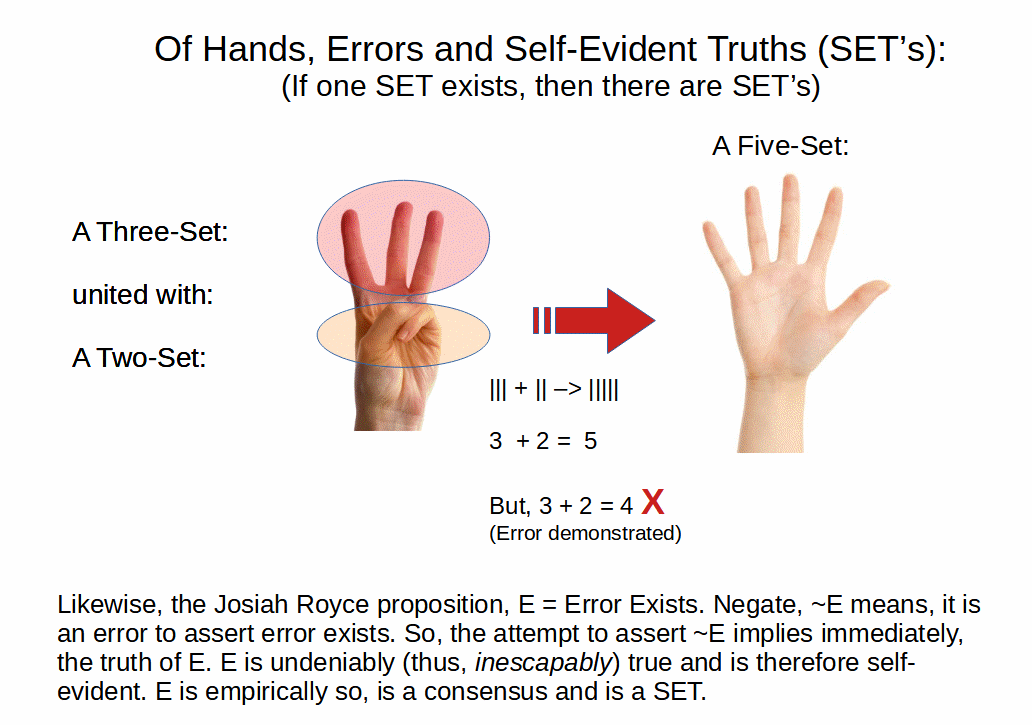
Notoriously, Winston Smith in 1984 is put on the rack to break his mind to conform to The Party’s double-think. He is expected to think 2 + 2 = whatever The Party needs at the moment, suppressing the last twisted answer, believing that was always the case, while simultaneously he must know that manifestly 2 + 2 = 4 on pain of instant absurdity. This is of course a toy example but it exposes the way crooked yardstick thinking leads to chaos:
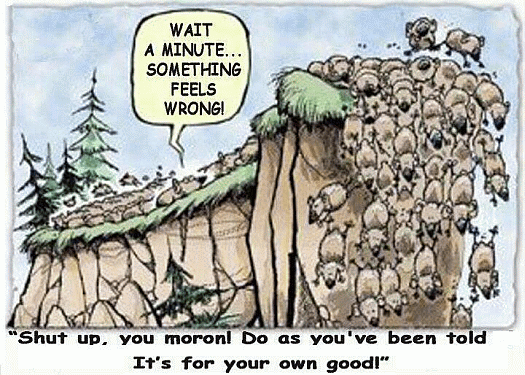
Of Lemmings, marches of folly and cliffs of self-falsifying absurdity . . .

(Yes, real lemmings do not act like that. But, humans . . . that’s a whole other story.)

So, now, let us turn to a recent barbed remark by one of our frequent objectors and my reply, laying out a frame of thought and inviting correction — dodged, of course:

KF, 120 in the Foundations thread: [[It is now clear that SG is unwilling to substantially back up the one liner insinuation he made at 84 above, try making a good argument. Accordingly, let me respond in outline, for record, to the general case, that people like us are ignorant, stupid, insane or wicked and the associated zero concessions, selectively hyperskeptical dismissiveness policy. Here, I will show the rational responsibility of the design inference and related ideas, views and approaches, for record and reference:

I will use steps of thought:

1: Reason, in general: Notice, supporters and fellow travellers of evolutionary materialistic scientism undermine the responsible, rational freedom required for reason to be credible. They tend to discount and discredit objectors, but in fact their arguments and assertions are self-referentially incoherent, especially reduction of mind to computationalism on a wetware substrate. Reppert is right to point out, following Haldane and others:

. . . let us suppose that brain state A [–> notice, state of a wetware, electrochemically operated computational substrate], which is token identical to the thought that all men are mortal, and brain state B, which is token identical to the thought that Socrates is a man, together cause the belief [–> concious, perceptual state or disposition] that Socrates is mortal. It isn’t enough for rational inference that these events be those beliefs, it is also necessary that the causal transaction be in virtue of the content of those thoughts . . . [But] if naturalism is true, then the propositional content is irrelevant to the causal transaction that produces the conclusion, and [so] we do not have a case of rational inference. In rational inference, as Lewis puts it, one thought causes another thought not by being, but by being seen to be, the ground for it. But causal transactions in the brain occur in virtue of the brain’s being in a particular type of state that is relevant to physical causal transactions.

2: This extends to Marx’s class/cultural conditioning, to Freud’s potty training etc, to Skinner’s operant conditioning , to claims my genes made me do it, and many more. So, irrationality and undermining of the credibility of reason are a general issue for such supporters and fellow travellers, it is unsurprising to see projection to the despised other (a notorious defence mechanism) and linked failure to engage self referentiality.

3: First principles of right reason: Classically, the core of reason starts with distinct identity, excluded middle, non contradiction. Something x is what it is i/l/o its core characteristics, nothing can be both x and not x in the same sense and circumstances, any y in W = {x| ~x} will be x, ~x, not both or neither. And more. Claimed quantum counter examples etc actually are rooted in reasoning that relies on such. And yes, there have been enough objections that this has come up and is in UD’s Weak Argument Correctives. We leave it to objectors like SG to tell us whether they acknowledge such first principles of right reason: _______ and explain why ________ .

4: Self evidence: There are arguments that, once we have enough experience and maturity to understand [a sometimes big if], will be seen as true, as necessarily true and as true on pain of immediate absurdities on attempted denial. That error exists is a good case in point, and if one is able to see that the attempt to deny objectivity of knowledge for a given reasonably distinct field of thought such as morals or history or reality [metaphysics], or the physical world, or external reality, or in general, etc, one is claiming to objectively know something about that field and so refutes oneself.

5: self referential incoherence and question begging: We just saw an example of how arguments and arguers can include themselves in the zone of reference of an argument in ways that undermine it, often by implying a contradiction. Such arguments defeat themselves. Question begging is different, it assumes, suggests or imposes what should be shown and for which there are responsible alternatives. Arguments can be question begging, and then may turn out to be self refuting.

6: Deduction, induction, abduction (inference to the best [current] explanation [IBE]) and weak-form knowledge: Deduction uses logical validity to chain from givens to conclusions, where if givens are so and the chain valid, conclusions must also be true. Absent errors of reasoning, the debate rapidly becomes one over why the givens. Induction, modern sense, is about degree of support for conclusions i/l/o evidence of various kinds as opposed to demonstration, statistics, history, science, etc are common contexts. Abduction, especially IBE, compares live option alternatives and what they imply, on factual adequacy, coherence and balance of explanatory power, to choose the best explanation so far. In this context weak sense common knowledge is warranted, credibly true (so, reliable) belief. Which, is open to correction or revision and extension.

7: Worldviews context: Why accept A? B. But why B? C, etc. We see that we face infinite regress, or circularity or finitely remote first plausibles . . . which, frame our faith points . . . as we set out to understand our world. Infinite regress is impossible to traverse in reasoning or in cause effect steps, so we set it aside, we are forced to have finitely remote start points to reasoning and believing, warranting and knowing — first plausibles that define our views of the world. Thus, we all live by faith, the question is which, why; so, whether it is rational/reasonable and responsible. Where, too, all serious worldview options bristle with difficulties, hence the point that philosophy is the discipline that studies hard, basic questions. Question begging circles are a challenge, answered through comparative difficulties across factual adequacy, coherence and balance of explanatory power: elegantly simple, neither ad hoc nor simplistic.

[Let’s add an illustration:]
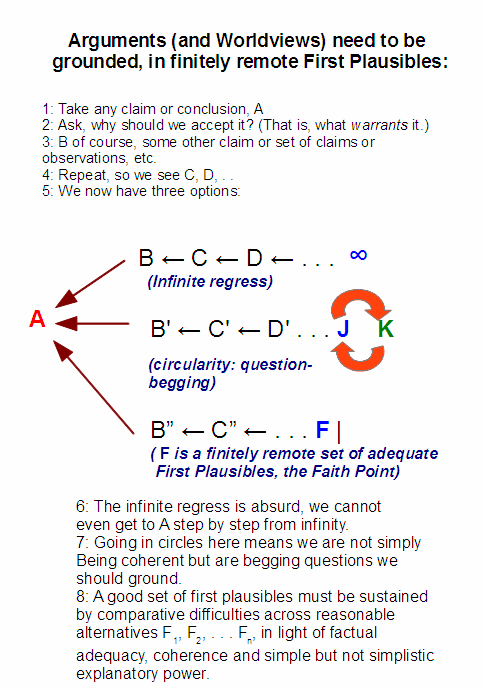
A summary of why we end up with foundations for our worldviews, whether or not we would phrase the matter that way}

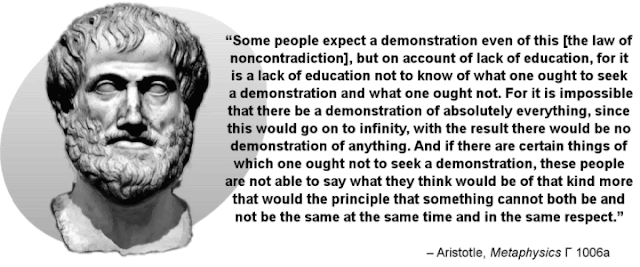
[or in Aristotle’s words:]

8: Failure of evolutionary materialistic scientism and fellow traveller views: It will be evident already, that, while institutionally and culturally dominant, evolutionary materialistic scientism and fellow travellers are profoundly and irretrievably incoherent. Yes, a view backed by institutions, power brokers in the academy, the education system and the media can be irretrievably, fatally cracked from its roots.

9: Logic of being (and of structure and quantity), also possible worlds: Ontology and her grand child, Mathematics, grow out of core philosophy, particularly distinct identity and consideration of possible worlds. A possible world, w, is a sufficiently complete description of how our world or another conceivable or even actual world is or may be; i.e. a cluster of core, world describing propositions. In that context, a candidate being or entity or even state of affairs, c, can be impossible of being [e.g. a Euclidean plane square circle] or possible. Possible beings may be contingent [actual in at least one possible world but not all] or necessary [present in every possible world]. We and fires are contingent, dependent for existence on many independent, prior factors; what begins or may cease of existence is contingent. Necessary beings are best seen as part of the fabric or framework for this or any possible world. We can show that distinct identity implies two-ness, thence 0, 1, 2. Ponder, W = {A|~A}, the partition is empty, 0, A is a unit, ~A is a complex unit, so we see 2. So, onward via von Neumann’s construction, the counting numbers N. Thence, Z, Q, R, C, R* etc in any w. This is what gives core Mathematics its universal power.

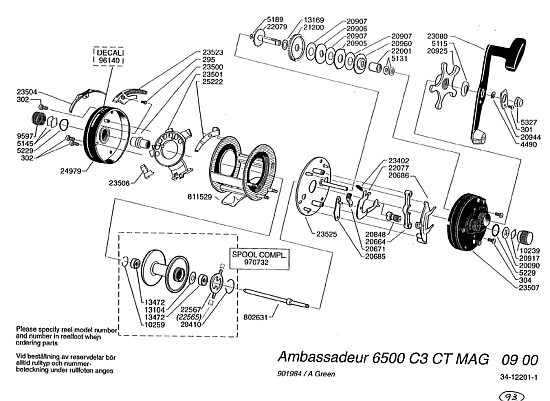
10: The basic credibility of the design inference: of course, we routinely recognise that many things show reliable signs of intelligently directed configuration as key cause, i.e. design. For example, objectors to the design inference often issue copious, complex text in English, beyond 500 to 1,000 bits of complexity. In the 70’s Orgel and Wicken identified a distinct and quantifiable phenomenon, functionally specific, complex organisation and/or associated information, which I often abbreviate FSCO/I. Organisation is there as things like a fishing reel [my favourite, e.g. the ABU 6500 CT] or a watch [Paley, do not overlook his self replicating watch thought exercise in Ch 2]
or an oil refinery or a computer program [including machine code]

Petroleum refinery block diagram illustrating FSCO/I in a process-flow system

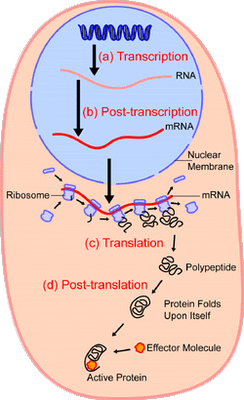
or the cell’s metabolic process-flow network [including protein synthesis]
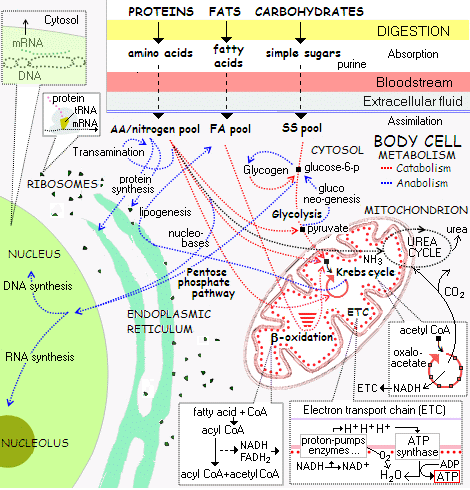
[with:]
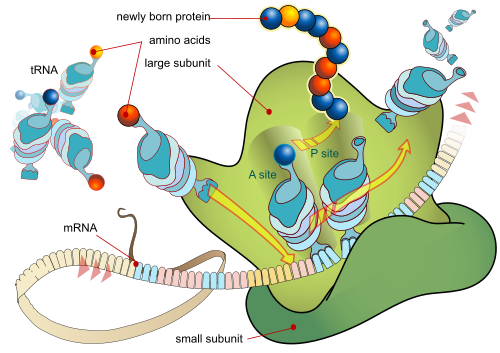
Step by step protein synthesis in action, in the ribosome, based on the sequence of codes in the mRNA control tape (Courtesy, Wikipedia and LadyofHats)

[and:]

all can be described in a suitably compact string of Y/N questions, structured through description languages such as AutoCAD. The inference posits that, with trillions of cases under our belt, reliably, FSCO/I or its generalisation, CSI, will be signs of design as key cause. The controversies, as may be readily seen, are not for want of evidence or inability to define or quantify, but because this challenges the dominant evolutionary materialism and fellow travellers. Which, of course, long since failed through irretrievable self referential incoherence.
_____________________

So, challenge: let SG and/or others show where the above fails to be rational and responsible, if they can__________________ Prediction, aside from mere disagreement and/or dismissiveness, assertions, or the trifecta fallacy of red herrings, led away to strawmen soaked in ad hominems and set alight to cloud, confuse, poison and polarise the atmosphere, they will not be able to sustain a case for general failure to be rational and responsible.]]

The good argument challenge is duly open for response. END

U/D, Nov 4: As it seems certain objectors want to attack the descriptive metaphor, islands of function amidst seas of non function, let me put up here a couple of infographics I used some years ago to discuss this concept. But first, as the primary contexts have to do with protein synthesis and OoL, let me first put up Vuk Nicolic’s video illustrating just what is required for protein synthesis:

. . . and Dr James Tour’s summary presentation on OoL synthesis challenges:

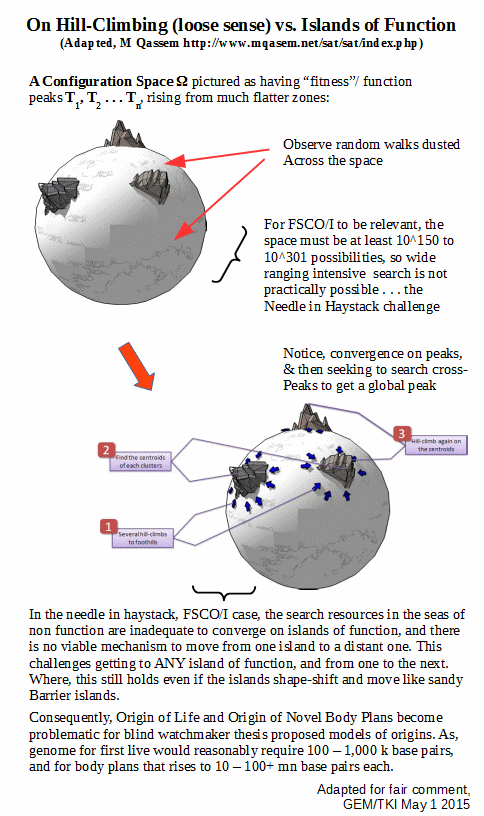
Now, this is my framework for discussing islands of function:
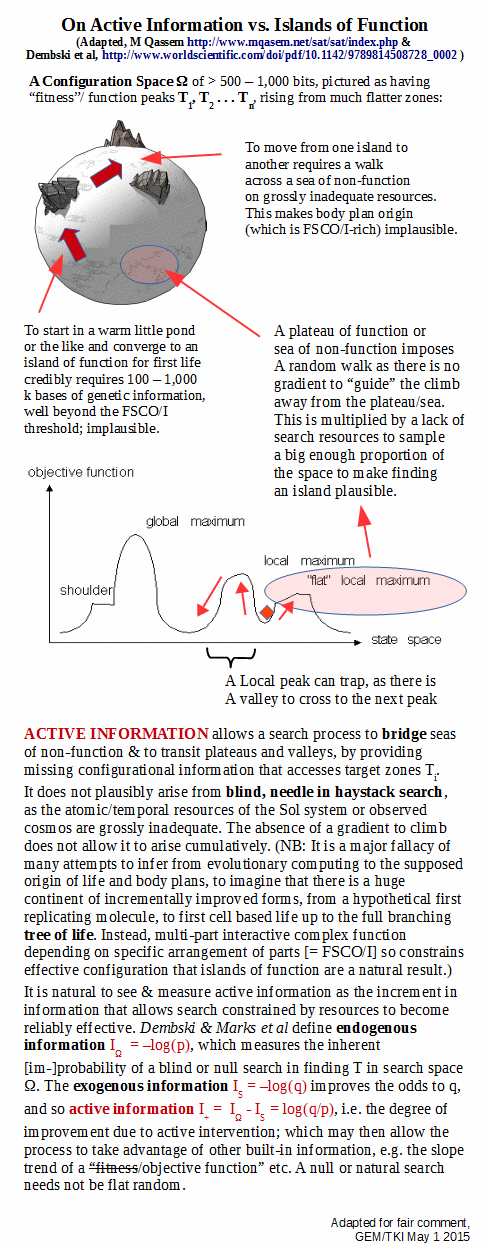
. . . and, on associated active information:
Thus, we can discuss the Orgel-Wicken functionally specific, complex organisation and associated information concept, FSCO/I, similarly:
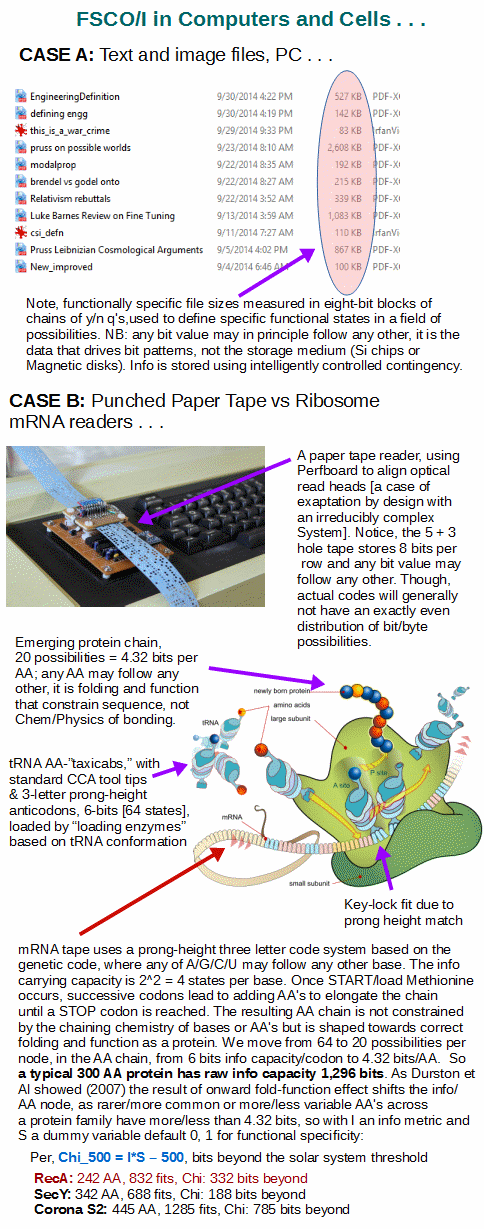
We see here the needle in a haystack, blind search challenge and how it is dominated by not the hill climbing on fitness functions that is commonly discussed but by the issue of arriving at shorelines of first function. Obviously and primarily, for origin of cell based life [cf. Tour] but also to move from that first unicellular body plan to others. Where, we can observe too that even within an island of function, incremental changes will be challenged by intervening valleys, tending to trap on a given peak or plateau.

But, what of the thesis, that there is in effect a readily accessible first functionality, incrementally connected to all major body plans, allowing unlimited, branching tree of life body plan level macro evolution?
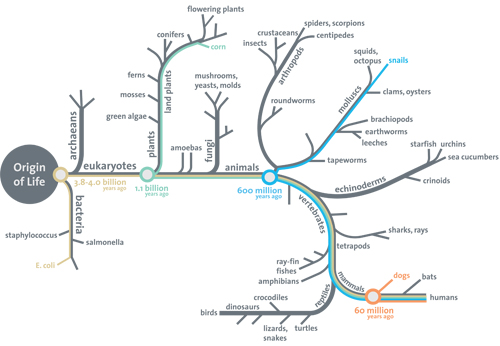
The Smithsonian’s tree of life model, note the root in OOL

Obviously, this architecture implies such continuity. The first problem, obviously is the root and the plethora of speculations and debatable or even dubious syntheses that have been made into icons of the grand evolutionary narrative and taught as effective fact, already tell us something is wrong. A second clue is how the diagram itself implies that transitional forms should utterly dominate the space, with terminal tips being far less common. On basic statistics, we should then expect an abundance of these transitions or “links.” The phrase, missing link, tells the tale instead.

For, the trade secret of paleontology, is the utter rarity of such forms, to the point where punctuated equilibria was a major school intended to explain that general absence. Where, Darwin, notoriously, noted the gaps but expected and predicted that on wider investigations they would go away. But now, after 150 years of searching, billions of fossils seen in situ, millions in museum back office drawers [only a relative few can be displayed] and over a quarter of a million fossil species, the pattern of gaps is very much still here, hot denials and dismissals notwithstanding. That is especially true of the Cambrian fossil life form revolution, where the major current body plans for animals pop up with nary an intermediate. So much so, that there have been significant efforts to make it disappear, obfuscating its significance.

We also have molecular islands of function, starting with protein fold domains. Thousands, scattered across the AA sequence space, no easy path connecting them. Even just homochirality soon accumulates into a serious search space challenge as molecules are complex and mirror image handedness is not energetically enforced, why racemic forms, 50-50 mixes of left and right handed molecules are what we tend to get in lab syntheses. This then gets more complicated where there are multiple isomers as Tour discusses.

In short, a real issue not a readily dismissible notion without significant empirical support.

And so forth.

U/D2 Nov 4: I just found where I had an image from p. 11 NFL, so observe:
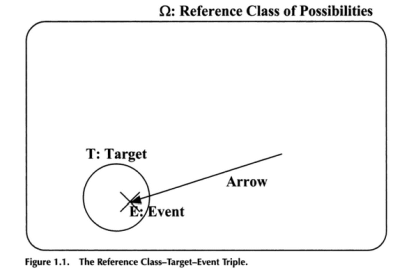
ID researcher William A Dembski, NFL, p.11 on possibilities, target zones and events

Where, we can further illustrate the beach of function issue:

And, some remarks:

U/D 3 Nov 7: The all-revealing Eugenics Conference Logo from 1912 and 1921 showing how it was seen as a capstone of ever so many sciences and respected domains of knowledge, especially statistics, genetics, biology and medicine, even drawing on religion, with, politics, law, education, psychology, mental testing and sociology . . . menacingly . . . also being in the roots:
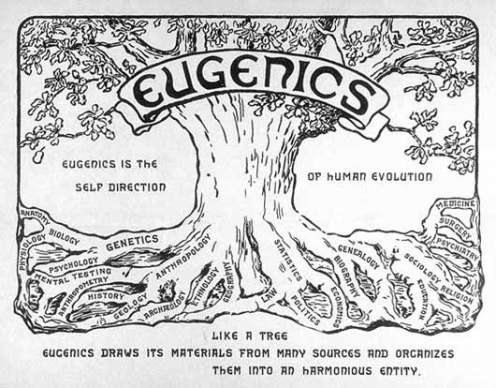
“Eugenics is the self-direction of human evolution”: Logo from the Second International Eugenics Conference, 1921, depicting Eugenics as a tree which unites a variety of different fields.

U/D 4, Nov 10: A reminder on cosmological fine tuning, from Luke Barnes:
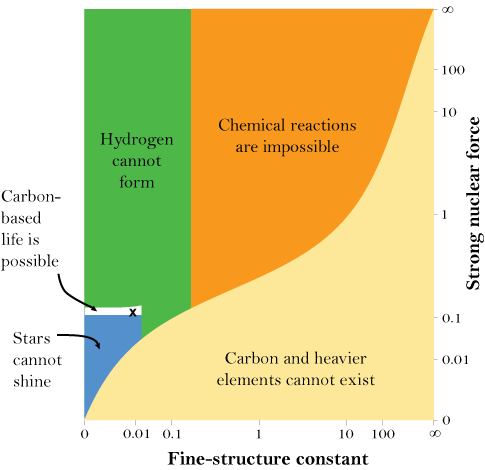
Barnes: “What if we tweaked just two of the fundamental constants? This figure shows what the universe would look like if the strength of the strong nuclear force (which holds atoms together) and the value of the fine-structure constant (which represents the strength of the electromagnetic force between elementary particles) were higher or lower than they are in this universe. The small, white sliver represents where life can use all the complexity of chemistry and the energy of stars. Within that region, the small “x” marks the spot where those constants are set in our own universe.” (HT: New Atlantis)

U/D 5, Nov 12: As there is dismissiveness of the textual, coded information stored in DNA, it is necessary to show here a page clip from Lehninger, as a case in point of what should not even be a debated point:

For record.

U/D 6, Nov 14: The per aspect design inference explanatory filter shows how right in the core design inference, alternative candidate causes and their observational characteristics are highlighted:
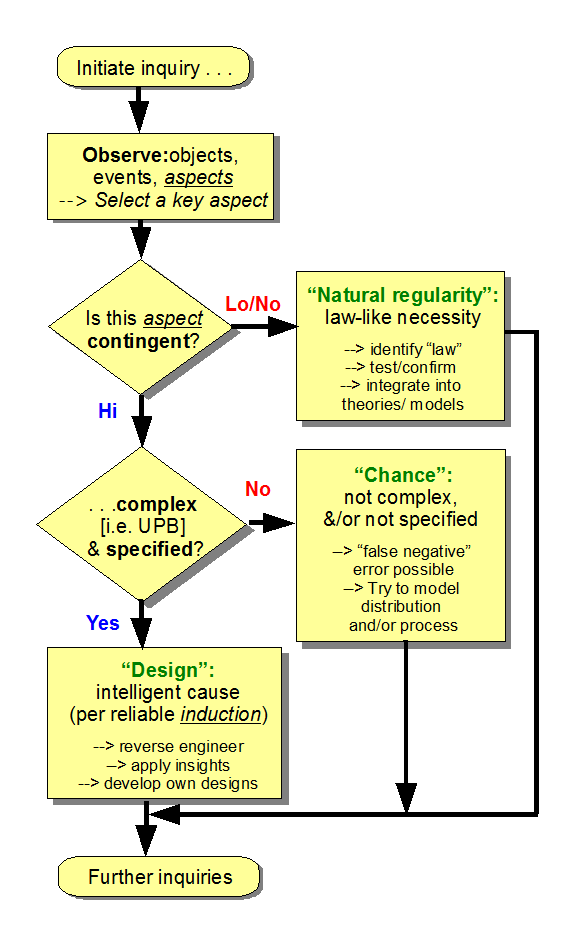
Explanatory Filter

Again, for record.

Comments
Can we please move on to talking about anything else at all?
We now have racism. What would you prefer to talk about? Aside: I continually point out that much of what gets posted here are just personal opinions and gotchas to make an ID person look bad. It has little to do with ID. Kf and BA post lots of hard material though some are hard to read. Aside2: Dawkins used the word cumulative over 90 times in the Blind Watchmaker. So he obviously thinks the concept important.jerry
November 7, 2022
November
11
Nov
7
07
2022
09:48 AM
9
09
48
AM
PDT
Alan Fox @196,
As Sir Giles points out, this is also nonsense. Darwin’s alleged racism has nothing to do with whether evolutionary theory is an accurate model.
“Alleged” racism? You’ve seen it repeatedly in his own words and in a book dedicated to the concept, which you’ve never read. Darwinism has been repeatedly falsified. There doesn’t seem to be a month that goes by without an article of paper indicating the surprise of evolutionary biologists at some new discovery. So the next question is your position on Eugenics. In other words, do you believe that it’s in humanity’s best interests to guide its own evolution? For example, are you in favor of preventing hemophiliacs from having biological children? -QQuerius
November 7, 2022
November
11
Nov
7
07
2022
09:30 AM
9
09
30
AM
PDT
Alan Fox @195, No. But the accusation Querius makes by quotemining Darwin is that Charles Darwin personally was a racist. Which is nonsense. Quote mining??? I guess I shouldn’t be surprised that you’re defending racism. What is it about “exterminate and replace the savage races” that you don’t get? You apparently excuse Darwin’s conclusion that “the negro or Australian” is closer to “the gorilla” than to the “civilized races of man.” Or maybe you even agree with him. Incredibly, you can’t bring yourself to reject Darwin’s conclusion that “Such are the facts . . . in regard to the wonderful instinct of making slaves.” Disgusting. -QQuerius
November 7, 2022
November
11
Nov
7
07
2022
09:29 AM
9
09
29
AM
PDT
Allow me to stop the "discussion." This has rarely been about science, it's mostly about ideology or worldview. The anti-ID side is consistently like this to IDers: You, you cherry picker! Liar! Dishonest. You don't think like I do so you're wrong! You make stupid comments. YOU don't want to have a discussion, with vague hints of you are bad/evil. The pro-ID side has evidence of Design. Evolution is not a self-starting, self-running engine. Only a designer can design, can create. That means an Intelligent entity as opposed to nothing. As opposed to chance. Example: Who made this watch? "A blind man."relatd
November 7, 2022
November
11
Nov
7
07
2022
09:27 AM
9
09
27
AM
PDT
PyrrhoManiac1: Can we please move on to talking about anything else at all? You mean leaving stupid statements unchallenged?JVL
November 7, 2022
November
11
Nov
7
07
2022
09:15 AM
9
09
15
AM
PDT
Not that this is super-relevant, but when I read The Blind Watchmaker (which was a very long time ago), it was pretty obvious to me that WEASEL and the biomorphs were just intended as examples of artificial selection. They were supposed to improve on Darwin's pigeon-breeding only by virtue of taking minutes or hours rather than years to observe the intended effects. And I say that as someone with zero respect for Dawkins at all. Can we please move on to talking about anything else at all?PyrrhoManiac1
November 7, 2022
November
11
Nov
7
07
2022
09:04 AM
9
09
04
AM
PDT
Jerry: Artificial selection and cumulative selection only make changes to the genome. Right, so humans who used cumulative selection to create all the dog breeds we see nowadays did so how exactly? And it was human who used cumulative selection to take a species of wild cabbage and turned it into all the brassicas we have naw and that worked how exactly? And horse breeders who decide who gets to mate with who are doing what exactly? Clearly cumulative selection can lead to morphological changes. If those differences aren't stored in the genome then where are they stored? I don't think you've really thought this through. OR I'm right and you're just a troll trying to make ID look particularly stupid.JVL
November 7, 2022
November
11
Nov
7
07
2022
08:44 AM
8
08
44
AM
PDT
I must say, the following ranks right up there.
But my comment was absolutely true. Artificial selection and cumulative selection only make changes to the genome. That is genetics. There is zero proof that changes to the genome have ever led to anything really new. So how can that be Evolution? So what does that make your comment? Maybe you should refrain from commenting and ask question since you do not understand what is going on. Others should do that too.jerry
November 7, 2022
November
11
Nov
7
07
2022
08:32 AM
8
08
32
AM
PDT
Jerry: Interesting for someone who just started to comment, that something would be classified as stupidest comment ever.
I can only go by what I have seen. At least one of my comments has been classified as the stupidest comment on UD. And by comparison, KF’s was more stupid. Although, I must say, the following ranks right up there.
Therefore cumulative selection is genetics and not Evolution.
Sir Giles
November 7, 2022
November
11
Nov
7
07
2022
08:27 AM
8
08
27
AM
PDT
Jerry: Therefore cumulative selection is genetics and not Evolution. Cumulative selection is deciding who gets to reproduce and have their variation continue on into the next generation and that's part of evolution. You can only look at morphological variation if you like. But the question then is: where do those morphological variations come from? If you have two children and one has blue eyes and one has brown eyes where is that variation determined? If one is normal but one has Down's syndrome where is that variation determined? If one is tall and one is short where is that variation determined? If one has a hairy chest and the other does not where is that variation determined? If one is blonde and the other brunette where is that variation determined?JVL
November 7, 2022
November
11
Nov
7
07
2022
08:23 AM
8
08
23
AM
PDT
This has to be one of the stupidest comments ever posted at UD
Actually, it is quite accurate. Artificial selection is a form of cumulative selection which is essentially intelligent design. The difference is that the change in artificial selection is a shuffling of alleles. Where cumulative selection could include that or it could include variations to the genome in addition to allele shuffling. That makes your comment inaccurate and Kf's correct. Both artificial selection and cumulative selection are part of genetics. Therefore cumulative selection is genetics and not Evolution. Interesting for someone who just started to comment, that something would be classified as stupidest comment ever.jerry
November 7, 2022
November
11
Nov
7
07
2022
08:04 AM
8
08
04
AM
PDT
Whistler: With Weasel software Dawkins made the case for intelligent design but said that is evidence for evolution . This is how mass hypnosis looks like. You people just don't even read our responses! And you clearly haven't read Dr Dawkins' book or didn't understand it if you did. Dr Dawkins wrote his programme to show the power of cumulative selection vs random generation. He was very clear about that, he said he was only using an artificial case to make a narrow, specific point. The only hypnosis going on here is all of you who never read the book or couldn't understand the basic argument made around this one particular aspect of unguided evolutionary theory. You're all hypnotised to believe things that weren't said. And will you go an read the actual text to find out? Of course not. That's intellectual dishonesty, pure and simple. And it's so far from scientific it's not even on the scale. You should be ashamed of yourselves.JVL
November 7, 2022
November
11
Nov
7
07
2022
07:51 AM
7
07
51
AM
PDT
re 190, to hnorman: You write,
The pattern for the weasel is: Change, Change, Change, Change, Feedback. You don’t have an iteration until you get feedback. It is only the last step – the establishment of function – that can be extrapolated into the world of biology.
I don’t understand this. At every generation in Weasel there is feedback: the number of letters that match the target string. Each cycle the pattern is repeated: crate a generation of children, pick the child that most closely resembles the target, and make that new parent. That is an iterative process. Weasel has nothing to do with function. The strings, including the target string (which could be a random set of characters and not the Weasel sentence), are not meant to represent function. Dawkins was not intended the Weasel string to be something that could be “extrapolated into biology”. Also, at 211, you quote Dawkins further. (I appreciate it that you’ve looked a more than just the part describing Weasel.)
211 There is a big difference, then, between cumulative selection (in which each improvement, however slight, is used as a basis for future building), and single-step selection (in which each new ‘try’ is a fresh one). If evolutionary progress had to rely on single-step selection, it would never have got anywhere. If, however, there was any way in which the necessary conditions for cumulative selection could have been set up by the blind forces of nature, strange and wonderful might have been the consequences....
The first sentence is a re-statement of the concept Weasel was intended to illustrate: that cumulative steps in response to a selection criteria is powerful. The bolded part is the part that distinguishes Weasel from a model for evolution. Weasel uses an artificial (or intelligent) selection criteria, and nature uses a different type of selection criteria, one which, according to Dawkins, is non-intelligent. I’m not arguing that Dawkins is right or wrong about nature: what I am trying to make clear is that Dawkins did not intend Weasel to model natural selectionViola Lee
November 7, 2022
November
11
Nov
7
07
2022
07:38 AM
7
07
38
AM
PDT
Whistler, did you read posts 137, 145, and 168, and understand the distinction between what Dawkins was claiming and what he was not claiming? He specifically explained the ways in which Weasel was NOT like evolution.Viola Lee
November 7, 2022
November
11
Nov
7
07
2022
07:21 AM
7
07
21
AM
PDT
KF We do not recall Dawkins standing up and saying to his enthusiasts, no, no, no you got it wrong, I am using an example of a pre-loaded target to simply show that strings will converge to it if proximity is rewarded. What we saw was championing of evolutionism and Weasel was used as an icon in the days when a computer program already had a mystique, an almost magical aura.
With Weasel software Dawkins made the case for intelligent design but said that is evidence for evolution . This is how mass hypnosis looks like.whistler
November 7, 2022
November
11
Nov
7
07
2022
07:14 AM
7
07
14
AM
PDT
@226 I don't think it's stupid to point out that artificial selection involves a rational agent to provide the criteria for what counts as a desirable trait. Maybe trivially obvious, but not stupid. But it does perhaps miss the point of Darwin's (and Wallace's) original insight: that environmental interactions (organisms interacting with conspecifics, with other species, and with physical conditions) can act as an iterated filter analogous to the role played by aesthetic or utilitarian criteria in selective breeding.PyrrhoManiac1
November 7, 2022
November
11
Nov
7
07
2022
07:04 AM
7
07
04
AM
PDT
KF: notice the studious failure to admit that artificial selection is a form of intelligent design.
This has to be one of the stupidest comments ever posted at UD. Unless I have missed the claim that ID is the intelligent selection of undesigned phenotypic variation. If humans are part of nature, which they are, then artificial selection is just a specific subset of natural selection.Sir Giles
November 7, 2022
November
11
Nov
7
07
2022
06:55 AM
6
06
55
AM
PDT
Jerry: Did Dawkins say that Evolution by natural selection is impossible? I know you've already said you're not even trying to have a real conversation but does that excuse saying something that stupid? What he said was you need cumulative selection AND inheritable variation. You've been commenting here how long and you still don't even understand the basic premises? He says cumulative selection is necessary but everyone agrees cumulative selection is nonsense. Cumulative selection is not nonsense!! That's a core part of the whole unguided evolutionary theory! Incredible that you don't even get the simplest bits. That means Dawkins is consistent since he admitted to Ben Stein in Expelled that the best explanation for Evolution was an intelligence. No, he did not say that. Good lord, you can't even report easy to check things accurately!! You're sounding more and more like a plant trying to make ID proponents look stupid. I can think of no other explanation for some of the ridiculous things you say if you really have been paying attention over the last decade and a half. Fool or knave; which is it?JVL
November 7, 2022
November
11
Nov
7
07
2022
05:58 AM
5
05
58
AM
PDT
Kairosfocus: yes, in the same 1980’s that saw the outbreak of affordable and powerful, usable personal computers, there was a mystique that attached to the machines and what they did. As we all should know. More rhetoric. Then, there was the now past wave where genetic and evolutionary algorithms full of active information were used to promote the blind watchmaker thesis. Really? I must have missed that. What does that have to do with what Dr Dawkins wrote in the mid-80s? Nothing. Meanwhile we cannot but note how the issues of pre life chemistry required to get to a metabolising, encapsulated and smart gated automaton with a von Neumann self replicator are being ducked. No one is ducking anything, it's an active area of research! An ID lab wouldn't be bothering trying would it because you already think it's impossible. Talk about a science stopper!! Again, in your attempted rebuttals, you are leaving out those subtle levers of persuasion tracing to the times, much less the scheme and cumulative case being made up by Dawkins. Crazy. The program was simply a way to check out the timing faster than doing it by hand! The people who read his book probably were a lot more computer savvy than the average person and would not have been awed in the slightest. By then I had written many, many much more complicated programmes as had ever computer science graduate, every mathematics graduate, most physics graduates and, for sure, every single person at university level or above was quite familiar with word processors and maybe even spreadsheets and data bases. Maybe you weren't but you weren't in American academia at the time. I was. I know. And how many children had played video games by then? AND Dawkins didn't wait to write his book for a time he could capitalise on some vague, maybe sense of mystic magic. That's crazy. You're just making stuff up. How else, do you think a targetted search that rewarded gibberish for mere increments of proximity became part of making a case for the blind watchmaker. Itself a loaded phrase. I've already told you several times that Dr Dawkins was illustrating one tiny part or aspect of the overall process of unguided evolutionary theory and that was the power of cumulative selection over pure random search. Clearly you just don't understand the point. Or you are intentionally not understanding the point. Which is it? Sorry, the revisionisms do not get away from what this was a part of. Go read the book. Make up your own mind. Your conspiracy laden diatribe, laced with intentional ignorance and cherry picking evidence, is sheer rhetorical garbage. But you could go read the book for yourself. I know you won't but you can not claim to have given its arguments or its presentation a fair and honest chance until you do. That might point out that maybe even slightly in some tiny way you were incorrect. And you can't have that now can you?JVL
November 7, 2022
November
11
Nov
7
07
2022
05:51 AM
5
05
51
AM
PDT
JVL writes, "He wasn’t modelling natural selection! I’ve already told you that! Look, if you’re not going to read my responses or even read what you yourself have posted then what’s the point of having a conversation?" Yes, it does make trying to have a discussion fruitless at times. I've explained the same thing several time, with quotes, but KF really doesn't engage with people: he engages with the stereotypes in his own head.Viola Lee
November 7, 2022
November
11
Nov
7
07
2022
05:48 AM
5
05
48
AM
PDT
Kairosfocus: we both know how rhetoric work, here the impact of the cumulative case being made in Watchmakers. Nice try, using the term rhetoric so as to cast Dr Dawkins writings as being an attempt to influence or persuade as opposed to just trying to explain which is what he is doing. Yes, the whole book may have been an attempt to persuade the readers of the truth of unguided evolution but he did so by trying to explain how it worked. He has made some statements but, as you should be aware, he has also said, frequently, that he thinks spending too much time debating and correcting things like Creationism and ID gives too much oxygen to the adherents (meaning they gain attention) and he clearly thinks it's a waste of time. So, again, nice try for trying to make it look like Dr Dawkins didn't disagree with your characterisations. Using a bit of rhetoric yourself there maybe? Certainly you're not presenting all the information and facts available. I believe there were onward printings and perhaps editions. Is there fresh text or maybe a corrective footnote? There was an extended edition published in the 90s (which you referenced in the stuff you posted funnily enough [I guess you didn't even read what you posted or you didn't understand it]); I'm sure you can get a cheap paperback copy or one from your local library. I'm not obligated to catch you up on all the stuff you haven't bothered to read but criticise anyway. Also, do not overlook the underlying context of Darwin using artificial selection — a form of intelligently designed configuration by controlled breeding for desired characteristics — as a model for his natural selection. He wasn't modelling natural selection! I've already told you that! Look, if you're not going to read my responses or even read what you yourself have posted then what's the point of having a conversation?JVL
November 7, 2022
November
11
Nov
7
07
2022
05:34 AM
5
05
34
AM
PDT
Did Dawkins say that Evolution by natural selection is impossible? He says cumulative selection is necessary but everyone agrees cumulative selection is nonsense. So natural selection is not the source of Evolution according to Dawkins. See#211. That means Dawkins is consistent since he admitted to Ben Stein in Expelled that the best explanation for Evolution was an intelligence. Let’s here it for pro ID Richard Dawkins. Aside: I notice that the time stamps on comments are +6 or Central Standard Time.jerry
November 7, 2022
November
11
Nov
7
07
2022
05:10 AM
5
05
10
AM
PDT
@201
Perhaps comparatively by the standards of his time.
Perhaps, but I think that's usually pretty weak tea. After all, everyone is a product of their own time. (Think of it this way: it would be a bad question to ask, "who is more a product of their own time, Bull Connor or Martin Luther King Jr?") Most people accept the social conventions of their own time without much question, especially if they materially or symbolically benefit from those conventions. It takes rare moral courage to stand up and say "no, these practices are wrong!" And it is (unfortunately) not infrequent to see people, even quite brilliant and gifted philosophers and scientists, being even more bigoted and discriminatory than the prevailing social norms would prescribe. In any event, the prevailing evidence I've seen is that Darwin abhorred slavery but was nevertheless racist. Which, I think, was probably a pretty common view for upper-class Victorians. @206
I am going to add an update on Eugenics, which was a global craze only resisted by a few folks such as G K Chesterton, the big conference logo that identified it as self direction of human evolution . . . which reminds us of its actual roots and associations with Galton the founder of modern Eugenics and his cousins, the Darwin family.
I hope you can find time to include the attacks on eugenics by prominent biologists such as Ray Lankester and Lancelot Hogben. @208 Lewontin's commitment to methodological naturalism is, I think, often misunderstood:
It is not that the methods and institutions of science somehow compel us to accept a material explanation of the phenomenal world, but, on the contrary, that we are forced by our a priori adherence to material causes to create an apparatus of investigation and a set of concepts that produce material explanations, no matter how counterintuitive, no matter how mystifying to the uninitiated. Moreover, that materialism is absolute, for we cannot allow a Divine Foot in the door. The eminent Kant scholar Lewis Beck used to say that anyone who could believe in God could believe in anything. To appeal to an omnipotent deity is to allow that at any moment the regularities of nature may be ruptured, that miracles may happen.
His point, I think, is that the intelligibility of scientific practices require an a priori exclusion of the kind of occasionalism articulated by theologians like al-Ghaz?l?. If one believes that God can always intervene in the causal order for reasons that are known only to Him and inscrutable to us, then one can never be entirely sure whether the results of an experiment are really giving us insight into the causal structure of the world or if He is manipulating things for reasons that we cannot know. I have heard it suggested that al-Ghaz?l?'s occasionalism was somehow responsible for the demise of Islamic science, but I don't know that for a fact, and I've learned the hard way that there's of subtle (and even not so subtle) Islamophobia in the scholarship on Islamic philosophy and theology. Anyway, Lewontin's a priori methodological naturalism is quite compatible with other conceptions of the Divine, even though he himself was a strict atheist. All that his methodological prescription demands is that we do not believe that God can alter the results of any experiment at any time for reasons that are unknowable to us.PyrrhoManiac1
November 7, 2022
November
11
Nov
7
07
2022
04:29 AM
4
04
29
AM
PDT
PS: The despised creationists go on:
1. Over-simplification. Let’s assume a self-replicating molecule is possible. Various origin-of-life proponents have been trying in recent years to get a self-replicating RNA-based enzyme—a ribozyme; but without success. Dawkins proposes a protein-based molecule but in some mysterious, unexplained manner ends up with DNA-based genes. How does he go from one to the other? Anyway, for the sake of the argument, how many amino acids would have to be strung together in the proper sequence to get this hypothetical replicator? There are few functional enzymes less than 100 amino acids; most have hundreds. Let’s be kind to Dawkins and assume it is possible to get such with just 100 amino acids. What is the probability of this happening, assuming all the amino acids are present? This protein is going to be one incredible protein, because not only has it to catalyse the joining together of the amino acids in a copy of itself, but it has to make them line up in the correct order as well. No such thing is known to exist—amino acids have no affinity for other amino acids of the same type and nor is there any complementary attraction like with the nucleotides of DNA/RNA)! Functional enzymes have a 3-dimensional structure, so this enzyme will have to unravel itself to allow amino acids to line up along it in the correct order (which they won’t /don’t) and at the same time act as a catalyst for their polymerisation (while it is unfolded!) Come on Dawkins, you can’t be serious!? However, ignoring all such problems, and many others that could be detailed, what is the probability of getting just 100 amino acids lined up in a functional manner? Since there are 20 different amino acids involved, it is (1/20)^100, which is 10^-130. To try to get this in perspective, there are about 10^80 fundamental particles (electrons, etc) in the universe. If every one of those particles were an experiment at getting the right sequence with all the correct amino acids present, every microsecond of 15 billion years, that amounts to 4.7 x 10^103 experiments. We are still 10^27 experiments short of getting an even chance of it happening. In other words, this is IMPOSSIBLE! [--> they imply that complex configuration function comes in locally deeply isolated islands in a configuration space. This is a well supported point, attempts to sideline it notwithstanding.] How can it be spelt out any more clearly to Dawkins and his like? Dawkins knows this, but persists in his nonsense because it fools laymen and is effective in his proselytising for atheism (he is an avowed anti-Christian cum atheist and takes every opportunity to ridicule the Bible—jibes about copying errors in the New Testament and the virgin birth, for example). It’s actually far worse than this. More than the 20 amino acids found in living things have been produced in ‘origin of life’ experiments. It is impossible without enzymes to produce them with the correct chirality—there are left and right-handed forms of amino acids and only left-handed forms are used in living things. The non-enzymic processes available in the pre-biotic soup (only living cells produce enzymes) could only produce equal quantities of both types. In other words there could have been more than 50 amino acids to choose the 20 from. This makes the probability (1/50)^100 or 10^-170! (if we made every elementary particle in our universe another universe the same as this one, we would have 10^160 elementary particles … etc.) [--> again, answer James Tour.] Dr Aw Swee-Eng and other creationists are absolutely correct about the necessity of the cell (see The origin of life: a critique of current scientific models (PDF)). Without the cellular environment, spontaneous chemical reactions would destroy proteins quicker than they could form. One of the assumptions under-pinning the origin of life scenarios is the absence of oxygen on the early earth, but such an absence of oxygen would also mean an absence of ozone and so UV radiation would destroy complex chemicals such as proteins or nucleic acids (DNA/RNA). Cells have all sorts of mechanisms for protecting the cellular machinery (enzymes, membranes, DNA, RNA, etc.) from oxidative processes. Without these mechanisms, it is impossible to conceive how ‘life’ could form itself. By the way, it is impossible that the earth could have been devoid of oxygen for very long (assuming that it could have been at all!) because UV penetrating to the earth in the absence of an ozone layer would split water molecules to produce oxygen. There is no evidence that the earth was ever free of oxygen, and so even the abiotic origin of the amino acids, nucleotides and sugars is impossible. Even with no oxygen, ribose and uracil, critical components of RNA, are extremely difficult to produce and are very unstable in a cell-free environment, so are unlikely to have formed. 2. Illogical analogy. Dawkins is a master at this. With regard to Dawkins’ argument that given enough time the improbable becomes certain (the lottery analogy, for example), see the article ‘Cheating with Chance’, p. 14 in the March/May 1995 Creation magazine. The condensation reaction in which amino acids are polymerised to produce a peptide (protein) is reversible so that all that more time will do is ensure equilibrium conditions, or very little polymerisation! Dr Harold F. Blum, Time’s Arrow and Evolution, 2nd edition, Princeton Uni Press, N.J. said that ‘increased time spans in biological systems will merely increase the probability of equilibrium being set up, and not the probability of improbable reaction products being formed.’ DNA cannot replicate by itself without enzymes (contrary to Dawkins). You may have heard of the polymerase chain reaction (PCR). This is the process used to copy DNA pieces, or amplify them to large enough quantities to do research on. It is called this because a very complex enzyme called DNA polymerase is necessary for it to happen. Other specified conditions are also necessary, such as pH, absence of substances which would spoil the reaction, osmolality control (salt concentration), temperature, etc. In the cell, a whole suite of enzymes are necessary, including ones such as the helicases, which unravel the double strand to allow copying.
kairosfocus
November 7, 2022
November
11
Nov
7
07
2022
03:43 AM
3
03
43
AM
PDT
F/N: Let the Creationists speak for themselves c 1996+ https://creation.com/a-response-to-richard-dawkins-the-blind-watchmaker
There are glaring deficiencies in logic in Dawkins’ arguments. It fools laymen who know little of the complexities of living things, but it should not fool anyone who is scientifically literate. Many of those who cite Dawkins’ book to put down creationists know that it is a large dose of bluff. Dawkins is a rabid atheist and his mission in life is to use every tactic, fair or foul, to destroy biblical Christianity. This can be easily documented. His books are self-confessed attempts at indoctrination. Note that, for natural selection to work, you have to have a self-reproducing entity. What is the simplest conceivable such unit? It is incredibly complex and full of information. This whole functioning unit has to come into being all at once, before Dawkins’ mutations and natural selection can function (assuming that they then can function at all as Dawkins claims!). [--> If you dismiss all at once, kindly explain, on actual observations tracing to the epoch of origins [and answering Tour], how you get from chemistry and physics to a metabolising, encapsulated & smart gated automaton with built in von Neumannkinematic self replicator] Fred Hoyle did some calculations on the likelihood of a hypothetical minimum self-reproducing cell coming together, given all the ingredients (this is impossible anyway, by natural, non-enzymatic processes). Hoyle hypothesised a cell of only 400 enzymes/proteins; a real world bacterium has about 2,000! For this hypothetical minimum cell, Hoyle calculated a probability of it forming by natural processes of 1 in 10^40,000. To put this in context, there are about 1080 atomic particles in the universe. If the universe actually were 15 billion years old, as Dawkins believes, this would give about 10^18 seconds. If every second and every atomic particle were an experiment in a soup of all the ingredients necessary for the cell to form, this would amount to 10^98 experiments. This is a long way short of any chance of getting our ‘cell’. Let’s make every microsecond an experiment. This gives 10^104 experiments. This is not getting us anywhere. Let’s make every atomic particle in our universe a universe like our own with every atomic particle in those universes and every microsecond an experiment. We now have 10^204 experiments. Hey, we’re still a long way short of 10^40,000 necessary for a reasonable chance of succeeding. The chances of getting our cell are zero! [--> again, if you do not like these numbers and the span of 15 BY given, provide an actual empirical observation tracing to the epoch based alternative] Furthermore, if you mixed all the ingredients together necessary for a living cell to form, many of those ingredients would react together to prevent anything from happening! [--> more broadly, answer Dr Tour] Dawkins’ computer morphs have as much relevance to the origin of the information in living things as sand has to the origin of information in a computer memory (the memory chips are made of silicon extracted from sand). Dawkins’ selects things that look like something recognisable and then he claims that what he gets is the result of blind selection (The Blind Watchmaker). How illogical! There is no evolutionary answer to the origin of information in living things.
KFkairosfocus
November 7, 2022
November
11
Nov
7
07
2022
03:35 AM
3
03
35
AM
PDT
PS, yes, in the same 1980's that saw the outbreak of affordable and powerful, usable personal computers, there was a mystique that attached to the machines and what they did. As we all should know. Then, there was the now past wave where genetic and evolutionary algorithms full of active information were used to promote the blind watchmaker thesis. Meanwhile we cannot but note how the issues of pre life chemistry required to get to a metabolising, encapsulated and smart gated automaton with a von Neumann self replicator are being ducked. Again, in your attempted rebuttals, you are leaving out those subtle levers of persuasion tracing to the times, much less the scheme and cumulative case being made up by Dawkins. How else, do you think a targetted search that rewarded gibberish for mere increments of proximity became part of making a case for the blind watchmaker. Itself a loaded phrase. Sorry, the revisionisms do not get away from what this was a part of. KFkairosfocus
November 7, 2022
November
11
Nov
7
07
2022
03:24 AM
3
03
24
AM
PDT
JVL, we both know how rhetoric works, here the impact of the cumulative case being made in Watchmaker. I note, too, how you cannot readily and quickly show Dawkins making a persistent effort to correct what you and others portray as misunderstandings of Weasel and the wider book; remember, we were there and saw the debates and influence, we saw how Weasel was used as an icon. I believe there were onward printings and perhaps editions. Is there fresh text or maybe a corrective footnote? Also, do not overlook the underlying context of Darwin using artificial selection -- a form of intelligently designed configuration by controlled breeding for desired characteristics -- as a model for his natural selection. KFkairosfocus
November 7, 2022
November
11
Nov
7
07
2022
02:55 AM
2
02
55
AM
PDT
Kairosfocus: [–> notice the studious failure to admit that artificial selection is a form of intelligent design], Again, it's just a model for a part of evolutionary theory! Incredible, you just keep quote mining and misinterpreting things. Why can't you read an entire long-form argument and try and understand the whole point instead of trying to pry the whole thing apart by focusing down so small you miss the bigger picture! Over and over Dr Dawkins qualifies what he does as illuminating part of the whole process. If there was ever a question of whether or not you even tried to understand his points you've made it very clear now that you will attack absolutely every single word or phrase you object to BUT you miss engaging with the bigger point. Sure, all your ID buddies love it but, again, you leave the central issue unchallenged.JVL
November 7, 2022
November
11
Nov
7
07
2022
02:21 AM
2
02
21
AM
PDT
JVL, note my just now excerpt from Wiki's confessions. There is a wider context and theme that will override caveats and so we have to be aware of a very suggestive phrase, weasel words. Then, the further context of a second program sold as an educational supplement that also feeds the same manipulation, reinforces the point. I challenge you to show us where Dawkins, on the record, publicly, repeatedly and frankly corrected those who were taking Weasel etc as an icon, that they were fundamentally wrong and misleading while Blind Watchmaker was riding high. KFkairosfocus
November 7, 2022
November
11
Nov
7
07
2022
02:21 AM
2
02
21
AM
PDT
F/N: Wiki on Dawkins; The Blind Watchmaker:
In his choice of the title for this book, Dawkins refers to the watchmaker analogy made famous by William Paley in his 1802 book Natural Theology.[1] Paley, writing long before Charles Darwin published On the Origin of Species in 1859, held that the complexity of living organisms was evidence of the existence of a divine creator by drawing a parallel with the way in which the existence of a watch compels belief in an intelligent watchmaker.
[--> funny how they never go on to address Ch 2 in which he speaks to a self replicating time keeping watch which points to complex organisation based function and additional complexity for replication]
Dawkins, in contrasting the differences between human design and its potential for planning with the workings of natural selection, therefore dubbed evolutionary processes as analogous to a blind watchmaker. To dispel the idea that complexity cannot arise without the intervention of a "creator", Dawkins uses the example of the eye. Beginning with a simple organism, capable only of distinguishing between light and dark, in only the crudest fashion, he takes the reader through a series of minor modifications, which build in sophistication until we arrive at the elegant and complex mammalian eye. In making this journey, he points to several creatures whose various seeing apparatus are, whilst still useful, living examples of intermediate levels of complexity. [--> ducking the sophisticated chemistry, information and organisation issues] In developing his argument that natural selection can explain the complex adaptations of organisms, Dawkins' first concern is to illustrate the difference between the potential for the development of complexity as a result of pure randomness, as opposed to that of randomness coupled with cumulative selection. He demonstrates this by the example of the weasel program.
[--> notice what the global context in the book is, support for claimed powers of chance variation and natural selection, so we must reckon with that wider thesis to understand its rhetorical role]
Dawkins then describes his experiences with a more sophisticated computer model of artificial selection implemented in a program also called The Blind Watchmaker [--> notice the studious failure to admit that artificial selection is a form of intelligent design], which was sold separately as a teaching aid. [--> to teach based on a fallacy as just pointed out] The program displayed a two-dimensional shape (a "biomorph") made up of straight black lines, the length, position, and angle of which were defined by a simple set of rules and instructions (analogous to a genome). [--> riddled with design] Adding new lines (or removing them) based on these rules offered a discrete set of possible new shapes (mutations), which were displayed on screen so that the user could choose between them. [--> so we see active information inputs towards targetted goals] The chosen mutation would then be the basis for another generation of biomorph mutants to be chosen from, and so on. [--> continued] Thus, the user, by selection, could steer the evolution of biomorphs. [--> misleading name] This process often produced images which were reminiscent of real organisms for instance beetles, bats, or trees. [--> yes, because of intelligently directed steering] Dawkins speculated that the unnatural selection role played by the user in this program could be replaced by a more natural agent if, for example, colourful biomorphs could be selected by butterflies or other insects, via a touch-sensitive display set up in a garden. [--> the weasel words game that evades responsibility for a rhetorical strategy] "Biomorph" that randomly evolves following changes of several numeric "genes", determining its shape. The gene values are given as bars on the top. [--> notice the word association games, this, in the name of education is sheer manipulation] In an appendix to a later edition of the book (1996), Dawkins explains how his experiences with computer models led him to a greater appreciation of the role of embryological constraints on natural selection. In particular, he recognised that certain patterns of embryological development could lead to the success of a related group of species in filling varied ecological niches, though he emphasised that this should not be confused with group selection. He dubbed this insight the evolution of evolvability. After arguing that evolution is capable of explaining the origin of complexity, near the end of the book Dawkins uses this to argue against the existence of God: "a deity capable of engineering all the organized complexity in the world, either instantaneously or by guiding evolution ... must already have been vastly complex in the first place ..." He calls this "postulating organized complexity without offering an explanation." [--> he needs to study logic of being and related root of reality issues] In the preface, Dawkins states that he wrote the book "to persuade the reader, [--> rhetoric is the too often dark art of persuasion] not just that the Darwinian world-view happens to be true, but that it is the only known theory that could, in principle, solve the mystery of our existence." [--> lying by dismissal of serious alternatives]
A real confession, this.kairosfocus
November 7, 2022
November
11
Nov
7
07
2022
02:14 AM
2
02
14
AM
PDT
1 9 10 11 12 13 19

Leave a Reply