Uncommon Descent Serving The Intelligent Design Community

L&FP, 63: Do design thinkers, theists and the like “always” make bad arguments because they are “all” ignorant, stupid, insane or wicked?

Categories
Logic and Reason
rhetoric
Share
Facebook
Twitter/X
LinkedIn
Flipboard
Print
Email

Dawkins’ barbed blanket dismissiveness comes up far too often in discussions of the design inference and related themes. Rarely, explicitly, most often by implication of a far too commonly seen no concessions, selectively hyperskeptical policy that objectors to design too often manifest. It is time to set this straight.

First, we need to highlight fallacious, crooked yardstick thinking (as exposed by naturally straight and upright plumb-lines). And yes, that classical era work, the Bible, is telling:

Notice, a pivotal point here, is self-evident truths. Things, similar to 2 + 3 = 5:
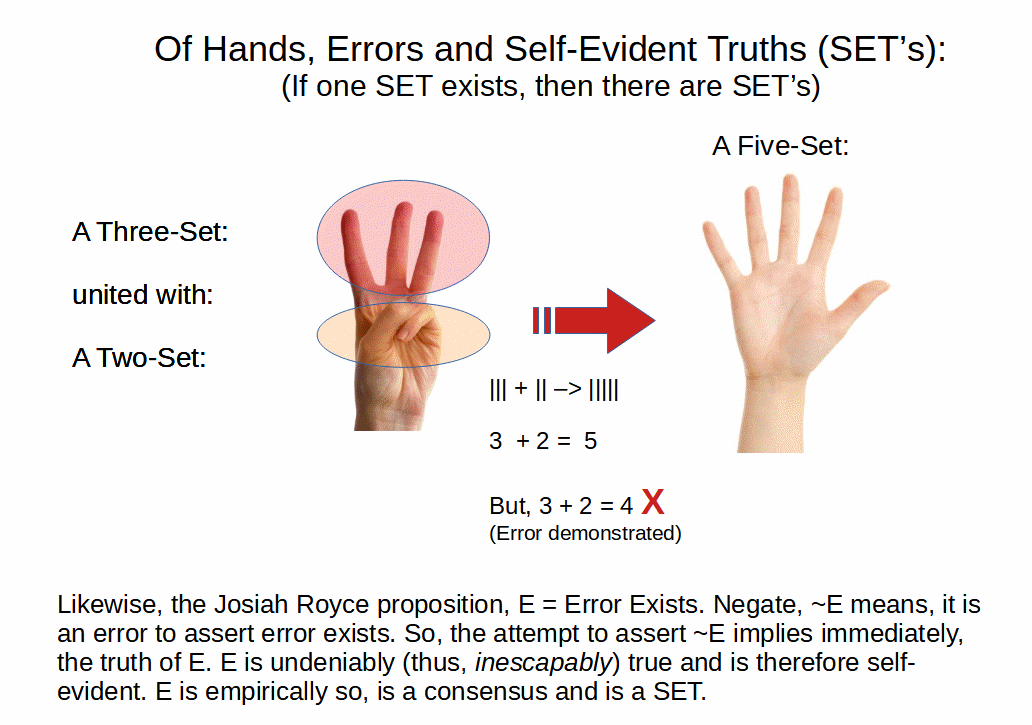
Notoriously, Winston Smith in 1984 is put on the rack to break his mind to conform to The Party’s double-think. He is expected to think 2 + 2 = whatever The Party needs at the moment, suppressing the last twisted answer, believing that was always the case, while simultaneously he must know that manifestly 2 + 2 = 4 on pain of instant absurdity. This is of course a toy example but it exposes the way crooked yardstick thinking leads to chaos:
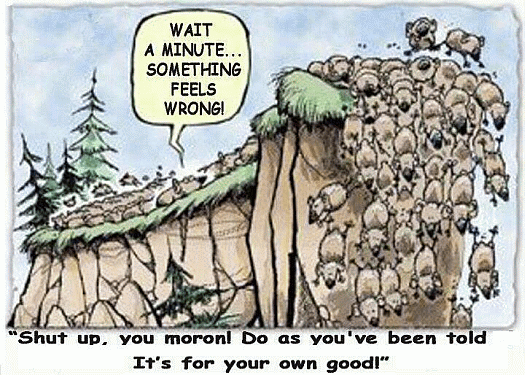
Of Lemmings, marches of folly and cliffs of self-falsifying absurdity . . .

(Yes, real lemmings do not act like that. But, humans . . . that’s a whole other story.)

So, now, let us turn to a recent barbed remark by one of our frequent objectors and my reply, laying out a frame of thought and inviting correction — dodged, of course:

KF, 120 in the Foundations thread: [[It is now clear that SG is unwilling to substantially back up the one liner insinuation he made at 84 above, try making a good argument. Accordingly, let me respond in outline, for record, to the general case, that people like us are ignorant, stupid, insane or wicked and the associated zero concessions, selectively hyperskeptical dismissiveness policy. Here, I will show the rational responsibility of the design inference and related ideas, views and approaches, for record and reference:

I will use steps of thought:

1: Reason, in general: Notice, supporters and fellow travellers of evolutionary materialistic scientism undermine the responsible, rational freedom required for reason to be credible. They tend to discount and discredit objectors, but in fact their arguments and assertions are self-referentially incoherent, especially reduction of mind to computationalism on a wetware substrate. Reppert is right to point out, following Haldane and others:

. . . let us suppose that brain state A [–> notice, state of a wetware, electrochemically operated computational substrate], which is token identical to the thought that all men are mortal, and brain state B, which is token identical to the thought that Socrates is a man, together cause the belief [–> concious, perceptual state or disposition] that Socrates is mortal. It isn’t enough for rational inference that these events be those beliefs, it is also necessary that the causal transaction be in virtue of the content of those thoughts . . . [But] if naturalism is true, then the propositional content is irrelevant to the causal transaction that produces the conclusion, and [so] we do not have a case of rational inference. In rational inference, as Lewis puts it, one thought causes another thought not by being, but by being seen to be, the ground for it. But causal transactions in the brain occur in virtue of the brain’s being in a particular type of state that is relevant to physical causal transactions.

2: This extends to Marx’s class/cultural conditioning, to Freud’s potty training etc, to Skinner’s operant conditioning , to claims my genes made me do it, and many more. So, irrationality and undermining of the credibility of reason are a general issue for such supporters and fellow travellers, it is unsurprising to see projection to the despised other (a notorious defence mechanism) and linked failure to engage self referentiality.

3: First principles of right reason: Classically, the core of reason starts with distinct identity, excluded middle, non contradiction. Something x is what it is i/l/o its core characteristics, nothing can be both x and not x in the same sense and circumstances, any y in W = {x| ~x} will be x, ~x, not both or neither. And more. Claimed quantum counter examples etc actually are rooted in reasoning that relies on such. And yes, there have been enough objections that this has come up and is in UD’s Weak Argument Correctives. We leave it to objectors like SG to tell us whether they acknowledge such first principles of right reason: _______ and explain why ________ .

4: Self evidence: There are arguments that, once we have enough experience and maturity to understand [a sometimes big if], will be seen as true, as necessarily true and as true on pain of immediate absurdities on attempted denial. That error exists is a good case in point, and if one is able to see that the attempt to deny objectivity of knowledge for a given reasonably distinct field of thought such as morals or history or reality [metaphysics], or the physical world, or external reality, or in general, etc, one is claiming to objectively know something about that field and so refutes oneself.

5: self referential incoherence and question begging: We just saw an example of how arguments and arguers can include themselves in the zone of reference of an argument in ways that undermine it, often by implying a contradiction. Such arguments defeat themselves. Question begging is different, it assumes, suggests or imposes what should be shown and for which there are responsible alternatives. Arguments can be question begging, and then may turn out to be self refuting.

6: Deduction, induction, abduction (inference to the best [current] explanation [IBE]) and weak-form knowledge: Deduction uses logical validity to chain from givens to conclusions, where if givens are so and the chain valid, conclusions must also be true. Absent errors of reasoning, the debate rapidly becomes one over why the givens. Induction, modern sense, is about degree of support for conclusions i/l/o evidence of various kinds as opposed to demonstration, statistics, history, science, etc are common contexts. Abduction, especially IBE, compares live option alternatives and what they imply, on factual adequacy, coherence and balance of explanatory power, to choose the best explanation so far. In this context weak sense common knowledge is warranted, credibly true (so, reliable) belief. Which, is open to correction or revision and extension.

7: Worldviews context: Why accept A? B. But why B? C, etc. We see that we face infinite regress, or circularity or finitely remote first plausibles . . . which, frame our faith points . . . as we set out to understand our world. Infinite regress is impossible to traverse in reasoning or in cause effect steps, so we set it aside, we are forced to have finitely remote start points to reasoning and believing, warranting and knowing — first plausibles that define our views of the world. Thus, we all live by faith, the question is which, why; so, whether it is rational/reasonable and responsible. Where, too, all serious worldview options bristle with difficulties, hence the point that philosophy is the discipline that studies hard, basic questions. Question begging circles are a challenge, answered through comparative difficulties across factual adequacy, coherence and balance of explanatory power: elegantly simple, neither ad hoc nor simplistic.

[Let’s add an illustration:]
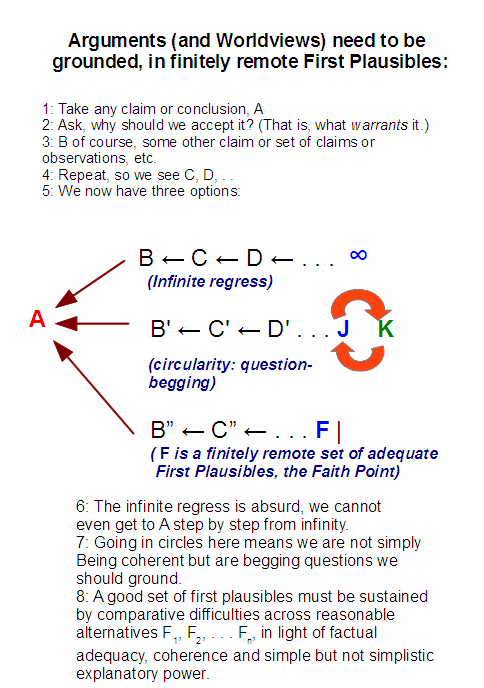
A summary of why we end up with foundations for our worldviews, whether or not we would phrase the matter that way}

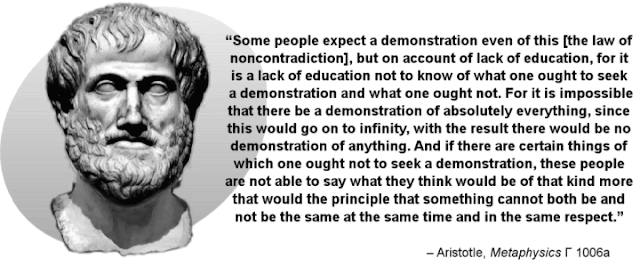
[or in Aristotle’s words:]

8: Failure of evolutionary materialistic scientism and fellow traveller views: It will be evident already, that, while institutionally and culturally dominant, evolutionary materialistic scientism and fellow travellers are profoundly and irretrievably incoherent. Yes, a view backed by institutions, power brokers in the academy, the education system and the media can be irretrievably, fatally cracked from its roots.

9: Logic of being (and of structure and quantity), also possible worlds: Ontology and her grand child, Mathematics, grow out of core philosophy, particularly distinct identity and consideration of possible worlds. A possible world, w, is a sufficiently complete description of how our world or another conceivable or even actual world is or may be; i.e. a cluster of core, world describing propositions. In that context, a candidate being or entity or even state of affairs, c, can be impossible of being [e.g. a Euclidean plane square circle] or possible. Possible beings may be contingent [actual in at least one possible world but not all] or necessary [present in every possible world]. We and fires are contingent, dependent for existence on many independent, prior factors; what begins or may cease of existence is contingent. Necessary beings are best seen as part of the fabric or framework for this or any possible world. We can show that distinct identity implies two-ness, thence 0, 1, 2. Ponder, W = {A|~A}, the partition is empty, 0, A is a unit, ~A is a complex unit, so we see 2. So, onward via von Neumann’s construction, the counting numbers N. Thence, Z, Q, R, C, R* etc in any w. This is what gives core Mathematics its universal power.

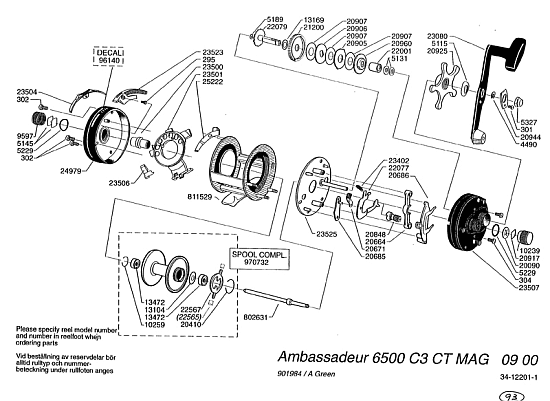
10: The basic credibility of the design inference: of course, we routinely recognise that many things show reliable signs of intelligently directed configuration as key cause, i.e. design. For example, objectors to the design inference often issue copious, complex text in English, beyond 500 to 1,000 bits of complexity. In the 70’s Orgel and Wicken identified a distinct and quantifiable phenomenon, functionally specific, complex organisation and/or associated information, which I often abbreviate FSCO/I. Organisation is there as things like a fishing reel [my favourite, e.g. the ABU 6500 CT] or a watch [Paley, do not overlook his self replicating watch thought exercise in Ch 2]
or an oil refinery or a computer program [including machine code]

Petroleum refinery block diagram illustrating FSCO/I in a process-flow system

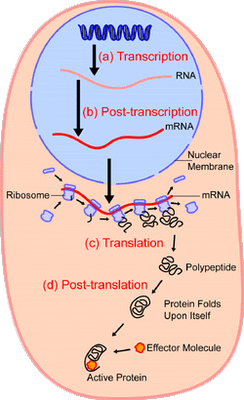
or the cell’s metabolic process-flow network [including protein synthesis]
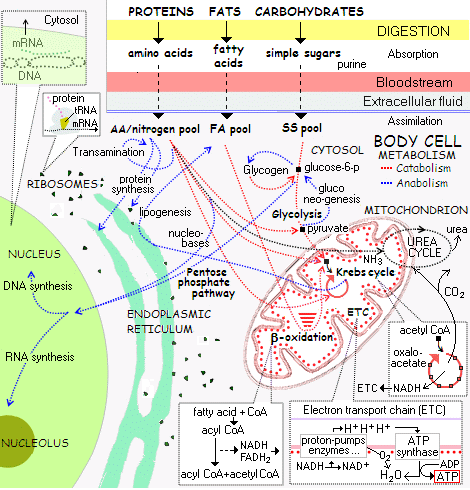
[with:]
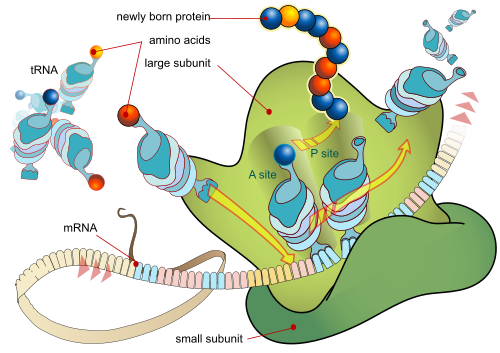
Step by step protein synthesis in action, in the ribosome, based on the sequence of codes in the mRNA control tape (Courtesy, Wikipedia and LadyofHats)

[and:]

all can be described in a suitably compact string of Y/N questions, structured through description languages such as AutoCAD. The inference posits that, with trillions of cases under our belt, reliably, FSCO/I or its generalisation, CSI, will be signs of design as key cause. The controversies, as may be readily seen, are not for want of evidence or inability to define or quantify, but because this challenges the dominant evolutionary materialism and fellow travellers. Which, of course, long since failed through irretrievable self referential incoherence.
_____________________

So, challenge: let SG and/or others show where the above fails to be rational and responsible, if they can__________________ Prediction, aside from mere disagreement and/or dismissiveness, assertions, or the trifecta fallacy of red herrings, led away to strawmen soaked in ad hominems and set alight to cloud, confuse, poison and polarise the atmosphere, they will not be able to sustain a case for general failure to be rational and responsible.]]

The good argument challenge is duly open for response. END

U/D, Nov 4: As it seems certain objectors want to attack the descriptive metaphor, islands of function amidst seas of non function, let me put up here a couple of infographics I used some years ago to discuss this concept. But first, as the primary contexts have to do with protein synthesis and OoL, let me first put up Vuk Nicolic’s video illustrating just what is required for protein synthesis:

. . . and Dr James Tour’s summary presentation on OoL synthesis challenges:

Now, this is my framework for discussing islands of function:
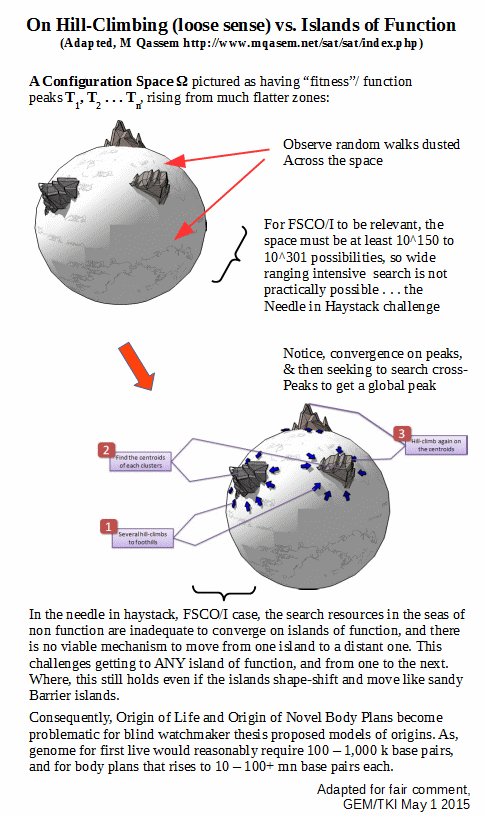
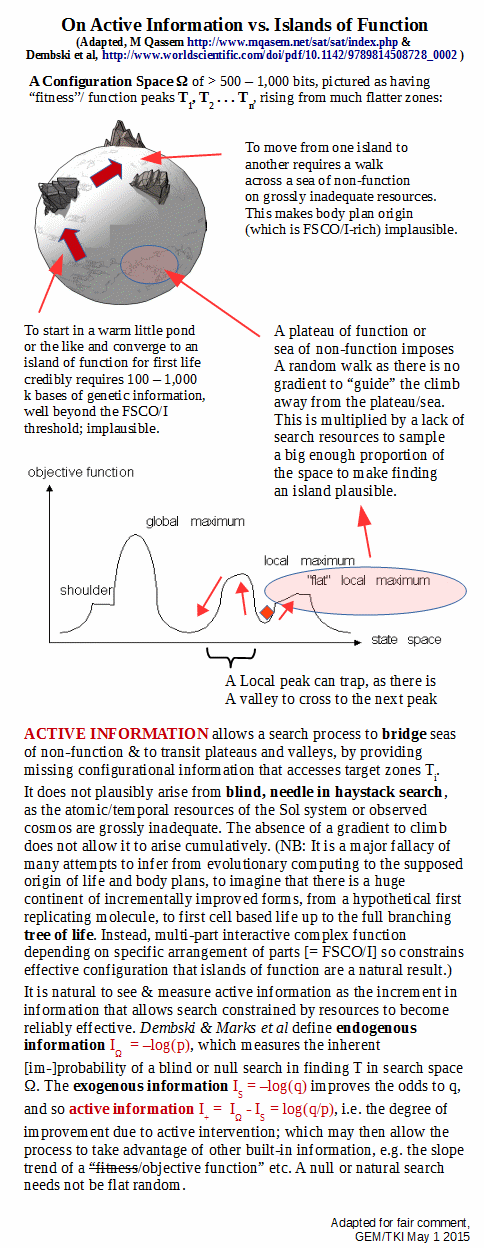
. . . and, on associated active information:
Thus, we can discuss the Orgel-Wicken functionally specific, complex organisation and associated information concept, FSCO/I, similarly:
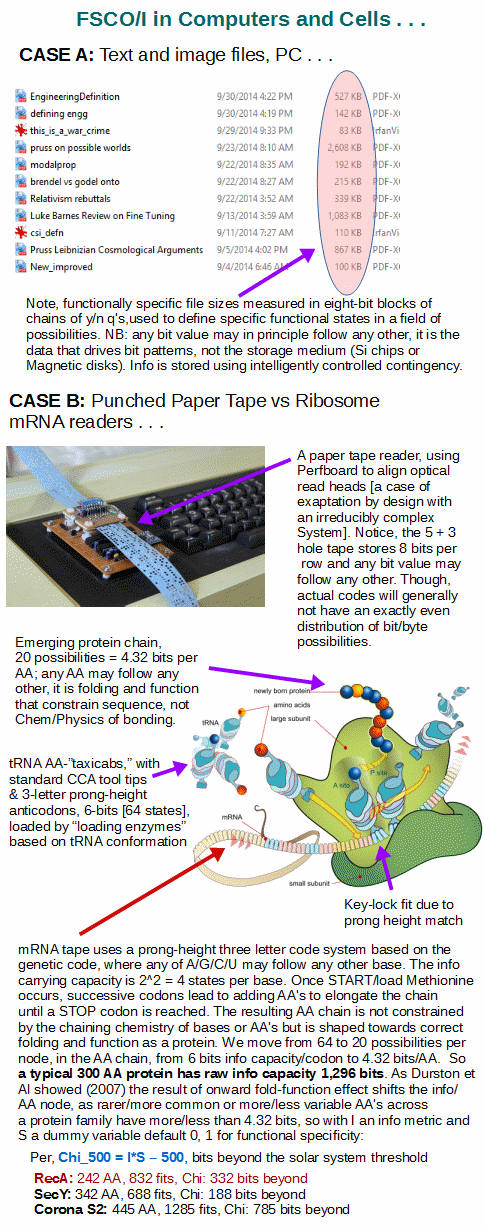
We see here the needle in a haystack, blind search challenge and how it is dominated by not the hill climbing on fitness functions that is commonly discussed but by the issue of arriving at shorelines of first function. Obviously and primarily, for origin of cell based life [cf. Tour] but also to move from that first unicellular body plan to others. Where, we can observe too that even within an island of function, incremental changes will be challenged by intervening valleys, tending to trap on a given peak or plateau.

But, what of the thesis, that there is in effect a readily accessible first functionality, incrementally connected to all major body plans, allowing unlimited, branching tree of life body plan level macro evolution?
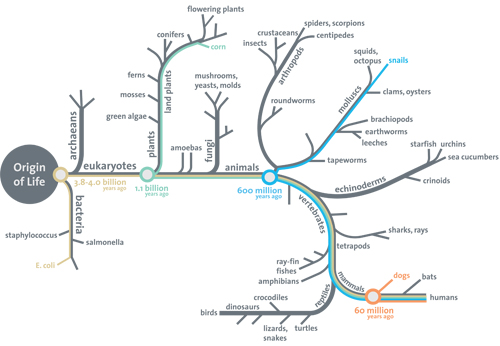
The Smithsonian’s tree of life model, note the root in OOL

Obviously, this architecture implies such continuity. The first problem, obviously is the root and the plethora of speculations and debatable or even dubious syntheses that have been made into icons of the grand evolutionary narrative and taught as effective fact, already tell us something is wrong. A second clue is how the diagram itself implies that transitional forms should utterly dominate the space, with terminal tips being far less common. On basic statistics, we should then expect an abundance of these transitions or “links.” The phrase, missing link, tells the tale instead.

For, the trade secret of paleontology, is the utter rarity of such forms, to the point where punctuated equilibria was a major school intended to explain that general absence. Where, Darwin, notoriously, noted the gaps but expected and predicted that on wider investigations they would go away. But now, after 150 years of searching, billions of fossils seen in situ, millions in museum back office drawers [only a relative few can be displayed] and over a quarter of a million fossil species, the pattern of gaps is very much still here, hot denials and dismissals notwithstanding. That is especially true of the Cambrian fossil life form revolution, where the major current body plans for animals pop up with nary an intermediate. So much so, that there have been significant efforts to make it disappear, obfuscating its significance.

We also have molecular islands of function, starting with protein fold domains. Thousands, scattered across the AA sequence space, no easy path connecting them. Even just homochirality soon accumulates into a serious search space challenge as molecules are complex and mirror image handedness is not energetically enforced, why racemic forms, 50-50 mixes of left and right handed molecules are what we tend to get in lab syntheses. This then gets more complicated where there are multiple isomers as Tour discusses.

In short, a real issue not a readily dismissible notion without significant empirical support.

And so forth.

U/D2 Nov 4: I just found where I had an image from p. 11 NFL, so observe:
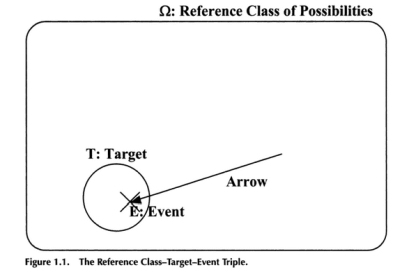
ID researcher William A Dembski, NFL, p.11 on possibilities, target zones and events

Where, we can further illustrate the beach of function issue:

And, some remarks:

U/D 3 Nov 7: The all-revealing Eugenics Conference Logo from 1912 and 1921 showing how it was seen as a capstone of ever so many sciences and respected domains of knowledge, especially statistics, genetics, biology and medicine, even drawing on religion, with, politics, law, education, psychology, mental testing and sociology . . . menacingly . . . also being in the roots:
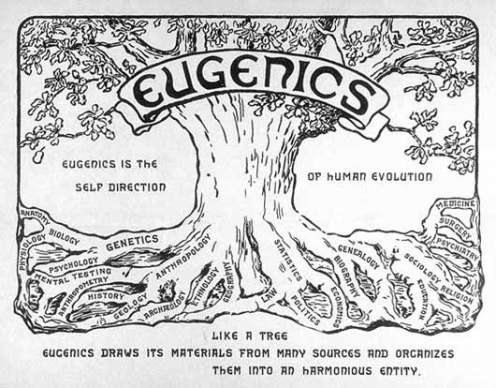
“Eugenics is the self-direction of human evolution”: Logo from the Second International Eugenics Conference, 1921, depicting Eugenics as a tree which unites a variety of different fields.

U/D 4, Nov 10: A reminder on cosmological fine tuning, from Luke Barnes:
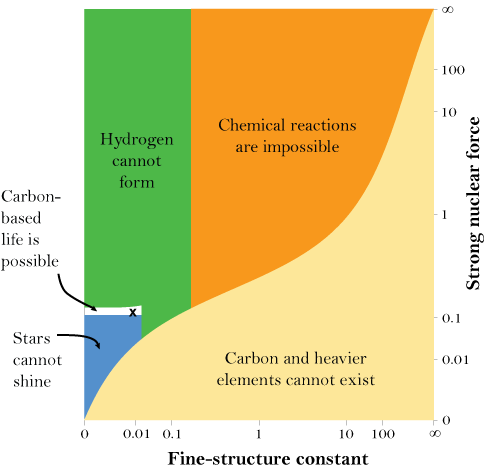
Barnes: “What if we tweaked just two of the fundamental constants? This figure shows what the universe would look like if the strength of the strong nuclear force (which holds atoms together) and the value of the fine-structure constant (which represents the strength of the electromagnetic force between elementary particles) were higher or lower than they are in this universe. The small, white sliver represents where life can use all the complexity of chemistry and the energy of stars. Within that region, the small “x” marks the spot where those constants are set in our own universe.” (HT: New Atlantis)

U/D 5, Nov 12: As there is dismissiveness of the textual, coded information stored in DNA, it is necessary to show here a page clip from Lehninger, as a case in point of what should not even be a debated point:

For record.

U/D 6, Nov 14: The per aspect design inference explanatory filter shows how right in the core design inference, alternative candidate causes and their observational characteristics are highlighted:
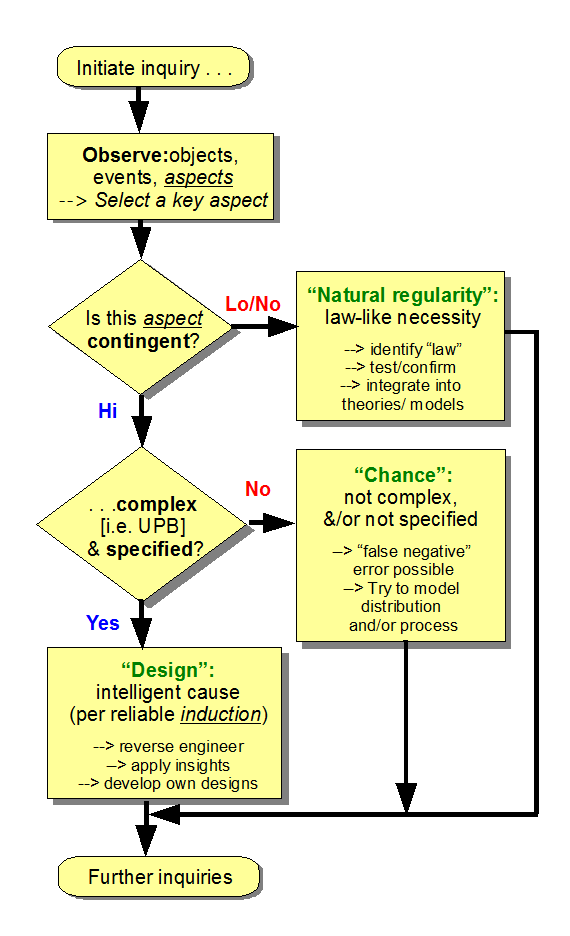
Explanatory Filter

Again, for record.

Comments
VL, there is the identification of fine tuning in Weasel, which is a mark of design, as was noted earlier. Note, what happens as rates and population numbers shift. KFkairosfocus
November 8, 2022
November
11
Nov
8
08
2022
09:11 AM
9
09
11
AM
PDT
JV L, notice the balance of values that have to go Goldilocks zone to present the sort of behaviour as published by Mr Dawkins. This was excerpted above. As to trying to project eugenics, kindly notice the conference logo now appended to the OP, you will be able to see a whole agenda of power that humans cannot safely hold over one another. KFkairosfocus
November 8, 2022
November
11
Nov
8
08
2022
09:07 AM
9
09
07
AM
PDT
SG at 282, And you, yes you, can go to a pro-evo site and avoid all this. But I suspect that's not going to happen...relatd
November 8, 2022
November
11
Nov
8
08
2022
08:29 AM
8
08
29
AM
PDT
re 283, to hnorman. First, I’d like to say it’s refreshing have a civil, thoughtful discussion that stays focused. Thanks. You write, “The simulation works as an illustration of intelligent design. This may be all you’re claiming but I’m not sure.” No, it is an illustration of how small cumulative steps can produce larger positive changes if there is process that selects according to some criteria as the process iterates. In this case both the selection process and the positive change (advancing towards the target string) are artificially (his words), or intelligently, designed. But illustrating intelligent design is not the purpose of the program: illustrating the power of iterative selection is the purpose. Then, as he goes on to argue, natural forces do provide a selection process that can explain slow evolutionary change. Discussing that is the purpose of the book, and way beyond the scope of his discussion. But the program is not meant to be an illustration of, or evidence for, natural selection. That is what the rest of the book is about. So yes, he does extrapolate the power of selection to biology, but he replaces the intelligent design aspect of the program with natural selction: the argument for the power of iterative selection doesn’t change, but the nature of the selection process does. ==== You also quoted me as writing,
One is that many (most) arguments I have read about how something is impossible because the probability of it happening is so small are working on the assumption that a whole bunch of parts came together independently at one trial, like throwing a whole bunch of coins at once, rather than through a series of selected steps and with huge populations.
, and you replied, “If the weasel is in any way relevant here, then you have extrapolated it to biology, and successfully I might add. But how does it do so? Only an intelligent agent can hold onto parts for what they might accomplish later on.” And later on, you write, “The weasel does not select for advantage. It selects for a concept that will not yield an advantage until fully realized – selection with foresight. And that is the province of the intelligent designer.” Yes, this is the difference between Weasel and nature, and between what ID posits and what natural selection posits. Here is my understanding of evolutionary theory. (I’m not trying to argue whether this is true, which is way beyond the scope of this discussion, but just trying to get the concepts clear.) In nature, there is always variation among the members of a population, and that variation is maintained and increased at times by both mutation and the genetics of sexual reproduction. This corresponds to the process in Weasel where some number of “children”, say 100, are created by randomly changing (mutating) a small number of letters in the child strings. Then, in nature, both the goal and the selection process is for the individual to survive to sexual maturity and successfully have abundant progeny. Here there is no intelligent design and there is no future target goal. Successfully having more children to add to the population for the next iteration of generational change is the selection criteria and the goal. Cumulative change happens without there being any teleology in respect to a future goal nor any intelligent selection of what changes are passed on to the next generation This is the difference between Weasel and nature, a difference Dawkins clearly understood.Viola Lee
November 8, 2022
November
11
Nov
8
08
2022
07:32 AM
7
07
32
AM
PDT
Sir Giles: Because it would not be in your best interest to look over your shoulder for the rest of your life. OMG, I never thought that. We need to start teaching that to would-be rapists and bicycle thieves. Crime problem solved!ram
November 8, 2022
November
11
Nov
8
08
2022
06:58 AM
6
06
58
AM
PDT
@295
PM1, just a minor point, but it is my understanding that recessive genes are not the same as undesirable genes. They just are not express if their counterpart in the genome is a dominant gene.
Right! My point was if the undesirable trait is only expressed in homozygous recessive individuals, then eliminating the individuals with that trait in one generation doesn't prevent the recurrence of those undesirable traits in the next generation, because you're not able to eliminate the individuals carrying the recessive allele if you're only eliminating the individuals expressing the undesirable trait. One could need to do genetic screening to eliminate every individual carrying the recessive allele, so the next generations are all homozygous dominant. That's a huge reduction in genetic diversity that can make the population more vulnerable to stress, disease, and even extinction.PyrrhoManiac1
November 8, 2022
November
11
Nov
8
08
2022
06:00 AM
6
06
00
AM
PDT
Kairosfocus: fine tuning implies islands of function in seas of non function in a configuration space. I'm not talking about 'fine tuning' (which is not clear is the case). And if I were then I would say it would depend on what was being fine tuned in what environment for what purpose. Indeed, the much derided observable imperfect ratcheting or latching effect is a symptom of that fine tuning. You also full well know that selective breeding is a kind of intelligent design. As for trying the turnabout stunt on Eugenics, breeding of dogs is worlds apart from coercive control of people; shame on you for that stunt. Again, your view of ID is that the designer had a target, a goal. If that designer 'guided' the development of life towards that goal then that is a guided selective breeding program which means some individuals are denied the right to breed. That's Eugenics is it not?JVL
November 8, 2022
November
11
Nov
8
08
2022
06:00 AM
6
06
00
AM
PDT
PM1, just a minor point, but it is my understanding that recessive genes are not the same as undesirable genes. They just are not express if their counterpart in the genome is a dominant gene.Sir Giles
November 8, 2022
November
11
Nov
8
08
2022
05:45 AM
5
05
45
AM
PDT
@275
Really? Why do you say, “cannot succeed”?
If I recall my high school biology, one of the things we know from population genetics is that it's basically not possible to eliminate recessive alleles from a population, so even if you were to eliminate all homozygous recessives for their "undesirable" traits, those recessive alleles can persist and a homozygous recessive can always result from a heterozygous pairing. And one of the other things we know from more recent work in developmental biology is that "one gene, one trait" is the exception rather than the rule in biology: gene products have multiple functions and phenotypic traits have multiple genetic influences. So it's just not possible to eliminate all possibility of recurrence of some trait simply by eliminating every organism who possesses that trait, without eliminating the entire species (or causing a speciation event). But this is just speaking from the scientific side of things, about why eugenics is not compatible with our understanding of how biology actually works. The moral issue would be separate, and there's no hope for generating moral judgments or principles from biology.PyrrhoManiac1
November 8, 2022
November
11
Nov
8
08
2022
04:14 AM
4
04
14
AM
PDT
JVL, read Dr Dawkins' preface, with fresh eyes, the intent to indoctrinate is stated therein, and no we will not be gaslighted into doubting what is there in cold black and white text. As to oh you must provide a full mechanism to our satisfaction to have a best explanation of the causal factor at work, that is a distraction. We both know what inference on tested reliable sign means, the signified. Then, what the Weasel emulator shows -- and IIRC the previous one developed by a UD commenter too -- is the properties of a Weasel like program, which exhibits FSCO/I, complete with obviously intentional and undisclosed fine tuning to achieve the rhetorically desired hill climbing to target functionality; fine tuning implies islands of function in seas of non function in a configuration space. Indeed, the much derided observable imperfect ratcheting or latching effect is a symptom of that fine tuning. You also full well know that selective breeding is a kind of intelligent design. As for trying the turnabout stunt on Eugenics, breeding of dogs is worlds apart from coercive control of people; shame on you for that stunt. KFkairosfocus
November 8, 2022
November
11
Nov
8
08
2022
02:10 AM
2
02
10
AM
PDT
Kairosfocus: Here, in his characteristically breezy and superficial manner, he tries to brush aside the basis of inductive reasoning on inference to the best, observational evidence backed explanation. The 'best' explanation cannot even say when or how design was implemented? Really? Plus it presupposes the existence of a designer which has not otherwise been established. So, no, not the 'best' explanation. In so doing, he also tries to brush aside Newton’s rule that explanatory hypotheses must be actually observed to have the causal power that we are going to use to explain what we did not observe due to it being in the remote distance or remote past etc. So, there can be no historical science? No palaeontology? No geology? Limited archaeology? I mean, we didn't see those ancients humans build those pyramids or Stonehenge did we? Gosh, maybe it was . . . some other intelligent designers! One who came from somewhere, somehow at some time and did something and poof there are those ancient structures. Is that a better explanation? Weasel is part of an exercise in manipulative, atheistically motivated indoctrination dressed up in a lab coat and we are well advised to be on our guard. Which it clearly was not. Dr Dawkins said exactly what he was trying to illustrate, he didn't say it modelled evolution, he said it showed the power of cumulative selection. You are attacking what Dr Dawkins wrote because you don't like his conclusion not because what he said was wrong. You are the one parlaying rhetoric in an attempt to stop someone from paying attention to the science involved. This is just like attacking Darwin as a racist in hopes of getting people to distrust his HISTORICAL science (which was based on years and years of observation, data collection, etc). "Me thinks it's like a weasel" . . . do you know where that comes from? You seem to imply that Dr Dawkins inadvertently picked a phrase that gave away his supposed underlying motivation. Of course, it turns out there was rewarding of gibberish for increments of productivity, which already inadvertently spotlights the issue of vast seas of non function and the challenge to find shorelines of function. Again this is criticising Dr Dawkins' program for being something it was not! Why can't you just read what he wrote and respond to his actual words? Is that so hard to do? In other words: did his program show the power of cumulative selection or not? Yes or no? Let's see if you can answer that first. So, Weasel actually demonstrates islands of function, blind needle in haystack search challenge and fine tuning, thus islands of function and their significance. All, not disclosed by Mr Dawkins. And you wonder why Dr Dawkins chooses, for the most part, not to debate ID proponents: they don't understand what he wrote in the first place and choose to filter everything through a somewhat paranoid, theistic framework. Weasel, properly used, is actually a counter example to Mr Dawkins’ thesis. What? Hang on . . . let me get this straight . . . are you saying that you think Dr Dawkins program supports ID? Does that mean you think ID is a case of selective breeding to reach a target? That your intelligent designer is using Eugenics to get his desired outcome? Is that what you are saying? Wow, I had no idea ID supported Eugenics. That's pretty interesting don't you think?JVL
November 8, 2022
November
11
Nov
8
08
2022
01:57 AM
1
01
57
AM
PDT
Thanks, KF, this is really my last word for now. :)Alan Fox
November 8, 2022
November
11
Nov
8
08
2022
12:46 AM
12
12
46
AM
PDT
AF, enjoy your trip. Meanwhile, I have provided documentation on what actually lurks in Weasel, but which Mr Dawkins did not disclose. KFkairosfocus
November 8, 2022
November
11
Nov
8
08
2022
12:26 AM
12
12
26
AM
PDT
Last wordAlan Fox
November 8, 2022
November
11
Nov
8
08
2022
12:25 AM
12
12
25
AM
PDT
W, you are right as I just documented. I was busy elsewhere and thought it would be useful to hold what I just put up overnight. Dawkins confessed to and/or implied more than he realised in his preface, and it sets us up to look at Weasel with a far sharper eye. Which it is clear, is well warranted. My bet is, we will never see frank admission that the imperfect latching effect was symptomatic of fine tuning and exemplifies the pervasive nature of islands of function as an aspect of FSCO/I. I am also pretty sure there will be no willingness on the part of some objectors to admit that this is an observable and even quantifiable phenomenon. KFkairosfocus
November 8, 2022
November
11
Nov
8
08
2022
12:24 AM
12
12
24
AM
PDT
Anyway, I'm away on a family visit to UK (my wife is already there)in a couple of days, so I need to get stuff done. If developments in "Intelligent Design" becomes headline news, I may check in, otherwise that's all from me for a couple of weeks. I'll be back! If I'm spared...Alan Fox
November 8, 2022
November
11
Nov
8
08
2022
12:19 AM
12
12
19
AM
PDT
@ KF You could just close comments if you want the last word.Alan Fox
November 8, 2022
November
11
Nov
8
08
2022
12:11 AM
12
12
11
AM
PDT
F/N: now, part 2, where we allow the despised Creationists to speak, exposing more of what is going on in Weasel than we imagine. Now, a long time ago, one of UD's commenters created a reconstruction of Weasel, which is now hard to find. However, we can find one here, developed by CMI -and a 2019 update to the Delphi original], which will allow us to examine and confirm some telling findings. The original, of course, has been somehow lost. Now, Les Ey and Don Batten, at CMI, Aug 2002, yes twenty years ago:
The program described herein mimics Dawkins’ program, but also provides the user with the opportunity to explore different values for the parameters such as the mutation rate, number of offspring, the selection coefficient, and the ‘genome’ size. Varying the values for these parameters shows that Dawkins chose his values carefully to get the result he wanted. Furthermore, the user can see that, with realistic values for the parameters, the number of generations needed to achieve convergence increases to such an extent that it shows that evolution of organisms with long generation times and small numbers of offspring is not possible even with a uniformitarian time-frame. [--> we thus see not only design but fine tuning and locally isolated operating zones, i.e. islands of function, naturally and unsurprisingly emerging] And this is with a deterministic exercise, which cannot be a simulation of real-world evolution anyway . . . . Many introductory courses in biology at universities have The Blind Watchmaker, by Dawkins,2 as required reading. The title, a play on William Paleys’ watchmaker analogy, wherein Paley (1743–1805) argued that the complexity of living things demanded an intelligent creator, reveals Dawkins’ aim—to rid his readers of any sense of a need for a Creator. The blind watchmaker is purely natural—mutation and natural selection. Dawkins’ book is an undisguised polemic for atheism [ --> as we just saw from Dawkins' preface]. In this book, Dawkins presents a description of a computer program that generated the sequence of letters, ‘METHINKS IT IS LIKE A WEASEL’3 from a starting sequence of random letters. The process involves randomly changing letters in each ‘generation’ and selecting the ‘offspring’ closest to the target sequence. The mutation and selection process is repeated until the sequence is arrived at. This supposedly showed that evolution by cumulative selection of favourable random changes was inevitable, easy and fast. [--> that is certainly invited by Dawkins' idea that cumulative selection would greatly exceed the rate of convergence of chance alone] At the time (1986) it was fairly showy to have a computer program to demonstrate something and many readers were duped into thinking that the program had proved something, not realizing that a program will do whatever its programmer designs it to do. Because of the deceptive nature of Dawkins’ demonstration, several creationist authors saw the need to counter Dawkins’ dupe.4–6 These authors have pointed out reasons why Dawkins’ program does not ‘prove evolution’. It should be fairly obvious that any program that sets a target sequence of letters and then achieves it, by whatever means, has not demonstrated that the information in the sequence has arisen by some natural process not involving intelligence. The programmer specified the information; it did not arise from a ‘simulation’ of evolution. [--> that is, design] Dawkins’ program has apparently been lost . . .
We already have sobering reason to take pause. And yes, I use comments on arrows and highlights to draw put key observations. There is nothing disreputable in that, unlike some unworthy suggestions that have been made. Let's go on:
How Dawkins’ program worked To begin with, a target string of letters was chosen. Dawkins chose, ‘METHINKS IT IS LIKE A WEASEL’. Next, the computer generated a sequence of random uppercase letters to represent the original ‘organism’. So, there were only 26 letters, plus a space, to choose from to generate the starting organism. This sequence always contained exactly the same number of letters as the target phrase—28 letters and spaces. The parent sequence would be copied, probably about 100 times (how many is not stated, but it must be a large number to get the results obtained), to represent reproduction. With each copy there would be a chance of a random error, a mutation, in the copying. Now for what was supposedly analogous to selection, each copy would now be tested to determine which copy was most like the target string ‘METHINKS IT IS LIKE A WEASEL’. A copy would be chosen even if only one letter matched the target in the correct place, so long as it happened to be the best match. The chosen copy would then be copied several times, again with introduced errors in the copying. In turn this ‘progeny’ was also tested to find the best match. This process would be repeated until a copy was found that matched the target exactly.
Already, this is design with a pre loaded target, he could have just coded a Hello World println but that would be too obvious. A means was created to make a target phrase seemingly emerge from gibberish, step by step. Cumulatively, by chance and necessity. Of course, it turns out there was rewarding of gibberish for increments of productivity, which already inadvertently spotlights the issue of vast seas of non function and the challenge to find shorelines of function. That is, fine tuning. But it turns out that parameters etc had to be tuned to achieve the notorious imperfect ratchet occasionally slipping latch effect, i.e. general but not quite inexorable progress to the target:
In the Error Catastrophe model, the offspring number is simply reduced from 100 to 10; all other parameters remain as in the Dawkins model. Because the number of offspring is low, the chances of a desirable mutation occurring in at least one offspring are reduced. Furthermore, as the model moves towards convergence, the probability of a mutation undoing what has been achieved rises to the point where it equals the probability of adding a desirable new mutation. So the model fails to converge. [--> that is, the model shows fine tuning, thus islands of function; unsurprising but of course hotly objected to] The user can also induce error catastrophe by increasing the mutation rate after selecting the [no> option for [Guarantee Mutation?>. One mutation in six letters per generation is about the error catastrophe point with 100 offspring. With 10 offspring the error catastrophe mutation rate drops to about 1 in 18. Increasing the length of the target letter sequence shows that the mutation rate has to be decreased in proportion to avoid error catastrophe. To avoid error catastrophe, the mutation rate (per letter or base per generation) has to be inversely proportional to the size of the genome. [--> a fine tuning, engineering rule] That is, the larger the genome, the lower the mutation rate. Once this is factored into the theory, ‘evolution’ slows down to such a slow pace that it could never account for the amount of biological information in existence (the basic point of ‘Haldane’s Dilemma’, which Walter ReMine spells out in his book9). With an amino acid sequence (‘DNA model’ under the [Models> menu item), with a small offspring number of say 10, the substitution mutation rate cannot be much more than one in the length of the target sequence. E.g., if the target is 33 amino acids (99 base pairs), a mutation rate of 1 in 50 produces error catastrophe. So the Dawkins model will converge with a mutation rate of 1 in 28 with a target of 28 letters, but not on a genome just a little bit bigger and certainly not with a human-sized genome of 3x10⁹ nucleotides.
This is already telling us key things. They continue:
In effect, the mutation rate cannot be much greater than one per genome per generation. This then severely limits the rate of progress from a chimp-like species to human, if this were possible, even with perfect selection and all the other assumptions. Real-world mutation rates are many orders of magnitude less than used in Dawkins’ model, or other supposed simulations of evolution for that matter. Spetner, in his book Not by Chance, summarizes the knowledge on actual rates of mutation as follows: ‘In bacteria the mutation rate per nucleotide is between 0.1 and 10 per billion transcriptions [refs]. But in all other forms of life the rate is smaller. For organisms other than bacteria, the mutation rate is between 0.01 and 1 per billion [ref.].’10 We expect that the reason for this difference between bacteria and other organisms relates to genome size: bacteria have the smaller genomes and can therefore sustain higher mutation rates without error catastrophe. Biological replication is extremely accurate. This level of accuracy is due to the processes of proof reading and error correction. This is vital since mutations disorder existing functional DNA sequences, and are therefore overwhelmingly harmful (and even rare beneficial mutations are the result of information loss). The Adjusted Mutation Rate model shows what happens when a more realistic mutation rate is applied to Dawkins’ model. A mutation rate of 1 in 100,000,000 (10 per billion letters) means that the model takes a long time to run. It could take a few weeks on a typical slower PC. Of course the Adjusted Mutation Rate model is still somewhat unrealistic, being the upper limit estimated for bacteria, but it helps to illustrate the point that real life is nothing like the Dawkins model . . . . The [Complexity> option in the program allows the user to specify how many of the target letters or amino acids have to be present together for an increase in ‘fitness’. This enables some recognition of the fact that not every point mutation can be adaptive in the change from one sequence to another. It does not address irreducible complexity at the system level. With [Complexity> set at three, for example, a mutant with one of the target letters added could not be selected against one without the letter. Nor would another mutant with two letters. Only if three new target letters were present together would the mutant be selected. With a setting of three, the number of generations for convergence for Dawkins’ model blows out to about 30,000, or about 600,000 years for human generation times—and this is with perfect selection, high mutation rate and 100 offspring!
So, Weasel actually demonstrates islands of function, blind needle in haystack search challenge and fine tuning, thus islands of function and their significance. All, not disclosed by Mr Dawkins. Weasel, properly used, is actually a counter example to Mr Dawkins' thesis. KFkairosfocus
November 8, 2022
November
11
Nov
8
08
2022
12:08 AM
12
12
08
AM
PDT
JVL, et al, it is obvious that we need to put some facts on the table to clear away a lot of after the fact revisionism. First, what Mr Dawkins was up to in Weasel, which he explicitly admits is an exercise in persuasion, i.e. rhetoric, having promoted Darwinism from theory to be critically assessed to truth:
For reasons that are not entirely clear to me, Darwinism seems more in need of advocacy than similarly established truths in other branches of science. [ Preface, BW, xv]
Instantly, given the pessimistic induction, no scientific theory has that epistemic level of warrant: the true mindset of science is to be open ended, recognising the limitations of the logic of inference to the best current explanation involved, i.e. as Newtonian Dynamics irrevocably established, empirical reliability is not a proxy for ultimate truth; we may hope or believe but such ultimacy is not in our gift. Mr Dawkins is simply wrong, making an assertion of a rhetorician at best; out to lock in ideology, not a genuine effort of science. He then turns his rhetorical guns on the inference to design on signs, but fails to see that if he makes a point it would establish too much, self referential, mind discrediting grand delusion thence collapse of confidence in any significant intellectual activity involving inference on evidence, thus of course science in general:
It is almost as if the human brain were specifically designed to misunderstand Darwinism, and to find it hard to believe. Take, for instance, the issue of 'chance', often dramatized as blind chance. The great majority of people that attack Darwinism leap with almost unseemly eagerness to the mistaken idea that there is nothing other than random chance in it. Since living complexity embodies the very antithesis of chance, if you think that Darwinism is tantamount to chance you'll obviously find it easy to refute Darwinism! One of my tasks will be to destroy this eagerly believed myth that Darwinism is a theory of 'chance'. [p. xv]
He builds on this seemingly modest suggestion, in a galloping hypothesis game:
A third respect in which our brains seem predisposed to resist Darwinism stems from our great success as creative designers. Our world is dominated by feats of engineering and works of art. We are entirely accustomed to the idea that complex elegance is an indicator of premeditated, Grafted design. This is probably the most powerful reason for the belief, held by the vast majority of people that have ever lived, in some kind of supernatural deity. It took a very large leap of the imagination for Darwin and Wallace to see that, contrary to all intuition, there is another way and, once you have understood it, a far more plausible way, for complex 'design' to arise out of primeval simplicity. A leap of the imagination so large that, to this day, many people seem still unwilling to make it. It is the main purpose of this book to help the reader to make this leap.
Here, in his characteristically breezy and superficial manner, he tries to brush aside the basis of inductive reasoning on inference to the best, observational evidence backed explanation. In so doing, he also tries to brush aside Newton's rule that explanatory hypotheses must be actually observed to have the causal power that we are going to use to explain what we did not observe due to it being in the remote distance or remote past etc. Otherwise, the door is open to power backed imposition of essentially ideological speculation dressed up in a lab coat. Again, here is Lyell pointing to the principle, in the title of a book:
PRINCIPLES OF GEOLOGY: BEING AN INQUIRY HOW FAR THE FORMER CHANGES OF THE EARTH’S SURFACE ARE REFERABLE TO CAUSES NOW IN OPERATION. [--> appeal to Newton's Rules, in the title of the work] BY CHARLES LYELL, Esq, F.R.S. PRESIDENT OF THE GEOLOGICAL SOCIETY OF LONDON . . . JOHN MURRAY , , , 1835 [--> later, publisher of Origin]
No, we must not allow Mr Dawkins to program us to be suspicious of inference on tested sign, or of the need to actually observationally establish the causal power of our claimed driving causes. Where, we know that Orgel-Wicken functionally specific, complex organisation and/or associated information [FSCO/I] is a real phenomenon such as is seen in text in English (as Mr Dawkins exemplifies), as distinct from typical results of random text ut86toivsijx or a stuck key sssssssssss. Why, Mr Dawkins actually here provides one of the trillions of actually observed cases in point. Where, reliably, such FSCO/I comes about by intelligently directed configuration, and is never seen to have come about by any other factor or combination, i.e. blind chance and/or mechanical necessity, his proposed blind watchmaker. Now, we must not overlook a key target of his rhetoric: "[w]e are entirely accustomed to the idea that complex elegance is an indicator of premeditated, Grafted design . . . probably the most powerful reason for the belief . . . in some kind of supernatural deity." That is, he is trying to imply that belief in God on signs of design in our world, is delusional, enmeshing "the vast majority of people that have ever lived." Which, of course, would be the title of an onward book, twenty years later. He here sidesteps the obvious problem, if we are that prone to delusion, why should we have any confidence in any significant frame of reasonably abstract thought? (Apart from the magisterial power of the bright elites, who have deemed the unwashed theists to be ignorant, stupid, insane or wicked, or in Lewontin's and Sagan's terms, believers in demons who are to be disabused of that notion by the elites who know Science is the only begetter of truth.) The doublethink, indoctrination and dismissive, belittling projection to the despised other could not be plainer. This is the framework context for assessing the book and it is the context for assessing Weasel. Weasel is part of an exercise in manipulative, atheistically motivated indoctrination dressed up in a lab coat and we are well advised to be on our guard. Indeed, it is entirely in order to notice key associations such as:
[Merriam Webster:] weasel word: a word used in order to evade or retreat from a direct or forthright statement or position
In other words, rhetorical evasiveness designed to plant a loaded notion then seemingly retreat in the confidence that the telling notion has been planted. Which, is exactly what we are already seeing hints of in the preface. KFkairosfocus
November 7, 2022
November
11
Nov
7
07
2022
11:22 PM
11
11
22
PM
PDT
Viola regarding the weasel - I have been reviewing your comments as well as those of a few others. I have a few thoughts. The simulation works as an illustration of intelligent design. This may be all you're claiming but I'm not sure. An intelligent agent who knows what to throw away and what to keep can certainly reach a target. This would make sense if Dawkins was presenting an argument in the following form. (1) Selection can do wonderful things. (2) Here's an example of how an intelligent agent does it. (3) If blind forces could work the same way it could do wonderful things as well. (4) But they can. Here's how they do it. He seems to give us steps 1 through 3 but for 4 he just gives us the bald assertion that they can do it. I am repeating the last sentence that you requoted as well as the one after it.
If, however, there was any way in which the necessary conditions for cumulative selection could have been set up by the blind forces of nature, strange and wonderful might have been the consequences. As a matter of fact that is exactly what happened on this planet, and we ourselves are among the most recent, if not the most wonderful, of those consequences.
Dawkins clearly thought he was describing a process that could be extrapolated into biology. ---- Another point: I was confused by something you wrote at 183 -
One is that many (most) arguments I have read about how something is impossible because the probability of it happening is so small are working on the assumption that a whole bunch of parts came together independently at one trial, like throwing a whole bunch of coins at once, rather than through a series of selected steps and with huge populations.
If the weasel is in any way relevant here, then you have extrapolated it to biology, and successfully I might add. But how does it do so? Only an intelligent agent can hold onto parts for what they might accomplish later on. ------ Another point. I'm always struck by how much confusion a word can cause when it can be used in different senses. I didn't think that cumulative selection could be accomplished by blind evolution but some descriptions of it seemed valid. Cumulative selection is simply a set of survival events that retain certain things for reasons various and sundry because they provided an advantage at the time. The weasel does not model cumulative selection but contingent selection - or if you will -- cumulative intelligent selection. The weasel does not select for advantage. It selects for a concept that will not yield an advantage until fully realized - selection with foresight. And that is the province of the intelligent designer.hnorman42
November 7, 2022
November
11
Nov
7
07
2022
08:46 PM
8
08
46
PM
PDT
VL: I’d rather keep the focus here on the value the work has for families who would like to have children.
So would I. But we both know that won’t happen.Sir Giles
November 7, 2022
November
11
Nov
7
07
2022
08:08 PM
8
08
08
PM
PDT
I'd rather keep the focus here on the value the work has for families who would like to have children.Viola Lee
November 7, 2022
November
11
Nov
7
07
2022
07:57 PM
7
07
57
PM
PDT
VL: Fascinating and important work.
I agree. But I have the feeling that there are a few commenters here who would find the whole idea horrendous and objectively immoral. :)Sir Giles
November 7, 2022
November
11
Nov
7
07
2022
07:34 PM
7
07
34
PM
PDT
It is very common, according to my friend, for a couple with recessive gene issues to fertilize a number of eggs, let them grow to about eight cells I think, test them for the recessive gene, which might not be a gender specific. issue, and then implant the best embryo. I helped my friend put together a spreadsheet one time of a couple of years of data and learned a lot about how they grade embryos for health and viability, test them genetically, take the age and health of the mother into consideration, etc. Fascinating and important work.Viola Lee
November 7, 2022
November
11
Nov
7
07
2022
07:27 PM
7
07
27
PM
PDT
VL, yes, in-vitro is a godsend for thousands of couples. Although my grand-nieces are healthy, they may have to make their own decisions because they both carry the hemophiliac gene and any son they have will have a 50% chance of being hemophiliac. If they want kids, hey have three options. 1) use in-vitro and only implant the female embryos: 2) get pregnant and abort if it is male; or 3) get pregnant and have the baby regardless of gender. I do not envy them regardless of the decision they make but they will certainly be supported by their family regardless of the choice.Sir Giles
November 7, 2022
November
11
Nov
7
07
2022
07:20 PM
7
07
20
PM
PDT
Very interesting, SG. I have a good friend who is an in vitro doctor, and he has fascinating stories to tell about situations he's had. He's very committed to helping families have children under difficult circumstances.Viola Lee
November 7, 2022
November
11
Nov
7
07
2022
07:07 PM
7
07
07
PM
PDT
Querius: For example, do you think it’s okay for hemophiliacs to biologically reproduce rather than adopt children instead?
Sure. I have two beautiful grand-nieces because my niece and her hemophiliac partner decided to reproduce. They used in-vitro and pre-screened so that only female fetuses were implanted.Sir Giles
November 7, 2022
November
11
Nov
7
07
2022
06:59 PM
6
06
59
PM
PDT
PyrrhoManiac1 @267,
1. If Darwinism is true, does Eugenics naturally follow?
No, not at all. But also: the modern synthesis version of evolutionary theory entails that eugenics cannot succeed.
Really? Why do you say, "cannot succeed"? For example, do you think it's okay for hemophiliacs to biologically reproduce rather than adopt children instead? -QQuerius
November 7, 2022
November
11
Nov
7
07
2022
05:42 PM
5
05
42
PM
PDT
VL: I’m so glad we finally got away from that boring Weasel discussion and on to something substantial like the nature of morality! (not) ?
That does appear to be a recurring trend here. And by trend, I mean pathological obsession.Sir Giles
November 7, 2022
November
11
Nov
7
07
2022
04:38 PM
4
04
38
PM
PDT
I'm so glad we finally got away from that boring Weasel discussion and on to something substantial like the nature of morality! (not) :-)Viola Lee
November 7, 2022
November
11
Nov
7
07
2022
04:23 PM
4
04
23
PM
PDT
1 7 8 9 10 11 19

Leave a Reply