Uncommon Descent Serving The Intelligent Design Community

L&FP42: is knowledge warranted, credibly true (so, reliable) belief?

Categories
Defending our Civilization
Epistemology
Logic and Reason
Share
Facebook
Twitter/X
LinkedIn
Flipboard
Print
Email

It’s time to start delivering on a promise to address “warrant, knowledge, logic and first duties of reason as a cluster,” even at risk of being thought pedantic. Our civilisation is going through a crisis of confidence, down to the roots. If it is to be restored, that is where we have to start, and in the face of rampant hyperskepticism, relativism, subjectivism, emotivism, outright nihilism and irrationality, we need to have confidence regarding knowledge.

Doing my penance, I suppose: these are key issues and so here I stand, in good conscience, I can do no other, God help me.

For a start, from the days of Plato, knowledge has classically been defined as “justified, true belief.” However, in 1963, the late Mr Gettier put the cat in among the pigeons, with Gettier counter-examples; which have since been multiplied. In effect, there are circumstances (and yes, sometimes seemingly contrived, but these are instructive thought exercises) in which someone or a circle may be justified to hold a belief but on taking a wider view such cannot reasonably be held to be a case of knowledge.

As a typical thought exercise, consider a circle of soldiers and sailors on some remote Pacific island, who are eagerly awaiting a tape of a championship match sent out by the usual morale units. They get it, play it and rejoice that team A has won over team B (and the few who thought otherwise have to cough up on their bets to the contrary). Unbeknownst to them, through clerical error, it was last year’s match, which had the same A vs B match-up and more or less the same outcome. They are justified — have a right — to believe, what they believe is so, but somehow the two fail to connect leading to accidental, not reliable arrival at truth.

Knowledge must be built of sterner stuff.

Ever since, epistemology as a discipline, has struggled to rebuild a solid consensus on what knowledge is.

Plantinga weighed in with a multi-volume study, championing warrant, which(as we just noted) is at first defined by bill of requisites. That is, we start with what it must do. So, warrant — this builds on the dictionary/legal/commercial sense of a reliable guarantee of performance “as advertised” — will be whatever reliably converts beliefs we have a right to into knowledge.

The challenge being, to fill in the blank, “Warrant is: __________ .”

Plantinga then summarises, in his third volume:

The question is as old as Plato’s Theaetetus: what is it that distinguishes knowledge from mere true belief? What further quality or quantity must a true belief have, if it is to constitute knowledge? This is one of the main questions of epistemology. (No doubt that is why it is called ‘theory of knowledge’.) Along with nearly all subsequent thinkers, Plato takes it for granted that knowledge is at least true belief: you know a proposition p only if you believe it, and only if it is true. [–> I would soften to credibly, true as we often use knowledge in that softer, defeat-able sense cf Science] But Plato goes on to point out that true belief, while necessary for knowledge, is clearly not sufficient: it is entirely possible to believe something that is true without knowing it . . .

[Skipping over internalism vs externalism, Gettier, blue vs grue or bleen etc etc] Suppose we use the term ‘warrant’ to denote that further quality or quantity (perhaps it comes in degrees), whatever precisely it may be, enough of which distinguishes knowledge from mere true belief. Then our question (the subject of W[arrant and] P[roper] F[unction]): what is warrant?

My suggestion (WPF, chapters 1 and 2) begins with the idea that a belief has warrant only if it is produced by cognitive faculties that are functioning properly, subject to no disorder or dysfunction—construed as including absence of impedance as well as pathology. The notion of proper function is fundamental to our central ways of thinking about knowledge. But that notion is inextricably bound with another: that of a design plan.37

Human beings and their organs are so constructed that there is a way they should work, a way they are supposed to work, a way they work when they work right; this is the way they work when there is no malfunction . . . We needn’t initially take the notions of design plan and way in which a thing is supposed to work to entail conscious design or purpose [–> design, often is naturally evident, e.g. eyes are to see and ears to hear, both, reasonably accurately] . . .

Accordingly, the first element in our conception of warrant (so I say) is that a belief has warrant for someone only if her faculties are functioning properly, are subject to no dysfunction, in producing that belief.39 But that’s not enough.

Many systems of your body, obviously, are designed to work in a certain kind of environment . . . . this is still not enough. It is clearly possible that a belief be produced by cognitive faculties that are functioning properly in an environment for which they were designed, but nonetheless lack warrant; the above two conditions are not sufficient. We think that the purpose or function of our belief-producing faculties is to furnish us with true (or verisimilitudinous) belief. As we saw above in connection with the F&M complaint [= Freud and Marx], however, it is clearly possible that the purpose or function of some belief-producing faculties or mechanisms is the production of beliefs with some other virtue—perhaps that of enabling us to get along in this cold, cruel, threatening world, or of enabling us to survive a dangerous situation or a life-threatening disease.

So we must add that the belief in question is produced by cognitive faculties such that the purpose of those faculties is that of producing true belief.

More exactly, we must add that the portion of the design plan governing the production of the belief in question is aimed at the production of true belief (rather than survival, or psychological comfort, or the possibility of loyalty, or something else) . . . .

[W]hat must be added is that the design plan in question is a good one, one that is successfully aimed at truth, one such that there is a high (objective) probability that a belief produced according to that plan will be true (or nearly true). Put in a nutshell, then, a belief has warrant for a person S only if that belief is produced in S by cognitive faculties functioning properly (subject to no dysfunction) in a cognitive environment [both macro and micro . . . ] that is appropriate for S’s kind of cognitive faculties, according to a design plan that is successfully aimed at truth. We must add, furthermore, that when a belief meets these conditions and does enjoy warrant, the degree of warrant it enjoys depends on the strength of the belief, the firmness with which S holds it. This is intended as an account of the central core of our concept of warrant; there is a penumbral area surrounding the central core where there are many analogical extensions of that central core; and beyond the penumbral area, still another belt of vagueness and imprecision, a host of possible cases and circumstances where there is really no answer to the question whether a given case is or isn’t a case of warrant.41 [Warranted Christian Belief (NY/Oxford: OUP, 2000), pp 153 ff. See onward, Warrant, the Current Debate and Warrant and Proper Function; also, by Plantinga.]

So, we may profitably distinguish [a] Plantinga’s specification (bill of requisites) for warrant and [b] his theory of warrant. The latter, being (for the hard core):

a belief has warrant for a person S only if that belief is produced in S by cognitive faculties functioning properly (subject to no dysfunction) in a cognitive environment [both macro and micro . . . ] that is appropriate for S’s kind of cognitive faculties, according to a design plan that is successfully aimed at truth.

Obviously, warrant comes in degrees, which is just what we need to have. Certain things are known to utterly unchangeable certainty, others are to moral certainty, others for good reason are held to be reasonably reliable though not certain enough to trust when the stakes are high, other things are in doubt as to whether they are knowledge, some things outright fail any responsible test.

That’s why I have taken up and commend a modified form, recognising that what we think is credibly, reliably true today may oftentimes be corrected for cause tomorrow. (Back in High School Chemistry class, I used to imagine a courier arriving at the door to deliver the latest updates to our teacher.)

Yes, I accept that many knowledge claims are defeat-able, so open-ended and provisional.

Indeed, that is part of what distinguishes the prudence and fair-mindedness of sober knowledge claims hard won and held or even stoutly defended in the face of uncertainty and challenge from the false certitude of blind ideologies. Especially, where deductive logical schemes can have no stronger warrant than their underlying axioms and assumptions and where inductive warrant provides support, not utterly certain, incorrigible, absolute demonstration.

That said, we must recognise that some few things are self-evident, e.g.:
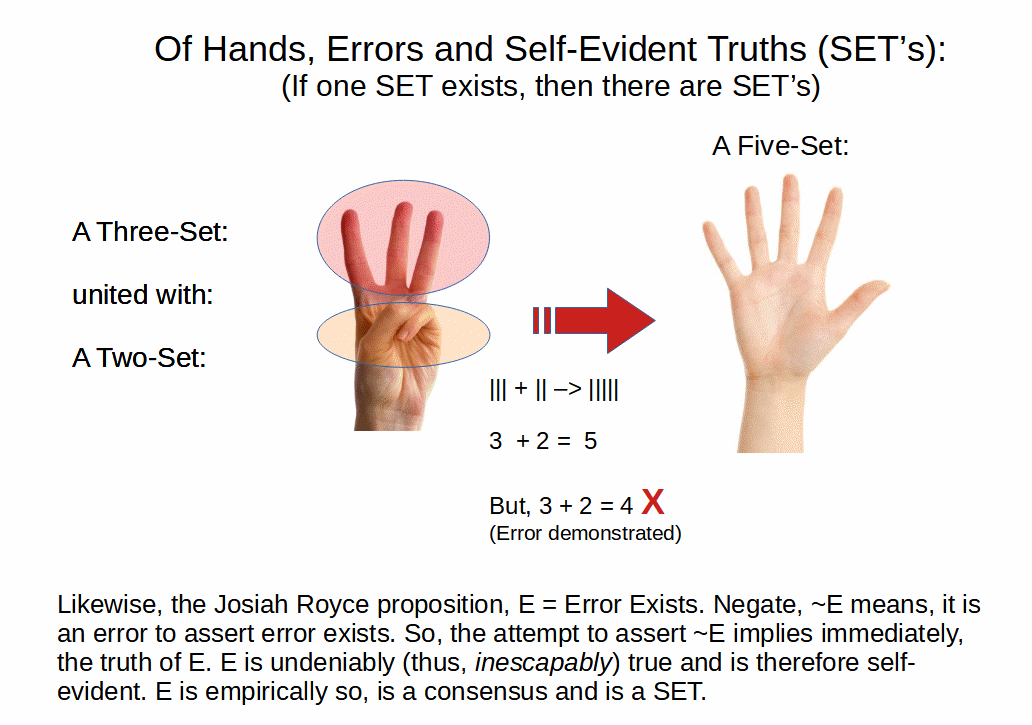
While self-evident truths cannot amount to enough to build a worldview, they can provide plumb line tests relevant to the reliability of warrant for what we accept as knowledge:

Such, of course, bring to the fore Ciceronian first duties of reason:

Marcus [in de Legibus, introductory remarks, C1 BC, being Cicero himself]: . . . we shall have to explain the true nature of moral justice, which is congenial and correspondent with the true nature of man [–> we are seeing the root vision of natural law, coeval with our humanity] . . . . “Law (say [“many learned men”]) is the highest reason, implanted in nature, which prescribes those things which ought to be done, and forbids the contrary” . . . . They therefore conceive that the voice of conscience is a law, that moral prudence is a law [–> a key remark] , whose operation is to urge us to good actions, and restrain us from evil ones . . . . the origin of justice is to be sought in the divine law of eternal and immutable morality. This indeed is the true energy of nature, the very soul and essence of wisdom, the test of virtue and vice.

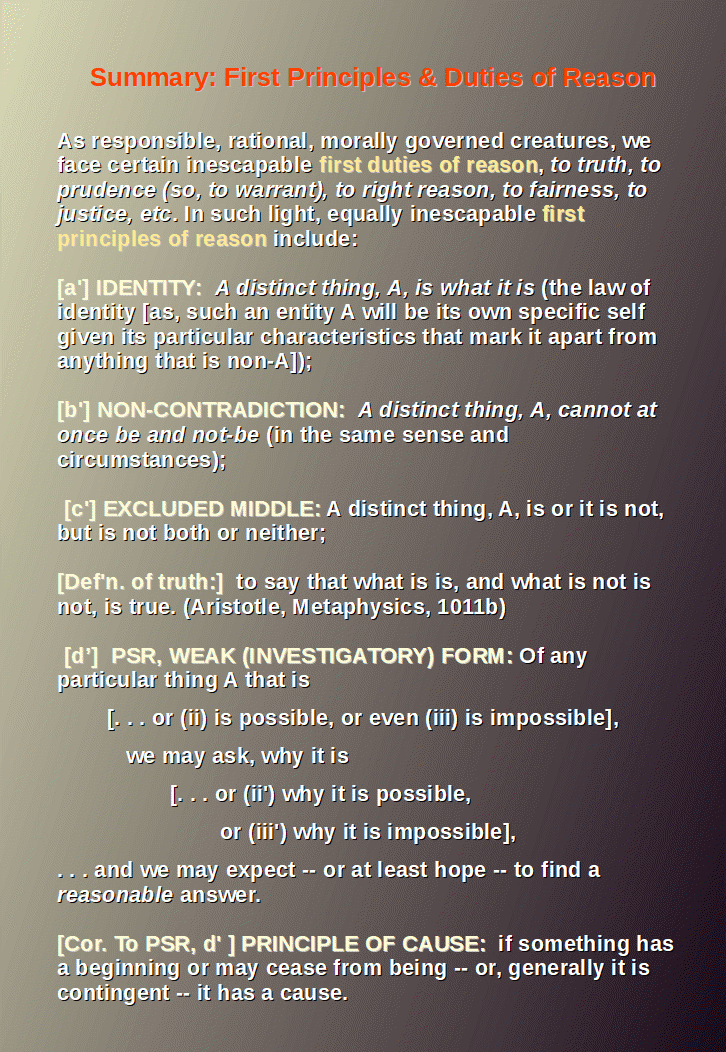
We may readily expand such first duties of reason: to truth, to right reason, to prudence, to sound conscience, to neighbour, so also to fairness and justice. Where, it may readily be seen that the would-be objector invariably appeals to the said duties. Does s/he object, false, or doubtfully so, or errors of reason, or failure to warrant, or unfairness or the like, alike, s/he appeals to the very same duties, collapsing in self-referentiality. So, instead, let us acknowledge that these are inescapable, true, self-evident.

It may help, too to bring out first principles of right reason, such as:
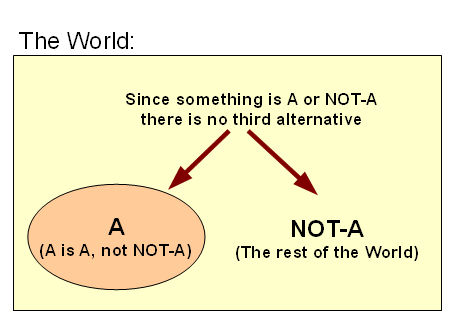
Laws of logic in action as glorified common-sense first principles of right reason

Expanding as a first list:

Such enable us to better use our senses and faculties to build knowledge. END

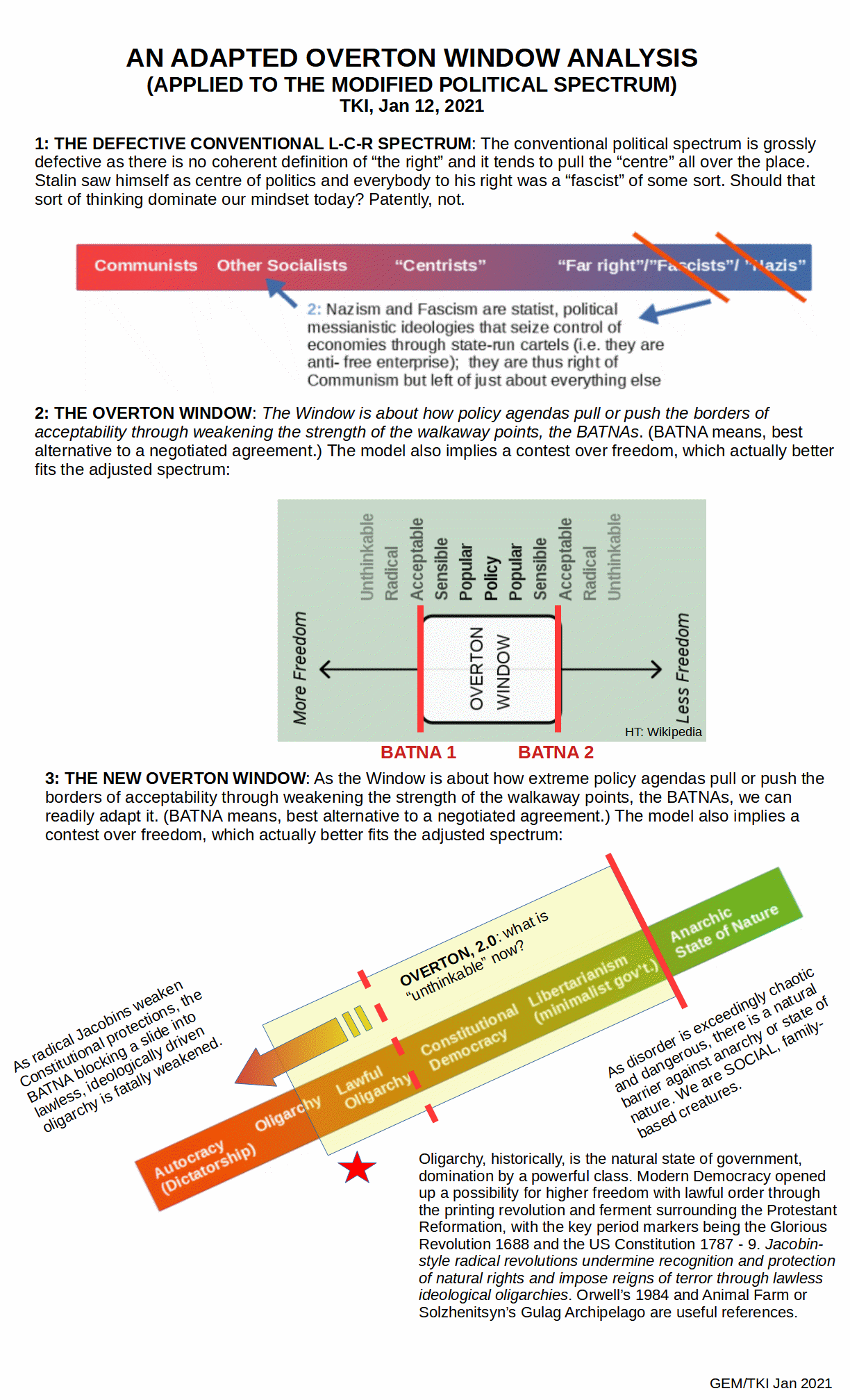
U/D May 16, regarding the Overton window, first, just an outline:
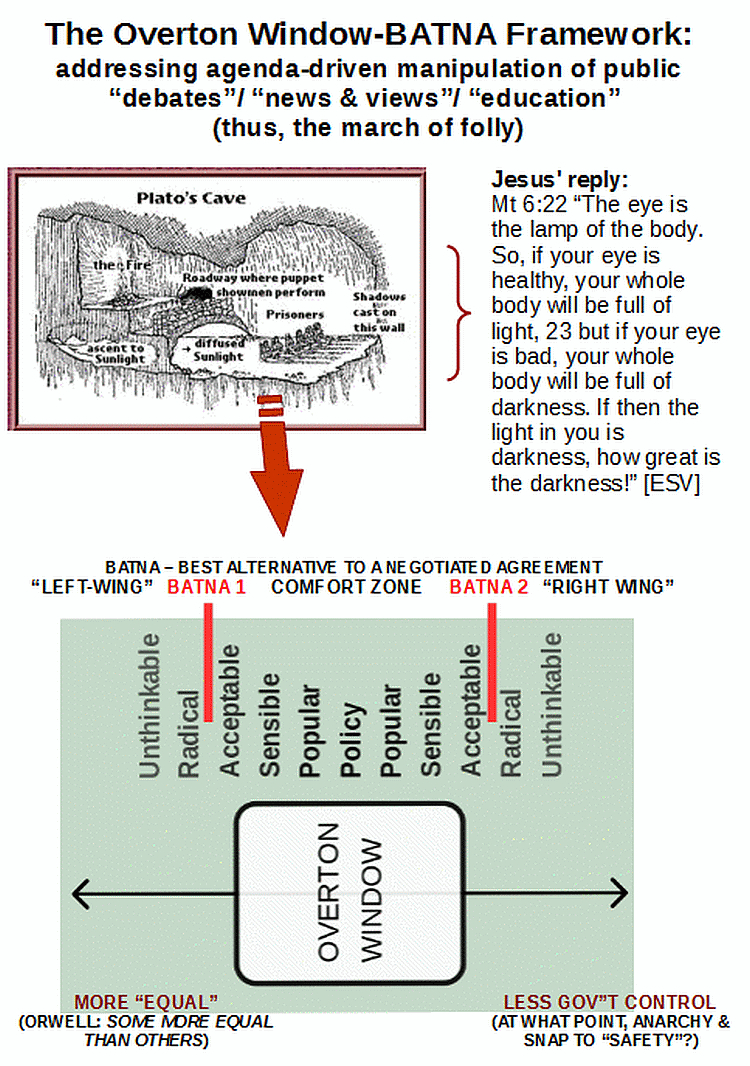
Next, as applied:
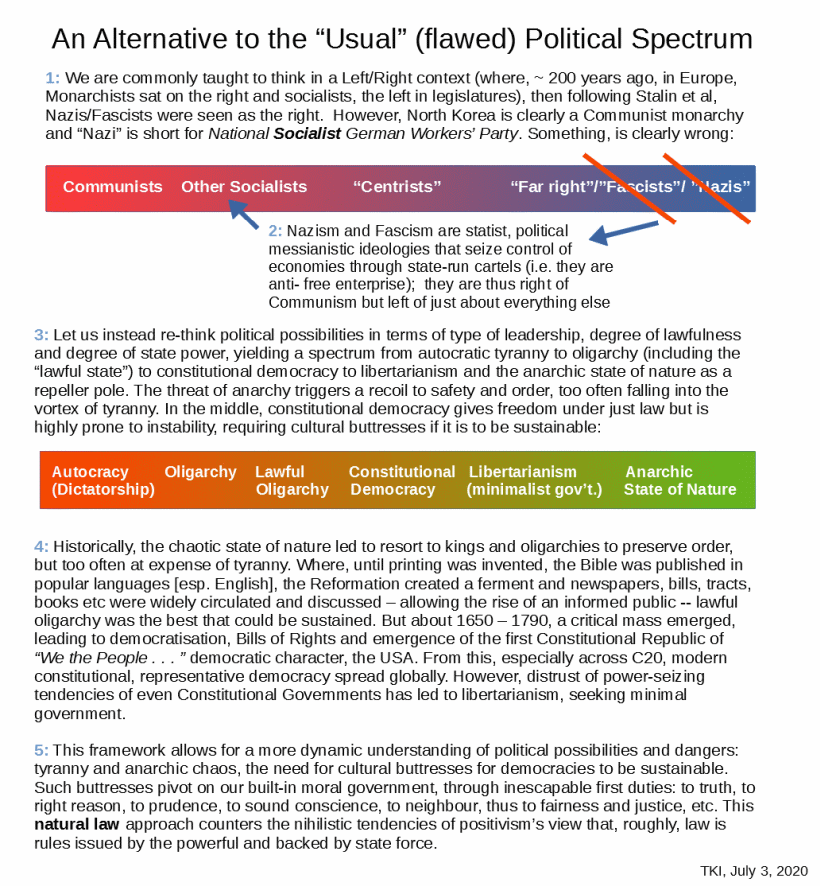
Backgrounder, on the political spectrum:
Comments
P.S. Jerry can shut the thread down by following his own advice: quit replying. I doubt that Paige and I will talk back-and-forth between ourselves for very long. (No offense, Paige! :-) )Viola Lee
May 17, 2021
May
05
May
17
17
2021
07:18 PM
7
07
18
PM
PST
KF, this is an important illustrative topic about the state of our civilization, and the role of law in helping mediate the fact that we live in a society of diverse views about what is true. Jerry thinks one thing is true, and I think more-or-less the opposite is true. How do we decide? We can't: each of us has our views and there is no objective arbiter. How do we live with that problem? Appealing to religious belief as the ultimate arbiter doesn't cut it. But if some people claim that their religious beliefs trump the law, that leads to anarchy. This is all on-topic for this thread.Viola Lee
May 17, 2021
May
05
May
17
17
2021
07:15 PM
7
07
15
PM
PST
Strike three. Few of the commenters here are consistent so they have no idea what knowledge is or what can justify it. Shut it down. All these threads end up the same way.jerry
May 17, 2021
May
05
May
17
17
2021
07:05 PM
7
07
05
PM
PST
Folks, I am seeing a derailed discussion thread. Derailed, by distraction from the focal issue, what is knowledge, how is it warranted and how does such differ from opinion, indoctrination, agit prop etc. This includes that it is self evidently true that conscience guides and guards our life of the mind and heart, so we ignore at peril. Further to which, we can find objective moral knowledge that regulates rationality through first duties including justice, truth, right reason, prudence etc. Above, there was repeated hyperskeptical dismissal, which failed to see that having disregarded the pivotal knowledge issue, it undermines the credibility of opinions, advocated policies and declarations under colour of law. We have no basis to take such self-defeating opinions seriously. Now, we are at strike two for this thread, do not force it to strike three. KFkairosfocus
May 17, 2021
May
05
May
17
17
2021
06:59 PM
6
06
59
PM
PST
Jerry writes, "This is getting ridiculous because one has the option of leaving the society for some place that does not have the immoral laws." This is not a serious suggestion. Are people moving out of the US because of laws allowing same-sex marriage? I don't think so And where would they go? Most of North and South America and Europe either have legal same-sex marriage or recognize marriages legalized elsewhere.Viola Lee
May 17, 2021
May
05
May
17
17
2021
06:57 PM
6
06
57
PM
PST
Jerry writes, "And people wonder why there seems to be a bias against religion in the US." As this discussion is showing, what we object to is people claiming that religious beliefs have a special status that can override the law.Viola Lee
May 17, 2021
May
05
May
17
17
2021
06:52 PM
6
06
52
PM
PST
You are saying that if a person decides a law is unnecessary, onerous, and requires immoral action, then that person can break the law
Yes, that is the moral thing to do when faced with an immoral law.
and have the right to have no legal consequences – true?
In "might makes right" there will be legal consequences but it will be immoral legal action by whoever applies the force. This is getting ridiculous because one has the option of leaving the society for some place that does not have the immoral laws. But most people do not see the laws as immoral so are not faced with this decision. But this has changed in recent years as certain parts of our society have prescribed onerous laws that are immoral.jerry
May 17, 2021
May
05
May
17
17
2021
06:48 PM
6
06
48
PM
PST
And who gets to decide "if the laws are unnecessary and onerous and essentially require immoral actions by the person"? It seems like you are saying that each person gets to be the judge of that for themselves. So, to be clear: You are saying that if a person decides a law is unnecessary, onerous, and requires immoral action, then that person can break the law and have the right to have no legal consequences - true?Viola Lee
May 17, 2021
May
05
May
17
17
2021
06:35 PM
6
06
35
PM
PST
Should one be excused from following the law because of one’s moral beliefs?
Most definitely, yes. Already answered several times. Especially if the laws are unnecessary and onerous and essentially require immoral actions by the person.
Instead you are dismissing the examples.
Why shouldn't they be dismissed. They are stupid and irrelevant examples. Why were such examples provided? And people wonder why there seems to be a bias against religion in the US. The previous comments are excellent examples.jerry
May 17, 2021
May
05
May
17
17
2021
06:31 PM
6
06
31
PM
PST
But you still aren't answering this question, Jerry. Instead you are dismissing the examples. Should one be excused from following the law because of one's moral beliefs?Viola Lee
May 17, 2021
May
05
May
17
17
2021
06:20 PM
6
06
20
PM
PST
A poll in 2017 show that approximately 9% of Americans oppose inter-racial marriage. This is the first time that I have heard someone say that 30,000,000 was next to zero.
Another stupid comment. If one opposed inter-racial marriage, how many are landlords that refuse to rent to such people for morality purposes. And how many would do that based on religious reasons.jerry
May 17, 2021
May
05
May
17
17
2021
05:59 PM
5
05
59
PM
PST
Jerry
In this case the landlord should get out of the rental business. However, my guess is that there is next to zero people that hold this attitude. So it is a nonsense example.
A poll in 2017 show that approximately 9% of Americans oppose inter-racial marriage. This is the first time that I have heard someone say that 30,000,000 was next to zero.paige
May 17, 2021
May
05
May
17
17
2021
05:49 PM
5
05
49
PM
PST
What: go some place else for your transfusion or surgery?
You got to be kidding. One of the more stupid comments.
Should the landlord being excused from following the law because of his moral beliefs.
In this case the landlord should get out of the rental business. However, my guess is that there is next to zero people that hold this attitude. So it is a nonsense example.jerry
May 17, 2021
May
05
May
17
17
2021
05:43 PM
5
05
43
PM
PST
Jerry writes, "People are revealing who they really are by their comments." Well, I agree with that! :-) You write about Paige's examples, "But there is zero effect on the world from these refusals. Because there are immediate alternatives." What: go some place else for your transfusion or surgery? Another question: suppose a landlord refuses to rent to an inter-racial couple because interracial marriage is immoral. The laws says that it illegal. Should the landlord being excused from following the law because of his moral beliefs. That seems to be the question you haven't addressed.Viola Lee
May 17, 2021
May
05
May
17
17
2021
05:19 PM
5
05
19
PM
PST
The subject of the importance of the nuclear family got me thinking about what the ultimate goal of this and how we attain it. Obviously the ultimate goal is to raise children to be healthy, contributing members of society. And I think most would agree that the best way of doing this is a strong commitment by the couple to ensure that their marriage is strong and endures. But the divorce rate in the US today is between 40 and 50%. However, digging deeper I found out that there is one type of marriage that only has a 4% divorce rate. If a strong and enduring union is how we attain our goal of raising children who become productive members of society, why aren’t we strongly advocating for all marriages to be of this type?paige
May 17, 2021
May
05
May
17
17
2021
05:04 PM
5
05
04
PM
PST
Jerry
On each of the above, the answer is yes they can refuse.
Sure they can. But not without consequences such as being fired. But, in reality, you wouldn’t see these sort of things because people with these beliefs would not seek these jobs. The trouble occurs when people with a specific religious or moral belief get into a career that conforms to this belief, only to have laws change. This has happened numerous times throughout history. Most recently with LGBQ acceptance. But before this was equal rights for women and the civil rights movement. In both cases moral values and religious beliefs were used to argue against them and jobs were lost, lawsuits filed, and reputations destroyed. But, eventually, the vast majority of people became accepting of these.paige
May 17, 2021
May
05
May
17
17
2021
04:53 PM
4
04
53
PM
PST
Could an emergency doctor refuse to administer transfusions because their religion does not allow them? Could a Jewish surgeon refuse to perform emergency surgery on a patient between sundown Friday and sundown Saturday because his religion does not allow work on the sabbath? Could a grocery store cashier refuse to allow people to buy meat because she is morally opposed to eating the flesh of animals?
people who think it is immoral to serve an inter-racial couple. Should they be allowed to do that?
On each of the above, the answer is yes they can refuse. But there is zero effect on the world from these refusals. Because there are immediate alternatives. These are all vacuous examples. And apparently knee jerk responses. People are revealing who they really are by their comments.jerry
May 17, 2021
May
05
May
17
17
2021
04:38 PM
4
04
38
PM
PST
Civil disobedience is a time-tested way to get laws changed. However, these aren’t consequence fee acts. And shouldn’t be.paige
May 17, 2021
May
05
May
17
17
2021
04:21 PM
4
04
21
PM
PST
ViolaLee The main point is that you have an inconsistent philosophy. You want a stabile society, but you don’t want to have to follow laws that you think are immoral
Imagine that to be a consistent philosophy has to follow the laws of other philosophies. :)Sandy
May 17, 2021
May
05
May
17
17
2021
04:15 PM
4
04
15
PM
PST
It didn't function very well when the immoral laws of forbidding interracial marriages, or segregation, or not letting women vote were in place. they are still people who think it is immoral to serve an inter-racial couple. Should they be allowed to do that? I think not allowing assisted dying is immoral. Does that mean my spouse should be able to assist that if the time comes and face no consequences? The main point is that you have an inconsistent philosophy. You want a stabile society, but you don't want to have to follow laws that you think are immoral, but you don't want to think through the consequences of applying that desire to some and not all.Viola Lee
May 17, 2021
May
05
May
17
17
2021
04:02 PM
4
04
02
PM
PST
Jerry
But what if the service is seen as immoral by the person/organization that is supposed to administer it?
Where is the line drawn? And who has the authority to draw it? Could an emergency doctor refuse to administer transfusions because their religion does not allow them? Could a Jewish surgeon refuse to perform emergency surgery on a patient between sundown Friday and sundown Saturday because his religion does not allow work on the sabbath?Could a grocery store cashier refuse to allow people to buy meat because she is morally opposed to eating the flesh of animals?paige
May 17, 2021
May
05
May
17
17
2021
04:02 PM
4
04
02
PM
PST
As I said before, how could society function like this?
It functioned just fine before the immoral laws. Get rid of the laws that require people to do what they consider are immoral things. It has never been an issue until recently. Why? There is a huge difference between allowing some to do immoral things and forcing others to do them or abet others in doing something immoral..jerry
May 17, 2021
May
05
May
17
17
2021
03:45 PM
3
03
45
PM
PST
And they cold not obey the law without any consequences? That is, you are saying that each citizen has the right to pick and choose which laws they wish to follow, without consequences, based on their beliefs about what is moral? As I said before, how could society function like this?Viola Lee
May 17, 2021
May
05
May
17
17
2021
03:34 PM
3
03
34
PM
PST
they would have had obey that decision – true?
No, they would not obey the law. It is an immoral law. Why are they being put under this obligation to obey an immoral law? That is the issue. The society functioned just fine before the immoral laws.jerry
May 17, 2021
May
05
May
17
17
2021
03:28 PM
3
03
28
PM
PST
But they followed the law by going to the Supreme Court, which was their right. If the Supreme Court had ruled against them, then they would have had obey that decision - true? Or are you saying that you believe that if a law violates one's religious convictions, one has the right to disobey the law and be free of any consequences for doing so? P.S. I see you added this to 320: "But what if the service is seen as immoral by the person/organization that is supposed to administer it?" They still have to follow the law. How would society function if anyone could decide to not follow a law because they thought it was immoral?Viola Lee
May 17, 2021
May
05
May
17
17
2021
03:15 PM
3
03
15
PM
PST
Seversky
Sandy/267 You support contradictory causes which give us a hint about you. Would have been better for you to be a naive student.
I agree with Paige on almost all of those positions.
Paige I am not a member of either party, although I support some policies from both.
:) Both parties are controlled by the same cabal. S/he opposes abortion because supporting same sex marriage they need children to be adopted and sexualized. S/he support the right for someone to take a knee or burn the flag for which veterans fought and died but also s/he support veterans. Imagine that :)) S/he believes that there is systemic racism but somehow a black became president twice not being stopped by this systemic racism. On the other side blacks are 10% of population and commit 50% of the crimes...because systemic racism. Right? S/he thinks change is inevitable ...oh yes "build back better" :)
Seversky Maybe it’s naïve to think you can fit people neatly into boxes like “conservative” or “liberal” or that labelling them as such tells you everything they believe in. Maybe it’s naïve to think that “worldview” is anything other than a vague and incoherent concept.
Nope, everything is crystal clear. Atheists have a "regulated" inteligence there are messages where are very smart when they talk against God and after 2 messages they know nothing if is against their materialist religion. Everything become foggy and vague and incoherent. :))Sandy
May 17, 2021
May
05
May
17
17
2021
03:13 PM
3
03
13
PM
PST
but we all need to follow the same legal rules.
Not if it violates one's religious convictions. This has never been an issue till recently but has come up when the government requires individuals and religious organizations to do things they are morally against, such as providing abortions, providing operations that violate their religious views. There was a law suit that would have required nuns to provide money for insurance that included contraceptive supplies and abortions. They went to the Supreme Court to avoid it.
They are being sued for refusing to provide a service to people who are legally entitled to it.
But what if the service is seen as immoral by the person/organization that is supposed to administer it?jerry
May 17, 2021
May
05
May
17
17
2021
03:06 PM
3
03
06
PM
PST
And I don’t think any of this constitutes persecution. Nobody is being sued or charged for their religious beliefs. They are being sued for refusing to provide a service to people who are legally entitled to it.paige
May 17, 2021
May
05
May
17
17
2021
02:29 PM
2
02
29
PM
PST
There is a difference between belief and action. If there are laws about something, religious belief should not get somebody out of having to follow the law. One can believe what one wants, whether it be because of religion, philosophy, or whatever, but we all need to follow the same legal rules.Viola Lee
May 17, 2021
May
05
May
17
17
2021
02:08 PM
2
02
08
PM
PST
"Are adoption agencies allowed to deny adoption because of the religion, or lack of religion, of the couple seeking an adoption?" Paige, From what I understand, these Christian adoption agencies had the right to maintain the definition of what marriage is, and they would refer couples to other agencies if there wasn't a real marriage involved. Andrewasauber
May 17, 2021
May
05
May
17
17
2021
01:19 PM
1
01
19
PM
PST
1 … 31 32 33 34 35 … 44