Uncommon Descent Serving The Intelligent Design Community

L&FP42: is knowledge warranted, credibly true (so, reliable) belief?

Categories
Defending our Civilization
Epistemology
Logic and Reason
Share
Facebook
Twitter/X
LinkedIn
Flipboard
Print
Email

It’s time to start delivering on a promise to address “warrant, knowledge, logic and first duties of reason as a cluster,” even at risk of being thought pedantic. Our civilisation is going through a crisis of confidence, down to the roots. If it is to be restored, that is where we have to start, and in the face of rampant hyperskepticism, relativism, subjectivism, emotivism, outright nihilism and irrationality, we need to have confidence regarding knowledge.

Doing my penance, I suppose: these are key issues and so here I stand, in good conscience, I can do no other, God help me.

For a start, from the days of Plato, knowledge has classically been defined as “justified, true belief.” However, in 1963, the late Mr Gettier put the cat in among the pigeons, with Gettier counter-examples; which have since been multiplied. In effect, there are circumstances (and yes, sometimes seemingly contrived, but these are instructive thought exercises) in which someone or a circle may be justified to hold a belief but on taking a wider view such cannot reasonably be held to be a case of knowledge.

As a typical thought exercise, consider a circle of soldiers and sailors on some remote Pacific island, who are eagerly awaiting a tape of a championship match sent out by the usual morale units. They get it, play it and rejoice that team A has won over team B (and the few who thought otherwise have to cough up on their bets to the contrary). Unbeknownst to them, through clerical error, it was last year’s match, which had the same A vs B match-up and more or less the same outcome. They are justified — have a right — to believe, what they believe is so, but somehow the two fail to connect leading to accidental, not reliable arrival at truth.

Knowledge must be built of sterner stuff.

Ever since, epistemology as a discipline, has struggled to rebuild a solid consensus on what knowledge is.

Plantinga weighed in with a multi-volume study, championing warrant, which(as we just noted) is at first defined by bill of requisites. That is, we start with what it must do. So, warrant — this builds on the dictionary/legal/commercial sense of a reliable guarantee of performance “as advertised” — will be whatever reliably converts beliefs we have a right to into knowledge.

The challenge being, to fill in the blank, “Warrant is: __________ .”

Plantinga then summarises, in his third volume:

The question is as old as Plato’s Theaetetus: what is it that distinguishes knowledge from mere true belief? What further quality or quantity must a true belief have, if it is to constitute knowledge? This is one of the main questions of epistemology. (No doubt that is why it is called ‘theory of knowledge’.) Along with nearly all subsequent thinkers, Plato takes it for granted that knowledge is at least true belief: you know a proposition p only if you believe it, and only if it is true. [–> I would soften to credibly, true as we often use knowledge in that softer, defeat-able sense cf Science] But Plato goes on to point out that true belief, while necessary for knowledge, is clearly not sufficient: it is entirely possible to believe something that is true without knowing it . . .

[Skipping over internalism vs externalism, Gettier, blue vs grue or bleen etc etc] Suppose we use the term ‘warrant’ to denote that further quality or quantity (perhaps it comes in degrees), whatever precisely it may be, enough of which distinguishes knowledge from mere true belief. Then our question (the subject of W[arrant and] P[roper] F[unction]): what is warrant?

My suggestion (WPF, chapters 1 and 2) begins with the idea that a belief has warrant only if it is produced by cognitive faculties that are functioning properly, subject to no disorder or dysfunction—construed as including absence of impedance as well as pathology. The notion of proper function is fundamental to our central ways of thinking about knowledge. But that notion is inextricably bound with another: that of a design plan.37

Human beings and their organs are so constructed that there is a way they should work, a way they are supposed to work, a way they work when they work right; this is the way they work when there is no malfunction . . . We needn’t initially take the notions of design plan and way in which a thing is supposed to work to entail conscious design or purpose [–> design, often is naturally evident, e.g. eyes are to see and ears to hear, both, reasonably accurately] . . .

Accordingly, the first element in our conception of warrant (so I say) is that a belief has warrant for someone only if her faculties are functioning properly, are subject to no dysfunction, in producing that belief.39 But that’s not enough.

Many systems of your body, obviously, are designed to work in a certain kind of environment . . . . this is still not enough. It is clearly possible that a belief be produced by cognitive faculties that are functioning properly in an environment for which they were designed, but nonetheless lack warrant; the above two conditions are not sufficient. We think that the purpose or function of our belief-producing faculties is to furnish us with true (or verisimilitudinous) belief. As we saw above in connection with the F&M complaint [= Freud and Marx], however, it is clearly possible that the purpose or function of some belief-producing faculties or mechanisms is the production of beliefs with some other virtue—perhaps that of enabling us to get along in this cold, cruel, threatening world, or of enabling us to survive a dangerous situation or a life-threatening disease.

So we must add that the belief in question is produced by cognitive faculties such that the purpose of those faculties is that of producing true belief.

More exactly, we must add that the portion of the design plan governing the production of the belief in question is aimed at the production of true belief (rather than survival, or psychological comfort, or the possibility of loyalty, or something else) . . . .

[W]hat must be added is that the design plan in question is a good one, one that is successfully aimed at truth, one such that there is a high (objective) probability that a belief produced according to that plan will be true (or nearly true). Put in a nutshell, then, a belief has warrant for a person S only if that belief is produced in S by cognitive faculties functioning properly (subject to no dysfunction) in a cognitive environment [both macro and micro . . . ] that is appropriate for S’s kind of cognitive faculties, according to a design plan that is successfully aimed at truth. We must add, furthermore, that when a belief meets these conditions and does enjoy warrant, the degree of warrant it enjoys depends on the strength of the belief, the firmness with which S holds it. This is intended as an account of the central core of our concept of warrant; there is a penumbral area surrounding the central core where there are many analogical extensions of that central core; and beyond the penumbral area, still another belt of vagueness and imprecision, a host of possible cases and circumstances where there is really no answer to the question whether a given case is or isn’t a case of warrant.41 [Warranted Christian Belief (NY/Oxford: OUP, 2000), pp 153 ff. See onward, Warrant, the Current Debate and Warrant and Proper Function; also, by Plantinga.]

So, we may profitably distinguish [a] Plantinga’s specification (bill of requisites) for warrant and [b] his theory of warrant. The latter, being (for the hard core):

a belief has warrant for a person S only if that belief is produced in S by cognitive faculties functioning properly (subject to no dysfunction) in a cognitive environment [both macro and micro . . . ] that is appropriate for S’s kind of cognitive faculties, according to a design plan that is successfully aimed at truth.

Obviously, warrant comes in degrees, which is just what we need to have. Certain things are known to utterly unchangeable certainty, others are to moral certainty, others for good reason are held to be reasonably reliable though not certain enough to trust when the stakes are high, other things are in doubt as to whether they are knowledge, some things outright fail any responsible test.

That’s why I have taken up and commend a modified form, recognising that what we think is credibly, reliably true today may oftentimes be corrected for cause tomorrow. (Back in High School Chemistry class, I used to imagine a courier arriving at the door to deliver the latest updates to our teacher.)

Yes, I accept that many knowledge claims are defeat-able, so open-ended and provisional.

Indeed, that is part of what distinguishes the prudence and fair-mindedness of sober knowledge claims hard won and held or even stoutly defended in the face of uncertainty and challenge from the false certitude of blind ideologies. Especially, where deductive logical schemes can have no stronger warrant than their underlying axioms and assumptions and where inductive warrant provides support, not utterly certain, incorrigible, absolute demonstration.

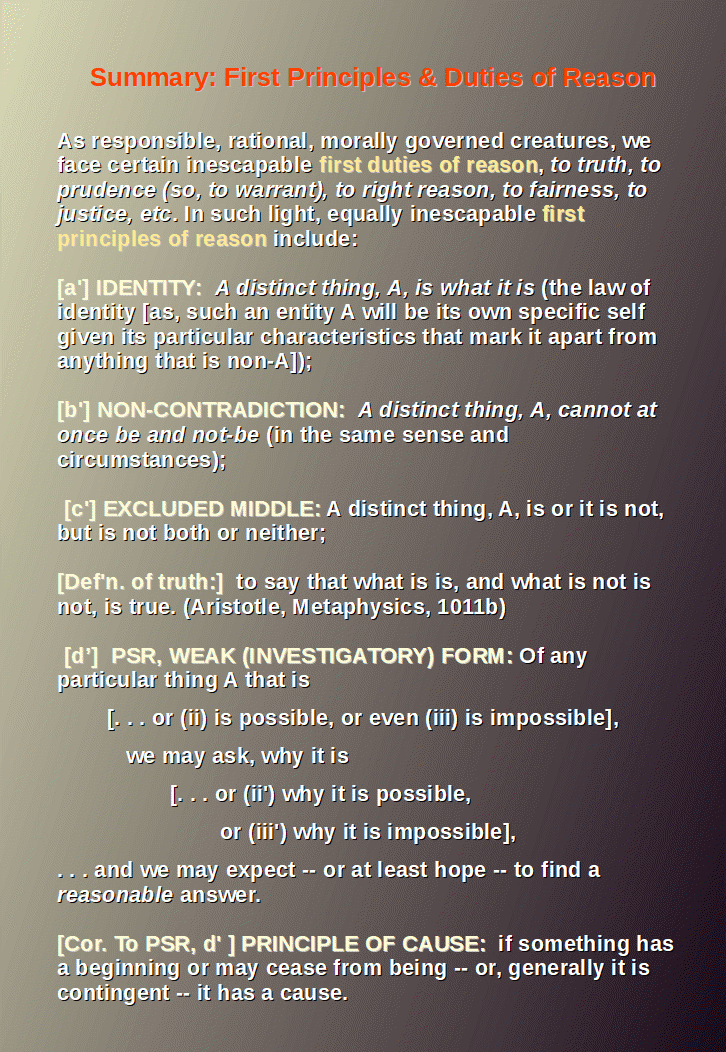
That said, we must recognise that some few things are self-evident, e.g.:
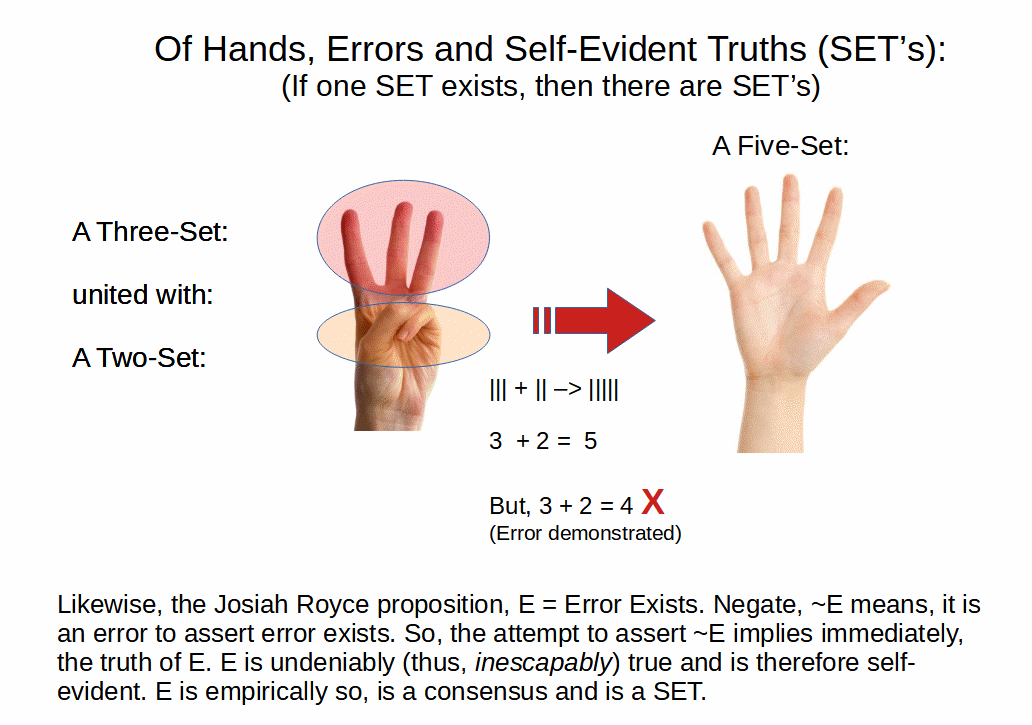
While self-evident truths cannot amount to enough to build a worldview, they can provide plumb line tests relevant to the reliability of warrant for what we accept as knowledge:

Such, of course, bring to the fore Ciceronian first duties of reason:

Marcus [in de Legibus, introductory remarks, C1 BC, being Cicero himself]: . . . we shall have to explain the true nature of moral justice, which is congenial and correspondent with the true nature of man [–> we are seeing the root vision of natural law, coeval with our humanity] . . . . “Law (say [“many learned men”]) is the highest reason, implanted in nature, which prescribes those things which ought to be done, and forbids the contrary” . . . . They therefore conceive that the voice of conscience is a law, that moral prudence is a law [–> a key remark] , whose operation is to urge us to good actions, and restrain us from evil ones . . . . the origin of justice is to be sought in the divine law of eternal and immutable morality. This indeed is the true energy of nature, the very soul and essence of wisdom, the test of virtue and vice.

We may readily expand such first duties of reason: to truth, to right reason, to prudence, to sound conscience, to neighbour, so also to fairness and justice. Where, it may readily be seen that the would-be objector invariably appeals to the said duties. Does s/he object, false, or doubtfully so, or errors of reason, or failure to warrant, or unfairness or the like, alike, s/he appeals to the very same duties, collapsing in self-referentiality. So, instead, let us acknowledge that these are inescapable, true, self-evident.

It may help, too to bring out first principles of right reason, such as:
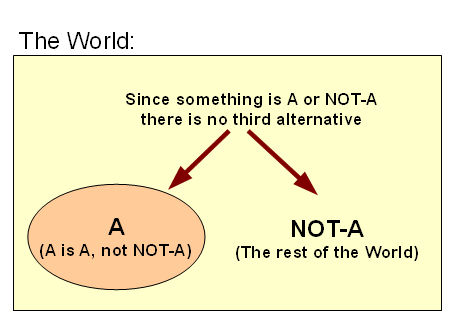
Laws of logic in action as glorified common-sense first principles of right reason

Expanding as a first list:

Such enable us to better use our senses and faculties to build knowledge. END

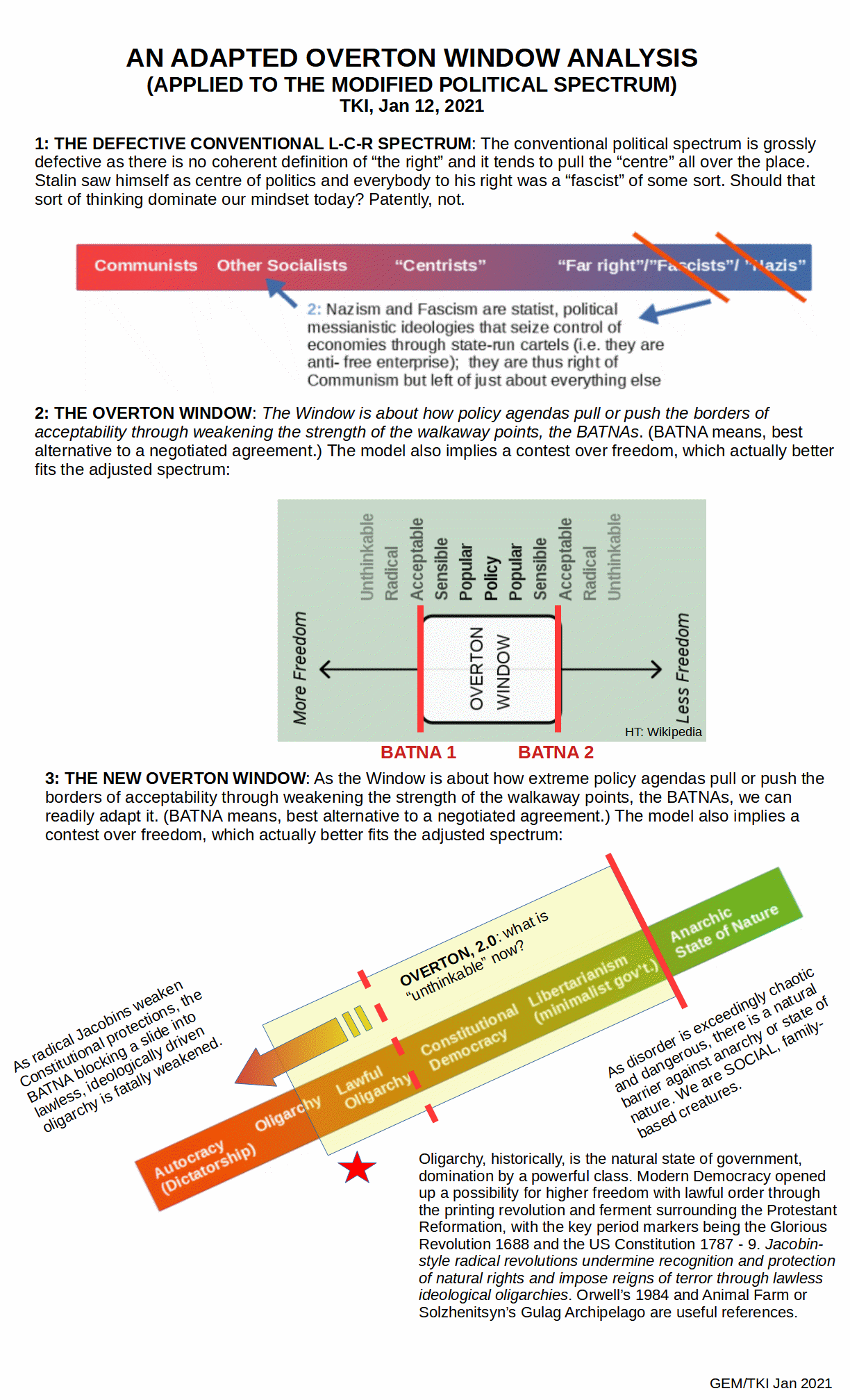
U/D May 16, regarding the Overton window, first, just an outline:
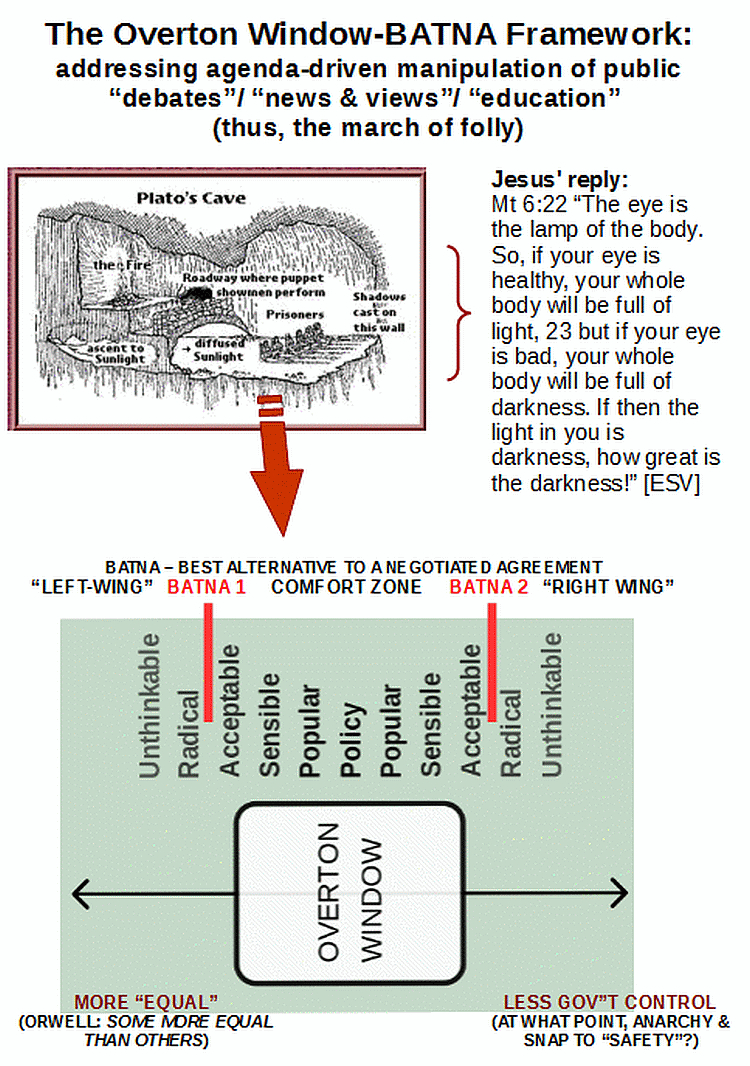
Next, as applied:
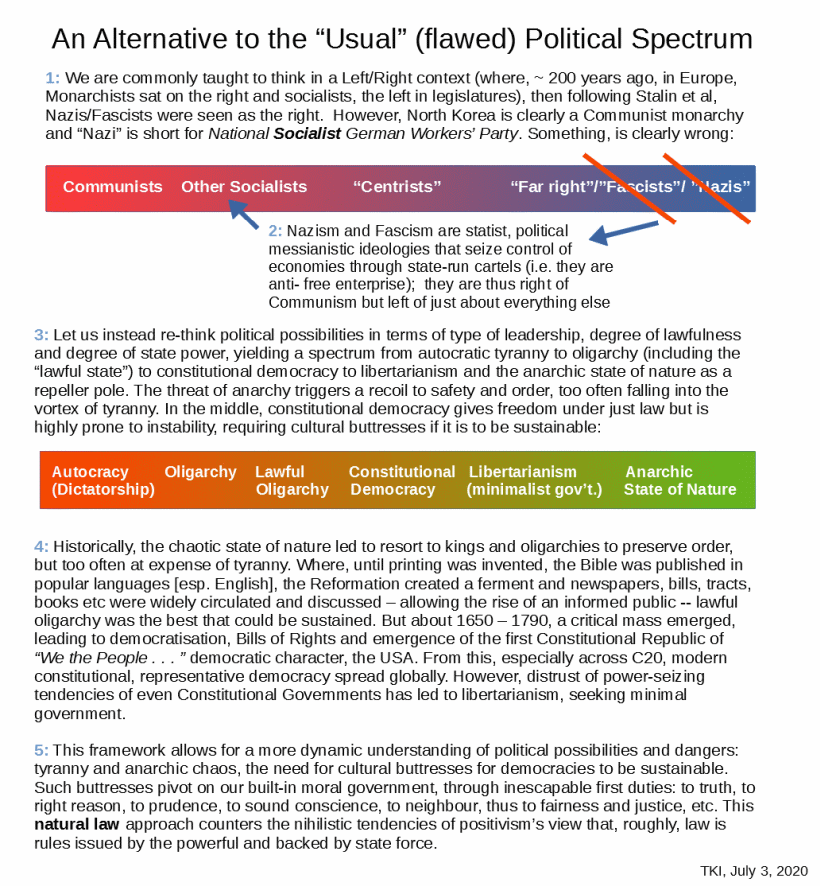
Backgrounder, on the political spectrum:
Comments
SB
It is interesting that both of these individuals support a world view (political progressivism)...
Again with the labelling so as to categorize an individual into the “despised other” group. If you see the things I support at 250 you will see that some fall on the right end of the spectrum and some fall on the left. Rather that apply a convenient, although inaccurate, label to VL and myself, why not address the issues we actually mention? For example, I don’t think that VL or I have ever said anything to support the “cancel culture”, but we are accused of supporting it. As well, neither VL or I have said anything in support of authoritative or totalitarian regimes, but those implications have been made.paige
May 16, 2021
May
05
May
16
16
2021
12:10 PM
12
12
10
PM
PST
I may be able to respond more later tonight, but Stephen writes, "Progressives, by definition, are supporters of a totalitarian government because they view the state (not the family) as the primary institution for shaping the culture." Can you provide a source for that "definition"? And " Progressives hate the nuclear family and always have.." Can you provide some evidence for that? I have lots of friends that could be labelled "progressives" and am virtually certainly every one of them thinks family is the core and heart of community, from which government derives its power. (Note: I left out "nuclear" because families comes in all sorts, including the extended family: grandparents, parents, and children that help establish the continuity that helps family extend over time.) And, I will add that Stephen's comment is a prime example of something we have been discussing here, and that I mentioned: without knowing very much about me he throws me into a demonized stereotypical group for which he has nothing but disgust. Such tribalism, demonization, and distorted simplifications are some of the things I am concerned about in the world.Viola Lee
May 16, 2021
May
05
May
16
16
2021
11:55 AM
11
11
55
AM
PST
^^^^^^ I wish I could have articulated that as well as you did StephenB.bornagain77
May 16, 2021
May
05
May
16
16
2021
11:38 AM
11
11
38
AM
PST
Viola Lee --- [worries about] “Our effect on the environment, totalitarian approaches to government, threats to democracy in the US and elsewhere, conspiracy theories and the reasons they take hold, tribal attachment to worldviews and the demonization of people who think otherwise, to name a few. Paige --- “I agree. The risk to civilization is not divorce, premarital sex, universal health care, same sex marriage, the decline of Christianity, globalization, immigration or the tolerance and protection of different worldviews. It is intolerance, political divisiveness, labelling, xenophobia, government overreach, lack of support for the least fortunate, lack of action against racism and sexism, the resistance to change and experimentation, and the belief in a non-existent “better times”. It is interesting that both of these individuals support a world view (political progressivism) that militates against the values they claim to care about. So let’s make a few relevant points: Christians and theists support a rational world view that recognizes the existence of God given rights, such as the right to life, the right to free speech, and right to free expression. They view government as the institution that is supposed to protect those basic human rights, which reflect the natural moral law. Under that system, there is a tolerance for diverse views and a justifiable bias against totalitarianism. With this formula, it is they (the citizens) who are supposed to be calling the shots and it is the government that is supposed to be serving them. Progressives, by definition, are supporters of a totalitarian government because they view the state (not the family) as the primary institution for shaping the culture. Progressives hate the nuclear family and always have. On that matter, they refuse to *tolerate* those with whom they disagree. That is what “hate crime” legislation is all about. Those same progressives gave us the “cancel” culture, which eliminates any form of dissent from politically correct ideology. They enforce their totalitarian view by such acts as shutting down YouTube accounts. Christians support the first rules of right reason because they understand that a rational world view is necessary to appreciate the objective truths that define our natural rights and the attendant responsibilities that go with them. According to the natural moral law, rights and responsibilities go together. Without that understanding, it is impossible to build a well ordered society. Progressives dismiss morality, duty, and human dignity as myths. That is why they militate against the rational principles set forth in the American Constitution and Declaration of Independence, which are grounded in “the laws of nature and nature’s God.” Notice how often they have said (on this very thread) that humans have no moral duties at all. In the American culture, progressives have taken up the immoral Marxist philosophy, which holds that “the end justifies the means," which is the same as saying, they (not their adversaries) may do anything they please if they so choose. If they must lie, cheat, steal, or murder to get their way, they will do it since they recognize no objective moral constraints on their behavior. So please, Viola Lee and Paige, don’t tell me that you worry about the evils of totalitarianism and intolerance. If you were sincere about freedom's principles, you would join the Theists and abandon your radical secularism.StephenB
May 16, 2021
May
05
May
16
16
2021
11:18 AM
11
11
18
AM
PST
Too late to edit 251: "mankind as a whole", not "making as a whole."Viola Lee
May 16, 2021
May
05
May
16
16
2021
11:18 AM
11
11
18
AM
PST
KF writes, "VL, the Bruntland sustainability principle is an application of the Kantian Categorical Imperative, i.e. it is essentially ethical." What does that have to do with what I wrote? My concerns about the world are primarily ethical as they are based on my wishes for the betterment of making as a whole.Viola Lee
May 16, 2021
May
05
May
16
16
2021
10:57 AM
10
10
57
AM
PST
Sandy
Paige probably you are a young and unexperienced(not to use a harsher term ) student.
On the contrary. I am in my mid sixties, have worked in over 25 countries in North and South America, Asia, Australasia, Africa and Europe, and continue to work with people from over 70 countries, covering most cultures and religions. I am not a member of either party, although I support some policies from both. I oppose abortion but don’t see a path towards eliminating the demand for them. I oppose deficit budgets except in times of crisis. I support the right for someone to take a knee or burn the flag. I support full support for veterans. I oppose super-pacs. I support freedom of speech, which also includes the right of people to advocate for consequences (eg, boycotting, withholding advertising revenue, etc) for people who’s speech you disagree with. I support freedom for religion except when it imposed restrictions on other people’s freedoms. I support same sex marriage but also support the right of any church to not preside over SSM. I support universal health care but not government delivery of these services. I support the 2nd amendment. I believe that there is systemic racism but it is much better than it was 50+ years ago. I think change is inevitable so it is in our best interest to help guide this change rather than blindly resist it.paige
May 16, 2021
May
05
May
16
16
2021
10:56 AM
10
10
56
AM
PST
I agree. The risk to civilization is not divorce, premarital sex, universal health care, same sex marriage, the decline of Christianity, globalization, immigration or the tolerance and protection of different worldviews. It is intolerance, political divisiveness, labelling, xenophobia, government overreach, lack of support for the least fortunate, lack of action against racism and sexism, the resistance to change and experimentation, and the belief in a non-existent “better times”.
One of the more gibberish paragraphs I’ve seen in awhile. Probably every thing in it could be shown wrong to some extent or empty of any thinking. A couple are innocuous or pious nonsense such as universal health care but most are meaningless such as there doesn’t exist a better time. A product of not thinking clearly. It’s let me print the good sounding points without any thought.jerry
May 16, 2021
May
05
May
16
16
2021
10:46 AM
10
10
46
AM
PST
The problem I have with apocalyptic visions of imminent social collapse is that it implies that there was widespread social order and stability which preceded it and is in danger of being abandoned through some sort of madness for want of a better word. I think this is a misperception. I think that if you look at human cultures on a global scale going back over the millennia they have been a pretty awful mess. Yes, there have been pockets of relative peace and prosperity but they haven't lasted. On top of this you have the daunting problem of trying to find a way of governing and providing for a world population of upwards of 7 billion and growing, a lot of whom don't want other people interfering with their way of life as they see it. How do you help those who don't want your help? This is a situation we've never had to deal with before. Looking back to previous cultures to see what we can learn from them is always a good idea but they may not be the answer, at least not all of it. We may have to try to find something new. Political ideologies like Marxism or communism or socialism don't seem to work because, whatever their ideals, they seem to fall all too easily into the hands of gangsters. Capitalist democracies are a little better but the wealth and power available soon fall into the hands of those with the skills to manipulate the system to their own advantage, in other words, the modern equivalents of the so-called "robber barons". As they say in some movies at a time of crisis, "If anyone has a better idea, now's the time."Seversky
May 16, 2021
May
05
May
16
16
2021
10:40 AM
10
10
40
AM
PST
Paige VL, I agree. The risk to civilization is not divorce, premarital sex, universal health care, same sex marriage, the decline of Christianity, globalization, immigration or the tolerance and protection of different worldviews. It is intolerance, political divisiveness, labelling, xenophobia, government overreach, lack of support for the least fortunate, lack of action against racism and sexism, the resistance to change and experimentation, and the belief in a non-existent “better times”.
:) Paige probably you are a young and unexperienced(not to use a harsher term ) student. What happens when naivity,credulity and idealism met together ? Why socialism ,comunism,leftism have such a success with unexperienced and full of imaginary goals students? Because they had no real responsibility in life,no experience in life and are full of imaginary idealist goals. Easy to be tricked and they think they are the saviours of the world when in reality they can't even distinguish which is their left arm and which is their right arm. It's sad .Sandy
May 16, 2021
May
05
May
16
16
2021
10:07 AM
10
10
07
AM
PST
VL, the Bruntland sustainability principle is an application of the Kantian Categorical Imperative, i.e. it is essentially ethical. The first duties of reason are foundational to ethical and political reason too. Unsoundness at the root leads to unsoundness in policy and to breakdown of trust in community. That last, alas, is too often so for cause. KFkairosfocus
May 16, 2021
May
05
May
16
16
2021
09:46 AM
9
09
46
AM
PST
@Paige:
VL, I agree. The risk to civilization is not divorce, premarital sex, universal health care, same sex marriage, the decline of Christianity, globalization, immigration or the tolerance and protection of different worldviews. It is intolerance, political divisiveness, labelling, xenophobia, government overreach, lack of support for the least fortunate, lack of action against racism and sexism, the resistance to change and experimentation, and the belief in a non-existent “better times”.
The irony is that the sj movement's fight against so called "racism" and "sexism" has lead to intolerance, political divisiveness, labelling, goverment overreach, lack of support for the least fortunate, ...AndyClue
May 16, 2021
May
05
May
16
16
2021
09:45 AM
9
09
45
AM
PST
BA77, if people look at the equivalent of a naturally straight and upright plumb line and insist that it is crooked, the issue is not evidence or reason but crooked yardstick standards of thinking. We are manifestly rational, responsible, conscience guided. Truth is the manifest purpose of reason and we have a duty to move towards it. Likewise, duty informs us of what we should do but are inherently free not to do. If we reject the force of such and refuse to recognise from the course of our own objections that they appeal to the first duties, invariably [with case after case on point] we can only duly note the fact and recognise its sad consequences. KFkairosfocus
May 16, 2021
May
05
May
16
16
2021
09:42 AM
9
09
42
AM
PST
The obvious analysis about what is happening is, people are making bad personal opinions about what is good, loving and beautiful. If people don't pay dedicated attention to subjective issues, as in prayer to God, then they will have bad personal opinions. If atheists sat down, and thought about subjective issues, then they would form better personal opinons. That would be another way than prayer to pay dedicated attention to subjective issues. But clearly, praying to God is by far the most excellent way to pay dedicated attention to subjective issues. And atheists are utterly clueless about how subjectivity functions, because it is an inherently creationist concept. So then the atheists go by their intuitive understanding of subjectivity only, not any intellectual understanding of it. It can only turn out bad. Creationists are themselves too blame, for not teaching the creationist conceptual scheme. The CCS which explains the difference between opinions and facts.mohammadnursyamsu
May 16, 2021
May
05
May
16
16
2021
07:40 AM
7
07
40
AM
PST
VL, I agree. The risk to civilization is not divorce, premarital sex, universal health care, same sex marriage, the decline of Christianity, globalization, immigration or the tolerance and protection of different worldviews. It is intolerance, political divisiveness, labelling, xenophobia, government overreach, lack of support for the least fortunate, lack of action against racism and sexism, the resistance to change and experimentation, and the belief in a non-existent “better times”.paige
May 16, 2021
May
05
May
16
16
2021
07:16 AM
7
07
16
AM
PST
KF writes, "My fear is, our civilisation — through insistent folly — is becoming a plague on the earth." I have some similar fears, but for quite different reasons than KF. Our effect on the environment, totalitarian approaches to government, threats to democracy in the US and elsewhere, conspiracy theories and the reasons they take hold, tribal attachment to worldviews and the demonization of people who think otherwise, to name a few.Viola Lee
May 16, 2021
May
05
May
16
16
2021
06:49 AM
6
06
49
AM
PST
Well KF, while this is not a thread for biblical apologetics, it is important to note that the primary and root reason and/or motivation that is driving Sev, KM, and even WJM, into their absurd arguments is their rejection of classical Theism and their rejection of Christian Theism in particular. Might it too obvious to point out that until that root issue with Theism and/or Christianity is dealt with squarely then the issues you are focused on will never be successfully resolved? I may be wrong, but that seems like a fairly obvious observation to me.bornagain77
May 16, 2021
May
05
May
16
16
2021
04:06 AM
4
04
06
AM
PST
AC, my fear is, our civilisation -- through insistent folly -- is becoming a plague on the earth. KFkairosfocus
May 16, 2021
May
05
May
16
16
2021
02:22 AM
2
02
22
AM
PST
Observe we have atheists whining about biblical slaughter of children, while a the same time supporting the abortion holocaust. And we have christians whining about the abortion holocaust, while at the same time defending the biblical slaugther of children. Now let's see the first paragraph of this op:
Our civilisation is going through a crisis of confidence, down to the roots. If it is to be restored, that is where we have to start, and in the face of rampant hyperskepticism, relativism, subjectivism, emotivism, outright nihilism and irrationality, we need to have confidence regarding knowledge.
Indeed.AndyClue
May 15, 2021
May
05
May
15
15
2021
11:42 PM
11
11
42
PM
PST
BA 77, without due recognition of responsible rational, conscience guided and guarded freedom, reason collapses and knowledge loses credibility. Ideology, crooked yardsticks, out of control passions and lawlessness opening the gates to nihilism take over. Resemblance to current events is not coincidental. Unfortunately, one of the things we are liable to lose out of our folly is liberty under just law. The lawless can only be curbed or deterred, they will not freely govern themselves from within by right reason applied to just conduct. KFkairosfocus
May 15, 2021
May
05
May
15
15
2021
10:51 PM
10
10
51
PM
PST
SB and Paige: SB, thanks. Paige, you are beginning to slide into rhetorical territory that is ill advised. FYI, this forum will not indulge red guard attack tactics (associated with a dirty form McFaul colour revolution now at the Reichstag fire agitprop and lawfare stage . . . ), passive aggressive mind bending games, linked brainwashing tactics (I spent 20 years exposing and dealing with destructive mind bending sects, do you really want me to start expounding on unfreezing, changing, refreezing and resistance or programming breakout techniques?) and the like. KFkairosfocus
May 15, 2021
May
05
May
15
15
2021
10:44 PM
10
10
44
PM
PST
BA77, Sev, KM et al, this is not a forum for evil bible style internet atheist side tracks. Kindly cease the distractions. We are dealing with a fairly serious and central issue regarding the life of the mind. Needless side tracks will lead nowhere productive, especially as it is manifest that emotion rather than fair mindedness is in the driver seat. I have already linked on a start point for those troubled by genuine issues, of course unduly but predictably ignored. That speaks for itself, return to focus. KFkairosfocus
May 15, 2021
May
05
May
15
15
2021
10:36 PM
10
10
36
PM
PST
Jerry, the OP is about what constitutes knowledge, why, also by extension what happens when you don't get that right. Thus, it is directly relevant to the ID debates, as part of the foundations of reason framework. Further to this, I am of the view that we have not got basic reasoning right and as a direct result have taken up warped views of knowledge and how we warrant it, e.g. scientism, so called methodological naturalism and many other rhetorical games we meet with. As one result, per the pessimistic induction, theoretical, explanatory frameworks of science are intrinsically unable to attain even moral certainty. Linked, the factual observations and reliability of predictive frameworks are empirical observations taken on credit due to induction. They hold absolutely no special status relative to other responsible investigations. Scientism, the perceived domination of reputable knowledge by Big-S Science, collapses. Of course ideologues and the indoctrinated will object, but they haven't got an epistemological or logical leg to stand on. KF PS: Two other important issues are that our responsible, rational freedom so our life of the mind is morally governed per self evident first truths about duty and this frames a valid structure for sound thinking about law and government, also governance. Including of institutional scienc, especially in the face of damaging impacts of scientism etc.kairosfocus
May 15, 2021
May
05
May
15
15
2021
10:29 PM
10
10
29
PM
PST
I don’t think you’ll find BA77 will agree our lives are meaningless.
I never said anything close to that.jerry
May 15, 2021
May
05
May
15
15
2021
06:52 PM
6
06
52
PM
PST
Seversky, your argument as usual does not hold water. For instance, you want to hold God to be completely morally culpable for any wickedness that men may do in this world, but you completely ignore the fact that we have been given free will by God. With free will, that necessarily makes each of us each morally responsible for our own actions. There is no way around it. Indeed, our entire legal system is built upon that predicate. If we were automatons with no choice of whether to do good or whether to do evil then you might have a point with your argument, but with free will in the mix then that sinks your entire argument.bornagain77
May 15, 2021
May
05
May
15
15
2021
05:30 PM
5
05
30
PM
PST
Bornagain77/229
Seversky, as to the wickedness in Noah’s day,...
We only have God's word that the wickedness of man was as widespread as claimed. We never get to hear from the people of that time in their own defense. Even our justice system allows defendants to answer their accusers. I would expect God to be no less just. And even if wickedness were as widespread as claimed, it is absurd to believe that the unborn, babies and small children were all as wicked as the adults were alleged to be. Finally, if indeed the humans of that time were wicked, the responsibility for that must be laid at God's doorstep. Nothing happens but by His will. If human beings were capable of wickedness then that is how He designed them. Nor, if He is omniscient, can He pretend ignorance of that capability. He would have known it at the time of the creation and He would know of its consequences through the whole of time.
And geological evidence confirms that there was indeed cataclysmic worldwide flooding approx. 14,000 years ago
We are not discussing whether the Flood actually occurred, we are discussing its morality, assuming it did happen and was caused by God.
As to the wickedness of Sodom and Gomorrah, Well, there is that little incident of the men of Sodom wanting to rape the angels that were visiting Lot:
Again, an unsubstantiated allegation and we hear nothing from the accused. But the true horror of that story is the moral inversion of the father offering his two daughters to be raped by the mob instead of the angels being presented as a good thing. Especially since we learn later that the angels have the power to defend themselves.
You objected that God did not have sufficient predicate for rendering His judgements. The Bible disagrees and says that God had more than sufficient predicate.
And that is enough for you? God can do whatever He likes and you would never question Him? But how would you know? Supposing a man came forward today and said that God had appeared to him and told him the world was wicked and he was appointed to destroy all mankind in any way he could, would you believe him without question?Seversky
May 15, 2021
May
05
May
15
15
2021
03:43 PM
3
03
43
PM
PST
Jerry/228
Then you know from the Christian perspective the fate (good or bad) of any specific human (except one) during life on earth is meaningless in the scheme of things.
I don't think you'll find BA77 will agree our lives are meaningless. And I do remember Matthew 10:29-31 (NIV)
29 Are not two sparrows sold for a penny? Yet not one of them will fall to the ground outside your Father’s care. 30 And even the very hairs of your head are all numbered. 31 So don’t be afraid; you are worth more than many sparrows.
Seversky
May 15, 2021
May
05
May
15
15
2021
03:10 PM
3
03
10
PM
PST
Seversky, as to the wickedness in Noah's day,
Genesis 6 5Then the LORD saw that the wickedness of man was great upon the earth, and that every inclination of the thoughts of his heart was altogether evil all the time. 6And the LORD regretted that He had made man on the earth, and He was grieved in His heart. 7So the LORD said, “I will blot out man, whom I have created, from the face of the earth—every man and beast and crawling creature and bird of the air—for I am grieved that I have made them.” 8Noah, however, found favor in the eyes of the LORD.
And geological evidence confirms that there was indeed cataclysmic worldwide flooding approx. 14,000 years ago.
Humanpast.net Excerpt: Worldwide, we know that the period of 14,000 to 13,000 years ago, which coincides with the peak of abundant monsoonal rains over India, was marked by violent oceanic flooding – in fact, the first of the three great episodes of global superfloods that dominated the meltdown of the Ice Age. The flooding was fed not merely by rain but by the cataclysmic synchronous collapse of large ice-masses on several different continents and by gigantic inundations of meltwater pouring down river systems into the oceans. (124) What happened, at around 13,000 years ago, was that the long period of uninterrupted warming that the world had just passed through (and that had greatly intensified, according to some studies, between 15,000 years ago and 13,000 years ago) was instantly brought to a halt – all at once, everywhere – by a global cold event known to palaeo climatologists as the ‘Younger Dryas’ or ‘Dryas III’. In many ways mysterious and unexplained, this was an almost unbelievably fast climatic reversion – from conditions that are calculated to have been warmer and wetter than today’s 13,000 years ago, to conditions that were colder and drier than those at the Last Glacial Maximum, not much more than a thousand years later. From that moment, around 12,800 years ago, it was as though an enchantment of ice had gripped the earth. In many areas that had been approaching terminal meltdown full glacial conditions were restored with breathtaking rapidity and all the gains that had been made since the LGM were simply stripped away…(124) A great, sudden extinction took place on the planet, perhaps as recently as 11,500 years ago (usually attributed to the end of that last ice age), in which hundreds of mammal and plant species disappeared from the face of the earth, driven into deep caverns and charred muck piles the world over. Modern science, with all its powers and prejudices, has been unable to adequately explain this event. (83) http://humanpast.net/environment/environment11k.htm
The Bible also speaks of God opening up the fountains of the deep,
What does Genesis 7:11 mean? Excerpt: We are told that on that day all the fountains or springs of the great deep burst forth. The picture is of geyser spewing its contents into the sky, implying that a great underground ocean had existed and had been under some amount of pressure since the beginning of creation. In addition, the "windows of heaven" were opened. Great torrents of rain poured from the sky. https://www.bibleref.com/Genesis/7/Genesis-7-11.html
And indeed it was recently discovered that there is enough water below the surface of the earth to completely cover the earth in water:
Study: Deep beneath the earth, more water than in all the oceans combined – June 16, 2014 Excerpt: And its a good thing, too, Jacobsen told New Scientist: “We should be grateful for this deep reservoir. If it wasn’t there, it would be on the surface of the Earth, and mountain tops would be the only land poking out.” https://www.washingtonpost.com/news/morning-mix/wp/2014/06/16/study-deep-beneath-north-america-theres-more-water-than-in-all-the-oceans-combined/
As to the wickedness of Sodom and Gomorrah, Well, there is that little incident of the men of Sodom wanting to rape the angels that were visiting Lot:
Why Did God Destroy Sodom and Gomorrah? Their Story of Sin in the Bible The sinful ways of Sodom and Gomorrah were so outrageous that God destroyed the two cities with fire sparing only the family of Lot. Excerpt: According to Genesis 19:5, “They called to Lot, ‘Where are the men who came to you tonight? Bring them out to us so that we can have sex with them.’” Lot pleaded with the crowd to reconsider, even offering his two virgin daughters in place of the two visiting men, whose angelic identity was apparently unknown to the lustful sodomites. https://www.christianity.com/wiki/sin/why-did-god-destroy-sodom-and-gomorrah-story-of-sin-in-the-bible.html
And there is indeed archeological evidence also supporting the fact that Sodom and Gomorrah were suddenly destroyed by fire:
Q&A: The Bible and Archaeology (Conversation with Joel Kramer) - Sodom and Gomorrah - 11:22 min. mark https://youtu.be/ZqTjpCrsGFE?t=682
So Seversky, these events really happened as far as the best geological and archeological evidence can tell us. Do with it what you wil Severskyl,,,, but Christians have sufficient warrant to maintain that the events recorded in the Bible were real historical events. You objected that God did not have sufficient predicate for rendering His judgements. The Bible disagrees and says that God had more than sufficient predicate. So Seversky, seeing that, as far as the geological and archeological evidence can tell us, the events really did happen, I think I will wisely choose to believe what the Bible has to say about those events over what your personal opinion about those events are. But then again, me following the evidence, and you ignoring evidence, is nothing new, is it Seversky?bornagain77
May 15, 2021
May
05
May
15
15
2021
01:54 PM
1
01
54
PM
PST
I was raised as a Christian and initially believed in it implicitly.
Then you know from the Christian perspective the fate (good or bad) of any specific human (except one) during life on earth is meaningless in the scheme of things.jerry
May 15, 2021
May
05
May
15
15
2021
01:26 PM
1
01
26
PM
PST
Bornagain77/225
Let’s just say, to put it mildly, that your Biblical literacy is not nearly as good as you think it is if you think God just willy nilly, out of the blue, commanded them to be destroyed without more than sufficient predicate for rendering His judgment against them.
How do you know He didn't? How many children - born or unborn - were killed in the obliteration of Sodom and Gomorrah? How many were drowned in the Noachic Flood? And for what? What can they possibly have done to merit death? And this from a God who is supposed to have the power to easily do otherwise. I was raised as a Christian and initially believed in it implicitly. But as I became aware of all the inconsistencies and contradictions in the Bible I lost my faith. I can understand how important that faith is to some people and that they will cling to it come what may but they do it no favors by trying to sweep these issues under the carpet or pretend they don't existSeversky
May 15, 2021
May
05
May
15
15
2021
12:27 PM
12
12
27
PM
PST
1 … 34 35 36 37 38 … 44