Uncommon Descent Serving The Intelligent Design Community

L&FP42: is knowledge warranted, credibly true (so, reliable) belief?

Categories
Defending our Civilization
Epistemology
Logic and Reason
Share
Facebook
Twitter/X
LinkedIn
Flipboard
Print
Email

It’s time to start delivering on a promise to address “warrant, knowledge, logic and first duties of reason as a cluster,” even at risk of being thought pedantic. Our civilisation is going through a crisis of confidence, down to the roots. If it is to be restored, that is where we have to start, and in the face of rampant hyperskepticism, relativism, subjectivism, emotivism, outright nihilism and irrationality, we need to have confidence regarding knowledge.

Doing my penance, I suppose: these are key issues and so here I stand, in good conscience, I can do no other, God help me.

For a start, from the days of Plato, knowledge has classically been defined as “justified, true belief.” However, in 1963, the late Mr Gettier put the cat in among the pigeons, with Gettier counter-examples; which have since been multiplied. In effect, there are circumstances (and yes, sometimes seemingly contrived, but these are instructive thought exercises) in which someone or a circle may be justified to hold a belief but on taking a wider view such cannot reasonably be held to be a case of knowledge.

As a typical thought exercise, consider a circle of soldiers and sailors on some remote Pacific island, who are eagerly awaiting a tape of a championship match sent out by the usual morale units. They get it, play it and rejoice that team A has won over team B (and the few who thought otherwise have to cough up on their bets to the contrary). Unbeknownst to them, through clerical error, it was last year’s match, which had the same A vs B match-up and more or less the same outcome. They are justified — have a right — to believe, what they believe is so, but somehow the two fail to connect leading to accidental, not reliable arrival at truth.

Knowledge must be built of sterner stuff.

Ever since, epistemology as a discipline, has struggled to rebuild a solid consensus on what knowledge is.

Plantinga weighed in with a multi-volume study, championing warrant, which(as we just noted) is at first defined by bill of requisites. That is, we start with what it must do. So, warrant — this builds on the dictionary/legal/commercial sense of a reliable guarantee of performance “as advertised” — will be whatever reliably converts beliefs we have a right to into knowledge.

The challenge being, to fill in the blank, “Warrant is: __________ .”

Plantinga then summarises, in his third volume:

The question is as old as Plato’s Theaetetus: what is it that distinguishes knowledge from mere true belief? What further quality or quantity must a true belief have, if it is to constitute knowledge? This is one of the main questions of epistemology. (No doubt that is why it is called ‘theory of knowledge’.) Along with nearly all subsequent thinkers, Plato takes it for granted that knowledge is at least true belief: you know a proposition p only if you believe it, and only if it is true. [–> I would soften to credibly, true as we often use knowledge in that softer, defeat-able sense cf Science] But Plato goes on to point out that true belief, while necessary for knowledge, is clearly not sufficient: it is entirely possible to believe something that is true without knowing it . . .

[Skipping over internalism vs externalism, Gettier, blue vs grue or bleen etc etc] Suppose we use the term ‘warrant’ to denote that further quality or quantity (perhaps it comes in degrees), whatever precisely it may be, enough of which distinguishes knowledge from mere true belief. Then our question (the subject of W[arrant and] P[roper] F[unction]): what is warrant?

My suggestion (WPF, chapters 1 and 2) begins with the idea that a belief has warrant only if it is produced by cognitive faculties that are functioning properly, subject to no disorder or dysfunction—construed as including absence of impedance as well as pathology. The notion of proper function is fundamental to our central ways of thinking about knowledge. But that notion is inextricably bound with another: that of a design plan.37

Human beings and their organs are so constructed that there is a way they should work, a way they are supposed to work, a way they work when they work right; this is the way they work when there is no malfunction . . . We needn’t initially take the notions of design plan and way in which a thing is supposed to work to entail conscious design or purpose [–> design, often is naturally evident, e.g. eyes are to see and ears to hear, both, reasonably accurately] . . .

Accordingly, the first element in our conception of warrant (so I say) is that a belief has warrant for someone only if her faculties are functioning properly, are subject to no dysfunction, in producing that belief.39 But that’s not enough.

Many systems of your body, obviously, are designed to work in a certain kind of environment . . . . this is still not enough. It is clearly possible that a belief be produced by cognitive faculties that are functioning properly in an environment for which they were designed, but nonetheless lack warrant; the above two conditions are not sufficient. We think that the purpose or function of our belief-producing faculties is to furnish us with true (or verisimilitudinous) belief. As we saw above in connection with the F&M complaint [= Freud and Marx], however, it is clearly possible that the purpose or function of some belief-producing faculties or mechanisms is the production of beliefs with some other virtue—perhaps that of enabling us to get along in this cold, cruel, threatening world, or of enabling us to survive a dangerous situation or a life-threatening disease.

So we must add that the belief in question is produced by cognitive faculties such that the purpose of those faculties is that of producing true belief.

More exactly, we must add that the portion of the design plan governing the production of the belief in question is aimed at the production of true belief (rather than survival, or psychological comfort, or the possibility of loyalty, or something else) . . . .

[W]hat must be added is that the design plan in question is a good one, one that is successfully aimed at truth, one such that there is a high (objective) probability that a belief produced according to that plan will be true (or nearly true). Put in a nutshell, then, a belief has warrant for a person S only if that belief is produced in S by cognitive faculties functioning properly (subject to no dysfunction) in a cognitive environment [both macro and micro . . . ] that is appropriate for S’s kind of cognitive faculties, according to a design plan that is successfully aimed at truth. We must add, furthermore, that when a belief meets these conditions and does enjoy warrant, the degree of warrant it enjoys depends on the strength of the belief, the firmness with which S holds it. This is intended as an account of the central core of our concept of warrant; there is a penumbral area surrounding the central core where there are many analogical extensions of that central core; and beyond the penumbral area, still another belt of vagueness and imprecision, a host of possible cases and circumstances where there is really no answer to the question whether a given case is or isn’t a case of warrant.41 [Warranted Christian Belief (NY/Oxford: OUP, 2000), pp 153 ff. See onward, Warrant, the Current Debate and Warrant and Proper Function; also, by Plantinga.]

So, we may profitably distinguish [a] Plantinga’s specification (bill of requisites) for warrant and [b] his theory of warrant. The latter, being (for the hard core):

a belief has warrant for a person S only if that belief is produced in S by cognitive faculties functioning properly (subject to no dysfunction) in a cognitive environment [both macro and micro . . . ] that is appropriate for S’s kind of cognitive faculties, according to a design plan that is successfully aimed at truth.

Obviously, warrant comes in degrees, which is just what we need to have. Certain things are known to utterly unchangeable certainty, others are to moral certainty, others for good reason are held to be reasonably reliable though not certain enough to trust when the stakes are high, other things are in doubt as to whether they are knowledge, some things outright fail any responsible test.

That’s why I have taken up and commend a modified form, recognising that what we think is credibly, reliably true today may oftentimes be corrected for cause tomorrow. (Back in High School Chemistry class, I used to imagine a courier arriving at the door to deliver the latest updates to our teacher.)

Yes, I accept that many knowledge claims are defeat-able, so open-ended and provisional.

Indeed, that is part of what distinguishes the prudence and fair-mindedness of sober knowledge claims hard won and held or even stoutly defended in the face of uncertainty and challenge from the false certitude of blind ideologies. Especially, where deductive logical schemes can have no stronger warrant than their underlying axioms and assumptions and where inductive warrant provides support, not utterly certain, incorrigible, absolute demonstration.

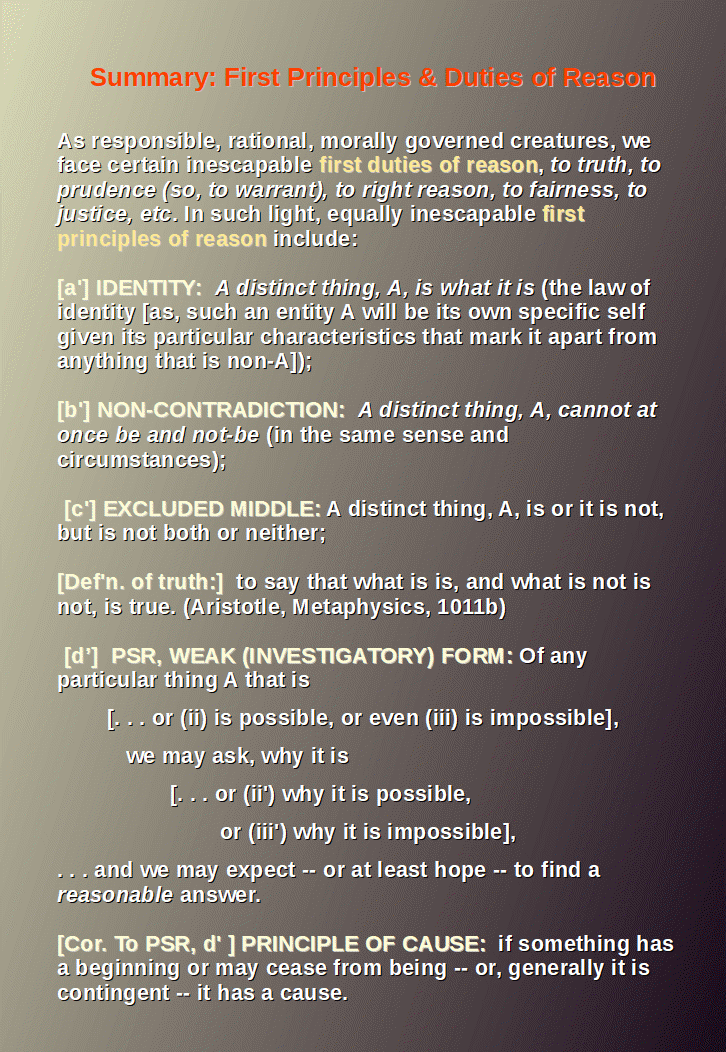
That said, we must recognise that some few things are self-evident, e.g.:
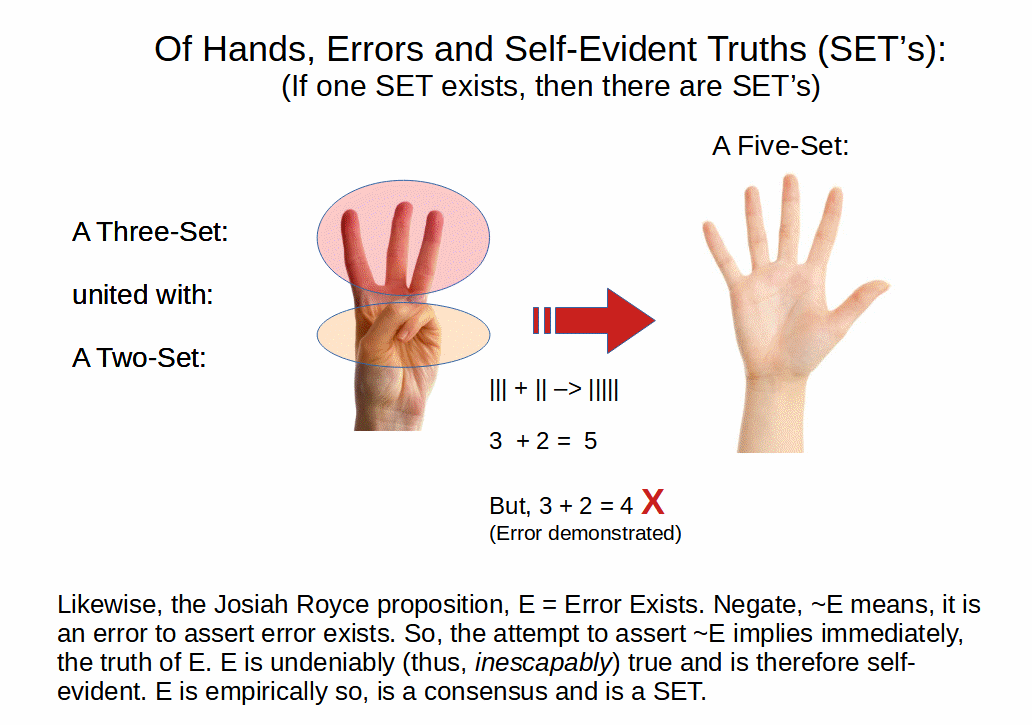
While self-evident truths cannot amount to enough to build a worldview, they can provide plumb line tests relevant to the reliability of warrant for what we accept as knowledge:

Such, of course, bring to the fore Ciceronian first duties of reason:

Marcus [in de Legibus, introductory remarks, C1 BC, being Cicero himself]: . . . we shall have to explain the true nature of moral justice, which is congenial and correspondent with the true nature of man [–> we are seeing the root vision of natural law, coeval with our humanity] . . . . “Law (say [“many learned men”]) is the highest reason, implanted in nature, which prescribes those things which ought to be done, and forbids the contrary” . . . . They therefore conceive that the voice of conscience is a law, that moral prudence is a law [–> a key remark] , whose operation is to urge us to good actions, and restrain us from evil ones . . . . the origin of justice is to be sought in the divine law of eternal and immutable morality. This indeed is the true energy of nature, the very soul and essence of wisdom, the test of virtue and vice.

We may readily expand such first duties of reason: to truth, to right reason, to prudence, to sound conscience, to neighbour, so also to fairness and justice. Where, it may readily be seen that the would-be objector invariably appeals to the said duties. Does s/he object, false, or doubtfully so, or errors of reason, or failure to warrant, or unfairness or the like, alike, s/he appeals to the very same duties, collapsing in self-referentiality. So, instead, let us acknowledge that these are inescapable, true, self-evident.

It may help, too to bring out first principles of right reason, such as:
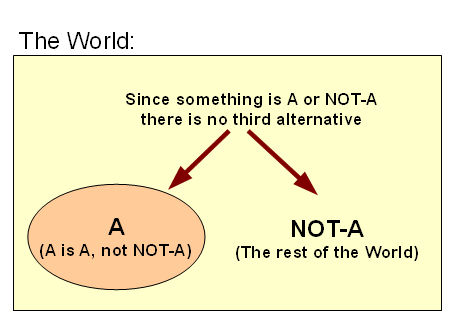
Laws of logic in action as glorified common-sense first principles of right reason

Expanding as a first list:

Such enable us to better use our senses and faculties to build knowledge. END

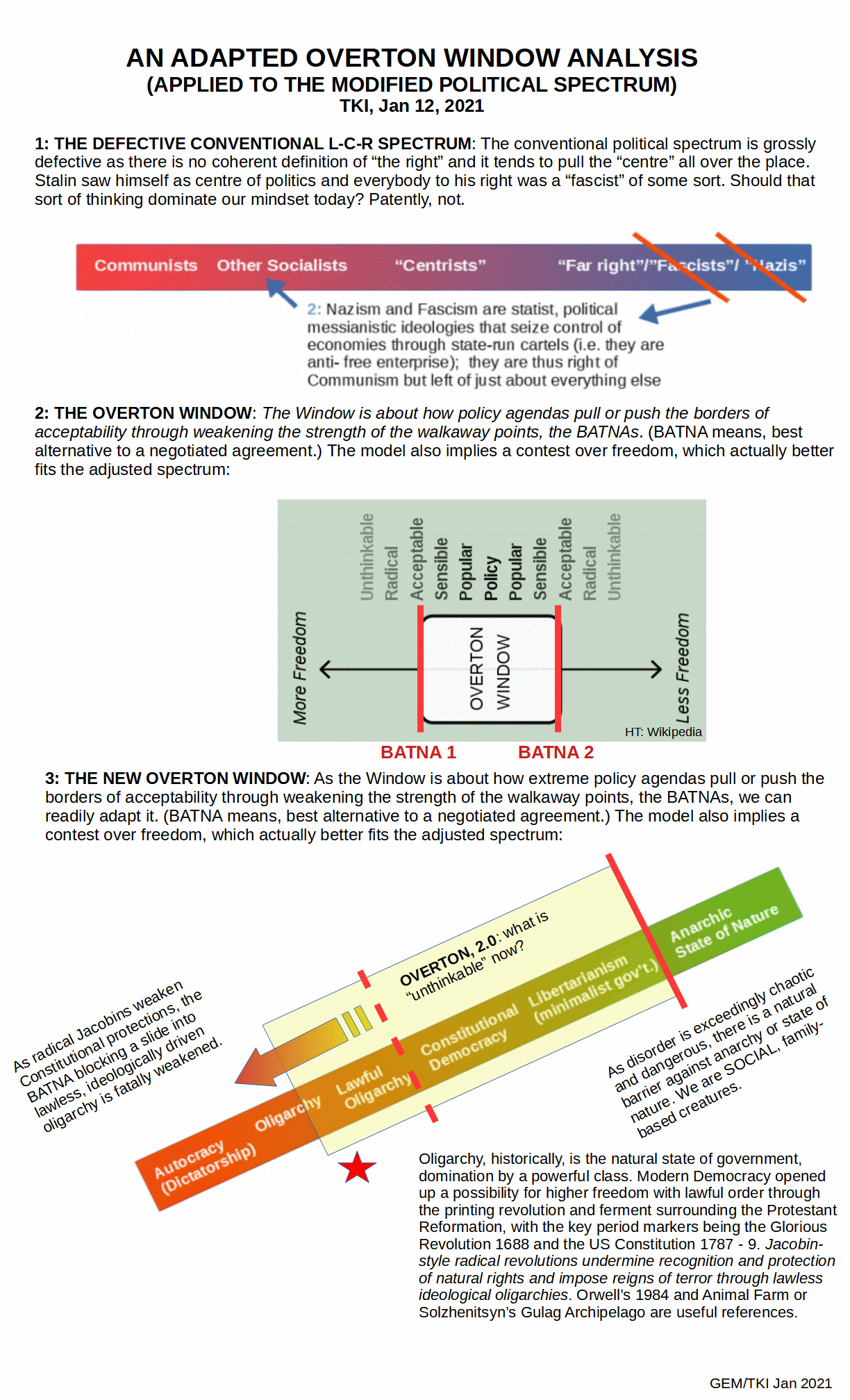
U/D May 16, regarding the Overton window, first, just an outline:
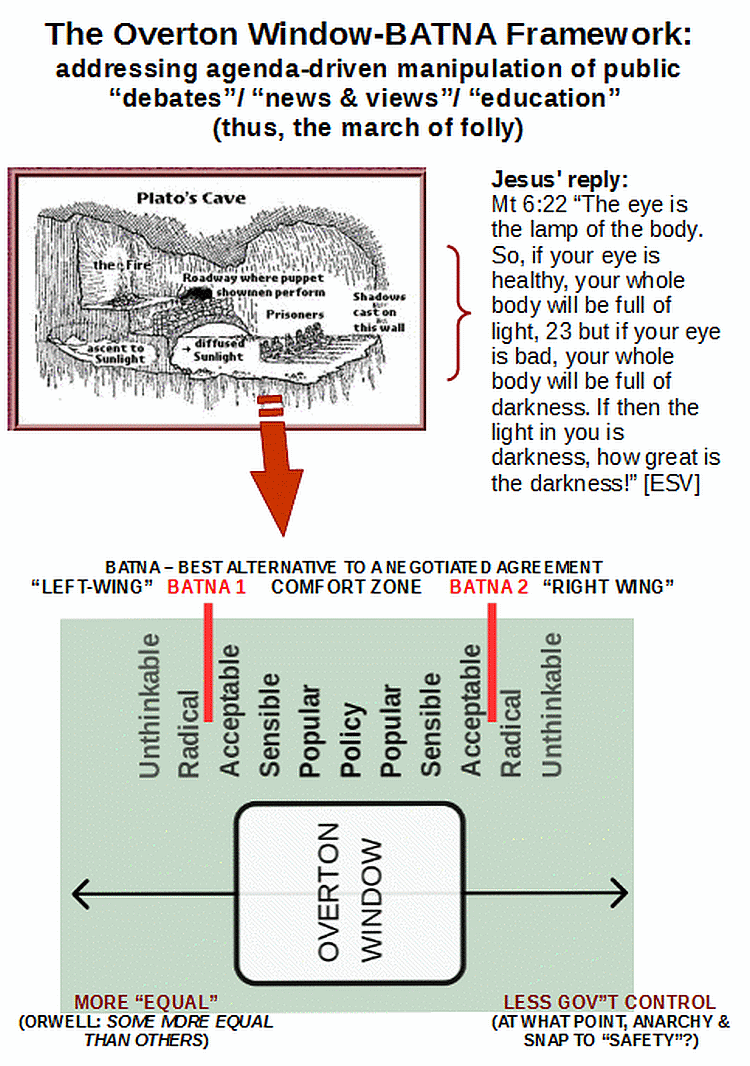
Next, as applied:
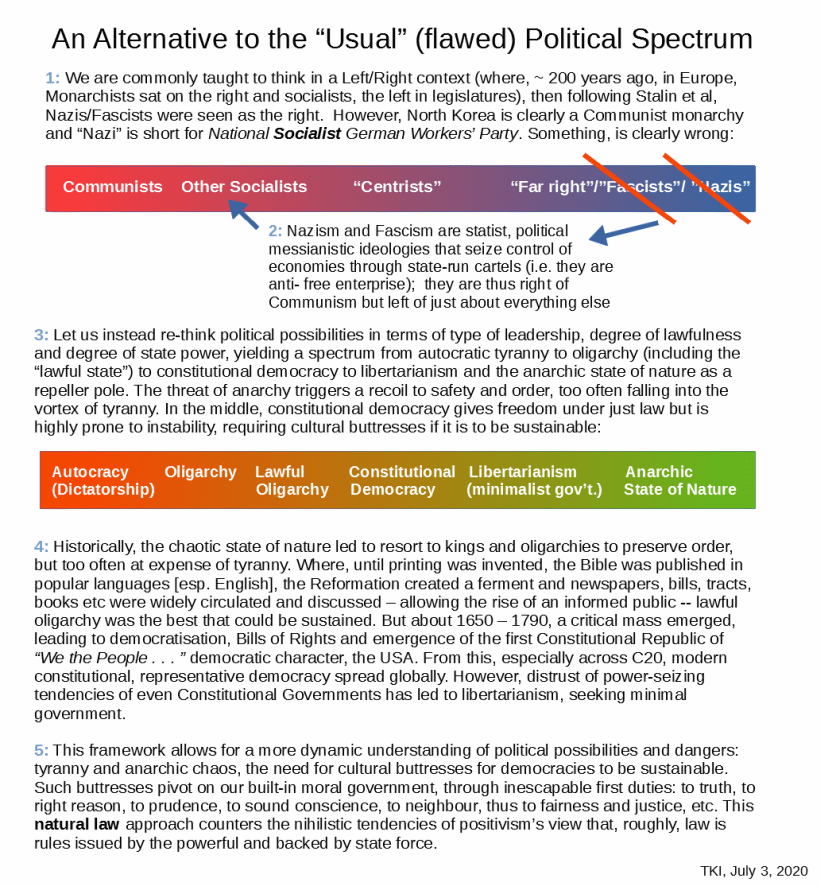
Backgrounder, on the political spectrum:
Comments
BA77: His judgment against them. Yep, those innocent babies and children.Karen McMannus
May 15, 2021
May
05
May
15
15
2021
12:07 PM
12
12
07
PM
PST
Let's just say, to put it mildly, that your Biblical literacy is not nearly as good as you think it is if you think God just willy nilly, out of the blue, commanded them to be destroyed without more than sufficient predicate for rendering His judgment against them. Of supplemental note: In 2014, Stephen Meyer gave this very interesting, even amazing, talk on Biblical Archeology. Archeological evidence that very strongly suggests 'supernatural' destruction of one of Israel's enemies: A Tale of Two Conquests - Stephen Meyer https://www.youtube.com/watch?v=NcDNYXmUWO0bornagain77
May 15, 2021
May
05
May
15
15
2021
11:51 AM
11
11
51
AM
PST
BA77: Well actually, I do believe, based on archeological evidence, that really happened. You believe that your God commanded it, as the text claims? Okie dokie.Karen McMannus
May 15, 2021
May
05
May
15
15
2021
11:30 AM
11
11
30
AM
PST
SB
You can’t possibly be as delicate as you pretend.
Trust me, I am far from delicate. KF is free to be as condescending as he wants. I will not stop him. But life is too short for me to waste my time trying to interact with someone who projects a sense of patronizing superiority towards those he disagrees with.paige
May 15, 2021
May
05
May
15
15
2021
10:58 AM
10
10
58
AM
PST
Paige to KF: "Obviously you are incapable of not taking a condescending attitude towards those who disagree with you. I will limit my future interactions with those who can interact on a civil and respectful manner." You really do need to get off your high horse. If KF asks you to please rethink your position, or if he reminds you of the cultural implications of your philosophy, he is appealing politely and earnestly to your nobler self. You should be complimented that he thinks you have one. He isn't condescending to you. You can't possibly be as delicate as you pretend. In my opinion, you are using that free speech silencing ploy of claiming to be "offended" when someone says something that you disagree with. What is obvious is that KF is trying to be kind in the face of continued personal insults directed at his perfectly legitimate way of communicating, especially from those who complain that he should not be so thorough in his analysis.StephenB
May 15, 2021
May
05
May
15
15
2021
09:55 AM
9
09
55
AM
PST
WJM: --- "It is clear that some things are as morally identifiable as a full-grown oak tree is visually identifiable, such as in the instance of “torturing babies for personal pleasure.” Clearly, unmistakable, objectively wrong if (1) you have a functioning conscience, and (2) you understand the meaning of the symbolic words employed and how they apply to things you apprehend through the sensory capacity of “conscience.” SB: In this case, clearly can be understood to mean the same as self-evidently. ---"No, it doesn’t." Yes, it does. If you *know* (not guess, not merely suspect) that it is objectively wrong to torture babies for fun, and you now say that you do, it is not because the point was successfully argued or because of any evidential appeal. You know it *infallibly* because it is self evident. There is no potential for error here. It is obvious that we ought not to torture babies for fun because the existence of the natural moral law is self evident.StephenB
May 15, 2021
May
05
May
15
15
2021
09:26 AM
9
09
26
AM
PST
Me
Could you please refrain from the condescending attitude. I am not your daughter or your parishioner. If you are incapable of doing this I am afraid that I will refrain from making any attempt to have a meaningful discussion with you.
KF
Paige, it seems that you are projecting. Twice, I have had to make major corrections in thread for you specifically. Projecting passive aggressive comebacks does not hack it, with all due respect.
Obviously you are incapable of not taking a condescending attitude towards those who disagree with you. I will limit my future interactions with those who can interact on a civil and respectful manner.paige
May 15, 2021
May
05
May
15
15
2021
08:55 AM
8
08
55
AM
PST
And then you basically make the same argument I just made.
No!!! You equated choosing ice cream to whether some person dies or not. No body gives a rat’s rear end about choices on the level of eating ice cream they are discussing choices on whether someone lives or not. Or is able to progress in life uninhibited in any major way. If one doesn’t see that, then that person is pretty fairly demented.jerry
May 15, 2021
May
05
May
15
15
2021
08:44 AM
8
08
44
AM
PST
Paige, it seems that you are projecting. Twice, I have had to make major corrections in thread for you specifically. Projecting passive aggressive comebacks does not hack it, with all due respect. KFkairosfocus
May 15, 2021
May
05
May
15
15
2021
08:39 AM
8
08
39
AM
PST
KF
I think, for cause, you need to rethink from ground up.
Could you please refrain from the condescending attitude. I am not your daughter or your parishioner. If you are incapable of doing this I am afraid that I will refrain from making any attempt to have a meaningful discussion with you. I am here to learn different viewpoints, not to stroke your fragile ego.
Next, I see your 184, which again inadvertently demonstrates but shies away from the inescapability of the first duties of reason, as a core of knowledge, law and even socio-psychological systems in society:
All you are describing is a human capability, not a first duty or any such nonsense. I have the ability to hit a golf ball almost 200 yards. When I golf, I don’t have any duty to do this but I am not going to beat my partner if I don’t make every effort to do so. The same applies to reasoning. I have that capability but it is not a duty. However, if I am in a discussion with someone who disagrees with me I am going to reason with him if I am going to convince him that my view is correct. The fact that people enjoy Star Wars, Star Trek and the Marvel movies clearly shows that we do not have a duty to right reason. If we did, we would not be able to enjoy these movies as they are not consistent with right reason.paige
May 15, 2021
May
05
May
15
15
2021
07:57 AM
7
07
57
AM
PST
In this case, clearly can be understood to mean the same as self-evidently.
No, it doesn't. "That is not a a tree" is not a logically absurd statement in and of itself. "That tree is not a tree" is. Pointing at a tree and saying, "that is not a tree" is not a logically absurd statement; it's either an error of identification or a lie.William J Murray
May 15, 2021
May
05
May
15
15
2021
07:57 AM
7
07
57
AM
PST
KF said:
repeating a classic error:
Well, it would be had I not said, in the same comment:
So, what KF and others must necessarily be talking about is an objectively existent internal landscape, like logic or math, that we all experience (except sociopaths) where ought[s] are objectively existent (like logical principles and relationships and reasoning) as oughts.
Which would include
but there may be an is that is also the root of ought,
William J Murray
May 15, 2021
May
05
May
15
15
2021
07:50 AM
7
07
50
AM
PST
Jerry said:
This is pure nonsense.
And then you basically make the same argument I just made. As I've said before, preferences can be direct, like choosing to enjoy some ice cream now, or abstract/indirect, such as choosing not to eat the ice cream now because you prefer (1) waiting until after dinner, (2) prefer not putting on the extra weight, etc. Non-direct objectives are preferences that cannot be directly or immediately acquired are objectives because the are a potential state you prefer to the current state. You then preferentially organize acting on direct preferences (or not) in service to the abstract objective - some state or situation you prefer to acquire in the future above your direct preferences that would make the acquisition of that preference more difficult. Ultimately, it all boils down to how one preferentially organizes their preferences, in service of direct and/or abstract goals. Telling me that I should prefer what I do not prefer is absurd; what would not be absurd is informing me of something, or a potential something, that I recognize as my preference ,that I did not think of or was aware of before. What you cannot do is dictate to me what my preferences are or "should" be. You cannot argue that I ought do what I ought not do, (prefer what I do not.) That's absurd. An example to make this more clear: Let's say that I have car trouble, and I prefer to take it to a mechanic to have it repaired. You might say, "Hey, WJM, that's an easy fix, it only takes 10 minutes and no special tools. You ought let me show you because you ought to just fix that car yourself." Well, that's the ought according to your preferences and some abstract goal you have, like saving money and time, satisfaction of doing the jobs yourself that you can do, etc. If my overriding preference is that I don't like doing any work on cars whatsoever, it doesn't matter how easy it is or how cheap it is, those things do not define my ought. If you say, however, "I can fix that for you," again, that may or may not serve my preference - I may prefer taking every single minor thing to the dealer mechanic. There is no sound argument one can make about a person's preferences except in relationship to that same person's preferences. Their preferences are the existential "measuring ruler" of their oughts, and nobody else's preferences can even apply.William J Murray
May 15, 2021
May
05
May
15
15
2021
07:45 AM
7
07
45
AM
PST
WJM, repeating a classic error:
Unfortunately for KF et al, oughts cannot be derived from an is. The “is” of any physical situation, including torturing babies, cannot provide the ought. You cannot point at an ought out there in the external physical world to identify an ought, because oughts cannot exist “out there;” oughtness cannot exist “out there” in the physical world of “is” under dualism.
Hume's mistake has been corrected for years. Ought cannot be derived from a mere is, but there may be an is that is also the root of ought, i.e. the inherently good and utterly wise creator God who is necessary being and maximally great; who made us as morally governed creatures free enough to love, be truthful, be prudent, be wise. Which pivot on choice and so on freedom. Thus, we have a basis for is, what exists, for ought, how free creatures should act, for truth, how we should speak, etc. In that context, a child is a neighbour and has the same moral value though not the maturity and strength to defend itself. To murder a child for one's pleasure -- and the objection games and evasions were played just as hard when I put a real case on the table -- is an ultimate ought-not, utter evil. And, murdering the child by sexual torture (yes, that happened) takes its moral freighedness from the more than merely physical element involved. Lock that out, create and institutionalise worldviews of that sort of absurdity and we see societies that descend into chaos. But, we clearly see the irrationality, gaps-driven errors of thought, absurdity and incoherence at work. KFkairosfocus
May 15, 2021
May
05
May
15
15
2021
07:42 AM
7
07
42
AM
PST
WJM: --- "It is clear that some things are as morally identifiable as a full-grown oak tree is visually identifiable, such as in the instance of “torturing babies for personal pleasure.” Clearly, unmistakable, objectively wrong " In this case, clearly can be understood to mean the same as self-evidently. Since we have here one manifestation of a self-evident truth, we can be certain that others exist (surely I don't need to make a list at this point) and the principle is confirmed. The natural moral law exists as a self-evident truth. ---"Unfortunately for KF et al, oughts cannot be derived from an is." This is an incomplete statement. An ought cannot be derived from an is if "Is" is understood to mean a set of circumstances, such as one person being observed stabbing another person with a knife. On that information alone, we cannot say that the perpetrator ought not to do it because more information is needed to make that calculation. This is what David Hume, the originator of that phrase meant. However, if we understand "is" to mean the existence of a an objective moral law (there "is" a natural moral law), then we most certainly can derive an ought to from an is (It is wrong to torture babies for fun because it violates the natural moral law, therefore we ought not to do it). ---"You cannot point at an ought out there in the external physical world to identify an ought, because oughts cannot exist “out there;” oughtness cannot exist “out there” in the physical world of “is” under dualism.: You are misusing the word dualism here, which takes many forms. It needs to be more clearly expressed in its legitimate form.. There is an objective reality which can be expressed as the *object* off the investigation, which is definitely distinct from and outside of the thinking *subject*. I, as the thinking subject, am not the same thing as the object of my thought, which in this case is the apprehension of the natural moral law. This natural moral law is just what the word indicates. It is a reflection of a moral universe with moral laws, which, if violated, will cause harm to the violator, just as the breaking of the physical law of gravity can harm the violator. The *object* of the investigation (the natural moral law) is, therefore outside of and distinct from the thinking *subject*. It also has an internal component called conscience. Christians would say that it was placed there, but that is not what is important for the moment. What matters is that conscience is internal and can be identified as the faculty that "ought to" guide human behavior -- it is the capacity to recognize and act on moral truths. A functional conscience, like any other faculty, needs to be developed, nurtured, and informed. It is not perfect in its primitive form, and it can deadened through abusive brainwashing or misuse through bad habits, but that is another story.StephenB
May 15, 2021
May
05
May
15
15
2021
07:35 AM
7
07
35
AM
PST
Jerry, this all started with encountering Cicero on nature of law thus justice. Thus, that which leads to the stabilising civil peace of justice is involved. However, that is for us, rational people and leads to core law as highest reason, showing first duties of built in law coeval with our humanity. Which are actually self evident because we cannot evade their authority, the would be objector appeals to them to try to discredit them, as we see several times above and many times previously. That's not hard to see though with our impoverished education it is strange to us. The walkaway from this is also responsible for a lot of the chaos we see in law and government, with geostrategic consequences beginning to play out. KFkairosfocus
May 15, 2021
May
05
May
15
15
2021
07:30 AM
7
07
30
AM
PST
The argument from consequences was answered above. It’s a no brainer.                                     It’s a strong argument for Cicero’s oughts/duties jerry
May 15, 2021
May
05
May
15
15
2021
07:28 AM
7
07
28
AM
PST
SB is right. KFkairosfocus
May 15, 2021
May
05
May
15
15
2021
07:24 AM
7
07
24
AM
PST
Now that we've examined that, we can shed some light on the argument that KF et al are necessarily making. It is crystal clear, and shows why it always comes down to an argument from consequences. What they are actually arguing is that certain preferential choices I might make now will inevitably result in consequences I will not prefer, meaning that nobody could possibly prefer those consequences. Their entire argument is from hypothetically inevitable, universally non-preferred consequences. Good luck making that argument stick.William J Murray
May 15, 2021
May
05
May
15
15
2021
06:47 AM
6
06
47
AM
PST
it’s an absurd argument because oughts are necessarily about preference. You are, essentially, trying to argue that I ought not do what I ought do, or vice-versa, which is patently absurd.
This is pure nonsense. Something is preferred because it’s reaches desired objectives better than others. If something is extremely better than other things for reaching a highly desired objective, it is hard to say it is not an “ought.’” If there are a multiple of ways of reaching an objective then no one specific way is an “ought.” But if something frustrates reaching an objective, then this becomes an “ought not.” So it may be about preferences but some preferences frustrate the reaching of objectives. The ones that do help reach objectives then become “duties.” The ones that frustrate reaching desired objectives become duties to avoid. The interesting thing is that some people here have taken up your cause which is apparently fueled by some mental deficiency. Anyone who admits that their survival takes back seat to their enjoyment has a serious problem. It’s the admission of an addict, someone seriously addicted to something that reason and will then fails. And we have others defending this self destructive behavior of addiction. Related: Kf has taken the duties expressed by Cicero and indicated they are “oughts” for a stable society. If someone objects, please indicate which of these “oughts” or duties are not necessary for a stable society. No one will have any objection if anyone adds to the list.jerry
May 15, 2021
May
05
May
15
15
2021
06:26 AM
6
06
26
AM
PST
Karen McMannus, I appreciate your support and kind words. I think you'll really enjoy the following. Kind of long, but there's a big payoff at the end. As I said before, just because something is not self-evidently true doesn't mean that thing is not objectively existent. These are two different things. While moral statements (apparently, by lack of argument otherwise) cannot be self-evidently true (they are not made so even if there is universal agreement with a moral statement,) that doesn't mean that morality is not an objectively existent thing. Even the existence of a sociopath doesn't mean that morality is not an objectively existent thing because there's an infinite number of objectively existent things I (and any other person) do not personally experience at at any time in their lives. An objectively existent thing doesn't have to be omnipresent in everyone's experience at all times, or even in anyone's experience at any time in their lives. So, what is KF (and others here) actually claiming? The claim is that whether or not we recognize it as such, we all have something of a sensory capacity called "conscience" that, like sight, is subject to error but that we all use it to navigate real moral qualities we perceive through it, and that it is by rational examination we can discern true statements from false in the moral landscape we are perceiving. Even a person who is, theoretically, a born sociopath would just be comparable to someone born blind. Just because a sociopath cannot perceive the moral landscape wouldn't mean it doesn't exist. Thus, we can justify KF's "normally functioning people" objection by comparing a sociopath to a blind mind, either born without a conscience, or later become, for whatever reason, "blind." Let's say that everyone with functioning sight would immediately recognize a full-grown oak tree as a tree. The word "tree" is a symbolic representation of something everyone with sight can immediately recognize as what that word represents. Conscience would be the ability to recognize the difference between two categories of things; right and wrong, which would be words that represent two distinct kinds of things in our moral landscape. Just because some or even most things are not universally, immediately clear whether they are right or wrong, morally speaking, doesn't mean they do not have that quality. It is clear that some things are as morally identifiable as a full-grown oak tree is visually identifiable, such as in the instance of "torturing babies for personal pleasure." Clearly, unmistakable, objectively wrong if (1) you have a functioning conscience, and (2) you understand the meaning of the symbolic words employed and how they apply to things you apprehend through the sensory capacity of "conscience." The problem with this model is that, under the worldview (dualism) of those that are promoting it, the commodities that identify the tree as a tree are external to the observers, and exist independently of those who are experiencing the sight of the tree. That is what "objective" means under the dualistic perspective; the mutually experiential qualities of any real, objective thing exist in the external thing itself, not in the subjective experience of the observer. Under dualism, the observer is subjectively experiencing an external "is." Unfortunately for KF et al, oughts cannot be derived from an is. The "is" of any physical situation, including torturing babies, cannot provide the ought. You cannot point at an ought out there in the external physical world to identify an ought, because oughts cannot exist "out there;" oughtness cannot exist "out there" in the physical world of "is" under dualism. So, what KF and others must necessarily be talking about is an objectively existent internal landscape, like logic or math, that we all experience (except sociopaths) where ought are objectively existent (like logical principles and relationships and reasoning) as oughts. We've objectively established that there are no self-evidently true (on pain of absurdity) moral statements; but this only means that the self-evidently true nature of any particular moral statement cannot be discerned by logic; "oughtness" itself would then have to be self-evident in a way either comparable to logic itself, or discernible via logic (absence of oughtness = absurdity.); you cannot operate without employing them. IOW.you cannot think or do anything without employing oughtness, even when you argue against its existence. That's is the case I think KF is trying to make; that "oughtness" is an inescapable, self-evident commodity revealed by the absurdity of considering its absence. However, is this logically identifiable as true in the sense KF is asserting? Let's look at this statement: we cannot help do what we ought do, even when we argue that we ought not do what we ought; we are still arguing from ought. Even a mistaken ought would still be enacted out of ought; even the argument that we have no oughts depends on the "oughtness" of the perspective of "we ought not operate as if we have oughts, because oughts do not exist." So, my statement "I do whatever I want" would be a statement that this is how I ought organize my perspective, because of my belief that "objective oughtness" does not actually exist. I would still be referencing an ought, even in objection that oughts actually exist. This would make "oughtness" a self-evident, existentially necessary commodity. If one considers "oughtness" is synonymous with "morality," what one ought and ought not do, then morality would in fact be an existential, necessary commodity on its own, discernible by the absurdity of the contrary. Even the statement "there is nothing I ought do" would be a statement of an ought. But... what does "ought" actually mean? What is necessary for an "ought" to even exist? Simply put: oughts only exists when there is a potential state (a potential "is") that is preferable to the current state, or "is," or compared to the potential state, the current state is preferable. The free will capacity to enact or instantiate or choose an "ought" is inescapably one of preference, because preference is an inescapable, intractable aspect of free will and the only way an ought can be recognized and evaluated. Or, as Viola said, "free will and preference are essentially the same thing," or something like that, if I remember correctly (from another thread.) The question is: can what we call a sentient being exist in a state where they have no preferences? Would that be an actual absurd, or self-contradictory situation? That's an whole argument in itself, but the short answer is: no. For a sentient being to exist as such, self and other must exist; A and not-A must exist; which means distinguishable and varying conditions must exist; non-instantiated potentials must exist; and free will to navigate current conditions into potential conditions must exist (sequences of experiences), and they can only be navigated preferentially. Preference, thus is also an inescapable, self-evident aspect of our existence as sentient beings, and it is that which is necessary for and informs the fundamental existence of "oughtness." (BTW, all of these things are mutually necessary and depend on each other for their existence; you cannot remove one and still have the others.) Unfortunately for KF, although "oughtness" itself is existentially necessary, or objectively existent, it also necessarily means that what oughtness is fundamentally about, and is necessarily informed by, is preference. To say that we ought prefer one thing over another whether we prefer that thing or not is thus revealed as an absurd statement, on par with trying to argue that 2+2=5 or that I don't exist or that I don't have free will. But, that's exactly what you're trying to do; argue that we all ought prefer X whether we prefer it or not. it's an absurd argument because oughts are necessarily about preference. You are, essentially, trying to argue that I ought not do what I ought do, or vice-versa, which is patently absurd.William J Murray
May 15, 2021
May
05
May
15
15
2021
06:16 AM
6
06
16
AM
PST
This has been about two things, Christianity and Kf’s long and often hard to understand OP’s and comments (I rarely read them then mostly fail to understand much of them when I do.) However, both seem to be threats to some people and they then (Christianity and Kf’s comments) become the center of criticism. Anyone who answers these objectors, don’t ever expect any semblance of agreement or acknowledgment that one has a valid point. Their silence is indicative that they admit justification of the positions which they criticize. The more interesting thing is why this lack of acknowledgment for the well justified is so deeply ingrained in a large number of people. Certain things are definitely ingrained in most of us and many are unlikely to admit that these positions/opinions/attitudes held have very little justification. Expressed as “My opinion is as good as yours” but in reality they aren’t as good. That is why ID is actually an amazing area. It’s positions are extremely well justified. But objectors to it must claim the opposite. Christianity and Kf’s OP’s have little to do with ID but often use the logic/evidence approach used in ID for justification.jerry
May 15, 2021
May
05
May
15
15
2021
05:58 AM
5
05
58
AM
PST
---"Karen Macmannus: He [WjM] does. You do. I do. We all do. [Admit that it is self-evidenty true that it is wrong to torture babies for fun]." I am going to call you on that one. Please show me where WJM or any of his defenders, including you, ever acknowledged the existence of any self-evident moral truth. The sad responses found in this entire thread have been all about the denial of objective morality and you know it. ---"Now… deal squarely deal with this:Now… (An Old Testament reference about God)." Not so fast. You don't get to change the subject at the very time your errors have been exposed. I can defend the God of the Old Testament all day long, and will when the time comes, but right now you need to back up your above claim.StephenB
May 15, 2021
May
05
May
15
15
2021
04:36 AM
4
04
36
AM
PST
BA77, please do not further feed the needless toxic distraction. I accept that you respond under right of reply, but let that suffice. She [?] is resorting to toxic distractors in the face of defeat on substantial merits on what is itself a failure to respond to the main thrust of the OP on the nature of knowledge and why we have to get knowledge straight if we are to rescue our civilisation, now, likely, THROUGH shipwreck. KFkairosfocus
May 15, 2021
May
05
May
15
15
2021
04:08 AM
4
04
08
AM
PST
Karen McMannus quotes 1 Samuel 15:2-3,
1 Samuel 15:2-3, God commanded Saul and the Israelites, “This is what YHWH shaddai says: ‘I will punish the Amalekites for what they did to Israel when they waylaid them as they came up from Egypt. Now go, attack the Amalekites and totally destroy everything that belongs to them. Do not spare them; put to death men and women, children and infants cattle and sheep, camels and donkeys.'”
And then states,
You know damn well you don’t believe that really happened. So stop making excuses for these idiotic fictions that you don’t believe.
Well actually, I do believe, based on archeological evidence, that really happened.
Biblical Archeology - Amalek and the Amalekites: https://www.bible.ca/archeology/bible-archeology-exodus-amalekites.htm
Moreover, God, among other evil deeds, judged the Amalekites for, get this, ritualistic child sacrifice to their false god! http://www.christian-thinktank.com/rbutcher1.htmlbornagain77
May 15, 2021
May
05
May
15
15
2021
03:59 AM
3
03
59
AM
PST
Jerry, it is, sadly, increasingly plain to me that it is going to take a shipwreck to sort out this mess we have got ourselves into; the consequence of a civilisation level march of folly. I shudder to contemplate geostrategic consequences we are so foolishly bringing on ourselves . . . even under the shadow of the chaos since 1914. What will it take for us to finally learn from history? KFkairosfocus
May 15, 2021
May
05
May
15
15
2021
03:51 AM
3
03
51
AM
PST
KM, your wearisome projections to the despised other fail. You have been repeatedly directed to where you can find a serious working through of issues not appropriate to either this thread or to UD's focus, but insist on bringing such up whenever it is convenient to your rhetorical purpose. It thus becomes a flashing sign: defeated on the merits, let's try to derail discussion by stirring up an internet atheist string of objections to that bronze age sky god monster and his dangerous fanatical followers. The conclusion of such a trollish pattern is obvious: unacknowledged evidence of defeat on the merits, covered over through displacing cognitive dissonance by projection. It evidently hasn't even dawned on you that establishing the natural law of our morally governed nature is the basis for such arguments having any rhetorical traction. Without implicit recognition of the inherently good as grounds for identifying evils as what ought not to be, the whole frame of ontological and theological arguments from evil collapses. As Boethius long since recognised while facing an unjust death penalty for standing up to lawless oligarchy in the court of a Germanic king and successor to the W Roman Empire. KF PS: Dembski on Boethius:
In his Consolation of Philosophy, Boethius states the following paradox: “If God exists, whence evil? But whence good, if God does not exist?” Boethius contrasts the problem that evil poses for theism with the problem that good poses for atheism. The problem of good does not receive nearly as much attention as the problem evil, but it is the more basic problem. That’s because evil always presupposes a good that has been subverted. All our words for evil make this plain: the New Testament word for sin (Greek hamartia) presupposes a target that’s been missed; deviation presupposes a way (Latin via) from which we’ve departed; injustice presupposes justice; etc. So let’s ask, who’s got the worse problem, the theist or the atheist? Start with the theist. God is the source of all being and purpose. Given God’s existence, what sense does it make to deny God’s goodness? None . . . . The problem of evil still confronts theists, though not as a logical or philosophical problem, but instead as a psychological and existential one [as was addressed above] . . . . The problem of good as it faces the atheist is this: nature, which is nuts-and-bolts reality for the atheist, has no values and thus can offer no grounding for good and evil. As nineteenth century freethinker Robert Green Ingersoll used to say, “In nature there are neither rewards nor punishments. There are consequences.” More recently, Richard Dawkins made the same point: “The universe we observe has precisely the properties we should expect if there is, at bottom, no design, no purpose, no evil and no good, nothing but blind pitiless indifference.” ["Prepared Remarks for the Dembski-Hitchens Debate," Uncommon Descent Blog, Nov 22, 2010]
kairosfocus
May 15, 2021
May
05
May
15
15
2021
03:22 AM
3
03
22
AM
PST
PS: A much deserved critique of relativism, subjectivism, emotivism, that is instructive:
Excerpted chapter summary, on Subjectivism, Relativism, and Emotivism, in Doing Ethics 3rd Edn, by Lewis Vaughn, W W Norton, 2012. [Also see here and here.] Clipping: . . . Subjective relativism is the view that an action is morally right if one approves of it. A person’s approval makes the action right. This doctrine (as well as cultural relativism) is in stark contrast to moral objectivism, the view that some moral principles are valid for everyone.. Subjective relativism, though, has some troubling implications. It implies that each person is morally infallible and that individuals can never have a genuine moral disagreement Cultural relativism is the view that an action is morally right if one’s culture approves of it. The argument for this doctrine is based on the diversity of moral judgments among cultures: because people’s judgments about right and wrong differ from culture to culture, right and wrong must be relative to culture, and there are no objective moral principles. This argument is defective, however, because the diversity of moral views does not imply that morality is relative to cultures. In addition, the alleged diversity of basic moral standards among cultures may be only apparent, not real. Societies whose moral judgments conflict may be differing not over moral principles but over nonmoral facts. Some think that tolerance is entailed by cultural relativism. But there is no necessary connection between tolerance and the doctrine. Indeed, the cultural relativist cannot consistently advocate tolerance while maintaining his relativist standpoint. To advocate tolerance is to advocate an objective moral value. But if tolerance is an objective moral value, then cultural relativism must be false, because it says that there are no objective moral values. Like subjective relativism, cultural relativism has some disturbing consequences. It implies that cultures are morally infallible, that social reformers can never be morally right, that moral disagreements between individuals in the same culture amount to arguments over whether they disagree with their culture, that other cultures cannot be legitimately criticized, and that moral progress is impossible. Emotivism is the view that moral utterances are neither true nor false but are expressions of emotions or attitudes. It leads to the conclusion that people can disagree only in attitude, not in beliefs. People cannot disagree over the moral facts, because there are no moral facts. Emotivism also implies that presenting reasons in support of a moral utterance is a matter of offering nonmoral facts that can influence someone’s attitude. It seems that any nonmoral facts will do, as long as they affect attitudes. Perhaps the most far-reaching implication of emotivism is that nothing is actually good or bad. There simply are no properties of goodness and badness. There is only the expression of favorable or unfavorable emotions or attitudes toward something.
kairosfocus
May 15, 2021
May
05
May
15
15
2021
03:03 AM
3
03
03
AM
PST
Paige, First, kindly note what I just commented to SB. Next, I see your 184, which again inadvertently demonstrates but shies away from the inescapability of the first duties of reason, as a core of knowledge, law and even socio-psychological systems in society:
most of the things that you say are duties are merely behavioral expectations that the majority of individuals in a society must agree to in order for society to be relatively stable. Simple game theory shows us this. This does not make them inherent to the universe or human individuals. Most of these are learned behaviors.
I take in steps of thought: >>most of the things that you say are duties are merely behavioral expectations>> - you have relabelled what a right is, a binding morally driven expectation in the name of justice, rooted in our quasi-infinite value and dignity as persons with unique individual identities and irreplaceable individual lives - this re-labelling is meant to be conducive to radical relativism, which is self referentially absurd and utterly inconsistent, demanding to impose politically correct values and narratives without acknowledging that they are claims about truth and right, hence for example the fallacies of the 1619 agenda - notice, too, that you are here appealing to duty to truth and to right reason etc, without acknowledging it >> that the majority of individuals in a society must agree to in order for society to be relatively stable.>> - ask yourself why we must seek the civil peace of justice . . . due balance of rights, freedoms and duties . . . to have a sustainable community. - then, observe the first duties you glide over, to justice, to fairness, to neighbour - thence, notice the further duties, to truth [we ought not to deceive or defraud or mislead neighbour], to right reason [a plumb line guide to truth, the naturally evident purpose of our faculties of reason], to prudence including warrant, i.e. to right guiding of thought, speech and action amidst a sea of potential for confusion - all, testified to by conscience, once it is sound. >>Simple game theory shows us this.>> - an appeal to an application of right reason and prudence dressed up in language of mathematics >> This does not make them inherent>> - lesseee, is conscience built-in? If you have never felt its bite, you are a damaged person and should seek serious help. (Yes, there may actually be psychopaths who did not merely crush conscience, they were deaf to it from outset.) - You obviously feel prompted and propelled to seek truth and right reason as shown by the implicit structure of your objections. Just, this have been channelled by a civilisation that has seriously lost its way. >> to the universe or human individuals.>> - humans are part of the universe, we are embodied, ensouled, rational, conscience guided creatures, so we can ask about our being and its built in structures, such as rationality, conscience, consciousness etc. - we find that certain constants structure our rationality to the point that even objectors inadvertently appeal to them. - we call these first principles, first duties, natural law, whatever, labels simply tell us what's in the tin. (And BTW, we rely on truthfulness in labelling tins.) >>Most of these are learned behaviors.>> - we LEARN to be prompted by guilt? We LEARN to seek and rely on accuracy of especially visual, auditory and tactile perception to safely navigate the world? We LEARN to value truth, what such accuracy is about? We LEARN that truth/accuracy opens opportunities while protecting from danger? - I think, for cause, you need to rethink from ground up. KFkairosfocus
May 15, 2021
May
05
May
15
15
2021
03:00 AM
3
03
00
AM
PST
SB:
Reason’s rules are not limited to the laws of causality, identity, and non contradiction, or the easily apprehended truth that the finite whole is always greater than any of its parts, or the nature of inductive and deductive reasoning. The natural moral law is no less self-evident than any or all of the other six principles. That humans possess an intrinsic sense of right and wrong that governs our reasoning and behavior has been known since the time of the ancient Greeks. That WJM, KM, VL, and Paige arbitrarily exclude this sense from the list of self-evident truths has nothing to do with reality and everything to do with their irrational biases and prejudices against truth itself. Their argument against objective morality fails because it is based on the false and arbitrary assumption that reason’s rules do not include rules about morality. This assumption cannot be justified.
Sadly, yes. Reflective of the sorry state and ruinous line of drift of our storm-caught civilisation. I note, there is often refusal to acknowledge even first, self-evident principles of logic starting with law of identity and its close corollaries, non contradiction and excluded middle. Often, under false colours of Q-mechanics etc. Similarly, there is a dismissal of the manifest fact that there is such a thing as logic of being, ontology, so that we may reasonably ask of a thing or candidate thing A, why it is, or why it is not, or even why it cannot be [e.g. a square circle] and seek a reasonable answer. That is, it is self-evident that a weak form principle of sufficient reason obtains, regardless of much huffing and puffing in philosophy. In which context, it is manifest that certain entities are contingent and are caused. Credibly, such include a fire, ourselves and even our observed cosmos. All of which points beyond, to necessary being that is the causally sufficient framework for any world to become actual, and particularly a world with rational, responsible, significantly free creatures able to reason like this. Where, it is undeniable fact that we find ourselves (once we are normally functional) under government of oughtness testified to by conscience, i.e. we face the reality of a built in law and aspect of our centre of unified being . . . the soul . . . that guides and guards our reasoning, speech and action. Yes it can be warped so we phrase, duty to sound conscience with closely linked duty to prudence and to neighbour who is a similarly ensouled, en-conscienced rational creature. Pull back a step or two and we see that prudence, conscience and rationality are self-evidently duty-bound by truth and right reason. Moral government testified to by sound conscience cannot be forcibly extracted from this cluster and discarded, they are inextricably entangled. That is, we are seeing the wholism- microcosm- facets principle in action. Each facet draws on all to flash with diamond-like fire, and each contributes to all. First principles, first truths and first duties are all so together forming a unified whole, showing the flash and living fire of the soul at work. It is time to acknowledge that the naturally straight and upright plumb line is telling us that we have been using a warped, inaccurate, crooked yardstick as a false authority for straightness, accuracy and uprightness. Jesus of Nazareth was diagnostic in the greatest sermon on record, in some remarks that probably deliberately echo and respond to Plato's Parables of the Cave and of the Ship of State:
Mt 6: 21 . . . where your treasure is, there your heart [your wishes, your desires; that on which your life centers] will be also. 22 “The eye is the lamp of the body; so if your eye is clear [spiritually perceptive], your whole body will be full of light [benefiting from God’s precepts]. 23 But if your eye is bad [spiritually blind], your whole body will be full of darkness [devoid of God’s precepts]. So if the [very] light inside you [your inner self, your heart, your conscience] is darkness, how great and terrible is that darkness! [AMP]
KFkairosfocus
May 15, 2021
May
05
May
15
15
2021
02:32 AM
2
02
32
AM
PST
1 … 35 36 37 38 39 … 44