Uncommon Descent Serving The Intelligent Design Community

L&FP42: is knowledge warranted, credibly true (so, reliable) belief?

Categories
Defending our Civilization
Epistemology
Logic and Reason
Share
Facebook
Twitter/X
LinkedIn
Flipboard
Print
Email

It’s time to start delivering on a promise to address “warrant, knowledge, logic and first duties of reason as a cluster,” even at risk of being thought pedantic. Our civilisation is going through a crisis of confidence, down to the roots. If it is to be restored, that is where we have to start, and in the face of rampant hyperskepticism, relativism, subjectivism, emotivism, outright nihilism and irrationality, we need to have confidence regarding knowledge.

Doing my penance, I suppose: these are key issues and so here I stand, in good conscience, I can do no other, God help me.

For a start, from the days of Plato, knowledge has classically been defined as “justified, true belief.” However, in 1963, the late Mr Gettier put the cat in among the pigeons, with Gettier counter-examples; which have since been multiplied. In effect, there are circumstances (and yes, sometimes seemingly contrived, but these are instructive thought exercises) in which someone or a circle may be justified to hold a belief but on taking a wider view such cannot reasonably be held to be a case of knowledge.

As a typical thought exercise, consider a circle of soldiers and sailors on some remote Pacific island, who are eagerly awaiting a tape of a championship match sent out by the usual morale units. They get it, play it and rejoice that team A has won over team B (and the few who thought otherwise have to cough up on their bets to the contrary). Unbeknownst to them, through clerical error, it was last year’s match, which had the same A vs B match-up and more or less the same outcome. They are justified — have a right — to believe, what they believe is so, but somehow the two fail to connect leading to accidental, not reliable arrival at truth.

Knowledge must be built of sterner stuff.

Ever since, epistemology as a discipline, has struggled to rebuild a solid consensus on what knowledge is.

Plantinga weighed in with a multi-volume study, championing warrant, which(as we just noted) is at first defined by bill of requisites. That is, we start with what it must do. So, warrant — this builds on the dictionary/legal/commercial sense of a reliable guarantee of performance “as advertised” — will be whatever reliably converts beliefs we have a right to into knowledge.

The challenge being, to fill in the blank, “Warrant is: __________ .”

Plantinga then summarises, in his third volume:

The question is as old as Plato’s Theaetetus: what is it that distinguishes knowledge from mere true belief? What further quality or quantity must a true belief have, if it is to constitute knowledge? This is one of the main questions of epistemology. (No doubt that is why it is called ‘theory of knowledge’.) Along with nearly all subsequent thinkers, Plato takes it for granted that knowledge is at least true belief: you know a proposition p only if you believe it, and only if it is true. [–> I would soften to credibly, true as we often use knowledge in that softer, defeat-able sense cf Science] But Plato goes on to point out that true belief, while necessary for knowledge, is clearly not sufficient: it is entirely possible to believe something that is true without knowing it . . .

[Skipping over internalism vs externalism, Gettier, blue vs grue or bleen etc etc] Suppose we use the term ‘warrant’ to denote that further quality or quantity (perhaps it comes in degrees), whatever precisely it may be, enough of which distinguishes knowledge from mere true belief. Then our question (the subject of W[arrant and] P[roper] F[unction]): what is warrant?

My suggestion (WPF, chapters 1 and 2) begins with the idea that a belief has warrant only if it is produced by cognitive faculties that are functioning properly, subject to no disorder or dysfunction—construed as including absence of impedance as well as pathology. The notion of proper function is fundamental to our central ways of thinking about knowledge. But that notion is inextricably bound with another: that of a design plan.37

Human beings and their organs are so constructed that there is a way they should work, a way they are supposed to work, a way they work when they work right; this is the way they work when there is no malfunction . . . We needn’t initially take the notions of design plan and way in which a thing is supposed to work to entail conscious design or purpose [–> design, often is naturally evident, e.g. eyes are to see and ears to hear, both, reasonably accurately] . . .

Accordingly, the first element in our conception of warrant (so I say) is that a belief has warrant for someone only if her faculties are functioning properly, are subject to no dysfunction, in producing that belief.39 But that’s not enough.

Many systems of your body, obviously, are designed to work in a certain kind of environment . . . . this is still not enough. It is clearly possible that a belief be produced by cognitive faculties that are functioning properly in an environment for which they were designed, but nonetheless lack warrant; the above two conditions are not sufficient. We think that the purpose or function of our belief-producing faculties is to furnish us with true (or verisimilitudinous) belief. As we saw above in connection with the F&M complaint [= Freud and Marx], however, it is clearly possible that the purpose or function of some belief-producing faculties or mechanisms is the production of beliefs with some other virtue—perhaps that of enabling us to get along in this cold, cruel, threatening world, or of enabling us to survive a dangerous situation or a life-threatening disease.

So we must add that the belief in question is produced by cognitive faculties such that the purpose of those faculties is that of producing true belief.

More exactly, we must add that the portion of the design plan governing the production of the belief in question is aimed at the production of true belief (rather than survival, or psychological comfort, or the possibility of loyalty, or something else) . . . .

[W]hat must be added is that the design plan in question is a good one, one that is successfully aimed at truth, one such that there is a high (objective) probability that a belief produced according to that plan will be true (or nearly true). Put in a nutshell, then, a belief has warrant for a person S only if that belief is produced in S by cognitive faculties functioning properly (subject to no dysfunction) in a cognitive environment [both macro and micro . . . ] that is appropriate for S’s kind of cognitive faculties, according to a design plan that is successfully aimed at truth. We must add, furthermore, that when a belief meets these conditions and does enjoy warrant, the degree of warrant it enjoys depends on the strength of the belief, the firmness with which S holds it. This is intended as an account of the central core of our concept of warrant; there is a penumbral area surrounding the central core where there are many analogical extensions of that central core; and beyond the penumbral area, still another belt of vagueness and imprecision, a host of possible cases and circumstances where there is really no answer to the question whether a given case is or isn’t a case of warrant.41 [Warranted Christian Belief (NY/Oxford: OUP, 2000), pp 153 ff. See onward, Warrant, the Current Debate and Warrant and Proper Function; also, by Plantinga.]

So, we may profitably distinguish [a] Plantinga’s specification (bill of requisites) for warrant and [b] his theory of warrant. The latter, being (for the hard core):

a belief has warrant for a person S only if that belief is produced in S by cognitive faculties functioning properly (subject to no dysfunction) in a cognitive environment [both macro and micro . . . ] that is appropriate for S’s kind of cognitive faculties, according to a design plan that is successfully aimed at truth.

Obviously, warrant comes in degrees, which is just what we need to have. Certain things are known to utterly unchangeable certainty, others are to moral certainty, others for good reason are held to be reasonably reliable though not certain enough to trust when the stakes are high, other things are in doubt as to whether they are knowledge, some things outright fail any responsible test.

That’s why I have taken up and commend a modified form, recognising that what we think is credibly, reliably true today may oftentimes be corrected for cause tomorrow. (Back in High School Chemistry class, I used to imagine a courier arriving at the door to deliver the latest updates to our teacher.)

Yes, I accept that many knowledge claims are defeat-able, so open-ended and provisional.

Indeed, that is part of what distinguishes the prudence and fair-mindedness of sober knowledge claims hard won and held or even stoutly defended in the face of uncertainty and challenge from the false certitude of blind ideologies. Especially, where deductive logical schemes can have no stronger warrant than their underlying axioms and assumptions and where inductive warrant provides support, not utterly certain, incorrigible, absolute demonstration.

That said, we must recognise that some few things are self-evident, e.g.:
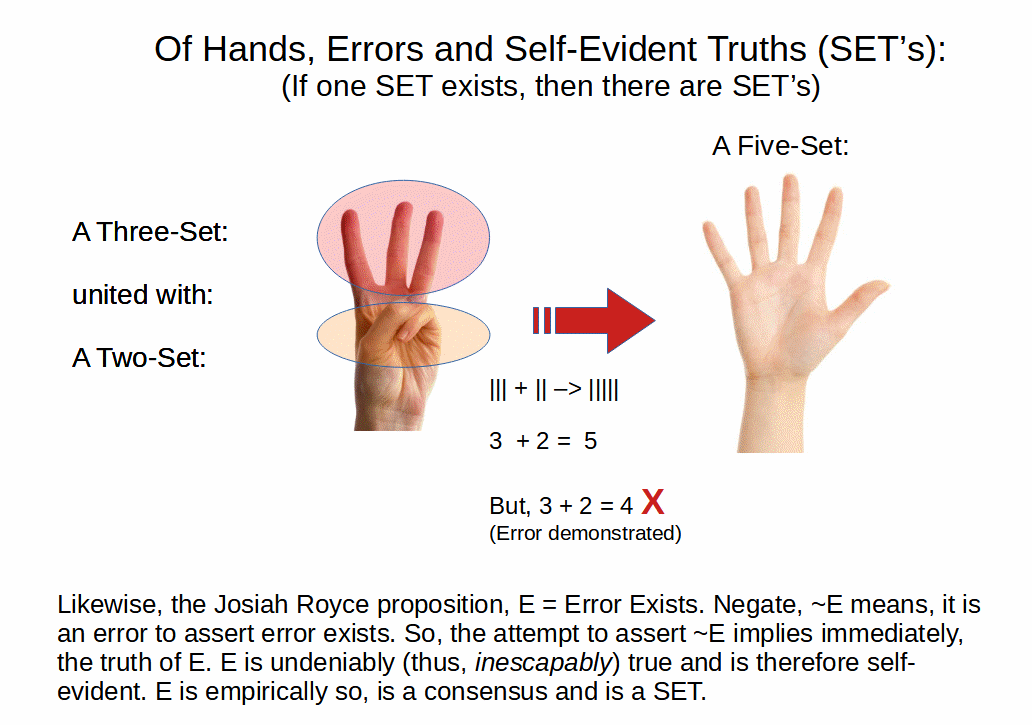
While self-evident truths cannot amount to enough to build a worldview, they can provide plumb line tests relevant to the reliability of warrant for what we accept as knowledge:

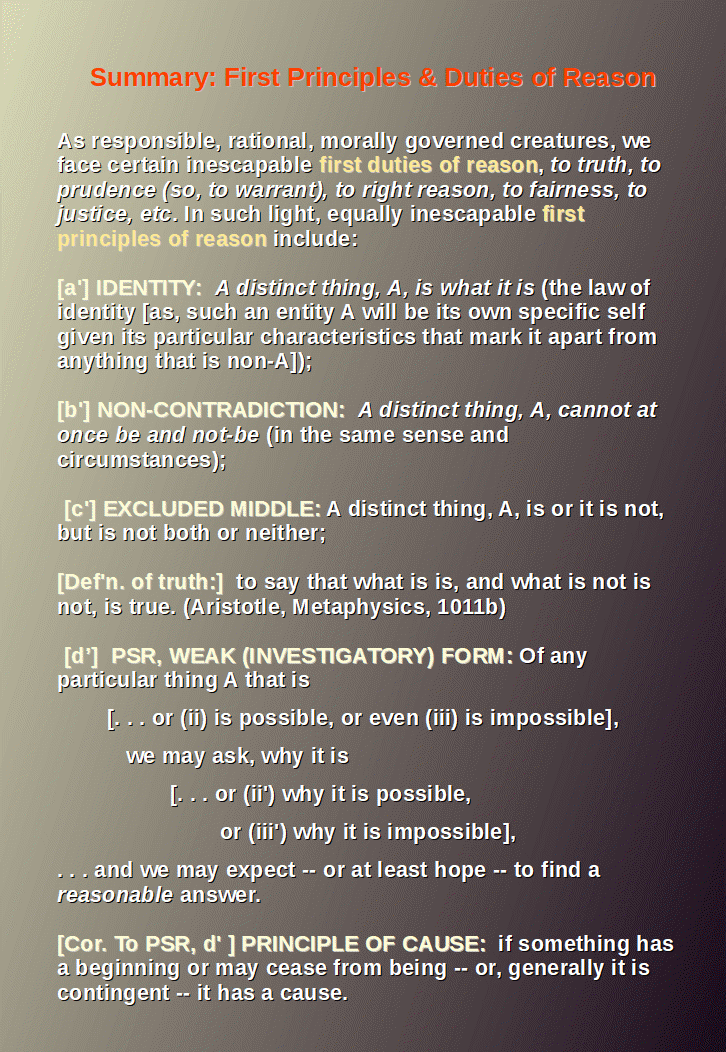
Such, of course, bring to the fore Ciceronian first duties of reason:

Marcus [in de Legibus, introductory remarks, C1 BC, being Cicero himself]: . . . we shall have to explain the true nature of moral justice, which is congenial and correspondent with the true nature of man [–> we are seeing the root vision of natural law, coeval with our humanity] . . . . “Law (say [“many learned men”]) is the highest reason, implanted in nature, which prescribes those things which ought to be done, and forbids the contrary” . . . . They therefore conceive that the voice of conscience is a law, that moral prudence is a law [–> a key remark] , whose operation is to urge us to good actions, and restrain us from evil ones . . . . the origin of justice is to be sought in the divine law of eternal and immutable morality. This indeed is the true energy of nature, the very soul and essence of wisdom, the test of virtue and vice.

We may readily expand such first duties of reason: to truth, to right reason, to prudence, to sound conscience, to neighbour, so also to fairness and justice. Where, it may readily be seen that the would-be objector invariably appeals to the said duties. Does s/he object, false, or doubtfully so, or errors of reason, or failure to warrant, or unfairness or the like, alike, s/he appeals to the very same duties, collapsing in self-referentiality. So, instead, let us acknowledge that these are inescapable, true, self-evident.

It may help, too to bring out first principles of right reason, such as:
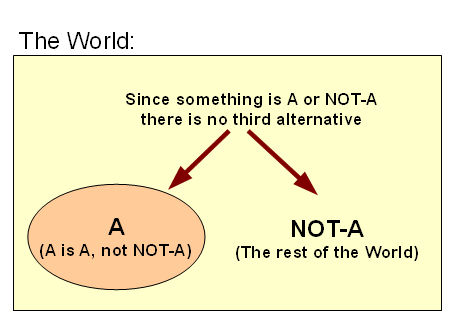
Laws of logic in action as glorified common-sense first principles of right reason

Expanding as a first list:

Such enable us to better use our senses and faculties to build knowledge. END

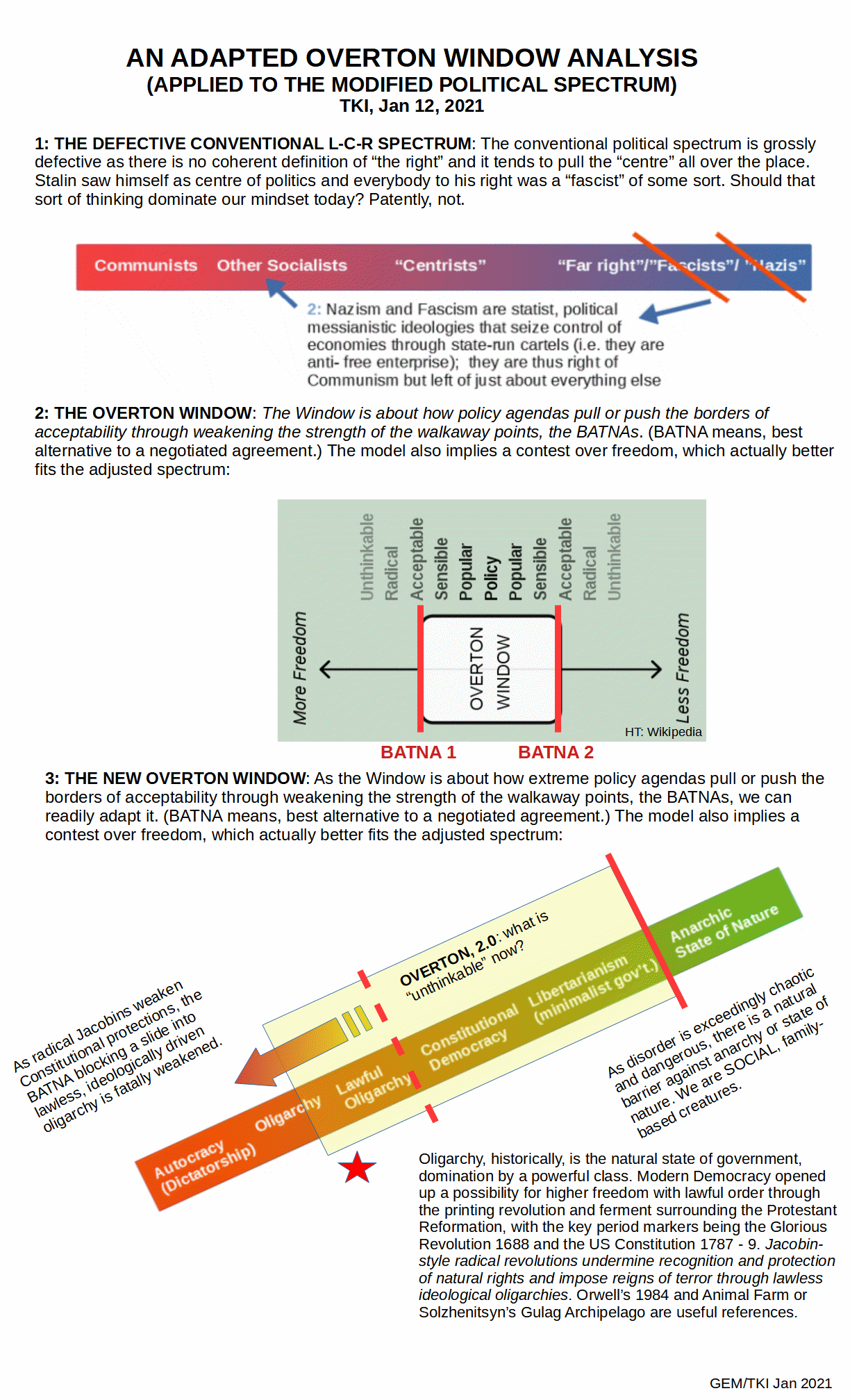
U/D May 16, regarding the Overton window, first, just an outline:
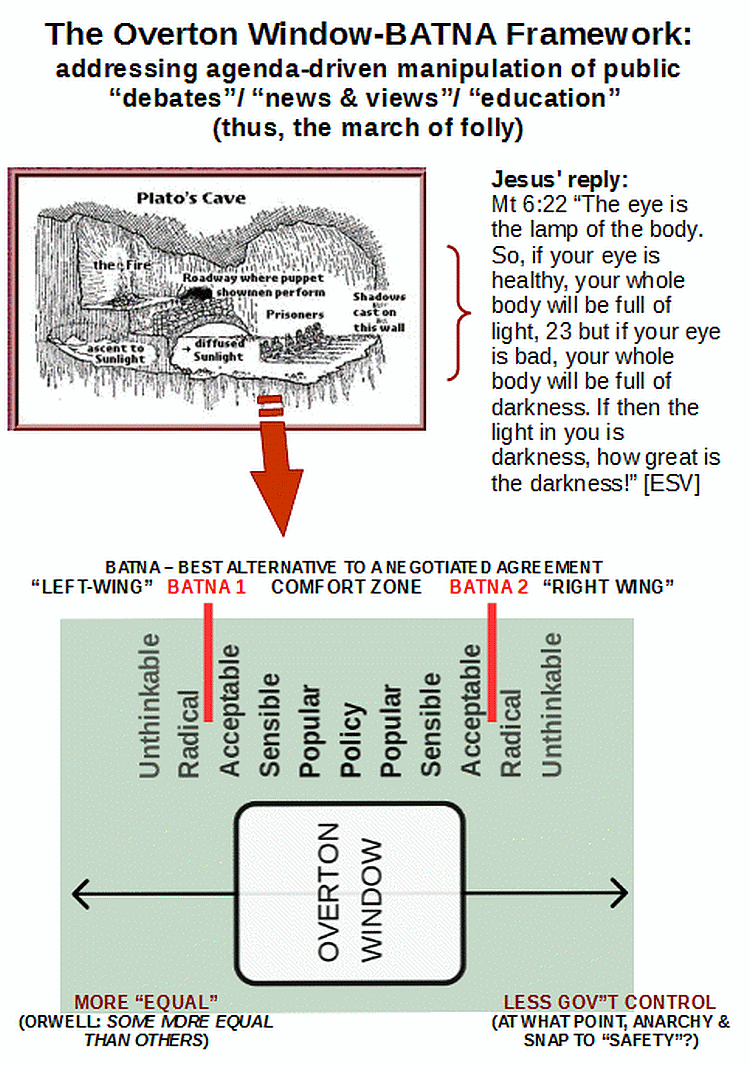
Next, as applied:
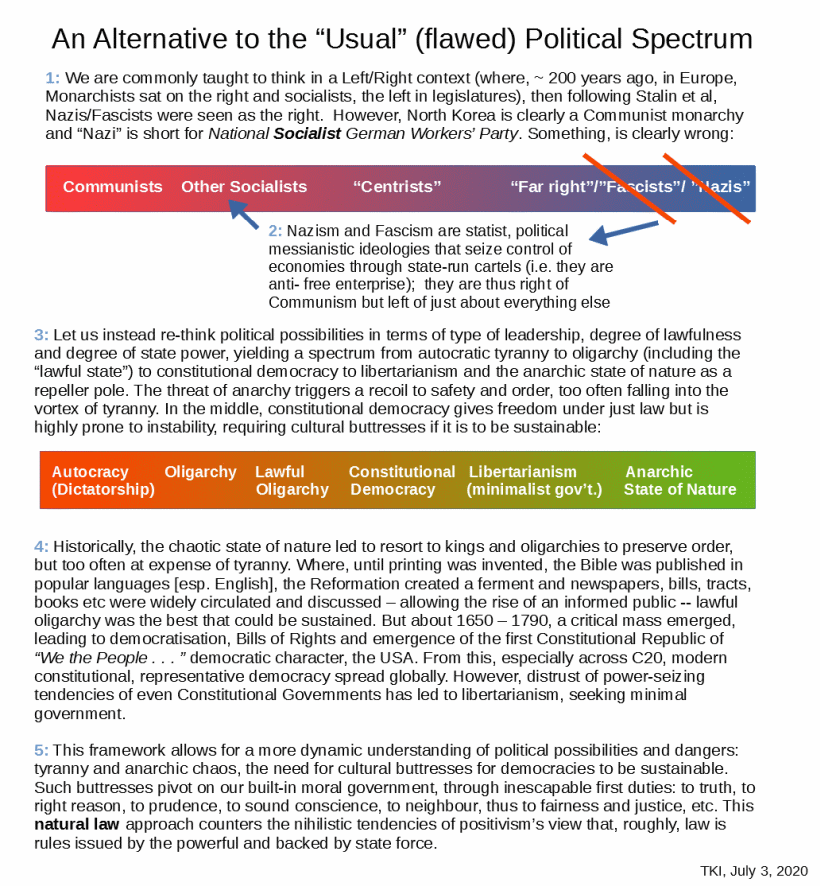
Backgrounder, on the political spectrum:
Comments
KM, At this point, this is becoming self-parody on the part of objectors: >>[185:] WJM has defeated>> - appeal to duty to right reason, prudence and truth, intended to gain persuasive traction as an announcement of alleged fact - of course, it fails at outset by being a case in point of how objections appeal to our implicit sense of the authority of these first duties. Inescapable authority, indeed constitutive of reasoned reflection and argument and so self evidently true, built-in first law coeval with our nature. - in fact, attempted denial thus will readily be seen to be self-referential and incoherent, denying what it finds itself forced to appeal to in order to gain persuasive traction. - as this case illustrates yet again. - of course, one can stoutly deny or even be blind to what is manifest. >>your “duty” arguments with solid unassailable logic.>> - explicit appeal to duty to right reason, but pivoting on a false assertion - falsified by inability to gain persuasive traction save by appealing to duties it would dismiss >>Over and over again.>> - mere repetition of appeals to the very duties one would refute or dismiss -- thus showing their inescapability as duties [oughts, as in what we should do but may flout or err in trying to do] -- cannot refute them. - notice, carefully, what is inescapable, and what is a result of free action:
[a] One cannot but imply the authority and truth of the duties as describing our nature as rational, responsible, significantly free creatures, where also [b] we cannot reason, infer logically, make credible judgements regarding warrant etc unless we are significantly free [unlike a microprocessor etc], so that [c] We are indeed free to do what we ought not, by error or by deliberately flouting what we know we should do. Indeed, [d] the gap between what is (too often as a result of our error or misuse of freedom of thought and action) and what ought to be (the result of doing duty aright) is at the heart of the gap between is and ought. Where, [e] What is mechanically necessary and/or stochastic or driven uncontrollably by instinct is precisely the opposite of what manifests rational, responsible freedom, which last [f] defines our agency, which is [g] the order of being which is what is morally governed, hence [h] we find our reason and conscience [facets of our souls in action -- our centres of freely willed thought and action and core of our unified individuality . . . ] testifying jointly to built in law coeval with our agency and framing sound civil law, just community order [the civil peace of justice] and sound government.
- It is a sign of the terrifying holes in our formal and informal education due to domination of self-referentially absurd evolutionary materialistic scientism and/or fellow travellers . . . influencing even traditional theists . . . that such themes, ideas, reasoning and grounding of our self-understanding seem strange, alien, even suspect. Instead, the flawed analogy of programmed, GIGO-driven computing substrates in action has been set up as an implicit model for brains, with mind being a dubious, somehow emergent figment of software. - This fails to recognise that morally governed, rational, responsible freedom/agency is the condition for credibility of our thinking, reasoning and arguing, hence a main root of resistance to what should be clear on five minutes of reflection. - again, from the top, and building on Cicero . . . who is prior to the Judaeo-Christian tradition (so, no, this is not worldview level q-begging as VL tried to argue and so far has apparently not withdrawn when I corrected):
We can readily identify at least seven inescapable first duties of reason. "Inescapable," as they are so antecedent to reasoning that even the objector implicitly appeals to them; i.e. they are self-evident. Namely, duties, to truth, to right reason, to prudence, to sound conscience, to neighbour; so also, to fairness and justice etc. Of course, there is a linked but not equivalent pattern: bounded, error-prone rationality often tied to ill will and stubbornness or even closed mindedness; that’s why the study of right reason has a sub-study on fallacies and errors. That we sometimes seek to evade duties or may make inadvertent errors does not overthrow the first duties of reason, which instead help us to detect and correct errors, as well as to expose our follies. Perhaps, a negative form will help to clarify, for cause we find to be at best hopelessly error-riddled, those who are habitually untruthful, fallacious and/or irrational, imprudent, fail to soundly warrant claims, show a benumbed or dead conscience [i.e. sociopathy and/or highly machiavellian tendencies], dehumanise and abuse others, are unfair and unjust. At worst, such are utterly dangerous, destructive,or even ruthlessly, demonically lawless. Such built-in . . . thus, universal . . . law, then, is not invented by parliaments, kings or courts, nor can these principles and duties be abolished by such; they are recognised, often implicitly as an indelible part of our evident nature. Hence, "natural law," coeval with our humanity, famously phrased in terms of "self-evident . . . rights . . . endowed by our Creator" in the US Declaration of Independence, 1776 . . .
_______________ That is, we are up against crooked yardstick thinking and not even a naturally upright plumb line will be able to dislodge the seeming authority of such scientism for far too many cases. This is why we are in a civilisation in a storm, on a line of drift to fatal sandbars of Syrtis, and not even realising that safety lies in trying to break the line of drift. Our prospects are grim. KFkairosfocus
May 15, 2021
May
05
May
15
15
2021
01:54 AM
1
01
54
AM
PST
... the fact that some of you people can go along with the murder of children in the name of your God's desires proves that you don't believe killing babies is "self evidently wrong." If it were self evidently wrong, it would always be self-evidently wrong. It's beyond laughable that you can't see this. The logical argument was been won by WJM, QED. The way to know if something is self-evidently true, is to test its negation for an absurdity. It is not logically absurd to kill babies. (Your own god seems to do it from time to time.) Or for lions to kill gazelles. Or for dogs to kill skunks. Whether it's "right or wrong" morally has to come from something else. Something non-logical. So stop pretending any logical argument grounded in "duty" has anything to do with the question. It's bullsh*t and you know it.Karen McMannus
May 14, 2021
May
05
May
14
14
2021
10:58 PM
10
10
58
PM
PST
BA77: If WJM can’t bring himself to honestly admit that it is self evidently true that it is wrong to torture babies... He does. You do. I do. We all do. Now... deal squarely deal with this:
1 Samuel 15:2-3, God commanded Saul and the Israelites, “This is what YHWH shaddai says: 'I will punish the Amalekites for what they did to Israel when they waylaid them as they came up from Egypt. Now go, attack the Amalekites and totally destroy everything that belongs to them. Do not spare them; put to death men and women, children and infants cattle and sheep, camels and donkeys.'"
You know [SNIP -- you know full well that vulgarity and profanity are unacceptable] you don't believe that really happened. So stop making excuses for these idiotic fictions that you don't believe. It's good for you to denounce the torture and murder of babies. Now, come clean, hypocrite. Anyone interested in the topic, read Numbers 31. What's the difference between people who believes this stuff and the World Trade Center terrorists? Nothing. It's murder in the service of their belief of what they think their "God" wants.Karen McMannus
May 14, 2021
May
05
May
14
14
2021
10:15 PM
10
10
15
PM
PST
If WJM can't bring himself to honestly admit that it is self evidently true that it is wrong to torture babies for fun, then WJM might as well deny that it is self evidently true that 2+2=4.
“Yet our common moral knowledge is as real as arithmetic, and probably just as plain. Paradoxically, maddeningly, we appeal to it even to justify wrongdoing; rationalization is the homage paid by sin to guilty knowledge.” - J. Budziszewski, What We Can't Not Know: A Guide
WJM, when he denies the objective existence of self-evidently true moral principles, is basically in the same boat as Atheistic materialists when they try to deny the objective existence of self evidently true mathematics.
What Does It Mean to Say That Science & Religion Conflict? - M. Anthony Mills - April 16, 2018 Excerpt: Barr rightly observes that scientific atheists often unwittingly assume not just metaphysical naturalism but an even more controversial philosophical position: reductive materialism, which says all that exists is or is reducible to the material constituents postulated by our most fundamental physical theories. As Barr points out, this implies not only that God does not exist — because God is not material — but that you do not exist. For you are not a material constituent postulated by any of our most fundamental physical theories; at best, you are an aggregate of those constituents, arranged in a particular way. Not just you, but tables, chairs, countries, countrymen, symphonies, jokes, legal contracts, moral judgments, and acts of courage or cowardice — all of these must be fully explicable in terms of those more fundamental, material constituents. In fact, more problematic for the materialist than the non-existence of persons is the existence of mathematics. Why? Although a committed materialist might be perfectly willing to accept that you do not really exist, he will have a harder time accepting that numbers do not exist. The trouble is that numbers — along with other mathematical entities such as classes, sets, and functions — are indispensable for modern science. And yet — here’s the rub — these “abstract objects” are not material. Thus, one cannot take science as the only sure guide to reality and at the same time discount disbelief in all immaterial realities. https://www.realclearreligion.org/articles/2018/04/16/what_does_it_mean_to_say_that_science_and_religion_conflict.html
Who knows, perhaps WJM will go so far as to say that just because everyone in the world says that it is self evidently true that 2+2=4 that does not make it objectively true. I would not put it past him at this point.bornagain77
May 14, 2021
May
05
May
14
14
2021
08:58 PM
8
08
58
PM
PST
I don't think anyone has defended WJM's IRT (formerly MRT.) I have defended his logical arguments about such things as self-evidency and duties.Viola Lee
May 14, 2021
May
05
May
14
14
2021
07:56 PM
7
07
56
PM
PST
Jerry: --- "Murray has been spouting nonsense for nearly a year. I find it interesting that anyone would actually defend the absurdities he’s published." So do I.StephenB
May 14, 2021
May
05
May
14
14
2021
07:24 PM
7
07
24
PM
PST
Reason’s rules are not limited to the laws of causality, identity, and non contradiction, or the easily apprehended truth that the finite whole is always greater than any of its parts, or the nature of inductive and deductive reasoning. The natural moral law is no less self-evident than any or all of the other six principles. That humans possess an intrinsic sense of right and wrong that governs our reasoning and behavior has been known since the time of the ancient Greeks. That WJM, KM, VL, and Paige arbitrarily exclude this sense from the list of self-evident truths has nothing to do with reality and everything to do with their irrational biases and prejudices against truth itself. Their argument against objective morality fails because it is based on the false and arbitrary assumption that reason’s rules do not include rules about morality. This assumption cannot be justified. WJM, Paige, VL, and KM all recognize (without saying so) that it is objectively wrong to torture babies for fun, but they will not admit what they *know* to be true even though it is *obviously* true, presumably because they don’t *want* it to be true. That is why I continually remind WJM that his wants and preferences, which he says are the only things that he cares about, are irrelevant to the truth, which is the one thing he says that he does not care about. This explains why he will not answer my question: Is it wrong to torture babies for fun, yes or no? His argument against objective morality fails so miserably that not even he or his unthinking defenders believe it. As he has reminded us, he often says things that he does not believe in order to entertain himself or achieve some rhetorical effect. His refusal to engage my questions is probably informed by an exercise in self-talk that goes something like this: "If I answer "yes" to the question "Is it [objectively]wrong to torture babies for fun," then I give the store away. (Even one persuasive example proves the principle as there are many others that would carry equal moral weight and be equally compelling). On the other hand, if I say no to that same question, then everyone will recognize what a moral monster I really am. So I will just shut down, avoid the issue, and continue to peddle my sophistry to those who are naive enough to swallow it."StephenB
May 14, 2021
May
05
May
14
14
2021
07:07 PM
7
07
07
PM
PST
That is not what I said.
It’s exactly what you said.
The behaviors that the majority of us share are the ones that are advantageous in our society.
Another name for these behaviors is called duties.
But in other societies the behabviors may be different.
I doubt it. Which of these is not universal to humans: truth, right reason, prudence, sound conscience, considering your neighbor, fairness and justice Cicero missed out on game theory. He was deprived.jerry
May 14, 2021
May
05
May
14
14
2021
06:42 PM
6
06
42
PM
PST
Jerry
Paige has just made the argument for duties that they are inherent and inescapable.
That is not what I said. I said that they were learned. The behaviors that the majority of us share are the ones that are advantageous in our society. But in other societies the behabviors may be different.paige
May 14, 2021
May
05
May
14
14
2021
06:24 PM
6
06
24
PM
PST
WJM --- "What have I done by admitting that sometimes I lie and that I don’t have a duty to truth? What does my doing that gain me?" WJM: --- "Well, for one, I said I always tell the truth as best I know and am able in this forum because it is necessary to gain what I want to gain here. This is remarkable. Do you not understand that the admission "I sometimes lie" militates the claim that "I always tell the truth as best I know." But to answer your question about what the admission might gain for you, I would say this: Perhaps it is a calculation designed to perpetuate the illusion that you are being open and transparent.StephenB
May 14, 2021
May
05
May
14
14
2021
06:03 PM
6
06
03
PM
PST
Paige has just made the argument for duties that they are inherent and inescapable. QED Otherwise you die. Surviving is part of human nature. Flourishing is part of human nature. One framework for examining basic human needs is Maslow’s hierarchy of needs. You will find Cicero’s duties from 2100 years ago appropriate to meet those needs. Murray has been spouting nonsense for nearly a year. I find it interesting that anyone would actually defend the absurdities he’s published.jerry
May 14, 2021
May
05
May
14
14
2021
05:57 PM
5
05
57
PM
PST
KF, WJM has defeated your "duty" arguments with solid unassailable logic. Over and over again. A beautiful thing to watch. Interesting that you can't see that. Please, reconsider. KM.Karen McMannus
May 14, 2021
May
05
May
14
14
2021
03:49 PM
3
03
49
PM
PST
KF, most of the things that you say are duties are merely behavioral expectations that the majority of individuals in a society must agree to in order for society to be relatively stable. Simple game theory shows us this. This does not make them inherent to the universe or human individuals. Most of these are learned behaviors.paige
May 14, 2021
May
05
May
14
14
2021
03:29 PM
3
03
29
PM
PST
VL, an irrelevancy. Ought is what should be but sometimes, by our choice, is not. Truthfulness, right reason, prudence, seeking to do the right etc, notoriously are things that we should do but often enough do not. The issue on the table is that even objectors appeal to them, showing that they cannot escape their authority -- as opposed to actually fulfilling what ought to be. In short, we are looking at law governing rational, responsible freedom, not mechanical necessity. For instance, the objection above is an assertion about what is the case -- appealing to and implicitly acknowledging the authority of truth and that of right reason -- but commits an informal fallacy of irrelevancy. KFkairosfocus
May 14, 2021
May
05
May
14
14
2021
03:15 PM
3
03
15
PM
PST
Viola Lee “1. Existentially unavoidable behavior (fundamental logical relationships) does not make or indicate a duty.”
...then what exactly make or indicate ? PS : Looks like you have a duty to show us what is the truth.Sandy
May 14, 2021
May
05
May
14
14
2021
02:53 PM
2
02
53
PM
PST
"1. Existentially unavoidable behavior (fundamental logical relationships) does not make or indicate a duty."Viola Lee
May 14, 2021
May
05
May
14
14
2021
02:36 PM
2
02
36
PM
PST
ViolaLee WJM is making valid points that aren’t actually being addressed in reply.
Mention one valid point.Sandy
May 14, 2021
May
05
May
14
14
2021
02:33 PM
2
02
33
PM
PST
I’m afraid that I have to side with WJM, KM and VL on this. KF has written thousands of poorly articulated words in response to those who question his logic, which is mostly circular, but he has never once actually addressed the criticisms.paige
May 14, 2021
May
05
May
14
14
2021
02:03 PM
2
02
03
PM
PST
I'm with Karen on this conversation. FWIW. WJM is making valid points that aren't actually being addressed in reply. Please see #151.Viola Lee
May 14, 2021
May
05
May
14
14
2021
01:26 PM
1
01
26
PM
PST
KM, I was struck by just how inverted that is, a classic of turnabout projection. Thus, confession of cognitive dissonance by projection. Please, reconsider. KFkairosfocus
May 14, 2021
May
05
May
14
14
2021
12:35 PM
12
12
35
PM
PST
It's like Karen Mac is watching a different movie from the rest of us. Andrewasauber
May 14, 2021
May
05
May
14
14
2021
12:35 PM
12
12
35
PM
PST
Karen McMannus WJM, They squirm. They twitch. They attack your character and motives. But they can’t defeat your rational arguments. Bravo. Thank you.
They can't defeat a self-defeated argument. It's already defeated. :)Sandy
May 14, 2021
May
05
May
14
14
2021
12:33 PM
12
12
33
PM
PST
SB:
. . . the nature of a self-evident truth, which cannot be demonstrated with an argument or “shown to be true.” It is on the foundation of a self-evident truth that other arguments are made.
Precisely. In this case, rational responsible freedom is in key part framed on fulfillment of first duties. Beyond, Cicero's summary highlights that core law is rooted in that reason. Ironically, dismissal of these duties debases our rationality and undermines our freedom as we become slaves of intellectual and moral vices. Further to such, these are the substance of sound reasoning, truth, right reason, prudence, sound conscience, mutuality in regard to neighbour, so too fairness, justice etc. We cannot escape them and be reasonable. Even deceit and hyperskepticism must pay grudging homage. We cannot disprove them as the attempt must resort to them. Neither can we prove them as they are the fabric of proof. Which of course attracts the scorn of an age steeped in hyperskepticism and trying to reduce intellectual effort to games played with essentially arbitrary rules. Which can then be disregarded when they are inconvenient. The door to nihilism lies open. ours is a sick age and we do not want to find sound health. KFkairosfocus
May 14, 2021
May
05
May
14
14
2021
12:27 PM
12
12
27
PM
PST
WJM, They squirm. They twitch. They attack your character and motives. But they can't defeat your rational arguments. Bravo. Thank you.Karen McMannus
May 14, 2021
May
05
May
14
14
2021
12:10 PM
12
12
10
PM
PST
WJM: --- “Asking me about my personal views is entirely irrelevant to the arguments on the table. We’re not arguing about my personal views; we’re arguing about the existence of objective morality and whether or not a statement about murder represents something self-evidently true. “Murder is not wrong” does not represent an absurdity. Therefore, it is not self-evidently true." Part of the process of achieving a fair exchange of ideas with you would include the privilege of asking follow up questions about some of your statements, especially those that appear to be illogical and nonsensical. In your special case, it is doubly important since, by your own admission, you often say things that you do not believe in order to entertain yourself or achieve some rhetorical effect. How can I know if you really meant what you just wrote unless I ask specific questions that have been framed to elicit an honest response? Dodging them is a tacit admission that you would prefer to be dishonest. So, here we go again: Do you agree that it is inherently wrong to torture babies for fun? Yes or no. Meanwhile, the comment “murder is not wrong” is clearly an absurdity. According to the philosophical (not legal) definition, murder is the “unjust” taking of a human life. To say that it is not wrong is to say that it is not unjust, which would be both contradictory and absurd. ---“The relevant question is not “does WJM believe that murder is objectively wrong” because the argument is not about what I personally believe; it’s about whether or not the statement can be shown to be objectively true or false.” That comment indicates that you do not understand the nature of a self-evident truth, which cannot be demonstrated with an argument or “shown to be true.” It is on the foundation of a self-evident truth that other arguments are made. Either [a] you did not know that, in which case you are not yet prepared to discuss the matter or [b] you did know it, but you are, once again, saying something you do not really believe. Which is it?StephenB
May 14, 2021
May
05
May
14
14
2021
10:50 AM
10
10
50
AM
PST
KF said:
WJM, for record, the necessity of logic is distinct identity. You cannot communicate without using it, however a lot of people then try to reject it (sometimes by suggesting that q theory overturns it).
Agree 100 %
So even there there is freedom,
What do you mean by "even there? Even where? I agree, and have always agreed, that people have the option to "turn away" from logic except where it is inescapable in order to even think about or communicate their denial or objection to logic.
... and freedom comes with moral government,
Bald assertion with counterfactuals in evidence (sociopaths.)
You are free to be untruthful, illogical, imprudent, reckless in knowledge and fact claims, crush conscience and disregard neighbour. What you are not free to do is to break the force of actual obligations,
I think you're about to conflate "duty" with "existentially inescapable behavior and relationships required for sentient thought" again ....
... and in trying to persuade others you will be forced to appeal to the implicit recognition of such duties ...
Nope. Such duties have not been established as existent. What I am "forced" to appeal to are unavoidable fundamental logical principles and relationships, not duties.
... normally functioning people have.
There's the appeal to "common human behavior," which cannot make the case such duties exist.
Already, you have made some imprudent declarations that you would be well advised to reconsider. KF
And there's the chastising warning made in lieu of a sound argument for the existential necessity of moral duties. Note: I have challenged KF and others several to to demonstrate how the lack of duty to truth (not the lack ability to recognize and employ truths, not the lack of the existentially necessary principles of logic and their relationships) would lead to a self-contradictory, absurd conclusion. I'll assume this is because they know they cannot make that argument. This is why we get appeals to "normally functioning people," dire consequences and the constant conflation of duty and what is existentially unavoidable. I think this is also probably now why my "credibility" has become a concern where my credibility has no bearing on the matter; if you can't win the argument, attack the person. BTW, what I have actually said about whether or not I tell the truth is that I admit that sometimes, in various situations and for various reasons, I lie. Anyone that claims they do not ever lie, in any situation for any reason, is IMO full of it. And the fact that I'm willing to admit it counts against me? Here's a headline: people can say they have a duty to truth and be lying about it. It would serve to make what they say more credible to more people. What have I done by admitting that sometimes I lie and that I don't have a duty to truth? What does my doing that gain me? Well, for one, I said I always tell the truth as best I know and am able in this forum because it is necessary to gain what I want to gain here. Second, that statement makes plain the following: my arguments do not rely on whether or not I'm telling the truth, they stand or fall on their own merits. It's a form of "don't believe me; follow the logic. Don't believe me, find and follow the facts and the evidence." It's of no value to me that someone believe anything I say, or accept my arguments, because they find me "credible." Of what value is "credibility" to me in this forum? It has zero value in a forum that is about logic, facts and evidence.William J Murray
May 14, 2021
May
05
May
14
14
2021
09:20 AM
9
09
20
AM
PST
SA said:
You can deny the duty to the truth. Logical relationships are only necessary for those who establish logic and truth as the foundation of their worldview.
You're not understanding what "existentially necessary" means. My ability to think or say anything remotely meaningful, like "I'm hungry" or "I'm walking to the store," or a decision to do X and not Y, existentially require reference to the principles of identity (identification), excluded middle and non-contradiction. No sentient being can even begin to operate outside of those fundamental logical relationships whether believe in them, or are even aware of them as such.
“I deny the moral duty to truth” means that the person attempts to establish a foundation on an irrational basis – by using lies and illogic.
Nope. One is perfectly capable of denying a duty to truth and accepting self-evident truths, fundamental, unavoidable logical relationships and understanding the efficacy of reasoning in pursuing their goals.
By your every argument, however, you observe a duty to truth – you adhere to the laws of truth and logic.,
You are conflating the separate, proposed duty with existential unavoidable behaviors, and perhaps with psychology and motivations. Because I unavoidably use the fundamental principles of logic and unavoidable logical relationships in my arguments (and in anything I say anywhere at any time,) and because I choose to make my arguments here as logically sound as possible, does not imply I have a duty to do so.
You’re thinking that since truth is a moral duty, then everyone necessarily observes that duty. But we have ample evidence of people who do not uphold the duty to truth.
I am not thinking that, never said it, nor implied it. That people can lie has no bearing whatsoever on whether or not a "duty" to truth is existentially necessary because the nature of a duty is that you can violate or not fulfill it. Otherwise, it's just an existential "is," like fundamental logical principles and relationships. The burden you and KF bear if you're going to claim that such duties are existentially necessary (self-evident) is to show the absurdity that would result without the duty. Note: the duty to logical reasoning and the inescapable, existential qualities of the principles of logic and logical relationships are not the same thing as a duty to carry those things out beyond what is unavoidably, existentially necessary.
We are not compelled to use logic and reason – not by force of anything.
Of course we are, up until where said use is avoidable. You cannot avoid the existential requirement of the principles of identity, excluded middle and non-contradiction or else you could not identify yourself, an experience, any difference between experience, the difference between you and "other," etc. Sentience cannot exist without it, regardless of you believe in it or not, understand it or not.William J Murray
May 14, 2021
May
05
May
14
14
2021
08:42 AM
8
08
42
AM
PST
"It’s not a bad analogy about the argument that we have a duty to use the laws of logic' VL, It's a bad analogy because logic can only be utilized with a purpose, otherwise the result logic gives you is meaningless. Andrewasauber
May 14, 2021
May
05
May
14
14
2021
08:12 AM
8
08
12
AM
PST
It's not a bad analogy about the argument that we have a duty to use the laws of logic. Caring about life is a different issue, but my analogy is not about that.Viola Lee
May 14, 2021
May
05
May
14
14
2021
08:07 AM
8
08
07
AM
PST
"Here’s an analogy to consider: if I jump off a building, do I have a duty to fall?" VL, This is a bad analogy, of course. The question is: "If I jump off a building when I know it's a long way and I will kill myself for no reason, should I care?" Andrewasauber
May 14, 2021
May
05
May
14
14
2021
08:04 AM
8
08
04
AM
PST
1 … 36 37 38 39 40 … 44