Uncommon Descent Serving The Intelligent Design Community

L&FP42: is knowledge warranted, credibly true (so, reliable) belief?

Categories
Defending our Civilization
Epistemology
Logic and Reason
Share
Facebook
Twitter/X
LinkedIn
Flipboard
Print
Email

It’s time to start delivering on a promise to address “warrant, knowledge, logic and first duties of reason as a cluster,” even at risk of being thought pedantic. Our civilisation is going through a crisis of confidence, down to the roots. If it is to be restored, that is where we have to start, and in the face of rampant hyperskepticism, relativism, subjectivism, emotivism, outright nihilism and irrationality, we need to have confidence regarding knowledge.

Doing my penance, I suppose: these are key issues and so here I stand, in good conscience, I can do no other, God help me.

For a start, from the days of Plato, knowledge has classically been defined as “justified, true belief.” However, in 1963, the late Mr Gettier put the cat in among the pigeons, with Gettier counter-examples; which have since been multiplied. In effect, there are circumstances (and yes, sometimes seemingly contrived, but these are instructive thought exercises) in which someone or a circle may be justified to hold a belief but on taking a wider view such cannot reasonably be held to be a case of knowledge.

As a typical thought exercise, consider a circle of soldiers and sailors on some remote Pacific island, who are eagerly awaiting a tape of a championship match sent out by the usual morale units. They get it, play it and rejoice that team A has won over team B (and the few who thought otherwise have to cough up on their bets to the contrary). Unbeknownst to them, through clerical error, it was last year’s match, which had the same A vs B match-up and more or less the same outcome. They are justified — have a right — to believe, what they believe is so, but somehow the two fail to connect leading to accidental, not reliable arrival at truth.

Knowledge must be built of sterner stuff.

Ever since, epistemology as a discipline, has struggled to rebuild a solid consensus on what knowledge is.

Plantinga weighed in with a multi-volume study, championing warrant, which(as we just noted) is at first defined by bill of requisites. That is, we start with what it must do. So, warrant — this builds on the dictionary/legal/commercial sense of a reliable guarantee of performance “as advertised” — will be whatever reliably converts beliefs we have a right to into knowledge.

The challenge being, to fill in the blank, “Warrant is: __________ .”

Plantinga then summarises, in his third volume:

The question is as old as Plato’s Theaetetus: what is it that distinguishes knowledge from mere true belief? What further quality or quantity must a true belief have, if it is to constitute knowledge? This is one of the main questions of epistemology. (No doubt that is why it is called ‘theory of knowledge’.) Along with nearly all subsequent thinkers, Plato takes it for granted that knowledge is at least true belief: you know a proposition p only if you believe it, and only if it is true. [–> I would soften to credibly, true as we often use knowledge in that softer, defeat-able sense cf Science] But Plato goes on to point out that true belief, while necessary for knowledge, is clearly not sufficient: it is entirely possible to believe something that is true without knowing it . . .

[Skipping over internalism vs externalism, Gettier, blue vs grue or bleen etc etc] Suppose we use the term ‘warrant’ to denote that further quality or quantity (perhaps it comes in degrees), whatever precisely it may be, enough of which distinguishes knowledge from mere true belief. Then our question (the subject of W[arrant and] P[roper] F[unction]): what is warrant?

My suggestion (WPF, chapters 1 and 2) begins with the idea that a belief has warrant only if it is produced by cognitive faculties that are functioning properly, subject to no disorder or dysfunction—construed as including absence of impedance as well as pathology. The notion of proper function is fundamental to our central ways of thinking about knowledge. But that notion is inextricably bound with another: that of a design plan.37

Human beings and their organs are so constructed that there is a way they should work, a way they are supposed to work, a way they work when they work right; this is the way they work when there is no malfunction . . . We needn’t initially take the notions of design plan and way in which a thing is supposed to work to entail conscious design or purpose [–> design, often is naturally evident, e.g. eyes are to see and ears to hear, both, reasonably accurately] . . .

Accordingly, the first element in our conception of warrant (so I say) is that a belief has warrant for someone only if her faculties are functioning properly, are subject to no dysfunction, in producing that belief.39 But that’s not enough.

Many systems of your body, obviously, are designed to work in a certain kind of environment . . . . this is still not enough. It is clearly possible that a belief be produced by cognitive faculties that are functioning properly in an environment for which they were designed, but nonetheless lack warrant; the above two conditions are not sufficient. We think that the purpose or function of our belief-producing faculties is to furnish us with true (or verisimilitudinous) belief. As we saw above in connection with the F&M complaint [= Freud and Marx], however, it is clearly possible that the purpose or function of some belief-producing faculties or mechanisms is the production of beliefs with some other virtue—perhaps that of enabling us to get along in this cold, cruel, threatening world, or of enabling us to survive a dangerous situation or a life-threatening disease.

So we must add that the belief in question is produced by cognitive faculties such that the purpose of those faculties is that of producing true belief.

More exactly, we must add that the portion of the design plan governing the production of the belief in question is aimed at the production of true belief (rather than survival, or psychological comfort, or the possibility of loyalty, or something else) . . . .

[W]hat must be added is that the design plan in question is a good one, one that is successfully aimed at truth, one such that there is a high (objective) probability that a belief produced according to that plan will be true (or nearly true). Put in a nutshell, then, a belief has warrant for a person S only if that belief is produced in S by cognitive faculties functioning properly (subject to no dysfunction) in a cognitive environment [both macro and micro . . . ] that is appropriate for S’s kind of cognitive faculties, according to a design plan that is successfully aimed at truth. We must add, furthermore, that when a belief meets these conditions and does enjoy warrant, the degree of warrant it enjoys depends on the strength of the belief, the firmness with which S holds it. This is intended as an account of the central core of our concept of warrant; there is a penumbral area surrounding the central core where there are many analogical extensions of that central core; and beyond the penumbral area, still another belt of vagueness and imprecision, a host of possible cases and circumstances where there is really no answer to the question whether a given case is or isn’t a case of warrant.41 [Warranted Christian Belief (NY/Oxford: OUP, 2000), pp 153 ff. See onward, Warrant, the Current Debate and Warrant and Proper Function; also, by Plantinga.]

So, we may profitably distinguish [a] Plantinga’s specification (bill of requisites) for warrant and [b] his theory of warrant. The latter, being (for the hard core):

a belief has warrant for a person S only if that belief is produced in S by cognitive faculties functioning properly (subject to no dysfunction) in a cognitive environment [both macro and micro . . . ] that is appropriate for S’s kind of cognitive faculties, according to a design plan that is successfully aimed at truth.

Obviously, warrant comes in degrees, which is just what we need to have. Certain things are known to utterly unchangeable certainty, others are to moral certainty, others for good reason are held to be reasonably reliable though not certain enough to trust when the stakes are high, other things are in doubt as to whether they are knowledge, some things outright fail any responsible test.

That’s why I have taken up and commend a modified form, recognising that what we think is credibly, reliably true today may oftentimes be corrected for cause tomorrow. (Back in High School Chemistry class, I used to imagine a courier arriving at the door to deliver the latest updates to our teacher.)

Yes, I accept that many knowledge claims are defeat-able, so open-ended and provisional.

Indeed, that is part of what distinguishes the prudence and fair-mindedness of sober knowledge claims hard won and held or even stoutly defended in the face of uncertainty and challenge from the false certitude of blind ideologies. Especially, where deductive logical schemes can have no stronger warrant than their underlying axioms and assumptions and where inductive warrant provides support, not utterly certain, incorrigible, absolute demonstration.

That said, we must recognise that some few things are self-evident, e.g.:
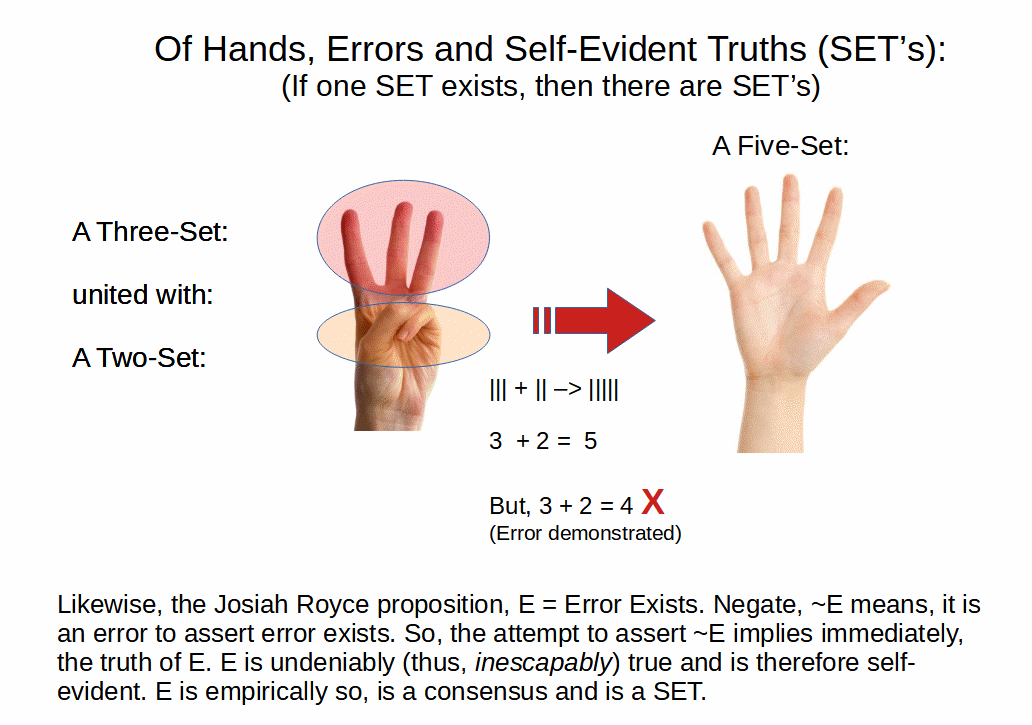
While self-evident truths cannot amount to enough to build a worldview, they can provide plumb line tests relevant to the reliability of warrant for what we accept as knowledge:

Such, of course, bring to the fore Ciceronian first duties of reason:

Marcus [in de Legibus, introductory remarks, C1 BC, being Cicero himself]: . . . we shall have to explain the true nature of moral justice, which is congenial and correspondent with the true nature of man [–> we are seeing the root vision of natural law, coeval with our humanity] . . . . “Law (say [“many learned men”]) is the highest reason, implanted in nature, which prescribes those things which ought to be done, and forbids the contrary” . . . . They therefore conceive that the voice of conscience is a law, that moral prudence is a law [–> a key remark] , whose operation is to urge us to good actions, and restrain us from evil ones . . . . the origin of justice is to be sought in the divine law of eternal and immutable morality. This indeed is the true energy of nature, the very soul and essence of wisdom, the test of virtue and vice.

We may readily expand such first duties of reason: to truth, to right reason, to prudence, to sound conscience, to neighbour, so also to fairness and justice. Where, it may readily be seen that the would-be objector invariably appeals to the said duties. Does s/he object, false, or doubtfully so, or errors of reason, or failure to warrant, or unfairness or the like, alike, s/he appeals to the very same duties, collapsing in self-referentiality. So, instead, let us acknowledge that these are inescapable, true, self-evident.

It may help, too to bring out first principles of right reason, such as:
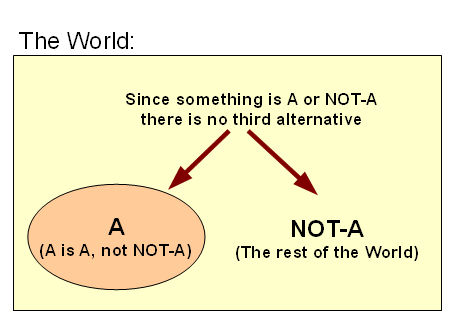
Laws of logic in action as glorified common-sense first principles of right reason

Expanding as a first list:

Such enable us to better use our senses and faculties to build knowledge. END

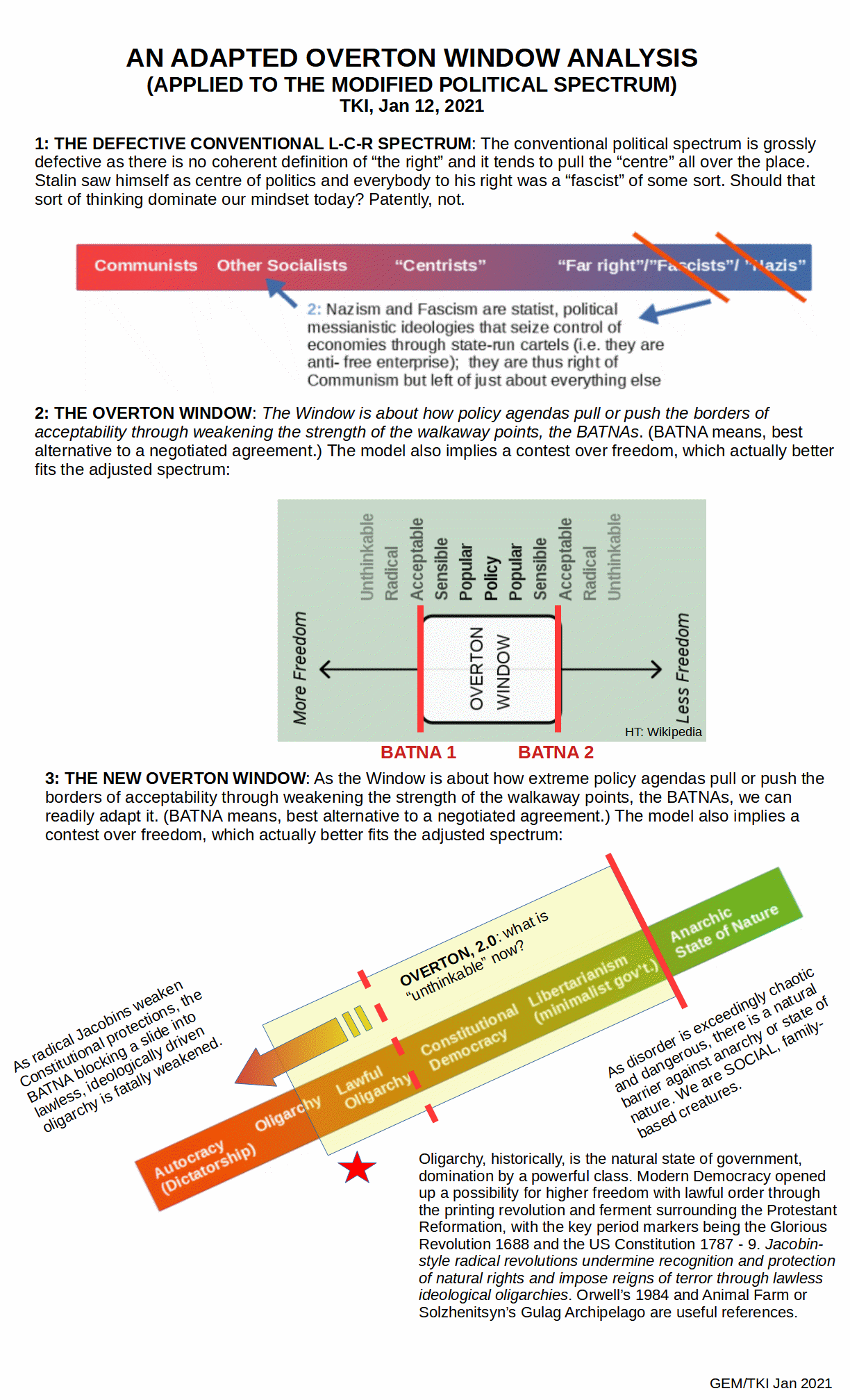
U/D May 16, regarding the Overton window, first, just an outline:
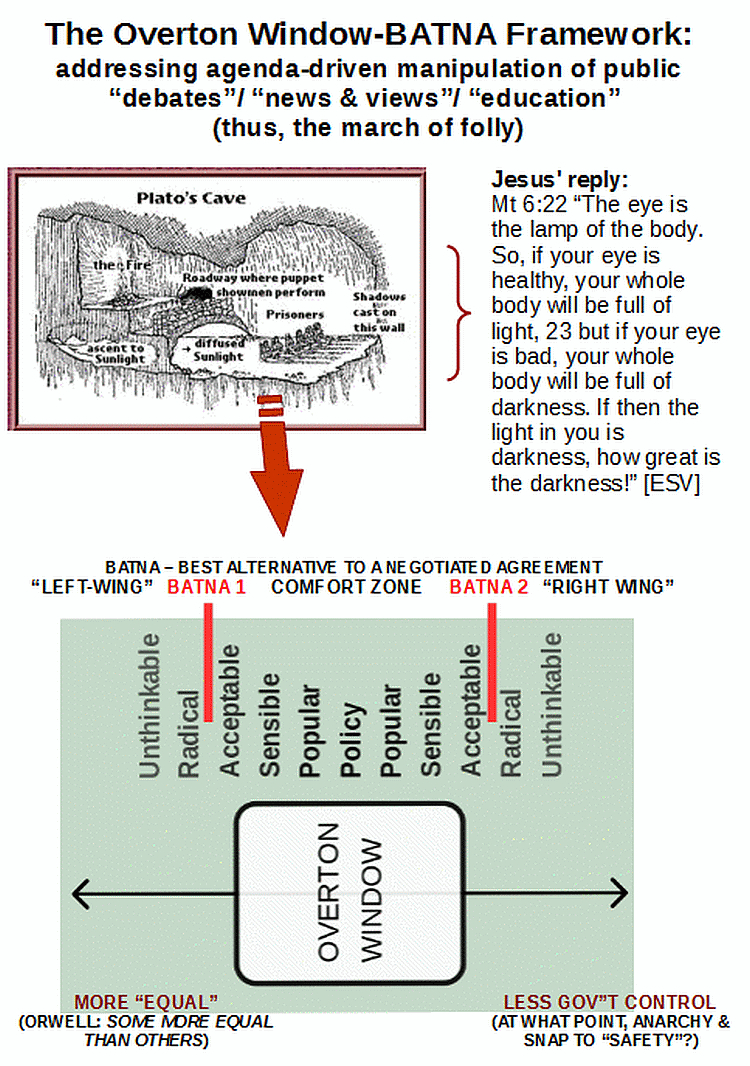
Next, as applied:
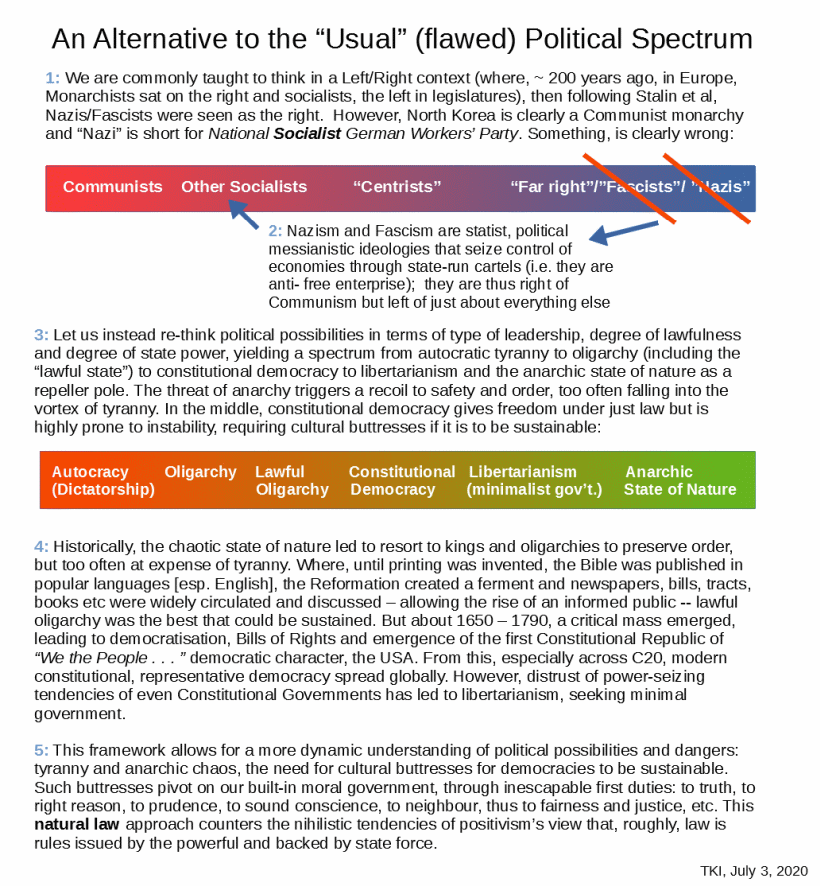
Backgrounder, on the political spectrum:
Comments
WJM, in your latest dismissal you again miss that you expect us to acknowledge duties of reason and justice etc, in order for your argument to have traction. Indeed, without that government of built in law, the pivot of epistemology, seeking responsible knowledge given our proneness to error, evaporates. And meanwhile so self-evidently manifest a justice issue as the right to life seems to evaporate also. Those are red flags that something is seriously wrong. KFkairosfocus
May 13, 2021
May
05
May
13
13
2021
05:55 AM
5
05
55
AM
PST
F/N: As a reminder on the focus of this thread, Wiki as speaking against ideological interests:
Epistemology (/??p?st??m?l?d?i/ (About this soundlisten); from Greek ????????, epist?m? 'knowledge', and -logy) is the branch of philosophy concerned with knowledge. Epistemologists study the nature, origin, and scope of knowledge, epistemic justification, the rationality of belief, and various related issues. Epistemology is considered one of the four main branches of philosophy, along with ethics [--> I would bring in the other half of axiology, aesthetics], logic, and metaphysics [--> given its historical and continuing importance, political philosophy too as it studies justice, law and good government].[1] Debates in epistemology are generally clustered around four core areas:[2][3][4] 1] The philosophical analysis of the nature of knowledge and the conditions required for a belief to constitute knowledge, such as truth and justification [--> studiously omitted, warrant i/l/o the impact of Gettier] 2] Potential sources of knowledge and justified belief [--> notice the AND], such as perception, reason, memory, and testimony [--> notice, the impact of cultivating hyperskepticism regarding these major faculties, contrast Reidian Common Sense] 3] The structure of a body of knowledge or justified belief, including whether all justified beliefs must be derived from justified foundational beliefs or whether justification requires only a coherent set of beliefs 4] Philosophical skepticism, which questions the possibility of knowledge, and related problems, such as whether skepticism poses a threat to our ordinary knowledge claims and whether it is possible to refute skeptical arguments In these debates and others, epistemology aims to answer questions such as "What do we know?", "What does it mean to say that we know something?", "What makes justified beliefs justified?", and "How do we know that we know?".[1][2][5][6][7]
The pivotal importance of knowledge to the project of civilisation is obvious. KFkairosfocus
May 13, 2021
May
05
May
13
13
2021
05:36 AM
5
05
36
AM
PST
KF said:
WJM, first, in what format is irrelevant to independence of the perceptions or conceptions of a fallible subject
I agree that "in what format" it actually exists is irrelevant; however, you and I cannot have a meaningful conversation about that. We an only have a meaningful conversation about our conceptualizations of how that thing exists and what that conceptualization means to our worldview.
Secondly, the incoherence of the idealist views you proposed has long since been shown and yet again in trying to correct what I noted, you show that to gain rhetorical traction you implicitly appeal to the known binding nature of the very same first duties of reason that for some reason you find it hard to acknowledge as inescapable. even as you repeatedly show that you cannot escape their force. KF
That I unavoidably, inescapably appeal to logic and reason is not the same thing as unavoidably, inescapably appealing to a duty to logic and reason. You continually combine those two entirely different things as if they are the same thing.William J Murray
May 13, 2021
May
05
May
13
13
2021
05:34 AM
5
05
34
AM
PST
WJM, first, in what format is irrelevant to independence of the perceptions or conceptions of a fallible subject. Secondly, the incoherence of the idealist views you proposed has long since been shown and yet again in trying to correct what I noted, you show that to gain rhetorical traction you implicitly appeal to the known binding nature of the very same first duties of reason that for some reason you find it hard to acknowledge as inescapable. even as you repeatedly show that you cannot escape their force. KFkairosfocus
May 13, 2021
May
05
May
13
13
2021
05:15 AM
5
05
15
AM
PST
KF, your entire argument - even about the world, civilization, the ramifications of certain beliefs - entirely depends on a metaphysical perspective about what the "world" is, what "we" are, how we exist, how experiences are acquired and from what, the supposed limitations and parameters of what an individual is, what they are operating in or from, what "reality" is and how it works, etc. Even your conception of "all possible worlds" is derived from an a priori conceptualization of how "worlds" exist and what they exist as. Your warning is (as if we're not already there, as if we haven't always been there) that the world may turn into a lawless oligarchy; my response from my perspective is: so what? In your worldview, it is very important because it is the only world we have before we reach a final dispensation. In my worldview, what happens to "this world" is entirely irrelevant, because of how it actually exists, what it actually exists as: an informational matrix of potential from which people draw whatever experiences they, at some level, will. It's one "form" of a "world" in an infinite ocean of potential forms of "worlds," all of which eternally exist in universal mind. So, as you might be able to apprehend, under that perspective I have no "duty" to justice, fairness, or neighbor unless I access and process that potential as part of my "world" or "reality" experience. I agree that you live in a world of objective first duties. That is not the only world one can experience. I live in a world (reality) where no such things objectively exist (except, for me, as part of infinite potential outside of my experience.) We do not live in the same reality, even though our different realities have a large subset of shared physical experiential references - the physical universe.William J Murray
May 13, 2021
May
05
May
13
13
2021
05:13 AM
5
05
13
AM
PST
KF gives us a definition of "objective" that he thinks will clear things up: "1. (Philosophy) existing independently of perception or an individual’s conceptions: are there objective moral values?." But, exists independently of one's perception and conceptions in what format? What is the nature of that thing's existence? What does it exist as beyond anyone's particular perception and conception? Quantum physics experimentation have shown that the old, general consensus of what it meant for a thing to have an "objective existence" (as defined above) is not valid. So, how would I answer the question if, whether I say yes or no, neither of those answers means to you what it means to me in terms of the nature of how things exist outside of perception, and what they exist as?William J Murray
May 13, 2021
May
05
May
13
13
2021
04:39 AM
4
04
39
AM
PST
KF said Where, WJM, you above tried to sweep away an argument by willfully, insistently mischaracterising it as empty assertion in the face of repeated correction. The "duty" part is - so far - entirely nothing more than assertion.
In short, you managed to yet again show how you cannot escape appealing to first duties claims of or referrals to facts or truth to gain rhetorical traction for your argument. Inescapable, so first truths of reason, truths regarding duty, so too, moral, self evident truths. Truths that include duty to justice, due balance of rights, freedoms and responsibilities. Including the first right, life. Thence why you cannot defend the view that there is no duty to protect innocent life.
I don't have to defend that view, you're the one making the clam I have such a duty. So far, you have yet to make that case.
Do you, WJM, see that there can be no rights and freedoms without correlative duties, duties demanding mutual respect among neighbours?
This is unquestionably an appeal to consequences. In my worldview, I have complete freedom to do anything I want, and complete, 100% self-authority. So, the question of "rights" doesn't even come up. I have no inherent "duties" whatsoever; how can I, if I am the sole authority of my existence? There is no such thing as "justice" in any existentially meaningful sense of the word. Yes, there are existential unavoidables that make my existence possible - such as the rules of logic, math, free will, preference, context - but I have no "duty" to use or treat those things in any particular way beyond what is unavoidable. They provide for my existence as a free, individual, rational being. Beyond that, I am completely free and self-authorized to do whatever I wish.William J Murray
May 13, 2021
May
05
May
13
13
2021
04:19 AM
4
04
19
AM
PST
WJM, Objective:
objective (?b?d??kt?v) adj 1. (Philosophy) existing independently of perception or an individual's conceptions: are there objective moral values?. 2. undistorted by emotion or personal bias 3. of or relating to actual and external phenomena as opposed to thoughts, feelings, etc 4. (Medicine) med (of disease symptoms) perceptible to persons other than the individual affected . . . 9. an actual phenomenon; reality . . . 11. (General Physics) optics a. the lens or combination of lenses nearest to the object in an optical instrument [--> the object being viewed] b. the lens or combination of lenses forming the image in a camera or projector Abbreviation: obj Compare: subjective objectival adj ob?jectively adv ?objec?tivity, ob?jectiveness n Collins English Dictionary – Complete and Unabridged, 12th Edition 2014 © HarperCollins Publishers 1991, 1994, 1998, 2000, 2003, 2006, 2007, 2009, 2011, 2014
While we are at it:
nihilism (?na???l?z?m) n 1. a complete denial of all established authority and institutions 2. (Philosophy) philosophy an extreme form of scepticism that systematically rejects all values, belief in existence, the possibility of communication, etc 3. (Government, Politics & Diplomacy) a revolutionary doctrine of destruction for its own sake 4. (Government, Politics & Diplomacy) the practice or promulgation of terrorism [C19: from Latin nihil nothing + -ism, on the model of German Nihilismus] ?nihilist n, adj ?nihil?istic adj Nihilism (?na???l?z?m) n (Historical Terms) (in tsarist Russia) any of several revolutionary doctrines that upheld terrorism Collins English Dictionary – Complete and Unabridged, 12th Edition 2014 © HarperCollins Publishers 1991, 1994, 1998, 2000, 2003, 2006, 2007, 2009, 2011, 2014
That's good enough for starters. KFkairosfocus
May 13, 2021
May
05
May
13
13
2021
04:01 AM
4
04
01
AM
PST
SB said:
The above statement does not address the question. Do you agree that murder is objectively wrong? While you are at it, try this one: Is it ever morally permissible to torture babies for fun?
The word "objective" means something entirely different in my worldview than it does in yours. In any event, the answers to those questions are irrelevant as to whether or not objective morality is self-evidently true.
Why do you say that the consequences of subjective morality (might makes right) would be “undesirable?: Do you mean that they would be undesirable for you personally, or do you mean that they would be unacceptable in principle? If it is the latter, please explain why.
I meant that the might be undesirable to some, many or most, such as to you and KF.William J Murray
May 13, 2021
May
05
May
13
13
2021
03:39 AM
3
03
39
AM
PST
AS:
They [the Woke] are motivated by images and sounds on the screens in front of them that trigger them emotionally [--> as connected to dominant narratives, ideologies, indoctrination and linked unexamined worldviews]. A piece of glacier breaking off video, or a crying nurse commercial, or someone in a lab coat using sciency catchphrases on popsci TV is the beginning and end of the story. They aren’t interested in expressing or listening to [--> or reading] a thoughtful and consistent position with words that mean specific things. It’s just impressions snatched from the airwaves all the way down.
This, as annotated, exposes the miseducation of a generation, and the longstanding issue that arguments persuade through pathos, ethos, logos. Our emotions are no better than underlying grounds for associated perceptions and judgements. No authority is better than his/her facts, reasoning and key assumptions (or biases). Only facts and logic, responsibly and soundly worked through can actually warrant conclusions and choices. Including of course facts of moral government, which so many have been indoctrinated to dismiss today. Those sad facts explain a lot about where we are and where we are headed. And oh yes, my Strategic Marketing reminds, that deep trends and patterns drive how we respond to perceived alternatives, whether goods and services,brands, ideas or people, ideologies etc. This blog is at that level, not the level of Z---- it's us or rust or C--- i'ts the real thing or Marlboro Man or Jolly Green Giant, or see what the fashionable stars are wearing today. Worldviews count, count decisively. So do shipwrecks as termini of voyages of folly. Ask yourself, why that short, real world study on manipulation of democracy, isn't a standard part of our mental furniture, or why Plato's ship of state, likewise is not part of the canon of general civics education. Time, to think again. KFkairosfocus
May 13, 2021
May
05
May
13
13
2021
02:38 AM
2
02
38
AM
PST
BA, WordFence is up to tricks again. And again. KF PS: of media power . . . kairosfocus
May 13, 2021
May
05
May
13
13
2021
01:21 AM
1
01
21
AM
PST
WJM & SB: The OP above is on knowledge in the post Gettier world, so on warrant as first bill of requisites then as a theory that addresses various issues and draws conclusions, through Plantinga's key contribution. The reason for that focus is highlighted in my # 63 to KM (who is silent for the moment):
This thread — for cause — is about knowledge in the post Gettier world, in further light of impacts of radical relativism, not about details of Bible issues or other tangential matters. If we . . . as a civilisation . . . don’t get the difference between warranted knowledge and subjective opinion straight, no further progress is possible on literally anything. Civilisation will come down to the nihilism of force or fraud, which is fatal. That is how important the particular focus of this thread is.
Now, warrant is abstract, a judgement that should be -- note, ought -- drawn on good (note again, implications) evidence and reasoning that especially in inductive contexts will be based on support. Plantinga characterises what warrant is, after a three volume published exploration:
a belief has warrant for a person S only if that belief is produced in S by cognitive faculties functioning properly (subject to no dysfunction) in a cognitive environment [both macro and micro . . . ] that is appropriate for S’s kind of cognitive faculties, according to a design plan [--> often, naturally evident] that is successfully aimed at truth.
Notice, involvement of a representative subject, implying also the community and those who, through reliance on credible authority, obtain warrant secondarily by way of credible authority and instruction. (This power, sadly, is open to manipulation in a day when nihilistic will to power far too often triumphs over Ciceronian first duties of reason and abuses -- note the oughtnes issue -- media and cultural power. The ongoing 4th generation, agit prop and lawfare-heavy civil war in the USA, with the playing out of a McFaul, black theme colour revolution push and growing economic and geostrategic folly underscores the point..) We are at the heart of objectivity in the face of our being subjects. Error exists is undeniably, self evidently true and we are error-prone, so we need warrant to provide reasonable assurance that our beliefs or perceptions [which as a rule we habitually believe . . . seeing is believing] are reliable, credibly accurate and not delusional or otherwise erroneous. But warrant is a mental, abstract state after doing due diligence along Plantinga's lines. It is in that context that we can see that our rational, responsible freedom is governed and guided by Ciceronian first duties, duties which expand the "responsible" part of our freedom, indeed we are looking at core built in law coeval with our humanity. Something that irks many in an age where licence and will to power too often substitute for freedom under just law towards the civil peace of justice. Where, WJM, you above tried to sweep away an argument by willfully, insistently mischaracterising it as empty assertion in the face of repeated correction. But, when you said in 91 "All KF is doing here is baldly asserting these existential unavoidables are duties by fiat," you implicitly appealed -- yet again, as pointed out -- to duties to truth, to right reason and to warrant (so, prudence). In short, you managed to yet again show how you cannot escape appealing to first duties to gain rhetorical traction for your argument. Inescapable, so first truths of reason, truths regarding duty, so too, moral, self evident truths. Truths that include duty to justice, due balance of rights, freedoms and responsibilities. Including the first right, life. Thence why you cannot defend the view that there is no duty to protect innocent life. As to necessities of reasoning, we are free to disregard logic at key points, and often simply err. While, we cannot but use distinct identity just to communicate, but we often try to flout its close corollaries, non contradiction and excluded middle. We even try to drag in quantum mechanics to that end, failing to recognise that that discipline is founded on said core laws applied to a physical context controlled by observations. The focus is, that after about 100 comments and five days or so, no-one has been seriously able to touch Plantinga's core point regarding warrant. That is significant, in an age that seems to wish to overturn objectivity where it is not convenient. This is rhetorically decisive, as what is studiously side stepped in the Wilsonian, Arte of Rhetorique style, is typically what is unanswerable. Applying, the reasonably reliable faculties in question that are clearly successfully aimed at truth include, precisely, our rational, responsibly free, conscience-guided minds. There are known pathologies, but such can be corrected through due diligence to carry out duty regarding truth-seeking, right use and ends of reason, prudence [including, warrant] and heeding the voice of sound conscience. Which is precisely the Ciceronian moral government through built-in law coeval with our humanity that has been highlighted. These -- as WJM, you again inadvertently demonstrated -- are inescapable in our reasoning (even when attempting to object), are thus self-evident first truths, first truths regarding duty, first truths of moral character. WJM, is there a duty to uphold and protect innocent life? Is there a right to life? Is murder wrong [including when the innocent life is in the womb]? Does this not illustrate the mutuality of duty involved in the civil peace of justice? Does lawless disregard overthrow a first duty, or does it simply show that freedom can be abused to disregard duty? Do you, WJM, see that there can be no rights and freedoms without correlative duties, duties demanding mutual respect among neighbours? SB, yes, thou shalt do no murder is a first application of duty to justice, indeed it is a particular application of thou shalt do no theft, as murder steals life. I am here looking to the wider framework, stirred by reflection on Cicero, as noted in OP:
Marcus [in de Legibus, introductory remarks, C1 BC, being Cicero himself]: . . . we shall have to explain the true nature of moral justice, which is congenial and correspondent with the true nature of man [–> we are seeing the root vision of natural law, coeval with our humanity] . . . . “Law (say [“many learned men”]) is the highest reason, implanted in nature, which prescribes those things which ought to be done, and forbids the contrary” . . . . They therefore conceive that the voice of conscience is a law, that moral prudence is a law [–> a key remark] , whose operation is to urge us to good actions, and restrain us from evil ones . . . . the origin of justice is to be sought in the divine law of eternal and immutable morality. This indeed is the true energy of nature, the very soul and essence of wisdom, the test of virtue and vice.
KFkairosfocus
May 13, 2021
May
05
May
13
13
2021
01:17 AM
1
01
17
AM
PST
Of related note to post 87 and 88, it is also very interesting to note that the genetic responses of humans are designed in a very sophisticated way so as to differentiate between hedonic (selfish) and ‘noble’ moral happiness:
Human Cells Respond in Healthy, Unhealthy Ways to Different Kinds of Happiness - July 29, 2013 Excerpt: Human bodies recognize at the molecular level that not all happiness is created equal, responding in ways that can help or hinder physical health,,, The sense of well-being derived from “a noble purpose” may provide cellular health benefits, whereas “simple self-gratification” may have negative effects, despite an overall perceived sense of happiness, researchers found.,,, But if all happiness is created equal, and equally opposite to ill-being, then patterns of gene expression should be the same regardless of hedonic or eudaimonic well-being. Not so, found the researchers. Eudaimonic well-being was, indeed, associated with a significant decrease in the stress-related CTRA gene expression profile. In contrast, hedonic well-being was associated with a significant increase in the CTRA profile. Their genomics-based analyses, the authors reported, reveal the hidden costs of purely hedonic well-being.,, “We can make ourselves happy through simple pleasures, but those ‘empty calories’ don’t help us broaden our awareness or build our capacity in ways that benefit us physically,” she said. “At the cellular level, our bodies appear to respond better to a different kind of well-being, one based on a sense of connectedness and purpose.” http://www.sciencedaily.com/releases/2013/07/130729161952.htm
All in all the Christian Theist has a very strong empirical support for his claim that morality is objectively real and is not merely subjective and illusory.bornagain77
May 12, 2021
May
05
May
12
12
2021
07:04 PM
7
07
04
PM
PST
WJM: "The consequences of denying objective morality (adopting subjective morality) is this: anything goes, and might (in whatever form) functionally makes right. That might be an undesirable consequence, but it is not an absurd one. " Why do you say that the consequences of subjective morality (might makes right) would be "undesirable?: Do you mean that they would be undesirable for you personally, or do you mean that they would be unacceptable in principle? If it is the latter, please explain why.StephenB
May 12, 2021
May
05
May
12
12
2021
06:01 PM
6
06
01
PM
PST
SB to KF: Simply ask WJM if he agrees that murder is objectively wrong. --- “It doesn’t matter if I and every single person on the planet agree that murder is objectively wrong, that fact would not make “murder is wrong” self-evidently true, nor does it make the existent of objective morality self-evidently true.” The above statement does not address the question. Do you agree that murder is objectively wrong? While you are at it, try this one: Is it ever morally permissible to torture babies for fun?StephenB
May 12, 2021
May
05
May
12
12
2021
05:27 PM
5
05
27
PM
PST
KF, said:
We can readily identify at least seven inescapable first duties of reason.
All KF is doing here is baldly asserting these existential unavoidables are duties by fiat. The consequences of denying any self-evident truth is absurdity (denying free will, denying that 2+2=4, denying the 3 fundamental principles of logic, etc.) The consequences of denying objective morality (adopting subjective morality) is this: anything goes, and might (in whatever form) functionally makes right. That might be an undesirable consequence, but it is not an absurd one. And that is why "objective morality" is not a self-evident truth. To reply to SB's challenge,
Simply ask WJM if he agrees that murder is objectively wrong.
It doesn't matter if I and every single person on the planet agree that murder is objectively wrong, that fact would not make "murder is wrong" self-evidently true, nor does it make the existent of objective morality self-evidently true.William J Murray
May 12, 2021
May
05
May
12
12
2021
04:43 PM
4
04
43
PM
PST
Seversky claims, "This is not about objective morality. There can be no such thing." Hmmm, do you REALLY believe that Seversky?
“My argument against God was that the universe seemed so cruel and unjust. But how had I got this idea of just and unjust? A man does not call a line crooked unless he has some idea of a straight line. What was I comparing this universe with when I called it unjust?” - C.S. Lewis, Mere Christianity
So Seversky if you are absolutely certain that your Atheistic worldview is 100% true, and you truly believe that 'there can be no such thing' as objective morality, then you should have no problem whatsoever explaining to us exactly why it is impossible for you, and other atheists, to consistently live your lives as if morality did not objectively exist? In the following article, Nancy Pearcey quotes many leading atheists in academia who honestly confess that it is impossible to live their life as if atheistic materialism were actually true.
Darwin's Robots: When Evolutionary Materialists Admit that Their Own Worldview Fails - Nancy Pearcey - April 23, 2015 Excerpt: Even materialists often admit that, in practice, it is impossible for humans to live any other way.,,, When I teach these concepts in the classroom, an example my students find especially poignant is Flesh and Machines by Rodney Brooks, professor emeritus at MIT. Brooks writes that a human being is nothing but a machine -- a "big bag of skin full of biomolecules" interacting by the laws of physics and chemistry. In ordinary life, of course, it is difficult to actually see people that way. But, he says, "When I look at my children, I can, when I force myself, ... see that they are machines." Is that how he treats them, though? Of course not: "That is not how I treat them.... I interact with them on an entirely different level. They have my unconditional love, the furthest one might be able to get from rational analysis." Certainly if what counts as "rational" is a materialist worldview in which humans are machines, then loving your children is irrational. It has no basis within Brooks's worldview. It sticks out of his box. How does he reconcile such a heart-wrenching cognitive dissonance? He doesn't. Brooks ends by saying, "I maintain two sets of inconsistent beliefs." He has given up on any attempt to reconcile his theory with his experience. He has abandoned all hope for a unified, logically consistent worldview. http://www.evolutionnews.org/2015/04/when_evolutiona095451.html
And as the following article states, "A materialist who lived his life according to his professed convictions—understanding himself to have no moral agency at all, seeing his friends and enemies and family as genetically determined robots—wouldn’t just be a materialist: He’d be a psychopath."
The Heretic - Who is Thomas Nagel and why are so many of his fellow academics condemning him? - March 25, 2013 ?Excerpt: ,,,Fortunately, materialism is never translated into life as it’s lived. As colleagues and friends, husbands and mothers, wives and fathers, sons and daughters, materialists never put their money where their mouth is. Nobody thinks his daughter is just molecules in motion and nothing but; nobody thinks the Holocaust was evil, but only in a relative, provisional sense. A materialist who lived his life according to his professed convictions—understanding himself to have no moral agency at all, seeing his friends and enemies and family as genetically determined robots—wouldn’t just be a materialist: He’d be a psychopath. ?http://www.weeklystandard.com/articles/heretic_707692.html?page=3
Even Richard Dawkins himself honestly admitted that it would be quote-unquote "intolerable" for him to live his life as if he had no moral agency.
Who wrote Richard Dawkins’s new book? – October 28, 2006 Excerpt: Dawkins: What I do know is that what it feels like to me, and I think to all of us, we don't feel determined. We feel like blaming people for what they do or giving people the credit for what they do. We feel like admiring people for what they do.,,, Manzari: But do you personally see that as an inconsistency in your views? Dawkins: I sort of do. Yes. But it is an inconsistency that we sort of have to live with otherwise life would be intolerable. http://www.evolutionnews.org/2006/10/who_wrote_richard_dawkinss_new002783.html
In what should be needless to say, if it is impossible and/or 'intolerable' for you to live as if your atheistic worldview were actually true then your atheistic worldview cannot possibly reflect reality as it really is but your worldview must instead be based on a delusion.
Existential Argument against Atheism - November 1, 2013 - Jason Petersen 1. If a worldview is true then you should be able to live consistently with that worldview. 2. Atheists are unable to live consistently with their worldview. 3. If you can’t live consistently with an atheist worldview then the worldview does not reflect reality. 4. If a worldview does not reflect reality then that worldview is a delusion. 5. If atheism is a delusion then atheism cannot be true. Conclusion: Atheism is false. http://answersforhope.com/existential-argument-atheism/
So please do tell us Seversky, if your worldview is actually true, then why is it impossible and/or 'intolerable' for you and other atheists to consistently live your lives as if your atheistic worldview were actually true and as if morality did not objectively exist? Not that you will listen to me, but I will tell you exactly why it is impossible for you to do so.
Romans 2:14-15 Even Gentiles, who do not have God’s written law, show that they know his law when they instinctively obey it, even without having heard it. They demonstrate that God’s law is written in their hearts, for their own conscience and thoughts either accuse them or tell them they are doing right.
bornagain77
May 12, 2021
May
05
May
12
12
2021
03:19 PM
3
03
19
PM
PST
Bornagain77/88
Richard Dawkins’s ‘selfish gene’ concept is more of less directly based on Darwin’s own ‘survival of the fittest’ thinking about competition.
So is US marketplace capitalism but you don't seem to have a moral problem with that. Maybe money trumps morals.
In short, the objective existence of morality must precede the existence of multicellular life for multicellular life to even be possible.
This is not about objective morality. There can be no such thing. This is about the unwarranted assertion of the primacy of your version of Christian morality over all others.Seversky
May 12, 2021
May
05
May
12
12
2021
02:46 PM
2
02
46
PM
PST
Moreover, to dive a little bit deeper into the molecular level of life, the falsification of the Darwinian ‘survival of the fittest’, i.e. ‘selfish’ morality occurs at the molecular level too. Richard Dawkins’s ‘selfish gene’ concept is more of less directly based on Darwin’s own ‘survival of the fittest’ thinking about competition. Yet genes are now found to be anything but selfish. Instead of being ‘selfish’, genes are now found to be exist in an extensive holistic web of mutual interdependence and cooperation (which is the very antithesis of Richard Dawkins's entire 'selfish gene' concept).
What If (Almost) Every Gene Affects (Almost) Everything? – JUN 16, 2017 Excerpt: If you told a modern geneticist that a complex trait—whether a physical characteristic like height or weight, or the risk of a disease like cancer or schizophrenia—was the work of just 15 genes, they’d probably laugh. It’s now thought that such traits are the work of thousands of genetic variants, working in concert. The vast majority of them have only tiny effects, but together, they can dramatically shape our bodies and our health. They’re weak individually, but powerful en masse. https://www.theatlantic.com/science/archive/2017/06/its-like-all-connected-man/530532/ Theory Suggests That All Genes Affect Every Complex Trait – June 20, 2018 Excerpt: Mutations of a single gene are behind sickle cell anemia, for instance, and mutations in another are behind cystic fibrosis. But unfortunately for those who like things simple, these conditions are the exceptions. The roots of many traits, from how tall you are to your susceptibility to schizophrenia, are far more tangled. In fact, they may be so complex that almost the entire genome may be involved in some way,,, One very early genetic mapping study in 1999 suggested that “a large number of loci (perhaps > than 15)” might contribute to autism risk, recalled Jonathan Pritchard, now a geneticist at Stanford University. “That’s a lot!” he remembered thinking when the paper came out. Over the years, however, what scientists might consider “a lot” in this context has quietly inflated. Last June, Pritchard and his Stanford colleagues Evan Boyle and Yang Li (now at the University of Chicago) published a paper about this in Cell that immediately sparked controversy, although it also had many people nodding in cautious agreement. The authors described what they called the “omnigenic” model of complex traits. Drawing on GWAS analyses of three diseases, they concluded that in the cell types that are relevant to a disease, it appears that not 15, not 100, but essentially all genes contribute to the condition. The authors suggested that for some traits, “multiple” loci could mean more than 100,000. https://www.quantamagazine.org/omnigenic-model-suggests-that-all-genes-affect-every-complex-trait-20180620/ Gene Pleiotropy Roadblocks Evolution by Jeffrey P. Tomkins, Ph.D. – Dec. 8, 2016 Excerpt: Before the advent of modern molecular biology, scientists defined a gene as a single unit of inheritance. If a gene was found to influence multiple externally visible traits, it was said to be pleiotropic—a term first used in 1910.2 During this early period of genetic discovery, pleiotropy was considered to be quite rare because scientists assumed most genes only possessed a single function—a simplistic idea that remained popular throughout most of the 20th century. However, as our understanding of genetics grew through DNA science, it became clear that genes operate in complex interconnected networks. Furthermore, individual genes produce multiple variants of end products with different effects through a variety of intricate mechanisms.2,3 Taken together, these discoveries show that pleiotropy is a common feature of nearly every gene.,,, The pleiotropy evolution problem is widely known among secular geneticists, but rarely discussed in the popular media. In this new research report, the authors state, “Many studies have provided evidence for the ability of pleiotropy to constrain gene evolution.”,,, “Our study provided supportive evidence that pleiotropy constraints the evolution of transcription factors (Tfs).”,,, The authors state, “We showed that highly pleiotropic genes are more likely to be associated with a disease phenotype.”,,, http://www.icr.org/article/9747
Such extensive, even astonishing, ‘holistic cooperation’ between all the genes is, needless to say, the exact polar opposite of being ‘selfish’ as Richard Dawkins had erroneously envisioned for genes. In laying out the objective morality that lays behind life, it is also interesting to note that the highest possible moral in Christian ethics is someone giving his life so that others may live. Indeed, that is the central message of Christianity, i.e. Jesus died for us so that we might inherit eternal life in the kingdom of heaven.
John 15:13 Greater love has no one than this: to lay down one's life for one's friends.
Such self sacrificial altruistic behavior, which is central to the Christian's view of objective morality, is simply antithetical to Darwin's one 'general law' of “let the strongest live and the weakest die.” Yet, if it were not for such self sacrificial altruistic behavior on the molecular level of life, we simply would not even be here to argue whether morality was objectively real or not. Specifically, 'apoptosis', which means programmed cell death, is a necessary part of embryological development.
Apoptosis in Embryonic Development Excerpt: As cells rapidly proliferate during development, some of them undergo apoptosis, which is necessary for many stages in development, including neural development, reduction in egg cells (oocytes) at birth, as well as the shaping of fingers and,, organs in humans and other animals. Sydney Brenner, H. Robert Horvitz, and John E. Sulston received the Nobel Prize in Physiology or Medicine in 2002 for their work on the genetic regulation of organ development and programmed cell death. https://embryo.asu.edu/pages/apoptosis-embryonic-development
Thus in conclusion, just as the abstract, immaterial, realm of mathematics and logic demonstrate that it is objectively real entity in the effects that it brings about in man's modern day, (almost miraculous), inventions, so to does the abstract, immaterial, realm of morality demonstrate that it is an objectively real entity in the effects it brings about in life. Namely, multicellular life, particularly human life, would not even exist if the molecular level of life was not designed along the lines of the highest, altruistic, moral principles found within Christian Theism. Namely, if cells did not die for the good of other cells during embryonic development, life, as we know it, simply would not exist. In short, the objective existence of morality must precede the existence of multicellular life for multicellular life to even be possible.
John 3:16 For God so loved the world that he gave his one and only Son, that whoever believes in him shall not perish but have eternal life.
bornagain77
May 12, 2021
May
05
May
12
12
2021
01:24 PM
1
01
24
PM
PST
As to:
KM — “Um, but it isn’t “objective”, in the sense that Mount Rushmore is objective [objective morality. At best it’s consensus, which is not nor ever has been a yardstick of Truth. “
To which StephenB replies,
"Human dignity, justice, goodness, right and wrong are objective (and abstract). Physical existence is not the only kind of objective existence."
To add my two cents worth, (which may very well be overpriced), but just as the immaterial, abstract, realm of mathematics and logic demonstrates the objectively real existence of mathematics and logic by the tangibly real effects that mathematics and logic bring about in the, (almost miraculous), modern inventions of man,,,
Describing Nature With Math By Peter Tyson – Nov. 2011 Excerpt: Mathematics underlies virtually all of our technology today. James Maxwell’s four equations summarizing electromagnetism led directly to radio and all other forms of telecommunication. E = mc2 led directly to nuclear power and nuclear weapons. The equations of quantum mechanics made possible everything from transistors and semiconductors to electron microscopy and magnetic resonance imaging. Indeed, many of the technologies you and I enjoy every day simply would not work without mathematics. When you do a Google search, you’re relying on 19th-century algebra, on which the search engine’s algorithms are based. When you watch a movie, you may well be seeing mountains and other natural features that, while appearing as real as rock, arise entirely from mathematical models. When you play your iPod, you’re hearing a mathematical recreation of music that is stored digitally; your cell phone does the same in real time. “When you listen to a mobile phone, you’re not actually hearing the voice of the person speaking,” Devlin told me. “You’re hearing a mathematical recreation of that voice. That voice is reduced to mathematics.” http://www.pbs.org/wgbh/nova/physics/describing-nature-math.html Recognising Top-Down Causation – George Ellis Excerpt: Causation: The nature of causation is highly contested territory, and I will take a pragmatic view: Definition 1: Causal Effect If making a change in a quantity X results in a reliable demonstrable change in a quantity Y in a given context, then X has a causal effect on Y. Example: I press the key labelled “A” on my computer keyboard; the letter “A” appears on my computer screen.,,,, Definition 2: Existence If Y is a physical entity made up of ordinary matter, and X is some kind of entity that has a demonstrable causal effect on Y as per Definition 1, then we must acknowledge that X also exists (even if it is not made up of such matter). This is clearly a sensible and testable criterion; in the example above, it leads to the conclusion that both the data and the relevant software exist. If we do not adopt this definition, we will have instances of uncaused changes in the world; I presume we wish to avoid that situation. Excerpt: page 5: A: Causal Efficacy of Non Physical entities: Both the program and the data are non-physical entities, indeed so is all software. A program is not a physical thing you can point to, but by Definition 2 it certainly exists. You can point to a CD or flashdrive where it is stored, but that is not the thing in itself: it is a medium in which it is stored. The program itself is an abstract entity, shaped by abstract logic. Is the software “nothing but” its realisation through a specific set of stored electronic states in the computer memory banks? No it is not because it is the precise pattern in those states that matters: a higher level relation that is not apparent at the scale of the electrons themselves. It’s a relational thing (and if you get the relations between the symbols wrong, so you have a syntax error, it will all come to a grinding halt). This abstract nature of software is realised in the concept of virtual machines, which occur at every level in the computer hierarchy except the bottom one [17]. But this tower of virtual machines causes physical effects in the real world, for example when a computer controls a robot in an assembly line to create physical artefacts. Excerpt page 7: The assumption that causation is bottom up only is wrong in biology, in computers, and even in many cases in physics, ,,, The mind is not a physical entity, but it certainly is causally effective: proof is the existence of the computer on which you are reading this text. It could not exist if it had not been designed and manufactured according to someone’s plans, thereby proving the causal efficacy of thoughts, which like computer programs and data are not physical entities. http://fqxi.org/data/essay-contest-files/Ellis_FQXI_Essay_Ellis_2012.pdf
,,,, just as the immaterial, abstract, realm of mathematics and logic demonstrates the objectively real existence of immaterial mathematics and logic by the tangibly real effects that immaterial mathematics and logic bring about in the, (almost miraculous), modern inventions of man, so to can the objective existence of the abstract and immaterial realm of morality be demonstrated by appealing to the 'physical' realm. Specifically, I can appeal to life itself to demonstrate that the abstract and immaterial realm of morality is objectively real. In making my case, it is first necessary to juxtapose the Darwinian view of morality against the Christian view of morality. Morality for the Darwinian atheist is not just the absence of morality, i.e. amorality, i.e. “no evil, no good, nothing but pitiless indifference”, as Dawkins put it,,,
“In a universe of electrons and selfish genes, blind physical forces and genetic replication, some people are going to get hurt, other people are going to get lucky, and you won’t find any rhyme or reason in it, nor any justice. The universe that we observe has precisely the properties we should expect if there is, at bottom, no design, no purpose, no evil, no good, nothing but pitiless indifference.” – Richard Dawkins, River Out of Eden: A Darwinian View of Life
No!,,,, Morality for the Darwinian atheist is not just the absence of morality, (i.e. amorality, ‘pitiless indifference’), but turns out to be, (when you throw the precepts of Darwinian evolution on top of the atheist’s worldview of ‘pitiless indifference’), a worldview that is completely antithetical to any sense of objective morality that we may have as Christians, or even any sense of objective morality that we may have as simply being decent human beings. As Charles Darwin himself put the one defining 'general law' of his theory, “let the strongest live and the weakest die.”
“One general law, leading to the advancement of all organic beings, namely, multiply, vary, let the strongest live and the weakest die.” – Charles Darwin, The Origin of Species
As should be obvious to everyone who is not a psychopath, not only is “let the strongest live and the weakest die” amoral, but it is completely ANTI-moral. Adolf Hilter himself, (whom I think we can all agree was a psychopath of the first order), echoed Charles Darwin’s words when he stated, “Nature,,, wipes out what is weak in order to give place to the strong.”
“A stronger race will oust that which has grown weak; for the vital urge, in its ultimate form, will burst asunder all the absurd chains of this so-called humane consideration for the individual and will replace it with the humanity of Nature, which wipes out what is weak in order to give place to the strong.” – Adolf Hitler – Mein Kampf – pg 248
As should be needless to say, wiping out the weak to give place to the strong is directly opposed to the primary Christian ethic of the strong looking after the weak.
Matthew 25:34-40 “Then the King will say to those on his right, ‘Come, you who are blessed by my Father; take your inheritance, the kingdom prepared for you since the creation of the world. For I was hungry and you gave me something to eat, I was thirsty and you gave me something to drink, I was a stranger and you invited me in, I needed clothes and you clothed me, I was sick and you looked after me, I was in prison and you came to visit me.’ “Then the righteous will answer him, ‘Lord, when did we see you hungry and feed you, or thirsty and give you something to drink? When did we see you a stranger and invite you in, or needing clothes and clothe you? When did we see you sick or in prison and go to visit you?’ “The King will reply, ‘Truly I tell you, whatever you did for one of the least of these brothers and sisters of mine, you did for me.’
As Sir Arthur Keith noted shortly after WWII, “the (moral) law of Christ is incompatible with the (moral) law of evolution as far as the law of evolution has worked hitherto. Nay, the two laws are at war with each other; the law of Christ can never prevail until the law of evolution is destroyed.”
“for, as we have just seen, the ways of national evolution, both in the past and in the present, are cruel, brutal, ruthless, and without mercy.,,, Meantime let me say that the conclusion I have come to is this: the law of Christ is incompatible with the law of evolution as far as the law of evolution has worked hitherto. Nay, the two laws are at war with each other; the law of Christ can never prevail until the law of evolution is destroyed.” Sir Arthur Keith, (1866 — 1955) Fellow of the Royal College of Surgeons – Evolution and Ethics (1947) p.15
Hitler was hardly the only genocidal maniac who based his worldview on Darwinian evolution. In fact all the leading Atheistic Tyrants of the communist regimes of the 20th century, who murdered tens of millions of their own people, based their murderous ideology on Darwin’s theory.
Hitler, Marx, Lenin, Stalin, Mao – quotes – Foundational Darwinian influence in their Atheistic ideology – July 2020 https://uncommondescent.com/intelligent-design/michael-egnor-on-the-relationship-between-darwinism-and-totalitarianism/#comment-707831
Moreover, not only is Darwinian morality at ‘war’ with Christian morality, but Darwinian morality is also at ‘war’ with the science itself. Namely, if evolution by natural selection were actually the truth about how all life came to be on Earth then the only life that should be around should be extremely small organisms with the highest replication rate, and with the most ‘mutational firepower’, since only they, (since they greatly outclass multi-cellular organism in terms of ‘reproductive success’ and ‘mutational firepower’), would be fittest to survive in the dog eat dog world where 'blind pitiless' evolution ruled and only the 'strongest' are allowed to survive. The logic of this is nicely summed up here in this following Richard Dawkins’ video:
Richard Dawkins interview with a ‘Darwinian’ physician goes off track – video Excerpt: “I am amazed, Richard, that what we call metazoans, multi-celled organisms, have actually been able to evolve, and the reason [for amazement] is that bacteria and viruses replicate so quickly — a few hours sometimes, they can reproduce themselves — that they can evolve very, very quickly. And we’re stuck with twenty years at least between generations. How is it that we resist infection when they can evolve so quickly to find ways around our defenses?” http://www.evolutionnews.org/2012/07/video_to_dawkin062031.html
In other words, since successful reproduction is all that really matters on a neo-Darwinian view of things, how can anything but successful, and highly efficient reproduction, be realistically ‘selected’ for? Darwin himself stated, “every single organic being around us may be said to be striving to the utmost to increase in numbers;”
“every single organic being around us may be said to be striving to the utmost to increase in numbers;” – Charles Darwin – Origin of Species – pg. 66
The logic of natural selection is nicely and simply illustrated on the following graph:
The Logic of Natural Selection – graph http://recticulatedgiraffe.weebly.com/uploads/4/0/6/2/40627097/1189735.jpg?308
As you can see in the preceding graph, any other function besides successful reproduction, such as much slower sexual reproduction, sight, hearing, abstract thinking, and especially altruistic behavior (i.e. the ‘strong’ taking care of the ‘weak’), would be highly superfluous to the primary criteria of successful reproduction, and should, on a Darwinian view, be discarded, and/or ‘eaten’, by bacteria, and/or viruses, as so much excess baggage since it obviously would slow down successful reproduction. Yet, contrary to this central anti-moral ‘survival of the fittest’ assumption that lies behind Darwinian evolution, instead of eating us, time after time we find micro-organisms helping each other, and us, in ways that have nothing to with their own ‘survival of the fittest’’ concerns. The following researchers, since it directly contradicted Darwinian assumptions, said that they were ‘banging our heads against the wall’ by the mutual cooperation that they had found among bacteria. They even went so far as to state, ,,, "Maybe Darwin’s presumption that the world may be dominated by competition is wrong.”
Doubting Darwin: Algae Findings Surprise Scientists – April 28, 2014 Excerpt: One of Charles Darwin’s hypotheses posits that closely related species will compete for food and other resources more strongly with one another than with distant relatives, because they occupy similar ecological niches. Most biologists long have accepted this to be true. Thus, three researchers were more than a little shaken to find that their experiments on fresh water green algae failed to support Darwin’s theory — at least in one case. “It was completely unexpected,” says Bradley Cardinale, associate professor in the University of Michigan’s school of natural resources & environment. “When we saw the results, we said ‘this can’t be.”‘ We sat there banging our heads against the wall. Darwin’s hypothesis has been with us for so long, how can it not be right?” The researchers ,,,— were so uncomfortable with their results that they spent the next several months trying to disprove their own work. But the research held up.,,, The scientists did not set out to disprove Darwin, but, in fact, to learn more about the genetic and ecological uniqueness of fresh water green algae so they could provide conservationists with useful data for decision-making. “We went into it assuming Darwin to be right, and expecting to come up with some real numbers for conservationists,” Cardinale says. “When we started coming up with numbers that showed he wasn’t right, we were completely baffled.”,,, Darwin “was obsessed with competition,” Cardinale says. “He assumed the whole world was composed of species competing with each other, but we found that one-third of the species of algae we studied actually like each other. They don’t grow as well unless you put them with another species. It may be that nature has a heck of a lot more mutualisms than we ever expected. “,,, Maybe Darwin’s presumption that the world may be dominated by competition is wrong.” http://www.livescience.com/45205-data-dont-back-up-darwin-in-algae-study-nsf-bts.html
And as the following study found, “‘survival of the friendliest’ outweighs ‘survival of the fittest’ for groups of bacteria. Bacteria make space for one another and sacrifice properties if it benefits the bacterial community as a whole.”
Friendly bacteria collaborate to survive – 10 October 2019 Excerpt: New microbial research at the University of Copenhagen suggests that ‘survival of the friendliest’ outweighs ‘survival of the fittest’ for groups of bacteria. Bacteria make space for one another and sacrifice properties if it benefits the bacterial community as a whole. The discovery is a major step towards understanding complex bacteria interactions and the development of new treatment models for a wide range of human diseases and new green technologies. https://news.ku.dk/all_news/2019/10/friendly-bacteria-collaborate-to-survive/
Again, this 'survival of the friendliest' is, morally speaking, directly contrary to Charles Darwin’s primary 'general law' of his theory, i.e. “let the strongest live and the weakest die.”
“One general law, leading to the advancement of all organic beings, namely, multiply, vary, let the strongest live and the weakest die.” – Charles Darwin, The Origin of Species
bornagain77
May 12, 2021
May
05
May
12
12
2021
01:23 PM
1
01
23
PM
PST
My Two Cents on The Woke: They are motivated by images and sounds on the screens in front of them that trigger them emotionally. A piece of glacier breaking off video, or a crying nurse commercial, or someone in a lab coat using sciency catchphrases on popsci TV is the beginning and end of the story. They aren't interested in expressing or listening to a thoughtful and consistent position with words that mean specific things. It's just impressions snatched from the airwaves all the way down. My own lovely wife can sometimes be susceptible to being caught up in whatever she's watching and forget to remind herself that it's not necessarily real or true or is the whole story. To actually Follow The Science is too time consuming or unsatisfying emotionally or they are not intellectually up to the task or meh... But to them, if someone culturally approved says "Follow The Science", the game is over. Everyone go home and you are a racist if you think otherwise. Andrewasauber
May 12, 2021
May
05
May
12
12
2021
01:22 PM
1
01
22
PM
PST
Jerry: --- "Manufactured nonsense positions are being created and then defended as if personally held. It seems the real intent is a game of gotcha or luring someone into convoluted defenses of the obvious. It is not someone honestly trying to defend a held position or trying to understand anything." "Manufactured nonsense" is a good way of putting it. If the assumptions that drive it are exposed and refuted, I think that most lurkers will recognize that the claims lack substance. ---“There is the defense of positions that run against the grain of most people on this site primarily because most commenters here tend to be Christians. The defense for these contrary positions is that my opinion is as good as your opinion. There is usually little if any justification for their opinion/position other than nonsense or hand waving.” In observing the successes of the “woke” culture, they may have discovered that it is easier to assert loudly than to provide a rational argument, especially since they don't have one. Notice how often they use bold type. Their formulations are often chaotic word clusters posing as arguments. They think that using the word “existential” every other paragraph gives them an extra boost. It may well be that, for some of them, the philosophical errors are the product of the programming they receive in government sponsored schools, Because they have been grounded in the corruption of postmodernism, it is hard to know if they are motivated by a hatred or truth or if they simply want to rile people up. I suspect it is the former, which is why I try to respond to their misguided claims with what I hope is the appropriate counter claim.StephenB
May 12, 2021
May
05
May
12
12
2021
12:52 PM
12
12
52
PM
PST
PS: Let me clip as a summary of a bigger argument:
We can readily identify at least seven inescapable first duties of reason. "Inescapable," as they are so antecedent to reasoning that even the objector implicitly appeals to them; i.e. they are self-evident. Namely, duties, to truth, to right reason, to prudence, to sound conscience, to neighbour; so also, to fairness and justice etc. Of course, there is a linked but not equivalent pattern: bounded, error-prone rationality often tied to ill will and stubbornness or even closed mindedness; that’s why the study of right reason has a sub-study on fallacies and errors. That we sometimes seek to evade duties or may make inadvertent errors does not overthrow the first duties of reason, which instead help us to detect and correct errors, as well as to expose our follies. Perhaps, a negative form will help to clarify, for cause we find to be at best hopelessly error-riddled, those who are habitually untruthful, fallacious and/or irrational, imprudent, fail to soundly warrant claims, show a benumbed or dead conscience [i.e. sociopathy and/or highly machiavellian tendencies], dehumanise and abuse others, are unfair and unjust. At worst, such are utterly dangerous, destructive,or even ruthlessly, demonically lawless. Such built-in . . . thus, universal . . . law, then, is not invented by parliaments, kings or courts, nor can these principles and duties be abolished by such; they are recognised, often implicitly as an indelible part of our evident nature. Hence, "natural law," coeval with our humanity, famously phrased in terms of "self-evident . . . rights . . . endowed by our Creator" in the US Declaration of Independence, 1776. (Cf. Cicero in De Legibus, c. 50 BC.) Indeed, it is on this framework that we can set out to soundly understand and duly balance rights, freedoms and duties; which is justice, the pivot of law. The legitimate main task of government, then, is to uphold and defend the civil peace of justice through sound community order reflecting the built in, intelligible law of our nature. Where, as my right implies your duty a true right is a binding moral claim to be respected in life, liberty, honestly aquired property, innocent reputation etc. To so justly claim a right, one must therefore demonstrably be in the right. Likewise, Aristotle long since anticipated Pilate's cynical "what is truth?": truth says of what is, that it is; and of what is not, that it is not. [Metaphysics, 1011b, C4 BC.] Simple in concept, but hard to establish on the ground; hence -- in key part -- the duties to right reason, prudence, fairness etc. Thus, too, we may compose sound civil law informed by that built-in law of our responsibly, rationally free morally governed nature; from such, we may identify what is unsound or false thus to be reformed or replaced even though enacted under the colour and solemn ceremonies of law. The first duties, also, are a framework for understanding and articulating the corpus of built-in law of our morally governed nature, antecedent to civil laws and manifest our roots in the Supreme Law-giver, the inherently good, utterly wise and just creator-God, the necessary (so, eternal), maximally great being at the root of reality.
PPS: Epictetus on inescapability of core logic, is linked
DISCOURSES CHAPTER XXV How is logic necessary? When someone in [Epictetus'] audience said, Convince me that logic is necessary, he answered: Do you wish me to demonstrate this to you?—Yes.—Well, then, must I use a demonstrative argument?—And when the questioner had agreed to that, Epictetus asked him. How, then, will you know if I impose upon you?—As the man had no answer to give, Epictetus said: Do you see how you yourself admit that all this instruction is necessary, if, without it, you cannot so much as know whether it is necessary or not? [Notice, inescapable, thus self evidently true and antecedent to the inferential reasoning that provides deductive proofs and frameworks, including axiomatic systems and propositional calculus etc. Cf J. C. Wright]
kairosfocus
May 12, 2021
May
05
May
12
12
2021
12:24 PM
12
12
24
PM
PST
SB, enough has been said long since. Murder is one of the worst injustices and is generally recognised as abhorrent evil. I have pointed to Ciceronian first duties of reason which even objectors are forced to appeal to to gain rhetorical traction for their objections. The onward objections, again and again have been shown to be cases in point. It turns out that in part this is about the moral government of rationality and about duties of care towards sound knowledge claims. KFkairosfocus
May 12, 2021
May
05
May
12
12
2021
12:21 PM
12
12
21
PM
PST
They are not, in and of themselves, arguments.
Something is happening here that has nothing to do with reasoning or intellectual positions. Manufactured nonsense positions are being created and then defended as if personally held. It seems the real intent is a game of gotcha or luring someone into convoluted defenses of the obvious. It is not someone honestly trying to defend a held position or trying to understand anything. There is the defense of positions that run against the grain of most people on this site primarily because most commenters here tend to be Christians. The defense for these contrary positions is that my opinion is as good as your opinion. There is usually little if any justification for their opinion/position other than nonsense or hand waving. It’s as if this will be guaranteed to get them upset so here goes. The problem is that these provocations are answered in good faith and the circus then just continues.jerry
May 12, 2021
May
05
May
12
12
2021
11:05 AM
11
11
05
AM
PST
KF, it is necessary to emphasize the self-evident nature of objective morality. WJM continues to ask for an "argument," but self-evident truths, such as the moral law, are the basis on which arguments are made. They are not, in and of themselves, arguments. Simply ask WJM if he agrees that murder is objectively wrong. He will likely either evade the point or deny it. Them simply take it from there by showing the unreasonableness of denying the wrongness of murder.StephenB
May 12, 2021
May
05
May
12
12
2021
09:56 AM
9
09
56
AM
PST
Jerry, this is not for yet another round on a side issue but the warrant has had to be laid out. KFkairosfocus
May 12, 2021
May
05
May
12
12
2021
09:08 AM
9
09
08
AM
PST
There is no “the” interpretation. People interpret facts in a wide variety of ways. Have you met people?
One of the stupidest comments yet. No one would hire anyone who made this comment for anything let alone marketing.jerry
May 12, 2021
May
05
May
12
12
2021
08:32 AM
8
08
32
AM
PST
StephenB: I think your experiential model is unduly self-centered and individualistic. Karen Mcmannus: --- “Says the guy who is using his own brain to make judgements about anything and everything. You are very confused. Among other things, you don’t grasp the difference between metaphysics and epistemology. Epistemology moves from the thinking subject to the object of the investigation, but metaphysics moves from the object of investigation back to the thinking subject. As the thinking subject, for example, I can recognize the existence of a first cause of the universe, whose existence preceded me. So it is with the existence of the natural moral law or any other self-evident truth.StephenB
May 12, 2021
May
05
May
12
12
2021
08:04 AM
8
08
04
AM
PST
KM --- “Um, but it isn’t “objective”, in the sense that Mount Rushmore is objective [objective morality. At best it’s consensus, which is not nor ever has been a yardstick of Truth. “ Human dignity, justice, goodness, right and wrong are objective (and abstract). Physical existence is not the only kind of objective existence. The natural moral law, for example is an objective truth that can be grasped by any individual who is capable of reasoning in the abstract. There are, however, a few people who have been brainwashed, so to speak, to the point where their natural inclination to understand basic morality has been compromised. Islamists who fly jets into buildings would fall into that category. ---“About 5% of the population are “sociopaths” who wouldn’t understand what you’re talking about. Which demonstrates that whatever your views are regarding human dignity and all that, happen to be the way your brain is programmed.” Sociopaths do not lack the capacity to understand my points, but they are unable to sympathize. It is their will, not their intellect, that has been perverted. Meanwhile, you are mixing apples and oranges here. My world view is not the product of programming. It is a simple matter of knowing the philosophical errors that drive modern thought, especially the errors of subjectivism and hyperskepticism. ---“Point is: it’s arbitrary, and even if you believe in a creator, it doesn’t prove anything about what values are “true” in an absolute sense. Morality is not arbitrary. People should not lie, cheat, steal, slander, or murder. It is a self-evident truth. Some may deny its existence in order to rationalize their bad behavior or escape responsibility for their actions, but they are just fooling themselves.StephenB
May 12, 2021
May
05
May
12
12
2021
07:41 AM
7
07
41
AM
PST
1 … 39 40 41 42 43 44