Uncommon Descent Serving The Intelligent Design Community

L&FP42: is knowledge warranted, credibly true (so, reliable) belief?

Categories
Defending our Civilization
Epistemology
Logic and Reason
Share
Facebook
Twitter/X
LinkedIn
Flipboard
Print
Email

It’s time to start delivering on a promise to address “warrant, knowledge, logic and first duties of reason as a cluster,” even at risk of being thought pedantic. Our civilisation is going through a crisis of confidence, down to the roots. If it is to be restored, that is where we have to start, and in the face of rampant hyperskepticism, relativism, subjectivism, emotivism, outright nihilism and irrationality, we need to have confidence regarding knowledge.

Doing my penance, I suppose: these are key issues and so here I stand, in good conscience, I can do no other, God help me.

For a start, from the days of Plato, knowledge has classically been defined as “justified, true belief.” However, in 1963, the late Mr Gettier put the cat in among the pigeons, with Gettier counter-examples; which have since been multiplied. In effect, there are circumstances (and yes, sometimes seemingly contrived, but these are instructive thought exercises) in which someone or a circle may be justified to hold a belief but on taking a wider view such cannot reasonably be held to be a case of knowledge.

As a typical thought exercise, consider a circle of soldiers and sailors on some remote Pacific island, who are eagerly awaiting a tape of a championship match sent out by the usual morale units. They get it, play it and rejoice that team A has won over team B (and the few who thought otherwise have to cough up on their bets to the contrary). Unbeknownst to them, through clerical error, it was last year’s match, which had the same A vs B match-up and more or less the same outcome. They are justified — have a right — to believe, what they believe is so, but somehow the two fail to connect leading to accidental, not reliable arrival at truth.

Knowledge must be built of sterner stuff.

Ever since, epistemology as a discipline, has struggled to rebuild a solid consensus on what knowledge is.

Plantinga weighed in with a multi-volume study, championing warrant, which(as we just noted) is at first defined by bill of requisites. That is, we start with what it must do. So, warrant — this builds on the dictionary/legal/commercial sense of a reliable guarantee of performance “as advertised” — will be whatever reliably converts beliefs we have a right to into knowledge.

The challenge being, to fill in the blank, “Warrant is: __________ .”

Plantinga then summarises, in his third volume:

The question is as old as Plato’s Theaetetus: what is it that distinguishes knowledge from mere true belief? What further quality or quantity must a true belief have, if it is to constitute knowledge? This is one of the main questions of epistemology. (No doubt that is why it is called ‘theory of knowledge’.) Along with nearly all subsequent thinkers, Plato takes it for granted that knowledge is at least true belief: you know a proposition p only if you believe it, and only if it is true. [–> I would soften to credibly, true as we often use knowledge in that softer, defeat-able sense cf Science] But Plato goes on to point out that true belief, while necessary for knowledge, is clearly not sufficient: it is entirely possible to believe something that is true without knowing it . . .

[Skipping over internalism vs externalism, Gettier, blue vs grue or bleen etc etc] Suppose we use the term ‘warrant’ to denote that further quality or quantity (perhaps it comes in degrees), whatever precisely it may be, enough of which distinguishes knowledge from mere true belief. Then our question (the subject of W[arrant and] P[roper] F[unction]): what is warrant?

My suggestion (WPF, chapters 1 and 2) begins with the idea that a belief has warrant only if it is produced by cognitive faculties that are functioning properly, subject to no disorder or dysfunction—construed as including absence of impedance as well as pathology. The notion of proper function is fundamental to our central ways of thinking about knowledge. But that notion is inextricably bound with another: that of a design plan.37

Human beings and their organs are so constructed that there is a way they should work, a way they are supposed to work, a way they work when they work right; this is the way they work when there is no malfunction . . . We needn’t initially take the notions of design plan and way in which a thing is supposed to work to entail conscious design or purpose [–> design, often is naturally evident, e.g. eyes are to see and ears to hear, both, reasonably accurately] . . .

Accordingly, the first element in our conception of warrant (so I say) is that a belief has warrant for someone only if her faculties are functioning properly, are subject to no dysfunction, in producing that belief.39 But that’s not enough.

Many systems of your body, obviously, are designed to work in a certain kind of environment . . . . this is still not enough. It is clearly possible that a belief be produced by cognitive faculties that are functioning properly in an environment for which they were designed, but nonetheless lack warrant; the above two conditions are not sufficient. We think that the purpose or function of our belief-producing faculties is to furnish us with true (or verisimilitudinous) belief. As we saw above in connection with the F&M complaint [= Freud and Marx], however, it is clearly possible that the purpose or function of some belief-producing faculties or mechanisms is the production of beliefs with some other virtue—perhaps that of enabling us to get along in this cold, cruel, threatening world, or of enabling us to survive a dangerous situation or a life-threatening disease.

So we must add that the belief in question is produced by cognitive faculties such that the purpose of those faculties is that of producing true belief.

More exactly, we must add that the portion of the design plan governing the production of the belief in question is aimed at the production of true belief (rather than survival, or psychological comfort, or the possibility of loyalty, or something else) . . . .

[W]hat must be added is that the design plan in question is a good one, one that is successfully aimed at truth, one such that there is a high (objective) probability that a belief produced according to that plan will be true (or nearly true). Put in a nutshell, then, a belief has warrant for a person S only if that belief is produced in S by cognitive faculties functioning properly (subject to no dysfunction) in a cognitive environment [both macro and micro . . . ] that is appropriate for S’s kind of cognitive faculties, according to a design plan that is successfully aimed at truth. We must add, furthermore, that when a belief meets these conditions and does enjoy warrant, the degree of warrant it enjoys depends on the strength of the belief, the firmness with which S holds it. This is intended as an account of the central core of our concept of warrant; there is a penumbral area surrounding the central core where there are many analogical extensions of that central core; and beyond the penumbral area, still another belt of vagueness and imprecision, a host of possible cases and circumstances where there is really no answer to the question whether a given case is or isn’t a case of warrant.41 [Warranted Christian Belief (NY/Oxford: OUP, 2000), pp 153 ff. See onward, Warrant, the Current Debate and Warrant and Proper Function; also, by Plantinga.]

So, we may profitably distinguish [a] Plantinga’s specification (bill of requisites) for warrant and [b] his theory of warrant. The latter, being (for the hard core):

a belief has warrant for a person S only if that belief is produced in S by cognitive faculties functioning properly (subject to no dysfunction) in a cognitive environment [both macro and micro . . . ] that is appropriate for S’s kind of cognitive faculties, according to a design plan that is successfully aimed at truth.

Obviously, warrant comes in degrees, which is just what we need to have. Certain things are known to utterly unchangeable certainty, others are to moral certainty, others for good reason are held to be reasonably reliable though not certain enough to trust when the stakes are high, other things are in doubt as to whether they are knowledge, some things outright fail any responsible test.

That’s why I have taken up and commend a modified form, recognising that what we think is credibly, reliably true today may oftentimes be corrected for cause tomorrow. (Back in High School Chemistry class, I used to imagine a courier arriving at the door to deliver the latest updates to our teacher.)

Yes, I accept that many knowledge claims are defeat-able, so open-ended and provisional.

Indeed, that is part of what distinguishes the prudence and fair-mindedness of sober knowledge claims hard won and held or even stoutly defended in the face of uncertainty and challenge from the false certitude of blind ideologies. Especially, where deductive logical schemes can have no stronger warrant than their underlying axioms and assumptions and where inductive warrant provides support, not utterly certain, incorrigible, absolute demonstration.

That said, we must recognise that some few things are self-evident, e.g.:
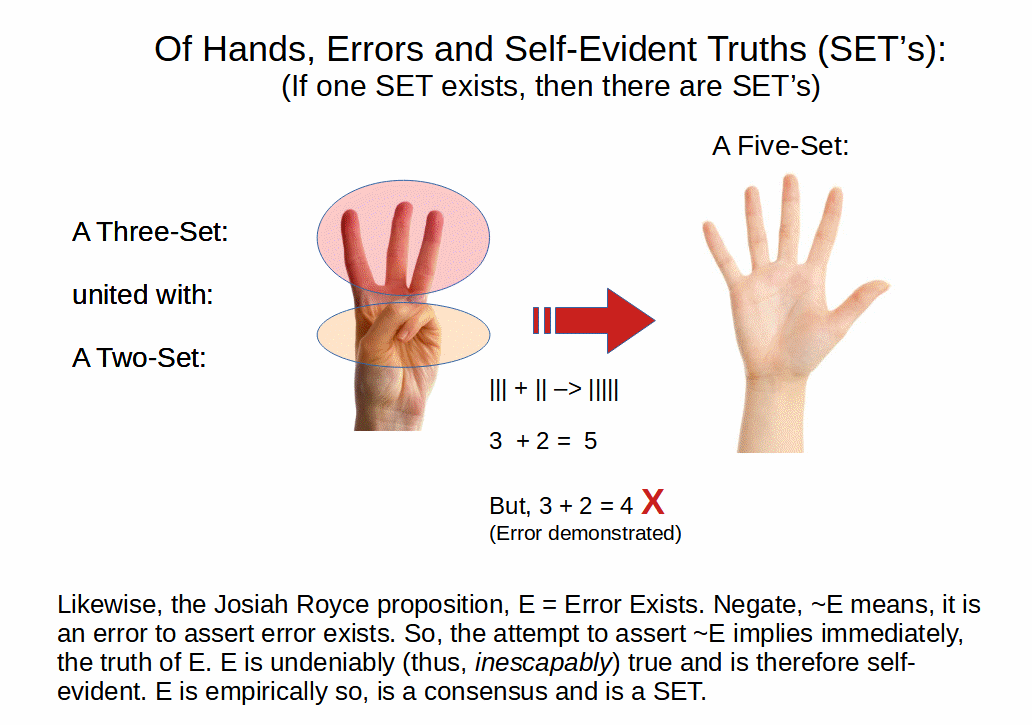
While self-evident truths cannot amount to enough to build a worldview, they can provide plumb line tests relevant to the reliability of warrant for what we accept as knowledge:

Such, of course, bring to the fore Ciceronian first duties of reason:

Marcus [in de Legibus, introductory remarks, C1 BC, being Cicero himself]: . . . we shall have to explain the true nature of moral justice, which is congenial and correspondent with the true nature of man [–> we are seeing the root vision of natural law, coeval with our humanity] . . . . “Law (say [“many learned men”]) is the highest reason, implanted in nature, which prescribes those things which ought to be done, and forbids the contrary” . . . . They therefore conceive that the voice of conscience is a law, that moral prudence is a law [–> a key remark] , whose operation is to urge us to good actions, and restrain us from evil ones . . . . the origin of justice is to be sought in the divine law of eternal and immutable morality. This indeed is the true energy of nature, the very soul and essence of wisdom, the test of virtue and vice.

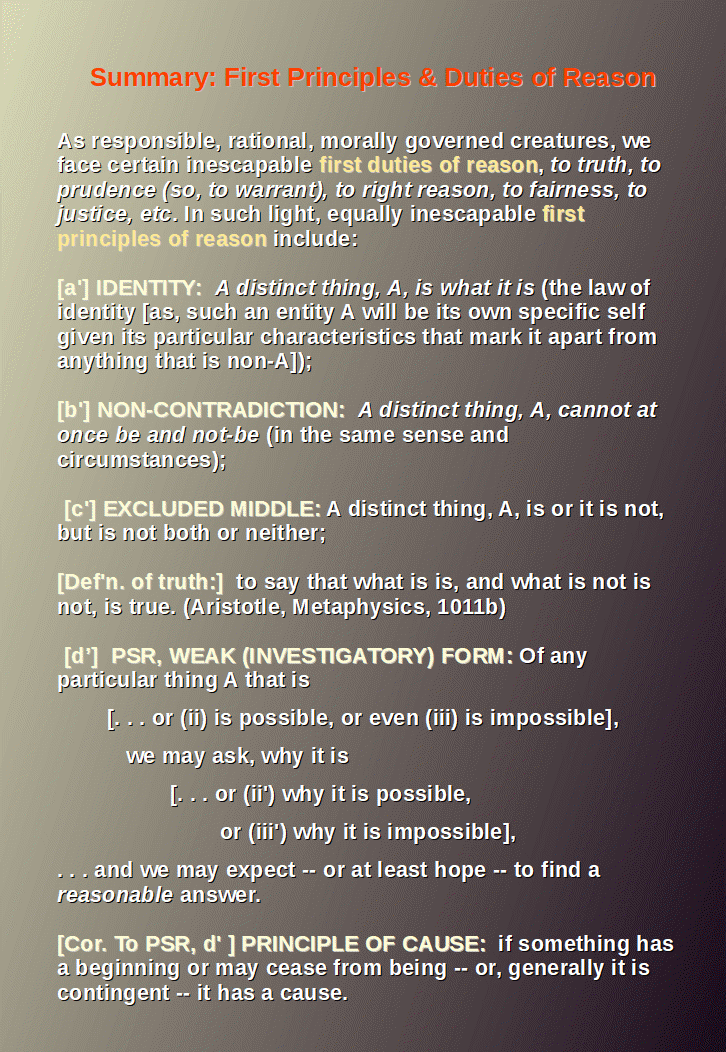
We may readily expand such first duties of reason: to truth, to right reason, to prudence, to sound conscience, to neighbour, so also to fairness and justice. Where, it may readily be seen that the would-be objector invariably appeals to the said duties. Does s/he object, false, or doubtfully so, or errors of reason, or failure to warrant, or unfairness or the like, alike, s/he appeals to the very same duties, collapsing in self-referentiality. So, instead, let us acknowledge that these are inescapable, true, self-evident.

It may help, too to bring out first principles of right reason, such as:
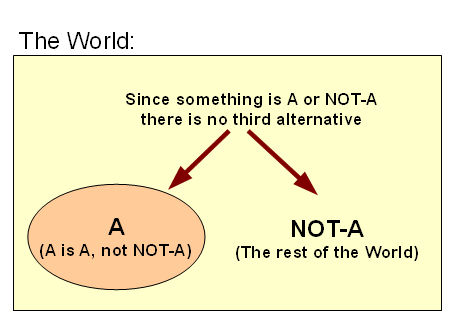
Laws of logic in action as glorified common-sense first principles of right reason

Expanding as a first list:

Such enable us to better use our senses and faculties to build knowledge. END

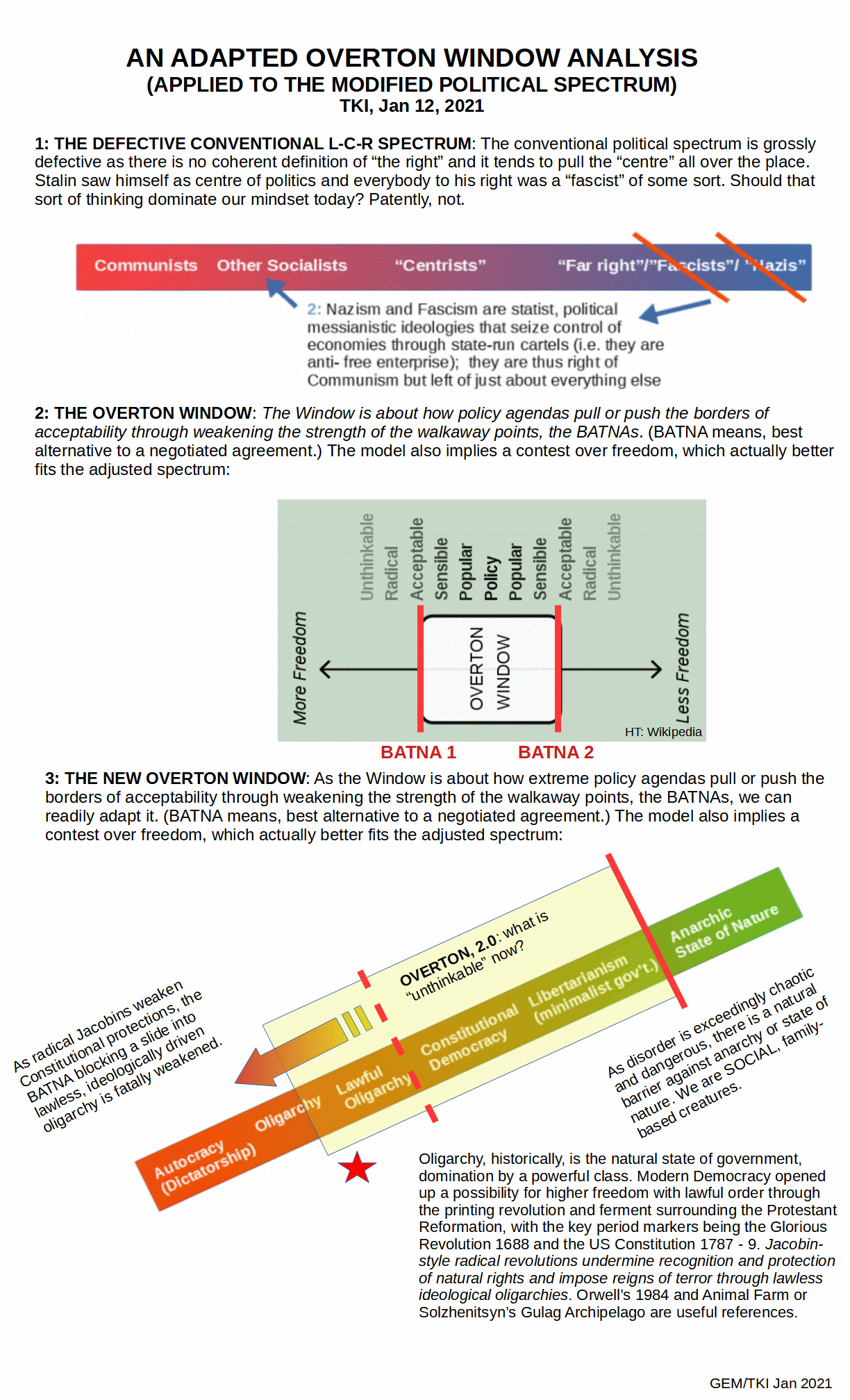
U/D May 16, regarding the Overton window, first, just an outline:
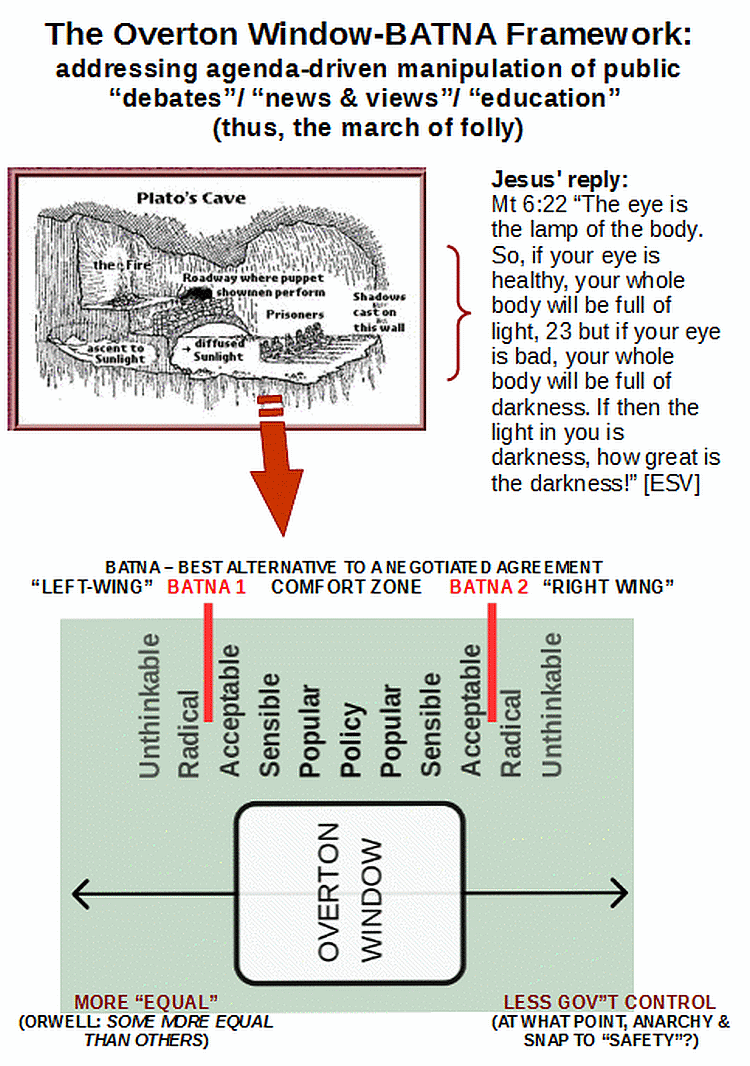
Next, as applied:
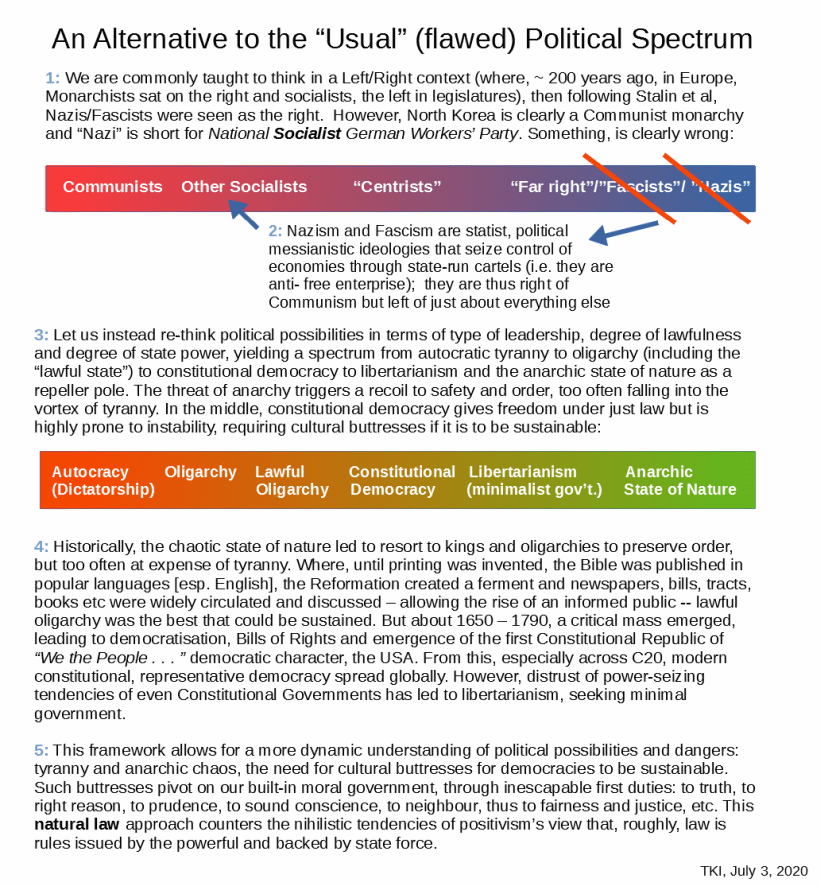
Backgrounder, on the political spectrum:
Comments
When I discuss issues with other people, I appeal to my expectations of them. Just because I am appealing to these expectations doesn’t mean that I am appealing to “duty” or “right reason”, whatever that means. If people don’t meet my expectations, I stop interacting with them. None of this means that these expectations (duties in KF speak) are inherent in to our existence. .paige
May 13, 2021
May
05
May
13
13
2021
01:43 PM
1
01
43
PM
PST
When I said, "He is claiming the duties flow inescapably from the root of reality," KF responded, at 127, "I have made NO SUCH CLAIM. As you should have known, had you actually paid attention to what was said."" Here is a quote from KF, identical to, or similar to, one he has posted many times:
The first duties, also, are a framework for understanding and articulating the corpus of built-in law of our morally governed nature, antecedent to civil laws and manifest our roots in the Supreme Law-giver, the inherently good, utterly wise and just creator-God, the necessary (so, eternal), maximally great being at the root of reality.
In short, our duties comes from God, at the root of reality. I think I have been paying attention! :-)Viola Lee
May 13, 2021
May
05
May
13
13
2021
01:02 PM
1
01
02
PM
PST
Paige, we mostly don't explicitly work out principles like this, they are worked on. If I doubt that your claim is true and think your reasoning is flawed, I will reject your claim without working through law of identity, corollaries, fallacies by name, cogency, probabilities etc. KFkairosfocus
May 13, 2021
May
05
May
13
13
2021
12:42 PM
12
12
42
PM
PST
But if we weren’t a gregarious animal, would we be doing this?
But we have a nature? Do all these duties flow from that nature? Do all these duties flow from the need to survive and flourish which are part of that nature? Isn’t the word “implicit” a more accurate description of something that is part of us, part of our nature? Now someone may say that is not part of their nature but if it was not part of most natures would such a species survive? I doubt it. Would then the person who said it was not a duty for themselves be a parasite?jerry
May 13, 2021
May
05
May
13
13
2021
12:30 PM
12
12
30
PM
PST
KM
I have specifically, repeatedly shown FROM YOUR OWN OBJECTIONS and those of others my point that even objectors cannot escape appealing to our own implicit recognition of the duties, to gain rhetorical traction for their arguments.
I find it very revealing that you use the word "implicit" rather than "explicit". Yes, we all interact with others under the "implicit" expectation that they will interact honestly and logically. Just because this is what we "expect" doesn't mean that this is what we always get. It is an expectation we have of others, not a duty. When we run into people who do not meet our expectations, we stop interacting with them. From the very early days of our children's lives we instil in them the importance of being honest in their interactions with others. We do this because, through experience, we know that being honest with others makes our existence in society much easier. But if we weren't a gregarious animal, would we be doing this?paige
May 13, 2021
May
05
May
13
13
2021
12:25 PM
12
12
25
PM
PST
You may think that he is getting away with this nonsense, but it doesn’t seem so to me.
it’s been going on for almost a year. My guess, a couple thousand comments. It’s a charade.jerry
May 13, 2021
May
05
May
13
13
2021
12:20 PM
12
12
20
PM
PST
SB
I think it is important to expose the irrational nature of this philosophy because its radical subjectivism is very similar to the ideology that drives the woke culture. UD is one of the few places where rational people can fight back without being canceled.
True. I just read an essay in New Oxford Review where the author points out a growing "Berkeleyism" among people who spend too much time on Twitter or social media and they begin to think that whatever happens on these places or is videoed on Youtube is "more real" than reality itself. Or that there is no reality at all - just their own thoughts.Silver Asiatic
May 13, 2021
May
05
May
13
13
2021
11:57 AM
11
11
57
AM
PST
KF You have done a long series on the value of the First Principles. So the Law of Identity is a foundation. There is being vs non-being. True assigns with being. False assigns with non-being. Irrationality is the claim that being is equivalent with non-being. Or that there is no objective value distinction between true and false.Silver Asiatic
May 13, 2021
May
05
May
13
13
2021
11:55 AM
11
11
55
AM
PST
Jerry: --- "And the circus goes on. Why should anyone answer anything from a person who does not care what truth is?" I think it is important to expose the irrational nature of this philosophy because its radical subjectivism is very similar to the ideology that drives the woke culture. UD is one of the few places where rational people can fight back without being canceled. When this ideology ("it's all about me and what I want" or "truth doesn't matter" or "truth is what I want it to be") is exposed for what it is, and when its illogical underpinnings are probed, there is a certain clearing of the air. It happens each time WJM dodges a question or cheats on the meaning of words. Observers who pay close attention to the interactions cannot help but notice what is going on. You may think that he is getting away with this nonsense, but it doesn't seem so to me. From my perspective, he has received several knock out blows that completely destroyed his credibility.StephenB
May 13, 2021
May
05
May
13
13
2021
11:43 AM
11
11
43
AM
PST
VL,
[122:] He is claiming the duties flow inescapably from the root of reality. That is very different than invoking the practical value to society.
I have made NO SUCH CLAIM. As you should have known, had you actually paid attention to what was said. My argument is far simpler, far more direct, the duties are naturally evident from the course of discussion, reflection and argument. I have specifically, repeatedly shown FROM YOUR OWN OBJECTIONS and those of others my point that even objectors cannot escape appealing to our own implicit recognition of the duties, to gain rhetorical traction for their arguments. For example in the clip just above YOU ASSERT THAT A CERTAIN STATE OF AFFAIRS IS THE CASE as a basis for appealing to your reasons for rejection, which you obviously commend to us, expecting us to acknowledge the force of truth and reason. In short, you could not but appeal to truth, reason and warrant as duties. (It so happens that your facts are false and erect a strawman caricature and your reasons amount to knocking over a strawman, but that is secondary. ) My argument is much like the demonstration of self-evidence of 3 + 2 = 5 in the OP. By direct, consistent inspection and a moment's reflection we can see how our actual reasoning, arguments, debates and even quarrels inevitably pivot on said duties. So, if inescapable, true and self-evident. Indeed they are antecedents of argument, the stuff from which we build arguments. They CANNOT be proved as proofs appeal to them, they cannot be disproved as the attempt implies their antecedence. So, we are forced to recognise first principles and duties. Yes, they are ALSO evidently the fabric of a reasonably functional society, as can be seen from say trying Kant's categorical imperative to truth vs lying. Lying parasites on the need for overwhelming truth telling for community to be viable. Were lying to become just a common occurrence, trust in verbal or symbolic communication would collapse and society with it. SA and Jerry have that point, but it is not self-evident. Inescapability is. As for issues tracing to root reality, you have dragged in a very different issue. Freedom implies moral government rather than mechanical-stochastic. A microprocessor is not freely rational, it simply grinds out outputs per chain of inputs and stored values. It is a mechanism, not a mind. We rationally infer, making real choices, which often face what ought to be done but needs not be done. The issue is this points to an IS-OUGHT gap, and the only level where such can be bridged, post Hume et al, is in the root of reality. That is, at a more complex level of argument than self-evidence [I skip over circular cause and infinite stepwise regress], we can set a bill of requisites to characterise the root of reality. It seems a pivotal problem is failure to grasp the concept of self-evidence. It is that certain truths are understood as true once we have a certain level of maturity, understood as necessarily true and that their denial manifests immediate absurdity. In this case, the attempted objector cannot but appeal to the first duties of reason s/he would deny. Just, to try to get rhetorical traction. But it is manifest that we are here confronting a deeply embedded error in the intellectual history of our civilisation. The obvious culprits are radical relativism, emotivism, subjectivism, hyperskepticism, evolutionary materialistic scientism and their fellow travellers. Currently leading the march of folly threatening to take us all over the cliff. KFkairosfocus
May 13, 2021
May
05
May
13
13
2021
11:39 AM
11
11
39
AM
PST
I got this from BA77 recently - the quickest and easiest way to prove that the value of truth is embedded in the nature of reality: It's the statement: "Error exists". That statement is objectively true - one cannot have a subjective answer to it (and remain coherent). Because it is an objective truth (just like Mt. Rushmore is objective), then our commitment to truth is part of our nature. It is a moral duty as part of rational human nature. The proof of this is that yes, it is possible to deny this statement "Error exists". Yes it is possible. Claimant: "The statement 'error exists' is false". Response: But you just proved error exists by saying the statement is false. Claimant: So what? (or Who cares? Or I can say whatever I want. Or it means something to me and it doesn't matter if you understand). In other words, people can choose to be irrational, but not totally. You cannot make a commitment to lie all of the time. Even doing that is the liar's paradox. "I will always tell a lie". Yes, a person can be insane and contradictory to a large extent and even choose to deny the truth - but it is impossible to affirm anything at all without placing a higher value on truth.Silver Asiatic
May 13, 2021
May
05
May
13
13
2021
11:36 AM
11
11
36
AM
PST
He is claiming the duties flow inescapably from the root of reality.
Are we into a definition war? What does “reality” mean? This brings back that famous question. “What does “is” mean?” Are we dealing with a distinction without a real difference here? It seems that what violates a stable society is a violation of a major reality.jerry
May 13, 2021
May
05
May
13
13
2021
10:54 AM
10
10
54
AM
PST
Those duties flow from the root of reality. We cannot deny them. The duty to truth is objective and necessary. If you could even deny those duties (which is logically impossible), you would be irrational and insane. Everything starts from the difference between truth and falsehood and our assent to the one and rejection of the other. You cannot affirm lies and falsehoods as the root of reality - it's affirming non-reality and non-existence. When a person makes an oath (in the USA we even may say we will keep the oath "so help me God" - so before the perfect justice of God) - they are swearing by something greater, to uphold the truth. But what happens if the person says they don't have a moral duty to the truth - they may tell a lie or not at any time? That's just arbitrary? Telling the truth is embedded in human nature as necessary for a logical understanding (denial of it is a denial of first principles and a sin against intellectual virtue).Silver Asiatic
May 13, 2021
May
05
May
13
13
2021
10:42 AM
10
10
42
AM
PST
first duties of reason: to truth, to right reason, to prudence, to sound conscience, to neighbour, so also to fairness and justice
The person who says "I reject those because I choose my own morals" is starting out with a lie. You can't reject the duty to truth or right reason and maintain a rational intellect. Statement: "I reject the duty to truth". Response: "Really? Do you mean that truthfully or are you lying?" You can't even make one affirmation without affirming the moral value of the truth. A person must be required, by duty, to affirm "I will strive always to speak truthfully and not to tell lies". Even also: "I will strive to learn and tell the truth to myself and uncover all the ways I may be deceiving myself with a lie --- and then correct it." I am afraid that a lot of people do not care if they tell themselves a lie - and they don't try to correct it. But that does not build up the person in the practice of goodness or virtue. We might not like the truth when we see it, but we have to try to conform our mind to it, to the best that we can. Or at least say that we're struggling to accept it and try to embrace it ultimately.Silver Asiatic
May 13, 2021
May
05
May
13
13
2021
10:39 AM
10
10
39
AM
PST
Jerry asks, "Which duty that Kf listed is not a duty for a stable society? " I believe that all the things that KF lists are beneficial for a stable society, and I consider a stable society a valuable good. But that is not what KF is claiming. He is claiming the duties flow inescapably from the root of reality. That is very different than invoking the practical value to society. This is one of the critiques that WJM has made: when pressed to support his claims, KF falls back on consequences, or practical benefits, or consensus among people, none of which actually establish the metaphysical point he claims to pertain.Viola Lee
May 13, 2021
May
05
May
13
13
2021
10:38 AM
10
10
38
AM
PST
WJM
What I care about is entirely how to best acquire experiences I enjoy. The only “truths” I care about are entirely about what I subjectively experience. I have unilaterally decided that this is all I care about.
What makes the experience something you enjoy is that you affirm and uphold the duty of truth. This begins with telling the truth to yourself. Then it moves to telling truth to other people. You want to be trusted - but that requires a commitment to the truth. In making affirmations, you are making truth statements, even if you only speak to yourself about them. You do not lie to yourself and you know that to do so would be wrong. Then speaking to others, why would anyone listen to what you have to say if you find moral equivalency between telling truth or telling lies. You explain your belief - but you could lie about it and then nobody would care.Silver Asiatic
May 13, 2021
May
05
May
13
13
2021
10:29 AM
10
10
29
AM
PST
But I think his criticism of KF’s “duty” argument are spot on..
Which duty that Kf listed is not a duty for a stable society? I believe his list came from Cicero. Here’s the list.
first duties of reason: to truth, to right reason, to prudence, to sound conscience, to neighbour, so also to fairness and justice
jerry
May 13, 2021
May
05
May
13
13
2021
10:26 AM
10
10
26
AM
PST
And the circus goes on. Why should anyone answer anything from a person who does not care what truth is? I could go and make up a false identity and generate nonsense remarks here and there would be hundreds if not thousand of comment trying to show that nonsense is nonsense. This has been going on for 6 months or so over various threads and there is no end in sight in trying to show that nonsense is nonsense. The person originating the nonsense knows exactly what he is doing. His anticipated expectations have probably far exceeded any he originally had. So who is the fool here?jerry
May 13, 2021
May
05
May
13
13
2021
10:00 AM
10
10
00
AM
PST
WJM: --- "First, I don’t care what “the truth” is in any objective sense. " So now, after evading my questions about morality on the grounds that the word "objective" means something "entirely different" for you than it does for me, you finally confess that you do, after all, know the ordinary meaning of the term.StephenB
May 13, 2021
May
05
May
13
13
2021
09:54 AM
9
09
54
AM
PST
The moral duty to truth is what we must observe in order to engage in a rational discourse with anyone. The person who denies this duty (as many do) make it impossible to be trusted. In fact, even before observing this duty to truth in conversation - the person has the moral duty to truth to himself. This is a necessary component for rationality. Denying this duty is to elevate irrationality and lies to the level of truth. The person who attempts such a thing is involved in a self-refuting exercise. Error exists. This is necessarily true. Therefore truth exists and we must affirm it, or else abandon rationality and reasonable discourse - and deny the value of human nature.Silver Asiatic
May 13, 2021
May
05
May
13
13
2021
09:39 AM
9
09
39
AM
PST
SB: --- "Do you agree that murder is objectively wrong? While you are at it, try this one: Is it ever morally permissible to torture babies for fun?" ---WJM: "The word “objective” means something entirely different in my worldview than it does in yours. In any event, the answers to those questions are irrelevant as to whether or not objective morality is self-evidently true." The meaning of objective in this context means the same for both of us. Rational dialogue is not possible when one of the participants will not provide an honest answer to an honest and fair question. "Do you agree that murder is objectively wrong? And yes, it has everything to do with the self-evident nature or morality. Apparently, It is so self-evident to you that you dare not share your true beliefs openly and honestly. SB: Why do you say that the consequences of subjective morality (might makes right) would be “undesirable?: ---WJM: "I meant that the might be undesirable to some, many or most, such as to you and KF." Once, again, you are evading the key point. Is there, in your judgment (or according to your world view), anything [objectively] wrong with the right-makes-right principle? (Please don't tell me that you don't know what objective means or that it means something different for you than it does for me.). If not, then why did you say it is undesirable when, in fact you don't believe that it is? Or, if you really think it is undesirable, as you originally stated, then why are you changing your story and shifting the undesirable element to KF and me,StephenB
May 13, 2021
May
05
May
13
13
2021
09:08 AM
9
09
08
AM
PST
I find WJM's theory interesting, but I don't believe it, and I certainly don't believe some of the consequences he described about a bunch of stuff. But I think his criticism of KF's "duty" argument are spot on..Viola Lee
May 13, 2021
May
05
May
13
13
2021
09:01 AM
9
09
01
AM
PST
Oh well, there is not really much left for me to say after that comment of yours
He doesn’t believe anything he says. Never has. He’s playing a game. He baiting people and they gladly open their mouths and swallow. And laughing each time they do.jerry
May 13, 2021
May
05
May
13
13
2021
07:56 AM
7
07
56
AM
PST
WJM, if there was a poll, I don't think you would like the results. Most Darwinists, who are notoriously wrong about practically every scientific thing that they comment on, have, from what I can tell, viewed your theory favorably, whereas most ID proponents, again from what I can tell, don't think much of your theory at all. It SHOULD be a huge red flag for you when Seversky, of all people, says that he likes your theory! :) And although I was initially sympathetic to your theory, you lost me when you, basically, said that empirical evidence is of little consequence to your theory. ,,, Oh well, there is not really much left for me to say after that comment of yours is there?bornagain77
May 13, 2021
May
05
May
13
13
2021
07:17 AM
7
07
17
AM
PST
"Did you take a poll of everyone who reads this forum?" WJM, No. I suspect I don't have to, to be right (in this case). Andrewasauber
May 13, 2021
May
05
May
13
13
2021
07:09 AM
7
07
09
AM
PST
Asauber said:
This is why most here consider you an unserious commenter.
Did you take a poll of everyone who reads this forum? Or was that an unserious comment without regard to objective truth? ; )William J Murray
May 13, 2021
May
05
May
13
13
2021
07:08 AM
7
07
08
AM
PST
My Two Cents on The Woke:
Here is a description of the woke by someone who lives amongst them but Is not one of them. It is an interview of John McWhorter by Freddy Sayers. These are two level headed people in most ways. https://unherd.com/thepost/john-mcwhorter-white-people-should-stand-up-to-antiracist-ideologues/?=frpo It’s about 35 minutes and mostly about race relations but spends a lot of time on wokeness since McWhorter teaches at Columbia. The main thing I disagree with McWhorter on is that he describes wokeness as a religion implying it’s an unfounded belief without justification. In other words like a superstition held despite contrary evidence. Otherwise very informative. I highly recommend following Sayers as he interviews people on a wide range of topics. Great quote by McWhorter
One of the oddest things is to see mathematicians and philosophers who’ve made their way through Plato, Kant and Kierkegaard, and then all of a sudden when they’re reasoning about Black Lives Matter, they exhibit the reasoning power of roughly an orangutan.”
Another great quote
You can’t engage people like that… There is nothing you can do to talk somebody out of a religion. There’s no conversation to be had, it’s worthless. Some of them will say they want to have a conversation with you. But what they want is for you to learn from them. If there’s anything that they have to learn from you, it’s that they want to learn what your mental barriers are to understanding their truth
jerry
May 13, 2021
May
05
May
13
13
2021
06:59 AM
6
06
59
AM
PST
"First, I don’t care what “the truth” is in any objective sense." WJM, This is why most here consider you an unserious commenter. Andrewasauber
May 13, 2021
May
05
May
13
13
2021
06:57 AM
6
06
57
AM
PST
Let me further explain how I am not operating under "duty" to truth. First, I don't care what "the truth" is in any objective sense. I don't know what I am, how things exist, or how experiences occur. That doesn't matter to me one bit. What I care about is entirely how to best acquire experiences I enjoy. The only "truths" I care about are entirely about what I subjectively experience. I have unilaterally decided that this is all I care about. In this forum, some years back, I made several arguments for objective morality that were so good that BA77 used to regularly quote from them. Do you think I made those arguments out of a duty to truth? I didn't even believe in objective morality at the time. I made them because I found them enjoyable and interesting to make, and because I enjoy exploring my own psychology around the idea of morality and how it relates to having enjoyable experiences, and also because it evoked responses I found interesting and useful. Am I arguing for IRT here because I think it is true and I have some kind of subconscious duty to argue for truth against what I consider to be errors of thought in others, even if I myself happen to be in error? Certainly not, because I don't care if IRT is true or not. It doesn't make me one bit of difference. I find that model very useful in pursuing what I subjectively enjoy. I find it enjoyable and interesting to argue, for the same reasons I argued for objective morality back in the day. This should not be a revelation to you because I have stated this before as the reason and motivations for my participation here. I'm not here out of duty to truth. I don't argue out of duty to truth, or out of duty to "justice" or "fairness" or "neighbor."William J Murray
May 13, 2021
May
05
May
13
13
2021
06:52 AM
6
06
52
AM
PST
KF said :
WJM, in your latest dismissal you again miss that you expect us to acknowledge duties of reason and justice etc, in order for your argument to have traction.
And this is exactly where you are mistaking your motivations and your interpretation for factual, universal commodities in everyone. I'm not expecting any such thing. What I hope is that someone will provide an interesting (or at least entertaining) response that I can use, one way or another, to refine my model of acquiring experiences I desire. I'm not relying on your "duties;" I'm relying on the interest you or others may have in my propositions and arguments. You are under no obligation or duty to pay any attention to me whatsoever, much less respond to anything I say. I am under no obligation or duty to read or respond to anything anyone here writes. I do it because I find it interesting, entertaining and occasionally very useful. Nothing more.
Indeed, without that government of built in law, the pivot of epistemology, seeking responsible knowledge given our proneness to error, evaporates. And meanwhile so self-evidently manifest a justice issue as the right to life seems to evaporate also. Those are red flags that something is seriously wrong. KF
Now you're just throwing the term "self-evident" around like it can be applied to anything you personally believe. However, I can see in your behavior how you are operating from a sense of duty; apparently, it is your "duty" to hand out lecture and chastisement pamphlets (or referrals to such) every time someone says something that you consider to be an error of thought or might lead to world-wide ruin. In fact, that you see these things as your necessary first duties explains a lot of your behavior here.William J Murray
May 13, 2021
May
05
May
13
13
2021
06:29 AM
6
06
29
AM
PST
1 … 38 39 40 41 42 … 44