Uncommon Descent Serving The Intelligent Design Community

L&FP42: is knowledge warranted, credibly true (so, reliable) belief?

Categories
Defending our Civilization
Epistemology
Logic and Reason
Share
Facebook
Twitter/X
LinkedIn
Flipboard
Print
Email

It’s time to start delivering on a promise to address “warrant, knowledge, logic and first duties of reason as a cluster,” even at risk of being thought pedantic. Our civilisation is going through a crisis of confidence, down to the roots. If it is to be restored, that is where we have to start, and in the face of rampant hyperskepticism, relativism, subjectivism, emotivism, outright nihilism and irrationality, we need to have confidence regarding knowledge.

Doing my penance, I suppose: these are key issues and so here I stand, in good conscience, I can do no other, God help me.

For a start, from the days of Plato, knowledge has classically been defined as “justified, true belief.” However, in 1963, the late Mr Gettier put the cat in among the pigeons, with Gettier counter-examples; which have since been multiplied. In effect, there are circumstances (and yes, sometimes seemingly contrived, but these are instructive thought exercises) in which someone or a circle may be justified to hold a belief but on taking a wider view such cannot reasonably be held to be a case of knowledge.

As a typical thought exercise, consider a circle of soldiers and sailors on some remote Pacific island, who are eagerly awaiting a tape of a championship match sent out by the usual morale units. They get it, play it and rejoice that team A has won over team B (and the few who thought otherwise have to cough up on their bets to the contrary). Unbeknownst to them, through clerical error, it was last year’s match, which had the same A vs B match-up and more or less the same outcome. They are justified — have a right — to believe, what they believe is so, but somehow the two fail to connect leading to accidental, not reliable arrival at truth.

Knowledge must be built of sterner stuff.

Ever since, epistemology as a discipline, has struggled to rebuild a solid consensus on what knowledge is.

Plantinga weighed in with a multi-volume study, championing warrant, which(as we just noted) is at first defined by bill of requisites. That is, we start with what it must do. So, warrant — this builds on the dictionary/legal/commercial sense of a reliable guarantee of performance “as advertised” — will be whatever reliably converts beliefs we have a right to into knowledge.

The challenge being, to fill in the blank, “Warrant is: __________ .”

Plantinga then summarises, in his third volume:

The question is as old as Plato’s Theaetetus: what is it that distinguishes knowledge from mere true belief? What further quality or quantity must a true belief have, if it is to constitute knowledge? This is one of the main questions of epistemology. (No doubt that is why it is called ‘theory of knowledge’.) Along with nearly all subsequent thinkers, Plato takes it for granted that knowledge is at least true belief: you know a proposition p only if you believe it, and only if it is true. [–> I would soften to credibly, true as we often use knowledge in that softer, defeat-able sense cf Science] But Plato goes on to point out that true belief, while necessary for knowledge, is clearly not sufficient: it is entirely possible to believe something that is true without knowing it . . .

[Skipping over internalism vs externalism, Gettier, blue vs grue or bleen etc etc] Suppose we use the term ‘warrant’ to denote that further quality or quantity (perhaps it comes in degrees), whatever precisely it may be, enough of which distinguishes knowledge from mere true belief. Then our question (the subject of W[arrant and] P[roper] F[unction]): what is warrant?

My suggestion (WPF, chapters 1 and 2) begins with the idea that a belief has warrant only if it is produced by cognitive faculties that are functioning properly, subject to no disorder or dysfunction—construed as including absence of impedance as well as pathology. The notion of proper function is fundamental to our central ways of thinking about knowledge. But that notion is inextricably bound with another: that of a design plan.37

Human beings and their organs are so constructed that there is a way they should work, a way they are supposed to work, a way they work when they work right; this is the way they work when there is no malfunction . . . We needn’t initially take the notions of design plan and way in which a thing is supposed to work to entail conscious design or purpose [–> design, often is naturally evident, e.g. eyes are to see and ears to hear, both, reasonably accurately] . . .

Accordingly, the first element in our conception of warrant (so I say) is that a belief has warrant for someone only if her faculties are functioning properly, are subject to no dysfunction, in producing that belief.39 But that’s not enough.

Many systems of your body, obviously, are designed to work in a certain kind of environment . . . . this is still not enough. It is clearly possible that a belief be produced by cognitive faculties that are functioning properly in an environment for which they were designed, but nonetheless lack warrant; the above two conditions are not sufficient. We think that the purpose or function of our belief-producing faculties is to furnish us with true (or verisimilitudinous) belief. As we saw above in connection with the F&M complaint [= Freud and Marx], however, it is clearly possible that the purpose or function of some belief-producing faculties or mechanisms is the production of beliefs with some other virtue—perhaps that of enabling us to get along in this cold, cruel, threatening world, or of enabling us to survive a dangerous situation or a life-threatening disease.

So we must add that the belief in question is produced by cognitive faculties such that the purpose of those faculties is that of producing true belief.

More exactly, we must add that the portion of the design plan governing the production of the belief in question is aimed at the production of true belief (rather than survival, or psychological comfort, or the possibility of loyalty, or something else) . . . .

[W]hat must be added is that the design plan in question is a good one, one that is successfully aimed at truth, one such that there is a high (objective) probability that a belief produced according to that plan will be true (or nearly true). Put in a nutshell, then, a belief has warrant for a person S only if that belief is produced in S by cognitive faculties functioning properly (subject to no dysfunction) in a cognitive environment [both macro and micro . . . ] that is appropriate for S’s kind of cognitive faculties, according to a design plan that is successfully aimed at truth. We must add, furthermore, that when a belief meets these conditions and does enjoy warrant, the degree of warrant it enjoys depends on the strength of the belief, the firmness with which S holds it. This is intended as an account of the central core of our concept of warrant; there is a penumbral area surrounding the central core where there are many analogical extensions of that central core; and beyond the penumbral area, still another belt of vagueness and imprecision, a host of possible cases and circumstances where there is really no answer to the question whether a given case is or isn’t a case of warrant.41 [Warranted Christian Belief (NY/Oxford: OUP, 2000), pp 153 ff. See onward, Warrant, the Current Debate and Warrant and Proper Function; also, by Plantinga.]

So, we may profitably distinguish [a] Plantinga’s specification (bill of requisites) for warrant and [b] his theory of warrant. The latter, being (for the hard core):

a belief has warrant for a person S only if that belief is produced in S by cognitive faculties functioning properly (subject to no dysfunction) in a cognitive environment [both macro and micro . . . ] that is appropriate for S’s kind of cognitive faculties, according to a design plan that is successfully aimed at truth.

Obviously, warrant comes in degrees, which is just what we need to have. Certain things are known to utterly unchangeable certainty, others are to moral certainty, others for good reason are held to be reasonably reliable though not certain enough to trust when the stakes are high, other things are in doubt as to whether they are knowledge, some things outright fail any responsible test.

That’s why I have taken up and commend a modified form, recognising that what we think is credibly, reliably true today may oftentimes be corrected for cause tomorrow. (Back in High School Chemistry class, I used to imagine a courier arriving at the door to deliver the latest updates to our teacher.)

Yes, I accept that many knowledge claims are defeat-able, so open-ended and provisional.

Indeed, that is part of what distinguishes the prudence and fair-mindedness of sober knowledge claims hard won and held or even stoutly defended in the face of uncertainty and challenge from the false certitude of blind ideologies. Especially, where deductive logical schemes can have no stronger warrant than their underlying axioms and assumptions and where inductive warrant provides support, not utterly certain, incorrigible, absolute demonstration.

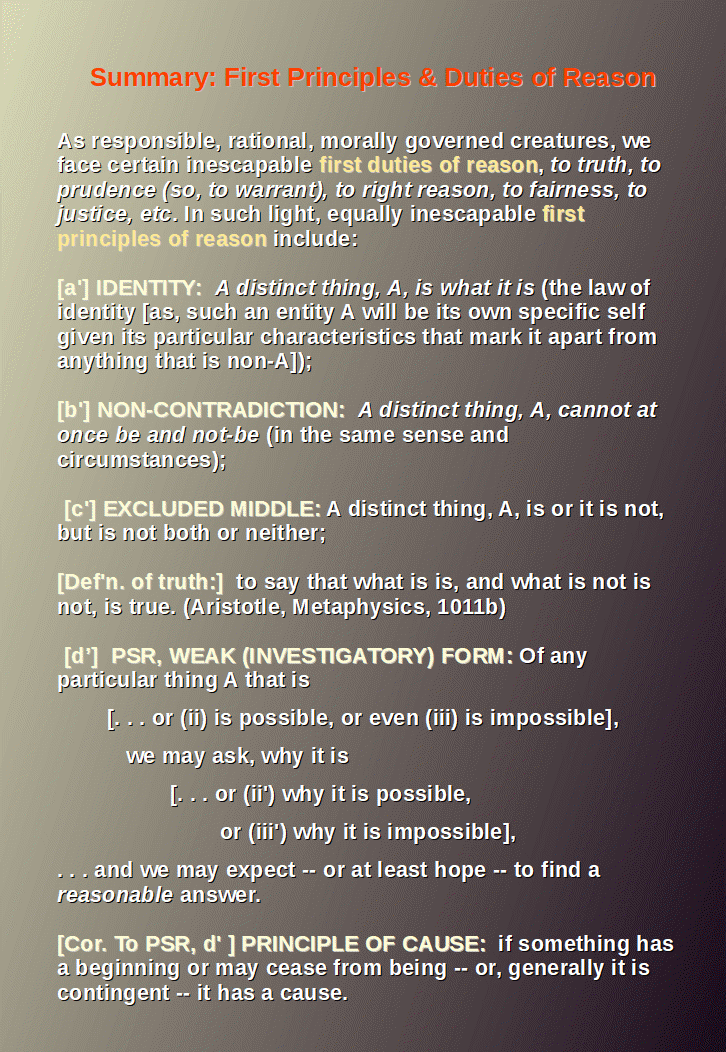
That said, we must recognise that some few things are self-evident, e.g.:
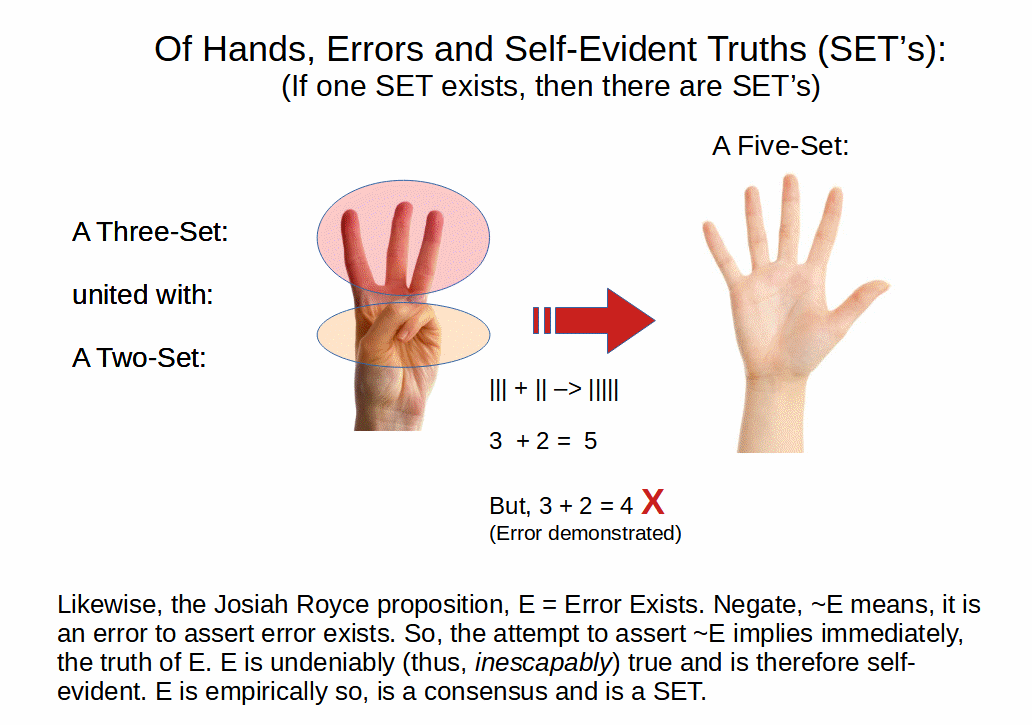
While self-evident truths cannot amount to enough to build a worldview, they can provide plumb line tests relevant to the reliability of warrant for what we accept as knowledge:

Such, of course, bring to the fore Ciceronian first duties of reason:

Marcus [in de Legibus, introductory remarks, C1 BC, being Cicero himself]: . . . we shall have to explain the true nature of moral justice, which is congenial and correspondent with the true nature of man [–> we are seeing the root vision of natural law, coeval with our humanity] . . . . “Law (say [“many learned men”]) is the highest reason, implanted in nature, which prescribes those things which ought to be done, and forbids the contrary” . . . . They therefore conceive that the voice of conscience is a law, that moral prudence is a law [–> a key remark] , whose operation is to urge us to good actions, and restrain us from evil ones . . . . the origin of justice is to be sought in the divine law of eternal and immutable morality. This indeed is the true energy of nature, the very soul and essence of wisdom, the test of virtue and vice.

We may readily expand such first duties of reason: to truth, to right reason, to prudence, to sound conscience, to neighbour, so also to fairness and justice. Where, it may readily be seen that the would-be objector invariably appeals to the said duties. Does s/he object, false, or doubtfully so, or errors of reason, or failure to warrant, or unfairness or the like, alike, s/he appeals to the very same duties, collapsing in self-referentiality. So, instead, let us acknowledge that these are inescapable, true, self-evident.

It may help, too to bring out first principles of right reason, such as:
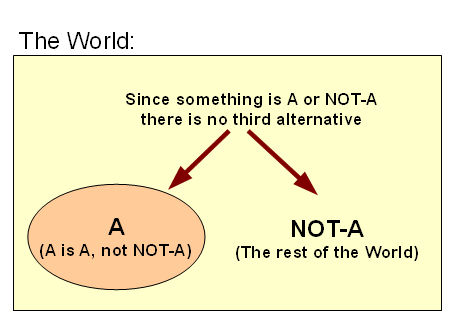
Laws of logic in action as glorified common-sense first principles of right reason

Expanding as a first list:

Such enable us to better use our senses and faculties to build knowledge. END

U/D May 16, regarding the Overton window, first, just an outline:
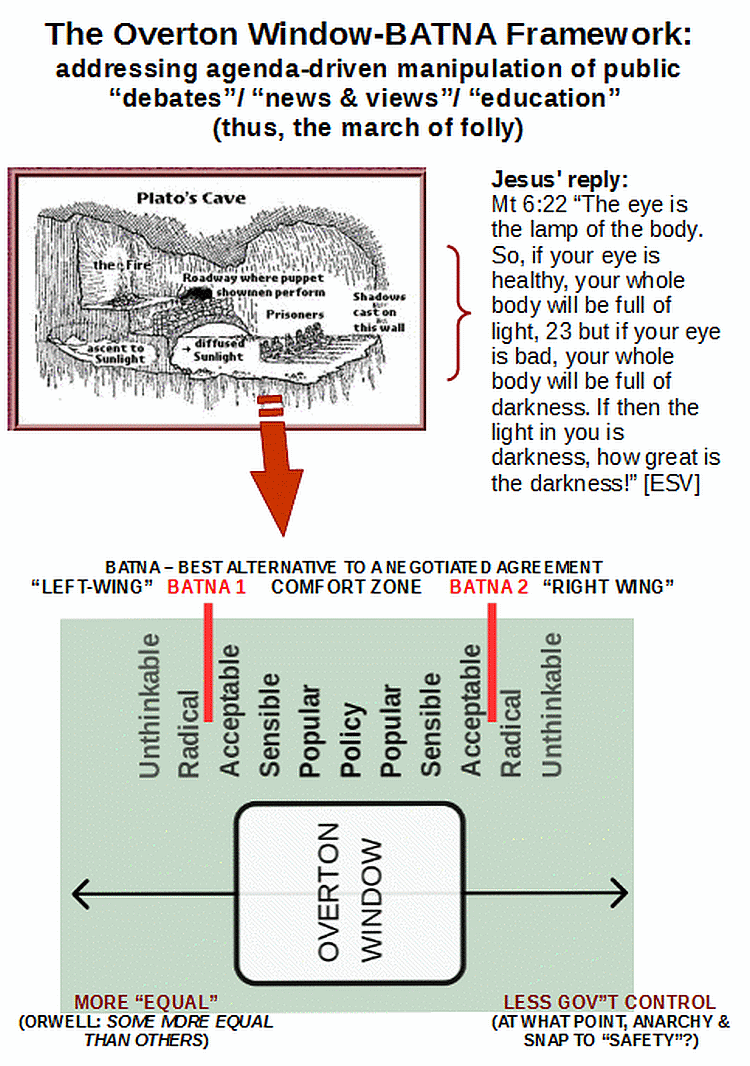
Next, as applied:
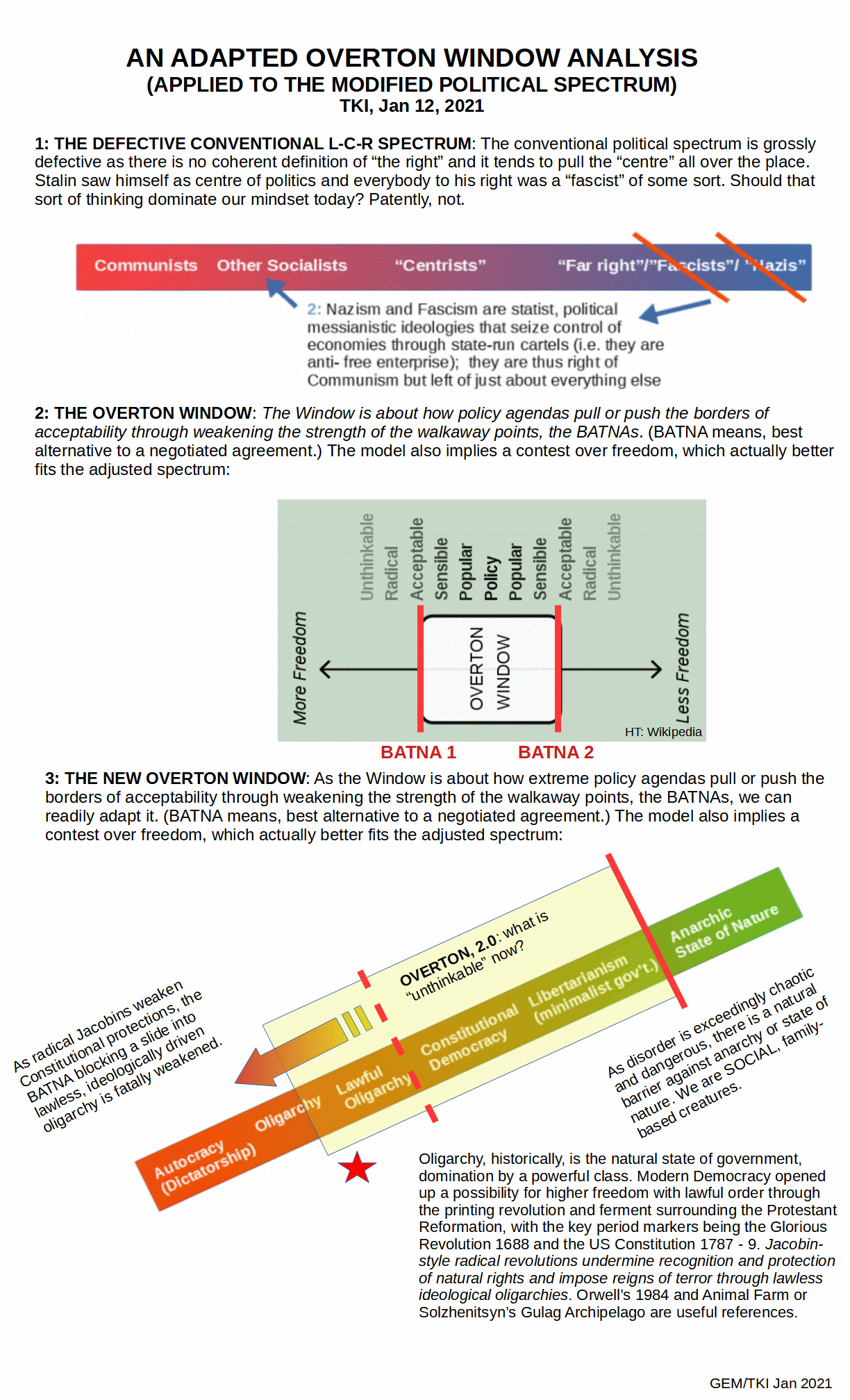
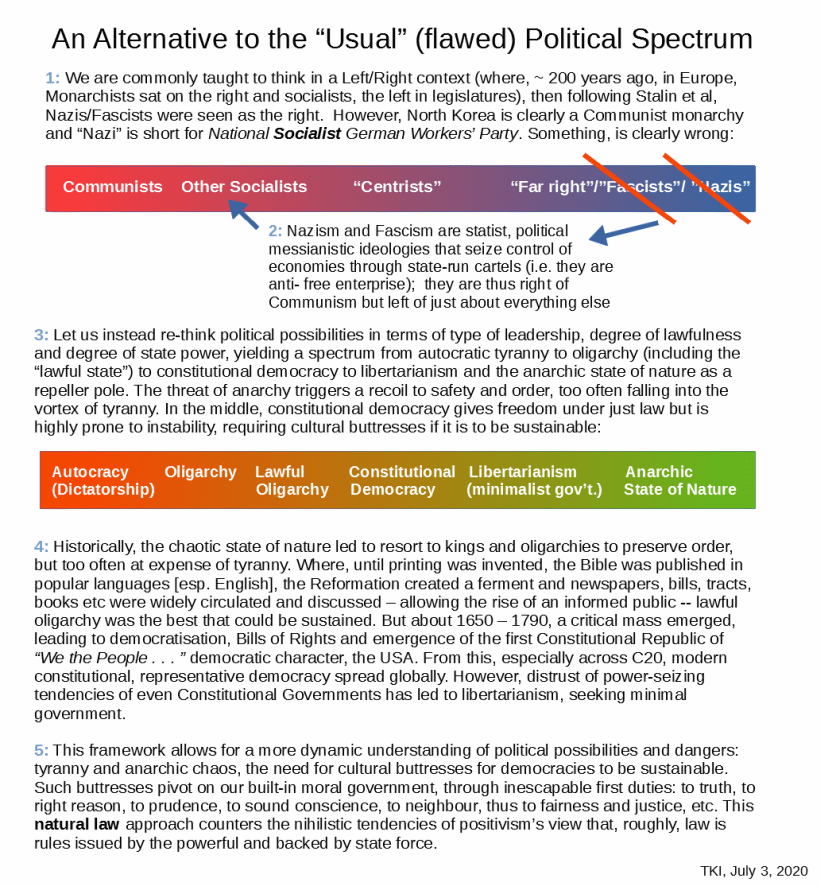
Backgrounder, on the political spectrum:
Comments
So the interpretation gets better and better.
There is no "the" interpretation. People interpret facts in a wide variety of ways. Have you met people? Also, a "better" interpretation (whatever "better" might mean to an individual) is still just an interpretation; KF is claiming that "what the facts" necessary (thus, factually) imply is a moral duty. But, he has yet to make that case; he just keeps repeating that the facts necessarily imply it. So, until he can make that case, then it is my view that he is mistaking his interpretation for a fact.William J Murray
May 12, 2021
May
05
May
12
12
2021
07:24 AM
7
07
24
AM
PST
I’m also in marketing, been in it for almost 30 years.
Is this in the external world?
mistaking your interpretation of the facts for a fact itself.
Since the beginning of time, experiences have been compared with other’s experiences of the same facts. So the interpretation gets better and better. That the difference between opinions often based on emotions and justified true beliefs. So as usual the claim is spurious.jerry
May 12, 2021
May
05
May
12
12
2021
07:19 AM
7
07
19
AM
PST
The only way to make the case that my arguments, truth referrals and truth claims indicate a moral duty whether I agree or not, like if someone argues against free will, is to establish that those arguments, truth claims and referrals are necessarily moral in nature or else they are absurd. IOW, it would be something along the lines of this: "your claims and referrals to true statements and facts are absurd unless you are making them out of obedience (conscious or subconscious ) to moral duty, because ..." Unless the person arguing against free will has free will, his argument is rendered absurd because he has no way of knowing if his argument is valid. So, if I am doing a similar thing with truth claims and referrals, how is my argument absurd if absent any "moral duty" component?William J Murray
May 12, 2021
May
05
May
12
12
2021
06:52 AM
6
06
52
AM
PST
Hey Jerry & KF: I'm also in marketing, been in it for almost 30 years. Here's the succinct pitch that demolishes KF's entire argument: Existential unavoidables do not a duty make because you can't get an ought from an "is," much less an unavoidable "is." The conversational/debate content/format necessary to say coherent things, including claims of truth and pattern of reference to truths do not in and of themselves indicate a moral duty to do so. So, your claim that what you are interpreting is "manifestly there" cannot in fact be the case. You are - once again - mistaking your interpretation of the facts for a fact itself.William J Murray
May 12, 2021
May
05
May
12
12
2021
06:40 AM
6
06
40
AM
PST
This is about warrant, not ad slogans and impressions; which, are the very opposite of warrant.
No, you are wrong. Nobody is reading your long contrived explanations. So how can they be about warrant? They can only become effective when they are reduced to short relevant sentences or examples. Then they become useful. In my example, the ultimate warrant was the squeezing of the product. Another example, a preacher was going on and on and nobody could remember what was said two sentences before. Then, after 25 minutes of who knows what, he said his mother told him, “Andrew you are always circling but never landing.” A member of the congregation leaned over to his wife and said, “He finally said something I will remember.”jerry
May 12, 2021
May
05
May
12
12
2021
06:08 AM
6
06
08
AM
PST
Jerry, I can afford to be brief now because I have already made the substantial case. This is about warrant, not ad slogans and impressions; which, are the very opposite of warrant. KFkairosfocus
May 12, 2021
May
05
May
12
12
2021
05:33 AM
5
05
33
AM
PST
Kf, I have a background in advertising at the highest levels. I personally was not of any importance but worked for three of the largest advertising agencies in the world (New York City) and my wife worked for another. The emphasis was on succinct and focused communication. The best philosophy I ever saw developed implementing this objective was called the selling idea/selling proposition structure. The selling idea was a very short story/example demonstrating the usefulness of the product (warrant) and the selling proposition was a short saying/visual/sound/ that communicated this selling idea. The agency at the time held up the best example ever of this structure which was a commercial no longer used because it was no longer needed. It was for Charmin toilet tissue. Charmin when it was introduced a long time ago was a technological breakthrough. It was based on an innovative paper making process that made softer paper than anything else but no more expensive. So how to communicate this softness. The selling idea was to have an eccentric store manager preventing the shoppers from squeezing the product. The selling proposition was “Please don’t squeeze the Charmin” which communicated the softness. Within in one year over 90% of supermarket shoppers had secretly squeezed Charmin and by years end was the number one brand in the US. This format can be used in any context whether it’s advertising, homilies, political campaigns, world-views or any thing that requires quick communication. It’s rarely used because it requires effort to come up with both parts. But the model of short to the point and clear communication will always win if the idea/product is demonstrably better. In the US everyone knows what MAGA means and many love it while others detest it. But they all know what it means.jerry
May 12, 2021
May
05
May
12
12
2021
05:08 AM
5
05
08
AM
PST
Kf, You are getting there. Use their words against them to show contradiction but do it briefly. Claiming they are using the traditional worldview to justify their perverted one without a few short clear examples does nothing. It has to be few, clear and short or otherwise it has no effect. On another site I described the perverted worldview expressed here as parasitic. Yes, you can profess it but only if others don’t and they use right reasoning, prudence, fairness, justice etc. So the world of one’s personal preferences can only exist if other’s worldviews are different than this one. In other words this worldview can only be professed and acted on if there are grownups around to ensure this spoiled child doesn’t get crushed. Another contradiction. It’s an admission of an inferior worldview held. Which is why it is not really held but BS professed just to generate pixels.jerry
May 12, 2021
May
05
May
12
12
2021
04:11 AM
4
04
11
AM
PST
WJM, nope, it's what I see because it is manifestly there. Let's roll tape on your latest objection: >>That’s what you see>> - projection of inappropriate bias on my part, implying that I have erred, which is to be avoided . . . and implying I should know and do better - appeals to duty to truth and to right reason, also, warrant (an aspect of prudence) >> because of>> - appeals to cause leading to logical error, with similar strictures - again, same cluster of duties >>your worldview, your psychological commitments.>> - appeal to truth by implicit projection or probably culpable error on my part - same cluster of duties, again >> I don’t share that worldview or those commitments.>> - appeal to fairness, as in how dare you try to impose - of course, the comments here show the objective force of my long since noted point on first duties of reason: objectors are forced to appeal to what they would overthrow, showing inescapability, thus truth and self evidence KFkairosfocus
May 12, 2021
May
05
May
12
12
2021
03:46 AM
3
03
46
AM
PST
KF said:
WJM, do you not see your appeals to duties to say truth and right reason when you argue like:
That's what you see because of your worldview, your psychological commitments. I don't share that worldview or those commitments.William J Murray
May 12, 2021
May
05
May
12
12
2021
02:55 AM
2
02
55
AM
PST
a Thing existing continuously since first human walked on Earth: hierarchy of values. Every human have that hierarchy .What differ is type of values that are placed inside that hierarchy. There is the top of hierarchy where reign only one thought: God, ego,pleasure, love ,etc.Sandy
May 12, 2021
May
05
May
12
12
2021
02:36 AM
2
02
36
AM
PST
SB @57 asks:
If I say that there “really are” such things as human dignity, justice, goodness, right and wrong, I mean that all those values rise to the level of objective reality and exist as elements of a moral universe.. In what way would those same words (“really are”) mean something different for you?
I would mean that all those values rise to the level of experiential reality and exist as elements of a moral experience. KF said:
WJM, do you not see your appeals to duties to say truth and right reason when you argue like:
Was that a rhetorical question? ;)William J Murray
May 12, 2021
May
05
May
12
12
2021
02:21 AM
2
02
21
AM
PST
WJM, do you not see your appeals to duties to say truth and right reason when you argue like:
[31:] The idea of “moral duty” is about a an ought that is it’s own is as an ought. Oughts are only oughts if one can do what they ought not; it requires that context. That we must think, at least fundamentally, according to the basic rules of logic, is not an ought because it doesn’t provide any options. An ought can only exist in the context of existent, recognized and available actionable options. The use of fundamental logical principles does not have such a context. There is no other option to even have a single coherent thought. Math provides no alternative to 2+2=4, just as logic provides no option to A=A. There are no inherent choices available. They do not exist as “oughts.”
Perhaps, too, you have missed a key difference between the GIGO-limited, input-process-output causal patterns of computation on a substrate and the freedom of action required for rational inference. One must be free to recognise and acknowledge a valid inference (much less, make a subtle prudential judgement), one is not merely playing out one's programming. The latter is no better than the bugs, noise, glitches etc involved and is inherently non-rational. There is nothing free about the action of NAND, NOR or X-OR gates, imagine a bipolar npn transistor in an inverter ckt with two input resistors, pull up either input and the BJT goes to the on saturated state issuing a low output voltage, effecting the NOR logic. Similarly, a D-latch is fixed in its storage behaviour, Yes an RS flipflop has hazard states with in the abstract mathematics an oscillatory action, but in the real world a latching that is uncontrolled. JK flipflops deliberately load the latching action so this becomes controlled. From such, digital computers are constructed and have no more freedom of action than a falling rock that acts as its support is removed. Freedom is involved in reasoning, including the reasoning and prudential judgement involved in evaluating degree of warrant for a serious knowledge claim. Even self-evident truths can be distorted or rejected. What is 2 + 2 Mr Smith is a satire of a very real issue of oppressive, police state, lawless ideological oligarchies. Indeed, signs of 1984 are increasingly manifest in our headlines, not least when we are "invited" or "encouraged" to follow the science, i.e. the latest power elite narrative dressed up in a lab coat. We "must" -- actually, OUGHT -- to think in light of the first principles of logic. Sometimes, we simply err in that regard, other times we willfully flout such. It is entirely possible to see people looking at a duly suspended plumb line and denying its message that a particular preferred yardstick is crooked thus not a proper standard of straightness, accuracy or uprightness. We are free, including in reasoning, especially once we move beyond common sense thinking. Indeed, it is quite clear that many have been indoctrinated to doubt, dispute or contend against core principles such as the two corollaries of distinct identity: non contradiction and excluded middle. And yet as the illustration in the OP shows, the principles are trivially plain and undeniable. Just to type out a comment, we rely on said principles, starting with distinct identity. When we move beyond to even weak form sufficient reason [gateway to logic of being] things get worse and many have been indoctrinated to doubt cause-effect bonds. Don't even mention that strange beast, a necessary being. I think most of us can understand why a square circle cannot exist however I recall a TV programme with more or less that title. All of these are deeply involved in recognising knowledge and particularly warrant. When it comes to first duties, it would be amusing to see how blind we are to the implicit appeals to duty in our argument, but then it is so manifestly sad. We need to pause and ponder why we seem to imagine that the concept of oughtness . . . a direct corollary of freedom . . . is seen as a trammelling of doing as we please. But, that would require acknowledging the difference between responsible liberty expressing the civil peace of justice and nihilistic, chaotic licence. KFkairosfocus
May 11, 2021
May
05
May
11
11
2021
11:25 PM
11
11
25
PM
PST
KM, is the substance of mathematics objective in the same sense as Mt Rushmore? Is the information or meaningfulness of strings of symbols such as those in your comment? Do you not see that we have those who doubt the world we perceive through the five senses plus common sense? Objectivity has to do with warrant, not with mere intersubjective agreement, which can be in error. Where, if you look at your comment just now you will see how many times you make or imply claims of truth or mutually known facts, which are to be acknowledged. Further, you appeal to reason to gain rhetorical traction towards your conclusions. Implicit in speaking of sociopaths is the recognition that they are morally damaged persons, and BTW one of the reasons we do not put a tiger on trial for murder is that it is operating on instinct not rational, responsible freedom. Of course, a tiger that gets a taste for human prey is put down, itself a recognition of something in the human being that is beyond the merely animal-instinctual, conditioned etc. KF PS: I see you again assert various religious ideas and issues. I have noted and explained why UD is not a theology forum, and have pointed out that there are such fora out there. Consider, kindly, why you feel urged to drag in involved theological-historical debates in a context where they are not appropriate. And no, there is not a door opening. There is a difference between issues of warrant connected to origins science, associated worldviews and critical analysis issues and dragging discussion off track into evil Bible style debates etc. Something that is massively evident. There are fora for such debates, you are directed there to address issues to duly qualified experts who have the time, energy and focus to entertain such involved matters at due length. Here, there is a place for personal views, for correctives or rebalancing and the like, but not for derailing focal discussion, a difference manifest to those of reasonable experience. So, again, no. This thread -- for cause -- is about knowledge in the post Gettier world, in further light of impacts of radical relativism, not about details of Bible issues or other tangential matters. If we . . . as a civilisation . . . don't get the difference between warranted knowledge and subjective opinion straight, no further progress is possible on literally anything. Civilisation will come down to the nihilism of force or fraud, which is fatal. That is how important the particular focus of this thread is.kairosfocus
May 11, 2021
May
05
May
11
11
2021
10:45 PM
10
10
45
PM
PST
And for those (KF) who want to run to some "out of bounds" defense that this is not an apologetics website, hey, you opened the door. You do it literally every day. You cannot divorce your morality from your theology. Let me say that again... You cannot divorce your morality from your theology. All is fair. Or go ahead like a coward and run home with your football. I implore you and your ilk to be men and stop pretending like you have some superior morality while completely ignoring the foundation of your worldview, as if it's irrelevant and.... sacrosanct. (P.S. for the new readers: I'm neither a "materialist" nor an "atheist.")Karen McMannus
May 11, 2021
May
05
May
11
11
2021
10:28 PM
10
10
28
PM
PST
Paige, this is not a sez who issue. A right exists in the context of the civil peace of justice, the due balance of rights, freedoms and responsibilities or duties. So, your right to life implies my duty to regard and protect or uphold that life, e.g. by refraining from drunk driving or shooting a weapon carelessly etc. Similarly, I have a duty to your honestly acquired property, not to cheat or defraud you out of it or rob you of it, fraud implying deceit or lying. If you are a woman, I have a further duty to respect the significance of that femininity, e.g. rape is a deep violation of the person. And so forth. That is, rights are binding moral claims to be regarded in particular ways due to being a human being, a rationally, responsibly free thus morally governed creature free to understand and act in accord with ought . . . thus, necessarily, to do the opposite were one so inclined. Thus, moral education rooted in first principles, truths and duties is a necessary component of sound, sustainable civilisation. Where, clearly, such key rights are intelligible based on self evident first duties, rendering them due subjects for education -- precisely what our decaying civilisation is failing to acknowledge and act on. For further example, I cannot justly have a claim to a right that forces you to do wrong or lie or harm or otherwise uphold me in evil; e.g. to compel you to uphold me in claimed or implied racial superiority. Rights are rooted in justice and carry with them correlative mutual duties. The irretrievable incoherence of what you have been conditioned to believe is patent. KFkairosfocus
May 11, 2021
May
05
May
11
11
2021
10:25 PM
10
10
25
PM
PST
Now for a sidebar: for those nincompoops (like Seversky,, sorry, but yeah, I think s/he is an intellectual worm driven by emotion), who think ID is some sort of "religious" conspiracy against "science", well, it ain't. This should be obvious by now to anyone with half a brain.Karen McMannus
May 11, 2021
May
05
May
11
11
2021
10:08 PM
10
10
08
PM
PST
StephenB: I think your experiential model is unduly self-centered and individualistic. Says the guy who is using his own brain to make judgements about anything and everything. The irony. The "unduly" part is particularly humorous. The gods must be laughing until they cry.Karen McMannus
May 11, 2021
May
05
May
11
11
2021
09:11 PM
9
09
11
PM
PST
StephenB: If I say that there “really are” such things as human dignity, justice, goodness, right and wrong, I mean that all those values rise to the level of objective reality and exist as elements of a moral universe.. Um, but it isn't "objective", in the sense that Mount Rushmore is objective. At best it's consensus, which is not nor ever has been a yardstick of Truth. About 5% of the population are "sociopaths" who wouldn't understand what you're talking about. Which demonstrates that whatever your views are regarding human dignity and all that, happen to be the way your brain is programmed. And brains can be programmed in all manner of ways. Just talk to a hungry tiger who wants to eat you. Or a hungry sociopathic human who wants to eat you. Now, you could say the creator programmed most humans to have certain values, and I might agree. But they are not "objective" or "real" in any metaphysically absolute way. One wonders why the creator programmed so many sociopaths to not understand or care about the values of the rest of its creations. Point is: it's arbitrary, and even if you believe in a creator, it doesn't prove anything about what values are "true" in an absolute sense. Remember, the God of the Old Testament had no problem with Israelites killing babies. (Yeah, I know this will trigger the Big Dogs here. Too bad.) Now, I couldn't care less about Old Testament historiography. I think it's all fiction. I don't think Israelites actually ran swords though the chests of Canaanite babies and children. The point is: the fact that you believe it's true, and accept it is good, proves that your vaunted concern about human dignity is a load of hogwash.Karen McMannus
May 11, 2021
May
05
May
11
11
2021
07:45 PM
7
07
45
PM
PST
WJM --- "I guess that depends on what you mean by “really are.” I think that phrase means one thing to you, and an entirely different thing to me." If I say that there "really are" such things as human dignity, justice, goodness, right and wrong, I mean that all those values rise to the level of objective reality and exist as elements of a moral universe.. In what way would those same words ("really are") mean something different for you?StephenB
May 11, 2021
May
05
May
11
11
2021
07:38 PM
7
07
38
PM
PST
SB said:
The concepts of morality and rights come from the recognition that there really are such things as human dignity, justice, goodness, right and wrong.
I guess that depends on what you mean by "really are." I think that phrase means one thing to you, and an entirely different thing to me.William J Murray
May 11, 2021
May
05
May
11
11
2021
07:16 PM
7
07
16
PM
PST
StephenB
Let’s follow up on your standard. If the people that you want to associate with expected you to lie, cheat, steal, slander, and murder, would you then feel free to do those things, assuming of course, that there would be no legal or social price to pay.
Personally, I would look for others I want to associate with. Isn’t that what we see playing out on these very threads? Commenters tend to coalesce around others who share similar moral expectations and distance themselves form those who differ.paige
May 11, 2021
May
05
May
11
11
2021
07:16 PM
7
07
16
PM
PST
SB said:
I was referring to the specific psychological goal implied by Plato’s chariot allegory whereby the intellectual faculty of the soul “ought to” rule the other faculties.
Well, I hope that worked for Plato.William J Murray
May 11, 2021
May
05
May
11
11
2021
07:11 PM
7
07
11
PM
PST
WJM --- "The concepts of morality and rights are essentially a form of psychological conditioning, IMO. I’m not saying that’s a “bad thing.” They provide the context for a whole array of experiences that would not be available unless one believes in those things. Any experience requires psychological conditions, beliefs, subconscious programming." The concepts of morality and rights come from the recognition that there really are such things as human dignity, justice, goodness, right and wrong. To be more specific, the rights of individual persons, especially those that were once said to be "unalienable," flow from their dignity as human persons.StephenB
May 11, 2021
May
05
May
11
11
2021
07:08 PM
7
07
08
PM
PST
WJM: -- "The trick is to understand you can reprogram your psychology to have the experience you want in any given situation. You can also have different psychological sets available to use in different situations. That can make life really, really fun.?" There is another way of understanding this dynamic. A man who refuses to conform his behavior to the objective moral standard will soon find a subjective moral standard that conforms to his behavior.StephenB
May 11, 2021
May
05
May
11
11
2021
06:44 PM
6
06
44
PM
PST
SB: However, there are certain moral commitments that must be present in order to realize this psychological goal. WJM: -- "That may be your experience; it is not mine. I’m at my psychological goal and have been for years now with zero moral commitments." I was referring to the specific psychological goal implied by Plato's chariot allegory whereby the intellectual faculty of the soul "ought to" rule the other, less noble, faculties.StephenB
May 11, 2021
May
05
May
11
11
2021
06:27 PM
6
06
27
PM
PST
The concepts of morality and rights are essentially a form of psychological conditioning, IMO. I'm not saying that's a "bad thing." They provide the context for a whole array of experiences that would not be available unless one believes in those things. Any experience requires psychological conditions, beliefs, subconscious programming. The trick is to understand you can reprogram your psychology to have the experience you want in any given situation. You can also have different psychological sets available to use in different situations. That can make life really, really fun.William J Murray
May 11, 2021
May
05
May
11
11
2021
06:26 PM
6
06
26
PM
PST
SB said:
However, there are certain moral commitments that must be present in order to realize this psychological goal.
That may be your experience; it is not mine. I'm at my psychological goal and have been for years now with zero moral commitments.William J Murray
May 11, 2021
May
05
May
11
11
2021
06:10 PM
6
06
10
PM
PST
Paige: --- An objective, binding duty? Then I would say, no. However, the people who I want to continue to associate with have certain expectations of me. That includes to refrain from lying, cheating, stealing, slandering, and murdering." Let's follow up on your standard. If the people that you want to associate with expected you to lie, cheat, steal, slander, and murder, would you then feel free to do those things, assuming of course, that there would be no legal or social price to pay.StephenB
May 11, 2021
May
05
May
11
11
2021
05:54 PM
5
05
54
PM
PST
KF
Paige, thanks for letting us know that you reject the binding nature of duty.
The binding nature of duty that I abide by are the binding duties that I agree to. Not the ones that you want to impose on me.
Which BTW means that you reject that people have rights that are any more binding than the mouth of a gun.
According to you. I claim many rights. Whether they are granted or not depends on my ability to convince others that I am entitled to them. Of course, I can be overruled by the mouth of a gun. When has it been otherwise?paige
May 11, 2021
May
05
May
11
11
2021
05:22 PM
5
05
22
PM
PST
1 … 40 41 42 43 44