Uncommon Descent Serving The Intelligent Design Community

Dr Zelenko on Israel National News, May 21, 2020 — forthcoming paper ~ two weeks?

Categories
Academic Freedom
Defending our Civilization
Medicine
News Highlights
rhetoric
Sci-Tech watch
Share
Facebook
Twitter/X
LinkedIn
Flipboard
Print
Email

Dr Zelenko expects to be in publication along with some German colleagues, in about two weeks. In the following video (pardon quality issues):

. . . he asks, in effect, isn’t it standard to treat a disease as early as possible, so why the strange difference here? He makes a comparison to how a fire can flash over into a much more dangerous stage and notes how much easier it is to hit it while it is small. He expresses a measure of anger with medical and political establishments, /do allow for that.

He identifies that by the time people are at a Doctor’s office they are likely to be about day 5 in the disease process, on the verge of an explosion in viral load with attendant damage to the body.

He estimates turnaround time at about 3 days on tests, thus if you wait you likely have had serious damage due to explosion in viral load with attendant cell destruction to produce those viruses; linked doubtless, is immune response which can spin out of control in a potentially fatal cytokine storm.

He points to manageable toxicity and safety then suggests, go on the drug cocktail, then pull back if there is no need.

An implication of his discussion is what we may call the U-model of such a disease as this. As came up in a current UD thread:

The idea is that a fast-mover disease like this triggers a U-shaped trend (with a potentially catastrophic descending arm), where the crisis is the bend. Those who fail to make it, unfortunately die . . . a reverse J as the rising arm has been frustrated. Recovery then takes an onward period so recovery statistics lag death statistics, part of the epidemiologist’s headaches. Of course, relapses can move us to a W . . . double U . . . etc. So, we have a simple descriptive model of the trend of such an illness. [This is similar to the plucking model of recession in economics.] The stitch in time factor is, to hit the process early in the descending arm, so the U is shallow; you will probably recall the question of building up one’s “resistance” to colds, Flu and the like. In the context of Ivermectin, its preliminary indication is that it can help to pluck back up from further down the descending arm. And of course hospitalisation is an index of being fairly far down the arm, ICU being a yet worse sign. Intubation and Ventilation are grim signs.

While we wait on his announced publication, we may wish to discuss. END

PS: An interesting second vid comes from India, courtesy Tech for Luddites:

https://www.youtube.com/watch?v=H8HtWHAr9rI

PPS: Here is the screen clip, June 3rd:
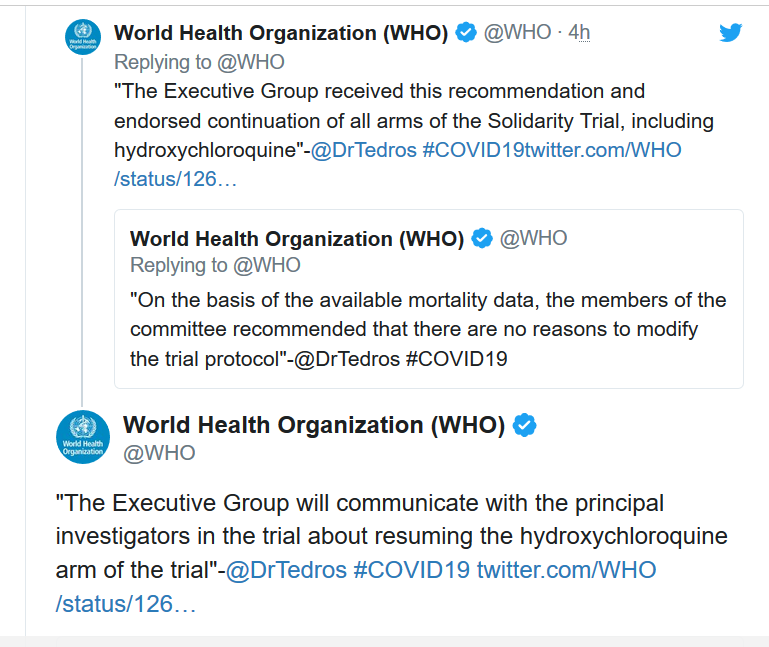
Screenshot from Twitter
Comments
KF
EG, community spread “outside” of such homes where the homes interact with the community through staff etc and constitute 40% of cases, is not so easily severed from what is going on in the homes.
Au contraire mon cher (apologies for my French). Once we noticed the situation in the nursing homes they were locked down. Unfortunately it was too late for the nursing homes because the virus had already infiltrated. But once that was done I have not heard of any significant spread from nursing homes to the community, although I am sure there were some isolated incidents.Ed George
May 31, 2020
May
05
May
31
31
2020
06:32 AM
6
06
32
AM
PST
F/N VF hit piece on the Zelenko trial . . . pre-emptive strike? See https://www.vanityfair.com/news/2020/05/documents-expose-fda-commissioners-interventions-on-behalf-of-trump/amp This is really sad to see. KFkairosfocus
May 31, 2020
May
05
May
31
31
2020
06:31 AM
6
06
31
AM
PST
F/N: I clip on doxycycline: https://www.kotatv.com/content/news/New-York-doctor-tells-us-about-his-impressive-results-with-hydroxychloroquine-as-South-Dakota-undergoes-clinical-trial-569682111.html >>By Alexus Davila | Posted: Wed 8:48 PM, Apr 15, 2020 | Updated: Thu 1:28 AM, Apr 16, 2020 RAPID CITY, S.D. (KOTA TV) - South Dakota is the first to launch a state-wide clinical trial of hydroxychloroquine to potentially treat and prevent COVID-19. Monument Heatlh is playing a role in this study and a New York doctor tells us about his eye opening case series with the same drug. "We don't have good information honestly," Monument Health Director of Research Roger DeRaad said. Lack of information is the reason why South Dakota's clinical trial with hydroxychloroquine is vital. Monument Health workers are helping register participants, like health care workers and high-risk individuals, to undergo a five day course. They will also help keep an eye on each participants' health. "Whenever we use a medication in a way that's not approved, we really should be following up with those people," DeRaad said. But someone else has already taken a close look at the anti-malarial drug in smaller numbers. Forty-five is a powerful number to Dr. Ryan Saadi because that is how many patients clinically recovered from COVID-19 symptoms in a case series he conducted. However, he studied hydroxychloriquine and a cardioprotective antibiotic, doxycycline. "That was impressive. I thought it looked too good to be true," Dr. Saadi, Executive Vice President and Global Head of Patient Access & Medical Affairs at Quantaira Health, said. Dr. Saadi says the reason why he looked at doxycycline is because between the anti-inflammatory properties and the overall fewer affects the drug has on the heart, the antibiotic was considered to be more ideal to mix with hydroxychloriquine as the coronavirus "essentially causes some cardiac injuries." But the FDA can't accept that small number of hope. This is why clinical trials are needed, like the 2,000 outpatient one Sanford Health is conducting state-wide in South Dakota. See related story South Dakota site for clinical trial of hydroxychloroquine and COVID-19 Dr. Saadi said it's a little too early in the stages for him to share his complete thoughts about the clinical trial in South Dakota. But, he said the state is on the right track and he looks forward to the results. "No drug is 100 percent safe," Dr. Saadi said. "So what we do is that we find the balance between the safety and the benefit. If the benefit is more than the risk you are taking, then that's what you do, especially during a pandemic." Besides, DeRaad said their patients feel a sense of power when participating in research. "Our patients frequently mention when they talk about participating in clinical research, it makes them feel like they are fighting back against something they really did not have control of," DeRaad said.>> With: https://nypost.com/2020/04/04/long-island-doctor-tries-new-hydroxychloroquine-for-covid-19-patients/ >>Dr. Mohammud Alam, an infectious disease specialist affiliated with Plainview Hospital, said 81 percent of infected covid patients he treated at three Long Island nursing homes recovered from the contagion. “In this crisis, I realized I had to do something,” Alam said. ”I realized if this was my dad, what would I do? And I would do anything I could to help.” Alam said he decided he could not apply the touted combination of the antimalarial hydroxychloroquine and antibiotic azithromycin because the side effects could be potentially fatal for his high-risk patients, many of whom had underlying heart issues. “I knew I could not jeopardize these patients,” Alam said. “We know from the FDA that azithromycin can cause fatal arrhythmia and abnormal heart failure that can lead to death,” Alam said. His patients were under long-term acute care and had comorbidities such as hypertension, coronary artery disease, chronic obstructive pulmonary disease or congestive heart failure. The FDA has warnings that azithromycin “can cause abnormal changes in the electrical activity of the heart that may lead to a potentially fatal irregular heart rhythm.” So instead, Alam replaced azithromycin with another decades-old antibiotic that doesn’t pose any known risks to the heart. “Doxycycline is an anti-inflammatory with properties similar to azithromycin but without the safety concerns and without cardiac toxicity,” he said. “So I decided why not choose that?” added Alam, a board-certified internist, who shared the results of an observational report consisting of 47 patients he treated. ”With the [limited]resources we have at the nursing home, we took a deep breath and realized we need to do something,” Alam said. Alam is not the only one to begin using doxycycline in the fight against COVID-19. Henry Ford Health System has started using combinations of the three drugs because of apparently fewer side effects, published reports state. Alam began treating his patients, 45 of whom had tested positive for the coronavirus after they developed a high fever, shortness of breath and cough. He received permission from their families before starting them on the medications, which have not yet undergone randomized controlled trials. “The majority had clinical improvement,” said Alam. “We had very good outcomes.” Alam said that 38 of 47 patients treated returned to their baseline and their symptoms resolved. Seven of the patients were transferred to a hospital and two died.>> Of course, I find the same talking point on "controls" where the obvious fact is, there is a baseline of business as usual that is producing highly unsatisfactory results. In the logic of decision theory as I have highlighted, what is needed is reason to see credible improvement relative to such an unsatisfactory baseline. There is no need to demand as gold standard the creation of an artificial no treatment baseline. Notice, too, the role being played by Nursing Homes in the NY area, that was already a warning sign on what was going on with a disastrous local policy blunder. Where, of course, on the questionable Lancet paper and other pushes there is a move to lock down investigation and use of HCQ. That seems to be a warning sign, too. KFkairosfocus
May 31, 2020
May
05
May
31
31
2020
03:06 AM
3
03
06
AM
PST
RH7, you have raised a long chain of issues, I will only respond to what catches my eye as significant: -- what is not highlighted is often more important than what is. As I just noted above, the sudden contrast in response to assemblies for riot and arson vs peaceful assembly in houses of worship speaks volumes. -- I note yet again that once pandemic broke out large numbers of deaths could not be averted. In all that is done, it needs to be recognised that chaos and death consequent on social disruption and economic collapse [even if temporary] can be worse than whatever happens with the direct epidemic; consider deaths of despair and deaths of famine consequent on economic chaos as evidence of the past century clearly demonstrates. Too often, the issue of balance minimising overall chaos and death is not struck. A telling sign of hidden agendas at work. -- that India (and other countries, likely) for the moment are dependent on China for raw materials to make HCQ, speaks volumes on the strategic imprudence of economic policy over recent decades. The baseline feedstock is petroleum and/or coal. Strategic capacity and reserves should have been priorities even if lowballing on prices created pressure to offshore to China. -- Likewise, over the past 20 - 40 years since HIV then SARS etc, there should have been a strategic priority on getting broad spectrum antivirals. For which BTW, HCQ on that 2005 paper, is a candidate. -- such, speaks volumes on the want of sound thought behind strategy and policy. Never good signs. -- the main problems with the Lancet paper and with WHO are conspicuous by absence from the minor correction issued. I see you clipped a little on this. The gap between oh we made a mistake over a hospital in "Australasia" and the failure to address cogently the question of treatment locus along the U-shaped trajectory of such a disease tells us that the problem of agendas is dominant. By the time one is hospitalised serious damage has likely been done by that sneaky destructive killer. The stitch in time factor is material. The US response to WHO just above tells us there is something that has gone significantly wrong. -- Notice the 500+ CT scans by Raoult et al, showing lung lesions even at the point of minor symptoms suggesting that damage to other organs is also likely to be in train, including the heart. As I argue above and in the previous thread and as others who carry far more weight have pointed out, it should be obvious that a stitch in time saves nine. So, it is unsurprising that thousands of cases on early intervention show good effect even as those on late intervention show want of such impact or even possible compounding of damage likely to be at root coming from the CV19 disease process -- As for differential points of plateau in cumulative cases and deaths, I am not so sure that it is as easy to control local actions in a large federation as it is to do so in a small unitary state, and I am sure that strong centralisation of governing power is inherently dangerous. -- cocktails of various types have shown some good effect. In the last thread, I highlighted from a suggestion by Jerry IIRC, that Ivermectin added to the HCQ-based coscktail, may allow better effects lower down the U of the disease, which should be followed up. I have also noted on Doxycycline substitution for Azithromycin, which was favourably reviewed by Raoult et al and seems to be a subject for study.kairosfocus
May 31, 2020
May
05
May
31
31
2020
02:51 AM
2
02
51
AM
PST
EG, community spread "outside" of such homes where the homes interact with the community through staff etc and constitute 40% of cases, is not so easily severed from what is going on in the homes. The tendency of such epidemics is to spread at rates based on current mass of cases -- and not proportion to population of whatever geographical or political zone is used as frame -- so long as factors don't restrict it. KFkairosfocus
May 31, 2020
May
05
May
31
31
2020
02:20 AM
2
02
20
AM
PST
F/N: Prediction, the current wave of rioting in the US is liable to trigger a secondary surge in CV19 cases. The sudden switch in media and voices suggests that the former arguments on how important continued lockdown (including of churches) was, was ideologically loaded. If riotous and arson-laced assemblies that confront local police forces that have nothing to do with an admittedly saddening incident are not clamped down on as peaceful ones in houses of worship are, something truly ugly is coming out about underlying intent. The real message is in the balance of what is unsaid, what is signalled by action/inaction as well as what is promoted as narrative. Rev 13:16 - 18 haunts our civilisation. KFkairosfocus
May 31, 2020
May
05
May
31
31
2020
02:16 AM
2
02
16
AM
PST
F/N: What we are not hearing (as part context for evaluating what we are hearing as dominant narrative), just as an example, being food for thought rather than endorsement: https://www.whitehouse.gov/briefings-statements/president-donald-j-trump-demanding-accountability-world-health-organization/ >>[STATEMENT:] President Donald J. Trump ACCOUNTABILITY FOR AMERICAN TAXPAYERS: President Donald J. Trump is holding the World Health Organization (WHO) accountable by putting a hold on United States funding. President Trump is placing a hold on all funding to the WHO while its mismanagement of the coronavirus pandemic is investigated. The American taxpayers provide $400 million to $500 million in funding to the WHO each year, but the WHO has failed them. China, on the other hand, provides just around one-tenth of the funding that the United States provides. The American people deserve better from the WHO, and no more funding will be provided until its mismanagement, cover-ups, and failures can be investigated. President Trump will continue fighting the coronavirus outbreak and will redirect global health aid to others directly engaged in the fight. INVESTIGATING THE WHO’S FAILED RESPONSE: The WHO’s response to the coronavirus outbreak has been filled with one misstep and cover-up after another. Despite the fact that China provides just a small fraction of the funding that the United States does, the WHO has shown a dangerous bias towards the Chinese government. The WHO repeatedly parroted the Chinese government’s claims that the coronavirus was not spreading between humans, despite warnings by doctors and health officials that it was. Taiwan contacted the WHO on December 31 after seeing reports of human-to-human transmission of the coronavirus, but the WHO kept it from the public. The WHO praised the Chinese government’s response throughout January and claimed there was no human-to-human transmission, despite the fact that doctors in Wuhan were warning there was. The WHO decided on January 22 that the coronavirus did not pose a Public Health Emergency of International Concern, all while praising China’s response. The WHO put political correctness over life-saving measures by opposing travel restrictions. The WHO made the disastrous decision to oppose travel restrictions from China and other countries—despite applauding travel restrictions within China itself—leading to further spread of the virus internationally. STRUCTURAL ISSUES AND NECESSARY REFORMS: The WHO has longstanding structural issues that must be addressed before the organization can be trusted again. The WHO has shown it was not prepared to prevent, detect, and respond to a severe infectious disease crisis like this. The WHO lacks the structure to ensure accurate information and transparent data sharing from members, which makes it vulnerable to misinformation and political influence. The United States seeks to refocus the WHO on fulfilling its core missions of preparedness, response, and stakeholder coordination. The United States is also calling for reforms to promote transparency and data sharing, hold member states accountable for abiding by the International Health Regulations, increase access to medicines, and counter China’s outsized influence on the organization.>> KFkairosfocus
May 31, 2020
May
05
May
31
31
2020
01:46 AM
1
01
46
AM
PST
Have the Swiss government’s lockdown measures been effective in stemming the pandemic? That’s the question a team of EPFL researchers set out to answer by analyzing data dating back to 28 February, the day the Swiss government banned groupings of over 1,000 people. This initial restriction was followed by a series of others that culminated in a ban on groupings of over five people, introduced on 20 March. “It’s essential for policymakers to be able to quantify how effective these measures are in slowing the spread of SARS-CoV-2, so that they can make the right decisions for both this pandemic and future ones,” says Jacques Fellay, the study’s coauthor. Fellay, a medical researcher at EPFL’s School of Life Sciences, also sits on the Swiss federal government’s COVID-19 scientific advisory board. The team’s findings have just been published in Swiss Medical Weekly. The research team found that on a national level, R0 fell from 2.8 at the start of the pandemic to 0.4 in early April – a decrease of 86%. Looking at individual cantons, R0 dropped between 53% (in Jura) and 92% (in Basel-Stadt). The reduction in people’s movements was measured using smartphone data: trips for work, shopping and recreational activities fell between 50% and 75% on a national level and between 30% and 80% on a cantonal level. The researchers also found a strong correlation between a reduction in people’s movements and a decrease in R0, even though this rate actually started declining a few days before people began changing their habits. The researchers’ model indicates that 3.9% of the Swiss population has been infected by the new coronavirus (as of 24 April), with cantonal rates ranging from 1.9% in Bern to 16% in Ticino. Now that the lockdown measures are gradually being lifted, the research team plans to publish their R0 estimate daily. Tracking this metric closely will be essential since the spread of the virus can only be slowed through people’s behaviors, and not by waiting until we achieve herd immunity – which is still far off. https://actu.epfl.ch/news/switzerland-s-lockdown-has-sharply-reduced-the-cas/rhampton7
May 30, 2020
May
05
May
30
30
2020
04:24 PM
4
04
24
PM
PST
Andr ew Gelman, a statistician at Columbia University who has blogged about the article and started the PubPeer discussion on it, writes in an email to The Scientist that the authors’ update “does not address many of the questions that have been raised about this study, but of course it is good for them to correct mistakes and omissions when they find them.” Watson writes in an email to The Scientist that the authors “have not addressed the other nine points referred to in the letter, and we do not understand why they cannot at least provide data aggregated by country rather than by continent.” He adds that the signatories on the letter would also like to know which countries in Africa the team is working worth. “By allowing the authors to post this correction and not address any of the other concerns,” Watson continues, “The Lancet appear to [be] stating that so far they are not worried about the reliability of the study.” https://www.the-scientist.com/news-opinion/disputed-hydroxychloroquine-study-brings-scrutiny-to-surgisphere-67595rhampton7
May 30, 2020
May
05
May
30
30
2020
02:41 PM
2
02
41
PM
PST
Norway and Denmark will allow tourists to travel between the two countries from mid-June, their governments announced on Friday, although border crossings with Sweden - where the number of Covid-19 infections is higher - will remain restricted. “ We are looking at the possibility of regional solutions, for example, opening up the Oresund region," Swedish Foreign Minister Ann Linde said at a news conference on Friday, adding that she had been in contact with the Danish foreign minister. Meanwhile, Sweden has advised all its citizens against travelling abroad until July 15. https://www.straitstimes.com/world/europe/sweden-excluded-as-neighbours-denmark-and-norway-ease-tourism-restrictionsrhampton7
May 30, 2020
May
05
May
30
30
2020
02:38 PM
2
02
38
PM
PST
There have now been ten times as many COVID-19 deaths in Sweden than Norway on a per capita basis. According to the Worldometers website, 435 out of every one million Swedes have died from the virus, while the virus has killed 44 out of every million Norwegians. And it’s not clear Sweden’s economy will be better off than Norway’s this year. “Economists at Swedish bank SEB estimate Sweden’s GDP will drop 6.5 per cent this year, about the same as the US and Germany, but a little better than Norway and ahead of 9–10 per cent falls in Finland and Denmark, all of which have had lockdowns,” the Financial Times reported May 10. A Reuters poll from April found economists predicting the Scandinavian economies would all fare about the same in 2020. https://www.nationalreview.com/corner/swedens-covid-death-rate-now-ten-times-higher-than-norways/rhampton7
May 30, 2020
May
05
May
30
30
2020
02:35 PM
2
02
35
PM
PST
A person who partied in the Lake of the Ozarks, Missouri, area on Memorial Day weekend has tested positive for coronavirus — and was possibly infectious over the holiday weekend. The Boone County resident visited multiple bars on May 24 and 25, according to the Camden County Health Department. They "developed illness" on Sunday and were possibly infectious before then. The partier went to Backwater Jacks between approximately 1 p.m. and 5 p.m. local time and again shortly before 10 p.m. local, according to health officials. The person — who was not identified by officials — also went to Shady Gators and Lazy Gators and Buffalo Wild Wings, officials said. https://www.wlwt.com/article/person-who-was-at-lake-of-the-ozarks-memorial-day-gathering-tests-positive-for-coronavirus/32719602rhampton7
May 30, 2020
May
05
May
30
30
2020
02:33 PM
2
02
33
PM
PST
Singapore researchers conducted a new study that revealed Remdesivir to be six-and-a-half times more effective at treating patients if it is combined with ritonavir and lopinavir–drugs used to treat people the with human immunodeficiency virus (HIV). With the help of artificial intelligence (AI), the researchers were able to determine the effective combination and dosage of the drugs that proved to be effective. Professor Dean Ho, the director of the N.1 Institute for Health and the Institute for Digital Medicine at the National University of Singapore (NUS), co-supervised the study. He claimed that although the research for a COVID-19 vaccine or cure continues, the results their study produced will help speed up the search for an interim treatment. “Drugs on the market can be combined in various ways and in varying doses,” he said in the report. “With AI, we can interrogate the entire universe of possibilities.” The new platform created by the researchers is called “IDentif.AI” which used a pool of 12 carefully selected drugs, and combined them in different ways to check which combination yielded the best result. The drugs used in the study are already being evaluated in clinical trials, with some that are already approved for patient use. Remdesivir, ritonavir, lopinavir, as well as the malaria drug hydroxychloroquine, are involved in the study. https://en.brinkwire.com/health/covid-19-update-combination-of-remdesivir-lopinavir-and-ritonavir-6x-more-effective-form-of-treatment-moderna-starts-dosing-patients-in-mid-stage-study/rhampton7
May 30, 2020
May
05
May
30
30
2020
02:27 PM
2
02
27
PM
PST
Russia’s Ministry of Health on Saturday approved a flu drug for use in fighting coronavirus after officials said preliminary testing showed hospitalized patients who took the pills recovered more quickly. The drug, known as favipiravir, had produced promising results against coronavirus in early testing in Russia. Its approval makes it among the first in a global race to find treatments and eventually a vaccine for the virus. https://www.wsj.com/articles/russia-approves-flu-drugs-use-against-covid-19-11590870709rhampton7
May 30, 2020
May
05
May
30
30
2020
02:23 PM
2
02
23
PM
PST
Medial journal The Lancet issued a correction on a large observational study that linked use of anti-malarial drug Hydroxychloroquine with increased death risk in COVID-19 patients, after more than 100 scientists and medical professionals raised questions about integrity of data analysed in the study. I n the correction issued on Friday, Lancet said that one hospital self-designated as belonging to the Australasia continental designation should have been assigned to the Asian continental designation. Surgisphere in a statement said that its data use agreements do not allow it to make some data public. While issuing the correction, Lancet also said that “there have been no changes to the findings of the paper.” “ The Executive Group of the Solidarity Trial, representing 10 of the participating countries, met on Saturday (May 23) and has agreed to review a comprehensive analysis and critical appraisal of all evidence available globally,” Tedros said in a virtual press conference on Monday. The review will consider data collected so far in the Solidarity Trial and in particular robust randomized available data, to adequately evaluate the potential benefits and harms from this drug, he said. https://www.thestatesman.com/world/journal-issues-correction-study-led-halt-clinical-trial-hydroxychloroquine-1502894403.htmlrhampton7
May 30, 2020
May
05
May
30
30
2020
02:14 PM
2
02
14
PM
PST
KF
You cannot simply subtract a significant component in the system and voila here you have a simple, easily calculated different outcome.
All I was suggesting is that we concentrate on community spread outside of nursing homes. When this is done, Canada appears to be managing this much better than the US. However, with respect to nursing homes, Canada has fared much worse than the US. That is why I am saying that comparisons can be very instructional. Both countries made mistakes. Both imposed lockdowns late. Both had mixed messages on wearing masks. But Canada had a far better unified message as compared to the polarizing messages in the US. Canada is being far more cautious in reopening.Ed George
May 30, 2020
May
05
May
30
30
2020
01:37 PM
1
01
37
PM
PST
Acartia Eddie:
Canada and the US are very similar culturally.
Canada wishes
Similarly clustered in urban areas.
Not according to the numbers I provided. Not even close.
From the numbers alone it appears that the Canadians are faring better.
The USA was hit first and harder. But that is moot as your assumptions and premises are all wrong.ET
May 30, 2020
May
05
May
30
30
2020
01:24 PM
1
01
24
PM
PST
India saw its biggest spike in Coronavirus cases and deaths on Saturday as 7,964 new infections and 265 fatalities were reported in the last 24 hours. With the latest jump, the total number of cases in the country has climbed to 1,73,763 with 4,971 succumbing to the deadly infection. Of the total cases, 86,422 are active while 82,370 patents have been cured. This is the second consecutive day that India has reported over 7,000 cases in a single day and eighth day when more than 6,000 patients were logged in 24 hours. https://www.thestatesman.com/india/india-sees-biggest-one-day-spike-7964-coronavirus-cases-265-deaths-24-hrs-total-cases-cross-1-73-lakh-1502894145.htmlrhampton7
May 30, 2020
May
05
May
30
30
2020
01:11 PM
1
01
11
PM
PST
THIRUVANANTHAPURAM: Kerala State Drugs and Pharmaceutical Limited (KSDP) has started exploring possibilities for sourcing raw materials for producing hydroxychloroquine, an antimalarial drug being used as a prophylactic against Covid-19. “The state government has instructed KSDP for producing hydroxychloroquine at a meeting. We are trying our best to meet the demand, but there is scant availability of the raw material for the drug,” KSDP chairman C B Chandrababu said. “ Now the only place from where we can source the chemicals for the production of the drug is China. Owing to the increased demand for the drug and the Covid-19 related emergencies, both raw materials and the drug are of short supply. The suppliers promising to supply the materials imported from China are demanding unrealistic price. The price of the raw materials that were available at Rs 100 to 150 per kg till a few months ago is now pegged at Rs 6,000 and more,” Chandrababu said. The drug is not available in the open market. Whatever stock available in the state is the ones that the central government has supplied free of cost to the state. https://timesofindia.indiatimes.com/city/thiruvananthapuram/raw-material-shortage-hinders-hcq-production/articleshow/76106606.cmsrhampton7
May 30, 2020
May
05
May
30
30
2020
01:09 PM
1
01
09
PM
PST
EG, I am simply telling you that in a dynamic situation dynamics count, where they can be shockingly counter-intuitive. That's why problematiques are not easy to address. You cannot simply subtract a significant component in the system and voila here you have a simple, easily calculated different outcome. The system architecture will be very different and it will behave in a different way. What is clear is that nursing homes and the elderly were at the centre of gravity of this pandemic. In the US, a major impact on cases and deaths occurred due to a local blunder in a complex polity. If that had been better managed, the outcomes would have been very different. KF PS: The numbers for pop density ET gave also carry big implications for social interaction patterns and manageability. Again, very different architectures lurk in seemingly simple numbers.kairosfocus
May 30, 2020
May
05
May
30
30
2020
11:55 AM
11
11
55
AM
PST
KF, so you are not even willing to address the possibility that we can learn from the experiences of others? Canada and the US are very similar culturally. Similarly clustered in urban areas. Both with huge problems in nursing homes. But both responded to the pandemic in different ways. From the numbers alone it appears that the Canadians are faring better. I think that both sides can learn from each other. Pretending that they are not comparable is just sticking your head in the sand.Ed George
May 30, 2020
May
05
May
30
30
2020
11:39 AM
11
11
39
AM
PST
You have to be a desperate fool to try to compare Canada and the USA. The numbers I provided prove that Acartia Eddie is a desperate fool.ET
May 30, 2020
May
05
May
30
30
2020
10:51 AM
10
10
51
AM
PST
EG, the dynamics would shift dramatically, there is no simple subtraction. You are removing a dominant mass and location, the situations would not be the same. Counterintuitive but pivoting on growth is by contact with existing mass where it is until slow down effects appear. No, the comparisons are invalid. For instance, where would the older people be instead and how would that shift social contact patterns? If, in family homes, that shifts social dynamics in general. KFkairosfocus
May 30, 2020
May
05
May
30
30
2020
10:39 AM
10
10
39
AM
PST
KF
EG, the centre of the US epidemic is one big urban concentration, also with 40% of deaths being Nursing Homes.
If you want to remove COVID-19 deaths in old age homes from the comparison, I am fine with that. 82% of COVID deaths in Canada were from nursing homes. That leaves a comparison where both countries have the same percentage of population in urban settings. Everything else being equal you would expect the US to have ten times the number of cases and deaths. But the US has 20 times the cases and 15 times the number of cases. To make matters worse, Canada has a couple additional factors that should make combatting the spread of disease more difficult. Canada has 1.38 times the urban density than the US and a higher median age.Ed George
May 30, 2020
May
05
May
30
30
2020
07:15 AM
7
07
15
AM
PST
Are The lack of new cases a good metric of handling the virus? I haven’t seen any logic that this is a good metric. As long as the virus remains it will eventually reach everyone. Certainly low deaths from the virus is a good objective but that is not the same metric as lowering new cases. Is the goal having everyone immune the real goal? If so how does this happen? Which is the better strategy effective treatment of people when they get the virus, assuming all have to get it or postponing the inevitable while having good testing? The latter seems to be the objective of the world but is it foolish? I realize people are scared. My wife talked with an old friend a week ago and her friend thinks she and her family had the virus and are now through it. My wife was jealous. She doesn’t want to get the virus, she just wants to be over it. Do we all have to get through it but we ourselves don’t want to actually get it? Is that what is in most of our minds? If a country or area think that they have it under control will someone, it just takes one person, be able to start it all over again?jerry
May 30, 2020
May
05
May
30
30
2020
04:19 AM
4
04
19
AM
PST
Chicago has over 11, 500 people per square mile.ET
May 29, 2020
May
05
May
29
29
2020
09:00 PM
9
09
00
PM
PST
New York city has a population density of 27,000 people/ sq. mile. Toronto has a population density of about 6, 890 people/ sq. mile. Yeah, it's close. :roll: 2015 NYC Census TorontoET
May 29, 2020
May
05
May
29
29
2020
08:52 PM
8
08
52
PM
PST
EG, the centre of the US epidemic is one big urban concentration, also with 40% of deaths being Nursing Homes. Given what has emerged regarding mismanagement of control of infections in such homes in the general vicinity of the Hudson estuary, there is clearly a special factor at work. One, that is very local rather than national. I guess the degree of locality in the US as a federation can be said, strictly, to be a national policy, but that has roots in the 1700's and in the post Civil War era, with further modifications impacted by the Civil Rights era. I remain convinced by the early exponential spreading, that there is a tendency to grow at a rate proportional to the current mass of the infected; later, that rate is damped down by saturation effects and counter measures. I have been puzzled by the long sustained linearisation rather than bending over of growth for several nations and the global picture. There is a weird factor there. As at the last I looked, the US growth was bending over but very slowly. KFkairosfocus
May 29, 2020
May
05
May
29
29
2020
08:50 PM
8
08
50
PM
PST
ET
You cannot compare the USA with Canada. For one, the population density is much different.
Urban settings are at the highest risk for disease transmission and both Canada and the US have the same percentage of their population in urban areas (just over 80%). Where they differ is that in these urban areas, Canada has 1.38 times the density per square mile of the US. So, all else being equal, we would expect the COVID-19 infection rates to be higher than in the US. But we are not seeing that.Ed George
May 29, 2020
May
05
May
29
29
2020
07:58 PM
7
07
58
PM
PST
You cannot compare the USA with Canada. For one, the population density is much different. We might not even have closed down if our population was so low.ET
May 29, 2020
May
05
May
29
29
2020
07:32 PM
7
07
32
PM
PST
1 2 3 4 5 6 … 8