Uncommon Descent Serving The Intelligent Design Community

Durston and Craig on an infinite temporal past . . .

Categories
Atheism
Mathematics
rhetoric
worldview
Share
Facebook
Twitter/X
LinkedIn
Flipboard
Print
Email

In recent days, the issue of an infinite temporal past as a step by step causal succession has come up at UD. For, it seems the evolutionary materialist faces the unwelcome choice of a cosmos from a true nothing — non-being or else an actually completed infinite past succession of finite causal steps.

Durston:

>>To  avoid  the  theological  and  philosophical  implications  of  a  beginning  for the  universe,  some  naturalists  such  as  Sean  Carroll  suggest  that  all  we  need  to  do  is  build  a  successful  mathematical  model  of  the  universe  where  time  t runs  from  minus  infinity  to  positive  infinity. Although  there  is  no  problem  in  having  t run  from  minus  infinity  to  plus  infinity with  a  mathematical  model,  the real past  history  of  the  universe  cannot  be  a  completed  infinity  of  seconds  that  elapsed,  one  second  at  a  time. There  are at  least  two  problems.  First,  an  infinite  real  past  requires  a  completed  infinity, which  is  a  single  object and  does  not  describe  how  history  actually  unfolds.  Second,  it  is  impossible  to  count  down  from  negative  infinity  without  encountering the  problem  of  a  potential infinity  that  never  actually  reaches  infinity. For  the  real  world,  therefore,  there  must  be  a  first  event  that  occurred  a  finite  amount  of  time  ago  in  the  past . . . [More] >>

Craig:

>Strictly speaking, I wouldn’t say, as you put it, that a “beginningless causal chain would be (or form) an actually infinite set.” Sets, if they exist, are abstract objects and so should not be identified with the series of events in time. Using what I would regard as the useful fiction of a set, I suppose we could say that the set of past events is an infinite set if the series of past events is beginningless. But I prefer simply to say that if the temporal series of events is beginningless, then the number of past events is infinite or that there has occurred an infinite number of past events . . . .

It might be said that at least there have been past events, and so they can be numbered. But by the same token there will be future events, so why can they not be numbered? Accordingly, one might be tempted to say that in an endless future there will be an actually infinite number of events, just as in a beginningless past there have been an actually infinite number of events. But in a sense that assertion is false; for there never will be an actually infinite number of events, since it is impossible to count to infinity. The only sense in which there will be an infinite number of events is that the series of events will go toward infinity as a limit.

But that is the concept of a potential infinite, not an actual infinite. Here the objectivity of temporal becoming makes itself felt. For as a result of the arrow of time, the series of events later than any arbitrarily selected past event is properly to be regarded as potentially infinite, that is to say, finite but indefinitely increasing toward infinity as a limit. The situation, significantly, is not symmetrical: as we have seen, the series of events earlier than any arbitrarily selected future event cannot properly be regarded as potentially infinite. So when we say that the number of past events is infinite, we mean that prior to today ℵ0 events have elapsed. But when we say that the number of future events is infinite, we do not mean that ℵ0 events will elapse, for that is false. [More]>>

Food for further thought. END

PS: As issues on numbers etc have become a major focus for discussion, HT DS here is a presentation of the overview:
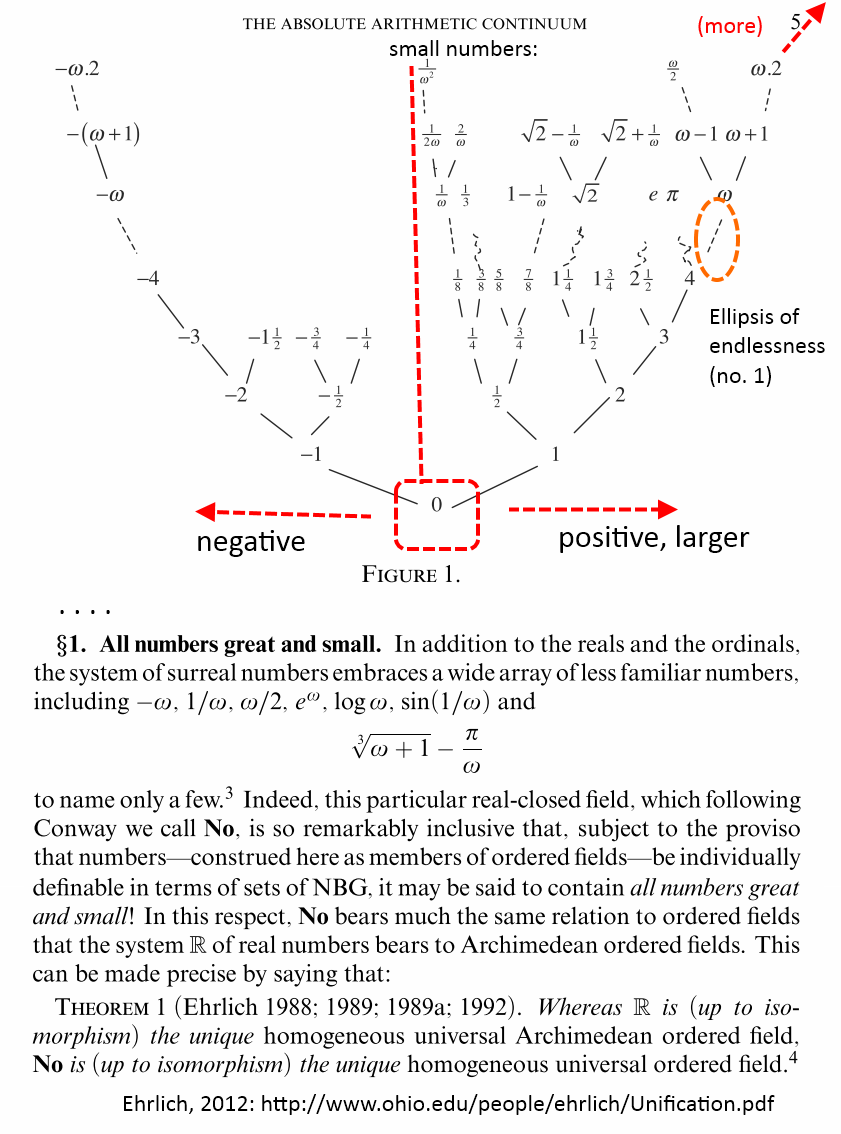
unity

Where also, this continuum result is useful:
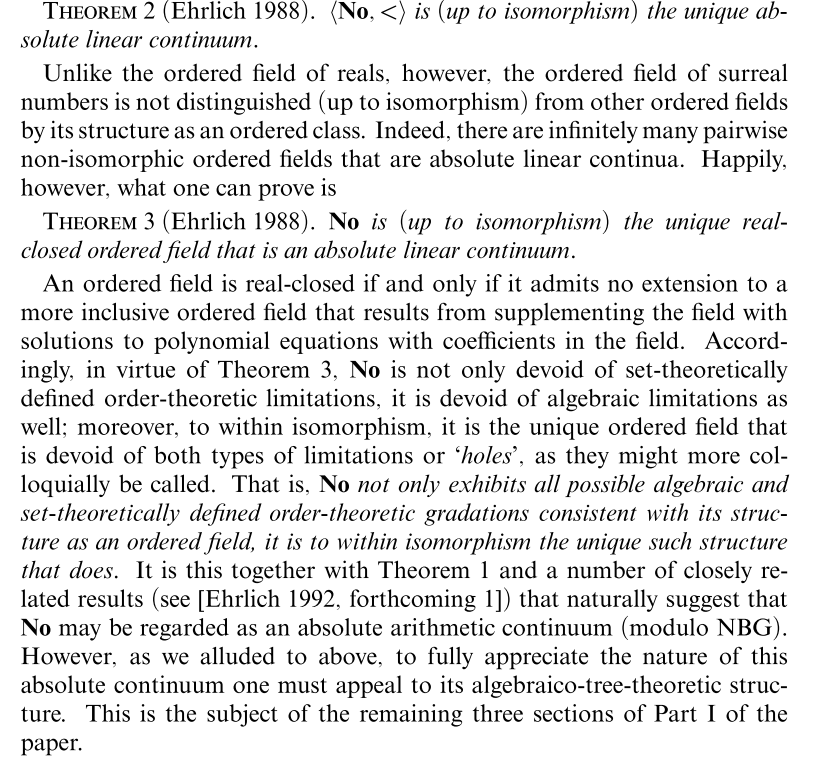
unified_continuum

PPS: As a blue vs pink punched paper tape example is used below, cf the real world machines
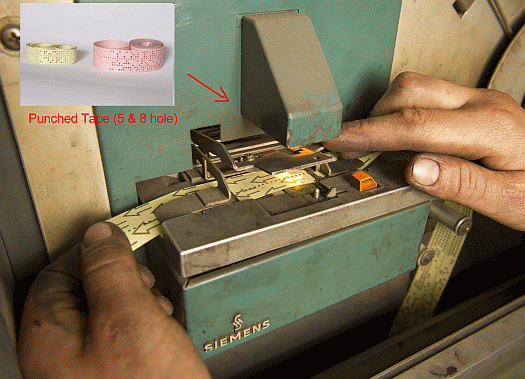
Punched paper Tape, as used in older computers and numerically controlled machine tools (Courtesy Wiki & Siemens)

and the abstraction for mathematical operations:
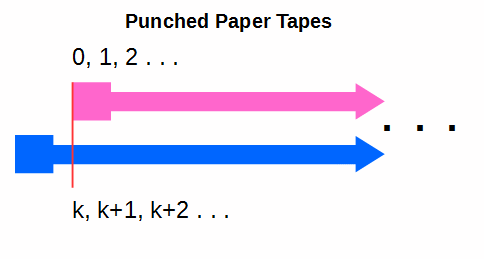
punchtapes_1-1

Note as well a Turing Machine physical model:
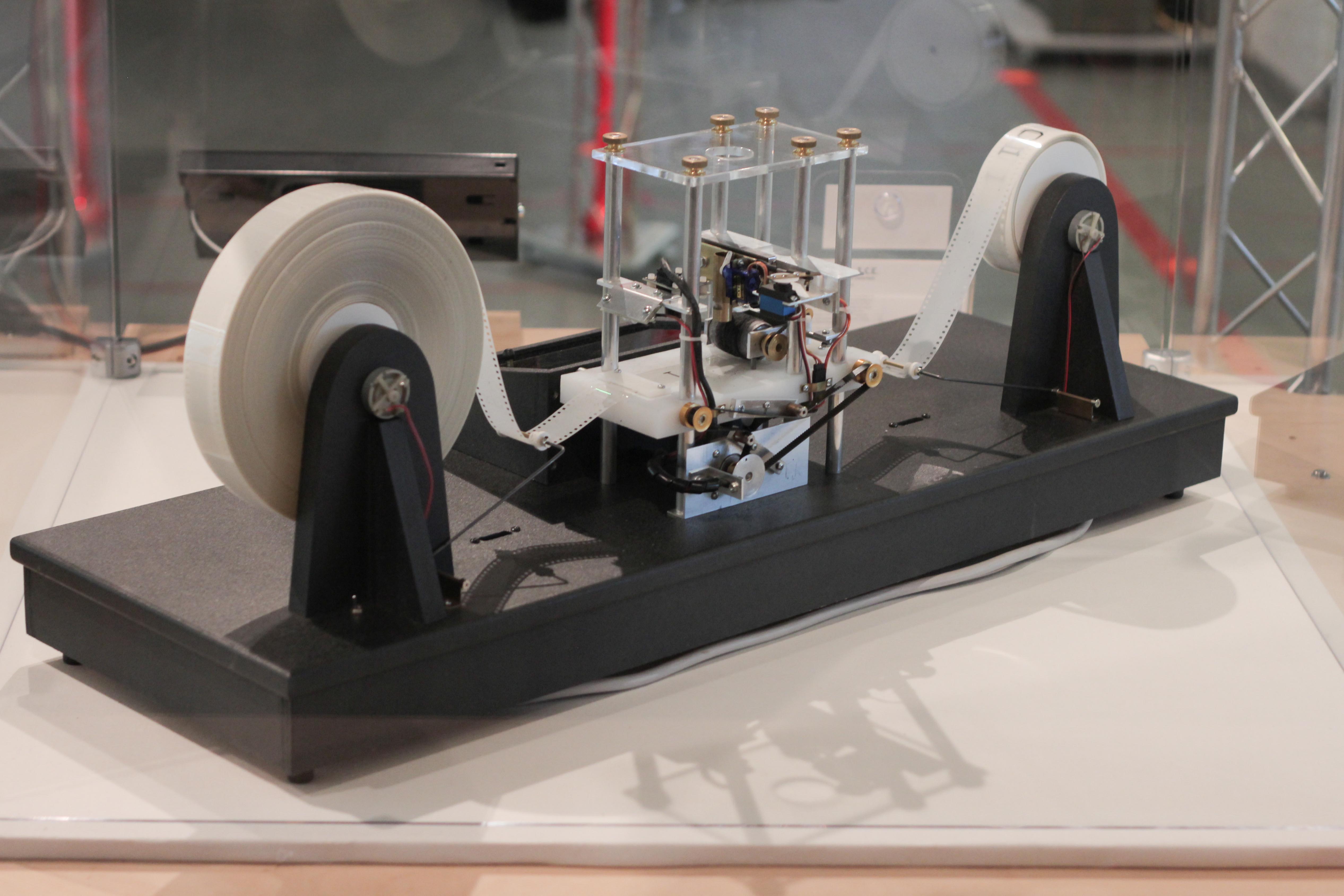
Turing_Machine_Model_Davey_2012

and its abstracted operational form for Mathematical analysis:
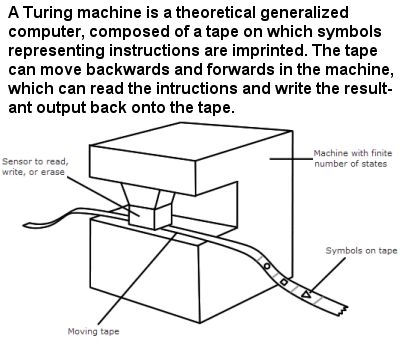
turing_machine

F/N: HT BA77, let us try to embed a video: XXXX nope, fails XXXX so instead let us instead link the vid page.

Comments
KF,
DS, my point is, that if there were an infinitely remote point in time as part of the past it would have to be endlessly remote.
Hmm. I would agree with this, simply because my understanding was that "infinitely" and "endlessly" were exact synonyms in your usage. Hence this would be true by definition. If they are not exact synonyms, what's the difference? More to the point, though, your definition of "infinite past" is different from that used by WLC, John Lane Bell (a mathematician and philosopher), and others who write on this topic. Their concept of an infinite past does not include any points infinitely remote in time. Are we clear on that? When WLC or JLB uses the term "infinite past", they are not asserting that the past includes any points infinitely many seconds from the present; in fact, quite the opposite is true. For WLC and JLB, every instant in this hypothetical infinite past is finitely many seconds from the present. And yet they both agree that the term "infinite past" is appropriate for that case. One can obviously consider the implications of removing this "finite accessibility hypothesis*" as JLB calls it (and he briefly does so), but then your definition of "infinite past" would be different from what everyone else is using, so we would have yet another clash of definitions, something which has plagued this entire discussion (see "endless" vs. "infinite"). My vote is we stick with the definition of "infinite past" used by WLC, et al, and consider only finite time coordinates. You are then welcome to show that WLC's usage of "infinite past" in this context is "dubious". ____ *JLB's finite accessibility hypothesis states that any two points in time are finitely many steps (seconds, say) apart.daveS
March 28, 2016
March
03
Mar
28
28
2016
06:52 AM
6
06
52
AM
PDT
DS, my point is, that if there were an infinitely remote point in time as part of the past it would have to be endlessly remote. Where, infinite past requires endlessly -- infinitely -- remote past points in time, or there is no infinitely remote past. And as the issue is a causal succession, that would have to be associated with a transfinitely large past number of causal steps to get from the suggested then to now. The sequence of cause effect bonds from then to now would have to traverse and complete endlessness in finite stage steps. The very contradiction in terms involved shows why this is dubious, and those who propose an infinite -- so, endlessly remote -- past need to show good reason for their claims. The assertion that an endless string of only finite values in finite stage steps is similarly questionable. If finite then by definition not endless. Still too busy to do other than outline. KFkairosfocus
March 28, 2016
March
03
Mar
28
28
2016
05:08 AM
5
05
08
AM
PDT
KF,
DS, very briefly, the point is that once there is a supposed infinite past, at some point there would have to be an endlessly remote — transfinitely remote — point. Does not have to be a start point, just, would have to be.
No, this is false. We have been over this "endlessly". WLC himself agrees with me. John Lane Bell agrees with me. You have not given any proofs showing that such points exists. When you get time, I challenge you to find such proofs in the literature on this subject (and not mere assertions). I have cited a few papers, even a couple where this same error crops up (Whitrow, e.g.), and where it is corrected (Bell).
And nope, the notion of endlessly remote finite values in a succession is dubious, a finite value is by definition not endlessly remote for one. More later, local issues have to take my main focus. KF
Certainly dubious, because they do not exist! That is, if you mean, in essence, natural numbers infinitely far from 0. If, on the other hand, you mean that the notion of infinitely many finite natural numbers is incoherent, then you're welcome to be a finitist as far as mathematics goes, but that doesn't mean the physical universe must obey this limitation.daveS
March 27, 2016
March
03
Mar
27
27
2016
05:06 PM
5
05
06
PM
PDT
DS, very briefly, the point is that once there is a supposed infinite past, at some point there would have to be an endlessly remote -- transfinitely remote -- point. Does not have to be a start point, just, would have to be. Effectively by definition. The very fact that this is problematic is telling us something. And nope, the notion of endlessly remote finite values in a succession is dubious, a finite value is by definition not endlessly remote for one. More later, local issues have to take my main focus. KFkairosfocus
March 27, 2016
March
03
Mar
27
27
2016
02:13 PM
2
02
13
PM
PDT
'There is a kind of religion in science; it is the religion of a person who believes there is order and harmony in the Universe…This religious faith of the scientist is violated by the discovery that the world had a beginning under conditions in which the known laws of physics are not valid, and as a product of forces or circumstances we cannot discover. When that happens, the scientist has lost control. If he really examined the implications, he would be traumatized.' [17] Hilarious last sentence... though evidently true.Axel
March 27, 2016
March
03
Mar
27
27
2016
11:21 AM
11
11
21
AM
PDT
KF,
e –> The attempt to step down from A as a suggested transfinite = w + g to the finite range in neighbourhood of 0, runs into the nature of w as a limit ordinal, is in effect not a direct successor to the sequence 0, 1, 2 . . . but rather a value assigned as limit to the endlessness, as order type of the endlessness.
Once more, there is no attempt to count down from a transfinite A to 0 here. The counting (up) through all negative integers to 0 has no beginning, and hence no starting point A.
f –> I have argued that the stepwise +1 stage countup from 0 cannot be completed to the transfinite, that every value attained by this or extensions of it — every natural number we can specifically write own in effect — will be inherently finite, and that he pink/blue tapes example shows that for any arbitrarily large k in he succession, k, k+1, k+2 etc can be put in 1:1 correspondence with 0,1,2 etc, showing in succession that we actually never even begin to scratch the surface of endlessness by any finite stage incrementing cumulative process.
And I don't think anyone has disputed these points.
h –> Indeed even an endlessly sparser as we go subset the primes, is undefinably endless. There is no definable largest prime. Endlessness is a paradigm shift we have to swallow whole.
Not sure about "undefinably endless", but everyone here grasps the fact that there are infinitely many primes. We are not having trouble "swallowing" that idea.
i –> Note, I am NOT speaking to a continuum, a smooth timeline, but to a succession of stages, where going back to the big bang only gets us to 0. In short, the count is by generations of causal succession, not by an imagined clock. Rows in the punched tape, not the presumed tape that runs on with the holes in it.
I don't know about the distinction between a tape and a clock here. Surely you can't disqualify a ticking clock in a thought experiment involving the passage of time?
j –> In this context, it is to my mind readily apparent that an endless, finite stage succession inherently maps to a succession of ordinals and extensions of such, so if there is a logical constraint on the numbers it will extend instantly to what maps to this.
Eh? Can you make this more precise? What is this "mapping"?
k –> In short this is just as if 3 +1 +1 +1 + 6 –> 12, we cannot add three pennies, a three-pence coin and a sixpence without getting a shilling’s value.
I do agree that 3 + 1 + 1 + 1 + 6 = 12.
n –> In that context, proposing to complete an endless finite stage succession in steps, bridging the transfinite, is at minimum paradoxical and more plausibly is an attempt to effect the logically impossible.
Proposing to X the X-less would be paradoxical, I agree. Proposing to X the Y-less (END the BEGINNING-less) is not necessarily paradoxical.
p –> In this context, it seems clear to me that a claimed transfinite successive past of stages of cause-effect down to now tries to span the transfinite in steps. Never mind clever verbal steps or objections, the claim is quite plain on reflection.
It "tries" to span the transfinite in a transfinite number of steps, you could say.
r –> The past, plausibly is finite, on a constraint of logic. Logic of structure and quantity.
Most would agree that physical evidence indicates the past is probably finite, but I think you're overlooking the "obvious objection" to your argument that Bennett identifies in the quote from post #1078.
t –> And this seems there as a limit to observable reality imposed by logic, never mind that we cannot observe the remote past, or even the much nearer past. u –> I would actually challenge those who propose such while wearing or pointing to the lab coat: kindly, show us observational evidence.
If this is addressed to me, a reminder: my argument is simply that this "counting down from infinity" argument fails to show the past must be finite. I certainly don't have observational evidence of an infinite past. **** I would urge you to take another look at my post #1077. We're over a thousand posts in this thread alone, and you're still referring to a transfinite "starting point" A to this (beginningless!) process of counting through {..., -2, -1, 0}. That tells me you haven't dealt with the distinction between ω and ω*.daveS
March 27, 2016
March
03
Mar
27
27
2016
07:24 AM
7
07
24
AM
PDT
Folks, While still busy, I will pick up a few things, let me start fairy early in the last set of exchanges:
A, 1059: >>I think the connection between the mathematics of infinity and metaphysical speculations about time and God are tenuous at best.>> DS, 1061: >>Can you explain how the punched tape example demonstrates that an omnipotent deity, existing outside of time, and who did not begin to exist, cannot create a universe with an infinite past?>> DS, 1063: >>I am merely saying that I see no logical problems with an infinite past, and I don’t think any such problems have been described here. In other words, it hasn’t been shown to be impossible.>> A, 1064: >>1. As far as is known, and as is generally accepted, our universe started about 14 billion years ago, so within our universe there is no issue about an infinite past: the amount of time since the universe began is finite. 2. We tend to accept the model of a number line starting at zero as part of the background framework of events happening in the world, as if time existing as a background clock in respect to which events happened steadily, and in one direction only. As with all applied math, this is a model which maps a mathematical concept to a real-world phenomena, and must be tested to see if it is a valid model. While it certainly suffices for the macroscopic world, we know that at the quantum and relativistic level this model breaks down in places. 3. We also have a model of the world being causally connected from moment to moment in time, each moment being a causal product of the moment before. However, even the implied continuity in the number line model breaks down at the quantum level, both in terms of discrete amounts of energy and time, as well as the introduction of genuine probabilities as opposed to strict deterministic cause and effect. 4. It is a completely untestable metaphysical speculation as to whether anything like the time we experience in our universe exists outside of our universe, including before our universe. To extend the model of a number line within our universe to whatever exists outside/before our universe is just not justified.>>
a --> The first issue is not about God or what he could create, save that not even God can make a violation of the first principles of right reason, For instance, that Canadian Christian children's TV programme title notwithstanding God cannot create a square circle. b --> Likewise, the question is not the evident finite past of our observed cosmos, but whether there is a chain of in some essential sense physical causal antecedents beyond it without limit. As I have modelled ever so many times in this thread, the implied argument is that there is a chain of causal stages Cj: . . . EoE . . . Ck+1 –> Ck –> . . . –> Cn, now. c --> Or, more elaborately, let me go to 7 above:
. . . what is warranted is that step by step finite succession cannot bridge to the transfinite. This is easiest to see starting at 0 and counting up, but it is patent that bridging the transfinite the other way to appear at the present has to bridge the same span. That is why I went to lengths to identify a reasonable ordered succession 0, 1, 2 . . . [TRANSFINITE SPAN] . . . w [--> omega], . . . w + g . . . and identify that A = W + g, a transfinite with w the first transfinite ordinal and g some large finite [so still of the scale aleph null] will be such that in a descent . . . A, A~1 [= w + (g – 1)], A ~ 2, . . . 2, 1, 0, 1*, 2* . . . n, n being now, we see A, A~1 [= w + (g – 1)], A ~ 2, . . . 0, 1#, 2#, . . . and so we run into a transfinite bridge and the count down will not reach from A to 0, no more than it can reach up from 0 to A.
d --> Of course much water has passed under the bridge since then and we have seen that the surreals allows us to make the sort of succession of numbers implied, cf the tree added to the op. Where it remains so that there is no basis for a stepwise spanning of the transfinite and there is no definable finite antecedent to w. e --> The attempt to step down from A as a suggested transfinite = w + g to the finite range in neighbourhood of 0, runs into the nature of w as a limit ordinal, is in effect not a direct successor to the sequence 0, 1, 2 . . . but rather a value assigned as limit to the endlessness, as order type of the endlessness. f --> I have argued that the stepwise +1 stage countup from 0 cannot be completed to the transfinite, that every value attained by this or extensions of it -- every natural number we can specifically write own in effect -- will be inherently finite, and that he pink/blue tapes example shows that for any arbitrarily large k in he succession, k, k+1, k+2 etc can be put in 1:1 correspondence with 0,1,2 etc, showing in succession that we actually never even begin to scratch the surface of endlessness by any finite stage incrementing cumulative process. g --> In short, endlessness has to be taken seriously as part of the definition of naturals and of reals too. So beyond any specific counting number, there is an endless onward succession that can be put in correspondence with the full set. h --> Indeed even an endlessly sparser as we go subset the primes, is undefinably endless. There is no definable largest prime. Endlessness is a paradigm shift we have to swallow whole. i --> Note, I am NOT speaking to a continuum, a smooth timeline, but to a succession of stages, where going back to the big bang only gets us to 0. In short, the count is by generations of causal succession, not by an imagined clock. Rows in the punched tape, not the presumed tape that runs on with the holes in it. j --> In this context, it is to my mind readily apparent that an endless, finite stage succession inherently maps to a succession of ordinals and extensions of such, so if there is a logical constraint on the numbers it will extend instantly to what maps to this. k --> In short this is just as if 3 +1 +1 +1 + 6 --> 12, we cannot add three pennies, a three-pence coin and a sixpence without getting a shilling's value. l --> Logical-mathematical realities can and do causally constrain the real world. If you put the above coins in a tin in a drawer and come back a week later to find less than a shilling's value, it is not logic or arithmetic but the laws of England that were broken, to paraphrase C S Lewis. m --> Mathematics is the logical study of structure and quantity. Laws of logic, likewise, are inextricably entangled into possible realities. n --> In that context, proposing to complete an endless finite stage succession in steps, bridging the transfinite, is at minimum paradoxical and more plausibly is an attempt to effect the logically impossible. o --> And yes, I accept that this shifts how I have to view ordinary mathematical induction. As was already addressed. p --> In this context, it seems clear to me that a claimed transfinite successive past of stages of cause-effect down to now tries to span the transfinite in steps. Never mind clever verbal steps or objections, the claim is quite plain on reflection. q --> Nor does it help to try to suggest an endless succession of finite values on mathematical induction; that too is caught up in the problem. r --> The past, plausibly is finite, on a constraint of logic. Logic of structure and quantity. s --> That is, it seems to me that a claimed infinite successive past is much like a square circle, by claiming to end the endless in steps. t --> And this seems there as a limit to observable reality imposed by logic, never mind that we cannot observe the remote past, or even the much nearer past. u --> I would actually challenge those who propose such while wearing or pointing to the lab coat: kindly, show us observational evidence. ______________ Okay, back to the local budget season rhetorical games and Cicero's point that rhetorical eloquence and wisdom (including the ethics of sustainability) too often never meet. Back in a day or so, DV. KFkairosfocus
March 27, 2016
March
03
Mar
27
27
2016
04:43 AM
4
04
43
AM
PDT
Still busy but BA77 has a clip: https://www.facebook.com/philip.cunningham.73/videos/vb.100000088262100/1119397401406525/?type=2&theaterkairosfocus
March 23, 2016
March
03
Mar
23
23
2016
03:36 AM
3
03
36
AM
PDT
KF, I finally found paper which deals at length with many of the issues that have arisen here:
The Age and Size of the World Jonathan Bennett Synthese Vol. 23, No. 1, Kant and Modern Science (Aug., 1971), pp. 127-146
The first 11 pages or so are most relevant to our discussion. Here is a portion from the first pages which summarizes one of the points I have been making: Bennett begins by reviewing Strawson's essay on an infinite past:
When Strawson discusses this matter he pretends that "for as long as the world has existed, a clock has been ticking at regular intervals", and he then equates the world's age with the length of the series of past ticks. His 'ticks' do exactly the same work as my 'events'. Now, Kant argues like this. If the world never began, then it has been going on forever, and the series of past events---past ticks of Strawson's clock---has infinitely many members. But:
The infinity of a series consists in the fact that it can never be completed through successive synthesis. It thus follows that it is impossible for an infinite world-series to have passed away. (A 426)
That is Kant's argument---his presentation of the alleged conceptual difficulty in the idea that the world is infinitely old. The argument looks bad, because on the face of it it is open to an obvious objection. Kant says that "the infinity of a series consists in the fact that it can never be completed through successive synthesis"---that is, through a one-by-one enumeration of its members---but that is just false. A series of the sort Kant has in mind must, if it is infinite, be open at one end; it cannot have both a first and last member; and so the enumeration of its members, if started 'can never be completed'. But such an enumeration could be completed all the same, if it did not ever start but had been going on for ever.
daveS
March 22, 2016
March
03
Mar
22
22
2016
07:09 AM
7
07
09
AM
PDT
KF, I'll take this opportunity to elaborate on the distinction between "endless" and "beginningless", using some of the notation and concepts that appear in the papers I mentioned. As we have seen, the set N has order type ω. If we have a (countably) infinite sequence of distinct events, E_i, where each i is an integer, then the set of all the E_i is ordered (chronologically). [Edit: Naturally I assume that no pair of these events occur simultaneously.] Now suppose we have a one-to-one, order-preserving correspondence between N and the set of all the E_i in such a sequence. Then by definition, the set of the E_i has order type ω as well, and it is appropriate to call the sequence endless. We have used the notation (E_0, E_1, E_2, ...) for endless sequences of events. On the other hand, the set of all nonpositive integers has order type ω*. We could denote that set by Z^-. Clearly there is no one-to-one, order-preserving correspondence between N and Z^-, so ω is not equal to ω*. I will call a countably infinite sequence of events beginningless if the set of all such E_i has order type ω*. You can of course represent such a beginningless sequence by (..., E_(-2), E_(-1), E_(0)). In these threads, we have sometimes used the word "endless" as a synonym for "infinite", but I think it's important, when discussing ordered sets, to reserve the term "endless" for sets of order type ω (for countable sets, anyway), in order to avoid any equivocation. A few observations:
1) No sequence of events in the past has an endless subsequence. 2) No sequence of events in the future has a beginningless subsequence. 3) Every infinite sequence of past events is beginningless. 4) Every infinite sequence of future events is endless.
Agreed so far?daveS
March 21, 2016
March
03
Mar
21
21
2016
07:02 AM
7
07
02
AM
PDT
Aleta, Just now I do not have much time given local matters, I responded to a general point on relevance. The claim of an infinite past succession of causally linked stages is subject to the issue of actualising the infinite in successive finite stage steps which is tied to the logic of structure and quantity. Pardon me if I have not exactly intersected with your concerns and have gaps on things you asked, there is a major local development that requires my main effort just now. Similar to the recent trip that put me effectively offline for several days. KFkairosfocus
March 20, 2016
March
03
Mar
20
20
2016
01:22 PM
1
01
22
PM
PDT
Thanks, Dave. And kf, I'll point out that not only do you address points to me about things that I don't claim, you also don't address points that I do claim, such as that the model of time as a number line extending beyond our know finite universe is an unjustified metaphysical speculation which renders meaningless the whole discussion about an infinite past time.Aleta
March 20, 2016
March
03
Mar
20
20
2016
08:47 AM
8
08
47
AM
PDT
KF, I have to be away for several hours, but I will echo Aleta's request that you not address posts on these subjects to her. It seems to imply (falsely) that she has made certain claims (or taken certain positions) when she hasn't.daveS
March 20, 2016
March
03
Mar
20
20
2016
08:39 AM
8
08
39
AM
PDT
kf, you once again address me about claims and positions I haven't made and don't have. Why do you do that? Did you even read 1070? Or do you just repeat your points irrespective of what someone else writes???Aleta
March 20, 2016
March
03
Mar
20
20
2016
06:34 AM
6
06
34
AM
PDT
KF,
Aleta (attn DS), the claim there is a completed infinite past entails completion of the endless. That is the fundamental issue where at minimum a paradox emerges.
I assume you're addressing me, primarily. :P Anyway, it would entail completion of an infinite set. Specifically, completion of "the beginningless", not "the endless".
And, if at ANY remote time in the past only a finite past has been subsequently traversed that points to there being only a finite past.
True. Of course I'm assuming otherwise.
By contrast an ellipsis of endlessness in {0,1,2 . . . } points to a process that is precisely beyond completion,
Perhaps, but again you're referring to a process with a beginning but no end. In the digits of pi example, the process has no beginning but has an end, so is not "endless". I think that while you have spent quite a bit of time discussing "endlessness", the real issue is "beginninglessness". After all, the central topic is an infinite past, which by definition has no beginning. Endlessness and beginninglessness are very different.daveS
March 20, 2016
March
03
Mar
20
20
2016
06:28 AM
6
06
28
AM
PDT
Aleta (attn DS), the claim there is a completed infinite past entails completion of the endless. That is the fundamental issue where at minimum a paradox emerges. And, if at ANY remote time in the past only a finite past has been subsequently traversed that points to there being only a finite past. By contrast an ellipsis of endlessness in {0,1,2 . . . } points to a process that is precisely beyond completion, which is why for any definable thus finite k, there will be an onward endlessness k, k+1, k+2 etc that can be matched to 0,1,2 etc endlessly. The foot of the rainbow is ever receding. KFkairosfocus
March 20, 2016
March
03
Mar
20
20
2016
06:10 AM
6
06
10
AM
PDT
kf writes,
Aleta & DS: Do you see the problem with claiming to complete — thus, end — an endless, transfinite traverse in finite cumulative steps?
kf, I have never, ever made that claim. Haven't I made that perfectly clear? I have also never, ever made the claim that one could somehow "start" at negativity infinity and proceed to 0 - that claim itself doesn't make sense. And, I have clearly stated that I don't think the number line is a testable model for time as it pertains to something metaphysical beyond our universe. So I really wonder why you keep addressing comments about these issues to me as if I were defending something that I'm not. Seriously, do you pay attention to the establshed positions of other participants in the discussion?Aleta
March 19, 2016
March
03
Mar
19
19
2016
06:18 PM
6
06
18
PM
PDT
KF,
Aleta & DS: Do you see the problem with claiming to complete — thus, end — an endless, transfinite traverse in finite cumulative steps?
If the process has a beginning, yes, I see the issue. If an omnipotent deity begins counting through the natural numbers in order, one number per second, then at any point in the future, it will have only counted through a finite subset of N. At no point in the future will this "infinity" be completed. In a beginningless process, that is not an issue. Think of the example of the deity mentally noting the passing of each second through an eternal past. At the time of any particular tick, there has already been infinitely many other ticks previous to it. There is no point at which the number of ticks completed transitions from finite to infinite---it has always been infinite.
you cannot traverse in +1 steps from 0 as a reference, which also reverses to if one claims an endlessly remote past then to reach now such would have had to be traversed in finite stage steps, which runs into the issue of endlessness.
In the example of the beginningless deity, there is no starting point, nothing corresponding to the "from 0" that you have when counting 0, 1, 2, 3, ... . Edit: Something else to consider, which I'm stealing from the philosophy forum I linked to, based on an anecdote told by Wittgenstein. Consider an omniscient deity who never began to exist, and who exists outside of time. Now imagine this deity reciting the decimal digits of pi, one digit per second, in reverse order. He completes this task today, ending with 9, 5, 1, 4, 1, 3. Is that logically impossible?daveS
March 19, 2016
March
03
Mar
19
19
2016
05:51 PM
5
05
51
PM
PDT
I've read some of the papers along with some additional sources (written by professional philosophers), and I have to say I think most of the discussion in these threads is at least comparable in quality. Both of the following passages leave me shaking my head. Here's a quote from WLC in his book on the Kalam Cosmological Argument (pages 200-201), with some emphasis added, and separated into paragraphs for readability:
If the universe had no beginning, then at least one temporal chain of events had no beginning. (By temporal chain of events is meant a sequence of discrete physical occurrences that has the usual properties of discrete chronological order.) If E is an event in this chain, then there is an important difference between an infinite past and an infinite future for E; one is actual and the other potential. That the future is a potential infinite means that (1) for any future event in E there will be future events and (2) any event in the future of E is separated from E by a finite number of intermediate events. On the other hand, the past is actual. Whitrow points out that when we try to think back over the series of past events, our train of thought yields only a potential infinite; but this process does not correspond to the actual successive occurrence of these events. Therefore, if the past events are infinite, they constitute an actual infinite. Consequently, if the chain of events prior to E is infinite, then there must be an event O that is separated from E by an infinite number of intermediate events. If not, then the number of events separating E from any event O would be finite, and thus the past would be only a potential infinite, which is impossible. But an infinite number of intermediate events raises two problems: (1) if E is an infinite number of events from O, then with regard to O the notion of the future as a potential infinite is destroyed, since both O and E do occur; (2) when in the temporal chain between O and E does the total number of events that have occurred since O become infinite instead of finite?
Pamela Huby says this in her 1971 paper "Kant or Cantor: That the Universe, if Real, must be Finite in Both Space and Time":
Similarly me may argue of things in space, that any object in space, however far distant, is a finite distance only from every other object. But between any object and any other there can then be only a finite number of objects, and therefore, however vast the total number of objects may be, it will still be finite.
???daveS
March 19, 2016
March
03
Mar
19
19
2016
05:32 PM
5
05
32
PM
PDT
Aleta & DS: Do you see the problem with claiming to complete -- thus, end -- an endless, transfinite traverse in finite cumulative steps? That is interesting. Especially when, over and over again anytime one attains to some finite but large accumulation, k, endlessness still sits there before one even as the foot of the rainbow is ever receding. Which, the pink/blue tape exercise plainly shows. Which then applies to a claimed endless succession of distinct finite causal stages along a timeline to the present. Oh yes, aleph null is the cardinality of first order endlessness, so speaking of aleph zero can be directly translated to endlessness, which then brings up the significance of the ellipsis of endlessness -- you cannot traverse in +1 steps from 0 as a reference, which also reverses to if one claims an endlessly remote past then to reach now such would have had to be traversed in finite stage steps, which runs into the issue of endlessness. And that has been pointed out above many times as a problem. KF PS: I cannot elaborate, main focus is on current local issues just now.kairosfocus
March 19, 2016
March
03
Mar
19
19
2016
05:14 PM
5
05
14
PM
PDT
Hmm. Popper, John Lane Bell, and WLC all submitted replies to Whitrow's article, also to the BJPS. I suppose this would have been a good place (for me) to start reading on the subject.daveS
March 19, 2016
March
03
Mar
19
19
2016
10:09 AM
10
10
09
AM
PDT
I haven't spent much time looking for publications by working philosophers on this issue, but there are quite a few. I picked one which appeared on the first page of google search results, but wasn't very impressed with this quote:
If n events occurred in sequence before E_0, then there must have occurred an event designated E_(-n), in my notation. Similarly if aleph-zero events occurred before E_0, then there must actually have occurred (in time past) events E_(-aleph-zero). But, starting from any one such event, it would have been impossible to attain the event E_0, just as from the event E_0 it will never be possible to attain events E_(aleph-zero) in the future. Consequently, the concept of an infinite sequence of past events is incapable of culminating in the present event. Hence, just as every future sequence of discrete events from E_0 onward will always be finite, in the sense that never will an event E_n be attained where n is not finite, so in every past sequence the total number of events, however large, can never be infinite.
where:
Similarly if aleph-zero events occurred before E_0, then there must actually have occurred (in time past) events E_(-aleph-zero).
is clearly incorrect. As we've seen here, the set N has cardinality aleph-null, but no element(s) aleph-null. It's not clear to me why he speaks of plural "elements E_(-aleph-null)" either. Source: On the Impossibility of an Infinite Past by G. J. Whitrow in The British Journal for the Philosophy of Science, Vol. 29, No. 1 (March, 1978). For some informal discussion, there are some posts on this philosophy forum that seem on the mark.daveS
March 19, 2016
March
03
Mar
19
19
2016
07:50 AM
7
07
50
AM
PDT
At 1060, kf wrote,
Aleta, a past causal succession by finite stages runs into issues revealed by the punched tapes exercise. A proposed past-infinite succession like that tries to bridge the transfinite. KF
Hmmm, kf. I'm not sure why you addressed this comment to me. My previous comment at 1059 was about pure math and not at all about a "past causal succession by finite stages." I did make the comment that I thought "the connection between the mathematics of infinity and metaphysical speculations about time and God are tenuous at best." Let me expand on that. First, almost entirely (not completely) I've concentrated on the purely mathematical nature of infinity throughout these threads. Now I'll make some comments about the larger issue of time and an infinite past. 1. As far as is known, and as is generally accepted, our universe started about 14 billion years ago, so within our universe there is no issue about an infinite past: the amount of time since the universe began is finite. 2. We tend to accept the model of a number line starting at zero as part of the background framework of events happening in the world, as if time existing as a background clock in respect to which events happened steadily, and in one direction only. As with all applied math, this is a model which maps a mathematical concept to a real-world phenomena, and must be tested to see if it is a valid model. While it certainly suffices for the macroscopic world, we know that at the quantum and relativistic level this model breaks down in places. 3. We also have a model of the world being causally connected from moment to moment in time, each moment being a causal product of the moment before. However, even the implied continuity in the number line model breaks down at the quantum level, both in terms of discrete amounts of energy and time, as well as the introduction of genuine probabilities as opposed to strict deterministic cause and effect. 4. It is a completely untestable metaphysical speculation as to whether anything like the time we experience in our universe exists outside of our universe, including before our universe. To extend the model of a number line within our universe to whatever exists outside/before our universe is just not justified. Similarly, we have no idea if what we experience as a sequence of causes and effects happening in a temporally linear manner apples to whatever came before and/or is outside our universe. 5. That is why I think the whole argument about a "past infinite causal succession" is an empty topic. We have no idea if our model of time as a number line and events on it as modelled by successive points applies to the world outside our universe, and no way of testing if that is so. It is a misapplication of math to just assume the model is valid, and then to argue about things within the mathematics itself as if they automatically meant something about the world outside of mathematics, and especially about an inaccessible metaphysical world.Aleta
March 18, 2016
March
03
Mar
18
18
2016
05:41 PM
5
05
41
PM
PDT
KF,
As for the issue can God make (A and ~ A) true shows that if something is a logical problem it is a problem. If one posits an infinite causal succession in stages, she needs to explain how such is possible. KF
Well, I am merely saying that I see no logical problems with an infinite past, and I don't think any such problems have been described here. In other words, it hasn't been shown to be impossible.daveS
March 18, 2016
March
03
Mar
18
18
2016
03:13 PM
3
03
13
PM
PDT
DS, I spoke to something much more restricted, that endlessness is beyond any finite k no matter how large. That is not in itself any proof of omnipotence etc, but it dies show that claimed infinite stepwise causal succession is seriously problematic as it must span the transfinite. As for the issue can God make (A and ~ A) true shows that if something is a logical problem it is a problem. If one posits an infinite causal succession in stages, she needs to explain how such is possible. KFkairosfocus
March 18, 2016
March
03
Mar
18
18
2016
02:54 PM
2
02
54
PM
PDT
KF, Can you explain how the punched tape example demonstrates that an omnipotent deity, existing outside of time, and who did not begin to exist, cannot create a universe with an infinite past?daveS
March 18, 2016
March
03
Mar
18
18
2016
10:32 AM
10
10
32
AM
PDT
Aleta, a past causal succession by finite stages runs into issues revealed by the punched tapes exercise. A proposed past-infinite succession like that tries to bridge the transfinite. KFkairosfocus
March 18, 2016
March
03
Mar
18
18
2016
10:13 AM
10
10
13
AM
PDT
I think the connection between the mathematics of infinity and metaphysical speculations about time and God are tenuous at best. For math to be applied via a model there has to be some way to test the model, and there is no way to test metaphysical speculations. As I've said before, I believe math, as an abstract system, has truth and meaning in and of itself, irrespective of any possible (and untestable) connections with metaphysics. From this point of view, I am more in line with Nelson's view that the math doesn't exist until we invent it than with the idea that all math, not matter how obtruse, has some metaphysical correlate. With that said, I also think the basics of math started as an abstraction based on reality - see my post about the invention of writing the counting numbers at 994. But once the abstract systems are set up, they take on a life of their own that goes beyond a direct correlate with physical reality also. In this way, I really liked Nelson's statement that
But numbers are symbolic constructions; a construction does not exist until it is made; when something is new is made, it is something new and not a selection from a pre-existing collection. There is no map of the world because the world is coming into being.
Aleta
March 18, 2016
March
03
Mar
18
18
2016
08:29 AM
8
08
29
AM
PDT
KF,
I suspect it is coming to a point where it is clear that there are valid issues there, it is not as cut and dried as doing a class may suggest.
Well, the Russell and Nelson works have clarified some of these issues for me, certainly. Edit: As have our discussions here, including your own posts to be sure!
Bottomline, trying to traverse the transfinite in finite stage cumulative steps is problematic. As causal succession to our present world fits under that, the implication is suggesting an infinite past for the physical cosmos fails.
I don't really see a strong connection these mathematical/philosophical issues and the possible existence of an infinite past. The radical predicativist position that Nelson adopts in this particular book concerns abstract entities, while the question that kicked off these threads is an empirical one. How can skepticism about the principle of mathematical induction (for example) solve such a question? I believe all those arguing against an infinite past believe in an omnipotent deity, existing outside of time, who did not begin to exist. Who is to say that such a deity could not have arranged for our physical universe to have an infinite past, perhaps intervening occasionally to counteract the effects of the 2nd law of thermodynamics, etc? All the while this deity could note the passing of each second, much like an eternal ticking clock. I'm not convinced that these mathematical investigations have shown that such a deity could not accomplish this.daveS
March 18, 2016
March
03
Mar
18
18
2016
07:13 AM
7
07
13
AM
PDT
Me neither. Ain't math grand.Aleta
March 18, 2016
March
03
Mar
18
18
2016
06:44 AM
6
06
44
AM
PDT
1 … 10 11 12 13 14 … 48