Uncommon Descent Serving The Intelligent Design Community

Durston and Craig on an infinite temporal past . . .

Categories
Atheism
Mathematics
rhetoric
worldview
Share
Facebook
Twitter/X
LinkedIn
Flipboard
Print
Email

In recent days, the issue of an infinite temporal past as a step by step causal succession has come up at UD. For, it seems the evolutionary materialist faces the unwelcome choice of a cosmos from a true nothing — non-being or else an actually completed infinite past succession of finite causal steps.

Durston:

>>To  avoid  the  theological  and  philosophical  implications  of  a  beginning  for the  universe,  some  naturalists  such  as  Sean  Carroll  suggest  that  all  we  need  to  do  is  build  a  successful  mathematical  model  of  the  universe  where  time  t runs  from  minus  infinity  to  positive  infinity. Although  there  is  no  problem  in  having  t run  from  minus  infinity  to  plus  infinity with  a  mathematical  model,  the real past  history  of  the  universe  cannot  be  a  completed  infinity  of  seconds  that  elapsed,  one  second  at  a  time. There  are at  least  two  problems.  First,  an  infinite  real  past  requires  a  completed  infinity, which  is  a  single  object and  does  not  describe  how  history  actually  unfolds.  Second,  it  is  impossible  to  count  down  from  negative  infinity  without  encountering the  problem  of  a  potential infinity  that  never  actually  reaches  infinity. For  the  real  world,  therefore,  there  must  be  a  first  event  that  occurred  a  finite  amount  of  time  ago  in  the  past . . . [More] >>

Craig:

>Strictly speaking, I wouldn’t say, as you put it, that a “beginningless causal chain would be (or form) an actually infinite set.” Sets, if they exist, are abstract objects and so should not be identified with the series of events in time. Using what I would regard as the useful fiction of a set, I suppose we could say that the set of past events is an infinite set if the series of past events is beginningless. But I prefer simply to say that if the temporal series of events is beginningless, then the number of past events is infinite or that there has occurred an infinite number of past events . . . .

It might be said that at least there have been past events, and so they can be numbered. But by the same token there will be future events, so why can they not be numbered? Accordingly, one might be tempted to say that in an endless future there will be an actually infinite number of events, just as in a beginningless past there have been an actually infinite number of events. But in a sense that assertion is false; for there never will be an actually infinite number of events, since it is impossible to count to infinity. The only sense in which there will be an infinite number of events is that the series of events will go toward infinity as a limit.

But that is the concept of a potential infinite, not an actual infinite. Here the objectivity of temporal becoming makes itself felt. For as a result of the arrow of time, the series of events later than any arbitrarily selected past event is properly to be regarded as potentially infinite, that is to say, finite but indefinitely increasing toward infinity as a limit. The situation, significantly, is not symmetrical: as we have seen, the series of events earlier than any arbitrarily selected future event cannot properly be regarded as potentially infinite. So when we say that the number of past events is infinite, we mean that prior to today ℵ0 events have elapsed. But when we say that the number of future events is infinite, we do not mean that ℵ0 events will elapse, for that is false. [More]>>

Food for further thought. END

PS: As issues on numbers etc have become a major focus for discussion, HT DS here is a presentation of the overview:
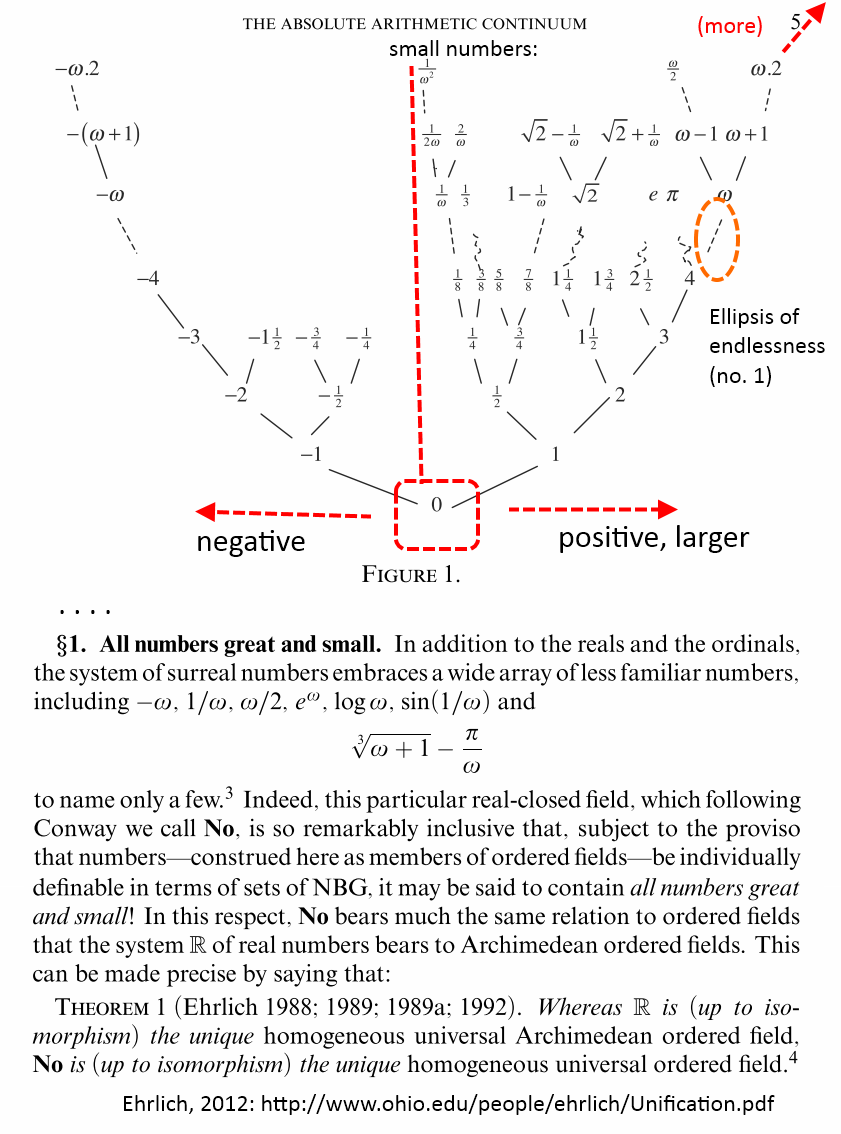
unity

Where also, this continuum result is useful:
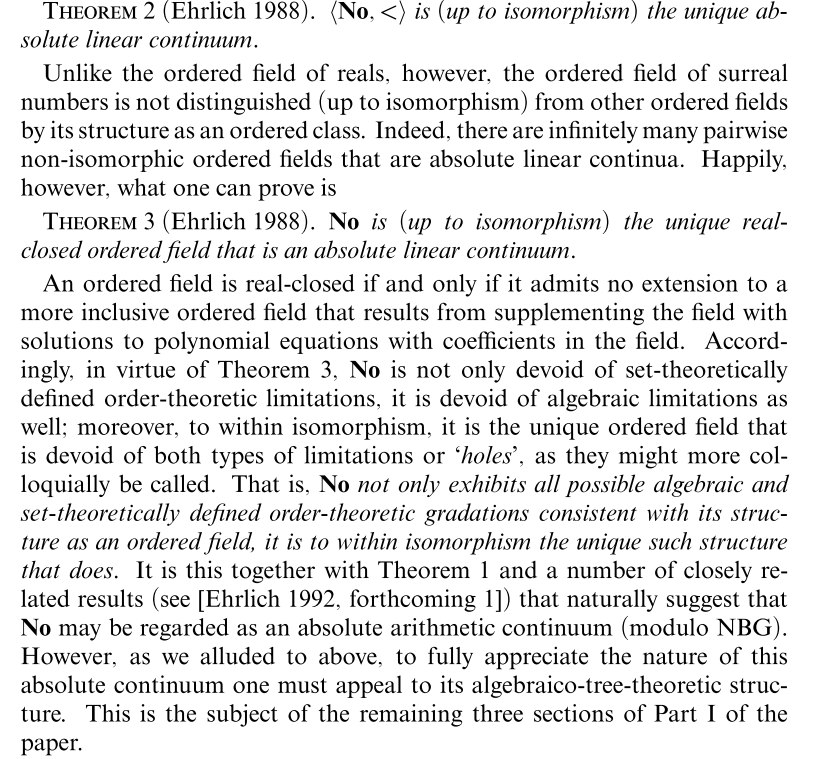
unified_continuum

PPS: As a blue vs pink punched paper tape example is used below, cf the real world machines
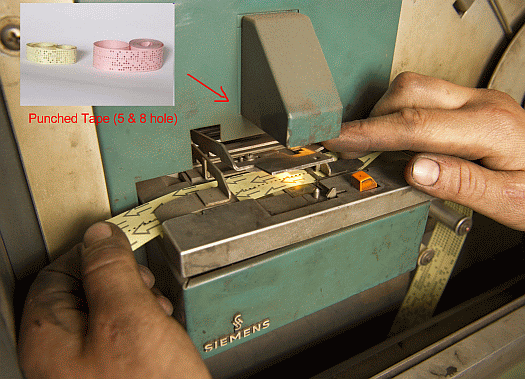
Punched paper Tape, as used in older computers and numerically controlled machine tools (Courtesy Wiki & Siemens)

and the abstraction for mathematical operations:
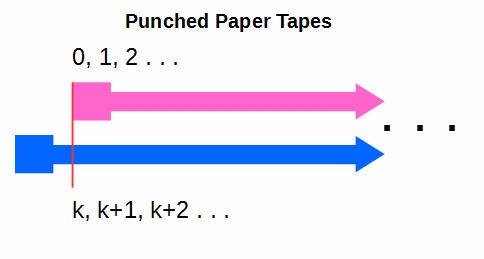
punchtapes_1-1

Note as well a Turing Machine physical model:
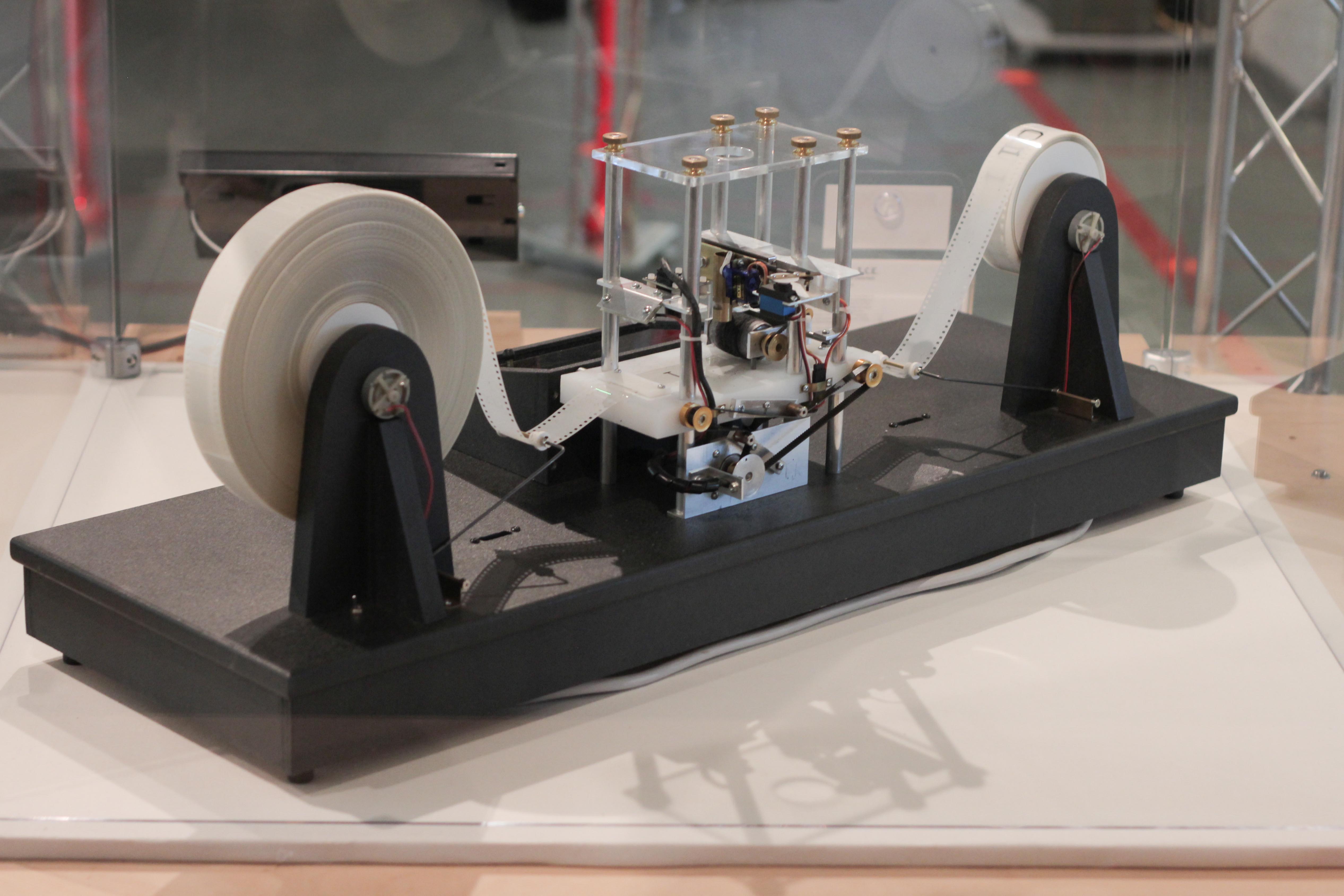
Turing_Machine_Model_Davey_2012

and its abstracted operational form for Mathematical analysis:
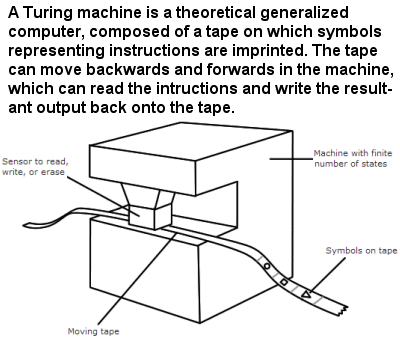
turing_machine

F/N: HT BA77, let us try to embed a video: XXXX nope, fails XXXX so instead let us instead link the vid page.

Comments
I'd like to offer a few thoughts here, but I'm jumping in very late so please correct me if I've gotten anyone's position wrong. Also, I have no expertise when it comes to math, so I'm going to leave that aspect alone and simply deal with the logic. daveS, you said:
If you replaced the word “endless” with “beginningless” [i.e. "ending a beginingless succession" rather than "ending and endless succession"], or “order type ?*”, this would make more sense to me.
And
If I start counting through the natural numbers in order, starting at 0, then I’m “beginning the endless” in your language. There’s nothing contradictory about that right? Likewise, there’s nothing contradictory about “ending the beginningless”. It obviously is a very strange concept from our perspective, but I don’t see any straightforward logical problem with it.
It seems there is a fairly straightforward logical problem, whether we speak of "ending the endless" or "ending the beginningless". KF's example illustration of descending a ladder is quite apt. Imagine walking into a field and seeing a ladder running straight up into the sky as far as you can see. Near the bottom is a man climbing down the ladder towards the ground. As you get closer you hear him say, "3, 2, 1, done. Wow, I have literally been climbing down that ladder forever." Is his statement even coherent? Taken literally, this man is claiming to have ended a climb down a beginningless succession of rungs and to thereby have traversed an infinite sequence one step at a time. But if the ladder truly has an infinite number of rungs, such that there is no first, highest rung to the ladder, then the man could not have traversed all the rungs of the ladder to reach the ground, as there was no opportunity for him to begin his descent. That any particular rung is only a finite distance from the ground is irrelevant, because the man is climbing down the ladder towards the ground, not up the ladder and away from the ground. As such, the absence of any beginning point for the man to have started a descent means that no matter what particular rung you might choose, however far from the ground it might be, the man could never have gotten even to that rung, much less to the ground. The man would always be infinitely far from any particular rung you might choose. So, if we accept that the ladder truly has an infinite number of rungs and yet the man has reached the ground, the only logical conclusion is that the man began his descent down the ladder at some specific time and at some specific rung that was a finite distance from the ground and that that rung where he began his descent was preceded by an infinite number of other rungs. In other words, even if we were to allow the possible existence of actual infinities in the real world (which I don't), we would still be left with the impossibility of traversing those infinities through any stepwise chain, whether we're talking about seconds, causal events, or anything else. As such, even if some sort of time dimension could exist eternally in some sense, any physical type of space in which events, change, motion, or anything of the sort is capable of taking place would need to have an absolute beginning point. Your notion that one might "end the beginningless" seems to come from an idea that there is some kind of symmetry between the future and the past with regard to infinities, but there isn't. If we assume that the universe will simply go on existing forever, then the future would constitute a potential infinite, but as we move into the future, no matter how far we go, there would only ever be a finite number of days that had passed since the Big Bang and we would never reach a point where the universe was infinitely old and an infinite succession of days, minutes, seconds or events had been traversed. On the other hand, if the past is beginningless then we immediately find ourselves with an actual infinite number of past days, minutes, seconds or events that have been traversed, one at a time, to arrive at the present. In other words, we have walked into a field and found a man stepping off the last rung of an infinite ladder, finishing an infinite climb that he never started. The logic that allows us to recognize the future as a potential infinite that is never actualized because every particular point, day or event is only a finite distance from the Big Bang simply does not help us with the past. It doesn't matter that every negative point going into an infinite past would be a finite distance from whatever zero-point we choose (e.g. the Big Bang) because the issue isn't going into an infinite past ... it's having come from an infinite past. If you try to weigh the logical coherence of an infinite past by picturing a sequence that starts at a selected zero-time and proceeds infinitely into the past along a negative timeline then you're going to come to false conclusions because you're starting in the wrong place and, for all intents and purposes, confusing the past for the future. So, in short: Beginning the Endless = coherent Ending the Endless = incoherent Ending the Beginningless = incoherent Take care, HeKSHeKS
March 30, 2016
March
03
Mar
30
30
2016
01:08 AM
1
01
08
AM
PDT
DS, pardon but this begins to look like futile circles of semantics. Beginningless entails an endless past, one that recedes further into the past forever, beyond any arbitrarily large but finite value. By contrast, stating a PARTICULAR value defines a distinct point in some notation system thus instantiating a finite and definite number in some system of units. Endlessness proceeds beyond any such value and resists trying to list it out and exhaust it, we resort to ellipses of endlessness. That has been my point and you know that I find for cause a serious defect in claims about infinitely many finite and discrete, finite stage incremented values constituting a set of infinite cardinality -- whether positive or negative direction. Such a set by definition if fully expressed MUST entail what we cannot get to in such discrete steps, a transfinite value that involves in itself a completed endlessness. In other words I am finding here assertions that can be put in words but which on inspection involve mutually contradictory required characteristics, similar to a square circle or a triangle with five vertices etc. KFkairosfocus
March 30, 2016
March
03
Mar
30
30
2016
12:32 AM
12
12
32
AM
PDT
KF,
The problem with beginningless quasi-spatial causal succession is rather like saying one has endlessly since infinity past been descending a ladder.
Beginninglessly, rather than endlessly.
It entails that one once was at a rung that is endlessly remote — I do not claim it was the first — and has in steps descended to the present, traversing endlessness.
But this doesn't square with #1107, where you stated that "no particular actual past time point was infinitely remote in seconds". If the ladder is being descended at one rung per second, how many seconds ago were we at this endlessly remote rung? ∞, which contradicts #1107. No, just as there was no particular instant infinitely many seconds prior to the present, there is no particular rung "endlessly remote" from the bottom of the ladder.
As for objecting to causal succession, that is an objection to physical reality, why I have spoken here of rungs of a ladder.
No, I'm not objecting to causal succession, or to physical reality. Mainly I don't want to open another can of worms. We have been discussing sequences of events in the past, for example, points in spacetime. Suppose events E_k and E_(k + 1) are separated by a spacelike interval. Then E_(k + 1) could not have been caused by E_k. I have been making no assumptions about causal relationships between the events E_k all along.daveS
March 29, 2016
March
03
Mar
29
29
2016
11:51 PM
11
11
51
PM
PDT
DS, we can set up ad start do forever loops, we can keep going at them, what we cannot do is thereby successively traverse an endless span. The problem with beginningless quasi-spatial causal succession is rather like saying one has endlessly since infinity past been descending a ladder. It entails that one once was at a rung that is endlessly remote -- I do not claim it was the first -- and has in steps descended to the present, traversing endlessness. And, ending it. As for objecting to causal succession, that is an objection to physical reality, why I have spoken here of rungs of a ladder. We know from the tapes example and the problem of going on from k, that the proposed span to be traversed cannot credibly be spanned in successive steps, as endlessness forever recedes before the kth value in succession. Thus also, the issue pivots on what it means to have a claimed infinite past. KFkairosfocus
March 29, 2016
March
03
Mar
29
29
2016
11:10 PM
11
11
10
PM
PDT
KF, PS to this in my #1110:
If you replaced the word “endless” with “beginningless”, or “order type ?*”, this would make more sense to me. Infinite sequences of order type ?*, with a greatest element, do exist.
If I start counting through the natural numbers in order, starting at 0, then I'm "beginning the endless" in your language. There's nothing contradictory about that right? Likewise, there's nothing contradictory about "ending the beginningless". It obviously is a very strange concept from our perspective, but I don't see any straightforward logical problem with it.daveS
March 29, 2016
March
03
Mar
29
29
2016
07:24 PM
7
07
24
PM
PDT
kf writes,
I am not mapping my beliefs, I am mapping what seem to be the ideas or implications of claims of multiverse-ish believers who hold to an infinite actual [quasi-?] physical past.
OK, that is clear. I'm not interested in these "multiverse-ish believers who hold to an infinite actual [quasi-?] physical past", so I'll quit expressing my metaphysical concerns.Aleta
March 29, 2016
March
03
Mar
29
29
2016
06:43 PM
6
06
43
PM
PDT
KF,
DS, given causal succession of finite stages, I would agree that — absent a compelling reason to see otherwise — no particular actual past time point was infinitely remote in seconds, stages etc,
:O I think we agree on that point.
I take it, we agree there was an actual past that has causally descended to now . . . just as successive seconds are causally connected and accumulating. The issue is whether it is open and endless in the past like a negative going left axis without limit, with a zero point at say Big Bang then forward to now. KF
I do agree with most of this; I would prefer to say as little about causality as possible, but I think your description of the issue in the last sentence is right. Edit---From your reply to Aleta:
I further challenge the claim that there has been infinite quasi-physical past as implying an infinite past regress of causal stages, leading to implied traversal of and ending an endless succession of finite cumulative stages.
If you replaced the word "endless" with "beginningless", or "order type ω*", this would make more sense to me. Infinite sequences of order type ω*, with a greatest element, do exist.daveS
March 29, 2016
March
03
Mar
29
29
2016
06:08 PM
6
06
08
PM
PDT
A, I am not mapping my beliefs, I am mapping what seem to be the ideas or implications of claims of multiverse-ish believers who hold to an infinite actual [quasi-?] physical past. Wherein, there is an onward past chain of antecedents beyond the singularity to endlessness in prior proposed time. My argument is we can IMAGINE such but once it proposes causally successive cumulative stages to the present, it is implicitly proposing a traversal of a proposed endless past in finite stages, running into serious concerns. Think of is it Linde's model of ever budding and expanding sub-cosmi as one example. I suggest a different mode of existence, eternity in common parlance, would be a relevant consideration. Also, that on pondering possible vs impossible being the latter has core characteristics in mutual contradiction and cannot be actualised in any world. Of possible, contingents are dependent on external enabling factors that if one or more are "off" the being cannot exist -- think fire and heat oxidiser fuel chain rxn. Necessary beings are so connected to the framework of a world that for any world to exist, they must be. Compounding, non-being has no causal influence and if there were ever utter non being such would forever obtain. The issue as there is an actual world, is which serious candidate necessary beings are possible. If possible, in any world and in our actual one, perforce. I further challenge the claim that there has been infinite quasi-physical past as implying an infinite past regress of causal stages, leading to implied traversal of and ending an endless succession of finite cumulative stages. Sorry, this stuff is complex and weird, but important to foundations of thought. It seems this is now dubbed the battle of infinity. Let us hope not a Verdun or a Somme. KFkairosfocus
March 29, 2016
March
03
Mar
29
29
2016
05:33 PM
5
05
33
PM
PDT
kf, If we take zero to be the Big Bang, so that causally connected events appear sequentially in time up to the present moment, how do you know that a similar causally connected set of temporally ordered events preceded the Big Bang? What evidence do you have that the metaphysical world, in whatever form it may be, out of which our universe came, has the same properties of time and cause-and-effect as our universe does?Aleta
March 29, 2016
March
03
Mar
29
29
2016
05:21 PM
5
05
21
PM
PDT
DS, given causal succession of finite stages, I would agree that -- absent a compelling reason to see otherwise -- no particular actual past time point was infinitely remote in seconds, stages etc, per the challenge of traversing the endless in successive finite stage steps. I take it, we agree there was an actual past that has causally descended to now . . . just as successive seconds are causally connected and accumulating. The issue is whether it is open and endless in the past like a negative going left axis without limit, with a zero point at say Big Bang then forward to now. KFkairosfocus
March 29, 2016
March
03
Mar
29
29
2016
04:17 PM
4
04
17
PM
PDT
KF,
DS I already said just that re WLC, for any particular specified point or stage of cause-effect in the past.
Ok, I understand this to mean yes, you do agree with WLC on that point. You would not agree to the statement "no particular instant in the past occurred infinitely many seconds from the present", I take it?daveS
March 29, 2016
March
03
Mar
29
29
2016
03:50 PM
3
03
50
PM
PDT
DS I already said just that re WLC, for any particular specified point or stage of cause-effect in the past. Beyond would lie onward endlessness. Insofar as mathematics is a logical study it should eschew contradictions in terms/core characteristics showing something like a square circle; here, traversing and ending the endless through stepwise finite cumulative stages. That logical factors constrain what is possible through needed coherence of core characteristics is a significant issue and a gateway to mathematics as a powerful analytical tool and even causal force. KF PS: B to weak B+ today, would have wished for a cost effectiveness case in point and exploitation of 800th of Magna Carta to point the way to reform rooted in ancient, rich principle. I am again sobered by how much impact manner esp confident seeming assertive manner has . . . not to mention dismissive negatives and put-downs; life is rhetoric more than logic. Such is life.kairosfocus
March 29, 2016
March
03
Mar
29
29
2016
03:19 PM
3
03
19
PM
PDT
KF,
DS, pardon but the force of C S Lewis’ pennies in a drawer example is in key part that the logic of structure and quantity — a matter of pure abstract logic — constrains physical reality (providing an intervening unobserved operation is not being overlooked).
Yes, but I don't believe you have given any mathematical arguments which show that an infinite past is impossible, and the vast majority of mathematicians would say the same. Back to the WLC quote, then: do you agree with him than any particular instant in the past would be within a finite number of seconds of the present?daveS
March 29, 2016
March
03
Mar
29
29
2016
06:00 AM
6
06
00
AM
PDT
Aleta, did you notice WLC's point, any PARTICULAR number -- one that you pick, i.e. state or represent as a specific value say k [here, actually - k]? There is a difference there that brings in the force of endlessness beyond any particular stated or picked numeral or value in place value or sci notation form or even algebraic form where the value say - k is constrained to be finite and definite to a particular case. In short, we cannot write down in that sort of form or pronounce in words a value that is achievable in finite stage steps from 0 that is transfinite, but we know from the tapes example that -- reverting to positives WLOG -- beyond any arbitrarily large but finite k, endlessness proceeds such that k, k+1 etc can be readily matched with 0, 1 etc. We cannot even scratch the surface of endlessness, and resort to the ellipsis then limit ordinal w BEYOND the span, and so on, on, on to the surreals and the tree of numbers most fruitfully large and small: which is not the least important point put on the table for general discussion through this thread. It seems the radical even shocking force of this has still to soak in fully. Before I definitely go back to budgie cheaping, I need to say take A = w + g and define a less one process so that A ~1 = [ w + (g - 1)], g of course finite and w is omega. Repeat ~1 until we exhaust g and are at w. That is the finite incremental part of A is wiped out in g steps of ~1. Now, continue k "further" times "beyond" w. Or, try. It fails, in effect, w ~ k --> w, precisely because w is a qualitative difference from finite values, there is no finite defined value v that is such that v +1 --> w. That is, w is a limit, the order type of first degree endlessness, and we have again seen the force of, you cannot traverse the endless in finite scale +1or ~1 steps. Which BTW is part of why VC's set subtraction exercises fail to work with transfinites. 0,1,2 etc, 0, 2, 4, etc and 1, 3, 5 etc are all ways to represent the same first degree endlessness and because of endlessness can be transformed the one sequence into the other. More radical, shocking properties. Oh, well, the budgie calls. Cheap, cheap, cheap. KFkairosfocus
March 29, 2016
March
03
Mar
29
29
2016
01:42 AM
1
01
42
AM
PDT
DS, pardon but the force of C S Lewis' pennies in a drawer example is in key part that the logic of structure and quantity -- a matter of pure abstract logic -- constrains physical reality (providing an intervening unobserved operation is not being overlooked). Logic of abstract entities has causal constraining force in the physical world. Hence the famous remark by was it Wheeler on the astonishing power of mathematics in the physical sciences. My fav example was the objection to Young et al (and in particular Fresnel), that if a wave interference/ diffraction, Huygens wavelet type theory was right there should be a little dot of light in the centre of the shadow of a small ball under relevant circumstances. It was thought, so there, obviously no one has seen such. Then, someone did the experiment. The dot is there: https://en.wikipedia.org/wiki/Arago_spot . It seems, it is now also observed for beams of particles, i.e. the wavicle nature of matter at molecular scale is confirmed similarly. And, on the suggestion of a transfinite actual physical past, there are logic of structure and quantity [plus linked relations and operations etc] -- mathematical -- issues to be answered to. KFkairosfocus
March 29, 2016
March
03
Mar
29
29
2016
01:19 AM
1
01
19
AM
PDT
MT (attn IE), kindly consult the pink and blue punched tape thought exercise which has been repeatedly discussed [and put up in the OP] and which draws out the significance of something being endlessly beyond any arbitrarily large finite value, especially putting k, k+1 etc in perfect correspondence with the un-shifted naturals. This can be repeated k times to the same effect, shifting by k^2 --> k'. Then do that k' times to get k", and so forth. At no stage of increasingly large finite steps have we even scratched the surface of endlessness. That is how radical the concept is, and the only way for it to soak in is by such a paradigmatic example, a fresh one as Hilbert's Hotel has become too familiar and ho hum. Beyond a certain point, too, enough has been said so to act as though it has not is to become fallacious. For, a definition by instructive example has been given. Yes, it is horribly shocking, but in that shock it tells us what the significance of w is. Including why trying to subtract a finite from w will be fruitless, you cannot span or traverse the endless in finite stage steps. You cannot even scratch the surface. Endlessness -- so often represented by a seemingly insignificant three dot ellipsis -- is pivotal. And, the struggle of this thread is to understand endlessness, given that mathematics is the logical study of structure and quantity. This thread is foundational and foundationally significant. Back to budgie cheaping away -- and yes that is a very low grade pun. But I have to find some way to laugh as I deal with grim things, that are so key I can only give snatches of attention here for the moment. Hopefully in a day or two. KFkairosfocus
March 29, 2016
March
03
Mar
29
29
2016
01:09 AM
1
01
09
AM
PDT
KF @ 1097
DS, notice also, any PARTICULAR negative number will be finitely remote from 0. That is endlessness beyond any particular number is a relevant factor. Oddly, I had intent to pick up that exact point when the budgies stop cheaping . . . pardon the awful puns, but we have to be able to laugh at something.
You will pick a number beyond which 'endlessness' starts? What is your definition of endlessness? How is it different from infinity?Me_Think
March 28, 2016
March
03
Mar
28
28
2016
07:57 PM
7
07
57
PM
PDT
KF,
DS, notice also, any PARTICULAR negative number will be finitely remote from 0. That is endlessness beyond any particular number is a relevant factor. Oddly, I had intent to pick up that exact point when the budgies stop cheaping . . . pardon the awful puns, but we have to be able to laugh at something. KF
Yes, he did say "any", so perhaps in the sense of Russell. I would be interested to know if he objects to the statement "all negative integers are finitely remote from 0". I suspect not, but who knows. Now, do you therefore agree than any particular instant in the past would be within a finite number of seconds of the present?daveS
March 28, 2016
March
03
Mar
28
28
2016
07:51 PM
7
07
51
PM
PDT
WLC is quoted as saying,
For from any point in the infinite past at which God chose to create there is only a finite distance to the present, just as any negative number you pick is only finitely distant from 0, even though there are an infinite number of negative numbers.
That is, he says, 1a. Any negative number is finite 1b. Therefore all negative numbers are finite 2. There are an infinite number of negative numbers. kf, do you agree with WLC?Aleta
March 28, 2016
March
03
Mar
28
28
2016
07:42 PM
7
07
42
PM
PDT
DS, notice also, any PARTICULAR negative number will be finitely remote from 0. That is endlessness beyond any particular number is a relevant factor. Oddly, I had intent to pick up that exact point when the budgies stop cheaping . . . pardon the awful puns, but we have to be able to laugh at something. KFkairosfocus
March 28, 2016
March
03
Mar
28
28
2016
06:40 PM
6
06
40
PM
PDT
KF,
DS, endlessness beyond any finite value is the substance of infinity, the latter is just a label until endlessness is brought to bear, and indeed that is part of the underlying dynamic of the match with proper subset approach, it is because of the endlessness property that it works, even with say primes, as in the list of primes is endless in succession though obviously on average sparser and sparser as we go up in scale. KF
I'm not totally clear on the meaning of this, but is it consistent with the bolded sentence from the WLC quote?daveS
March 28, 2016
March
03
Mar
28
28
2016
03:03 PM
3
03
03
PM
PDT
Re 1091: Electrons are cheap. There have actually been quite a few interesting points developed in this thread, for those interested in the topic.Aleta
March 28, 2016
March
03
Mar
28
28
2016
02:59 PM
2
02
59
PM
PDT
DS, endlessness beyond any finite value is the substance of infinity, the latter is just a label until endlessness is brought to bear, and indeed that is part of the underlying dynamic of the match with proper subset approach, it is because of the endlessness property that it works, even with say primes, as in the list of primes is endless in succession though obviously on average sparser and sparser as we go up in scale. KFkairosfocus
March 28, 2016
March
03
Mar
28
28
2016
02:26 PM
2
02
26
PM
PDT
Indiana Effigy, Is someone putting a gun to your head?mike1962
March 28, 2016
March
03
Mar
28
28
2016
12:22 PM
12
12
22
PM
PDT
KF, Some additional food for thought, from WLC's website. Dr Craig is responding to a Muslim who is arguing for the possibility of an infinite past:
(Actually, as I think about it, it occurs to me that your argument is fallacious even if there was an infinite series of temporal points prior to creation! For from any point in the infinite past at which God chose to create there is only a finite distance to the present, just as any negative number you pick is only finitely distant from 0, even though there are an infinite number of negative numbers. From the fact that at any point in an infinite past God is able to create a world, it does not follow that God was able to create a world with an infinite past.)
(Some bolding added)daveS
March 28, 2016
March
03
Mar
28
28
2016
12:15 PM
12
12
15
PM
PDT
I hate to be the bearer of the patently obvious, but this entire thread ranks right up there with the arguments over how many angels can fit on the head of a pin. What is mind boggling insane is that it has lasted over 1000 comments. Give it up. Everyone. It is just a waste of electrons.Indiana Effigy
March 28, 2016
March
03
Mar
28
28
2016
11:29 AM
11
11
29
AM
PDT
KF, I'm not attempting any sort of "move". The definition you are giving of "endless" seems to coincide with the definition of "infinite" you quoted from the dictionary, so I'm wondering why you need two terms when just one will do. It would also make your statement above:
DS, my point is, that if there were an infinitely remote point in time as part of the past it would have to be endlessly remote.
tautological, which leads me to question why it needs to be stated. Is there any difference between infinite and endless sets? If so, what is the difference? Can you give examples of sets which are endless but not infinite (or vice-versa)?daveS
March 28, 2016
March
03
Mar
28
28
2016
10:53 AM
10
10
53
AM
PDT
DS, endless means just that as per the pink and blue tape example as has been pointed out any number of times above. That is, for something that comes in distinct lumps or steps of finite scale, for any kth member of arbitrarily large but finite scale, k, k+1 and so forth can be put in 1 to 1 correspondence with 0,1,2 etc without limit. And by extension that can be repeated any number of times. I trust by now there is willingness to move beyond the let's demand the [already repeatedly given or adequately explained or exemplified] definition yet again move. Beginninglessness would be the much the same; save time is a key context of the lumps or stages, in the cases in view causal succession from past to present. As has also been repeatedly given including by use of symbolisations. KFkairosfocus
March 28, 2016
March
03
Mar
28
28
2016
10:42 AM
10
10
42
AM
PDT
KF, Of course #4(b) is the relevant definition for us. #1(a) as well; an infinite past is unbounded. How does "endless" differ (in your usage---I've already stated how I think "endless" and "beginningless" should be defined).daveS
March 28, 2016
March
03
Mar
28
28
2016
08:13 AM
8
08
13
AM
PDT
infinite (??nf?n?t) adj 1. a. having no limits or boundaries in time, space, extent, or magnitude b. (as noun; preceded by the): the infinite. 2. extremely or immeasurably great or numerous: infinite wealth. 3. all-embracing, absolute, or total: God's infinite wisdom. 4. (Mathematics) maths a. having an unlimited number of digits, factors, terms, members, etc: an infinite series. b. (of a set) able to be put in a one-to-one correspondence with part of itself c. (of an integral) having infinity as one or both limits of integration. Compare finite2 ?infinitely adv ?infiniteness n Collins English Dictionary – Complete and Unabridged, 12th Edition 2014 © HarperCollins Publishers 1991, 1994, 1998, 2000, 2003, 2006, 2007, 2009, 2011, 2014kairosfocus
March 28, 2016
March
03
Mar
28
28
2016
07:59 AM
7
07
59
AM
PDT
1 9 10 11 12 13 48

Leave a Reply