Uncommon Descent Serving The Intelligent Design Community

Durston and Craig on an infinite temporal past . . .

Categories
Atheism
Mathematics
rhetoric
worldview
Share
Facebook
Twitter/X
LinkedIn
Flipboard
Print
Email

In recent days, the issue of an infinite temporal past as a step by step causal succession has come up at UD. For, it seems the evolutionary materialist faces the unwelcome choice of a cosmos from a true nothing — non-being or else an actually completed infinite past succession of finite causal steps.

Durston:

>>To  avoid  the  theological  and  philosophical  implications  of  a  beginning  for the  universe,  some  naturalists  such  as  Sean  Carroll  suggest  that  all  we  need  to  do  is  build  a  successful  mathematical  model  of  the  universe  where  time  t runs  from  minus  infinity  to  positive  infinity. Although  there  is  no  problem  in  having  t run  from  minus  infinity  to  plus  infinity with  a  mathematical  model,  the real past  history  of  the  universe  cannot  be  a  completed  infinity  of  seconds  that  elapsed,  one  second  at  a  time. There  are at  least  two  problems.  First,  an  infinite  real  past  requires  a  completed  infinity, which  is  a  single  object and  does  not  describe  how  history  actually  unfolds.  Second,  it  is  impossible  to  count  down  from  negative  infinity  without  encountering the  problem  of  a  potential infinity  that  never  actually  reaches  infinity. For  the  real  world,  therefore,  there  must  be  a  first  event  that  occurred  a  finite  amount  of  time  ago  in  the  past . . . [More] >>

Craig:

>Strictly speaking, I wouldn’t say, as you put it, that a “beginningless causal chain would be (or form) an actually infinite set.” Sets, if they exist, are abstract objects and so should not be identified with the series of events in time. Using what I would regard as the useful fiction of a set, I suppose we could say that the set of past events is an infinite set if the series of past events is beginningless. But I prefer simply to say that if the temporal series of events is beginningless, then the number of past events is infinite or that there has occurred an infinite number of past events . . . .

It might be said that at least there have been past events, and so they can be numbered. But by the same token there will be future events, so why can they not be numbered? Accordingly, one might be tempted to say that in an endless future there will be an actually infinite number of events, just as in a beginningless past there have been an actually infinite number of events. But in a sense that assertion is false; for there never will be an actually infinite number of events, since it is impossible to count to infinity. The only sense in which there will be an infinite number of events is that the series of events will go toward infinity as a limit.

But that is the concept of a potential infinite, not an actual infinite. Here the objectivity of temporal becoming makes itself felt. For as a result of the arrow of time, the series of events later than any arbitrarily selected past event is properly to be regarded as potentially infinite, that is to say, finite but indefinitely increasing toward infinity as a limit. The situation, significantly, is not symmetrical: as we have seen, the series of events earlier than any arbitrarily selected future event cannot properly be regarded as potentially infinite. So when we say that the number of past events is infinite, we mean that prior to today ℵ0 events have elapsed. But when we say that the number of future events is infinite, we do not mean that ℵ0 events will elapse, for that is false. [More]>>

Food for further thought. END

PS: As issues on numbers etc have become a major focus for discussion, HT DS here is a presentation of the overview:
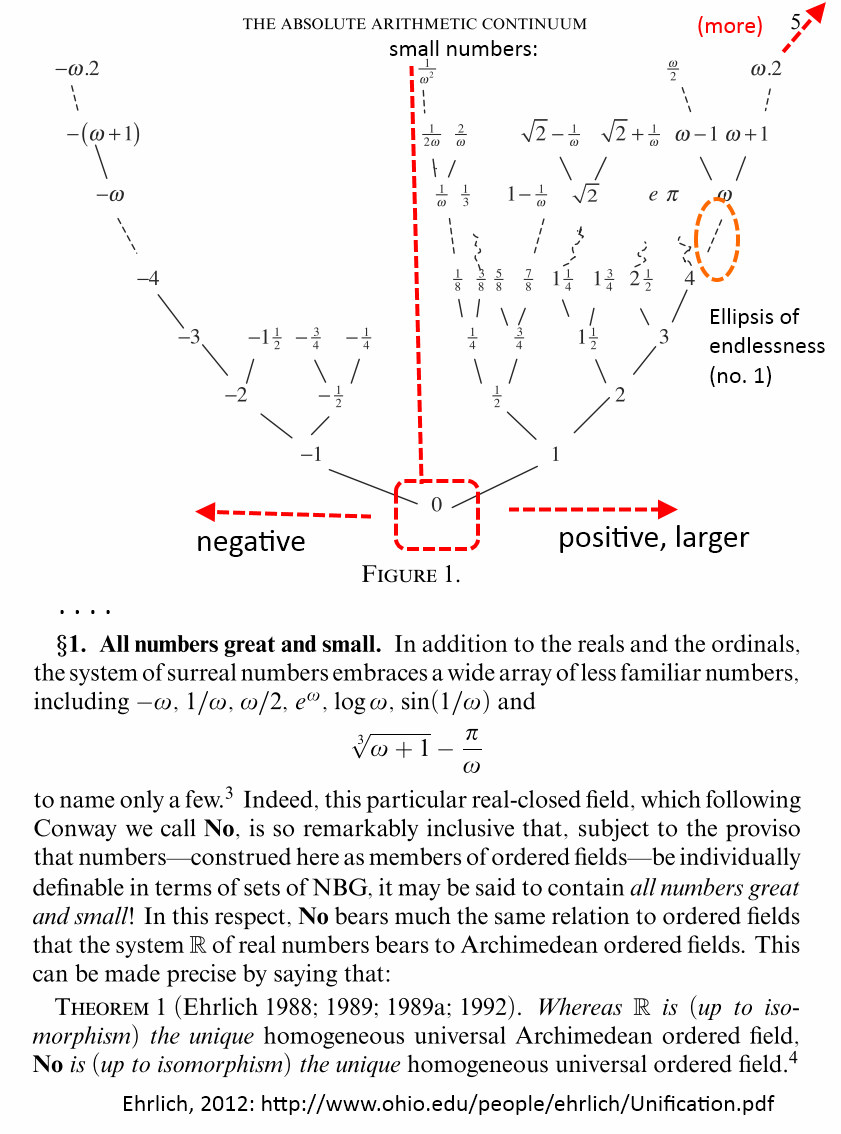
unity

Where also, this continuum result is useful:
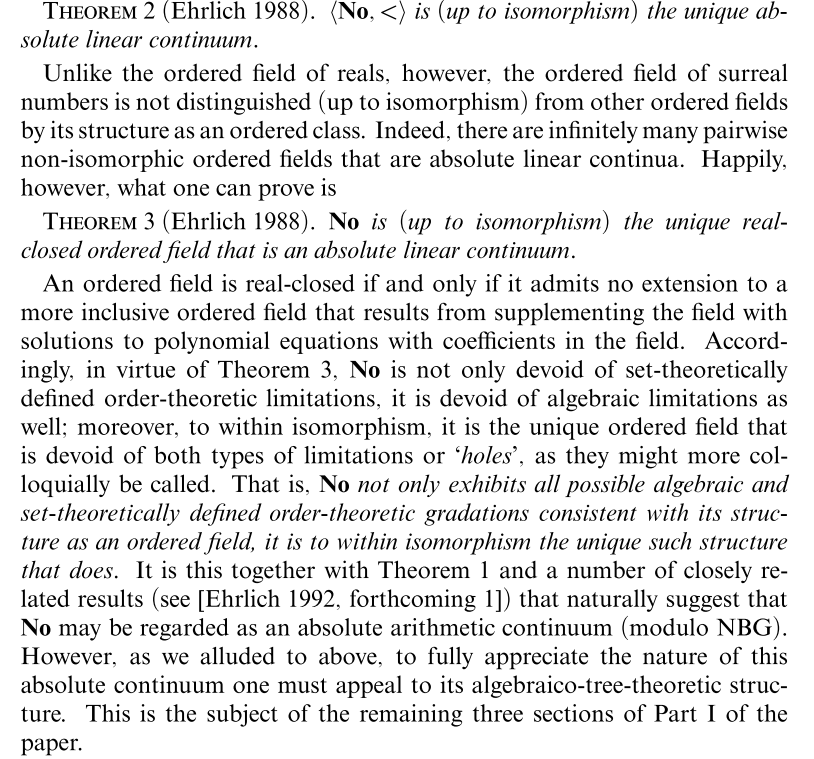
unified_continuum

PPS: As a blue vs pink punched paper tape example is used below, cf the real world machines
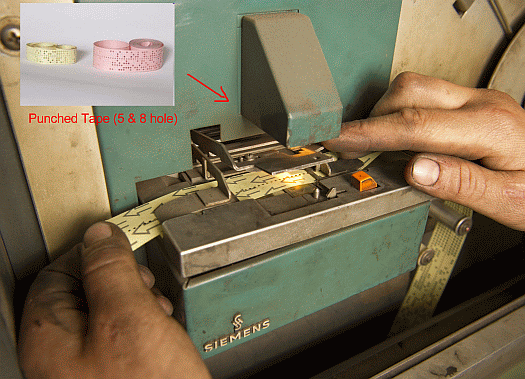
Punched paper Tape, as used in older computers and numerically controlled machine tools (Courtesy Wiki & Siemens)

and the abstraction for mathematical operations:
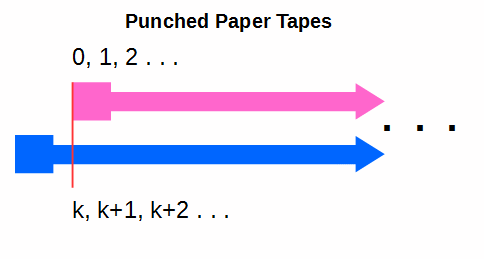
punchtapes_1-1

Note as well a Turing Machine physical model:
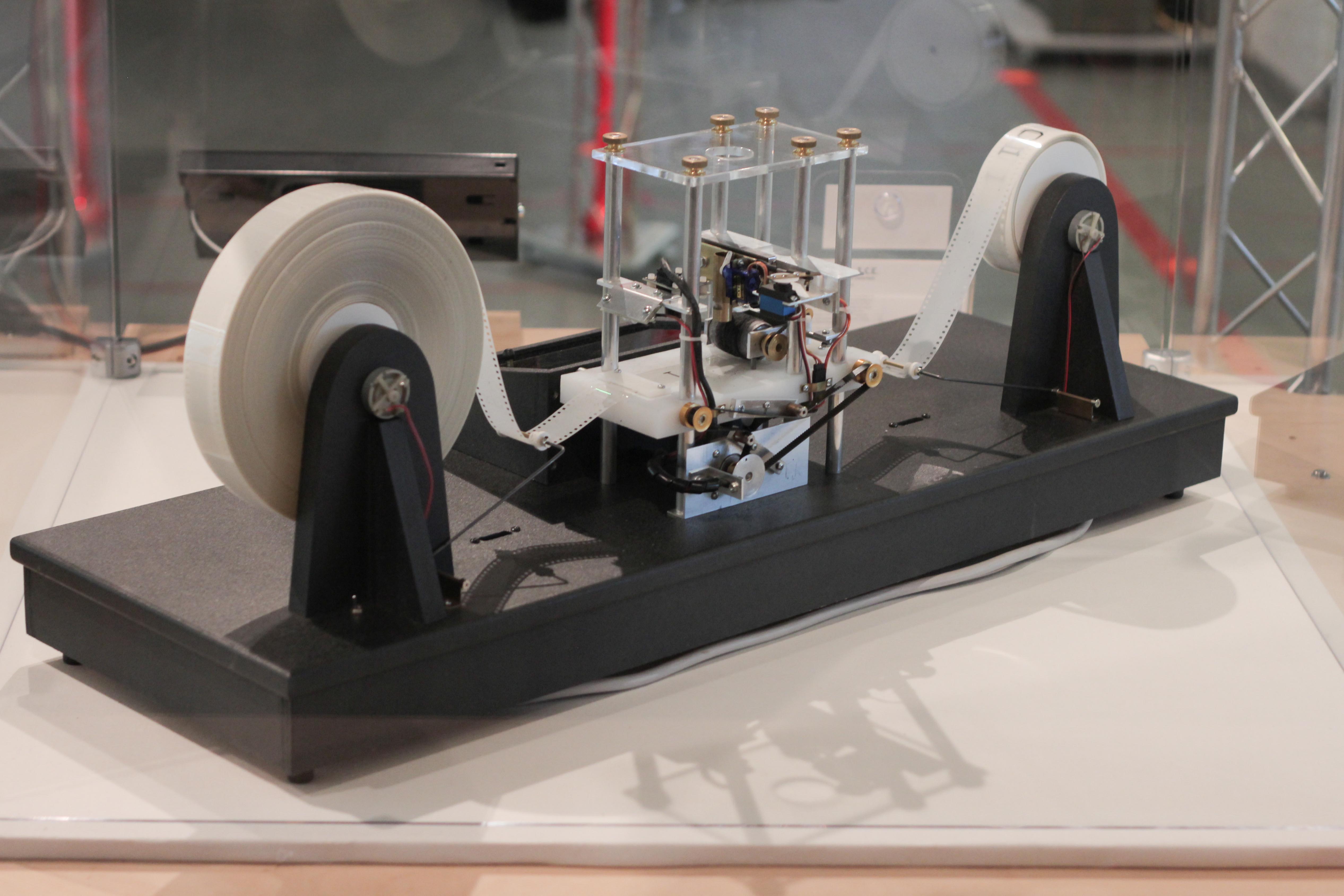
Turing_Machine_Model_Davey_2012

and its abstracted operational form for Mathematical analysis:
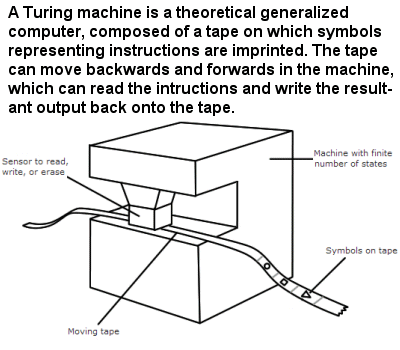
turing_machine

F/N: HT BA77, let us try to embed a video: XXXX nope, fails XXXX so instead let us instead link the vid page.

Comments
Aleta, Wow, that's a very beautiful result. I didn't expect such a nice pattern.daveS
March 18, 2016
March
03
Mar
18
18
2016
06:32 AM
6
06
32
AM
PDT
The basketball stuff is not related at all - it's just a complete tangent.Aleta
March 18, 2016
March
03
Mar
18
18
2016
06:21 AM
6
06
21
AM
PDT
MT, The OP sets the frame, and the question of the infinite arose in that context. I suspect it is coming to a point where it is clear that there are valid issues there, it is not as cut and dried as doing a class may suggest. Bottomline, trying to traverse the transfinite in finite stage cumulative steps is problematic. As causal succession to our present world fits under that, the implication is suggesting an infinite past for the physical cosmos fails. Where also pulling a cosmos out of non being is even more problematic. We are looking at necessary being root of reality. KFkairosfocus
March 18, 2016
March
03
Mar
18
18
2016
04:38 AM
4
04
38
AM
PDT
I can no longer figure out what this thread is about !Me_Think
March 18, 2016
March
03
Mar
18
18
2016
03:16 AM
3
03
16
AM
PDT
Those are all correct, and your answers are exact and mine had some rounding off errors. I worked on this today while watching the games. I set up a spreadsheet, which made me think carefully about the formulas, and made some interesting discoveries by changing the probabilities. I found out it's never better to guess an upset no matter what the odds are: the EV for going with the higher seed in every game, is always better than the EV for guessing one or more upsets. Then I worked out all the formulas and got formulas for EV(0 = no upsets), EV(1), etc. After doing that, I saw some results that were simple and made sense. This all followed a pattern I've noticed before in problem solving. First I work out an example with real numbers; Then I explore it algebraically because both the process and results of working with numbers give me some hints. Then, after doing things the long way, I see some results that have more direct routes. And finally some times I see that results make sense in some more intuitive, meaningful ways. Anyway, if p = probability of the higher seed winning, and q = 1 - p = probability of an upset with the higher seed winning. EV(0) = 4p (This is a duh! You have an expected value of p per game, and there are 4 games.) EV(4) = 4q. Same reasoning. The math doesn't care whether you are playing to win or playing to lose. EV(2) = 2 no matter what the odds. At first this was a surprise, but it makes sense because the math is symmetrical: two upsets is the same as two non-upsets, so you get 1/2 the possible 4 points no matter what. EV(1) = 2p + 1 and EV(3) = 3 - 2p = 2q + 1, which makes sense because the math is symmetrical as to p and q. Interestingly enough, the difference between any two EV's, such as EV(2) - EV(3) is always 2p - 1. Therefore EV(0) is always bigger than EV(1), with the amount of the difference depending on p. Thus, the bigger that p is, the more difference it makes to not pick an upset, which makes sense also.Aleta
March 17, 2016
March
03
Mar
17
17
2016
09:50 PM
9
09
50
PM
PDT
Aleta, I just noticed I reversed the probabilities above, saying that 0.7 is the probability of an upset, when it's actually 0.3. Anyway, I got a few minutes to work in this, and did get an EV of 2.8 assuming we predict 0 upsets, and 2.4 assuming 1 upset, both exact. I'm not sure if I made a mistake with the 2.4, since it's a little different than your answer. I also got an EV of 1.2 assuming we predict 4 upsets. Is that what you're getting? I'll try the others tomorrow! I'm interested to know whether you can get a higher expected value by predicting 1 or more upsets if we increase the number of games or adjust the probabilities.daveS
March 17, 2016
March
03
Mar
17
17
2016
08:21 PM
8
08
21
PM
PDT
Thanks, Aleta, that helps. I might take a shot at this later today.daveS
March 17, 2016
March
03
Mar
17
17
2016
06:53 AM
6
06
53
AM
PDT
You got the basic picture. The first part of the problem, P(0), P(1), etc. is a straightforward binomial probability problem. I used to teach this in pre-calculus class. The second part is trickier. If you get one point for each correct pick, what is the expected value for picking no upsets vs picking one upset. That is, even though the odds are that there will be an upset, the odds are also that you will be pick the wrong game for the upset to occur. I wound up figuring out the EV for picking no upsets is 2.79 and the EV for picking one upset is 2.42, so in this case it's better not to guess.Aleta
March 17, 2016
March
03
Mar
17
17
2016
06:24 AM
6
06
24
AM
PDT
Aleta, I don't know enough about the NCAA tournament to understand the question, so I had to resort to some googling. I take it we're talking about the four #5 seed vs. #12 seed games in round 1? And if so, are we trying to find P(0 upsets) and P(1 or 2 upsets) in round 1, assuming a 70% chance of an upset in each of the 4 games? I have a feeling you're asking about something much harder, which I wouldn't even know how to approach...daveS
March 17, 2016
March
03
Mar
17
17
2016
05:58 AM
5
05
58
AM
PDT
Cool. So much of this math is stuff I know very little about, other then the broad outline of the issues, but it is fascinating. I particularly like probability. Here's a problem that I'm working on while I start getting geared up for March Madness: given that 5 seeds beat 12 seeds 70% of the time (an empirical fact based on the past 26 years, as of last year), what is the expected value of picking no upsets versus one or two upsets. What's the best strategy from a purely mathematical point of view. Totally off-topic, I know: no infinity involved, although I am skeptical about any metaphysical considerations. :-)Aleta
March 16, 2016
March
03
Mar
16
16
2016
07:40 PM
7
07
40
PM
PDT
Aleta, Thanks. I think I'm more in agreement with you than with Nelson about these philosophical issues, but I do find the closing paragraphs of his chapter 1 quite poetic. Looking at his wikipedia page, sadly he passed away a couple of years ago. I didn't realize it until now, but he was the "Nelson" of the Hadwiger-Nelson problem, which has fascinated me for many years. An all-around genius, apparently:
Nelson made contributions to the theory of infinite-dimensional group representations, the mathematical treatment of quantum field theory, the use of stochastic processes in quantum mechanics, and the reformulation of probability theory in terms of non-standard analysis. For many years he worked on mathematical physics and probability theory, and he retained a residual interest in these fields, particularly in connection with possible extensions of stochastic mechanics to field theory. In 1950, Nelson formulated a popular variant of the four color problem: What is the chromatic number, denoted χ, of the plane? In more detail, what is the smallest number of colors sufficient for coloring the points of the Euclidean plane in such a way that no two points of the same color are unit distance apart? We know by simple arguments that 4 ≤ χ ≤ 7. The problem was introduced to a wide mathematical audience by Martin Gardner in his October 1960 Mathematical Games column. The chromatic number problem, also now known as the Hadwiger-Nelson problem, was a favorite of Paul Erdös, who mentioned it frequently in his problems lectures.
daveS
March 16, 2016
March
03
Mar
16
16
2016
07:21 PM
7
07
21
PM
PDT
My spouse loves books, and has quite a collection. With that said, there's a Facebook meme going around that says:
Rule #12: The correct number of books to own is n + 1, where n is the number of books currently owned.
Yikes - no wonder we keep running out of bookshelf space. When will it ever end? :-)Aleta
March 16, 2016
March
03
Mar
16
16
2016
06:36 PM
6
06
36
PM
PDT
Well this is very interesting. The last paragraph of Chapter 1 of Nelson's book brings up some major topics that tie into several different issues in this discussion.
It appears to be universally taken for granted by mathematicians, whatever their views on foundational questions may be, that the impredicativity inherent in the induction principle is harmless - that there is a concept of number given in advance of all mathematical constructions, that discourse within the domain of numbers is meaningful. But numbers are symbolic constructions; a construction does not exist until it is made; when something is new is made, it is something new and not a selection from a pre-existing collection. There is no map of the world because the world is coming into being.
Now I realize that Nelson's book is presenting a non-standard "radical" view, and without agreeing or disagreeing with all he says, here are some comments. I have argued differently: I have argued that via the symbolic abstraction of pure mathematics, we can embrace a totality - the infinite set of natural numbers. However, I have also argued that this need not refer to anything beyond mathematics: if does not refer to any actual infinity in the real, physical world, but nor does it need to refer to any speculative metaphysical reality such as a world of Platonic ideals, the mind of God, or the Tao. Nelson's notions are even further removed from metaphysics than my view, and there are some important ways in which I agree with him. He says,
But numbers are symbolic constructions; a construction does not exist until it is made; when something is new is made, it is something new and not a selection from a pre-existing collection. There is no map of the world because the world is coming into being.
This is the view that mathematics is invented, not discovered. In spite of the sense that the conclusions were "already there", so to speak, as we "bring them alive" via our logical constructions, they in fact don't exist until the moment our symbolic, logical system brings them into mathematical being. Until someone thought of using iterative functions with complex numbers to create what we now call fractals, and in fact explored the function that creates what we now call the Mandelbot set, there was no Mandelbrot set: math, according to Nelson's statement, is a world coming into being, not a map of some some pre-existing world that we tap into somehow. It is man-made, and its truth and meaning reside within itself, not in reference to anything outside itself. So even though I think that "there is a concept of number given in advance of all mathematical constructions, [and] that discourse within the domain of numbers is meaningful" (that is to say, that we can consider the infinite nature of the numbers as a completed whole), I also learn towards Nelson's view that when we create mathematics we are making "something new and not [making] a selection from a pre-existing collection." Very interesting find, dave.Aleta
March 16, 2016
March
03
Mar
16
16
2016
06:27 PM
6
06
27
PM
PDT
Thanks, looks interesting, doing an OCR. KFkairosfocus
March 16, 2016
March
03
Mar
16
16
2016
05:08 PM
5
05
08
PM
PDT
KF, I haven't found the source on Russell yet, but looking through another Feferman paper, I found this quote:
There is a radical form of predicativism which does not accept the natural numbers as a “completed totality”, i.e. over which unbounded quantification has a definite truth-functional value. This is the sense of [Nelson 1986]; Nelson’s system is much weaker than PRA, Primitive Recursive Arithmetic, whereas PRA itself is already acceptable to finitists.
which I think might be even closer to what we're discussing. Edward Nelson has actually made the entire book available on his website here. The first chapter (approximately 1 page long total) gives a nontechnical rationale for this radical form of predicativism that Feferman refers to.daveS
March 16, 2016
March
03
Mar
16
16
2016
12:50 PM
12
12
50
PM
PDT
DS, okay, do let me know. I agree a specific stated value in PVN or Sci Not'n or the Knuth multiple up arrows notation or whatever will be finite, but due to endlessness there is an onward continuation per do forever that we cannot capture other than by indicating endlessness. This leads to numbers pointed to in general but not defined specifically as 2.8769 *10^2145 would be, in PVN 287690 0 0 . . . 0, where there are 2141 0's to follow. (Obviously writing wholes this way requires care not to put in an inadvertent fractional value.) KFkairosfocus
March 16, 2016
March
03
Mar
16
16
2016
07:09 AM
7
07
09
AM
PDT
I asked Origenes some questions in a post at 994 that were a follow up to an earlier conversation. He may not have seen it, and even if he does may not want to respond (which is fine), but I thought I'd bump the issue one time.Aleta
March 16, 2016
March
03
Mar
16
16
2016
05:56 AM
5
05
56
AM
PDT
KF, One qualification: I'll have to check the original source to be sure I'm not misstating Russell's position. I'm not clear on whether he allows universal quantification over infinite sets or not (as opposed to arbitrary classes). Note that the passage does make clear that this is allowed:
any particular proposition p is either true or false
but this isn't:
For all propositions p, p is either true or false
although the law of the excluded middle is often stated in that form.daveS
March 16, 2016
March
03
Mar
16
16
2016
05:55 AM
5
05
55
AM
PDT
DS, It seems Lord Russell has a point. As I have noted above several times, particular, defined, stated numbers will either come as results of +1 stage finite cumulative steps from 0, or will be stated in forms that depend on such, place value, scientific, etc. The values we can reach will therefore be just as finite. But endlessness must be taken seriously. In that context w is in material part an emergence and recognition of a new quantitative phenomenon rather than a direct successor to any definite individual stated in particular value counting number k. The tapes exercise also shows the process can be repeated endlessly, any arbitrary number of times with the same result. Endlessness is truly extremely strange but pivotal. KFkairosfocus
March 16, 2016
March
03
Mar
16
16
2016
05:01 AM
5
05
01
AM
PDT
KF, Reflecting a bit on my post #926, I'm more convinced that your position is quite similar to Russell's regarding N. The gist of that passage is that this is legitimate:
Any particular natural number is finite.
while it is not ok to say:
For all n ∈ N, n is finite.
Is that something you agree with?daveS
March 15, 2016
March
03
Mar
15
15
2016
07:10 PM
7
07
10
PM
PDT
UD Editors: We are releasing this comment from moderation in connection with a permanent ban of VC. All commenters should be aware that the surest and fastest way to be shown the exit from these pages is to cast aspersions on our faith.
I guess that's a clear --and interesting-- statement.hrun0815
March 15, 2016
March
03
Mar
15
15
2016
03:35 PM
3
03
35
PM
PDT
KF,
DS, every defined prime will be stated as a place value notation number or the like, so it will be finite and on Hamming distance will be finitely distant from 0. As a finite value, there will be endlessly more values beyond that are not defined other than being in the span of onward endlessness.
Can you elaborate on what the bolded "not defined" means? How do I distinguish between "defined" and "not defined" numbers?
What does the pink vs blue tape example indicate about that endlessness?
The pink and blue tape example illustrates that the set N can be put into 1-1 correspondence with proper subsets of itself, and therefore N is infinite.daveS
March 15, 2016
March
03
Mar
15
15
2016
03:27 PM
3
03
27
PM
PDT
DS, every defined prime will be stated as a place value notation number or the like, so it will be finite and on Hamming distance will be finitely distant from 0. As a finite value, there will be endlessly more values beyond that are not defined other than being in the span of onward endlessness. What does the pink vs blue tape example indicate about that endlessness? KFkairosfocus
March 15, 2016
March
03
Mar
15
15
2016
03:20 PM
3
03
20
PM
PDT
EZ, moderation as stated is not banning. VC has a chance to set himself to the right on attitude. OOPS, just saw the further interaction. He is now banned for cause. KFkairosfocus
March 15, 2016
March
03
Mar
15
15
2016
03:10 PM
3
03
10
PM
PDT
UD editors I'm not disagreeing with you on banning Virgil Cain based on his comments and attitude. He was/is combative and antagonistic most of the time. And, it's your blog. You get to make the rules. I will however vote for allowing dissenting views their time on UD. I appreciate the fact that the UD editors have allowed this thread to continue on at great length. And for granting a forum for a discussion of a serious issue without attempting to influence or guide the debate. It is much appreciated.ellazimm
March 15, 2016
March
03
Mar
15
15
2016
03:04 PM
3
03
04
PM
PDT
KF, Yes, I see how a physical science perspective could differ from a pure-mathematical perspective.
DS, I think it is more accurate to say that I hold that in the successive counting sets endlessness is a part of the core definition: {0,1,2 . . . }. Where, any specific value we can reach by +1 succession or by stating in notations based on that (e.g. sci notation) will be finite. I do not find it strange in that context that primes may be very far apart, and as we have an existence proof there is no specific largest prime, that far apart-ness has to reckon with the ellipsis of endlessness. However there is no prime we can represent in any specific notation such as place value binary or decimal or hexadecimal or the traditional sexagesimal that will be more than a finite span from the finite [and prime riddled] near neighbourhood of 0, as in 0,1,2,3 etc. KF
Hm. Does this leave open the possibility that there are primes infinitely far from 0?daveS
March 15, 2016
March
03
Mar
15
15
2016
10:33 AM
10
10
33
AM
PDT
Virgil Cain is in moderation for responding in kind to his attackers. What kind of moderation punishers the responder and not the people who provokes him with lies, bluffs and personal attacks? Surely not Christians... UD Editors: We are releasing this comment from moderation in connection with a permanent ban of VC. All commenters should be aware that the surest and fastest way to be shown the exit from these pages is to cast aspersions on our faith.Virgil Cain
March 15, 2016
March
03
Mar
15
15
2016
09:47 AM
9
09
47
AM
PDT
We look forward to seeing your system, Virgil.Aleta
March 15, 2016
March
03
Mar
15
15
2016
09:00 AM
9
09
00
AM
PDT
Virgil
Bijective function, just as I have been saying all along.
So what is the bijective function between the positive integers and the prime numbers? And between sets A and B and the positive integers.
I have using set subtraction.
Except that no one agrees with you or uses the same technique.
That is incorrect. I asked for something specific and it has not been addressed.
Those were specific examples. Maybe you don't understand them.
OK so Jerad doesn’t have any support for his diatribe. All you had to do is say so, Jerad.
You still haven't figured out the relative cardinality of the primes or sets A and B above. The rest is just avoiding the failings of your ideas. If you want to figure out my view then you can read a standard book on set theory. Which I have suggested before. You will find no one using set subtraction regarding cardinality.ellazimm
March 15, 2016
March
03
Mar
15
15
2016
08:54 AM
8
08
54
AM
PDT
UD Editors: Virgil Cain is in moderation until he apologizes for inappropriate tone and refusal to heed warnings.Barry Arrington
March 15, 2016
March
03
Mar
15
15
2016
08:48 AM
8
08
48
AM
PDT
1 … 11 12 13 14 15 … 48