Uncommon Descent Serving The Intelligent Design Community

Durston and Craig on an infinite temporal past . . .

Categories
Atheism
Mathematics
rhetoric
worldview
Share
Facebook
Twitter/X
LinkedIn
Flipboard
Print
Email

In recent days, the issue of an infinite temporal past as a step by step causal succession has come up at UD. For, it seems the evolutionary materialist faces the unwelcome choice of a cosmos from a true nothing — non-being or else an actually completed infinite past succession of finite causal steps.

Durston:

>>To  avoid  the  theological  and  philosophical  implications  of  a  beginning  for the  universe,  some  naturalists  such  as  Sean  Carroll  suggest  that  all  we  need  to  do  is  build  a  successful  mathematical  model  of  the  universe  where  time  t runs  from  minus  infinity  to  positive  infinity. Although  there  is  no  problem  in  having  t run  from  minus  infinity  to  plus  infinity with  a  mathematical  model,  the real past  history  of  the  universe  cannot  be  a  completed  infinity  of  seconds  that  elapsed,  one  second  at  a  time. There  are at  least  two  problems.  First,  an  infinite  real  past  requires  a  completed  infinity, which  is  a  single  object and  does  not  describe  how  history  actually  unfolds.  Second,  it  is  impossible  to  count  down  from  negative  infinity  without  encountering the  problem  of  a  potential infinity  that  never  actually  reaches  infinity. For  the  real  world,  therefore,  there  must  be  a  first  event  that  occurred  a  finite  amount  of  time  ago  in  the  past . . . [More] >>

Craig:

>Strictly speaking, I wouldn’t say, as you put it, that a “beginningless causal chain would be (or form) an actually infinite set.” Sets, if they exist, are abstract objects and so should not be identified with the series of events in time. Using what I would regard as the useful fiction of a set, I suppose we could say that the set of past events is an infinite set if the series of past events is beginningless. But I prefer simply to say that if the temporal series of events is beginningless, then the number of past events is infinite or that there has occurred an infinite number of past events . . . .

It might be said that at least there have been past events, and so they can be numbered. But by the same token there will be future events, so why can they not be numbered? Accordingly, one might be tempted to say that in an endless future there will be an actually infinite number of events, just as in a beginningless past there have been an actually infinite number of events. But in a sense that assertion is false; for there never will be an actually infinite number of events, since it is impossible to count to infinity. The only sense in which there will be an infinite number of events is that the series of events will go toward infinity as a limit.

But that is the concept of a potential infinite, not an actual infinite. Here the objectivity of temporal becoming makes itself felt. For as a result of the arrow of time, the series of events later than any arbitrarily selected past event is properly to be regarded as potentially infinite, that is to say, finite but indefinitely increasing toward infinity as a limit. The situation, significantly, is not symmetrical: as we have seen, the series of events earlier than any arbitrarily selected future event cannot properly be regarded as potentially infinite. So when we say that the number of past events is infinite, we mean that prior to today ℵ0 events have elapsed. But when we say that the number of future events is infinite, we do not mean that ℵ0 events will elapse, for that is false. [More]>>

Food for further thought. END

PS: As issues on numbers etc have become a major focus for discussion, HT DS here is a presentation of the overview:
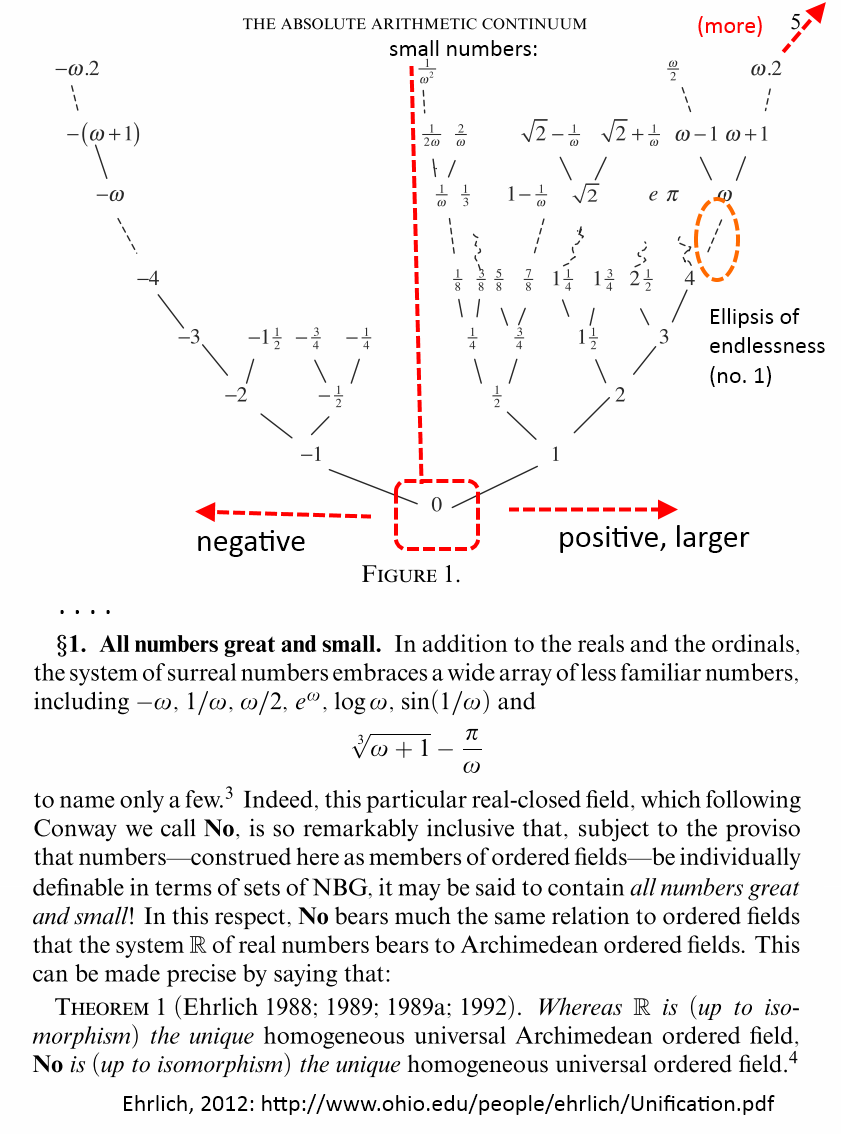
unity

Where also, this continuum result is useful:
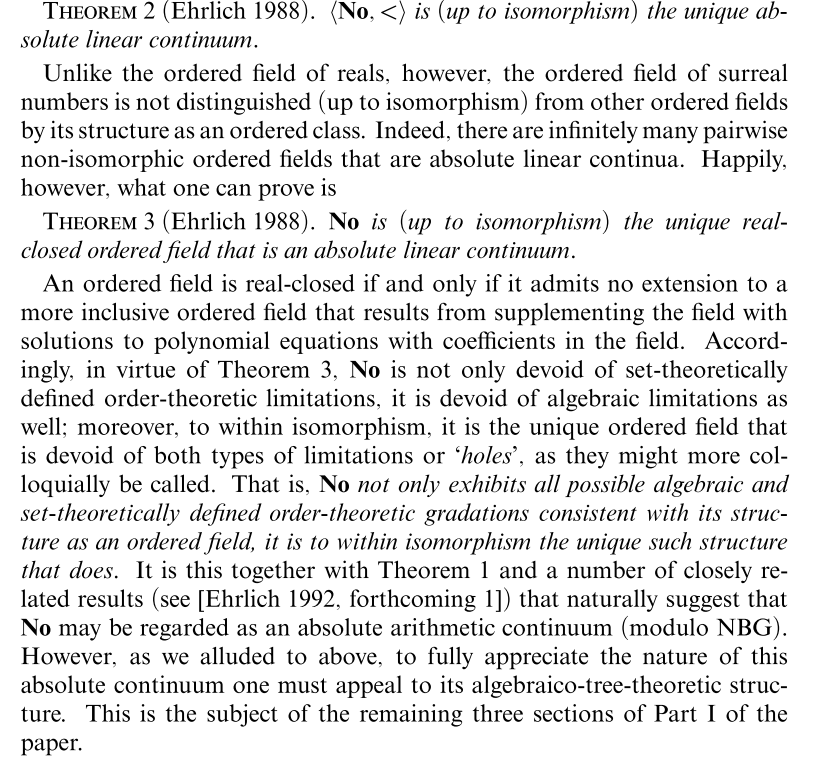
unified_continuum

PPS: As a blue vs pink punched paper tape example is used below, cf the real world machines
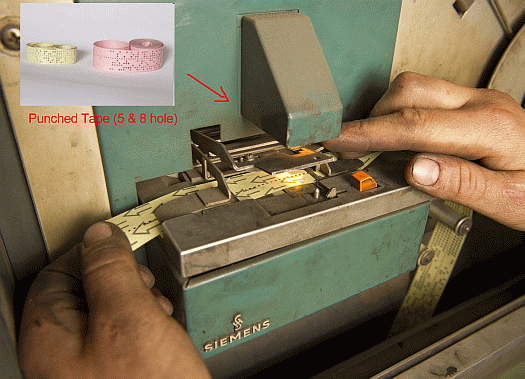
Punched paper Tape, as used in older computers and numerically controlled machine tools (Courtesy Wiki & Siemens)

and the abstraction for mathematical operations:
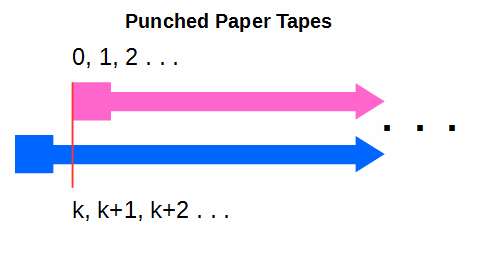
punchtapes_1-1

Note as well a Turing Machine physical model:
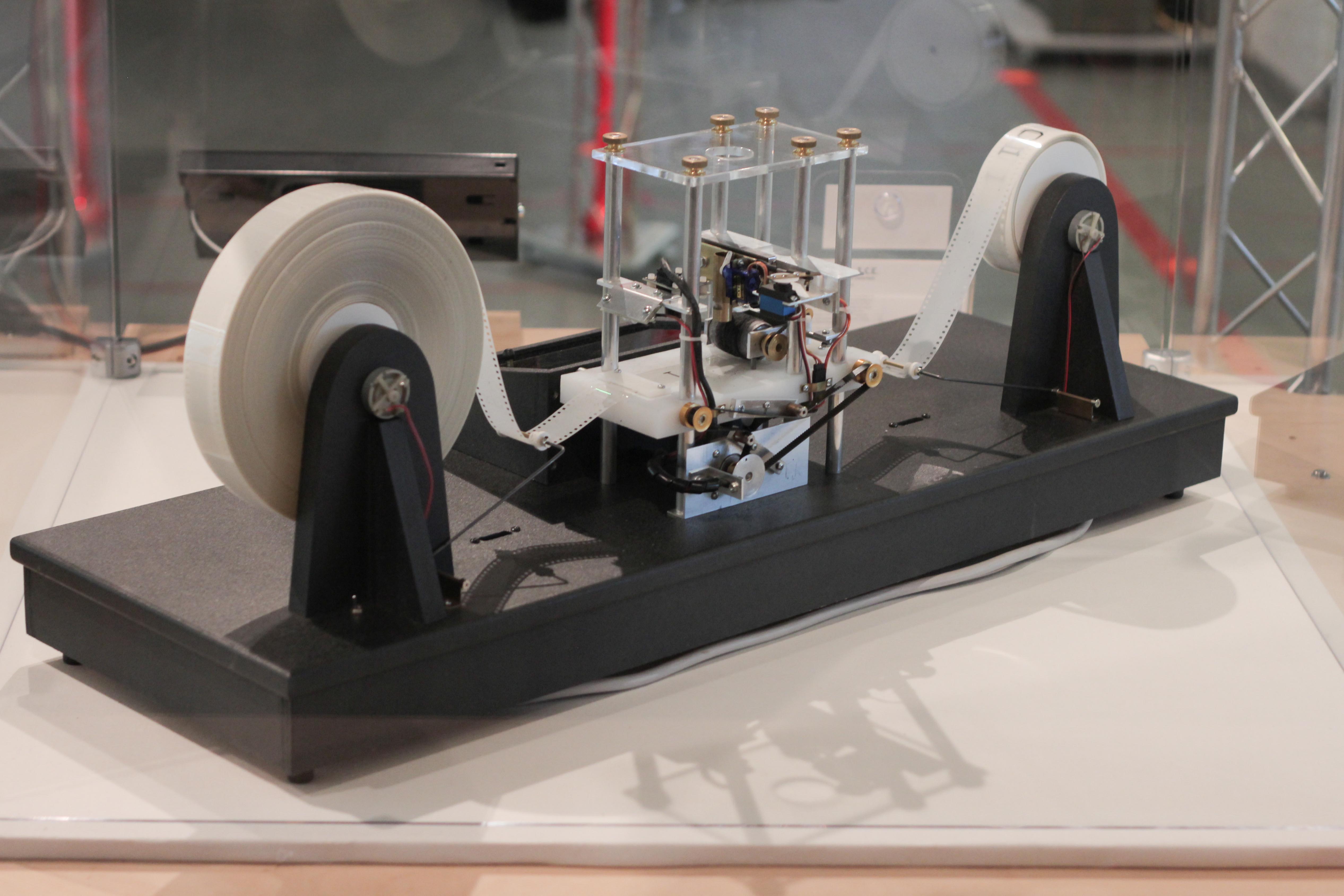
Turing_Machine_Model_Davey_2012

and its abstracted operational form for Mathematical analysis:
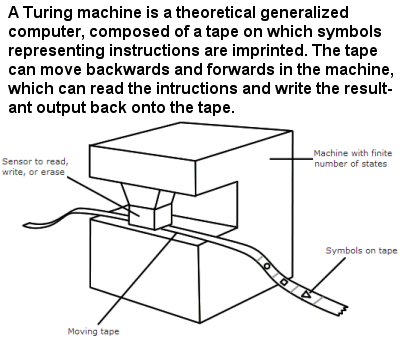
turing_machine

F/N: HT BA77, let us try to embed a video: XXXX nope, fails XXXX so instead let us instead link the vid page.

Comments
fear far worse than mere paradox
What in the world could kf be concerned about here? All this continual talk of consequences but not able to say what they are. And yes, often kf's sentences are a mish-mash of idiosyncratic language and syntax that they only make sense, in a way, because he's been over the points so often. What, or what, pray tell, are the consequences, dire as they may be, of there being an infinite number of finite natural numbers? Does the whole edifice of math come crumbling down?Aleta
April 3, 2016
April
04
Apr
3
03
2016
03:04 PM
3
03
04
PM
PDT
KF #1294
DS, the chaining is right there in the k to k+1 succession.
Why is 'chaining' a mathematical problem? How has this NOT been addressed by the work or Cantor or what has been presented to you on this thread over the last 1200+ responses? You keep objecting about a problem that does not exist. All the mathematical issues have been considered and dealt with.ellazimm
April 3, 2016
April
04
Apr
3
03
2016
03:01 PM
3
03
01
PM
PDT
DS, the chaining is right there in the k to k+1 succession. KFkairosfocus
April 3, 2016
April
04
Apr
3
03
2016
02:55 PM
2
02
55
PM
PDT
KF #1289
EZ, I would suggest that k = 0 +1 +1 . . . +1 k times over shows how we get to k in successive +1 steps, which may be converted into successive collections of counting sets or a looping process. I have not spoken gibberish. In that context I suggest that ordinary mathematical induction starts with a case 0 or sometimes the like base case then extends on a do forever chain case k => case k+1, which depends crucially on chaining. this has import for what we may legitimately conclude from such, given that no such successive chain can actually complete to completed endlessness.
You have spoken gibberish.
or sometimes the like base case then extends on a do forever chain case k => case k+1, which depends crucially on chaining.
That is gibberish. Why can't you talk in normal mathematical language?
this has import for what we may legitimately conclude from such, given that no such successive chain can actually complete to completed endlessness
That makes no sense at all. It isn't even a sentence. Just give it up.ellazimm
April 3, 2016
April
04
Apr
3
03
2016
02:54 PM
2
02
54
PM
PDT
KF,
In that context I suggest that ordinary mathematical induction starts with a case 0 or sometimes the like base case then extends on a do forever chain case k => case k+1, which depends crucially on chaining.
This is the misunderstanding of induction that I referred to in my post #1240. The Axiom of Induction does not include any "do forever chains".daveS
April 3, 2016
April
04
Apr
3
03
2016
02:48 PM
2
02
48
PM
PDT
KF #1289
please pause and ponder why I would see a paradox at minimum and fear far worse than mere paradox in asserting that one has proved that there is an INFINITE — so, endless — number of FINITE successive counting numbers at +1 steps from 0.
I can't think of a good reason why you should object to that.
Notice, where I have gone to to see why there is no foundational flaw, namely our inability to exhaust endlessness in finite stage steps and the implication of ordinary mathematical induction depending on a case 0 and a chaining implication case k => case k+1.
That doesn't even make sense let alone stand as a sound mathematical argument. In fact, I'm not sure it is even a sentence. You've got some issue that is clouding your judgment. You best work on clearing that.ellazimm
April 3, 2016
April
04
Apr
3
03
2016
02:45 PM
2
02
45
PM
PDT
Aleta and daveS What do you think? Time to stop beating our heads against the wall? KF clearly has some issue which prevents him from accepting tried and accepted mathematics. I think now that there is nothing we can do to change his inclination. So . . . time to quit?ellazimm
April 3, 2016
April
04
Apr
3
03
2016
02:38 PM
2
02
38
PM
PDT
Aleta & EZ, please pause and ponder why I would see a paradox at minimum and fear far worse than mere paradox in asserting that one has proved that there is an INFINITE -- so, endless -- number of FINITE successive counting numbers at +1 steps from 0. Notice, where I have gone to to see why there is no foundational flaw, namely our inability to exhaust endlessness in finite stage steps and the implication of ordinary mathematical induction depending on a case 0 and a chaining implication case k => case k+1. KF PS: EZ, I would suggest that k = 0 +1 +1 . . . +1 k times over shows how we get to k in successive +1 steps, which may be converted into successive collections of counting sets or a looping process. I have not spoken gibberish. In that context I suggest that ordinary mathematical induction starts with a case 0 or sometimes the like base case then extends on a do forever chain case k => case k+1, which depends crucially on chaining. This has import for what we may legitimately conclude from such, given that no such successive chain can actually complete to completed endlessness. At some point we point across an implicit ellipsis of endlessness, but this may become a material issue.kairosfocus
April 3, 2016
April
04
Apr
3
03
2016
02:36 PM
2
02
36
PM
PDT
KF #1285
I am suggesting that we cannot attain to spanning the endlessness of succession of counting sets and that this can have a material impact on conclusions we may legitimately draw from e.g. ordinary mathematical induction.
You really don't get the basic maths.
As I have said for weeks, we cannot exhaust endlessness in finite stage steps. In particular, an assertion that has been repeatedly put as though it is a no brainer at minimum has in it a deep paradox and may be much worse than mere paradox: that there are infinitely many FINITE counting numbers at +1 stage succession from 0. Which runs into issues of the successor at k+1 being a copy of the list of counting sets to kth stage from 0.
What does your last sentence mean? 'At +1 stage succession from 0. Which runs into issues of the successor at k+1.' There are no issues. This has all been dealt with. Over 100 years ago. What is your real issue here? The existence of an infinite past? We're not your adversaries in that. We're just talking about the maths.
So if this were to proceed to endlessness, there would be endless, non finite members. Howbeit, it cannot actually proceed to endlessness, we can only attain to finite values and point on to further endless succession from any specific k (which immediately calls forth k+1 etc endlessly IN PRINCIPLE).
Seriously, you are repeating yourself to the point of madness AND you are still wrong.
This entails that we cannot specify an infinite prime — obviously — but also that we cannot exhaust the list of primes, the endlessness is material. Likewise, there can be no finite prime removed from 0 by infinitely many +1 actually completed steps
Again, that is pretty much gibberish. Just give it up.ellazimm
April 3, 2016
April
04
Apr
3
03
2016
02:35 PM
2
02
35
PM
PDT
KF,
In particular, an assertion that has been repeatedly put as though it is a no brainer at minimum has in it a deep paradox and may be much worse than mere paradox: that there are infinitely many FINITE counting numbers at +1 stage succession from 0. Which runs into issues of the successor at k+1 being a copy of the list of counting sets to kth stage from 0. So if this were to proceed to endlessness, there would be endless, non finite members.
As I've said from day 1, practically, the notion that N is infinite yet has only finite members is not paradoxical to me (nor to William Lane Craig, it would seem). But what exactly are you saying about primes? Clearly the set of primes can be put into 1-1 correspondence with itself, right? So if N is infinite, shouldn't P also be infinite? Edit: Just read this:
This entails that we cannot specify an infinite prime — obviously — but also that we cannot exhaust the list of primes, the endlessness is material. Likewise, there can be no finite prime removed from 0 by infinitely many +1 actually completed steps.
Hmm. Are you leaving the door open to the existence of primes which are infinite? I honestly can't tell.daveS
April 3, 2016
April
04
Apr
3
03
2016
02:32 PM
2
02
32
PM
PDT
Aleta #1282
Yes, EZ. There is no arguing with someone who rejects foundational aspects of math without being able to say why other than because of vague concerns and unstated consequences.
KF has some agenda driven issue that has nothing to do with math. We are not agreeing or disagreeing with him about that other issue. We are just discussing the mathematics. But it seems to be a 'with me or against me' issue with him.ellazimm
April 3, 2016
April
04
Apr
3
03
2016
02:24 PM
2
02
24
PM
PDT
DS, I am suggesting that we cannot attain to spanning the endlessness of succession of counting sets and that this can have a material impact on conclusions we may legitimately draw from e.g. ordinary mathematical induction. As I have said for weeks, we cannot exhaust endlessness in finite stage steps. In particular, an assertion that has been repeatedly put as though it is a no brainer at minimum has in it a deep paradox and may be much worse than mere paradox: that there are infinitely many FINITE counting numbers at +1 stage succession from 0. Which runs into issues of the successor at k+1 being a copy of the list of counting sets to kth stage from 0. So if this were to proceed to endlessness, there would be endless, non finite members. Howbeit, it cannot actually proceed to endlessness, we can only attain to finite values and point on to further endless succession from any specific k (which immediately calls forth k+1 etc endlessly IN PRINCIPLE). This entails that we cannot specify an infinite prime -- obviously -- but also that we cannot exhaust the list of primes, the endlessness is material. Likewise, there can be no finite prime removed from 0 by infinitely many +1 actually completed steps. KFkairosfocus
April 3, 2016
April
04
Apr
3
03
2016
02:20 PM
2
02
20
PM
PDT
KF #1279
I trust the above shows just why I asked for something that is impossible, to draw attention to something that keeps on being missed in the discussion and confident assertion that there is an infinite set of finite successive counting sets in +1 steps from 0. Something that at minimum is deeply paradoxical, and may well be much worse than mere paradox
You think your point keeps on being missed but I say that is not true. I think you keep ignoring the explanations that have been offered to you and the vast amount of mathematics that has been done in the last 100+ years which addresses your 'concerns'. Seriously, I don't thing you're keeping up with the research. And you seem to have an agenda.ellazimm
April 3, 2016
April
04
Apr
3
03
2016
02:18 PM
2
02
18
PM
PDT
Kf #1277
You cannot write down a prime that is finite and infinitely many +1 steps removed from 0, which illustrates a key point from the above, one that shows what happens when endlessness of succession in +1 or similar steps from 0 is material to a conclusion.
You are just making stuff up now, you do realise that. And you keep arguing against a stance that no one is taking. 'Is material to a conclusion'?
Yes we can show there is no specific largest prime leading to endlessness of this progressively sparser subset of the counting numbers but that is not the whole story. There is a difference between numbers we can actually reach by direct +1 succession from 0 or specifically represent in notations based on such and spanning or traversing the endless set of successive counting sets in finite stage steps.
I tell you what, I'll just stick with normal established and proven mathematics.
Any arbitrarily large specific number k we can write down will be finite and there will be an onward succession k, k+1 etc that can be put in 1:1 match with 0,1,2 . . . where this can then be repeated for a value we reach beyond k, and so on, showing that endless continuation cannot be exhausted as from any finite k, there is yet endless continuation onward
Great, so you can't count up to infinity. I think I said that.
The set of numbers reached by +1 increments IN PRINCIPLE from 0 is endless but we can only stop at a finite stage and point onward. This has specific implications for the conclusions we may properly infer from an ordinary mathematical induction, which depends on exactly such chaining, especially where endless succession may affect the force of the conclusion drawn. Of course, one may resort to axiomatic imposition of conclusions that point across the endlessness, but then the axiom becomes a forcing act.
That just doesn't make any sense at all. And doesn't address the issues we have been discussing. KF you are clearly outside of your comfort zone. Why not just admit it and get on with other things. Take the honourable way out.ellazimm
April 3, 2016
April
04
Apr
3
03
2016
02:12 PM
2
02
12
PM
PDT
This has specific implications for the conclusions.
And what are those conclusions, kf?
Of course, one may resort to axiomatic imposition of conclusions that point across the endlessness, but then the axiom becomes a forcing act. KF
Yes, axioms have a way of doing that. It is axioms that lead to the creation of aleph null and w: do you object to those because they were forced upon you by axioms. Arrrgggghhhh. Yes, EZ. There is no arguing with someone who rejects foundational aspects of math without being able to say why other than because of vague concerns and unstated consequences.Aleta
April 3, 2016
April
04
Apr
3
03
2016
02:10 PM
2
02
10
PM
PDT
KF, I think I'm a bit lost regarding your position.
you cannot write down a prime that is finite and infinitely many +1 steps removed from 0, which illustrates a key point from the above, one that shows what happens when endlessness of succession in +1 or similar steps from 0 is material to a conclusion. Yes we can show there is no specific largest prime leading to endlessness of this progressively sparser subset of the counting numbers but that is not the whole story.
Are you suggesting that there are primes somewhere in the "far zone" that are not finite? Or perhaps this: while you don't claim that infinite prime numbers exist, we cannot legitimately say "all primes are finite"?daveS
April 3, 2016
April
04
Apr
3
03
2016
02:08 PM
2
02
08
PM
PDT
Aleta, it looks like I need to include you in what I just said. KFkairosfocus
April 3, 2016
April
04
Apr
3
03
2016
02:04 PM
2
02
04
PM
PDT
EZ, I trust the above shows just why I asked for something that is impossible, to draw attention to something that keeps on being missed in the discussion and confident assertion that there is an infinite set of finite successive counting sets in +1 steps from 0. Something that at minimum is deeply paradoxical, and may well be much worse than mere paradox. KFkairosfocus
April 3, 2016
April
04
Apr
3
03
2016
02:03 PM
2
02
03
PM
PDT
I agree. I got reinvolved in part because I'm interested in the nature of mathematics, but that subject never took off. Then I thought maybe the prime proof would make a difference. kf's remark at 1273 is really off the mark. Maybe we can find some new mathematical topic to discuss! :-)Aleta
April 3, 2016
April
04
Apr
3
03
2016
01:57 PM
1
01
57
PM
PDT
Aleta (and attn EZ): you cannot write down a prime that is finite and infinitely many +1 steps removed from 0, which illustrates a key point from the above, one that shows what happens when endlessness of succession in +1 or similar steps from 0 is material to a conclusion. Yes we can show there is no specific largest prime leading to endlessness of this progressively sparser subset of the counting numbers but that is not the whole story. There is a difference between numbers we can actually reach by direct +1 succession from 0 or specifically represent in notations based on such and spanning or traversing the endless set of successive counting sets in finite stage steps. Any arbitrarily large specific number k we can write down will be finite and there will be an onward succession k, k+1 etc -- where k+1 already bounds k and shows it definitively finite -- that can be put in 1:1 match with 0,1,2 . . . where this can then be repeated for a value we reach beyond k, and so on, showing that endless continuation cannot be exhausted as from any finite k, there is yet endless continuation onward. The set of numbers reached by +1 increments IN PRINCIPLE from 0 is endless but we can only stop at a finite stage and point onward. This has specific implications for the conclusions we may properly infer from an ordinary mathematical induction, which depends on exactly such chaining, especially where endless succession may affect the force of the conclusion drawn. Of course, one may resort to axiomatic imposition of conclusions that point across the endlessness, but then the axiom becomes a forcing act. KFkairosfocus
April 3, 2016
April
04
Apr
3
03
2016
01:56 PM
1
01
56
PM
PDT
Aleta I think it's time to stop arguing with KF and just acknowledge that he doesn't get it. No shame in that. But it's just the truth.ellazimm
April 3, 2016
April
04
Apr
3
03
2016
01:39 PM
1
01
39
PM
PDT
KF
Aleta, the set cannot be spanned in succession of +1 steps or the like.
So? That is known and dealt with.
There is therefore a distinction between what we can reach and what is implied by traversing endlessness
What is endlessness in a mathematical sense? If it's infinity then that has been dealt with.
Which clearly means unlimited succession within the set that collects counting numbers that cannot be actually completed.
So?
The far zone being the zone of that endlessness beyond any relevant arbitrarily large finite.
Please, please, please learn to use standard mathematical terms and definitions. If you want to make a mathematical argument.
And were there a counting set that succeeds to endlessness, it would not be finite.
Already answered many times.
The solution is, we may succeed from 0 to an arbitrarily large but finite value, but in so doing any such value k faces onward endlessness that cannot be completed.
What does that mean mathematically? You've been asked over and over again to deal with this and you haven't done so.
We can only point across the endlessness and draw conclusions in that light.
You haven't brought up anything that hasn't already been dealt with. I cannot fathom what you are still objecting about.
leta, please write down for us a prime that is finite and an infinite number of +1 steps removed from 0.
OMG, you really have not grasped the basic concepts at all. After all these posts and you still haven't got the basic idea or the arguments we have been offering. I'm sorry KF but it's pretty clear now that you are just not up to the situation. There's is no shame in that but you shouldn't hold yourself up as someone who 'knows' when you clearly don't. Just let it go.ellazimm
April 3, 2016
April
04
Apr
3
03
2016
01:36 PM
1
01
36
PM
PDT
That misses the point, kf. All natural numbers are some number of +1 steps from zero: All natural numbers are finite. The proof I showed does does not claim that some prime is infinitely far from 0 (infinitely far from 0 is a meaningless phrase) - it shows that there are an infinite number of primes. Those are two different things. Furthermore, the proof doesn't depend on knowing what the exact primes are. It just proves there are an infinite number of them. Surely you understand that. It seems like the statements that you made in 1273 are either irrelevant to the proof (knowing what the primes are) or incorrect about what the proof shows, for it shows that there are an infinite number of primes. I find it telling that you use the phrase "infinite number of +1 steps removed from 0". No number is an infinite number of steps from zero. The only infinite number relevant to this discussion is w, and it doesn't make sense at all to say the distance between a natural number N and zero is w. w doesn't measure a distance.Aleta
April 3, 2016
April
04
Apr
3
03
2016
12:59 PM
12
12
59
PM
PDT
Aleta, please write down for us a prime that is finite and an infinite number of +1 steps removed from 0. KFkairosfocus
April 3, 2016
April
04
Apr
3
03
2016
12:33 PM
12
12
33
PM
PDT
You keep saying that, kf, but you don't say what conclusions can be drawn. What about the prime number proof? It does not span anything in +1 steps. How do you account for that? It demonstrates that there is an infinite subset of the natural numbers (the primes) that are all finite numbers - no traversing needed. How do you explain that?Aleta
April 3, 2016
April
04
Apr
3
03
2016
11:00 AM
11
11
00
AM
PDT
Aleta, the set cannot be spanned in succession of +1 steps or the like. There is therefore a distinction between what we can reach and what is implied by traversing endlessness. Which clearly means unlimited succession within the set that collects counting numbers that cannot be actually completed. The far zone being the zone of that endlessness beyond any relevant arbitrarily large finite. And were there a counting set that succeeds to endlessness, it would not be finite. The solution is, we may succeed from 0 to an arbitrarily large but finite value, but in so doing any such value k faces onward endlessness that cannot be completed. We can only point across the endlessness and draw conclusions in that light. KFkairosfocus
April 3, 2016
April
04
Apr
3
03
2016
10:29 AM
10
10
29
AM
PDT
ellazimm,
I guess we’re just a bit odd eh? :-) Forget about concerns, jump in and play!!
Yes, maybe so. For me, mathematics is almost entirely a recreational activity. I'm not going to use it to solve any significant real-world problems, so I probably have a different perspective than many others.daveS
April 3, 2016
April
04
Apr
3
03
2016
09:59 AM
9
09
59
AM
PDT
daveS #1268
One of my favorite examples of this type is Cantor’s Staircase.
More loveliness!! I remember when I took a measure theory class, absolutely stunning stuff. I know how it's always said that math is just applied logic but it always seemed to me that logic classes were pretty dull and boring compared to my math classes. I never found that logic went as far and got as weird and wonderful as math did. I used to have so much fun with stoned or drunk friends telling them about Achilles and the tortoise and watching them trying to wrap their heads around it. https://en.wikipedia.org/wiki/Zeno%27s_paradoxes (I bet Mapou would love the arrow paradox.) I miss that fun of seeing that stuff for the first time. It's hard for me to understand why everyone doesn't just fall in love with the wonderland of this kind of mathematics. Why parts seem hard to swallow. I guess we're just a bit odd eh? :-) Forget about concerns, jump in and play!!ellazimm
April 3, 2016
April
04
Apr
3
03
2016
09:38 AM
9
09
38
AM
PDT
Aleta and ellazimm (and everyone else interested), One of my favorite examples of this type is Cantor's Staircase. Here's the animation from that page showing the construction of its graph. It's constructed much like the Cantor set. Instead of deleting the "middle thirds" of intervals, you lift them up a certain amount. You start by raising the interval [1/3, 2/3] from the x-axis to the level y = 1/2. Then continue. (Edit: In contrast with the Cantor set, we work with closed rather than open intervals). The function thus defined is continuous and differentiable except on a set of measure 0, which is a little strange, but not too hard to accept. Here's what I find surprising: The graph consists of pieces of the interval [0, 1] (which has length 1, obviously) "pushed upward" various distances. However, the arclength of the graph turns out to be exactly 2.daveS
April 3, 2016
April
04
Apr
3
03
2016
09:17 AM
9
09
17
AM
PDT
That's exactly the thought I've been having: the limit as n -> infinity is absolutely central to modern mathematics.Aleta
April 3, 2016
April
04
Apr
3
03
2016
09:15 AM
9
09
15
AM
PDT
1 3 4 5 6 7 48

Leave a Reply