Uncommon Descent Serving The Intelligent Design Community

Durston and Craig on an infinite temporal past . . .

Categories
Atheism
Mathematics
rhetoric
worldview
Share
Facebook
Twitter/X
LinkedIn
Flipboard
Print
Email

In recent days, the issue of an infinite temporal past as a step by step causal succession has come up at UD. For, it seems the evolutionary materialist faces the unwelcome choice of a cosmos from a true nothing — non-being or else an actually completed infinite past succession of finite causal steps.

Durston:

>>To  avoid  the  theological  and  philosophical  implications  of  a  beginning  for the  universe,  some  naturalists  such  as  Sean  Carroll  suggest  that  all  we  need  to  do  is  build  a  successful  mathematical  model  of  the  universe  where  time  t runs  from  minus  infinity  to  positive  infinity. Although  there  is  no  problem  in  having  t run  from  minus  infinity  to  plus  infinity with  a  mathematical  model,  the real past  history  of  the  universe  cannot  be  a  completed  infinity  of  seconds  that  elapsed,  one  second  at  a  time. There  are at  least  two  problems.  First,  an  infinite  real  past  requires  a  completed  infinity, which  is  a  single  object and  does  not  describe  how  history  actually  unfolds.  Second,  it  is  impossible  to  count  down  from  negative  infinity  without  encountering the  problem  of  a  potential infinity  that  never  actually  reaches  infinity. For  the  real  world,  therefore,  there  must  be  a  first  event  that  occurred  a  finite  amount  of  time  ago  in  the  past . . . [More] >>

Craig:

>Strictly speaking, I wouldn’t say, as you put it, that a “beginningless causal chain would be (or form) an actually infinite set.” Sets, if they exist, are abstract objects and so should not be identified with the series of events in time. Using what I would regard as the useful fiction of a set, I suppose we could say that the set of past events is an infinite set if the series of past events is beginningless. But I prefer simply to say that if the temporal series of events is beginningless, then the number of past events is infinite or that there has occurred an infinite number of past events . . . .

It might be said that at least there have been past events, and so they can be numbered. But by the same token there will be future events, so why can they not be numbered? Accordingly, one might be tempted to say that in an endless future there will be an actually infinite number of events, just as in a beginningless past there have been an actually infinite number of events. But in a sense that assertion is false; for there never will be an actually infinite number of events, since it is impossible to count to infinity. The only sense in which there will be an infinite number of events is that the series of events will go toward infinity as a limit.

But that is the concept of a potential infinite, not an actual infinite. Here the objectivity of temporal becoming makes itself felt. For as a result of the arrow of time, the series of events later than any arbitrarily selected past event is properly to be regarded as potentially infinite, that is to say, finite but indefinitely increasing toward infinity as a limit. The situation, significantly, is not symmetrical: as we have seen, the series of events earlier than any arbitrarily selected future event cannot properly be regarded as potentially infinite. So when we say that the number of past events is infinite, we mean that prior to today ℵ0 events have elapsed. But when we say that the number of future events is infinite, we do not mean that ℵ0 events will elapse, for that is false. [More]>>

Food for further thought. END

PS: As issues on numbers etc have become a major focus for discussion, HT DS here is a presentation of the overview:
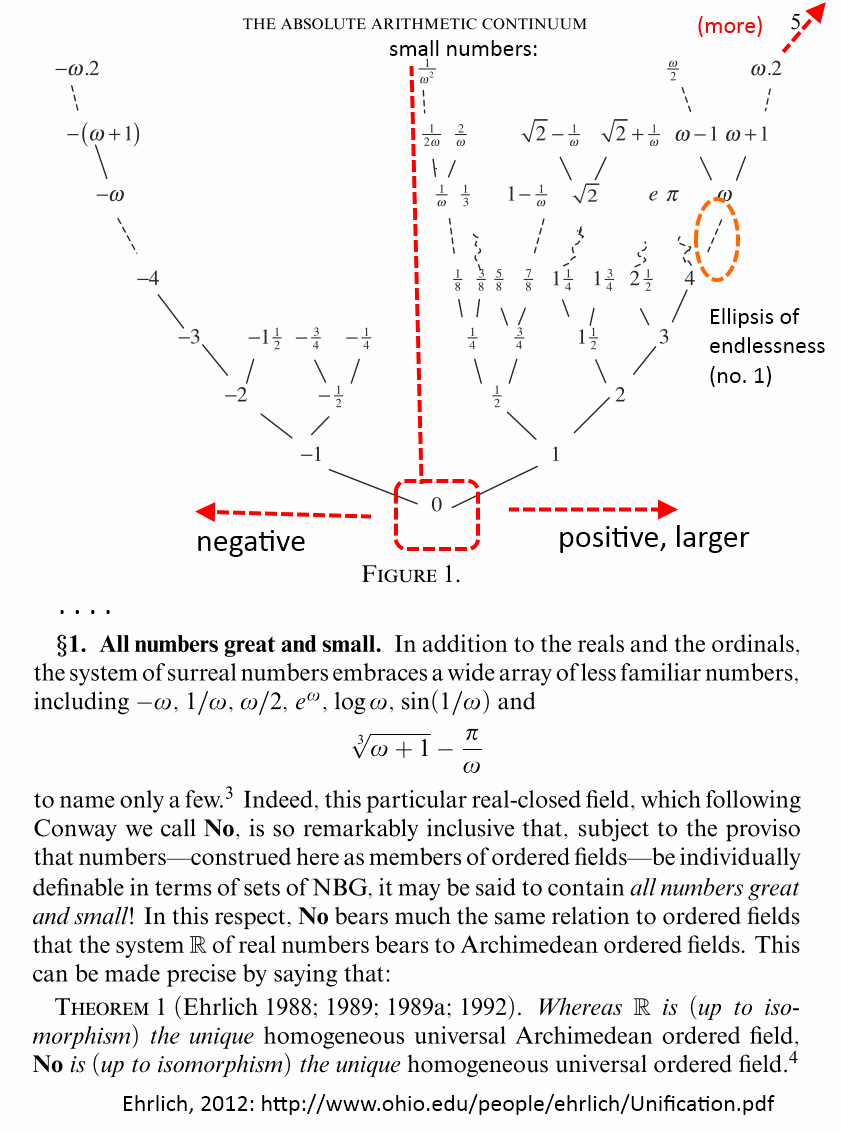
unity

Where also, this continuum result is useful:
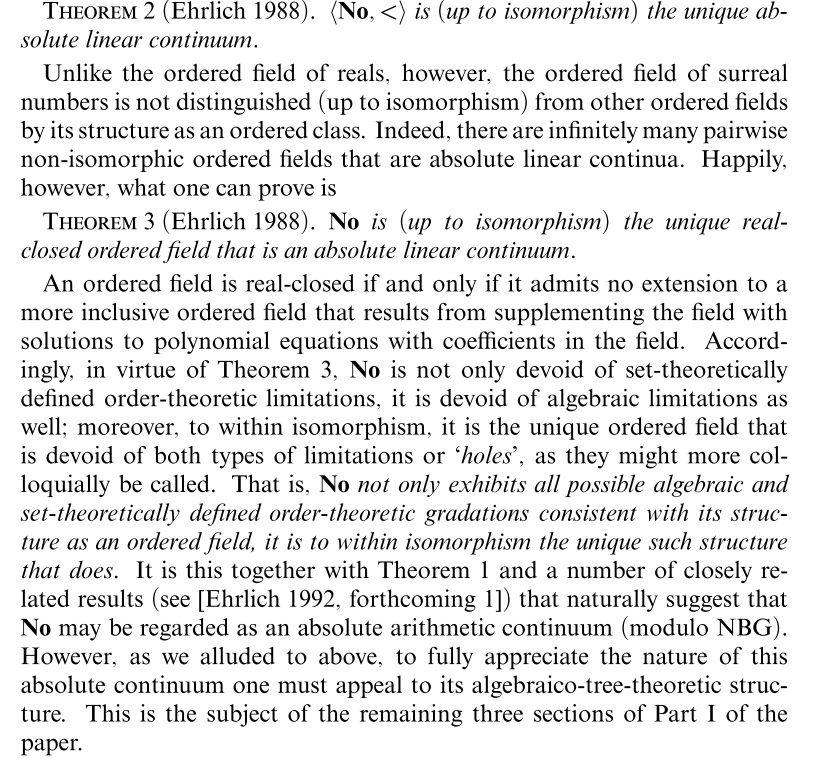
unified_continuum

PPS: As a blue vs pink punched paper tape example is used below, cf the real world machines
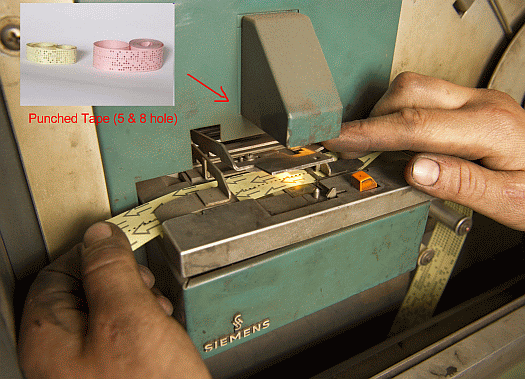
Punched paper Tape, as used in older computers and numerically controlled machine tools (Courtesy Wiki & Siemens)

and the abstraction for mathematical operations:
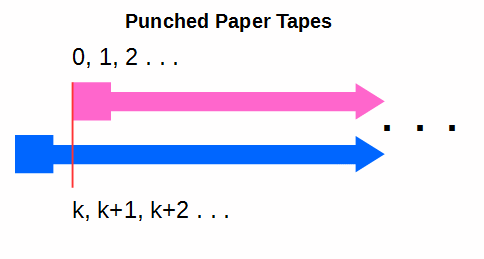
punchtapes_1-1

Note as well a Turing Machine physical model:
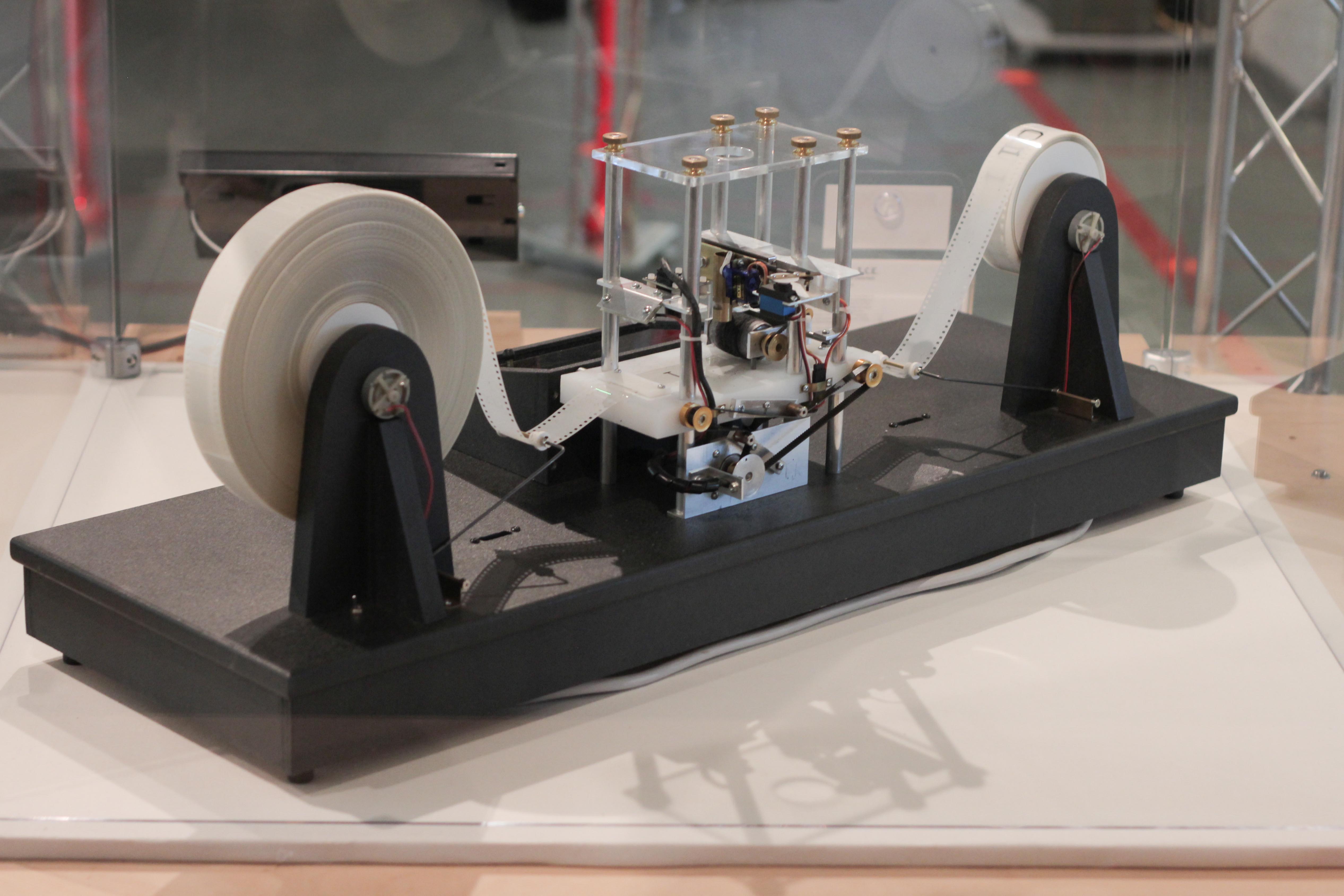
Turing_Machine_Model_Davey_2012

and its abstracted operational form for Mathematical analysis:
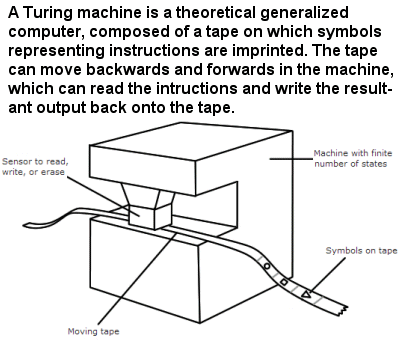
turing_machine

F/N: HT BA77, let us try to embed a video: XXXX nope, fails XXXX so instead let us instead link the vid page.

Comments
KF and Aleta, If I may respond to KF's post:
Aleta, strictly there is nothing in a province of mathematics provable from its axioms that is not included in those axioms. Likewise, if a set of axioms are contradictory, there is nothing “more” that is provided by a reductio proof. So, why is so much effort exerted in proving theorems etc?
???? This kind of floors me. Would you be content if mathematics consisted simply of the ZFC axioms together with rules and symbols for first order logic, and where no one was interested in investigating what theorems follow? To me, the whole point of mathematics is to see what follows from various axiom systems and logics. Without the great effort that has been exerted in proving theorems, we would have no Fermat's last theorem, no Poincaré Conjecture (theorem now), no prime number theorem, no e^(iπ) = -1, and so on. It's extremely non-obvious what does follow from these axioms, and proving such theorems can be very difficult (taking centuries of cumulative effort). See the abc conjecture for a potential example of such a hard theorem being proved in real time.daveS
April 2, 2016
April
04
Apr
2
02
2016
07:27 AM
7
07
27
AM
PDT
Aleta, for cause I do not trust abstract symbols by themselves and I do not trust test cases by themselves. I am only happy when the two come together in mutually reinforcing light. And it is clear to me above that the punched tapes example brings out explicitly many of the concerns at the heart of this thread. Starting with the often repeated but what is endlessness. KFkairosfocus
April 2, 2016
April
04
Apr
2
02
2016
07:20 AM
7
07
20
AM
PDT
Aleta, please keep on going. Start, {} --> 0 {0} --> 1 Define +1 as an operation that extends and thus a growing, endless set of counting sets: {0, 1, 2 . . . k} --> Sk+1 --> k+1 Now, where . . . denotes endless succession and Sk+1 collects the set of sets Sk, the copy counting sets so far principle. Can you actually instantiate to endlessness, no, at any k we are finite and bounded by k+1, thus we see the onward endlessness that can be successively put in match with the set {0,1,2 etc}. This shows, first, we cannot traverse stepwise to the zone of endlessness, so we impose by pointing across an ellipsis of endlessness. Second, were we to attain to a zone of actually infinite successive members, there would be members with endlessness in them, infinite integers. It is crucial that we cannot succeed to such a zone in +1 or similarly finite stage steps. And, the case warns us that there may be a fallacy of composition in extending to endlessness what is true of strictly finite subsets or ranges. KFkairosfocus
April 2, 2016
April
04
Apr
2
02
2016
07:15 AM
7
07
15
AM
PDT
Aleta,
But the tape doesn’t reveal anything that the abstract symbolism doesn’t cover: we all know that you can’t traverse the entire infinite set by stepping through the numbers one by one, and we all know that, because the set is infinite, it can be put into a 1:1 correspondence with a proper subset.
Yes, this is becoming more and more clear to me. I think in terms of physical analogies quite a bit, but in the case of the infinite, those analogies tend to break down at some point, whether they are "infinite" Turing machine tapes, ladders, clocks, whatever. Since we have not been able to resolve our differences using these analogies, I think it's time to set aside the tapes, ladders, and clocks, and use actual mathematical arguments (when discussing mathematics).daveS
April 2, 2016
April
04
Apr
2
02
2016
07:14 AM
7
07
14
AM
PDT
kf, I very much appreciate applied math, and always made a point of showing my students physical applications and representations of the math they were learning. But I also very much wanted to impress upon them the nature and power of pure mathematics, and to convince them that ultimately things fall back to the pure math for their foundational validity. So I agree with you that models are useful, both because that is the only way to actually apply math to the real world and because it helps us understand the math better. But in this case we are experienced enough people to work with the pure math. Your tape example may help some understand better what the pure math is about (such as with the 1:1 correspondences). However, I think it fundamentally misrepresents the nature of an infinite set by implying that you have to step through the set in order to fully create it, which is false.Aleta
April 2, 2016
April
04
Apr
2
02
2016
07:11 AM
7
07
11
AM
PDT
Aleta, strictly there is nothing in a province of mathematics provable from its axioms that is not included in those axioms. Likewise, if a set of axioms are contradictory, there is nothing "more" that is provided by a reductio proof. So, why is so much effort exerted in proving theorems etc? Or, on studying special cases of interest? Likewise, what is the benefit of setting up the case of a tank or bucket being filled with a liquid to study and clarify the meaningfulness and relevance of the core concepts of the calculus? Then its extension to a tank with both inflow and outflow? (And BTW, that actually helped me make much more sense of what lurked behind the usual symbols.) The answers to these will show why something like the case of an abstract pair of punched tapes that are endless can be instructive and can reveal things we would not have spotted from the abstract symbols alone. Of course, one also wishes to express the case in an accurate algebraic model and explore its properties . . . which was done in outline. This is a case of both and not either or. KFkairosfocus
April 2, 2016
April
04
Apr
2
02
2016
07:02 AM
7
07
02
AM
PDT
Prove: there is a largest positive integer Proof by contradiction: assume there is a largest integer L Let N = L + 1 N is also an integer, and N > L This contradicts the assumption that L is the largest integer Therefore the assumption that there is a largest integer is false Therefore there is no largest integer Therefore there are an infinite number of integers. Q.E.D How's that - pure math, and no writing any numbers down.involved.Aleta
April 2, 2016
April
04
Apr
2
02
2016
06:54 AM
6
06
54
AM
PDT
ellazim: Mathematics is a beautiful system of abstract thinking wherein you can handle things you can’t do exhaustively, ‘by hand’. If that is so, then why did you issue the following demonstration for the claim that there is an infinite number of positive integers? If there are a finite number of positive integers and if you wrote them all down you could always take the largest one and add 1 to it and get one that was not on your list. Would you like to try again?Mung
April 2, 2016
April
04
Apr
2
02
2016
06:48 AM
6
06
48
AM
PDT
at 1222, methink asks,
Mathematical infinity or actual infinity
Mathematical infinity is actual infinity. Infinity is a mathematical concept. All of us here have agreed, I think, that there is no physical instantiation of infinity in our universe.Aleta
April 2, 2016
April
04
Apr
2
02
2016
06:44 AM
6
06
44
AM
PDT
But the tape doesn't reveal anything that the abstract symbolism doesn't cover: we all know that you can't traverse the entire infinite set by stepping through the numbers one by one, and we all know that, because the set is infinite, it can be put into a 1:1 correspondence with a proper subset. What does the tape reveal that the abstract symbolism conceals? Everything you say in 1226, for instance, is not made any clearer by the tape example. Furthermore, the tape example conceals things the abstract symbolism reveals. Cantor's definition of orders of infinity, which start with naming aleph null as representing the first level of infinity - the size of the integers, is much more "revealed" with the abstract symbolism than it is with the tape. Furthermore, additional mathematics to which you often refer (higher orders of infinity, hyperreals, etc.) are not revealed by the tape example at all.) So I don't see the tape example as adding anything to the discussion.Aleta
April 2, 2016
April
04
Apr
2
02
2016
06:38 AM
6
06
38
AM
PDT
MT: the essence of infinity is endlessness beyond any arbitrarily large finite (and bounded) case. This obtains for the natural numbers, and the scale of the continuum. Where, as mathematics is the logical study of structure and quantity, insofar as these features are manifested in abstract or concrete entities, that logic constrains possibilities and can even have causative effect; e.g. as core properties for circularity and squarishness stand in contradiction for one and the same entity and circumstances, the attempt to create a square circle must fail. As, was discussed above. One consequence of such, is that a stepwise finite stage incremental process, abstract or physical/concrete, cannot traverse a transfinite span. That is, one that is endless. How omega -- I have used w for convenience -- is the order type of {0,1,2 . . . } is inherently different from how 5 is order type of {0,1,2,3,4} because of that endlessness. KFkairosfocus
April 2, 2016
April
04
Apr
2
02
2016
05:59 AM
5
05
59
AM
PDT
Aleta, I say again, that abstract symbolism often conceals more than it reveals, hence the place for the instructive case study. KFkairosfocus
April 2, 2016
April
04
Apr
2
02
2016
05:53 AM
5
05
53
AM
PDT
kf, I can see perfectly well both the endlessness and the 1:1 correspondences between an infinite set and one of its infinite subsets by thinking and writing numbers in set notation. I don't need to visualize a tape or a ladder or a hotel. Physical analogies such as the tape are misleading because they make it seem like the step-by-step process is essential for accessing the infinite set, and mathematically it's not.Aleta
April 2, 2016
April
04
Apr
2
02
2016
05:20 AM
5
05
20
AM
PDT
Aleta, a thought exercise often imposes an experimentum crucis that brings out the issue in ways that symbolism may conceal. Thus the power of Turing's machine as an example; which may then be algebraically symbolised. In this case, the issue is endless continuation, and the pulling of the blue tape by some arbitrary, large but finite k steps then placing rows k, k+1, k+2 etc in 1:1 match with the undisturbed print tape from 0,1,2 etc shows how endlessness entails that no finite stepwise advance from 0 can exhaust endlessness, or even scratch its surface. Thus, we see plainly and undeniably that the onward endlessness is a critical aspect of our understanding of natural numbers understood to be successive, cumulative counting sets. As a consequence of which, we see that ordinary mathematical induction with its k, k+1 chaining from case 0, is only capable of the potentially infinite and that onward endlessness materially affects consequences. That which then becomes indeterminate is the finitude of all integers. For, we can only ever attain to finite specific values by stepwise count, or representation in notations based on such, with onward undefined endlessness ever before us. So, the proper conclusion is that every integer we can determine or state or specify will be finite but there is an endlessness beyond all such. Thence, we define an order type of such endlessness, w. This is a new type of quantity recognised and represented. Then, we may proceed to operate on such, and it seems the surreals and hyper reals give us promising results. In my case, I find the catapult operation of multiplicative inverse and the hyperbola y = 1/x applied to the interval [0,1] especially very near to 0, [0,1] regarded as a continuum then lets me see interesting onward vistas. KFkairosfocus
April 2, 2016
April
04
Apr
2
02
2016
04:40 AM
4
04
40
AM
PDT
KF @ 1216
We cannot exhaust the system (as the two tapes example illustrates), but every number we can write down specifically will be finite. Endlessness strikes again and gives a strange answer.
When you say ' Endlessness', what are you referring to - Mathematical infinity or actual infinity?Me_Think
April 2, 2016
April
04
Apr
2
02
2016
03:08 AM
3
03
08
AM
PDT
Mung #1215
Your premise is that if there is a finite number of positive integers I could write them all down. I disagree. I think your premise is false.
How about have them written down? Or what's wrong with something like: 1, 2, 3, 4, . . . . L-2, L-1, L (where L is the 'largest' number)
If the positive integers are infinite I would not be able to write them all down. I cannot write them all down. Therefore, the positive integers are infinite.
Because that's like an argument from ignorance: I can't do something so it's impossible. Also, A -> B doesn't always mean B -> A. I cannot write down all the digits of sqrt(2) but the value of sqrt(2) is finite. Mathematics is a beautiful system of abstract thinking wherein you can handle things you can't do exhaustively, 'by hand'.ellazimm
April 1, 2016
April
04
Apr
1
01
2016
09:26 PM
9
09
26
PM
PDT
KF #1216
Mung, EZ and Aleta, it seems the answer is indeterminate in a positive sense. We cannot exhaust the system (as the two tapes example illustrates), but every number we can write down specifically will be finite. Endlessness strikes again and gives a strange answer.
Well, I'm not sure what is indeterminate. I trust you're not just giving up. The beauty of Canto's work is that he found a way to deal with infinite sets and even determined that some infinite sets are 'bigger' than others.ellazimm
April 1, 2016
April
04
Apr
1
01
2016
09:18 PM
9
09
18
PM
PDT
KF,
Mung, EZ and Aleta, it seems the answer is indeterminate in a positive sense. We cannot exhaust the system (as the two tapes example illustrates), but every number we can write down specifically will be finite. Endlessness strikes again and gives a strange answer. KF
Aren't you therefore forced to reject the law of the excluded middle? If we let A be the sentence "the set of integers is infinite", then A∨¬A is false?daveS
April 1, 2016
April
04
Apr
1
01
2016
05:05 PM
5
05
05
PM
PDT
And I'll remind you that the proof I offered that there are an infinite number of primes does not depend on induction, or any traversal, or even knowing what all the primes are up to a certain number. What would be your answer to these two questions: 1. There are an infinite number of primes: True or False 2. All primes are finite:: True or FalseAleta
April 1, 2016
April
04
Apr
1
01
2016
04:43 PM
4
04
43
PM
PDT
The answer to what is indeterminate? My two questions in 1188? Your tape analogy just confuses the situation by conflating pure math with the physical world. Dave explained it well in 1203, and I've said the same thing:
To address your post, I think you and I are simply playing by a different mathematical rule book. I accept the Axiom of Infinity, which means I don’t need to think of N as being constructed step by step. The entire set just “exists”, and we proceed from there.
The infinite set of integers exist in a mathematical sense irrespective of whether we can write them down, or traverse them, or punch them out on a tape. Yes, "every number we can write down specifically will be finite" and every number we don't write down will also be finite. They're all finite whether we write them down or not. Infinity is strange. The fact that the answers to both my questions are "true" is part of that strangeness, but lots of strange things are true.Aleta
April 1, 2016
April
04
Apr
1
01
2016
04:38 PM
4
04
38
PM
PDT
Mung, EZ and Aleta, it seems the answer is indeterminate in a positive sense. We cannot exhaust the system (as the two tapes example illustrates), but every number we can write down specifically will be finite. Endlessness strikes again and gives a strange answer. KFkairosfocus
April 1, 2016
April
04
Apr
1
01
2016
04:26 PM
4
04
26
PM
PDT
ellazimm: If there are a finite number of positive integers and if you wrote them all down you could always take the largest one and add 1 to it and get one that was not on your list. Your premise is that if there is a finite number of positive integers I could write them all down. I disagree. I think your premise is false. You could try this: If the positive integers are infinite I would not be able to write them all down. I cannot write them all down. Therefore, the positive integers are infinite. :)Mung
April 1, 2016
April
04
Apr
1
01
2016
03:28 PM
3
03
28
PM
PDT
Follow-on from #1213 If the sqrt(2) is not irrational then there must be a mistake in all the proofs (starting with some Greek guy about 2500 years ago) that sqrt(2) is irrational. If you think that sqrt(2) does not have an infinite, non-repeating decimal expansion then: can you find a mistake in one of the proofs? Additionally: if there are no infinite, decimal expansions then 1/3 does not have the decimal expansion 0.33333 . . . . . 1/3 would have the decimal expansion of 0.333 . . . . 3 with an, as yet, undetermined number of 3s. But then 3 x 1/3 would not be 1, it would be 0.999999999 . . . . . 9. Ooops.ellazimm
April 1, 2016
April
04
Apr
1
01
2016
09:13 AM
9
09
13
AM
PDT
Silver Asiatic #1210
This assumes that the universe could contain one more than the largest. We can’t know that.
IF this is not an April Fool's Day response . . . If the Universe could only hold so many numbers then . . . Could it hold more 1s than 1000s? How about 1000000s? How about -2s? Or sqrt(2)s? (Sqrt(2) has an infinite, non-repeating decimal expansion.) How about 3+4i? Is 3+4i 'bigger' than 5 say? Their magnitudes are the same but do they take up the same amount of space in the universe? Which brings up another question . . . If there really is nothing that is infinite then sqrt(2) has a finite decimal expansion which means it's not an irrational number. Which means there are no irrational numbers. Which means (I think) that the real numbers are all rational numbers. Which means that the reals are countably infinite, i.e. have the same cardinality as the positive integers. Today's homework: what famous proof would this be a contradiction of? (That would put the continuum hypothesis to rest though.)ellazimm
April 1, 2016
April
04
Apr
1
01
2016
08:58 AM
8
08
58
AM
PDT
Silver Asiatic,
“How many days?” = you’re setting that up for an answer that is a finite number. To say “Infinitely many” is to make that appear as a finite quantity.
I certainly wasn't expecting a finite number answer. If I say in an infinite past, the cardinality of the set of past days is infinite, would you agree to that?
The number of days elapsed from an infinite past is non-calculable. It’s the same as asking “how may days ago was the very first day in an infinite past”.
Non-calculable? I don't know. I'm thinking in terms of cardinalities here. I think everyone who has published on this topic takes an "infinite past" to mean the set of days elapsed to the present has cardinality aleph_0, so that's what I am assuming.
You’re basically saying that the answer is: “an infinite time ago”. But there’s no first day and it is impossible to say how many days have elapsed in total. An infinite string of days is all the days. You can’t add a day to it.
I don't agree. In an infinite past, all the days previous to today comprise an infinite string of days, but this leaves out today---so today could be added to the set. There's nothing problematic about adding an element to an already infinite set.daveS
April 1, 2016
April
04
Apr
1
01
2016
08:37 AM
8
08
37
AM
PDT
This assumes that the universe could contain one more than the largest
??? Numbers don't take up space in the universe. So, SA, even though you are going offline, are you saying that mathematically we could reach a number that we couldn't add one more to because there would be no room for it on the number line?Aleta
April 1, 2016
April
04
Apr
1
01
2016
08:36 AM
8
08
36
AM
PDT
If there are a finite number of positive integers and if you wrote them all down you could always take the largest one and add 1 to it and get one that was not on your list.
This assumes that the universe could contain one more than the largest. We can't know that. I will be off-line for 3 days - so silence does not equal consent, except with everyone I agree with. :-)Silver Asiatic
April 1, 2016
April
04
Apr
1
01
2016
08:25 AM
8
08
25
AM
PDT
daveS
I meant something like this: How many days have elapsed to this point, assuming and infinite past? Infinitely many days. I guess I don’t understand your objection.
I explained this in detail. You cannot circumscribe an infinite. Your term "available" translated infinite amount into a finite quantity. You do the same above. "How many days?" = you're setting that up for an answer that is a finite number. To say "Infinitely many" is to make that appear as a finite quantity. But it's an amorphous amount. The answer to "How many days?" is that it is, by definition, "unknowable". To merely say "an infinite number" and then make that seem like a finite quantity is false. The number of days elapsed from an infinite past is non-calculable. It's the same as asking "how may days ago was the very first day in an infinite past". You're basically saying that the answer is: "an infinite time ago". But there's no first day and it is impossible to say how many days have elapsed in total. An infinite string of days is all the days. You can't add a day to it. To know something is to capture it - to comprehend it. Infinity is unknowable - by either science or math.Silver Asiatic
April 1, 2016
April
04
Apr
1
01
2016
08:21 AM
8
08
21
AM
PDT
Mung #1207
I am going to go with false. If they cannot be numbered, there is not an infinite number of them. Plus, infinity is not a number, so there cannot be an infinite number of anything.
If there are a finite number of positive integers then how many are there? If there are a finite number of positive integers and if you wrote them all down you could always take the largest one and add 1 to it and get one that was not on your list.ellazimm
April 1, 2016
April
04
Apr
1
01
2016
08:08 AM
8
08
08
AM
PDT
Aleta: 1. True or False: there are an infinite number of integers I am going to go with false. If they cannot be numbered, there is not an infinite number of them. Plus, infinity is not a number, so there cannot be an infinite number of anything.Mung
April 1, 2016
April
04
Apr
1
01
2016
07:42 AM
7
07
42
AM
PDT
1 … 5 6 7 8 9 … 48