Uncommon Descent Serving The Intelligent Design Community

Durston and Craig on an infinite temporal past . . .

Categories
Atheism
Mathematics
rhetoric
worldview
Share
Facebook
Twitter/X
LinkedIn
Flipboard
Print
Email

In recent days, the issue of an infinite temporal past as a step by step causal succession has come up at UD. For, it seems the evolutionary materialist faces the unwelcome choice of a cosmos from a true nothing — non-being or else an actually completed infinite past succession of finite causal steps.

Durston:

>>To  avoid  the  theological  and  philosophical  implications  of  a  beginning  for the  universe,  some  naturalists  such  as  Sean  Carroll  suggest  that  all  we  need  to  do  is  build  a  successful  mathematical  model  of  the  universe  where  time  t runs  from  minus  infinity  to  positive  infinity. Although  there  is  no  problem  in  having  t run  from  minus  infinity  to  plus  infinity with  a  mathematical  model,  the real past  history  of  the  universe  cannot  be  a  completed  infinity  of  seconds  that  elapsed,  one  second  at  a  time. There  are at  least  two  problems.  First,  an  infinite  real  past  requires  a  completed  infinity, which  is  a  single  object and  does  not  describe  how  history  actually  unfolds.  Second,  it  is  impossible  to  count  down  from  negative  infinity  without  encountering the  problem  of  a  potential infinity  that  never  actually  reaches  infinity. For  the  real  world,  therefore,  there  must  be  a  first  event  that  occurred  a  finite  amount  of  time  ago  in  the  past . . . [More] >>

Craig:

>Strictly speaking, I wouldn’t say, as you put it, that a “beginningless causal chain would be (or form) an actually infinite set.” Sets, if they exist, are abstract objects and so should not be identified with the series of events in time. Using what I would regard as the useful fiction of a set, I suppose we could say that the set of past events is an infinite set if the series of past events is beginningless. But I prefer simply to say that if the temporal series of events is beginningless, then the number of past events is infinite or that there has occurred an infinite number of past events . . . .

It might be said that at least there have been past events, and so they can be numbered. But by the same token there will be future events, so why can they not be numbered? Accordingly, one might be tempted to say that in an endless future there will be an actually infinite number of events, just as in a beginningless past there have been an actually infinite number of events. But in a sense that assertion is false; for there never will be an actually infinite number of events, since it is impossible to count to infinity. The only sense in which there will be an infinite number of events is that the series of events will go toward infinity as a limit.

But that is the concept of a potential infinite, not an actual infinite. Here the objectivity of temporal becoming makes itself felt. For as a result of the arrow of time, the series of events later than any arbitrarily selected past event is properly to be regarded as potentially infinite, that is to say, finite but indefinitely increasing toward infinity as a limit. The situation, significantly, is not symmetrical: as we have seen, the series of events earlier than any arbitrarily selected future event cannot properly be regarded as potentially infinite. So when we say that the number of past events is infinite, we mean that prior to today ℵ0 events have elapsed. But when we say that the number of future events is infinite, we do not mean that ℵ0 events will elapse, for that is false. [More]>>

Food for further thought. END

PS: As issues on numbers etc have become a major focus for discussion, HT DS here is a presentation of the overview:
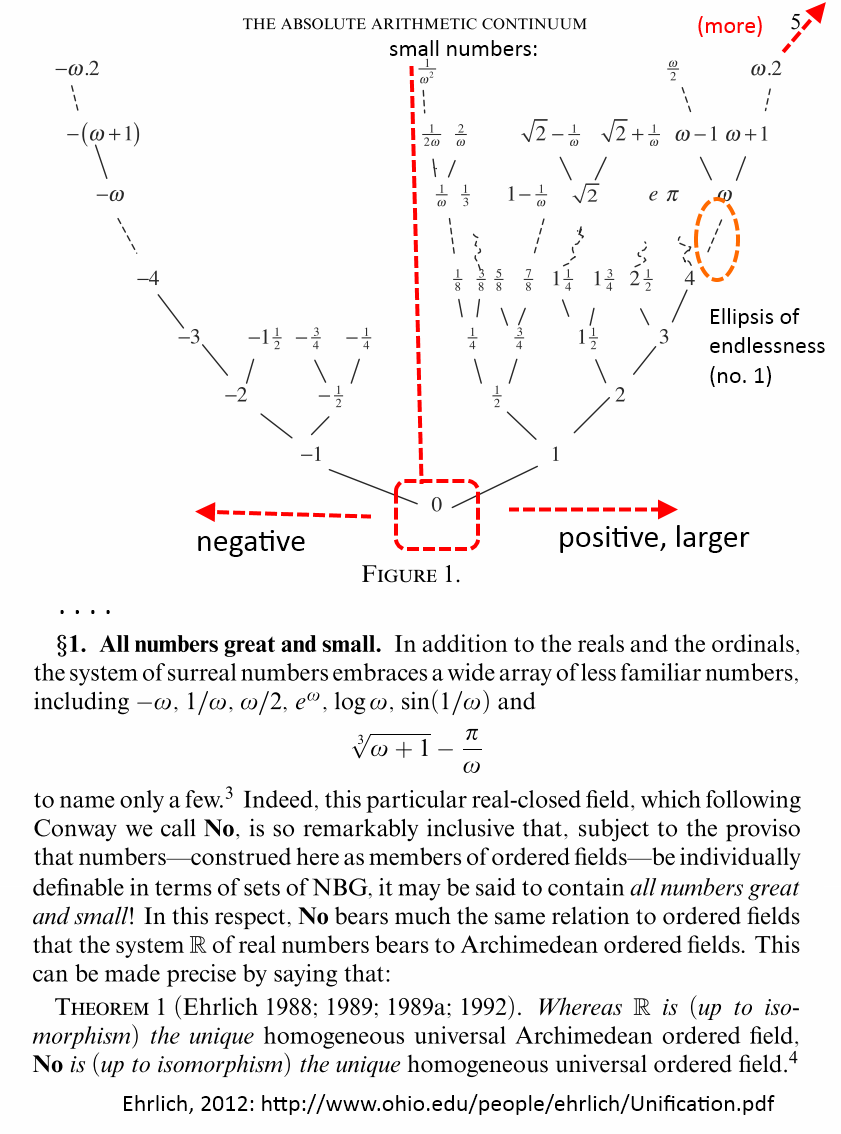
unity

Where also, this continuum result is useful:
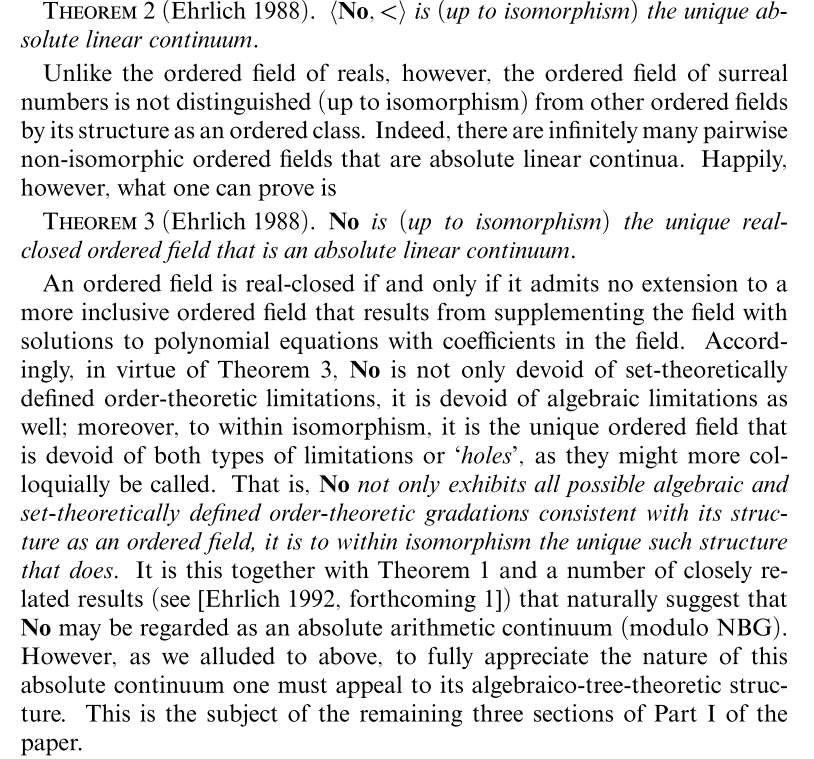
unified_continuum

PPS: As a blue vs pink punched paper tape example is used below, cf the real world machines
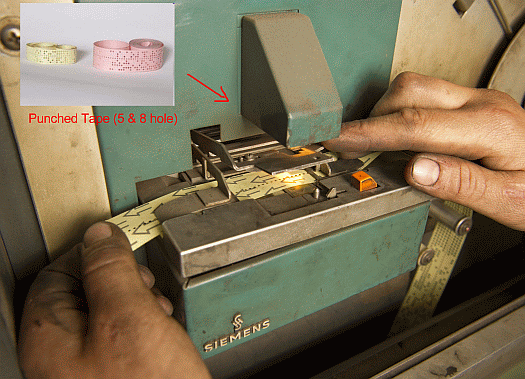
Punched paper Tape, as used in older computers and numerically controlled machine tools (Courtesy Wiki & Siemens)

and the abstraction for mathematical operations:
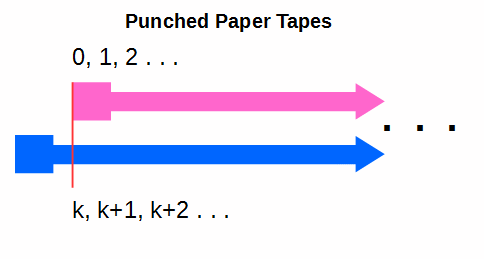
punchtapes_1-1

Note as well a Turing Machine physical model:
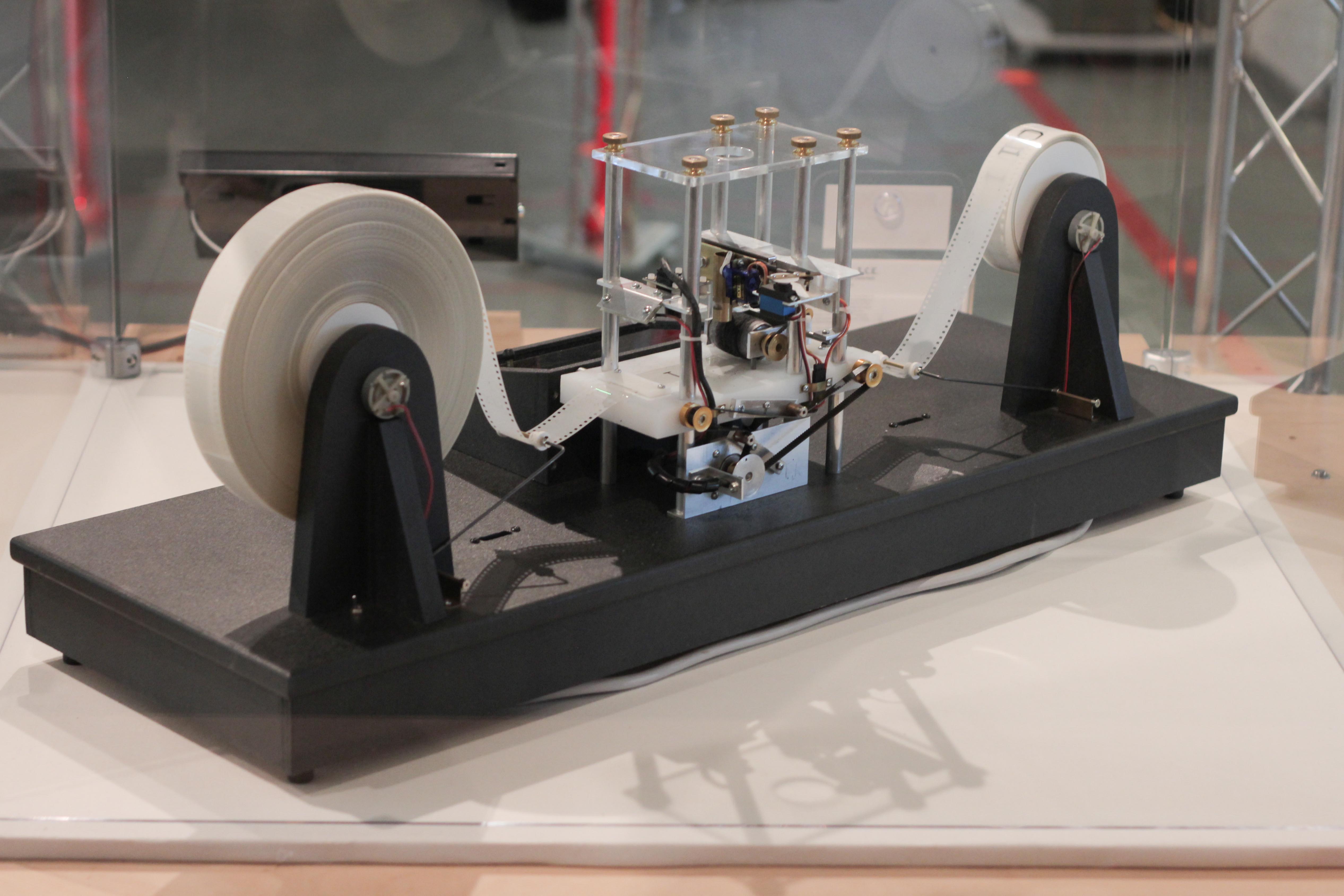
Turing_Machine_Model_Davey_2012

and its abstracted operational form for Mathematical analysis:
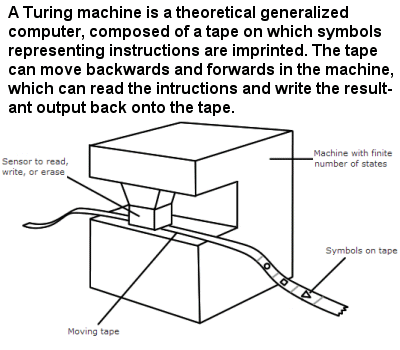
turing_machine

F/N: HT BA77, let us try to embed a video: XXXX nope, fails XXXX so instead let us instead link the vid page.

Comments
Silver Asiatic,
daveS Likewise, not every “infinite past” scenario needs to have points in time infinitely far in seconds from the present.
I think, by definition, it does. With an infinite past, it takes an infinite amount of time to arrive at the present.
Regarding the bolded part, starting from where? Any particular point in time is only finitely many seconds "ago". WLC (and maybe KF) agree with me on this.daveS
March 31, 2016
March
03
Mar
31
31
2016
12:05 PM
12
12
05
PM
PDT
That's what I said at 1170.
Negative infinity isn’t a place, and thus you can’t start there. This is a category error: you can’t start from a place that isn’t a place. No matter where you start, you are starting at a finite negative number.
The same would be true about starting at a finite positive number and moving "down" to zero.Aleta
March 31, 2016
March
03
Mar
31
31
2016
11:58 AM
11
11
58
AM
PDT
HeKS @1169
Nobody said there was a problem with stepping onto the ladder from the ground or climbing up the ladder. The end on the ground is the boundaried end and there’s no problem with simply stepping onto it and starting to climb. You will simply never reach the other “end”. Stepping onto and climbing the ladder in this direction represents moving forward into a potentially infinite future but where no matter how far into the future we go, any day we get to will still be only a finite number of days from the Big Bang. The problem arises when we come to the idea of trying to get on the ladder from the other end – the unboundaried end, the infinite “end”, “location”, “zone”, or perhaps more appropriately, state – and start climbing down towards the ground, which represents traversing an actually (not just potentially) infinite past to arrive at the present. No person, piece of equipment, or other sort of aid could help the man get onto the ladder from the other direction at an infinite point and begin a descent from infinity to the ground. If the man gets onto a rung, he does so at some arbitrary finite point, however large it may be, and begins a finite descent to the ground. When he finally does get to the ground, he can say that he’s been climbing down the ladder for a very long time, but he won’t be able to say that he has been climbing down the ladder forever, or from the infinite past.
Does anyone in this thread disagree with the above quote?Dionisio
March 31, 2016
March
03
Mar
31
31
2016
11:49 AM
11
11
49
AM
PDT
There are no points infinitely far from zero!!! All points are a finite distance from zero. "Infinitely far" is not a well-defined mathematical concept. See my comments at 1170 for the mathematical meaningless of this idea.Aleta
March 31, 2016
March
03
Mar
31
31
2016
11:37 AM
11
11
37
AM
PDT
daveS
Likewise, not every “infinite past” scenario needs to have points in time infinitely far in seconds from the present.
I think, by definition, it does. With an infinite past, it takes an infinite amount of time to arrive at the present.Silver Asiatic
March 31, 2016
March
03
Mar
31
31
2016
11:27 AM
11
11
27
AM
PDT
Mung @1161
This thread provides actual proof that one can begin at the top and descend down across an infinite number of posts.
Exactly! It reminds me of the old TV commercial with the Energizer bunny that kept going playing a drum. A never-ending story. On the bright side this thread has been the most popular this year! That means more anonymous visitors have read KF's interesting posts. KF's persistent interlocutors deserve some credits for keeping this discussion going. :) HeKS wrote something interesting @1145:
We may well be approaching that point, but it’s more satisfying to do that once you’re reasonably sure that the parties to the conversation have at least properly understood each other’s arguments. Then, if no agreement can be reached, so be it. At least you’ve hopefully had an interesting discussion.
The impression one gets when reading a few comments here is that some of the most active interlocutors aren't sure what exactly the discussion is about, hence they seem to talk past each other. That may explain why this thread has lasted so much. KF's OP and comments have been clear enough even for me to understand them. :)Dionisio
March 31, 2016
March
03
Mar
31
31
2016
11:14 AM
11
11
14
AM
PDT
FWIW, my position from the beginning is that it doesn't make sense to think about starting at "negative infinity" and moving towards 0. Negative infinity isn't a place, and thus you can't start there. This is a category error: you can't start from a place that isn't a place. No matter where you start, you are starting at a finite negative number. Also, FWIW and IMHO and YMMV :-), a great deal of the confusion here is because we are confusing pure mathematics with metaphorical physical models, whether they be time, hotels, tapes, or ladders. From a mathematical point of view, the entire infinite set of integers exists as a whole without there being any "stepping" through them. We don't look at a number line and say "Zero can't really exist because you couldn't have got there from negative infinity," nor do we say "the number line must have a starting point somewhere to the left because otherwise we couldn't have got to 0." Those would be silly things to say about the number line. And yet when we try to apply the number line to a physical model we think there is a problem - but the problem is trying to force a mathematical model past its limits. The problems are not with the nature of infinity, but with our confusion between pure and applied mathematics.Aleta
March 31, 2016
March
03
Mar
31
31
2016
10:58 AM
10
10
58
AM
PDT
Me_Think @1165
Well, the ladder is supposed to be on the ground. The distance between any two rungs has to be finite (other wise it is not a ladder!). There is nothing stopping someone from lifting and placing the person – by some equipment- on one of the rung of the ladder, or the person can climb the ladder and then descend down. The point is, if you assume the ladder can’t be climbed up or down, what is the point of the ladder metaphor ? KF’s tape metaphor will do.
You seem to have misunderstood the issue. Nobody said there was a problem with stepping onto the ladder from the ground or climbing up the ladder. The end on the ground is the boundaried end and there's no problem with simply stepping onto it and starting to climb. You will simply never reach the other "end". Stepping onto and climbing the ladder in this direction represents moving forward into a potentially infinite future but where no matter how far into the future we go, any day we get to will still be only a finite number of days from the Big Bang. The problem arises when we come to the idea of trying to get on the ladder from the other end - the unboundaried end, the infinite "end", "location", "zone", or perhaps more appropriately, state - and start climbing down towards the ground, which represents traversing an actually (not just potentially) infinite past to arrive at the present. No person, piece of equipment, or other sort of aid could help the man get onto the ladder from the other direction at an infinite point and begin a descent from infinity to the ground. If the man gets onto a rung, he does so at some arbitrary finite point, however large it may be, and begins a finite descent to the ground. When he finally does get to the ground, he can say that he's been climbing down the ladder for a very long time, but he won't be able to say that he has been climbing down the ladder forever, or from the infinite past.HeKS
March 31, 2016
March
03
Mar
31
31
2016
10:28 AM
10
10
28
AM
PDT
KF,
PS: I find that there is still a serious problem of taking the endlessness in definition of positive integers or natural, counting numbers seriously. Every natural number we can reach will be finite, but there is an endlessness that has to be taken at its full weight. We cannot exhaust that endlessness through any finite stage stepwise process, going up or down.
Who says that we (or a deity of some sort) can't count down through all natural numbers given an infinite past? I still haven't seen a proof. The tapes example, while useful as an illustration of an infinite set, does not prove this. Edit: Recall the scheme I provided---the deity counts "n", n seconds ago for each natural number n.daveS
March 31, 2016
March
03
Mar
31
31
2016
10:00 AM
10
10
00
AM
PDT
KF,
DS, let us just consider for a moment, is [0,1] a continuum?
Yes, I believe so.
If so then it enfolds every possible number in the interval, no exceptions, no gaps . . . something you glided over a little too easily for my comfort above.
Every possible real number, that is, assuming your notation [0, 1] means all real numbers between 0 and 1 inclusive.
If there are hard infinitesimals that 1/h –> hyper reals, then it follows as at least reasonable for exploration that there will be milder cases that go to 1/m –> A, where A = w + g, g a finite.
This is an example of what I was talking about. "Hard" and "mild" infinitesimals? Is your m a real number? If so, then we can stop right here, because no such m exist. Likewise, if your ω on the right is the first infinite ordinal, then again we can stop. Such an equation cannot hold. Edited: It can hold if we are working in the surreal numbers, but then I'm not clear how this relates to [0, 1]. If m is not real, and ω is not N, what exactly are they? I can't quite follow the rest. Are you concerned that there are gaps in [0, 1]? And that the infinitesimals are required to fill in those gaps?daveS
March 31, 2016
March
03
Mar
31
31
2016
09:56 AM
9
09
56
AM
PDT
A number line will do. No metaphor is needed. The physical metaphorical representations have added nothing, really, and have perhaps confused some issues.Aleta
March 31, 2016
March
03
Mar
31
31
2016
09:55 AM
9
09
55
AM
PDT
Mung @ 1162
I thought it was wonderful. How did the man get on to the rung above the rung you are talking about? Or did you just not think about that?
Well, the ladder is supposed to be on the ground. The distance between any two rungs has to be finite (other wise it is not a ladder!). There is nothing stopping someone from lifting and placing the person - by some equipment- on one of the rung of the ladder, or the person can climb the ladder and then descend down. The point is, if you assume the ladder can't be climbed up or down, what is the point of the ladder metaphor ? KF's tape metaphor will do.Me_Think
March 31, 2016
March
03
Mar
31
31
2016
09:35 AM
9
09
35
AM
PDT
DS, let us just consider for a moment, is [0,1] a continuum? If so then it enfolds every possible number in the interval, no exceptions, no gaps . . . something you glided over a little too easily for my comfort above. If there are hard infinitesimals that 1/h --> hyper reals, then it follows as at least reasonable for exploration that there will be milder cases that go to 1/m --> A, where A = w + g, g a finite. And what is more, it is reasonable to see that we can identify n so that 1/n --> w + (g +1) and fill in the interval (n, m) such that the continuum there could in principle be taken to 1/p_k in (n,m) to map between the two, ultimately filling in a continuum from w on up. And yes, I have stated that I have a serious problem with the argument that near 0 there is a gap in the real line, as that would imply a break of continuity. So, for every hard infinitesimal, there should be a mild one once [0,1] is really a continuum. KF PS: I find that there is still a serious problem of taking the endlessness in definition of positive integers or natural, counting numbers seriously. Every natural number we can reach will be finite, but there is an endlessness that has to be taken at its full weight. We cannot exhaust that endlessness through any finite stage stepwise process, going up or down. Just now, I resorted to the surreals to make the point, and I point out that the last number in a chain of attained finites so far is finite but the naturals go on beyond what we can reach in the sort of stepwise +1 processes we have looked at and extensions to that. As the pink and blue tapes example shows, endlessness continues on beyond any finite k however arbitrarily large it is, and going up in steps can only span a potentially infinite but actually finite process, likewise going down. Claiming there is an infinite causal chain in the past in a quasi-physical world leading to us today runs into serious coherence problems, as just again outlined.kairosfocus
March 31, 2016
March
03
Mar
31
31
2016
09:34 AM
9
09
34
AM
PDT
KF,
DS, I have no problem with a ladder rung labelled w say by way of a sticker on a roll with a label printer.
Really? Ok. But my point is not every infinite ladder needs to have these strange ω rungs. Likewise, not every "infinite past" scenario needs to have points in time infinitely far in seconds from the present. In case of an infinite ladder with rungs indexed by Z^-, no matter which rung you are on, you can descend to the ground in finitely many steps.
PS: The logic of structure and quantity is obviously highly relevant to making good sense of a world full of structure and quantity. Hence the inextricable entanglement of mathematics with physics. (Do you recall, the Lucasian chair held by Barrow then Newton was a Mathematics chair?)
Of course mathematics is useful in understanding the physical world. I don't mean this as an insult, but some of your arguments here have been, shall we say, not completely rigorous (m such that 1/m –> A, A = w + g just made another appearance, for example!). I think Aleta, ellazimm, I, and some other participants are mainly interested in purging these arguments of mathematical errors, and perhaps investigating whatever holds up. I actually would like to see a rigorous argument for a finite past, based only on mathematics, logic, etc., that I can't knock over.daveS
March 31, 2016
March
03
Mar
31
31
2016
08:54 AM
8
08
54
AM
PDT
Me_Think:
I think ladder is a poor metaphor for the topic under discussion. If there is a rung below, the man can move. There is nothing that stops the man from descending – unless the distance between 2 rungs is infinite.
I thought it was wonderful. How did the man get on to the rung above the rung you are talking about? Or did you just not think about that?Mung
March 31, 2016
March
03
Mar
31
31
2016
08:47 AM
8
08
47
AM
PDT
This thread provides actual proof that one can begin at the top and descend down across an infinite number of posts. :)Mung
March 31, 2016
March
03
Mar
31
31
2016
08:44 AM
8
08
44
AM
PDT
DS, I have no problem with a ladder rung labelled w say by way of a sticker on a roll with a label printer. Using the surreals tree, keep on going down the ladder tagging successive rungs as you go, taking away just 1 at a time. Can you reach to a zone finitely remote from 0 at ground level? Futility of attempted traversing of the endless, again. And it matters not that you have any number of onward rungs w+1 etc. above w. KF PS: The logic of structure and quantity is obviously highly relevant to making good sense of a world full of structure and quantity. Hence the inextricable entanglement of mathematics with physics. (Do you recall, the Lucasian chair held by Barrow then Newton was a Mathematics chair?)kairosfocus
March 31, 2016
March
03
Mar
31
31
2016
08:28 AM
8
08
28
AM
PDT
F/N: observe the number-tree diagram to see how for surreals w - 1 etc is reasonable. Obviously for finite steps (no matter how arbitrarily large) these are still of general order of magnitude w. This provides no escape from the zone of endlessness. KFkairosfocus
March 31, 2016
March
03
Mar
31
31
2016
08:22 AM
8
08
22
AM
PDT
KF #1154 I've never considered these mathematical issues to be very helpful in dealing with the real world except in a limited 'modelling' sense. But I can't argue against that interpretation. daveS #1157
I like mathematics as much as the next person, but it doesn’t have a much to do with my “worldview” or my religious beliefs.
My view as well. I don't see how this mathematical discussion sheds any light on faith or beliefs at all. Not saying it's worthless though.ellazimm
March 31, 2016
March
03
Mar
31
31
2016
07:04 AM
7
07
04
AM
PDT
Aleta,
to Dionisio re 1151: Actually the vast, vast majority of the discussion has been about the purely mathematical topic of infinity, and not about “two opposite irreconcilable worldview positions regarding the ultimate reality.”
I think this needs to be emphasized. I have also been focused mainly on pure mathematics in this thread, although I have ventured occasionally into issues of mathematical philosophy (to the extent that I am capable of, anyway). And ironically, when asked to give the roughest sketch of how an infinite past could have occurred, I have to rely on a theistic premise! I like mathematics as much as the next person, but it doesn't have a much to do with my "worldview" or my religious beliefs.daveS
March 31, 2016
March
03
Mar
31
31
2016
06:55 AM
6
06
55
AM
PDT
Me_Think,
An infinite past would mean time existed before Singularity. It would also mean that time existed as part of ’empty space’. That is not our current understanding of how universe started – the Quantum fluctuation created Space-time, thus it is erroneous to assume infinite past.
Yes, from what little I know about physics, I would agree.daveS
March 31, 2016
March
03
Mar
31
31
2016
06:34 AM
6
06
34
AM
PDT
HeKS,
By “that” I mean that the man happens to be at any particular rung on the ladder at all. The problem of infinity is not how it could be possible to get from some particular point on the spectrum to the boundaried end. Rather, it’s how you manage to get onto any particular point in the spectrum at all.
Thanks, that does help me understand your position more clearly. Obviously no human would be capable of this. I have given several similar examples which I think are less implausible, anyway. Suppose there exists a god outside of time, who created our universe. This god can perceive every instant in our universe simultaneously. Could this god count down through all the natural numbers (ending in 0), in a beginningless process? I don't see how we can rule that out. Could this god simply note the passing of each second (as a clock)? This would leave out the counting part, but still could take place in a universe with an infinite past. Or maybe this god created our universe to be eternal (beginningless and endless), with infinitely many Big Bang/Big Crunch cycles. In any case, my primary concern is identifying fallacious arguments against an infinite past, rather than demonstrating the plausibility of an infinite past.daveS
March 31, 2016
March
03
Mar
31
31
2016
06:33 AM
6
06
33
AM
PDT
Aleta, infinity and the driving force of endlessness beyond any particular finite value are foundational issues all through the thread. As is the premise that mathematics is best understood as the logic -- and linked logical study -- of structure and quantity, where structure is of course abstract and concrete and where quantities are a whole domain of reality. This thread is one of the most foundational discussions I have had at UD and such issues are inextricably entangled and intertwined with both reality and our views on reality. It seems that there is a sense that logical, structural, quantity-linked coherence is pivotal to a sound understanding of reality. In that context clarifying infinity, numbers, infinitesimals and even ordinary mathematical induction as well as stepwise finite stage progressions and linked algorithms including do forever loop structures has been a major issue. That seems to be why this thread persists at coming on 1200 comments and two full months in. The Somme ran what, five months, and Verdun (the mincer), ten. Come to think about it, precisely 100 years ago this year. Contrast the one day clash at Jutland, also 100 years ago this year. KFkairosfocus
March 31, 2016
March
03
Mar
31
31
2016
06:28 AM
6
06
28
AM
PDT
to Dionisio re 1151: Actually the vast, vast majority of the discussion has been about the purely mathematical topic of infinity, and not about "two opposite irreconcilable worldview positions regarding the ultimate reality."Aleta
March 31, 2016
March
03
Mar
31
31
2016
05:38 AM
5
05
38
AM
PDT
KF Visited 5,361 times, 268 visits today 1,152 comments posted Over 4,200 visits that did not post comments? How many of them anonymous? That seems like a lot of lurkers out there.Dionisio
March 31, 2016
March
03
Mar
31
31
2016
05:30 AM
5
05
30
AM
PDT
HeKS @1142
The problem of infinity is not how it could be possible to get from some particular point on the spectrum to the boundaried end. Rather, it’s how you manage to get onto any particular point in the spectrum at all.
That seems like "il cuore" of the "Zankapfel" in this whole thread that was so skillfully started by KF's OP. It seems like your comment helped to confirm -and maybe further clarify- what KF and others had reiterated a number of occasions in this apparently endless discussion. KF's OP started this discussion referring to an earlier discussion on the same topic. The title of KF's informative OP pointed to the persons involved in that early argument. Perhaps the multiverses and other 'convoluted' ideas being promoted these days in some academic circles are intended to provide a different solution to the problem you explained -i.e. how to get the man on a given rung within a hypothetical ladder that never had a starting rung (borrowing the analogy that has been used here for illustration purpose, assuming I've understood it well). Again, it seems like the whole discussion boils down to the conflict between two opposite irreconcilable worldview positions regarding the ultimate reality. On one end, those who believe that ultimate reality is based on matter and energy, which can't be created nor destroyed, but only transformed from one into another (i.e. WYSIWYG), the idea of an eternal past is required, hence demanded and not open for any kind of compromise. On the other side, those of us who strongly believe that the Ultimate Reality is summarized in the very first verse of the canonical OT and divinely described through the apostle John by the end of the first century of this age of grace:
In the beginning was the Word, and the Word was with God, and the Word was God. He was in the beginning with God. All things were made through Him, and without Him was not any thing made that was made.
In between those two extremely opposite irreconcilable worldview positions there appear to be gazillion viewpoints, some of them friendly or even supportive of the ID proposition, while others lean more toward materialistic concepts. This international website seems like an "eintopf" made of a wide variety of opinions.Dionisio
March 31, 2016
March
03
Mar
31
31
2016
05:12 AM
5
05
12
AM
PDT
KF You started this thread last January 31. Exactly two months later we see this: Popular Posts (Last 30 Days) Durston and Craig on an infinite temporal past . . . (2,309) A world-famous chemist tells the truth: there’s no… (2,209) Quantum Darwinism = Darwinism as woo-woo? (2,194) Homologies, differences and information jumps (1,384) An encounter with a critic of biological semiosis (1,322) Wow! Congratulations! Apparently your OP really touched the right nerve. :)Dionisio
March 31, 2016
March
03
Mar
31
31
2016
05:04 AM
5
05
04
AM
PDT
MT, the issue is endlessness, and descending a ladder stretching endlessly into the sky, or inspecting the rooms in Hilbert's hotel from the far end [oops, sleepy -- ZONE], or having an endless punched tape or using algebraic style representations all come down to the same challenge of getting from the endlessly remote w-order zone to a zone finitely remote from a zero point. All of these and the case of the intervening endlessly large Sahara to be traversed in finite scale steps, join together to show the underlying incoherence of the attempt to traverse the endless span in any arbitrarily large but finite number of finite stage actually completed steps. Note, at 217 above, I actually laid out an algorithm that draws attention to the problem. In this context, I am fully justified to assert there is a fallacy of ending the endless, to focus the key incoherence. If you want an endless set, you have to specify an action powerful enough to give all at one go. That typically entails setting up a potential infinite then pointing across an ellipsis of endlessness, but the above shows how this has limits, even with ordinary mathematical induction. KF PS: Note, this has been an exploratory thread, and positions were arrived at through discussion. My conclusion is that the ellipsis of endlessness is a pivotal part of defining the successive counting sets and that beyond any particular such set we can represent with typical forms there will always be an onward endless succession. Trying to cross that span going up or down will be futile, if one resorts to finite stage successive steps. That is also why I adapted the 1/x catapult to show how we can use a mathematical wormhole to leap across the endlessness. In response to onward debates on the different symbolisations that use omega, I suggested a model of taking 1/x on mild infinitesimals that gets you to a w + g type value and hard ones that get you to something like w + w + k where being inside a pair of transfinite zone ellipses of endlessness gives the property, no first value as well as no last value. Such also brings to bear the importance of the interval [0,1] and how this can be used as a dual to the transfinite zone. In that context the surreals make sense of the jungle of numbers great and small.kairosfocus
March 31, 2016
March
03
Mar
31
31
2016
02:44 AM
2
02
44
AM
PDT
HeKS @ 1142
Any given rung, however high the number from the ground, is still a finite number of rungs from the ground, but that very same rung is also infinintely many rungs away from infinity, which is where the man finds himself. When I said that the man would always be infinitely far from any rung you might choose, no matter how high the number, I didn’t mean he would be in the process of moving from one rung to another where those rungs would be infinitely far from the rung you had chosen
I think ladder is a poor metaphor for the topic under discussion. If there is a rung below, the man can move. There is nothing that stops the man from descending - unless the distance between 2 rungs is infinite.Me_Think
March 31, 2016
March
03
Mar
31
31
2016
02:18 AM
2
02
18
AM
PDT
Dionisio
Yes, that’s an interesting point. Thank you. Please, note that at the end of the text you quoted @1145 there was a :) which did not get copied. :) Have a good day.
You too.HeKS
March 30, 2016
March
03
Mar
30
30
2016
11:13 PM
11
11
13
PM
PDT
1 … 7 8 9 10 11 … 48