Uncommon Descent Serving The Intelligent Design Community

Durston and Craig on an infinite temporal past . . .

Categories
Atheism
Mathematics
rhetoric
worldview
Share
Facebook
Twitter/X
LinkedIn
Flipboard
Print
Email

In recent days, the issue of an infinite temporal past as a step by step causal succession has come up at UD. For, it seems the evolutionary materialist faces the unwelcome choice of a cosmos from a true nothing — non-being or else an actually completed infinite past succession of finite causal steps.

Durston:

>>To  avoid  the  theological  and  philosophical  implications  of  a  beginning  for the  universe,  some  naturalists  such  as  Sean  Carroll  suggest  that  all  we  need  to  do  is  build  a  successful  mathematical  model  of  the  universe  where  time  t runs  from  minus  infinity  to  positive  infinity. Although  there  is  no  problem  in  having  t run  from  minus  infinity  to  plus  infinity with  a  mathematical  model,  the real past  history  of  the  universe  cannot  be  a  completed  infinity  of  seconds  that  elapsed,  one  second  at  a  time. There  are at  least  two  problems.  First,  an  infinite  real  past  requires  a  completed  infinity, which  is  a  single  object and  does  not  describe  how  history  actually  unfolds.  Second,  it  is  impossible  to  count  down  from  negative  infinity  without  encountering the  problem  of  a  potential infinity  that  never  actually  reaches  infinity. For  the  real  world,  therefore,  there  must  be  a  first  event  that  occurred  a  finite  amount  of  time  ago  in  the  past . . . [More] >>

Craig:

>Strictly speaking, I wouldn’t say, as you put it, that a “beginningless causal chain would be (or form) an actually infinite set.” Sets, if they exist, are abstract objects and so should not be identified with the series of events in time. Using what I would regard as the useful fiction of a set, I suppose we could say that the set of past events is an infinite set if the series of past events is beginningless. But I prefer simply to say that if the temporal series of events is beginningless, then the number of past events is infinite or that there has occurred an infinite number of past events . . . .

It might be said that at least there have been past events, and so they can be numbered. But by the same token there will be future events, so why can they not be numbered? Accordingly, one might be tempted to say that in an endless future there will be an actually infinite number of events, just as in a beginningless past there have been an actually infinite number of events. But in a sense that assertion is false; for there never will be an actually infinite number of events, since it is impossible to count to infinity. The only sense in which there will be an infinite number of events is that the series of events will go toward infinity as a limit.

But that is the concept of a potential infinite, not an actual infinite. Here the objectivity of temporal becoming makes itself felt. For as a result of the arrow of time, the series of events later than any arbitrarily selected past event is properly to be regarded as potentially infinite, that is to say, finite but indefinitely increasing toward infinity as a limit. The situation, significantly, is not symmetrical: as we have seen, the series of events earlier than any arbitrarily selected future event cannot properly be regarded as potentially infinite. So when we say that the number of past events is infinite, we mean that prior to today ℵ0 events have elapsed. But when we say that the number of future events is infinite, we do not mean that ℵ0 events will elapse, for that is false. [More]>>

Food for further thought. END

PS: As issues on numbers etc have become a major focus for discussion, HT DS here is a presentation of the overview:
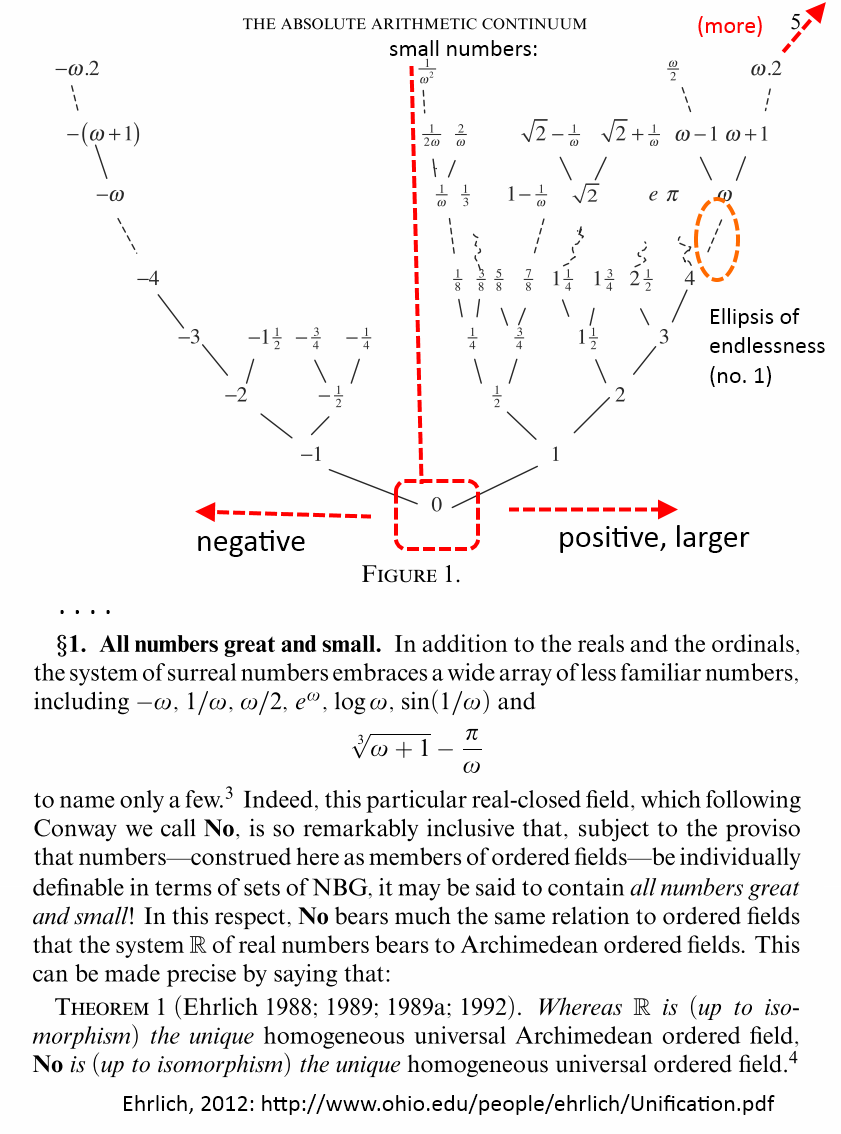
unity

Where also, this continuum result is useful:
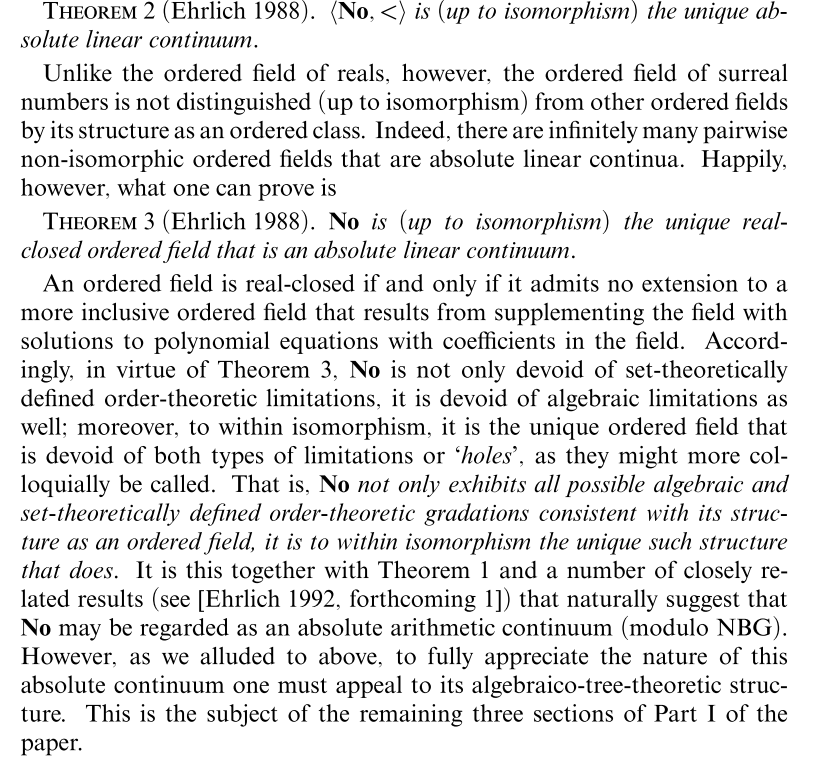
unified_continuum

PPS: As a blue vs pink punched paper tape example is used below, cf the real world machines
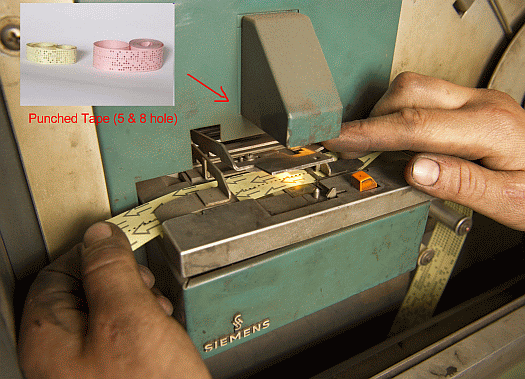
Punched paper Tape, as used in older computers and numerically controlled machine tools (Courtesy Wiki & Siemens)

and the abstraction for mathematical operations:
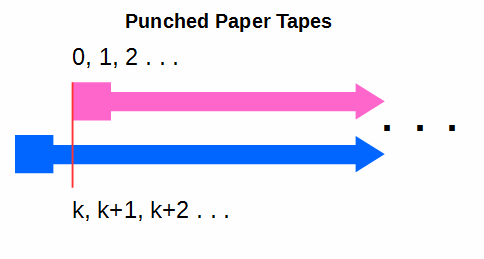
punchtapes_1-1

Note as well a Turing Machine physical model:
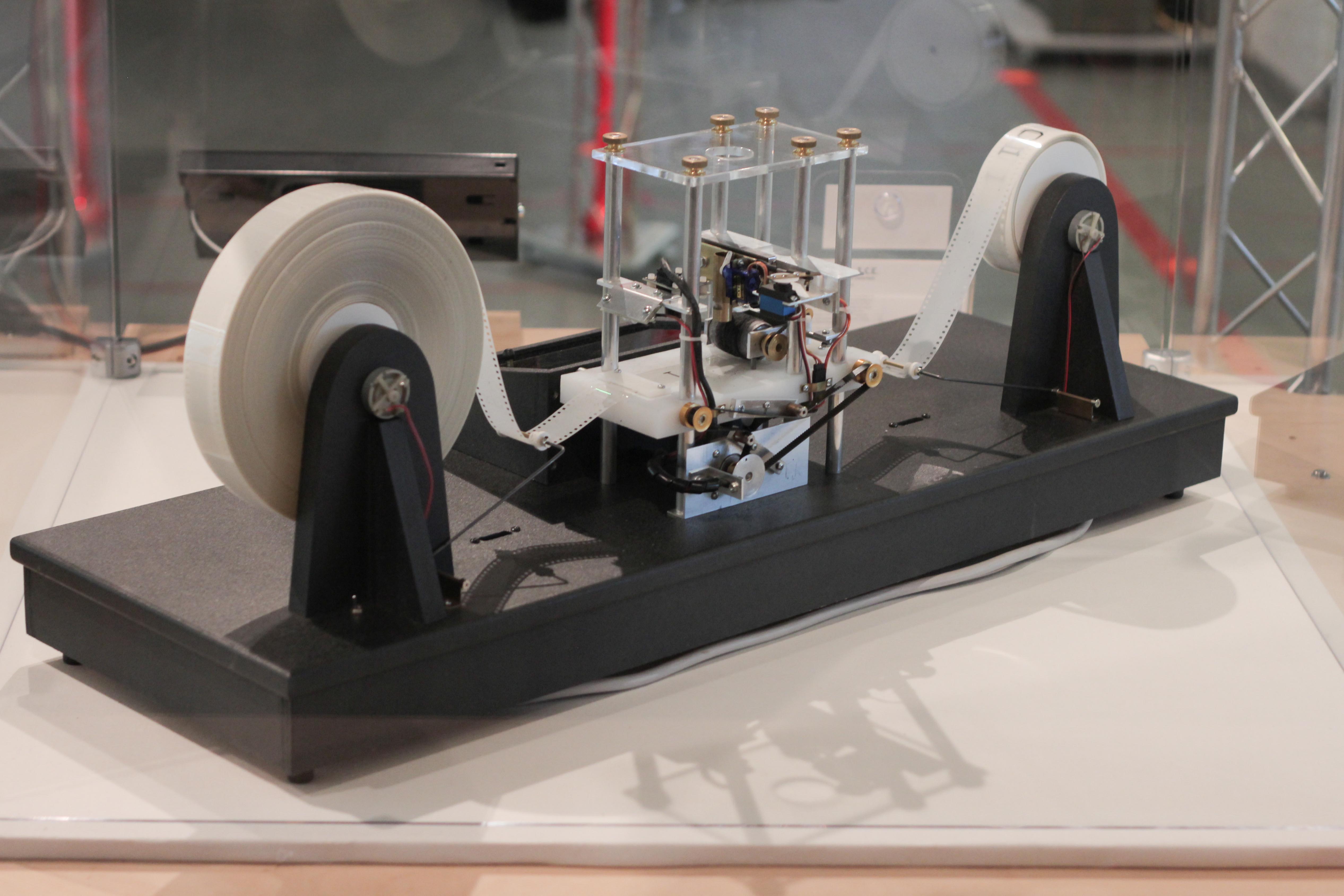
Turing_Machine_Model_Davey_2012

and its abstracted operational form for Mathematical analysis:
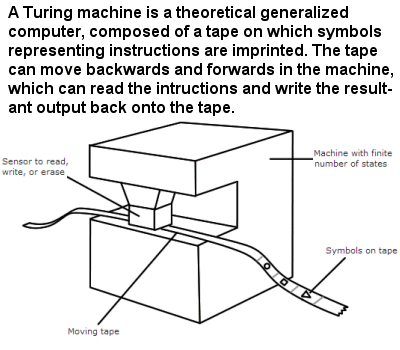
turing_machine

F/N: HT BA77, let us try to embed a video: XXXX nope, fails XXXX so instead let us instead link the vid page.

Comments
How do we get the man up on the rung of the ladder without him having to climb up the ladder? A ladder truck! Obviously.Mung
April 1, 2016
April
04
Apr
1
01
2016
07:39 AM
7
07
39
AM
PDT
Silver Asiatic,
That doesn’t follow. The term “available” cannot be used with regards to an infinite amount. Available means something like “accessible” or “can be captured”. But by its nature, you can’t have “availability” to infinitude. If you did, it would be finite. The distance to travel is infinite. By its nature, nothing can “capture” or “have access” to that which cannot be circumscribed. An infinite amount of anything is never available. It always reaches beyond any terminus.
I'm not quite following this. Maybe the word "available" was a poor choice on my part. I meant something like this: How many days have elapsed to this point, assuming and infinite past? Infinitely many days. I guess I don't understand your objection.
Infinity is a oneness that cannot be realized in temporal terms – by definition.
Can you provide more context or a source? I have never heard this before.
You cannot say, “today I finally completed traveling for infinite amount of time”. If you started the journey, then it has a finite past. If you never started, then you have no measurement. If today ends an infinite journey, then yesterday was infinity minus one, which is impossible.
Well, yesterday would also have been the end of an infinite journey. There's no mathematical problem with that. If the set of days previous to today has cardinality aleph_0, then the set of days previous to yesterday has cardinality aleph_0 - 1 = aleph_0 as well.
You’re restating the problem but not solving it. For some reason, you want to apply the term “0” to today. But that’s arbitrary. Tomorrow would then be 1. The next day would be 2, etc. But we arrive at the next day, and you’re calling that 0 again. But you already called today 0. What you’ve done is selected an arbitrary point on the line and assigned a value. You could call a day a million years ago “0” (and ultimately, any day you call “0” drifts to the past).
Yes, the choice of the label "0" for today is completely arbitrary, but that often/usually is the case when you set up a coordinate system. But once I fix an origin at 0, then I can't call tomorrow day 0 again in that same system. It would have to be day 1, unless I reset my coordinates, in which everything would have to shift.
It would not be possible to pick the earliest point on the line and assign any value to it, positive or negative.
True. There is no "earliest" point in time, assuming an infinite past.daveS
April 1, 2016
April
04
Apr
1
01
2016
07:29 AM
7
07
29
AM
PDT
daveS
There is an infinite time available with an infinite past, for one thing.
That doesn't follow. The term "available" cannot be used with regards to an infinite amount. Available means something like "accessible" or "can be captured". But by its nature, you can't have "availability" to infinitude. If you did, it would be finite. The distance to travel is infinite. By its nature, nothing can "capture" or "have access" to that which cannot be circumscribed. An infinite amount of anything is never available. It always reaches beyond any terminus.
But again, there is an infinite amount of time available, so you can both travel an infinite amount of time and arrive.
Infinity is a oneness that cannot be realized in temporal terms - by definition. You cannot say, "today I finally completed traveling for infinite amount of time". If you started the journey, then it has a finite past. If you never started, then you have no measurement. If today ends an infinite journey, then yesterday was infinity minus one, which is impossible. The idea that is possible to "have available" an infinite amount is made to appear as if "an infinite amount" is a finite thing that can be made available. But the universe does not have an infinite "available" since this quantity considered a completed infinite continues to expand. The universe does not have access to next year. So, it does not have next year "available". It cannot have available or accessible an infinite past because that quantity cannot be captured to be made available to anything. Nothing can "apply" an infinite amount to anything - again, because that amount cannot be circumscribed, captured, made available or made real in temporal terms.
…}, in order, wouldn’t work. The days could be labeled using {…, -3, -2, -1, 0}, however, which does have a maximum but no minimum.
You're restating the problem but not solving it. For some reason, you want to apply the term "0" to today. But that's arbitrary. Tomorrow would then be 1. The next day would be 2, etc. But we arrive at the next day, and you're calling that 0 again. But you already called today 0. What you've done is selected an arbitrary point on the line and assigned a value. You could call a day a million years ago "0" (and ultimately, any day you call "0" drifts to the past). The measurement is exactly the same, using positive or negative integers. You're driving to a destination an infinite distance away. Calling yesterday -1 doesn't make it possible to reach the destination. It would not be possible to pick the earliest point on the line and assign any value to it, positive or negative.Silver Asiatic
April 1, 2016
April
04
Apr
1
01
2016
07:06 AM
7
07
06
AM
PDT
KF, Well, I'm sure I'm repeating myself, but I will say a couple of things. First, I will answer Aleta's True/False questions directly: True to both. This is a philosophical position, I understand, and not everyone will agree with me, especially on #1. But I have given answers in the proper format. To address your post, I think you and I are simply playing by a different mathematical rule book. I accept the Axiom of Infinity, which means I don't need to think of N as being constructed step by step. The entire set just "exists", and we proceed from there. From what I gather, the only legitimate mathematical constructions for you are those that could be carried out (in principle) on a digital computer, starting with {}, with finite but arbitrarily large storage, in a finite amount of time. Therefore you don't accept the Axiom of Infinity or mathematical induction the same way I do. I don't see any reason to assume the universe "respects" either of our philosophical positions. Now if you could derive a logical contradiction P∧¬P from the assumption of an infinite past, I would agree that would be a major problem for me. So far, I haven't seen one demonstrated. I don't believe the tapes example provides one, and yes, I fully comprehend the concept of endlessness as you have defined it.daveS
April 1, 2016
April
04
Apr
1
01
2016
06:52 AM
6
06
52
AM
PDT
Aleta, people are dressing up these speculations in lab coats, and are using them in worldview construction. Those worldviews are then imposed in the name of science. More importantly, there are significant coherence issues to be resolved, so this is one case where Math and life issues intersect. Never mind that it is also desirable to more deeply understand mathematics in its own right. KFkairosfocus
April 1, 2016
April
04
Apr
1
01
2016
06:37 AM
6
06
37
AM
PDT
DS: Could you let us know your response on the merits to:
. . . the ellipsis cannot be exhausted. All numbers we can reach will be finite but endlessness remains onwards; as the pink vs blue punch tape examples highlight [ --> these being a thought exercise in essence similar to the thought exercise of Turing's machine and used to show what endlessness implies]. And yes this points to limitations on what ordinary mathematical induction can reach by chaining, again only to the potentially infinite. And this is echoed in the problem of a claimed infinite succession of finite values at +1 increments from 0. The succession cannot be completed by any successive process and were it there is an incoherence involved as in effect the successor set to the last achieved is a copy of the sequence so far. [--> e.g. {0,1,2,3,4} --> 5] If completed to actual endlessness, there would be endless and non finite members. The answer is, the endless cannot be traversed in successive +1 steps from 0.
KFkairosfocus
April 1, 2016
April
04
Apr
1
01
2016
06:16 AM
6
06
16
AM
PDT
Does anyone else want to answer Aleta's questions in #1188? If you look at her questions and KF's response in #1189, you will indeed see why this thread has 1200 posts as of now.daveS
April 1, 2016
April
04
Apr
1
01
2016
06:09 AM
6
06
09
AM
PDT
Silver Asiatic,
You cannot project forward in time without an origin point. For example, in an infinite past, it took an infinite amount of time to arrive at yesterday.
I would agree that an infinite number of days had elapsed prior to yesterday.
So the universe had to wait an infinite amount of time to add another day (today). If the amount of time needed in order to add one more day to the string of time is infinite, then a new day would never be added.
I don't see how this follows. There is an infinite time available with an infinite past, for one thing. The universe is "adding" new days eternally, every 24 hours.
To wait an infinite amount of time means to wait an infinitely long time — it means to always be waiting. You wait infinitely to arrive at the present – or at any present moment. If it takes waiting an infinite amount of time before you arrive at today, then you can never arrive. If it takes an infinite amount of time, for example, for you to travel from one place to another, you can never reach your destination because you’ll be traveling for an infinite amount of time which means it’s not possible to ever arrive.
But again, there is an infinite amount of time available, so you can both travel an infinite amount of time and arrive.
With an infinite past, today would be the maximum number of an infinite string. Tomorrow would be that maximum (impossible) number plus one. Obviously that doesn’t work.
Are you referring to a problem with labeling each day with a number? If so, I agree that using {1, 2, 3, ...}, in order, wouldn't work. The days could be labeled using {..., -3, -2, -1, 0}, however, which does have a maximum but no minimum.daveS
April 1, 2016
April
04
Apr
1
01
2016
06:04 AM
6
06
04
AM
PDT
I realize that those ideas are out there, but I think I've made it clear that my position is that metaphysical speculations about what is beyond our universe are just that - speculations, and if there is no experience we could have that would bear on their truth (and there isn't), then we should just live with the limits of our possible knowledge, and accept not knowing. That is why I've said several times that thinking about time as being modeled by a number line that extends back past the start of our universe is unwarranted. Whatever metaphysical background to our universe there is, assuming that there is one, may not exhibit either time or cause-and-effect continuity that is the same as, or even similar to, what we experience in our universe.Aleta
April 1, 2016
April
04
Apr
1
01
2016
05:50 AM
5
05
50
AM
PDT
Aleta, multiverse speculations try to get around such a terminus, cf OP and folks such as Krauss and Dawkins etc. (who in effect try to present the primordial quasi-physical space as "nothing" . . . https://uncommondescent.com/intelligent-design/fine-tuning-of-the-universe/#comment-541398 and this OP from 3 years back: https://uncommondescent.com/philosophy/on-pulling-a-cosmos-out-of-a-non-existent-hat/ ) This is a context of this discussion. Previously, there were oscillating models. The logic of an infinite quasi-physical regress of causally linked states/ entities culminating in our world is something that needs to be resolved. That infinite regress achieving the present points to issues of coherence is something to be looked at. Traversing and ending the endless in finite stage steps in succession looks like running into coherence issues, those need to be resolved -- including, is this like a square circle? KFkairosfocus
April 1, 2016
April
04
Apr
1
01
2016
05:33 AM
5
05
33
AM
PDT
FWIW, this debate took place about the time that the Big Bang theory was not yet established. Nowadays, and in this thread, I think everyone accepts that our universe is finite in time and space.Aleta
April 1, 2016
April
04
Apr
1
01
2016
04:57 AM
4
04
57
AM
PDT
debate link: http://faculty.arts.ubc.ca/rjohns/cop_rus.pdfkairosfocus
April 1, 2016
April
04
Apr
1
01
2016
03:40 AM
3
03
40
AM
PDT
This problem reminds me of the Copleston vs. Russell debate, during which Russell surprisingly didn’t have a problem with an infinite past of the universe, which conveniently provided him with a ground to deny the existence of the Uncaused Cause. Excerpt:
Copleston: Well, my point is that what we call the world is intrinsically unintelligible, apart from the existence of God. You see, I don't believe that the infinity of the series of events -- I mean a horizontal series, so to speak – (…) If you add up chocolates to infinity, you presumably get an infinite number of chocolates. So if you add up contingent beings to infinity, you still get contingent beings, not a Necessary Being. An infinite series of contingent beings will be, to my way of thinking, as unable to cause itself as one contingent being. Russell: I see no reason whatsoever to suppose that the total has any cause whatsoever. (…) I should say that the universe is just there, and that's all.
Origenes
April 1, 2016
April
04
Apr
1
01
2016
03:13 AM
3
03
13
AM
PDT
HeKS @1169
No person, piece of equipment, or other sort of aid could help the man get onto the ladder from the other direction at an infinite point and begin a descent from infinity to the ground. If the man gets onto a rung, he does so at some arbitrary finite point, however large it may be, and begins a finite descent to the ground. When he finally does get to the ground, he can say that he’s been climbing down the ladder for a very long time, but he won’t be able to say that he has been climbing down the ladder forever, or from the infinite past.
I have no problem agreeing with that. I was responding to Mung's question @ 1162 about how the man got on to the rung. He can obviously start only from a finite point on the ladder. For the record, I don't believe in infinite past nor infinite space. (see comment #1141)Me_Think
April 1, 2016
April
04
Apr
1
01
2016
03:05 AM
3
03
05
AM
PDT
With an infinite past, today would be the maximum number of an infinite string. Tomorrow would be that maximum (impossible) number plus one. Obviously that doesn't work.Silver Asiatic
April 1, 2016
April
04
Apr
1
01
2016
02:34 AM
2
02
34
AM
PDT
daveS
Why not? The assumption is of a universe which is eternal, which always has existed. I don’t see how you can conclude such universe could not have reached a present moment.
You cannot project forward in time without an origin point. For example, in an infinite past, it took an infinite amount of time to arrive at yesterday. So the universe had to wait an infinite amount of time to add another day (today). If the amount of time needed in order to add one more day to the string of time is infinite, then a new day would never be added. To wait an infinite amount of time means to wait an infinitely long time -- it means to always be waiting. You wait infinitely to arrive at the present - or at any present moment. If it takes waiting an infinite amount of time before you arrive at today, then you can never arrive. If it takes an infinite amount of time, for example, for you to travel from one place to another, you can never reach your destination because you'll be traveling for an infinite amount of time which means it's not possible to ever arrive.Silver Asiatic
March 31, 2016
March
03
Mar
31
31
2016
07:29 PM
7
07
29
PM
PDT
I know all that, kf. See 1170.Aleta
March 31, 2016
March
03
Mar
31
31
2016
06:51 PM
6
06
51
PM
PDT
Aleta, you and I are both aware the ellipsis cannot be exhausted. All numbers we can reach will be finite but endlessness remains onwards; as the pink vs blue punch tape examples highlight. And yes this points to limitations on what ordinary mathematical induction can reach by chaining, again only to the potentially infinite. And this is echoed in the problem of a claimed infinite succession of finite values at +1 increments from 0. The succession cannot be completed by any successive process and were it there is an incoherence involved as in effect the successor set to the last achieved is a copy of the sequence so far. If completed to actual endlessness, there would be endless and non finite members. The answer is, the endless cannot be traversed in successive +1 steps from 0. KFkairosfocus
March 31, 2016
March
03
Mar
31
31
2016
06:36 PM
6
06
36
PM
PDT
To Dionisio, Origenes, HeKS, Silver Asiatic, and anyone else coming late to this party: to help explain what has kept this thread going so long, let me ask each of the following two questions: Consider the integers on a standard number line, with the positive counting numbers 1, 2, 3, ... to the right of zero and their negatives to the left. 1. True or False: there are an infinite number of integers 2. True or False: Every integer is a finite number. What are your answers to questions 1 and 2. Note: this is a purely mathematical question. It is not about time, or ladders, or tapes - just math.Aleta
March 31, 2016
March
03
Mar
31
31
2016
04:44 PM
4
04
44
PM
PDT
The universe has to start at the beginning in order to reach the present moment. However, given an infinite past, there is no beginning to start from. And if there is no beginning then nothing can reach the beginning.Origenes
March 31, 2016
March
03
Mar
31
31
2016
04:22 PM
4
04
22
PM
PDT
Silver Asiatic,
Wherever you start would be (or have been) a present moment. But that present moment would have required an infinite amount of time to “become present”. Infinite past, necessarily, has no beginning – by definition. That which has no beginning has no starting point. An infinite past can never have gotten started.
I agree with that. An infinite past would not have a beginning.
That which has no beginning (an infinite past by definition) could never have had a present moment.
Why not? The assumption is of a universe which is eternal, which always has existed. I don't see how you can conclude such universe could not have reached a present moment.daveS
March 31, 2016
March
03
Mar
31
31
2016
04:09 PM
4
04
09
PM
PDT
Silver Asiatic @1182 & @1183 If time is a dimension that got created along with the known 3 spatial dimensions at the beginning of this universe, then those concepts are rendered meaningless outside this universe. This is incomprehensible for our limited minds.Dionisio
March 31, 2016
March
03
Mar
31
31
2016
02:30 PM
2
02
30
PM
PDT
HeKS @1180 Yes. Exactly. BTW, a while ago in another thread I think someone suggested that those 'persistent' interlocutors could be just agents working for this site in order to keep the discussions on, thus potentially increasing the website traffic. But I never took that story seriously. It sounded like a joke. :) However, this time I wonder... why not? :) All they have to do is repeat the same 'yerunda' (bzdura) over and over again until they are told to stop it. This time they've done a remarkable job! They've lifted this thread up to the top of the ranking! They should get a bonus! :) Check this out:
Popular Posts (Last 30 Days) Durston and Craig on an infinite temporal past . . . (2,390) A world-famous chemist tells the truth: there’s no… (2,239) Quantum Darwinism = Darwinism as woo-woo? (2,197) Homologies, differences and information jumps (1,386) An encounter with a critic of biological semiosis (1,323)
Wow!Dionisio
March 31, 2016
March
03
Mar
31
31
2016
02:17 PM
2
02
17
PM
PDT
That which has no beginning (an infinite past by definition) could never have had a present moment. So, you can't 'pick a point and start there'. No points on the continuum could be realized unless there was a beginning that created/started the continuum. If there was a start or beginning to the continuum, that is, if it ever came into temporal existence then it would have a finite past, not infinite. If it can never come into temporal existence then it could never exist.Silver Asiatic
March 31, 2016
March
03
Mar
31
31
2016
01:42 PM
1
01
42
PM
PDT
daveS
Regarding the bolded part, starting from where?
Wherever you start would be (or have been) a present moment. But that present moment would have required an infinite amount of time to "become present". Infinite past, necessarily, has no beginning - by definition. That which has no beginning has no starting point. An infinite past can never have gotten started.Silver Asiatic
March 31, 2016
March
03
Mar
31
31
2016
01:28 PM
1
01
28
PM
PDT
This thread has turned funny indeed. Pure entertainment. It's like the 'deep breaths of relief' in professor Alon's Systems Biology classes at the Weizmann Institute for Science. Except that here one doesn't have to stay focused on the explanation for biological oscillators, FFL, and all those circuits. Apparently some of the most active interlocutors here forgot the title of this OP?
Durston and Craig on an infinite temporal past . . .
Or maybe they skipped the first paragraph of the OP?
[...] it seems the evolutionary materialist faces the unwelcome choice of a cosmos from a true nothing — non-being or else an actually completed infinite past succession of finite causal steps.
:)Dionisio
March 31, 2016
March
03
Mar
31
31
2016
01:16 PM
1
01
16
PM
PDT
Dionisio
The impression one gets when reading a few comments here is that some of the most active interlocutors aren’t sure what exactly the discussion is about, hence they seem to talk past each other. That may explain why this thread has lasted so much.
And I'll say Amen to that. Based on ellazimm's latest comments I'm getting the impression that he/she may be one of those people who aren't sure exactly what the discussion is about ... or what arguments people have been making. I'm certainly unclear about who ellazimm thinks is 'bending the math to suit an agenda'.HeKS
March 31, 2016
March
03
Mar
31
31
2016
01:04 PM
1
01
04
PM
PDT
Aleta #1178
Amen! :-)
hahahahahahahahahahahahahahahahahahahahahahahahahahahahahhaha Okay, I'm off to my local pub for quiz night.ellazimm
March 31, 2016
March
03
Mar
31
31
2016
12:33 PM
12
12
33
PM
PDT
This isn’t about faith or beliefs or the origin of the universe. It’s just about mathematics. Accept the math and then see how it might apply to a given situation. Don’t bend the math to suit an agenda.
Amen! :-)Aleta
March 31, 2016
March
03
Mar
31
31
2016
12:20 PM
12
12
20
PM
PDT
Aleta #1173
There are no points infinitely far from zero!!! All points are a finite distance from zero. “Infinitely far” is not a well-defined mathematical concept. See my comments at 1170 for the mathematical meaningless of this idea.
Amazing, after almost 1200 posts. You have the patience of a saint. I'd love to buy you a drink. Next time you're in the UK let me know. Look folks: infinity, which ever one you want, plus or minus, is not something you can count to, or is a step, or on a ladder, or a hole on a tape. All of those are finite, albeit sometimes very large, numbers. And there is always an infinite number of steps or rungs or holes after any one you pick. And those will be finite as well. 'Endlessnes' is not a problem. There a system for dealing with it. For different kinds of 'endlessness' in fact. If you can come up with a better system then great, lets see it. And you'll have to show why the methods developed by Cantor are lacking as well. This isn't about faith or beliefs or the origin of the universe. It's just about mathematics. Accept the math and then see how it might apply to a given situation. Don't bend the math to suit an agenda.ellazimm
March 31, 2016
March
03
Mar
31
31
2016
12:13 PM
12
12
13
PM
PDT
1 … 6 7 8 9 10 … 48