In recent days, objector ES has been twisting the concept of Wickensian functionally specific information-bearing complex organisation into post-modernist deconstructionist subjectivist pretzels, in order to obfuscate the plain inductive argument at the heart of the design inference and/or explanatory filter.
For example, consider these excerpts from the merry go round thread:
ES, 41: . . . If a conscious observer connects some observed object to some possible desired result which can be obtained using the object in a context, then we say that the conscious observer conceives of a function for that object . . . . In science, properties of the material just are, without purpose, because everybody knows purpose is subjective. Functionality comes in when you get engineerial, and then it’s more up to the “objective functionality” of the engineer than of the material . . .
KF, 42: When one puts together a complex composite such as a program or an electronic amplifier ckt or a watch or an auto engine or many other things, function is not projected to it by an observer. I wuk, or i nuh wuk, mon. Was that a bad starter motor, a run down battery, out of gas, dirty injector points and more. Was that a bug in syntax or in semantics. Was that a BJT miswired and fried, did you put in the wrong size load resistor so it sits in saturation when it was meant to be in the middle of the load line, did you put in an electrolytic cap the wrong way around, etc. Is this a heart attack triggered by a blood clot etc. Function is not a matter of imagination but observation. And you full well know that or should.
Joe, 44: Earth to E. Seigner- functionality, ie a function, is an OBSERVATION. We observe something performing some function and we investigate to try to figure out how it came to be the way it is. Within living organisms we observe functioning systems and subsystems. As for “information”, well with respect to biology ID uses the same definition that Crick provided decades ago. And we say it can be measured the same way Shannon said, decades ago.
ES, 46: To an observer it looks like cars take people to work and shopping. But most of the time cars stand in garage motionless, and sometimes they fail to start. If the observer is truly impartial, then it’s not up to him to say that the failure to start or mere standing is any less of the car’s function than the ability of being driven. The car’s function is what the car does and when the car fails to start then that’s what it does and this is its function. Of course this sounds silly, but it’s true . . .
BA, 48: It is clear to me now. You have drunk deeply from the post-modernist/constructivist Koolaid. Kairosfocus and gpuccio be advised — attempting to reason with such as E.Seigner is pointless.
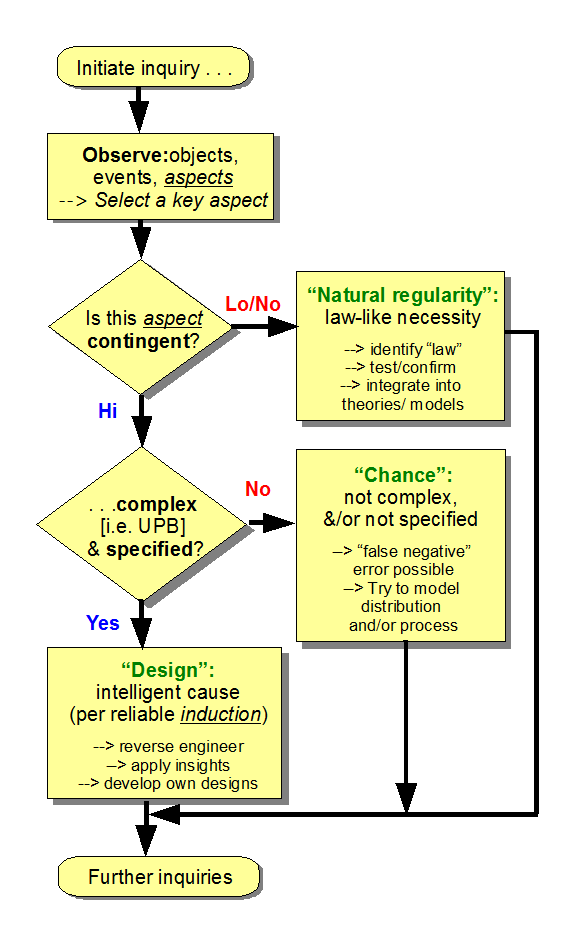
Let’s first remind ourselves as to what the glorified common-sense design inference process actually does as an exercise in inductive, inference to the best current explanation on empirically observed evidence:
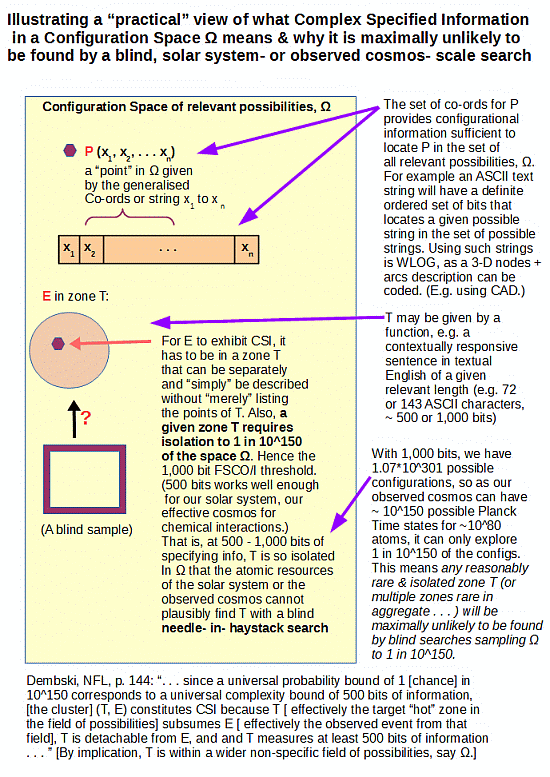
. . . and also, of the significance of Wickensian functionally specific, complex information and Orgellian informational specified complexity for a blind, needle in haystack search; as highlighted by Dembski et al:
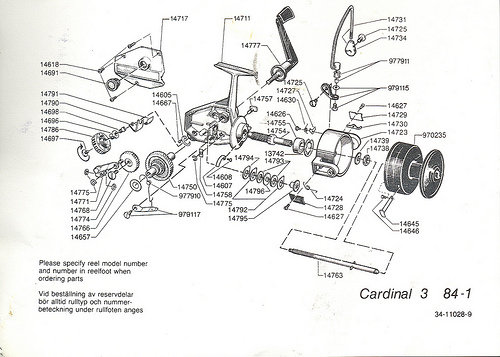
While we are at it, let us remind ourselves of what FSCO/I looks like in the form of functionally specific organisation in the technological world:
Fig 6: An exploded view of a classic ABU Cardinal, showing how functionality arises from a highly specific, tightly constrained complex arrangement of matched parts according to a “wiring diagram.” Such diagrams are objective (the FSCO/I on display here is certainly not “question-begging,” as some — astonishingly — are trying to suggest!), and if one is to build or fix such a reel successfully, s/he had better pay close heed.. Taking one of these apart and shaking it in a shoe-box is guaranteed not to work to get the reel back together again. (That is, even the assembly of such a complex entity is functionally specific and prescriptive information-rich.)
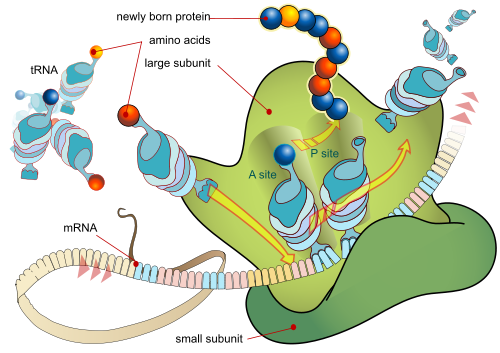
. . . and, in the life of the cell, as the Ribosome constructs a protein (which is a functionally specific string structure) based on the coded algorithmic information in the mRNA tape:
Step by step protein synthesis in action, in the ribosome, based on the sequence of codes in the mRNA control tape (Courtesy, Wikipedia and LadyofHats)
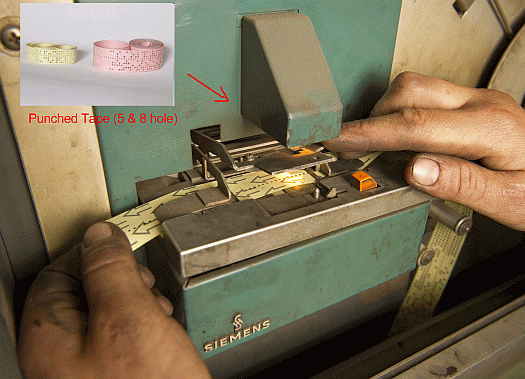
. . . not to mention, the parallel in the punched paper tape reader used for older computers and NC machines:
Punched paper Tape, as used in older computers and numerically controlled machine tools (Courtesy Wiki & Siemens)
(When things have been strawmannised and twisted into pretzels, it helps to straighten them back out again. Where also, a picture is worth a thousand words.)
However, Mr Arrington has a point.
While those caught up in po mo deconstructionist schemes are hardly likely to have a sudden change of heart on the strength of a mere blog comment or even a headlined post, the rest of us can draw lessons from what we see laid out before us. I therefore crave the indulgence of a promoted comment to headlined status, including a snippet of intensely personal history of my homeland. For, comments get buried and forgotten within hours, but a headlined post is for the record:
It may be entertaining to play semantics games with terms like function, but that simply reveals that your problem is not with science, it is with common sense reality tracing to some of the sillier bits of post-modernist radical subjectivism and deconstructionism.
Perhaps, it has not dawned on you that survival of the fittest or hill-climbing algorithms or natural selection or the like pivot on the objectivity of function. Have you gone to Panda’s Thumb, TSZ, ATBC or the like Darwinist agitator sites to challenge the core concepts of evolution based on differential reproductive success pivoting on functional differences of life-forms? I safely bet not, you are reserving such talking-points for those you object to, regardless of inconsistencies or outright incoherence.
[Ill-]Logic with a swivel.
Patently, revealingly, sadly, you have indulged in incoherent selective hyperskepticism.
And if you genuinely imagine that a stalled car with a dead engine, or a leaky roof, or a crashed computer, or a PA system that distorts sounds horribly are functionally distinct as a mere matter of subjective opinion, your problem is a breach of common sense.
Do you — or a significant other — have a mechanic? Are you a shade-tree mechanic? Do you have even one tool for maintenance? Do you recognise the difference between sugar, salt and arsenic in your cup of coffee? Between an effective prescription correctly filled and faithfully carried out when you get sick and a breakdown of that process? Etc?
I put it to you that you cannot and do not live consistent with your Lit class seminar-room talking points.
And, your evasive resort to clinging to such absurdities to obfuscate the issue of functionally specific, complex organisation and associated information, speaks loudest volumes for the astute onlooker.
Own-goal, E-S.
The bottom-line of the behaviour of several objectors over the past few days, speaks inadvertent volumes on the real balance on the merits of the core design theory contention that there are such things as reliable empirical markers — such as Wickensian FSCO/I — that are strong signs of design as key causal process.
But, many are so wedded to the totalising metanarrative of a priori Lewontinian evolutionary materialism that they refuse to heed the 2350 year old warning posed by Plato on where cynical radical relativism, amorality opening the door to might makes right nihilism and ruthless factions points to for a civilisation. Refusing to learn the hard-bought, paid for in blood lessons of history, they threaten to mislead our civilisation into yet another predictably futile and bloody march of folly. As the ghosts of 100 million victims of such demonically wicked deceptions over the past century warn us.
The folly on the march in our day is so arrogantly stubborn that it refuses to learn living memory history or the history passed on first hand to our grand parents.
Here is Sophia (personification of Wisdom), in the voice of Solomon echoing hard-bought, civil war triggered lessons in Israel c 1,000 BC:
Prov 1:20 Wisdom [Gk, Sophia] cries aloud in the street,
in the markets she raises her voice;
21 at the head of the noisy streets she cries out;
at the entrance of the city gates she speaks:
22 “How long, O simple ones, will you love being simple?
How long will scoffers delight in their scoffing
and fools hate knowledge?
23 If you turn at my reproof,[a]
behold, I will pour out my spirit to you;
I will make my words known to you.
24 Because I have called and you refused to listen,
have stretched out my hand and no one has heeded,
25 because you have ignored all my counsel
and would have none of my reproof,
26 I also will laugh at your calamity;
I will mock when terror strikes you,
27 when terror strikes you like a storm
and your calamity comes like a whirlwind,
when distress and anguish come upon you.
28 Then they will call upon me, but I will not answer;
they will seek me diligently but will not find me.
29 Because they hated knowledge
and did not choose the fear of the Lord,
30 would have none of my counsel
and despised all my reproof,
31 therefore they shall eat the fruit of their way,
and have their fill of their own devices.
32 For the simple are killed by their turning away,
and the complacency of fools destroys them;
33 but whoever listens to me will dwell secure
and will be at ease, without dread of disaster.”
A grim warning, bought at the price of a spoiled, wayward son who fomented disaffection and led rebellion triggering civil war and needless death and destruction, ending in his own death and that of many others.
Behind the Proverbs lies the anguished wailing of a father who had to fight a war with his son and in the end cried out, Oh Absalom, my son . . .
History sorts out the follies of literary excesses, if we fail to heed wisdom in good time.
Often, at the expense of a painful, bloody trail of woe and wailing that leads many mothers and fathers, widows and orphans to wail the loss of good men lost to the fight in the face of rampant folly.
But then, tragic history is written into my name, as George William Gordon’s farewell to his wife written moments before his unjust execution on sentence of a kangaroo court-martial, was carried out:
My beloved Wife, General Nelson has just been kind enough to inform me that the court-martial on Saturday last has ordered me to be hung, and that the sentence is to be executed in an hour hence; so that I shall be gone from this world of sin and sorrow.
I regret that my worldly affairs are so deranged; but now it cannot be helped. I do not deserve this sentence, for I never advised or took part in any insurrection. All I ever did was to recommend the people who complained to seek redress in a legitimate way; and if in this I erred, or have been misrepresented, I do not think I deserve the extreme sentence. It is, however, the will of my Heavenly Father that I should thus suffer in obeying his command to relieve the poor and needy, and to protect, as far as I was able, the oppressed. And glory be to his name; and I thank him that I suffer in such a cause. Glory be to God the Father of our Lord Jesus Christ; and I can say it is a great honour thus to suffer; for the servant cannot be greater than his Lord. I can now say with Paul, the aged, “The hour of my departure is at hand, and I am ready to be offered up. I have fought a good fight, I have kept the faith, and henceforth there is laid up for me a crown of righteousness, which the Lord, the righteous Judge shall give me.” Say to all friends, an affectionate farewell; and that they must not grieve for me, for I die innocently. Assure Mr. Airy and all others of the truth of this. Comfort your heart. I certainly little expected this. You must do the best you can, and the Lord will help you; and do not be ashamed of the death your poor husband will have suffered. The judges seemed against me, and from the rigid manner of the court I could not get in all the explanation I intended . . .
Deconstruct that, clever mocking scorners of the literary seminar room.
Deconstruct it in the presence of a weeping wife and mother and children mourning the shocking loss of a father and hero to ruthless show-trial injustice ending in judicial murder.
Murder that echoes the fate of one found innocent but sent to Golgotha because of ruthless folly-tricks in Jerusalem c. 30 AD.
(How ever so many fail to see the deep lesson about folly-tricks in the heart of the Gospel, escapes me. New Atheists and fellow travellers, when you indict the Christian Faith as the fountain-head of imagined injustice, remember the One who hung between thieves on a patently unjust sentence, having been bought at the price of a slave through a betrayer blinded by greed and folly. If you do not hear a cry for just government and common decency at the heart of the Gospel you would despise, you are not worth the name, literary scholar or educated person.)
And in so doing, learn a terrible, grim lesson of where your clever word games predictably end up in the hands of the ruthless.
For, much more than science is at stake in all of this.
GEM of TKI >>
_________________
I trust that the astute onlooker will be inclined to indulge so personal a response, and will duly draw on the hard-bought lessons of history (and of my family story . . . ) as just outlined. END
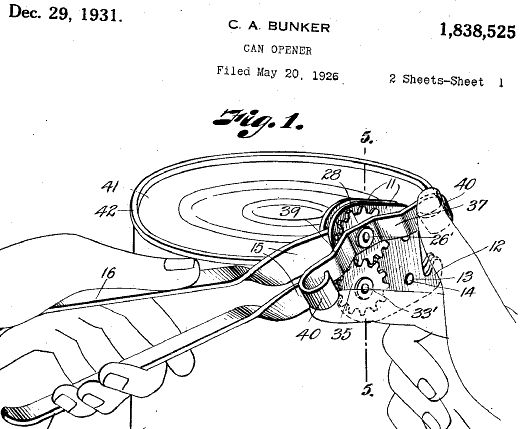
PS, Sept 30: ES has been making heavy weather over the idea of a primitive tribe encountering a can opener for the first time and not understanding its function (which he then wishes to project as subjective):
A rotating cutter can opener in action
And, a modern development showing meshing serrated gears:
modern rotary action can opener with meshing gears (Both images HT Wiki)
However, this is both incorrect and irrelevant to recognising from aspects of the can opener that exhibit FSCO/I, that it is designed:
1 –> Whether or not the primitive seeing an opener for the first time can recognise its purpose and contrivance that integrates materials, forces of nature and components into a functioning whole, that functionally specific, complex organisation for a purpose exists and is embedded in how the opener is designed.
2 –> Just by looking at the evident contrivance manifested in FSCO/I that is maximally unlikely to obtain by blind chance and mechanical necessity — as with the fishing reel above, the primitive is likely to perceive design.
3 –> The rotating gears with matched teeth set to couple together alone implies highly precise artifice to build centred disks, cut matching gearing, mount them on precisely separated and aligned centred axes, with other connected parts already demonstrates design to a reasonable onlooker.
4 –> The precisely uniformly thick handles joined in a pivot, and reflecting rectangle-based shapes would be equally demonstrative.
5 –> Where, actual intended function has not been brought to bear. (And note, we see here again the implicit demand that the design inference be a universal decoder/ algorithm identifier. That is a case of setting up and knocking over a strawman, where . . . just on theory of computation, such a universal decoder/detector is utterly implausible. The point of the design inference is that on inductively confirmed reliable signs such as FSCO/I we may confidently identify design — purposefully directed contingency or contrivance — as key causal factor. It seems that any number of red herrings are led away from this point to convenient strawman caricatures that are then knocked over as though the actual point has been effectively answered on the merits. It has not.)
6 –> But of course, that functionality dependent on specific components and an arrangement otherwise vanishingly improbable, reeks of design and the function can be readily demonstrated, as the patents diagram shows.
7 –> Where, again, it must be underscored that, per my comment 49 to ES:
[the] ultra-modernist, ugly- gulch- between- the- inner- world- and- the outer- one [of] sophomorised Kantianism fails and needs to be replaced with a sounder view. As F H Bradley pointd out over a century ago, to pretend to know that the external world is un-knowable due to the nature of subjectivitiy . . . the denial of objective knowledge . . . is itself a claim to objective knowledge of the external world and a very strong one too. Which therefore is self-referentially incoherent. Instead, it is wiser to follow Josiah Royce’s point that we know that error exists, undeniably and self evidently. Thus, there are certain points of objective knowledge that are firm, that ground that objective truth, warrant and knowledge exist, and that schemes of thought that deny or denigrate such fail. Including post modernism, so called. Of course, that we know that error exists means we need to be careful and conservative in knowledge claims, but the design inference is already that, it is explicitly inductive on inference to best explanation on observed patterns and acknowledges the limitations of inductive knowledge including scientific knowledge. [A Po-Mo] selectively hyperskeptical focus on the design inference while apparently ignoring the effect of that same logic on science as a whole, on history, on common sense reality and on reason itself, simply multiplies the above by highlighting the double standard on warrant.
8 –> In short, we have here a case of clinging to an ideological absurdity in the teeth of accessible, well-warranted correction.
Comments
Box, an elevator has a motor-cable assembly that moves it. It is easy to see the function and FSCO/I content. Same, with the gear assembly on can openers and the code in DNA as well as the associated nanotech execution machines. Focussing on such components is sufficient to ground a design inference without worrying over grand contexts. KFkairosfocus
September 30, 2014
September
09
Sep
30
30
2014
06:16 PM
6
06
16
PM
PST
GPuccio @98, Thank you very much for the clarification. I understand now why you define function in subjective terms and why you differentiate it from objective functionality. This helps immensely. Our arguments are eminently compatible, but as you say, the methodologies are quite different. In order to avoid confusion for the poor reader, I will substitute your term, "objective functionality" for my term "function" and your term "function" for my term "perception of function." This way we will be using words that mean the same thing when we argue. Thanks for taking time out to explain.StephenB
September 30, 2014
September
09
Sep
30
30
2014
06:07 PM
6
06
07
PM
PST
Now we could say, the function of the elevator can only be understood within the context of … what?
If you can't answer that all by yourself, dear Asiatic, you need to go back to elementary school.Daniel King
September 30, 2014
September
09
Sep
30
30
2014
05:20 PM
5
05
20
PM
PST
KF: "(...) the motor and cable assembly would be enough (...)"
Enough .. to do what?Box
September 30, 2014
September
09
Sep
30
30
2014
04:47 PM
4
04
47
PM
PST
Box: think components and interactions, as already noted. We do not need function of the whole. For an elevator the motor and cable assembly would be enough, much less the floor programming system. KFkairosfocus
September 30, 2014
September
09
Sep
30
30
2014
04:00 PM
4
04
00
PM
PST
KF #102: That is why for FSCO/I the protein synthesis process — obviously central to cell based life — is a key case.
Again, I agree 100%. The cell is an excellent context for the protein synthesis process - which is obviously functional for the cell. I stated something very similar in post #95. However a not-in-context can opener is not part of such a context - only in our minds. Unfortunately I have to repeat myself, because you have ignored this point once again.
SA #101: The function of an elevator, for example, is to carry people or things up or down the building.
Now we could say, the function of the elevator can only be understood within the context of … what?
I don't see much difference with the can opener example. One could compare the elevator with the can opener and "people and things" with the can.Box
September 30, 2014
September
09
Sep
30
30
2014
03:07 PM
3
03
07
PM
PST
PS: A gear is almost as iconic, that seemingly humble disc with a centred hole and meshed teeth that transmits power, synchronisation and regulatory control, requiring astonishing precision and alignment to do so well. (Ever got sand into the gear assembly of a fishing reel such as the one pictured above?) KFkairosfocus
September 30, 2014
September
09
Sep
30
30
2014
01:02 PM
1
01
02
PM
PST
Box: Sub-assemblies and sometimes components in their own right have function that may be readily discerned and may exhibit FSCO/I. We do not need to set out on the overall, if a component or two or a sub assembly will do. That is why for FSCO/I the protein synthesis process -- obviously central to cell based life -- is a key case. One that puts design at the foundation of biological life, from microbes to man. One that, as it pivots on codes, algorithms and NC machines, is a signpost pointing to language-using intelligence implicated in the design process. One that, once a priori materialist blinkers are removed, is readily understood in an information age. One that puts the chalenge squarely to such: kindly, show us on empirical observation, a comparable case of such FSCO/I and particularly dFSCI and associated NC execution machinery, coming about by blind chance and mechanical necessity on the gamut of our solar system or observable cosmos. An in fact decisive case. That is why, predictably, when it is on the table -- as in the OP -- it is ALWAYS ducked or diverted from by objectors. And of course, let us hear some explanation of how codes and algorithms and execution machinery only have imagined, projected function, how the machine-readable object codes disappear into blind chemistry etc (notice, the telling echo of what happens to conscious mind under evolutionary materialism). KFkairosfocus
September 30, 2014
September
09
Sep
30
30
2014
12:58 PM
12
12
58
PM
PST
Perhaps the example of a can opener is too simplistic and it doesn't work as well as others.
The function of an elevator, for example, is to carry people or things up or down the building.
Now we could say, the function of the elevator can only be understood within the context of ... what?Silver Asiatic
September 30, 2014
September
09
Sep
30
30
2014
12:36 PM
12
12
36
PM
PST
KF #96: Discs with centred holes, aligned on just right axes and with meshing co-ordinated teeth are not credible results of blind chance and mechanical necessity.
Indeed, I agree 100%. Of course it is designed.
The function of a can opener however, can only be understood in context. Without a can being in existence, there is no function of a can opener.
Discs with centered holes are parts of the can opener irrespective of context. On the contrary the function of a can opener is not part of the can opener irrespective of context. So the function of the can opener is ontologically distinct from the can opener. The function is an idea in the minds of conscious observers who can envision the context.Box
September 30, 2014
September
09
Sep
30
30
2014
12:30 PM
12
12
30
PM
PST
SB:You are running into difficulties with logic. We can detect the design features of a can opener without knowing its function. That doesn’t mean that we cannot perceive its function. Quite the contrary. We can perceive its function, but we may not if we don’t know why it was designed.
This is exactly the point I was making.
It is not the point that you have been making at all. You have been arguing the very opposite, namely that we cannot detect design—period, that we must “project” it.
With respect to function, you have never made the distinction that I made above (We can perceive function, but we may not). However, if you agree with the point, so much the better. We can forget about function and focus on design. .
SB: The members of the tribe will not know its function if they have never observed a can, which is the scenario you set up. On the other hand, they will perceive its function if they observe a can or if someone tells them the purpose of the can opener.
I don’t mean to be unkind, but this was precisely the point I was making, and this goes squarely against your original unconditional contention that we can perceive function, full stop.>
I did not go against my original claim, which was that we can perceive function. Members of the tribe will detect design in a can opener the moment they observe it. They will likely not immediately understand its function if they have never observed a can. Nevertheless, they can understand its function when they learn about cans. Let me dramatize the point: Members of the tribe WILL (unconditionally and with no understanding of context) perceive design and they CAN (with an understanding of context) perceive function.
To sum up, I have never said that an uninitiated tribe will immediately perceive the function of a can opener. I have said that they will immediately perceive its design. You are trying to argue that they will project their cultural biases and decide on that basis whether or not it was designed. That is false.StephenB
September 30, 2014
September
09
Sep
30
30
2014
11:09 AM
11
11
09
AM
PST
StephenB at #65:
I don't think there are differences between our views on these things, only different methodologies. I will try to clarify.
In all my discussion with E. Seigner, as in my general scientific arguments here, I try not to depend on ant specific metaphysics, as far as it is possible. That does not mean that I have not a metaphysics, but I try to make science when I make science, and metaphysics when I make metaphysics. I know that any science is more or less metaphysically based or biased, and all the rest, but just the same, let's say that whe I make science, I try to do it in a way that to me appears the leastt biased I can do it. OK?
Now, when I speak of function, and I say that the function we define for the object is subjective, my discourse is completely empirical and procedural.
Bear with me with what I am saying, for a moment: I try to treat subjects as objects, in the sense that they exist objectively as subjects, and therefore I can use them objectively in a procedure.
So, let's say that a subject is the only type of "object" who can "recognize" a function. Or simply "conceive" it.
It is true that the liver works independently from anyone who observes it, but again describing what happens in the liver as a function requires the conception of purpose, and only subjects have that.
Therefore, function is "subjective" because only a subject can conceive that a series of events has a purpose, which is the only conception which can differentiate any generic series of events (which always generates results) form a functional series of events (which generates purposeful results).
But the point is, our observer looks at a object (or material system) and "recognizes" a function in it. OK. But is he right? I mean, is that object really generating those results because a designer intended that? Or am I, the observer, only thinking that that is the case?
In general, the observer cannot know, unless he has direct knowledge that the object was designed.
That's why we are discussing design detection, and in particular design detection in cases where we know nothing of the designer and the design process, and what we have is the object and the system in which the object is supposed to have originated.
That's why I just say that the observer "conceives" of a function for the object he is observing. And verifies that this object has the objective functionality to implement that function.
So, in my procedure, the function is subjective because I leave the observer completely free to conceive and define any possible function for the object he is observing. Maybe those functions were designed, maybe not, Maybe he is just imagining that function, as a conscious being, for the first time. Maybe the object is not designed, and still we can conceive of a function for it, and still maybe that it has the objective functionality to implement it.
That's why I say that the conception of the function, and the definition of it, in my procedure, are subjective. Not because they cannot be objectively shared (they can) and used (they can), but because my observer is completely free to conceive and define any function for which the object can be used.
But how does that connect to design detection?
It's easy, and you know very well.
The point is, if an observer, any observer, can conceive a define for an object any function which:
a) is complex enough (requires a minimum of informational bits to be implemented,
and
b) those bits are enough according to an appropriate threshold for the system to make any random generation of the whole sequence of bits completely unlikely
and
c) there is no known necessity mechanism in the system which can generate that specific information
then we infer design as the best explanation.
Why? because in all the cases where we can apply the procedure and verify it (because we may know independently if the object is designed or not), IOWs in all the cases in which we can scientifically test the procedure. the procedure as described has 100% specificity for designed objects (and low sensitivity).
OK, that was a repetition, but the purpose was to clarify better what I mean when I say that, in my procedure, the function is defined as a subjective conception of the observer, while the objective functionality is the objective, repeatable assessment of whether an object can implement the previously defined function or not.
I hope I have been clear (not for E. Seigner, I think, I have lost those kind of hopes).
By the way, I will be very busy in the rest of the week, so I apologize in advance if I don't answer some post by someone. I will do my best.gpuccio
September 30, 2014
September
09
Sep
30
30
2014
10:00 AM
10
10
00
AM
PST
E. Seigner at #60:
"The thing is, I find #47 more full of holes than any of your previous comments. The most glaring fundamental ones we already covered in discussion just before, so I won’t go over them again."
and
"And that’s why I say – incalculable, undetectable, subjective."
OK. I have tried to explain my views, but I will not debate them with you endlessly. I hate repetitions.
Thank you for your interesting contributions.gpuccio
September 30, 2014
September
09
Sep
30
30
2014
09:30 AM
9
09
30
AM
PST
Box, its completed function as a can opener, yes, but the structure, composition and functions of component parts which have context, is a legitimate focus of a design inference. For example look at the modern opener, with the inclined gearing. The meshing and working of the gear train is complex, specific and functional, sufficient to make a confident by design inference. Discs with centred holes, aligned on just right axes and with meshing co-ordinated teeth are not credible results of blind chance and mechanical necessity. The hinged rectangle based arms, even, would be enough. KFkairosfocus
September 30, 2014
September
09
Sep
30
30
2014
09:20 AM
9
09
20
AM
PST
KF #94,
DNA as an integrated part of the organism undeniably has a function IMHO. A function ultimately for the organism.
However, a can opener is out there. It is not obviously a part of a larger whole. So, contrary to DNA, the function of the can opener is hanging in mid air, so to speak.
Similarly, one could say that extracted DNA has lost its function, by being isolated from its context.Box
September 30, 2014
September
09
Sep
30
30
2014
08:24 AM
8
08
24
AM
PST
Box, function depending on interacting integrated parts depends on the context of configurations and the materials and forces of nature. It often does not depend on an onlooking conscious observer. The living cell is not conscious, and neither is an embedded controller. That function is objective -- i wuk or i nuh wuk. But, those bedevilled by a sophomorised kantian ugly gulch between inner and outer worlds tend to project that error to the world. But as has been pointed out -- ignored of course -- that ugly gulch concept fails its own test, it implies the strong knowledge claim about the outside world, that it is unknowable. It self-refutes. KFkairosfocus
September 30, 2014
September
09
Sep
30
30
2014
07:31 AM
7
07
31
AM
PST
The best one could do irrespective of content is to posit a possible function or functions.Joe
September 30, 2014
September
09
Sep
30
30
2014
06:58 AM
6
06
58
AM
PST
Inferring design and inferring function are two distinct operations. The second is controversial if one claims to be able to do so irrespective of context.Box
September 30, 2014
September
09
Sep
30
30
2014
06:53 AM
6
06
53
AM
PST
KF,
Good clarification. Thank you.Dionisio
September 30, 2014
September
09
Sep
30
30
2014
06:40 AM
6
06
40
AM
PST
Because even something as basic as a can opener is not automatically self-explanatory by plain observation. It requires instruction and the image is meant as such instruction.
Of course, you're completely incorrect, as usual.
There are many human beings who have suffered severe brain damage and could not recognize a can opener even with instructions. Some are in a coma and cannot respond to information. Others would not be able to see what that image is because they are lacking eyesight. Other people are not interested in science so they would not want to know of a can-opener was designed or not.
So, obviously, the design inherently obvious in a object like a can-opener is not self-explanatory and it's impossible to determine if it emerged naturally from random chemical reactions.
In fact, a can-opener may be a living organism that evolved from scorpions. If you look at it quickly, there could be some homology there.
//sarcSilver Asiatic
September 30, 2014
September
09
Sep
30
30
2014
06:27 AM
6
06
27
AM
PST
F/N: Philip Johnson replies to the a priori Lewontinian materialism that is driving so much of the above, directly or indirectly through fellow traveller ideologies:
For scientific materialists the materialism comes first; the science comes thereafter. [[Emphasis original] We might more accurately term them "materialists employing science." And if materialism is true, then some materialistic theory of evolution has to be true simply as a matter of logical deduction, regardless of the evidence. That theory will necessarily be at least roughly like neo-Darwinism, in that it will have to involve some combination of random changes and law-like processes capable of producing complicated organisms that (in Dawkins’ words) "give the appearance of having been designed for a purpose."
. . . . The debate about creation and evolution is not deadlocked . . . Biblical literalism is not the issue. The issue is whether materialism and rationality are the same thing. Darwinism is based on an a priori commitment to materialism, not on a philosophically neutral assessment of the evidence. Separate the philosophy from the science, and the proud tower collapses. [[Emphasis added.] [[The Unraveling of Scientific Materialism, First Things, 77 (Nov. 1997), pp. 22 – 25.]
Back to a challenging transition, I already had to go out for the morning to deal with a policy paper.
KFkairosfocus
September 30, 2014
September
09
Sep
30
30
2014
05:03 AM
5
05
03
AM
PST
D: FSCO/I is the general form, which needs not be in digitally coded strings -- cf the exploded view of a fishing reel in the OP, which can be reduced to a set of coded strings by using something like AutoCAD etc. What GP and I both call dFSCI is the latter, coded strings. DNA is an explicit code, RNA is transcribed from it, proteins are assembled based on translating the code and themselves embed the code in their amino acid sequences. So, analysis on strings is without loss of generality, WLOG. Of course, the funciton of protein strings is quite remote from the DNA code, it requires a lot of nanomachinery to transcribe, edit, transfer, set up the Ribosome, and assemble the protein, That hen needs to fold or be folded in a chaperone machine, then perhaps be augmented with enabling species and/or clustered to build a structure, etc. We have not yet touched on the post office despatch system using the intracellular highway and vesicles moved about with walking trucks -- yes, walking trucks. This stuff is astonishing, awe-inspiring indeed. We have a long way to go to get near that sophistication. And as for the molecular nanotech involved, sheer genius that. KFkairosfocus
September 30, 2014
September
09
Sep
30
30
2014
04:59 AM
4
04
59
AM
PST
ES: More red herrings led away to strawmen. I chose a patents drawing, which will naturally be indexed. how convenient to pounce on and ignore the actual issue being highlighted! But, had you bothered to notice what was drawn out point by point from the discs and matched teeth with centred holes and aligned axes as well as the flat pieces of metal bent into rectangle based shapes and hinged at a pivot, you would have seen that the FSCO/I involved in the parts, independent of the overall function, would be enough to infer design. Perhaps, you are unaware of how hard it is to make a precise circle out of metal, cut meshing teeth and centre holes for mounting then align parallel axes at just the right separation in 3-d space . . . quite an exercise in geometry and in precision fabrication as well as dynamics of machines. Just so, the FSCO/I in text-strings in posts in this thread, in computer programs, in the PC or whatever you are reading this on, and of course in DNA, in mRNA and tRNA and in the ribosome or proteins, will be quite sufficient to confidently infer design. Save, for those locked into a prioris that lead them to cling to absurdities rather than admit that there is evidence pointing to something that does not sit comfortably with their preferred worldview. KFkairosfocus
September 30, 2014
September
09
Sep
30
30
2014
04:50 AM
4
04
50
AM
PST
#85 correction
Every new discovery reveals more FSCO/I and dFCSI that demand explanation.Dionisio
September 30, 2014
September
09
Sep
30
30
2014
04:33 AM
4
04
33
AM
PST
76 the bystander
Apparently you did not understand my message. Sorry, my fault, I'm not a good communicator.
In the many examples you saw in the indicated thread, one can note elaborate cellular and molecular choreographies associated with what KF calls FSCO/I and GP refers to as dFCSI.
As you could note in most of those posts, serious scientists are very busy trying to figure out how those complex processes work. They don't have time to think about how they appeared to begin with. IOW, OOL discussions are irrelevant to resolve their research issues at this point.
Every new discovery reveals more FSCO/I and dFCSI that demands explanation.
Your question about how an intelligent agent does his work seems kind of premature, in light of our lack of detailed information about the actual work of the observed processes. You might have to wait quite a while for an answer to your question. First things first.
Did you get it now?Dionisio
September 30, 2014
September
09
Sep
30
30
2014
04:30 AM
4
04
30
AM
PST
@kairosfocus #82
You mean this? https://uncommondescent.com/wp-content/uploads/2014/09/BunkerOpener.jpg
What are those lines and numbers in the image? The numbers refer to some explanatory notes, right? Why should there be explanatory notes meant to go along with the image? Because even something as basic as a can opener is not automatically self-explanatory by plain observation. It requires instruction and the image is meant as such instruction.
I note that your failure to acknowledge the value of context and the importance of background information when it's right there even in your own illustrations is remarkable. Definitely an ideological issue.E.Seigner
September 30, 2014
September
09
Sep
30
30
2014
04:09 AM
4
04
09
AM
PST
the bystander:
Wouldn’t that still need an explanation of how an agent can design intelligent organism to evolve?
Yes, that is separate from ID and it proves ID is not a dead-end.
I thought ID was about intervention and guiding complex biological/evolutionary process by ID agent.
That is a possibility but it isn't required.Joe
September 30, 2014
September
09
Sep
30
30
2014
03:59 AM
3
03
59
AM
PST
ES: Your can opener attempted counter example is answered in a PS to the OP, above. That is because a picture is worth a thousand words. I also note that failure to observe function on our part does not entail absence of function in an artifact. And, even when overall function based on complex, specific organisation, is poorly understood, the FSCO/I in parts is enough to point to design. KFkairosfocus
September 30, 2014
September
09
Sep
30
30
2014
03:29 AM
3
03
29
AM
PST
StephenB
You are running into difficulties with logic. We can detect the design features of a can opener without knowing its function. That doesn’t mean that we cannot perceive its function. Quite the contrary. We can perceive its function, but we may not if we don’t know why it was designed.
This is exactly the point I was making. You are running into difficulties with reading comprehension. (Note that subjective difficulties in reading comprehension are perfectly expected according to my background assumptions, while according to yours everybody should understand things the same way.)
StephenB
I don’t mean to be unkind, but you are going to have to work harder with your logic. The members of the tribe will not know its function if they have never observed a can, which is the scenario you set up. On the other hand, they will perceive its function if they observe a can or if someone tells them the purpose of the can opener.
I don't mean to be unkind, but this was precisely the point I was making, and this goes squarely against your original unconditional contention that we can perceive function, full stop.E.Seigner
September 30, 2014
September
09
Sep
30
30
2014
01:27 AM
1
01
27
AM
PST
SB: Any observer can detect its [can opener's] design features even without knowing its function.
E. Seigner
But what did you say just before? You said: “Can we perceive its function? Of course.” Well, of course we cannot perceive can opener’s function unless we see it in its *intended* context. It’s not up to the observer to determine what the intended context is. The observer might see it in any random context.
You are running into difficulties with logic. We can detect the design features of a can opener without knowing its function. That doesn't mean that we cannot perceive its function. Quite the contrary. We can perceive its function, but we may not if we don't know why it was designed. We don't need that same knowledge to detect design. Any rational person will know that a can opener was designed immediately upon inspection, even if they know nothing else. The same is not true of function. Recall my example of the surgeon's tool. I can recognize the design without knowing its function. Even so, I can perceive its function once I come to understand why it was designed.
SB: Members of the tribe will immediately detect the design features in the can opener, but they will not know its function or why it was designed if they have never observed a can.
Good. So your original claim “Can we perceive its function? Of course.” is overturned.
I don't mean to be unkind, but you are going to have to work harder with your logic. The members of the tribe will not know its function if they have never observed a can, which is the scenario you set up. On the other hand, they will perceive its function if they observe a can or if someone tells them the purpose of the can opener.StephenB

It may be entertaining to play semantics games with terms like function, but that simply reveals that your problem is not with science, it is with common sense reality tracing to some of the sillier bits of post-modernist radical subjectivism and deconstructionism.
Perhaps, it has not dawned on you that survival of the fittest or hill-climbing algorithms or natural selection or the like pivot on the objectivity of function. Have you gone to Panda’s Thumb, TSZ, ATBC or the like Darwinist agitator sites to challenge the core concepts of evolution based on differential reproductive success pivoting on functional differences of life-forms? I safely bet not, you are reserving such talking-points for those you object to, regardless of inconsistencies or outright incoherence.
[Ill-]Logic with a swivel.
Patently, revealingly, sadly, you have indulged in incoherent selective hyperskepticism.
And if you genuinely imagine that a stalled car with a dead engine, or a leaky roof, or a crashed computer, or a PA system that distorts sounds horribly are functionally distinct as a mere matter of subjective opinion, your problem is a breach of common sense.
Do you — or a significant other — have a mechanic? Are you a shade-tree mechanic? Do you have even one tool for maintenance? Do you recognise the difference between sugar, salt and arsenic in your cup of coffee? Between an effective prescription correctly filled and faithfully carried out when you get sick and a breakdown of that process? Etc?
I put it to you that you cannot and do not live consistent with your Lit class seminar-room talking points.
And, your evasive resort to clinging to such absurdities to obfuscate the issue of functionally specific, complex organisation and associated information, speaks loudest volumes for the astute onlooker.
Own-goal, E-S.
The bottom-line of the behaviour of several objectors over the past few days, speaks inadvertent volumes on the real balance on the merits of the core design theory contention that there are such things as reliable empirical markers — such as Wickensian FSCO/I — that are strong signs of design as key causal process.
But, many are so wedded to the totalising metanarrative of a priori Lewontinian evolutionary materialism that they refuse to heed the 2350 year old warning posed by Plato on where cynical radical relativism, amorality opening the door to might makes right nihilism and ruthless factions points to for a civilisation. Refusing to learn the hard-bought, paid for in blood lessons of history, they threaten to mislead our civilisation into yet another predictably futile and bloody march of folly. As the ghosts of 100 million victims of such demonically wicked deceptions over the past century warn us.
The folly on the march in our day is so arrogantly stubborn that it refuses to learn living memory history or the history passed on first hand to our grand parents.
Here is Sophia (personification of Wisdom), in the voice of Solomon echoing hard-bought, civil war triggered lessons in Israel c 1,000 BC:
A grim warning, bought at the price of a spoiled, wayward son who fomented disaffection and led rebellion triggering civil war and needless death and destruction, ending in his own death and that of many others.
Behind the Proverbs lies the anguished wailing of a father who had to fight a war with his son and in the end cried out, Oh Absalom, my son . . .
History sorts out the follies of literary excesses, if we fail to heed wisdom in good time.
Often, at the expense of a painful, bloody trail of woe and wailing that leads many mothers and fathers, widows and orphans to wail the loss of good men lost to the fight in the face of rampant folly.
But then, tragic history is written into my name, as George William Gordon’s farewell to his wife written moments before his unjust execution on sentence of a kangaroo court-martial, was carried out:
Deconstruct that, clever mocking scorners of the literary seminar room.
Deconstruct it in the presence of a weeping wife and mother and children mourning the shocking loss of a father and hero to ruthless show-trial injustice ending in judicial murder.
Murder that echoes the fate of one found innocent but sent to Golgotha because of ruthless folly-tricks in Jerusalem c. 30 AD.
(How ever so many fail to see the deep lesson about folly-tricks in the heart of the Gospel, escapes me. New Atheists and fellow travellers, when you indict the Christian Faith as the fountain-head of imagined injustice, remember the One who hung between thieves on a patently unjust sentence, having been bought at the price of a slave through a betrayer blinded by greed and folly. If you do not hear a cry for just government and common decency at the heart of the Gospel you would despise, you are not worth the name, literary scholar or educated person.)
And in so doing, learn a terrible, grim lesson of where your clever word games predictably end up in the hands of the ruthless.
For, much more than science is at stake in all of this.
GEM of TKI >>