Uncommon Descent Serving The Intelligent Design Community
Author

Robert Deyes

Molecular ‘Chevaliers’ Rattle The Darwin-faithful

Review Of The Fifth Chapter Of Signature In The Cell By Stephen Meyer

Amidst the many memories that I cherish from my college undergraduate years are the get-togethers that friends and I would have to discuss the core textbook principles of molecular biology. Benjamin Lewin’s Genes IV stands out as one of the treasured resources we would pour over as we searched for the facts on the makeup of life. Perhaps most often visited amongst our topics of discussion were those of eukaryotic transcription and translation principally because for all of us there was something deeply unsettling about the naturalistic foundations upon which the emergence of these processes had been presented. So unsettled were we that we could never quite swallow the evolutionary suppositions that accompanied the factual details. Read More ›
Functional Interdependencies Tighten The Noose On Darwinists’ ‘Received Wisdom’

Synopsis Of The Fourth Chapter Of Nature’s IQ By Balazs Hornyanszky and Istvan Tasi

As an avid participant of the compass-based sport of orienteering in the 1980s, one of the roles I was frequently assigned to was that of ‘course designer’. Meeting the needs of the many orienteering enthusiasts who turned up on competition day was a formidable task that required the cooperative efforts of a large number of individuals. Errors in communicating course layout or map design could have been navigationally disastrous for all concerned. Of course few of us need reminding of nature’s own ‘grand schemes’ of cooperative synchrony epitomized in the colonies of over eleven thousand ant species that today grace our planet. Workers, soldiers, fertilizing males and queens ‘play their instruments’ in an orchestra that is in part directed by the activity of a family of molecules called pherormones.

Read More ›

Sewing The Seeds Of Biology’s Post-‘Shannon Information’ Era

Synopsis Of The Fourth Chapter Of Signature In The Cell by Stephen Meyer
ISBN: 9780061894206; ISBN10: 0061894206; Imprint: HarperOne

When talking about ‘information’ and its relevance to biological design, Intelligent Design theorists have a particular definition in mind. Indeed they see information as “the attribute inherent in and communicated by alternative sequences or arrangements of something that produce specific effects” (p.86). When the twentieth century American mathematician Claude Shannon laid down his own theory for quantifying information he drew attention to a mathematical relationship that on its surface appeared intuitive. Information as Shannon noted was inversely proportional to uncertainty. That is, the more information we had about our world the less uncertainty there was over the outcome of future events. Shannon also proposed that the more improbable an event the more information such an event would impart once it actually took place (say, throwing a six on a role of dice). Read More ›

“Please Be My Toothpick You Scrumptious Old Wrasse!”

Synopsis Of The Third Chapter Of Nature’s IQ By Balazs Hornyanszky and Istvan Tasi
ISBN 978-0-9817273-0-1

Mutualism and symbiosis are terms that budding biologists are all too familiar with by the time they begin their university careers. We all learn about the cooperativity that exists amongst many of our world’s creatures and the benefits they can reap from each other’s presence. Goliath groupers that open their mouths to cleaning ‘minions’ such as the blue-streak cleaner wrasse defy deeply held expectations of nature’s ways as do sharks that extend their vicious jaws to pilot fish that then pick out food remnants from between their teeth.

Extraordinary from a predatory perspective is the finding that wrasses and pilot fish are rarely (if ever) eaten by their much larger hosts. Discussions on the evolution of such partnerships leave the non-expert believing that chance mutations could simply turn predator ‘fearers’ into predator ‘lovers’ that naturally bond with their otherwise mortal enemies. Evolutionists weigh in by further supposing that reciprocal mutations led these same enemies to offer VIP treatments to their tasty servants.

Read More ›

‘That Wild-Haired Man And That Dapper Fellow’- Homing In On The Secret Of Life

Synopsis Of The Third Chapter Of  Signature In The Cell by Stephen Meyer
ISBN: 9780061894206; ISBN10: 0061894206; Imprint: HarperOne
 
Watson, with his wild hair and perfect willingness to throw off work for a Hedy Lamarr film, and Crick, a dapper and no longer especially young fellow who couldn’t seem to close the deal on his dissertation“(p.59).  These are the uninspiring words that Stephen Meyer uses to describe the two men who would ultimately unravel the structure of DNA and thus ring in the molecular biology revolution. 

With the chemical composition of DNA sufficiently well established, the world of science appeared poised for a major shake-up in its understanding of heredity.  Still, the road of discovery up until that time had been anything but a ‘walk in the park’.  While important details concerning the components of DNA had been ironed out as early as 1909, several erroneous turns at the beginning of the twentieth century had thrown biologists ‘off piste’ into thinking that protein and not DNA lay at the heart of heredity. Read More ›

A Look Back At Brian Goodwin’s Organocentric View

(Originally published on the Access Research Network on the 28th Aug, 2008 as  The Organocentric Illusion: The Biological Complexity Underlying Dynamic Systems)

Brian Goodwin died last week at the age of 78

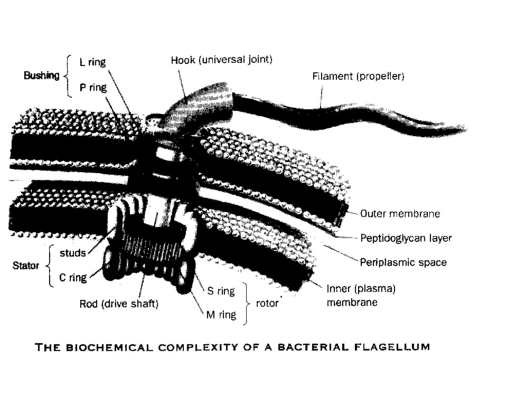
Today much of evolutionary biology has focused on trying to establish how genes may have provided the raw material for natural selection to run its course (Ref 1, pp.1-2). In this genocentric view, inheritance through random mutation and selection is the basis upon which all of life and its ensuing diversity have arisen. Nevertheless several scientists including Open University biologist Brian Goodwin have challenged this view by postulating that organisms are built not only through genetic instruction but also through processes of dynamic organization that act independently of genes (Ref 1, pp.1-8). In his book How The Leopard Changed Its Spots, Goodwin outlines several key examples in nature that support his position. From the elegant concentric and spiral patterns of slime-mould amoebas to the dynamic mode of the mammalian heart and the brain, and finally to the ordering of haphazard ants into efficient, hard working colonies, (Ref 1, pp.43-76) Goodwin comes to the conclusion that in these systems, biological complexity has arisen through the ordering of dynamic systems independently of the action of genes. Experiments on the bacterial flagellum are yet another of his notable examples. Read More ›

Masquerades Unmasked And The Designed IQ

Synopsis Of The Second Chapter Of Nature’s IQ By Balazs Hornyanszky and Istvan Tasi
ISBN 978-0-9817273-0-1

Defense, Disguise, Perception is the descriptive title that Hornyanszky and Tasi have chosen for the second chapter of their book Nature’s IQ. And the delivery of the facts is as convincing and thought-provoking as ever. Coupled with its vivid illustrations, the chapter lays out a set of arguments that are easily accessible to the expert and non-expert reader alike. The underlying principle of their text is simple- intelligent design lies at the heart of many of nature’s phenomena.

Read More ›

The Intelligent Design Of Animal Behaviors

Synopsis Of The First Chapter Of Nature’s IQ By Balazs Hornyanszky and Istvan Tasi
ISBN 978-0-9817273-0-1

Ethology, the field of biology that attempts to explain the origins of animal behavioral patterns, has traditionally focused on two possible sources for such patterns- those that are inherited and those that are environmentally induced. For the former of these two, the Darwinian mechanism is that which is most commonly advanced. The underlying axiom barely needs repeating- inherited behaviors have been acquired through gradual changes as a result of environmental selective pressures. In his 1973 Nobel lecture entitled Analogy As A Source Of Knowledge, Konrad Lorenz made his case in favor of the link between Darwinian gradualism and animal behavior. And yet in Nature’s IQ, authors Balazs Hornyanszky and Istvan Tasi blast such a gradualistic inference and re-interpret the evidence in favor of the intelligent design alternative.

Read More ›

An Eye Into The Materialist Assault On Life’s Origins

Synopsis Of The Second Chapter Of  Signature In The Cell by Stephen Meyer

ISBN: 9780061894206; ISBN10: 0061894206; HarperOne

When the 19th century chemist Friedrich Wohler synthesized urea in the lab using simple chemistry, he set in motion the ball that would ultimately knock down the then-pervasive ‘Vitalistic’ view of biology.  Life’s chemistry, rather than being bound by immaterial ‘vital forces’ could indeed by artificially made.  While Charles Darwin offered little insight on how life originated, several key scientists would later jump on Wohler’s ‘Eureka’-style discovery through public proclamations of their own ‘origin of life’ theories.  The ensuing materialist view was espoused by the likes of Ernst Haeckel and Rudolf Virchow who built their own theoretical suppositions on Wohler’s triumph.  Meyer summed up the logic of the day

“If organic matter could be formed in the laboratory by combining two inorganic chemical compounds then perhaps organic matter could have formed the same way in nature in the distant past” (p.40)

Read More ›

Beginnings Of A Personal Conviction

Synopsis Of The First Chapter Of  Signature In The Cell by Stephen Meyer

ISBN: 9780061894206; ISBN10: 0061894206; Imprint: HarperCollins

In August of 2004, philosopher Stephen Meyer published an article in the Proceedings Of The Biological Society Of Washington.  The article raised media interest and outrage because it was the first to “advance the theory of intelligent design” in a peer-reviewed scientific journal.  The editor Richard Sternberg lost his position as a result of the ensuing debacle.

Read More ›

B.A.R.B: Birds Are Really…..Birds!

The summer of 2000 promised to be very exciting for ornithologists and paleontologists alike as they flew into Beijing for the fifth quadrennial meeting of the Society of Avian Paleontology and Evolution (Ref 1). The setting was most appropriate given the richness of fossils that have been unearthed in Chinese soil. The central theme of the meeting lay in trying to resolve the question of whether birds had really evolved from dinosaurs (Ref 1). However, rather than a harmonious discussion with the constructive disagreement that one might expect from any scientific ‘get-together’ aimed at resolving discrepancies in data, the meeting did nothing but expose an underlying discord (Ref 1). Read More ›

Synergistic Modifications Of Nuclear Histone Proteins Display Functional Design

The word ‘compaction’ is one that in my mind conjures up images of vacations long-passed when I would cram as many clothes as I could into the smallest suitcases I could find. Such a task has become even more irksome in recent years with the hefty restrictions in place that limit the amount of luggage we can now take onto airplanes. But in at least one context- that of DNA biology- compaction refers to something much more exquisite and desirable.

Read More ›

Prebiotic Earth Scenarios Founded On Tarry Barbecue Mess

A Nature review that begins with the pronouncement that an experiment “has quashed” major objections to the RNA world of prebiotic origins (Ref 1) is bound to raise a few eye-brows.  It is a bold pronouncement indeed and one that must be accompanied by a water-tight set of evidences.  In his review of the work of John Sutherland and others at the University of Manchester, science writer Richard Van Noorden promised just that by declaring to his readers that these same scientists had achieved the ‘never-before-performed’ feat of making a ribonucleotide- one of the components of RNA- in the lab (Ref 1).  Key to the success of the experiment was the presence of a phosphate group that, in addition to serving as one of the final reactants in the ribonucleotide synthesis process, also functioned as a catalyst earlier on in the reaction (Refs 1-3).  This result was the culmination of twelve long years of laboratory-based research during which simple molecules had been shown to be the “unwitting choreographers” of ribonucleotide synthesis (Ref 1).

Read More ›

The New Spontaneous Generationists

On this episode of ID the Future, Anika Smith interviews writer Robert Deyes on The New Spontaneous Generationists, who argue that “matter and energy somehow self-originated into complex forms without outside intelligence.” While we may have moved beyond expecting rats to materialize from garbage heaps and maggots from decaying meat, materialists today are trying to simulate the origin of first life without intelligent agency — and they’re failing. Listen in to learn why, and read Deyes’ article at ARN’s ID Report for more.

untitled

We Have No Excuse- A Scientific Case for Relating Life to Mind (PART II)

By Robert Deyes And John Calvert

PART II: THE ULTIMATE RELATIONSHIP – ANALYZING PATTERNS THAT COMPRISE LIFE


Many scientific disciplines that seek to determine the relationship of an existing pattern to past events analyze them as we analyzed the letters on the drawing board (See PART I).  Coroners seek to know the cause of a death – is the death related to a mind or a natural or accidental cause?  Those searching for extraterrestrial intelligence seek to know whether a sequence of radio waves from outer space is related to an intelligent rather than a natural or accidental cause.  Archeologists seek to know whether a hammer shaped rock got its shape from a mind or a stream.  


Our analyses show that the determination of causal relationships involve three inquiries.  First, does the pattern manifest a function or purpose – an effect to occur in the future, such as the meaning of the word “Think?” If not there is no necessity to infer a mind.  Second, are the various components of the pattern related to or dependent on material causes driven by physical and chemical forces – by necessity?  A snowflake looks designed, but its beautiful hexagonal symmetry simply reflects the way water molecules necessarily organize under certain conditions.  If chemical necessity can explain the pattern, there is no necessity to infer a mind.  Third, if a functional relationship reflected in the pattern is physically independent (not necessary like the snowflake), can chance explain it?  If not then a mind – an intention becomes the best explanation for the functional relationship reflected in the pattern.  The methodology is explained with great precision by William Dembski in The Design Inference (Refs 1,2). Read More ›