Uncommon Descent Serving The Intelligent Design Community

The freedom/mind issue surfaces again

Categories
Computing
mind and brain
rhetoric
Share
Facebook
Twitter/X
LinkedIn
Flipboard
Print
Email

First, a happy thanksgiving.

Then, while digesting turkey etc, here is something to ponder.

One of the underlying issues surrounding the debates over the design inference is the question of responsible, rational freedom as a key facet of intelligent action, as opposed to blind chance and/or mechanical necessity. It has surfaced again, e.g. the WD400 thread.

Some time back, this is part of how I posed the issue, emphasising the difference between self-aware responsible freedom and blindly mechanical causal chains used in computing:
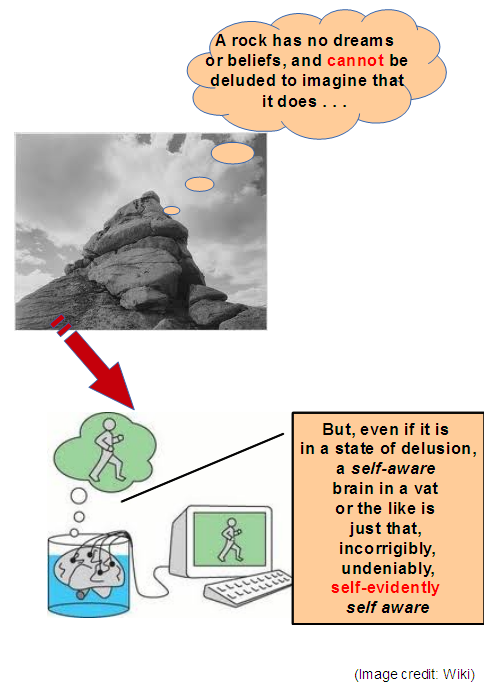
self_aware_or_not

Even if deluded about circumstances a self-aware being is just that, self-evidently, incorrigibly self-aware. And, a key facet of that self awareness is of responsible, rational freedom. Without which we cannot choose to follow and accept a rational case, we would just be mechanically grinding out our programming or and/or hard wiring.

Like, say, a full adder circuit:

1_bitFull-Adder-Circuit

Wire it right, designate the correct voltages as 1 and 0, and the outputs will add one bit with carry in and out. Indeed, more consistently correctly than we do.

Mis-wire, and it won’t, just as if the voltage-state assignments are wrong. But the circuits neither know nor care that they are performing arithmetic, they simply respond to inputs per the mechanical performance of the given circuits.

That is the context of my comment at 79 in the thread:

Z, 73:

mohammadnursyamsu: All current programs on computers work in a forced way, there is no freedom in it, the flexibility does not increase the freedom one bit.

[Z:] All you have done is introduce yet another term, “freedom”, which is not well-defined in this context.

Actually, not.

Absent responsible, rational freedom — exactly what a priori evolutionary materialist scientism cannot account for — you could not actually compose comment 73 above.

In short, freedom is always there once the mind is brought to bear, and without it we cannot be rationally creative.

And per observation, computation is a blind, mechanical cause effect process imposed on suitably organised substrates by mind. In fact, a fair summary of decision node based processing is that coded algorithms reduced to machine code act on suitably coded inputs and stored data by means of a carefully designed and developed . . . troubleshooting in a multi-fault environment required . . . physical machine, to generate desired outputs. At least, once debugging is sufficiently complete. (Which is itself an extremely complex, highly intuitive, non algorithmic procedure critically dependent on creative, responsible, rational freedom. [Where, this crucial aspect tends to get overlooked in discussions of finished product programs and processing.])

There really is a wizard behind the curtain.

Freedom, responsible rational freedom is not to be dismissed as a vague, unnecessary and suspect addition to the discussion, it is the basis on which we can at all think, ground and accept conclusions on their merits instead of being a glorified full adder circuit.

Where, of course, inserting decision nodes amounts to this: set up some operation, which throws an intermediate result, a test condition. In turn, that feeds a flag bit in a flag register. On one alternative, go to chain A of onward instructions, on the other go to chain B. And this can be set up as a loop.

First, the classic 6800 MPU as an example:
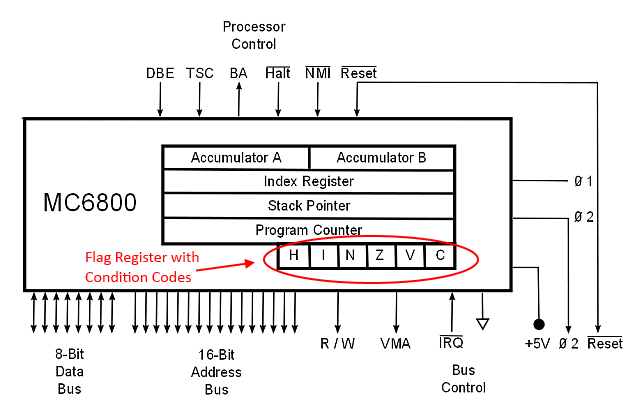
MC6800_Processor_DiagramLet me add [Nov 28] a more elaborate diagram of a generalised microprocessor and its peripheral components, noting that an adder is a key component of an Arithmetic and Logic Unit, ALU . . . laying out the mechanisms and machinery that, properly organised, will execute algorithms:
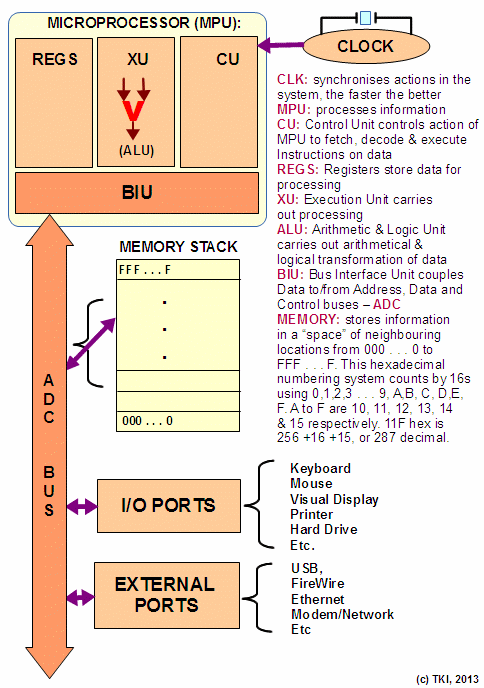
mpu_model

Next, the structured programming patterns that can implement any computing task:
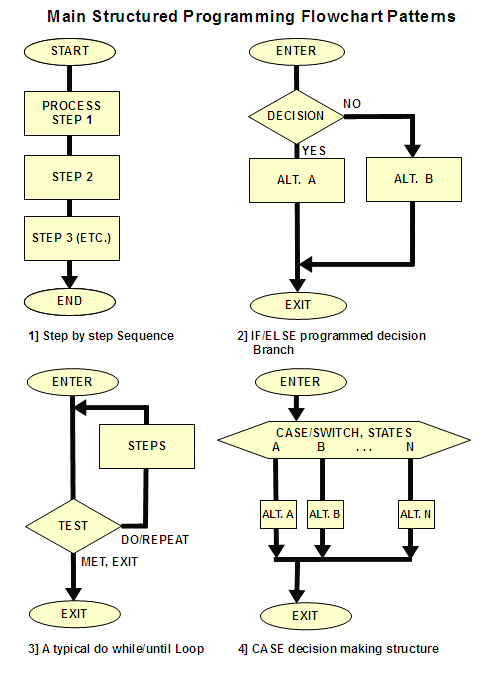
The classic programming structures, which are able to carry out any algorithmic procedure

It should be clear that no actual decisions are being made, only pre-programmed sequences of mechanical steps are taken based on the designer’s prior intent. (Of course one problem is that a computer will do exactly what it is programmed to, whether or not it makes sense.)

As a related point, trying to derive rational, contemplative self aware mindedness from computation is similar to trying to get North by heading due West.

Samuel Johnson, reportedly responding to the enthusiasm for mechanistic thinking in his day, is apt: All theory is against the freedom of the will; all experience for it. (Nor does this materially change if we inject chance processes, as such noise is no closer to being responsible and rational.)

If we are wise, we will go with the experience. END

Comments
DS, the problem is not whether you are personally explicitly committed to evolutionary materialist scientism, but the degree of influence it holds over you, sometimes even unconsciously. Even as an outspoken opponent to Marxism on my campus, its influences seeped in subtly in ways it took years to clean out again, including in visceral, intuitive responses that were simply soaked in. KF PS: It may be helpful for you to articulate your core worldview commitments and assess them on factual adequacy, logical and dynamical coherence, and explanatory power. At the very least to yourself.A good first point is to look at the root of reality and linked matters ontological and moral, applying to moral governance, community life and civilisational consequences.kairosfocus
November 27, 2015
November
11
Nov
27
27
2015
09:07 AM
9
09
07
AM
PDT
Z, if you refuse to understand the implications of agency, self-identity, intentionality, responsible freedom and rationality in I play a game, I cannot stop you. But I can point out the absurdity and the sobering consequences of reducing man to machine. KFkairosfocus
November 27, 2015
November
11
Nov
27
27
2015
09:01 AM
9
09
01
AM
PDT
F/N: where this ends is, you or I or an unborn child in the womb have no more value or worth than that outdated computer now being scrapped to mine its valuable bits and pieces. This stuff is not without serious consequences. KFkairosfocus
November 27, 2015
November
11
Nov
27
27
2015
08:59 AM
8
08
59
AM
PDT
kairosfocus: Deep Blue has no intention to engage in a sport for fun or profit No, but that's not a requirement to play chess. It's like saying a steam drill doesn't drill because it doesn't have the intention of John Henry, who, by the way, didn't do it for fun or money, but out of pride.
"Lord a man ain't noth' but a man But before I let that steam drill beat me down I'm gonna die with a hammer in my hand, Lord, Lord I'll die with a hammer in my hand" — John Henry
Zachriel
November 27, 2015
November
11
Nov
27
27
2015
08:55 AM
8
08
55
AM
PDT
KF,
DS, the fact that you are conscious, purposeful, responsibly free and rational, able to warrant claims and thus knowing, cannot be accounted for on materialistic grounds. Indeed, that is why there are so many cases of trying to set such first person experiences aside as delusional, whatever clever words will be used. The resulting self referential incoherence will be plain. KF
OK, but I'm not a materialist, and am not trying to set fire to anything.daveS
November 27, 2015
November
11
Nov
27
27
2015
08:54 AM
8
08
54
AM
PDT
Z, I pointed out the equivocation involved precisely to see how you would respond. Deep Blue has no intention to engage in a sport for fun or profit, it is simply processing bits per a program and per its machine organisation, blindly and mechanically. It does not even understand what it is to be appeared to blue-ly, much less what it means to have a name and a distinct, enduring identity, awareness and will, much less to evaluate and accept grounds and logically draw out consequences on meanings. Don't even go to the hints of IBM in the name we attach to the machine. As a result, I. Big Blue, am playing Kasparov at Chess, an ancient stylised war game, is utterly, absurdly irrelevant to what is happening with the machine. The fallacies of anthropomorphising jump up and scream out. It is simply blindly, in the ultimate sense unquestioningly processing bits on registers that are freighted with algorithmic utility in codes created and used for purposes wholly external to the machine. Load, shift left, invert, add, subtract, 2s complement, test flag reg and branch on a given bit 0, etc. KFkairosfocus
November 27, 2015
November
11
Nov
27
27
2015
08:50 AM
8
08
50
AM
PDT
DS, the fact that you are conscious, purposeful, responsibly free and rational, able to warrant claims and thus knowing, cannot be accounted for on materialistic grounds. Indeed, that is why there are so many cases of trying to set such first person experiences aside as delusional, whatever clever words will be used. The resulting self referential incoherence will be plain. KFkairosfocus
November 27, 2015
November
11
Nov
27
27
2015
08:42 AM
8
08
42
AM
PDT
kairosfocus: Deep Blue is in no wise playing, much less playing Chess. For some strange definition of "playing Chess". Of course Deep Blue plays chess. It does so by making moves on the basis of plans.Zachriel
November 27, 2015
November
11
Nov
27
27
2015
08:32 AM
8
08
32
AM
PDT
gpuccio: And I did. Yes, you clarified you are using terminology in a non-standard way. That's okay, except it makes it hard to understand your point when it needs to be translated into standard English. gpuccio: “Consciousness is any subjective experience. Conscious events require a subject which experiences them. That’s what I call the I. Okay. That's what you call it. What do you call the internal monologue in humans that most people consider representative of the "I"? gpuccio: The I is not what you seem to mean by “ego”. A standard definition was provided. You are using the term in a different fashion. ego, the “I” or self of any person; a person as thinking, feeling, and willing, and distinguishing itself from the selves of others and from objects of its thought. http://dictionary.reference.com/browse/ego gpuccio: That is simply true. We have defined two completely different concepts of “subconsciousness”. Again, a standard definition was provided, though we did neglect to provide a link. "existing or operating in the mind beneath or beyond consciousness:" http://dictionary.reference.com/browse/subconscious The etymology is that the subconscious is beneath the conscious. Let's return to your original point, which was approval of this statement: Box: In other words, the existence of consciousness is the most certain knowledge one has. All other knowledge must be in compliance with the extraordinary status of “I exist”. Using your definition of consciousness to include those aspects of mind of which someone is not even aware doesn't really work in this context. Many activities of the mind are largely outside of "certain knowledge". What most people would agree is that they (what word do we use to refer to what is normally called the conscious mind?) have an awareness of the world, an awareness of their own minds, that they have a representation of themselves, called the "I", that they can abstract about the world, about others, and about themselves. They also have learned that there is a (what word do we use to refer to the activities of the mind that are not in direct awareness?) mental world that occurs below the level of awareness. This activity does slip into awareness at times, but it has been shown that much of it remains below the level of the part of the mind that is aware, or at least below the level of the part of the mind that can communicate with the outside world.Zachriel
November 27, 2015
November
11
Nov
27
27
2015
08:30 AM
8
08
30
AM
PDT
KF, First, let me stress that in my post #18, I was merely trying to answer Robert's question. I don't know of any specific ways in which my day-to-day experience of life would differ if I did have a soul. I don't have much to say about the OP itself. To address a few of your questions:
See the category-jump problem and the inescapable need for the perceiving, aware I if one is to move to insightful, rational contemplation rather than blindly mechanical computation?
Sure, but I've never felt that the operation of my mind is (solely) due to blind mechanical computation. And I haven't the slightest idea whether brain states are in one-to-one correspondence with beliefs.
Now, ponder what would be if you are actually ensouled, enconscienced and under actual moral government and ultimate accountability before the truth and the right. However, just for argument, ponder the further case that you have been immersed in a culture and in institutions that indoctrinate us in the message that only the material, concrete and physically manifest causal chains of chance and necessity are real, have objective character, the subjective is illusory. Is not scientific as you cannot put it in a test tube or encode it in signals and process it. Is thus dubious, spooky, superstition, even nonsense and fairy tales. And if you go there your intelligence and acceptability in circles that count will be degraded. Would you not be inclined to lock out or dismiss lines of reflection that go beyond the circle of such scientism dominated by an implicit evolutionary materialism?
I can imagine that happening. However, I don't move in circles where one's beliefs on this matter make any difference, so there's not much at stake here for me. I'll leave the culture-war aspect for others to discuss. But just to clarify, I am about as anti-scientism as one can be. I'm very skeptical about attempts to apply scientific or mathematical findings to other areas. One example: Gödel's incompleteness theorems, which surely you agree are widely abused.daveS
November 27, 2015
November
11
Nov
27
27
2015
08:26 AM
8
08
26
AM
PDT
PPS: Perhaps, this from Cothram may help:
The materialist, said Chesterton, "is not allowed to admit into his spotless machine the slightest speck of spiritualism or miracle." Materialists like Harris keep asking why we make the decisions we do, and what explanation there could be other than the physiological. The answer, of course, is the psychological, the philosophical, the whimsical, and about a thousand others. But these violate the central tenets of his narrow dogma, and so are automatically rejected. There is something ironic about the position of thinkers like Harris on issues like this: they claim that their position is the result of the irresistible necessity of logic (in fact, they pride themselves on their logic). Their belief is the consequent, in a ground/consequent relation between their evidence and their conclusion. But their very stated position is that any mental state -- including their position on this issue -- is the effect of a physical, not logical cause. By their own logic, it isn't logic that demands their assent to the claim that free will is an illusion, but the prior chemical state of their brains. The only condition under which we could possibly find their argument convincing is if they are not true. The claim that free will is an illusion requires the possibility that minds have the freedom to assent to a logical argument, a freedom denied by the claim itself. It is an assent that must, in order to remain logical and not physiological, presume a perspective outside the physical order. And this is not only a mortal consequence for Harris as the one trying to prove his point, it is also problematic from the reader's perspective: If we are convinced by Harris's logic, we would have to consider this conviction as something determined not by the rational strength of his logic, but by the entirely irrational arrangement of the chemicals in our brains. They might, as Harris would have to say, coincide, but their relation would be completely arbitrary. If prior physical states are all that determine our beliefs, any one physical state is no more rational than any other. It isn't rational or irrational, it just is. If what Harris says is true, then our assent to what we view as the rational strength of his position may appear to us to involve our choice to assent or not to assent to his ostensibly rational argument, but (again, if it is true) in truth it cannot be any such thing, since we do not have that choice -- or any other. Indeed, it is hard to see how, if free will is an illusion, we could ever know it. ["The Medial Pre-Frontal Cortex Did It: Sam Harris's Free Will" by Martin Cothran at ENV (echoing C S Lewis and J B S Haldane etc) on November 9, 2012, HT the too often underestimated BA77, cf. here.]
kairosfocus
November 27, 2015
November
11
Nov
27
27
2015
08:19 AM
8
08
19
AM
PDT
PS: I ran across an argument that helps us see the typical errors at work:
1) Deep Blue is material. 2) Playing chess uses rationality. 3) Deep Blue plays chess. [Vs Kasparov plays chess presumably] .: Ergo, Deep Blue is rational (2, 3).
The problems lie in gross conflations and confusions in 2 and 3. Deep Blue is in no wise playing, much less playing Chess. It has no responsible freedom, no sense of grounds and consequences, no weighing up of judgements, no true decision. Kasparov is just the opposite. In 2, computers use the results of rationality, mechanically, to process information by -- let's talk bit based machines -- mechanically, blindly manipulating bit patterns in registers that were coded based on a language and design wholly external to the machine. But by imposing evolutionary materialism on Kasparov, he too becomes a big blue and if he like us is conscious and rational then obviously a sufficiently complex computer will be the same. But in fact the reduction of a human to a meat, wetware machine decisively undermines the foundation of rationality and ends in self-referential incoherence. But, for those bewitched by the fashionable ideologies of our day, the argument seems plausible, especially when scientism locks out any other perspective.kairosfocus
November 27, 2015
November
11
Nov
27
27
2015
08:17 AM
8
08
17
AM
PDT
Zachriel: I said: gpuccio: "We are using a completely different language here." You confirm my statement. I said: gpuccio: "I will try to clarify." And I did. Apparently, you are only trying to confound. The point is, we don't need link to a dictionary. We simply need good will and honesty in trying to understand what we are saying. I said: gpuccio: "Consciousness is any subjective experience. Conscious events require a subject which experiences them. That’s what I call the I. The I is not what you seem to mean by “ego”. Of course, it’s a question of how one uses words. You seem to refer to self-awareness, or to some more complex structure." I will add emphasis throughout this post, just to help you in your reading and understanding. You apparently confirm my point: Zachriel: "ego, the “I” or self of any person; a person as thinking, feeling, and willing, and distinguishing itself from the selves of others and from objects of its thought." As I said: gpuccio: "You seem to refer to self-awareness, or to some more complex structure." I said: gpuccio: "Subconscious processes are conscious representations which are represented at a different level. Think of it as the difference between macular vision and peripheral vision. Peripheral vision is represented in consciousness, but in a different way compared to macular vision. The wakeful state and the “conscious” ego are only part of our consciousness. They are the tip of the iceberg, not the whole thing." That seems like a detailed clarification of my point of view. You comment: Zachriel: "You’re using terminology in a very odd fashion. The subconscious is the part of the mind which is largely outside of conscious awareness." OK, as I said: gpuccio: "We are using a completely different language here." That is simply true. We have defined two completely different concepts of "subconsciousness". You use "awareness" in a very ambiguous way. "Mind" too. Let's take your statement: Zachriel: "The subconscious is the part of the mind which is largely outside of conscious awareness" That would be a definition of subconsciousness? So, it is a part of the "mind". Which is what? But it is "largely (!) outside" of what? "of conscious awareness". So, please, could you: a) Define "conscious" b) "Define "aware" c) Define "mind" I am not asking you anything more than I try to do. I quote myself: a) gpuccio: "Consciousness is any subjective experience. Conscious events require a subject which experiences them. That’s what I call the I." So, unless you have problems with the concept of "subjective experience", I have given a rather clear definition. Your objection? Zachriel: "A slug has subjective experiences, is conscious of those experiences." And so? Probably. But, as I said, we have scarce understanding or evidence of the subjective experiences of a slug. Why do you keep referring to something that we don't really know? b) I use "aware" only as a synonym of "conscious". c) I scarcely use "mind", and if I do, it's only as referring to groups of contents which are represented by a conscious I. My point is clear: Consciousness: for me: any subjective experience. It includes the waking consciousness, subconscious processes, dreams, mystical experiences, and any other state of consciousness. That's why they are called "states of consciousness". for you: only the state of waking consciousness (it seems, please clarify) "I": for me: the subject, in any subjective experience. for you: the ego operating in waking consciousness (it seems, please clarify) I thought that I had been clear enough in my precious post: gpuccio: "The wakeful state and the “conscious” ego are only part of our consciousness. They are the tip of the iceberg, not the whole thing."gpuccio
November 27, 2015
November
11
Nov
27
27
2015
08:05 AM
8
08
05
AM
PDT
Z, computers - in the current sense, in the old days computer was a job title and these people did reason -- are strictly mechanical machines that do not reason. (NB, AmHD, rational -- Having or exercising the ability to reason.) These machines process input signals based on how they are organised and programmed yielding outputs in a strictly blind mechanical force based cause-effect not ground-consequent way empty of insight into meaning, inference, evidential support etc. The organisation is based on rational purposes, knowledge and skill, as will be the programming and algorithms. But the blind mechanisms will just as mindlessly process on buggy software or corrupted hardware to yield nonsense -- and may well crash in some cases. Cf. the OP. KFkairosfocus
November 27, 2015
November
11
Nov
27
27
2015
07:52 AM
7
07
52
AM
PDT
Computers are thought to be rational, but unfeeling.
Reference please.Virgil Cain
November 27, 2015
November
11
Nov
27
27
2015
07:01 AM
7
07
01
AM
PDT
Box: Are you saying that the mind is having this “experience of consciousness”? If so, that would be fundamentally incoherent… Consciousness is the awareness of the world. That awareness may include the awareness of the mind itself. The "I" is the model the mind uses to understand itself. All models are wrong, but some are useful. Box: The experience of consciousness presupposes consciousness. It's due to self-reflection, the mind looking at itself. gpuccio: Consciousness is any subjective experience. A slug has subjective experiences, is conscious of those experiences. gpuccio: Conscious events require a subject which experiences them. That’s what I call the I. A slug has subjective experiences, but doesn't have a sense of ego, the "I". It goes through life without the benefit of an internal dialogue, or abstracting about itself. gpuccio: The I is not what you seem to mean by “ego”. ego, the “I” or self of any person; a person as thinking, feeling, and willing, and distinguishing itself from the selves of others and from objects of its thought. http://dictionary.reference.com/browse/ego gpuccio: Subconscious processes are conscious representations which are represented at a different level. You're using terminology in a very odd fashion. The subconscious is the part of the mind which is largely outside of conscious awareness. kairosfocus: The computer — whether digital, analogue or neural net — is strictly non-rational Which is contrary to how most people use the term. Computers are thought to be rational, but unfeeling.Zachriel
November 27, 2015
November
11
Nov
27
27
2015
06:58 AM
6
06
58
AM
PDT
DS, Ponder the computational challenge. The computer -- whether digital, analogue or neural net -- is strictly non-rational, it only has significance because of complex, functionally specific organisation and associated information (in codes and/or signals), which allows signal/info processing in ways that are based on mechanical causal chains but produce useful outputs. (And of course, it "works" is no proper substitute for truth or right.) Reppert puts the matter thusly:
. . . let us suppose that brain state A, which is token identical to the thought that all men are mortal, and brain state B, which is token identical to the thought that Socrates is a man, together cause the belief that Socrates is mortal. It isn’t enough for rational inference that these events be those beliefs, it is also necessary that the causal transaction be in virtue of the content of those thoughts . . . [[But] if naturalism is true, then the propositional content is irrelevant to the causal transaction that produces the conclusion, and [[so] we do not have a case of rational inference. In rational inference, as Lewis puts it, one thought causes another thought not by being, but by being seen to be, the ground for it. But causal transactions in the brain occur in virtue of the brain’s being in a particular type of state that is relevant to physical causal transactions.
See the category-jump problem and the inescapable need for the perceiving, aware I if one is to move to insightful, rational contemplation rather than blindly mechanical computation? Now, ponder what would be if you are actually ensouled, enconscienced and under actual moral government and ultimate accountability before the truth and the right. However, just for argument, ponder the further case that you have been immersed in a culture and in institutions that indoctrinate us in the message that only the material, concrete and physically manifest causal chains of chance and necessity are real, have objective character, the subjective is illusory. Is not scientific as you cannot put it in a test tube or encode it in signals and process it. Is thus dubious, spooky, superstition, even nonsense and fairy tales. And if you go there your intelligence and acceptability in circles that count will be degraded. Would you not be inclined to lock out or dismiss lines of reflection that go beyond the circle of such scientism dominated by an implicit evolutionary materialism? As was once noted in a famous sermon, the eye is the lamp of the body. If your eyes are good, your body will be full of light. But if your eyes are bad your body will be full of darkness. And if therefore what you imagine to be light is in reality darkness -- think here the shadow-shows in Plato's cave -- how great is your darkness. So, maybe the issue is that there is need for fresh, transformational insights. Then, in light of such, there would be a whole new way of seeing the world. As a start, I again highlight that on an evolutionary materialist basis, there is an inherent, self-falsifying incoherence by way of self-reference. Haldane put it this way:
"It seems to me immensely unlikely that mind is a mere by-product of matter. For if my mental processes are determined wholly by the motions of atoms in my brain I have no reason to suppose that my beliefs are true. They may be sound chemically, but that does not make them sound logically. And hence I have no reason for supposing my brain to be composed of atoms. In order to escape from this necessity of sawing away the branch on which I am sitting, so to speak, I am compelled to believe that mind is not wholly conditioned by matter.” [["When I am dead," in Possible Worlds: And Other Essays [1927], Chatto and Windus: London, 1932, reprint, p.209.]
Does this come across to you with any force? Do you sense in it the force of self-reference? Is there rising up some deflection, some dismissal that is not cogently answering the point without smuggled in assumptions that one standing on evolutionary materialism has no right to? As in, on what ground logic, meaning, insight, warrant, knowledge -- these are not mV potentials or micro Amp currents in neural networks. Is there not a better base, to start from the evident facts of conscience and mind and recognise that access to the observed world is through the workings of the conscious self, at whatever levels are relevant? Could it not be that at quantum influence levels, the mental and material could interact, so that there is no lock-in of a Laplace's Demon world of material determinism? That, chance stochastic noise etc cannot be equated to rational insight and choice, with responsible freedom? That, just perhaps, dear Horatio, there are more things in heaven and on earth than are dreamed of in our scientism-riddled philosophies? And more? Especially, when we ponder the roots of a reality where our cosmos evidently had a beginning and is credibly contingent. Multiplied by the fact of moral government, leading to the challenge of finding a world-root necessary being IS that can also ground OUGHT. Where, after centuries of back-forth, there is but one serious candidate: the inherently good Creator God, a necessary and maximally great being worthy of ultimate loyalty and the reasonable service of doing the good in light of our evident nature. KFkairosfocus
November 27, 2015
November
11
Nov
27
27
2015
02:40 AM
2
02
40
AM
PDT
Robert, I doubt that I have an eternal soul, but I do believe I have free will to some degree. At least it seems that way. To answer your question, I don't know if I would notice any difference. That's what I conclude from life experience, reading, and discussion with theists, including my wife of a number of years.daveS
November 26, 2015
November
11
Nov
26
26
2015
07:01 PM
7
07
01
PM
PDT
After dinner thought exercise. If one did have a soul/free will then , for deniers of this, how would that be different from the way we are now? What would deniers notice about themselves different if they had a soul independent of chance etc?Robert Byers
November 26, 2015
November
11
Nov
26
26
2015
06:51 PM
6
06
51
PM
PDT
Z, freedom is in the context of the crucial difference between a non-rational, mechanical computational entity and the agent who must actually be able to reason, following ground and consequent by choice as opposed to GIGO-limited mechanical computational steps perhaps with some injection of randomness. If we in particular -- and among other things the designers of hardware and programmers of code -- are not significantly, responsibly free the project of rationality collapses. Or more realistically worldv views that would squeeze such out end in self referential absurdity. With evolutionary materialistic scientism as exhibit A. KFkairosfocus
November 26, 2015
November
11
Nov
26
26
2015
04:05 PM
4
04
05
PM
PDT
Zachriel:
That’s a very odd definition of consciousness, which usually refers to awareness. Nor is it consistent with the discussion you responded to above, which has repeatedly referred to the “I”, or ego. The claim that we can be certain of the existence of consciousness seemingly must be referring to the awareness of the mind, not the parts that are subconscious, or functions that have only recently been uncovered. You probably mean mind, the consciousness being the surface awareness of the mind.
No. We are using a completely different language here. I will try to clarify. Consciousness is any subjective experience. Conscious events require a subject which experiences them. That's what I call the I. The I is not what you seem to mean by "ego". Of course, it's a question of how one uses words. You seem to refer to self-awareness, or to some more complex structure. No. The I, in my context, is simply the subject. Therefore, all conscious experiences, including subconscious processes and dreams, are perceived by the I. We can define the ego as some more complex super-structure, usually the sum of mental features which prevails during the wakeful state. In that sense, we could say that that ego is less present during subconscious processes and dreams. But the perceiving I is always there. That I is simple and transcendental. It is not a mental structure. It perceives all mental structure, and can more ore less be identified with them. YOu must not make confusion between "subconscious" and "inconscious". Subconscious processes are conscious representations which are represented at a different level. Think of it as the difference between macular vision and peripheral vision. Peripheral vision is represented in consciousness, but in a different way compared to macular vision. The wakeful state and the "conscious" ego are only part of our consciousness. They are the tip of the iceberg, not the whole thing.gpuccio
November 26, 2015
November
11
Nov
26
26
2015
04:01 PM
4
04
01
PM
PDT
Zach: It’s not clear that the experience of consciousness is an entirely accurate depiction of what is happening in the mind.
You speak of "the experience of consciousness" happening in the "mind". Not sure what you mean here. Are you saying that the mind is having this "experience of consciousness"? If so, that would be fundamentally incoherent... Do you not understand that it is incoherent to suggest that something other than consciousness is having "the experience of consciousness"? The experience of consciousness presupposes consciousness. Consciousness is the ultimate starting point — the primordial datum — , there is not something else, which is more basic, that is having "consciousness" as an experience. The only thing that can have "consciousness as an experience" is consciousness itself.Box
November 26, 2015
November
11
Nov
26
26
2015
01:27 PM
1
01
27
PM
PDT
gpuccio: “In all conscious representations, and that includes all states of consciousness, including subconsciousness, dreams, and so on,” That's a very odd definition of consciousness, which usually refers to awareness. Nor is it consistent with the discussion you responded to above, which has repeatedly referred to the "I", or ego. The claim that we can be certain of the existence of consciousness seemingly must be referring to the awareness of the mind, not the parts that are subconscious, or functions that have only recently been uncovered. You probably mean mind, the consciousness being the surface awareness of the mind.Zachriel
November 26, 2015
November
11
Nov
26
26
2015
09:43 AM
9
09
43
AM
PDT
'Am I doing the thinking or is something else — beyond my control — doing the thinking?' If the latter is true, then "I" am outside the domain of rationality. If I don't think, don't ask me anything. I'm lost in irrationality. Don't make me part of any rational inquiry. Address your questions to whatever it is that is thinking.
Gpuccio: (...) consciousness is “the fact of all facts”. Building an empirical map of reality ignoring consciousness as the primordial fact is complete folly.
!!Box
November 26, 2015
November
11
Nov
26
26
2015
09:19 AM
9
09
19
AM
PDT
Happy Thanksgiving to all!Mung
November 26, 2015
November
11
Nov
26
26
2015
09:10 AM
9
09
10
AM
PDT
Zachriel: Can't you read? "In all conscious representations, and that includes all states of consciousness, including subconsciousness, dreams, and so on," Where's the problem?gpuccio
November 26, 2015
November
11
Nov
26
26
2015
09:09 AM
9
09
09
AM
PDT
gpuccio: it is obvious that consciousness is the seat of all those events which can be called “conscious representations”. It's been known for a long time that many mental representations occur in the subconscious mind.Zachriel
November 26, 2015
November
11
Nov
26
26
2015
09:06 AM
9
09
06
AM
PDT
Zachriel: "It’s not clear that the experience of consciousness is an entirely accurate depiction of what is happening in the mind." It's not clear what you mean! However you may like to define "mind", it is obvious that consciousness is the seat of all those events which can be called "conscious representations". In all conscious representations, and that includes all states of consciousness, including subconsciousness, dreams, and so on, it is the "I" which perceives different forms. The I is the connection between all mental contents which are represented. It is the common subject to a variety of mental objects. Conscious things happen in consciousness, not in the mind. The I perceives mental objects.gpuccio
November 26, 2015
November
11
Nov
26
26
2015
08:57 AM
8
08
57
AM
PDT
Zachriel: All you have done is introduce yet another term, “freedom”, which is not well-defined in this context. kairosfocus: Actually, not. You forgot the definition suitable to the context.Zachriel
November 26, 2015
November
11
Nov
26
26
2015
08:21 AM
8
08
21
AM
PDT
Box: In other words, the existence of consciousness is the most certain knowledge one has. It's not clear that the experience of consciousness is an entirely accurate depiction of what is happening in the mind.Zachriel
November 26, 2015
November
11
Nov
26
26
2015
08:20 AM
8
08
20
AM
PDT
1 2 3 4

Leave a Reply