Uncommon Descent Serving The Intelligent Design Community

A Whale of a Problem for Evolution: Ancient Whale Jawbone Found in Antartica

Categories
Intelligent Design
Share
Facebook
Twitter/X
LinkedIn
Flipboard
Print
Email

MSNBC.com is reporting on the discovery of a jawbone of an ancient whale in Antarctica: the oldest fully aquatic whale yet discovered. The news story reports,

The jawbone of an ancient whale found in Antarctica may be the oldest fully aquatic whale yet discovered, Argentine scientists said Tuesday.

A scientist not involved in the find said it could suggest that whales evolved much more quickly from their amphibian precursors than previously thought.

Argentine paleontologist Marcelo Reguero, who led a joint Argentine-Swedish team, said the fossilized archaeocete jawbone found in February dates back 49 million years. In evolutionary terms, that’s not far off from the fossils of even older proto-whales from 53 million years ago that have been found in South Asia and other warmer latitudes.

Those earlier proto-whales were amphibians, able to live on land as well as sea. This jawbone, in contrast, belongs to the Basilosauridae group of fully aquatic whales, said Reguero, who leads research for the Argentine Antarctic Institute.

“The relevance of this discovery is that it’s the oldest known completely aquatic whale found yet,” said Reguero, who shared the discovery with Argentine paleontologist Claudia Tambussi and Swedish paleontologists Thomas Mors and Jonas Hagstrom of the Natural History Museum in Stockholm.

Paul Sereno, a University of Chicago paleontologist who wasn’t involved in the research, said that if the new find withstands the scrutiny of other scientists, it will suggest that archaeocetes evolved much more quickly than previously thought from their semi-aquatic origin in present-day India and Pakistan.

“The important thing is the location,” Sereno said. “To find one in Antarctica is very interesting.”

As many readers will doubtless be aware, the evolution of the whale has previously raised substantial problems because of the extremely abrupt timescale over which it occurred. Evolutionary Biologist Richard von Sternberg has previously applied the population genetic equations employed in a 2008 paper by Durrett and Schmidt to argue against the plausibility of the transition happening in such a short period of time.  Indeed, the evolution of Dorudon and Basilosaurus (38 mya) from Pakicetus (53 mya) has been previously compressed into a period of less than 15 million years.

Previously, the whale series looked something like this:
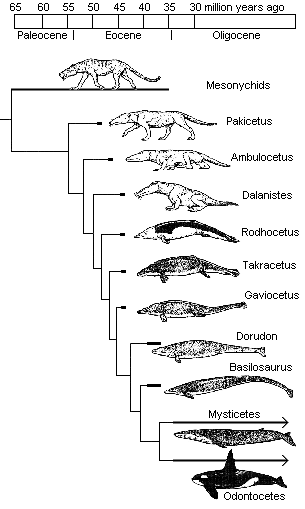
Such a transition is a fete of genetic rewiring and it is astonishing that it is presumed to have occurred by Darwinian processes in such a short span of time. This problem is accentuated when one considers that the majority of anatomical novelties unique to aquatic cetaceans (Pelagiceti) appeared during just a few million years – probably within 1-3 million years. The equations of population genetics predict that – assuming an effective population size of 100,000 individuals per generation, and a generation turnover time of 5 years (according to Richard Sternberg’s calculations and based on equations of population genetics applied in the Durrett and Schmidt paper), that one may reasonably expect two specific co-ordinated mutations to achieve fixation in the timeframe of around 43.3 million years. When one considers the magnitude of the engineering fete, such a scenario is found to be devoid of credibility. Whales require an intra-abdominal counter current heat exchange system (the testis are inside the body right next to the muscles that generate heat during swimming), they need to possess a ball vertebra because the tail has to move up and down instead of side-to-side, they require a re-organisation of kidney tissue to facilitate the intake of salt water, they require a re-orientation of the fetus for giving birth under water, they require a modification of the mammary glands for the nursing of young under water, the forelimbs have to be transformed into flippers, the hindlimbs need to be substantially reduced, they require a special lung surfactant (the lung has to re-expand very rapidly upon coming up to the surface), etc etc.

With this new fossil find, however, dating to 49 million years ago (bear in mind that Pakicetus lived around 53 million years ago), this means that the first fully aquatic whales now date to around the time when walking whales (Ambulocetus) first appear. This substantially reduces the window of time in which the Darwinian mechanism has to accomplish truly radical engineering innovations and genetic rewiring to perhaps just five million years — or perhaps even less. It also suggests that this fully aquatic whale existed before its previously-thought-to-be semi-aquatic archaeocetid ancestors.

Another day; another bad day for Darwinism.

Comments
WS43, I can completely understand where you’re coming from. I too was an ‘evolutionist’ of sorts, until becoming a Christian some 5 years ago and discovering that ‘evolution’ wasn’t all it was made out to be. And I have to say that I too had my eyes opened, largely through following this website over the past two years. I don’t post very often, perhaps asking the odd question here and there, although very rarely, but I do spend a lot of time going through the various posts as well as reading all the comments. And I think it would be fair to say that it is through the ‘comments’ that I gain a better understanding of what is actually being discussed. I keep a very open mind while doing so, weighing up the evidence from both camps, and as impartially as I can decide who in my eyes is making the most sense. This article is an excellent example of what I don’t like to see from the ‘evolutionist’ camp. The diagram for instance shows how whales supposedly evolved over 65my, when this clearly contradicts the ‘parts’ of it that are the most important. For instance Elizabeth doesn’t seem to be bothered about the fact that the whale in question lived at the same time as Ambulocetus, and instead of striking Ambulocetus off as a transitional (Because at the end of the day, it didn’t have to evolve into anything did it) she still clings to the belief that it deserves to be there. It is somehow still an example of ‘evolution’ when, as Joseph touches on in some previous posts, there isn’t any physical evidence that it did evolve. Why keep it there, especially in light of this find ? Also Basilosaurus, isn’t thought to have evolved into anything. There is no evidence linking it to the modern day whale, in fact Basilosaurus is believed to have become extinct. But still it is on that diagram. Why? Elizabeth seems to think that this causes no problems for ‘whale evolution’; simply a ‘tweeking’ of existing data is all that is required. Not from where I’m sitting. It is evidence like this, countered with arguments like Elizabeth’s, which convince me even more that Darwinian Evolution is very wrong.PeterJ
October 14, 2011
October
10
Oct
14
14
2011
02:36 PM
2
02
36
PM
PDT
Good, Chris, I'm glad you aren't making the claim that the fossil record is complete. We agree! What does a transitional fossil look like? What attributes would it have that we would recognize. If you can't answer those questions how are you in any position to declare that no transitional fossils have ever been found (false by the way)? If, as we agree, the fossil record is incomplete why would you make this declaration: "it shows the sudden appearance of creatures where there were none before. ". If the record is incomplete,as we agree, then it is quite premature to declare that any creature appeared suddenly..whatever that might mean....100 million years....50 million....5 years...1 year....a day? How geologic time frame do you consider as being sudden? Scott, what I think is embarrasing is your making conflicting declarations all within a few sentences of each other. Scott, have you ever raised, or watched, chickens? Do you think birds are descended from theropod dinosaurs?Acipenser
October 14, 2011
October
10
Oct
14
14
2011
02:19 PM
2
02
19
PM
PDT
Thats rich!butifnot
October 14, 2011
October
10
Oct
14
14
2011
02:17 PM
2
02
17
PM
PDT
On the one hand we have commenters scorning evolutionary interpretations made on the basis of single bones; on the other, the entire thrust of the article is that Darwinism is supposed to be traumatised by just such a bone. It seems that single-bone analysis is only relevant if it is purported to support the anti-Darwinian case. But really, it does no such thing. Even if aquatic and precedent to Ambulocetus, all it calls into question is a particular interpretation among palaeontologists. Ambulocetus may not be directly ancestral to whales, without troubling "Darwinism". This fossil may equally be an earlier aquatic side-shoot that left no modern descendants. Further, insisting that all of the features of modern whales must have been present in that individual, and therefore evolved in an 'impossibly' short time period, is not a justified inference.Chas D
October 14, 2011
October
10
Oct
14
14
2011
02:17 PM
2
02
17
PM
PDT
You'd still be extrapolating, PaV. And did you read the rest of my post?Elizabeth Liddle
October 14, 2011
October
10
Oct
14
14
2011
02:03 PM
2
02
03
PM
PDT
No-one is claiming the fossil record is complete, Acipenser. I am merely observing the fact that the fossil record does not contain any missing links/transitional fossils (the terms are interchangeable by the way, don't get hung up on terminology. It detracts from the important points). The point you are missing is this: why is it that all the gaps in the fossil record are the important ones from an evolutionist point of view? Why is that all the fossils we do see are either of extant (and, crucially unchanged) species or of truly extinct species (like dinosaurs which never evolved into anything else at all)? Another point you're missing is this: if evolution were true, there would be no missing links. Why? Because the fossil record would show a continuous evolution of species (albeit with some gaps due to its incompleteness). The problem for evolutionists is this: the fossil record shows the complete opposite: it shows the sudden appearance of creatures where there were none before. Furthermore, it is characterised by discontinuity and stasis. You won't take my word for it, so I'll let Charles Darwin tell you all about missing links instead: On this doctrine of the extermination of an infinitude of connecting links, between the living and extinct inhabitants of the world, and at each successive period between the extinct and still older species, why is not every geological formation charged with such links? Why does not every collection of fossil remains afford plain evidence of the gradation and mutation of the forms of life? We meet with no such evidence, and this is the most obvious and forcible of the many objections which may be urged against my theory. Why, again, do whole groups of allied species appear, though certainly they often falsely appear, to have come in suddenly on the several geological stages? Why do we not find great piles of strata beneath the Silurian system, stored with the remains of the progenitors of the Silurian groups of fossils? For certainly on my theory such strata must somewhere have been deposited at these ancient and utterly unknown epochs in the world's history. I can answer these questions and grave objections only on the supposition that the geological record is far more imperfect than most geologists believe. To hide behind the "imperfect" fossil record was a weak excuse then. Trying the same tactic now is just embarrassing, don't you think Acipenser?Chris Doyle
October 14, 2011
October
10
Oct
14
14
2011
01:35 PM
1
01
35
PM
PDT
Nice reasoning DrBot :) But we can rule it out in this case, because the Grant's correlated with available seeds in a given year. Filling my own glass right now....Elizabeth Liddle
October 14, 2011
October
10
Oct
14
14
2011
01:23 PM
1
01
23
PM
PDT
In this case we can infer causation, because we have a clear mechanisms by which seed size influences mean finch beak size, and absolutely no conceivable mechanisms by which finch beak size could influence mean seed size.
Hmm, that made me think of Cod stocks. The average adult Cod size has been going down, and the suggestion is that it is due to fishing regulations over the size of the holes in fishing nets so that only larger fish get caught - so there is a survival advantage in being a small fish in a big pond so to speak ;) Hypothetically, the ability of finches to eat seeds could influence seed size because finch populations that share certain behavioral or morphological traits would tend to eat some size seeds more than others - the seeds not eaten are the ones that produce trees. Just a random thought after a glass of wine ;)DrBot
October 14, 2011
October
10
Oct
14
14
2011
01:08 PM
1
01
08
PM
PDT
In what way is that "circular reasoning", Scott? And yes, finch beak sizes correlated with seed sizes. In this case we can infer causation, because we have a clear mechanisms by which seed size influences mean finch beak size, and absolutely no conceivable mechanisms by which finch beak size could influence mean seed size. Not only that, but the Grants' tracked the family tree of every finch, and was able to show heritability in finch-beak size. Do read the book, it's excellent.Elizabeth Liddle
October 14, 2011
October
10
Oct
14
14
2011
01:01 PM
1
01
01
PM
PDT
Elizabeth, You state why it isn't circular reasoning...
It isn’t “circular reasoning” at all. There is no principle of “Darwinism” that says adaptation has to occur at a constant rate, quite the reverse.
And then you reaffirm why it is.
Adaptation will track the rate of change in the environment to which adaptation is occurring.
Yes, the finches' beaks change. No one even knows whether that is natural selection. But when it comes to any more substantial change, adaptation and environmental pressures are each the measure of and the evidence for the other. Birds have beaks because of environmental pressure that made beaks beneficial. This is evident because birds have beaks. Why is the glass 40% full? Because it's 60% empty. Sounds nice, explains nothing. I could train a small child to do this. Why do birds have beaks? "Because beaks are good for them!" Here's a piece of candy.ScottAndrews
October 14, 2011
October
10
Oct
14
14
2011
12:51 PM
12
12
51
PM
PDT
That is all fine, Chris, but there is a problem with your premise. For example what catastrophic processes existed in the past that do not exist today. We have floods. We have earthquakes, and last time I checked we have volcanic eruptions. So what process is missing that results in no fossils formation today or in the recent past (say 10,000 years or so)? Yes, Chris, there are many fossils that have been found and many left to be found but none have been found for a organism that we know numbered in the billions. Isn't that curious that on one hand you demand that the fossil record is complete yet can not point to a single example (outside a few found thousands of miles away in the tar pits) that document the existence of the passenger pigeon. Don't you think that demonstrates what Elizabeth, and otehrs, have stated about the fossil record? No, Chris, I do not think the millions of fossils ahve no evolutionary significance. The hominid linage alone demonstrates that this is false. You brought up the concept of the 'missing link' so I was curious how you would recognize one if it showed up in a fossil collection. Apparently, you wouldn't be able to recognize one because you have no idea what one would look like yet you insist that it must exist. Funny that. Darwin never used the term 'missing link' in any of his writings although some people who wrote to him did use that terminology. He did, however, posit that there would be transitional fossils found. Chris, what would a transitional fossil look like to you? What characteristics would you use to determine that a fossil of one organism was transitional to another?Acipenser
October 14, 2011
October
10
Oct
14
14
2011
12:43 PM
12
12
43
PM
PDT
I just explained why, PaV! Because adaptation will track changes in environment. If the environment changes rapidly, then adaptation will happen rapidly (if it can keep up - the other thing that may happen is exctinction); if the environment remains stable, no adaptation will take place, and all selective pressures will be in the direction of maintaining the population at the optimum. It isn't "circular reasoning" at all. There is no principle of "Darwinism" that says adaptation has to occur at a constant rate, quite the reverse. Adaptation will track the rate of change in the environment to which adaptation is occurring. This is easily modelled. And my statement is not "nonsense". Have you read Jonathan Weiner's book "The Beak of the Finch"? In it he reports the Grants' work on the Galapagos finches, which shows that adaptation is observable from one year to another. Clearly annual changes are not going to affect an annually breeding population, but rapid cyclical changes only slightly slower than the breeding cycle (e.g. El Nino events in Pacific) result in observable adaptation by the finch population to different distributions of seed sizes. As for quantifying it: do read Weiner's book. In this case, what the Grants measured was beak depth in relation to mean seed sizes.Elizabeth Liddle
October 14, 2011
October
10
Oct
14
14
2011
12:31 PM
12
12
31
PM
PDT
Elizabeth @ 6.1.1.1:
Evolutionary change varies in speed.
This is a completely meaningless statement. Why? Because if they see a large number of sequence changes in a short period of time, then they say it was "fast evolution". If it is a small number of sequence changes in a short period of time (based on supposed evolutionary relationships), then they say evolution was "slow". It's circular reasoning. As is all of Darwinism.
Evolutionary change is a function of, among other things, environmental change.
Another nonsense statement, I'm afraid. Every year in southern California, as in almost all parts of the world, the environment changes. I golf at a golf course where Canadian Geese are here during the winter. They're not here during the summer. It rains and is cold in the winter; it's warm and dry in the summer. So what of this "environmental change" that you're talking about? In what does it consist? How do you quantify it?PaV
October 14, 2011
October
10
Oct
14
14
2011
12:21 PM
12
12
21
PM
PDT
There's another way of looking at it, Acipenser: that the past isn't actually the key to the present, that catastrophism better explains geology than uniformitarianism. So, the catastrophic processes that created most of the fossils we see today aren't actually happening right now. Nonetheless, we have discovered literally millions of fossils and we are still discovering them. There are plenty of them out there. But the funny thing is, they are all either of creatures which are still around today (and unchanged) or of creatures that went extinct (ie. did not leave descendants, indeed their fossils may have been created in their own extinction event). Don't you think it is a strange coincidence that none of the million of fossils we do know about have any evolutionary significance whatsoever? And why are you asking me what a missing link would look like? Charles Darwin himself predicted their existence. I tell you what they don't like: Ida. But that didn't stop David Attenborough making a feature-length documentary all about the most important "missing link" ever discovered. Why don't you ask poor old David what a missing link looks like!?Chris Doyle
October 14, 2011
October
10
Oct
14
14
2011
12:18 PM
12
12
18
PM
PDT
Elizabeth @ 3.1:
Imagine you find a human hip bone. Could you draw the animal it came from?
Yes, because we know what the human skeleton looks like. When it comes to Lucy, we're left guessing. Read Gee's book, "Search for Deep Time".PaV
October 14, 2011
October
10
Oct
14
14
2011
12:14 PM
12
12
14
PM
PDT
Yes, because we know what the human skeleton looks like.PaV
October 14, 2011
October
10
Oct
14
14
2011
12:07 PM
12
12
07
PM
PDT
Elizabeth @ 2.1.1.1.8:
How likely is it that you would find a fossil on the direct line of descent to an extant organism, given the rarity of fossilisation, and the frequency of extinction? The answer is: remote. However, we can still look for – and, indeed, find – transitional fossils in the related sense of fossils that have features of two already known taxonomic groups. And far from “failing”, we have many clear transitional series, and an increasingly populated Tree of Life.
This is possible, possibly plausible. But, the problem for evolution isn't "related species". The problem is, and always will be, the amount of time involved in the onset of these species. That is, we're dealing with "explosions". There's the Cambrian Explosion. Now there's a "Mammalian Explosion". And there will likely be others. It appears that this new form fits in perfectly with the growing sense of the Mammalian Explosion. Petrushka cited Durrett and Schmidt's paper, where, in almost bizarre fashion, they quibble with Behe's EoE statistics. They tell us that using a effective populations of 500,000, and assuming mutation rates of 10^-9, that their "Theorem 1 predicts a waiting time of 31.6 million generations for one prespeci?ed pair of mutations in one species . . .." We're talking about two amino acid substitutions. And they think they're onto something because it will only take 31.6 million years?!! So, take your Ambulecetus and add 31.6 million years. That will gain you a two amino acid change. Now, is this going to change a "walking whale" into a fully "aquatic whale"? There is no person of faith, of religion, that would buy that whopper. Only smart scientists are dumb enough for that.
Your scoffing is quite unwarranted.
Please allow for a little scoffing. I think some is in order here.PaV
October 14, 2011
October
10
Oct
14
14
2011
12:05 PM
12
12
05
PM
PDT
So disconfirming evidence is taken AS evidence that evolution can work fast, like magic. Lovely.bbigej
October 14, 2011
October
10
Oct
14
14
2011
11:53 AM
11
11
53
AM
PDT
wut?Elizabeth Liddle
October 14, 2011
October
10
Oct
14
14
2011
11:26 AM
11
11
26
AM
PDT
What evidence doesn't support the tree as postulated, butifnot? But sure, design is consistent with the evidence. That's the trouble - there is no evidence that would be inconsistent with design. It really is unfalsifiable.Elizabeth Liddle
October 14, 2011
October
10
Oct
14
14
2011
11:26 AM
11
11
26
AM
PDT
I see it as more evidence that evolution does not rely (exclusively) upon random exhaustive searches as many have assumed. There are ways in which natural processes can narrow the search space and thus the time to find a solution (for examples, see Evolutionary Computation). Note, however, that how such scoped-search systems arose is still unanswered.rhampton7
October 14, 2011
October
10
Oct
14
14
2011
11:25 AM
11
11
25
AM
PDT
Yes, indeed, the fact that features of living things are distributed in nested hierarchy is strong evidence for common descent. I'm not sure of your point. What part do you think is "circular reasoning?"Elizabeth Liddle
October 14, 2011
October
10
Oct
14
14
2011
11:22 AM
11
11
22
AM
PDT
No, it isn't PaV. It's quite a good article. But if it's a good article, it doesn't matter whether it's "embarassing" for evolution or not. Evolution is just a scientific theory. It doesn't get "embarassed", nor do the scientists who think it's a pretty good theory. If it's right, cool. If it's wrong, even cooler.Elizabeth Liddle
October 14, 2011
October
10
Oct
14
14
2011
11:20 AM
11
11
20
AM
PDT
PaV: the ages of the strata are not determined by their fossils. Convergent evidence from many sources is used to date strata, one being radiometric dating of intervening volcanic layers. Once layers have been dated, "index fossils" can then be used to date other layers. But the fossils themselves are not the primary source of the dating. "Convergent evolution" is when a similar feature with a similar function evolves separately in two lineages. But they are rarely homologous - for instance flippers evolved several times, but from different structures. Ditto eyes. Homologies are what palaentologists look for - the evolution of a bone, say, or a sinus.Elizabeth Liddle
October 14, 2011
October
10
Oct
14
14
2011
11:18 AM
11
11
18
AM
PDT
The only evidence darwinists has for the tree is that common descent led naturally to the nested hierarchy of traits instead an orchard model not necessary led to that nested hierarchy. Thats all. All the other so called evidence is nothing more than circular reasoning.Blas
October 14, 2011
October
10
Oct
14
14
2011
11:16 AM
11
11
16
AM
PDT
Elizabeth @ 2.1.1.1:
It’s just like the objection that those Polish fossil footprints are a “problem” for the “transitional” fossil, Tiktaalik. They aren’t. They just mean that the clade has to be rearranged a little.
Yes, and we call the rearrangement of the clade an "epicycle".PaV
October 14, 2011
October
10
Oct
14
14
2011
11:12 AM
11
11
12
AM
PDT
I actually don't understand this post! Scientific methodology is to fit models to data. A tree fits the data well. There is no circularity.Elizabeth Liddle
October 14, 2011
October
10
Oct
14
14
2011
11:09 AM
11
11
09
AM
PDT
Why do you bring up this article, Petrushka? It's rather embarrassing for evolution.PaV
October 14, 2011
October
10
Oct
14
14
2011
11:07 AM
11
11
07
AM
PDT
Elizabeth @ 1.1.1.3.1:
No, but it’s pretty powerful when you note: 1) The mapping of the tree on to geological strata and therefore time and
But the age of the geological strata are determined by their fossils. Therefore, there is a 1 to 1 correspondence. How is this powerful? It's, instead, unavoidable.
2) The almost complete absence of transfer of “solutions” from one lineage to another once a branching has occurred.
I'm not sure what you mean by this. But what about homologies, and convergent evolution, etc? There have been separate lines that have solved problems with almost the same final solution, but with varying starting solutions. This is unexpected from a Darwinian perspective, is it not?
This is not true of, for example, human designs.
What about Berra's Blunder?PaV
October 14, 2011
October
10
Oct
14
14
2011
10:46 AM
10
10
46
AM
PDT
Elizabeth@ 1.1.1.2.1:
ust as we fit a diagonal to a scatter plot to find out whether there is a significant correlation, we can fit a tree to character data to see whether there is a significant depth of branching – deeper branching then would be expected under the null hypothesis of no nested hierarchy.
There is a correlation between the NFC team winning the SuperBowl and a rise in the stock market. So what if you end up with an eigenvalue solution. What if it is an eigenvalue solution to a data set that is nonsense? Then what? You're stuck with circularity. This is just like Eohippus. And Gould has demonstrated the groundlessness of that.PaV
October 14, 2011
October
10
Oct
14
14
2011
10:39 AM
10
10
39
AM
PDT
1 2 3 4 5 6 7