Uncommon Descent Serving The Intelligent Design Community

A Whale of a Problem for Evolution: Ancient Whale Jawbone Found in Antartica

Categories
Intelligent Design
Share
Facebook
Twitter/X
LinkedIn
Flipboard
Print
Email

MSNBC.com is reporting on the discovery of a jawbone of an ancient whale in Antarctica: the oldest fully aquatic whale yet discovered. The news story reports,

The jawbone of an ancient whale found in Antarctica may be the oldest fully aquatic whale yet discovered, Argentine scientists said Tuesday.

A scientist not involved in the find said it could suggest that whales evolved much more quickly from their amphibian precursors than previously thought.

Argentine paleontologist Marcelo Reguero, who led a joint Argentine-Swedish team, said the fossilized archaeocete jawbone found in February dates back 49 million years. In evolutionary terms, that’s not far off from the fossils of even older proto-whales from 53 million years ago that have been found in South Asia and other warmer latitudes.

Those earlier proto-whales were amphibians, able to live on land as well as sea. This jawbone, in contrast, belongs to the Basilosauridae group of fully aquatic whales, said Reguero, who leads research for the Argentine Antarctic Institute.

“The relevance of this discovery is that it’s the oldest known completely aquatic whale found yet,” said Reguero, who shared the discovery with Argentine paleontologist Claudia Tambussi and Swedish paleontologists Thomas Mors and Jonas Hagstrom of the Natural History Museum in Stockholm.

Paul Sereno, a University of Chicago paleontologist who wasn’t involved in the research, said that if the new find withstands the scrutiny of other scientists, it will suggest that archaeocetes evolved much more quickly than previously thought from their semi-aquatic origin in present-day India and Pakistan.

“The important thing is the location,” Sereno said. “To find one in Antarctica is very interesting.”

As many readers will doubtless be aware, the evolution of the whale has previously raised substantial problems because of the extremely abrupt timescale over which it occurred. Evolutionary Biologist Richard von Sternberg has previously applied the population genetic equations employed in a 2008 paper by Durrett and Schmidt to argue against the plausibility of the transition happening in such a short period of time.  Indeed, the evolution of Dorudon and Basilosaurus (38 mya) from Pakicetus (53 mya) has been previously compressed into a period of less than 15 million years.

Previously, the whale series looked something like this:
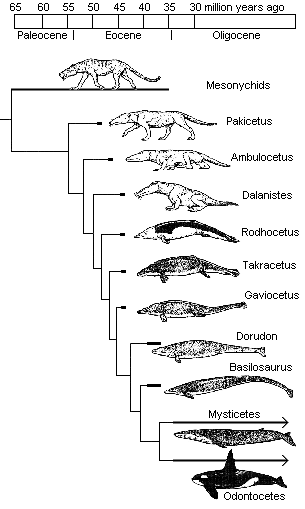
Such a transition is a fete of genetic rewiring and it is astonishing that it is presumed to have occurred by Darwinian processes in such a short span of time. This problem is accentuated when one considers that the majority of anatomical novelties unique to aquatic cetaceans (Pelagiceti) appeared during just a few million years – probably within 1-3 million years. The equations of population genetics predict that – assuming an effective population size of 100,000 individuals per generation, and a generation turnover time of 5 years (according to Richard Sternberg’s calculations and based on equations of population genetics applied in the Durrett and Schmidt paper), that one may reasonably expect two specific co-ordinated mutations to achieve fixation in the timeframe of around 43.3 million years. When one considers the magnitude of the engineering fete, such a scenario is found to be devoid of credibility. Whales require an intra-abdominal counter current heat exchange system (the testis are inside the body right next to the muscles that generate heat during swimming), they need to possess a ball vertebra because the tail has to move up and down instead of side-to-side, they require a re-organisation of kidney tissue to facilitate the intake of salt water, they require a re-orientation of the fetus for giving birth under water, they require a modification of the mammary glands for the nursing of young under water, the forelimbs have to be transformed into flippers, the hindlimbs need to be substantially reduced, they require a special lung surfactant (the lung has to re-expand very rapidly upon coming up to the surface), etc etc.

With this new fossil find, however, dating to 49 million years ago (bear in mind that Pakicetus lived around 53 million years ago), this means that the first fully aquatic whales now date to around the time when walking whales (Ambulocetus) first appear. This substantially reduces the window of time in which the Darwinian mechanism has to accomplish truly radical engineering innovations and genetic rewiring to perhaps just five million years — or perhaps even less. It also suggests that this fully aquatic whale existed before its previously-thought-to-be semi-aquatic archaeocetid ancestors.

Another day; another bad day for Darwinism.

Comments
Yes, Chris, I know that the only reason we know that passenger pigeons existed is because humans observed them alive at one point in time. The point is that you have a population that numbered in the billions with no fossil evidence to indicate that they ever existed. The scientific take-home point is that fossilization is a rare event and the current collection is far from complete as evidence by the lack of a fossil of a species we know existed in large numbers for many years. That bit of information is vital in evaluating the fossil record and any such claims of 'lack of missing links' (whatever they are). By the way what would a 'missing link' look like? For example in the hominid linage.Acipenser
October 14, 2011
October
10
Oct
14
14
2011
10:34 AM
10
10
34
AM
PST
Acipenser, are you claiming that there is a scientific equivalent between knowing that passenger pigeons existed and knowing that missing links existed? Because there isn't. We only know that passenger pigeons existed because we were around to observe them. That extra source of evidence is vital. Without observational evidence for missing links in the fossil record, what extra source of vital evidence are you offering?Chris Doyle
October 14, 2011
October
10
Oct
14
14
2011
10:24 AM
10
10
24
AM
PST
Hey Folks, first post here. I used to be a theistic evolutionist as I always accepted evolution as a fact because it was engrained into me in my high school and college biology classes. As a new convert to the ID movement it feels like my eyes have been open and I owe to a year of following this blog. Great article and it clearly shows that the so-called evolution of the whale is clearly micro-evolution and not the fairy tale macro evolution. Keep em coming folks:)wallstreeter43
October 14, 2011
October
10
Oct
14
14
2011
10:06 AM
10
10
06
AM
PST
May indicate issues with dating and assumptions regarding that...Think, revise archeopteryx (I wonder if they held off as long as possible...) Certainly begs for a mechanism to account of it. Maybe the mechanism has simply been lost over time. Sounds like that may be a conclusion soon to be entertained. Aricle Head: Mechanism Accounting for Body Plan Diversity Sans Design Lost to Deep Time (Sub) "But we still know it was a natural phenomena."arkady967
October 14, 2011
October
10
Oct
14
14
2011
09:57 AM
9
09
57
AM
PST
Chris, we know that passenger pigeons numbered in the billions then went extinct. Can you point me to any fossils of passenger pigeons?Acipenser
October 14, 2011
October
10
Oct
14
14
2011
09:04 AM
9
09
04
AM
PST
Oh alright then, no-one was looking for missing links, Lizzie. Not even Charles Darwin himself! In fact, "missing link" is just some term that a crazy Creationist coined yes? So, keep on telling yourself that and don't worry about it. Just don't think too much about things like Piltdown Man and Coelacanth and Tiktaalik. And, would you Adam and Eve it, you and I share a very Great Grandmother and it was a shrew-like mammal. Of course, apart from our very Great Grandfather, she lived totally alone in isolation while the dinosaurs roamed the Earth. There just wasn’t another specimen of the shrew-like mammal anywhere to be seen so no wonder that entire species didn’t leave any fossils behind! But it is plain to see, we don’t need any fossil evidence for the existence of our shrew-like ancestor: she must have existed otherwise where did you and I come from? Just look at our genes (but only at the similar ones, and certainly don’t look in the 95% of our DNA that is just junk – there’s nothing to see there, move on). Anybody who is still demanding inconvenient things like “evidence” and “reason” need only look at the “clear transitional series” offered up by whale fossils… but please, ignore the one mentioned in the OP. That just muddies the water and there’s nothing worse than ugly facts slaying a beautiful hypothesis, right Lizzie?Chris Doyle
October 14, 2011
October
10
Oct
14
14
2011
08:05 AM
8
08
05
AM
PST
Elizabeth, this quote from the expert,,,
The penis (of the whale because of its attachment to these 'Vestigial Legs') seems to be capable of a lot of independent motion, much like the trunk of an elephant.
,,, does not strike me as 'tending to persist'bornagain77
October 14, 2011
October
10
Oct
14
14
2011
07:43 AM
7
07
43
AM
PST
We are all looking at the same evidence and much of it doesn't support the tree as postulated. And we already are discussing possible explanations, which are also consistent with the evidence.butifnot
October 14, 2011
October
10
Oct
14
14
2011
07:34 AM
7
07
34
AM
PST
ba77: "vestigial" doesn't mean "serves no function". It means that a feature is the "vestige" of some earlier feature, possibly with a different function, and the clue lies in homologies between the two. The vestigial feature may or may not serve some useful function. If it does, it will tend to persist.Elizabeth Liddle
October 14, 2011
October
10
Oct
14
14
2011
07:32 AM
7
07
32
AM
PST
Of course it's "observational science". All science is "observational". You can't do science without data, aka observations. And any "crazy speculation" has to be tested against those data. You seem to think evolutionary scientists don't know how to do science.Elizabeth Liddle
October 14, 2011
October
10
Oct
14
14
2011
07:28 AM
7
07
28
AM
PST
Evolutionary change varies in speed. If a population is at an optimum, conservative selection will tend to keep it there. If it is not at an optimum, selection will tend to move it to an optimumum. Evolutionary change is a function of, among other things, environmental change. Environmental change rates vary, either because a population migrates to a new environment or niche, or because of change in the actual environment. If we see a population evolving rapidly, that indicates that it was exposed to a rapid environmental change. Like adopting a new habitat, the ocean, for instance.Elizabeth Liddle
October 14, 2011
October
10
Oct
14
14
2011
07:27 AM
7
07
27
AM
PST
How convenient, Lizzie. We spent 150 years looking for “missing links” and “transistional fossil” and didn’t find any.
Who was looking for "missing links"? And of course we found "transitional fossils".
But instead of being discouraged by a whacking failed prediction, evolutionists comfort themselves with mantras like: “The chance that any fossil, or fossil population is directly transitional is vanishingly small.”
It's not a "mantra", Chris, it's a simple statement. How likely is it that you would find a fossil on the direct line of descent to an extant organism, given the rarity of fossilisation, and the frequency of extinction? The answer is: remote. However, we can still look for - and, indeed, find - transitional fossils in the related sense of fossils that have features of two already known taxonomic groups. And far from "failing", we have many clear transitional series, and an increasingly populated Tree of Life. Your scoffing is quite unwarranted.
But, if evolution were actually true, that statement would obviously be false. Even Darwin realised that! After all, the majority of our ancestors, be they ape-like, shrew-like, reptile, fish or microbe were transitional species. The chances are, the fossil record would be littered with them.
All our ancestors were "transitional". Not "transitional species" though, because "species" is a horizontal concept, not a vertical one. So, if fossilisation were extremely common, then yes, the fossil record would be littered with them. Unfortunately, fossilisation isn't common, it is rare, and only certainly habitats lend themselves to fossilisation, so the sparse sampling we have is also a biased sampling. Fortunately we have genetics as well, so that fills in some of the blanks.
The fact is we only find fossils of creatures that went extinct (ie. left no descendanats) including the odd ‘hopeful monster’ that used to be paraded as a crucially important missing link/transitional fossil. Like Tiktaalik.
Tiktaalik's lineage probably did go extinct eventually, we don't know when. But then most lineages do. Therefore, most fossils will be on lineages that went extinct before the present. Nothing surprising about that. And I have no idea what "hopeful monster" you are talking about. What "hopeful monster" was "paraded"? What do you even mean by the term? Saltation theories were abandoned a long time ago in favour of Darwin's incremental process, because they are not supported by any evidence or mechanism.
The rest of the fossils we find are of creatures that are the same today as they were tens of millions of years ago.
Such as?Elizabeth Liddle
October 14, 2011
October
10
Oct
14
14
2011
07:23 AM
7
07
23
AM
PST
Possibly, Joseph, possibly. At this stage I am simply pointing out the evidence for a tree. If you accept that, then we can discuss possible explanations for the tree.Elizabeth Liddle
October 14, 2011
October
10
Oct
14
14
2011
07:11 AM
7
07
11
AM
PST
Elizabeth Liddle: "All scientific theories and hypotheses are models." ==== Correct, but of all the supposed different sciences only evolution gets a giant universe of latitude for embellishment. ---- Elizabeth Liddle: "The key thing about a scientific model is that it must be fitted to data. That’s where the rigor comes in." "That is not the same as “myth manufacturing”." ==== Yes and Captain Kirk and his elite band of merry troopers came back from the future and hijacked several whales to appease some future Aliens who were pieved at their extinction and threatened the Earth with an extinction of their own.Eocene
October 14, 2011
October
10
Oct
14
14
2011
06:55 AM
6
06
55
AM
PST
further notes:
An Email Exchange Regarding "Vestigial Legs" Pelvic Bones in Whales by Jim Pamplin Excerpt: The pelvic bones of whales serve as attachments for the musculature associated with the penis in males and its homologue, the clitoris, in females. The muscle involved is known as the ischiocavernosus and is quite a powerful muscle in males. It serves as a retractor muscle for the penis in copulation and probably provides the base for lateral movements of the penis. The mechanisms of penile motion are not well understood in whales. The penis seems to be capable of a lot of independent motion, much like the trunk of an elephant. How much of this is mediated by the ischiocavernosus is not known. In females the anatomical parts are smaller and more diffuse. I would imagine that there is something homologous to the perineal muscles in man and tetrapods, which affect the entire pelvic area - the clitoris, vagina and anus. The pelvic rudiments also serve as origins for the ischiocaudalis muscle, which is a ventral muscle that inserts on the tips of the chevron bones of the spinal column and acts to flex the tail in normal locomotion. http://www.darwinisdead.com/an_email_exchange_regarding.htm
The following video reveals the extreme bias and misrepresentation that neo-Darwinists have used to reconstruct a purely imaginary Darwinian transition to whales.
Whale Evolution? - Exposing The Deception - Dr. Terry Mortenson - video http://www.metacafe.com/watch/4032568
This following studies provides solid support for Dr. Terry Mortenson's critique of the 'imaginary' evidence for whale evolution in the preceding video:
How Whales Have (NOT) Changed Over 35 Million Years – May 2010 Excerpt: We could have found that the main whale lineages over time each experimented with being large, small and medium-sized and that all the dietary forms appeared throughout their evolution, or that whales started out medium-sized and the largest and smallest ones appeared more recently—but the data show none of that. Instead, we find that the differences today were apparent very early on. https://uncommondescent.com/education/beacon-comes-home-with-the-bacon/#comment-356170
As well, This following article shows how misleading to the general public Darwinists can be with the 'whale' evidence:
Meet Pakicetus, the Terrestrial Mammal BioLogos Calls a "Whale" - November 2010 http://www.evolutionnews.org/2010/11/meet_pakicetus_the_terrestrial039851.html
This following sites is a bit more detailed in their dismantling of the whale evolution myth:
Whale Tale Two Excerpt: We think that the most logical interpretation of the Pakicetus fossils are that they represent land-dwelling mammals that didn’t even have teeth or ears in common with modern whales. This actually pulls the whale evolution tree out by the roots. Evolutionists are back to the point of not having any clue as to how land mammals could possibly have evolved into whales. http://www.ridgecrest.ca.us/~do_while/sage/v6i2f.htm
bornagain77
October 14, 2011
October
10
Oct
14
14
2011
06:52 AM
6
06
52
AM
PST
butifnot: "The entire whale lineage story is flight of fancy. Also, the ‘chart’ – never fails to amuse! “Nested hierarchy, Nested hierarchy” “Clade , Clade, clade” You made a chart, and you placed some animals on it, some of them imaginary – Overwhelming evidence that." ===== In the past when fabricating charts to pimp worldview they've lined up various Dinosaur fossils or Rhino fossils or whatever to infinity, some of those SUPPOSED transitionals were found to be young juveniles of the similiar creature. But never underestimate their ability to back up spin on short notice. Remember, Science is the ever evolving ever self-correcting mechanism where by morphed truth always rises to the surface like fluff in a cesspit. And when it comes to Evolutionist's favourite charts, let's not forget those Mud-to-Man Evo charts depicting other races(usually dark Negroid) of human beings right below a white Studly Englishman or German/Nordic example where they are depicted as living transitionals between a white European and a long since extinct Apeman creature. At some point people around the Earth are going to get tired of this crap and rebel. I work with African, Mideastern, Indian/Pakistani and South American students and they literally hate the spin illustrated through such racist depictions of their supposed imaginary ancient heritage. And these folks here will fight tooth and nail to defend such sludge.Eocene
October 14, 2011
October
10
Oct
14
14
2011
06:47 AM
6
06
47
AM
PST
Its forensic science, not observational science. It by very nature can lend itself to crazy speculation like the epicycles to the nth degree mess that 'evolution' isbutifnot
October 14, 2011
October
10
Oct
14
14
2011
06:40 AM
6
06
40
AM
PST
Here is a cool animated video showing a sperm whale using 'designed' echolocation to hunt a giant squid:
Sperm whale Vs giant squid - video http://www.youtube.com/watch?v=_z2Lfxpi710
Moreover, identical forms of echolocation show up in widely divergent species. This finding is unexpected from an evolutionary perspective, yet this finding is exactly what we would expect to find from presupposing a Creator to reuse optimal designs:
Convergence Drives Evolution Batty - Fazale Rana - September 2010 Excerpt: The multiple, independent origin of echolocation in these animals (twice in bats and once in toothed whales) exemplifies convergence,,, When examined from an evolutionary perspective, convergence doesn’t make much sense.,,, the latest research demonstrates that—again, from an evolutionary perspective—the genetic and biochemical changes that account for the emergence of echolocation in bats and dolphins is identical. Given the random nature of the evolutionary process, this recent discovery doesn’t match what evolutionary biologists would expect to find. But both the discovery and convergence make sense if life stems from the work of a Creator. http://www.reasons.org/convergence-drives-evolution-batty Common Design in Bat and Whale Echolocation Genes? - January 2011 Excerpt: two new studies in the January 26th issue of Current Biology, a Cell Press publication, show that bats' and whales' remarkable ability and the high-frequency hearing it depends on are shared at a much deeper level than anyone would have anticipated -- all the way down to the molecular level. http://www.evolutionnews.org/2011/01/common_design_in_bat_and_whale042291.html Bat and Whale Echolocation Genes Point to Common Design - February 2011 - Podcast http://intelligentdesign.podomatic.com/entry/2011-02-21T10_59_16-08_00
As well, It seems the entire neo-Darwinian argument for inferring the supposed fossil sequence for whale evolution, in the fossil record, is primarily based on the extremely biased readings of 'bone homology', or bone similarity, between different species. Yet this entire line of reasoning, for establishing scientific certainty for any proposed evolutionary sequence of fossils, is anything but 'certain', as this following video and quote clearly point out:
Investigating Evolution: Homology - video http://www.youtube.com/watch?v=XgXT9sU6y18
If you want to make evolutionist Henry Gee mad at you remind him that he once wrote this following 'true' statement:
“To take a line of fossils and claim that they represent a lineage is not a scientific hypothesis that can be tested, but an assertion that carries the same validity as a bedtime story, amusing, perhaps even instructive, but not scientific.” Evolutionist - Henry Gee, editor of Nature, on the feasibility of reconstructing phylogenetic trees from fossils
further notes:
"Whales have a long generation time, and they don't have huge populations. They're like the worst-case scenario for trying to evolve structures rapidly," "To fix all the mutations needed to convert a little land mammal into a fully functional whale [in ten million years]--mathematically that's totally not possible." Casey Luskin http://www.evolutionnews.org/2009/11/6_bones_of_contention_with_nat.html#more Whale Evolution? Darwinist 'Trawlers' Have Every Reason To Be Concerned: Excerpt: As one review noted: "The anatomical structure, biological function, and way of life of whales are so distinctly different from those of terrestrial mammals that they cannot possibly have evolved from the latter by small genetic changes; aquatics require the simultaneous presence of all their complex features to survive." http://www.arn.org/blogs/index.php/2/2009/12/29/whale_evolution_darwinist_trawlers_have
This following video takes a honest look at just what evolutionists are up against to satisfactorily explain whale evolution:
What Does It take To Change A Cow Into A Whale - David Berlinski - video http://www.youtube.com/watch?v=DRqdvhL3pgM How to Become a Whale - David Klinghoffer - August 2011 http://www.evolutionnews.org/2011/08/post_28049671.html
etc.. etc..bornagain77
October 14, 2011
October
10
Oct
14
14
2011
06:40 AM
6
06
40
AM
PST
Elizabeth Liddle:
Given a few, or one, the theory predicts a tree stemming from that ancestral population or populations (“few forms, or one” as Darwin said).
So if I plant a few acorns I can only expect one oak tree? Do you ever think?
Given the universality of the genetic code, a single universal ancestral population seems more likely.
It isn't that universal and common design and convergence explain it also.Joseph
October 14, 2011
October
10
Oct
14
14
2011
06:38 AM
6
06
38
AM
PST
So you were fine with 20 million years of evolution in between and you're fine with half that and half that again will be fine. To start its slow evolution and then its not. I see this as a problem.butifnot
October 14, 2011
October
10
Oct
14
14
2011
06:36 AM
6
06
36
AM
PST
How convenient, Lizzie. We spent 150 years looking for "missing links" and "transistional fossil" and didn't find any. But instead of being discouraged by a whacking failed prediction, evolutionists comfort themselves with mantras like: "The chance that any fossil, or fossil population is directly transitional is vanishingly small." But, if evolution were actually true, that statement would obviously be false. Even Darwin realised that! After all, the majority of our ancestors, be they ape-like, shrew-like, reptile, fish or microbe were transitional species. The chances are, the fossil record would be littered with them. The fact is we only find fossils of creatures that went extinct (ie. left no descendanats) including the odd 'hopeful monster' that used to be paraded as a crucially important missing link/transitional fossil. Like Tiktaalik. The rest of the fossils we find are of creatures that are the same today as they were tens of millions of years ago. Which is exactly what you'd expect to find if evolution never really happened.Chris Doyle
October 14, 2011
October
10
Oct
14
14
2011
06:31 AM
6
06
31
AM
PST
Given a few, or one, the theory predicts a tree stemming from that ancestral population or populations ("few forms, or one" as Darwin said). Given the universality of the genetic code, a single universal ancestral population seems more likely.Elizabeth Liddle
October 14, 2011
October
10
Oct
14
14
2011
06:23 AM
6
06
23
AM
PST
Whatever side of the fence you're onbutifnot
October 14, 2011
October
10
Oct
14
14
2011
06:22 AM
6
06
22
AM
PST
One amazing feature of most echo-locating dolphins and small whales is the ‘melon,’ a fatty protrusion on the forehead. This ‘melon’ is actually a sound lens—a sophisticated structure designed to focus the emitted sound waves into a beam which the dolphin can direct where it likes. This sound lens depends on the fact that different lipids (fatty compounds) bend the ultrasonic sound waves traveling through them in different ways. The different lipids have to be arranged in the right shape and sequence in order to focus the returning sound echoes. Each separate lipid is unique and different from normal blubber lipids, and is made by a complicated chemical process, requiring a number of different enzymes. U. Varanasi, H.R. Feldman, and D.C. Malins, Molecular Basis for Formation of Lipid Sound Lens in Echolocating Cetaceans, Nature 255(5506):340–343, 22 May 1975. Thats awesome!butifnot
October 14, 2011
October
10
Oct
14
14
2011
06:21 AM
6
06
21
AM
PST
You made a chart, and you placed some animals on it, some of them imaginary – Overwhelming evidence that.
If this is what you think palaeontologists do, no wonder you aren't persuaded by the "evidence". I suggest you find out what palaeontologists actually do!Elizabeth Liddle
October 14, 2011
October
10
Oct
14
14
2011
06:20 AM
6
06
20
AM
PST
No, it does not predict a tree because a tree depends on the origin of life. The OoL determines how many ancestors there will be.Joseph
October 14, 2011
October
10
Oct
14
14
2011
06:19 AM
6
06
19
AM
PST
Yes, the finding, if confirmed, would change the estimates for the rate of whale evolution. So?Elizabeth Liddle
October 14, 2011
October
10
Oct
14
14
2011
06:18 AM
6
06
18
AM
PST
"I’m not clear why it’s a “bad day for Darwinism”. Do you see a trend here? The range of occurrence of everything is increasing! Look where this is headed. The points in your theory are changing. Let me guess, if you ask an evolutionist how long it takes to change from this thing to another thing they'll look at the latest chart and by golly it takes as long as it says there. If you ask how long it should take, a valid question since this is all so well understood - No answer, sometimes fast, some times slow sometimes just right. Do these finds not change your rate for evolution?? The entire whale lineage story is flight of fancy. Also, the 'chart' - never fails to amuse! "Nested hierarchy, Nested hierarchy" "Clade , Clade, clade" You made a chart, and you placed some animals on it, some of them imaginary - Overwhelming evidence that.butifnot
October 14, 2011
October
10
Oct
14
14
2011
06:16 AM
6
06
16
AM
PST
Put it this way, Ambulocetus cannot possibly be a transitional fossil between land mammals and whales if fully-aquatic whales were swimming in the Antartic at the same time as Ambulocetus was frolicking on the shores like a sea-lion.
if the new whale lived contemporaneously then certainly they must be in different lineages. But "transitional" in paleontology does not mean "in direct line of descent between two populations". If it did, all fossils would be "transitional" except for those who died without issue. It means "shares transitional features between two taxonomic groups" and transitional fossils are important in that they allow palaeontologists to pin down more closely where branchings must have occurred. So no problem for evolutionary science, just a problem for the myths about evolutionary science! But myth-busting is good.Elizabeth Liddle
October 14, 2011
October
10
Oct
14
14
2011
06:16 AM
6
06
16
AM
PST
All scientific theories and hypotheses are models. That is not the same as "myth manufacturing". The key thing about a scientific model is that it must be fitted to data. That's where the rigor comes in.Elizabeth Liddle
October 14, 2011
October
10
Oct
14
14
2011
06:12 AM
6
06
12
AM
PST
1 3 4 5 6 7

Leave a Reply