
Uncommon Descent Serving The Intelligent Design Community

Controlling the waves of dynamic, far from equilibrium states: the NF-kB system of transcription regulation.

Categories
Intelligent Design
Share
Facebook
Twitter/X
LinkedIn
Flipboard
Print
Email

I have recently commented on another thread:

about a paper that (very correctly) describes cells as dynamic, far from equilibrium systems, rather than as “traditional” machines.

That is true. But, of course, the cell implements the same functions as complex machines do, and much more. My simple point is that, to do that, you need much greater functional complexity than you need to realize a conventional machine.

IOWs, dynamic, far from equilibrium systems that can be as successful as a conventional machine, or more, must certainly be incredibly complex and amazing systems, systems that defy everything else that we already know and that we can conceive. They must not only implement their functional purposes, but they must do that by “harnessing” the constantly changing waves of change, of random noise, of improbability. I have commented on those ideas in the mentioned thread, at posts #5 and #8, and I have quoted at posts #11 and #12 a couple of interesting and pertinent papers, introducing the important concept of robustness: the ability to achieve reliable functional results in spite of random noise and disturbing variation.

In this OP, I would like to present in some detail a very interesting system that shows very well what we can understand, at present, of that kind of amazing systems.

The system I will discuss here is an old friend: it is the NF-kB system of transcription factors (nuclear factor kappa-light-chain-enhancer of activated B cells). We are speaking, therefore, of transcription regulation, a very complex topic that I have already discussed in some depth here:

I will remind here briefly that transcription regulation is the very complex process that allows cells to be completely different using the same genomic information: IOWs, each type of cell “reads” differently the genes in the common genome, and that allows the different types of cell differentiation and the different cell responses in the same cell type.

Transcription regulation relies on many different levels of control, that are summarized in the above quoted OP, but a key role is certainly played by Transcription Factors (TFs), proteins that bind DNA and act as activators or inhibitors of transcription at specific sites.

TFs are a fascinating class of proteins. There are a lot of them (1600 – 2000 in humans, almost 10% of all proteins), and they are usually medium sized proteins, about 500 AA long, containing at least one highly conserved domain, the DNA binding domain (DBD), and other, often less understood, functional components.

I quote again here a recent review about human TFs:

The Human Transcription Factors

The NK-kB system is a system of TFs. I have discussed it in some detail in the discussion following the Ubiquitin thread, but I will describe it in a more systematic way here.

In general, I will refer a lot to this very recent paper about it:

Considering Abundance, Affinity, and Binding Site Availability in the NF-kB Target Selection Puzzle

The NF-kB system relies essentially on 5 different TFs (see Fig. 1 A in the paper):

  1. RelA  (551 AAs)
  2. RelB  (579 AAs)
  3. c-Rel  (619 AAs)
  4. p105/p50
    (968 AAs)
  5. p100/p52  (900 AAs)

Those 5 TFs work forming dimers, homodimers or heterodimers, for a total of 15 possible compbinations, all of which have been found to work in the cell, even if some of them are much more common.

Then there are at least 4 inhibitor proteins, collectively called IkBs.

The mechanism is apparently simple enough. The dimers are inhibited by IkBs and therefore they remain in the cytoplasm in inactive form.

When an appropriate signal arrives to the cell and is received by a membrane receptor, the inhibitor (the IkB molecule) is phosphorylated and then ubiquinated and detached from the complex. This is done by a protein complex called IKK. The free dimer can then migrate to the nucleus and localize there, where it can act as a TF, binding DNA.

This is the canonical activation pathway, summarized in Fig. 1. There is also a non canonical activation pathway, that we will not discuss for the moment.
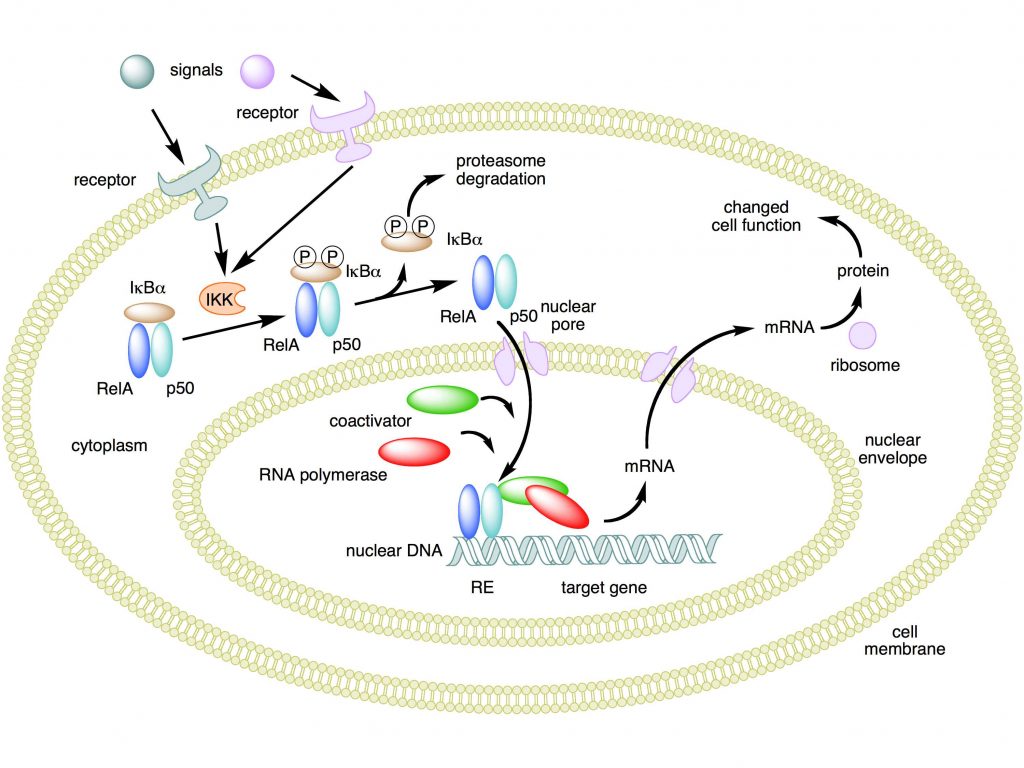

Mechanism of NF-κB action. In this figure, the NF-κB heterodimer consisting of Rel and p50 proteins is used as an example. While in an inactivated state, NF-κB is located in the cytosol complexed with the inhibitory protein IκBα. Through the intermediacy of integral membrane receptors, a variety of extracellular signals can activate the enzyme IκB kinase (IKK). IKK, in turn, phosphorylates the IκBα protein, which results in ubiquitination, dissociation of IκBα from NF-κB, and eventual degradation of IκBα by the proteasome. The activated NF-κB is then translocated into the nucleus where it binds to specific sequences of DNA called response elements (RE). The DNA/NF-κB complex then recruits other proteins such as coactivators and RNA polymerase, which transcribe downstream DNA into mRNA. In turn, mRNA is translated into protein, resulting in a change of cell function.

Attribution: Boghog2 at English Wikipedia [Public domain]

Now, the purpose of this OP is to show, in greater detail, how this mechanism, apparently moderately simple, is indeed extremely complex and dynamic. Let’s see.

The stimuli.

First of all, we must understand what are the stimuli that, arriving to the cell membrane, are capable to activate the NF-kB system. IOWs, what are the signals that work as inputs.

The main concept is: the NF-kB system is a central pathway activated by many stimuli:

  1. Inflammation
  2. Stress
  3. Free
    radicals
  4. Infections
  5. Radiation
  6. Immune
    stimulation

IOWs, a wide variety of aggressive stimuli can activate the system

The extracellular signal arrives to the cell usually through specific cytokines, for example TNF, IL1, or through pathogen associated molecules, like bacterial lipopolysaccharides (LPS). Of course there are different and specific membrane receptors, in particular IL-1R (for IL1) , TNF-R (for TNF), and many TLRs (Toll like receptors, for pathogen associated structures). A special kind of activation is implemented, in B and T lymphocytes, by the immune activation of the specific receptors for antigen epitopes (B cell receptor, BCR, and T cell receptor, TCR).

The process through which the activated receptor can activate the NF-kB dimer is rather complex: it involves, in the canonical pathway, a macromolecular complex called IKK (IkB kinase) complex, comprising two catalytic kinase subunits (IKKa and IKKb) and a regulatory protein (IKKg/NEMO), and involving in multiple and complex ways the ubiquitin system. The non canonical pathway is a variation of that. Finally, a specific protein complex (CBM complex or CBM signalosome) mediates the transmission from the immune BCR or TCR to the canonical pathway. See Fig. 2:
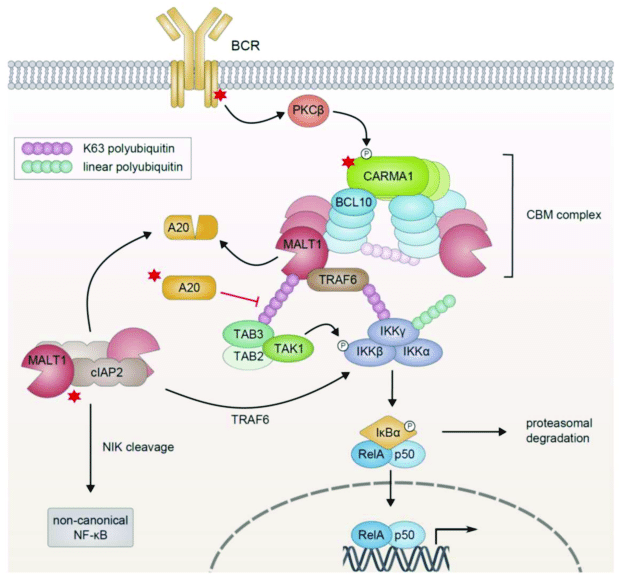
From: NF-κB Activation in Lymphoid Malignancies: Genetics, Signaling, and Targeted Therapy – Scientific Figure on ResearchGate. Available from: https://www.researchgate.net/figure/Increased-activity-of-the-CARMA1-BCL10-MALT1-signalosome-drives-constitutive-NF-kB_fig2_324089636 [accessed 10 Jul, 2019]
Figure 3 – NF-κB Activation in Lymphoid Malignancies: Genetics, Signaling, and Targeted Therapy
available via license: Creative Commons Attribution 4.0 International

I will not go into further details about this part, but those interested can have a look at this very good paper:

TLR-4, IL-1R and TNF-R signaling to NF-kB: variations on a common theme

In particular, Figg. 1, 2, 3.

In the end, as a result of the activation process, the IkB inhibitor is degraded by the ubiquitin system, and the NK-kB dimer is free to migrate to the nucleus.

An important concept is that this is a “rapid-acting” response system, because the dimers are already present, in inactive form, in the cytoplasm, and must not be synthesized de novo: so the system is ready to respond to the activating signal.

The response.

But what is the cellular response?

Again, there are multiple and complex possible responses.

Essentially, this system is a major regulator of innate and adaptive immune responses. As such, it has a central role in the regulation of inflammation, in immunity, in autoimmune processes, and in cancer.

Moreover, the NF-kB system is rather ubiquitous, and is present and active in many different cell types. And, as we have seen, it can be activated by different stimuli, in different ways.

So, the important point is that the response to activation must be (at least):

  1. Lineage-specific
  2. Stimulus-specific

IOWs, different cells must be able to respond differently, and each cell type must respond differently to different stimuli. That gives a wide range of possible gene expression patterns at the transcription level.

The following paper is a good review of the topic:

Selectivity of the NF-κB Response

For example, IL2 is induced by NF-kB activayion in T cells, but not in B cells (lineage specific response). Moreover, specific cell types can undergo specific, and often different, cell destinies after NF-kB activation: for example, NK-kB is strongly involved in the control and regulation of T and B cell development.

From:

30 years of NF-κB: a blossoming of relevance to human pathobiology

“B and T lymphocytes induce NF-κB in adaptive immune responses through the CARD11:Bcl10:MALT1 (CBM) complex (Hayden and Ghosh, 2008). Newly expressed genes promote lymphocyte proliferation and specific immune functions including antibody production by B cells and the generation of cytokines and other anti-pathogen responses by T cells.”

And, in the same cell type, certain promoters regulated by NF-kB require additional signaling (for example,  in human dendritic cells promoters for Il6Il12b, and MCP-1 require additional p38 histone phosphorylation to be activated), while others can be activated directly (stimulus-specific response).

So, to sum up:

  1. A variety of stimuli can activate the system in different ways
  2. The system itself has its complexity (different dimers)
  3. The response can be widely different, according to the cell type where it happens, and to the type of stimuli that have activated the system, and probably according to other complex variables.
  4. The possible responses include a wide range of regulations of inflammation, of the immune system, of cell specifications or modifications, and so on.

How does it work?

So, what do we know about the working of such a system?

I will ignore, for the moment, the many complexities of the activation pathways, both canonical and non canonical, the role of cyotkines and receptors and IKK complexes, the many facets of NEMO and of the involvement of the ubiquitin system.

For simplicity, we will start with the activated system: the IkB inhibitor has been released from the inactive complex in the cytoplasm, and some form of NF-kB dimer is ready to migrate to the nucleus.

Let’s remember that the purpose of this OP is to show that the system works as a dynamic, far from equilibrium system, rather than as a “traditional” machine. And that such a way to work is an even more amazing example of design and functional complexity.

To do that; I will rely mainly on the recent paper quoted at the beginning:

Considering Abundance, Affinity, and Binding Site Availability in the NF-kB Target Selection Puzzle

The paper is essentially about the NF-kB Target Selection Puzzle. IOWs, it tries to analyze what we know about the specificity of the response. How are specific patterns of transcription achieved after the activation of the system? What mechanisms allow the selection of the right genes to be transcribed (the targets) to implement the specific patterns according to cell type, context, and type of stimuli?

A “traditional” view of the system as a machine would try to establish rather fixed connections. For example, some type of dimer is connected to specific stimuli, and evokes specific gene patterns. Or some other components modulate the effect of NK-kB, generate diversification and specificity of the response.

Well, those ideas are not completely wrong. In a sense, the system does work also that way. Dimer specificity has a role. Other components have a role. In a sense, but only in a sense, the system works as though it were a traditional machine, and uses some of the mechanisms that we find in the concept of a traditional biological machine.

But that is only a tiny part of the real thing.

The real thing is that the system really works as a dynamic, far from equilibrium system, harnessing huge random/stochastic components to achieve robustness and complexity and flexibility of behavior in spite of all those non finalistic parts.

Let’s see how that happens, at least for the limited understanding we have of it. It is important to consider that this is a system that has been studied a lot, for decades, because of its central role in so many physiological and pathological contexts, and so we know many things. But still, our understanding is very limited, as you will see.

So, let’s go back to the paper. I will try to summarize as simply as possible the main concepts. Anyone who is really interested can refer to the paper itself.

Essentially, the paper analyzes three important and different aspects that contribute to the selection of targets at the genomic level by our TFs (IOWs, our NF-kB dimers, ready to migrate to the nucleus. As the title itself summarizes, they are:

  1. Abundance
  2. Affinity
  3. Binding site availability

1. Abundance

Abundance is referred here to two different variables: abundance of NF-kB Binding Sites in the genome and abundance of Nucleus-Localized NF-kB Dimers. Let’s consider them separately.

1a) Abundance of NF-kB Binding Sites in the genome:

It is well known that TFs bind specific sites in the genome. For NF-kB TFs, the following consensus kB site pattern has been found:

 5′-GGGRNWYYCC-3′

where R, W, Y, and N, respectively denote purine, adenine or thymine, pyrimidine, and any nucleotide.

That simply means that any sequence corresponding to that pattern in the genome can, in principle, bind NF-kB dimers.

So the problem is: how many such sequences do exist in the human genome?

Well, a study based on RelA has evaluated about 10^4 consensus sequences in the whole genome, but as NF-kB dimers seem to bind even incomplete consensus sites, the total number of potential binding sites could be nearer to 10^6

1b) Abundance of Nucleus-Localized NF-kB Dimers:

An estimate of the abundance of dimers in the nucleus after activation of the system is that about 1.5 × 10^5 molecules can be found, but again that is derived from studies about RelA only. Moreover, the number of molecules and type of dimer can probably vary much according to cell type.

So, the crucial variable, that is the ratio between binding sites and available dimers, and which could help undertsand the rate of sites saturation in the nucleus, remains rather undecided, and it seems very likely that it can vary a lot in different circumstances.

But there is another very interesting aspect about the concentration of dimers in the nucleus. According to some studies, NF-kB seems to generate oscillations of its nuclear content in some cell types, and those oscillation can be a way to generate specific transcription patterns:

NF-kB oscillations translate into functionally related patterns of gene expression

For example, this very recent paper :

NF-κB Signaling in Macrophages: Dynamics, Crosstalk, and Signal Integration

shows at Fig. 3 the occupancy curve of binding sites at nuclear level after NF-kB activation in two different cell types.

In fibroblasts, the curve is a periodic oscillation, with a frequency that varies according to various factors, and translates into different transcription scenarios accordingly:

Gene expression dynamics scale with the period (g1) and amplitude (g2) of these oscillations, which are influenced by variables such as signal strength, duration, and receptor identity.


In macrophages, instead, the curve is rather:

a single, strong nuclear translocation event which persists for as long as the stimulus remains and tends to remain above baseline for an extended period of time.

In this case, the type of transcription will be probably regulated by the are under the curve, ratehr than by the period and amplitude of the oscialltions, as happened in fibroblasts.

Interestingly, while in previous studies it seemed that the concentration of nuclear dimers could be sufficient to saturate most or all binding sites, that has been found not to be the case in more recent studies. Again from the paper about abundance:

in fact, this lack of saturation of the system is necessary to generate stimulus- and cell-type specific gene expression profiles

Moreover, the binding itself seems to be rather short-lived:

Interestingly, it is now thought that most functional NF-kB interactions with chromatin—interactions that lead to a change in transcription—are fleeting… a subsequent study using FRAP in live cells expressing RelA-GFP showed that most RelA-DNA interactions are actually quite dynamic, with half-lives of a few seconds… Indeed, a recent study used single-molecule tracking of individual Halo-tagged RelA molecules in live cells to show that the majority (∼96%) of RelA undergoes short-lived interactions lasting on average ∼0.5 s, while just ∼4% of RelA molecules form more stable complexes with a lifetime of ∼4 s.

2. Affinity

Affinity of dimers for DNA sequences is not a clear cut matter. From the paper:

Biochemical DNA binding studies of a wide variety of 9–12 base-pair sequences have revealed that different NF-kB dimers bind far more sequences than previously thought, with different dimer species exhibiting specific but overlapping affinities for consensus and non-consensus kB site sequences.

IOWs, we have different dimers (15 different types) binding with varying affinity different DNA sequences (starting from the classical consensus sequence, but including also incomplete sequences). Remember that those sequences are rather short (the consensus sequence is 10 nucleotides long), and that there are thousands of such sequences in the genome.

Moreover, different bindings can affect transcription differently. Again, from the paper:

How might different consensus kB sites modulate the activity of the NF-kB dimers? Structure-function studies have shown that binding to different consensus kB sites can alter the conformation of the bound NF-kB dimers, thus dictating dimer function When an NF-kB dimer interacts with a DNA sequence, side chains of the amino  acids located in the DNA-binding domains of dimers contact the bases exposed in the groove of the DNA. For different consensus kB site sequences different bases are exposed in this groove, and NF-kB seems to alter its conformation to maximize interactions with the DNA and maintain high binding affinity. Changes in conformation may in turn impact NF-kB binding to co-regulators of transcription, whether these are activating or inhibitory, to specify the strength and dynamics of the transcriptional response. These findings again highlight how the huge array of kB binding site sequences must play a key role in modulating the transcription of target genes.

Quite a complex scenario, I would say!

But there is more:

Finally, as an additional layer of dimer and sequence-specific regulation, each of the subunits can be phosphorylated at multiple sites with, depending on the site, effects on nearly every step of NF-kB activation.

IOWs, the 15 dimers we have mentioned can be phosphorylated in many different ways, and that changes their binding affinities and their effects on transcription.

This section of the paper ends with a very interesting statement:

Overall, when considering the various ways in which NF-kB dimer abundances and their affinity for DNA can be modulated, it becomes clear that with these multiple cascading effects, small differences in consensus kB site sequences and small a priori differences in interaction affinities can ultimately have a large impact on the transcriptional response to NF-kB pathway activation.

Emphasis mine.

This is interesting, because in some way it seems to suggest that the whole system acts like a chaotic system, at least at some basic level. IOWs, small initial differences, maybe even random noise, can potentially affect deeply the general working of the whole systems.

Unless, of course, there is some higher, powerful level of control.

3. Availability of high affinity kB binding sequences

We have seen that there is a great abundance and variety of binding sequences for NF-kB dimers in the human genome. But, of course, those sequences are not necessarily available. Different cell types will have a different scenario of binding sites availability.

Why?

Because, as we know, the genome and chromatin are a very dynamic system, that can exist in many different states, continuosly changing in different cell types and, in the same cell type, in different conditions..

We know rather well the many levels of control that affect DNA and chromatin state. In brief, they are essentially:

  1. DNA methylation
  2. Histone modifications (methylation, acetylation, etc)
  3. Chromatin modifications
  4. Higher levels of organization, including nuclear localization and TADs (Topologically Associating Domains)

For example, from the paper:

The promoter regions of early response genes have abundant histone acetylation or trimethylation prior to stimulation [e.g., H3K27ac, (67) and H4K20me3, (66)], a chromatin state “poised” for immediate activation…  In contrast, promoters of late genes often have hypo-acetylated histones, requiring conformational changes to the chromatin to become accessible. They are therefore unable to recruit NF-kB for up to several hours after stimulation (68), due to the slow process of chromatin remodeling.

We must remember that each wave of NK-kB activation translates into the modified transcription of a lot of different genes at the genome level. It is therefore extremely important to consider what genes are available (IOWs, their promoters can be reached by the NF-kB signal) in each cell type and cell state.

The paper concludes:

Taken together, chromatin state and chromatin organization strongly influence the selection of DNA binding sites by NF-kB dimers and, most likely, the selection of the target genes that are regulated by these protein-DNA interaction events. Analyses that consider binding events in the context of three-dimensional nuclear organization and chromatin composition will be required to generate a more accurate view of the ways in which NF-kBDNA binding affects gene transcription.

This is the main scenario. But there are other components, that I have not considered in detail for the sake of brevity, for example competition between NF-kB dimers and the complex role and intervention of other co-regulators of transcription.

Does the system work?

But does the system work?

Of course it does. It is a central regulator, as we have said, of many extremely important biological processes, above all immunity. This is the system that decides how immune cells, T and B lymphocytes, have to behave, in terms of cell destiny and cell state. It is of huge relevance in all inflammatory responses, and in our defense against infections. It works, it works very well.

And what happens if it does not work properly?

Of course, like all very complex systems, errors can happen. Those interested can have a look at this recent paper:

30 years of NF-κB: a blossoming of relevance to human pathobiology

First of all, many serious genetic diseases have been linked to mutations in genes involved in the system. You can find a list in Table 1 of the above paper. Among them, for example, some forms of SCID, Severe combined immunodeficiency, one of the most severe genetic diseases of the immune system.

But, of course, a dysfunction of the NF-kB system has a very important role also in autoimmune diseases and in cancer.

Conclusions.

So, let’s try to sum up what we have seen here in the light of the original statement about biological systems that “are not machines”.

The NF-kB system is a perfect example. Even if we still understand very little of how it works, it is rather obvious that it is not a traditional machine.

A traditional machine would work differently. The signal would be transmitted from the membrane to the nucleus in the simplest possible way, without ambiguities and diversions. The Transcription Factor, once activated, would bind, at the level of the genome, very specific sites, each of them corresponding to a definite cascade of specific genes. The result would be clear cut, almost mechanical. Like a watch.

But that’s not the way things happen. There are myriads of variations, of ambiguities, of stochastic components.

The signal arrives to the membrane in multiple ways, very different one from the other: IL1, IL17, TNF, bacterial LPS, and immune activation of the B cell receptor (BCR) or the T cell receptor (TCR) are all possible signals.

The signal is translated to the NF-kB proteins in very different ways: canonical or non canonical activation, involving complex protein structures such as:

The CBM signalosome, intermediate between immune activation of BCR or TCR and canonical activation of the NF-kB. This complex is made of at least three proteins, CARD11, Bcl10 and MALT1.

The IKK complex in canonical activation: this is made of three proteins, IKK alpha, IKK beta, and NEMO. Its purpose is to phosphorylate the IkB, the inhibitor of the dimers, so that it can be ubiquinated and released from the dimer. Then the dimer can relocate to the nucleus.

Non canonical pathway: it involves the following phosphorylation cascade: NIK -> IKK alpha dimer -> Relb – p100 dimer -> Relb – p50 dimer (the final TF). It operates during the development of lymphoid organs and is responsible for the generation of B and T lymphocytes.

Different kinds of activated dimers relocate to the nucleus.

Different dimers, in varying abundance, interact with many different binding sites: complete or incomplete consensus sites, and probably others. The interaction is usually brief, and it can generate an oscillating pattern, or a more stable pattern

Completely different sets of genes are transcribed in different cell types and in different contexts, because of the interaction of NF-kB TFs with their promoters.

Many other factors and systems contribute to the final result.

The chromatin state of the cell at the moment of the NF-kB activation is essential to determine the accessibility of different binding sites, and therefore the final transcription pattern.

All these events and interactions are quick, unstable, far from equilibrium. A lot of possible random noise is involved.

In spite of that amazing complexity and potential stochastic nature of the system, reliable transcripion regulation and results are obtained in most cases. Those results are essential to immune cell differentiation, immune response, both innate and adaptive, inflammation, apoptosis, and many other crucial cellular processes.

So, let’s go back to our initial question.

Is this the working of a machine?

Of course it is! Because the results are purposeful, reasonably robust and reliable, and govern a lot of complex processes with remarkable elegance and efficiency.

But certainly, it is not a traditional machine. It is a lot more complex. It is a lot more beautiful and flexible.

It works with biological realities and not with transistors and switches. And biological realities are, by definition, far from equilibrium states, improbable forms of order that must continuously recreate themselves, fighting against the thermodynamic disorder and the intrinsic random noise that should apparently dominate any such scenario.

It is more similar to a set of extremely clever surfers who succeed in performing elegant and functional figures and motions in spite of the huge contrasting waves.

It is, from all points of view, amazing.

Now, Paley was absolutely right. No traditional machine, like a watch, could ever originate without design.

And if that is true of a watch, with its rather simple and fixed mechanisms, how much truer it must be for a system like NF-kB? Or, for that, like any cellular complex system?

Do you still have any doubts?
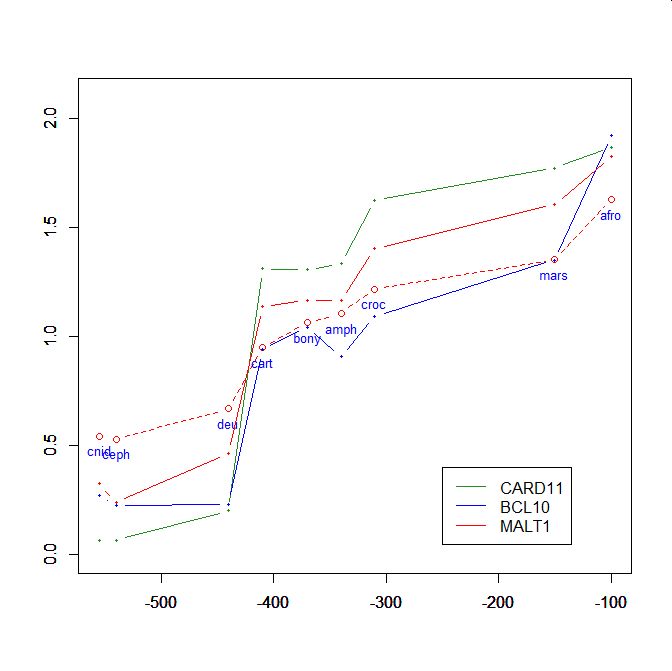
Added graphic: The evolutionary history, in terms of human conserved information, of the three proteins in the CBM signalosome.
On the y axis, homologies with the human protein as bits per aminoacid (bpa). On the x axis, approximate time of appearance in million of years.
The graphic shows the big information jump in vertebrates for all three protens , especially CARD11.
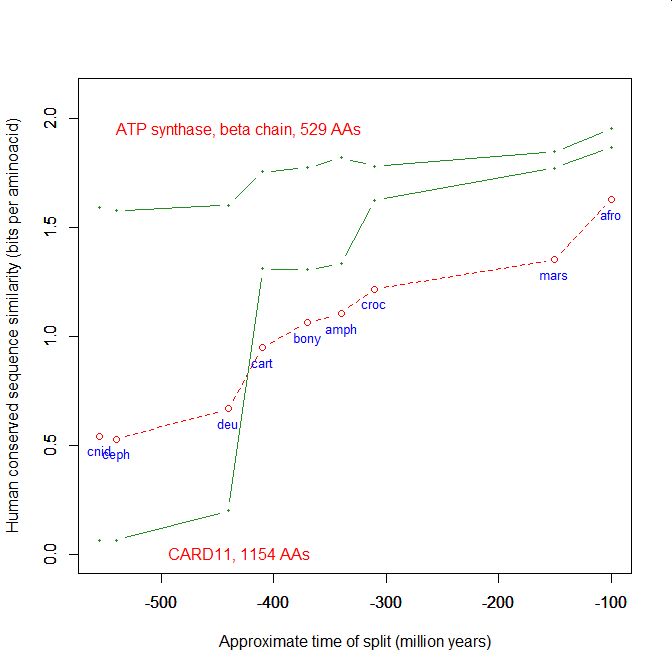

Added graphic: two very different proteins and their functional history
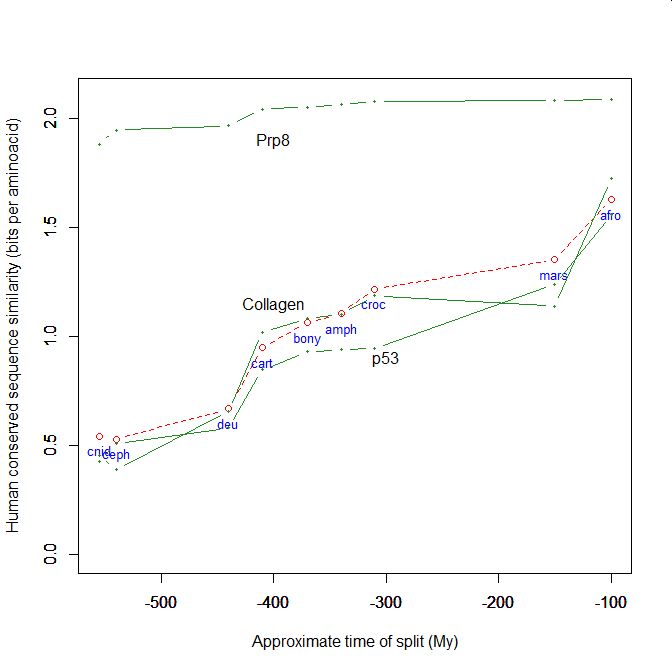

Added graphic (for Bill Cole). Functional history of Prp8, collagen, p53.
Comments
Sven Mil: "Is there an explanation for this disagreement?" Thank you for the comment and welcome to the discussion. Thank you also for addressing an interesting and specific technical point. It is not really a disagreement, probably only a different perspective. Reseacrhers interested in possible homologies (IOWs, in finding orthologs or paralogs for some gene) often use very sensitive algorithms. They find homologies that are often very weak, or maybe not real. Or they may look at structural homologies, that are not evident at the sequence level. My point of view is different. In order to debate ID in biology, I am only interested in definite homologies, possibly very high homologies conserved for a long evolutionary time. My aim is specificity, not sensitivity. Moreover, as I accept CD (as discussed in detail in this thread) I have no interest in denying possible weak homologies. I just ignore them, because they are not relevant to my argument. That's why I always measure homology differences, not absolute homologies. I want to find information jumps at definite evolutionari times. Another possibility for the different result is that I have not blasted the right protein form. For brevity (it was nort really an important aspect of my discussion) I have not blaste all possible forms of sigma factors against eukaryotic factor TFIIB. I have just blasted sigma 70 from E. coli. Maybe a more complete search could detect some higher homology. OK, as you have raised the question, I have just checked the literature reference in the Wikipedia page: The sigma enigma: Bacterial sigma factors, archaeal TFB and eukaryotic TFIIB are homologs https://www.ncbi.nlm.nih.gov/pmc/articles/PMC4581349/
Abstract Structural comparisons of initiating RNA polymerase complexes and structure-based amino acid sequence alignments of general transcription initiation factors (eukaryotic TFIIB, archaeal TFB and bacterial sigma factors) show that these proteins are homologs. TFIIB and TFB each have two-five-helix cyclin-like repeats (CLRs) that include a C-terminal helix-turn-helix (HTH) motif (CLR/HTH domains). Four homologous HTH motifs are present in bacterial sigma factors that are relics of CLR/HTH domains. Sequence similarities clarify models for sigma factor and TFB/TFIIB evolution and function and suggest models for promoter evolution. Commitment to alternate modes for transcription initiation appears to be a major driver of the divergence of bacteria and archaea.
As you can see from the abstract, they took into consideration structure similarities, not only sequence alignments. Maybe you can have a look at the whole article. Now I don't think I have the time.gpuccio
July 18, 2019
July
07
Jul
18
18
2019
04:28 AM
4
04
28
AM
PDT
Interesting conversation here, 'sigma factor “is a bacterial transcription initiation factor that enables specific binding of RNA polymerase (RNAP) to gene promoters. It is homologous to archaeal transcription factor B and to eukaryotic factor TFIIB”.' "I have blasted sigma 70 from E. coli with human TFIIB and found no detectable homology (E value 1.4). So, there seems to be little conservation here." Is there an explanation for this disagreement?Sven Mil
July 18, 2019
July
07
Jul
18
18
2019
04:06 AM
4
04
06
AM
PDT
John_a_designer at #177: Exactly! That's why I say that ID is fully scientific. Science has the duty to make good inferences from facts, without any a priori commitment to any specific worldview. That reality must behave according to our religious convictions is an a priori wordview. That's why, as I have explained, I strive a lot to avoid, as much as humanly possible, any influence of my philosophy or theology on my scientific reasonings. That realy must behave according to our atheistic or materialistic convictions is an a priori wordview. That's why our knid interlocutors should strive a lot to avoid, as much as humanly possible, any influence of their philosophy or atheology on their scientific reasonings. The simple fact is that ID theory, reasoning from facts in a perfectly scientific way, infers a process of design for the origin of biological objects. Now, our interlocutors can debate if our arguments are right or wrong from a scientific point of view. That's part of the scientific debate. But the simple idea that we have no other evidence of the existence of conscious agent, for example, at the time of OOL is not enough. Because we have no evidence of the contrary, too. The simple idea that non physical conscious agents cannot exist is not enough, because it is only a specific philosophical conviction. Od course non physical conscious agents can exist. We don't even know what consciousness is, least of all how it works and what is necessary for its existence. My point is: the design inference is real and perfectly scientific. All arguments about things that we don't know are no reason to ignore that scientific inference. They are certainly valod reasons to pursue any further scientific investigation to increase our knowledge about those things. That's perfectly legitimate. For example, I am convinced that our rapidly growing understanding of biology will certainly help to understand how the design was implemented at various times. And, even if ID is not a theory of consciousness, there is no doubt that future theories of consciousness can integrate ID and its results. For example, much can be done to understand better if a quantum interface between conscious representations and physical events is working in us humans, as many have proposed and as I believe. That same model could be applied to biological design in natural history. And of course, philosophy, physics, biophysics and what else can certainly contribute to a better understanding of consciousness, and of its role in reality. A better study of common events like NDEs can certainly contribute to understand what consciousness is. I would like to repeat hear a statment that I have made in the discussion with Silver Asiatic, that sums up well my position about science: Science can, and must, investigate, everything that can be observed in reality. And, from observed things, infer ever better models of reality. Given that very broad definition, there are no other limitations.gpuccio
July 18, 2019
July
07
Jul
18
18
2019
12:43 AM
12
12
43
AM
PDT
A few years ago here at UD one of our regular interlocutors who was arguing with me about the ID explanation for origin of life pointed out:
the inference from that evidence to intelligence being involved is really indirect. You don’t have any other evidence for the existence of an intelligence during the times it would need to be around.
I responded, “We have absolutely no evidence as to how first self-replicating living cell originated abiogenetically (from non-life). So following your arbitrarily made-up standard that’s not a logical possibility, so we shouldn’t even consider it... As the saying goes, ‘sauce for the goose is sauce for the gander.’” When you argue that life originated by some “mindless natural process,” that is not an explanation how. Life is not presently coming into existence by abiogenetically, so if such process existed in the past it no longer exists in the present. Therefore you are committing the same error which you accuse ID’ists of committing. That’s a double standard, is it not? This kind of reasoning on the part of materialists also reveals that they don’t really have any strong arguments based on reason, logic and the evidence. If they do, why are they holding back?john_a_designer
July 17, 2019
July
07
Jul
17
17
2019
08:52 PM
8
08
52
PM
PDT
OLV @139: The paper you cited doesn't seem to support Behe's polar bear argument.PavelU
July 17, 2019
July
07
Jul
17
17
2019
06:48 PM
6
06
48
PM
PDT
JAD @173, Yes, that makes much sense.PeterA
July 17, 2019
July
07
Jul
17
17
2019
06:39 PM
6
06
39
PM
PDT
Just to clarify, it’s not my view that ID doesn’t raise some very legitimate scientific questions. Behe’s discovery of irreducible complexity (IC) raises some important questions. For example, in his book Darwin’s Black Box, Michael Behe asks,
“Might there be an as yet undiscovered natural process that would explain biochemical complexity? No one would be foolish enough to categorically deny the possibility. Nonetheless we can say that if there is such a process, no one has a clue how it would work. Further it would go against all human experience, like postulating that a natural process might explain computers… In the face of the massive evidence we do have for biochemical design, ignoring the evidence in the name of a phantom process would be to play the role of detective who ignore the elephant.” (p. 203-204)
Basically Behe is asking, if biochemical complexity (irreducible complexity) evolved by some natural process x, how did it evolve? That is a perfectly legitimate scientific question. Notice that even though in DBB Behe was criticizing Neo-Darwinism he is not ruling out a priori some other mindless natural evolutionary process, “x”, might be able to explain IC. Behe is simply claiming that at the present there is no known natural process that can explain how irreducibly complex mechanisms and processes originated. If he and other ID’ist are categorically wrong then our critics need to provide the step-by-step-by-step empirical explanation of how they originated, not just speculation and wishful thinking. Unfortunately our regular interlocutors seem to only be able to provide the latter not the former. Behe made another point which is worth keeping in mind.
“In the abstract, it might be tempting to imagine that irreducible complexity simply requires multiple simultaneous mutations - that evolution might be far chancier than we thought, but still possible. Such an appeal to brute luck can never be refuted... Luck is metaphysical speculation; scientific explanations invoke causes.”
In other words, a strongly held metaphysical belief is not a scientific explanation. So why does Neo-Darwinism persist? I believe it is because of its a-priori ideological or philosophical fit with naturalistic or materialistic world views. Human being are hard wired to believe in something-- anything to explain or make some sense of our existence. Unfortunately we also have a strong tendency to believe in a lot of untrue things. On the other hand, if IC is the result of design, it has to answer the question of how was the design instantiated. If ID wants to have a place at the table it has to find a way to answer questions like that. Once again, one of the primary things science is about is answering the “how” questions. Or as another example, ID’ists argue that the so-called Cambrian explosion can be better explained by an infusion of design. Okay that is possible. (Of course, I whole heartedly agree because I am very sympathetic to the concept of ID.) But how was the design infused to cause a sudden diversification of body plans? Did the “designer” tinker with the genomes of simpler life forms or were they specially created as some creationists would argue? (The so-called interventionist view.) Or were the new body plans somehow pre-programmed into their progenitors genomes (so-called front loading.) How do you begin to answer such questions that have happened in the distant past? At least the Neo-Darwinists have the pretense of an explanation. Can we get them to abandon their theory by declaring it impossible? Isn’t it at least possible, as Behe acknowledges, that there could be some other unknown natural explanation “x.” Is saying something is metaphysically possible a scientific explanation? The goal of science is to find some kind of provisional proof or compelling evidence. Why for example was the Large Hadron Collider built at the cost of billions of dollars (how much was it in euros?) Obviously it was because in science mere possibility is not the end of the line. The ultimate quest of science is truth and knowledge. Of course, we need to concede that science will never be able to explain everything.john_a_designer
July 17, 2019
July
07
Jul
17
17
2019
03:17 PM
3
03
17
PM
PDT
Peter A Final edit: "As far as philosophical naturalism goes, here is a summary of reasons why I do not think philosophical naturalism is sufficient as a world view." That is what I meant to say and luckily corrected before the edit function timed out. Hopefully that makes sense now.john_a_designer
July 17, 2019
July
07
Jul
17
17
2019
01:27 PM
1
01
27
PM
PDT
John_a_designer at #169: I agree with almost everything that you say, except of course that ID is not science. For me, it is science without any doubt. It has, of course, important philosophical implications, like many other important scientific theories (Big Bang, Quantum mechanics, Relativity, Dark energy, and so on).gpuccio
July 17, 2019
July
07
Jul
17
17
2019
01:17 PM
1
01
17
PM
PDT
John_a_designer at #166: I agree with what you say about Dawkins. He is probably honest enougheven if completely wrong, but he is really obsessed by his antireligious crusade. The book you mention is "Signature in the Cell" by Stephen Meyer.gpuccio
July 17, 2019
July
07
Jul
17
17
2019
01:14 PM
1
01
14
PM
PDT
JAD @169: “As far as philosophical naturalism goes, here is a summary of reasons why I do not think philosophical naturalism is insufficient as a world view” “do not think” “is insufficient” Is that the combination you wanted to express? I’m not sure if I understood it.PeterA
July 17, 2019
July
07
Jul
17
17
2019
01:04 PM
1
01
04
PM
PDT
SA, [The following is something I posted on UD before which defines my position about I.D. Please note, however, I see it nothing more than just a personal opinion and I am not stating it in an attempt to change anyone’s mind. Indeed it remains tentative and subject to change but over the years I have seen no reason to change it.] Even though I think I.D. provokes some interesting questions I am actually not an I.D. proponent in the same sense that several other commenters here are. I don’t think I.D. is “science” (the empirical study of the natural world) any more than naturalism/materialism is science. So questions from materialists, like “who designed the designer,” are not scientific questions; they are philosophical and/or theological questions. However, many of the questions have philosophical/theological answers. For example, the theist would answer the question, “who designed the designer,” by arguing that the designer (God) always existed. The materialist can’t honestly reject that explanation because historically materialism has believed that the universe has always existed. Presently they are trying to shoehorn the multiverse into the discussion to get around the problem of the Big-Bang. Of course, this is a problem because there is absolutely no scientific evidence for the existence of a multiverse. In other words, it is just an arbitrary ad hoc explanation used in an attempt to try to wiggle out of a legitimate philosophical question. However, this is not to say that science can’t provoke some important philosophical and theological questions-- questions which at present can’t be answered scientifically. For example: Scientifically it appears the universe is about 14.5 billion years old. Who or what caused the universe to come into existence? If it was “a what”-- just natural causes-- how do we know that? Why does the universe appear to exhibit teleology, or design and purpose? In other words, what is the explanation for the universes so-called fine tuning? How did chemistry create the code in DNA or RNA? How dose mindless matter “create” consciousness and mind? If consciousness and mind are “just an appearance” how do we know that? These are questions that arise out of science which are philosophical and/or theological questions. Is it possible that they could have scientific explanations? Possibly. But even if someday some of them could be answered scientifically that doesn’t make them at present illegitimate philosophical/theological questions, because we don’t know if they have, or ever could have, scientific answers. As far as philosophical naturalism goes, here is a summary of reasons why I do not think philosophical naturalism is sufficient as a world view. Naturalism (or materialism) cannot provide:
*1. An ultimate explanation for existence. Why does anything at all exist? *2. An explanation for the nature of existence. Why does the universe appear to exhibit teleology, or Design and Purpose? *3. A sufficient foundation for truth, knowledge and meaning. *4. A sufficient foundation for moral values and obligations. *5. An explanation for what Aristotle called form and what we call information. Specifically how did chemistry create the code in DNA or RNA? *6. An explanation for mind and consciousness. How dose mindless matter “create” consciousness and mind? If consciousness and mind are just an appearance how do we know that? *7. An explanation for the apparently innate belief in the spiritual-- a belief in God or gods, and the desire for immortality and transcendence.
Of course the atheistic naturalist will dismiss numbers 6 or 7 as illusions and make up a just-so story to explain them away. But how do they know they are illusions? The truth is they really don’t know and they certainly cannot prove that they are. They just believe. How ironic to be an atheist/naturalist/ materialist you must believe a lot-- well actually everything-- on the basis of faith.john_a_designer
July 17, 2019
July
07
Jul
17
17
2019
12:32 PM
12
12
32
PM
PDT
JAD
Bonus question: Ben Stein was made famous by one word. Does anyone know what that one word was? Anyone?
The kid in the movie - can't remember his name. Travis?
As whether or not ID is science. I am skeptical of the claim that Darwinism in the macro-evolutionary sense is science or that SETI is science (what empirical evidence is there that ETI’s exist?) How does NS + RV cause macro-evolutionary change? Science, needs to answer the question of how. Just saying “oh somehow it could” with any airy wave of the hand is not a sufficient explanation. But that applies for people on both sides of the debate.
It's a great point. I have argued for many years that ID is science. By that, I mean "the same science as Dawkins uses". It is my belief that 90% of the scientists agree with Dawkins' view of science - it's the mainstream view. I also believed that ID was a subterfuge - an apologetic for the existence of God. I don't see anything wrong with that. ID was going to use the exact same science that Dawkins uses, and then show that there is evidence of intelligent design. The method for doing that is to show that proposed natural mechanisms (RM + NS) cannot produce the observed effects. Intelligence can produce them, so Intelligence is the best, most probable inference. However, what I learned from many IDists over the years (GP pointed it out to me just previously) is that to accept ID, one needs a different science than what Dawkins uses. I find that to be a big problem. If, in order to accept ID, a person first needs "a different kind of science" than the normal, mainstream science of Dawkins, then there's no reason to start talking about ID first. Instead, one should start to convince everyone that a different kind of science should be used throughout the world. Because for me, Dawkins' version of science is fine. He just does what mainstream science does. They look at observations, collect data, propose causes. The first problem is that Dawkins' mechanisms cannot produce the observed effects. So, even on his own terms, the science fails. However, when Dawkins says that science can only accept material causes, that doesn't make a lot of sense - as you have pointed out. Additionally, he's talking about a philosophical view. In that case, it is one philosophy versus another. The philosophy of ID vs Dawkins' philosophical view. We can't speak about science at that point. So, I hate to admit it because so many of my opponents over the years said this and I disagreed, but I do now accept that ID has always been a game to introduce God into the closed world of materialistic science. The difference in my view now is that I don't see anything wrong with that game. Why not try to put God in science? What's wrong with that? If the only way to do this is to trick materialist scientists using their own words, concepts and reasoning, again - what's wrong with that? Dishonest? I don't think so. The motive for using a certain methodology (ID in this case) has no bearing on what the methodology shows. In the same way, it doesn't matter what belief an evolutionist has, they have to show that the observations can be explained from their theory. If, however, ID requires an entirely different science and philosophical view (that is possible also), then I don't really see much need for the discussion on whether ID is a science or not. Why not just start with the idea that God exists, and then use ID observations to support that view? I don't see why that is a problem. If IDists are saying "we don't accept mainstream science", then why appeal to mainstream science for credibility? Just create your own ID-science. But for me, I'm a religious believer with philosophical reasons for believing in God (as the best inference from facts and far more rational than atheism) so instead of trying to prove to everyone that we need a new science, I'd just start with God and then do science from that basis. That's the way it would be if ID is not science. If, however, ID is science, for me that means "ID is the same science that Dawkins and all mainstream scientists use". The inferences from ID can be shown using exactly the same data and observations that Dawkins uses. For me, that would give ID a lot more value.Silver Asiatic
July 17, 2019
July
07
Jul
17
17
2019
11:17 AM
11
11
17
AM
PDT
GP
But it is true that ID is the first scientifc way to detect something that only conciousness can do: generate complex functional information.
What I have been doing is questioning what ID can or cannot do and even questioning scientific assumptions along the lines of the ideas you've posted. You have explained your views on design and how consciousness is involved and even on whether the actions of conscious mind can be considered "creative acts", as well as how we evaluate immaterial entities. I have always argued that ID is a scientific project but I could reconsider that. ID does not need to be scientific to have value. I'll respond to JAD in the next post with some thoughts that I question myself on and just respond to his feedback, but your definitions of science and ID will also be included in my considerations.Silver Asiatic
July 17, 2019
July
07
Jul
17
17
2019
10:35 AM
10
10
35
AM
PDT
Gp @ #156,
To be fair to Dawkins, I don’t think that he assumes that “design is impossible”. On the contrary, he is one of the few who admit that design could be a scientific explanation. He just does not accept it as a valid scientific explanation. That is epistemologically correct, even if of course completely wrong in the essence.
Indeed, here is another stunning admission by Richard Dawkins: https://www.youtube.com/watch?v=BoncJBrrdQ8 Dawkins concedes that (because nobody knows) first life on earth could have been intelligently designed-- as long as it was an ET intelligence not an eternally existing transcendent Mind (God.) Of course other atheists have admitted the same thing. See the following article which refers to a paper written by Francis Crick and British chemist Leslie Orgel. https://blogs.scientificamerican.com/guest-blog/the-origins-of-directed-panspermia/ I believe it was Crick and Orgel who coined the term directed panspermia. To be fair I think Dawkins later tried to walk back his position. Maybe Crick and Orgel did as well. But the point remains, until you prove how life first originated by mindless, purposeless “natural causes” intelligent design is a logical possibility-- a very viable possibility. Ironically, in the Ben Stein interview Dawkins said that if life were intelligently designed (by space aliens) the scientific research may be able to discover their signature. Didn’t someone write a book about the origin of life with the word signature in the title? Who was that? I wonder if he picked up the idea from Dawkins. Does anyone know? Bonus question: Ben Stein was made famous by one word. Does anyone know what that one word was? Anyone?john_a_designer
July 17, 2019
July
07
Jul
17
17
2019
10:30 AM
10
10
30
AM
PDT
Silver Asiatic: Theory of consciousness is a fascinating issue. A philosophical issue which, like all philosophical issues, can certainly use some scientific findings. I have my ideas about theory of consciousness, and sometimes I have discussed some of them here. But ID is not a theory of consciousness. But it is true that ID is the first scientifc way to detect something that only conciousness can do: generate complex functional information. In this sense, the results of ID are certainly important to any theory of consciousness. The simple fact that there is something that only consciousness can do, and that there is a scientific way to detect it, is certainly important. It also tells us that consciousness can do things that no non comscious algorithm, however intelligent or complex, can do. I usually say that some properties of conscious experiences, like the experience of understanding meaning and of feeling purposes, are the best rationale to explain why conscious agents can generate complex functional information while non conscious systems cannot. But again, ID is not a theory of consciousness. All spheres of human cognition are interrelated: religion, philosophy, science, art, everything. But each of those things a specificity. ID theory will probably be, in the future, part of a theory of consciousness, if and when we can develop a scientific approach to it. But at present it is only a theory about how to detect a specific product of consciousness, complex functional information, in material objects. Jeffrey Schwartz and Mario Beauregard are neuroscientists who have dealed brilliantly with the problem of consciousness. the spiritual brain is a very good book. Chalmers is a philosopher who has given us a precious intuition with his concept of the hard problem of consciousness. None of those approaches, however, is even near to understand anything about the "origin" of cosnciousness. Least of all ID. I am absolutely certain that consciousness is in essence immaterial. But that is my philosophical conviction. the best scienctific evidence that I can imagine about that are NDEs, and they are not related to ID theory.gpuccio
July 17, 2019
July
07
Jul
17
17
2019
10:17 AM
10
10
17
AM
PDT
JAD
Science itself rests on a number of empirically unprovable or metaphysical (philosophical) assumptions.
Agreed. Science does not stand alone as a self-evident process. It is dependent upon philosophical assumptions. Dawkins has his own assumptions. If he said, for example, that science can only accept material causes for all of reality, that is just his philosophical view. If ID says that science can accept immaterial causes, then it is different science. A person might also say that science must accept that God exists. That's a philosophical starting point. In the end, people who do science are carrying out a philosophical project. If a person is willing to do enough philosophy to carry out the project of science, I believe they have the responsibility to carry the philosophy farther than science. The philosophical questions go beyond simply what causes we can accept. But people like Dawkins and others do not accept this. They think that science simply has one set of rules, and they claim to be the ones following the true scientific rules, as if those rules always existed. Some IDists have tried to convince the world that ID is just following the normal, accepted rules of science and that people do not need to accept a new kind of science in order to accept ID conclusions. Others will say that mainstream science itself is incorrect and that people need a different kind of science in order to understand ID. I think ID will even work with Dawkins' version of science. He may say that "only material causes" can be considered. So, we observe intelligence and so some material cause created the intelligent output? The question for Dawkins would be what material cause creates intelligent outputs?Silver Asiatic
July 17, 2019
July
07
Jul
17
17
2019
09:53 AM
9
09
53
AM
PDT
"CSI is a reliable indicator of design" --- William Dembski "it is CSI on which David Chalmers hopes to base a comprehensive theory of human consciousness." -- William Dembski https://www.asa3.org/ASA/PSCF/1997/PSCF9-97Dembski.htmlSilver Asiatic
July 17, 2019
July
07
Jul
17
17
2019
09:37 AM
9
09
37
AM
PDT
SA: I have read ID researchers who have spoken about the irreducible quality of consciousness as evidence of design. GP: Who? Where? As far as I know, complex specified information (or complex functional information) in objects has always been considered the mark of design. Dembski, Behe, Abel, Meyer, Berlinski, and so on.
ID and Neuroscience https://uncommondescent.com/intelligent-design/id-and-neuroscience/ My good friend and colleague Jeffrey Schwartz (along with Mario Beauregard and Henry Stapp) has just published a paper in the Philosophical Transactions of the Royal Society that challenges the materialism endemic to so much of contemporary neuroscience. By contrast, it argues for the irreducibility of mind (and therefore intelligence) to material mechanisms. William Dembski
Silver Asiatic
July 17, 2019
July
07
Jul
17
17
2019
09:34 AM
9
09
34
AM
PDT
SA, Science itself rests on a number of empirically unprovable or metaphysical (philosophical) assumptions. For example: That we exist in a real special-temporal world-- that the world (the cosmos) is not an illusion and we are not “brains in a vat” in some kind of Matrix like virtual reality. That the laws of nature are universal throughout time and space. Or that there are really causal connections between things and things, people and things. David Hume famously argued that that wasn’t self-evidently true. Indeed, in some cases it isn’t. Sometime there is correlation without causation or “just coincidence.” Again, notice the logic Dawkins wants us to accept. He wants us to implicitly accept his premise that that living things only have the appearance of being designed. But how do we know that premise is true? Is it self-evidently true? I think not. Why can’t it be true that living things appear to be designed for a purpose because they really have been designed for a purpose? Is that logically impossible? Metaphysically impossible? Scientifically impossible? If one cannot answer those questions then design cannot be eliminated from consideration or the discussion. Therefore, it is a legitimate inference from the empirical (scientific) evidence. I have said this here before, the burden of proof is on those who believe that some mindless, purposeless process can “create” a planned and purposeful (teleological) self-replicating system capable of evolving further though purposeless mindless process (at least until it “creates” something purposeful, because, according to Dawkins, living things appear to be purposeful.) Frankly, this is something our regular interlocutors consistently and persistently fail to do. As a theist I do not claim I can prove (at least in an absolute sense) that my world view is true. Can naturalists/ materialists prove that their world view is true? Personally I believe that all worldviews rest on unprovable assumptions. No one can prove that their world view is true. Is that true of naturalism/ materialism? If it can someone with that world view needs to step forward and provide the proof. As whether or not ID is science. I am skeptical of the claim that Darwinism in the macro-evolutionary sense is science or that SETI is science (what empirical evidence is there that ETI’s exist?) How does NS + RV cause macro-evolutionary change? Science, needs to answer the question of how. Just saying “oh somehow it could” with any airy wave of the hand is not a sufficient explanation. But that applies for people on both sides of the debate.john_a_designer
July 17, 2019
July
07
Jul
17
17
2019
09:18 AM
9
09
18
AM
PDT
Silver Asiatic at #157: OK, I apologize too. Multiple question marks are not intended as an offense, only as an expression of true amazement. Some other statements may have been a little more "heated", as you say. Let's try to be more detached. :) I have just finished commenting on your statements. Please, forgive any possible question marks or tones. My purpose is always, however, to clarify. I am afraid that Egnor and BA are not exactly my main reference for ID theory. I always quote my main references: Dembski (with whom, however, I have sometimes a few problems, but whose genius and importance for ID theory cannot be overestimated) Behe, with whom I agree (almost) always. Abel, who has given a few precious intuitions, at least to me. Berlinsky, who has entertained me a lot with creative and funny thoughts. Meyer, who has done very good work about OOL and the Cambrian explosion. And, of course, others. Including many friends here. Let me quote at least KF and UB for the many precious contributions, but of course there are a lot more, and I hope nobody feels excluded: it would be a big work to give a coherent list.gpuccio
July 17, 2019
July
07
Jul
17
17
2019
09:01 AM
9
09
01
AM
PDT
Silver Asiatic at #152: I wasn’t “playing” with it. I was helping you clarify your statement. Well, I hope I have clarified it. Thank you for the help.
Again, normally IDists would not say that science can Directly investigate, evaluate, analyze, measure or describe immaterial entities. You seem to disagree with that.
Well, it seems that I have not clarified enough. Please, read again what I have written. Here are some more clues: 1) "investigate, evaluate, analyze, measure or describe" are probably too many different words. I quote myself: "But science tries to explain facts building theories (maps of reality). Those theories need not include only what is observable. They just need to explain observed facts. For example, most scientific theories are based on mathematics, which is not something observable. Another example. Most theories in empirical science are about possible relationships of cause and effect. But the relarionship of cause and effect is not something that can be observed. My error was probably to use the word “investigate”, which was ambiguous enought to allow you to play with it." So, again. Science starts with facts: what can be observed. "Measures" are only made on what can be observed. I suppose that all your fancy words can apply to our interaction with facts: - When we gather facts and observe their properties, it can be said, I suppose, that we are "investigating" facts, and "analyzing" them. And "eveluating" them or "describing" them. And of course taking measures is part of observing facts. - When we build theories to explain observed facts, not all those terms apply. For example, let's say that we hypothesize a cause and effect relationship. That is part of our theory, but we don't take measures of the cause-effect relationship. At most, we infer it from the measures we have taken of facts. But in a wide sense building a theory can be considered an evaluation, certainly it is a form of investigation. I have said clearly that we can use any possible concept in our theories, provided that the purpose is to explain facts. We use the cause-effect relationship, we use complex numbers in quantum mechanics, we can in principle use the concept of God, if useful. Or of immaterial entities. That does not mean that we can measure those things, or have further information about them except for what can be reasonably inferred from facts. That should be clear, but I don't know why I will not be suprised if again you don't understand.
Evaluation is not the gathering of facts. Collecting facts comes from observation, measurement, or investigation. Evaluation can create some facts (such as logical conclusions) but in science it all must start with observation. After that, we can evaluate. To infer is to draw a logical conclusion from observations and evaluation.
As you like. As said, it's not a problem about words. You want to limit "evaluation" in some, not very clear to me, way, be my guest. I will simply avoid the word with you. But please, note that logical conclusions are not facts. If you insist on that kind of epistemology, we cannot really communicate.
As I have heard other ID theorists state, ID cannot observe anything about an immaterial designer or designers. I think you disagree with this.
No. Why should I? Of course if a thing is immaterial it cannot be "observed". The only exception is our personal consciousness, that each of us observes directly, intuitively. I have only said that we can use the concept of immaterial entoities in our theories, and that we can make inferences about the designer from observed facts, be he material or immaterial.
The only thing ID attempts to do is show that there is evidence of Intelligence at work.
Of intelligent designers.
The effects that we observe in nature could have been produced by millions of designers, each one of which has less intelligence than a human being, but collectively create design in nature.
I absolutely disagree. ATP synthase could never have been designed by a crowd of stupid designers. It's the first time I hear such a silly idea.
If you are speaking about a designer that exists outside of space and time, then we do not have any experience with that.
I have never said that. I have said many times that the designer acts in space and time. Where he exists, I really don't know. Have you some information about that?
We can observe various effects, but not the entity itself.
That's right. Like dark energy or dark matter. As for that, we cannot even observe conscious representations in anyone else except us, but still we very much base our science and map of reality on their effects and the inference tha thy exist.
It seemed that you disagree with this and believe instead that science can directly observe an immaterial designer (or any immaterial entity) that produces effects in reality.
This is only your unwarranted misinterpretation. I have said many times that science can directly observe some effects and infer a designer, maybe immaterial. It's exactly the other way round.gpuccio
July 17, 2019
July
07
Jul
17
17
2019
08:50 AM
8
08
50
AM
PDT
Richard Dawkins’ books should be in the “cheap philosophy” section of bookstores. But instead they have them in the Science section. Specially after Professor Denis Noble has discredited them. Bizarre.jawa
July 17, 2019
July
07
Jul
17
17
2019
08:39 AM
8
08
39
AM
PDT
GP
??? Again, I can’t follow you. Who is “we”? I am not aware that ID, especially in its biological form, but probably also in the cosmological form, is inferring anything about “the generation of consciousness”. Why do you say that?
Your use of multiple question-marks and the personal digs ("even you can understand") indicate to me that this conversation is getting too heated. You apologized previously, so thank you. I'll also apologize for the tone of my remarks. You asked about ID and consciousness:
Yet the adequacy of matter to generate agency (or apparent agency) is fundamental to both the problem of consciousness and the problem of the origins of biological complexity. If immaterial explanations are necessary to explain the agency inherent to the mind, then the view that immaterial explanations are necessary to explain the agency apparent in living things gains considerable traction. https://evolutionnews.org/2008/12/consciousness_and_intelligent/
Michael Egnor writes about consciousness as evidence supporting ID. I think here, BornAgain77 often posts resources that support this concept. I understand that your interest is in biological ID, and therefore limited to biological designer or designers. You answered my questions adequately. Again, I appreciate your comments and I apologize for any misunderstandings that may have arisen in this conversation.Silver Asiatic
July 17, 2019
July
07
Jul
17
17
2019
08:34 AM
8
08
34
AM
PDT
John_a_designer at #150: I agree with what you say. I just want to clarify that: 1) IMO Dawkin's biological arguments are very bad, but at least they are a good incarnation of true neo-darwinism, thereofre easy to confute. In that sense, he is better than many post-post-neo-darwinists, whose thoughts are so ethereal that you cannot even catch them! :) 2) On the contrary, Dawkin's philosohical arguments are arrogant, superficail and ignorant. Unbearable. He should stick to being a bad thinker about biology. 3) To be fair to Dawkins, I don't think that he assumes that "design is impossible". On the contrary, he is one of the few who admit that design could be a scientific explanation. He just does not accept it as a valid scientific explanation. That is epistemologically correct, even if of course completely wrong in the essence.gpuccio
July 17, 2019
July
07
Jul
17
17
2019
08:19 AM
8
08
19
AM
PDT
JAD
ID, on the other hand, is at the very least a philosophical inference from the study of nature itself.
It's a complicated issue and I can see where you are going with this. At the same time, I think many prominent IDists will say that ID is not a philosophical inference. It's a scientific inference from what science already knows about the power of intelligence. So, something is observed that appears to be the product of intelligent design, then science evaluates the probability that it came from natural causes. If that probability is too remote, intelligent design becomes the best answer since we know that intelligence can design things like that which has been observed. On the other hand, with your view, there are different philosophical starting points for both ID and Dawkins. So, depending on what we mean it may be correct to say that ID is really a philosophical inference. It's a different philosophy of science than that of Dawkins. I think Dembski and Meyer would disagree with this. They have attempted to show that ID uses exactly the same science as Dawkins does.Silver Asiatic
July 17, 2019
July
07
Jul
17
17
2019
08:18 AM
8
08
18
AM
PDT
Jawa at #149: Maybe translucent OPs. :)gpuccio
July 17, 2019
July
07
Jul
17
17
2019
08:11 AM
8
08
11
AM
PDT
Silver Asiatic at #138: Let's see your last statements.
As above, the designer we refer to in ID is the designer of the universe, not merely of biological information.
That's not correct. As said, the inference of a designer for the universe, and the inference of a biological designer are both part of ID, but they are different and use completely different observed facts. Therefore, even if both are correct (which I do believe), there is no need that the designer of the universe is the same designer as the designer of biological information. I don't follow your logic.
We infer something about the generation of consciousness.
??? Again, I can't follow you. Who is "we"? I am not aware that ID, especially in its biological form, but probably also in the cosmological form, is inferring anything about "the generation of consciousness". Why do you say that?
In fact, the immaterial quality of consciousness is evidence in support of ID.
No. Big epistemological errors here. Consciousness is a fact, because we can directly observe it. Being a fact, anyone can use its existence as evidence for what one likes. But "the immaterial quality of consciousness" is a theory, not a fact. It's a theory that I accept in my worldview and philosophy, but I would not say that we have incontrovertible scientific evidence for it. Maybe strong scientific evidence, at best. But the important point is: a theory is not a fact. It is never evidence of anything. A theory, however good, needs the support of facts as evidence. it is not evidence for other theories. At most, it is more or less compatible with them.
We look for the origin of that which we can observe.
Correct, and as consciousness can be observed, it is perfectly reasonable to look for some scientific theory that explains its origin. But that theory is not ID. As I have said, ID is not a theory about the origin of consciousness. It is a theory that says that conscious agents are the orign of designed objects. I believe that you can see the difference.
Mainstream evolution already assumes that consciousness is an evolutionary development.
Mainstream evolution assumes a lot of things. Most of them are wrong. And so?
I have read ID researchers who have spoken about the irreducible quality of consciousness as evidence of design.
Who? Where? As far as I know, complex specified information (or complex functional information) in objects has always been considered the mark of design. Dembski, Behe, Abel, Meyer, Berlinski, and so on.
Consciousness separates humans from non-human animals.
??? Why do you say that? I believe that a cat or a dog are conscious. And I think that most ID thinkers would agree. Ask ET about nears! :)
Evolutionary theory offers an explanation, and ID (not your version of ID but others) offers an opposing one.
An explanation for what? For the origin of consciousness? But what ID sources have you been perusing? One of the most famous ID icons is the bacterial flagellum, since Behe used it to explain the concept of irreducible complexity (a concept linked to functional complexity). Is that an explanation of human consciousness? I can't see how. Meyer has written a whole book about OOL and a whole book about the Cambrian explosion. Are those theories about the origin of human consciousness? Of course ID thinkers certainly believe that some special human functions, like reason, are linked to the specific design of humans. But it is equally true that the special functions of bacteria (like the CRISPR system) are certainly linked to the specific design of bacteria. The desing inference is perfectly valid in both cases. But consiousness is not "a function". It is much more. It is a component of reality that we cannot in any way explain by objective configurations of external things. ID is not a theory of consciousness.gpuccio
July 17, 2019
July
07
Jul
17
17
2019
08:10 AM
8
08
10
AM
PDT
GP
My error was probably to use the word “investigate”, which was ambiguous enought to allow you to play with it.
I wasn't "playing" with it. I was helping you clarify your statement. I'm not trying to say gotcha. I sincerely thought you believed that science could investigate (directly evaluate, measure, analyze) anything (like God) that produces observable facts. I kept in mind that you said that science is not limited by matter. I'd conclude from that a belief that science can investigate (evaluate, analyze, measure, observe, describe) immaterial entities. You cited a philosophy of science to support that view. How am I supposed to know what you are thinking of? I asked you if science could "investigate" God, but you didn't want to answer that. Again, normally IDists would not say that science can Directly investigate, evaluate, analyze, measure or describe immaterial entities. You seem to disagree with that.
Indeed, ID is not evaluating anything about the designer, except for what can be inferred by the observable effects of his interventions.
Evaluation is not the gathering of facts. Collecting facts comes from observation, measurement, or investigation. Evaluation can create some facts (such as logical conclusions) but in science it all must start with observation. After that, we can evaluate. To infer is to draw a logical conclusion from observations and evaluation. As I have heard other ID theorists state, ID cannot observe anything about an immaterial designer or designers. I think you disagree with this. The only thing ID attempts to do is show that there is evidence of Intelligence at work. The effects that we observe in nature could have been produced by millions of designers, each one of which has less intelligence than a human being, but collectively create design in nature. If you are speaking about a designer that exists outside of space and time, then we do not have any experience with that. We can observe various effects, but not the entity itself. It seemed that you disagree with this and believe instead that science can directly observe an immaterial designer (or any immaterial entity) that produces effects in reality.Silver Asiatic
July 17, 2019
July
07
Jul
17
17
2019
08:05 AM
8
08
05
AM
PDT
Silver Asiatic at #138:
ID science is not limited to the study of biology. ID also looks at the origin of the universe. In that case, ID is making a claim about the origin of time, space and matter. It is not limited to reconfigurations of existing matter.
That's correct. The cosmological argument, especially in the form of fine tuning, is certainly part of the ID debate. But here I have never discussed the cosmological argument in detail. I think it is a very good argument, but many times I have said that it is different from the biological argument, because it has, inevitably, a more philosophical aspect and implication. I have always discussed the biological argument of ID here, and it is also the main object of discussion, I belieev, since the ID movement started. Dembski, Behe, Meyer, Abel, Berlinski and others usually refer mainly to the biological argument. So I apologize if that created some confusion: all that I say about ID is referred to the biological argument. And biological design always happens in space and time.
You’re trying to blame me for something here, but what you quoted did not answer the question. You avoided answering it when I asked about God also. You say that science can investigate anything that produces observable facts. You explain that by saying science can only make inferences from observable effects. As I said before, those two ideas contradict. In the first (bolded) you say that science can investigate “the producer” of the facts. You then shame me for asking why ID cannot investigate the designer by saying that ID can investigate the observable effects. As I said above, you corrected your first statement with the second – but you should not have blamed me for something that merely pointed to the conflict here.
As I have explained, there is no conflict at all. Of course the word "investigate" refers both to the analysis of facts and to the building of hypotheses. Every action of the mind in relation to science is an "investigation" and an "evaluation", IOWs a cognitive activity in search of some truth about reality. I think I have been clear enough at #128: "The correct answer is always the same: science can, and must, investigate, everything that can be observed in reality. And, from observed things, infer ever better models of reality. Given that very broad definition, there are no other limitations." That should be clear, even to you. There are no limitations. If a concept of god were necessary to build a better scientific model of reality that explains observed things, there is no problem: god can be included in that model. But I refuse, and always will refuse, in a scientific discussion, to start from some philosophical or religious idea of God and allow, without any conscious resistance on my part, that such idea influence my scientific reasoning. Science should work, or try to work, independently from any pre-conceived worldview. If scientific reasonings brings to the inclusion, or to the exclusion, of God in a good map of reality, scientific reasoning should follow that line of thought and impartially test it. The opposite is not good, IMO. I hope that's clear enough.
I’m not trying to trick or trap you or win anything. You make a statement that contradicts everything I had known about ID, as well as what contradicts science itself (that science can investigate anything that produces observations). I’m not really worried about your personal views on these things, I was just interested in what seemed to be a confused approach to the issue.
Neither am I. I am trying to clarify. When I don't understand well what my interlocutor is saying, I ask. When they ask me, I answer. That's the way. It's strange that my statements contradict everything you have known of ID. My application of the ID procedure for design inference is very standard, maybe with some more explicit definition. About God, an issue that I never discuss here for the reasons I have given, it is rather clear that all the official ID movement unanimously states that the design inference from biology tells nothing about God. Indeed, ID defenders are usually reluctant to tell anything about the biological designer. I want to clarify well my position about that, even if I have been explicit many times here. 1) I absolutely agree with the idea that there is no need to say anything about the designer to make a valid design inference. This is a pillar of the ID thoughtm and it is perfectly correct. I ofetn say that the designer can only be describet as some conscious, intelligent and purposeful agent. But that is implicit in the definition of design, it is not in any way something we infer about any specific designer. 2) That said, I have always been available here, maybe more than other ID defenders, to make reasonable hypotheses about the biological designer in the measure that those hypotheses can be reasonably driven from known facts. That's what I have done at #100 and #101, trying to answer a number of questions that you had asked. I know very well that trying to reason scientifically about those issues is always a sensitive matter, both for those in my filed and for those in the other. Or maybe just in.between. But I do believe that science must pursue all possible avenues of thought, provided that we always start form observable facts and are honest in building our theories. Knowing that, I have also added, at the end of post #101: "That’s the best I can do to answer your questions. Just a note: my answers here are highly tentative, but they are strictly empirical. They do not derive from any theological agenda. These are the ideas that, in my opinion, are more reasonable to explain the facts as we know them. Right or wrong that they may be, this is the spirit in which I express them." I can only repeat my statement: That’s the best I can do to answer your questions. More in next post.gpuccio
July 17, 2019
July
07
Jul
17
17
2019
07:43 AM
7
07
43
AM
PDT
1 18 19 20 21 22 25

Leave a Reply