Uncommon Descent Serving The Intelligent Design Community

Failure of the “compensation argument” and implausibility of evolution

Categories
Biophysics
Intelligent Design
Share
Facebook
Twitter/X
LinkedIn
Flipboard
Print
Email

Granville Sewell and Daniel Styer have a thing in common: both wrote an article with the same title “Entropy and evolution”. But they reach opposite conclusions on a fundamental question: Styer says that the evolutionist “compensation argument” (henceforth “ECA”) is ok, Sewell says it isn’t. Here I briefly explain why I fully agree with Granville. The ECA is an argument that tries to resolve the problems the 2nd law of statistical mechanics (henceforth 2nd_law_SM) posits to unguided evolution. I adopt Styer’s article as ECA archetype because he also offers calculations, which make clearer its failure.

The 2nd_law_SM as problem for evolution.

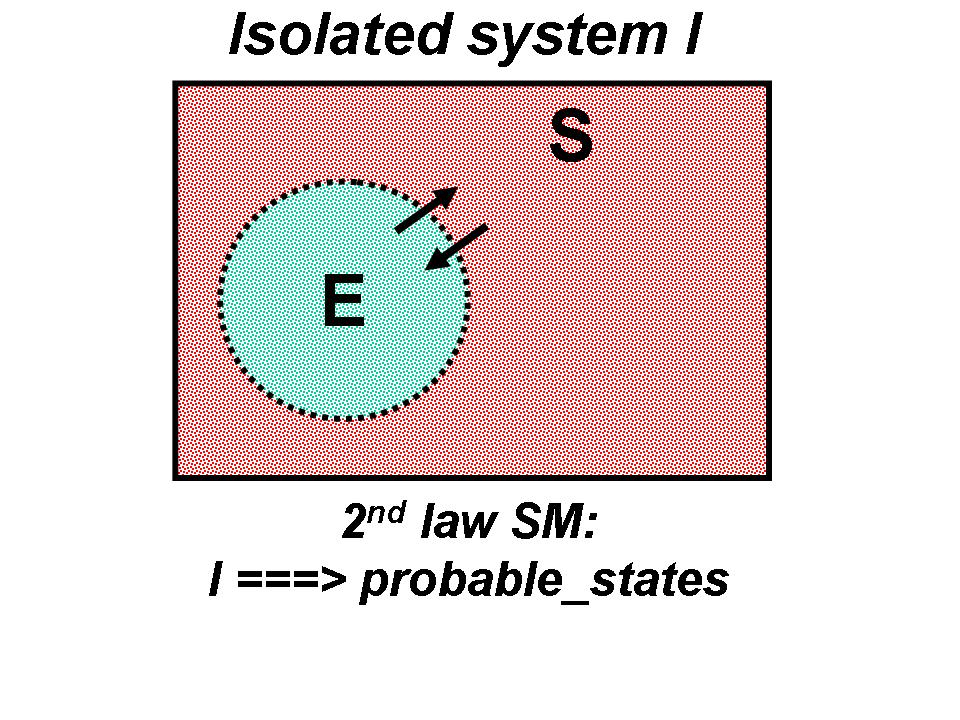
The 2nd_law_SM says that a isolated system goes toward its more probable macrostates. In this diagram the arrow represents the 2nd_law_SM rightward trend/direction:

organization … improbable_states … systems ====>>> probable_states

Sewell says:

“The second law is all about using probability at the microscopic level to predict macroscopic change. […] This statement of the second law, or at least of the fundamental principle behind the second law, is the one that should be applied to evolution.”

The physical evolution of a isolated system passes spontaneously through macrostates with increasing values of probability until arriving to equilibrium (the most probable macrostate). Since organization is highly improbable a corollary of the 2nd_law_SM is that isolated systems don’t self-organize. That is the opposite of what biological evolution pretends.

See the picture:
cs1

Styer’s ECA.

Since the 2nd_law_SM applies to isolated systems the ECA says: the Earth E is not a isolated system, then its entropy can decrease thanks to an entropy increase (compensation) in the surroundings S (wrt to the energy coming from the Sun). Unfortunately to consider open the systems is useless, because, as Sewell puts it:

“If an increase in order is extremely improbable when a system is closed, it is still extremely improbable when the system is open, unless something is entering which makes it not extremely improbable.”

Here is how Styer applies the ECA to show that “evolution is consistent with the 2nd law”.
Suppose that, due to evolution, each individual organism is 1000 times more improbable that the corresponding individual was 100 years ago (Emory Bunn says 1000 times is incorrect, it should be 10^25 times, but this is a detail). If Wi is the number of microstates consistent with the specification of an initial organism I 100 years ago, and Wf is the number of microstates consistent with the specification of today’s improved and less probable organism F, then

Wf = Wi / 1000

At this point he uses Boltzmann’s formula:

S = k * ln (W)

where S = entropy, W = number of microstates, k = 1.38 x 10^-23 joules/degrees, ln = logarithm.

Then he calculates the entropy change over 100 years, and finally the entropy decrease per second:

Sf – Si = -3.02 x 10^-30 joules/degrees

By considering all individuals of all species he gets the change in entropy of the biosphere each second: -302 joules/degrees. Since he knows that the Earth’s physical entropy throughput (due to energy from the Sun) each second is: 420 x 10^12 joules/degrees he concludes: “at a minimum the Earth is bathed in about one trillion times the amount of entropy flux required to support the rate of evolution assumed here”, then evolution is largely consistent with the 2nd law.

The problem in Styer’s argument (and in general in the ECA).

Although it could seem an innocent issue of measure units the introduction of the Boltzmann’s formula with k = 1.38 x 10^-23 joules/degrees in this context is a conceptual error. With such formula the ECA has transformed a difficult problem of probability (in connection with the arise of ultra-complex organized systems) into a simple issue of energy (“joule” is unit of energy, work, or amount of heat). This assumes a priori that energy is able to organize organisms from sparse atoms. But such assumption is totally gratuitous and unproved. That energy can do that is exactly what the ECA should prove in the first place. So Styer’s ECA begs the question.

Similarly Andy McIntosh (cited by Sewell) says:

Both Styer and Bunn calculate by slightly different routes a statistical upper bound on the total entropy reduction necessary to ‘achieve’ life on earth. This is then compared to the total entropy received by the Earth for a given period of time. However, all these authors are making the same assumption—viz. that all one needs is sufficient energy flow into a [non-isolated] system and this will be the means of increasing the probability of life developing in complexity and new machinery evolving. But as stated earlier this begs the question…

The Boltzmann’s formula in the ECA, with its introduction of joules of energy, establishes a bridge between probabilities and the joules coming from the Sun. Unfortunately this link is unsubstantiated here because no one has proved that joules cause biological organization. On the contrary, in my previous post “The illusion of organizing energy” I explained why any kind of energy per se cannot create organization in principle. To greater reason, thermal energy is unable to the task. In fact, heat is the more degraded and disordered kind of energy, the one with maximum entropy. So the ECA would contain also an internal contradiction: by importing entropy in E one decreases entropy in E!

The problem of Boltzmann’s formula, as used in the ECA, is then “to buy” probability bonus with energy “money”. Sewell expresses the same concept with different words:

The compensation argument is predicated on the idea […] that the universal currency for entropy is thermal entropy.

That conversion / compensation is not allowed if one hasn’t proved at the outset a direct causation role of energy in producing the effect, biological organization, which is in the opposite direction of the 2nd_law_SM rightward arrow (extreme left on the above diagram). In a sense the ECA conflates two different planes. This wrong conflation is like to say that a roulette placed inside a refrigerated room can easily output 1 million “black” in a row because its entropy is decreased compared to the outside.

Note that evolution doesn’t imply a single small deviation from the trend, quite differently it implies countless highly improbable processes happened continually in countless organisms during billion years. Who claims that evolution doesn’t violate the 2nd_law_SM, would doubt a violation if countless tornados always turned rubble into houses, cars and computers for billion years? Sewell asks (backward tornado is the metaphor he uses more). In conclusion Roger Caillois is right: “Clausius and Darwin cannot both be right.”

Implausibility of evolution.

Styer’s paper is also an opportunity to see the problem of evolution from a probabilistic viewpoint. You will note the huge difference of difficulty of the probabilistic scenario compared to the above enthusiastic thermal entropy scenario, with potentially 1,000,000,000,000 times evolution!
In Appendix #2 he proposes a problem for students: “How much improved and less probable would each organism be, relative to its (possibly single-celled) ancestor at the beginning of the Cambrian explosion? (Answer: 10 raised to the 1.8 x 10^22 times)”. Call this monster number “a”, Wi = the initial microstates, Wf = the final microstates, W = the total microstates. According to Styer’s answer (which is correct as calculation) we have:

Wf = Wi / a

The probability of the initial macrostate is Wi / W. The probability of the final macrostate is Wf / W. Suppose Wf = 1, then Wi is = a. W must be equal or greater a otherwise (Wi / W) would be greater than 1 (impossible). Therefore the probability to occur of the final macrostate is:

(Wf / W) equal or less (1 / a)

This is the probability of evolution of a single individual organism in the Cambrian:

1 on 10 raised to the 1.8 x 10^22

a number with more than 10^22 digits (10 trillion billion digits). This miraculous event had to occur 10^18 times, for each of other organisms.

Dembski’s “universal probability bound” is:

1 / 10^150

1 on a number with “only” 150 digits. Therefore evolution is far beyond the plausibility threshold. In conclusion: the ECA fails to prove that “evolution is consistent with the 2nd law”, and we have also a proof of the implausibility of evolution based on probability.

Some could object: “you cannot have both ways, if the ECA is wrong then Appendix #2 is wrong too, because it uses the same method, then the evolution probability is not correct”.
Answer: the method is biased toward evolution both in ECA and in Appendix #2. This means the evolution probability is even worse than that, and the implausibility of evolution holds to greater reason.

Comments
KS, Yes. A nice new book by David L. Abel about the foremost problem of the origin of life research: http://goo.gl/YDfcbo Clear, informal and down to earth.EugeneS
March 31, 2015
March
03
Mar
31
31
2015
07:48 AM
7
07
48
AM
PST
Zachriel: Evolution doesn’t target anything specific, but specific things evolve. EugeneS: That is an interesting sci-fi story. A simple example, provided above, is the evolution of an aerobic citrate transport system in Lenski's E. coli long-term evolution experiment. The mutations involved can be shown to be random with respect to the given function, and the specific pathway was contingent on potentiating mutations. An even simpler example is a single point mutation, not targeted, but very specific.Zachriel
March 31, 2015
March
03
Mar
31
31
2015
07:46 AM
7
07
46
AM
PST
EugeneS: Yes, books are just collections of sheets of compressed cellulose pulp [(C6H10O5)n], with haphazard blots of typographic ink on them. And that is a perfectly valid description! Nobody cares, of course, that it misses the whole point about whether they are intelligently produced. The blots are not haphazard, and books are certainly intelligently produced. The production, however, no matter how clever the craftsman, has to conform to the 2nd law of thermodynamics.Zachriel
March 31, 2015
March
03
Mar
31
31
2015
07:42 AM
7
07
42
AM
PST
Zachriel "Evolution doesn’t target anything specific, but specific things evolve." I can see you firmly believe in this but all that counts is evidence.EugeneS
March 31, 2015
March
03
Mar
31
31
2015
07:41 AM
7
07
41
AM
PST
Box,
In every post you harp on the fact that it [design] isn’t included [in description of thermodynamic macrostates] as if we are not aware of that fact. Please be so kind to assume that we know.
So then what's the excuse for continuing to conflate and equivocate non-thermodynamic macrostates with thermodynamic ones? As was done in the very next sentence:
The question is whether the 2nd law’s tendency towards probable macrostates – despite the absence of e.g. Specified Functionality in the definition of macrostate
You wrote:
You seem to be claiming that there is a total disconnect between the 2nd law and organization. Those two have nothing to do with each other so the line of reasoning is illogical. However you cannot prove this.
I don't need to demonstrate a total disconnect, a few counter examples (several already provided) are all that are needed to show it is inappropriate to enlist 2LOT entropy as an argument against evolution of design. Example: the 2LOT entropy of a functioning 747 is millions of times greater than a crumpled junk piece of aluminum foil from a baking pan. Even though universal 2LOT entropy is increasing, how then does increase of 2LOT entropy preclude mindless evolution of design given that I just showed an example where a designed functioning object has MORE 2LOT entropy than a piece of junk? I did the same sort of calculation with a 747 hit by a tornado and showed the tornado REDUCED 2LOT entropy in the 747. If there are many cases (and there are) of 2LOT entropy being inversely correlated with design (such as crumpled junk foil vs. 747s), then it is pointless to enlist universal 2LOT entropy increase as an argument against mindless evolution of design.scordova
March 31, 2015
March
03
Mar
31
31
2015
07:40 AM
7
07
40
AM
PST
Dr Selenski, indeed. And yet, a lot of mass, energy and information flow was passed through constructors to end with the finished product, which is in a tightly defined macro-observable functionally specific state. And the configurational process to get there is not credibly the result of lucky noise and the simple binding of ink to paper or the like. Where, the statistical underpinnings that for 100+ years have been tied closely, inextricably, to 2LOT, highlight why that is so. Where, the generality involved extends to the origin and body plan level diversification of cell based life. Mere irrelevant flows do not explain configurational work beyond reasonable threshold of resulting functionally specific, complex organisation and associated information. But, oh, how hard it is for so many to see that. KFkairosfocus
March 31, 2015
March
03
Mar
31
31
2015
07:39 AM
7
07
39
AM
PST
Yes, books are just collections of sheets of compressed cellulose pulp [(C6H10O5)n], with haphazard blots of typographic ink on them. And that is a perfectly valid description! Nobody cares, of course, that it misses the whole point about whether they are intelligently produced.EugeneS
March 31, 2015
March
03
Mar
31
31
2015
07:24 AM
7
07
24
AM
PST
CJYman: Just because we are not looking specifically for a J/K measurement, doesn’t mean that the violation of the statistically derived concept of entropy for a paramagnetic model, dice model, Einstein solid or my doghouse example earlier in the previous thread would also not prove a violation of 2LOT, since all are founded on the same statistical principles, along with the same definition of entropy — multiplicity — and it is the probability associated with those principles which would be apparently violated. The 2nd law of thermodynamics concerns the flow of energy. In statistical terms, thermodynamic entropy is a measure of available microstates due to thermal fluctuations. CJYman: C. Therefore, a violation of configuration entropy would be a violation of 2LOT. And yet doghouses exist.Zachriel
March 31, 2015
March
03
Mar
31
31
2015
06:34 AM
6
06
34
AM
PST
fifthmonarchyman: Do you agree that evolution is not targeting anything specific? Evolution doesn't target anything specific, but specific things evolve. Those specific things that confer an advantage are more likely to be propagated, but many things evolve and persist that are not necessarily advantageous.Zachriel
March 31, 2015
March
03
Mar
31
31
2015
06:23 AM
6
06
23
AM
PST
fifthmonarchyman: Instead of the decay of just one atom the Cat killing device is dependent on 50 atoms all decaying at precisely the same exact time. Radioactive decay is a stochastic process, so fifty atoms decaying within a given window of time would be feasible, but not "at precisely the same exact time". The hydrocyanic acid will never be released, and the cat will live. However, the entropy of the system will increase due to the radioactive decay, not to mention the metabolism of the cat which will continue to burn its food reserves.Zachriel
March 31, 2015
March
03
Mar
31
31
2015
06:07 AM
6
06
07
AM
PST
Dear Salvador Cordova- If you are going to quote me then quote it all. Do NOT quote me out-of-context as it shows you to be a piss-poor person. Thank you. Now run back to TSZ and tell them I am picking on you too.Joe
March 31, 2015
March
03
Mar
31
31
2015
04:24 AM
4
04
24
AM
PST
Hey scordova, Could you briefly address my variation of Schroedinger’s cat thought experiment in 72. Thanks in advance peacefifthmonarchyman
March 31, 2015
March
03
Mar
31
31
2015
04:19 AM
4
04
19
AM
PST
franklin:
There is no granting for argument the development of the IC aerobic citrate transport system’s evolution in this bacterial strain since it is a clear result of this experiment with the evolutionary pathway clearly delineated.
It isn't IC and no one can say if blind and undirected processes produced it.Joe
March 31, 2015
March
03
Mar
31
31
2015
04:05 AM
4
04
05
AM
PST
Evolutionists don't have anything anyway so who cares about the 2LoT?Joe
March 31, 2015
March
03
Mar
31
31
2015
04:04 AM
4
04
04
AM
PST
Scordova: However, the word MACRO-state in thermodynamics is defined by: Energy, Temperature, Number of Particles, Pressure, Volume.
If ‘Specified Functionality’ is on that list we would not be having this discussion. In every post you harp on the fact that it isn’t included as if we are not aware of that fact. Please be so kind to assume that we know. The question is whether the 2nd law's tendency towards probable macrostates - despite the absence of e.g. Specified Functionality in the definition of macrostate - nonetheless precludes the formation of spaceships, computers and the internet by purely natural forces. You seem to hold that it does not.
Scordova: Thermodynamic macrostates are not defined by words like computer, spaceship, or other designed objects.
Indeed, otherwise we would not be having this discussion. And yes we know ….
Scordova: It’s like saying, “1+1=2, therefore the sky is blue”. The conclusion may be correct, but the line of reasoning is illogical.
Here is another objection towards your style of critique: this comparison is entirely unfair and so is saying that the line of reasoning is illogical. It is simply not true. You seem to be claiming that there is a total disconnect between the 2nd law and organization. Those two have nothing to do with each other so the line of reasoning is illogical. However you cannot prove this. You would only do so if you were able to show that the most probable macrostate – in thermodynamic terms – can result in organization (spaceship, computer, internet or an organism).
Scordova: I didn’t say ordinary (natural if you will) spontaneously create computers and space ships.
Scordova: If anything energy spontaneously organizes itself into the most probable macrostate, namely the macrostate with maximum multiplicity.
The question remains: “can a spontaneous macrostate with maximum multiplicity ever be a computer or a space ship?” Some of us hold that the answer to that question is a resound “NO”. And if that answer is correct what does that tell us about the relationship between the 2nd law and organization?Box
March 31, 2015
March
03
Mar
31
31
2015
04:03 AM
4
04
03
AM
PST
franklin says Lenski’s data clearly show ‘something specific’ that was not especially likely did arise from a process that was not targeting the observed result I say Evolution did not make that specific result more likely. Another result would have been just as likely. That is the point Evolution could care less whether this particular aerobic citrate transport system is Irreducibly Complex or not. This is an important point because in nature we see lots of highly specified events with low entropy that are not particularly related to environmental adaptation. Evolution can not be the explanation for these events. Curly Howard says, evolution makes specific things more likely and other things less likely. I say, What???? Are you saying that evolution makes non specific things less likely?? Curly Howard says, This is due to the fact that the possible evolution of “specific” things is dependent on what already exists in the species. I can say, quite certainly, that whales will never evolve gills. I say, That is a statement of the limits of evolution not of it's strengths. You apparently are saying highly specified low entropy events are even less likely if they don't follow an expected sequence. That is bad news for your side check this out https://www.quantamagazine.org/20150325-did-neurons-evolve-twice/ Given that sponges have thrived in their environment for millions of years with out them do you think evolution makes the arrival of neurons (twice) a likely event? Peacefifthmonarchyman
March 31, 2015
March
03
Mar
31
31
2015
04:02 AM
4
04
02
AM
PST
Evolutionists laugh.
Hasn't it ever occurred to you that the laugh may be deserved, and that you would profit from listening to people from your own camp who understand thermodynamics better? If you adopt this warrior mentality (Close the ranks! No dispute! We've got a battle to win first!), you'll just dig your hole deeper -- much to the amusement of passing "evolutionists".Piotr
March 31, 2015
March
03
Mar
31
31
2015
03:44 AM
3
03
44
AM
PST
scordova
I suggest IDists stop trying to defend ID with 2LOT, the more appropriate law would be something like LLN (which is at the heart of 2LOT anyway).
An absurd suggestion, it would help only your evolutionists friends. Your next affirmation is incoherent. If "at the heart of 2LOT" there is an ID argument, one doesn't understand why "IDists should stop trying to defend ID with 2LOT". In my previous post "The illusion of organizing energy" I had begun with simple words to defend Granville Sewell's ID argument from the 2nd_law_SM, by pointing out that energy cannot organize. Intelligent IDers offered valuable contributions. Evolutionists were without reasonable counter-arguments. In my actual post with simple words I had continued the defense, by refuting Styer's evolutionist "compensation argument" and also finding in his very paper calculations that clearly show the implausibility of evolution. In both posts I never used the terms entropy, order, disorder. Intelligent IDers offered valuable contributions. Evolutionists were without reasonable counter-arguments. At this point you come in and begin to attack me and the above IDers (and, last but not least, indirectly also Sewell). You accuse us of "bad science", "using vague phrases", confusion about entropy, order, disorder, "using kindergaden type distorted versions of the 2nd law", "hurting the ID movement"... Evolutionists laugh. What to say. Only one thing. If in the ID army the "friend-fire" is at this level, it is unlikely this army will win the war.niwrad
March 31, 2015
March
03
Mar
31
31
2015
03:20 AM
3
03
20
AM
PST
Curly Cue:
The most important thing evolution does is target better adaptation to the environment in species.
Only intelligent design evolution can target. Unguided evolution doesn't target anything. You are obviously an ignorant troll.Joe
March 31, 2015
March
03
Mar
31
31
2015
03:14 AM
3
03
14
AM
PST
not specifically calculating for J/K.
J/K can be converted to bits with this conversion factor: 1 Joule/Kelvin = 1 / (1.381 x 10^-23) / ln (2) Shannon Bits = 1.045 x 10^23 Shannon Bits But that does not mean any old Shannon bits can be reverse converted back to J/K! If one isn't dealing with thermodynamic microstates, this reverse conversion would be inappropriate. https://uncommondescent.com/physics/gordon-davissons-talk-origins-post-of-the-month-october-2000/
1. 2LOT deals with the irreversibility of macrostates.
2Lot deals with thermodynamic macrostates not non-thermodynamic macrostates. A example of a functional non-thermodynamic macrostate is being "alive" or "dead" biologically speaking. 2LOT entropy doesn't have much to say about this, further the non-thermodynamic microstates that realize non-thermodynamic macrostates is not covered by 2LOT nor should it be. Of course statistics can be thrown at these sort of non-thermodynamic states, but that doesn't justify throwing 2LOT at it because 2LOT is concerned with thermodynamic energy (or position/momenetum) microstates and the resulting macrostates.
2. Entropy can be defined, statistically, in terms of multiplicity of macrostates. 3. Mutiplicity is the number of microstates that possibly make up a given macrostate. 4. Macrostates are defined by properties of a collection of units.
This is most surely acceptable outside of thermodynamics, but not all entropies are covered by 2LOT. LLN (law of large numbers) would be the more general law appropriate for this, not 2LOT. LLN is implicitly at the heart of 2LOT, not the other way around. I laid out an example with the 500 fair coins. There is an entropy derived from the heads/tails configuration. The Shannon entropy is 500 bits, the number of microstates is 2^500, the "around 50% heads" state can be asserted as a macrostate and the associated multiplicity of this macrostate determined by the binomial distribution. However 2LOT governs nothing of the evolution of the heads heads/tails configuration or entropy. It would be totally incorrect to multiply the 500 bits of heads/tails entropy by the reverse conversion factor above and conclude the system had a J/K entropy based on a mere 500 bits! The thermodynamic entropy (as based on 2LOT and 3LOT stanadard molar entropy ) yields totally different numbers because thermodynamic entropy deals with totally different microstates than head/tails configuration. Number of thermodynamic micrsotates if the coins are pure copper at 298K weighing 3.11 grams 2^(8.636 x 10^25) and the thermodynamic entropy is 826.68 J/K or 8.636 x 10^25 bits
I do agree with the above site’s general view on ‘order’ & ‘disorder’ but only because they are discussing the terms as generally (and improperly I will add) applied while not being precisely defined. It seems that a more precise definition of order, pertaining to ‘relative periodicity,’ would solve many if not all the problems discussed and still provide an intuitive and teach-ably useful sense of 2LOT.
I do not share that view as it leads to non-intuitive counter examples. A functioning 747 has millions of times more thermodynamic entropy than a crumpled piece of aluminum foil on a baking pan. Using the idea "entropy is disorder" would make no sense since it would wrongly imply the 747 is more disordered or disorganized than a junk scrap of foil. Finally, from the entropy website:
"Entropy is disorder" is an archaic, misleading definition of entropy dating from the late 19th century before knowledge of molecular behavior, of quantum mechanics and molecular energy levels, or of the Third Law of thermodynamics. It seriously misleads beginning students, partly because "disorder" is a common word, partly because it has no scientific meaning in terms of energy or energy dispersal. Ten examples conclusively demonstrate the inadequacy of "disorder" in general chemistry.
Yet it is exactly this archaic misleading definition of entropy so many IDists appeal to in order to invoke the 2nd law in favor of ID. I note also from that website:
The 36 Science Textbooks That Have Deleted "disorder" From Their Description of the Nature of Entropy (As advocated in the publications of Dr. Frank L. Lambert, Professor Emeritus, Chemistry, Occidental College.)
Ergo, I suggest IDists stop trying to defend ID with 2LOT, the more appropriate law would be something like LLN (which is at the heart of 2LOT anyway). References: Standard Molar Entropy: http://www.presentingscience.com/quantumcasino/tutorial/entropy.html Dimensionless Entropy (in bits): http://en.wikipedia.org/wiki/Boltzmann_constant and derivation of dimensionless entropy http://creationevolutionuniversity.com/forum/viewtopic.php?f=4&t=72 and https://uncommondescent.com/physics/shannon-information-entropy-uncertainty-in-thermodynamics-and-id/scordova
March 30, 2015
March
03
Mar
30
30
2015
10:14 PM
10
10
14
PM
PST
Yes, evolution makes specific things more likely and other things less likely. This is due to the fact that the possible evolution of "specific" things is dependent on what already exists in the species. I can say, quite certainly, that whales will never evolve gills.Curly Howard
March 30, 2015
March
03
Mar
30
30
2015
08:23 PM
8
08
23
PM
PST
Fmm your original claim/question was this:
Do you agree that something specific is not especially likely to result from a process that is not targeting it?
My answer was directed at this and as Lenski's data clearly show 'something specific' that was not especially likely did arise from a process that was not targeting the observed result any more than any of the other observed changes were likely yet were observed to evolve in this species of bacteria during this expt. so...
.Then the experiment and the transport system is irrelevant to the discussion at hand is it not?
is a incorrect statement and the results are directly relevant to the discussion.franklin
March 30, 2015
March
03
Mar
30
30
2015
08:16 PM
8
08
16
PM
PST
Curly Howard says, Basically you are asking me “when species adapt to their environment, can this also produce change in ways that are not related to environmental adaptation?” I say, That is not what I'm asking at all. I'm asking if evolution makes SPECIFIC things not related to environmental adaption more likely. Can't you see the difference? peacefifthmonarchyman
March 30, 2015
March
03
Mar
30
30
2015
08:04 PM
8
08
04
PM
PST
franklin says, Evolution did not target the development of this system nor did it (evolution) target any of the other observed changes that were observed and documented during this experiment. I say, Then the experiment and the transport system is irrelevant to the discussion at hand is it not? Evolution may or may not produce all kinds of nifty things but it does not render likely the production of anything specific? Just as I said peacefifthmonarchyman
March 30, 2015
March
03
Mar
30
30
2015
07:56 PM
7
07
56
PM
PST
Well fifth, I don't think your question is worded very well. We can get rid of "particular specific things like the origin of species and complex structures" And not lose anything important. Now we have "Do you think that targeting better adaptation to the environment in species makes it likely you will produce "things" that are not at all related to better adaptation to the environment? Basically you are asking me "when species adapt to their environment, can this also produce change in ways that are not related to environmental adaptation?" And the answer is a resounding yes. This is due to the fact that there are always trade-offs between traits, not to mention the fact that adaptation to the environment often allows for species to change their behavior to a certain extent which can have significant effects on a vast number of characteristics. It is often forgotten that behavior can adapt just as well.Curly Howard
March 30, 2015
March
03
Mar
30
30
2015
07:54 PM
7
07
54
PM
PST
FMM
Granting this for the sake of argument. Did evolution target this particular system or would any ole aerobic citrate transport system do just as well?
There is no granting for argument the development of the IC aerobic citrate transport system's evolution in this bacterial strain since it is a clear result of this experiment with the evolutionary pathway clearly delineated. But, no, Evolution did not target the development of this system nor did it (evolution) target any of the other observed changes that were observed and documented during this experiment.franklin
March 30, 2015
March
03
Mar
30
30
2015
07:46 PM
7
07
46
PM
PST
I see the confusion with attempting to artificially constrict all entropy discussions into a J/K measurement (and no, I am not j/k) instead of looking at how the general principle of entropy and the probabilities involved can apply the principles of 2LOT -- irreversibility & entropy -- beyond merely J/K measurements. Furthermore, even within configuration entropy, a direct connection must be made to thermodynamics when one considers how energy must be precisely generated, constrained and directed (low configuration entropy macrostate) in order to generate further low configuration entropy states such as the aforementioned doghouse mentioned in the previous 2LOT threads. In this case, we are dealing with thermodynamics (energy flow), micro/macrostates, irreversibility of configuration entropy, and the exact same statistical mathematics even though we may not be dealing specifically with J/K measurements. From http://entropysite.oxy.edu/ : “Overcoming Misconceptions about Configurational Entropy in Condensed Phases”, Evgenuii I. Kozliak, from the Journal of Chemical Education, Vol. 86, pp. 1063-1068, September 2009., pg. 5 The main disconnect between thermodynamics and configuration entropy appears to be in relation to the third law as discussed in the above paper. However, out of the few articles I've read through on the above site, it appears that calculating configuration entropy (through statistics) of a thermodynamic system provides the same measurement, when normalized, as the thermodynamic calculation -- hence statistical thermodynamics. So, apparently there is no significant difference between configuration entropy and thermodynamic entropy when it comes to the direction of entropy and the second law. As an aside, I do agree with the above site's general view on 'order' & 'disorder' but only because they are discussing the terms as generally (and improperly I will add) applied while not being precisely defined. It seems that a more precise definition of order, pertaining to 'relative periodicity,' would solve many if not all the problems discussed and still provide an intuitive and teach-ably useful sense of 2LOT. Now, back to the discussion at hand. Just because we are not looking specifically for a J/K measurement, doesn't mean that the violation of the statistically derived concept of entropy for a paramagnetic model, dice model, Einstein solid or my doghouse example earlier in the previous thread would also not prove a violation of 2LOT, since all are founded on the same statistical principles, along with the same definition of entropy -- multiplicity -- and it is the probability associated with those principles which would be apparently violated. Furthermore, it is the very probability of configuration multiplicity which provides the rationale for how 2LOT 'works.' If the mathematics are apparently 'violated' for configuration entropy, then 2LOT is apparently violated and statistical thermodynamics will either need a complete re-write or it is merely 'statistics,' divorced from thermodynamic considerations . Is there anyone here promoting a re-write of statistical thermodynamics? The difference between purely configuration entropy verses 'J/K entropy' is in the choice of the measured macrostate. Volume, temperature, and pressure are not the only macrostates available for measurement. Functional tolerance is an actual, precise, macrostate that is utilized in the industry within which I work (industrial automation -- automotive to be precise). Once components fall out of tolerance, catastrophic functional failure becomes a likely option. That is one widely utilized example of a practically measurable macrostate that is not specifically calculating for J/K. The statistical measurement of bit macrostates is so useful to the understanding of 2LOT that it is used as a textbook example of the principles of 2LOT (referencing the paramagnetic model, coins, or dice). Of course the textbooks could be teaching a bad habit, but I'm going to need a good reason to believe that especially when the examples rely on the exact same statistical mathematics that provide the foundation for how 2LOT 'works.' As far as I am aware, there is no other overarching law other than 2LOT, which provides a general understanding of the 'directionality of time' while also providing a precise explanation of how it all works through rigorous statistical mathematics that is applicable to macrostates in general. Again, if the mathematics are apparently 'violated' for configuration entropy, then 2LOT is apparently violated and statistical thermodynamics will need a complete re-write. Here follow the points relevant to the original example of a tornado busting through a city block or energy from the sun whipping up a doghouse, laid out as simple and straightforward as possible: 1. 2LOT deals with the irreversibility of macrostates. 2. Entropy can be defined, statistically, in terms of multiplicity of macrostates. 3. Mutiplicity is the number of microstates that possibly make up a given macrostate. 4. Macrostates are defined by properties of a collection of units. If anyone disagrees with any of the preceeding points, please simply lay out your disagreements with references and relevant argument showing how the above can not be true even in principle. I really shouldn't have to ask this, but please leave out all ad hominem -- ie: 'bank robbers [or creationists] also have the same understanding as you so you must be wrong. You obviously believe in BRLOT. neener neener.' Well, maybe those 'bank robbers' are smarter than you ... oh the horror! But of, course we all know that could never happen ... The final syllogism: P1. Configuration multiplicity provides the basis for statistical thermodynamics. P2. Statistical thermodynamics provides the rationale behind why 2LOT exists. P3. If configuration entropy is apparently violated, then statistical thermodynamics is apparently violated. P4. If statistical thermodynamics is apparently violated then 2LOT is apparently violated. C. Therefore, a violation of configuration entropy would be a violation of 2LOT. The whole point from the very beginning of the tornado vs. city block example was that certain macrostates require very specific conditions beyond simply uneven heat transfer for any sort of reversibility and are indeed irreversible even under conditions of mere open system heat flow. Simply put: a compensation factor is required for certain configurational macrostates (Tornado vs. city block or sun vs. doghouse examples) to be reversible and anyone who states otherwise is promoting an apparent violation of the very foundations of the operation of 2LOT. When we finally have that understanding settled, we can carry on with a discussion of what is the required compensation -- mere heat flow in an open system or a prior thermodynamic system of lower configuration entropy or something else?CJYman
March 30, 2015
March
03
Mar
30
30
2015
07:37 PM
7
07
37
PM
PST
franklin said, a IC aerobic citrate transport system arose. I say, Granting this for the sake of argument. Did evolution target this particular system or would any ole aerobic citrate transport system do just as well? Thanks in advance Peacefifthmonarchyman
March 30, 2015
March
03
Mar
30
30
2015
07:28 PM
7
07
28
PM
PST
Curly Howard
The most important thing evolution does is target better adaptation to the environment in species. The adaptations aren’t “perfect” because they are limited by both the alleles already present in a population and the nature of the pre-existing traits and also the fact that there is always trade-offs between traits.
Absolutely! A key example is found in the results from lenski's group long-term E coli experiment where a IC aerobic citrate transport system arose.franklin
March 30, 2015
March
03
Mar
30
30
2015
07:18 PM
7
07
18
PM
PST
Curly Howard says, The most important thing evolution does is target better adaptation to the environment in species. I say, Agreed, Do you think that targeting better adaptation to the environment in species makes it likely you will produce particular specific things like the origin of species and complex structures that are not at all related to better adaptation to the environment? If so why? peacefifthmonarchyman
March 30, 2015
March
03
Mar
30
30
2015
07:08 PM
7
07
08
PM
PST
1 17 18 19 20 21 22

Leave a Reply