Uncommon Descent Serving The Intelligent Design Community

Failure of the “compensation argument” and implausibility of evolution

Categories
Biophysics
Intelligent Design
Share
Facebook
Twitter/X
LinkedIn
Flipboard
Print
Email

Granville Sewell and Daniel Styer have a thing in common: both wrote an article with the same title “Entropy and evolution”. But they reach opposite conclusions on a fundamental question: Styer says that the evolutionist “compensation argument” (henceforth “ECA”) is ok, Sewell says it isn’t. Here I briefly explain why I fully agree with Granville. The ECA is an argument that tries to resolve the problems the 2nd law of statistical mechanics (henceforth 2nd_law_SM) posits to unguided evolution. I adopt Styer’s article as ECA archetype because he also offers calculations, which make clearer its failure.

The 2nd_law_SM as problem for evolution.

The 2nd_law_SM says that a isolated system goes toward its more probable macrostates. In this diagram the arrow represents the 2nd_law_SM rightward trend/direction:

organization … improbable_states … systems ====>>> probable_states

Sewell says:

“The second law is all about using probability at the microscopic level to predict macroscopic change. […] This statement of the second law, or at least of the fundamental principle behind the second law, is the one that should be applied to evolution.”

The physical evolution of a isolated system passes spontaneously through macrostates with increasing values of probability until arriving to equilibrium (the most probable macrostate). Since organization is highly improbable a corollary of the 2nd_law_SM is that isolated systems don’t self-organize. That is the opposite of what biological evolution pretends.

See the picture:
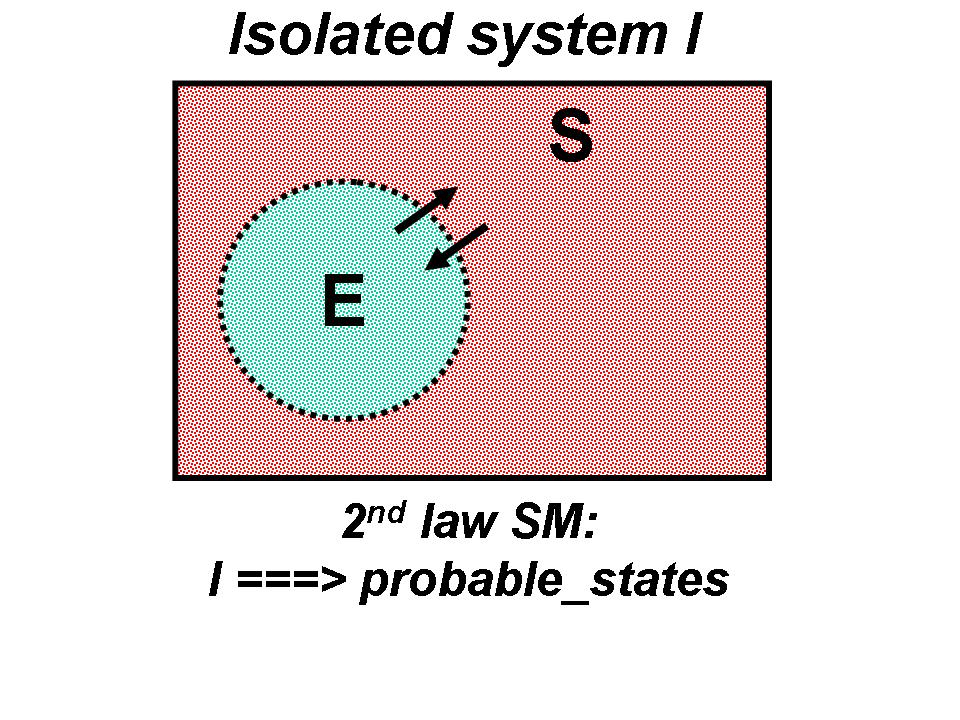
cs1

Styer’s ECA.

Since the 2nd_law_SM applies to isolated systems the ECA says: the Earth E is not a isolated system, then its entropy can decrease thanks to an entropy increase (compensation) in the surroundings S (wrt to the energy coming from the Sun). Unfortunately to consider open the systems is useless, because, as Sewell puts it:

“If an increase in order is extremely improbable when a system is closed, it is still extremely improbable when the system is open, unless something is entering which makes it not extremely improbable.”

Here is how Styer applies the ECA to show that “evolution is consistent with the 2nd law”.
Suppose that, due to evolution, each individual organism is 1000 times more improbable that the corresponding individual was 100 years ago (Emory Bunn says 1000 times is incorrect, it should be 10^25 times, but this is a detail). If Wi is the number of microstates consistent with the specification of an initial organism I 100 years ago, and Wf is the number of microstates consistent with the specification of today’s improved and less probable organism F, then

Wf = Wi / 1000

At this point he uses Boltzmann’s formula:

S = k * ln (W)

where S = entropy, W = number of microstates, k = 1.38 x 10^-23 joules/degrees, ln = logarithm.

Then he calculates the entropy change over 100 years, and finally the entropy decrease per second:

Sf – Si = -3.02 x 10^-30 joules/degrees

By considering all individuals of all species he gets the change in entropy of the biosphere each second: -302 joules/degrees. Since he knows that the Earth’s physical entropy throughput (due to energy from the Sun) each second is: 420 x 10^12 joules/degrees he concludes: “at a minimum the Earth is bathed in about one trillion times the amount of entropy flux required to support the rate of evolution assumed here”, then evolution is largely consistent with the 2nd law.

The problem in Styer’s argument (and in general in the ECA).

Although it could seem an innocent issue of measure units the introduction of the Boltzmann’s formula with k = 1.38 x 10^-23 joules/degrees in this context is a conceptual error. With such formula the ECA has transformed a difficult problem of probability (in connection with the arise of ultra-complex organized systems) into a simple issue of energy (“joule” is unit of energy, work, or amount of heat). This assumes a priori that energy is able to organize organisms from sparse atoms. But such assumption is totally gratuitous and unproved. That energy can do that is exactly what the ECA should prove in the first place. So Styer’s ECA begs the question.

Similarly Andy McIntosh (cited by Sewell) says:

Both Styer and Bunn calculate by slightly different routes a statistical upper bound on the total entropy reduction necessary to ‘achieve’ life on earth. This is then compared to the total entropy received by the Earth for a given period of time. However, all these authors are making the same assumption—viz. that all one needs is sufficient energy flow into a [non-isolated] system and this will be the means of increasing the probability of life developing in complexity and new machinery evolving. But as stated earlier this begs the question…

The Boltzmann’s formula in the ECA, with its introduction of joules of energy, establishes a bridge between probabilities and the joules coming from the Sun. Unfortunately this link is unsubstantiated here because no one has proved that joules cause biological organization. On the contrary, in my previous post “The illusion of organizing energy” I explained why any kind of energy per se cannot create organization in principle. To greater reason, thermal energy is unable to the task. In fact, heat is the more degraded and disordered kind of energy, the one with maximum entropy. So the ECA would contain also an internal contradiction: by importing entropy in E one decreases entropy in E!

The problem of Boltzmann’s formula, as used in the ECA, is then “to buy” probability bonus with energy “money”. Sewell expresses the same concept with different words:

The compensation argument is predicated on the idea […] that the universal currency for entropy is thermal entropy.

That conversion / compensation is not allowed if one hasn’t proved at the outset a direct causation role of energy in producing the effect, biological organization, which is in the opposite direction of the 2nd_law_SM rightward arrow (extreme left on the above diagram). In a sense the ECA conflates two different planes. This wrong conflation is like to say that a roulette placed inside a refrigerated room can easily output 1 million “black” in a row because its entropy is decreased compared to the outside.

Note that evolution doesn’t imply a single small deviation from the trend, quite differently it implies countless highly improbable processes happened continually in countless organisms during billion years. Who claims that evolution doesn’t violate the 2nd_law_SM, would doubt a violation if countless tornados always turned rubble into houses, cars and computers for billion years? Sewell asks (backward tornado is the metaphor he uses more). In conclusion Roger Caillois is right: “Clausius and Darwin cannot both be right.”

Implausibility of evolution.

Styer’s paper is also an opportunity to see the problem of evolution from a probabilistic viewpoint. You will note the huge difference of difficulty of the probabilistic scenario compared to the above enthusiastic thermal entropy scenario, with potentially 1,000,000,000,000 times evolution!
In Appendix #2 he proposes a problem for students: “How much improved and less probable would each organism be, relative to its (possibly single-celled) ancestor at the beginning of the Cambrian explosion? (Answer: 10 raised to the 1.8 x 10^22 times)”. Call this monster number “a”, Wi = the initial microstates, Wf = the final microstates, W = the total microstates. According to Styer’s answer (which is correct as calculation) we have:

Wf = Wi / a

The probability of the initial macrostate is Wi / W. The probability of the final macrostate is Wf / W. Suppose Wf = 1, then Wi is = a. W must be equal or greater a otherwise (Wi / W) would be greater than 1 (impossible). Therefore the probability to occur of the final macrostate is:

(Wf / W) equal or less (1 / a)

This is the probability of evolution of a single individual organism in the Cambrian:

1 on 10 raised to the 1.8 x 10^22

a number with more than 10^22 digits (10 trillion billion digits). This miraculous event had to occur 10^18 times, for each of other organisms.

Dembski’s “universal probability bound” is:

1 / 10^150

1 on a number with “only” 150 digits. Therefore evolution is far beyond the plausibility threshold. In conclusion: the ECA fails to prove that “evolution is consistent with the 2nd law”, and we have also a proof of the implausibility of evolution based on probability.

Some could object: “you cannot have both ways, if the ECA is wrong then Appendix #2 is wrong too, because it uses the same method, then the evolution probability is not correct”.
Answer: the method is biased toward evolution both in ECA and in Appendix #2. This means the evolution probability is even worse than that, and the implausibility of evolution holds to greater reason.

Comments
The most important thing evolution does is target better adaptation to the environment in species. The adaptations aren't "perfect" because they are limited by both the alleles already present in a population and the nature of the pre-existing traits and also the fact that there is always trade-offs between traits.Curly Howard
March 30, 2015
March
03
Mar
30
30
2015
06:45 PM
6
06
45
PM
PST
Curly Howard. Statements like this may work here at UD, where biological knowledge approaches zero, but anyone who actually understands the basics of evolution would laugh at what you have said. I say, I'm sure lots of folks at UD would laugh at what I said as well ;-) Do you agree that evolution is not targeting anything specific? Do you agree that something specific is not especially likely to result from a process that is not targeting it? If not please explain why? peacefifthmonarchyman
March 30, 2015
March
03
Mar
30
30
2015
06:24 PM
6
06
24
PM
PST
"It’s no different than claiming that a particular intricate statue is the result of wind action." Statements like this may work here at UD, where biological knowledge approaches zero, but anyone who actually understands the basics of evolution would laugh at what you have said.Curly Howard
March 30, 2015
March
03
Mar
30
30
2015
05:58 PM
5
05
58
PM
PST
We do not see computers, spaceships and libraries self-organize by natural forces. The truth of the statement – organization is a highly improbable macrostate – is obvious to anyone; even to those who deny it.
I didn't say ordinary (natural if you will) spontaneously create computers and space ships. However, the word MACRO-state in thermodynamics is defined by: Energy, Temperature, Number of Particles, Pressure, Volume. Thermodynamic macrostates are not defined by words like computer, spaceship, or other designed objects. Sure, one can define designed macrostate in terms of designed objects, but that would have nothing or little to do with the terminology associated with the 2nd law thermodynamics. I'll tell you how illogical some of these discussions sound to me. It's like someone saying, "Newton's 2nd law of motion shows naturalistic evolution is false". It just doesn't make sense. I believe in Newton's 2nd law for its appropriated domain (low speed relative to lightspeed), I disbelieve in naturalistic evolution, but I'd never say: "Newton's 2nd law of motion shows naturalistic evolution is false". In like manner, I wouldn't say: "The 2nd law of thermodynamics demonstrates naturalistic evolution is false". I'd say that it is the right conclusion ("naturalistic evolution is false"), but a wrong, non-sequitur inference. It's like saying, "1+1=2, therefore the sky is blue". The conclusion may be correct, but the line of reasoning is illogical.scordova
March 30, 2015
March
03
Mar
30
30
2015
05:55 PM
5
05
55
PM
PST
All, Maybe instead of thinking about coins it might be better to think of a variation of Schroedinger's cat thought experiment. Instead of the decay of just one atom the Cat killing device is dependent on 50 atoms all decaying at precisely the same exact time. We lift the box and the amazingly we find that the cat is dead. Did the mechanism at the exact time of the triggering have more or less entropy than it did one picosecond earlier? Thanks in advance peacefifthmonarchyman
March 30, 2015
March
03
Mar
30
30
2015
05:31 PM
5
05
31
PM
PST
Scordova:
2. organization is a highly improbable macrostate
Not in traditional physics textbooks where organization is so vaguely defined. If I defined organization to allow highly probable macrostates, then I could just as well say organization is a highly probable macrostate!
Common sense informs us that this is not a serious objection. We do not see computers, spaceships and libraries self-organize by natural forces. The truth of the statement - organization is a highly improbable macrostate - is obvious to anyone; even to those who deny it. It seems to be your main objection to the argument, but I'm not convinced that you have point here.Box
March 30, 2015
March
03
Mar
30
30
2015
05:31 PM
5
05
31
PM
PST
Piotr says. Evolution is not a search for a specific state. I say, Exactly, And that is the problem. Evolution is offered as an explanation of specific (ie highly specified)states like the origin species and complex structures but it is not searching for them. Logically the probability that any one highly specified state is the result of evolution can not be any more than that of random chance. It's no different than claiming that a particular intricate statue is the result of wind action. Natural selection is not a help because you have already conceded that it is not selecting for any specific target. peacefifthmonarchyman
March 30, 2015
March
03
Mar
30
30
2015
05:20 PM
5
05
20
PM
PST
Piotr, what predictions does unguided evolution produce? ID is only inconsistent in the eyes of the willfully ignorant, Piotr. We stand by our testable entailments while you can't even produce any for unguided evolution. You don't even know your place. If your position had something then you wouldn't even need to attack ID. And you can't even demonstrate you understand ID in the first place, so that would be another problem. You sure as heck don't seem to understand what is being debated. The way to stop ID is to support the claims of unguided/ blind watchmaker evolution. Anything less is a coward's way.Joe
March 30, 2015
March
03
Mar
30
30
2015
05:12 PM
5
05
12
PM
PST
There's little to attack or to understand, Joe. ID is amorphous and inconsistent, has no theory and generates no predictions.Piotr
March 30, 2015
March
03
Mar
30
30
2015
04:21 PM
4
04
21
PM
PST
Piotr, you are clueless. There isn't any evidence there that supports unguided evolution. Attacking ID will NEVER be positive evidence for your position. And attacking it without understanding it is just poor. Joe Felsenstein is the master at misrepresenting ID. Anything ID he has a hand in is doomed to failure.Joe
March 30, 2015
March
03
Mar
30
30
2015
04:14 PM
4
04
14
PM
PST
Just the other day, on Panda's Thumb... Fitness surfaces and searches: Dembski, Ewert, and Marks’s search for designPiotr
March 30, 2015
March
03
Mar
30
30
2015
04:08 PM
4
04
08
PM
PST
kairosfocus: And so the issue of getting to shores of islands of function where in nice cases gradients can lead in happy directions, is the dominant problem. That's an empirical question, not a mathematical one, meaning strictly logical arguments are insufficient to resolve the question.Zachriel
March 30, 2015
March
03
Mar
30
30
2015
03:38 PM
3
03
38
PM
PST
Box, Hope this helps.
1. 2nd_law_SM states that isolated systems tend to the most probable macrostate.
You won't find 2nd_law_SM in text books. It's the 2nd law of thermodynamics. The 2nd law can be derived from equilibrium statistical mechanics under some constraints, it hasn't been satisfactorily derived form non-equilibrium statistical mechanics though most physicist conjecture it should be.
isolated systems tend to the most probable macrostate.
That is correct as far as thermodynamics. But it should not be applied to the question of ID except with extreme care, which I'm not seeing being done.
2. organization is a highly improbable macrostate
Not in traditional physics textbooks where organization is so vaguely defined. If I defined organization to allow highly probable macrostates, then I could just as well say organization is a highly probable macrostate! It is more correct to say, "design is a highly improbable organization of parts". Invoking themodynamic terms like macrostate to the ID argument can lead to equivocation. See: http://en.wikipedia.org/wiki/Equivocation Designs are framed in terms of the organization of parts of a system (like the protein translation machines in cells), not the organization of energy in terms of thermodynamic micrsotates that realize thermodynamic macrostates. I tried to show calculations to demonstrate how organization of energy in thermodynamic microstates are different than the organization of parts of a design with the 500 fair coins example. When the 500 copper coins are at 298 Kelvin, the system is in the following macrostate: MACROSTATE: 500 copper coins weighing 3.11 grams at 298 K. That's it, that is the macrostate, there is no further statement about the macrostate that is really necessary! Given that macrostate, the energy distribution can be realized by: 2^(8.636 x 10^25) microstates Just like the macrostate of 2 dice being 7 is realized by 6 microstates, http://hyperphysics.phy-astr.gsu.edu/hbase/therm/entrop2.html a system of 500 copper coins at 298 Kelvin at equilibrium is in in a macrostate realized by 2^(8.636 x 10^25) thermodynamic microstates. Btw, a thermodynamic macrostate is usually defined by the following variables: N = number of particles E = internal energy T = temperature P = pressure (if applicable) V = volume (if applicable)
Classical thermodynamics describes macroscopic systems in terms of a few variables (functions of state): temperature, pressure, volume...
http://theory.physics.manchester.ac.uk/~judith/stat_therm/node55.html NOWHERE does it define macrostate in terms of design type configurations (flagellum is composed of stator, rotor, gear, etc.). What is happening is some IDists are equivocating and conflating thermodynamic macrostates with design organization. That is scientifically wrong. The 500 fair coins example and the associated calculations tried to bring that point home. One could do the same with motors or 747 and see that design organization has nothing or little to do with thermodynamic macrostates. I gave an example showing a working 747 having HIGHER thermodynamic entropy than one that got hit by a tornado! See: https://uncommondescent.com/computer-science/a-designed-objects-entropy-must-increase-for-its-design-complexity-to-increase-part-2/
3. compensation argument is invalid.
It's moot whether right or wrong since the 2nd law doesn't really apply to the organization of designs. Besides, I showed cases where it's desirable to thermodynamic INCREASE entropy to make a complex design, not reduce it (i.e. high entropy warm living humans vs. low entropy lifeless ice cubes). PS If you want to see examples of how microstates are counted and can be inferred from macrostates (defined by N and E) see my "homework" answers to Professor Elzinga: http://www.creationevolutionuniversity.org/public_blogs/skepticalzone/2nd_law_sewell/basic_statistical_mechanics_v1_c.doc and http://www.creationevolutionuniversity.org/public_blogs/skepticalzone/2nd_law_sewell/purcell_and_pound_v1.doc If you really want to see some other ways thermodynamic microstates are counted for given thermodynamic macrostate, see: http://en.wikipedia.org/wiki/Grand_canonical_ensemble or http://en.wikipedia.org/wiki/Liouville's_theorem_(Hamiltonian) YIKES!scordova
March 30, 2015
March
03
Mar
30
30
2015
03:31 PM
3
03
31
PM
PST
SalC: I draw attention to 16 above: https://uncommondescent.com/intelligent-design/failure-of-the-compensation-argument-and-implausibility-of-evolution/#comment-556746 I do not have time for an exchange, but believe some balance i/l/o the informational school of thought is relevant. As is the fact that for 100+ years, 2LOT has been inextricably linked to statistical underpinnings. As s is a state func, with path independence, there is no problem with partitioning a component to a baseline and addressing it. Here, scattered vs clumped vs functionally organised states. To move from one to the next more and more sharply constrains number of possibilities consistent with the macro-picture, and in particular the scarcity of complex functionally specific, organised state-clusters readily explains why such are not to be reasonably sought on blind forces. Relevant energy flows, mass flows, information flows and constructors are the empirically warranted cluster that achieves FSCO/I. The statistical analysis undergirds why and shows why an irrelevant flow is not going to reasonably account for FSCO/I per alleged "compensation." Sewell has a serious point. KFkairosfocus
March 30, 2015
March
03
Mar
30
30
2015
03:26 PM
3
03
26
PM
PST
Piotr et al: Let's see what Dembski actually wrote in NFL: >> p. 148:“The great myth of contemporary evolutionary biology is that the information needed to explain complex biological structures can be purchased without intelligence. My aim throughout this book is to dispel that myth . . . . Eigen and his colleagues must have something else in mind besides information simpliciter when they describe the origin of information as the central problem of biology. I submit that what they have in mind is specified complexity [[cf. here below], or what equivalently we have been calling in this Chapter Complex Specified information or CSI . . . . Biological specification always refers to function. An organism is a functional system comprising many functional subsystems. . . . In virtue of their function [[a living organism's subsystems] embody patterns that are objectively given and can be identified independently of the systems that embody them. Hence these systems are specified in the sense required by the complexity-specificity criterion . . . the specification can be cashed out in any number of ways [[through observing the requisites of functional organisation within the cell, or in organs and tissues or at the level of the organism as a whole. Dembski cites: Wouters, p. 148: "globally in terms of the viability of whole organisms," Behe, p. 148: "minimal function of biochemical systems," Dawkins, pp. 148 - 9: "Complicated things have some quality, specifiable in advance, that is highly unlikely to have been acquired by ran-| dom chance alone. In the case of living things, the quality that is specified in advance is . . . the ability to propagate genes in reproduction." On p. 149, he roughly cites Orgel's famous remark from 1973, which exactly cited reads: In brief, living organisms are distinguished by their specified complexity. Crystals are usually taken as the prototypes of simple well-specified structures, because they consist of a very large number of identical molecules packed together in a uniform way. Lumps of granite or random mixtures of polymers are examples of structures that are complex but not specified. The crystals fail to qualify as living because they lack complexity; the mixtures of polymers fail to qualify because they lack specificity . . . And, p. 149, he highlights Paul Davis in The Fifth Miracle: "Living organisms are mysterious not for their complexity per se, but for their tightly specified complexity."] . . .” p. 144: [[Specified complexity can be more formally defined:]“. . . since a universal probability bound of 1 [[chance] in 10^150 corresponds to a universal complexity bound of 500 bits of information, [[the cluster] (T, E) constitutes CSI because T [[ effectively the target hot zone in the field of possibilities] subsumes E [[ effectively the observed event from that field], T is detachable from E, and and T measures at least 500 bits of information . . . ” >> Your objection is a misrepresentation. Similarly, under relevant circumstances, the resource shortage for search overwhelms any hoped for golden search. Take 500 coins as a useful model. A search is a subset (chosen at random) from the power set for W = 3.27*10^150 configs. You are hoping for a golden search that somehow overwhelms the first tier blind needle in haystack search challenge. The problem is, search for search (S4S) is a blind sample from the power set. An utterly stiffer challenge. And so the issue of getting to shores of islands of function where in nice cases gradients can lead in happy directions, is the dominant problem. Where also the requisites of correctly coupled and arranged parts to achieve specific function naturally confine us to very narrow zones in the overall space, hence, islands of function. Where the concept of a description language and string thus length of string to specify state, indicates that considerations on bit strings are effectively WLOG. KF PS: Your projection of strawman is also a turnabout, as I started with trivial cases then IMMEDIATELY went on to more complex ones, to illustrate what functionally specific complex organisation and information, FSCO/I, is about.kairosfocus
March 30, 2015
March
03
Mar
30
30
2015
03:12 PM
3
03
12
PM
PST
I haven’t written my posts about the 2nd_law_SM to convince you, because I know you stay on the side of evolutionists. In war I wouldn’t like to have you as kameraden.
No need to take it so personally, I was hoping you'd accept the suggested theoretical improvements to your anti-evolutionary arguments. The evolutionists are usually wrong, but in this case, IDists swearing by the 2nd law arguments are not defending ID from textbook science, and the evolutionists are right to disagree. A case against evolution can be defended by textbook science, but the 2nd law isn't one of the tools to use, LLN and variations of Humpty Dumpty (down to the chemical expectation) is the more solid way. LLN arguments look like 2nd law arguments because the 2nd law is based on LLN type statistical principles, but not the other way around.scordova
March 30, 2015
March
03
Mar
30
30
2015
02:49 PM
2
02
49
PM
PST
@niwrad #57 Hi niwrad, You said:
I haven’t written my posts about the 2nd_law_SM to convince you, because I know you stay on the side of evolutionists. In war I wouldn’t like to have you as kameraden.
I'm not sure what you're trying to say there. Are you trying to suggest that because scordova ultimately agrees with ID he should feel duty-bound to agree with every argument that any ID proponent uses? I've been defending Sewell's papers over at TSZ for the past week or so, not in the sense of arguing that they are definitely correct (I don't feel qualified to ultimately pronounce on that), but simply defending them against endless misrepresentations. I say that so you know I have no strong feelings on the correctness of any argument from the second law (though I tend to think that the statistical/probabilistic principle on which Sewell's arguments are based is sound), so I'm not defending scordova because I necessarily agree with him. I just don't agree with what I take to be your claim that ID proponents should simply maintain a unified front at the possible expense of their own intellectual honesty. Is that really the kind of message you want to send? But then, perhaps I misread you. HeKSHeKS
March 30, 2015
March
03
Mar
30
30
2015
02:37 PM
2
02
37
PM
PST
Scordova,
Scordova: If anything energy spontaneously organizes itself into the most probable macrostate, namely the macrostate with maximum multiplicity.
How does that differ from what I said in #49 ?:
1. 2nd_law_SM states that isolated systems tend to the most probable macrostate.
I would like you to comment on the other points as well:
2. organization is a highly improbable macrostate. 3. compensation argument is invalid. conclusion: 4. 2nd_law_SM “states” that processes spontaneously go in the opposite direction of organization.
Where do things go wrong in your opinion? [edit:] It may be more accurate to say: the 2nd_law_SM informs us that processes spontaneously go in the opposite direction of organization.Box
March 30, 2015
March
03
Mar
30
30
2015
02:29 PM
2
02
29
PM
PST
niwrad, The issue is the proper way to falsify evolution. We both agree it is false, but imho, the 2nd law doesn't falsify it. I've said the proper way is via LLN or variations of the Humpty Dumpty argument. The 2nd law is stated as follows:
Heat can never pass from a colder to a warmer body without some other change, connected therewith, occurring at the same time
That is Clausius statement. It does not follow from this statement, "evolution can't happen". I'm suggesting we teach the 2nd Law with this definition (Clausius):
Heat can never pass from a colder to a warmer body without some other change, connected therewith, occurring at the same time
Not:
2nd law states that processes spontaneously go in the opposite direction of organization
The 2nd law deals with the organization of thermodynamic energy (or position/momentum) microstates, not the microstates associated with specified complex designs. I illustrated that with the 100% fair coins heads design and its independence from the thermodynamic microstates of 500 fair coins made of copper. Students of engineering, physics, and chemistry should appreciate the significance of the derivations and calculations I provided. If there is an independence of design space microstates from thermodynamic microstates, then the 2nd law should not be applied to design space microstates. What I have provided are textbook answers. It's okay to deviate from textbook answers, but we should be fair to the readers and tell them that this statement isn't the consensus textbook definition of the 2nd law:
2nd law states that processes spontaneously go in the opposite direction of organization
Finally, The one who said, "Clausius and Darwin cannot both be right" was a philosopher who studied games, he wasn't a physicist. http://en.wikipedia.org/wiki/Roger_Cailloisscordova
March 30, 2015
March
03
Mar
30
30
2015
02:20 PM
2
02
20
PM
PST
scordova Your pedagogism with Box is ridiculous, as your I-have-to-protest-what-is-going-on-here directed to me. Suggestion: you could try to expel me from the ID movement.. ah ah I haven't written my posts about the 2nd_law_SM to convince you, because I know you stay on the side of evolutionists. In war I wouldn't like to have you as kameraden.niwrad
March 30, 2015
March
03
Mar
30
30
2015
01:30 PM
1
01
30
PM
PST
I corrected my mistake within 2 minutes – see #49 it says MACROstate – , unfortunately you are very quick. :)
:-)scordova
March 30, 2015
March
03
Mar
30
30
2015
01:22 PM
1
01
22
PM
PST
Box: 2nd_law_SM states that isolated systems tend to the most probable macrostate. What is the probability that a cold, low pressure zone will form in the Earth's atmosphere based on a statistical distribution of microstates?Zachriel
March 30, 2015
March
03
Mar
30
30
2015
01:01 PM
1
01
01
PM
PST
Scordova:
Box: 2nd law states that isolated systems tend to most probable microstate.
It is most probable MACRO-state not microstate.
I corrected my mistake within 2 minutes - see #49 it says MACROstate - , unfortunately you are very quick. :)Box
March 30, 2015
March
03
Mar
30
30
2015
12:51 PM
12
12
51
PM
PST
Box,
2nd law states that isolated systems tend to most probable microstate.
It is most probable MACRO-state not microstate. One of the foundational postulates of statistical mechanics: every microstate is equally probable, that means one is not more probable than another! See: http://en.wikipedia.org/wiki/Ergodic_hypothesis
2nd law states that processes spontaneously go in the opposite direction of organization
The 2nd law does not state that, I provided above the actual statements as framed by Clausius and Kelvin-Plank. If anything energy spontaneously organizes itself into the most probable macrostate, namely the macrostate with maximum multiplicity. See: http://hyperphysics.phy-astr.gsu.edu/hbase/therm/entrop2.html#c1 Finally, I have to protest what is going on here. We're supposed to be teaching good science to the next generation of IDists. Teaching them distorted notions of entropy, the 2nd law, microstate, macrostate, etc. This isn't good. There are better ways to argue ID, using distortions of the 2nd law and 2nd-law entropy concepts is hurting the ID movement. It's not helping. Use the Humpty Dumpty argument and LLN. That will be more fruitful. Using the Order vs. Disorder view of thermodynamics is only a teaching tool, it is slightly wrong: http://hyperphysics.phy-astr.gsu.edu/hbase/therm/entrop.html
Caveats and Objections There are some subtleties in the nature of entropy and other thermodynamic quantities, subtleties that we try to put into word pictures and sketches which sometimes oversimplify. In teaching thermodynamics, I have always tried to keep in mind the words of one of the great physics teachers of the mid-20th century, Mark Zemansky: "Teaching thermal physics is as easy as a song: You think you make it simpler when you make it slightly wrong." The diagrams above have generated a lively discussion, partly because of the use of order vs disorder in the conceptual introduction of entropy. It is typical for physicists to use this kind of introduction because it quickly introduces the concept of multiplicity in a visual, physical way with analogies in our common experience. Chemists, on the other hand, often protest this approach because in chemical applications order vs disorder doesn't communicate the needed ideas on the molecular level and can indeed be misleading. The very fact of differences of opinion on the use of order and disorder can itself be instructive. The top diagram depicts time's arrow as pointing from order to disorder, but one must admit that the apparent tendency to move from order to disorder is not the most fundamental way to look at the top diagram. At ordinary temperatures, the internal energy of a gas would give the molecules high velocities, and it is evident that this orderly arrangement would be very rare because there are only a few ways to do it. If it occurred, it would be for a brief instant and then the molecules would move to some other configuration. The diagram at left depicts a more random or disordered configuration, but the key point is that there is a vast number of ways that such configurations could be achieved. So multiplicity is the key concept - molecular ensembles will spontaneously tend to evolve from configurations of lower multiplicity to configurations of greater multiplicity. The bottom diagram is again a picture with which common experience immediately identifies - there are more ways to create a jumbled pile of bricks than a neatly stacked arrangement. Again, the idea of multiplicity is the key point. Objections to this kind of introduction to entropy come from the fact that the useful applications of entropy are thermodynamic ones and involve nature on the atomic and molecular scale. The ordered bricks vs the jumbled pile may be a useful introductory visualization, but if these two piles of bricks were at the same temperature, then the numerical value of the entropy would be almost identical for the two stacks. If the contributions to entropy involves the multiplicity of the ways that the vast number of molecules in the two stacks of bricks can be arranged, then the fact that the macroscopic orientations of the bricks is different is a negligible contribution to the total entropy. Entropy is a crucial microscopic concept for describing the thermodynamics of systems of molecules, and the assignment of entropy to macroscopic objects like bricks is of no apparent practical value except as an introductory visualization.
IDists don't help their argument using kindergaden type distorted versions of the 2nd law. 500 fair coins sponataneously organize themselves toward the 50% heads macrostate plus or minus a few standard deviations when they are subject to processes that maximize the uncertainty of their state (like shaking and flipping them). The 2nd law also spontaneously organizes systems in terms of energy distributions that have highest multiplicity (entropy). Using vague phrases like this isn't helpful for training the next generation of IDists.
2nd law states that processes spontaneously go in the opposite direction of organization
The heads/tails organization has nothing to do with the 2nd law, and I demonstrated this by showing the 2nd law thermodynamic entropy values of 500 pure copper pennies.scordova
March 30, 2015
March
03
Mar
30
30
2015
12:14 PM
12
12
14
PM
PST
#50 Isolated systems? On this planet, with all these energy cascades? We don't live on an asteroid drifting in interstellar space and frozen to the core.Piotr
March 30, 2015
March
03
Mar
30
30
2015
12:13 PM
12
12
13
PM
PST
Piotr @29, The Universe is finite. So is the amount of time it has existed. The notion of the Universe having existed eternally is as dead as the notion of a flat Earth. So there are finite limits to the number of ways the matter in the Universe might arrange itself given the time it has had to do so. Relative to all the configurations of matter and energy that are possible, only an infinitesimally small fraction of them would create an environment that would allow for self-replicating units of some kind to emerge and for their replication to be sustained such that natural selection could take place. Roger Penrose calculated the odds of the Big Bang producing a universe with low enough entropy to make life even a possibility to be 1 in 10^10^123. In other words, it was virtually impossible for that to have happened mindlessly and accidentally. If such an environment was miraculously arrived at, we then need another miracle: the mindless, accidental assembly of the first of those self-replicating units. How likely is that? Well, for the sake of clarity, let's use as an example something much, much less functionally complex than life. How likely would the mindless, accidental assembly of a computer that could manufacture another computer be? Ultimately, all the elements a computer requires can be derived from naturally occurring substances. The miracle we need is for the laws of physics combined with chance to mindlessly and accidentally configure an environment in which a significantly functionally complex unit of matter and energy (a computer) will be accidentally assembled. Significant functional complexity is required for several reasons, not the least of which is that it must be capable of manufacturing another computer like itself. If it can't do that its fortunate assembly was to no avail; it will eventually disintegrate into the more likely state of the matter from which it emerged. If an environment accidentally coming about in which a computer might accidentally be assembled seems like an absurd notion, that is because it is just that. And since it is just that, the notion that an environment accidentally came about that mindlessly assembled that first single-celled, reproducing life form is even more absurd, as the functional complexity of life is light years beyond that of a computer. If you think that analogy is bogus because the first single-celled reproducing life forms weren't nearly as functionally complex as life is now, you haven't though about it enough. To arrive at a self-replicating unit of any kind you need a way to constructively harness available energy in order to do the work of self-replication, if for no other reason. That alone requires significant functional complexity. If such a self replicating unit “dies” after manufacturing just one unit, the population size of its descendants will never be more than one unit. So you need a way for such a unit to sustain itself, to resist the inexorable tendency of matter to disintegrate into a more likely, less functional state. You need some kind of "metabolism." That alone requires significant functional complexity. If the tendency of matter to disintegrate into a more likely state is not inexorable, if environments that allow for the assembly of self-replicating, self-sustaining units are not extremely unlikely, then why is life the sole example of such units? Why aren't there a plethora of other kinds of self-replicating, self-sustaining units around, like computers capable of manufacturing more computers? If such environments are not all that unlikely, more of them should exist and natural selection should have created many self-replicating, self-sustaining phenomena other than life by now. It hasn't. Life is the sole exception. That is because the probabilistic resources provided by the entire Universe aren't sufficient to mindlessly and accidentally create environments with the precision required to allow for self-replicating, self-sustaining units, or to assemble such units if the required environment were to miraculously come about. The fact that life is digital-information-based is a huge clue atheistic materialists seem to have missed. The accidental assembly and configuration of the required protein machines into a functional unit is well beyond the probabilistic resources the Universe provides. That is why the assembly of such functionally complex units must be directed by digital information. And, other than an intellect, how many sources of massive quantities of digitally stored, precise functional information can you list for me?harry
March 30, 2015
March
03
Mar
30
30
2015
12:13 PM
12
12
13
PM
PST
scordova That "processes spontaneously go in the opposite direction of organization", about which you are so scandalized, is a direct corollary of the fact that isolated systems go toward their more probable states. Do you deny that? And maybe you affirm that textbooks say they go toward their less probable states?niwrad
March 30, 2015
March
03
Mar
30
30
2015
11:54 AM
11
11
54
AM
PST
Scordova & Piotr, In the OP Niwrad explains:
The physical evolution of a isolated system passes spontaneously through macrostates with increasing values of probability until arriving to equilibrium (the most probable macrostate). Since organization is highly improbable a corollary of the 2nd_law_SM is that isolated systems don’t self-organize.
1. 2nd_law_SM states that isolated systems tend to the most probable macrostate. 2. organization is a highly improbable macrostate 3. compensation argument is invalid. conclusion: 4. 2nd_law_SM "states" that processes spontaneously go in the opposite direction of organization.Box
March 30, 2015
March
03
Mar
30
30
2015
11:50 AM
11
11
50
AM
PST
There is a fundamental law of physics — 2nd_law_SM — that says that processes spontaneously go in the opposite direction of organization
That's not in most physics texts or literature except paraphrasing popularization like Asimov (which is wrong). A few textbooks may use the word "disorder" but that is not as accurate a entropy based on microstates or the Clausius inequality.
There is a fundamental law of physics — 2nd_law_SM — that says that processes spontaneously go in the opposite direction of organization
Crystals and snowflakes spontaneously order themselves. The 2nd law doesn't preclude that. This is the statement of the 2nd law: CLAUSIUS
Heat can never pass from a colder to a warmer body without some other change, connected therewith, occurring at the same time
KELVIN-PLANK
It is impossible, by means of inanimate material agency, to derive mechanical effect from any portion of matter by cooling it below the temperature of the coldest of the surrounding objects
There aren't many serious physics books that say:
There is a fundamental law of physics — 2nd_law_SM — that says that processes spontaneously go in the opposite direction of organization
I don't think IDists should attempt to teach that definition to students of chemistry, physics, and engineering. I'd teach them the Clausius and/or Kelvin-Plank formulation. Those formulations are widely viewed as correct, not Asimov's.scordova
March 30, 2015
March
03
Mar
30
30
2015
11:21 AM
11
11
21
AM
PST
Niwrad's formulation of "the second law of statistical mechanics":
processes spontaneously go in the opposite direction of organization
There is no such "fundamental law of physics". Physicists wouldn't use a fuzzy, unquantifiable term like "organisation" to formulate a law, anyway.Piotr
March 30, 2015
March
03
Mar
30
30
2015
11:02 AM
11
11
02
AM
PST
1 18 19 20 21 22

Leave a Reply