Uncommon Descent Serving The Intelligent Design Community

Homologies, differences and information jumps

Categories
Intelligent Design
Share
Facebook
Twitter/X
LinkedIn
Flipboard
Print
Email

In recent posts, I have been discussing some important points about the reasonable meaning of homologies and differences in the proteome in the course of natural history. For the following discussion, just to be clear, I will accept a scenario of Common Descent (as explained in many recent posts) in the context of an ID approach. I will also accept the very reasonable concept that neutral or quasi-neutral random variation happens in time, and that negative (purifying) selection is the main principle which limits random variation in functional sequences.

My main points are the following:

  1. Given those premises, homologies through natural history are certainly an indicator of functional constraints, because they mean that some sequence cannot be significantly transformed by random variation. Another way to express this concept is that variation in a functional sequence with strong functional constraints is not neutral, but negative, and therefore negative selection will in mot cases suppress variation and conserve the functional sequence through time. This is a very important point, because it means that strong homologies through time point to high functional complexity, and therefore to design. I have used this kind of argument, for example, for proteins like the beta chain of ATP synthase (highly conserved from LUCA to humans) and Histone H3 (highly conserved in all eukaryotes).
  2. Differences between homologues, instead, can have two completely different meanings:
  •  2a) They can be the result of accumulating neutral variation in parts of the molecule which are not functionally constrained
  • 2b) They can be the expression of differences in function in different species and contexts

I do believe that both 2a and 2b happen and have an important role in shaping the proteome. 2b, in particular, is often underestimated. It is also, in many cases, a very good argument for ID.

Now, I will try to apply this reasoning to one example. I have chosen a regulatory protein, one which is not really well understood, but which has certainly an important role in epigenetic regulation. The protein is called “Prickle”, and we will consider in particular the one known as “Prickle 1”. It has come to my attention trough an interesting paper linked by Dionisio (to whom go my sincere thanks and appreciation):

Planar polarization of Vangl2 in the vertebrate neural plate is controlled by Wnt and Myosin II signaling

In brief, Prickle is a molecule implied, among other things, in planar polarization events and in the regulation of neural system in vertebrates.

Let’s have a look at the protein. From Wikipedia:

Prickle is part of the non-canonical Wnt signaling pathway that establishes planar cell polarity.[2] A gain or loss of function of Prickle1 causes defects in the convergent extension movements of gastrulation.[3] In epithelial cells, Prickle2 establishes and maintains cell apical/basal polarity.[4] Prickle1 plays an important role in the development of the nervous system by regulating the movement of nerve cells.[5

And:

Mutations in Prickle genes can cause epilepsy in humans by perturbing Prickle function.[12] One mutation in Prickle1 gene can result in Prickle1-Related Progressive Myoclonus Epilepsy-Ataxia Syndrome.[2] This mutation disrupts the interaction between prickle-like 1 and REST, which results in the inability to suppress REST.[2] Gene knockdown of Prickle1 by shRNA or dominant-negative constructs results in decreased axonal and dendritic extension in neurons in the hippocampus.[5] Prickle1 gene knockdown in neonatal retina causes defects in axon terminals of photoreceptors and in inner and outer segments.[5]

The human protein is 831 AAs long.

Its structure is interesting: according to Uniprot, in the first part of the molecule we can recognize 4 domains:

1 PET domain:  AAs 14 – 122

3 LIM zinc-binding doamins:  AAs 124 – 313

In the rest of the sequence (AAs 314 – 831) no known domain is recognized.

Here is the FASTA sequence of the human protein, divided in the two parts (red: 4 domain part; blue: no domain part):

>sp|Q96MT3|PRIC1_HUMAN Prickle-like protein 1 OS=Homo sapiens GN=PRICKLE1 PE=1 SV=2
MPLEMEPKMSKLAFGCQRSSTSDDDSGCALEEYAWVPPGLRPEQIQLYFACLPEEKVPYV
NSPGEKHRIKQLLYQLPPHDNEVRYCQSLSEEEKKELQVFSAQRKKEALGRGTIKLLSRA
VMHAVCEQCGLKINGGEVAVFASRAGPGVCWHPSCFVCFTCNELLVDLIYFYQDGKIHCG
RHHAELLKPRCSACDEIIFADECTEAEGRHWHMKHFCCLECETVLGGQRYIMKDGRPFCC
GCFESLYAEYCETCGEHIGVDHAQMTYDGQHWHATEACFSCAQCKASLLGCPFLPKQGQI
YCSKTCSLGEDVHASDSSDSAFQSARSRDSRRSVRMGKSSRSADQCRQSLLLSPALNYKF
PGLSGNADDTLSRKLDDLSLSRQGTSFASEEFWKGRVEQETPEDPEEWADHEDYMTQLLL
KFGDKSLFQPQPNEMDIRASEHWISDNMVKSKTELKQNNQSLASKKYQSDMYWAQSQDGL
GDSAYGSHPGPASSRRLQELELDHGASGYNHDETQWYEDSLECLSDLKPEQSVRDSMDSL
ALSNITGASVDGENKPRPSLYSLQNFEEMETEDCEKMSNMGTLNSSMLHRSAESLKSLSS
ELCPEKILPEEKPVHLPVLRRSKSQSRPQQVKFSDDVIDNGNYDIEIRQPPMSERTRRRV
YNFEERGSRSHHHRRRRSRKSRSDNALNLVTERKYSPKDRLRLYTPDNYEKFIQNKSARE
IQAYIQNADLYGQYAHATSDYGLQNPGMNRFLGLYGEDDDSWCSSSSSSSDSEEEGYFLG
QPIPQPRPQRFAYYTDDLSSPPSALPTPQFGQRTTKSKKKKGHKGKNCIIS

So, this is a very interesting situation, which is not so rare. We have the first part of the sequence (313 AAs) which configures well known and conserved domains, while “the rest”(517 AAs)  is apparently not understood in terms of structure and function.

So, to better understand what all this could mean, I have blasted those two parts of the human molecule separately.

(Those who are not interested in the technical details, can choose here to go on to the conclusions  🙂 )

The first part of the sequence (AAs 1 – 313) shows no homologies in prokaryotes. So, we are apparently in the presence of domains which appear in eukaryotes.

In fungi, we find some significant, but weak, homologues. The best hit is an expect of 2e-21, with 56 identities and 93 positives (99.4 bits).

Multicellular organisms have definitely stronger homologies:

C. elegans:  144 identities, 186 positives, expect 2e-90 (282 bits)

Drosophila melanogaster:  202 identities, 244 positives, expect 5e-152 (447 bits)

Let’s go to non vertebrate chordates:

Cephalochordata (Branchiostoma floridae):  222 identities, 256 positives, expect 6e-165 (484 bits)

Tunicata (Ciona intestinalis): 196 identities, 241 positives, expect 2e-149 (442 bits)

Now, vertebrates:

Cartilaginous fishes (Callorhincus milii): 266 identities, 290 positives, expect 0.0 (588 bits)

Bony fishes (Lepisosteus oculatus): 274 identities, 292 positives, expect 0.0 (598 bits)

Mammals (Mouse): 309 identities, 312 positives, expect 0.0 (664 bits)

IOWs, what we see here is that the 4 domain part of the molecule, absent in prokaryotes, is already partially observable in single celled eukaryotes, and is strongly recognizable in all multicellular beings. It is interesting that homology with the human form is not very different between drosophila and non vertebrate chordates, while there is a significant increase in vertebrates, and practical identity already in mouse. That is a very common pattern, and IMO it can be explained as a mixed result of different functional constraints and neutral evolution in different time splits.

Now, let’s go to “the rest” of the molecule: AAs 314 – 831 (518 AAs). No recognizable domains here.

What is the behaviour of this sequence in natural history?

Again, let’s start again from the human sequence and blast it.

With Prokaryotes: no homologies

With Fungi: no homologies

C. elegans: no homologies

Drosophila melanogaster: no homologies

Let’s go to non vertebrate chordates:

Cephalochordata (Branchiostoma floridae):  no significant homologies

Tunicata (Ciona intestinalis): no significant homologies

So, there is no significant homology in the whole range of eukaryotes, excluding vertebrates and including chordates which are not vertebrates.

Now, what happens with vertebrates?

Here are the numbers:

Cartilaginous fishes (Callorhincus milii): 350 identities, 429 positives, expect 0.0 (597 bits)

Bony fishes (Lepisosteus oculatus): 396 identities, 446 positives, expect 0.0 (662 bits)

Mammals (Mouse): 466 identities, 491 positives, expect 0.0 (832 bits)

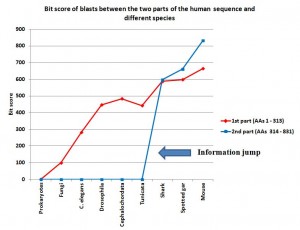
IOWs, what we see here is that the no domain part of the molecule is practically non existent in prokaryotes, in single celled eukaryotes and in all multicellular beings which are not vertebrates. In vertebrates, the sequence is not only present in practically all vertebrates, but it is also extremely conserved, from sharks to humans. So, we have a steep informational jump from non chordates and non vertebrate chordates, where the sequence is practically absent, to the very first vertebrates, where the sequence is already highly specific.

What does that mean from an ID point of view? It’s simple:

a) The sequence of 517 AAs which represents the major part of the human protein must be reasonably considered highly functional, because it is strongly conserved throughout vertebrate evolution. As we have said in the beginning, the only reasonable explanation for high conservation throughout a span of time which must be more than 400 million years long is the presence of strong functional constraints in the sequence.

b) The sequence and its function, whatever it may be (but it is probably an important regulatory function) is highly specific of vertebrates.

We have here a very good example of a part of a protein which practically appears in vertebrates while it is absent before, and which is reasonably highly functional in vertebrates.

So, to sum up:

  1. Prickle 1 is a functional protein which is found in all eukaryotes.
  2. The human sequence can be divided in two parts, with different properties.
  3. The first part, while undergoing evolutionary changes, is rather well conserved in all eukaryotes. Its function can be better understood, because it is made of known domains with known structure.
  4. The second part does not include any known domain or structure, and is practically absent in all eukaryotes except vertebrates.
  5. In vertebrates, it is highly conserved and almost certainly highly functional. Probably as a regulatory epigenetic sequence.
  6. For its properties, this second part, and its functional sequence, are a very reasonable object for a strong design inference.

I have added a graph to show better what is described in the conclusions, in particular the information jump in vertebrates for the second part of the sequence:
Graph3

Note: Thanks to the careful checking of Alicia Cartelli, I have corrected a couple of minor imprecisions in the data and the graph (see posts #83 and #136). Thank you, Alicia, for your commitment. The sense of the post, however, does not change.

Those who are interested in the evolutionary behaviour of protein Prickle 2 could give a look at my posts #127 and #137.

Comments
Mung: "You just don’t have enough imagination." That's why I have not become a famous science fiction writer, which was one of my aims when I was young!gpuccio
February 7, 2016
February
02
Feb
7
07
2016
11:12 AM
11
11
12
AM
PDT
jerry: Thank you for your contribution. Your pet rat was certainly intelligent in some measure, but his walk on the keyboard was not intelligently aimed at erasing your document (at least I hope so! :) ). Similar things happen with my cats, who are certainly very intelligent! OK, the point is: intelligent beings can certainly do non intelligent things (see Alicia Cartelli :) )gpuccio
February 7, 2016
February
02
Feb
7
07
2016
11:08 AM
11
11
08
AM
PDT
RexTugwell: Thank you for expressing so clearly what I think of GaryGaulin's theory.gpuccio
February 7, 2016
February
02
Feb
7
07
2016
11:04 AM
11
11
04
AM
PDT
You have not scientifically explained how “intelligent cause” works
The forces that produced this phrase in an example of how an intelligent cause works. The pressing of the keyboard symbols is an intelligent process. Why a scientific explanation is necessary is beyond me. Intelligence as an explanation for an event is usually where the event cannot be explained as a result of the four basic forces of physics such as the pressing of keyboard symbols to effect a response from some unrelated entity. We once had a pet rat who we let loose on our desk. It proceeded to walk on the keyboard and erased a document we were working on. Now is that intelligent? My guess not. This rat was fairly smart and we taught it to do some fun things.jerry
February 7, 2016
February
02
Feb
7
07
2016
10:42 AM
10
10
42
AM
PDT
GaryGaulin, no one cares about your version of "ID Theory" so please give it a rest.RexTugwell
February 7, 2016
February
02
Feb
7
07
2016
10:30 AM
10
10
30
AM
PDT
gpuccio:
By the way, if I were like Alicia Cartelli I could simply argue that the data form extinct species would definitely support ID theory.
What "ID theory"? You have not scientifically explained how "intelligent cause" works, therefore you do not have an "ID theory".GaryGaulin
February 7, 2016
February
02
Feb
7
07
2016
10:01 AM
10
10
01
AM
PDT
A -> B 600 bits A -> [missing sequence data] -> B 600 bits It's still 600 bits. Also, we're talking about a conserved sequence aren't we? So it's a reasonable inference that if it was present in the "missing intermediates" that it was also conserved there. Certainly more reasonable than ad hoc speculation with no supporting facts. Does Alicia care to at least speculate about the alleged ancestral sequence A and at least one supposed transitional sequence A', or are we just supposed to join her in wishful thinking? gpuccio, you'd never get published in a real science journal. You just don't have enough imagination.Mung
February 7, 2016
February
02
Feb
7
07
2016
09:35 AM
9
09
35
AM
PDT
gpuccio:
The shameful manipulation by Alicia Cartellli (and apparently supported by you) is that, not having any observed data in favor of her theories, she assumes that such data could be found in extinct species if only we had those data available. And then she accuses Mung and me of having an untestable hypothesis (us!), because we base our hypothesis on existing data and not on non existing data, while she bases hers on imagined non existing data, and not on existing data.
You are the one sifting through the mountains of evidence for common descent, for anything that will make all the evidence against you seem to magically vanish.GaryGaulin
February 7, 2016
February
02
Feb
7
07
2016
08:52 AM
8
08
52
AM
PDT
Oh Rexy, UD is just a playground for idiots and I treat it as such. Get over yourselfAlicia Cartelli
February 7, 2016
February
02
Feb
7
07
2016
08:34 AM
8
08
34
AM
PDT
Alicia, your use of cutesy names like pucci and mungy betrays an impotent fury that's just sad to watch. Whatever the reason for your bitterness, you should grow up.RexTugwell
February 7, 2016
February
02
Feb
7
07
2016
08:27 AM
8
08
27
AM
PDT
Ignoring the fact that your experiment doesn't actually test your hypothesis? Another hallmark of "ID science." Good chat pucci.Alicia Cartelli
February 7, 2016
February
02
Feb
7
07
2016
07:43 AM
7
07
43
AM
PDT
Ah, wonderful! Alicia Cartelli has gone back to merely stating platitudes, so I can go back to not discussing with her.gpuccio
February 7, 2016
February
02
Feb
7
07
2016
06:47 AM
6
06
47
AM
PDT
mike1962: Thank you! :)gpuccio
February 7, 2016
February
02
Feb
7
07
2016
06:45 AM
6
06
45
AM
PDT
Yes, let's use sequence data to look at the evolution of a protein, when there is no sequence data from the time that the protein evolved. Flawless logic. I can sleep easy knowing that's what "ID science" amounts to.Alicia Cartelli
February 7, 2016
February
02
Feb
7
07
2016
05:36 AM
5
05
36
AM
PDT
gpuccio, thank you for your good work and patience.mike1962
February 7, 2016
February
02
Feb
7
07
2016
04:42 AM
4
04
42
AM
PDT
Dionisio: An important point which should remain from this discussion, beyond the picturesque distractions provided by some, is that even in the protein coding part of the genome there are many sequences which are probably functional, which are probably regulatory, and which are at present not understood in terms of structure and specific function, and scarcely analyzed in terms of conservation and evolutionary history. Many of these sequences, IMO, could be interpreted in terms of what I have called 2b): functional sequences which can be very different in different sets of organisms, for functional reasons.gpuccio
February 7, 2016
February
02
Feb
7
07
2016
03:14 AM
3
03
14
AM
PDT
Mung: I must really thank you for your contributions and for your company here. Your attitude is very positive, and you really don't deserve the infamous comments made by some here.gpuccio
February 7, 2016
February
02
Feb
7
07
2016
01:45 AM
1
01
45
AM
PDT
Dionisio: I am very satisfied of the discussion, for its contents, if not for its tone. I believe that we must definitely go on bringing the discussion into biology, because ID is a precious tool to look at biological data and try to understand them. Neo darwinists definitely don't like that, and this thread is a good demonstration of this simple fact.gpuccio
February 7, 2016
February
02
Feb
7
07
2016
01:43 AM
1
01
43
AM
PDT
Alicia Cartelli's post #146 obviously does not deserve any comment, but I invite all to read it and to judge for themselves.gpuccio
February 7, 2016
February
02
Feb
7
07
2016
01:13 AM
1
01
13
AM
PDT
GaryGaulin: Mung is very serious and very reasonable. The shameful manipulation by Alicia Cartellli (and apparently supported by you) is that, not having any observed data in favor of her theories, she assumes that such data could be found in extinct species if only we had those data available. And then she accuses Mung and me of having an untestable hypothesis (us!), because we base our hypothesis on existing data and not on non existing data, while she bases hers on imagined non existing data, and not on existing data. A commendable scientific attitude indeed! Do you support that attitude? Please, take your responsibilities. By the way, if I were like Alicia Cartelli I could simply argue that the data form extinct species would definitely support ID theory. Well I do think that, but being serious (at least I hope) I have never made that argument. Why? Because nobody can seriously base his scientific arguments on data which are not available, imagining that those data would support his theory.gpuccio
February 7, 2016
February
02
Feb
7
07
2016
01:10 AM
1
01
10
AM
PDT
gpuccio @139 Definitely I'm interested in the concepts explained in your OP and in your follow-up comments within this discussion thread. The papers you linked @127 are good illustrations of your OP concept 2b) which is fundamental to the important topic discussed here. Please, note that my comments @135 are intended to share the thoughts on that this highly important discussion just scratches the surface of the challenges science faces in the understanding of what's going on in biology. Some folks could believe that this discussion could resolve many remaining issues that hinder our full understanding of the biological complex complexity. That seems very far from reality, to say it nicely. The technical level of this discussion makes it harder for me (and perhaps a few others?) to understand it right away, but your detailed explanations with pertinent links and clear illustrations (plus the scary shark image presiding the OP) makes it easier to digest, assuming we try our best to understand it correctly. I'll be glad to see more of this kind of technical OPs in this forum. But with less of the distracting nonsense trolling that seems attracted to trying to derail the otherwise serious discussions. However, looking at the bright side of every situation, perhaps an unintended benefit of those annoying posts is the (sometimes) entertaining side of them. :)Dionisio
February 6, 2016
February
02
Feb
6
06
2016
11:49 PM
11
11
49
PM
PDT
Oh pucci, I already explained that my choosing of homologs was random, and that any other random combination would have made my point. There are a whole bunch of different prickle-like protein genes in a whole bunch of species. In the end, as I already said, your "jump" in bit score occurs over some 50-100 million years, in species of which we have no sequence information. How convenient. You've come up with an untestable hypothesis. Congratulations. That is, unless mungy has a time machine he's not telling us about.Alicia Cartelli
February 6, 2016
February
02
Feb
6
06
2016
10:57 PM
10
10
57
PM
PDT
Mung demands:
Produce the missing sequence data. Please.
If Mung is serious then (along with all else they have said in other threads) their demand for sequence data from all of the long gone living things that ever existed only leads to the conclusion that Mung is mentally ill.GaryGaulin
February 6, 2016
February
02
Feb
6
06
2016
10:39 PM
10
10
39
PM
PDT
Mung: Alicia Cartelli is fully responsible of the followings sins: a) Cherry picking: as demonstrated #138 b) Intentional manipulation of the discussion: presenting her cherry picking without explaining in any way the methodology used, with the clear intention of suggesting a conclusion. c) Pitiful manipulation of the evolutionary theory itself: at post #112 she attributes a 600 bit homology between shark and humans to "convergent evolution", a concept which strangely is not restated in the following discussion, after my rather strong objections (including a desperate invocation to Popper). d) Further pitiful manipulation of the evolutionary theory, of scientific reasoning, and of the concept of chronological causation itself: in the last series of posts, she uses the range of homologies observed in vertebrates (from bony fishes on) to argue that there exists a reasonable evolutionary history of intermediates for the Prickle sequences we are debating, while all those homologies appear after the first appearance of our sequences (both the one in Prickle 1 and the one in Prickle 2) in cartilaginous fishes. She should be aware that usually a cause must precede an effect in a scientific explanation, and that the existence of a full range of homologues after the appearance of the functional sequences, while there is none before, is very strong evidence in favour of my interpretation, not of hers. OK, are those enough "present sins", for the moment? By the way, just as an aside, you may have observed that most of the different homologues which are observed in vertebrates fall grossly in three ranges of homology level: a) Two "high level" sets of homologues, let's say 500 - 700 bits and 300 - 450 bits), which can be explained as alignments of Prickle 1 like sequences with Prickle 1 like sequences (the first set) and Prickle 2 like sequences with prickle 2 like sequences (the second set). One "lower level" set of homologies (100 - 150 bits), which can be explained as cross alignments of Prickle 1 like sequences with Prickle 2 like sequences. As I have tried to explain in my posts #127 and #138.gpuccio
February 6, 2016
February
02
Feb
6
06
2016
10:30 PM
10
10
30
PM
PDT
Oh of course Mungy, let me just jump in my time machine. Or were the jawless fish sequencing their own genomes 400 million years ago?Alicia Cartelli
February 6, 2016
February
02
Feb
6
06
2016
08:34 PM
8
08
34
PM
PDT
Alicia Cartelli:
In the end, your argument is simply one of the gaps, because you take advantage of the 50-100 million years or so of missing sequence data...
Produce the missing sequence data. Please.Mung
February 6, 2016
February
02
Feb
6
06
2016
06:04 PM
6
06
04
PM
PDT
My point was that there are many other homologs to the 2nd "region" ("domain" is commonly used colloquially to refer to a wide variety of protein regions, characterized or uncharacterized) of the prickle 1 protein, homologs which you were ignoring. So yes, the homologs I reported did not need to be specific, I could have picked any random combination from any of those species and gotten the idea across. You however, specifically picked the highest bit score, and ignored anything else. The bit score for the human prickle 2/C. milii prickle-like protein 2 is 464, a significantly smaller jump than what you chose to show, and which also suggests evolution through gene duplication took place. In the end, your argument is simply one of the gaps, because you take advantage of the 50-100 million years or so of missing sequence data between the extant jawless fish and the the earliest chondricthye lineage still living today.Alicia Cartelli
February 6, 2016
February
02
Feb
6
06
2016
05:50 PM
5
05
50
PM
PDT
Alicia Cartelli has a real future as a cherry-picker.Mung
February 6, 2016
February
02
Feb
6
06
2016
04:58 PM
4
04
58
PM
PDT
Dionisio at #135: Thank you, as always, for your observations. I think you can be interested in the different contributions of Prickle 1 and Prickle 2 (and other forms) to epigenetic regulation, for example as outlined in the paper I linked before: http://www.ncbi.nlm.nih.gov/pmc/articles/PMC4427563/ where we can see that Prickle 1 and Prickle 2 have different cellular localizations during the regulation process. The idea that such specific tasks may be based, at least in part, on the differences between their "second part" is really appealing. That's what I mean with my 2b) category: differences in sequence between otherwise similar proteins which are the expression of differences in function.gpuccio
February 6, 2016
February
02
Feb
6
06
2016
04:42 PM
4
04
42
PM
PDT
To Alicia Cartelli at #129: "And for the last time, none of my BLASTs are wrong, unlike yours." OK. Here is what you wrote in your post #104:
Bit score Species 107 Fundulus heteroclitus 130 Danio rerio 147 Alligator mississippiensis 165 Chrysemys picta bellii 294 Oryzias latipes 314 Ophiophagus Hannah 384 Esox Lucius 446 Salmo salar 480 Poecilia Formosa 516 Haplochromis burtoni 563 Clupen larengus (all vertebrates)
No comments, no explanations. So, you are offering 11 blasts of vertebrates, presumably representing a growing set of similarities with the sequence. Anybody can see that the bit scores are in ascending order. Now the question is, as you give no explanations regarding your methodology, we should assume that you used some consistent methodology to get those results. Let's se: 1) Fundulus heteroclitus: First hit: 481 bits Second hit: 318 bits Third hit: 317 bits Fourth hit: 107 bits You choose the fourth hit 2) Danio Rerio: First hit: 453 bits Second hit: 453 bits Third hit: 452 bits Fourth hit: 451 bits Fifth hit: 377 bits Sixth hit: 376 bits Seventh hit: 130 bits You choose the seventh hit 3) Alligator mississippiensis: First hit: 772 bits Second hit: 772 bits Third hit: 771 bits Fourth hit: 157 bits Fifth hit: 157 bits Sixth hit: 147 bits You choose the sixth hit 4) Chrysemys picta bellii: First hit: 775 bits Second hit: 165 bits You choose the second hit 5) Oryzias latipes: First hit: 477 bits Second hit: 295 bits Third hit: 294 bits You choose the third hit 6) Ophiophagus Hannah: First hit: 314 bits You choose the first hit 7) Esox Lucius: First hit: 455 bits Second hit: 384 bits You choose the second hit 8) Salmo Salar: First hit: 446 bits Second hit: 429 bits Third hit: 374 bits Fourth hit: 119 bits You choose the first hit 9) Poecilia Formosa: First hit: 480 bits Second hit: 323 bits Third hit: 323 bits Fourth hit: 118 bits You choose the first hit 10) Haplochromis burtoni: First hit: 516 bits Second hit: 327 bits Third hit: 85.5 bits Fourth hit: 85.5 bits You choose the first hit 11) Clupea harengus: First hit: 563 bits Second hit: 397 bits Third hit: 102 bits Fourth hit: 38.9 bits You choose the first hit Ah, what scientifically correct methodology! What honesty! Is it a problem of competence or simply ill faith? Or both? Have a good time.gpuccio
February 6, 2016
February
02
Feb
6
06
2016
04:33 PM
4
04
33
PM
PDT
1 26 27 28 29 30 33

Leave a Reply