Uncommon Descent Serving The Intelligent Design Community

Homologies, differences and information jumps

Categories
Intelligent Design
Share
Facebook
Twitter/X
LinkedIn
Flipboard
Print
Email

In recent posts, I have been discussing some important points about the reasonable meaning of homologies and differences in the proteome in the course of natural history. For the following discussion, just to be clear, I will accept a scenario of Common Descent (as explained in many recent posts) in the context of an ID approach. I will also accept the very reasonable concept that neutral or quasi-neutral random variation happens in time, and that negative (purifying) selection is the main principle which limits random variation in functional sequences.

My main points are the following:

  1. Given those premises, homologies through natural history are certainly an indicator of functional constraints, because they mean that some sequence cannot be significantly transformed by random variation. Another way to express this concept is that variation in a functional sequence with strong functional constraints is not neutral, but negative, and therefore negative selection will in mot cases suppress variation and conserve the functional sequence through time. This is a very important point, because it means that strong homologies through time point to high functional complexity, and therefore to design. I have used this kind of argument, for example, for proteins like the beta chain of ATP synthase (highly conserved from LUCA to humans) and Histone H3 (highly conserved in all eukaryotes).
  2. Differences between homologues, instead, can have two completely different meanings:
  •  2a) They can be the result of accumulating neutral variation in parts of the molecule which are not functionally constrained
  • 2b) They can be the expression of differences in function in different species and contexts

I do believe that both 2a and 2b happen and have an important role in shaping the proteome. 2b, in particular, is often underestimated. It is also, in many cases, a very good argument for ID.

Now, I will try to apply this reasoning to one example. I have chosen a regulatory protein, one which is not really well understood, but which has certainly an important role in epigenetic regulation. The protein is called “Prickle”, and we will consider in particular the one known as “Prickle 1”. It has come to my attention trough an interesting paper linked by Dionisio (to whom go my sincere thanks and appreciation):

Planar polarization of Vangl2 in the vertebrate neural plate is controlled by Wnt and Myosin II signaling

In brief, Prickle is a molecule implied, among other things, in planar polarization events and in the regulation of neural system in vertebrates.

Let’s have a look at the protein. From Wikipedia:

Prickle is part of the non-canonical Wnt signaling pathway that establishes planar cell polarity.[2] A gain or loss of function of Prickle1 causes defects in the convergent extension movements of gastrulation.[3] In epithelial cells, Prickle2 establishes and maintains cell apical/basal polarity.[4] Prickle1 plays an important role in the development of the nervous system by regulating the movement of nerve cells.[5

And:

Mutations in Prickle genes can cause epilepsy in humans by perturbing Prickle function.[12] One mutation in Prickle1 gene can result in Prickle1-Related Progressive Myoclonus Epilepsy-Ataxia Syndrome.[2] This mutation disrupts the interaction between prickle-like 1 and REST, which results in the inability to suppress REST.[2] Gene knockdown of Prickle1 by shRNA or dominant-negative constructs results in decreased axonal and dendritic extension in neurons in the hippocampus.[5] Prickle1 gene knockdown in neonatal retina causes defects in axon terminals of photoreceptors and in inner and outer segments.[5]

The human protein is 831 AAs long.

Its structure is interesting: according to Uniprot, in the first part of the molecule we can recognize 4 domains:

1 PET domain:  AAs 14 – 122

3 LIM zinc-binding doamins:  AAs 124 – 313

In the rest of the sequence (AAs 314 – 831) no known domain is recognized.

Here is the FASTA sequence of the human protein, divided in the two parts (red: 4 domain part; blue: no domain part):

>sp|Q96MT3|PRIC1_HUMAN Prickle-like protein 1 OS=Homo sapiens GN=PRICKLE1 PE=1 SV=2
MPLEMEPKMSKLAFGCQRSSTSDDDSGCALEEYAWVPPGLRPEQIQLYFACLPEEKVPYV
NSPGEKHRIKQLLYQLPPHDNEVRYCQSLSEEEKKELQVFSAQRKKEALGRGTIKLLSRA
VMHAVCEQCGLKINGGEVAVFASRAGPGVCWHPSCFVCFTCNELLVDLIYFYQDGKIHCG
RHHAELLKPRCSACDEIIFADECTEAEGRHWHMKHFCCLECETVLGGQRYIMKDGRPFCC
GCFESLYAEYCETCGEHIGVDHAQMTYDGQHWHATEACFSCAQCKASLLGCPFLPKQGQI
YCSKTCSLGEDVHASDSSDSAFQSARSRDSRRSVRMGKSSRSADQCRQSLLLSPALNYKF
PGLSGNADDTLSRKLDDLSLSRQGTSFASEEFWKGRVEQETPEDPEEWADHEDYMTQLLL
KFGDKSLFQPQPNEMDIRASEHWISDNMVKSKTELKQNNQSLASKKYQSDMYWAQSQDGL
GDSAYGSHPGPASSRRLQELELDHGASGYNHDETQWYEDSLECLSDLKPEQSVRDSMDSL
ALSNITGASVDGENKPRPSLYSLQNFEEMETEDCEKMSNMGTLNSSMLHRSAESLKSLSS
ELCPEKILPEEKPVHLPVLRRSKSQSRPQQVKFSDDVIDNGNYDIEIRQPPMSERTRRRV
YNFEERGSRSHHHRRRRSRKSRSDNALNLVTERKYSPKDRLRLYTPDNYEKFIQNKSARE
IQAYIQNADLYGQYAHATSDYGLQNPGMNRFLGLYGEDDDSWCSSSSSSSDSEEEGYFLG
QPIPQPRPQRFAYYTDDLSSPPSALPTPQFGQRTTKSKKKKGHKGKNCIIS

So, this is a very interesting situation, which is not so rare. We have the first part of the sequence (313 AAs) which configures well known and conserved domains, while “the rest”(517 AAs)  is apparently not understood in terms of structure and function.

So, to better understand what all this could mean, I have blasted those two parts of the human molecule separately.

(Those who are not interested in the technical details, can choose here to go on to the conclusions  🙂 )

The first part of the sequence (AAs 1 – 313) shows no homologies in prokaryotes. So, we are apparently in the presence of domains which appear in eukaryotes.

In fungi, we find some significant, but weak, homologues. The best hit is an expect of 2e-21, with 56 identities and 93 positives (99.4 bits).

Multicellular organisms have definitely stronger homologies:

C. elegans:  144 identities, 186 positives, expect 2e-90 (282 bits)

Drosophila melanogaster:  202 identities, 244 positives, expect 5e-152 (447 bits)

Let’s go to non vertebrate chordates:

Cephalochordata (Branchiostoma floridae):  222 identities, 256 positives, expect 6e-165 (484 bits)

Tunicata (Ciona intestinalis): 196 identities, 241 positives, expect 2e-149 (442 bits)

Now, vertebrates:

Cartilaginous fishes (Callorhincus milii): 266 identities, 290 positives, expect 0.0 (588 bits)

Bony fishes (Lepisosteus oculatus): 274 identities, 292 positives, expect 0.0 (598 bits)

Mammals (Mouse): 309 identities, 312 positives, expect 0.0 (664 bits)

IOWs, what we see here is that the 4 domain part of the molecule, absent in prokaryotes, is already partially observable in single celled eukaryotes, and is strongly recognizable in all multicellular beings. It is interesting that homology with the human form is not very different between drosophila and non vertebrate chordates, while there is a significant increase in vertebrates, and practical identity already in mouse. That is a very common pattern, and IMO it can be explained as a mixed result of different functional constraints and neutral evolution in different time splits.

Now, let’s go to “the rest” of the molecule: AAs 314 – 831 (518 AAs). No recognizable domains here.

What is the behaviour of this sequence in natural history?

Again, let’s start again from the human sequence and blast it.

With Prokaryotes: no homologies

With Fungi: no homologies

C. elegans: no homologies

Drosophila melanogaster: no homologies

Let’s go to non vertebrate chordates:

Cephalochordata (Branchiostoma floridae):  no significant homologies

Tunicata (Ciona intestinalis): no significant homologies

So, there is no significant homology in the whole range of eukaryotes, excluding vertebrates and including chordates which are not vertebrates.

Now, what happens with vertebrates?

Here are the numbers:

Cartilaginous fishes (Callorhincus milii): 350 identities, 429 positives, expect 0.0 (597 bits)

Bony fishes (Lepisosteus oculatus): 396 identities, 446 positives, expect 0.0 (662 bits)

Mammals (Mouse): 466 identities, 491 positives, expect 0.0 (832 bits)

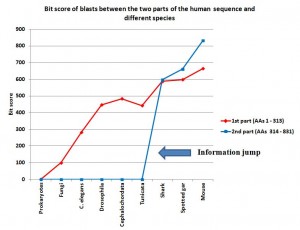
IOWs, what we see here is that the no domain part of the molecule is practically non existent in prokaryotes, in single celled eukaryotes and in all multicellular beings which are not vertebrates. In vertebrates, the sequence is not only present in practically all vertebrates, but it is also extremely conserved, from sharks to humans. So, we have a steep informational jump from non chordates and non vertebrate chordates, where the sequence is practically absent, to the very first vertebrates, where the sequence is already highly specific.

What does that mean from an ID point of view? It’s simple:

a) The sequence of 517 AAs which represents the major part of the human protein must be reasonably considered highly functional, because it is strongly conserved throughout vertebrate evolution. As we have said in the beginning, the only reasonable explanation for high conservation throughout a span of time which must be more than 400 million years long is the presence of strong functional constraints in the sequence.

b) The sequence and its function, whatever it may be (but it is probably an important regulatory function) is highly specific of vertebrates.

We have here a very good example of a part of a protein which practically appears in vertebrates while it is absent before, and which is reasonably highly functional in vertebrates.

So, to sum up:

  1. Prickle 1 is a functional protein which is found in all eukaryotes.
  2. The human sequence can be divided in two parts, with different properties.
  3. The first part, while undergoing evolutionary changes, is rather well conserved in all eukaryotes. Its function can be better understood, because it is made of known domains with known structure.
  4. The second part does not include any known domain or structure, and is practically absent in all eukaryotes except vertebrates.
  5. In vertebrates, it is highly conserved and almost certainly highly functional. Probably as a regulatory epigenetic sequence.
  6. For its properties, this second part, and its functional sequence, are a very reasonable object for a strong design inference.

I have added a graph to show better what is described in the conclusions, in particular the information jump in vertebrates for the second part of the sequence:
Graph3

Note: Thanks to the careful checking of Alicia Cartelli, I have corrected a couple of minor imprecisions in the data and the graph (see posts #83 and #136). Thank you, Alicia, for your commitment. The sense of the post, however, does not change.

Those who are interested in the evolutionary behaviour of protein Prickle 2 could give a look at my posts #127 and #137.

Comments
To Alicia Cartelli (#129): So, while I have to thank you for your work as an editor of my data, for the rest I completely disagree with you. You say: "What you’re essentially trying to do is show that there seems to be no intermediate forms for the 2nd domain of the prickle protein." Either you don't understand or you don't want to understand. What I am trying to do is to show: a) that the second part (Mung is right, it is not recognized as a domain) of the Prickle 1 protein has a sequence which is highly conserved from sharks to humans (can you deny it?), and therefore reasonably already present in the common ancestor of those two lines. b) that this conserved sequence has no detectable intermediate forms before the split between cartilaginous fishes and bony fishes (and therefore humans). Can you deny that? So, if you cannot deny either a) or b), all the rest of your "arguments" is useless. And I will happily stick to my "obsession". Moreover, with your help, we have demonstrated that: 1) The same can be said, in very similar terms, for the Prickle 2 protein. By the way, this "blue part" of the human Prickle 2 protein gives absolutely no hit either in Cephalochordata or in Tunicata, so we can all be happier. And, obviously, no significant hits in Drosophila, C. elegans or fungi or prokaryotes. You can check, and if you find other errors, I will be ready to correct myself. Here is the sequence: GSDSSDSAFQNARAKESRRSAKIGKNKGKTEEPMLNQHSQLQV SSNRLSADVDPLSLQMDMLSLSSQTPSLNRDPIWRSREEPYHYGNKMEQNQTQSPLQLLS QCNIRTSYSPGGQGAGAQPEMWGKHFSNPKRSSSLAMTGHAGSFIKECREDYYPGRLRSQ ESYSDMSSQSFSETRGSIQVPKYEEEEEEEGGLSTQQCRTRHPISSLKYTEDMTPTEQTP RGSMESLALSNATGLSADGGAKRQEHLSRFSMPDLSKDSGMNVSEKLSNMGTLNSSMQFR SAESVRSLLSAQQYQEMEGNLHQLSNPIGYRDLQSHGRMHQSFDFDGGMAGSKLPGQEGV RIQPMSERTRRRATSRDDNRRFRPHRSRRSRRSRSDNALHLASEREAISRLKDRPPLRAR EDYDQFMRQRSFQESMGHGSRRDLYGQCPRTVSDLALQNAFGDRWGPYFAEYDWCSTCSS SSESDNEGYFLGEPIPQPARLRYVTSDELLHKYSSYGLPKSSTLGGRGQLHSRKRQKSKN CIIS 2) The only weakly significant hit that I had found before the split (in Cephalochordata) was only an error of mine, as you kindly have pointed out. So, you an keep your ideas, and I will keep mine. Others can judge for themselves.gpuccio
February 6, 2016
February
02
Feb
6
06
2016
03:59 PM
3
03
59
PM
PDT
To Alicia Cartelli (#128): These are the results in Tunicata, correctly reported: PREDICTED: uncharacterized protein LOC100180080 [Ciona intestinalis] Sequence ID: ref|XP_009858881.1|Length: 821 Score: 31.2 bits Expect 3.1 Identities 17/48(35%) Positives 24/48(50%) It's an alignment of only 48 AAs, with an expect of 3.1. An expect of 3.1, as anybody doing blasts should know, means that you can expect 3 matches of this kind by random chance. It is not significant at all. PREDICTED: uncharacterized protein LOC100186276 [Ciona intestinalis] Sequence ID: ref|XP_002125964.2| Score: 29.6 bits Expect 9.0 Identities 26/96(27%) Positives 45/96(46%) It's an alignment of only 96 AAs, with an expect of 9.0. An expect of 9.0, as anybody doing blasts should know, means that you can expect 9 matches of this kind by random chance. It is not significant at all. So, I did not consider those as homologies, because the results are not statistically significant, and in the range of random chance. I checked the results I posted for cephalochordata, and frankly it seems that I made an error, because here too the results are non significant: hypothetical protein BRAFLDRAFT_82601 [Branchiostoma floridae] Sequence ID: ref|XP_002602014.1|Length: 208 Score: 29.6 bits Expect 4.4 Identities 11/40(28%) Positives 21/40(52%) The problem is that in my OP I report correctly the number of bits, the identities and the similarities, but for some reason that I can't explain the expect value is wrong, and is reported as slightly significant: Expect 0.007 I apologize for the error, and I have no idea of how it came through. It is obviously an error in absolute good faith, because I had no reason to give a significant result for cephalochordata which was not rel, as it was against my reasoning, even is slightly. Indeed, in my OP I comment: "(the hit with Branchiostoma floridae can really be considered trivial, with an expect of 0.007)" So, for the sake of honesty I included it in the graph, because my methodology was to exclude all the result which did not reach any statistical significance, and to include the others. While an expect of 0.007 was in no way impressing, it could be considered slightly significant in the context, so for the sake of honesty I included it. By the way, I added the graph some time after posting the OP, and I did not check each individual result. So, I suppose I must thank you for checking everything, and making my results even better for my reasoning. I will correct the errors tomorrow. Of course, when I post data I expect that others check them, and I am ready to correct any error. But again, the point is not that I have "censored" significant data in Tunicata. Rather, I have erroneously added some slightly significant data in Cephalochordata, against my interest, and for a material error.gpuccio
February 6, 2016
February
02
Feb
6
06
2016
03:35 PM
3
03
35
PM
PDT
gpuccio Now looking back after 130+ posts in this discussion thread, the comment posted @50 seems vindicated, validated, confirmed, proven. The topic you present here is quite interesting, and the way you explain it makes it more readable even for an uneducated person like me. However, having all the functional proteins at hand (one way or another) would resolve just part of the gigantic problem we face when trying to put together the spatiotemporally elaborate molecular and cellular choreographies orchestrated within the biological systems. The main issue is not to guess how we got all the required functional components. Guessing past events that did not get accurately recorded is always an extremely difficult (should I say almost impossible?) task, hence discussions on those topics tend to go forever unsettled. The question is how exactly one could make all the observed systemic complexity, assuming one has all the needed components and full-blown labs with the required toolkits and materials. Some famous folks have managed to shuffle genetic material between cells, thus prompting euphoric headlines in the mainstream media and pop-sci journals. But no one has explained how exactly to build a prokaryote cell. Let's not even bother asking about the eukaryotic cells. Forget about morphogenesis, organogenesis, interconnection, for the multicellular systems. Simply put all that aside for now. Still, one would have the enormous advantage of knowing the end result to guide the building process. Does anyone out there want to take that challenge? This is comparable to trying to swim across the Mediterranean Sea and the Atlantic Ocean from Fiumicino to Boston. The discussion about which, when, how functional proteins were available is like having a discussion -before jumping into the sea- about whether the swimmer should wear fins right from the start, or when passing near Ibiza or through the Gibraltar strait. At the end of the day it won't matter, because either way the guy will need to get pulled out of the water completely exhausted before crossing the strait between Corsica and Sardegna. :)Dionisio
February 6, 2016
February
02
Feb
6
06
2016
01:49 PM
1
01
49
PM
PDT
I am treating the 2nd part of the protein as a single domain, of which there is no known structure. Everything I have said refers to this domain. We are ignoring the first part of the protein because as Pucci has already admitted, there is an evolutionary trail of this protein sequence, so it doesn't fit his "science." Really not that confusing if you know what you are talking about, Mungy. Try to keep up.Alicia Cartelli
February 6, 2016
February
02
Feb
6
06
2016
01:35 PM
1
01
35
PM
PDT
Alicia Cartelli:
I’m saying that if you find a highly conserved protein domain present in a diverse group of species and want to reconstruct the evolution of that protein domain, then you have to look for the intermediates, not ignore them.
Alicia, you are being unclear. gpuccio identified four protein domains and admits they are all conserved. according to Uniprot, in the first part of the molecule we can recognize 4 domains: His argument has nothing to do with those domains.Mung
February 6, 2016
February
02
Feb
6
06
2016
01:23 PM
1
01
23
PM
PDT
Mungy, I'm saying that if you find a highly conserved protein domain present in a diverse group of species and want to reconstruct the evolution of that protein domain, then you have to look for the intermediates, not ignore them. You can't just take the protein sequences that are very similar, then take some species that are +100 million years older with no homologs, graph them, and claim that intermediates don't exist. You should probably actually look for the intermediates (or the leftovers of them) in more closely related species before drawing that conclusion. No?Alicia Cartelli
February 6, 2016
February
02
Feb
6
06
2016
12:11 PM
12
12
11
PM
PDT
gpuccio: I am without words. That's about as likely s Zachriel being without words. ;)Mung
February 6, 2016
February
02
Feb
6
06
2016
11:22 AM
11
11
22
AM
PDT
Alicia, so if A and B both exist in humans, and A and B both exist in sharks, then I need to look at both A and B in humans because in humans B could have evolved from A rather than B being present in humans by descent from B in sharks? Is that your point?Mung
February 6, 2016
February
02
Feb
6
06
2016
11:19 AM
11
11
19
AM
PDT
"The cross alignments between form 1 and form 2 and between shark and human confirm all that has been said" No. Don't you see that when you start taking the other protein variants into account, that you start to see higher bit scores and therefore less of this "jump" you're obsessed with? What you're essentially trying to do is show that there seems to be no intermediate forms for the 2nd domain of the prickle protein. But you tried to do this by only looking at the protein in a few species that is most similar to the human form. You can't do this when trying to reconstruct the evolutionary history of a protein. You have to account for any significant sequence homology. You are essentially "looking for intermediates," but ignoring the actual evidence for them. And for the last time, none of my BLASTs are wrong, unlike yours.Alicia Cartelli
February 6, 2016
February
02
Feb
6
06
2016
10:44 AM
10
10
44
AM
PDT
Did you not read what I just wrote Mungy? You can't just ignore other copies of the gene in a certain organism when trying to reconstruct the evolution of a protein. Also, when I BLAST the 2nd domain in Tunicates, I get hits: PREDICTED: uncharacterized protein LOC100180080 [Ciona intestinalis] 31.2 31.2 9% 3.1 35% XP_009858881.1 PREDICTED: uncharacterized protein LOC100186276 [Ciona intestinalis] 29.6 29.6 18% 9.0 27% XP_002125964.2 While both hits are similar to that of the cephalochordates, they are certainly not zero ("no homologies"). So, pucci, any comments on your wrong BLASTs?Alicia Cartelli
February 6, 2016
February
02
Feb
6
06
2016
09:58 AM
9
09
58
AM
PDT
I am without words. So your blasts were wrong, from all points of view, and you still have the arrogance to stick to your position (whatever it is) instead of having the honesty to admit it, or simply the smartness to remain silent? So, according to you, I cannot take the highest bit score, which is perfectly consistent with what I am looking for and arguing, while you can take a much lower score from another protein and just post it, without any other comments, as thought is were the result of the blast in question? If your argument had been that my blasts were correct, but that there were other sequences in the same organisms which has lower homologies with my sequence, you could just say that. Obviously it's not coincidence that there are other lower homologies with the sequence in organisms which already have high scoring sequences. But the point is, none of those can be used to say that they are intermediaries, because they all happen after the appearance of the sequence in cartilaginous fishes. Let's clarify better the question of Prickle 2. As it is clear form my OP, there are at least 2 main functional forms of the Prickle protein, usually called Prickle 1 and Prickle 2. My analysis, as explicitly stated in the OP, focused on Prickle 1. "The protein is called “Prickle”, and we will consider in particular the one known as “Prickle 1”." The paper quoted in my OP is about Prickle 1, too. But Prickle 2 (and other isoforms) is an important and functional protein too. For example, see this paper: http://www.ncbi.nlm.nih.gov/pmc/articles/PMC4530445/ or this one: http://www.ncbi.nlm.nih.gov/pmc/articles/PMC4427563/ IOWs, we are in front of a set of functional proteins, related and partially different. A perfect example of my 2b) concept in the OP. Now, the question is: what is the relationship between Prickle 1 and Prickle 2 in humans? First of all, they are very similar in length (831 and 844) and they very strongly share the 4 domain part (the red sequence): 542 bits Expect 0.0 Identities 246/311(79%) Positives 274/311(88%) And the second part? Well, the two "blue parts" in the two human sequences, when blasted one against the other, give the following result: 150 bits 8e-44 Identities 192/548(35%) Positives 278/548(50%) So, partial homology, but also big differences. In two proteins which are both functional and regulatory in humans. Again, clearly a case of 2b). The most interesting thin is that, if we blast each of the two "blue sequences" against shark, these are the results: Blue sequence from human Prickle 1: Best hit: prickle-like protein 1 [Callorhinchus milii] Sequence ID: ref|XP_007892833.1|Length: 832 597 bits Expect 0.0 Identities 350/526(67%) Positives 429/526(81%) (which is the result given in my OP) Second (and last) significant hit: prickle-like protein 2[Callorhinchus milii] Sequence ID: ref|XP_007893374.1|Length: 895 159 bits Expect 4e-41 Identities 192/542(35%) Positives 283/542(52%) Just to avoid further tricks from you, I mention that you also get a few minor hits, the best of which is 37.7 bits with an expect of 0.022, with other isoforms, which I have not considered significant. Now, just to have a further check of what that means, let's blast the blue sequence from human Prickle 2 protein against shark: These are the result: Bets hit: prickle-like protein 2 [Callorhinchus milii] Sequence ID: ref|XP_007893374.1|Length: 895 464 bits Expect 6e-153 Identities 295/531(56%) Similarities 375/531(70%) Second (and last) significant hit: prickle-like protein 1 [Callorhinchus milii] Sequence ID: ref|XP_007892833.1|Length: 832 175 bits Expect 8e-47 Identities 191/537(36%) Similarities 281/537(52%) Must I really explain what that really means? OK: a) There are at least two main forms of Prickle, let's say Prickle 1 and Prickle 2 b) Both are functional regulatory proteins in vetebrates, including humans c) Both share, vastly, what we have called the "red" sequence (the 4 domain part) d) They have significant homology, but also big differences, in the "blue" part. e) Both forms are already present in sharks, and extremely conserved up to humans. f) Both forms share approximately the same level of homology between them (in the blue part) both in sharks and in humans. g) The cross alignments between form 1 and form 2 and between shark and human confirm all that has been said. I leave it to you (and to all readers here) to judge how these data (facts) support your interpretations or mine. One final note, and believe me, I am very sincere here: I think that it is really a pity that this discussion, which is certainly interesting and stimulating, must go on without any reciprocal respect merely because of of your discussion "style".gpuccio
February 6, 2016
February
02
Feb
6
06
2016
09:51 AM
9
09
51
AM
PDT
gpuccio: Any other case should be discussed before getting to conclusions. Sure there are gaps. You conclude from this particular gap that it represents an unbridgeable jump. As many such gaps have been filled in before, it would seem premature to assume that this gap is special in that way. Extinction is a fact of biology, and is a more parsimonious explanation.Zachriel
February 6, 2016
February
02
Feb
6
06
2016
08:17 AM
8
08
17
AM
PDT
Alicia Cartelli: Your analysis is simply too rudimentary to support your conclusions. Could you say why and offer some suggestions on how to improve the analysis?Mung
February 6, 2016
February
02
Feb
6
06
2016
07:57 AM
7
07
57
AM
PDT
Sure you can take the highest bit score, but you can’t just ignore the other hits based on the genome sequence of the species. My BLASTs are not wrong, you just have no idea how to deal with even a small amount of data. You point to this huge jump in bits based on only part of the story. Do you think it’s just coincidence that the gator, for example, has four predicted prickle-like proteins encoded in its genome with varying sequence identity/homology to the human prickle protein? PREDICTED: prickle-like protein 1 [Alligator mississippiensis] 771 771 100% 0.0 84% XP_006269157.1 PREDICTED: prickle-like protein 2 [Alligator mississippiensis] 157 157 100% 3e-40 35% XP_006262189.2 PREDICTED: prickle-like protein 3 isoform X1 [Alligator mississippiensis] 30.8 30.8 10% 5.5 36% XP_006261340.2 PREDICTED: prickle-like protein 4 [Alligator mississippiensis] 47.4 47.4 5% 4e-05 65% XP_006278833.2 We are looking at the leftovers of various evolutionary processes at work. Your analysis is simply too rudimentary to support your conclusions.Alicia Cartelli
February 6, 2016
February
02
Feb
6
06
2016
06:39 AM
6
06
39
AM
PDT
One of the simplest of all the defining novelties of any major taxon is the enucleate red blood cell of mammals. This is a homolog shared by monotremes, marsupials, and placentals, and so must be assumed to be an ancient novelty which originated in the common ancestor of all extant mammalian species. - Denton, Michael. Evolution: Still a Theory in Crisis.
Mung
February 5, 2016
February
02
Feb
5
05
2016
07:35 PM
7
07
35
PM
PDT
nite gpuccio!Mung
February 5, 2016
February
02
Feb
5
05
2016
02:43 PM
2
02
43
PM
PDT
OK, goodnight everybody!gpuccio
February 5, 2016
February
02
Feb
5
05
2016
02:16 PM
2
02
16
PM
PDT
Again, any comments on your apparently wrong blasts? I should go to bed, it's late here in Italy...gpuccio
February 5, 2016
February
02
Feb
5
05
2016
02:09 PM
2
02
09
PM
PDT
You have achieved a great purpose: you have defied all my attempts to defend Common Descent. All homologies are not indicators of CD, they are convergent evolution. All differences are not a sign of neutral variation, they are non convergent evolution. Popper, where are you?gpuccio
February 5, 2016
February
02
Feb
5
05
2016
02:07 PM
2
02
07
PM
PDT
"has since convergently evolved in each lineage to have the similar sequences we now see." So, the 600 bits of homology between sharks and humans are the result of convergent evolution? Is that your theory? My compliments, really!gpuccio
February 5, 2016
February
02
Feb
5
05
2016
02:05 PM
2
02
05
PM
PDT
Again, any comments on your apparently wrong blasts?gpuccio
February 5, 2016
February
02
Feb
5
05
2016
02:02 PM
2
02
02
PM
PDT
"the huge amount of missing sequence data from both extinct and extant species" ??? To which, I suppose, you have privileged access? Not like us, poor laymen?gpuccio
February 5, 2016
February
02
Feb
5
05
2016
02:01 PM
2
02
01
PM
PDT
If there had been homologies in the Prickle-2-like proteins, my blasts would have shown it. I did not put any limitations to my blasts. I just filled in the sequence, as you can find it in my OP, and restricted the class of organisms or the organisms. I did not exclude the Prickle-2-like proteins from the search, or any other protein, for that. Can you understand these simple principles?gpuccio
February 5, 2016
February
02
Feb
5
05
2016
02:00 PM
2
02
00
PM
PDT
By the way, I can blast and keep the highest bit score. The 600 bits of homology between sharks and humans are a fact. There is 0 probability (approximation) to get that result by chance in the available proteome. So yes, if you can understand anything of scientific methodology, I can blast and keep the highest bit score. And I do it.gpuccio
February 5, 2016
February
02
Feb
5
05
2016
01:57 PM
1
01
57
PM
PDT
Any comments on your apparently wrong blasts?gpuccio
February 5, 2016
February
02
Feb
5
05
2016
01:55 PM
1
01
55
PM
PDT
The last common ancestor of humans, sharks, and bony fishes had this "proto-prickle-protein" which originally played a role in the development of the spine and has since convergently evolved in each lineage to have the similar sequences we now see. This makes sense as the protein carries out an important function during development. And you can't just BLAST it and pick the highest bit score. You can't just ignore the Prickle-2-like proteins, because we don't know which evolved first. It's just not as simple as you try to make it, not to mention the huge amount of missing sequence data from both extinct and extant species.Alicia Cartelli
February 5, 2016
February
02
Feb
5
05
2016
01:53 PM
1
01
53
PM
PDT
Alligator Mississipiensis: hypothetical protein Y1Q_031085 Sequence ID: gb|KQL86178.1|Length: 900 Score 772 bits Expect 0 Identities 436/522(84%) Positives 476/522(91%)gpuccio
February 5, 2016
February
02
Feb
5
05
2016
01:39 PM
1
01
39
PM
PDT
Danio Rerio: Prickle-like 1 Sequence ID: gb|AAI62516.1|Length: 793 Score 453 bits Expect 8e-150 Identities 301/536(56%) Positives 363/536(67%)gpuccio
February 5, 2016
February
02
Feb
5
05
2016
01:35 PM
1
01
35
PM
PDT
By the way, how did you do your blasts? I have just checked the first: PREDICTED: prickle-like protein 1 [Fundulus heteroclitus] Sequence ID: ref|XP_012735872.1|Length: 846Number of Matches: 1 Bit score: 481; Expect: 3e-160; Identities: 318/542(59%) Positives: 382/542(70%) Can you explain where did you find your 107 bits value?gpuccio
February 5, 2016
February
02
Feb
5
05
2016
01:31 PM
1
01
31
PM
PDT
I blasted the vertebrates. But the information jump is between the common ancestor of vertebrates and humans.gpuccio
February 5, 2016
February
02
Feb
5
05
2016
01:24 PM
1
01
24
PM
PDT
1 27 28 29 30 31 33

Leave a Reply