Uncommon Descent Serving The Intelligent Design Community

Interesting proteins: DNA-binding proteins SATB1 and SATB2

Categories
Intelligent Design
Share
Facebook
Twitter/X
LinkedIn
Flipboard
Print
Email

With this OP, I am starting a series (I hope) of articles whose purpose is to present interesting proteins which can be of specific relevance to ID theory, for their functional context and evolutionary history.

DNA-binding protein SATB1

SATB1 (accession number Q01826) is a very intriguing molecule. Let’s start with some information we can find at Uniprot, a fundamental protein database, about what is known of its function (in the human form):

Crucial silencing factor contributing to the initiation of X inactivation mediated by Xist RNA that occurs during embryogenesis and in lymphoma

And:

Transcriptional repressor controlling nuclear and viral gene expression in a phosphorylated and acetylated status-dependent manner, by binding to matrix attachment regions (MARs) of DNA and inducing a local chromatin-loop remodeling. Acts as a docking site for several chromatin remodeling enzymes

IOWs, it is an important regulatory protein involved in many different, and not necessarily well understood, processes, which binds to DNA and in involved in chromatin remodeling.

It is also involved in hematopoiesis (especially in T cell development), and has important roles in the biology of some tumors:

Modulates genes that are essential in the maturation of the immune T-cell CD8SP from thymocytes. Required for the switching of fetal globin species, and beta- and gamma-globin genes regulation during erythroid differentiation. Plays a role in chromatin organization and nuclear architecture during apoptosis.

Reprograms chromatin organization and the transcription profiles of breast tumors to promote growth and metastasis.

Keywords for molecular function: Chromatin regulator, DNA-binding, Repressor

Now, some information about the protein itself. I will relate, again, to the human form of the protein:

Length: 763 AAs. It’s a rather big protein, like many important regulatory molecules.

Its subcellular location is in the nucleus.

It is a multi-domain protein, with at least 5 detectable domains and many DNA binding sites.

Evolutionary history of SATB1

Now, let’s see some features of the evolutionary history of this protein in the course of metazoa evolution.

I will use here the same tools that I have developed and presented in my previous OP:

The amazing level of engineering in the transition to the vertebrate proteome: a global analysis

So, I invite all those who are interested in the technical details to refer to that OP.

Here is a graph of the levels of homology to the human protein detectable in other metazoan groups, expressed as mean bitscore per aminoacid site:


Fig. 1: Evolutionary history of SATB1 by human-conserved functional information
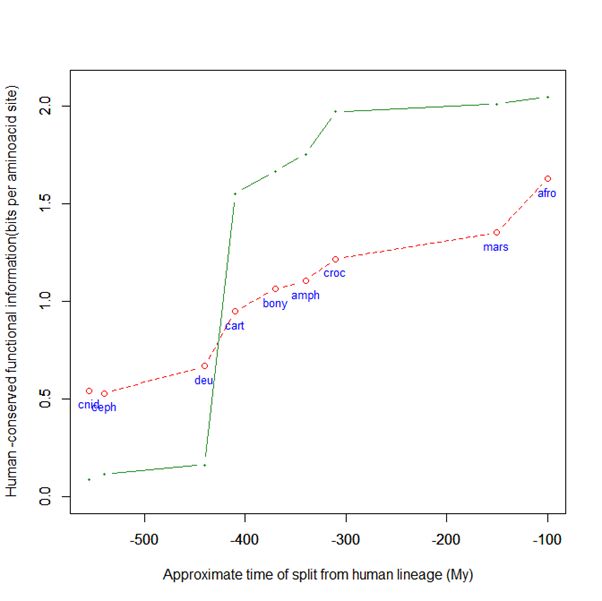
 

The green line represents the evolutionary history of our protein, while the red dotted line is the reference mean line for the groups considered, as already presented in my previous post quoted above (Fig. 2).

As everyone can see, this specific protein has a very sudden gain in human-conserved information with the transition from pre-vertebrates to vertebrates. So, it represents a very good example of the information jump that I have tried to quantify globally in my previous post.

Here, the jump is of almost 1.5 bits per aminoacid site. What does that mean?

Let’s remember that the protein is 763 AA long. Therefore, an increase of information of 1.5 bits per aminoacid corresponds to more than 1000 bits of information. To be precise, the jump from the best pre-vertebrate hit to the best hit in cartilaginous fish is:

1049 bits

But let’s see more in detail how the jump happens.

I will show here in detail some results of protein blasts. All of them have been obtained using the Blastp software at the NCBI site:

https://blast.ncbi.nlm.nih.gov/Blast.cgi?PROGRAM=blastp&PAGE_TYPE=BlastSearch&LINK_LOC=blasthome

with default settings.

Here is the result of blasting the human protein against all known protein sequences except for vertebrate sequences:

Fig. 2: Results of blasting human SATB1 against all non vertebrate protein sequences
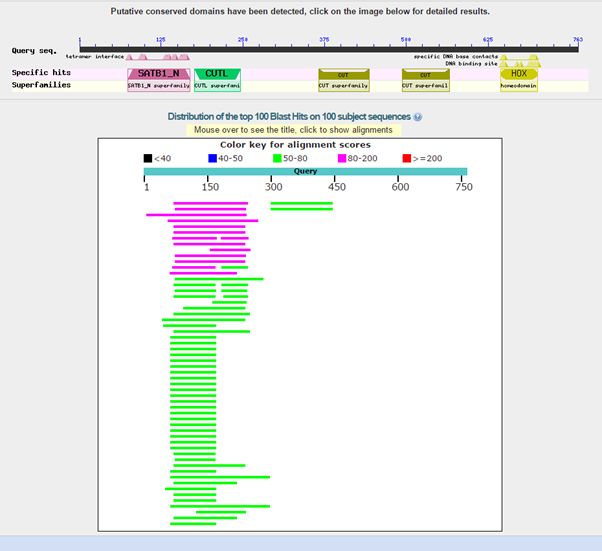
 

As can be seen, we find only low homologies in non vertebrates, and they are essentially restricted to a small part of the molecule, that correspond to the first two domains in the protein, or just to the first domain. The image shows clearly that all the rest of the sequence has no detectable significant homologies in non vertebrates (except for a couple of very low homologies for the third domain).

The best hit in non vertebrates is 154 bits with Parasteatoda tepidariorum, a spider. Here it is:

Fig. 3: The best hit in non vertebrates (with a spider)
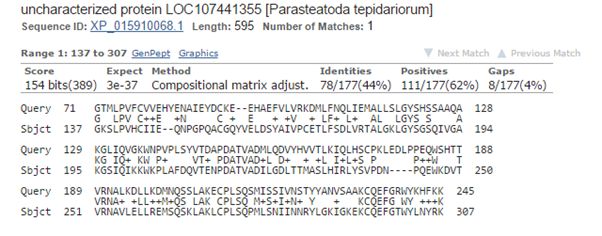
The upper line (Query) is the human sequence. The bottom line (Sbjct) is the aligned sequence of the spider. In the middle line, letters are identities, “+” characters are similarities (substitutions which are frequently observed in proteins, and are probably quasi-neutral), and empty spaces are less frequent substitutions, those that are more likely to affect protein structure and function if they happen at a functionally important aminoacid site.

The alignment here is absolutely restricted to AAs 71 – 245 (the first two domains), and involves only 177 AAs. Of these, only 78 (44%) are identities and 111 (62%) are positives (identities + similarities). So, in the whole protein we have only 78 identities out of 763 (10.2%).

The spider protein is labeled as “uncharacterized protein”, and that is the case in most of the other non vertebrate hits.

All the other non vertebrate hits, with a couple of exceptions, are well below 100 bits, most of them between 70 and 86 bits.

IOWs, the protein as we know it in vertebrates essentially does not exist in non vertebrates.

Even non vertebrate deuterostomia, which should be the nearest precursors of the first vertebrates, have extremely low homology bitscores with the human protein:

Saccoglossus kowalevskii (hemichordates):  87 bits

Branchiostoma floridae (cephalochordate): 67 bits

The information jump in vertebrates

Now, what happens with the first vertebrates?

The oldest split in vertebrates is the one between cartilaginous fish and bony fish (from which the human lineage derives). Therefore, homologies that are conserved between cartilaginous fish and humans had reasonably to be already present in the Last Common Ancestor of Vertebrates, before the split between cartilaginous fish and bony fish, and have been conserved for about 420 million years.

So, let’s see the best hit between the human protein and cartilaginous fish. It is with Rhincodon typus (whale shark). Here it is:


Fig. 4: The best hit of human SATB1 in cartilaginous fish (with the whale shark)
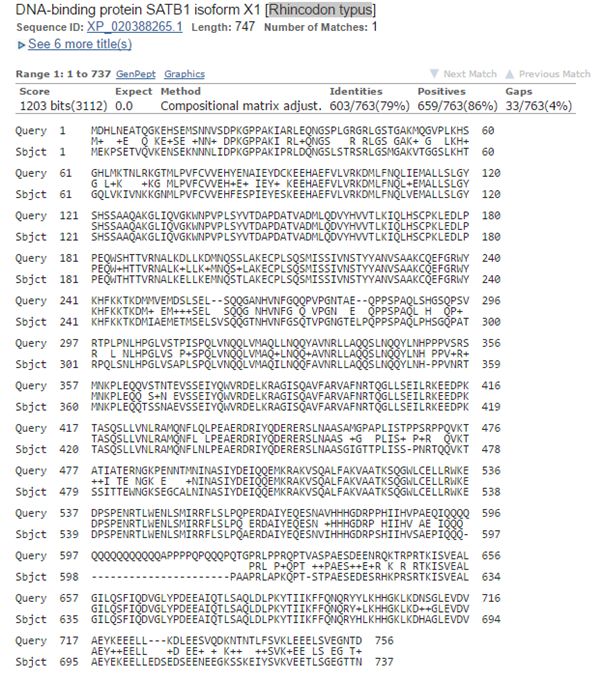
 

Here, the alignment involves practically the whole molecule (756 AAs), and we have 1203 bits of homology, 603 identities (79%), 659 positives (86%).

IOWs, the two molecules are almost identical. And the homology is extremely high not only in the domain parts, but also in the rest of the protein sequence.

Now, the evolutionary time between pre-vertebrates and the first split in vertebrates is certainly rather small, a few million years, or at most 20 – 30 million years. Not a big chronological window at all, in evolutionary terms.

However, in that window, this protein appears almost complete. 603 aminoacids are already those that will remain up to the human form of the protein, and only 78 of them were detectable in the best hit before vertebrate appearance.

1049 bits of new, original functional information. In such a short evolutionary window.

Functionality

Why functional? Because those 603 aminoacid have remained the same thorugh more than 400 million years of evolution. They have evaded neutral or quasi neutral variation, that would have certainly completely transformed the sequence in such a big evolutionary time, if those aminoacid sites were not under extreme functional constraint and purifying (negative) selection.

Now, I say that this fact cannot in any way be explained by any neo-darwinian model. Absolutely not.

Moreover, there is absolutely no evidence in the available proteome of any intermediate form, of any gradual development of the functional sequence that will be conserved up to humans (except, of course, for the 50 – 78 AAs which are already detectable in the first two domains in many pre -vertebrates).

By the way, Callorhincus milii, the Elephant shark, has almost identical values of homology:

1184 bits, 599 identities, 654 positives

But, how important is this protein?

In the ExAC database, a database of variations in the human genome, missense mutations are 110 out of 260.3 expected, with a z score of 4.56, an extremely high measure of functional constraint.

The recent medical literature has a lot of articles about the important role of SATB1 at least in two big fields:

  • T cell development
  • Tumor development (many different kinds of tumors)

If we want to sum up in a few words what is known, we could say that SATB1 is considered a master regulator, essentially a complex transcription repressor, involved mainly (but not only) in the development of the immune system, in particular T cells. A disregulation of this protein is linked to many aspects of tumor invasivity (especially metastases). The protein seems to act, among other possibilities, as a global organizer of chromatin states.

Here is a very brief recent bibliography:

Essential Roles of SATB1 in Specifying T Lymphocyte Subsets

SATB1 overexpression correlates with gastrointestinal neoplasms invasion and metastasis: a meta-analysis for Chinese population

SATB1-mediated Functional Packaging of Chromatin into Loops

DNA-binding protein SATB2

But there is more. There is another protein which is very similar to SATB1. It is called DNA-binding protein SATB2 (accession number Q9UPW6).

Its length is very similar to SATB1: 733 AAs.

Uniprot describes its function as follows:

Binds to DNA, at nuclear matrix- or scaffold-associated regions. Thought to recognize the sugar-phosphate structure of double-stranded DNA. Transcription factor controlling nuclear gene expression, by binding to matrix attachment regions (MARs) of DNA and inducing a local chromatin-loop remodeling. Acts as a docking site for several chromatin remodeling enzymes

Which is very similar to SATB1. But now come the differences. While SATB1 is implied prevalently in T cell development and tumor development, SATB2 is:

Required for the initiation of the upper-layer neurons (UL1) specific genetic program and for the inactivation of deep-layer neurons (DL) and UL2 specific genes, probably by modulating BCL11B expression. Repressor of Ctip2 and regulatory determinant of corticocortical connections in the developing cerebral cortex. May play an important role in palate formation. Acts as a molecular node in a transcriptional network regulating skeletal development and osteoblast differentiation

So, similar proteins with rather different specificities. While SATB1 is mainly connexted to adaptive immunity (T cell development), SATB2 seems to be more linked to neuronal development. Like SATB1, it is involved in cancer development, although usually in different types of cancer.

Here is a brief recent bibliography about SATB2:

Mutual regulation between Satb2 and Fezf2 promotes subcerebral projection neuron identity in the developing cerebral cortex

SATB1 and SATB2 play opposing roles in c-Myc expression and progression of colorectal cancer

However, how similar is SATB2 to SATB1 in terms of sequence homology?

Here is a direct blast of the two human molecules:


Fig. 5: Blast of human SATB1 vs human SATB2:
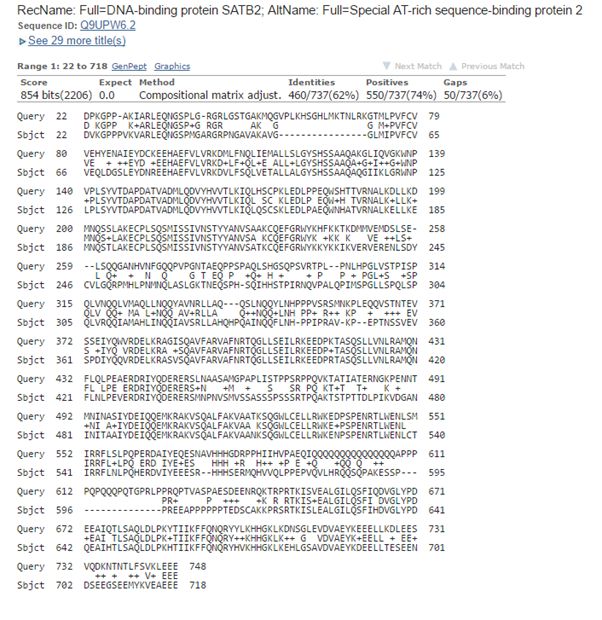
 

OK, they are very similar, but…  only 460 identities, 550 positives, 854 bits. IOWs, these two human proteins are similar, but not so similar as the two sequences of SATB1 in the shark and in humans.

Now, here is the evolutionary history of SATB2:


Fig. 6: Evolutionary history of SATB2 by human-conserved functional information
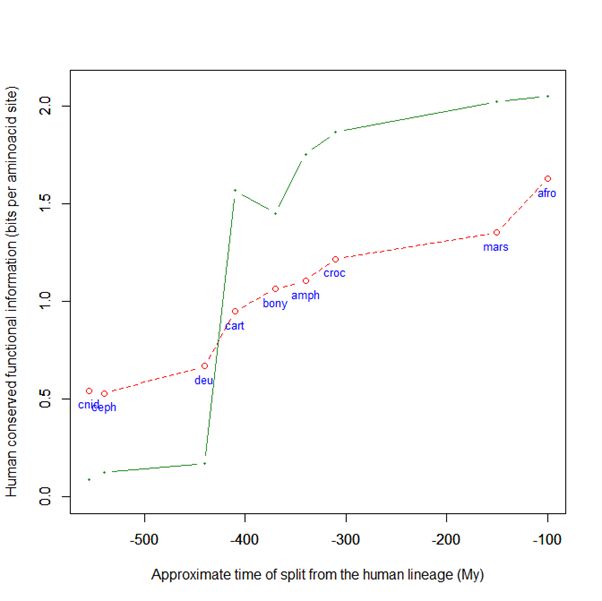
 

As everyone can see, it is almost identical to the evolutionary history of SATB1. To see it even better, Fig. 7 shows the two evolutionary histories together (the green line is SATB1, the brown line is SATB2):


Fig. 7: Evolutionary history of SATB1 and SATB2 by human-conserved functional information
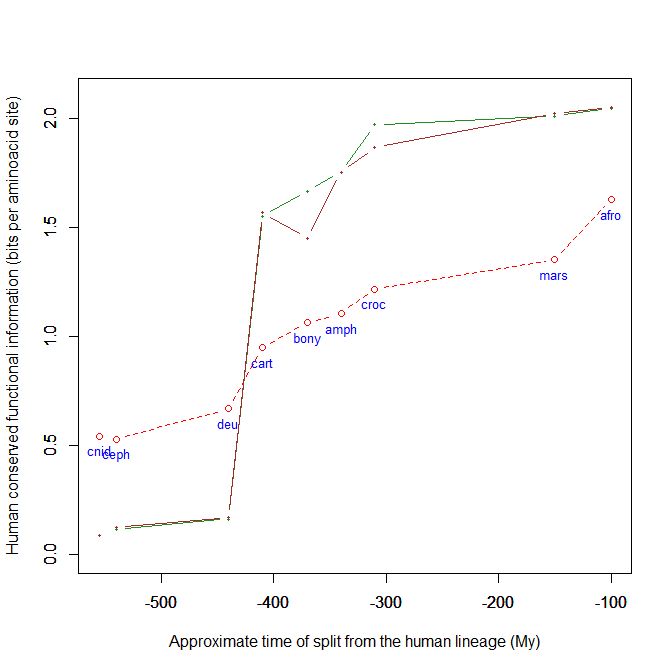
 

In particular, pre-vertebrate history and the jump in cartilaginous fish are practically identical. And yet these are two different molecules, as we have seen, with different specificities and about one third of difference in sequence.

Now, let’s blast human SATB2 against cartilaginous fish. Again the best hit is with the whale shark:


Fig. 8: The best hit of human SATB2 in cartilaginous fish (with the whale shark)
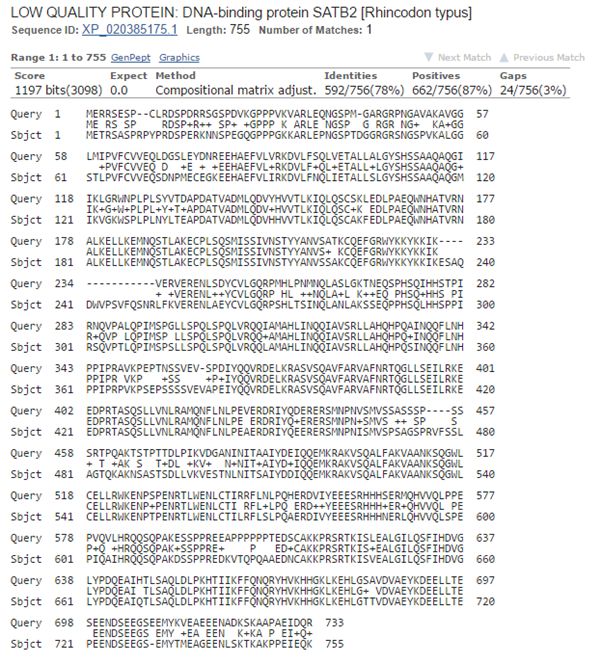
 

And the numbers are very similar, incredibly similar I would say, to those we found for SATB1:

1197 bits, 592 identities, 662 positives.

But what if we blast SATB1 of the whale shark against SATB2 of the whale shark?

Here are the results:


Fig. 9: Blast of whale shark SATB1 vs whale shark SATB2:
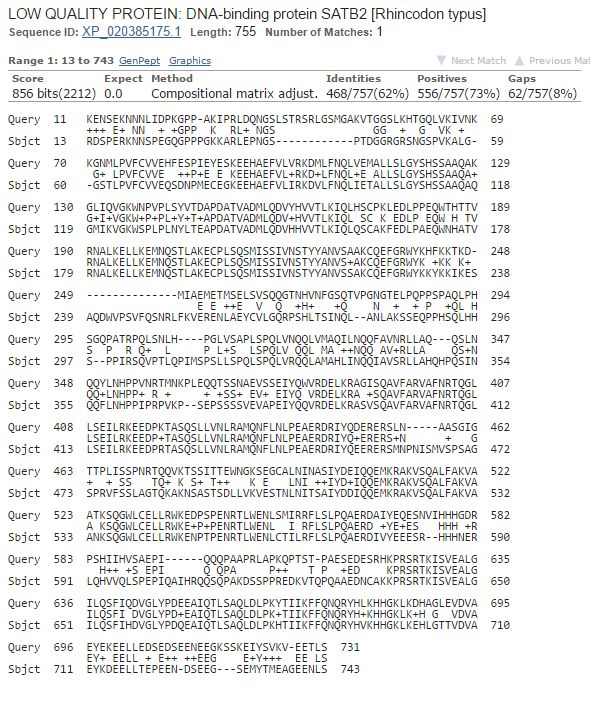
Now, please, compare the numbers we got here with those from the similar blast between the two proteins in humans:

SATB1 human vs SATB2 human:  460 identities, 550 positives, 854 bits

SATB1 shark vs SATB2 shark:      468 identities, 556 positives, 856 bits

Almost exactly the same numbers! Wow!

What does that mean?

It means that this system of two similar proteins with different function arises in vertebrates as a whole system, already complete, with the two components already differentiated, and is conserved almost identical up to humans. Indeed, SATB1 and SATB2 have the same degree of homology both in sharks and in humans, and the two SATB1 proteins in shark and humans, as well as the two SATB2 proteins in shark and humans, have greater similarity, after more than 400 million years of divergence, than SATB1 and SATB2 show when compared, both in sharks and in humans.

Would you describe that as sudden appearance of huge amounts of functional information, followed by an extremely long stasis? I certainly would!

The following table sums up these results:

Sequence 1 Sequence 2 Bitscore
SATB1 Human SATB2 Human 854
SATB1 Shark SATB2 Shark 856
SATB1 Human SATB1 Shark 1203
SATB2 Human SATB2 Shark 1197

IOWs, the whole system appeared practically as it is today, before the split of cartilaginous fish and bony fish, and has retained its essential form up to now.

So, the total amount of new functional information implied by the whole system of these two proteins is about 1545 bits (considering 855 bits of common information, and 345 bits x 2 of specific information in each molecule).

An amazing amount, for a system of just two molecules, considering that 500 bits is Dembski’s Universal Probability Bound!

Let’s remember that in my previous post, quoted above, I showed that the informational jump from pre-vertebrates to vertebrates is more than 1.7 million bits. That’s a very big number, but big numbers sometimes are not easily digested. So, I believe that seeing that just two important molecules can contribute for almost 1500 bits can help us understand what we are really seeing here.

Moreover, it’s certainly not a case that those two molecules seem to be fundamental in two very particular fields:

a) The adaptive immune system

b) The nervous system

if we consider that those are exactly the two most relevant developments in vertebrates.

And, as a final note, please consider that these are very complex master regulators, which interact with tens of other complex proteins to effect their functions. The whole system is certainly much more irreducibly complex than we can imagine.

But still, just the analysis of these two sister proteins is more than enough to demonstrate that the neo Darwinian paradigm is completely inappropriate to explain what we can see in the proteome and in its natural history. And this is only one example among thousands.

So, I want to conclude repeating again this strong and very convinced statement:

The observed facts described here cannot in any way be explained by any neo-darwinian model. Absolutely not. They are extremely strong evidence for a design inference.

Comments
gpuccio @85:
And, in the end, the important point is: there is only one place where that functional information can and must be found: the sequence Why? Because it’s the sequence, the primary structure, which in the end generates all the rest. The sequence is written in the mass memory (protein coding genes), and it’s in the sequence space that variation happens. It’s in the sequence space that the search is done, whatever the search is. And the sequence space dictates the probability context, if the movements is random.
Interesting information. That's one of the reasons I wanted to learn how to look at the genes that code for the proteins SATB1 and SATB2. You told me the tips and tricks. Thanks.Dionisio
July 19, 2017
July
07
Jul
19
19
2017
03:16 PM
3
03
16
PM
PST
RodW: By the way, to prepare some of my answers tomorrow, I would appreciate if you could give more precise references to the following things you mentioned: Tawflik jumanji Thanl you.gpuccio
July 19, 2017
July
07
Jul
19
19
2017
02:26 PM
2
02
26
PM
PST
RodW: Thank you for your contributions. It is late now here, so I will answer tomorrow. Good discussion, anyway! :)gpuccio
July 19, 2017
July
07
Jul
19
19
2017
02:15 PM
2
02
15
PM
PST
RodW: Now you say:
I got the impression from what you said in #13 that you’d agree that God created the sequences in an ancestral vertebrate and the differences in shark and human now are due to drift.
No, I will try to be more clear. And let's get rid of the idea of God in this discussion. My point are: a) The sequences that are conserved throughout the 400+ million years must be considered functional sequences. b) Those that are shared between cartilaginous fish and humans, and were never observed in non vertebrates, including non vertebrate chordates, must have originated in the last common ancestor of vertebrates, and therefore in a rather short evolutionary time. For those sequences, if complex enough, I infer design, according to the most classic ID theory. c) Now, we have two molecules, SATB1 and SATB2. In humans, they share a relevant quote of sequence information (854 bits, 460 identities). In sharks, the two molecules share almost exactly the same sequence information (856 bits, 468 identities). d) The obvious conclusion is: the two molecules share about 855 bits of functional information, and that quote of functional information was already present in the last ancestor of vertebrates, and it has been conserved from then on. OK? Is it clear? e) But the two molecules have additional functional information that has been conserved for 400+ million years. Only, that information is different in the two molecules, but in each molecule it has been conserved for 400+ million years. That information must be related to the specific function that each molecule performs differently from what the other one does. f) I have quantified that specific information. Let's consider 855 bits the information shared by the two molecules (the mean of 854 and 856). Then, for SATB1, the specific conserved information is: 348 bits (1203, that is the total homology between human and shark SATB1, - 855) And for SATB2, the specific conserved information is: 342 bits (1197, that is the total homology between human and shark SATB2, - 855) Remarkably similar, again. The point is, the 348 bits conserved in SATB! (beyond the shared 855 bits in the two molecules) are completely different from the 342 bits conserved in SATB2 ((beyond the shared 855 bits in the two molecules). They are completely different functional sequences, not shared bewteen the two molecules. That's why I say that the whole functional information in the system is: 855 + 348 + 342 = 1545 bits. However, if we consider that 154 bits were alredy detectable in pre-vertebrates, we can conclude that the total information jump in vertebrates for the two molecules is: 1545 - 154 = 1391 bits. (By the way, I apologize for having written 1545 in my last comments, I had forgotten to subtract the 154 bits of the best pre-vertebrate hit. Not that it makes a big difference... :) ) g) What about the sequence that is not conserved between sharks and humans? As always, let's be quantitative. As the maximun homology in blast results is about 2.2 bits per aminoacid (for total identity) we can say that the non conserved part is: About 476 bits for SATB1 About 416 bits for SATB2 Not too much, I would say. As you correctly say, this "gap" with the human sequence is, more or less gradually, filled in the course of the remaining natural history. That is rather obvious, After all, we must get to primates, which have almost complete sequence identity with humans. As you can see in Fig. 7, the gap is almost completely filled already in crocodiles, even more in mammals. What does that mean? I have tried to discuss it in post #13, and I invite you to read it again. In brief, I don't think that "all" the sequence must have functional constraints. There can be neutral divergence, of course. In that case, only par of those remaining bits are functional, and can be traced to specific new functional adaptations of the molecule in the new species. The rest could be neutral or quasi-neutral. The almost complete homology in mammals, for example, can be explained in part by passive conservation of neutral sites, in a time window (100 million years or less) that cannot ensure saturation of neutral site divergence. But, with what we know, it is almost impossible to separate additional functional information from neutral conservation in the part of the molecule which is not conserved from sharks, or at least from bony fish.gpuccio
July 19, 2017
July
07
Jul
19
19
2017
02:11 PM
2
02
11
PM
PST
I've always thought books make bad presents. When you give someone a book you're essentially saying "here, now spend ~50 hours of your free time reading this!" I'm going to go ahead and recommend 2 books to you guys. This is not the same thing because you all clearly put a lot of time and thought into this topic. The thing is it seems you get most of your info and interpretation through an ID community filter. I'm not saying this will persuade you that ID is wrong but you'll see that outside of the ID community no one thinks that evolution is on the verge of collapse. Every day papers come out that interpret their results in terms of evolution. At the very least evolution is consistent with their results. In some cases ID isn't. So the books you should read cover to cover are the latest editions of Molecular Biology of the Cell by Alberts Evolution by FutuymaRodW
July 19, 2017
July
07
Jul
19
19
2017
01:51 PM
1
01
51
PM
PST
gpuccio I don't have time to do research now so I'll go from memory, but this discussion is a good excuse to look up some papers on the topic
I am aware of no evidence at all that “natural genetic mechanism” can generate any amount of specific functional information above a few bits,
The mechanisms are inversions, translocation, deletions and insertions. They could be caused by random breaks, TEs and meiotic slippage during pairing. There is a new protein in drosophical (I think its called jumanji) created by the fusion of parts of 2 other proteins. When you look at protein families some of the proteins will be almost identical, others will differ in the regions between the domains and still others will add or delete a domain or 2.
and not to the two CUT domains or to the HOX domain, where no homology can be detected.
The CUT domain was first found in the cut protein in drosophila, so named because it made the wing margin look 'cut'. And of course the hox genes were discovered first in drosophia. They were responsible for the famous homeotic transformation mutants. Didn't you see the 4-wing fly picture that Wells used in Icons of Evolution? The genes were found in mouse when G Rubin at UCLA probed a mouse library with the fly gene. You might be interested to know that if you put the homologous (equivalent) mouse gene into the fly mutant it corrects the mistake. (I think the reverse experiment works sometimes) As for domains
Indeed, one of the best arguments for ID remains the existence of about 2000 domain superfamilies (referring to SCOP, release 1.75, we have 1195 different folds, 1962 superfamilies, 3902 families)......... There is no possible neo darwinian explanation for that.
I disagree. When one looks closely at domains most are composed of a few bits of secondary structure and function by binding specifically to some molecule. You may be aware that its very easy to generate a random series of proteins, or even short polypeptides, and find the ability to bind to something specific. So the big complex proteins we see today could easily have arisen by cobbling together simpler elements that predated LUCA. One researcher (Tawflik I think) did an analysis of several domains and found that they appear to have been generated from modification from much simpler repeat sequences of aa. Its know that very simple repeat polypeptides..ex. Glu-Pro-Glu-Pro etc can have a function. What all this means is that even though we don't have a detailed picture for how these came about we can still see that an ID isnt required. The picture we have now may be an outline, but it still suggests the gradual ratcheting up of complexity by natural mechanisms.RodW
July 19, 2017
July
07
Jul
19
19
2017
01:40 PM
1
01
40
PM
PST
RodW: Another thing that facts tell us is that the input of new functional information takes place in already existing beings, in some way. That's what I mean with "Common descent", and more in particular with "Designed Common Descent". It's not different from what happens in human design, for example in design of cars or of software. Designers who work on a new model of car, often reuse some old model and just modify it as desired. Of course, that is not always the case, but let's imagine a world where the only practical way to make a new car is to take an old one and modify it. That would generate an Universal Common Descent of cars, and yet each single new car would be designed. That would also generate naturally a nested hierarchy of designed cars. Now, I really don't know if CD is universal or not. I only know that some form of CD is apparently neede to explain many important observed facts. That's why I believe in CD. Again, it's not form of religion or anti-religion: it's just my scientific conviction. And, of course, it makes sense only with design. Because "natural" CD (non designed CD), without any design intervention, can never explain functional information. B) So, why do you say that: "why he chose to do it exactly the way evolution would do it requires an explanation" But facts are exactly the opposite of "the way evolution would do it". The way evolution (neo-darwinian evolution) would do it is what we could call "Dawkins'dream": a natural history full of gradual modifications, each of them slightly more functional, each of them naturally selected and amplified and fixed, so that we can at least find traces of it, and clear pathways of gradual increases of functionality. The opposite of what we can observe. The way evolution would do it would provide lots and lots of empirical examples of how really new original functional information can arise thorugh RV + NS: in natural history, in the lab, even in software. Insted, we have none. Absolutely none. (OK, now you will quote the usual mystifications, like Szostak's paper, or evolutionary softwares, and so on. I have debated those things hundreds of times, and I am a little tired of doing that. But you are a new person, and therefore, if you want to do that, let it be). So, observed facts tell us that whatever happened, it's not "the way evolution would do it". It's the way one or more designers, constrained by context, not necessarily omnipotent, and constrained by some necessity, or opportunity, to operate through some Common Descent, more or less universal, would do it. Is that clear? Natural history is not the way evolution would do it. It's the way designers would do it. That's what is meant when we say that biological beings have, strongly, the appearance of design, something that even die hard evolutionists like Dawkins admit. Otherwise, we would simply say that biological beings have the appearance of neo-darwinian evolution (whatever that can mean). So, what is at stack here is not what some imaginary idea of God would have done. We must ask ourselves what a designer would have done, given specific constraints. Exactly as happens in human design. More in next post.gpuccio
July 19, 2017
July
07
Jul
19
19
2017
01:30 PM
1
01
30
PM
PST
gpuccio @80:
Indeed, one of the best arguments for ID remains the existence of about 2000 domain superfamilies (referring to SCOP, release 1.75, we have 1195 different folds, 1962 superfamilies, 3902 families).
interesting informationDionisio
July 19, 2017
July
07
Jul
19
19
2017
01:13 PM
1
01
13
PM
PST
RodW @83, sometimes I feel Italian too :) Except that my Italian vocabulary is very poor compared to gpuccio's :) the best food is the Sicilian! :) [see it @73] the worst was in the archipelago Gulag :( regularly I eat Polish or Spanish food, but like any cuisine, as long as it's affordable :) Now, seriously, the best biochemical food is the one we can share! But of course, it must provide the essential nutrients required by our bodies to function, so our souls can operate in this world. OK, enough digression, time to focus in the discussion.Dionisio
July 19, 2017
July
07
Jul
19
19
2017
01:10 PM
1
01
10
PM
PST
RodW: You say:
God could have done it any of a thousand ways so why he chose to do it exactly the way evolution would do it requires an explanation.
Ah, this is strange indeed. A) Whoever spoke of God? Let's be clear, I am not trying to hide behind tricks. I really am not speaking of God here. I have never, never invokes any religious idea when I am discussing ID. ID for me is science. Period. Then, what are we speaking of? We are speaking of the necessity of one or more designers to explain the generation of functional information in biology and its natural history. We are speaking of the simple fact that complex functional information never, never originates without the intervention of some conscious designer capable og the specific conscious representations of meaning and purpose. Only those conscious representations can overcome the probabilistic barriers that make the generation of complex functional information practically impossible in all non design contexts. Is that designer or designers God? My answer is: what do observed facts tell us? Only that conscious and purposeful intelligence is required. Is that enough to say it was God? No. Not from a scientific point of you. The only requirement is conscious purposeful intelligence, and the ability to interact with biological beings in order to input some specific form to their stored information. So, we don't know why and how the designer designed biological information, and certainly we cannot try to derive that from some a priori concept of God. As you seem to do. But I have never done that. So, let's try to see what the facts have to tell us. The facts tell us that information in natural history grows suddenly, in big jumps. Of course the first, and most relevant, jump is OOL, but unfortunately we know really little about that. But I have tried to show, with my last OPs that some definite information jumps can be very well identified in more "recent" natural history, for example in the transition to vertebrates. And I have tried to quantify those jumps, and to support my conclusions as empirically as I could. I am still waiting for real objections to my procedure and conclusions. More in next post.gpuccio
July 19, 2017
July
07
Jul
19
19
2017
01:07 PM
1
01
07
PM
PST
RodW: Now, let's be serious again. You say:
I don’t think proteins are made of “fixed modules” and there are certainly functional sequences in some proteins between modules. But with all the massive sequencing and computing power I think most domains have probably been discovered.
Not necessarily. The identification of a domain usually requires studies of the structure, which at present are still difficult. However, two important points that I mentioned are: a) Very similar structures can certainly behave differently, if there are differences, even slight ones, in the sequence and in the general context of the whole molecule. That's why multidomain proteins are never simply a collection of domains, even when the domains are similar enough (that, as we have seen, is not always the case, at all). The domains must interact in specific ways, and it is the general architecture of the proteins that ensures that. b) Much protein function is not rigidly tied to a fixed structure. It's the case of intrinsically disordered proteins, which have become a very important part of our understanding of protein function. I quote from Wikipedia: "An intrinsically disordered protein (IDP) is a protein that lacks a fixed or ordered three-dimensional structure.[2][3][4] IDPs cover a spectrum of states from fully unstructured to partially structured and include random coils, (pre-)molten globules, and large multi-domain proteins connected by flexible linkers. They constitute one of the main types of protein (alongside globular, fibrous and membrane proteins).[5] The discovery of IDPs has challenged the traditional protein structure paradigm, that protein function depends on a fixed three-dimensional structure. This dogma has been challenged over the last decades by increasing evidence from various branches of structural biology, suggesting that protein dynamics may be highly relevant for such systems. Despite their lack of stable structure, IDPs are a very large and functionally important class of proteins. In some cases, IDPs can adopt a fixed three-dimensional structure after binding to other macromolecules. Overall, IDPs are different from structured proteins in many ways and tend to have distinct properties in terms of function, structure, sequence, interactions, evolution and regulation." Then you say:
Still, I think its generally true that most of the functionality comes from the modules.
Maybe, but as I have said that is questionable. And, in any case, the "modules" are not fixed and can be modified in thousands of ways for each functional requirement. And all that means functional information. And, in the end, the important point is: there is only one place where that functional information can and must be found: the sequence Why? Because it's the sequence, the primary structure, which in the end generates all the rest. The sequence is written in the mass memory (protein coding genes), and it's in the sequence space that variation happens. Mutations, be they random or guided, happen in the sequence of the protein coding gene, and therefore they are variations in the sequence space. Especially random variations, which are the only engine in the neo-darwinian paradigm, know nothing of secondary and tertiary structure, least of all of function. Random variation is by definition blind, therefore it is just a "movement" in the sequence space. Nothing else. It's in the sequence space that the search is done, whatever the search is. And the sequence space dictates the probability context, if the movements is random. And we know all too well how big and disconnected is the sequence space of proteins: let's say 20^100 different states for a "short" 100 AAs protein sequence? It's 432 bits of total information for that short sequence. And, already, it's an ocean that no RV can traverse. Again, I call for some explanation of the following facts: a) 561 functional in ATP synthase alpha chain (conserved for billions of years) b) 663 functional bits in ATP synthase beta chain (conserved for billions of years) c) 1545 functional bits in the system SATB1 – SATB2 (conserved for more than 400 million years): see my OP here d) More than 1.7 million functional bits in the transition from non vertebrate chordates to the first vertebrates (conserved for more than 400 million years). see my previous OP. More in next post.gpuccio
July 19, 2017
July
07
Jul
19
19
2017
12:53 PM
12
12
53
PM
PST
RodW: Nutella is probably the same. But what about pasta? :)gpuccio
July 19, 2017
July
07
Jul
19
19
2017
12:32 PM
12
12
32
PM
PST
Dionisio Yes, I realize gpuccio is from Italy. Americans who visit Europe and some Italians I know all insist the food is much better in Europe and especially Italy. I'm willing to believe that but I don't know why that should be the case. Can't we produce good food in the US?? Sometimes I think they're just so happy to be in Italy they imagine the food is better. Some have even said the Nutella is better in Italy but that cant be the caseRodW
July 19, 2017
July
07
Jul
19
19
2017
11:37 AM
11
11
37
AM
PST
RodW: I should discuss the aspect of Common Descent now, I suppose. But dinner awaits me (and a wife!). More in next post, as soon as possible! :)gpuccio
July 19, 2017
July
07
Jul
19
19
2017
10:40 AM
10
10
40
AM
PST
RodW: More about domains. You say: "CUT and HOX are also found in drosophila so even though the proteins are unique to vertebrates their parts are not." But I have blasted SATB1 (human) against drosophila melanogaster (all sequences), and the result is: 62.4 bits of maximum homology, with protein Dve. The only local alignment includes 186 AAs, segment 74 - 240 of the human sequence, with 47 identities and 92 positives. As you can see, this homology (very partial) refers to the first two domains (SATB1N and CUTL) as shown in the Blast figure, and not to the two CUT domains or to the HOX domain, where no homology can be detected. Now, let's look to the segment that, in the Blast Figure, is marked as HOX domain. It corresponds to AAs 644 - 701, and Blast gives a low homology of that sequence to the reference HOX domain (Expect 2.38e-08). Now, if we blst that specific sequence of 58 AAs vs drosophila, the best hit is: Chain A, Even-Skipped Homeodomain Complexed To At-Rich Dna 28.1 bits Expect 0.17 12 identities 17 positives, in a partial alignment of only 20 AAs. Here it is: Query 678 LSAQLDLPKYTIIKFFQNQR 697 L+AQL+LP+ TI +FQN+R Sbjct 34 LAAQLNLPESTIKVWFQNRR 53 While, if we blast the same "domain" (segment) with cartilaginous fish, we have: 114 bits Expect 1e-31 55 identities 56 positives and an alignment if all the 58 AAs in the segment. Here it is: Query 644 KTRPRTKISVEALGILQSFIQDVGLYPDE K R RTKISVEALGILQSFIQDVGLYPDE Sbjct 550 KPRSRTKISVEALGILQSFIQDVGLYPDE EAIQTLSAQLDLPKYTIIKFFQNQRYYLK 701 EAIQTLSAQLDLPKYTIIKFFQNQRY+LK EAIQTLSAQLDLPKYTIIKFFQNQRYHLK 607 This is the domain as it appears in this specific protein, and is conserved in vertebrates throughout 400 million years. As you can see, it has only a vague resemblance, not even significant, with the domain we find in drosophila (Expect 0.17). Are you really sure that we are discussing the same thing? Don't you suspect that there is a lot of specific functional information in the vertebrate domain which is not present before the appearance of vertebrates? How do you believe that specific sequences, which are so optimized that they are conserved after they appear, are found by RV? And without any trace of empirical evidence of any possible selectable pathway, and no trace at all of intermediate forms? My question is very simple: these highly specific sequences appear for the first time in cartilaginous fish. And they are conserved throughout the human lineage. Of course they arise at some time in the last common ancestor of vertebrates. How? When? With what mechanism? We are discussing thousands of functional bits, millions if you consider the whole vertebrate plan. What do you say?gpuccio
July 19, 2017
July
07
Jul
19
19
2017
10:37 AM
10
10
37
AM
PST
RodW: OK, let's try to deepen our discussion about domains. Just as a start, I would like to say that, even if my recent analysis has not focused in particular on daomains, it is absolutely true that domains were one of my forst arguments in discussing ID. Indeed, one of the best arguments for ID remains the existence of about 2000 domain superfamilies (referring to SCOP, release 1.75, we have 1195 different folds, 1962 superfamilies, 3902 families). As superfamilies are by definition groups for which no evolutionary relationship can be shown, neither at the level of structure nor at the level of sequence, the simple fact remains that we have to explain how about 200 functional superfamilies of protein domains came into existence, each of them with specific functions, each of them and isolated island of functionality in the ocean of sequence space. There is no possible neo darwinian explanation for that. One of the first examples I used was ATP syntase, alpha and beta chains. For example, the alpha chain is 553 AAs long, and the human sequence shows 561 bits of homology with the protein in E. coli, 290 identities, 373 positives. This homology has survived for... what? 3-4 billion years? I have asked to all neo darwinists who have posted here: how do you explain that? What possible pathway can you show for this highly optimized protein domain, existing practically at the beginning of life on our planet, which is part of a much more complex and sophisticated molecular machine? Nobody has ever even tried to offer an answer. But you say: "But when one looks at how proteins are put together and how function arises we can see that function could be generated by natural genetic mechanism and whats more there's abundant evidence for it." And I ask: what evidence? I am aware of no evidence at all that "natural genetic mechanism" can generate any amount of specific functional information above a few bits, certainly not above 120 bits (which is the threshold that I have proposed as a biological probability bound), even less above 500 bits (Dembski's Universal Probability Bound, computed for the whole universe as a whole machine). Now, I will call you to reference your statement. What is the abundant evidence? In particular, if you can, could you suggest how "natural genetic mechanisms" could generate the following? a) 561 bits of functional information in ATP synthase alpha chain (conserved for billions of years) b) 663 bits of functional information in ATP synthase beta chain (conserved for billions of years) c) 1545 bits of functional information in the system SATB1 - SATB2 (conserved for more than 400 million years): see my OP here d) More than 1.7 million bits of functional information in the transition from non vertebrate chordates to the first vertebrates (conserved for more than 400 million yeras). See my previous OP: https://uncommondescent.com/intelligent-design/the-amazing-level-of-engineering-in-the-transition-to-the-vertebrate-proteome-a-global-analysis/ OK, this for a start. More in next post.gpuccio
July 19, 2017
July
07
Jul
19
19
2017
09:54 AM
9
09
54
AM
PST
RodW @75, I invite you to join us for dinner next time I visit Sicilia. gpuccio will let us know his restaurant preferences, but I already indicated @73 my "limited" list of acceptable items that should be in the menu --approved by gpuccio. My only additional request is that the restaurant is located by the littoral, and the table outside, under a large umbrella. :) Another caveat: if my wife joins us too, then the conversation should not include any scientific topics, because she does not care much about our boring nerdy issues. Therefore we should use the opportunity to let gpuccio describe the beautiful views of the sea and the mountains and the surroundings, along with the history of the city. That should make her happy! :) just FYI - please, be aware of the fact that you're on the side of the debate that is doomed to become a shamefully stained page in science history. You'll do yourself a favor if you realize that sooner. Many folks here can help you understand this. Most probably gpuccio is willing to answer any questions you have, considering that "I don't know" is a valid answer too. I don't expect gpuccio to embarrass himself by claiming to know something that he knows that he does not know. A Canadian professor made that embarrassing mistake here a couple of years ago, but still some politely dissenting interlocutors here keep basing their nonsense commentaries on the opinion of that professor. Let's hope you can do better than that. Thanks.Dionisio
July 19, 2017
July
07
Jul
19
19
2017
09:29 AM
9
09
29
AM
PST
RodW: Glad to hear from you again! :) I think we can continue our discussion here. No thread is really dead until there are people who want to discuss. I will try to address your points in order, starting with next post. In the meantime, if you like, you can look at some interesting exchanges between Dionisio and me, for example about Sicilian cuisine! :) You could also, always if you like, look at my post #55 here, which adds some detail to one of the points I have tried to make. And now, let's start the discussion.gpuccio
July 19, 2017
July
07
Jul
19
19
2017
09:25 AM
9
09
25
AM
PST
RodW @75, Since you have been the only politely dissenting interlocutor who dared debating with gpuccio, but last week you had to pause until this week, the discussion here turned into a more intimate chat between friends., while waiting for you or someone else to heat up the room. Let me tell you that in my professional experience, had my former employer had the computers, the best programmers, all the office conditions and resources, but not the brilliant mind of my project leader who came up with the idea of the product and directed its development, testing, debugging, implementation, delivery and technical support, most probably it wouldn't have been the successful product that it was, which allowed many engineers to do their design work more productively and accurately. The product existed in my project leader's mind long before it was written in the tech and programming specs that my fellow programmers and I followed in order to develop the software. All the computers, programmers, and the whole nine yards together wouldn't have produced such a successful software product in a million years, no matter how hard they would have tried. And note that I'm talking computers, programmers and all the required resources being available. We could have come up with many nice programs, maybe a few cool games, but not the serious engineering design software that was produced based on the ideas that were initially in my project leader's mind and his marching orders to the rest of us. Ideas were first, implementation was next. The same is seen in biology these days, thanks to the tremendous technological advance that is allowing researchers to peek deeper into the biological systems, thus discovering elaborate molecular and cellular choreographies orchestrated in amazing shows that keep surprising the most dedicated scientists, who constantly see unexpected things and scratch their heads trying to figure out what next. Let's stop fooling ourselves with all that barrage of Darwinian nonsense we hear around. The gross extrapolation of the embedded variability framework associated with the biological systems has inflicted an enormous damage to science for over a century. It's time to trash all that and move on to cleaner science. BTW, Many times the anti-God folks are the first who mention Him. It's their hatred that betrays them. Let's keep God out of the scientific discussions, but let's talk rigorous science, very technical, the whole enchilada. I want to love God with all my heart, my mind, my strength, He's above science and everything else. He made everything that is. He's the root of the true ultimate reality. That's it. beginning and end. Alpha and Omega. All in all. But for the sake of clarity I don't have to mention Him in the purely scientific discussions. But then let's roll up our sleeves and get to serious discussions. It ain't gonna be easy, but we can try. We ain't seen nothin' yet. The most fascinating discoveries are still ahead. The ride has just started. Let's fasten our seatbelts.Dionisio
July 19, 2017
July
07
Jul
19
19
2017
09:06 AM
9
09
06
AM
PST
RodW @75:
I have a feeling this thread is dead [...]
Why do you have such a feeling? What makes you thing that way? Thanks.Dionisio
July 19, 2017
July
07
Jul
19
19
2017
08:44 AM
8
08
44
AM
PST
gpuccio Sorry for the delay. I'll try to answer as many of your points as possible. I have a feeling this thread is dead so if you want to continue on a new thread let me know #10 CUT and HOX are also found in drosophila so even though the proteins are unique to vertebrates their parts are not. #11 There are new domains in vertebrates, but again, to continue on a common theme those domains are in turn made of combinations of secondary structure that are found in all proteins in all living things. I don't think proteins are made of "fixed modules" and there are certainly functional sequences in some proteins between modules. But with all the massive sequencing and computing power I think most domains have probably been discovered. Still, I think its generally true that most of the functionality comes from the modules. The larger point I didn't make in the last post is this: IDers try to make their case by highlighting the extreme improbably of generating function by natural processes. But when one looks at how proteins are put together and how function arises we can see that function could be generated by natural genetic mechanism and whats more theres abundant evidence for it. God could have done it any of a thousand ways so why he chose to do it exactly the way evolution would do it requires an explanation.
Of course the homology, even if already high in sharks, continues to increase afterwards, up to the 100% or similar in primates. That is not difficult at all to explain, from an ID point of view.
I'm not sure why you say this because you accept common descent. I got the impression from what you said in #13 that you'd agree that God created the sequences in an ancestral vertebrate and the differences in shark and human now are due to drift. I disagree that an IDer who doesn't accept CD could explain it. Of course they'd have an explanation, but that explanation would fail on inspection. OK, well let me know where/if you want to continue. I purposely didn't expand on some of the ideas because I thought we could get to that later.RodW
July 19, 2017
July
07
Jul
19
19
2017
07:54 AM
7
07
54
AM
PST
Dionisio: You are a true expert! :)gpuccio
July 18, 2017
July
07
Jul
18
18
2017
01:49 PM
1
01
49
PM
PST
these are fine: Arancine, Caponata, Sfincione, Panella, Maccu, Crocché, Fritedda (fritella), Pane con milza, Stigghiola, Ricotta Salata, Caciocavallo, Canestrato, Tuma, Primo Sale, Gattò, triglie, pesce spade, cipollata, Seppia, finnochio con sarde, Ricci, Beccafico, vitello alla marsala, Spiedini, involtini, Cannoli, Cassata, Frutta di Martorana (pasta reale), gelato, pistachio, nocciola, gelsomino, gelsi, fragala, zuppa inglese, Granita, Gelo di melone, CuccìaDionisio
July 18, 2017
July
07
Jul
18
18
2017
09:56 AM
9
09
56
AM
PST
Dionisio: And Sicilian food is fine, I would say. :)gpuccio
July 18, 2017
July
07
Jul
18
18
2017
07:58 AM
7
07
58
AM
PST
gpuccio, I followed your detailed instructions and the click on the link “Genome data viewer” did work for me. Thanks! Now I know how to find that information easily! Next time I visit Italy we'll take you out for dinner. Just let me know your favorite local restaurant. Both my wife and I like Italian food. My children too. Still don't know if my grandchildren will like it though. But anyway, who doesn't like it? :)Dionisio
July 18, 2017
July
07
Jul
18
18
2017
07:40 AM
7
07
40
AM
PST
To whom this may concern: Here's some basic information --provided by gpuccio-- about the genes that express the two important regulatory proteins discussed by gpuccio in this interesting thread:
SATB1 gene is in chromosome 3, at the location 3p24.3, and it includes 17 exons. SATB2 gene is in chromosome 2, at the location 2q33.1, and it includes 16 exons.
BTW, p stands for the short (petit) arm and q for the long (queue) arm. The digits that follow represent the region, band and sub-band respectively.Dionisio
July 18, 2017
July
07
Jul
18
18
2017
06:37 AM
6
06
37
AM
PST
gpuccio @62:
There are many ways to get that information. The simplest way is probably the following: a) Go to the Uniprot page: http://www.uniprot.org/ b) Search SATB1 c) In the SATB1 page, scroll down till you find the Sequences section. After the protein sequence itself, there are other subsections. One of them is “Genome annotation databases”. Click on the link corresponding to the GeneID number d) You should be brought to the SATB1 gene page at NCBI. Here you can see that the SATB1 gene is located in chromosome 3, at the location 3p24.3, and that it includes 17 exons. e) Now, click on the link “Genome data viewer”. If you are lucky (at this precise moment it does not work for me! ) you should be brought to a detailed graphical view of the pertinent genome segment. f) Another alternative (which at present is working) is to click on the link “Map viewer”, which bring you at a different form of graphic representations, where you can see the exons and the transcripts. I hope that helps.
Yes, that helps much! Thank you. Thank you for providing the loci for SATB1 and SATB2 and for commenting on that particular subject too, providing detailed step-by-step instructions to find that kind of information. I should have searched for that information myself, but got used to ask the teacher instead. You have spoiled us here. We ask you easy technical questions instead of searching for the answers ourselves. That's laziness, isn't it? :)Dionisio
July 18, 2017
July
07
Jul
18
18
2017
06:21 AM
6
06
21
AM
PST
gpuccio @65: Yes, you're right, it's a free world. :) Well, at least one person showed enough interest to debate your ideas. RodW should be back with his strong counterarguments anytime soon, as he promised @21. I can't wait to see the continuation of your interesting discussion with RodW. :)Dionisio
July 18, 2017
July
07
Jul
18
18
2017
06:19 AM
6
06
19
AM
PST
gpuccio @62:
If the aminoacid sequence is conserved through hundred of millions of years, it means that it is under strong functional constraint. And if the aminoacid sequence is conserved in the protein, that means that the nucleotide sequence is conserved too in the corresponding gene, except for possible synonymous mutations.
Thanks!Dionisio
July 18, 2017
July
07
Jul
18
18
2017
06:04 AM
6
06
04
AM
PST
gpuccio @63: Thank you!Dionisio
July 18, 2017
July
07
Jul
18
18
2017
06:01 AM
6
06
01
AM
PST
1 … 6 7 8 9 10 11