Uncommon Descent Serving The Intelligent Design Community

Interesting proteins: DNA-binding proteins SATB1 and SATB2

Categories
Intelligent Design
Share
Facebook
Twitter/X
LinkedIn
Flipboard
Print
Email

With this OP, I am starting a series (I hope) of articles whose purpose is to present interesting proteins which can be of specific relevance to ID theory, for their functional context and evolutionary history.

DNA-binding protein SATB1

SATB1 (accession number Q01826) is a very intriguing molecule. Let’s start with some information we can find at Uniprot, a fundamental protein database, about what is known of its function (in the human form):

Crucial silencing factor contributing to the initiation of X inactivation mediated by Xist RNA that occurs during embryogenesis and in lymphoma

And:

Transcriptional repressor controlling nuclear and viral gene expression in a phosphorylated and acetylated status-dependent manner, by binding to matrix attachment regions (MARs) of DNA and inducing a local chromatin-loop remodeling. Acts as a docking site for several chromatin remodeling enzymes

IOWs, it is an important regulatory protein involved in many different, and not necessarily well understood, processes, which binds to DNA and in involved in chromatin remodeling.

It is also involved in hematopoiesis (especially in T cell development), and has important roles in the biology of some tumors:

Modulates genes that are essential in the maturation of the immune T-cell CD8SP from thymocytes. Required for the switching of fetal globin species, and beta- and gamma-globin genes regulation during erythroid differentiation. Plays a role in chromatin organization and nuclear architecture during apoptosis.

Reprograms chromatin organization and the transcription profiles of breast tumors to promote growth and metastasis.

Keywords for molecular function: Chromatin regulator, DNA-binding, Repressor

Now, some information about the protein itself. I will relate, again, to the human form of the protein:

Length: 763 AAs. It’s a rather big protein, like many important regulatory molecules.

Its subcellular location is in the nucleus.

It is a multi-domain protein, with at least 5 detectable domains and many DNA binding sites.

Evolutionary history of SATB1

Now, let’s see some features of the evolutionary history of this protein in the course of metazoa evolution.

I will use here the same tools that I have developed and presented in my previous OP:

The amazing level of engineering in the transition to the vertebrate proteome: a global analysis

So, I invite all those who are interested in the technical details to refer to that OP.

Here is a graph of the levels of homology to the human protein detectable in other metazoan groups, expressed as mean bitscore per aminoacid site:


Fig. 1: Evolutionary history of SATB1 by human-conserved functional information
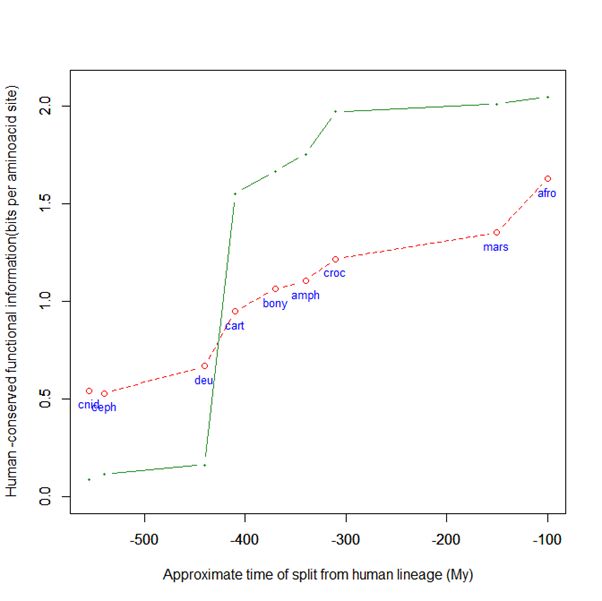
 

The green line represents the evolutionary history of our protein, while the red dotted line is the reference mean line for the groups considered, as already presented in my previous post quoted above (Fig. 2).

As everyone can see, this specific protein has a very sudden gain in human-conserved information with the transition from pre-vertebrates to vertebrates. So, it represents a very good example of the information jump that I have tried to quantify globally in my previous post.

Here, the jump is of almost 1.5 bits per aminoacid site. What does that mean?

Let’s remember that the protein is 763 AA long. Therefore, an increase of information of 1.5 bits per aminoacid corresponds to more than 1000 bits of information. To be precise, the jump from the best pre-vertebrate hit to the best hit in cartilaginous fish is:

1049 bits

But let’s see more in detail how the jump happens.

I will show here in detail some results of protein blasts. All of them have been obtained using the Blastp software at the NCBI site:

https://blast.ncbi.nlm.nih.gov/Blast.cgi?PROGRAM=blastp&PAGE_TYPE=BlastSearch&LINK_LOC=blasthome

with default settings.

Here is the result of blasting the human protein against all known protein sequences except for vertebrate sequences:

Fig. 2: Results of blasting human SATB1 against all non vertebrate protein sequences
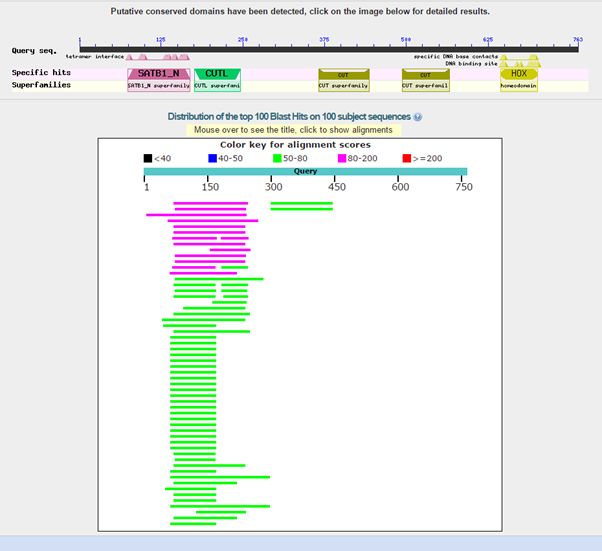
 

As can be seen, we find only low homologies in non vertebrates, and they are essentially restricted to a small part of the molecule, that correspond to the first two domains in the protein, or just to the first domain. The image shows clearly that all the rest of the sequence has no detectable significant homologies in non vertebrates (except for a couple of very low homologies for the third domain).

The best hit in non vertebrates is 154 bits with Parasteatoda tepidariorum, a spider. Here it is:

Fig. 3: The best hit in non vertebrates (with a spider)
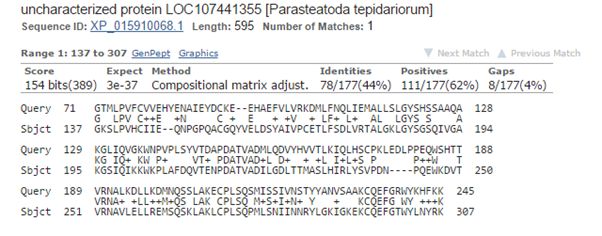
The upper line (Query) is the human sequence. The bottom line (Sbjct) is the aligned sequence of the spider. In the middle line, letters are identities, “+” characters are similarities (substitutions which are frequently observed in proteins, and are probably quasi-neutral), and empty spaces are less frequent substitutions, those that are more likely to affect protein structure and function if they happen at a functionally important aminoacid site.

The alignment here is absolutely restricted to AAs 71 – 245 (the first two domains), and involves only 177 AAs. Of these, only 78 (44%) are identities and 111 (62%) are positives (identities + similarities). So, in the whole protein we have only 78 identities out of 763 (10.2%).

The spider protein is labeled as “uncharacterized protein”, and that is the case in most of the other non vertebrate hits.

All the other non vertebrate hits, with a couple of exceptions, are well below 100 bits, most of them between 70 and 86 bits.

IOWs, the protein as we know it in vertebrates essentially does not exist in non vertebrates.

Even non vertebrate deuterostomia, which should be the nearest precursors of the first vertebrates, have extremely low homology bitscores with the human protein:

Saccoglossus kowalevskii (hemichordates):  87 bits

Branchiostoma floridae (cephalochordate): 67 bits

The information jump in vertebrates

Now, what happens with the first vertebrates?

The oldest split in vertebrates is the one between cartilaginous fish and bony fish (from which the human lineage derives). Therefore, homologies that are conserved between cartilaginous fish and humans had reasonably to be already present in the Last Common Ancestor of Vertebrates, before the split between cartilaginous fish and bony fish, and have been conserved for about 420 million years.

So, let’s see the best hit between the human protein and cartilaginous fish. It is with Rhincodon typus (whale shark). Here it is:


Fig. 4: The best hit of human SATB1 in cartilaginous fish (with the whale shark)
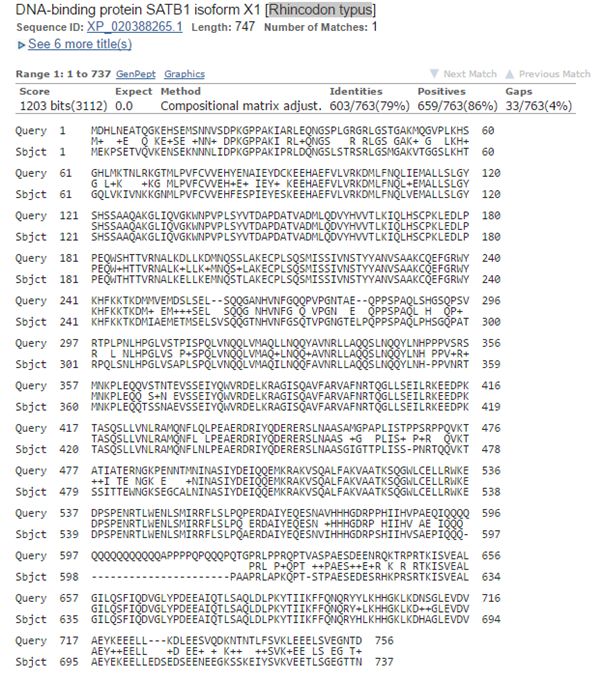
 

Here, the alignment involves practically the whole molecule (756 AAs), and we have 1203 bits of homology, 603 identities (79%), 659 positives (86%).

IOWs, the two molecules are almost identical. And the homology is extremely high not only in the domain parts, but also in the rest of the protein sequence.

Now, the evolutionary time between pre-vertebrates and the first split in vertebrates is certainly rather small, a few million years, or at most 20 – 30 million years. Not a big chronological window at all, in evolutionary terms.

However, in that window, this protein appears almost complete. 603 aminoacids are already those that will remain up to the human form of the protein, and only 78 of them were detectable in the best hit before vertebrate appearance.

1049 bits of new, original functional information. In such a short evolutionary window.

Functionality

Why functional? Because those 603 aminoacid have remained the same thorugh more than 400 million years of evolution. They have evaded neutral or quasi neutral variation, that would have certainly completely transformed the sequence in such a big evolutionary time, if those aminoacid sites were not under extreme functional constraint and purifying (negative) selection.

Now, I say that this fact cannot in any way be explained by any neo-darwinian model. Absolutely not.

Moreover, there is absolutely no evidence in the available proteome of any intermediate form, of any gradual development of the functional sequence that will be conserved up to humans (except, of course, for the 50 – 78 AAs which are already detectable in the first two domains in many pre -vertebrates).

By the way, Callorhincus milii, the Elephant shark, has almost identical values of homology:

1184 bits, 599 identities, 654 positives

But, how important is this protein?

In the ExAC database, a database of variations in the human genome, missense mutations are 110 out of 260.3 expected, with a z score of 4.56, an extremely high measure of functional constraint.

The recent medical literature has a lot of articles about the important role of SATB1 at least in two big fields:

  • T cell development
  • Tumor development (many different kinds of tumors)

If we want to sum up in a few words what is known, we could say that SATB1 is considered a master regulator, essentially a complex transcription repressor, involved mainly (but not only) in the development of the immune system, in particular T cells. A disregulation of this protein is linked to many aspects of tumor invasivity (especially metastases). The protein seems to act, among other possibilities, as a global organizer of chromatin states.

Here is a very brief recent bibliography:

Essential Roles of SATB1 in Specifying T Lymphocyte Subsets

SATB1 overexpression correlates with gastrointestinal neoplasms invasion and metastasis: a meta-analysis for Chinese population

SATB1-mediated Functional Packaging of Chromatin into Loops

DNA-binding protein SATB2

But there is more. There is another protein which is very similar to SATB1. It is called DNA-binding protein SATB2 (accession number Q9UPW6).

Its length is very similar to SATB1: 733 AAs.

Uniprot describes its function as follows:

Binds to DNA, at nuclear matrix- or scaffold-associated regions. Thought to recognize the sugar-phosphate structure of double-stranded DNA. Transcription factor controlling nuclear gene expression, by binding to matrix attachment regions (MARs) of DNA and inducing a local chromatin-loop remodeling. Acts as a docking site for several chromatin remodeling enzymes

Which is very similar to SATB1. But now come the differences. While SATB1 is implied prevalently in T cell development and tumor development, SATB2 is:

Required for the initiation of the upper-layer neurons (UL1) specific genetic program and for the inactivation of deep-layer neurons (DL) and UL2 specific genes, probably by modulating BCL11B expression. Repressor of Ctip2 and regulatory determinant of corticocortical connections in the developing cerebral cortex. May play an important role in palate formation. Acts as a molecular node in a transcriptional network regulating skeletal development and osteoblast differentiation

So, similar proteins with rather different specificities. While SATB1 is mainly connexted to adaptive immunity (T cell development), SATB2 seems to be more linked to neuronal development. Like SATB1, it is involved in cancer development, although usually in different types of cancer.

Here is a brief recent bibliography about SATB2:

Mutual regulation between Satb2 and Fezf2 promotes subcerebral projection neuron identity in the developing cerebral cortex

SATB1 and SATB2 play opposing roles in c-Myc expression and progression of colorectal cancer

However, how similar is SATB2 to SATB1 in terms of sequence homology?

Here is a direct blast of the two human molecules:


Fig. 5: Blast of human SATB1 vs human SATB2:
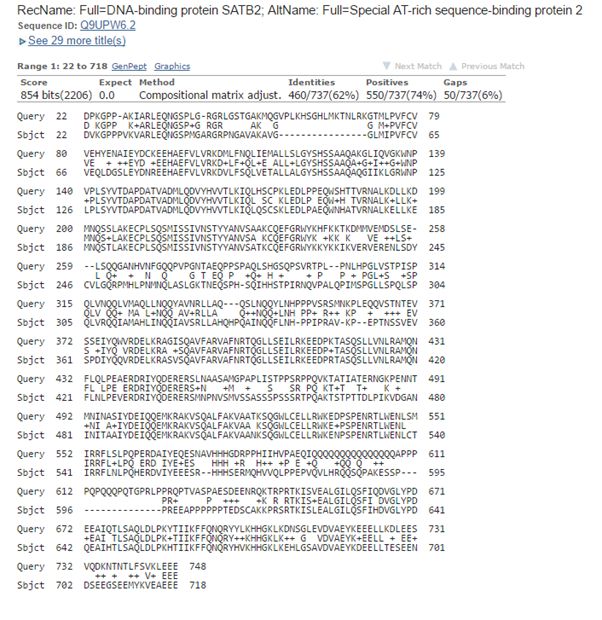
 

OK, they are very similar, but…  only 460 identities, 550 positives, 854 bits. IOWs, these two human proteins are similar, but not so similar as the two sequences of SATB1 in the shark and in humans.

Now, here is the evolutionary history of SATB2:


Fig. 6: Evolutionary history of SATB2 by human-conserved functional information
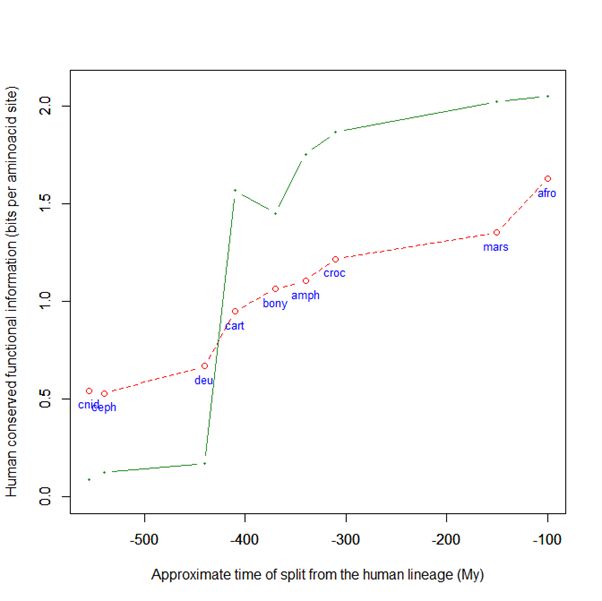
 

As everyone can see, it is almost identical to the evolutionary history of SATB1. To see it even better, Fig. 7 shows the two evolutionary histories together (the green line is SATB1, the brown line is SATB2):


Fig. 7: Evolutionary history of SATB1 and SATB2 by human-conserved functional information
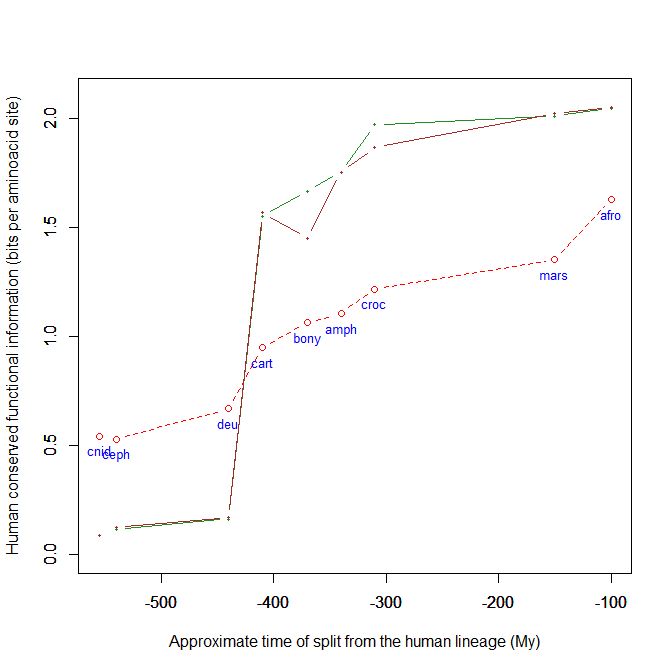
 

In particular, pre-vertebrate history and the jump in cartilaginous fish are practically identical. And yet these are two different molecules, as we have seen, with different specificities and about one third of difference in sequence.

Now, let’s blast human SATB2 against cartilaginous fish. Again the best hit is with the whale shark:


Fig. 8: The best hit of human SATB2 in cartilaginous fish (with the whale shark)
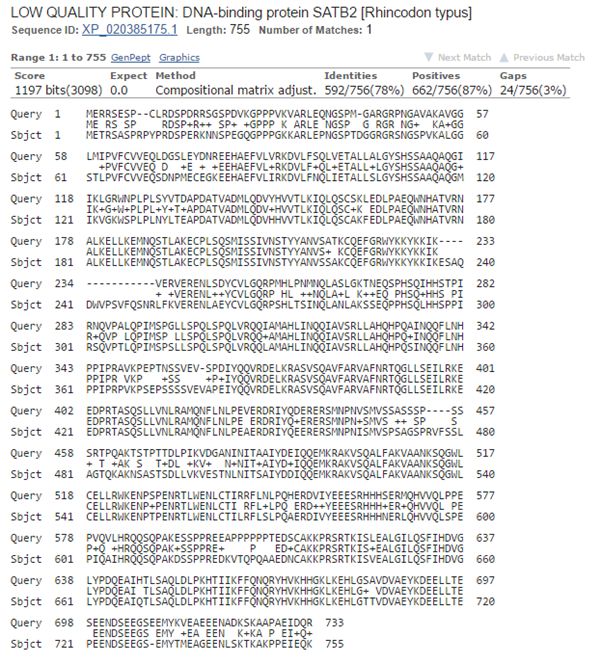
 

And the numbers are very similar, incredibly similar I would say, to those we found for SATB1:

1197 bits, 592 identities, 662 positives.

But what if we blast SATB1 of the whale shark against SATB2 of the whale shark?

Here are the results:


Fig. 9: Blast of whale shark SATB1 vs whale shark SATB2:
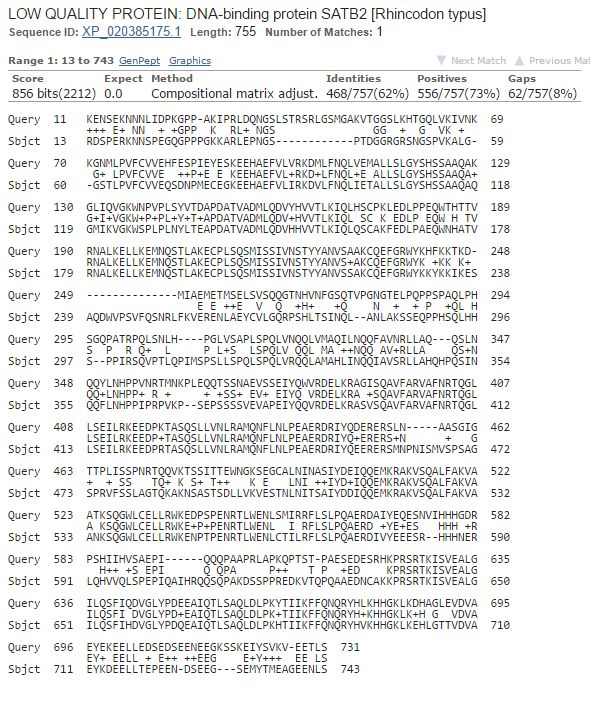
Now, please, compare the numbers we got here with those from the similar blast between the two proteins in humans:

SATB1 human vs SATB2 human:  460 identities, 550 positives, 854 bits

SATB1 shark vs SATB2 shark:      468 identities, 556 positives, 856 bits

Almost exactly the same numbers! Wow!

What does that mean?

It means that this system of two similar proteins with different function arises in vertebrates as a whole system, already complete, with the two components already differentiated, and is conserved almost identical up to humans. Indeed, SATB1 and SATB2 have the same degree of homology both in sharks and in humans, and the two SATB1 proteins in shark and humans, as well as the two SATB2 proteins in shark and humans, have greater similarity, after more than 400 million years of divergence, than SATB1 and SATB2 show when compared, both in sharks and in humans.

Would you describe that as sudden appearance of huge amounts of functional information, followed by an extremely long stasis? I certainly would!

The following table sums up these results:

Sequence 1 Sequence 2 Bitscore
SATB1 Human SATB2 Human 854
SATB1 Shark SATB2 Shark 856
SATB1 Human SATB1 Shark 1203
SATB2 Human SATB2 Shark 1197

IOWs, the whole system appeared practically as it is today, before the split of cartilaginous fish and bony fish, and has retained its essential form up to now.

So, the total amount of new functional information implied by the whole system of these two proteins is about 1545 bits (considering 855 bits of common information, and 345 bits x 2 of specific information in each molecule).

An amazing amount, for a system of just two molecules, considering that 500 bits is Dembski’s Universal Probability Bound!

Let’s remember that in my previous post, quoted above, I showed that the informational jump from pre-vertebrates to vertebrates is more than 1.7 million bits. That’s a very big number, but big numbers sometimes are not easily digested. So, I believe that seeing that just two important molecules can contribute for almost 1500 bits can help us understand what we are really seeing here.

Moreover, it’s certainly not a case that those two molecules seem to be fundamental in two very particular fields:

a) The adaptive immune system

b) The nervous system

if we consider that those are exactly the two most relevant developments in vertebrates.

And, as a final note, please consider that these are very complex master regulators, which interact with tens of other complex proteins to effect their functions. The whole system is certainly much more irreducibly complex than we can imagine.

But still, just the analysis of these two sister proteins is more than enough to demonstrate that the neo Darwinian paradigm is completely inappropriate to explain what we can see in the proteome and in its natural history. And this is only one example among thousands.

So, I want to conclude repeating again this strong and very convinced statement:

The observed facts described here cannot in any way be explained by any neo-darwinian model. Absolutely not. They are extremely strong evidence for a design inference.

Comments
Here's a link to the paper referenced @141: http://dev.biologists.org/content/early/2017/03/09/dev.144139.full.pdfDionisio
July 22, 2017
July
07
Jul
22
22
2017
04:33 PM
4
04
33
PM
PST
gpuccio, I see you wrapped up the discussion with wd400 very effectively. Did the discussion with RodW end? RodW was last seen @91 & @100 on July 19. Did you two exhaust the discussed topic? I look forward to reading your next article within this series. Thanks!Dionisio
July 22, 2017
July
07
Jul
22
22
2017
04:27 PM
4
04
27
PM
PST
Mung: "Apparently there is a purpose to “junk DNA” after all!" You bet! Between ENCODE and Dan Graur, there is no game. :)gpuccio
July 22, 2017
July
07
Jul
22
22
2017
12:00 PM
12
12
00
PM
PST
Dionisio: Very interesting and very recent paper. So, SATB1 is really a master regulator, having a critical role already in the first decisions in the embryo! Another interesting point is the antagonistic role of SATB1 and SATB2 already in these first phases of development. That's further evidence that the two molecules work as a whole system, irreducibly complex.gpuccio
July 22, 2017
July
07
Jul
22
22
2017
11:58 AM
11
11
58
AM
PST
gpuccio:
OK, first of all let’s clarify one important point: new functional genes must arise during evolutionary history. That they do arise even in more recent evolutionary history is no surprise.
Apparently three is a purpose to "junk DNA" after all!Mung
July 22, 2017
July
07
Jul
22
22
2017
11:32 AM
11
11
32
AM
PST
Very interesting explanation @149. Thanks. BTW, what do you think of the paper referenced @141?Dionisio
July 22, 2017
July
07
Jul
22
22
2017
11:24 AM
11
11
24
AM
PST
Answers to wd400:
There is growing evidence that functional genes arise from random and/or intergenic sequences.
Yes. And that is a very important issue in our debate. But I don't see how that can help the neo-darwinian paradigm. It is true that the emergence of new functional genes from non coding sequences, rather than from pre-existing protein coding genes (as was previously thought) is gaining momentum. Here are a couple of recent papers about that, for example: De Novo Genes Arise at a Slow but Steady Rate along the Primate Lineage and Have Been Subject to Incomplete Lineage Sorting https://www.ncbi.nlm.nih.gov/pmc/articles/PMC4860702/pdf/evw074.pdf and: Young genes are highly disordered as predicted by the preadaptation hypothesis of de novo gene birth https://www.nature.com/articles/s41559-017-0146 OK, first of all let's clarify one important point: new functional genes must arise during evolutionary history. That they do arise even in more recent evolutionary history is no surprise. As said many times, I fully believe in common descent, therefore I fully believe that new genes arise in pre-existing biological beings. The real question is: how? Now, from all points of view, the emergence of a new gene from an existing gene is certainly more compatible with the neo-darwinian scenario (in the measure that we can speak of "compatibility", for a theory that however cannot explain the rise of new complex information). Why? Because all neo-darwinian just so stories are of that kind: function emerges gradually from already existing function, through a continuum that has no reason to really exist, but that darwinists imagine must exist. But the emergence from non coding DNA? Well, for a new gene to arise from a non coding sequence, at least two things must take place: a) Transcription of the sequence must take place b) An ORF must be acquired, so that the transcribed sequence may be translated and become a gene Nobody knows exactly in what order the two things may happen, in the limited understanding that we have today of the issue. One hypothesis is that the non coding sequence is already transcribed, then acquires an ORF and is translated. Another hypothesis is that many ORFs exist but are not transcribed ("cryptic ORFs"), and at some point one of them is transcribed. Whatever. In both cases, one thing is for certain: unless and until the sequence is both transcribed and translated, no form of NS can take place for its function as a protein sequence, because no protein exists. IOWs, if a new gene emerges from a non coding sequence, whatever the modality, its "evolution" is completely neutral up to the moment it is both transcribed and translated. IOWs, up to the moment it becomes a new gene. That means that the emergence of a new gene, in the absence of any design intervention, is left purely to random variation. NS can have no role at all. Of course, darwinists imagine that after the emergence of the new gene, NS comes to the rescue, and operates its miracles. OK, faith has no limits. But remember, all the classic reasonings of neo-darwinism: a) Gradual evolution of function b) Recombination c) Starting near a functional island, and profiting of imaginary connections between functional islands and so on, here do not apply. Here we are starting from a completely random non coding sequence, according to the neo-darwinist theory. Until it becomes transcribed and translated, there is no reason at all that it may have any information about any protein sequence. None at all. So, the imagined NS should operate on a completely random sequence, when the sequence is already transcribed and translated. Not good for the neo-darwinian scenario. Not good at all. Just a few final remarks: 1) The emergence of new genes from non coding DNA, for what we understand at present, seems to happen both as a transposon related event and independently from transposon activity. 2) The second paper I quoted above seems to demonstrate that new genes, when they emerge, already have specific properties that "normal" non coding DNA does not have. IOWs, the long preparation of the sequence through apparently neutral variation, before any possible intervention of NS, seems to generate specific functional properties before the sequence is translated into a protein. How do you think that can happen? 3) So much for the idea that non coding DNA is junk: it is a source of new genes, the clue to all functional evolution. :) OK, this was one of the most important points. There is certainly much more to be said about this issue, and much more to be discovered.gpuccio
July 22, 2017
July
07
Jul
22
22
2017
08:17 AM
8
08
17
AM
PST
gpuccio @144:
[…] our best arguments are fully based on the result of modern biological research, even and especially research “inspired” by neo-darwinian ideas.
Yes, for example, the threads "Mystery at the heart of life" and "A third way of evolution?" have many references to biology-related research papers, despite the fact that some of those papers (specially the evo-devo literature) are filled --or at least sprinkled-- with archaic pseudoscientific hogwash based on the Neo-Darwinian just-so fairytales.Dionisio
July 22, 2017
July
07
Jul
22
22
2017
07:47 AM
7
07
47
AM
PST
gpuccio @144:
[...] our best arguments are fully based on the result of modern biological research, even and especially research “inspired” by neo-darwinian ideas. Because facts are facts, and facts do not belong to any ideology.
Yes, that's correct.Dionisio
July 22, 2017
July
07
Jul
22
22
2017
07:11 AM
7
07
11
AM
PST
Dionisio: Yes, of course. Thank you. :)gpuccio
July 22, 2017
July
07
Jul
22
22
2017
06:19 AM
6
06
19
AM
PST
gpuccio @144:
And it is true. As we will see, he makes some very general points, certainly interesting and which deserve discussion, but they are about the specifics of my data, which he seems to accept more or less, but about their general meaning, or the general approach. OK, that’s fine.
Did you mean "but they are NOT about the specifics of my data, [...]"?Dionisio
July 22, 2017
July
07
Jul
22
22
2017
05:49 AM
5
05
49
AM
PST
Answers to wd400: In his post #133, wd400 has reiterated his legitimate desire not to be dragged into this discussion in detail. I respect his choice. However, as he has expressed in brief his main objections, and, being as usual very competent in his field, has raised some interesting points even in a few lines, I think I have a right to comment on those points. In no way this is an attempt to involve wd400 any more: he is absolutely entitled not to answer these further comments. Therefore, I will not address him personally, but just the ideas he has expressed. I will comment on each point separately, for further clarity. I will also happily use, where appropriate, the very good ideas expressed by Origenes at #142. As a start, I will briefly comment on his introductory remark:
Here is what I would say about these kinds of posts generally. They lack any real connection to what we know from evoluionary biology.
So, the ideas he is going to express are "general" objections to the reasonings presented in my OP, or to any other post "of the same kind". And it is true. As we will see, he makes some very general points, certainly interesting and which deserve discussion, but they are not about the specifics of my data, which he seems to accept more or less, but about their general meaning, or the general approach. OK, that's fine. And the first argument is really very, very general: "They lack any real connection to what we know from evolutionary biology." And I would say: of course. For those who still have not understood it, I will say it again: ID theory is a paradigm which is strongly in disagreement with the standard approach of modern biology, based on the neo-darwinian synthesis. It's not that they can be considered compatible, not even by the most die hard compatibilists. :) Does that mean that we in ID refuse modern biology? Not at all. Indeed, our best arguments are fully based on the result of modern biological research, even and especially research "inspired" by neo-darwinian ideas. Because facts are facts, and facts do not belong to any ideology. But it should be clear that the interpretation of many of those facts, especially those involved in the generation of functional information, is radically opposite between the two paradigms. In that sense, there can be no "connection" at all, not where the problem of the origin of biological information is at stake. More in next post.gpuccio
July 22, 2017
July
07
Jul
22
22
2017
05:25 AM
5
05
25
AM
PST
Origenes at #142: My friend, you have taken the words right out of my mouth! Thank you indeed. :) It is wonderful to see that it is not only my obfuscated mind that sees things that, to me, appear to be obvious. Your support is really precious! I will comment on wd400's arguments later, when I have more time, but it is comforting to have some of the main points laid out so clearly by you.gpuccio
July 22, 2017
July
07
Jul
22
22
2017
01:39 AM
1
01
39
AM
PST
wd400@
wd400: There is no regard for the fact these genes have evolved down a species tree, the idea that you should be able to find every intermediate between an ancestral and moodern protein is obviously wrong as soon as you start thinking about trees.
GPuccio’s argument, as I understand it, is not about finding “every intermediate”, but rather about finding any intermediate. Unless you are willing to argue that, given trees, we should expect information jumps of thousands of bits and no intermediates whatsoever, you do not have a point.
wd400: Assuming what happened to evolve is the only way a given function could arise (this functional information business) ignores the fact that proteins that have many interactions co-evolve with their interactants.
An important fact that doesn't sit well with your position. The information jump under discussion is in fact far higher. From the OP:
… as a final note, please consider that these are very complex master regulators, which interact with tens of other complex proteins to effect their functions. The whole system is certainly much more irreducibly complex than we can imagine.
Origenes
July 22, 2017
July
07
Jul
22
22
2017
12:58 AM
12
12
58
AM
PST
The chromatin modifier Satb1 regulates cell fate through Fgf signalling in the early mouse embryo Mubeen Goolam and Magdalena Zernicka-Goetz Development. 2017 Apr 15; 144(8): 1450–1461. doi: 10.1242/dev.144139 PMCID: PMC5399666Dionisio
July 21, 2017
July
07
Jul
21
21
2017
07:56 PM
7
07
56
PM
PST
Copied from the OP: Here is a very brief recent bibliography: Essential Roles of SATB1 in Specifying T Lymphocyte Subsets SATB1 overexpression correlates with gastrointestinal neoplasms invasion and metastasis: a meta-analysis for Chinese population SATB1-mediated Functional Packaging of Chromatin into Loops Here is a brief recent bibliography about SATB2: Mutual regulation between Satb2 and Fezf2 promotes subcerebral projection neuron identity in the developing cerebral cortex SATB1 and SATB2 play opposing roles in c-Myc expression and progression of colorectal cancerDionisio
July 21, 2017
July
07
Jul
21
21
2017
07:53 PM
7
07
53
PM
PST
gpuccio, I agree with your comment @137. I apologize for any inappropriate comments I may have written. I should learn to restrain my emotions. :) However, the comment @133 says "There is growing evidence that functional genes arise from random and/or intergenic sequences." but it doesn't provide any literature to back such a bold affirmation. Besides, your argument is based on complex functional specified information, like in the case of the proteins SATB1 & SATB2.Dionisio
July 21, 2017
July
07
Jul
21
21
2017
07:46 PM
7
07
46
PM
PST
Dionisio: No, it was only a typo (twice repeated!) produced by quantum entanglement of the electrons in my personal brain! Thank you for pointing to it. :) If I were a compatibilist, I could probably believe that it was a free choice... (OK, just kidding :) )gpuccio
July 21, 2017
July
07
Jul
21
21
2017
07:43 PM
7
07
43
PM
PST
Dionisio and es58: Again, I think wd400 has said honestly what he could say. We cannot hope to "convert" a convinced evolutionary biologist that our arguments are good. There is a problem of basic worldview (and scienceview). Moreover, they are those who are recognized by public opinion as detaining the truth, and we are only (for most people) a minority of strange guys! :) So, I am really grateful to wd400. He has been honest in evaluating the biological core of my OP, and he has (when "stimulated" by es58) clearly stated that he does not "want to be dragged into a detailed discussion of this", that is absolutely something he is perfectly entitled to. He has, however, summarized clearly enough what his arguments would be. I have already commented about some aspects, and I will continue to do so tomorrow, for the sake of discussion. But I believe that we should respect wd400's desire "not to be dragged". We can certainly discuss some of the points that he has briefly summarized, without dragging him any more into our discussion.gpuccio
July 21, 2017
July
07
Jul
21
21
2017
07:35 PM
7
07
35
PM
PST
gpuccio, Thank you for clarifying that. I thought it was a mysterious Neo-Darwinian trick to account for the 20 AAs that are currently used to assemble the proteins, thus demonstrating that their apparent lack of valid arguments is only an illusion produced by quantum entanglement of the electrons in the brain. :) Have a good weekend.Dionisio
July 21, 2017
July
07
Jul
21
21
2017
07:34 PM
7
07
34
PM
PST
Dioniso: The correct number is 731. At some point in the post I must have written erroneously 751, and then I went on a couple of times. I am correcting that. However, the computation for the time (41000 year) is correct: it was made with 731.gpuccio
July 21, 2017
July
07
Jul
21
21
2017
07:18 PM
7
07
18
PM
PST
@133: nonsenseDionisio
July 21, 2017
July
07
Jul
21
21
2017
05:28 PM
5
05
28
PM
PST
Hi es, I don't really want to be dragged into a detailed discussion of this, I don't have the time and making small comments can seem like sniping away without properly engaging. Here is what I would say about these kinds of posts generally. They lack any real connection to what we know from evoluionary biology. There is growing evidence that functional genes arise from random and/or intergenic sequences. There is no requirement that each amino acid be selected one after the other (these proteins are made from domains that are conserved well beyond the vertebrates, recombination can bring such domains together). There is no regard for the fact these genes have evolved down a species tree, the idea that you should be able to find every intermediate between an ancestral and moodern protein is obviously wrong as soon as you start thinking about trees. Assuming what happened to evolve is the only way a given function could arise (this functional information business) ignores the fact that proteins that have many interactions co-evolve with their interactants. As I say, I don't have the time for a blow by blow account of this post or any other, all I would suggest is that people that are interested in sequence analysis check out the methods that evolutionary biology and genomics have developed to do this sorts of things. In the very least, all of these orthology/paralogy analyses are already done for every gene in places like ensembl.wd400
July 21, 2017
July
07
Jul
21
21
2017
03:38 PM
3
03
38
PM
PST
.Dionisio
July 21, 2017
July
07
Jul
21
21
2017
02:19 PM
2
02
19
PM
PST
gpuccio @129:
We have 731 conserved identities in the two molecules (a mean of 464 shared, + 139 + 128). a) That each of those 731 AAs brings, Even so, given that we have 30 million years (at most) available, and 751 steps to implement, [...] And, of course, we should have had 751 different expanded populations, of which no trace remains in the existing proteome.
Please, help me with this: Lost the connection from 731 to 751. Is the difference associated with the number of essential AAs? Emphasis added.Dionisio
July 21, 2017
July
07
Jul
21
21
2017
01:39 PM
1
01
39
PM
PST
GPuccio@129 Thankyou for your response. WD400@123: "The bit that is still lacking (even after the very long post above) is the evidence that this couldn’t be the result of mutation, recombination and selection. You’ve declared this multiple times, but no demonstrated it at all." How does GPuccio's response at 129 fail to answer your question? Thank youes58
July 21, 2017
July
07
Jul
21
21
2017
10:55 AM
10
10
55
AM
PST
es58: "can you identify an upper bound to the amount of time you’re referring to?" It's not easy, and I am not an expert of evolutionary times. The timeline I have used in my posts and graphs is the best I could derive from what I have read. However, always from what I have read, a reasonable upper limit for the transition we are discussing here could be 30 million years. But it could certainly be much less than that. The events from the Cambrian explosion on, even 100 million years after (which is more or less the time frame we are looking at) seem to take place very fast! "Also, is there any way to show what kind of mutation rates would be necessary to get you to the amount of informational data you see being created (~1300 bits?) vs observed or assumed mutation rates." Well, some time ago I made a gross computation that brought me to propose 120 bits as a "biological probability bound". That was done imagining our planet filled with bacteria, assuming a mean mutation rate and reproduction rate for bacteria, and considering a time frame of 5 billion years, and leaving about 20 bits of margin to make the thing really unlikely. So, 120 bits is IMO the upper margin of a search space that can be reasonably traversed by RV in the whole natural history of our planet. Here, of course, we should lower that threshold a lot. Firs of all we have only 30 million years at most available, and not 5 billion. Even more important, the population at stake here is certainly much, much lower (I have no idea how many lancelet-like beings could have been living in our earth's oceans at the time, but it is certainly a much lower number compared to the 10^30 bacteria that I considered in my computation. Even reproduction rates are certainly slower. I am not sure about mutation rates, but you get the general idea. So, 1300 bits is a search space that is absolutely beyomd anything RV can traverse in the whole universe (remember, Dembski's UPB is 500 bits). And these are, of course, exponential values: 1300 bits is a number which is about 350 orders of magnitude greater than 120 bits! Of course, these are the probabilistic resources, and refer to RV only. True NS can certainly lower those numbers. A little bit. If true NS could happen. But we have no trace that it happened. And how much NS are we speaking of? Let's see it from the point of view of identities, leaving apart mere similarities. We have 731 conserved identities in the two molecules (a mean of 464 shared, + 139 + 128). So, let's imagine, just for the sake of discussion: a) That each of those 731 AAs brings, individually, a detectable reproductive advantage, and therefore can be expanded by positive selection and then fixed by purifying selection. b) that such a fixing really happened, expanding the new 1 AA trait to all, or most, or some of the chordate population, before a new positive mutation could happen. IOWs, we are imagining that the specific new function, or functions, that vertebrate SATB1 and SATB2 perform in cartilaginous fish (and in all other vertebrates) could be deconstructed into 731 one AA steps, each of them bringing significant reproductive advantage, each of them naturally selected and expanded to a significant population. (I emphasize the expansion, because, even if darwinists try to belittle the concept, it's the numeric expansion of the clonal population with the new trait that lowers the probabilistic barriers, and nothing else). O course, we are beyond any credibility here, even for the most fervent darwinist imagination, even for some hot science fiction of the lowest level! Because, as I said before, complex functions cannot, as a rule, be deconstructed into many smaller functional steps, least of all naturally selectable ones. However, let's go on with our impossible scenario. Even so, given that we have 30 million years (at most) available, and 731 steps to implement, that means that each step (positive mutation, expansion to most of the population) should take place, in average, every 41000 years! Just the blink of an eye, in evolutionary terms. And, of course, we should have had 731 different expanded populations, of which no trace remains in the existing proteome. This is the old problem of the completely missing molecular intermediates, a problem that I have debated a lot of times with our kind interlocutors, always getting gross answers which, at best, were of the type: "They were eaten"; or: "Our theory implies that you can never find any evidence of this kind for it". All this is simply empirically impossible. There is not even a trace of credibility in that kind of explanation. It has no scientific value at all. Those levels of functional information are found only in designed objects. They can be explained only by design.gpuccio
July 21, 2017
July
07
Jul
21
21
2017
09:37 AM
9
09
37
AM
PST
gpuccio @126:
We certainly could not expect that he said: “Oh, OK, you are right. These are convincing data to infer that neo-darwinism is not so good as it seems!! Not so likely!
There's an old Spanish saying for this: "Pedirle peras al olmo" Asking an elm tree to produce pears. Or expecting pears from an elm tree. :)Dionisio
July 21, 2017
July
07
Jul
21
21
2017
08:37 AM
8
08
37
AM
PST
GPuccio@126: "3) A very short evolutionary time" Perhaps you've stated it above, and if so, you can point me to the post, but, can you identify an upper bound to the amount of time you're referring to? Also, is there any way to show what kind of mutation rates would be necessary to get you to the amount of informational data you see being created (~1300 bits?) vs observed or assumed mutation rates. If these questions are out of line, no problem. Also, thanks for the post!es58
July 21, 2017
July
07
Jul
21
21
2017
08:15 AM
8
08
15
AM
PST
Dionisio: I believe that wd400 has done what he could. And he has been honest in that. He has recognized that the biological analysis in my OP is correct, and that is already a great sign of good will, coming from am evolutionary biologist. We certainly could not expect that he said: "Oh, OK, you are right. These are convincing data to infer that neo-darwinism is not so good as it seems!! Not so likely! :) Of course you are right, his last statement is an example of the last line of defense that a neo-darwinist can recur to, when other arguments are lacking. It can be summarized as follows: "However, you cannot demonstrate that RV + NS (including recombination, if we want to be even more precise) could not do it". In practice, they are saying that their theory remains true unless we demonstrate (with some mathematical theorem, I suppose) that it is wrong. But we know very well that the confutation of an empirical theory is not logical, but empirical. A theory must explain facts at the best of its ability. And that "best" must be convincing and appropriate. Now, it is evident that, as a rule, complex functional information does not arise from random variation. The neo-darwinian theory has the pretention to be an exception, due to the particular context of replicating individuals and competition (IOWs, the usual RV + NS stuff). Not convincing at all, because they happily ignore two fundamental flaws of their reasoning: a) The huge probabilistic barriers at stake b) The simple fact that complex functions cannot be deconstructed into a series of smaller functional (least of all naturally selectable) steps, and therefore cannot be built by gradual events (as any computer programmer well knows). So, the theory is flawed just from the beginning. But if someone (like the majority of scientists today) still insist in believing it is a good scientific theory, that someone should at least consider that the theory badly needs a couple of important supports from facts. For example: 1) The graduality of appearance of complex sequences 2) Very long evolutionary times for really complex objects 3) Some realistic pathway or, at least: 4) Some detectable trace of a pathway In the absence of such support, the theory is not only flawed, it is empiricallly irrelevant. Now, I have provided some well documented example of: 1) Complex functional sequences, that 2) Arise rather suddenly, IOWs in 3) A very short evolutionary time, and for which 4) Their is no idea of a gradual pathway, and 5) No detectable trace of it. Is all that empirical evidence against the neo-darwinian paradigm? I believe it is. Of course, anybody is free to make his own mind about that. Moreover, I will remind again here that SATB1 and SATB2, while they are certainly a very good example of my reasoning (that's why I have chosen them), are certainly no rare exception. I have already done similar reasonings for other proteins, like Prickle1 and Prickle2, and mentioned in the discussion many other examples, last of them ATM. It could be interesting to note that the best examples of my argument seem to be complex regulatory molecules, even if other kinds of molecules can certainly be mentioned too.gpuccio
July 21, 2017
July
07
Jul
21
21
2017
05:07 AM
5
05
07
AM
PST
1 … 4 5 6 7 8 … 11